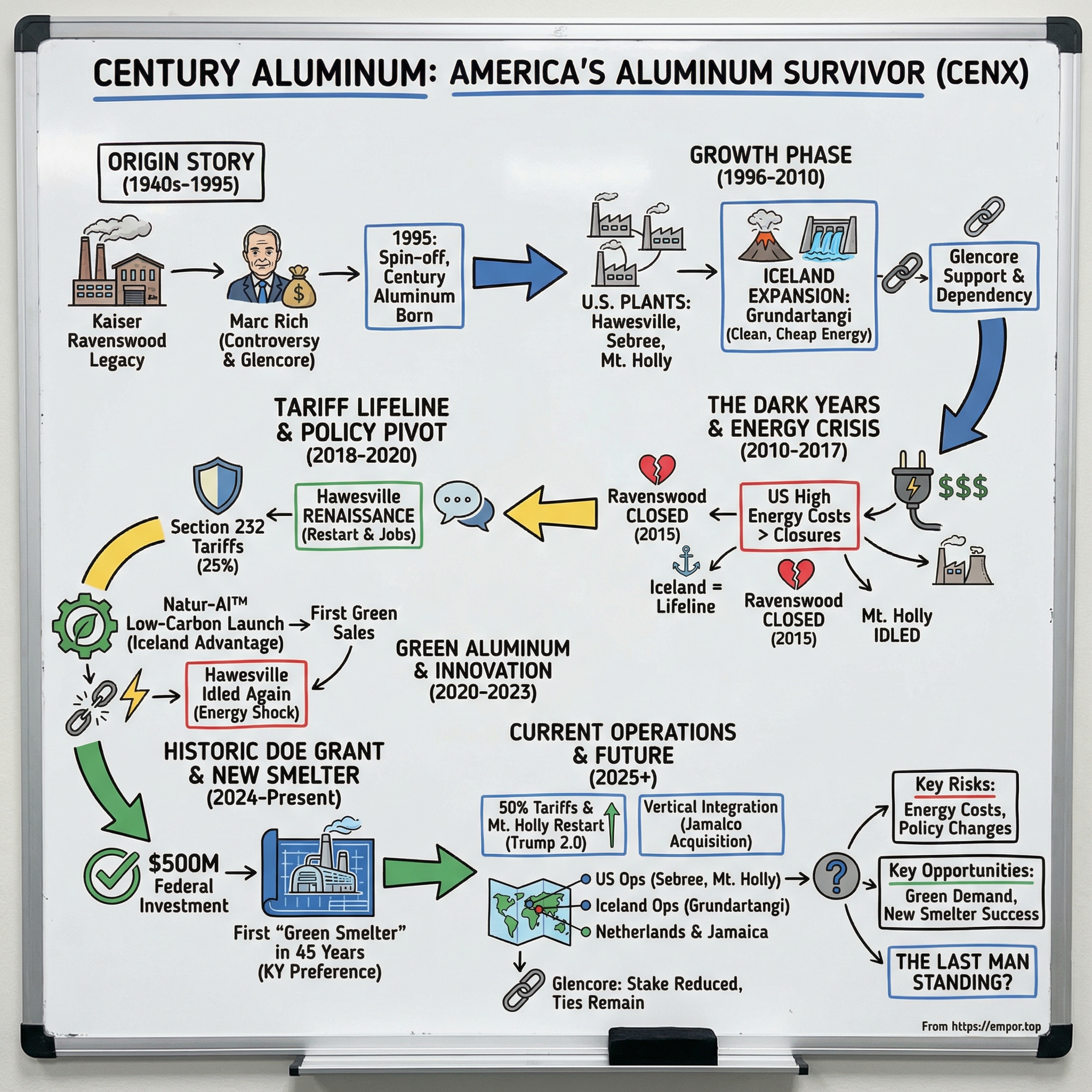
Century Aluminum: America's Aluminum Survivor
The Unlikely Last Man Standing
Picture a small town on the banks of the Ohio River in Western Kentucky, where the orange glow of molten metal once illuminated the night sky at dozens of facilities across America. Today, only a handful remain. The United States' aluminium sector is facing an existential crisis, with the number of operational smelters dwindling to just four. At the center of this story stands Century Aluminum—a company that has somehow defied gravity in an industry that has lost nearly 90% of its production capacity over the past four decades.
Century Aluminum Company is a US-based producer of primary aluminum, with aluminum plants in Kentucky, South Carolina and Iceland. It is the largest producer of primary aluminum in the United States. This is a company born of controversy, sustained by tariffs, and now poised to lead what could be the first meaningful expansion of American aluminum production in half a century.
The central question of this story is deceptively simple: How did a company spun out of one of the most notorious white-collar criminals in American history manage to survive decades of plant closures, energy crises, and Chinese competition—and now stand at the cusp of building America's first new aluminum smelter in 50 years?
The answer involves energy economics as destiny, a symbiotic relationship with commodities giant Glencore, tariff policy that literally saved the company from extinction, and an audacious bet on green aluminum that could position Century at the forefront of the clean energy transition. This is the story of America's aluminum survivor.
 Subscribe on LinkedIn
The Aluminum Industry Primer: Why Energy Is Everything
Before diving into Century's story, understanding the unique economics of aluminum production is essential. All Century's operations produce primary aluminum, that is, aluminum from ore, rather than from aluminum scrap. This distinction matters enormously because primary aluminum production is one of the most energy-intensive industrial processes on Earth.
The value chain begins with bauxite ore, typically mined in tropical regions like Jamaica, Guinea, and Australia. This ore is refined into alumina (aluminum oxide) through a chemical process. Alumina is then smelted into pure aluminum metal through electrolysis—the Hall-Héroult process invented in 1886. In this process, alumina is dissolved in a solution and a strong electric current is applied. This process has generally remained unchanged since its invention in 1886.
The energy requirements are staggering. "Low-cost electricity is the single most important factor for aluminium smelting, because power makes up roughly 40% of total production costs — and about 80% of industry emissions stem from electricity use." A single aluminum smelter consumes approximately 11 terawatt-hours of electricity annually—equivalent to powering a major metropolitan area like Boston or Nashville for an entire year.
This electricity dependency explains why American aluminum smelters have faced an existential threat. The trade association described the deregulation of energy prices as "the single most important factor leading to the near total demise of the primary aluminum industry." The association reported 2023 industrial power costs in the states with idled primary aluminium capacity ranging from $65.50 per megawatt-hour in Kentucky to $82.40 per MWh in Indiana.
Compare this to the competition. The US sources nearly two-thirds of its primary aluminium from Canada, where average purchased electrical costs for smelters range from $26.50-41.00 per MWh. Canadian smelters benefit from abundant hydroelectric power—clean, cheap, and reliable. American smelters, meanwhile, depend largely on fossil fuel-generated electricity with volatile pricing.
The industry structure tells a story of relentless decline. In 30 years, America has fallen from being the global leader in primary aluminum production to now representing just 1.2% of annual production. From a peak of roughly 30 smelters across the U.S. in 1980, Kentucky is home to two of the five remaining plants. China, meanwhile, now produces approximately 58% of global aluminum output—built on state subsidies and coal-fired electricity that Western producers cannot match on cost.
The strategic importance of aluminum cannot be overstated. The metal is essential to aerospace, automotive, defense, electric vehicles, renewable energy infrastructure, and packaging. Products essential to national security, including aluminum used in aerospace, armor plate, weapons, drone and space applications, are also vital and experiencing growth. The fact that America imports the vast majority of this strategically critical material represents a vulnerability that has finally captured policymakers' attention.
Origin Story: Kaiser, Marc Rich, and the Controversial Birth (1940s–1995)
The Ravenswood Legacy
The genesis of Century Aluminum traces back to one of America's great industrialists—Henry Kaiser. The origin of the Ravenswood plant was connected to an admired legendary industrialist, Henry Kaiser. He first gained prominence in the 1930s when his construction firm participated in the building of the Hoover Dam and the Grand Coulee Dam.
Kaiser was a builder of things that mattered—dams, ships, hospitals, and eventually, aluminum. During World War II, his shipyards built Liberty ships at a pace that stunned observers. After the war, Kaiser turned his attention to aluminum, aided by government surplus facilities. Founded in 1946, Henry J. Kaiser's corporation entered the aluminum business by leasing, then purchasing three government-owned aluminum facilities in Washington state.
Ravenswood Aluminum, located in Jackson County, began as a plant of Kaiser Aluminum as the giant metals company expanded in the aftermath of World War II. From its opening in 1954 until Kaiser sold its aluminum plants in 1988, Ravenswood workers had never been on strike. The plant was strategically located on the Ohio River, positioned to serve the eastern half of the United States.
When completed in the late 1950s, Kaiser's Ravenswood plant would house one of the world's largest aluminum smelters and mills. By the mid-1950s the foil and automobile-parts markets opened up. The facility became a cornerstone of the local economy, employing thousands and transforming the small West Virginia town into an industrial powerhouse.
The Marc Rich Connection
The story takes a dramatic turn in 1988 when Henry Kaiser's aluminum empire became vulnerable to corporate raiders. The empire of Henry Kaiser, who died in 1967, became susceptible to hostile takeovers in the 1980s. The business was targeted by two much larger players, corporate raider Charles Hurwitz and financier Marc Rich, who was already a major influence in the international metals market. When Rich dropped out of the bidding at the 11th hour, Hurwitz and his holding company, Maxxam, Inc., acquired Kaiser Aluminum in a $925 million leveraged buyout.
But Marc Rich wasn't finished. Marc Rich was a Belgian-American commodities trader, financier, and businessman. He founded the commodities company Glencore, and was later indicted in the United States on federal charges of tax evasion, wire fraud, racketeering, and making oil deals with Iran during the Iran hostage crisis. He fled to Switzerland at the time of the indictment and never returned to the United States.
Rich was one of the FBI's most wanted fugitives, yet his trading empire continued to expand. In 1974, he and co-worker Pincus Green set up their own company in Switzerland, Marc Rich + Co. AG, which would later become Glencore Xstrata Plc.
The Ravenswood plant eventually fell under Rich's control, setting the stage for one of the most bitter labor disputes in American industrial history. With the globalization of the industry in the 1980s, manufacturers sought cost-cutting measures that workers said jeopardized their safety and health. Indeed, during the summer before the lockout, four workers had died on the job at Ravenswood. The union confronted new owners with different ideas; the plant had changed ownership several times between 1988 and 1990.
When the old agreement expired at midnight on October 31, 1990, steelworkers were ordered out of the plant, despite their willingness to continue working under the old terms until a settlement was reached. Instead, replacements were brought in and the plant was barricaded with tractor trailers, railcars, and a tall barbed-wire fence. During the many months of the ensuing lockout, the local community became a war zone of sorts, disturbed by numerous acts of violence.
The Birth of Century
The resolution of this toxic situation came through corporate restructuring. The Ravenswood plant was the main asset of Century when the holding company was formed in 1995 to assume certain aluminum assets of Glencore International AG, a move which helped to distance Ravenswood from the stigma of one of the nation's most notorious whitecollar criminals, Marc Rich.
In 1994 Marc Rich and Co. acquired all of RAC. According to Juravich and Bronfenbrenner, Rich "changed his company's name to Glencore International... [M]ost believed the change was part of an effort to insulate the trading company from the negative press generated by Rich's fugitive status."
Glencore postponed Century's initial public offering (IPO) for a number of months, waiting for market conditions to improve. Not only were aluminum prices experiencing volatility, Ravenswood had posted more than $100 million in losses from 1992 to 1994. The company waited until the price of aluminum was trading around 75 cents a pound, a range at which the business could expect to break even. Nonetheless, the 1996 IPO was a disappointment. The company had hoped to place 20 million shares at a price between $15 and $18, with a target of grossing $330 million. In the end, Century was able to sell only 10.5 million shares at $13, a gross of $136.5 million.
Century Aluminium was formed in 1995 by Glencore International as its aluminium unit and was listed in 1996. From its inception, Century carried both the stigma of its controversial origins and the lifeline of Glencore's continued support—a duality that would define the company for decades to come.
Growth Through Acquisition: Building the U.S. Footprint (1996–2010)
Building the American Empire
Since it was formed in 1995, Century has significantly expanded its operations through acquisitions and capital expansion projects and today operates primary aluminum smelters in Kentucky, South Carolina and Iceland.
The early years of Century's independence marked an aggressive expansion strategy. Beyond the original Ravenswood facility in West Virginia, the company acquired or expanded stakes in several key U.S. smelting operations. The Hawesville, Kentucky smelter became a cornerstone of the portfolio—the largest Century Aluminum smelter in the U.S. and the largest producer of military-grade aluminum in North America.
The Sebree smelter in Robards, Kentucky joined the fold. Century Aluminum's Sebree smelter is located in Henderson County, Kentucky. Since it began operations in 1973, more than 10 billion pounds of aluminum have been created. This facility gave Century critical mass in the Kentucky aluminum corridor.
The Mt. Holly, South Carolina operations completed Century's U.S. footprint. Century Aluminum was established in 1995, with Mt. Holly being one of its initial facilities. Located near Charleston, Mt. Holly provided geographic diversification and access to the southeastern market.
The Iceland Expansion: The Crown Jewel
The strategic masterstroke of Century's early years was the expansion into Iceland. Our Grundartangi, Iceland smelter is our largest, most-modern and lowest-cost facility. Grundartangi is 100-percent owned and operated through our wholly owned subsidiary Norðurál Grundartangi ehf.
Why Iceland? The answer lies in the fundamental economics of aluminum production. Nordural is vital to Iceland's drive to strengthen its economy and utilize hydroelectric and geothermal resources that can be harnessed to provide an environmentally clean source of sustainable electrical energy.
Iceland offered something almost no other location could match: abundant, cheap, renewable electricity from geothermal and hydroelectric sources. While American smelters struggled with electricity costs of $65-$82 per MWh, Iceland could offer power at rates competitive with Canadian hydroelectric facilities.
Century Aluminum announced that its wholly owned subsidiary, Nordural Grundartangi ehf, has completed the energizing of all of the cells for its most recent 40,000 tonne expansion project at its primary aluminum smelter at Grundartangi, Iceland. As a result of the expansion, the rated capacity at the plant will go up to 260,000 tonnes from the current rated capacity of 220,000 tonnes. Earlier, in October 2006, the company had completed a 130,000 tonne expansion project at the Grundartangi facility that enhanced plant capacity to 220,000 tonnes from 90,000 tonnes.
Norðurál in Grundartangi is among the largest aluminum plants in Europe, with an annual production of 317.000 tons and approximately 600 employees. The facility became not just an important production asset, but Century's insurance policy against the energy cost volatility devastating its American operations.
The Glencore Relationship Deepens
Throughout this expansion, Glencore remained Century's dominant shareholder and essential business partner. Glencore has maintained its connection to Century Aluminum for roughly three decades. The relationship extends beyond equity ownership—Glencore supplies Century with alumina, the critical feedstock required for aluminum smelting, while simultaneously purchasing nearly the entire volume of Century's North American aluminum production for U.S. customers.
This arrangement created both security and vulnerability. On one hand, Century had a guaranteed off-take agreement and secure raw material supply. On the other hand, the company was deeply dependent on a single counterparty for the majority of its business.
The Energy Crisis and Dark Years (2010–2017)
The Fundamental Problem
The American aluminum industry's collapse accelerated in the 2010s. In the 1980s, 10 US smelters located across the states of Alabama, Arkansas, Louisiana, Texas and Tennessee closed. More followed the next decade, cutting the number of smelting operations to 23 plants by 1998.
The core issue was devastatingly simple: American smelters could not compete on electricity costs. Aluminum smelters in Canada typically pay $25 - $40 per MWh of electricity vs. $60 - $80 per MWh in the United States. This $20-$55 per MWh disadvantage translated directly into higher production costs, making American aluminum uncompetitive against imports.
The pattern continued into the 1990s, when the collapse of the Soviet Union and the flood of 10% of world aluminium into the market led prices to fall precariously close to $1,000 per tonne, once again putting pressure on marginal smelters. And so aluminium industry limped on, facing another cycle of closures in 2000-2002 and then again in 2009-10 at the end of the commodities super cycle. These were particularly devastating in the US Pacific Northwest, where capacity had been struggling for years. An unprecedented 15-fold increase in spot electricity prices in that region led to the curtailment of another 10 aluminium smelters in 2000 and 2001.
Ravenswood Closes Permanently
In 2015, Century was forced to make a painful decision about its founding asset. The Ravenswood plant—the facility that had launched the company and witnessed the bitter labor dispute that shaped its early identity—was permanently shuttered.
After joining Century Aluminum in 1995, the plant would run until its eventual shutdown in 2009, with Century Aluminum citing low aluminum prices and high electricity costs. The closure represented the end of an era. The Public Service Commission refused to allow the lower electricity rates, saying that reduced rates for the aluminum maker would have to be supported by rate hikes on residential customers.
In 2021, Constellium, opened a new plant on the site, advertised as "one of the world's largest rolled products facilities, offering customers the most powerful plate stretchers in the world." But the primary aluminum smelting era in Ravenswood was over.
Mt. Holly on the Brink
The pressure spread to Century's remaining facilities. The Mt. Holly smelter in South Carolina faced an existential crisis. Century had curtailed production at the smelter to 40% of maximum capacity in 2015, citing tough market conditions.
The situation became desperate enough that state intervention was required. In 2022, the company began operating the plant at 75% capacity following a 2020 project that restored curtailed production. The roller coaster of capacity cuts and partial restarts exemplified the industry's fragility.
The Iceland Lifeline
Amid the carnage in America, Grundartangi remained profitable. The Iceland facility's access to renewable energy at competitive rates made it Century's financial anchor during the darkest years.
In 2018, Grundartangi produced approximately 317,000 metric tonnes of aluminum, seventeen percent above rated capacity. On the horizon is a five-year expansion plan that we hope will enable the facility to produce up to 325,000 metric tonnes and enhance safety and operational efficiency.
Iceland was not merely surviving—it was thriving. The facility's economics demonstrated what American smelters could achieve with access to affordable clean energy, offering a glimpse of a potential future path forward.
The Section 232 Tariff Lifeline (2018–2020)
The Policy Change That Saved an Industry
March 2018 marked an inflection point. The Trump administration invoked Section 232 of the Trade Expansion Act of 1962, imposing 25% tariffs on aluminum imports based on national security concerns.
EPI Senior Economist Robert Scott said the tariff, imposed by former President Donald Trump under Section 232 in 2018, came at a time when the US primary aluminum industry was "hanging on by a thread." "The industry was threatened with collapse, and the US had the only existing high-quality, high-purity aluminum smelter that was running in the NATO countries."
For Century Aluminum, this was nothing short of salvation. Century Aluminum, America's largest primary aluminum producer, today announced the ceremonial restart of its smelter in Hawesville, Kentucky, that will return the facility to full capacity, create nearly 300 new American jobs by early next year and result in the investment of more than $150 million in the local economy. Today's ceremony marked the return to full production of the first of three production lines to be restarted at the smelter, which has already hired more than 125 new employees since the announcement of the Section 232 tariffs in March 2018.
The Hawesville Renaissance
Commerce Secretary Wilbur Ross himself attended the ceremonial restart, underscoring the political significance of the moment. "Were it not for the tariffs, we wouldn't have an aluminum industry by the end of this year – that's how desperate the situation was getting to be," says Commerce Secretary Wilbur Ross. "Now [aluminum smelters] are lighting up more pot lines and things are much better [for the industry]. You can't imagine how good it makes you feel to hear the workers here saying what impact it's had on their families – what impact it's had on their community."
A major driver of local economic growth, Century Aluminum will invest nearly $150 million in the facility to upgrade smelting technology, train existing employees to use new equipment, and add specialty positions, including welders, mechanics and engineers. For the past three years, the Hawesville smelter has operated at just 40 percent capacity. With today's restart, the facility will return to full production and add nearly 300 jobs by early next year.
The Hawesville facility was particularly important because of its unique capabilities. Century's Hawesville smelter produces aluminum that supplies the defense and aerospace industries, with a majority of Hawesville's production lines configured to produce military-grade aluminum, making the smelter the largest producer of military-grade aluminum in North America.
The Impact and the Debate
The tariffs' impact on Century was immediately positive. Since the Section 232 tariffs on aluminum and steel were imposed, there has been over a 60 percent increase in U.S. primary aluminum production and the manufacturing sector has added more than 260,000 jobs over the last year.
Jesse Gary, who will become the CEO of US-based Century Aluminum in July, said the company would not have been able to restore its lost capacity without the presence of the tariffs. "We've restarted idle capacity and upgraded technology at our Hawesville [Kentucky] smelter, which was operating at less than 50% capacity utilization before the Section 232 program went into effect," he said. "The smelter is now operating around 80% of capacity, and we have plans to restart the final pot line."
However, the tariffs remained controversial. Critics argued they raised costs for downstream manufacturers and consumers. The Peterson Institute for International Economics calculated the jobs "saved" came at roughly $650,000 per job—a staggering figure that illustrated the economic trade-offs of protectionist policy.
Yet for Century, the calculus was straightforward: the company's survival depended on tariff protection. Without it, the economics simply did not work.
The Green Aluminum Pivot and Natur-Al™ (2020–2023)
The Launch of Low-Carbon Aluminum
In February 2020, Century made a strategic bet that would differentiate the company in an increasingly ESG-conscious world. Century Aluminum Company today announced the launch of its Natur-Al™ low-carbon aluminum products. Natur-Al™ aluminum products are produced at our ASI-certified Norðurál Grundartangi aluminum plant in Iceland, with energy from 100 percent renewable sources, allowing us to achieve CO₂ levels below one-fourth of the industry average, or 4 tonnes CO₂ per tonne of aluminum, one of the lowest CO₂ footprints in the world.
This wasn't greenwashing—it was a genuine competitive advantage built on Iceland's renewable energy. Natur‐Al™ aluminum has direct CO₂ levels below two tonnes of CO₂ per tonne of aluminum – one of the lowest CO₂ footprints in the world for the metal. The total CO₂ footprint is four tonnes per tonne of aluminum, less than one‐quarter of the industry average. To achieve these levels requires strict adherence to the highest standards in the sourcing of bauxite and alumina, the exclusive use of green energy from hydroelectric and geothermal sources, and seamless operation of the production process.
The timing proved prescient. Major automakers, packagers, and construction companies were increasingly seeking low-carbon materials to meet their own sustainability commitments. Increasing its capacity of Natur-Al products will enable the Grundartangi plant to meet the high demand for low-carbon aluminum billet in Europe, where environmentally conscious consumers are looking to use aluminum as a key element in the production of electric cars, solar panels, aircraft, and sustainable buildings.
First Major Sales
The market responded enthusiastically. Century Aluminum Company has finalized the sale of 150,000 metric tons of Natur‐Al™ aluminum over five years to Austrian firm Hammerer Aluminium Industries. This represented a validation of the low-carbon strategy—customers were willing to pay a premium for verifiably green aluminum.
In 2021, a sales contract for Natur-Al™ with the Austrian company HAI was signed. The first long-term contract for green aluminum, globally.
The $120 Million Casthouse Investment
Century doubled down on the green aluminum strategy. Century Aluminum Company announced that its wholly-owned subsidiary, Norðurál Grundartangi ehf, has commenced construction of a new low-carbon billet casthouse at its Grundartangi, Iceland smelter. The new value-added casthouse will have a capacity of 150,000 tonnes of billet production and is expected to start production in the first quarter of 2024. The expansion project will also increase Grundartangi's annual capacity to produce primary foundry alloys from its current 60,000 tonnes of capacity to 120,000 tonnes of capacity. This incremental billet and primary foundry alloy capacity replaces standard-grade ingot production, raising expected product premiums for Grundartangi products. The $120 million investment is expected to create approximately 90 jobs.
Once complete, the new casthouse will enable Grundartangi to produce over 80% of its production as value-added products, further strengthening this world-class asset. In addition, by utilizing renewable electricity to further process our aluminum into billets in Iceland, we are not only creating a more valuable product, but we are also strengthening the Natur-Al™ brand and lowering the carbon footprint of aluminum production throughout Europe.
Another Setback: Hawesville Idled Again
Just as Century appeared to have turned the corner, the 2022 energy crisis struck. Century Aluminum Company, the largest producer of primary aluminum in the United States, has announced it will temporarily idle its smelter in Hawesville, Kentucky, as a direct result of skyrocketing energy costs. The smelter is expected to begin the idling process on Monday, June 27th. The company says it expects to idle operations for a period of approximately nine to twelve months until energy prices return to more normalized levels. Century continues to explore all available options to avoid the temporary curtailment. The Hawesville facility is the largest Century Aluminum smelter in the U.S. and the largest producer of military-grade aluminum in North America. It currently employs more than 600 workers, most of whom unfortunately received notice today under the WARN Act that they will be temporarily laid off.
The power cost required to run our Hawesville, KY, facility has more than tripled the historical average in a very short period. Unfortunately, this makes it necessary to temporarily curtail operations for approximately nine to twelve months until energy prices return to more normalized levels. We are confident that energy prices will moderate in the next year and believe strongly in the future prospects of the Hawesville smelter given its recent performance and the continuing important role it plays in US national security. "Our dedicated and highly-skilled employees are like family to us, and we are saddened that the current energy crisis triggered by the war in Ukraine has forced us to take this action."
This will mean layoffs for 628 Hawesville smelter employees, including 504 union members. The Ukraine-triggered energy spike had undone years of progress. As of late 2025, the Hawesville facility remains idle—a painful reminder that tariffs alone cannot solve the fundamental energy cost disadvantage.
The Historic DOE Grant and New Smelter (2024–Present)
The $500 Million Federal Investment
In March 2024, Century Aluminum received news that could transform the company's trajectory and the entire American aluminum industry. The U.S. Department of Energy (DOE) announced Century Aluminum is under award for up to $500 million to build the nation's first-ever "green smelter," turning the tide on decades of the primary aluminum industry's decline and pioneering a future of primary aluminum production that's reliant on clean energy. Century Aluminum's proposed Green Aluminum Smelter Project was selected for investment by the Office of Clean Energy Demonstrations Industrial Demonstrations Program in March of 2024. This step of Century becoming under award kicks off the formal process of working with DOE to implement the proposed project.
Century Aluminum received the award to build the first aluminum smelter in the U.S. in nearly half a century. The DOE says its design would cut carbon emissions by 75% compared to other plants.
The Scale of the Ambition
The proposed smelter would be transformational. The new smelter from Century would double American aluminum production capacity and provide 1,000 permanent jobs and 5,000 construction jobs.
Century Aluminum plans to construct the first new U.S. primary aluminum smelter in 45 years, based on up to US$500 million in funding from U.S. Department of Energy's Office of Clean Energy Demonstrations program. Century plans to construct its Green Aluminum Smelter Project at a site within the Ohio/Mississippi River Basins. The smelter would avoid an estimated 75% of emissions from a traditional smelter due to the implementation of state-of-the-art, energy-efficient design and the use of carbon-free energy. This smelter is also expected to create more than 1,000 full-time jobs represented by the United Steelworkers, and over 5,500 construction jobs.
Kentucky's Significance
A site for the green smelter has not been finalized, though when the project was announced in March of 2024, Century intended to locate the facility in the Ohio/Mississippi River Basins, with a preference for Kentucky.
It would bring about 1,000 permanent jobs to a region hit hard by the loss of coal and steel production. For eastern Kentucky, a region devastated by the decline of coal mining and the closure of steel mills, the prospect of a major manufacturing investment represents genuine hope for economic revival.
"Under their application to the Department of Energy, they only receive $500 million if they construct that facility in Kentucky," he said. "I know the company for a little bit had a different interpretation of that, but I clarified that with two of the top three officials at the Department of Energy. So, if Century Aluminum wants a half billion dollars to help build that facility, it has to be in this commonwealth."
The January 2025 Award
The U.S. Department of Energy (DOE) has announced that Century Aluminum has been awarded up to $500 million to build the nation's first-ever "green smelter," possibly in northeastern Kentucky, turning the tide on decades of the primary aluminum industry's decline and pioneering a future of primary aluminum production that's reliant on clean energy. Century Aluminum's proposed Green Aluminum Smelter Project was selected for investment by the Office of Clean Energy Demonstrations Industrial Demonstrations Program in March of 2024. This step of Century becoming under award kicks off the formal process of working with DOE to implement the proposed project. This groundbreaking project has the potential to breathe life back into an industry that, for decades, has suffered a lack of investment in modernization, skyrocketing electricity costs, and heightened global competition.
The 2025 Tariff Boost and Mt. Holly Restart
Trump 2.0 and 50% Tariffs
In 2025, the tariff protection that had sustained Century's American operations was dramatically strengthened. Century Aluminum Company applauds President Trump's unwavering defense of the nation's domestic production of critical metals by increasing aluminum tariffs to 50 percent. President Trump's action, announced in Pittsburgh on Friday, increases the Section 232 tariffs on foreign primary aluminum imports from 25 percent to 50 percent.
Glencore has reduced its stake in Century Aluminum from 43% to 33%, capitalizing on a sharp rise in Century's share price following the U.S. decision to double aluminum import tariffs to 50% on June 4. The tariff move aimed to spur domestic investment and boost profits for U.S. aluminum smelters.
The Mt. Holly Restart
The enhanced tariffs triggered immediate action. Century Aluminum Company has announced plans to restart over 50,000MT of idled production at its Mt. Holly, SC smelter. Century will invest approximately $50 million in the effort, create over 100 new jobs and boost U.S. domestic aluminum production by almost 10 percent. The restart will enable the plant, currently operating at 75 percent capacity, to achieve full production by June 30, 2026, a level not seen since 2015. The restart comes as a direct result of President Trump's application of Section 232 tariffs for primary aluminum, most recently increasing the tariffs to 50% on aluminum imports without exceptions or exemptions.
At full capacity Mt. Holly smelter has an economic impact of over $890 million annually in the state of South Carolina, driven in part by the average wage of $100,000 for jobs directly supported by Century Aluminum, according to University of South Carolina study released in 2024. The restart was made possible with the help of South Carolina Public Service Authority (Santee Cooper), Mt. Holly's power supplier. The parties worked cooperatively to reach an agreement in principle to extend the current contract through 2031 to purchase the additional power necessary for the restart.
"Today's announcement was made possible by President Trump's commitment to onshoring manufacturing of critical metals, protecting America's national security, and protecting American workers in our industry whose expertise is needed to ensure future generations do not have to rely on foreign supplies to build our communities and grow our economy," said CEO Jesse Gary.
Current Operations and Business Model
The Asset Base
As of late 2025, Century Aluminum operates a diversified portfolio of smelting and refining assets. Century Aluminum Company, together with its subsidiaries, produces and sells standard-grade and value-added primary aluminum products in the United States and Iceland. It also owns and operates a carbon anode production facility located in Vlissingen, the Netherlands, as well as engages in the bauxite mining and alumina refining business in Jamaica.
The U.S. operations include: - Sebree, Kentucky: Operating at 100% capacity, Century's most consistent American producer - Mt. Holly, South Carolina: Currently at 75% capacity, with restart to full production planned by June 2026 - Hawesville, Kentucky: Idled since 2022, undergoing strategic review
The international operations include: - Grundartangi, Iceland: The Nordural Grundartangi smelter has an annual rated production capacity of 320,000 tonnes of primary aluminium. - Vlissingen, Netherlands: Carbon anode production facility supporting Grundartangi
Vertical Integration Through Jamalco
In 2023, Century made a significant move toward vertical integration. Century Aluminum Company today announced that it has entered into an agreement with Noble Group Holdings Limited to acquire Noble's 55% ownership interest in Jamalco, a bauxite mining and alumina production joint venture in Jamaica. Jamalco has annual alumina production capacity of approximately 1.4 million tonnes and employs over 900 people. Pursuant to the terms of the agreement, a wholly owned subsidiary of Century will acquire General Alumina Holdings Limited, a Noble subsidiary and owner of Noble's 55% interest in Jamalco, for $1. The transaction is expected to close by the end of April 2023. "This acquisition is highly strategic for Century as it secures a predictable, long-term supply of alumina, our most critical raw material and achieves increased transparency and control of our supply chain," said Jesse Gary.
The $1 acquisition price reflected Noble's distressed circumstances, but the asset had real value. Century Aluminum, the new owner of Jamalco, has booked a US$103.3-million gain on its acquisition of the Clarendon-based alumina refinery.
Century Aluminum plans to invest up to US$30 million in its Jamaican alumina refinery, Jamalco, in 2026, to reduce energy costs and ramp up production towards full capacity. The refinery is on track to reach its full production capacity of 1.4 million tonnes of alumina annually.
The Glencore Dependency
The Glencore relationship remains central to Century's business. In 2024, 59% of Century Aluminum's sales came from Glencore. So Glencore is not only a majority shareholder in the aluminum giant but is also its largest customer as well as a supplier.
Glencore International AG has consistently been the largest shareholder, holding approximately 46% of Century Aluminum's common stock on a diluted basis, including convertible preferred stock, as of March 31, 2025.
However, in late 2025, Glencore began reducing its stake. In early November 2025, Glencore, Century Aluminum's largest shareholder, sold 9,000,000 shares in an overnight block trade handled by Morgan Stanley, reducing its stake to about 43% and raising approximately US$276 million in gross proceeds.
Glencore's transactions leave it holding around 36-million shares, equating to about 33% of Century's equity, down from 43% previously. The commodity trader and miner has had a stake in Century for around 30 years.
Despite the stake reduction, the commercial relationships remain intact. Supply chain relationships remain equally important, with nearly all of Century's alumina sourcing continuing through Glencore. This dual role as both major customer and key supplier creates operational interdependence that transcends equity ownership considerations. The strategic partnership around Natur-Al™ low-carbon aluminium continues unchanged. This indicates that collaborative product development and market positioning efforts remain intact despite the reduced ownership stake.
Leadership
Century Aluminum Company announced that Mike Bless will retire as President and Chief Executive Officer, effective July 1, 2021, after 15 years with Century, including nearly 10 years as CEO. Century's Board of Directors has appointed Jesse Gary, currently Century's Executive Vice President, Chief Operating Officer and General Counsel, to succeed Mr. Bless as Century's next President and Chief Executive Officer on July 1, 2021. Mr. Gary will also join the Board upon assuming his new role.
Mr. Gary joined Century in 2010. Mr. Gary was promoted to Executive Vice President and General Counsel in February 2013 and to Chief Operating Officer in April 2019. Mr. Gary was appointed President and Chief Executive Officer July 1, 2021. Mr. Gary brings valuable leadership, risk-management, and strategy-development experience to the Company.
Prior to joining Century, Mr. Gary practiced law at Wachtell, Lipton, Rosen & Katz in New York. Gary's legal background has proven valuable in navigating the complex regulatory and trade policy environment that has defined Century's recent trajectory.
Recent Financial Performance
Century Aluminum Company today announced its third quarter 2025 results. Century's liquidity position at September 30, 2025 was $488.2 million, comprised of cash and cash equivalents of $151.4 million and $336.8 million in combined borrowing availability. The company expects fourth quarter Adjusted EBITDA to range between $170 to $180 million primarily driven by higher realized LME and Midwest regional premiums.
Recorded a positive impact of $16.2 million to Century results from the increase in Section 232 aluminum tariffs to 25%, along with the removal of country exemptions. Achieved adjusted EBITDA attributable to Century stockholders of $78.0 million.
Century Aluminum Company announced that it closed its private offering of 6.875% senior secured notes due August 2032 for gross proceeds of $400 million. The net proceeds from the offering were approximately $395 million, after deducting the initial purchasers' discount and commissions and estimated offering expenses payable by Century.
Playbook: Business and Strategy Lessons
Lesson 1: In Commodity Businesses, Cost Structure Is Everything
Century's 30-year journey provides a master class in commodity economics. The company has the same basic technology, produces essentially the same product, and serves similar customers as its global competitors. Yet its survival has hinged entirely on cost structure—specifically, the cost of electricity.
The fundamental insight: when you're producing a commodity, you cannot differentiate on product. The only sustainable competitive advantages are cost-based. Century's Iceland operations have thrived while its American plants have lurched from crisis to crisis, not because of different management or technology, but because Iceland offers electricity at $26-40 per MWh while American industrial rates exceed $65-80 per MWh.
Lesson 2: The Power of a Strategic Anchor Shareholder
Glencore's role in Century's survival cannot be overstated. As both the largest shareholder and the dominant customer/supplier, Glencore has provided Century with: - Guaranteed off-take for production (reducing demand risk) - Secure supply of alumina (reducing input cost volatility) - Financial backstop during industry downturns - Market access and trading expertise
This structure is unusual in public markets, where such concentrated relationships typically concern governance-focused investors. But for Century, the Glencore connection has been essential to survival. The lesson: in industries with high capital intensity and volatile economics, having a strategic partner committed to your success can make the difference between survival and extinction.
Lesson 3: Policy Arbitrage—Positioning for Government Support
Century has become exceptionally skilled at navigating trade policy to its advantage. The company has: - Successfully advocated for Section 232 tariffs - Positioned itself as essential to national security (military-grade aluminum production) - Secured $500 million in DOE funding for the green smelter - Leveraged tariff increases to justify capacity restarts
This is not merely rent-seeking—it reflects genuine strategic capabilities. Century understood earlier than most that the American aluminum industry could not survive without policy support, and positioned accordingly.
Lesson 4: Geographic Diversification with Purpose
Century's Iceland expansion wasn't just geographic diversification—it was strategic insurance. When American energy costs made domestic production uneconomic, Grundartangi kept the company profitable. When tariffs restored American competitiveness, the domestic plants could restart. Iceland also enabled the Natur-Al™ low-carbon strategy, creating a new premium product category.
Lesson 5: Patience in Cyclical Industries
Century has survived multiple cycles of plant closures, commodity price crashes, and energy spikes. The company's willingness to idle capacity when economics don't work—rather than continue operating at unsustainable losses—has preserved the optionality to restart when conditions improve. This requires capital, patience, and the confidence that favorable conditions will eventually return.
Lesson 6: Green Premiums as Competitive Moat
The Natur-Al™ strategy demonstrates how sustainability can become competitive advantage. By leveraging Iceland's renewable energy, Century created a differentiated product category that commands premium pricing. As carbon border taxes (like the EU's CBAM) make carbon intensity increasingly expensive, this first-mover advantage could prove durable.
Porter's Five Forces Analysis
| Force | Assessment | Key Factors |
|---|---|---|
| Threat of New Entrants | LOW | A new smelter requires approximately $5 billion and five years to build. Massive capital requirements, energy access challenges, environmental permitting, and skilled labor requirements create substantial barriers. |
| Bargaining Power of Suppliers | MODERATE-HIGH | Energy suppliers have significant leverage given electricity's 40% share of costs. Alumina supply now partially secured via Jamalco, but energy remains the critical variable. |
| Bargaining Power of Buyers | MODERATE | The company relies heavily on a small number of customers, with Glencore accounting for approximately 59% of consolidated sales in 2024. This concentration creates both stability and vulnerability. |
| Threat of Substitutes | LOW-MODERATE | Aluminum has unique properties (lightweight, recyclable, corrosion-resistant) that limit substitution in most applications. However, steel and carbon fiber compete in specific uses. |
| Competitive Rivalry | HIGH | Global competition from China, Russia, and Middle Eastern producers with subsidized energy remains intense. However, 50% tariffs provide substantial protection in the U.S. market. |
Hamilton Helmer's 7 Powers Analysis
| Power | Present? | Analysis |
|---|---|---|
| Scale Economies | PARTIAL | As largest U.S. producer, Century benefits from some scale advantages in purchasing, marketing, and overhead allocation. However, global competitors are substantially larger. |
| Network Effects | NO | Aluminum is a commodity business with no network effects. Each additional customer adds no value to other customers. |
| Counter-Positioning | YES | Green aluminum (Natur-Al™) positions Century against traditional smelters. Coal-dependent competitors cannot easily replicate Iceland's renewable energy access. |
| Switching Costs | LOW | Aluminum is largely commoditized; customers can switch suppliers with minimal friction except for specialty grades. |
| Branding | EMERGING | Natur-Al™ represents emerging brand value in the low-carbon aluminum segment. Still nascent but could become meaningful as carbon intensity becomes a purchasing criterion. |
| Cornered Resource | YES | Iceland's geothermal/hydroelectric access and the associated power contracts represent a cornered resource that competitors cannot replicate. |
| Process Power | POTENTIAL | The planned green smelter could establish process advantages if technology proves superior and creates sustainable cost advantages. |
Net Assessment: Century's primary competitive powers are Cornered Resource (Iceland renewable energy access) and emerging Counter-Positioning (green aluminum differentiation). The DOE grant and new smelter project could create additional Process Power if the technology proves viable at scale.
Risk Analysis: Bear vs. Bull Case
Bear Case
Energy Cost Vulnerability: The Hawesville smelter was idled in June 2022 and hasn't re-started. In Kentucky, fossil fuels make up 93% of our energy portfolio, and the price of electricity for industrial customers has risen dramatically in the past 18 months. Electricity is the single largest cost of primary aluminum smelting, and Century Aluminum cited this price increase in curtailing the Hawesville smelter, costing the community 600 good-paying jobs. Any sustained increase in energy costs could force additional curtailments.
Glencore Concentration Risk: With approximately 59% of sales to a single customer who is also the largest shareholder and key supplier, Century faces significant concentration risk. Any deterioration in this relationship could be catastrophic.
Tariff Policy Uncertainty: Century's American operations depend heavily on Section 232 tariffs. A future administration change or trade policy shift could undermine the economics of domestic production.
Execution Risk on New Smelter: The proposed green smelter is an ambitious project requiring approximately $5 billion total investment, new technology deployment, and favorable power contracts. Delays or cost overruns could consume capital and management attention.
International Operations Risks: Norðurál Grundartangi ehf, a wholly owned subsidiary of Century Aluminum Company, has temporarily paused operations on one of its two potlines due to an electrical equipment failure at its aluminium smelter in Grundartangi, Iceland. Equipment failures, political changes, or power contract disruptions in Iceland could significantly impact results.
Aluminum Price Volatility: As a commodity producer, Century remains exposed to global aluminum price movements. Chinese production policies and global demand fluctuations can dramatically impact pricing.
Bull Case
Tariff Tailwinds: 50% tariffs on aluminum imports provide substantial protection and have already enabled capacity restarts. This protection appears likely to persist given bipartisan support for domestic manufacturing.
Green Smelter Optionality: If the DOE-funded smelter is built, it would double domestic production capacity and establish Century as the leader in low-carbon American aluminum.
Secular Demand Drivers: Electric vehicle adoption, renewable energy infrastructure (solar panels, transmission lines), and defense spending create structural demand growth for aluminum.
Counter-Cyclical Positioning: The Natur-Al™ product line positions Century to capture green premiums as carbon border taxes and corporate sustainability commitments increase demand for low-carbon materials.
Vertical Integration Benefits: The Jamalco acquisition provides captive alumina supply, reducing raw material cost volatility and securing a critical input.
Mt. Holly Restart: Century will invest approximately $50 million in the effort, create over 100 new jobs and boost U.S. domestic aluminum production by almost 10 percent. Full production by mid-2026 would significantly expand Century's output and profitability.
Key Performance Indicators to Monitor
For long-term investors tracking Century Aluminum's performance, three KPIs stand out as most critical:
1. Realized Electricity Cost per MWh (U.S. Operations)
This is the single most important metric for understanding Century's competitive position. The company's U.S. operations need electricity costs below $40/MWh to be sustainably competitive. Current costs of $65-82/MWh in states with idled capacity explain why the Hawesville smelter remains shut. Tracking the spread between Century's realized power costs and the benchmark competitive threshold tells investors whether the fundamental economics are improving or deteriorating.
2. Midwest Premium Pricing
The Midwest Premium represents the price differential that U.S. buyers pay above the global London Metal Exchange (LME) benchmark. This premium is directly impacted by tariff policy and reflects the competitive protection Century enjoys in the domestic market. Higher Midwest Premiums translate directly to improved margins for domestic producers like Century.
3. Capacity Utilization Rate Across All Smelters
Century's total capacity is approximately 1 million tonnes across all facilities, but actual production fluctuates significantly based on economics. Tracking capacity utilization—particularly progress toward full operation at Mt. Holly and any movement on the idled Hawesville plant—provides insight into management's confidence in the economic environment and the trajectory of the business.
Conclusion: The Last Man Standing
Century Aluminum's three-decade journey from a controversial spinoff of a fugitive commodities trader to America's largest primary aluminum producer is a story of survival against improbable odds. The company has outlasted dozens of competitors, navigated multiple industry crises, and emerged positioned for what could be its most ambitious chapter yet.
The fundamental tension that has defined Century's existence—world-class assets in Iceland operating alongside economically challenged American facilities—remains unresolved. The company continues to depend on tariff protection to make its domestic operations viable, while Iceland's renewable energy access provides both profitability and the green aluminum credentials that position Century for the low-carbon future.
The proposed new smelter represents both the company's greatest opportunity and its greatest risk. If successfully completed, it would cement Century's position as the undisputed leader in American primary aluminum production and establish a new template for sustainable manufacturing. If it stumbles, the company will have consumed substantial resources while its existing American assets continue to struggle with fundamental cost disadvantages.
For investors, Century Aluminum presents a compelling but concentrated bet on several themes: the durability of U.S. manufacturing protectionism, the transition to low-carbon industrial production, and the strategic revaluation of domestic supply chains for critical materials. The Glencore relationship provides stability but also limits the company's independence. The tariff environment provides protection but also creates policy dependency.
What cannot be denied is Century's resilience. From the bitter labor disputes of Ravenswood to the energy crises that have shuttered smelter after smelter across America, Century Aluminum has survived. In an industry littered with the wreckage of once-proud facilities, that survival itself represents a kind of victory—and perhaps the strongest argument for the company's continued relevance in American manufacturing.
The aluminum that flows from Century's pot lines will continue to strengthen fighter jets, lighten automobiles, frame solar panels, and conduct electricity across the nation's grid. Whether this production increasingly occurs on American soil or remains concentrated in Iceland will depend on energy economics, policy choices, and Century's ability to execute the most ambitious project in its history. The outcome will determine not just Century's future, but the future of primary aluminum production in the United States.
 LinkedIn
 WhatsApp
 Reddit
 Hacker News
 Email
Email Kindle
 RSS Feed
 Spotify
 Apple Podcasts
 Amazon Music
 Audible
 YouTube