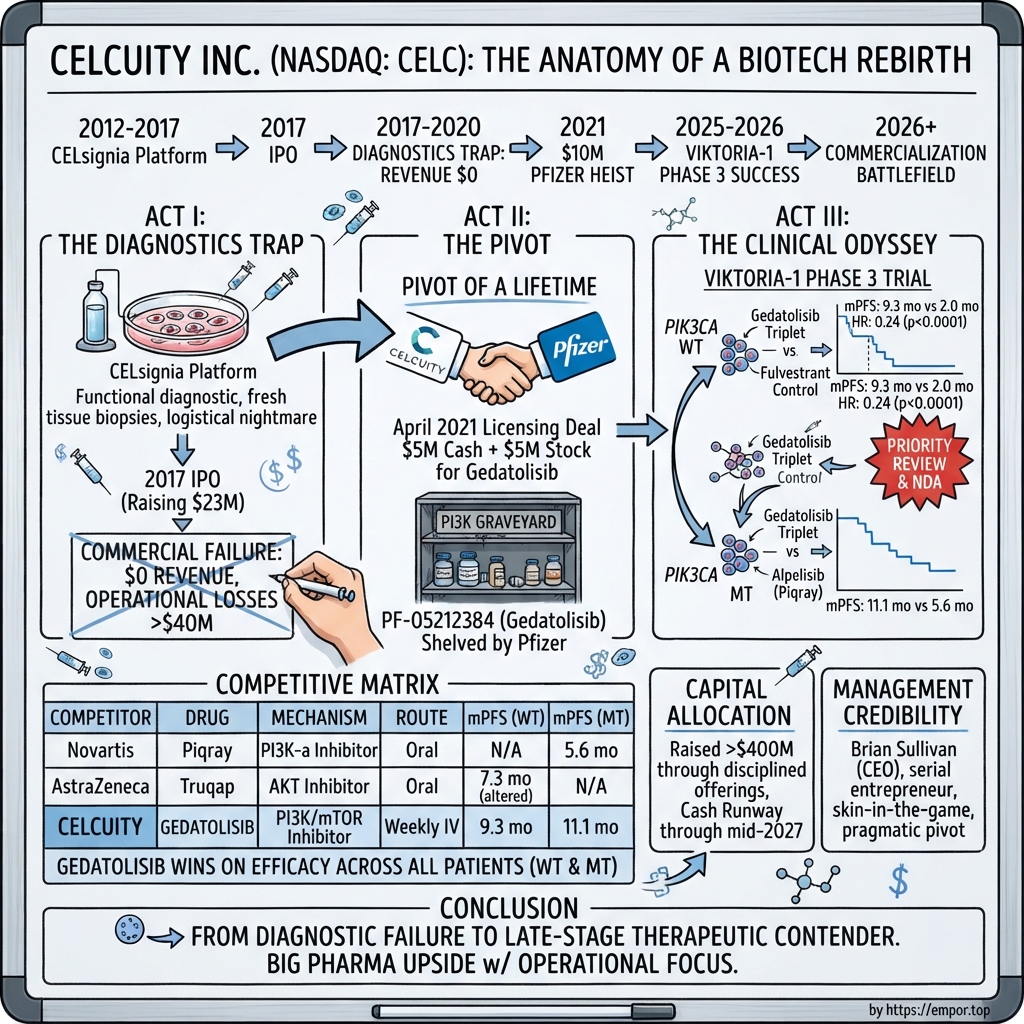
Celcuity Inc. (NASDAQ: CELC): The Anatomy of a Biotech Rebirth
I. Prologue & The $10 Million Pfizer Heist (00:00 – 00:15)
On April 8, 2021, a press release crossed the wire from a Minneapolis office park that drew little notice across the oncology sector. Celcuity Inc.—a company operating a CLIA-certified laboratory with several dozen employees, $11.6 million in cash on its balance sheet at year-end 2020, and, by the plain admission of its own regulatory filings, zero revenue since starting operations in 2012—announced that it had licensed worldwide rights to a Phase 3-ready cancer drug from Pfizer.12
The purchase price was $10 million, split evenly between cash and common stock.
To put that valuation in context, late-stage oncology assets carrying multi-hundred-patient clinical proof of concept routinely fetched nine-figure upfront commitments during that cycle. Celcuity paid less at signing than a mid-sized biotechnology developer typically spends running a single early-phase trial. In return, the company secured gedatolisib: a molecule synthesized as PKI-587 inside Wyeth, absorbed by Pfizer during its 2009 acquisition, tested across a decade of Pfizer-sponsored clinical studies involving hundreds of patients, and then shelved.
Five years later, that compound has a proprietary brand name, regulatory clearance, and a commercial price point. On July 14, 2026—three days ahead of its Prescription Drug User Fee Act target action date—the U.S. Food and Drug Administration approved REVTORPYK (gedatolisib) in combination with fulvestrant, with or without palbociclib, for adults with hormone-receptor-positive, HER2-negative locally advanced or metastatic breast cancer without a detected PIK3CA mutation following progression on endocrine therapy in the metastatic setting.3[^4] The decision marks the first regulatory clearance for any single therapeutic targeting all four Class I PI3K isoforms as well as both mTOR complexes. Just over two weeks later, on July 30, the National Comprehensive Cancer Network updated its clinical guidelines to list both the gedatolisib triplet and doublet regimens as preferred Category 1 second-line options for that indication—an unusually rapid inclusion by an NCCN review panel.4
On transaction math alone, the deal stands as one of the most asymmetric licensing agreements in modern biopharma. A developer unable to commercialize its proprietary diagnostic tool acquired an asset now valued by equity markets in the billions for roughly the price of suburban commercial real estate.
That headline represents the clean corporate narrative. The subsequent operational reality quickly grew more intricate.
On the trading day following FDA approval, Celcuity's shares fell approximately 19%.5 While the approved label excluded patients harboring PIK3CA mutations—a narrower scope than optimistic projections had modeled—the immediate selloff stemmed from management's disclosure that commercial product shipments would not begin until late in the third quarter of 2026. That timeline caught equity research desks off balance after optimistic management remarks on launch preparation just two months prior. Leerink analyst Andrew Berens observed that the delay "was not anticipated, given prior commentary on launch readiness."5 For the first time in five years, public markets penalized Celcuity for operational execution rather than trial data.
The central questions facing the company today do not center on whether it negotiated a bargain in 2021; on the documented financial terms, it undeniably did. The more demanding analytical questions address commercial execution and durability:
- Did the transaction reflect repeatable insight or unique arbitrage? Pfizer deprioritized gedatolisib for reasons that appeared methodologically sound in 2021. What did Celcuity detect in the clinical datasets that Pfizer's portfolio review missed, and does that diagnostic capability represent an enduring edge?
- Can clinical efficacy overcome delivery hurdles in the field? Gedatolisib's Phase 3 hazard ratios rank among the most favorable reported in second-line HR+/HER2- breast cancer. However, the regimen requires weekly intravenous infusions in a setting where incumbent therapies from AstraZeneca and Novartis are oral tablets administered once daily, and clinical trials documented stomatitis in approximately seven out of ten treated patients.
- How informative is the corporate operating track record? Celcuity spent nearly a decade assuring public investors that its functional diagnostic platform, CELsignia, would establish itself as a clinical standard of care. It never generated a dollar of commercial sales. That commercial shortfall represents critical empirical evidence when assessing management's current revenue projections.
- What is the true duration of product exclusivity? Gedatolisib's composition-of-matter patent expires in December 2029, a near-term expiration that directly tests the assumption that the company controls a durable, defensible monopoly asset.
A common analytical pitfall with clinical turnaround stories is outcome bias: inferring broad operational excellence from an exceptional regulatory milestone. The documentary record supports a narrower finding: management exhibited sharp scientific judgment under clinical uncertainty and executed an effective regulatory strategy with the FDA. Whether those capabilities translate to commercializing an infused oncology therapy against well-resourced pharmaceutical incumbents remains unproven. On its first major post-approval operational benchmark—commercial distribution timing—the company missed street expectations.
The analysis that follows charts how an entrepreneur with a background in water filtration came to head an oncology biotech; why the PI3K pathway turned into one of the industry's costliest developmental traps; how Celcuity negotiated the licensing transaction; what the Phase 3 VIKTORIA-1 trial established and what remains unresolved; the competitive market Celcuity must now penetrate; whether management's historical record supports current market valuations; and the core arguments for and against the business today.
The story begins with commercial water purification.
 Subscribe on LinkedIn
II. The Founders & The Diagnostics Trap: From Water Filters to Living Cells (00:15 – 00:45)
Brian F. Sullivan does not hold an M.D. or a Ph.D. He graduated magna cum laude with distinction from Harvard College with an A.B. in economics, then spent three decades outside oncology: founding, scaling, and selling Midwestern manufacturing and healthcare services businesses.6
His first major venture was Recovery Engineering, which he co-founded and led as chief executive. The company manufactured consumer water filtration systems under the PUR brand—the filter pitchers found across millions of American households. Sullivan took Recovery Engineering public and negotiated its sale to Procter & Gamble for $265 million in 1999. His second venture was SterilMed, a medical device reprocessing company. In 2003, he led an investment syndicate to acquire a majority interest, served as chairman and chief executive, and sold the business to Johnson & Johnson's Ethicon Endo-Surgery unit for $330 million in 2011.6 Along the way, he secured nine U.S. patents and served on the boards of two public companies.
Building two enterprises to nine-figure strategic sales established a disciplined operating track record, which carries direct analytical relevance: Sullivan is not a laboratory scientist who adapted to business, but a commercial operator who learned applied science. That orientation shaped Celcuity's corporate conduct, informing both its sharpest strategic transaction and its most persistent operational blind spot.
His co-founder was Lance G. Laing, Ph.D., a biomolecular screening scientist who became Celcuity's chief science officer and has served on its board of directors since 2012.6 Laing developed the core instrumentation; Sullivan provided the commercial thesis that the instrumentation could anchor a scalable biotechnology business.
The original insight, and why it was genuinely good science
The underlying scientific rationale was straightforward. By the mid-2010s, precision oncology had largely converged on genomic sequencing: extract tumor tissue, sequence its DNA, identify oncogenic mutations, and match the patient to a targeted therapeutic. While scientifically elegant, the approach had known clinical limits. A genetic sequence represents a blueprint, indicating what cellular machinery could produce rather than what signaling activity is actively taking place.
Celcuity argued that malignant growth is governed by dynamic pathway signaling—cascades of proteins activating and deactivating one another—and that a tumor could demonstrate hyperactive pathway signaling without harboring the specific genomic mutations detected by standard sequencing panels. Rather than analyzing DNA, Celcuity developed CELsignia, a proprietary platform designed to extract living tumor cells from fresh biopsies, culture them on biosensors, stimulate them with growth factors, and measure in real time whether HER2, c-Met, or PI3K pathways were signaling aberrantly.1 This was functional diagnostics rather than genomic sequencing: a diagnostic methodology aimed at identifying patients whose tumor pathways were hyperactive even when their genomic profiles appeared standard.
That core diagnostic hypothesis became the operational foundation for everything that followed.
The 2017 IPO and the partnership pitch
On September 20, 2017, Celcuity—having converted from a Minnesota limited liability company into a Delaware corporation five days prior—listed its shares on the Nasdaq Capital Market under the ticker CELC. The initial public offering closed on September 22, issuing 2,760,000 shares at $9.50 per share, including the full exercise of a 360,000-share overallotment option, generating approximately $26.2 million in gross proceeds, with Craig-Hallum Capital Group serving as the sole managing underwriter.71
The commercial pitch to public investors centered on a companion-diagnostics model. Celcuity intended to partner with pharmaceutical sponsors developing targeted oncology therapies, charging fees to identify pathway-active patients for clinical trials and subsequently capturing milestone payments and recurring per-test diagnostic revenues once those drugs reached the market with CELsignia designated as an FDA-required companion test. By 2020, Celcuity had initiated four clinical trial collaborations, including programs with Genentech and the NSABP Foundation, as well as Puma Biotechnology and the West Cancer Center.1 On paper, the partnership model appeared to be gaining momentum.
Historical falsification: the standalone diagnostic thesis, tested against nine years of evidence
The claim: CELsignia would emerge as a standard-of-care clinical diagnostic, generating recurring testing revenue and securing a defensible position within the precision oncology value chain through pharmaceutical co-development partnerships.
The disconfirming evidence, from the company's own filings: Celcuity's fiscal 2020 annual report—filed in February 2021, nine years after commencing operations and more than three years post-IPO—disclosed the commercial reality plainly: "To date, we have not generated any revenue." Net losses reached approximately $9.5 million in 2020 and $7.4 million in 2019, bringing the accumulated deficit to roughly $26.3 million under Celcuity Inc., alongside $12.6 million from its predecessor LLC, against remaining cash reserves of $11.6 million.1 Four pharmaceutical research collaborations had produced zero commercial product revenue.
The breakdown mechanism reflects an operational hurdle common to specialized medical diagnostics. CELsignia required viable, living tumor cells. Routine oncology practice, by contrast, relies almost universally on formalin-fixed paraffin-embedded tissue blocks—cut, stained, and archived—or on circulating tumor DNA collected through routine blood draws. Requiring community hospitals to extract fresh biopsy tissue, preserve cellular viability, and coordinate temperature-controlled overnight shipping to a single central laboratory in Minneapolis created an insurmountable logistical friction. In clinical medicine, workflow bottlenecks represent structural barriers that early-stage diagnostic providers rarely possess the commercial leverage to overcome.
The strategic dead end was equally structural. Pharmaceutical partners readily evaluated retrospective research samples when Celcuity bore the logistical burden. Committing to a commercial companion diagnostic was another matter: it required sponsors to accept a regulatory label tied to a proprietary, living-cell assay that would complicate patient screening, slow trial enrollment, and introduce logistical friction between oncologists' prescriptions and patient treatment. No pharmaceutical partner agreed to commercialize a drug tethered to that workflow.
Verdict: The standalone diagnostic thesis was rejected outright. The most compelling proof appears not in the income statement, but in the evolution of regulatory disclosures. Celcuity's fiscal 2020 annual report mentioned "CELsignia" 327 times. Its fiscal 2025 annual report, filed on March 26, 2026, mentioned the platform zero times.18 The diagnostic business was not merely de-emphasized or transitioned into a secondary internal research tool; the company's own regulatory filings show it was discontinued entirely.
This programmatic abandonment carries direct implications for corporate valuation. Any investment thesis modeling Celcuity as a functional-diagnostics enterprise with an embedded drug pipeline misreads the operating reality; assigning residual value to CELsignia credits an asset management no longer presents to public shareholders. At the same time, the transition demonstrates Sullivan's willingness to scrap a decade of internal development once empirical evidence disproved the commercial hypothesis—a pragmatic flexibility that represents a critical variable when evaluating the company's subsequent strategic pivot.
By late 2020, the corporate arithmetic left no room for maneuver: $11.6 million in cash reserves, an annual cash burn approaching $10 million, and a standalone diagnostic model that nine years of commercial operations had failed to validate. Sullivan required an in-licensed therapeutic asset to sustain the enterprise. As events unfolded, the laboratory platform he had spent a decade refining was about to serve an entirely unexpected purpose.
III. The Abandoned Molecule: The PI3K Graveyard & Why Pfizer Let It Go (00:45 – 01:15)
Understanding what Celcuity identified requires examining one of the most frustrating target pathways in solid-tumor oncology.
The pathway, in plain language
Consider a cancer cell as a factory that has lost its shutdown switch. One of the central wiring harnesses running through that factory is the PAM pathway—PI3K, AKT, and mTOR, three signaling proteins arranged in a relay chain. Signals arrive at the cell surface, PI3K fires, AKT relays, and mTOR executes: grow, divide, survive, and ignore programmed cell death. In hormone-receptor-positive breast cancer, this cascade serves as the primary biochemical escape route. When a patient treated with endocrine therapy or a CDK4/6 inhibitor eventually progresses—as nearly all do—hyperactivity in this pathway is very often the reason.8
The clinical stakes are substantial. Roughly 70% of breast tumors express the estrogen receptor, and HR+/HER2- advanced breast cancer remains incurable, with a median overall survival of roughly three years and a five-year survival rate of 34%.8 Second-line treatment marks the point where frontline standard-of-care therapies have failed and the disease timeline accelerates.
The result was an enormous target with multi-billion-dollar market potential, two decades of pharmaceutical investment, and a long trail of clinical failures.
The catch-22 that killed a generation of drugs
The primary obstacle is that this signaling cascade is not unique to cancer. Healthy cells rely on PI3K signaling to regulate glucose uptake, support immune defenses, and maintain the gastrointestinal lining. Early pan-PI3K inhibitors, which blocked the alpha, beta, delta, and gamma isoforms indiscriminately, produced severe toxicities inherent to disabling such foundational biology: colitis, elevated liver enzymes, opportunistic infections, and neuropsychiatric complications. The biological rationale was sound, but a viable therapeutic window did not exist.
The pharmaceutical industry responded by seeking isoform selectivity. Novartis targeted PI3K-alpha alone with alpelisib, which the FDA approved in May 2019 as Piqray for PIK3CA-mutated HR+/HER2- advanced breast cancer.[^10] Selectivity narrowed the toxicity profile but did not resolve it, because PI3K-alpha specifically mediates cellular insulin signaling. Blocking the isoform causes blood glucose levels to spike, frequently requiring aggressive clinical management. Downstream, AstraZeneca targeted AKT with capivasertib, approved as Truqap in November 2023 for tumors harboring PIK3CA, AKT1, or PTEN alterations.[^11]
The second obstacle is compensatory feedback, which makes the pathway exceptionally difficult to inhibit. Blocking PI3K alone triggers an intracellular workaround: mTORC2 reactivates AKT, allowing oncogenic signals to continue unimpeded. Conversely, inhibiting mTOR alone releases feedback inhibition on upstream receptor tyrosine kinases, similarly sustaining pathway activity. Blocking one node simply redirects cellular traffic. The theoretical solution—simultaneously shutting down the entire circuit across PI3K and both mTOR complexes—was biochemically obvious across oncology research, but drug developers repeatedly failed to achieve dual inhibition without inducing unacceptable patient toxicity.
Enter PF-05212384
Gedatolisib is a potent, reversible inhibitor of all four Class I PI3K isoforms and both mTORC1 and mTORC2. Originally synthesized at Wyeth as PKI-587, the molecule became Pfizer's property following its 2009 acquisition of Wyeth. Pfizer then funded the capital-intensive early clinical development. By the end of 2025, 1,127 patients and healthy volunteers had received gedatolisib across twelve completed or ongoing clinical trials—with the vast majority of that clinical exposure generated on Pfizer's budget before Celcuity ever acquired rights to the molecule.8
The early safety data showed surprising differentiation. In the 103-patient dose-expansion cohort of a Phase 1b trial, only 7% of patients experienced Grade 3 or 4 hyperglycemia, and fewer than 9% discontinued gedatolisib because of an adverse event.8 For a pan-PI3K inhibitor in a drug class defined by high discontinuation rates, that tolerability profile was an anomaly—and it was documented in public clinical datasets.
So why did Pfizer let it go?
Pfizer deprioritized the asset for three practical reasons, each consistent with large-pharma portfolio management at the time.
Portfolio logic. Pfizer's breast cancer franchise centered on Ibrance (palbociclib), an oral CDK4/6 inhibitor generating billions in annual revenue. The company's oncology strategy prioritized oral, combinable agents and immuno-oncology programs. Gedatolisib requires a weekly 30-minute intravenous infusion. An infused therapy did not fit the commercial profile of an oral breast cancer franchise, and within an organization of Pfizer's scale, strategic misalignment frequently determines asset prioritization long before teams debate Phase 1 efficacy.
Legacy discount. As an acquired Wyeth program, gedatolisib competed for capital against Pfizer's internally discovered molecules. In pharmaceutical portfolio reviews, organizational provenance quietly carries weight. As original scientific champions moved on, the orphaned program lacked senior advocates to contest competing corporate priorities.
Class stigma. By 2020, commercial experience with Piqray—where oncologists grappled with severe hyperglycemia and rash, and patients discontinued treatment at elevated rates—had reinforced industry skepticism. The consensus held that dual PI3K and mTOR inhibition was fundamentally intolerable. Although Pfizer held Phase 1b data suggesting gedatolisib differentiated on glycemic control, broader class skepticism made advancing an infused dual inhibitor difficult to justify internally.
Attributing Pfizer's decision to corporate oversight oversimplifies large-scale portfolio management. Pfizer did not conclude gedatolisib lacked therapeutic utility; the company structured the divestiture to retain meaningful downstream economics. Rather, Pfizer concluded the drug did not justify Pfizer's incremental capital and operational focus relative to competing internal opportunities. That represented a relative portfolio trade-off rather than an absolute scientific verdict. Such portfolio decisions create classic arbitrage opportunities for smaller biotechs whose alternative uses of capital are far more limited.
For a diagnostics company that had spent nine years building instruments to measure PI3K pathway activity, that disconnect was an opening Celcuity was uniquely positioned to exploit.
IV. The Pivot of a Lifetime: Licensing Gedatolisib (01:15 – 01:45)
The strategic insight behind the transaction mattered far more than the headline deal terms.
Celcuity had built a platform designed to identify tumors with hyperactive PI3K signaling in the absence of a PIK3CA mutation—cells signaling aggressively through a pathway that standard genomic sequencing labeled quiescent. While that diagnostic assay proved commercially unviable due to clinical workflow constraints, it yielded an analytical edge. Sullivan and Laing developed a specific, contrarian conviction: that the PIK3CA-mutated population contested by Novartis and later Roche represented the smaller half of the addressable market, and that PIK3CA wild-type patients—those without an identifiable mutation—were frequently driven by aberrant pathway signaling without targeted therapeutic options.
Under that clinical hypothesis, the optimal therapeutic was not an isoform-selective inhibitor, but a comprehensive agent capable of shutting down the entire signaling circuit irrespective of mutation status. Only one such candidate possessed Phase 3-ready human clinical data: gedatolisib, which sat unutilized in Pfizer's pipeline.
The strategic pivot was not simply acquiring an inexpensive molecule, but using empirical observations from an unviable diagnostic assay to recognize that an orphaned asset had been mispriced by prevailing industry consensus.
The terms
The license was signed on April 8, 2021: a worldwide, sublicensable, exclusive license to develop and commercialize gedatolisib.2 Consideration was $5.0 million in cash plus $5.0 million in Celcuity common stock, delivered as 349,406 shares under a separate equity grant agreement—implying roughly $14.31 per share, close to where the stock had been trading.9 Pfizer became an equity holder rather than a detached counterparty, aligning its financial incentives with Celcuity's clinical progress.
Behind the upfront consideration sat substantial contingent obligations: development and commercial milestone payments of up to $330 million (with Celcuity's annual report calculating the potential aggregate at $335.0 million), alongside tiered royalties on net sales "ranging from the low to mid-teens," subject to standard downward adjustments for patent expirations, third-party license stacking, and generic market entry.28
That royalty obligation represents a critical economic reality obscured by the modest upfront price. In biopharma licensing, low-to-mid-teens royalties impose a meaningful, perpetual claim on gross margins. For an oncology therapy priced at tens of thousands of dollars per treatment cycle, royalty payouts constitute a structural cash drain that persists regardless of commercial headwinds or launch friction. While commentators frequently highlight the $10 million acquisition cost, the royalty structure dictates Celcuity's retained economics throughout the product's commercial life.
Did Celcuity underpay?
Measured by upfront cash alone, the price was unquestionably low. Yet an analytical assessment indicates both parties structured risk according to divergent estimates of clinical success. Pfizer eliminated all forward development expenses—a Phase 3 program like VIKTORIA-1 would require hundreds of millions of dollars in clinical trial funding—while retaining an equity stake, up to $330 million in milestone commitments, and a lucrative royalty stream. For a pharmaceutical sponsor assigning the asset a low single-digit probability of commercialization, the agreement offered risk-free option value. For a developer assigning gedatolisib a substantially higher probability of success, licensing rights were secured at the valuation of an early-stage financing round.
Pfizer modeled the probability conservatively; Celcuity modeled it aggressively. Because Celcuity assumed the entire financial burden of clinical execution, that risk-reward asymmetry—rather than pure negotiating leverage—drove the transaction's structure.
Funding the swing
Celcuity entered the transaction with limited financial flexibility. Six weeks before executing the license, on February 26, 2021, the company closed an underwritten public offering raising approximately $25.8 million in net proceeds through the sale of 1,971,100 shares at $14.00 per share, which included full exercise of the underwriters' overallotment option.9 Concurrently with the Pfizer agreement, Celcuity secured a debt facility from Innovatus Capital Partners: a $25 million term loan structured in three tranches, with $15.0 million funded at closing and two $5.0 million tranches conditioned on clinical and financing milestones. The loan matured five years from funding, carried an effective interest rate of 11.36%, included warrant coverage equal to 2.5% of principal per tranche, and permitted Innovatus to convert up to 20% of outstanding principal into common stock.910
The terms reflected the steep cost of capital for a pre-revenue biotechnology developer without commercial assets. An 11.36% effective borrowing rate paired with warrants and conversion privileges represented classic venture-debt pricing—financing secured out of necessity rather than structural preference. That restrictive balance sheet profile establishes the baseline against which Celcuity's subsequent refinancing five years later must be measured, offering a direct reflection of how significantly the asset's risk profile evolved.
What happened to CELsignia
As confirmed by public disclosures, CELsignia was phased out entirely. While external market observers often look to ascribe residual pipeline value to legacy diagnostic assets, Celcuity's regulatory filings ceased referencing the platform altogether. The documentary record shows CELsignia served as intellectual scaffolding rather than an enduring commercial product: its entire economic return was captured in identifying the clinical rationale for licensing gedatolisib.
Following the April 2021 transaction, Celcuity was functionally reconstituted as a single-asset therapeutic biotechnology firm focused on a single signaling cascade and an initial breast cancer indication. Crucially, the company assumed responsibility for executing an expansive Phase 3 clinical trial whose ultimate costs far exceeded its available cash. The enterprise's survival hinged entirely on what that registration study would demonstrate.
V. The Clinical Odyssey: VIKTORIA-1 and De-Risking the Asset (01:45 – 02:15)
VIKTORIA-1 was effectively designed as two distinct studies under a single trial umbrella, and its architecture reflected Celcuity's core clinical hypothesis.
The architecture
The trial enrolled patients with HR+/HER2- locally advanced or metastatic breast cancer who had progressed on or after a CDK4/6 inhibitor plus an aromatase inhibitor—the standard second-line setting. Investigators stratified patients by PIK3CA mutation status into two independently analyzed cohorts.
The wild-type cohort—patients lacking a PIK3CA mutation, and therefore without an approved targeted therapy—randomized 392 patients in an approximately 1:1:1 ratio across three arms: gedatolisib plus fulvestrant plus palbociclib (the triplet), gedatolisib plus fulvestrant (the doublet), and fulvestrant monotherapy as the control.[^4] While industry observers noted that fulvestrant monotherapy set a relatively low clinical bar, it represented standard real-world care for those patients.
The mutant cohort adopted a more demanding design. Rather than testing against an inactive or low-efficacy comparator, Celcuity randomized 350 patients in a 3:3:1 ratio to evaluate gedatolisib directly head-to-head against alpelisib plus fulvestrant—Novartis's approved standard of care.13 Testing directly against an established active comparator represented a high-stakes clinical gamble: evaluating whether pan-inhibition delivered clinical superiority over isoform-selective targeting required testing against an approved incumbent rather than a monotherapy control.
The wild-type readout
Topline results arrived on July 28, 2025.8 In the wild-type cohort, the gedatolisib triplet generated a median progression-free survival of 9.3 months compared with 2.0 months for fulvestrant monotherapy—yielding a hazard ratio of 0.24 (95% CI 0.17–0.35; p<0.0001), representing a 76% reduction in the risk of disease progression or death. The doublet regimen achieved a median PFS of 7.4 months with a hazard ratio of 0.33 (95% CI 0.24–0.48; p<0.0001). Objective response rates reached 32% for the triplet and 28% for the doublet, compared to just 1% in the control arm, with median durations of response of 17.5 months and 12.0 months, respectively, against a control arm where duration could not be meaningfully estimated because only a single patient responded.[^4]3
Translating the clinical data: a hazard ratio of 0.24 represents an uncommonly wide therapeutic separation. In a clinical landscape historically characterized by median progression-free survival gains of one to two months, a 7.3-month absolute advantage over control marked the largest improvement reported in second-line HR+/HER2- breast cancer. The response rate differential was similarly striking: nearly one-third of treated patients experienced measurable tumor shrinkage, compared to one in a hundred receiving standard fulvestrant.
A necessary analytical caveat involves the comparator: fulvestrant monotherapy performed exceptionally poorly, and a 2.0-month median control PFS mechanically accentuates the resulting hazard ratio. Skeptics could reasonably question whether the dramatic separation reflected the potency of gedatolisib or the sheer inadequacy of single-agent fulvestrant in advanced post-CDK4/6 disease. That methodological question was directly addressed eleven months later.
The mutant readout, and the head-to-head
Topline data for the mutant cohort arrived on May 1, 2026, followed by detailed findings presented during a late-breaking oral session at the American Society of Clinical Oncology annual meeting on June 2, 2026.1213 Evaluated directly against Novartis's alpelisib plus fulvestrant, the gedatolisib triplet generated a median PFS of 11.1 months versus 5.6 months for the control, delivering a hazard ratio of 0.50 (95% CI 0.37–0.68; p<0.0001)—halving the risk of progression or death. The doublet achieved a median PFS of 11.3 months, yielding a hazard ratio of 0.51 (95% CI 0.33–0.79; descriptive p=0.0013).13
Two findings stand out from the mutant cohort. First, the triplet and doublet regimens demonstrated virtually identical efficacy—11.1 months versus 11.3 months—raising a legitimate clinical question as to whether palbociclib adds meaningful therapeutic value in this population given its associated toxicity burden. Severe (Grade 3) stomatitis occurred in 16.3% of triplet patients compared to 5.8% on the doublet.13 If community oncologists conclude that the doublet provides equivalent efficacy with substantially lower toxicity, clinical adoption could favor the two-drug regimen, reducing palbociclib-driven monitoring requirements. Second, doubling median progression-free survival against an approved commercial incumbent provided far more rigorous clinical validation than surpassing a monotherapy control. Regardless of reservations regarding the wild-type comparator, the mutant readout demonstrated that dual pathway inhibition could outperform isoform-selective targeting in a direct head-to-head trial.
The safety story — and where the bull case needs correcting
The pharmacological rationale for gedatolisib's tolerability centers on its intermittent pharmacokinetic profile. Oral PI3K-alpha inhibitors are taken daily, producing continuous systemic drug exposure that persistently suppresses insulin signaling and induces chronic hyperglycemia. In contrast, gedatolisib is administered as a 180 mg intravenous infusion over 30 minutes on days 1, 8, and 15 of a 28-day cycle, followed by a one-week treatment break.15 Serum drug concentrations peak rapidly and then clear, providing a scheduled physiological rest period each cycle.
Clinical glycemic data substantiate that pharmacokinetic mechanism. In the head-to-head mutant cohort, Grade 3 or higher hyperglycemia occurred in 2.6% of gedatolisib triplet patients and 0% of doublet patients, compared to 14.5% among patients receiving alpelisib.13 REVTORPYK's FDA prescribing information reports increased fasting glucose relative to baseline in 46% of triplet-treated patients, yet Grade 3 elevations occurred in only 0.9%.15 While mild glucose elevations remain common, life-threatening metabolic spikes are rare—marking a distinct clinical advantage over the incumbent oral PI3K-alpha inhibitor.
However, the approved drug label reveals a far more demanding safety profile than early investor presentations emphasized. Stomatitis—severe mouth ulceration—occurred in 72% of patients receiving the triplet, including Grade 3 events in 22%.15 Grade 3 stomatitis is a debilitating toxicity that severely impairs nutritional intake. The FDA label includes a dedicated warning instructing clinicians to initiate prophylactic treatment with a steroid-containing, alcohol-free mouthwash before starting therapy and to maintain that regimen four times daily for the first eight weeks.15 Moreover, vulnerability skews sharply with age: Grade 3 or higher stomatitis developed in 37% of patients aged 65 and older compared to 16% among younger patients—a significant clinical complication in a disease where the median age at diagnosis falls directly within that older cohort.15 Concurrently, the triplet regimen inherits palbociclib's characteristic hematologic toxicity, generating Grade 3 neutropenia in 52.3% of patients and Grade 4 neutropenia in 10.0%.14
Conversely, clinical discontinuation rates provide the primary counterbalance to those safety concerns. In the wild-type cohort, treatment-related adverse events resulted in treatment discontinuation in only 2.3% of triplet patients and 3.1% of doublet patients, with Grade 2 or 3 stomatitis on the triplet resolving to a lower grade within a median of 12 and 14 days, respectively.14 In the mutant cohort, study treatment discontinuation was 2.6% for the triplet and 3.8% for the doublet, compared to 7.1% for alpelisib.13 The clinical profile suggests gedatolisib is a demanding therapy to manage, but one whose toxicities are sufficiently reversible that patients can maintain dosing.
Management's public presentation of this data requires critical examination. On the second-quarter 2026 earnings call, Sullivan introduced a retrospective re-analysis of mutant-cohort discontinuations using the FDA label's methodology, reporting rates of 5.2% for the triplet and 3.8% for the doublet against 19% for alpelisib, arguing that this 4% to 5% range "best represents what we expect to see in a real world setting."16 Under that re-analysis, the discontinuation rate for alpelisib shifted from 7.1% at the ASCO presentation to 19%. While both metrics reflect distinct analytical methodologies—overall study-treatment discontinuation versus discontinuation of a specific single agent—management highlighted the calculation that produced the widest competitive divergence. Furthermore, Sullivan's assertion that early-trial investigator inexperience had artificially inflated adverse event rates remains unproven without real-world commercial registries. Independent analysts must evaluate actual post-launch persistence rather than relying on retrospective re-baselining.
The endpoint that has not reported yet
A central clinical limitation of VIKTORIA-1 warrants explicit emphasis: the trial has yet to demonstrate an overall survival benefit.
Progression-free survival measures the time elapsed before tumor growth or patient death; overall survival measures the absolute extension of life. In an advanced disease where median overall survival spans approximately three years, these metrics can decouple—a therapeutic can delay radiographic disease progression without extending survival, particularly if accumulated toxicities take a physical toll. The FDA granted approval for REVTORPYK based on progression-free survival, supported by objective response rates and duration of response; overall survival data from VIKTORIA-1 have not matured, and the clinical protocol mandates continued patient follow-up.[^4]8 While standard for accelerated oncology approvals and surrogate endpoint design, definitive survival benefit remains an unverified clinical assumption.
That analytical ambiguity is compounded by trial architecture: in the wild-type cohort, patients randomized to fulvestrant monotherapy had the option to cross over to a gedatolisib regimen upon confirmed radiographic disease progression.8 While crossover provisions represent standard ethical practice when a control arm underperforms, they structurally dilute detectable differences in overall survival. Consequently, the wild-type cohort is unlikely to yield a statistically clean overall survival signal, and the eventual absence of a statistically significant benefit cannot be interpreted as definitive proof of clinical equivalence or failure.
Management's public commentary on survival endpoints underscores this distinction. Addressing the frontline VIKTORIA-2 program during the first-quarter 2026 earnings call, Sullivan explained that overall survival "becomes in effect the way to break the tie" when competing regimens deliver comparable progression-free survival, and defined the clinical benchmark for VIKTORIA-2 as demonstrating superior progression-free survival while showing "no decrement in overall survival"—which he characterized as satisfying regulatory and clinical expectations.11 While consistent with precedent in the CDK4/6 class, targeting "no decrement" sets a materially lower bar than proving an absolute life-extension benefit. In therapeutic categories where incumbent frontline agents have demonstrated statistically significant survival advantages, maintaining survival parity may prove insufficient to secure preferential recommendations from clinical guidelines committees.
Regulatory execution
Celcuity utilized the FDA's Real-Time Oncology Review program—granted on August 27, 2025—to submit its New Drug Application on a rolling basis, and the regulatory agency granted Priority Review on January 20, 2026, building upon earlier Breakthrough Therapy and Fast Track designations.817 The FDA granted approval on July 14, 2026, three days ahead of the PDUFA target date, and Celcuity submitted its supplemental NDA covering the PIK3CA-mutant population on August 26, 2026.318
The regulatory campaign demonstrated disciplined procedural execution. However, guiding an unpartnered asset through clinical trials and regulatory review requires an entirely different operational capability than building a commercial sales infrastructure—a hurdle the company had never previously navigated.
VI. The Battlefield: Second-Line Breast Cancer & Big Pharma's Titans (02:15 – 02:45)
Consider the clinical setting that defines the commercial opportunity: a 58-year-old patient with metastatic HR+/HER2- breast cancer has experienced disease progression after eighteen months on a CDK4/6 inhibitor plus an aromatase inhibitor. Her oncologist—managing a demanding patient volume across breast, lung, colorectal, and hematologic cancers—has roughly ten minutes to evaluate the next line of therapy.
That compressed clinical decision represents Celcuity's primary commercial battleground.
The market
Celcuity estimates that approximately 37,000 patients in the United States receive second-line therapy for HR+/HER2- advanced breast cancer each year. Assuming an average treatment course of roughly ten cycles per patient at a wholesale acquisition cost of $30,000 per cycle ($10,000 per vial), management sizes the combined wild-type and mutant addressable market at more than $6 billion annually.16
That figure represents a theoretical ceiling based on gross list prices and 100% market capture, rather than an operational revenue forecast. The practical commercial question is what share of those second-line prescribing decisions Celcuity can secure, and at what realized net price. Management guided to an expected gross-to-net discount of roughly 20%, arguing that this concession is narrower than the approximately 30% discount typical for oral therapies in this category because infused drugs flow through medical-benefit buy-and-bill channels rather than retail pharmacy benefit managers.16 If realized, this channel dynamic provides a structural advantage for the infusion model by preserving higher net revenue per dollar of list price and limiting rebate leakage.
The incumbents
Novartis (Piqray/alpelisib). Approved in May 2019 as the first targeted therapy in this class, Piqray illustrates the commercial vulnerabilities of an oral inhibitor burdened by significant toxicity.[^10] For full-year 2025, Novartis reported net sales of $382 million, a 15% decline, with fourth-quarter sales falling 26% to $81 million as Novartis explicitly cited intensifying competition, predominantly in the United States.20 Despite a five-year first-mover advantage, the franchise is contracting, and gedatolisib's head-to-head Phase 3 data suggest that downward trajectory will be difficult to reverse.
AstraZeneca (Truqap/capivasertib). As an oral tablet approved in November 2023 for tumors harboring PIK3CA, AKT1, or PTEN alterations—encompassing roughly half the second-line population—Truqap serves as Celcuity's primary competitor, supported by AstraZeneca's global commercial scale.[^11] However, earnings disclosures indicate that market penetration may be plateauing. On AstraZeneca's fourth-quarter 2025 earnings call, management stated that "in the U.S., we now believe Truqap is at peak, with further incremental growth to be driven by other markets," even as fourth-quarter revenues rose 41% on inventory stocking and European pricing accrual reversals.21 When an entrenched incumbent with extensive detailing capacity projects a domestic plateau, it indicates that adoption is restricted by biomarker eligibility and tolerability profiles rather than promotional reach—a ceiling that creates a viable opening for Celcuity.
Roche (Itovebi/inavolisib). Approved in October 2024 as a mutation-specific PI3K-alpha inhibitor in combination with palbociclib and fulvestrant, Itovebi is advancing into frontline therapy. Roche did not break out Itovebi among its top-selling pharmaceuticals in its 2025 full-year financial results, reflecting its early commercial stage.22 Roche's strategic impact on Celcuity centers not on second-line share, but on intercepting mutant patients in the frontline setting, which would contract the pool of eligible second-line candidates if Celcuity's supplemental application gains approval.
Menarini (Orserdu/elacestrant). An oral selective estrogen receptor degrader indicated for ESR1-mutated tumors, Orserdu targets an alternative endocrine resistance mechanism with modest progression-free survival gains. It competes for the same oncologist's prescription pad without addressing the PAM signaling cascade.
Where Celcuity genuinely wins
Celcuity's competitive position rests on two documented clinical distinctions:
Biomarker breadth. Competing targeted agents require specific genetic alterations: Piqray and Itovebi require a PIK3CA mutation, while Truqap requires an alteration in PIK3CA, AKT1, or PTEN, restricting eligibility to approximately half of all second-line patients. Gedatolisib is the only therapeutic supported by Phase 3 evidence across both wild-type and mutant cohorts. REVTORPYK's initial label covers the wild-type population—the larger patient segment, which previously lacked an approved targeted option—and approval of the pending supplemental application would expand eligibility across nearly the entire second-line setting.
Magnitude of effect. Hazard ratios of 0.24 in the wild-type cohort and 0.50 against an active comparator in the mutant cohort exceed the efficacy benchmarks demonstrated by oral competitors in second-line trials. Celcuity's commercial thesis assumes that an absolute efficacy advantage of this scale will outweigh physician and patient preferences for oral convenience.
Where Celcuity can genuinely lose
The infusion chair. Truqap is an oral medication taken at home; REVTORPYK requires intravenous infusions at a clinic on three out of every four weeks on an ongoing basis. Addressing this friction during the second-quarter 2026 earnings call, management argued that infusion access presents no operational barrier because standard breast cancer care—including HER2-targeted antibodies, pembrolizumab, and intravenous chemotherapies—routinely utilizes existing infusion suites.16 While that point accurately describes institutional capacity, it does not resolve patient and clinician preference: when both alternatives are reimbursed and one requires no chair time, clinical practice demonstrates a persistent bias toward oral administration unless the therapeutic benefit is unmistakable. That commercial trade-off remains untested in the market.
Commercial scale. Celcuity deployed approximately 80 oncology sales specialists averaging 24 years of healthcare experience and 16 years in oncology, alongside strategic account, reimbursement, and medical science liaison teams, reporting engagement with more than 1,000 key opinion leaders and 250 core institutional accounts prior to launch.16 Although experienced, this field force remains a fraction of the detailing resources AstraZeneca deploys across the same medical centers. Management contends that oncology prescribing is dictated by clinical guidelines rather than detailing volume—a position supported by the NCCN panel adding gedatolisib regimens as preferred Category 1 options sixteen days after approval.4 Nevertheless, competing against the commercial reach of major pharmaceutical organizations represents an unproven operational test for an independent biotech.
Payer sequencing. The primary reimbursement risk is not outright coverage denial, but step-therapy protocols requiring patients to fail an oral regimen before payers authorize an infused agent. In the wild-type cohort, where no competing targeted oral drug is approved, that barrier is largely absent. However, step therapy represents an immediate consideration if the mutant indication is approved, where capivasertib and alpelisib offer established oral alternatives.
The 2029 patent expiration. Gedatolisib's composition-of-matter patent expires in December 2029, inclusive of patent term adjustment.8 Formulation and method-of-use patents extend to January 2041 and August 2042, and Celcuity plans to seek a five-year patent term extension under Hatch-Waxman provisions.8 While secondary patents provide ongoing coverage, method-of-use and formulation claims have historically faced higher litigation and circumvention risks from generic manufacturers than primary composition-of-matter exclusivity, creating a compressed timeframe for Celcuity to maximize unencumbered commercial cash flows.
Commercial visibility under buy-and-bill. Because REVTORPYK is distributed through medical-benefit buy-and-bill channels rather than retail pharmacies, Celcuity will lack the immediate prescriber-level data available for oral drugs. During the second-quarter earnings call, Sullivan acknowledged that initial internal tracking will be limited to wholesale vial shipments, while third-party survey data covering 40% to 50% of patients will arrive with a two-to-three-month lag.16 This reporting delay means capital markets will have limited visibility into real-world adoption and persistence during the early launch quarters, leaving early performance indicators ambiguous.
The commercial challenge ultimately centers on execution by an organization navigating its first product launch—a test that shifts analytical scrutiny directly onto management's historical operating record.
VII. Capital Allocation, Management Credibility & The Falsification Layer (02:45 – 03:05)
In May 2026, two months before its PDUFA date, Celcuity told investors it was on track to launch gedatolisib commercially in the third quarter, with management noting on the accompanying earnings call that it had identified an internal launch-ready date ahead of the PDUFA decision.11
FDA approval arrived on July 14, three days ahead of schedule. The next trading day, Celcuity's shares dropped roughly 19%—not due to the label, but because management disclosed that commercial product shipments would not begin until late in the third quarter to ensure adequate drug supply.5 On the second-quarter earnings call in August, TD Cowen analyst Tara Bancroft opened the question-and-answer session by asking what supported confidence in that revised timing and whether the company would launch using clinical trial inventory. Jefferies analyst Maury Raycroft pressed on the same operational issue. Sullivan responded that Celcuity had submitted validation data for a second manufacturing facility immediately following approval, could not distribute product from that site without FDA clearance, anticipated a review period of roughly two to four months, and maintained that underlying launch plans remained unchanged.16
That sequence provides a direct test of management credibility. The company had signaled launch readiness at approval; when approval arrived early, commercial supply was not ready to ship. The bottleneck was a manufacturing-site qualification that was foreseeable and, on the timeline's evidence, inadequately sequenced. While the commercial impact was modest—a brief shipment delay for a long-cycle therapeutic—the behavioral pattern was telling: a confident forward commitment missed, followed by commentary that reframed rather than acknowledged the execution gap. Berens's note captured the substance precisely.5
A single operational misstep does not constitute a full verdict. Evaluating management's execution requires testing that event against the broader corporate and capital allocation record.
Incentives and ownership
Sullivan beneficially owned 4,264,953 shares, or 8.62% of the class, as of March 17, 2026; Laing owned 1,596,891 shares, or 3.28%; and all directors and executive officers as a group held 13.33%.6 That represents an unusually high level of insider equity ownership for a commercial-stage biotechnology firm, ensuring executive financial outcomes remain tied to equity performance rather than cash compensation.
The institutional shareholder base shows comparable concentration. Baker Bros. Advisors held 9,582,874 shares, representing a 19.99% stake—having notified the company on March 20, 2026, that it was raising its self-imposed beneficial ownership cap from 4.99% to 19.99%, effective May 20, 2026.6 Avoro Capital held 6.44% and Perceptive Advisors held 6.54%. A specialist healthcare fund voluntarily raising its ownership ceiling ahead of a major PDUFA decision reflects concentrated institutional conviction. Conversely, it also concentrates trading liquidity among crossover healthcare funds whose portfolio adjustments can drive sharp volatility in either direction.
The capital record
From inception through December 31, 2025, Celcuity raised approximately $506.8 million net through equity offerings, $194.9 million net through convertible debt, and $130.0 million gross through credit facilities, against an accumulated deficit of $448.9 million.8 Management executed equity financings at progressively higher valuations—such as issuing 3,871,000 shares at $15.50 in May 2024 to generate $60.0 million in gross proceeds—diluting into advancing clinical momentum rather than raising capital under distress.8
The June 2026 refinancing provides the clearest demonstration of capital-allocation discipline in the company's history. Between presenting the mutant data at ASCO and receiving FDA approval, Celcuity issued $575.0 million of convertible senior notes due 2032 carrying a 0.250% coupon, generating $557.2 million in net proceeds, and allocated $137.0 million to retire its secured term loan entirely.19 Compared with the 11.36% effective rate on its 2021 venture debt, replacing high-cost senior borrowing with near-zero-coupon paper at the peak of clinical de-risking demonstrated disciplined balance-sheet management. With cash, cash equivalents, and investments standing at $754.0 million as of June 30, 2026, management extended its cash runway guidance from "through 2027" to "at least into 2029."1911
That capital structure introduces a substantial future obligation. The balance sheet carries $753.2 million in convertible debt, pushing total liabilities to $841.0 million against total assets of $828.2 million and leaving stockholders' equity at negative $12.8 million.19 A 0.250% coupon represents inexpensive capital only if the debt ultimately converts into equity. If commercial adoption of REVTORPYK falters and the stock fails to reach conversion thresholds, the company faces a $575 million debt maturity in 2032 under far less favorable refinancing conditions.
The burn
Building out commercial capabilities has driven an immediate surge in operating expenses. Selling, general, and administrative expenses escalated from $7.6 million in the second quarter of 2025 to $35.0 million in the second quarter of 2026—a $27.4 million expansion driven by $23.4 million in commercial personnel and launch preparation costs.19 Research and development expenses declined to $31.1 million as VIKTORIA-1 trial expenditures wound down, yielding a quarterly net loss of $78.9 million, or $1.44 per share, with operating cash burn reaching $55.4 million.19 Celcuity is now operating at an annualized cash burn rate exceeding $220 million without yet recording commercial revenue. Generating top-line product revenue fast enough to outpace that expanding fixed cost base represents the core operational challenge.
The falsification layer, weighed rather than listed
Claim 1: Management established an essential diagnostic moat. Rejected, based on the operational history documented in Section II. The valid retrospective takeaway is more focused: leadership exhibited the discipline to abandon a decade of sunk capital once clinical trial workflows disproved the commercial thesis. While that pragmatism proved decisive, scientific and strategic judgment does not automatically confer commercial execution capability.
Claim 2: Dual PI3K and mTOR inhibition is inherently unviable due to toxicity. Falsified, though the qualifying terms require scrutiny. VIKTORIA-1 demonstrated discontinuation rates in the low single digits, running counter to the class's reputation for treatment abandonment, while showing negligible rates of severe hyperglycemia compared to alpelisib. However, the trial did not demonstrate that the regimen is broadly benign: stomatitis rates of 72% across all grades, 22% at Grade 3, and 37% at Grade 3 or higher among patients aged 65 and older represent serious clinical burdens, particularly given that clinical trial participants receive closer monitoring than routine community clinic patients.15 The refined conclusion is that dual inhibition is clinically manageable under specialist supervision with mandatory prophylaxis, leaving real-world persistence in community oncology as an open empirical question.
Claim 3: Celcuity overpaid or encumbered its future in the Pfizer licensing transaction. Rejected, subject to critical ongoing obligations. Securing worldwide rights for $10 million in upfront consideration represents an exceptionally favorable transaction for an asset now carrying a multi-billion-dollar enterprise valuation. However, the license carries enduring structural obligations: tiered royalties in the low to mid-teens exert a permanent drag on gross margins, milestone obligations could total up to $335 million upon commercial success, and composition-of-matter patent exclusivity ends in December 2029.28 Celcuity secured a high-upside clinical call option rather than an unencumbered commercial asset.
Claim 4: Management's operational forward guidance is dependable. Unproven, with one documented execution shortfall. Celcuity's regulatory track record was disciplined, navigating a rolling Real-Time Oncology Review submission, securing Priority Review, obtaining approval ahead of the PDUFA target date, and submitting the supplemental application on schedule.817318 Its clinical execution in Phase 3 was equally rigorous. Yet on the very first commercial commitment tested by public markets, the company missed its launch distribution timeline and rationalized the delay rather than directly acknowledging the oversight. Regulatory efficiency does not guarantee commercial distribution capability, and the equity market's 19% selloff reflected that distinction. Commercial shipment volumes over the next four quarters will provide the decisive verdict.
The activist stress test
A skeptical investor examining Celcuity's strategy would likely focus on three operational vulnerabilities:
First, the decision to construct an independent commercial infrastructure. Deploying an internal field force of roughly 80 sales specialists against pharmaceutical leaders like AstraZeneca represents an aggressive operational choice. Celcuity could have mitigated commercial risk by partnering international rights or co-promoting domestically; retaining 100% of commercial rights maximizes potential equity upside while concentrating heavy fixed operating overhead on an unproven organization.
Second, corporate governance. Sullivan continues to serve as both chairman and chief executive, presiding over a board where several members have served since the 2014–2019 period.6 While six of the eight directors qualify as independent under Nasdaq listing standards, combining the board leadership and chief executive roles during a transition into a high-risk commercial launch concentrates operational authority at the exact moment independent oversight is most critical—especially after an initial launch guidance miss went unacknowledged by leadership.
Third, commercial visibility and channel transparency. Management informed analysts that granular prescribing data will be structurally limited by distribution through buy-and-bill medical benefit channels.16 While reflective of specialty distribution realities, this lag shields early launch trajectory from external scrutiny, leaving reported quarterly revenue as the sole objective benchmark of commercial uptake.
With commercial distribution underway, Celcuity has fully committed to its independent path; whether its competitive position can sustain that commitment remains the central question.
VIII. Strategy Teardown: 7 Powers & Porter's 5 Forces (03:05 – 03:25)
Hamilton Helmer's 7 Powers
Cornered Resource — real but time-limited. Celcuity holds exclusive worldwide rights to gedatolisib, backed by 13 granted U.S. patents and more than 297 granted foreign patents.8 This exclusivity serves as the company's central barrier: no competitor can develop the molecule. Yet the duration of that protection carries a distinct boundary. Primary composition-of-matter exclusivity expires in December 2029, leaving subsequent defense reliant on secondary formulation, method-of-use claims, and regulatory exclusivity—protections that face historically higher litigation and circumvention risks from generic manufacturers. A subcutaneous formulation initiative is underway partly to address this limitation; Celcuity filed its first patent application for an injectable formulation in May 2026, noting that the work "requires invention"—a frank acknowledgment that management knows the composition-of-matter clock is running.11
Process Power — moderate, with ambiguous defensibility. The weekly infusion schedule, scheduled one-week treatment break, and mandatory prophylactic steroid mouthwash protocol collectively transformed a signaling mechanism the industry had largely written off as intolerable into an administrable regimen, evidenced by lower discontinuation rates than those documented with alpelisib. Whether clinical protocol design represents durable process power is questionable. A dosing schedule and supportive-care regimen are not proprietary trade secrets; any drug developer can structure comparable administration protocols. What competitors cannot easily replicate is the registration dataset that validates that regimen with regulatory authorities—making this advantage a derivative of the company's regulatory exclusivity rather than an uncopyable operational routine.
Scale Economies — absent. Celcuity outsources drug substance and finished product to contract manufacturers and relies on third-party distributors and a third-party logistics provider.8 The company possesses neither manufacturing volume nor marketing scale, and the post-approval shipping delay highlighted limited supply-chain redundancy at the critical transition to commercialization.
Switching Costs — asymmetric and patient-specific. Once a metastatic patient establishes disease stability on an oncology regimen, clinicians rarely alter therapy prior to objective disease progression, providing high retention for existing patients. However, the initial second-line prescribing decision remains fully contestable for every newly eligible candidate. Celcuity must repeatedly win prescribing decisions at individual presentation points rather than relying on structural customer lock-in.
Branding — negligible. Celcuity lacks institutional brand equity among community oncologists. Rapid inclusion in the NCCN clinical practice guidelines acts as a functional proxy for corporate credibility, explaining why management prioritized guideline review.
Network Effects — none. Patient adoption generates no direct network advantages, standard for therapeutic pharmaceuticals.
Counter-Positioning — none. Celcuity operates under a traditional biopharmaceutical commercial model. Large competitors face no economic dilemma or business-model penalty in developing next-generation oral pathway inhibitors. Nothing in Celcuity's commercial architecture deters incumbents from pursuing alternative therapies; patent claims represent the sole structural barrier, with primary composition-of-matter protection lapsing in late 2029.
Porter's Five Forces
Threat of new entrants — low. Conducting multi-hundred-patient registration trials requires four to five years and hundreds of millions of dollars in capital. VIKTORIA-1 was expensive enough that its roll-off produced a visible reduction in Celcuity's R&D line.19 Clinical development timelines and capital thresholds present substantial barriers to entry that capital alone cannot compress.
Bargaining power of buyers — high. Commercial purchasers encompass pharmacy benefit managers, integrated delivery networks, and the NCCN panel whose recommendations dictate payer coverage. Sullivan emphasized this dependency on the second-quarter 2026 earnings call, explaining that the NCCN does not alter guidelines based solely on medical conference presentations and requires peer-reviewed publication before it will consider revising recommendations—which is why the mutant-cohort manuscript, submitted but not yet published, sits on the critical path to off-label-adjacent adoption.16 When commercial reimbursement and market access depend on an external committee evaluating a submitted manuscript outside the sponsor's control, pricing leverage remains structurally constrained.
Bargaining power of suppliers — moderate to high, and higher than usually assessed. Celcuity maintains no internal commercial drug substance or fill-finish manufacturing facilities. The third-quarter commercial shipping delay directly reflected facility qualification requirements with a secondary contract manufacturer, demonstrating the operational vulnerability inherent in outsourced production. Concurrently, while Pfizer's contractual royalty is fixed rather than variable, the low-to-mid-teens payout represents a permanent structural claim against gross margins.
Threat of substitutes — high. Prescribers have access to multiple alternative mechanisms: oral capivasertib, oral alpelisib, oral inavolisib, oral elacestrant, and antibody-drug conjugates advancing into earlier treatment lines. In routine clinical workflows, established oral options represent the default choice in a compressed prescribing consultation unless the oncologist is actively convinced that an infused regimen's efficacy justifies regular clinic visits.
Rivalry — intense. Entrenched pharmaceutical sponsors—including AstraZeneca, Novartis, Roche, and Eli Lilly—operate established commercial breast cancer franchises with long-standing institutional relationships across Celcuity's target accounts and substantially greater detailing resources.
Myth versus reality: three consensus narratives, tested
Myth: "Celcuity stole the drug from Pfizer, and the deal is the whole story." While the five-million-dollar upfront cash payment was exceptionally low for a late-stage oncology candidate, Pfizer retained substantial commercial participation: mid-teens royalties in perpetuity on net sales, up to $335 million of milestones, and an equity position taken at roughly $14.31 a share.29 Pfizer did not give gedatolisib away; it divested the capital-intensive, high-variance middle of the clinical development curve while preserving a structural claim on commercial cash flows. The licensing transaction transferred execution risk to Celcuity rather than transferring the underlying asset unencumbered.
Myth: "The IV route is a fatal commercial flaw." This conventional critique mischaracterizes oncology clinic operations. Advanced breast cancer care routinely utilizes infusion suites for HER2-directed therapies, immune checkpoint inhibitors, and cytotoxic chemotherapies; institutional chair capacity is rarely the primary constraint. Furthermore, distribution through medical-benefit buy-and-bill channels preserves a narrower gross-to-net discount than oral competitors face.16 The commercial friction is behavioral rather than physical: oncologists and patients exhibit an established preference for oral administration, alongside the monitoring burden imposed by weekly clinic visits and stomatitis management. Because that resistance is anchored in clinical workflow habits rather than logistical capacity, clinical datasets alone cannot resolve it; its magnitude will be revealed through prescribing adoption.
Myth: "Approval plus Category 1 guidelines equals adoption." Clinical guideline inclusion removes an institutional reimbursement barrier, but it does not independently generate clinical demand. Novartis held Category 1 status and a five-year commercial head start for Piqray, yet full-year 2025 net sales still shrank 15% in 2025 as better options arrived.20 Similarly, AstraZeneca guided its own US Truqap franchise to a plateau while holding a broad label and a large sales force.21 Both examples demonstrate that in second-line breast cancer, commercial ceilings are established by tolerability profiles, patient eligibility, and physician prescribing habits rather than regulatory clearance alone. While gedatolisib's clinical differentiation is documented, peer experience indicates second-line market penetration saturates faster than theoretical addressable market models project.
Synthesis. Celcuity's structural position combines a clinically differentiated therapeutic asset with a narrow commercial infrastructure and a looming expiration on its primary composition-of-matter patent. In specialty oncology, that structural imbalance frequently leads to a predictable resolution: strategic acquisition by an established pharmaceutical sponsor possessing the detailing capacity and supply-chain redundancy required to fully monetize the molecule before patent exclusivity diminishes.
IX. Playbook: Business & Investing Lessons (03:25 – 03:45)
1. The orphaned Big Pharma asset is a recurring arbitrage—but the edge is diagnosis, not procurement. Large pharmaceutical companies shelve compounds for portfolio alignment, administration format, and organizational provenance that may have little to do with a molecule's underlying clinical merit. Celcuity's transaction succeeded not because management simply sought an inexpensive asset, but because nine years of developing instruments to evaluate PI3K pathway activity produced a specific, differentiated conviction about which shelved drug was mispriced and why. Anyone can review an out-licensing catalog. The strategic edge was a contrarian thesis about pathway hyperactivity in wild-type patients—paired with the willingness to commit the enterprise's entire balance sheet to it.
2. Sunk-cost humility is a rare capital allocation discipline. After dedicating roughly a decade and tens of millions of dollars to CELsignia, the conventional executive impulse is to hire commercial personnel and double down—treating accumulated investment as justification for additional runway. Instead, Sullivan redirected the company's remaining capital toward an entirely different operational model, allowing the legacy diagnostic business to disappear from corporate disclosures. Investors should recognize what this pragmatism does and does not signal: it demonstrates rational decision-making under disconfirming evidence, not inherent commercial execution capability. Those disciplines rely on fundamentally different operational capabilities, as early distribution delays demonstrated.
3. Route of administration historically yields to superior efficacy in late-stage oncology—a principle facing an active test. The conventional market assumption that oral formulations invariably defeat intravenous alternatives stems largely from chronic primary-care settings. In advanced metastatic disease, where overall survival spans single-digit years, clinical elasticity often points in the opposite direction: oncologists will schedule regular infusion chair time if clinical trial data demonstrate clear therapeutic superiority. REVTORPYK is testing that dynamic in the open market. Yet it remains an ongoing commercial test rather than an established certainty—and management's reassurances regarding infusion suite capacity do not resolve real-world clinician and patient preference for oral convenience.
4. Clinical de-risking re-rates equity; commercial execution re-rates it again, in either direction. Progressing from early-phase trials to a positive Phase 3 registration readout drives the sharpest valuation expansions in biotechnology, as statistical probability of success shifts discontinuously and the market recalibrates terminal value. Celcuity has largely captured that phase. The subsequent re-rating follows an entirely different cadence: a gradual, quarterly assessment of realized product revenue measured against an expanding fixed cost base. The post-approval market response—where early regulatory clearance was met with a 19% equity decline—signaled that public markets had transitioned from celebrating clinical data to auditing commercial execution.
5. Finance against valuation catalysts rather than balance-sheet exhaustion. The most transferable piece of capital allocation in this narrative is the transition from an 11.36% effective rate on venture debt with warrant coverage in April 2021 to a 0.250% convertible note issue in June 2026. Management executed that refinancing in the brief window after head-to-head mutant data mitigated core clinical uncertainty, but before the FDA decision introduced binary regulatory risk. Early-stage biotechnology leadership frequently raises capital when dwindling cash reserves leave no alternative—the most dilutive possible posture. Celcuity raised capital when its asset's probability of success had expanded and before commercial execution had been tested, deploying the proceeds to retire its highest-cost debt. The broader lesson is that the cost of capital for a single-asset developer is dictated by its position on the clinical de-risking curve, an inflection point management can strategically anticipate.
6. Scrutinize what corporate disclosures omit. The most revealing detail in Celcuity's regulatory history is not a financial figure. It is that "CELsignia" appeared 327 times in the fiscal 2020 annual report and zero times in fiscal 2025.18 Discontinuations in regulatory disclosures are often more candid than corporate press releases. The same scrutiny applies to metrics introduced late in clinical development: when leadership shifts toward alternative yardsticks—such as emphasizing mean treatment cycles over median duration of therapy, or presenting a restated discontinuation rate rather than the primary metric from a medical conference—the alternative calculation may hold merit, but analysts must examine why the reporting convention changed.
7. Regulatory clearance provides commercial permission, not an operating business. Celcuity has navigated demanding scientific and regulatory thresholds, securing a preferred Category 1 NCCN guideline designation that many commercial-stage biotechs never obtain. Yet that clinical recognition has not yet generated a dollar of commercial product revenue. A decade earlier, the company's CLIA-certified laboratory, validated diagnostic platform, and four pharmaceutical collaborations produced zero revenue over nine years—establishing a prior pattern of achieving technical milestones that failed to convert into commercial cash flows. While gedatolisib represents a fundamentally different therapeutic asset entering an established treatment paradigm, that historical shortfall underscores that commercial credibility depends entirely on verified product shipments rather than regulatory milestones.
X. Epilogue: The Bull vs. Bear Case & What to Watch (03:45 – 04:00)
As of early September 2026, public markets value Celcuity in the mid-single-digit billions—a considerable expansion from the sub-$150 million enterprise value it carried upon signing the Pfizer license, yet meaningfully below its prior highs. That valuation volatility reflects an underlying operating reality: future returns now hinge entirely on questions that clinical trials alone cannot answer.
The three KPIs that matter
Three operational metrics will dictate whether that valuation holds.
1. Commercial vials shipped, converted into quarterly net product revenue, across the first four quarters. This represents the primary objective scoreboard, though specialty distribution dynamics mean channel reporting will remain blunt in early launch quarters.16 The critical comparison is top-line trajectory measured against selling, general, and administrative expenses, which reached $35.0 million in the second quarter of 2026 before distributing a single commercial vial.19 The key operational indicator is whether recognized revenue begins outpacing fixed operating overhead by the second full quarter, or whether expanding commercial infrastructure locks the company into negative operating leverage.
2. The supplemental New Drug Application outcome and resulting label breadth. Submitted on August 26, 2026, the application covering the PIK3CA-mutant population faces a six-month review if granted Priority Review and ten months under standard review, measured from submission completion.1816 Regulatory clearance would roughly double the addressable patient population, transforming gedatolisib from a wild-type niche therapy into an option covering virtually the entire second-line setting. Regulatory delays or a rejection would confine Celcuity to the wild-type population—a segment where it faces no direct targeted oral competitor, but one representing a materially smaller commercial base than management's six-billion-dollar addressable market ceiling suggests.
3. Real-world tolerability, measured through patient persistence. The critical indicators are the average number of completed treatment cycles and commercial discontinuation rates. Management has highlighted treatment persistence as a core metric, reporting mean cycles of 9.0 for the wild-type triplet and 10.0 for the mutant triplet, with 12% and 22% of dosed trial participants still receiving therapy as of the August 2, 2026 data cutoff.16 If community oncology practices replicate trial-level treatment duration while managing a 72% stomatitis rate with prophylactic mouthwash, the commercial model remains viable. If treatment dropouts accelerate in routine care, theoretical revenue models will unravel.
The bull case
Gedatolisib establishes itself as the standard-of-care second-line regimen in advanced HR+/HER2- breast cancer, carried by an absolute progression-free survival advantage that competing oral agents cannot match, while the NCCN preferred Category 1 guideline listing drives institutional adoption ahead of sales force detailing. Supplemental approval broadens the label across both wild-type and mutant populations. Third-party payers authorize coverage without step-therapy friction in wild-type disease because no oral alternative exists, while medical-benefit buy-and-bill distribution preserves higher realized net prices than retail pharmacy channels permit. Real-world patient persistence tracks registration trial benchmarks as clinicians adhere to prophylactic mouthwash protocols. Clinical pipeline optionality materializes: VIKTORIA-2 Study 1 reports topline data by year-end 2028 in frontline endocrine-resistant patients, while Study 2—enrolling approximately 740 patients and expanded in May 2026 to evaluate endocrine-sensitive disease—delivers results by 2030, addressing an annual domestic population of roughly 60,000 newly diagnosed women where current standards of care provide approximately 25 months of progression-free survival.1116 Concurrently, an ongoing Phase 1b/2 trial evaluating gedatolisib in combination with darolutamide for metastatic castration-resistant prostate cancer—with a clinical update anticipated in the fourth quarter of 2026—demonstrates proof of concept outside breast cancer.16 Longer term, an investigational subcutaneous formulation neutralizes infusion-chair resistance entirely, and an entrenched pharmaceutical sponsor with an existing breast cancer franchise acquires Celcuity to secure the asset before patent protections mature.
The bear case
Workflow friction in community clinics proves decisive, and compressed prescribing consultations default to oral therapies. Faced with a 72% incidence of stomatitis, mandatory steroid mouthwash protocols, and weekly chair time, community oncologists relegate REVTORPYK to third-line salvage therapy rather than initiating treatment at second-line progression. Payers implement strict step-therapy requirements in the mutant cohort, requiring patients to fail oral capivasertib or alpelisib before authorizing an infused dual inhibitor. Upstream, Roche's frontline inavolisib regimen intercepts mutant patients earlier, contracting the eligible second-line pool before Celcuity's supplemental application completes review. Commercial revenue accumulates slowly against fixed operating overhead that expanded more than fourfold year-over-year, shortening the company's guided cash runway. Primary composition-of-matter patent exclusivity lapses in December 2029, and any regulatory term extension falling short of the statutory five-year maximum leaves market defense vulnerable to secondary patent challenges.8 The $753.2 million in convertible notes, carrying a negligible 0.250% coupon, matures in 2032 as an unconvertible principal debt burden rather than absorbing into equity.19 Ultimately, the post-approval shipping delay proves to be the opening indicator of an organization with proven scientific and regulatory acumen struggling to master the operational mechanics of commercial distribution.
What would change the analysis
The constructive investment thesis would be validated by two consecutive quarters where commercial revenue growth decisively outpaces SG&A expansion, combined with an unencumbered supplemental FDA approval across mutant patients. Conversely, that thesis would be impaired if initial full-quarter product sales fall materially short of the approximately $36 million in 2026 revenues equity analysts modeled around approval, or if post-marketing data indicate commercial discontinuation rates substantially exceed registration trial benchmarks.5 A third, longer-horizon catalyst will arrive when mature overall survival data from VIKTORIA-1 report at a major medical congress: those findings will either translate the progression-free survival advantage into definitive evidence of life extension or leave gedatolisib defending a surrogate endpoint against oral competitors before payers scrutinizing total clinical benefit.
Most commercial outcomes will fall within that spectrum, and neither retrospective clinical analysis nor prior regulatory milestones can determine the result. Only verified distribution volumes and longitudinal patient data will provide the answer.
Final reflection
What Celcuity achieved between 2021 and 2026 remains an exceptional feat in modern biotechnology: management identified a shelved molecule that a pharmaceutical titan had synthesized but under-prioritized, secured worldwide rights for modest upfront consideration, financed and executed the Phase 3 trials its originator declined to fund, and produced unprecedented progression-free survival data in a major oncology market.
What the organization has yet to accomplish is generate commercial product sales. Over its fourteen-year corporate history, Celcuity has never recorded commercial revenue—neither from its discontinued CELsignia diagnostic platform nor yet from gedatolisib. The historical record reveals a nine-year attempt to establish a commercial diagnostic business that failed to monetize, followed by an agile strategic pivot to drug development. Capital markets are now extending a multi-billion-dollar valuation on the assumption that this second commercial transition will succeed, within an intensely competitive market, against well-resourced incumbents, and following an initial launch distribution delay.
The molecular biology is established; commercial execution remains an unverified hypothesis. Over the coming four quarters of shipment data, that distinction represents the core of the investment thesis.
References
-
Celcuity Inc. Annual Report on Form 10-K for the Fiscal Year Ended December 31, 2020 — SEC EDGAR, 2021-02-16 ↩↩↩↩↩↩↩
-
Celcuity Announces Worldwide Licensing Agreement with Pfizer to Develop and Commercialize Gedatolisib, a First-in-Class PI3K/mTOR Inhibitor for Breast Cancer — SEC EDGAR (Form 8-K, Exhibit 99.1), 2021-04-08 ↩↩↩↩↩
-
Celcuity Announces FDA Approval of REVTORPYK (gedatolisib) for the Treatment of HR+/HER2-, PIK3CA Wild-Type Locally Advanced or Metastatic Breast Cancer — SEC EDGAR (Form 8-K, Exhibit 99.1), 2026-07-14 ↩↩↩↩
-
Newly FDA-Approved REVTORPYK (gedatolisib) Included in the National Comprehensive Cancer Network (NCCN) Clinical Practice Guidelines for HR+/HER2- Locally Advanced or Metastatic Breast Cancer — GlobeNewswire, 2026-07-30 ↩↩
-
Celcuity shares fall as launch delay eclipses US approval for breast cancer drug — Reuters via AOL, 2026-07-15 ↩↩↩↩↩
-
Celcuity Inc. Definitive Proxy Statement (Form DEF 14A) — SEC EDGAR, 2026-04-02 ↩↩↩↩↩↩
-
Celcuity Inc. Current Report on Form 8-K Announcing Completion of Initial Public Offering — SEC EDGAR, 2017-09-22 ↩
-
Celcuity Inc. Annual Report on Form 10-K for the Fiscal Year Ended December 31, 2025 — SEC EDGAR, 2026-03-26 ↩↩↩↩↩↩↩↩↩↩↩↩↩↩↩↩↩↩↩↩
-
Celcuity Inc. Quarterly Report on Form 10-Q for the Period Ended June 30, 2021 — SEC EDGAR, 2021 ↩↩↩↩
-
Celcuity Licenses PI3K/mTOR Inhibitor from Pfizer, Enters $25M Debt Financing Agreement — Innovatus Capital Partners, 2021 ↩
-
Celcuity Inc. Reports Release of First Quarter 2026 Financial Results and Provides Corporate Update — GlobeNewswire, 2026-05-14 ↩↩↩↩↩
-
Celcuity's Phase 3 VIKTORIA-1 Trial Achieves Primary Endpoint With Clinically Meaningful Improvement in Progression-Free Survival in PIK3CA Mutant Cohort — SEC EDGAR (Form 8-K, Exhibit 99.1), 2026-05-01 ↩
-
Celcuity's Gedatolisib Combination Regimens Doubled the Likelihood of Survival without Disease Progression or Death Compared to Alpelisib plus Fulvestrant in the PIK3CA Mutant Cohort of the Pivotal Phase 3 VIKTORIA-1 Trial — SEC EDGAR (Form 8-K, Exhibit 99.1), 2026-06-02 ↩↩↩↩↩↩
-
VIKTORIA-1 PIK3CA Wild-Type Cohort — ESMO 2025 Congress Presentation, Celcuity Inc., 2025-10-18 ↩↩
-
REVTORPYK (gedatolisib) for Injection — Full Prescribing Information, DailyMed / U.S. National Library of Medicine, 2026 ↩↩↩↩↩↩
-
Celcuity Inc. Second Quarter 2026 Earnings Call and Corporate Update — Yahoo Finance, 2026-08-13 ↩↩↩↩↩↩↩↩↩↩↩↩↩↩↩
-
Celcuity Announces FDA Acceptance of New Drug Application for Gedatolisib in HR+/HER2-/PIK3CA Wild-Type Advanced Breast Cancer — GlobeNewswire, 2026-01-20 ↩↩
-
Celcuity Inc. Current Report on Form 8-K Announcing Submission of Supplemental New Drug Application for REVTORPYK — SEC EDGAR, 2026-08-26 ↩↩↩
-
Celcuity Inc. Reports Release of Second Quarter 2026 Financial Results and Provides Corporate Update — GlobeNewswire, 2026-08-13 ↩↩↩↩↩↩↩↩
-
Novartis Fourth Quarter and Full Year 2025 Interim Financial Report (Form 6-K) — Novartis AG, 2026-02-04 ↩↩
-
AstraZeneca Q4 2025 Earnings Call Transcript — Investing.com, 2026 ↩↩
-
Roche reports strong 2025 results with 7% sales growth — F. Hoffmann-La Roche Ltd, 2026-01-29 ↩
 LinkedIn
 WhatsApp
 Reddit
 Hacker News
 Email
Email Kindle
 RSS Feed
 Spotify
 Apple Podcasts
 Amazon Music
 Audible
 YouTube