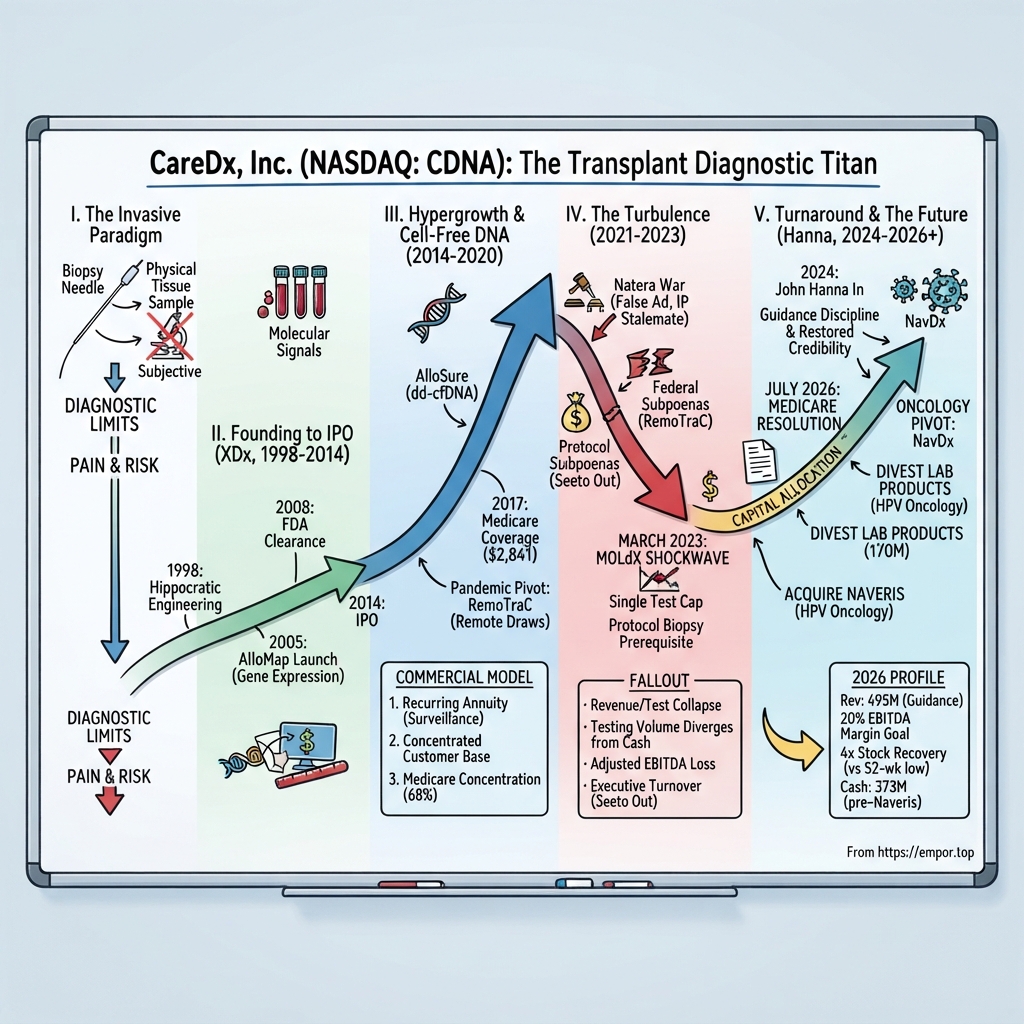
CareDx, Inc. (NASDAQ: CDNA): The Transplant Diagnostic Titan
I. Episode Roadmap & The Precision Medicine Miracle
Picture a cardiac catheterization lab on an ordinary weekday morning. A patient in his fifties, eight months out from a heart transplant, lies awake on the procedure table while a cardiologist threads a thin catheter through the jugular vein in his neck, guiding it down into the right ventricle of his donor heart. At the tip of the wire is a bioptome—a tiny set of surgical jaws that snips off pinhead-sized fragments of heart muscle. Those tissue samples are rushed to a pathologist, who examines them under a microscope to determine whether the patient's immune system has begun quietly rejecting the transplanted organ. If recovery proceeds routinely, the patient will undergo this invasive surveillance procedure a dozen or more times during his first year alone.
For most of the history of solid-organ transplantation, physical invasion was the unavoidable cost of vigilance. Because the human immune system recognizes an allograft as foreign tissue, the only reliable way to catch acute rejection before irreversible organ failure occurred was to extract physical tissue and inspect it. Kidney recipients faced an equally fraught diagnostic trade-off: undergo a percutaneous needle biopsy through the abdomen, or monitor serum creatinine, a lagging blood biomarker that typically spikes only after substantial graft injury has already taken place.
CareDx was founded on the hypothesis that circulating molecular signals in peripheral blood could replace the biopsy needle. That the underlying genomic science works is no longer in dispute. What makes CareDx an instructive case study in healthcare investing is the operational turbulence that followed the scientific proof: a sixteen-year path to a sub-scale initial public offering, severe balance-sheet distress in 2017, a pandemic-era hypergrowth run that pushed the share price above $90, an aggressive commercial counteroffensive by an encroaching peer, scrutiny from federal investigators, and a sudden Medicare billing instruction that erased nearly half the company's enterprise value in days.
By late 2026, CareDx presents a fundamentally altered operational profile. In the second quarter of 2026, the company reported $132 million in revenue, up 52% year-over-year, driven by its core Testing Services segment, which generated roughly $100 million in that single quarter.1 Management subsequently lifted full-year 2026 revenue guidance to between $490 million and $500 million, while raising adjusted EBITDA targets to a range of $66 million to $78 million.1 Regulatory clarity followed: on July 16, 2026, Medicare's molecular diagnostics contractors finalized a local coverage determination that affirmed coverage for routine surveillance testing in kidney, heart, and lung transplant recipients, which took effect on August 30, 2026.2 Concurrently, CareDx executed a portfolio realignment, divesting its legacy laboratory products line and acquiring Naveris, a molecular oncology company, extending its recurring surveillance testing model into human papillomavirus-driven head and neck cancers.3
Public markets responded rapidly to these developments. CareDx shares closed at $63.68 on September 25, 2026, representing a market capitalization of approximately $3.3 billion and a more than fourfold recovery from its 52-week low of $13.95.4
That swift multiple expansion highlights why the company's trajectory warrants rigorous examination rather than uncritical endorsement. The same second quarter that crossed $100 million in testing revenue included $15.6 million in out-of-period collections—cash recovered for tests billed in earlier fiscal periods. Management acknowledged that underlying gross margin excluding that catch-up revenue stood between 70% and 71%, rather than the reported 74% headline figure.3 Furthermore, fee-for-service Medicare continued to generate roughly 30% of total quarterly revenue, while principal competitor Natera remains entrenched across competing transplant centers.5
The central analytical question surrounding CareDx is no longer whether the franchise can survive operational disruption. It has demonstrated balance-sheet resilience. The decisive question for long-term capital is which competitive advantages represent genuine clinical moats, and which were simply administrative windfalls tied to Medicare reimbursement policy.
This analysis evaluates the business across seven sections: first, the clinical pathology of allograft rejection and the diagnostic limits of histology; second, the founding XDx era and the development of the AlloMap expression profile from 1998 through its 2014 IPO; third, the commercial scaling of donor-derived cell-free DNA through AlloSure; fourth, the digital health acquisitions intended to embed CareDx into transplant center workflows; fifth, the dual regulatory and competitive crises of 2021 through 2023; sixth, the operational turnaround under chief executive John W. Hanna, including Medicare coverage resolution and the oncologic expansion; and finally, the unit economics, strategic moats, and key metrics that delineate the bull and bear cases.
The investigation begins where the clinical demand originates: at the cellular interface between a donor organ and a host immune response.
 Subscribe on LinkedIn
II. The Biology of Allograft Rejection & The Invasive Biopsy Paradigm
Every solid-organ transplant is a negotiated biological truce. The human immune system is structured for a primary task: distinguishing self from non-self. Its central tools for that function are proteins called human leukocyte antigens, or HLA, which line the surface of human cells like molecular identity tags. A donor organ carries the donor's foreign HLA signatures, prompting the recipient's immune defenses to register the new graft as an intruder.
Transplant physicians sustain that truce with lifelong immunosuppressive regimens, calibrating dosages over the remainder of a patient's life. Insufficient immunosuppression allows the host immune system to attack the graft; excessive suppression leaves the patient defenseless against opportunistic infections and malignancies. Post-transplant care is an ongoing tightrope walk, requiring clinicians to detect graft injury in near-real time before functional damage becomes irreversible.
Allograft rejection manifests in two primary forms. In T-cell-mediated rejection, recipient immune cells directly infiltrate the donor tissue. In antibody-mediated rejection, the immune system generates donor-specific antibodies against the graft's HLA proteins, damaging the organ's microvasculature. Antibody-mediated rejection is frequently indolent and clinically silent, yet accounts for a substantial share of late-stage graft failure.
Historically, the clinical gold standard for surveillance was the physical tissue biopsy: the endomyocardial catheterization described earlier for hearts, and percutaneous core needle biopsies through the abdomen for kidneys. Tissue biopsies carry conspicuous liabilities: they are invasive, painful, expensive, and carry procedural risks such as bleeding and organ perforation. They also suffer from intrinsic diagnostic shortcomings. Because a needle snips only a pinhead-sized fragment from a large organ, focal or patchy rejection can be missed entirely. Furthermore, histologic interpretation relies on subjective human judgment, graded against standardized classification systems that pathologists do not always apply identically.
The standard non-invasive alternative for kidneys, serum creatinine, presents the opposite problem. It is inexpensive and routine, but it is a lagging indicator. The human kidney possesses substantial functional reserve, meaning blood creatinine levels often spike only after significant structural damage has already occurred. By the time creatinine signals distress, the optimal window for therapeutic intervention has frequently narrowed.
Molecular diagnostics introduced two distinct mechanisms to detect allograft injury earlier through a simple blood draw. The first, gene expression profiling, analyzes a recipient's circulating white blood cells to determine which genes are active. An immune system mobilizing for an attack exhibits a recognizable transcriptional signature—analogous to intercepting military radio communications before troops advance on the ground. That approach formed the biological basis of AlloMap.
The second approach provided a more direct and clinically versatile signal. When cells within a transplanted organ suffer injury or die, they shed fragments of cell-free DNA into the recipient's bloodstream. Because the graft originated from a genetically distinct donor, its circulating DNA differs from the host genome. Measuring the donor-derived fraction of total cell-free DNA yields a direct quantitative gauge of ongoing allograft injury. In CareDx's pivotal kidney study, median donor-derived cell-free DNA was 1.6% in patients with active rejection versus 0.3% in those without, establishing a quantitative baseline to separate healthy allografts from organs under immune attack.6 Much like counting broken glass on a city street to quantify property damage, the assay directly reflects cellular destruction. That is the operating principle behind AlloSure.
The market this science addresses is numerically modest in patient volume but geographically concentrated, a structure that dictates CareDx's commercial model. U.S. hospitals performed a record 49,064 organ transplants in 2025, including 27,573 kidney transplants, while more than 90,000 Americans remained on the kidney waiting list.7 CareDx's own filings counted approximately 232 U.S. centers performing kidney transplants and 144 performing heart transplants.8
A critical operational distinction governs the commercial value of these tests: surveillance testing versus for-cause testing. A for-cause test is ordered reactively when clinical markers or symptoms suggest an active rejection episode. A surveillance test is ordered proactively on a routine schedule for an asymptomatic patient to detect subclinical injury before functional loss occurs. Surveillance generates the overwhelming majority of diagnostic test volume because every stable recipient is a candidate throughout the graft's lifespan. It is also the indication that health plans and Medicare contractors challenge most aggressively, precisely because the patient appears healthy. When Medicare later moved to narrow reimbursement, surveillance testing was squarely in the crosshairs.
These clinical and institutional dynamics produce three core economic realities. First, a transplant recipient requires continuous monitoring for years, converting each successful transplant from an episodic procedure into an ongoing annuity of repeat testing. Second, the customer base comprises a concentrated network of specialist academic programs whose clinicians train together, co-author clinical studies, and follow consensus guidelines. Winning key opinion leaders across the major academic medical centers accelerates widespread adoption; losing them allows an encroaching competitor to capture an entire center's testing volume in a single institutional decision.
Third, and most decisively for the company's financial profile, Medicare finances a dominant share of kidney transplant care because end-stage renal disease qualifies patients for Medicare coverage regardless of age. In 2021, about 68% of CareDx's testing revenue came from Medicare.8 In practice, that payer concentration meant the company's commercial stability depended less on clinician demand than on the reimbursement determinations of a small cadre of Medicare contractor medical directors.
Understanding that monopsonistic payer influence is critical to interpreting CareDx's operational history. Before those commercial dynamics could unfold, however, the underlying genomic science had to be translated into a viable commercial enterprise—a process that required far more time and capital than the company's early backers anticipated.
III. Founding to IPO: XDx, AlloMap, and Surviving the Diagnostics Valley of Death (1998–2014)
The corporate entity that eventually became CareDx was incorporated in Delaware in December 1998 as Hippocratic Engineering.9 Over the subsequent decade and a half, its corporate identity shifted alongside its strategy: becoming BioCardia in 1999, Expression Diagnostics in 2002, XDx in 2007, and ultimately CareDx in March 2014.9 That sequence of corporate renamings captured the trajectory of an early-stage biotechnology venture spending years searching for an economically sustainable business model.
The scientific concept that ultimately took hold was technically ambitious for its era. In the early 2000s, genomics remained largely confined to academic research laboratories, yet XDx set out to translate peripheral blood gene expression profiling into a routine clinical diagnostic for heart transplant rejection. Operating ahead of formal regulatory clearance, the company launched AlloMap as a laboratory-developed test in January 2005 through its own certified facility.9
Initial clinical validation arrived through the Cardiac Allograft Rejection Gene Expression Observational (CARGO) study, which enrolled patients across nine major heart transplant centers.10 The assay did not attempt to diagnose acute rejection outright. Instead, its clinical utility was specific and rule-out oriented: identifying stable heart recipients with a low probability of moderate-to-severe cellular rejection at the time of testing, providing clinicians with objective diagnostic support to safely defer routine surveillance biopsies.10
On August 27, 2008, AlloMap secured 510(k) clearance from the Food and Drug Administration, prompting XDx to characterize itself as the first U.S. molecular diagnostics company to achieve clearance for an in vitro diagnostic multivariate index assay in transplant management.10 The regulatory classification was technically significant. Because a multivariate index assay applies a proprietary algorithm to synthesize multiple biomarker measurements into a single qualitative score, the FDA was then establishing its initial regulatory framework for complex algorithmic diagnostics. Securing that clearance established an early procedural precedent.
The defining clinical milestone followed two years later. The Invasive Monitoring Attenuation by Gene Expression (IMAGE) trial, led by Stanford cardiologist Michael Pham and published in the New England Journal of Medicine in 2010, randomized 602 heart transplant recipients to surveillance via gene expression profiling or routine protocol biopsy.11 The trial demonstrated that for clinically stable patients at least six months post-transplant, non-invasive gene expression monitoring yielded clinical outcomes comparable to serial invasive biopsies.11 By the time CareDx filed for its initial public offering, management could highlight that AlloMap was the sole non-invasive method recommended in the International Society for Heart and Lung Transplantation guidelines for surveillance of rejection in non-infant heart recipients.9
The executive transition that shaped the company's public era occurred in 2012, when Peter Maag joined as chief executive officer.12 Maag served as the operational professionalizer, transitioning the science-driven startup toward public markets, broadening its strategic aperture toward kidney transplantation, and initiating the acquisition strategy that defined the subsequent decade. He led CareDx as chief executive for eight years before transitioning to executive chairman.12
On July 16, 2014, CareDx priced its initial public offering at $10.00 per share, selling 4,000,000 shares to raise $40 million in gross proceeds through an underwriting syndicate led by Piper Jaffray and Leerink Partners.13 For an enterprise entering its sixteenth year of operations, the modest capital raise reflected the financial constraints visible in its operating history.
Myth vs. reality: does FDA clearance plus guideline status equal a monopoly?
The initial investment thesis for AlloMap appeared compelling on paper: proprietary FDA clearance, randomized trial validation published in the New England Journal of Medicine, and formal inclusion in international clinical guidelines. In theory, those assets formed an imposing clinical moat. In practice, commercial adoption revealed the fundamental unit-economic constraints of the underlying market.
AlloMap testing revenue grew from $19.7 million in 2012 to $21.7 million in 2013, generating modest top-line growth even as commercial volume surpassed 10,000 tests that year.9 The business remained unprofitable, carrying an accumulated deficit of approximately $161 million by March 2014.9 The core operational bottleneck was addressable market scale: the company's IPO prospectus identified only about 2,500 heart transplants performed annually in the United States in 2013 and a total prevalence pool of roughly 25,000 living recipients.9 Furthermore, Medicare accounted for approximately half of total testing revenue even then, establishing an early vulnerability to concentrated public-payer policy.9
The retrospective evidence was unmistakable. Rigorous clinical proof and regulatory first-mover status were necessary prerequisites, but wholly insufficient to drive standalone financial scale. Securing an effective commercial monopoly over an addressable cohort of just 25,000 patients produced a sub-scale enterprise that had absorbed more than $160 million in cumulative equity capital. First-to-market validation mattered little without an adequately sized patient population.
That precedent provides critical context for evaluating CareDx's positioning in 2026, as management emphasizes NavDx as the first and only Medicare-covered diagnostic in its clinical category. The historical experience with AlloMap demonstrated that first-to-market status is an operational starting line rather than an enduring economic outcome.
The IPO prospectus, however, outlined the strategic path forward. While heart transplantation remained structurally constrained, the same filing documented approximately 16,900 kidney transplants performed in the United States in 2013 and an established cohort of roughly 180,000 living kidney recipients—an addressable market several times larger.9 In May 2014, weeks prior to its public listing, CareDx moved to enter that broader market, agreeing to acquire a Palo Alto startup that had developed the technology to quantify circulating donor-derived cell-free DNA—the molecular broken glass in the bloodstream.14
IV. The Cell-Free DNA Breakthrough: AlloSure and the Hypergrowth Era (2014–2020)
The startup was ImmuMetrix, co-founded by Stanford bioengineer Stephen Quake, who agreed to join CareDx as a scientific advisor upon announcement of the transaction.14 Quake was already widely recognized in molecular diagnostics for pioneering the clinical use of cell-free DNA in blood, the foundational methodology that transformed non-invasive prenatal testing. ImmuMetrix provided both the core concept and access to licensed Stanford University intellectual property to adapt that genomic approach to transplanted organs.9
The conceptual parallel was straightforward: in prenatal screening, circulating foreign DNA originates from the fetus; in transplantation, foreign DNA originates from the donor allograft. The mathematics required to distinguish two distinct genomes within a single blood sample was fundamentally similar. CareDx's assay utilized targeted next-generation sequencing across single-nucleotide polymorphisms that differ between individuals. Crucially, this allowed the laboratory to quantify the donor-derived fraction without requiring a reference genotyping sample from the deceased donor—an essential operational advantage, as donor tissue is rarely accessible years post-transplant.
Translating that laboratory concept into a commercial diagnostic took three years and brought the enterprise to the brink of insolvency. As of December 31, 2017, CareDx held only $16.9 million in cash against an accumulated deficit of $268.0 million, after posting a net loss of $55.5 million for the year.15 To bridge the liquidity squeeze, the company entered into a commitment letter on March 1, 2018, for a senior secured term loan of up to $35 million with Perceptive Credit Holdings.15 It was the diagnostics valley of death in miniature: promising clinical technology, a substantial addressable market, and a balance sheet nearly depleted of operating capital.
Clinical validation arrived through the Circulating Donor-Derived Cell-Free DNA in Blood for Diagnosing Active Rejection in Kidney Transplant Recipients (DART) study, published in the Journal of the American Society of Nephrology in July 2017. Beyond establishing the median separation between rejecting and non-rejecting cohorts, donor-derived cell-free DNA proved particularly effective in identifying antibody-mediated rejection, achieving an area under the receiver operating characteristic curve of 0.87 for that phenotype and discriminating rejection significantly better than serum creatinine.6 On that diagnostic scale—where 0.5 represents chance performance and 1.0 indicates perfect discrimination—the result was clinically meaningful. Diagnostic performance across all rejection subtypes combined was more modest, underscoring that circulating cell-free DNA functioned primarily as an early alert system rather than an exhaustive definitive diagnosis.
The decisive commercial catalyst was not academic publication, however, but reimbursement authorization. Effective October 9, 2017, AlloSure secured Medicare coverage under Palmetto GBA's Molecular Diagnostic Services (MolDX) program, an essential gateway given CareDx's estimate that approximately 80% of U.S. kidney transplant recipients were covered by Medicare.16 The initial reimbursement rate was established at $2,841 per test, matching the rate previously granted to AlloMap.15 "This is the moment we have all been preparing for," Maag declared at the time.16
Initial commercial uptake was measured before accelerating sharply. By the close of 2017, 32 U.S. transplant centers had initiated AlloSure testing, generating just $0.5 million in fourth-quarter AlloSure revenue from 282 patient results.17 Total company revenue for 2017 stood at approximately $48 million, still dominated by legacy testing.17
During 2018, volume inflected. CareDx processed 11,634 AlloSure patient results during the year, and by the fourth quarter, 100 kidney transplant centers were routinely ordering the assay.18 Although the business posted a net loss of $46.8 million for 2018, it closed the year with $64.6 million in cash, providing an operating buffer far sturdier than its perilous position twelve months earlier.18 The velocity of institutional uptake highlighted a defining structural dynamic: transplant clinicians recognized the diagnostic deficit of creatinine, and once public reimbursement eliminated out-of-pocket friction, programmatic adoption followed rapidly.
Revenue expanded from $127.1 million in 2019 to $192.2 million in 2020, representing a 51% annual increase.19 In 2021, top-line growth advanced another 54% to reach $296.4 million, with core testing services accounting for $259.3 million of that sum.20
The mechanics behind that trajectory reflected an exceptional operational alignment: strong clinician buy-in, an addressable cohort requiring serial testing over multiple years, and a fixed Medicare reimbursement rate near $2,840 against a modest variable sequencing cost per sample. Because marginal processing costs were low relative to the established reimbursement rate, incremental test volume flowed directly to gross margin. That operating leverage enabled CareDx to report its first non-GAAP operating profit in 2020, generating $11.3 million in non-GAAP net income despite continuing to report a net loss under GAAP.19
The onset of the COVID-19 pandemic introduced an operational accelerant. In March 2020, with vulnerable, immunosuppressed transplant recipients actively avoiding hospital outpatient clinics, CareDx introduced RemoTraC, a remote blood-draw initiative utilizing mobile phlebotomists. By early 2022, more than 200 transplant centers had integrated the service, and over 11,000 patients had enrolled.8 Annual testing throughput surged in tandem: the company delivered approximately 79,000 diagnostic results in 2020 and expanded to roughly 153,000 in 2021.1920 While RemoTraC maintained testing continuity during lockdowns, the aggressive operational incentives behind remote collection would subsequently attract scrutiny from federal regulatory authorities.
CareDx broadened its diagnostic portfolio in parallel. AlloSure Heart obtained a favorable Medicare coverage decision in October 2020, allowing the company to bundle cell-free DNA quantification with AlloMap gene expression profiling under the trade name HeartCare. Management followed a similar dual-modality strategy in renal care, coupling AlloSure Kidney with an expression assay and an algorithmic risk model branded as KidneyCare, before formally launching AlloSure Lung in October 2021.8 Establishing multi-organ reach carried clear commercial logic: major academic medical centers operate multi-disciplinary transplant institutes, enabling CareDx's field force to cross-sell additional organ indications through established administrative relationships.
Equity markets enthusiastically capitalized the expansion. In January 2021, CareDx completed a public follow-on equity offering, selling more than 1.9 million common shares at $91.00 per share.21 That transaction established an all-time high-water mark for the equity valuation. While the timing of the issuance proved punishing for subsequent public market buyers, it was strategically opportune for the corporate treasury: CareDx concluded 2021 with $348.5 million in cash and cash equivalents, thoroughly recasting a balance sheet that had stood at just $16.9 million four years earlier.2015 That accumulated liquidity would prove vital when operational turbulence returned.
What the hypergrowth era proved, and what it did not
The hypergrowth era validated that donor-derived cell-free DNA surveillance addressed an authentic clinical need with enthusiastic physician adoption, and it demonstrated that CareDx possessed the operational capability to scale a high-complexity reference laboratory. What it did not prove was enduring pricing power or an impenetrable scientific moat. The decisive economic variable—a reimbursement rate approaching $2,840 per test—depended on the administrative determinations of a single Medicare contractor program, leaving margins vulnerable to unilateral policy shifts. Furthermore, the underlying biological reality that allografts shed identifiable cell-free DNA into peripheral blood was not proprietary to CareDx; competing molecular diagnostics providers could engineer comparable sequencing assays.
CareDx leadership recognized that reliance on standalone laboratory testing carried long-term strategic vulnerabilities. Management's strategic response was an aggressive acquisition campaign designed to embed CareDx directly into the administrative and clinical workflows of transplant centers.
V. The Software & Workflow Moat: M&A, Capital Allocation, and Digital Lock-In
Inside a busy transplant center, the primary operational center of gravity is rarely the operating room. It is the transplant coordinators: the specialized nurses and administrators managing waitlists, donor offers, medication regimens, lab orders, and regulatory compliance for hundreds or thousands of vulnerable patients. Their daily routines run on clinical software, spreadsheets, and endless phone calls. CareDx's core commercial insight was that whichever diagnostic provider minimized administrative friction for those coordinators would gain a durable structural advantage in capturing routine testing orders.
The acquisition campaign that followed encompassed three distinct initiatives, each carrying very different strategic and financial implications.
Allenex: the European lab-kit detour that became a cash harvest
In December 2015, CareDx agreed to acquire Stockholm-based Allenex, the developer of Olerup HLA typing kits used to match donors and recipients. The all-cash option valued the target at approximately SEK 300.7 million, alongside an equity alternative paid partly in CareDx common stock.22 At the prevailing exchange rate cited in the offer, the transaction represented roughly $35 million. Allenex brought about 58 employees and $16.8 million in 2015 revenue, with the acquisition closing on April 14, 2016.23
For most of the subsequent decade, this business operated as a slow-growing diagnostic kit operation—strategically adjacent to transplant medicine, but operationally distinct from a centralized U.S. clinical reference laboratory. In April 2026, CareDx agreed to sell its Lab Products business, including the Olerup HLA typing kits, to EuroBio Scientific for $170 million in cash.24 The segment had generated $48 million in revenue in 2025.25 The transaction closed on June 30, 2026, and CareDx recorded a gain of $113.0 million.5
On a simple multiple of the initial purchase price, converting a roughly $35 million investment into $170 million in cash appears to be an exceptional capital allocation triumph. Yet investors should resist treating that headline ratio as unalloyed return. Over the intervening decade, CareDx deployed significant capital into modernizing the typing product suite, including next-generation sequencing assays, meaning the true return on invested capital was more modest than the headline comparison suggests, particularly given that equity helped finance the original purchase. The more disciplined conclusion is narrower: CareDx sold the asset at approximately 3.5 times its 2025 revenue to a buyer that valued it more highly than public markets did, allowing CareDx to redeploy the proceeds into core clinical testing. On the company's second-quarter 2026 earnings call, the CFO added a telling operational detail: the kit manufacturing business had required about three times as many regulatory personnel per unit of work as the domestic testing laboratory, and divesting it improved the company's cash conversion cycle by roughly 70 days.3
OTTR and the digital bolt-ons: the workflow thesis
In April 2019, CareDx agreed to acquire OTTR Complete Transplant Management for approximately $16 million in cash.26 OTTR developed specialized software that tracked transplant patients through their clinical journey, integrating directly with the two dominant hospital electronic health record platforms, Cerner and Epic. At the time of the transaction, OTTR operated across more than 60 transplant centers, generating a projected $6 million to $8 million in 2019 revenue at roughly break-even operating margins.26 Maag was explicit regarding the strategic rationale: integrating OTTR into center record systems "will simplify the logistics of ordering AlloSure or AlloMap testing."26
A sequence of complementary digital acquisitions followed. CareDx acquired XynManagement, a provider of quality-tracking software and patient-support services, in August 2019; TransChart, another transplant records software vendor, in January 2021; MedActionPlan, a medication adherence platform, in November 2021; and The Transplant Pharmacy, a specialty pharmacy based in Mississippi, in December 2021.8 By early 2022, CareDx's digital software footprint spanned more than 150 U.S. transplant programs, expanding to more than 170 centers by early 2026.827
The behavioral mechanism driving this software investment is straightforward. If a transplant coordinator can order an AlloSure surveillance test with a single click inside an existing electronic patient chart, and the resulting donor-derived cell-free DNA trend line automatically populates that same screen, ordering a rival assay that requires logging into a separate web portal introduces immediate administrative friction. Multiplied across dozens of patients each week, that friction creates a tangible barrier to switching. By mid-2026, CareDx reported electronic connectivity with approximately 90% of its transplant customers by test volume, with roughly half of total volume flowing through integrated electronic medical records and 40% through its proprietary care portal.3
Stress-testing the claim: is Patient & Digital Solutions a software compounder?
CareDx's Patient and Digital Solutions segment reported revenue of $57 million in 2025, up 31% year-over-year.25 In the second quarter of 2026, segment revenue expanded another 50% to $19 million.1 On the surface, that top-line trajectory resembles a high-margin software business quietly compounding inside a clinical reference laboratory.
The underlying segment economics point to a different reality. On the second-quarter 2026 earnings call, the CFO noted that the segment's growth was "driven principally by our pharmacy," while guiding full-year segment gross margin to approximately 26% at the midpoint.3 A 26% gross margin reflects the operational profile of a dispensing specialty pharmacy and services operation, not the high-operating-leverage profile of enterprise software. Viewed accurately, Patient and Digital Solutions is a lower-margin support service whose primary strategic value lies in protecting and feeding testing volume, rather than generating standalone economic rent.
Moreover, the durable defensibility of that workflow advantage faces structural limits. CareDx has been expanding direct integrations through Epic Aura, Epic's specialized module for outpatient diagnostic ordering, with 17 transplant centers live and between 30 and 40 projected by the end of 2026.3 While Aura streamlines CareDx's order entry, Epic developed the architecture to link hospital networks with outside reference laboratories universally. As a result, the bespoke electronic health record connectivity CareDx spent years building and acquiring is increasingly becoming standardized, vendor-neutral hospital infrastructure that competitors can license and access. Workflow integration is transitioning from an proprietary moat into industry table stakes.
The operational record demonstrates that CareDx's digital acquisitions represented a sensible, highly defensive capital deployment that helped solidify ordering habits during the franchise's hypergrowth years. However, the thesis that these acquisitions created an independent, high-value software engine is unsupported by the segment's cost structure. Furthermore, the workflow barrier, while real, is narrowing as health systems adopt standardized laboratory connectivity protocols.
That strategic distinction would matter enormously once an aggressive, well-capitalized competitor mounted a direct commercial counteroffensive—because an operational moat built purely on coordinator convenience can be crossed by a rival willing to fund its own workflow integrations.
VI. The Twin Crises: The Natera War, Federal Subpoenas, and the Medicare MolDX Shockwave (2020–2023)
The rival was Natera, a molecular diagnostics provider that understood the cell-free DNA playbook intimately, having scaled a substantially larger enterprise on that same genomic foundation in non-invasive prenatal testing. When Natera launched Prospera, its competing donor-derived cell-free DNA assay for kidney transplant rejection, it brought a larger commercial sales force, greater laboratory scale, and an aggressive willingness to contest market share.
A commercial collision was unavoidable. Both companies were marketing a blood-based surveillance test to the same concentrated network of transplant centers, grounded in the identical biological mechanism, and billing into the same Medicare reimbursement framework. The strategic question was what, if anything, could prevent Natera from capturing CareDx's hard-won market share.
The courtroom war: who actually won?
CareDx initiated litigation against Natera in 2019 over comparative marketing claims. In March 2022, a Delaware federal jury found that Natera had engaged in false advertising regarding Prospera's performance, awarding CareDx $44.9 million, comprising $21.2 million in compensatory damages and $23.7 million in punitive damages.28 The jury simultaneously determined that CareDx had engaged in false advertising in two instances, including a press release characterizing a clinical study as independent despite CareDx providing financial support.28 That finding rarely features in corporate presentations, yet it provided critical context on the aggressive commercial practices characterizing both sides of the rivalry.
The monetary award never materialized. In July 2023, the district court affirmed Natera's liability but vacated the monetary damages award, and in August 2023 it issued an injunction prohibiting Natera from repeating those promotional claims.5 Following appellate review, the Third Circuit affirmed the judgment in August 2025 and denied rehearing in October 2025; on June 1, 2026, the U.S. Supreme Court declined CareDx's petition for certiorari.5 CareDx recorded no receivable for the judgment.5 It prevailed on the legal principle, but recovered none of the cash.
The intellectual property battle inflicted deeper structural damage on CareDx's competitive moat. CareDx and Stanford University asserted foundational patents licensed from the Quake era covering donor DNA quantification against Natera and other competitors. In September 2021, a Delaware federal court declared those patents invalid for claiming patent-ineligible subject matter, and on July 18, 2022, the Federal Circuit affirmed that ruling, concluding that the claims were directed to an unpatentable natural phenomenon paired with conventional sequencing techniques.29 In practical terms, the federal judiciary ruled that CareDx could not monopolize the biological principle of measuring donor-derived DNA in a recipient's bloodstream.
Natera subsequently launched an intellectual property counteroffensive. In January 2024, a federal jury found that CareDx infringed a Natera patent and awarded Natera $96.3 million, calculated on AlloSure and related sales generated between September 2021 and August 2023.5 CareDx accrued the liability on its balance sheet. That exposure proved short-lived: on February 24, 2025, U.S. District Judge Colm Connolly invalidated both asserted Natera patents for lack of adequate written description, vacating the entire $96.3 million verdict, a decision Natera signaled it would appeal.305
The litigation ledger thus reflected a grinding stalemate that clarified a fundamental commercial reality: neither competitor possesses enforceable patent exclusivity over donor-derived cell-free DNA testing in transplantation. The commercial contest is decided entirely on clinical evidence, laboratory turnaround, workflow integration, and payer reimbursement. For investors, CareDx's original intellectual property moat had dissolved, leaving any operational advantage to be defended commercially day by day. One legal overhang lingered: Natera's appeal of the patent invalidation, which theoretically risked reviving the $96.3 million verdict, though the asserted patent's expiration in September 2026 eliminated forward-looking injunction risk.5
The investigations
On October 28, 2021, CareDx disclosed in a regulatory filing that it had received a civil investigative demand from the Department of Justice under the False Claims Act concerning business practices in its kidney testing and phlebotomy services, alongside a Securities and Exchange Commission subpoena examining related matters and public reporting practices.21 The focus on phlebotomy pointed squarely at RemoTraC, the remote blood-draw initiative that had accelerated testing volume during the pandemic. A business that had successfully executed an equity offering at $91 per share nine months earlier was suddenly facing dual federal inquiries into the commercial mechanisms driving its top-line growth.
Resolving those regulatory inquiries required years of administrative uncertainty. On September 19, 2023, the SEC notified CareDx that it had closed its investigation without recommending enforcement action.5 Resolution with the Justice Department followed: a court filing unsealed on October 7, 2024, revealed that the federal government had declined to intervene in the underlying qui tam whistleblower lawsuit.5 While the relator pursued the action independently for a time, filing an amended complaint in April 2025, the plaintiff voluntarily dismissed the litigation on April 23, 2026, with Justice Department consent.5 Parallel shareholder litigation reached a separate resolution: CareDx agreed to a $20.25 million class action settlement paid in December 2025, alongside resolved derivative complaints.5
The balanced analytical takeaway is that federal authorities declined to pursue formal enforcement, and the company resolved related civil shareholder claims at manageable balance-sheet expense. While that outcome was substantially more favorable than public markets anticipated at the disclosure's outset, the $20 million settlement represented tangible shareholder value forfeited to address aggressive pandemic-era commercialization and disclosure practices.
The billing article
Then arrived an operational disruption no court or corporate legal team could forestall. In early March 2023, Medicare contractor Palmetto GBA's MolDX program published revised billing and coding article A58019, taking effect on March 31, 2023.31 Published as a sub-regulatory billing guideline rather than a formal national coverage determination, the document abruptly altered the reimbursement mechanics supporting CareDx's core testing operations.
The revision introduced three strict payment constraints. First, contractors permitted billing for only a single molecular allograft assessment test per patient encounter, directly undermining CareDx's multi-modality HeartCare protocol that paired gene expression profiling with cell-free DNA quantification.31 Second, contractors required surveillance testing to be billed under distinct coding from for-cause indications, restricting surveillance coverage solely to clinical settings where an invasive protocol biopsy would otherwise have been performed.31 Third, for-cause molecular testing could no longer be billed concurrently with a biopsy or within seven days of the procedure.31
The protocol biopsy prerequisite struck at the core of non-invasive clinical adoption. Leading transplant centers had integrated AlloSure into clinical workflows precisely to spare stable patients serial protocol biopsies. By stipulating that Medicare would reimburse molecular surveillance only where a program would have otherwise performed an invasive biopsy, MolDX upended the economic foundation of centers that had replaced biopsy schedules with routine blood draws.
Public equity markets reacted with severity. CareDx shares dropped from approximately $16 to roughly $9, compressing the company's enterprise valuation to around $480 million, while Natera's equity rose over the same interval, insulated by revenue diversification across oncology and women's health.31 In August 2023, MolDX published a draft local coverage determination proposing restrictive long-term coverage revisions, extending administrative uncertainty across the subsequent year.27
The commercial consequences reverberated across both primary organ franchises. HeartCare had been marketed on the diagnostic thesis that combining immune activation via AlloMap with cellular graft injury via AlloSure provided superior clinical surveillance than either biomarker alone; capping reimbursement at one molecular assay per visit dismantled that dual-test pricing model overnight. Renal testing experienced an operational squeeze of comparable severity. Transplant coordinators faced burdensome new clinical documentation requirements, while nephrologists at non-biopsying centers had to weigh whether to order surveillance panels that Medicare might reject. Many clinicians continued ordering surveillance tests on clinical grounds, and CareDx continued processing them, but average realized revenue per test collapsed as unpaid claims mounted.
The episode underscored the unique asymmetry of diagnostic payer risk. Natera's commercial encroachment was a standard competitive risk, contested through clinical sales forces and trial data. The Department of Justice and SEC inquiries represented legal risk, managed through counsel and compliance reforms. The MolDX billing article represented a third, far more hazardous category: sub-regulatory administrative action by an outsourced Medicare contractor, enacted without formal notice-and-comment rulemaking, that redefined segment economics instantaneously. No clinical validation or workflow convenience could insulate the business from an administrative mandate that made its core tests unbillable. The shock damaged CareDx disproportionately because organ transplant surveillance constituted almost the entirety of its enterprise revenue, whereas transplant diagnostics represented a minor fraction of Natera's diversified testing portfolio.
The financial damage and the leadership vacuum
The operational fallout manifested starkly in financial results. Full-year 2023 revenue declined 13% to $280.3 million from $321.8 million in 2022, with Testing Services revenue contracting 20% to $209.7 million.32 GAAP net loss expanded to $190.3 million, weighed down by the $96.3 million patent litigation accrual, while adjusted EBITDA swung to a loss of $38.0 million.32 Although the balance sheet remained unencumbered by debt, cash and marketable securities contracted to $235.4 million by year-end.32
A critical divergence between testing volume and cash collections defined that downturn. CareDx processed approximately 165,700 patient test results in 2023, exceeding the roughly 153,000 results delivered during the peak growth year of 2021.3220 Clinical demand did not disintegrate; rather, realized revenue per test collapsed because assays ordered by clinicians were either deemed non-reimbursable under contractor rules or subjected to widespread claim denials. That divergence fundamentally reframes the thesis that electronic health record integration served as an unassailable commercial moat. Workflow connectivity preserved coordinator ordering behavior, but it could not compel Medicare payment. CareDx absorbed the laboratory processing costs of unpaid assays, demonstrating that workflow lock-in insulated order volume while leaving underlying unit economics completely unprotected.
The operational crisis triggered executive turnover. Maag had transitioned to executive chairman in November 2020, elevating Reg Seeto—who joined CareDx in 2018 as president and chief business officer—to chief executive.12 On November 1, 2023, Seeto abruptly stepped down, and the board established an interim Office of the CEO comprising board chairman Michael Goldberg, CFO Abhishek Jain, and Alexander Johnson, president of patient and testing services, while initiating an external executive search.33 The company provided no explanation for Seeto's sudden departure.33
At the trough of the downturn, CareDx possessed clinically validated diagnostics, a better-capitalized competitor unconstrained by intellectual property barriers, a restrictive Medicare reimbursement framework, and an executive leadership vacuum. The incoming chief executive would inherit an enterprise whose underlying science remained respected, but whose commercial and regulatory foundation required comprehensive reconstruction.
VII. The Turnaround under John W. Hanna: Derisking, Restoration, and the Oncology Pivot (2024–2026)
CareDx named John W. Hanna president and CEO on April 15, 2024.34 His résumé read like a checklist of what CareDx needed. He had spent a decade at Veracyte, an oncology-focused molecular diagnostics company, in roles including vice president of marketing and chief commercial officer; he had run Apton Biosystems as CEO until its acquisition by Pacific Biosciences in August 2023, then served as Pacific Biosciences' vice president of corporate development; and he had earlier held roles at Humana and IBM.34 In other words: a commercial operator who had lived through the grind of getting molecular tests adopted and paid for, a CEO who had sold a company, and someone with payer-side exposure.
Hanna's language in his first release was notably restrained, emphasizing "scientific rigor and evidence generation" rather than growth targets.34 That restraint became a pattern, and it is the most important evidence about his management style.
Guidance discipline: the promises-versus-outcomes record
The cleanest way to judge a turnaround CEO is to compare what the company said it would do against what it did. Before Hanna arrived, CareDx guided 2024 revenue to $260 million–$274 million.32 It delivered $333.8 million, up 19%, with testing volume up 6% to about 176,000.35 For 2025, it guided $365 million–$375 million and delivered $380 million, with volume up 14% to about 200,000.3525 For 2026, it initially guided $420 million–$444 million; by July it had raised that to $490 million–$500 million.251
That is a consistent beat-and-raise record over three years, and it supports the conclusion that this management team sets conservative targets. But the pattern needs two caveats that a skeptic would press. First, a meaningful part of the upside has come from out-of-period collections, meaning better billing and appeals on older tests rather than new demand; Q4 2025 included about $5 million, and Q2 2026 included $15.6 million.253 Second, the raised 2026 guidance includes about $24 million from the newly acquired oncology business and an assumption of further out-of-period revenue.3 Conservative guidance plus improved collections is a real skill, but it is not the same as accelerating organic demand.
What the 2026 guide is actually made of
The CFO broke the raised $495 million midpoint into pieces on the July call, and the breakdown is more useful than the headline. Transplant testing accounts for about $376 million, specialty oncology about $24 million in the second half, Patient and Digital Solutions about $72 million, and the now-divested lab products about $23 million from the first half.3 Put differently, roughly $47 million of the guide comes from one business that has already been sold and one that was only just acquired. The guide also assumes testing volume of 258,000 to 266,000 for the year, including the new oncology tests.3
That decomposition matters for 2027 comparisons. Because the lab products sale was not classified as a discontinued operation, those revenues remain inside reported 2026 results, and they will disappear from 2027.5 Investors comparing next year's growth rate to this year's will need to adjust for a business that is no longer there, a business that has just arrived, and a catch-up in collections that is running down.
An accounting aside: out-of-period revenue
Diagnostic labs recognize revenue when they deliver a test result, but they often do not know how much they will eventually be paid, especially from commercial insurers that deny, delay, or partially pay claims. Labs therefore estimate expected collections and book revenue on that estimate. When actual cash comes in above the estimate for tests reported in earlier periods, the difference appears as out-of-period revenue.
This is standard accounting, not a red flag in itself. But it is a judgment area, and CareDx's recent results lean on it. The $15.6 million recognized in Q2 2026 was more than double the $7.5 million the company had guided for the quarter, and the CFO described it as an $8 million beat.3 That is good news about collections; it is also a reminder that reported revenue in a given quarter partly reflects how conservative earlier estimates were. The cleanest read on the underlying business is revenue per test excluding these catch-ups, a figure management has helpfully begun to disclose.
Clearing the decks
Several of the overhangs resolved on Hanna's watch, though not all because of him. The SEC matter had closed before he arrived; the DOJ declination and the reversal of the $96.3 million patent verdict came during his tenure; the class action and derivative settlements were completed; and the whistleblower case was dismissed in April 2026.5 2024 GAAP net income of $52.5 million looked like a dramatic turnaround, but it included the $96.3 million reversal of the patent accrual and was offset by $66.4 million of stock-based compensation.35 That stock compensation figure is a point an activist would raise: it is large relative to the company's adjusted EBITDA of $27.8 million that year.35
The Medicare policy fight, resolved
The coverage story had several turns. On August 16, 2024, the Medicare contractors declined to finalize the restrictive policy revision proposed in 2023.27 The new draft arrived on July 17, 2025, with a comment period through August 31, 2025.36 Hanna said at the time that it "solidifies coverage for surveillance testing."36 The company's annual report was more guarded, noting that the draft introduced new utilization limits and "a new bundled payment concept" that could reduce reimbursed surveillance tests.27
The final policy, published July 16, 2026, and effective August 30, 2026, affirmed coverage of AlloSure Kidney surveillance for up to six tests in the first year after transplant and up to four per year in years two and three; heart and lung surveillance was covered for up to 12 tests in year one and four per year in years two and three, with AlloMap and AlloSure Heart allowed in combination when medically appropriate.2 For-cause testing remained available when clinically indicated.2
Here the evidence requires an interpretation that differs from the most bullish reading. The same release noted that kidney patients currently receive about three to four tests in their first year.2 A cap of six is therefore headroom above current practice, not a release of pent-up demand. On the call, Hanna described the policy as "really a payment policy" and said the company "didn't anticipate that it would have an impact on volume."3 The financial effect showed up instead as the removal of a $7.5 million headwind that had been embedded in guidance.3 The policy's real value is that it removes a threat that had hung over the stock for three years and creates a pathway for future coverage of HistoMap, a tissue-based test, and potentially additional organs.3
Selling the past, buying the future
With coverage stabilizing, Hanna made the boldest portfolio move in CareDx's history. On April 15, 2026, the company announced the sale of its Lab Products business, as discussed earlier.24 The same announcement previewed a strong first quarter: revenue of about $118 million, up 39%, with testing services up 48% to about $91 million.24 Two weeks later, on April 28, it agreed to buy Naveris for $160 million in upfront cash plus up to $100 million tied to revenue milestones.37
Naveris, founded in 2017, makes NavDx, a blood test that detects fragments of DNA from human papillomavirus shed by HPV-driven tumors, principally in the throat and anus.37 The concept rhymes exactly with AlloSure: foreign DNA in the blood, here viral rather than donor, measured repeatedly to catch disease early. NavDx had obtained Medicare coverage in 2023 at an $1,800 rate, and more than 130,000 tests had been reported.38 Naveris had about $34 million–$35 million of 2025 revenue, more than double the prior year, approximately $12 million in the first quarter of 2026, a 65% gross margin, and a roughly breakeven operating result.3738 The deal closed on July 1, 2026.38
The capital-recycling logic is straightforward: $170 million from a slow-growing, regulation-heavy kits business funded a $160 million upfront bet on a faster-growing test business without new debt or shares. The price, about 4.6 times Naveris's 2025 revenue before milestones, was not cheap, and it bought a business with lower margins than the transplant lab.
The economics need close watching. The CFO guided specialty oncology to about $770–$795 of revenue per test in the second half of 2026, far below the $1,800 Medicare rate, because many tests are paid less or not at all by other payers; he said he believes the figure "should move up to $1,000 to $1,100."3 He guided the business's gross margin to about 63%, versus about 79% for transplant testing.3 And he acknowledged that moving Naveris onto CareDx's billing system is "a big undertaking" planned for the fourth quarter.3 Management's case for the deal, in short, is that CareDx's billing expertise can raise the revenue per NavDx test. That is plausible given what the company has done with its own collections, but it is a thesis to be proven, not a fact.
The financial inflection
The second quarter showed what the reshaped company can earn. Adjusted EBITDA rose to $24.8 million, a 19% margin, free cash flow was $28.7 million, and the company ended June with $373.6 million of cash and no debt, before paying for Naveris the following day.1 GAAP net income of $110.6 million was dominated by the $113 million gain on the kits sale, so it says little about recurring profitability.1 Management guided non-GAAP gross margin of 71%–73% for 2026 and said it believes the company "should be running at 20% EBITDA margins long-term," while warning that investments in oncology could weigh on margins for a year.3
Capital allocation also included buybacks. CareDx repurchased $88 million of stock in 2025 at an average of $15.16 per share, and another 570,000 shares at $21.50 in the second quarter of 2026.253 With the stock now above $60, those purchases look well-timed in hindsight, a notable contrast with the $91 equity raise of 2021.21
The turnaround's scorecard is strong on execution, conservative guidance, and legal cleanup. The open questions are whether transplant growth continues once collections normalize, and whether the Naveris bet earns its price. Those questions are best answered through the frameworks that explain why any lab test wins or loses.
VIII. Strategic Analysis: Hamilton Helmer's 7 Powers & Porter's 5 Forces
Imagine the perspective inside Natera's executive suite: CareDx holds no blocking patents, the underlying biology is in the public domain, the dominant payer is identical, and Natera operates a much larger laboratory footprint. What, then, prevents a well-funded rival from capturing the entire transplant surveillance market? The answer delineates CareDx's actual competitive moat—one considerably narrower and more operational than the titan framing implies.
Hamilton Helmer's 7 Powers
Switching costs: moderate, and at risk of erosion. CareDx's electronic connectivity with roughly 90% of its transplant customer base by volume, its software installed across more than 170 centers, and its network of patient-support and mobile phlebotomy services make switching reference laboratories a genuine operational burden for clinical coordinators.327 Serial test results also construct a longitudinal diagnostic history for each patient: a clinician monitoring a patient's historical AlloSure trajectory has an immediate clinical incentive to avoid switching mid-surveillance to a competing assay with distinct reference ranges and testing baselines. However, the 2023 billing shock revealed that workflow lock-in protects test ordering volume rather than realized pricing, while the rollout of standardized modules like Epic Aura is lowering the technical barrier for competing reference laboratories. Consequently, switching costs remain meaningful at the individual patient level, but only moderate at the institutional transplant center level.
Scale economies: moderate. CareDx processed approximately 200,000 tests in 2025 across a centralized laboratory carrying significant fixed overhead, generating a core transplant testing gross margin of roughly 79%.253 While volume throughput is essential for absorbing fixed sequencing and facility costs in clinical reference testing, Natera operates with vastly larger overall enterprise scale. Scale economies therefore provide CareDx with operating leverage against sub-scale entrants, but offer no structural cost advantage over its primary competitor.
Cornered resource: unproven. Management highlights NavDx as the first and only Medicare-covered assay for molecular residual disease in HPV-driven head and neck and anal cancers.38 Securing early reimbursement is a valuable commercial asset, but CareDx's own corporate history provides clear cautionary evidence. AlloSure was also the first Medicare-covered donor-derived cell-free DNA test for kidney recipients, yet within two years a well-capitalized competitor was marketing a rival assay to the same transplant programs and litigating claims in federal court.28 Medicare coverage determinations do not grant statutory exclusivity; any competitor generating adequate clinical trial evidence can secure equivalent reimbursement. This dynamic is more accurately characterized as an operational head start, with its longevity contingent on whether competing oncology diagnostic firms enter the HPV space and how effectively CareDx can defend NavDx pricing.
Process power: moderate. Years spent optimizing low-fraction cell-free DNA quantification alongside specialized revenue-cycle management constitute genuine operational capabilities. The marked improvement in cash collections between 2024 and 2026 provides the clearest confirmation: realized revenue per test expanded substantially through more rigorous billing and appeals workflows rather than external reimbursement rate increases. That institutional proficiency in navigating complex diagnostic claims reimbursement is the precise capability management relies on to expand realized revenue per NavDx test.
Network effects: weak to moderate, better described as evidence accumulation. Longitudinal clinical registries supply CareDx with an expanding evidentiary foundation. The SHORE registry has tracked more than 2,700 heart transplant recipients across 67 centers since 2018, while management highlighted a multi-center kidney registry study encompassing more than 1,250 recipients across 56 programs published in 2026.273 Accumulating clinical data sharpens risk-stratification algorithms and reinforces guideline recommendations with key opinion leaders. Nevertheless, registry accumulation does not constitute a true two-sided network effect where each marginal user automatically enhances product utility for all existing participants, particularly as Natera finances comprehensive clinical evidence programs of its own.
Counter-positioning: none in transplant. Rather than possessing counter-positioning, CareDx operated on the receiving end of structural asymmetry. Natera could market aggressively and price flexibly in transplant surveillance because allograft testing represented an incremental line item alongside its core oncology and reproductive health franchises, whereas transplant diagnostics constituted almost CareDx's entire commercial business.
Branding: moderate within a narrow community. AlloMap and AlloSure enjoy high name recognition among academic transplant surgeons and nephrologists. Yet in specialized healthcare diagnostics, brand equity reflects published clinical trials and established payer coverage policies rather than creating independent commercial pricing power on its own.
How CareDx compares with its rival
The head-to-head comparison with Natera is central to evaluating CareDx's long-term enterprise valuation, and the structural dynamics present an asymmetric challenge. Natera treats transplant surveillance as an adjacent vertical within a broader testing conglomerate, enabling it to invest aggressively in clinical commercialization without risking corporate solvency. CareDx, by contrast, even following its oncologic acquisition, continues to rely on organ transplant surveillance for the dominant share of its revenue. That vulnerability was laid bare in 2023, when an administrative billing revision severely curtailed CareDx's operating profitability while Natera's equity valuation climbed, insulated by cash generation from women's health and oncology.31 The acquisition of Naveris represents an intentional effort to diversify away from that concentrated payer risk. Yet by expanding into molecular residual disease surveillance in cancer, CareDx enters a diagnostic arena where Natera also commands extensive commercial infrastructure—meaning diversification away from allografts does not insulate CareDx from its primary corporate adversary.
The Helmer framework yields a clear conclusion: CareDx's competitive position rests upon early clinical incumbency, deeply integrated clinical workflows, and extensive published registry data. Because none of the seven powers provides an insurmountable structural fortress on its own, operating performance remains highly sensitive to day-to-day execution.
Porter's Five Forces
Buyer power: very high, but gradually diversifying. Public and private payers exercise immense leverage over clinical testing economics. Fee-for-service Medicare accounted for approximately 68% of CareDx's testing revenue in 2021, 53% in 2023, 50% in 2024, and 46% in 2025, even while Medicare samples represented just 25% of total test volume in 2025.827 By the second quarter of 2026, Medicare represented roughly 30% of total company revenue.5 The pronounced divergence between Medicare's share of testing volume and its share of cash revenue illustrates the chronic reimbursement gap in clinical diagnostics: Medicare reimburses approved claims reliably at established fee schedules, whereas commercial health plans frequently delay, adjudicate, or deny coverage. Consequently, buyer power exerts a two-fold constraint: dangerous revenue concentration within an administrative public payer, paired with persistent collection friction across commercial insurers. The August 2026 Medicare coverage determination mitigates policy cancellation risk, but it does not resolve the structural difficulty of collecting from private insurers.
Supplier power: low to moderate. CareDx depends on specialized next-generation sequencing platforms and consumables sourced from a concentrated group of life-sciences equipment manufacturers. However, instrument and reagent pricing has not constrained gross margins or surfaced as a material operational friction in corporate disclosures.
Threat of substitutes: moderate. Invasive protocol tissue biopsy remains the undisputed histopathological reference standard, and clinical consensus increasingly treats donor-derived cell-free DNA as an adjunct surveillance tool rather than a wholesale procedural replacement. CareDx's development of HistoMap Kidney—which incorporates molecular gene profiling into physical biopsy tissue—serves as a tacit operational concession that tissue evaluation remains foundational in post-transplant care.3 Emerging diagnostic substitutes, such as urine-based molecular assays and alternative circulating biomarkers, remain at preliminary stages of clinical validation.
Threat of new entrants: moderate. CareDx's 2025 annual report identifies Natera, Eurofins Transplant Genomics, Devyser Diagnostics, and Insight Molecular Diagnostics as direct commercial competitors, alongside internal academic hospital laboratories.27 Generating prospective clinical validation, publishing peer-reviewed trials, and securing MolDX coverage decisions demand substantial capital and years of institutional persistence, creating a formidable operational barrier to entry. However, because federal courts invalidated CareDx's core method patents, that barrier is built on time and capital expenditure rather than permanent legal exclusivity.
Rivalry: intense. Post-transplant molecular surveillance is effectively an entrenched duopoly between CareDx and Natera, contested transplant program by transplant program through comparative trial registries, electronic workflow integrations, and local phlebotomy logistics. With mutual patent litigation neutralized, the commercial rivalry is governed entirely by commercial execution, turnaround speed, and clinician relationships.
Taken together, the strategic frameworks describe an operationally sound business situated within a demanding market structure: attractive headline gross margins and sticky coordinator workflows balanced against a monopsonistic public payer, an equally capable and better-capitalized competitor, and an absence of patent exclusivity. That precarious equilibrium explains why CareDx's historical trajectory has experienced such sharp valuation swings, and it establishes the strategic lessons illuminated by its corporate transformation.
IX. The Playbook: Durable Business & Investing Lessons
In March 2023, a handful of dense paragraphs on a government contractor's website inflicted more damage on CareDx than any commercial rival had achieved over four years. The operational lessons from CareDx's trajectory are unusually instructive because the franchise traversed a complete corporate cycle—from scientific breakthrough to near-fatal crisis to institutional recovery—in little more than a decade.
Lesson 1: Clinical utility is not reimbursement durability. CareDx entered 2023 with peer-reviewed validation, guideline endorsement, and deep clinician loyalty. Yet none of that clinical capital prevented an administrative billing revision from cutting testing services revenue by 20% in a single year.32 In molecular diagnostics, the decisive operational risk is rarely whether an assay works biologically; it is who reimburses it, under what administrative constraints, and how abruptly those policies can shift. CareDx's strategic response—diluting Medicare exposure and broadening commercial reimbursement—points in the right direction, but the enduring disparity between Medicare's share of volume and its share of cash collections confirms that private-payer reimbursement remains an uphill operational climb.27
Lesson 2: Workflow integration protects volume, not price. A common investment narrative framed CareDx's digital health integrations as an unassailable defensive moat. The operational record reveals a more nuanced reality. Test volume in 2023 actually eclipsed 2021 peak levels, yet realized revenue per test collapsed because orders continued flowing even when payers refused to reimburse them.3220 Workflow connectivity protects coordinator habits and gross market share; it cannot enforce reimbursement or defend unit pricing.
Lesson 3: Patents on natural phenomena are weak moats in diagnostics. Federal courts established that CareDx could not claim proprietary ownership over the biological fact that donor allografts shed DNA into a recipient's bloodstream.29 The judiciary reached an identical conclusion regarding Natera's competing patent portfolio.30 In clinical diagnostics, durable advantages rarely derive from patent claims on natural biology; they are forged through prospective clinical registries, favorable coverage determinations, turnaround reliability, and institutional relationships.
Lesson 4: Capital recycling requires disciplined execution beyond headline multiples. Divesting a legacy diagnostic kits business for $170 million in cash to fund a $160 million upfront bet on a faster-growing oncology diagnostic represents an internally consistent strategic realignment.2437 Yet the ultimate economic return hinges on realized NavDx pricing, commercial adoption, and competitive defenses over the next several years. CareDx's broader capital-allocation ledger remains decidedly mixed: an opportunistic equity raise at $91 per share in 2021, opportunistic share repurchases around $15 in 2025, and a roster of digital acquisitions whose standalone margins proved dilutive.2125 That record reflects pragmatic balance-sheet management rather than flawless capital allocation.
Lesson 5: Conservative guidance restores credibility, but investors must dissect the source of earnings beats. Hanna's leadership team established a consistent record of exceeding and raising financial guidance since 2024.35251 That predictability rebuilt institutional confidence. The analytical imperative, however, is separating recurring operational momentum from non-recurring balance-sheet windfalls. Upside driven by organic test adoption at stable prices compounds over time; upside driven by out-of-period cash recoveries on historical claims is inherently self-liquidating.
These operational lessons frame the core tensions delineating the bull and bear cases today.
X. The Bear vs. Bull Case, Risk Radar & What to Watch
Consider two analysts leaving the same July 2026 earnings call. One hears a company that has resolved its regulatory disputes, secured long-term Medicare coverage, acquired a secondary commercial growth engine, and raised full-year revenue guidance to roughly 30% growth. The other hears an enterprise whose standout quarter was buoyed by historical catch-up collections, whose newly acquired oncology business realizes tests at less than half the established Medicare rate, and whose equity has quadrupled over twelve months to a valuation that discounts near-flawless forward execution. Both are evaluating the identical set of operating disclosures.
The bull case
Coverage is settled. The finalized Medicare local coverage determination eliminates the most acute operational uncertainty hanging over the franchise, affirming coverage for routine surveillance testing across kidney, heart, and lung with testing frequency thresholds established above current real-world kidney utilization patterns.2 For the first time since early 2023, CareDx's largest payer operates under a clear and durable administrative policy framework.
Transplant growth is real. Core testing volume expanded 17% year-over-year in the second quarter of 2026, with management projecting transplant volume of approximately 58,000 tests in the third quarter and 60,000 in the fourth.13 CareDx reported expanding surveillance frequency per enrolled patient alongside broader adoption of for-cause testing, which now represents slightly over half of total kidney testing volume.3 While total U.S. organ transplants reached an all-time record in 2025, kidney procedures contracted modestly, indicating that macro procedure volumes provide at best an incremental operational tailwind.7
The collections machine can be applied to NavDx. If CareDx succeeds in lifting average realized revenue per NavDx test from roughly $780 toward management's targeted range of $1,000 to $1,100, while volume expands at the 30% to 40% annual pace projected by leadership, specialty oncology could mature into a substantial secondary growth contributor.3
Pipeline optionality. AlloHeme, a blood-based surveillance assay designed to detect disease recurrence in patients undergoing cell therapy for hematologic malignancies, anticipated relapse a median of 41 days prior to clinical diagnosis in clinical validation and is slated for commercial introduction in 2027; HistoMap Kidney is likewise scheduled for broader commercial availability that same year.3
Balance sheet flexibility. An unencumbered capital structure carrying zero long-term debt, positive free cash flow, and substantial liquidity—even after funding the upfront cash purchase of Naveris—leaves the enterprise well capitalized to self-fund commercial expansion and opportunistic share repurchases.1
The bear case, and an activist's stress test
Quality of earnings. Out-of-period revenue contributed $15.6 million to the headline result in the second quarter of 2026, with management guiding for a step-down to $8 million in the third quarter and $4 million in the fourth.3 Because out-of-period collections reflect cash recovered on previously under-accrued claims, those inflows are self-liquidating by design. Excluding that catch-up revenue, underlying gross margin was approximately 70% to 71%, rather than the reported 74% headline figure.3 The critical question for investors is where baseline transplant testing revenue per sample settles once historical recoveries exhaust; management's second-half 2026 guidance range of roughly $1,455 to $1,465 per transplant test provides an early baseline, sitting well below the historical $2,841 Medicare reimbursement rate originally established for AlloSure in 2017.315
Commercial payers remain the weak link. Fee-for-service Medicare accounted for roughly one-quarter of total test volume in 2025 but generated nearly half of testing revenue, demonstrating that commercial health plans and private insurers continue to reimburse at substantially lower realized rates per assay.27 The finalized Medicare local coverage determination does not resolve that underlying commercial adjudication friction.
Natera. Unencumbered by patent barriers, Natera continues funding competitive clinical registries while actively contesting hospital system accounts. An operational scenario where Natera leverages its broader enterprise scale to secure regional health-system contracts or pressure testing pricing remains a tangible competitive threat, particularly given CareDx's historical vulnerability to aggressive commercial incursions. Concurrently, Natera's pending appellate challenge to the invalidation of its $96.3 million patent verdict represents a persistent, if lower-probability, balance-sheet overhang.5
Oncology execution. Clinical care for head and neck cancers is distributed across a significantly more fragmented landscape of head and neck surgeons, radiation oncologists, and community medical oncologists than the concentrated network of roughly 250 transplant institutes. Management projected a 63% gross margin for NavDx, well below transplant testing levels, while the complex operational integration of Naveris onto CareDx's internal billing systems remains underway.3 Furthermore, CareDx's historical experience with AlloSure illustrates how rapidly "first and only" reimbursement claims attract direct competitive alternatives.
Governance and incentives. Stock-based compensation reached $66.4 million in 2024, exceeding that year's reported adjusted EBITDA of $27.8 million by more than two to one.35 A shareholder activist would scrutinize whether ongoing dilution is being neutralized by share repurchases, and whether executive compensation packages properly align with per-share economic value creation rather than top-line revenue expansion following an acquisition.
Valuation sensitivity. With enterprise value recovering to roughly $3.3 billion and a trailing price-to-earnings multiple around 30 that remains flattered by the non-recurring gain on the laboratory products divestiture, the equity price discounts flawless ongoing execution.439 The consensus analyst price target sat below prevailing trading levels in late September 2026, suggesting that the recent equity advance has outpaced Wall Street's forward modeling assumptions.4
Risk radar
The primary investment risks stem directly from the business model's operating mechanics. Payer and reimbursement policy risk ranks first: Medicare contractors retain authority to revise billing and coding articles, and established fee schedules face periodic administrative recalibration. Competitive pricing risk from Natera ranks second. Execution and integration risk regarding Naveris—specifically migrating oncology claims onto CareDx's billing architecture—ranks third. Legal tail risk regarding Natera's appeal carries an identifiable dollar liability, though its forward-looking operational consequence remains limited. Broader macroeconomic variables, such as supply-chain disruptions or input inflation, remain secondary relative to these reimbursement and competitive pressures.
The three KPIs to watch
1. Transplant testing volume per quarter. This represents the most direct measure of whether CareDx is maintaining and expanding clinical market share against Natera, and whether the finalized coverage framework influences coordinator ordering frequency. Management projected transplant volume of approximately 58,000 tests in the third quarter and 60,000 in the fourth quarter of 2026.3 Steady sequential expansion would confirm commercial resilience, whereas stagnant volume would suggest competitive encroachment.
2. Transplant revenue per test, excluding out-of-period revenue. This metric provides the clearest gauge of pricing durability and revenue-cycle execution, filtering out the historical catch-up recoveries that augmented results across 2025 and 2026. Management guided second-half 2026 transplant realization to roughly $1,455 to $1,465 per test.3 A steady or improving baseline as out-of-period collections taper would confirm durable revenue collection; contraction would point to intensifying private-payer friction or competitive price erosion.
3. Specialty oncology volume and revenue per test. This operational metric will determine whether the capital deployed for Naveris yields an attractive return. Management guided to approximately 14,600 oncology tests in the third quarter and 16,300 in the fourth quarter of 2026, at an average realized rate between $770 and $795 per test.3 Meaningful progress toward management's targeted $1,000 to $1,100 range, paired with 30%-plus annual volume expansion, would validate the multi-franchise expansion strategy; stagnant realizations would indicate that CareDx's transplant billing capabilities do not readily translate to community oncology.
What would change the story
Several distinct operational developments would compel an adjustment to the core investment thesis. On the upside, tangible confirmation that NavDx revenue realization is expanding following the billing integration, or published peer-reviewed validation and reimbursement coverage for AlloHeme, would demonstrate that CareDx's commercial model can successfully scale beyond organ transplantation. On the downside, a sequential decline in quarterly transplant test volume, competitive displacement within major hospital networks, or unexpected sub-regulatory revisions to surveillance testing coverage would indicate that historical vulnerabilities remain unhedged. Finally, any reversal of the district court's patent invalidation on appeal would inflict a quantifiable balance-sheet penalty, though the expiration of the asserted patent in September 2026 precludes ongoing commercial injunctive risk.5
These three operational indicators, far more than promotional executive narratives, will ultimately determine which analyst's interpretation from that July conference call proves correct.
XI. Epilogue & Horizon
Return to the cardiac catheterization lab described at the outset. Two decades ago, a heart recipient faced a dozen or more invasive biopsies in his first post-transplant year alone. Under the Medicare coverage determination effective in August 2026, clinicians can order up to 12 blood-based surveillance tests during that initial year, pairing gene expression profiling with cell-free DNA quantification to determine whether an invasive procedure is clinically necessary.2 Regardless of near-term equity fluctuations, that transition toward non-invasive surveillance represents a lasting structural transformation in post-transplant care that CareDx spent more than two decades helping establish.
The company's forward strategy seeks to extend that monitoring model into adjacent indications. On the second-quarter 2026 earnings call, Hanna pointed to an evolving transplant landscape that must utilize more marginal donor organs, manage higher-risk recipients, and eventually support gene-edited organs and xenotransplantation, noting that the finalized coverage framework provides an administrative pathway for future expansion into organs such as the liver.3 Concurrently, AlloHeme is designed to extend peripheral-blood monitoring into cellular therapy for hematologic malignancies,3 while NavDx applies the approach to viral-driven solid tumors. The unifying commercial thesis remains longitudinal molecular surveillance: serially analyzing a patient's blood over multiple years to detect cellular injury or disease recurrence long before symptoms appear.
That diagnostic model is biologically sound and commercially scalable, yet CareDx's own operating history enforces analytical discipline. First-to-market scientific validation did not render the heart business self-sustaining. The cell-free DNA breakthrough did not confer enforceable patent exclusivity. Deep workflow integration inside transplant centers could not compel Medicare payment. Across each phase of corporate development, enterprise value was governed far less by laboratory elegance than by administrative reimbursement mandates, competitive counteroffensives, and balance-sheet management.
CareDx closed the summer of 2026 on its sturdiest operational footing in years, having resolved its primary regulatory inquiries, secured long-term Medicare coverage, and rebuilt cash reserves. Yet whether the enterprise solidifies its standing as an enduring diagnostic leader depends on the two prosaic variables that have dictated its fortunes from the beginning: the net realized price public and private insurers agree to reimburse per test, and whether clinicians continue choosing its assays over those of an equally capable and better-capitalized competitor.
References
-
CareDx Announces Second Quarter 2026 Financial Results (Form 8-K Exhibit 99.1) — U.S. SEC / CareDx, 2026-07-30 ↩↩↩↩↩↩↩↩↩
-
CareDx Announces Finalization of Solid Organ Transplant Molecular Testing Local Coverage Determination — CareDx Investor Relations, 2026-07-16 ↩↩↩↩↩↩
-
Earnings call transcript: CareDx beats Q2 2026 estimates and lifts outlook — Investing.com, 2026-07-30 ↩↩↩↩↩↩↩↩↩↩↩↩↩↩↩↩↩↩↩↩↩↩↩↩↩↩↩↩↩↩↩↩↩↩↩↩
-
CareDx (CDNA) Stock Price & Overview — StockAnalysis, 2026-09-25 ↩↩↩
-
CareDx, Inc. Form 10-Q for the Quarter Ended June 30, 2026 — U.S. SEC, 2026 ↩↩↩↩↩↩↩↩↩↩↩↩↩↩↩↩↩
-
Cell-Free DNA and Active Rejection in Kidney Allografts (DART Study) — Journal of the American Society of Nephrology, 2017-07 ↩↩
-
U.S. surpasses 49,000 organ transplants while deceased organ donations dip — UNOS, 2026 ↩↩
-
CareDx, Inc. Form 10-K for the Fiscal Year Ended December 31, 2021 — U.S. SEC, 2022 ↩↩↩↩↩↩↩
-
CareDx, Inc. Form S-1 Registration Statement — U.S. SEC, 2014 ↩↩↩↩↩↩↩↩↩↩
-
XDx's AlloMap Gene Expression Test Cleared by FDA — BioSpace, 2008-08 ↩↩↩
-
Gene-Expression Profiling for Rejection Surveillance after Cardiac Transplantation (IMAGE Study) — New England Journal of Medicine, 2010 ↩↩
-
Peter Maag Appointed Executive Chairman of the Board of Directors of CareDx; Reginald Seeto Appointed President and CEO — CareDx Investor Relations, 2020-10-29 ↩↩↩
-
CareDx, Inc. Initial Public Offering Prospectus (Form 424B4) — U.S. SEC, 2014-07-16 ↩
-
CareDx Enters Into Agreement to Acquire ImmuMetrix — GlobeNewswire, 2014-05-22 ↩↩
-
CareDx, Inc. Form 10-K for the Fiscal Year Ended December 31, 2017 — U.S. SEC, 2018 ↩↩↩↩↩
-
CareDx Confirms AlloSure Will Receive Medicare Coverage Effective October 9th, 2017 — GlobeNewswire, 2017-08-24 ↩↩
-
CareDx Preliminary Fourth Quarter and Full Year 2017 Results (Form 8-K Exhibit 99.1) — U.S. SEC, 2018-01 ↩↩
-
CareDx, Inc. Form 10-K for the Fiscal Year Ended December 31, 2018 — U.S. SEC, 2019 ↩↩
-
CareDx Fourth Quarter and Full Year 2020 Results (Form 8-K Exhibit) — U.S. SEC, 2021 ↩↩↩
-
CareDx Reports Fourth Quarter and Full Year 2021 Results (Form 8-K Exhibit) — U.S. SEC, 2022-02-24 ↩↩↩↩↩
-
CDNA Alert: Berman Tabacco Announces Investigation of CareDx, Inc. in Connection with Government Inquiries — Newsfile, 2021 ↩↩↩↩
-
CareDx Announces a Recommended Public Offer to All Shareholders in Allenex — Cision, 2015-12-16 ↩
-
CareDx Completes Allenex Acquisition — GlobeNewswire, 2016-04-14 ↩
-
CareDx Announces Agreement to Divest Lab Products Business to EuroBio Scientific for $170 Million and Announces First Quarter Preliminary Financial Results — CareDx Investor Relations, 2026-04-15 ↩↩↩↩
-
CareDx Fourth Quarter and Full Year 2025 Financial Results (Form 8-K/A Exhibit) — U.S. SEC, 2026-02-24 ↩↩↩↩↩↩↩↩↩
-
CareDx Agrees to Acquire OTTR Complete Transplant Management — CareDx Investor Relations, 2019-04-25 ↩↩↩
-
CareDx, Inc. Form 10-K for the Fiscal Year Ended December 31, 2025 — U.S. SEC, 2026 ↩↩↩↩↩↩↩↩↩↩
-
Jury orders Natera to pay $44.9M in damages to CareDx for false advertising — MedCity News, 2022-03-16 ↩↩↩
-
CareDx, Inc. v. Natera, Inc., Nos. 22-1027, 22-1028 (Opinion) — U.S. Court of Appeals for the Federal Circuit, 2022-07-18 ↩↩
-
CareDx Escapes $96 Million Verdict Over Natera DNA-Test Patents — Bloomberg Law, 2025-02-25 ↩↩
-
MolDx Moves Markets: CareDx Down. Commercial Payers: Natera Up. — Discoveries in Health Policy, 2023-03 ↩↩↩↩↩↩
-
CareDx Fourth Quarter and Full Year 2023 Results (Form 8-K Exhibit) — U.S. SEC, 2024-02-28 ↩↩↩↩↩↩↩
-
CareDx Announces CEO Transition — CareDx Investor Relations, 2023-11-01 ↩↩
-
CareDx Appoints John W. Hanna as its New President and Chief Executive Officer — CareDx Investor Relations, 2024-04-16 ↩↩↩
-
CareDx Announces Fourth Quarter and Full Year 2024 Financial Results — CareDx Investor Relations, 2025 ↩↩↩↩↩↩
-
CareDx Announces Proposed Draft LCD That Affirms Surveillance Testing Coverage for Solid Organ Transplant Rejection — CareDx Investor Relations, 2025-07-18 ↩↩
-
CareDx Announces Agreement to Acquire Naveris, A Leader in Viral-Mediated Cancer MRD Surveillance Testing — CareDx Investor Relations, 2026-04-28 ↩↩↩↩
-
CareDx Completes Acquisition of Naveris, Extending Leadership into High-Growth Specialty Oncology — CareDx Investor Relations, 2026-07-01 ↩↩↩↩
-
CareDx (CDNA) Statistics & Valuation — StockAnalysis, 2026-09-25 ↩
 LinkedIn
 WhatsApp
 Reddit
 Hacker News
 Email
Email Kindle
 RSS Feed
 Spotify
 Apple Podcasts
 Amazon Music
 Audible
 YouTube