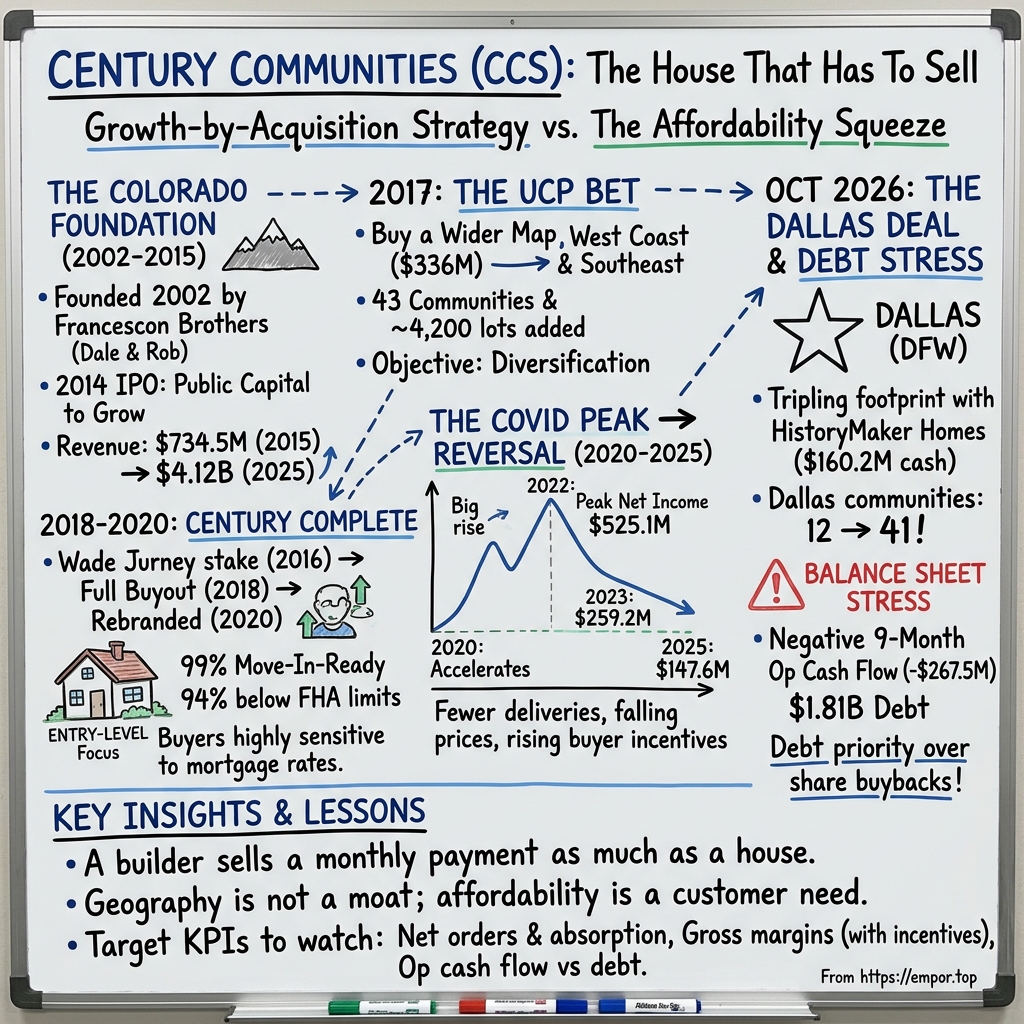
Century Communities: The House That Has to Sell
I. The Dallas Deal in a Down Market
On October 7, 2026, a homebuilder from Colorado bought a piece of Texas history. Century Communities paid about $160.2 million in cash for substantially all of the assets of HMH Lifestyles, the family business that sells houses across Dallas-Fort Worth as HistoryMaker Homes.1 HistoryMaker was founded in Fort Worth in 1949, calls itself the longest-standing production homebuilder in Texas, and has been run by the Mitchell family for five generations. Over those decades it built roughly 25,000 homes.2
The deal was large for Dallas. Before it, Century had 12 active communities in the Dallas division. Afterwards it had 41. Over the previous twelve months, the combined Dallas business delivered 669 homes, against 211 for Century on its own.3 In a single transaction, a minor regional outpost became one of the company's larger divisions, in what Century itself calls the largest housing market in the country.3
The timing made the deal awkward. Three weeks later, on the third-quarter call, the same management team had to explain why the business it already owned was getting harder to run. Over the first nine months of 2026, operations used about $267.5 million of cash.1 Leverage was higher than at the start of the year. Incentives, the discounts and mortgage-rate buydowns builders use to close sales, were also increasing. Century paid for HistoryMaker entirely in cash drawn from its revolving credit line.4
An analyst asked what Century had paid relative to HistoryMaker's earnings. Rob Francescon, the chief executive, declined to give valuation details and described the deal as "an attractive win-win."4 Asked later about leverage, he said the first priority was "to make sure that we're focused on the debt-to-cap," and that share repurchases would only continue opportunistically within that limit.4
In other words, management raised debt to buy growth and in the same breath promised to put the debt first. Both statements can be true. The tension between them is still the main question for anyone deciding whether to trust this company with capital.
A homebuilder has a simple product and a difficult business. It buys dirt and pays for streets, sewers and framing crews, then waits for a stranger to qualify for a mortgage. If the buyer closes, the cash comes back with a margin. If the buyer can't close, the house stays on the books, the land keeps costing interest, and the builder cuts its price until someone can. The house has to sell, and much of this story follows from that.
Century has followed one strategy for more than a decade. It grows by expanding into new markets, frequently by acquiring local builders, and it sells mostly at the affordable end of the market. On the third-quarter call management called HistoryMaker the tenth acquisition since the 2014 public listing.4 The company finished September with a record 343 selling communities.3 Its earnings, though, had been falling for nearly two years.
Three questions follow from this. The first is whether owning more communities in a city gives Century any real advantage, such as lower costs, better land or faster sales, or simply puts more of its capital at risk. The second is whether a business built around the buyer who can barely afford a home can hold up when that buyer is under the most pressure. The third is whether management will protect the balance sheet while it integrates yet another acquisition.
The people answering those questions have been in charge since the beginning. Dale Francescon, the elder of the two founding brothers, became Executive Chairman in January 2025 after more than two decades as co-chief executive. His younger brother Robert, known as Rob, has been sole CEO and President since then.5 In November 2026 the company said Jim Francescon would become President in January 2027.6 He is Rob's son and was previously executive vice president for corporate operations and business development.5
Century, then, is a public company that still runs much like a family business. It reports through a New York Stock Exchange listing and has a mostly independent board, yet the founders set its direction. To understand why the HistoryMaker deal looks the way it does, the story has to start in Colorado, with two brothers who had already sold one homebuilder before they started this one.
 Subscribe on LinkedIn
II. A Colorado Builder Looks Beyond Colorado
Century is not the Francescons' first homebuilder. During the 1990s they owned and ran Trimark Communities, which grew into the largest builder of attached for-sale homes in Colorado, meaning townhomes and condominiums. In 1996 they sold Trimark to D.R. Horton at a valuation above three times its book value, then stayed on as co-division presidents inside what was becoming the biggest homebuilder in America.7
That background helps explain much of what came later. The brothers had experienced a consolidation from the seller's side. They saw how a national builder valued a local operator: by its land, its people and its market share. They also saw how that operator was absorbed. Later they became the buyers.
Their training was not typical of the trade. Dale earned a business degree at the University of Southern California and a law degree at Loyola, and holds California licenses as both an attorney and a certified public accountant, now inactive.5
Rob, also a USC business graduate, spent his early career at thrifts and at the Federal Home Loan Mortgage Corporation, better known as Freddie Mac.5 Between them they had studied how deals are documented and how mortgages are financed. That second skill turns out to be central to homebuilding.
In August 2002 they set up the company that became Century, as a Colorado limited liability company with operations in metropolitan Denver.7 At the time the U.S. housing market was entering a boom that ended in the 2008 crash. Many builders went bankrupt in that collapse, and the survivors spent years repairing their balance sheets.
The company says Century stayed profitable each year through the downturn, "including down cycles when certain of our competitors struggled or exited the business."7 Century cites that record often; it said in its 2026 proxy that it had been profitable for 23 consecutive years.5 The record is real, but its size matters.
During the bust Century was a small Denver builder, so staying profitable then demonstrated caution, not a model that would scale. The founders' lesson from 2008 was probably more practical: in a downturn, a builder with land, cash and nerve can buy what others are forced to sell.
The opportunity came in 2013. In May of that year Century sold about 12.1 million shares in a private offering, raising roughly $224 million net.7 It was more capital than the company had ever had, and it went into land and new markets. In June 2013 Century hired a Texas division president and began buying land around Austin. In September it bought the assets of Jimmy Jacobs Homes there for $15.7 million, which brought 166 lots and 95 homes under construction.7
The next step was larger. On April 1, 2014, Century bought Las Vegas Land Holdings for about $165 million, gaining 1,761 lots in five communities.7 Century did not buy Las Vegas for its homebuilding staff. It bought the land: a pipeline of future lots in a market that was still recovering, acquired near the bottom of the cycle.
In 2013 Century delivered 448 homes.7 A few months after the Las Vegas purchase, it went public. The IPO priced on June 17, 2014 at $23 a share, for 4.48 million shares, 4 million of which were sold by the company.8 It was a small listing, and it gave the company a public currency and a route to the debt markets.
That combination of private capital, land bought cheaply, a newly entered state and then public shares shaped everything after it. Housing does not grow like software. A builder can only sell as many homes as it has lots, and it can only own as many lots as its capital allows. Each new market means a new local team, new relationships with city planning departments and new subcontractors. Acquisitions are the quickest way to get all of those at once.
The growth was dramatic. In 2015, its first full year as an established public company, Century reported $734.5 million of revenue, $39.9 million of net income and 2,401 home deliveries, more than double the year before.9 A decade later, in 2025, revenue reached $4.12 billion.10 Century describes the route itself: since the IPO it has "expanded geographically through the acquisitions of other homebuilders and organic entrance into new markets."10
That sentence is important for understanding the growth record. Revenue rose more than fivefold over the decade, but it is not one business growing on its own. A large part came from buying other companies' communities, lots and backlogs. That is a legitimate way to build a homebuilder. The real test is whether the businesses Century bought earned more as part of Century than they would have independently, and whether the price paid allowed for that.
The first acquisition big enough to test that question was a California builder called UCP.
III. The UCP Bet: Buy a Wider Map
On April 11, 2017, Century and UCP announced an agreement to combine. Dale Francescon said the combined company would be positioned "as a leading homebuilder with significant national scale."11 UCP shareholders were offered $5.32 in cash and 0.2309 of a new Century share for every share they held. Including UCP debt that would be repaid, the deal was valued at about $336 million.11
UCP was a builder and land developer with operations in California, Washington, North Carolina, South Carolina and Tennessee.12 Its controlling shareholder was PICO Holdings, which held about 57% of the voting power and signed an agreement to vote for the deal.11 That made the transaction relatively easy to complete. Once a holder of that size agrees, there is little chance of a competing bid.
The announcement described a business of real scale. The combined company would operate in 10 states and 17 markets, with 117 communities, roughly 25,000 lots and, on a pro forma basis, more than $1.3 billion of revenue for 2016.11 For a company that had been a Denver builder only five years before, that was a major change. UCP shareholders ended up owning about 16.4% of the combined Century.11
The rationale was straightforward. More markets meant less dependence on any single regional economy. A large lot pipeline meant Century would not need to bid at today's prices for every acre it would build on in the next few years. And a presence in both the West Coast and the Southeast spread the company's exposure across two very different housing markets.
The deal closed on August 4, 2017.12 The accounting shows what Century received. The acquired assets included about 4,199 owned lots in 43 communities, along with 346 homes in backlog and 59 model homes. Total consideration in cash and Century stock was about $209 million, and Century also took on about $153 million of UCP's notes payable.12 Most of the purchase price was effectively paid for land and homes under construction, with about $5.7 million of goodwill.12
That small goodwill figure is useful information. It indicates that Century paid roughly what UCP's assets were worth on paper, not a large premium for brand or earnings power. In homebuilding that is normally the sensible approach. A builder's franchise value is limited, because buyers seldom choose a home by the builder's name. Most of the value sits in the dirt.
Thirteen days after closing, Century sold one piece. On August 17, 2017 it sold BMCH South Carolina, a UCP subsidiary acquired in the deal, to a third party for about $17.1 million.12 Because the sale came so soon after closing, the accountants valued those assets at the sale price. This was pruning, not an admission that the deal had failed. Century bought a portfolio and kept the parts that fit. Still, it showed that the map management bought was not entirely the map it wanted.
Century kept going. On October 31, 2017 it acquired Sundquist Homes in the Seattle area, which added to the Washington position UCP had brought.12 That year the company was combining a national acquisition with a local one, which became its standard approach for the following decade.
Did UCP pay off? It is a fair question and a difficult one to answer. Century did not disclose UCP's results separately after the merger. The acquired operations were combined into regional segments, and integration costs were not reported as a separate line. Once assets are absorbed that thoroughly, it becomes impossible to say exactly what the purchase price returned.
The available evidence is indirect. Within three years Century's total revenue reached $3.2 billion, as discussed below.13 UCP added important pieces to that, including the West Coast and new Southeast positions. But Century was also expanding organically in that period, and a nationwide housing upturn was helping every builder. Given the strong market, it is hard to separate how much came from the UCP deal and how much came from favorable conditions.
There is also a more recent, less flattering clue. In the third quarter of 2026, net orders in Century's West segment, which covers California and Washington, fell about 20% from a year earlier. The segment's average delivered price was around $551,000, the highest in the company and the furthest from its affordable focus.3
Of the six communities that triggered impairments that quarter, some were in the San Francisco Bay Area.4 No public evidence ties those communities to UCP specifically. They do show that the higher-priced coastal business acquired in 2017 is now among the most exposed parts of the company.
The fair verdict on UCP is that it gave Century national reach and broad diversification at a price close to asset value, and that it would be hard to argue Century overpaid at the time. Whether the purchase earned more than a patient program of buying land would have earned cannot be shown from the company's disclosures.
That leaves a question that applies to every deal in this story. Each acquisition adds land, a local team and a set of communities. The issue is whether those additions improve the returns on Century's capital, or simply increase the amount of capital exposed to the housing cycle. In homebuilding the two outcomes look the same at closing and only diverge years later, usually in a downturn.
UCP made Century wider. The next acquisition changed what Century was selling.
IV. Century Complete Makes Affordability the Product
Most homebuilders sell a dream. They show a model home with the expensive countertops, the upgraded flooring and the extended patio, and then sell the buyer the options one at a time. Wade Jurney Homes did the opposite. It offered no options and no upgrades. Buyers saw a small number of floor plans, often in secondary markets, sold through retail studios and over the internet.12
In November 2016 Century bought a 50% stake in Wade Jurney's operating company through a joint venture, accounted for as an equity investment.12 On June 14, 2018 it bought the remaining half for $37.5 million, and Wade Jurney Homes became a wholly owned subsidiary.12 Century first tested the business as a part-owner, then bought the rest once it had seen how it worked.
The appeal is easy to see. Entry-level buyers are the largest pool of potential customers in the U.S. housing market, but they are also the most price-sensitive. A builder that can deliver a decent house at a lower price, by limiting what the buyer can customize, standardizes the construction process. Standardized processes are faster and cheaper. Selling online and through studios instead of a sales office in every community also reduces selling costs.
On February 6, 2020, Century announced that Wade Jurney Homes would be renamed Century Complete, with the same strategy and the same kind of homes.12 For the brand that came with the business, the rename had a cost. Century recorded an impairment of about $2.8 million on the Wade Jurney trade name as of the end of 2019.12
That is a small amount for a company of Century's size. It is still informative. When a buyer pays for an acquired brand and then retires it within two years, it is accepting that the name had less value than it had booked. Century's view was that the operating model was the valuable part and the name was not. That is a reasonable judgment, consistent with the UCP deal.
What Century Complete became matters much more than the trade name. By 2025, about 94% of the 10,387 new homes Century delivered had purchase prices below the limits for mortgages insured by the Federal Housing Administration, the government program built for buyers with small down payments. About 99% were built as move-in-ready homes, meaning construction began before a buyer signed, instead of building to order.10
Those two figures describe the whole company, not only Century Complete, and they show how far the Wade Jurney approach spread. Century's core brand still lets buyers personalize their homes "through certain option and upgrade selections," though on a limited basis.1 Century Complete "generally provides no option or upgrade selections."1 Both brands now mainly sell homes that are already built or under construction, at prices aimed at the buyer who needs government-backed financing.
In the third quarter of 2026, Century Complete delivered 928 homes, about 38% of Century's deliveries, at an average price of about $252,000.34 Its community count was 122, up 9% from a year earlier.4 In a quarter when total net orders fell about 4% from a year before, Century Complete orders rose almost 4%.3 Compared with the rest of the company, the low-cost brand was holding up.
CFO Scott Dixon gave several reasons on the call: the brand operates in secondary locations, it faces less pressure to discount, its no-options model makes it simpler, and it has meaningful exposure to the Midwest.4 That is a credible explanation. It is also an explanation about where Century Complete builds as much as what it builds, since a secondary Midwestern town may simply have fewer rival builders discounting down the road.
The same quarter also showed the weakness. Century Complete's average delivered price fell about 6% from a year earlier.3 The brand kept its sales volume partly by cutting prices. In this market, holding volume and holding price were alternatives.
Alan Ratner of Zelman & Associates asked about elasticity, meaning how much additional demand a given incentive buys. Rob Francescon said Century's buyers have "a little bit more elasticity" than buyers at peer builders, "maybe not to the extent that it was last year."4 The answer is mixed. Century's customer still responds to a lower price or a lower rate, but less than a year earlier. Each dollar of incentive now produces fewer additional sales.
Rob said affordability remained the binding constraint for Century's buyer, and the mortgage data agree. Nearly 35% of the principal in loans originated by Century's mortgage arm in the third quarter was in adjustable-rate mortgages.4 Two quarters earlier the figure was about 30%.14
In July, Rob Francescon had put it plainly: "Receptivity of our buyers to ARMs has been increasing."15 A builder's customers moving toward floating-rate loans is not a crisis. It is a sign of how hard the fixed-rate payment has become to make work. For these buyers the monthly payment now matters more than long-term rate certainty, which is another way of saying they are stretching.
Century Complete's value proposition is a lower price, and the limit on that proposition is the buyer's monthly payment. A $252,000 house fits within FHA limits, but the buyer still has to qualify at prevailing mortgage rates. When rates rise, the house does not get more expensive. The buyer can simply afford less. A builder that sells to that buyer has to make up the difference itself, through price cuts or rate buydowns, both of which come out of its margin.
The verdict on Century Complete is that it was a sound acquisition. A small investment grew into nearly two-fifths of the company's deliveries and its most resilient brand in a weak market. It is not, however, a defense against the housing cycle. It tells Century where to find buyers. It cannot make those buyers able to afford the payment. The proof would be order growth without falling prices, and in the third quarter of 2026 Century Complete achieved the order growth but not the stable prices.
To see how sensitive this buyer is to demand conditions, look back to the period when demand was so strong that affordability briefly stopped mattering.
V. The Boom Took Earnings to a Peak
In early February 2021, Century's management reported the best year in the company's history. In 2020 total revenue rose 25% to $3.2 billion. Deliveries rose 18% to 9,453 homes, and net new contracts rose 38%.13 Net income rose 82% to $206.2 million, and Dale Francescon told analysts the company had marked its "18th consecutive year of profitability."13
The atmosphere on that call was almost celebratory. Fourth-quarter deliveries were a record 2,826 homes, and the year ended with a backlog of 3,439 homes worth about $1.3 billion.13 Management said website traffic had risen 60% from a year earlier, and described a new mobile site that combined both brands, offered mortgage prequalification "in minutes," and had a "Buy Now" button for reserving a home online.13
Buying a house with a button sounds like a gimmick until you remember Century's model. When nearly every home is built before a buyer arrives, a house is close to a product in inventory. It has a known address, price and completion date, which makes it possible to sell online. The pandemic showed that buyers would accept this, and Century, with its move-in-ready model, was well positioned to benefit.
The balance sheet improved as well. Net homebuilding debt to net capital fell to about 27% from about 45% a year earlier.13 Profits were paying down debt, as a good year in homebuilding should allow. Management guided to between 10,500 and 11,500 deliveries in 2021.13
The conditions behind those results were unusual. In 2020 and 2021, mortgage rates were near historic lows, the pandemic sent buyers out of apartments and city centers, and supply of existing homes for sale was limited. Builders could raise prices almost every week. The market rewarded nearly every builder with land available, not only the best ones.
Century's earnings peaked in 2022 at $525.1 million of net income.16 Then the Federal Reserve began raising rates quickly, mortgage rates more than doubled, and the entry-level buyer was the first to feel it. Net income fell to $259.2 million in 2023, recovered to $333.8 million in 2024, and then fell to $147.6 million in 2025.1610
The 2025 drop shows how this happens. Deliveries fell 5.6% to 10,387, which Century attributed to slower absorption, meaning fewer sales per community each month. The average selling price fell 3.3% to about $378,000 "primarily due to higher incentives."10 Homebuilding gross margin fell from 21.5% to 17.6%.10 Net income fell about 56% for the year.
The arithmetic is unforgiving. A builder's costs for a house it has already built are mostly fixed: the land, the materials and the labor. If incentives reduce the effective price by a few percent, that loss comes entirely out of margin, and overhead such as sales staff, offices and interest stays the same. A small decline in price can produce a large decline in profit. That operating leverage helped Century on the way up and hurt it on the way down.
Results for 2026 so far have not reversed the trend. Net income for the first nine months was $73.2 million, down from $111.6 million a year earlier.1 Third-quarter net income was $12.6 million.3 At that pace the company was earning in a quarter roughly what it had earned in a week and a bit at the 2022 peak.
The guidance during the year was useful for judging how management reads its own business. In April, management reduced its full-year delivery forecast by 5%, to between 9,500 and 10,500 homes. It said March orders had fallen sharply because of the conflict in the Middle East, higher rates and higher fuel prices, and that April was "trending higher."14 In July it raised the low end to 9,750 and noted orders up 3% from a year earlier.15
In October it reduced the range to 9,350 to 9,650 homes, a figure that included about 100 HistoryMaker deliveries, and cut the home-sales revenue forecast from a range of $3.5 to $3.8 billion to $3.3 to $3.4 billion.415
Taken together, those revisions show management reacting to the market, not anticipating it. The July increase did not survive the following quarter, and the October range for Century's existing business ended below the April low. That is not unusual in an industry where demand changes monthly.
The market environment matched it. The National Association of Home Builders' builder sentiment index fell three points to 32 in September, a level that reflects widespread pessimism among builders.17 Even so, a guidance range that keeps changing gives investors little to rely on.
The consensus view in housing is that the United States has a structural shortage of homes, which means builders will eventually do well. That may be true for the industry. But a long-term shortage does not guarantee that a particular builder can sell a particular house this quarter at a price that leaves a profit. Shortage affects the eventual value of land. Affordability determines this quarter's results, and the latter is what has been setting Century's earnings since 2022.
The boom showed that Century's model could produce very strong results when buyers had cheap credit. The years since then show how much of that performance depended on credit conditions. To see where the money is actually made, and lost, follow a single house from purchase of the land to the closing.
VI. Every Sale Starts With a Lot and Ends at Closing
Every Century home begins years before anyone moves in. A land team finds a parcel at the edge of a growing metropolitan area: farmland outside Indianapolis, scrub near San Antonio, a former orchard in Utah. Century either buys it or, more often today, takes an option on it, paying a deposit for the right to buy finished lots later. Then come entitlements, the slow process of getting a city or county to approve streets, utilities and plats.
Century's lot pipeline is the stock of future houses created by this process. At September 30, 2026 it owned or controlled 60,969 lots.1 More than 27,000 of those were option lots secured by about $85 million of deposits, roughly 3% of shareholders' equity.4 The arrangement is a hedge. If a market turns, Century can walk away from an option and lose only the deposit, rather than being stuck with land worth less than it paid.
Construction comes next. Century employs very few builders. At the end of 2025 the company had 1,660 employees in total. Only 373 worked in construction and 484 in sales.10 Trade contractors do the framing, roofing, plumbing and painting. Century coordinates them, finances the materials and supervises quality. In the third quarter of 2026, a house took about 118 days to build.4
That cycle time matters. Every day a house is under construction, the capital in it earns nothing and the interest on the debt that financed it keeps running. Shorter cycle times make the same dollar of capital do more work in a year.
Century said its direct construction costs fell about 2% and its finished lot costs about 3% from the second quarter to the third.4 Rob Francescon added a warning: energy costs and tighter trade labor, which he linked to immigration enforcement, meant those cost savings would likely start to level off.4
The option-heavy approach has a cost of its own, which is why it is a choice rather than a free lunch. A land seller who carries the lots until Century is ready to take them wants to be paid for that patience, so an optioned lot usually costs more than one bought outright. Century pays that premium for flexibility, and in 2025 it used the flexibility.
The company said it selectively reduced its lot pipeline by terminating contracts in markets that no longer met its investment criteria.10 Headcount fell about 11% during the year as demand softened.10 The average number of selling communities rose to 318 from 281, yet the year-end count fell to 305 from 322.10 Century was opening communities it had committed to and closing out others, trimming the machine without stopping it.
Then the sale. Because nearly every Century home is built on speculation, the buyer usually walks into a house that already exists or soon will. This is where the business turns on the monthly payment. If the price, the rate and the buyer's income line up, the deal goes to contract.
If they don't, Century has two tools. It can cut the price, or it can pay to buy down the buyer's mortgage rate. In recent quarters about 60% of incentives took the form of price and about 40% the form of mortgage help.4
The mortgage often comes from Century itself. Inspire Home Loans, a Century subsidiary, originates loans approved for Fannie Mae, Freddie Mac, FHA, VA and USDA programs. Sister companies provide title, insurance and escrow services.10 This keeps the closing in-house. It also means the builder controls the most delicate step in the sale, the moment when a buyer either qualifies or doesn't.
Finally the closing. Title passes, the buyer moves in, and Century records the revenue.10 Only then does the money come back.
This is where the economics are decided. Century's 2025 revenue was $4.12 billion. Of that, $3.93 billion came from homebuilding.10 Financial services contributed about $86 million of revenue and about $19 million of pretax income, about 2% of company revenue.10 Multifamily sales contributed $97.2 million, almost all from the sale of a single 300-unit rental property through the Century Living business, which develops apartments in Colorado.10
The financial services business is a useful addition rather than a second engine. It captures fees from buyers Century would have sold to anyway. It makes incentives cheaper to deliver, because a rate buydown arranged in-house is easier to execute. But its profits rise and fall with the number of homes Century closes, so it cannot offset a weak homebuilding year.
The multifamily sale was a one-off. A single apartment complex sold in a single year says little about a recurring business, and treating it as one would mistake an asset sale for a growth engine. The arithmetic agrees: against $97.2 million of multifamily revenue, Century booked about $91.8 million of cost, leaving roughly $5 million of gross profit for years of development work.10
So for practical purposes Century is a homebuilder, and its profit comes down to one relationship. Selling price, less the cost of the land, less the cost of construction, less incentives, less any write-downs on communities that have lost value, less the overhead of selling and running the company. Price realization matters most in a down market.
Where does Century stand among its competitors? The American homebuilding market is far more fragmented than most people assume. In 2025, D.R. Horton captured about 12.8% of new for-sale closings with more than 87,000 homes, and Lennar about 12.2%. The top five builders together accounted for about 35% of closings, with PulteGroup at 4.4%, NVR at 3.2% and Meritage Homes at 2.2%.18 Based on those totals, Century's 10,387 deliveries represent roughly 1.5% of the national market.
That number reframes the competitive question. Century isn't really competing with D.R. Horton nationally. It competes in each submarket, against whichever builders have land nearby, as well as against existing homes on the resale market. In some of those submarkets it is a meaningful player. In most it is one of several options for a buyer driving between sales offices on a Saturday.
The five forces in this industry are not hard to read. Buyers have strong leverage when affordability is stretched, because they can walk to another community or simply wait. Suppliers of land and trade labor have local power, and that power rises when good lots are scarce or crews are busy.
Barriers to entry exist in zoning, entitlements and the capital needed to carry land, but they protect landowners more than any particular builder. Substitutes are always present in the form of resale homes and rentals. And rivalry among builders plays out in price, location, product and mortgage incentives, which is to say, often in margin.
A moat in this business would show up in a builder's numbers as selling faster than nearby competitors with lower incentives, or building at a lower cost per square foot than anyone else in the same market. Century's evidence supports a narrower claim.
It has operating reach in 16 states, a product range from Century Complete to move-up homes, and land positions in the markets it has chosen.1 Whether any of that adds up to durable competitive advantage, rather than simply size, is the question the bull and bear case has to settle.
Before that, there is the question of how management has used the money the business produced, and how the money stopped coming in.
VII. The Buyback Meets the Balance Sheet
When Century reported its 2025 results in early 2026, the capital-allocation record looked generous. During the year it returned about $178 million to shareholders through dividends and buybacks. It repurchased 2.3 million shares for about $143.6 million, at an average of about $63 a share, and raised its dividend by 12%, paying $1.16 a share over the year.10 At the same time it spent about $1.2 billion on land acquisition and development.10
It also refinanced. In September 2025, Century issued $500 million of 6.625% senior notes due 2033 and used the proceeds to retire $500 million of 6.75% notes due 2027.10 The coupon barely changed, but the maturity moved six years further out. That was a sensible move, since it removed a refinancing deadline that would have arrived in the middle of a weak market.
Cash in homebuilding behaves differently from earnings. When a builder grows, it spends cash on land and construction before closings bring it back, so operating cash flow can be negative even when the business is profitable. When it shrinks or holds steady, inventory turns into cash and operating cash flow can exceed earnings. That means negative operating cash flow is not, by itself, a sign of poor earnings quality.
Over 2023 to 2025, Century's net income totaled about $741 million, while operating cash flow totaled about $320 million.10 The gap came mainly from inventory investment and mortgage loans held for sale, the normal working capital of the business. In 2025 alone the two were close: about $153 million of operating cash flow against about $148 million of net income, because inventory released a little cash during a year of slower building.10
Then 2026 went the other way. Over the first nine months, operations consumed about $267.5 million of cash, against net income of $73.2 million. The largest drain was a $403.4 million build in inventory.1 Century kept starting and finishing homes, and buying and developing lots, while sales slowed.
The inventory had to be financed somehow. Part of the drag was softened by the mortgage subsidiary, which released about $104.6 million of cash as loans it had made to buyers were sold on to investors.1 Without that release, the hole would have been deeper.
It was financed with debt. Borrowings under the revolving credit line rose from $51.5 million at the end of 2025 to $456 million at the end of September 2026.1 Homebuilding debt to capital, the share of the company's capital funded by borrowing, rose from about 29% to about 37%.1 The ratio rose in every quarter of the year, to about 32% in the first quarter and about 34% in the second.1415 Total reported debt, including the mortgage subsidiary's repurchase facilities, reached about $1.81 billion.1
During those same nine months, Century kept buying its own stock. It repurchased about 1.1 million shares for about $71 million at an average of about $62, and separately netted about $15 million of shares to cover employees' tax withholding when equity awards vested.1 Management presented the buybacks as value creation: shares bought at a 27% discount to book value in the first quarter and at a 38% discount in the second.1415
That framing deserves scrutiny. Buying shares below book value looks cheap only if the book value is real, meaning the land and homes on the balance sheet are worth what they're carried at. In a market where Century took $19.6 million of impairments in the third quarter alone, that assumption weakens.4 And the cash for repurchases came, effectively, from the revolver at a time when operating cash flow was negative. The company was borrowing to shrink its share count while its leverage climbed.
By the third quarter the tone had changed. Buybacks dropped to about 170,000 shares for $11.6 million.1 On the call, Rob Francescon described the priorities as maintaining ample liquidity and keeping debt to capital "at or below our current levels." Buybacks, he said, would be opportunistic within that limit.4
Note the phrase "current levels." The current level was the highest of the year. A promise to hold leverage at its peak is a promise not to let it get worse, not a promise to reverse it. By then, Century had already spent about $160 million of revolver capacity on HistoryMaker. Rather than reducing debt, that capital decision added to it.
The skeptical reading is that Century bought back stock near $62 a share through 2026, and by November 20 the stock closed at about $49.191 Each share bought in the first nine months now carries a paper loss of about a fifth of its cost. A buyback is a bet that the share price is too low. In hindsight, the bet was early.
The generous reading is that the repurchases were modest relative to total capital, that a company trading at about half its book value has a reasonable case for buying shares, and that management did slow the program as leverage rose. Both readings are true. Neither changes the central lesson: buybacks are a capital-allocation decision that has to compete with debt reduction and acquisitions for the same dollar, and in 2026 that dollar was borrowed.
There are obligations that do not appear in the debt total at all. At the end of 2025, Century had about $65 million of letters of credit and about $445 million of performance and other bonds outstanding, mostly guaranteeing to cities and counties that it would finish the streets and utilities it had promised.10 These are not borrowings, but they are commitments that follow the land.
The auditor gave a clean opinion on the 2025 accounts and on internal controls, and singled out the assessment of inventory impairment as a critical audit matter, the area of the accounts requiring the most judgment. Century recorded about $21.8 million of such impairments that year.10 In a business whose balance sheet is mostly land and unsold homes, that judgment is the one that matters most.
Capital decisions like these belong to a governance structure that shapes who makes them. Dale and Rob Francescon together held about 13.2% of Century's shares in March 2026. BlackRock held about 15%, Dimensional about 7.3% and Vanguard about 7%.5 The founders have significant influence but no controlling stake. Five of seven directors are independent, and the 2025 say-on-pay vote received nearly 90% support.5
Compensation shows some adjustment for the downturn. In 2025, with net income falling by more than half, the compensation committee cut Dale's base salary by 10%, left Rob's unchanged, and reduced the brothers' target annual cash incentive opportunities by 30% and 15% respectively.5 Their car, phone and life-insurance allowances were cut by 20%.5 Reported total compensation was still about $7.4 million for Dale and about $8.5 million for Rob.5
The family relationships are disclosed. The proxy lists the founders' employment agreements and aircraft time-sharing arrangements, under which they reimburse Century the incremental cost of personal flights on the company plane.5 It also lists Jim Francescon, Rob's son, as a related party. In 2025 he received a base salary of $550,000, a cash bonus of about $1.09 million, and equity awards.5 The audit committee reviews related-party transactions quarterly.5
None of this is a scandal. The pay cuts are real, the disclosures are full, and shareholders have voted their approval. But a skeptical investor would note that the incoming President is the CEO's son and the Executive Chairman's nephew, that the company has never had a chief executive from outside the founding family, and that the board's independence will be tested most at exactly the moment when the family's judgment on acquisitions and leverage is most in question.
That moment had already arrived when Century closed the purchase in Dallas.
VIII. A Bigger Dallas Footprint, a Harder Return Test
When the third-quarter results came out on October 28, 2026, the HistoryMaker announcement led the release. Rob Francescon called the acquisition part of "our strategy of deepening our share in existing markets to drive improved margins and returns."3 The same release reported a quarter in which those margins were moving the wrong way.
The strategy itself is coherent. Century had been building in Dallas, but at a scale too small to matter. HistoryMaker brought 29 active communities, a local leadership team and staff who were joining Century, and a land pipeline that would take years to assemble from scratch.12 The two operations would combine into a single division headquartered in Grapevine.2 HistoryMaker also sells both entry-level and move-up homes, giving Century a broader reach across the Dallas market.3
The seller's side of the deal had its own story. HistoryMaker was run by Nelson Mitchell, part of the family that had built the company over five generations, and the family hired Vestra Advisors as its exclusive financial advisor.2
Jim Francescon, then still an executive vice president, thanked Mitchell publicly "for entrusting us with the next chapter of a company his family has built over five generations."2 It was a revealing line. A family-run public builder was buying a family-run private one, and the man who would soon become Century's President was the one making the promise of continuity.
The deal shows up quickly in the numbers. Century's guidance for the year now includes about 100 HistoryMaker deliveries in the fourth quarter, and its year-end community target of 360 to 370 includes the 29 acquired communities.4 So part of the record community count Century will report at year-end was bought, not built, which is worth remembering whenever the count is cited as evidence of organic momentum.
Was the price fair? Century has done this kind of deal before, which makes a rough comparison possible. In 2024 it bought Anglia Homes in Houston, with 26 active communities, for about $127 million. Earlier that year it bought Landmark Homes of Tennessee in Nashville, with six communities, for about $33.4 million.20 Those deals work out to roughly $4.9 million and $5.6 million per active community. HistoryMaker, at about $160 million for 29 communities, comes to about $5.5 million.
On that crude measure, HistoryMaker sits inside the range of Century's own recent purchases. But the measure is crude. A community can mean 40 lots or 400. It can be nearly sold out or just opening. The price per community says nothing about how many lots the seller owned, how many were under option, what the homes sell for, or what margins they earn. It is a screening test, not a valuation.
The numbers that would decide the question were not provided. Alex Barron of Housing Research Center asked about the funding and valuation; management gave no valuation multiple.4 Century did not disclose HistoryMaker's earnings, EBITDA, lot count or margins.21
One part of the transaction deserves particular attention. HistoryMaker's sister land-development company, Jabez Development, was not part of the deal. Century said it would maintain "an ongoing land relationship" with it, under which Jabez would complete land development on current and future communities for Century in the area.23 A sister build-to-rent business, ONM Living, also stayed independent.2
This is a common structure, since a developer that already knows the local soil and municipal processes can bring lots to market faster. It also means part of the economics of the acquired business now depend on payments to a company controlled by the sellers. Century has not disclosed the expected volume, pricing or terms of those land purchases.1 Shareholders will want to see those terms, and evidence that they're priced at arm's length, before concluding that the full value of the deal stayed with Century.
The quarter behind the announcement explains why the return test is harder now. Century delivered 2,442 homes at an average price of about $345,000, down about 10% from a year earlier.3 Net orders were 2,284, with a cancellation rate of about 14.6%.4 Reported homebuilding gross margin was 15.0%.4
That headline margin hides several layers. Stripping out $19.6 million of impairments on six underperforming communities, in the Bay Area, Houston and South Florida, the margin was 17.3%.4 Adjusting further for interest and purchase accounting produced an adjusted margin of 19.3%, down 70 basis points from the second quarter, mostly because of higher incentives.4
Management prefers the adjusted figure. Shareholders should keep the reported one in view. Impairments are not a one-time accounting quirk when they recur as market conditions weaken. They are the moment when the cost of a bad land decision becomes visible.
Houston on that impairment list is worth noting. It is the market Century deepened through Anglia two years earlier. The impaired communities were not identified by name, so they can't be tied to Anglia. But they are a reminder that buying density in a market does not exempt the buyer from that market's cycle.
The incentive outlook was worse. Incentives on closed homes ran at roughly 1,300 basis points in the third quarter, meaning about 13% of the selling price, up from about 1,200 in the second.4 Management expected fourth-quarter incentives to rise by another 200 to 250 basis points.4 In other words, Century was preparing to give buyers roughly 15% of the price in incentives to keep homes moving.
That is the setting in which a new acquisition has to earn its keep. The Dallas communities will be integrated into a market that is softening, with a cost of capital that is higher than it was, and with management guiding to more discounting, not less.
The credit markets were already watching. In June 2026, Moody's affirmed Century's Ba2 rating but moved the outlook to negative, citing sustained weakness in entry-level demand, incentives that limit pricing power, an expected 2026 EBIT margin around 5.5% and interest coverage of about 2.6 times.21 S&P then cut Century to BB- with a negative outlook, saying adjusted leverage could stay at or slightly above 4 times. Among its stated triggers for a further downgrade was adjusted debt above $1.5 billion without a recovery in EBITDA.22
That trigger makes the Dallas deal look riskier. At the end of September, homebuilding debt alone was already about $1.49 billion, before the revolver funded HistoryMaker.1 S&P calculates adjusted debt in its own way, so the two figures are not directly comparable. But they suggest that Century bought HistoryMaker close to, or beyond, the point where one rating agency said it would consider cutting again. Both agencies already rate Century below investment grade.
Century still has room. It reported about $863.8 million of liquidity at the end of the third quarter, including cash and revolver availability.3 In September it amended its credit facility, increasing the revolver to $1.2 billion and extending it to November 2030 for the lenders that agreed.234 Liquidity is not the same as free cash, though. It is the amount Century can still borrow. The more of it the company uses, the less cushion remains if the downturn deepens.
The verdict on HistoryMaker is that it fits the strategy, it was priced within the range of Century's own recent deals, and it is impossible to say from disclosed figures whether it was cheap or expensive. What would settle the question is clear: Dallas absorption, Dallas gross margin, integration costs, and the terms of the Jabez relationship, measured over the next two years. Until those arrive, the deal is a reasonable bet made with borrowed money at a difficult point in the cycle.
Which brings the story to the market's own verdict.
IX. Analysis & Bear vs. Bull Case
At the close on November 20, 2026, Century Communities stock traded at $48.97. The company's market value was about $1.38 billion, and its enterprise value, including debt, about $3.12 billion. The shares were down about 13% over the past year.19 A month earlier, management had reported a record book value of $90.61 per share.3 The market was valuing each dollar of Century's equity on the balance sheet at about 54 cents.19
That discount is the market's verdict, and it says something specific. The stock traded at about 13 times trailing earnings and about 0.36 times sales.19 Neither number looks expensive. But the price-to-book ratio says investors either doubt the value of the land and homes on the balance sheet, or doubt that Century can earn an adequate return on them. On the evidence, the second doubt is the stronger one.
Work it through. At about 13 times earnings, the market cap implies trailing net income of roughly $106 million. Against about $2.56 billion of equity, that's a return on equity of around 4%.191 An investor can earn more than that in Treasury bills. A company earning 4% on its equity will trade below book until it proves it can earn more. The discount is less a puzzle than a result of arithmetic.
The comparison with earlier years sharpens the point. Over 2023 to 2025, net income averaged about $247 million a year.10 Measured against that average, the market cap is less than six times earnings. Measured against the 2022 peak, it's less than three times. The market is not paying for a return to 2022. It is barely paying for a return to 2024. Whether that is too pessimistic depends entirely on whether the current trough is a cycle or a new level.
Peer comparisons help only a little. A market-data snapshot taken at a different date placed Century's P/E slightly above a peer median of about 12.8 times, with Lennar near 11.4, D.R. Horton near 13.5, and PulteGroup, KB Home and Meritage between 12 and 13.24 On that comparison, Century is not obviously cheap on earnings. Its discount is to book value and to sales. Those discounts reflect lower profitability per dollar of assets and revenue, which is exactly the difference investors would expect to see priced in.
The bull case starts with the product. The United States has too few affordable homes, and Century's lineup is built for the buyer looking for one. Its 2025 average selling price was about $378,000, and its third-quarter average was about $345,000.103 Century Complete sells for about a quarter of a million dollars.
Ending the third quarter with 343 communities, and guiding to between 360 and 370 by year-end including HistoryMaker, gives Century a broad base from which to sell when demand recovers.34 If rates fall, the entry-level buyer is the one with the most pent-up demand, and Century has positioned itself directly in that buyer's path.
The bull case also has a balance-sheet argument. Century's senior notes don't mature until 2029 and 2033, and the revolver now runs to 2030.1023 There is no wall of debt coming due in the next two years. Liquidity of more than $860 million gives the company time.3 And with HistoryMaker, Dallas becomes a real business, in what Century calls the country's largest housing market, at a price that's in line with the company's own past deals.
The bear case starts with the same buyer. Century's customer is the one most exposed to mortgage rates, and the evidence of 2026 is that this customer is responding less to incentives than a year ago, even as incentives rise.4
Reported gross margin fell to 15% in the third quarter, and management expected incentives to rise further in the fourth.4 Operating cash flow was negative for the year to date, debt was rising, and both rating agencies had negative outlooks.12221 Every new community, whether built or bought, adds land that has to be carried until it sells.
To decide between those cases, test the question that matters most: why should Century win from here? Hamilton Helmer's framework lists seven sources of lasting advantage, and running Century through them is clarifying.
Scale economies would require Century to have lower costs per home because it's bigger. At roughly 1.5% of national closings, it is a fraction of D.R. Horton or Lennar, each of which closes several times as many homes.18 Whatever purchasing advantages it has in lumber or appliances, the larger builders have more.
Network effects don't exist in homebuilding: one buyer's purchase doesn't make the house more valuable to the next. Switching costs don't exist either, because a home is a one-time purchase. A buyer who is happy with a Century home has no particular reason to buy the next one from Century.
Branding is weak across the industry, and Century's own history confirms it. When the company retired the Wade Jurney name, it wrote off the trade name rather than treating it as a lasting asset.12 Buyers choose location, price and payment first, and the builder's name somewhere after that.
Counter-positioning is the most interesting candidate. Century Complete's no-options, spec-built model is a bet that a portion of buyers want simplicity and price over choice, and that builders invested in a design-center model can't easily follow without cannibalizing their own upgrade revenue. It's a plausible argument.
But nothing about the model is proprietary. Any builder willing to give up upgrade revenue can copy it. The evidence that Century Complete outperforms in its markets is that its orders held up in the third quarter when the rest of the company's fell.3 The evidence against is that it held volume by cutting price.
Cornered resource, in homebuilding, means land. Century's 61,000 owned and controlled lots are a real asset, and in submarkets where entitled lots are scarce, they confer local advantage.1 But Century bought or optioned that land at market prices, often from the same developers who sell to competitors, and impairments on six communities in a single quarter show that some of it was bought at prices that no longer work.4 Land is a source of local strength, not a cornered resource in Helmer's sense.
Process power is where Century could, in principle, prove an edge, through faster cycle times, lower construction costs, or better absorption from the same land. The third-quarter cycle time of about 118 days and sequential cost declines are encouraging signals.4 But Century does not publish a consistent peer comparison of cost per square foot or absorption per community, so the claim of superior process remains unproven.
Put together, the evidence leaves Century without a demonstrable moat. What it has is operating reach, a product mix aimed at the largest pool of buyers, and local land positions in markets it knows. Those are real competitive assets. They are not proof that Century earns more than its cost of capital through a cycle, and the market's discount to book value suggests investors haven't been convinced either.
The claim that would change this is simple to state: Century selling faster than competing builders in the same submarkets, with lower incentives. If that showed up in the numbers, the scale story would become a moat story. Until then, it is mostly a story about geographic breadth.
Three measures will tell investors which way the story is going. The first is net orders per community. In the third quarter, about 2,284 orders across an average of 339 communities worked out to roughly 6.7 orders per community, or about two a month.4 A year earlier, with fewer communities and slightly more orders, the figure was higher.3 Absorption, in other words, was falling while the community count rose, which means growth in communities was masking slower sales in each.
The second is reported gross margin alongside incentives. In the third quarter the reported margin was 15% with incentives around 13% of price, and both were moving the wrong way.4 A recovery would show margin rising while incentives fall. Margin rising only because impairments stop would be a weaker signal.
The third is operating cash flow against inventory and debt. For the first nine months of 2026, operations used about $267.5 million while debt to capital rose to about 37%.1 The fourth quarter is seasonally when closings release cash. If that release comes and debt falls, management's priority statement will have teeth. If it does not, the leverage question becomes the main question.
The risks sit in different places on the income statement. Affordability and mortgage rates are demand risks, the most important of the three because they move incentives directly. Construction costs, energy, materials, trade policy and labor are margin risks, and Rob Francescon has already flagged that the recent run of cost savings is likely to level off.4 Refinancing is a balance-sheet risk with a known date: Century's $500 million of 3.875% notes come due in 2029.10
Replacing them at something like the 6.625% coupon Century paid in 2025 would add roughly $14 million a year of interest, before any change in total debt. Artificial intelligence is not a material standalone issue for a company that sells physical houses; at most it may affect marketing, design and operations at the margin, and the company has not quantified any effect.
A skeptical activist would focus on two questions. The first is whether Century should stop buying back shares entirely until leverage is back below where it was at the start of 2026. The company bought stock in every quarter of the year while borrowings rose, and the stock now trades well below the prices it paid.119
The second is what return Century requires before buying another builder. Management describes acquisitions as a way to drive "improved margins and returns," but does not break out the post-deal performance of Anglia, Landmark or any earlier purchase.3 An investor asked to fund another acquisition is entitled to see how the last ones performed.
The current price reflects doubt about whether Century can turn its larger footprint into returns. Resolving that doubt requires evidence the company has not yet provided, which leads to the lessons this story offers.
X. Business & Investing Lessons
Picture two moments four years apart. In 2022, Century earned $525 million, the most in its history, selling the last of the pandemic boom.16 In October 2026 it used borrowed money to buy a 77-year-old Texas builder, in a quarter when it was giving buyers about 13% of the price to close.14 It is the same company and the same founders, applying the same strategy under very different conditions.
The first lesson: a homebuilder sells a monthly payment as much as a house. Century's low-priced product still depends on whether buyers can manage the mortgage payment. When rates rise, Century has to bridge the gap with its own margin.
When management guided to another 200 to 250 basis points of incentives for the fourth quarter of 2026, it was conceding the point.4 Builders that understand this protect their pricing by protecting the payment, through rate buydowns and in-house mortgages. Builders that don't end up discounting the house.
The second lesson: a wider map is worth only the cash each market sends home. UCP gave Century California and Washington. Anglia gave it Houston. Landmark gave it Nashville. HistoryMaker gave it Dallas. Each deal expanded the map, but Century does not break out the returns those purchases earned after the deal. Impairments in the Bay Area and Houston in the third quarter of 2026 underline the risk.4 Doors on a map are not the same as returns. The test for any roll-up is whether each acquired market produces more cash per dollar invested than the buyer could have earned by growing on its own. Investors should insist on seeing that test.
The third lesson: a buyback funded by a revolver is a loan to your own stock. After returning about $178 million to shareholders in 2025, Century kept buying shares in 2026 as operating cash flow turned negative and revolver borrowings rose.101
Only in the third quarter did Rob Francescon put debt to capital ahead of repurchases.4 A buyback program has to compete each quarter with debt reduction and growth for the same dollar, and the right answer changes with the cycle.
The fourth lesson: affordable is an address, not a moat. Century has built its business around buyers at the bottom of the price ladder, a real strategic choice in a country short of affordable homes. Its low selling prices position it to serve that need, but do not protect it from rising rates or rival builders.
Taken together, the lessons point to the central question: whether Century's geographic expansion and focused product can produce adequate returns through the cycle. For founders, Century shows how far disciplined acquisitions can take a regional business. For investors, the growth record still depends on the returns behind it.
XI. Epilogue
As 2026 nears its close, Century Communities is in an in-between moment. It has more communities than ever, a balance sheet carrying more debt than it did a year ago, and a new acquisition still being integrated in Dallas. Its founders remain in control of strategy, and a member of the next generation is about to take a senior role.
In January 2027, Jim Francescon is scheduled to become President.6 Rob will remain CEO and Dale Executive Chairman. The first thing to watch is how responsibilities shift. A president who runs operations day to day, while the founders concentrate on land and capital, would be a meaningful step toward succession.
A title change with little change in authority would be something else. The family has run the company for 24 years; how it hands over power will say a lot about how it intends to run it for the next decade.
The second thing to watch is Dallas. Century will eventually have to show what HistoryMaker contributes: how quickly its 29 communities sell, what margins they earn, and what the integration costs. The terms of the land relationship with Jabez Development deserve the same scrutiny. If those disclosures come and the numbers look healthy, the deal will look like a well-timed bet on the country's largest housing market. If they don't come, investors will have to draw their own conclusions from the silence.
The third thing to watch is the fourth-quarter results, due early in 2027. Management guided to incentives 200 to 250 basis points higher than in the third quarter.4 If incentives come in at or below that range and margins hold, the guidance will look conservative and the cycle may be near a turn. If incentives exceed it, the fourth quarter will look like the third, only worse.
The fourth thing is cash and debt. Seasonally, the end of the year is when homebuilders close the most homes and release the most cash. Rob Francescon has promised to hold debt to capital at or below its current level, about 37%.4 The year-end balance sheet will show whether that promise held through a quarter in which Century spent $160 million on an acquisition. Whether buybacks continue will show how management weighs the stock price against the leverage.
Each of those markers ties back to the questions this story opened with. Does local scale give Century an edge? Dallas will show it. Can an entry-level focus survive the affordability squeeze? Incentives and margins will show it. Will management protect the balance sheet? The debt ratio and buyback figures will show it.
None of them will answer the deepest question, which is whether Century can turn a larger community count into cash before the next downturn asks it to. That answer will come over years, not quarters. For now, the acquisition logic and the affordability positioning remain plausible but not yet proven.
XII. Outro
Imagine a young couple in a Century sales office in a new subdivision north of Fort Worth. The house is finished. The floor plan is fine. The question they are really answering is whether a monthly payment fits a monthly paycheck, and the answer depends on a mortgage rate set in markets far from that sales office.
Century has built its business around that couple. It can buy more communities, acquire more builders, and add more lots. But every house it builds still needs a buyer who can afford to close. Its promise is a home within reach. Its risk is that interest rates and the incentives it must offer decide what reach costs.
References
-
Q3 2026 Form 10-Q — U.S. Securities and Exchange Commission, 2026 ↩↩↩↩↩↩↩↩↩↩↩↩↩↩↩↩↩↩↩↩↩↩↩↩↩↩
-
Century Communities Triples Dallas-Fort Worth Footprint with Acquisition of HistoryMaker Homes — Century Communities, 2026-10-08 ↩↩↩↩↩↩↩↩
-
Century Communities Reports Third Quarter 2026 Results (Exhibit 99.1) — U.S. Securities and Exchange Commission, 2026-10-28 ↩↩↩↩↩↩↩↩↩↩↩↩↩↩↩↩↩↩↩↩
-
Q3 2026 Earnings Call Transcript — Stock Analysis, 2026-10-28 ↩↩↩↩↩↩↩↩↩↩↩↩↩↩↩↩↩↩↩↩↩↩↩↩↩↩↩↩↩↩↩↩↩↩↩↩↩↩↩↩↩
-
2026 Proxy Statement — U.S. Securities and Exchange Commission, 2026 ↩↩↩↩↩↩↩↩↩↩↩↩↩
-
Century Communities Announces Promotion of Jim Francescon to President — Century Communities, 2026-11-09 ↩↩
-
Form S-1/A Registration Statement — U.S. Securities and Exchange Commission, 2014-05-30 ↩↩↩↩↩↩↩
-
IPO Prospectus (Form 424B4) — U.S. Securities and Exchange Commission, 2014-06-17 ↩
-
2015 Form 10-K — U.S. Securities and Exchange Commission, 2016 ↩
-
2025 Form 10-K — U.S. Securities and Exchange Commission, 2026-01-28 ↩↩↩↩↩↩↩↩↩↩↩↩↩↩↩↩↩↩↩↩↩↩↩↩↩↩↩↩
-
Century Communities and UCP Agree to Business Combination — Century Communities, 2017-04-11 ↩↩↩↩↩
-
2019 Form 10-K — U.S. Securities and Exchange Commission, 2020 ↩↩↩↩↩↩↩↩↩↩↩↩
-
Q4 2020 Earnings Call Transcript — The Motley Fool, 2021-02-05 ↩↩↩↩↩↩↩
-
Q1 2026 Earnings Call Transcript — The Motley Fool, 2026-04-22 ↩↩↩↩
-
Q2 2026 Earnings Call Transcript — Investing.com, 2026-07-22 ↩↩↩↩↩
-
Builder Sentiment Falls on Higher Interest Rates and Costs — National Association of Home Builders, 2026-09-16 ↩
-
Top Ten Builder Market Share Falls in 2025 — Eye on Housing (NAHB), 2026-07 ↩↩
-
Century Communities Statistics and Valuation — Stock Analysis, 2026-11-20 ↩↩↩↩↩↩
-
Q3 2024 Form 10-Q — U.S. Securities and Exchange Commission, 2024 ↩
-
Moody's Shifts Century Communities Outlook on Weak Demand — Investing.com, 2026-06-09 ↩↩
-
S&P Downgrades Century Communities Rating on Macro Headwinds — Investing.com, 2026 ↩↩
-
First Amendment to Credit Agreement, Form 8-K — U.S. Securities and Exchange Commission, 2026-09-30 ↩↩
 LinkedIn
 WhatsApp
 Reddit
 Hacker News
 Email
 Kindle
 RSS Feed
 Spotify
 Apple Podcasts
 Amazon Music
 Audible
 YouTube