CNB Financial: The Community Bank That Bought Its Way East
I. One Year After ESSA
There is a particular kind of anniversary that only bankers celebrate. Nobody cuts a cake. Nobody hangs a banner in the lobby. Instead, a chief financial officer sits on a conference line, takes a deep breath, and tells a group of sell-side analysts that the spreadsheet everyone signed off on eighteen months ago is, more or less, coming true.
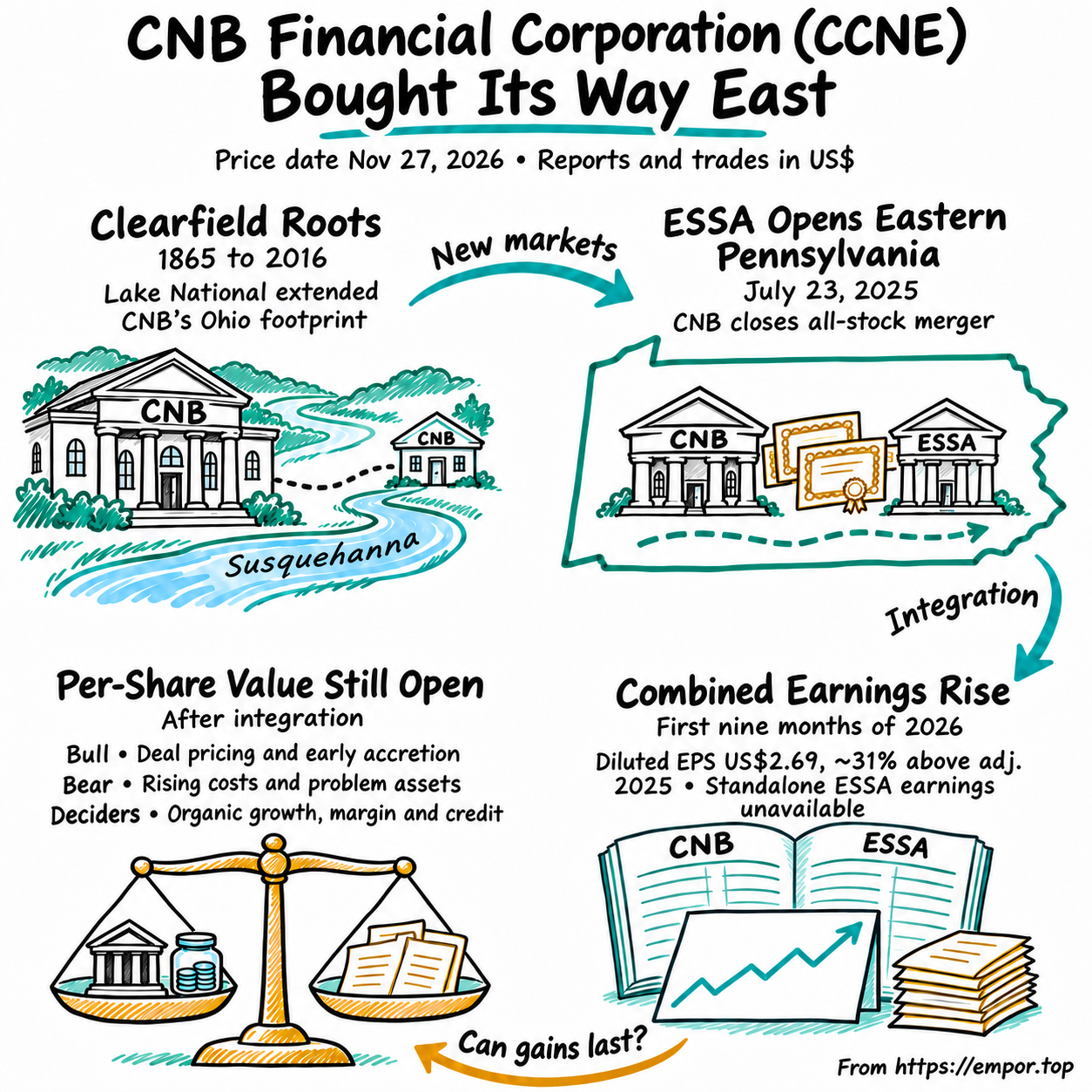
That is roughly what happened at CNB Financial Corporation in the summer of 2026. On July 23, 2025, the Clearfield, Pennsylvania, bank holding company had closed its all-stock merger with ESSA Bancorp, the parent of ESSA Bank & Trust in the eastern part of the state.1
A year later, on the second-quarter call, chief executive Michael Peduzzi told investors that CNB was "accreting even more than we expected from the ESSA side of the deal," and chief financial officer Tito Lima said the quarter had matched the merger model on revenue, earnings accretion and expense management.2
Peduzzi went further: the tangible-book earnback, originally modelled at about three years, was now "probably less than 18 months."2 Three months later, on the third-quarter call, Lima struck a slightly more measured note, saying earnings accretion "generally aligns" with what the company had expected after the merger.3
By the end of September 2026 the combined bank was a genuinely different animal from the one that had signed the merger agreement. It held about $8.4 billion of assets, about $7.0 billion of deposits and about $6.6 billion of loans.4 In the third quarter it earned a net interest margin of about 3.9%, meaning that for every $100 of earning assets, it kept almost $3.90 a year after paying its depositors and lenders.
Its efficiency ratio, the share of revenue swallowed by operating costs, was about 56.5%.4 For a community bank, both numbers are respectable. Neither is spectacular. Diluted earnings per share for the first nine months reached $2.69, a record for the company and about 31% above the adjusted figure for the same stretch of 2025.3
Here is the tension that drives this story. CNB is unquestionably bigger. Whether it is better is a different question, and the bank's own disclosures make that question surprisingly hard to answer. Because ESSA's systems were folded into CNB's, management has said it is impracticable to report what the acquired bank would have earned on its own after conversion.5
So investors can see the combined machine but not the two engines inside it. Every time a quarterly number rises, the same question hangs over it: is that growth, or is that just the arithmetic of having bought another bank?
The stakes are easy to understate because the company is small. At a closing price of $33.92 on November 27, 2026, CCNE traded at roughly ten times trailing earnings and about 1.2 times book value, which put its stock market value at around a billion dollars.6 That billion-dollar equity sliver supports a balance sheet more than eight times its size. In banking, that leverage is normal. It is also why small judgments about credit, deposit pricing and acquisition price compound into big outcomes for shareholders.
Four questions will run through everything that follows. Is ESSA creating durable value per share, or merely a larger share count? Can CNB keep good deposits without bidding away the margin that makes its loans worth making? Is its local-bank model, with its patchwork of regional brands, a genuine advantage or just a description? And can asset quality hold up as the acquired loan book ages and its problems, if any, surface?
One boundary before the story begins. CNB Financial Corporation is the listed holding company. Its principal subsidiary, CNB Bank, does almost all of the economic work: taking deposits, making loans and investing the surplus. Around it sit smaller businesses in wealth management, insurance, securities brokerage and consumer lending through Holiday Financial Services.5 The company reports a single operating segment, so there is no separate profit scorecard for the wealth arm or the consumer-finance shop.5 When this story talks about CNB's economics, it means the bank, because that is where the money is made.
The anniversary, then, is a checkpoint rather than a finish line. To understand why CNB arrived at it the way it did, carrying a new eastern footprint and a heavier share count, it helps to go back to the moment the bank decided that buying other banks was how it would grow.
 Subscribe on LinkedIn
II. A 160-Year Bank Learns to Grow by Buying
Clearfield is a borough on the west branch of the Susquehanna River, in the hills of central Pennsylvania, a long way from both Pittsburgh and Philadelphia. CNB Bank was chartered there in 1865, the year the Civil War ended.5 For most of the next century and a half, its story was the story of countless county banks: take the savings of local families and businesses, lend them back out to the farmers, merchants and homeowners down the road, and survive the panics that wiped out less careful neighbours.
That history matters less for its length than for what it left behind. A bank that has lasted 160 years in one place has a reputation, a deposit base built over generations and a habit of conservative lending. What it does not automatically have is a way to grow. Central Pennsylvania's population was not booming, and a bank that wants to compound its earnings faster than its home towns has only a few options.
It can steal share from neighbours. It can open branches in new places and wait years for them to mature. Or it can buy someone else's branches, customers and loans all at once.
CNB, over the past two decades, increasingly chose the third path, while also building new brands in new markets. By 2025 the company operated offices across Pennsylvania, New York, Ohio and Virginia, under a family of names that reflected that mix of building and buying.5 ERIEBANK works the shoreline from Erie toward Greater Cleveland, FCBank operates in Ohio around Columbus, BankOnBuffalo serves western New York and Ridge View Bank carries the flag in Virginia, where it had grown past $500 million of earning assets by the autumn of 2026.3
Each division is a local brand on top of a shared balance sheet, a structure meant to let CNB look like a hometown lender in each market while pooling capital, compliance and technology behind the scenes. The modern chapter of that strategy can be dated to a deal in 2016.
That year, CNB bought Lake National Bank, a small bank in northeastern Ohio, for $24.75 million in cash.7 It was not a transformational purchase. It added a modest piece of the Ohio market that CNB was already working through its own regional division, and it put about $12.0 million of goodwill on the balance sheet, the accounting residue left when a buyer pays more than the fair value of the net assets it acquires.7
Goodwill is, in effect, a bet recorded in ink: it says that the customer relationships, the people and the franchise are worth more than the loans and deposits on paper. Whether that bet pays off is only knowable years later.
What happened over the following decade is impressive on its face. In 2016 CNB earned about $81 million of net interest income, the spread between what it collected on loans and securities and what it paid out on deposits and borrowings. By 2025 that figure had reached about $242 million, roughly three times larger. Net income climbed from about $20.5 million to about $66.1 million over the same stretch.75
Those are the numbers a proud management team puts on the first slide. But they come with an asterisk that is easy to skip and impossible to ignore. Acquisitions sit at both ends of that comparison: Lake National at the beginning and ESSA at the end. In 2025 alone, net interest income rose about 29% year over year, and management attributed the increase primarily to ESSA.5 A decade-long chart that starts with one deal and ends with another cannot, by itself, show that CNB has a repeatable ability to grow without buying.
Nor was the path a straight line upward. Net income fell from about $58.0 million in 2023 to about $54.6 million in 2024, a period in which higher interest rates pushed up deposit costs across the industry and squeezed banks that had not repriced their loans fast enough.5 The ESSA combination then lifted reported scale in 2025.
The sequence is worth holding on to: the big acquisition arrived right after the legacy bank's earnings had dipped. That does not mean the deal was a rescue, but it does mean the reported recovery and the merger are tangled together.
It is worth pausing on why growth means something different for a bank than for, say, a software company. When a software company grows, it usually sells more of the same product at roughly the same cost, and margins expand. When a bank grows, it adds a balance sheet: more loans, each of which carries a chance of default, funded by more deposits, each of which has to be paid for and kept.
More branches can mean more durable relationships and cheaper funding. They can also mean more expense, more credit exposure and more capital tied up. Growth bought through acquisitions adds a further layer: someone else's underwriting decisions, someone else's systems and someone else's regulatory history all become yours on closing day.
The leadership that would make the biggest of those bets was in place by then. Michael Peduzzi became chief executive effective December 31, 2022, succeeding Joseph Bower.8 Peduzzi inherited a bank that had already learned to buy. His signature decision would be to buy something far bigger than Lake National.
The comparison is stark. Lake National cost under $25 million in cash. ESSA, announced barely two years into Peduzzi's tenure, was valued at around $214 million and paid for entirely in CNB stock.9 A cash deal spends money the bank already has. A stock deal spends the bank's ownership itself, diluting every existing shareholder in exchange for a share of the combined future.
CNB's history of buying banks tells you that it knows how to close a deal. It does not tell you whether it paid a sensible price for this one. Before answering that question, though, it is worth understanding exactly what CNB sells, because that determines what an acquired bank is actually worth.
III. The Spread That Pays for the Branches
Picture a commercial lender at one of CNB's regional offices sitting across from the owner of a mid-sized manufacturing company. The owner needs a line of credit to buy equipment. Three other banks would happily make that loan, and one of them is a national giant with a slicker app.
The lender's pitch is not really about the loan rate, which will be close to everyone else's. It is about everything that comes with it: a banker who picks up the phone, a treasury-management package that handles payroll and receivables, and decisions made by someone who knows the town.
If the pitch works, the bank wins twice. It earns interest on the loan, and the company moves its operating accounts over, bringing deposits that pay little or no interest. Then comes the hard part. Across the street, a competitor is advertising a high-yield savings rate, and an online bank is offering even more. The deposits that fund the new loan are not free, and some of them will leave the moment someone offers a better deal. The whole of CNB's business lives in the gap between those two scenes.
That gap has a name: the spread. Think of a bank as a shop that buys money wholesale from depositors and sells it retail to borrowers. The difference between the two prices, after accounting for loans that go bad, is the bank's gross margin. In the third quarter of 2026, CNB earned a yield of more than 6.3% on its loans and posted a net interest margin of 3.89% across all its earning assets.104
Its loans equalled about 94% of its deposits, which means almost every dollar customers left with the bank was lent back out.10
That last ratio cuts both ways. A bank that lends out most of its deposits is putting its funding to work rather than parking it in low-yielding bonds, which is good for earnings. But it also has less slack. If loan demand keeps growing, CNB has to attract more deposits, borrow from wholesale markets, or slow lending. Each of those choices costs something.
Around this core sit smaller fee businesses. CNB charges for deposit services, sells treasury management to businesses, earns interchange on debit and credit cards, originates and sells mortgages, and manages money through its wealth and asset-management arm.5 In 2025, all of that noninterest income added up to about $40.2 million. Set against pretax income of about $82.5 million, that looks substantial, around 49%.5
The headline flatters the reality. That 2025 fee line included a $1.1 million fee for transitioning the investment platform, life-insurance death benefits from bank-owned policies, and gains on securities sales, partly offset by a $1.6 million loss on selling commercial real estate loans and weaker pass-through income from small-business investment funds.5 Some of those items will not repeat. The honest reading is that fee income supports CNB's earnings rather than defining them. This is a spread business with ancillary services, not a diversified financial company.
The company also does not publish several measures that would let an outsider judge the quality of those revenues. There is no disclosed recurring-revenue percentage, no contract duration for treasury services and no customer revenue concentration.511 For a bank, though, the more relevant questions sit elsewhere: how concentrated the loan book is, how sticky the deposits are and how well the loans perform.
CNB said that at the end of 2025 no single industry accounted for more than 10% of its loan portfolio.5 That is a meaningful protection against one sector's downturn sinking the bank.
So where does CNB sit in the competitive landscape? In Pennsylvania it is a regional operator, not a statewide heavyweight. It competes with giant national and super-regional banks such as PNC, which can outspend it on technology and marketing many times over; with Pennsylvania peers of similar size; with credit unions, which do not pay income tax and often price deposits aggressively; with online banks that have no branches to pay for; and with nonbank lenders that compete for mortgages, equipment finance and consumer credit.5
CNB's share of any one market is modest, and its pricing has to live with everyone else's.
A strategist would recognise the pressures at once. Depositors hold real power: when interest rates rise, they can move money with a few taps, and the industry learned in 2023 how fast that can happen. Borrowers can shop loans, particularly the larger commercial customers CNB most wants. New entrants face real barriers in the form of charters, capital requirements and the trust that a 160-year-old bank has and a startup does not.
But digital channels have lowered the cost of competing for deposits without building branches, which erodes one of the traditional advantages of a dense local network.
What, then, is the strongest case that CNB has an edge? It rests on three ideas. First, local relationships: business owners who value a banker who knows them may accept a slightly worse rate in exchange for responsiveness. Second, a multi-market footprint: by operating under different local brands across several states, CNB can diversify its exposure while keeping a community feel in each place. Third, treasury management: management has described these business relationships as a source of noninterest-bearing deposit growth, the cheapest and stickiest funding a bank can have.3
The strongest rebuttal is that none of those ideas is proven in the published numbers. CNB does not disclose customer retention, deposit attrition by cohort or how its loan pricing compares with competitors. The best independent evidence points the other way. In its July 2026 ratings review, the credit-rating agency KBRA noted that CNB's share of noninterest-bearing deposits remained below that of its peers, at about 16% of total deposits.12
If relationship banking were producing a deep moat, one would expect more of those free operating balances, not fewer. The edge is plausible. It is not yet demonstrated.
Technology is not about to change that picture. On the third-quarter call, Peduzzi described an internal AI task force and an in-house tool called Harmony that gives employees quick access to policies and procedures, and which the bank leaned on during the ESSA systems conversion. Customer-facing uses were constrained by privacy requirements, so most of the work ran through the core-processing vendor, robotic process automation and a small-business credit-scoring model.
He called the spending "not heavily material" and said plainly that CNB was "not going to be the alpha or betas" of the technology; its effect, he said, would be to slow future hiring rather than replace existing staff.3 That candour is welcome. It also means investors should not credit CNB with a technology-driven profit engine that management itself does not claim.
The competitive heat shows up most clearly in the loan pipeline. Chief operating officer Michael Noah put the pipeline at about $1 billion and said it had been steady for two quarters, but he also flagged strong competition and pricing pressure on new loans.3 A full pipeline in a price war is a mixed blessing: it shows demand exists, and it shows that rivals see the same demand.
All of this sets up the central question about ESSA. If the core asset of a community bank is a base of loyal, low-cost depositors and well-underwritten borrowers, then buying another bank is really buying its customer relationships. The price CNB paid for ESSA's relationships, and what those relationships turn out to be worth, is where the story turns next.
IV. ESSA at 96 Cents on the Dollar
On January 10, 2025, CNB Financial and ESSA Bancorp announced that they would combine.13 The structure was simple and, for a deal of that size, a little bold. ESSA shareholders would receive 0.8547 shares of CNB common stock for each ESSA share they owned, with no cash in the mix.1314 Once the deal closed, ESSA's shareholders would become CNB's shareholders, and CNB's owners would share their bank with a new group of partners.
ESSA was not a random target. Headquartered in Stroudsburg, in the Pocono region near the New Jersey border, ESSA Bank & Trust had built a franchise across northeastern Pennsylvania and into the Lehigh Valley, one of the faster-growing parts of the state, sitting on the corridor between Philadelphia and New York.14
For a bank whose roots were in the rural centre and west of the state, that geography was the point. CNB was not just adding a balance sheet. It was buying its way east, into markets with more people, more businesses and, in principle, more room to grow.
The trade press framed it as a roughly $214 million deal between two Pennsylvania banks.9 The more revealing number is how that price compared with what ESSA owned. At announcement, the deal valued ESSA at about 96% of its tangible book value, meaning CNB was offering slightly less than the accounting value of ESSA's equity once intangible assets were stripped out. It also valued ESSA at about 11.6 times its trailing twelve months of earnings.14 The premium over ESSA's market price was about 10.6%.14
Those figures only mean something against a benchmark, and the merger proxy supplied one. ESSA's financial adviser compared the deal with a nationwide set of precedent bank transactions. The median deal in that group was priced at about 135% of tangible book value and about 15.5 times trailing earnings.14 On both measures, CNB paid noticeably less than the typical buyer. Put simply, the typical bank acquirer was paying $1.35 for each dollar of tangible equity. CNB was paying 96 cents.
That is the core of the bull case on the transaction, and it is a genuine point. Bank deals usually go wrong in one of two ways: the buyer overpays at the outset, or the buyer pays a fair price and then fumbles the integration. On the first test, at least, the evidence does not point to an obvious premium overpay.
But a price below the median is not proof of a bargain. Targets trade at discounts for reasons. ESSA was a thrift-heritage bank, the kind of institution that historically leaned on residential mortgages and rate-sensitive deposits, and those balance sheets were hit hard when rates rose quickly in 2022 and 2023. A lower multiple may simply have reflected lower expected profitability. The real test is not what CNB paid relative to other deals. It is whether ESSA's franchise, once combined, earns more than CNB gave up to get it.
And CNB did give something up. At announcement, management projected that the deal would dilute CNB's tangible book value per share by about 15%, and that it would take about 3.3 years of extra earnings to earn that dilution back.1314 That earnback period is the bank-deal equivalent of a payback period. It asks how long the acquirer's shareholders must wait before the higher earnings from the combined bank rebuild the per-share book value they surrendered on day one.
A little over three years is within the range investors typically tolerate. It is also a forecast, not a fact, and by mid-2026 management was describing a much shorter one. Peduzzi's claim that the earnback would come in at under 18 months, roughly half the original model, is the boldest statement anyone at CNB has made about the deal.2
It rests partly on tangible book value per share growing at an annualised rate of almost 13% in the second quarter of 2026.2 It also rests on management's own calculation, which outsiders cannot fully reconstruct, and on an accounting change, described below, that moved some credit costs out of the reported numbers. A management team that beats its own deal model deserves credit. A management team that redraws the model's finish line a year in also deserves a follow-up question about what changed.
The cost became concrete at closing. When the merger completed on July 23, 2025, CNB issued about 8.36 million new shares, valued at about $202.5 million.15 It recorded preliminary goodwill of about $49.9 million, the premium over the fair value of the net assets acquired.5 Both numbers deserve a moment. The share issuance meant that every existing CNB holder now owned a smaller slice of a larger bank, which is fine only if the larger bank earns proportionately more.
The goodwill is the accounting record of CNB's belief that ESSA's relationships, people and markets were worth more than its marked-to-market balance sheet.
The human side of the merger moved on a schedule of its own. ESSA's systems were converted onto CNB's platform in November 2025, about four months after legal closing, and Peduzzi said the period since had gone smoothly.2 Gary Olson, who had led ESSA Bank for more than four decades and joined CNB's board with the acquisition, resigned from that board in 2026.2 Neither event is alarming. Together they mark the point at which ESSA stopped being a partner in the story and became a division inside it.
Set that against the earlier chapter. Lake National cost under $25 million in cash and created about $12 million of goodwill.7 ESSA was roughly eight times as expensive, paid for in stock, and added about four times as much goodwill. The CNB that bought Lake National was experimenting at the edges of a new market. The CNB that bought ESSA was making a defining bet on its geographic future.
That bet came with baggage. In 2023, ESSA Bank had entered into a consent order with the U.S. Department of Justice resolving allegations that it had violated the Fair Housing Act and the Equal Credit Opportunity Act by failing to serve majority-Black and Hispanic neighbourhoods in the Philadelphia area, a practice known as redlining.15
Under the order, ESSA agreed to invest at least $2.92 million in a loan-subsidy fund for residents of those neighbourhoods, and to fund community partnerships, advertising and outreach, and to add staffing aimed at those communities.155 When CNB absorbed ESSA, CNB Bank assumed those obligations.5
The order did not end with the merger. In July 2025, the federal court in the Eastern District of Pennsylvania denied a motion to terminate it.16 CNB's third-quarter 2026 quarterly filing does not mention the order, so the public record from the company itself does not settle its later status.11 The financial sums are small relative to an $8 billion bank. The significance lies elsewhere: an acquirer inherits not only loans and deposits but also its target's regulatory commitments, and how faithfully it honours them is one of the clearer tests of integration discipline.
One question remains, and it is the one that matters most. Can the combined footprint produce more than the sum of two branch networks? The strategic logic is that CNB brings commercial-lending and treasury capabilities that ESSA lacked, and ESSA brings eastern markets CNB could not otherwise reach. If that works, legacy ESSA branches should start generating more business loans and operating deposits than they did as a standalone thrift.
CNB has not published a clean, post-conversion series showing legacy CNB and legacy ESSA performance side by side, so outsiders cannot see that cross-selling directly.5 The verdict on price is reasonably clear: CNB did not obviously overpay. The verdict on value depends on what happened after closing, and that is where the earnings statements start to tell their own story.
V. The Accretion Is Showing Up; the Expense Base Is Too
Peduzzi's team arrived at the second-quarter 2026 call with a simple message. Both engines were running. The merger was contributing more than planned, the legacy CNB divisions were still growing loans, and the efficiency ratio had dropped from just under 65% a year earlier to about 56%.2 Only one analyst question made it onto the transcript, which says something about how little the sell side felt the need to challenge the story that quarter.2
It was the call a management team hopes to host a year into a merger: no surprises, no excuses, few hard questions.
The headline numbers back up at least part of that claim. In the first nine months of 2026, CNB's efficiency ratio improved to about 58.4%, down from about 66.8% in the same period a year earlier.4 An efficiency ratio is simply operating expenses divided by revenue, so a lower number is better. Moving from about 67 cents of cost per dollar of revenue to about 58 cents is a large improvement for a bank in a single year. Net interest income over the same nine months rose about 35% year over year.4
The second-quarter figures put flesh on those claims. Diluted earnings per share were $0.91, up about 49% from $0.61 in the second quarter of 2025, the last quarter before ESSA joined. Operating revenue rose about 43% year over year to more than $87 million.2 Those are big jumps, and they are exactly what one would expect when a bank adds another bank's revenue to its own while issuing comparatively few shares to do so.
When the deal was announced, management had modelled that ESSA would add about 35% to CNB's diluted earnings per share in 2026, assuming cost synergies were fully phased in.1314 That was an aggressive-sounding number, but it reflected the arithmetic of buying a bank below book value with stock: if the acquired earnings are large relative to the new shares issued, per-share earnings jump. Management's mid-2026 assessment that accretion was tracking the model is consistent with the improvement in reported results.
Now for the part that gets less airtime on the call. Strip out merger costs, and CNB's noninterest expenses in the first nine months of 2026 still rose about $26.2 million, or about 21%, year over year.4 The drivers were personnel, occupancy, software and costs linked to higher system volumes, which is to say the ordinary expenses of running a much larger bank.4
Some of that is unavoidable: ESSA's staff and branches were not on CNB's books for most of the comparison period. But it also means the efficiency improvement came primarily from revenue growing faster than costs, not from the combined company becoming structurally cheaper to run.
This distinction matters because cost synergies are the most bankable part of any bank merger. Revenue synergies depend on customers behaving as hoped; cost synergies depend mostly on management closing branches, consolidating systems and trimming overlapping roles. When the expense base is still rising at a double-digit rate a year after closing, investors are entitled to ask whether the synergies were smaller than modelled, slower to arrive, or offset by new investments elsewhere.
The 2025 accounts included about $28.5 million of merger-related costs, and the 2025 annual report attributed some of the rise in technology spending to both ESSA and automation projects.5 Those are one-time and investment costs, respectively, but the line between integration costs and ongoing expenses can blur.
Management has said the reporting gap is impracticable to close.5 It is a common disclosure once systems are merged, and there is nothing improper about it. But it means investors cannot answer the most basic question about the deal: how much of the 2026 growth came from ESSA's franchise performing better under CNB, and how much came simply from ESSA's pre-existing earnings being added to the total?
Management has said legacy loan growth also contributed.4 Without a split, that is a claim to note rather than a fact to measure.
The calls offer a few clues anyway. In the third quarter, originated loans, excluding purchased syndicated credits, grew by about $76 million, a 4.7% annualised pace. Noah attributed most of it to Ridge View Bank in Virginia, ERIEBANK and BankOnBuffalo, while singling out FCBank and ESSA for good deposit growth.3 The second quarter had looked similar, with originated loans up at about a 4% annualised rate and commercial and industrial lending growing much faster.2
Read carefully, that suggests the legacy CNB divisions remain the main lending engine and the acquired eastern franchise has so far contributed more on the funding side than the loan side.
That is not a criticism; a deposit-rich acquisition can be valuable for exactly that reason. But it is not the same thing as the eastern growth story the deal was sold on, and it is a pattern worth watching as ESSA's markets get CNB's commercial-lending playbook.
Accounting added another wrinkle. In the first quarter of 2026, CNB early-adopted ASU 2025-08, an accounting standard that changed how banks recognise credit-loss reserves on certain acquired loans. Under the earlier treatment, a buyer effectively booked a second provision for expected losses on newly acquired loans, on top of the fair-value marks already taken, a quirk critics called "double counting." Adopting the new standard reversed that, producing a $16.4 million provision release.12
KBRA cited that reversal as one contributor to the improvement in CNB's capital ratio in the first quarter.12 The release made first-quarter earnings look better than the underlying operations would have on their own. It changed when credit costs appeared in the income statement, not how much the acquired loans would ultimately lose.
Who is accountable for all of this? Peduzzi's reported compensation was about $1.50 million in 2025, up from about $1.20 million in 2024 and about $1.18 million in 2023.8 Net income over those years moved from about $58.0 million down to $54.6 million and then up to $66.1 million, so pay tracked the recovery and the larger company.85 His long-term incentive awards were split between stock that vests with time and stock that vests on performance, with the performance portion tied equally to CNB's earnings-per-share growth and return on equity relative to a peer group.8
That design is sensible for a bank that has just issued a lot of shares, because it rewards per-share outcomes rather than size. Directors and officers as a group owned about 2.9% of the company, so management has a real but modest personal stake in how those per-share outcomes turn out.8
Shareholders were comfortable with the arrangement. At the April 2026 annual meeting, about 21.0 million votes were cast for the advisory resolution on executive pay and about 354,000 against, roughly 98% support.17 A few director nominees received more than a million votes against, a noticeable minority signal worth noting without overreading.17 It does not amount to broad shareholder opposition. It does suggest some holders want more from the board than a clean bill of health.
The credibility test for management is therefore behavioural rather than rhetorical. The original deal model promised 35% EPS accretion with full synergies and a roughly three-year earnback. Management says accretion is on track. The independent evidence shows sharply better efficiency but a still-rising cost base, an accounting release that flattered one quarter, and no clean split between acquired and organic growth. The early returns support the deal thesis; they do not yet prove that integration has made the larger company leaner.
Management has not promised the cost base will shrink. On the third-quarter call, Lima flagged a likely rise in incentive compensation in the fourth quarter, reflecting strong earnings and efficiency, and a "reasonable increase" in expenses in 2027, with technology investment planned.3
Peduzzi added that systems, audit and stress-testing capabilities for a $10 billion bank were already in place, which is one explanation for why the expense base has run ahead of the balance sheet.3 The full-year 2026 results, with merger costs fully behind it, will be the first chance to see the recurring expense run-rate clearly. Meanwhile, another part of the income statement had started to move in the wrong direction.
VI. The Loan Book Starts to Answer Back
Every bank eventually learns what it actually underwrote. For CNB, the third quarter of 2026 delivered a small but pointed reminder. Management reported a $1.6 million charge-off tied to a single commercial loan relationship, a borrower management did not name.4 In a bank with more than $6 billion in loans, a loss of that size is a rounding error. What made it worth noticing was the context around it.
At the end of September 2026, CNB's nonperforming assets, loans that have stopped paying as agreed plus foreclosed property, totalled about $56.9 million, or 0.68% of total assets.4 A year earlier, the same measure had stood at about $40.4 million, or 0.49%.4 Problem assets had risen by about 40% in a year while the bank's total assets were growing far more slowly. That is the kind of change a careful investor watches.
The pattern is more interesting because it reversed an improvement. At the end of 2025, nonaccrual loans were about $39.8 million, down from about $56.3 million a year earlier, and loans more than 89 days past due but still accruing had fallen to almost nothing.5 CNB had spent 2025 cleaning up. In 2026, some of that progress unwound.
It helps to understand the sequence by which a bad loan becomes a loss. First, a borrower falls behind. Then, if the bank doubts it will be repaid in full, the loan goes on nonaccrual status, meaning the bank stops counting the interest as income. The loan becomes a nonperforming asset. Only later, once the bank has negotiated, restructured, foreclosed or given up, does it write off the portion it does not expect to recover.
That write-off is the charge-off. The gap between the first step and the last can be many months, so rising nonperforming assets often appear before rising charge-offs, like smoke before flame.
For now, the flame is small. In the first nine months of 2026, CNB's net charge-offs totalled about $4.7 million, an annualised rate of about 0.10% of loans.4 That means that for every $1,000 lent, the bank wrote off about a dollar a year. The allowance for credit losses covered about 128% of nonaccrual loans, so CNB had set aside more reserves than the total balance of loans not currently paying interest.4 Both figures are reassuring by any standard measure.
But a low charge-off rate and a rising stock of problem loans are not contradictory. They are what the early stage of a credit cycle often looks like. The question is whether the 2026 increase in nonperforming assets is a temporary blemish, a few borrowers with idiosyncratic trouble, or the first sign that the larger, acquired loan book has a different risk profile from the one CNB built itself.
The company's disclosures limit how far that question can be answered. CNB does not name the commercial borrower behind the third-quarter charge-off, nor disclose customer-level terms.4 The 2025 annual report's assurance that no industry made up more than 10% of the loan book is useful protection against sector concentration, but it does not say where the new problem loans sit.5
One concentration measure does stand out. In its third-quarter supplement, CNB reported commercial real estate exposure equal to about 268% of total risk-based capital.10 Banking regulators have long used 300% as a threshold that triggers closer supervisory scrutiny of commercial real estate lending, so CNB sits below that line but not far below it. There is a second, quieter exposure in the acquired book. ESSA came from a savings-and-loan tradition, the kind of lender whose balance sheet historically leaned on residential mortgages funded by rate-sensitive deposits.14
Mortgages rarely produce sudden large losses, but they can tie up a balance sheet in low-yielding assets for years, which is one reason purchase-accounting marks and their accretion matter so much to the reported margin. The credit risk in a combined CNB-ESSA book is therefore less about the acquired mortgages defaulting and more about whether CNB's push to grow commercial lending in the new markets is underwritten as carefully as its heritage book was.
Commercial property has been the asset class most closely watched by bank investors since 2023, as higher interest rates and the shift to remote work pressured office valuations. A 268% ratio is not a forecast of loss. It is a sensitivity: if commercial property values or rents fall sharply, CNB's capital is more exposed than a bank with less property lending.
Management has framed the trend as idiosyncratic. On the second-quarter call, when nonperforming assets rose to 0.69% of assets from 0.58% three months earlier, Peduzzi attributed the increase to what he called "more of a one-off credit than an industry or policy settings matter."2 On the third-quarter call, Lima described credit quality as "stable and strong."3 Delinquencies were running at about 0.8% of loans in the second quarter, roughly flat on the prior quarter, and reserves were steady at about 1.04% of loans.2
Those statements are consistent with the low loss rate. But a series of individually "one-off" problems is also how a credit cycle tends to look from the inside, and the investor's job is to count how many one-offs arrive.
Weighed properly, the evidence narrows CNB's historically low-loss reputation without rejecting it. KBRA continued to cite historically solid asset quality as a strength in July 2026.12 Charge-offs remain low and reserves are ample. But the rise in nonperforming assets is real, it reversed a year of improvement and it arrived just as the acquired ESSA book began to season under CNB's ownership.
The next evidence will be migration: whether today's nonperforming loans turn into tomorrow's charge-offs, and whether they cluster in the acquired portfolio or in the commercial book CNB has been growing itself. Credit, though, is only half of what makes a loan profitable. The other half is what the bank pays to fund it.
VII. The Deposit Franchise Has to Earn Its Keep
In the third quarter of 2026, CNB did something banks rarely brag about: it let money walk out the door on purpose. The bank exited about $76 million of higher-cost corporate deposits, carrying an average rate of about 3.69%, more than the bank wanted to pay.3 As a result, total deposits fell by about $33 million during the quarter.
Excluding the exit, deposits grew by about $43.5 million, a modest annualised pace of about 2.4%.3 The second quarter had seen the same manoeuvre, as Lima described exiting "higher interest cost, single-thread deposit relationships," customers who held a single expensive account and nothing else.2
In a period when many banks were still fighting to hold every deposit dollar, that is an instructive choice. It suggests a management team that has decided not all deposits are worth having. A corporate treasurer who parks cash at a bank only because it offers the highest rate in town is not a relationship customer. That money will leave the moment someone else pays more, and while it stays, it compresses the spread on every loan it funds. Walking away from it is a bet that the bank's other deposits are cheaper and stickier.
The deposit mix matters because payroll accounts cost little, while high-rate accounts are expensive and reprice quickly when interest rates rise.
KBRA's July 2026 review captured both sides of CNB's funding story. On the positive side, the agency credited CNB with a durable deposit base in its heritage markets and limited reliance on wholesale funding such as brokered deposits and Federal Home Loan Bank advances.12 Those are real strengths: a bank that funds itself mostly from local customers is less exposed to sudden shifts in market sentiment. On the cautious side, KBRA noted that noninterest-bearing deposits made up about 16% of the total, below CNB's peers, and that its fee income was not widely diversified.12
That below-peer share limits how strongly the relationship thesis can be stated.
Management's own numbers show the treasury strategy working, at least modestly. Noninterest-bearing deposits grew by about $13.5 million in the third quarter, a 4.7% annualised rate, which Noah credited to expanded treasury-management relationships.3 The cost of interest-bearing deposits fell to about 2.40% from about 2.75% a year earlier.3 About $1 billion of deposits are tied to an index, many of them larger relationships moved onto that basis after the 2023 rate scare, and Lima estimated that CNB's deposit costs would move with roughly 40% of any change in market rates.3
He was also frank about competition, observing that there were "some crazy offerings out there right now," with some rivals paying above 4%, and adding that the bank would turn to Federal Home Loan Bank borrowing capacity, about $2 billion, before expensive brokered deposits.3 Both stories can be true. The bank may be winning good deposits through treasury services while still paying up for others in a crowded market.
With its loan-to-deposit ratio at about 94% at the end of the third quarter, CNB had little room to grow loans faster than deposits without wholesale borrowing or higher deposit rates.10
At the end of September 2026, CNB had about $164 million in short-term borrowings.11 That is modest relative to its size, but it is the line to watch if the deposit base stops keeping pace.
Taken together, the evidence leaves CNB with a credible funding franchise but not a proven funding moat. The heritage-market deposit base and limited wholesale reliance are real. The below-peer share of free operating balances and management's own description of intense rate competition cap how much advantage that franchise confers. One more detail sharpens the point. Lima said the net interest margin excluding purchase-accounting accretion, the gradual income released as acquired loans marked below face value pay off, was about 3.75%, compared with the reported 3.89%.3
Roughly 14 basis points of the headline margin is therefore an echo of the ESSA purchase rather than the ongoing spread business, and it will fade as those loans run off.
Lima has said that holding the margin stable into 2027 would count as "a success."3 The proof, if it comes, will be organic core-deposit growth after the deliberate exits, a stable or falling cost of deposits and a net interest margin that holds up through a full interest-rate cycle, not just a single favourable quarter.
So the questions have accumulated: a reasonably priced acquisition with an expense base still swelling, a credit book showing its first stresses and a deposit franchise that is good but not exceptional. Time to put the bull and bear cases side by side.
VIII. Analysis & Bear vs. Bull Case
Imagine a long-time CNB shareholder standing up at the next annual meeting with a simple question for the board. The bank has just bought ESSA. Should it keep buying, return more capital to shareholders, or spend the next few years proving that the enlarged franchise can grow without another acquisition? There is no obviously right answer, and the way the board responds would say a lot about how it thinks about value.
Start with what CNB has to work with. At the end of September 2026, its common equity tier 1 ratio, the core measure of a bank's loss-absorbing capital relative to its risk-weighted assets, was about 12.2%.10 That is comfortably above regulatory minimums. KBRA rated CNB Financial BBB with a Stable outlook in July 2026, with the bank itself rated a notch higher.12 At $33.92 per share on November 27, 2026, the stock traded at about 10.1 times trailing earnings and about 1.17 times book value.6
The bull case begins with identity. CNB is a 160-year-old community bank that has managed to expand into four states while keeping local brands and, in principle, local decision-making.5 Its business is relationship lending: commercial loans paired with treasury services, which management says are bringing in operating deposits.3 ESSA added a fast-growing eastern Pennsylvania region and a larger capital base, which raises the size of loan CNB can make to a single borrower and lets it compete for bigger commercial clients.14
The deal was priced below the precedent median, early accretion is tracking the plan, and the efficiency ratio has improved sharply.
The bear case starts with the customers. Depositors can move money with a phone, and CNB's share of free operating balances is below its peers.12 Borrowers can shop loans across national banks, regional rivals, credit unions and nonbank lenders. CNB is much smaller than the national banks it competes with and cannot match their technology budgets. And, crucially, the company has not shown evidence of customer retention, pricing power or market-share gains that would establish a durable moat.
Hamilton Helmer's framework of seven sources of lasting competitive advantage offers a useful lens. Of the seven, only a few apply to a community bank. Switching costs are the most relevant: a business with its payroll, receivables and credit lines at CNB faces real friction in moving them. But CNB does not quantify retention, so the size of those switching costs is unknown. Scale economies matter in banking, especially for technology and compliance costs, but CNB is a mid-sized player, and its scale is helpful rather than dominant.
Counter-positioning, network effects, cornered resources and process power have little purchase here. Brand matters in a trust business, and a 160-year history earns some of it, but there is no evidence that CNB's brands command a pricing premium. The honest assessment is that CNB's power, if it exists, is local and relationship-based, and that the filings do not prove the relationships produce superior pricing or retention.
Michael Porter's five forces point in the same direction. Rivalry is intense for both deposits and loans. Buyer power is high on the deposit side, where customers can move money easily, and moderate on the loan side, where switching a commercial lender takes effort. Regulation makes new bank charters hard to obtain, which protects incumbents, but digital banks and nonbank lenders have found ways around that barrier for specific products.
Substitutes for payments and some lending products are growing. Supplier power, in a bank's case its funding sources, is the force that most directly squeezes margins when rates rise. None of these forces is unusual for a community bank. That is precisely the point: CNB operates in a structurally competitive industry, and its edge has to come from execution rather than structure.
Next, the capital record, which an activist would scrutinise closely. CNB issued $50 million of subordinated debt in 2016 and $85 million of subordinated notes in 2021, and KBRA notes a common-stock issuance in 2022 to strengthen capital.712 The ESSA deal added about 8.4 million shares in 2025.1 Then, in June 2026, CNB redeemed $50 million of its subordinated notes, leaving $35 million outstanding.11 The board has also authorised a repurchase programme of up to 500,000 shares or $15 million, running through June 2027.11 Peduzzi has been explicit about the order of priorities: the first material use of capital is retiring the remaining $35 million of subordinated notes, which have moved into their floating-rate period, by June 2027, with a dividend increase possible and buybacks dependent on market conditions.3
On M&A, he told analysts in the summer that CNB would keep looking for deals to fill "gaps in our four-state current area," but that the key focus for 2026 was maximising the benefit of ESSA, and that the bank did not want to "acquire and crawl right up to" the $10 billion asset threshold.2
That threshold matters because, above it, the Durbin Amendment caps the interchange fees a bank can earn on debit cards, which would cut into a fee line that is already thin. CNB sits at about $8.4 billion. The next deal, if it comes, would likely need to be big enough to jump the line decisively. This is a bank that has raised capital repeatedly to grow and is only now beginning to return some.
The skeptic's question is which use of its next dollar of capital creates the most per-share value: buying back stock at around 1.17 times book, paying down debt, or funding another acquisition that would again dilute existing holders. The answer to that question will reveal more about management's discipline than any slide.
The credit picture deserves equal balance. A CET1 ratio above 12% and low year-to-date charge-offs are real cushions. But some of the capital improvement earlier in 2026 came from the accounting-driven provision release, not from operations, and nonperforming assets have risen while commercial real estate exposure is meaningful.12410 Liquidity and rate exposure look manageable too.
Lima put available liquidity at about 4.7 times adjusted uninsured deposits, the balances most likely to run in a panic, and Peduzzi described the balance sheet's sensitivity to interest-rate shocks as "pretty neutral," in part because so many larger deposits are now tied to an index.3
A neutral rate position protects the bank against sharp moves in either direction, though it also means CNB will not get a windfall if rates rise. The capital base is strong enough to absorb a moderate credit cycle. It is not so strong that credit can be ignored.
Valuation, finally, is context and not a recommendation. At roughly ten times trailing earnings and slightly above book value, the market is not paying for a high-growth story.6 It appears to be pricing CNB as a solid but ordinary community bank, assuming neither a collapse in credit nor a breakout in organic growth. That pricing is easier to interpret next to what the bank earns. Lima cited a return on tangible common equity of about 14.4% and a return on assets of about 1.33%, figures that sit in the upper half of what community banks typically produce.3
A bank earning mid-teens returns on tangible equity would ordinarily command more than a modest premium to book, so the market's restraint can be read in one of two ways: either investors doubt that today's returns, flattered by purchase-accounting accretion and a favourable rate backdrop, will last, or the stock is discounting the open questions about credit and organic growth that this story has laid out.
Neither reading is a forecast. Both say the market wants proof before it pays for the thesis. A comparison with peers or with CNB's own history would need a consistent dataset of forward and trailing multiples, and that comparison should not be made casually.
Three scorecards will settle the debate. The first is organic growth in core loans and deposits, because that is the only way to know whether the enlarged franchise compounds on its own. The second is the net interest margin, read together with the cost of deposits, because that shows whether CNB is paying away its spread to fund growth; the latest reading is 3.89%.4
The third is nonperforming assets and charge-offs, currently 0.68% of assets and 0.10% annualised, because that is where any underwriting weakness will surface.4 The efficiency ratio belongs alongside them as the gauge of integration, not as a scorecard on its own.
The case, in short, is balanced. Deal pricing and early accretion are supportive. The moat is plausible but unproven, asset quality has weakened from a year earlier and the most important growth data are not separately disclosed. That combination yields not a verdict but a set of lessons, some of which apply far beyond Clearfield.
IX. Business & Investing Lessons
The ESSA deal is a near-perfect case study in what bank investors call the two halves of an acquisition. The first half is the price. The second half is everything after. CNB bought a new region at 96% of tangible book, well below the precedent median, and then asked its combined company to turn about 15% of book-value dilution into higher per-share earnings within a little over three years.14 The first half looks disciplined. The second half is in progress.
The first lesson follows directly. A low price is only the first half of a good bank deal; the other half is earning back the shares you issued. Founders and investors in every industry fixate on the entry multiple because it is visible on announcement day. But the shareholders who received 8.36 million new CNB shares will ultimately be judged by what those shares earn, not by what they cost.1
A cheap acquisition that never achieves its synergies is more expensive than a fair one that does. CNB's test is not the 96 cents. It is whether the expense base, still rising at a double-digit pace a year after closing, eventually bends.
The second lesson comes from the deposit side. A relationship is an advantage only when customers keep their deposits through the next rate cycle. Community banks love to talk about relationships, and CNB's treasury strategy is designed to turn them into cheap operating balances. But the clearest independent evidence, KBRA's 16% noninterest-bearing share, says CNB's relationships have not yet produced an unusually low-cost deposit base.12 The decision to walk away from $76 million of expensive corporate money is the right instinct. Whether the remaining deposits stay put when rates move again is the proof.
The third lesson is about growth itself. In banking, growth buys you more balance sheet; underwriting decides whether it bought you value. CNB's assets have grown to about $8.4 billion, and its net interest income has roughly tripled in a decade. Yet nonperforming assets rose by about 40% in a year as the acquired book seasoned.4 Every new loan is a promise that will be tested later. A bank's true track record is written not when it books loans, but years afterward, when they are repaid or not.
There is a corollary that belongs to CNB alone. When the deal goes well, management tends to move the goalposts in its own favour, and CNB's did: an earnback modelled at about three years became "probably less than 18 months" a year later.2 Investors should welcome good news and still ask that it be shown in a form they can check.
The single most useful disclosure CNB could add would be a simple split of loans and deposits by legacy franchise. Until then, a faster earnback is a claim, and the best evidence for it is tangible book value per share, a number every shareholder can watch.
A fourth, quieter lesson concerns inheritance. When CNB bought ESSA, it bought a federal fair-lending consent order along with the branches.15 In any acquisition, the obligations you assume tell you as much about the target as the assets you acquire, and the way an acquirer handles them tells you as much about its culture as any mission statement. CNB's whole pitch is that it is a community bank that knows its neighbourhoods.
A consent order that exists because a predecessor was accused of not lending in some of those neighbourhoods is, in that light, not a compliance footnote but a direct test of the brand promise. Doing it well would turn an inherited liability into evidence for the thesis.
The last lesson is about the balance between patience and ambition. Peduzzi has said CNB does not want to creep toward $10 billion in assets and trip into the Durbin interchange cap with a deal that is too small to pay for it.2 That is a sensible constraint, and it forces a choice. CNB can grow organically for a while and let the enlarged franchise prove itself, or it can look for a deal large enough to clear the threshold with room to spare.
In a bank that has grown mostly by buying, the more disciplined path may also be the less exciting one: a year or two of boring, checkable, organic quarters.
X. Epilogue
Tonight, CNB Financial is a bank of about $8.4 billion in assets, operating in four states under a family of local brands, with a fresh eastern Pennsylvania franchise that it has owned for a little more than a year.4 The integration anniversary has passed. The early numbers look like what management promised. And yet the thesis is still open, for three specific reasons: same-store growth is not separately disclosed, recurring costs are still elevated and credit migration is still unfolding.
The next big moment will be the fourth-quarter 2026 results and call, expected early in 2027. Management has already told investors what to expect on costs: a bump in incentive pay in the fourth quarter and a reasonable rise in expenses in 2027.3 It has told them what it hopes for on margin: stability. And it has told them where capital goes first: the remaining subordinated notes, by June 2027.3
Those are specific, checkable commitments, which is to management's credit. It will be the first time management reports a full calendar year of combined operations, with the bulk of merger costs behind it. Analysts will ask about the recurring expense run-rate, the efficiency ratio after integration costs and whether loan and deposit growth in the legacy CNB and ESSA markets is holding up.
The margin is the clearest place to watch the deal's echo fade. Purchase-accounting accretion props up the reported figure by more than a tenth of a percentage point today, and that support shrinks every quarter as acquired loans pay down.3 Holding the headline margin flat while that tailwind weakens would require the underlying spread business to improve. That is a demanding test, and an honest one.
If organic deposits and loans grow while the margin holds near today's 3.89% and the efficiency ratio continues to improve, ESSA will look like what management said it was: a platform for compounding in a better market. CNB will have bought its way east and then grown there.
If, instead, earnings growth depends on accounting timing, on cost cuts that do not stick or on riskier loans to fill a fully lent balance sheet, then the accretion that management reported in 2026 will have overstated the economic payoff. Nonperforming assets above September's 0.68% of assets would be the first sign.
There is one more thread to follow: the status of ESSA's fair-lending consent order. The court declined to terminate it in July 2025, and CNB's latest quarterly filing does not address it.1611 How CNB fulfils and eventually closes out those obligations will be a test of whether it absorbed ESSA's regulatory history with the same care it applied to the deal price.
The question was never whether CNB could become larger. It already has. The question is whether it can become more valuable per share.
XI. Outro
Go back to that third-quarter decision. A bank that spent years buying other banks, issuing shares and stretching across four states chose, quietly, to let expensive deposits leave.3 It was not a growth move. It was a choice about what kind of bank CNB wants to be, one willing to put margin ahead of deposit growth.4
Acquisitions can buy a map. Whether relationships can fund it is the question CNB still has to answer.
References
-
CNB Financial ESSA Merger Closing Form 8-K — SEC, 2025-07-24 ↩↩↩↩
-
CNB Financial Q2 2026 Earnings Call Transcript — StockAnalysis, 2026-08-06 ↩↩↩↩↩↩↩↩↩↩↩↩↩↩↩↩
-
CNB Financial Q3 2026 Earnings Call Transcript — StockAnalysis, 2026-10-29 ↩↩↩↩↩↩↩↩↩↩↩↩↩↩↩↩↩↩↩↩↩↩↩↩↩↩
-
CNB Financial Corporation Reports Third Quarter 2026 Results — SEC Form 8-K exhibit, 2026-10-21 ↩↩↩↩↩↩↩↩↩↩↩↩↩↩↩↩↩↩↩↩
-
CNB Financial Corporation Form 10-K for 2025 — SEC, 2026-03-11 ↩↩↩↩↩↩↩↩↩↩↩↩↩↩↩↩↩↩↩↩↩↩↩↩↩
-
CNB Financial (CCNE) Statistics — StockAnalysis, 2026-11-27 ↩↩↩
-
CNB Financial Corporation Form 10-K for 2016 — SEC, 2017-03-10 ↩↩↩↩↩
-
CNB Financial Corporation Proxy Statement — SEC, 2026-03-16 ↩↩↩↩↩
-
Pennsylvania Banks to Combine in $214M Deal — Banking Dive, 2025-01-13 ↩↩
-
CNB Financial Q3 2026 Earnings Supplement — SEC, 2026-10-21 ↩↩↩↩↩↩
-
CNB Financial Corporation Form 10-Q for Q3 2026 — SEC, 2026-11-06 ↩↩↩↩↩↩
-
KBRA Affirms Ratings for CNB Financial Corporation — KBRA, 2026-07-17 ↩↩↩↩↩↩↩↩↩↩↩
-
CNB Financial Corporation and ESSA Bancorp, Inc. Announce Strategic Merger — CNB Financial, 2025-01-10 ↩↩↩↩
-
CNB Financial / ESSA Bancorp Merger Registration Statement, Form S-4/A — SEC, 2025-02-14 ↩↩↩↩↩↩↩↩↩↩
-
United States v. ESSA Bank (E.D. Pa.) — U.S. Department of Justice, Civil Rights Division ↩↩↩
-
United States v. ESSA Bank, Case 2:23-cv-02065 Docket — GovInfo ↩↩
-
CNB Financial Corporation Annual Meeting Results, Form 8-K — SEC, 2026-04-22 ↩↩
 LinkedIn
 WhatsApp
 Reddit
 Hacker News
 Email
 Kindle
 RSS Feed
 Spotify
 Apple Podcasts
 Amazon Music
 Audible
 YouTube