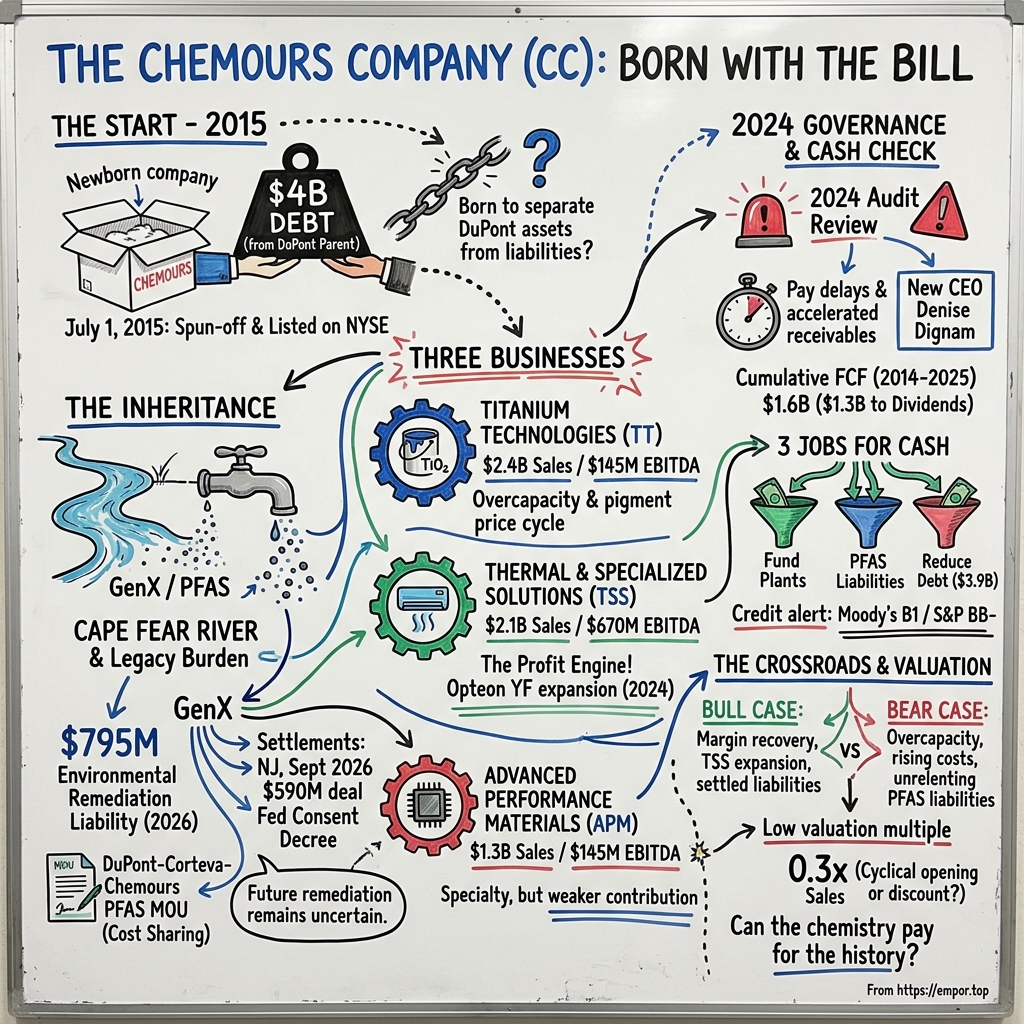
The Chemours Company: Born With the Bill
I. The Company That Owed Its Parent $4 Billion
On July 1, 2015, a new ticker lit up on the New York Stock Exchange. CC. The Chemours Company. For anyone who had owned DuPont the morning before, it arrived almost by mail: one Chemours share for every five DuPont shares they held, a dividend of paper from one of the most storied names in American industry.[^1] The plants were not new. The people running them were not new. Many of the products had been household names for generations: Teflon, the non-stick coating that made DuPont famous in American kitchens; Ti-Pure, the white titanium dioxide pigment inside paint, plastics and paper; Freon, the refrigerant that once defined air conditioning itself.
What was new was the balance sheet. Before it had sold a single pound of pigment as an independent company, Chemours had borrowed roughly $4 billion, through $2.5 billion of senior unsecured notes and a $1.5 billion term loan, alongside a $1 billion revolving credit line.[^1] And here is the detail that frames everything that follows. About $3.9 billion of that money did not stay with Chemours to build plants or fund research. It went to DuPont, in cash or in kind, as the price of the assets DuPont was handing over.[^1] The child left home carrying the mortgage on the house it had grown up in.
That is an unusual way to begin life. Most spin-offs are pitched as liberation: a neglected division freed from a sprawling parent, finally able to set its own strategy. Chemours was pitched that way too, as a focused leader in titanium technologies, fluoroproducts and chemical solutions. But the structure told a second story. DuPont kept its higher-growth agriculture, nutrition and electronics businesses and collected a large cash payment. Chemours received the cyclical commodity chemistry, the heavy industrial plants and, as the next decade would make painfully clear, a large share of the environmental history attached to those plants.
It is worth being precise about who is who, because the story keeps three companies in the frame. Chemours is the listed company, and every revenue, profit and cash figure in this story is Chemours' own. DuPont's legacy entity, now called EIDP, later became part of Corteva, the agricultural company spun out of the DowDuPont merger, while a separate company kept the DuPont name.1 Those former-parent companies matter here as counterparties, above all in a 2021 agreement to share certain legacy PFAS costs. They do not sit inside Chemours' reported numbers, and their businesses do not belong in this story except where their cheques or disputes touch Chemours.1
Eleven years on, Chemours is still a substantial industrial business. In 2025 it sold about $5.8 billion of products, roughly the same as the year before.[^3] It runs titanium dioxide plants on the U.S. Gulf Coast and abroad, refrigerant plants in Texas and elsewhere, and specialty fluoropolymer lines serving chip-makers and industrial customers.1 Yet in 2025 it earned essentially nothing at the operating line, and lost $386 million after interest, taxes and legal charges.[^3] Its shareholders' equity, the accounting cushion between what it owns and what it owes, had shrunk to about $250 million against about $4.6 billion of borrowings.1 By late October 2026 the whole company was valued in the stock market at roughly $2 billion, a fraction of the debt it carries.[^4]
So the question this story asks is not whether Chemours makes useful things. It plainly does. A paint can, a car air-conditioner and a semiconductor fab all contain its chemistry. The question is whether those businesses can earn enough, and turn enough of it into cash, to carry three loads at once: the plants that must keep running, the debt that came with the spin, and the bill for pollution that began long before Chemours existed but now has its name on it.
Three central questions run underneath. Can Chemours' businesses regain the margins they earned in the good years, when operating margins approached 19%? Can operating cash reduce debt while environmental costs are being settled, rather than merely refinancing it? And does Chemours have a competitive edge durable enough to earn a premium for its shareholders, or is it a capable operator in industries where scale and know-how keep you in the game but do not let you set the price?
The first tension is already visible on the day of the listing. Chemours inherited real operating know-how: decades of process engineering in chloride-route titanium dioxide, fluorine chemistry that few companies can replicate, and long-standing relationships with the world's largest paint makers. It also inherited liabilities whose final cost nobody could know in 2015. The separation documents spelled out that Chemours would indemnify DuPont for a broad range of liabilities tied to the businesses it received.[^1] The new company had been handed both the recipe book and the bill. The rest of this story is about which one turns out to be heavier.
 Subscribe on LinkedIn
II. The Inheritance Followed the Product
In June 2017, people in Wilmington, North Carolina, opened their newspaper to learn that something called GenX was in their drinking water. The StarNews had reported that a chemical used as a replacement for a key ingredient in making Teflon had been found in the water drawn from the Cape Fear River, and that the local utility's treatment plant could not filter it out.2 The source was about a hundred miles upstream, at a Chemours site called Fayetteville Works. Researchers had found the compound downstream of the plant but not above it, pointing to the facility's wastewater.2 Chemours said GenX was a byproduct of a separate manufacturing process at the site and agreed to capture it rather than discharge it into the river.2 For families who drew their water from the lower Cape Fear, that commitment did not answer the question every family was asking at the kitchen tap: how long had this been going on?
To understand why that question became Chemours' question, it helps to understand what PFAS are. Per- and polyfluoroalkyl substances are a large family of man-made chemicals built around one of the strongest bonds in chemistry, the bond between carbon and fluorine. That strength is the whole point of the products: it is why non-stick pans resist heat, why firefighting foams smother fuel fires, and why stain-resistant fabrics shed spills. It is also why the molecules barely break down once they escape into soil or water, earning them the nickname "forever chemicals." A product designed to last forever in a frying pan also lasts a very long time in a river.
DuPont had used a PFAS compound called PFOA for decades to make Teflon and related fluoropolymers. GenX was developed as a replacement, intended to be less persistent in the body. The difficulty for Chemours is that it inherited both chapters at once. The Fayetteville Works site, the Washington Works site in West Virginia and the Chambers Works site in New Jersey came with it in the spin, and with them came the environmental record of decades of DuPont operations as well as Chemours' own post-2015 conduct. That distinction matters legally and analytically. Contamination from before July 2015 is a legacy liability that Chemours carries under its separation agreements. Discharges after July 2015, and the controls Chemours chose to install or not install, are its own.
By 2021, the three companies tied to the old DuPont had to decide how to divide that legacy. In January of that year Chemours, DuPont and Corteva signed a binding memorandum of understanding to share eligible PFAS costs arising from conduct before the July 2015 spin. Chemours would bear half; DuPont and Corteva together the other half, up to a combined cap of $4 billion of qualified spending, with an escrow account funded over time to back the arrangement.1 It looks like a settlement among relatives, and in one sense it was: it ended a lawsuit in which Chemours had argued that DuPont had saddled it with liabilities far larger than the spin documents admitted. But the MOU did not make costs disappear. It moved the argument from whether costs would be shared to which costs qualify, how they are calculated and who indemnifies whom, and those questions can still be disputed.1
Then the bills began to arrive in sequence. In June 2023 the three companies agreed to pay $1.185 billion to resolve PFAS drinking-water claims from a nationwide class of U.S. public water systems; Chemours' share, consistent with the MOU, was half, or about $592 million.3 The agreement explicitly excluded personal-injury claims and state attorney-general claims over natural resources, which meant it was a large door closed in a building with many rooms.3
New Jersey was the next room. In August 2025, the three companies agreed to an $875 million settlement with the state covering legacy contamination at Chambers Works, Parlin, Pompton Lakes and Repauno and statewide PFAS claims, with payments stretched over 25 years and a separate reserve fund of up to $475 million to back future cleanup.4 Chemours bore half the payments under the cost-sharing formula.4 The charge landed in Chemours' 2025 accounts as roughly $270 million of extra general and administrative expense, enough on its own to explain much of why a business with flat sales reported an operating loss that year.1
In June 2026 came the federal government. The Environmental Protection Agency, the Department of Justice and West Virginia's environmental regulator announced what the EPA called the first comprehensive federal settlement with a major PFAS manufacturer.5 The package was valued at more than $450 million in penalties and required work: a $22.5 million civil penalty, sized, notably, on Chemours' ability to pay; a multi-year $90 million program to reduce PFAS discharges; pollution controls at Washington Works; clean drinking water for communities near the West Virginia and New Jersey plants; and an obligation to evaluate and install controls at Fayetteville Works.5 The consent decree added new obligations for off-site drinking-water programs around Washington Works and Chambers Works.6
Then, in September 2026, North Carolina. The state, eleven local governments along the Cape Fear, DuPont and Chemours announced a $590 million agreement, the largest PFAS settlement in the state's history.7 Of that, $455 million is guaranteed to the state and local governments over 10 to 15 years, and DuPont and Corteva committed a separate $135 million reserve to guarantee Chemours' obligations under its existing North Carolina consent order if Chemours loses the ability to pay.7 Chemours said the settlement payments would satisfy future escrow contributions it owed under the MOU, including a scheduled $50 million contribution.[^11] North Carolina's attorney general, Jeff Jackson, put the state's view in one sentence: "Chemours made this mess, and we're making sure Chemours cleans it up."7
Keep that deal in proportion. The $590 million headline is a three-company figure, and the public releases do not lay out a full company-by-company split. The detail about DuPont and Corteva guaranteeing Chemours' obligations is revealing in its own right: the counterparties were willing to post security in case Chemours could not pay. That is a statement about creditworthiness, not just about pollution.
What does all of this add up to on Chemours' balance sheet? At the end of 2025, its accrued environmental remediation liability, the money it had formally booked for cleanup it expects to perform, was $618 million. By June 2026 it was $795 million.8 Management also estimated that adverse developments could add up to roughly $700 million on top of that accrual, while saying explicitly that this was not an estimate of the maximum possible liability.8 Litigation reserves rose separately in the first half of 2026, with $235 million of PFAS-related legal charges booked in those six months.8
That is why PFAS is more than a set of lawsuits for Chemours. It runs through the plants, which must operate under tighter controls; through cash, which leaves in settlements and escrow; through reputation, which affects what regulators will tolerate; and through credit, which determines what the company pays to borrow. Each settlement narrows a specific set of claims. None makes the future cost of remediation certain. And none of these costs can be judged in the abstract, because the money to pay them has to come from somewhere. To know whether Chemours can carry its history, one first has to see what it makes, where it competes, and what its plants must keep doing to earn a living.
III. Three Businesses, One Cyclical Factory System
Picture three customers on the same morning. A paint maker in Ohio needs a railcar of white pigment, because titanium dioxide is what makes white paint opaque and bright. An air-conditioning manufacturer needs drums of refrigerant that comply with the latest climate rules. A semiconductor-equipment supplier needs high-purity fluoropolymer parts that survive the corrosive chemistry inside a chip fab. All three buy from Chemours. None of them buys a subscription.
That is the revenue model in a sentence. Chemours makes chemicals and materials and sells them by the ton, the drum and the part. Its sales move with how much customers buy, the price it can realize, currency and product mix, not with licences or recurring contracts.1 Some titanium dioxide customers sign medium- to long-term supply arrangements, but the company does not disclose a company-wide contract length, minimum volume commitment or recurring-revenue share.1 Every quarter, in effect, it has to win its revenue again.
The business is organized in three segments. Titanium Technologies, or TT, makes the white pigment under the Ti-Pure brand. Thermal & Specialized Solutions, or TSS, sells refrigerants under the Opteon and Freon names, as well as thermal-management fluids, propellants and solvents. Advanced Performance Materials, or APM, makes Teflon and other fluoropolymers and fluoroelastomers for industrial, electronics and semiconductor uses.1
Here is where the story most people tell about Chemours, as the titanium dioxide company, needs correcting. In 2025 TT was the biggest segment by sales, about $2.4 billion or roughly 41% of the total. TSS sold about $2.1 billion, roughly 36%, and APM about $1.3 billion, roughly 22%.1 But follow the profit, measured by the segment adjusted EBITDA the company uses to judge each business. TSS generated roughly $670 million. TT and APM each generated only about $145 million.1 Put differently, the refrigerant business earned about 32 cents of segment profit on every dollar of sales; the pigment business earned about six. The company most investors think of as a pigment maker is, in today's economics, a refrigerant company with a large and struggling pigment business attached.
A white powder in a crowded world
To see why TT earns so little, start with the product. Titanium dioxide is the most widely used white pigment in the world. Chemours makes it by the chloride process, which reacts titanium-bearing ore with chlorine at high temperature and then burns the resulting titanium tetrachloride back into pure oxide. Think of it as a refinery for whiteness: it produces a brighter, more consistent pigment than the older sulfate process, but it requires expensive plants and decades of operating know-how. That know-how is real, and it is the part of Chemours' inheritance that DuPont spent half a century building.
The problem is arithmetic. Chemours estimates that global demand for titanium dioxide in 2025 was about 7.3 million metric tons, against about 10 million tons of nameplate capacity.1 An industry with roughly a quarter more capacity than demand is an industry in which someone always has an incentive to cut price to fill a plant. Chemours names Tronox, 龙佰集团 LB Group, Kronos and INEOS among the rivals competing in premium-performance grades.1 Kronos, in its own annual report, estimates that LB Group, Chemours and Tronox each hold roughly 11% to 14% of global production capacity.9 Those are capacity estimates, not shares of actual sales, but they make the shape of the market clear: three large producers of similar size, a long tail behind them, and no one big enough to discipline price alone.
The newest pressure comes from China. LB Group and other Chinese producers have spent years building chloride-process capability, the technology that once separated Western producers like Chemours from cheaper sulfate-route competitors. As that capability spreads, the premium for consistent, high-performance pigment narrows, and established vendors can be displaced at customers who decide that good enough is good enough. In a business where a paint company can qualify a second or third pigment supplier, technical leadership has to be renewed constantly; it is not a wall, it is a head start.
The customer list tells the same story from the buyer's side. No single Chemours customer accounted for more than 10% of consolidated sales in 2025. But inside TT, the ten largest customers took more than 44% of segment sales, and one customer alone took more than 20%.1 A year earlier, the top ten had been about 41% and the largest just over 10%.10 At year-end 2025, a single customer accounted for about 7% of the company's total receivables.1 That concentration is a negotiating fact. A paint giant that buys a fifth of a segment's output knows its weight, can qualify other suppliers, and can push on price when the industry is oversupplied. Concentrated buyers in an oversupplied market are the textbook recipe for weak pricing power.
Chemours' best evidence that it can act on this structure is a plant it shut. In July 2023 it announced the closure of its titanium dioxide site at Kuan Yin, Taiwan, stopping production on August 1 and beginning decommissioning immediately, as part of a plan to improve TT's earnings power.11 It then sold the land: in January 2026 it signed agreements to sell ten parcels for about $360 million.1 Closing a plant to match supply with demand is what disciplined operators do in cyclical industries. It is also an admission that the asset could not earn its keep. The episode is evidence of willingness to take capacity out under pressure, not proof of a durable cost advantage, and the land proceeds, welcome as they were, are a one-time harvest rather than recurring earnings.
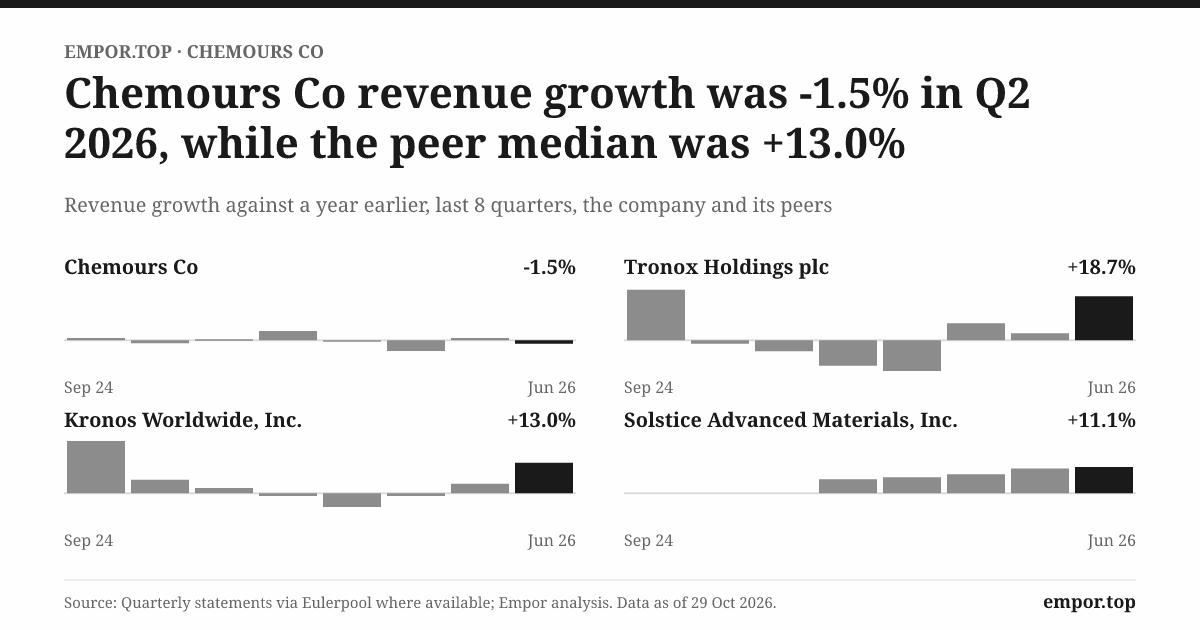
The other two segments deserve a fair description without inflation. TSS rides regulatory transitions: as governments phase down refrigerants with high global-warming potential, customers must switch to newer molecules, and those switches can shift demand toward the products Chemours makes. That is the subject of the next chapter. APM sells highly engineered fluoropolymers into specialty applications including electronics and semiconductors, where purity and performance matter and qualification takes time.1 But APM's earnings have weakened, and in the second quarter of 2026 its adjusted EBITDA roughly halved from a year earlier, to $26 million on $326 million of sales, which the company attributed partly to closing a production line and partly to costs from an outage at Washington Works.12 Product positioning in attractive markets is not the same thing as profitable growth, and APM has not yet shown the latter.
Why the margins broke
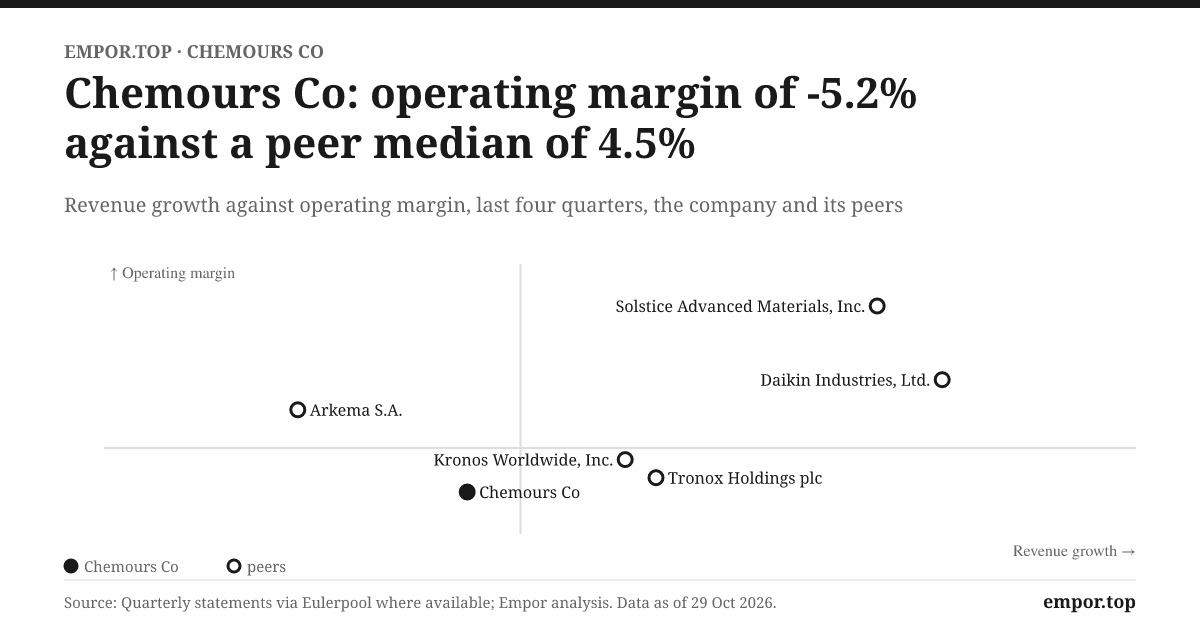
The margin story is where the three segments meet. In 2025 sales were essentially flat, yet the operating margin fell from about 7.7% to roughly zero.[^3] Decomposing the cost lines explains most of it. Cost of goods sold rose by $266 million, or 6%, to about $4.9 billion, driven by higher raw-material costs, while selling prices did not rise to match.1 Selling, general and administrative expense rose by about $201 million, largely because of the New Jersey settlement charge, partly offset by savings elsewhere.1 So the 2025 collapse is two stories braided together: a genuine squeeze in the factories, where input costs ran ahead of pricing, and a large legal bill that would not repeat in the same form.
The longer record shows how cyclical the operating engine is even without legal charges. Operating margins swung from under 2% in 2016 to almost 19% in 2018, back below 10% by 2019, up to about 11.5% in 2022 and then down again.1 A business whose margin can multiply tenfold and then collapse within three years is not a business with pricing power; it is a business with operating leverage to a cycle it does not control.
Put the competitive forces together and the picture is consistent. Rivalry is intense and capacity is excessive in titanium dioxide. Buyers are concentrated and powerful inside TT. Refrigerants face regulatory substitution, which can be an opportunity for whoever makes the next molecule and a threat to whoever makes the last one. APM sells differentiated technical products, but the company does not publish retention, switching-cost or price-realization data that would show those products command durable premiums. Scale and know-how matter in all three businesses. The evidence does not establish a broad, durable moat across the portfolio. It establishes one segment earning strong returns today and two segments fighting for margin.
That leaves the obvious next question. If the pigment business is where the cycle bites, and the specialty business has not yet delivered, then the investment case leans heavily on the refrigerant bet. Has Chemours built something there that customers will keep paying for, or simply built capacity ahead of the demand it hopes for?
IV. The Refrigerant Bet Needs Customers, Not Just Capacity
On the flat industrial coast near Corpus Christi, Texas, Chemours spent the years after its spin building more of one molecule. The product is Opteon YF, known to chemists as HFO-1234yf, the refrigerant that now cools most new cars sold in the United States and Europe. By the fourth quarter of 2024 the company had mechanically completed an expansion that lifted the site's Opteon YF capacity by roughly 40%.1 It was the kind of project that a chemicals company builds once a decade: a bet that a regulatory clock would keep ticking and that customers would keep switching.
The logic of that bet starts with the physics of cooling. Every air-conditioner and refrigerator works by pumping a fluid that absorbs heat when it evaporates and releases it when it condenses. For decades the fluids of choice were chlorofluorocarbons, then hydrofluorocarbons, or HFCs. Both turned out to be problems. The first ate the ozone layer; the second, when leaked, traps heat in the atmosphere thousands of times more powerfully than carbon dioxide. Regulators responded by phasing them down. In the United States the American Innovation and Manufacturing Act, the AIM Act, set a schedule to cut HFC production and consumption sharply and then required new equipment in many categories to use lower-global-warming refrigerants.1
Chemours is on the right side of that transition by design. Its hydrofluoroolefins, or HFOs, break down in the atmosphere in days rather than years, so their warming potential is a tiny fraction of the HFCs they replace. Opteon YF serves car air-conditioning; other Opteon blends serve stationary uses such as home and commercial air-conditioning and refrigeration.1 When a law forces an entire installed base to change chemistry, the companies that own the new molecules, the patents around them and the plants to make them can earn very good returns for a while. That is the real economic engine behind the gap between TSS's profits and the rest of the company.
TSS already led the other segments by a wide margin.1 In the second quarter of 2026, TSS earned $213 million of adjusted EBITDA on $591 million of sales, a margin of about 36%.12 For a company whose consolidated operating margin had been near zero, that is the difference between a functioning business and a broken one.
Chemours invested before every customer had switched, and that timing was deliberate. Refrigerant transitions run on a sequence: the rule takes effect for new equipment, original equipment makers redesign around the new fluid, distributors stock it, and then the long tail of servicing and replacement follows for years. A producer that waits until demand shows up arrives after its rivals have secured the contracts. A producer that builds early carries the capital cost before the volume arrives. With capital expenditure falling from about $360 million in 2024 to $213 million in 2025, Chemours told investors the drop reflected finished expansions, including Corpus Christi, rather than a decision to starve the business.1 The heavy spending, in other words, is behind it. The return on that spending is still being decided.
Capacity is a promise; orders are the proof
Here the line between technical capability and commercial success matters. A completed plant is a capacity to sell. It is not proof of volume, price or return on capital. The evidence for TSS sits in the segment results, and those results are strong but not smooth.
The second quarter of 2026 shows why. TSS volumes fell because North American aftermarket Opteon sales came in below the unusually high level of a year earlier, when distributors had filled their shelves ahead of the AIM Act transition.12 Higher prices for older Freon products, mainly in automotive, partly offset the decline.12 Then came the guidance. For the third quarter of 2026, Chemours guided TSS adjusted EBITDA to between $125 million and $140 million, well below the $213 million just reported.12 Some of that is seasonal; refrigerants sell hardest ahead of summer. Some is the channel digesting the inventory it built. Either way, the profit engine is not a straight line, and a year-on-year comparison against a channel-fill quarter flatters the past and punishes the present.
That pattern is the strongest disconfirming evidence for the bull view of TSS as a steady compounder. Regulatory transitions are real tailwinds, but they also create one-time pull-forwards: the year distributors stock up looks like growth, and the year after looks like a stall. The test is whether Chemours retains the installed base after the transition completes, and whether competing producers, including Honeywell, which co-developed the same family of molecules, and Chinese manufacturers expanding their own capacity, erode price once the scarcity phase ends.1 The company has not published customer retention data or realized-price series that would let an outsider settle that question.
Then there is the newest chapter of the story, the one that inevitably appears in any 2026 industrial narrative: data centers. As AI computing packs more power into each server rack, operators are turning from air cooling to liquid cooling, including two-phase immersion systems in which specialized fluids boil off the chips and condense again. Chemours has invested in such fluids and next-generation refrigerants and, in August 2026, its chief executive pointed to "continued traction in our liquid cooling solutions."12 What Chemours has not done is quantify AI-related revenue.[^17] Traction is a description, not a number. Until the company reports orders, revenue or margins from liquid cooling, it is an adjacent possibility, not a disclosed earnings driver, and it should be weighed accordingly.
So the verdict on the refrigerant bet is a calibrated one. The regulatory shift is real, Chemours owns relevant molecules and the capacity to make them, and TSS is today the company's largest profit pool by a wide margin. That is a genuine strategic position. But it is a position earned through a transition, and transitions end. The history of this very product category, in which Freon itself went from a crown jewel to a regulated legacy, is a reminder that a regulatory moat lasts only until the next regulation. The confirming evidence will be TSS margins that hold up after the channel-fill year rolls off; the falsifying evidence would be a sustained slide in price or volume as competitors catch up.
Which leaves a harder question for the next chapter. If TSS is the strongest business, can it carry a company whose other segments are weak and whose legacy obligations make cash flow uneven? And can investors trust the cash numbers that measure the answer? In early 2024, that second question stopped being theoretical.
V. When Reported Cash Became a Governance Question
In February 2024 Chemours did something that public companies dread. It told the market that its annual report would be late. Its audit committee had opened an internal review, and in the meantime the company placed its chief executive, Mark Newman, its chief financial officer, Jonathan Lock, and its principal accounting officer on administrative leave.13 For a company whose investment case already depended on trust in its estimates, from PFAS reserves to working capital, it was the worst kind of surprise: not a bad number, but a question about whether the numbers could be relied upon.
The review's findings were narrow and pointed. In the final weeks of 2023, executives had tried to delay payments to vendors and accelerate collections from customers, moving cash across the year-end line so that free cash flow would look stronger at precisely the moment it was being measured, including against targets tied to executive pay.13 Newman was terminated in March 2024. Lock, placed on leave in February, stepped down in April.14 The company also reported material weaknesses in its internal controls and had to explain to investors how it would remediate them.10
The mechanism is worth slowing down for, because it is not the classic accounting scandal of fake revenue. Nobody invented sales. The cash Chemours reported at the end of 2023 was real cash. What changed was its timing. Imagine a household that delays paying its credit card bill by a week and leans on a friend to repay a loan early, just before the bank checks its balance. The account looks healthier on that day. Nothing about the household's income or spending has changed, and next month the bills arrive anyway. That is exactly what happened to Chemours. The cash borrowed from the future came due in 2024, which is part of why Chemours' operating cash flow turned sharply negative in 2024.
So the problem was institutional more than personal. It touched the very measure the market uses to judge a heavily indebted company with large legal obligations: how much cash the business throws off. And it touched the incentive system, because the measure being managed was also a measure that paid bonuses.
The operator who inherited the chair
Into that chair stepped Denise Dignam. She is not a turnaround specialist imported from outside. She is a chemical engineer, trained at Drexel University in Philadelphia, who spent more than 26 years at DuPont in sales, business management and global supply chain roles, including running the supply chain for the fluoroproducts business.[^20] She moved to Chemours at the spin in 2015, ran global operations for fluoroproducts, and then led both the Titanium Technologies and the Advanced Performance Materials segments before becoming chief executive in March 2024.[^20] In other words, she has spent most of her working life inside the plants and product lines that now make up Chemours. That is an advantage in a business where operational detail decides margins. It also means she was a senior leader in two of the three segments during years when their performance deteriorated, which is worth remembering when judging how much of the turnaround is new.
Her personal stake is meaningful but not controlling. The 2026 proxy statement lists 470,402 shares as beneficially owned by Dignam as of March 2, 2026, including rights to acquire shares.15 Her reported compensation was $8.60 million in 2025, up from $5.89 million in 2024, and included a $1.18 million annual incentive award in a year when the company lost $386 million.15 The rise largely reflects equity awards that came with the top job rather than cash bonuses, but the juxtaposition is the kind of thing a skeptical shareholder will notice.
The more important question is what the bonus plan rewards. Under the 2026 proxy, the annual incentive weighs adjusted EBITDA at 50%, discretionary free cash flow at 10%, cash-conversion-cycle performance at 10%, control of functional costs at 20% and individual executive objectives at 10%.15 The plan still pays for cash and for working-capital speed, the very levers that were pulled at the end of 2023. That is not necessarily wrong; a company this indebted should reward cash. But it means the guardrails around those measures matter more than usual. And adjusted EBITDA, by design, excludes the legal and environmental charges that have consumed so much of the company's real cash. An investor can reasonably ask whether a plan anchored on adjusted figures gives management enough reason to minimize the costs that sit outside them.
Shareholders, for their part, have not objected. At the 2026 annual meeting, about 97.8% of votes cast supported the say-on-pay proposal, after 93.8% the year before, and every director received more than 95% support.[^22]16 Those votes show little recorded dissent. They are not a verdict on operating credibility, which only results can deliver.
The repair work since 2024 is visible on paper. The company has new leadership in the chief executive and finance roles. PricewaterhouseCoopers issued unqualified opinions on both the 2025 financial statements and the company's internal control over financial reporting, which means the auditor judged the controls effective after the earlier weaknesses.1 But the same auditor's report flagged PFAS remediation liabilities and PFAS litigation estimates as critical audit matters, the areas where management's judgment is most significant and hardest to verify.1 A clean opinion is a floor. It says the rules were followed; it does not say the estimates are easy or final.
On the calls since then, management's language has shifted toward measurable targets. In its August 2026 results, the company emphasized free cash flow conversion of 46% in the quarter, guided to at least $50 million of free cash flow in the third quarter, and targeted net leverage of about 3.8 times by year-end.12 Specific targets are a good habit, because they can be missed in public. Earlier in 2026, management told analysts it had completed the sale of nearly all its Kuan Yin land ahead of schedule and was using the proceeds to pay down near-term debt.[^24] What investors should watch is the gap between those two kinds of statements: targets met from operating cash prove something about the business, while targets met from land sales and financing tools prove something about the treasury.
That is the question the governance episode leaves behind. Trust is restored not by a new chief executive or a clean audit, but by a record of cash numbers that hold up quarter after quarter. So set the personalities aside and ask what the statements themselves can answer: how much of Chemours' cash is earned in its plants, and how much depends on timing, working capital and asset sales?
VI. The Cash Has to Do Three Jobs
Walk into a Chemours warehouse in 2025 and the first thing you might have noticed was how long things sat there. Pigment and refrigerant that the company had paid to make waited on shelves for weeks longer than they had a decade earlier. Meanwhile, at the other end of the transaction, finance teams arranged for banks and customer programs to pay Chemours early for goods it had already shipped, in exchange for a fee. One side of the operation tied cash up; the other pulled it forward. Both showed up in the cash flow statement, and only one reflected how healthy the business was.
Start with the long view, because it is more flattering than people expect. Across the twelve years from 2014 through 2025, Chemours' businesses reported about $2.9 billion of cumulative net profit but generated about $6.3 billion of operating cash flow, more than twice as much.1[^25] That gap is not suspicious. Chemical plants are expensive to build and are depreciated over many years, so a big part of each year's accounting cost is a non-cash charge for equipment bought long ago. Environmental accruals and restructuring charges work the same way: they hit profit when they are booked and hit cash only when they are paid. Over a long enough period, a capital-heavy business usually produces more operating cash than profit.
But operating cash flow is not what a company can spend freely. Subtract the money needed to maintain and expand plants, and the twelve-year total of free cash flow drops to about $1.6 billion.1[^25] Of that, about $1.3 billion went out as dividends.1[^25] Over its entire life as a listed company, then, Chemours returned to shareholders roughly four of every five dollars of free cash it generated, while its borrowings ended the period higher than where they began. Share repurchases added to the outflow: through 2025 the company had bought back about 10.3 million shares for $309 million, at an average of almost $30 each, more than twice where the stock trades today.1 That is the capital-allocation record a skeptical investor would put first: a company that inherited a large debt load and a large legal tail chose to distribute most of its free cash, and some of its buybacks were done at prices that now look expensive. The dividend has since been cut sharply, which is why 2025 payments fell to $78 million from about $148 million.1
The long-run total also hides how unstable the recent record is. Operating cash flow was a negative $633 million in 2024, and positive $264 million in 2025. Free cash flow was about negative $993 million in 2024 and a thin $51 million in 2025.1 The 2024 hole had several causes running through it at once: legal settlement cash, the unwinding of executives' year-end timing moves in 2023, and weak earnings.1 Whatever the mix, two consecutive years in which the business failed to fund itself meaningfully is not the profile of a company that can pay down debt from operations alone.
The warehouse problem
Here is where the working-capital ratios stop being decoration. In 2014, inventory sat on Chemours' books for about 76 days' worth of cost of sales. By 2025, it sat for about 117 days.1 That increase of roughly six weeks is cash trapped in goods that have been made but not sold. On a business with about $4.9 billion of annual cost of sales, every extra day of inventory locks up roughly $13 million, so forty extra days means something on the order of half a billion dollars that is not available to pay debt or legal bills.1
The cash-conversion cycle, which measures how long it takes from paying suppliers to collecting from customers, widened from about 48 days in 2014 to about 90 in 2025.1 Part of that is inventory. Part is that Chemours paid its own suppliers faster in 2025, with payable days falling from 88 to 69, perhaps in part because the company was no longer stretching vendors after the 2024 review.1 Notably, collections did not drive the deterioration. Debtor days peaked at about 55 in 2015 and stood at about 43 in 2025.1 Customers, broadly, are paying on similar terms to the past. The bigger clue is in the warehouse.
The first half of 2026 brought a fresh watch-point. Trade receivables rose to $773 million at the end of June, from $562 million at the end of 2025.8 Part of that is seasonal, because refrigerant sales peak in the spring and early summer. The allowance for doubtful accounts stayed at just $2 million, so the company does not expect meaningful losses.8 But Chemours does not publish an aging schedule that would show how much of the balance is overdue, so the increase is something to monitor rather than a conclusion in either direction.
And then there is the tool that brings customer cash forward. Through customer-facilitated financing programs, Chemours accelerated about $414 million of receivables in 2025, at a cost of about $6 million in fees, and another $156 million in the first half of 2026.18 The company also uses receivables securitization, factoring and supply-chain-finance arrangements.1 These are ordinary liquidity tools, used widely in the chemicals industry, and the fee is modest. But they change when cash arrives, not how much the business earns. A receivable sold early is a sale already made; collecting it sooner does not make customers buy more. After the 2023 episode, an analyst comparing operating cash flow across periods should ask how much acceleration sat in each period, because a change in the use of these programs can make one year look better and the next look worse.
Capital spending completes the picture. With the Corpus Christi and other expansions finished, purchases of plant and equipment fell to $213 million in 2025, about 3.7% of sales, from about 6% in the two years before.1 Maintenance and environmental compliance work continued, and some projects were put on hold.1 Chemours guided to capital spending of $250 million to $280 million for 2026.12 Research and development held steady at about $108 million a year, under 2% of sales, while headcount fell from about 6,200 in 2023 to about 5,700 in 2025.1 That is a company tightening its belt, not harvesting itself: the evidence points to discipline, but it also means that the low 2025 capex is not a permanently lower bill.
Put the three jobs side by side and the order matters. Operating cash must first keep the plants safe, compliant and competitive. It must then pay for settlements and remediation as they come due. Only after both are covered can it reduce debt or reward shareholders. In 2024 and 2025, the business did not generate enough cash to do all three. The question for the balance sheet is whether that is changing, or whether the company has simply bought itself time.
VII. Debt Is Lower, but the Recovery Is Not Yet Self-Funding
In 2026, Chemours went to the bond market with a familiar request and an unfamiliar price. It sold $700 million of new senior notes due 2034, carrying an interest rate of 7.875%, and used the proceeds to repay notes due in 2027 and 2028.8 It was a sensible move in one sense: it pushed the nearest maturities years into the future, removing a wall that would otherwise have loomed over a company with thin earnings. But the coupon told its own story. Paying nearly 8% a year to borrow is the price of capital for a company that lenders regard as risky. Every $100 million of such debt costs almost $8 million a year in interest before the company earns a cent for shareholders.
The longer balance-sheet trend explains why. Borrowings started at about $4 billion in 2015 and have stayed in a band between roughly $3.5 billion and $4.6 billion ever since: at the end of 2025 they stood at about $4.6 billion, with $672 million of cash against them.1 Shareholders' equity, by contrast, has eroded. It fell from about $1.1 billion in 2022 to about $250 million at the end of 2025, pushed down by losses, dividends, buybacks and legal charges.1 That is why the debt-to-equity ratio looks absurd, at more than 18 times: the debt has not exploded, but the equity cushion beneath it has nearly vanished.1 By late 2026 book value per share had turned slightly negative.[^4] A ratio built on a near-zero denominator says less about the debt than about how little accounting equity is left.
Two clarifications keep the picture honest. First, lease liabilities, about $292 million at the end of 2025, are a separate obligation from funded borrowings and should not be added to the debt figure without saying so.1 Second, the debt has come down in 2026. At the end of June, total debt principal was about $3.9 billion, after the company repaid €230 million of a euro-denominated term loan due in 2028, partly with proceeds from the Kuan Yin land sale and partly from organic cash.812 Net debt, after $671 million of cash, was about $3.2 billion, and the company reported net leverage of about 4.4 times trailing adjusted EBITDA.12
Liquidity provides breathing room. At the end of June 2026, Chemours had $953 million available under its revolving credit facilities after letters of credit, and it was in compliance with its covenants.8 There was a timetable inside that number, however. One $220 million revolving commitment was scheduled to mature on October 7, 2026, while the remaining $780 million commitment was scheduled to run to 2030, subject to so-called springing-maturity provisions that could pull the maturity forward if certain other debt was not refinanced in time.8 Revolvers are the lifeboats of a leveraged company; a smaller lifeboat is still a lifeboat, but there is less room in it.
The rating agencies read the same evidence and drew sober conclusions. On July 17, 2026, Moody's downgraded Chemours from Ba3 to B1, moving it deeper into speculative grade, while changing the outlook from negative to stable.8 The agency cited the negative outlook for the global chemicals sector, while expecting earnings to improve, free cash flow to turn positive and asset-sale proceeds to reduce debt.8 S&P's last disclosed action was an April 2025 affirmation at BB-, with a negative outlook.817 Read together, the ratings say that lenders see a company with a credible path but little margin for error, where the path itself depends on assumptions about earnings and asset sales.
Management's own outlook makes the assumptions explicit. In August 2026 the company guided to full-year adjusted EBITDA of $775 million to $825 million and targeted net leverage of about 3.8 times by year-end.12 That is a meaningful improvement on paper. But stress-test it the way a lender would. Strip out the land-sale proceeds, which do not recur. Strip out the receivables acceleration, which moves cash forward rather than creating it. Then ask whether the remaining operating cash covers capital spending, interest at higher coupons, PFAS settlement payments and remediation work, with something left over for debt reduction. In 2025 the answer was barely: free cash flow was about $51 million, before any adjustment for acceleration.1 The first half of 2026 looked better, with second-quarter free cash flow of $114 million, but six-month operating cash flow was $114 million against $93 million of capital spending, leaving only about $21 million of free cash for the half.12
That is the honest verdict on the balance sheet. Debt is lower than at the start of the year, liquidity is adequate, and maturities have been pushed out. Those are real achievements. But the deleveraging so far has leaned on a one-time asset sale and on refinancing, and the recovery is not yet self-funding. Leverage falls durably only if operating cash arrives and new liabilities do not consume it first.
Which brings the story back to where it began. A debt plan, however well executed, is only as sound as the liabilities beside it. Chemours has now settled with the federal government, New Jersey, North Carolina and the nation's water systems. Has it bounded its PFAS exposure, or simply settled the pieces of it that were ready to be settled?
VIII. A Settlement Closes a Door; Remediation Keeps the House Open
In June 2026 the consent decree among Chemours, the United States and West Virginia was lodged in federal court in the Southern District of West Virginia, opening a 30-day public comment period before a judge could approve it.5 Three months later, officials in Raleigh stood up to announce the North Carolina deal, naming the counties along the Cape Fear one by one: Bladen, Brunswick, Columbus, Cumberland, New Hanover, Robeson and Sampson, along with towns and a regional water authority.7 Each event produced a headline number and a sense of closure. Meanwhile, at Fayetteville, Washington Works and Chambers Works, the work of pumping, treating and monitoring groundwater went on, as it will for years. A settlement closes a courtroom door. It does not stop the pumps.
To read Chemours' PFAS exposure properly, it helps to separate four different kinds of number that headlines tend to blur together. The first is an accrued liability: money the company has formally recorded on its balance sheet because it judges a cost probable and can estimate it. The second is a settlement payment: cash that leaves the company, often in installments, to resolve specific claims from specific plaintiffs. The third is a remediation obligation: physical work the company must perform, such as installing treatment systems or capturing contaminated groundwater, whose cost depends on engineering and on what regulators require. The fourth is an unquantified potential claim: exposure the company knows exists but cannot yet estimate, such as personal-injury suits or claims from parties that have not yet sued. A settlement can move money from the second category to the first and then out the door. It rarely touches the third and fourth.
The federal agreement shows how these categories combine. Its value, estimated by the EPA at more than $450 million, is mostly not a cheque.5 The $22.5 million civil penalty is the cash punishment. The rest is work: a $90 million multi-year program to cut PFAS discharges, surface-water pollution controls at Washington Works, safe drinking water for communities near the West Virginia and New Jersey sites, and a commitment to evaluate and implement further controls at Fayetteville.56 Those obligations will be paid for over years, as capital spending and operating cost, and their final cost will depend on what the controls require in practice. The penalty itself was sized on Chemours' ability to pay, a phrase regulators do not use about companies they regard as flush.5
North Carolina works differently again. The $590 million figure covers the state, eleven local governments, DuPont, Corteva and Chemours together; $455 million is to be paid to the state and local governments over 10 to 15 years, and the other $135 million is a reserve funded by DuPont and Corteva to backstop Chemours' consent-order obligations.7 The public releases do not give a full split of the payments among the three companies, and the honest course is not to guess. What Chemours did say is that the settlement would satisfy its future contributions to the MOU escrow account, including a scheduled $50 million payment.[^11] In practice, that means some cash Chemours would have parked in escrow will instead flow to North Carolina. It is a reallocation of committed money, not a new pot found in the couch.
That is the logic of the MOU's shared pool more broadly. The arrangement with DuPont and Corteva covers eligible PFAS costs up to a combined $4 billion of qualified spending, for a limited period, with Chemours bearing half.1 Each qualifying settlement, from the national water-systems deal to New Jersey and now North Carolina, draws down that shared capacity. The good news for Chemours is that its former parents share the bill. The less comfortable implication is that the pool is finite, and every large settlement shrinks what remains for the claims still to come. Once the cap is reached or the term ends, eligible costs revert to whoever owns them under the original separation documents, and for many of these sites that is Chemours.
The accrual history shows how unsettled the estimates remain. Environmental remediation liabilities climbed from $618 million at the end of 2025 to $795 million at the end of June 2026, within six months, and management described up to roughly $700 million of further possible cost above that, while saying the figure was not a ceiling.8 Some of the increase reflected new obligations from the federal decree. That is exactly the point: each resolution can add to required work even as it resolves past claims.
PwC's unqualified opinion on the 2025 statements did not make the PFAS estimates final; its report identified remediation liabilities and litigation estimates as critical audit matters.1 In PFAS accounting, a reasonable estimate today can become an understated one tomorrow when a regulator tightens a standard or a court admits a new class of claims.
So how should an investor test management's credibility on this subject? Not by headline settlement values, which mix companies, timeframes and forms of payment. The useful test runs across several reporting periods. Compare the cash Chemours actually pays with the amounts it accrued. Track changes in estimates: if accruals repeatedly rise after each settlement, the earlier estimates were too low. Follow the required site spending under the consent decrees and the milestones regulators set. And watch whether the potential exposure above the accrual shrinks over time as uncertainty resolves, or keeps growing as new obligations appear.
The question at the end of this chapter is genuinely open. Despite those settlements, Chemours has not settled with every plaintiff, every state or every future regulator, and remediation at its legacy sites will run for many years. What the remaining remediation and litigation will ultimately cost, and how much of it Chemours will bear rather than share, cannot be known from today's filings. The market has put its own price on that uncertainty.
IX. The Recovery Case Has to Survive a Price Cycle
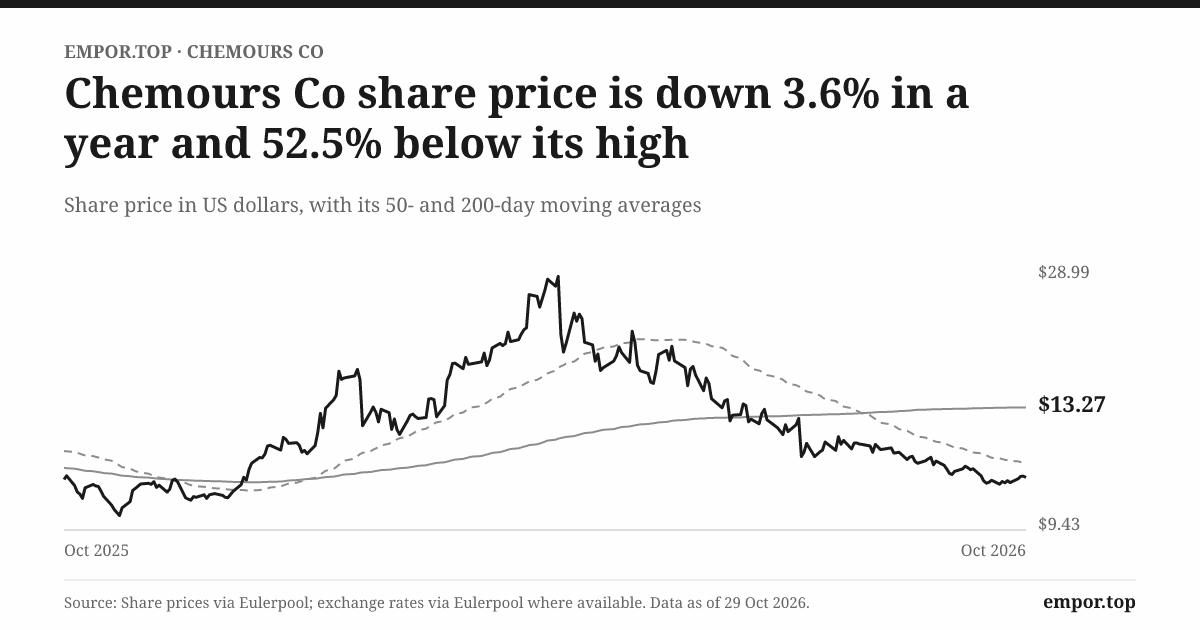
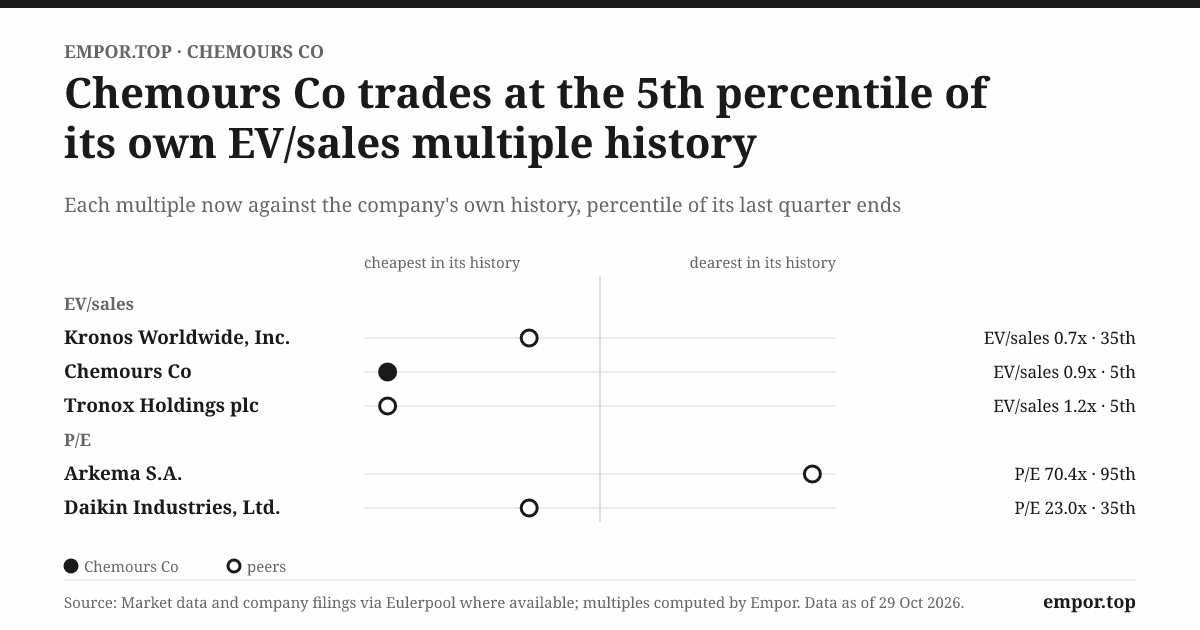
On October 29, 2026, Chemours shares closed at about $13.27.[^4] That was roughly 52% below the high of the previous twelve months, close to $28, in a stock whose annual volatility exceeds 60%.[^4] Over the past five years, holders at the worst moment could have watched about four-fifths of their investment disappear peak to trough.[^4] At that price, the whole company was valued at about $2 billion in the stock market, and about $5.4 billion once its debt, net of cash, is added.[^4] Against roughly $5.8 billion of annual sales, that is a price-to-sales ratio of about 0.3 times and an enterprise value of about 0.9 times sales.[^4][^3]
A cheap multiple of sales sounds like an opportunity. It is not evidence of one by itself. A business that earns nothing on its sales is not cheap at any multiple of them. Chemours' operating margin was about negative 0.1% in 2025, after 7.7% in 2024.[^3] The conventional earnings yardsticks barely function here. The trailing price-to-earnings ratio of almost 97 times reflects an older, tiny twelve-month profit, which works out to an earnings yield of about 1%, and the most recent twelve months show a loss of about $2 per share.[^4] The company's own five-year median price-to-earnings ratio of about 9 times describes a business that was earning money; it supplies no useful multiple for one that currently is not. Book value per share is negative.[^4] Valuation, in other words, has to be reasoned through cash flow and the balance sheet, not through a single ratio.
The narrowest peer comparison is Tronox, the largest pure-play titanium dioxide producer listed in the United States. Tronox traded at about 1.27 times enterprise value to sales on the same day, against Chemours' 0.9 times.18 The comparison is imperfect: Tronox mines much of its own ore and is more concentrated in pigment, while Chemours carries a strong refrigerant business and the PFAS overhang. The gap suggests that the market is charging Chemours a discount on its enterprise value even though its most profitable segment does not exist at Tronox. That discount is best explained by the legal tail and the leverage, not by the quality of the refrigerant franchise.
Weighing the edge
This is the place to argue the moat in full, once, using the framework of Hamilton Helmer's seven powers: scale economies, network economies, counter-positioning, switching costs, branding, cornered resources and process power.
Scale economies exist in titanium dioxide, but they are shared. Chemours, Tronox and LB Group run plants of comparable size, so scale protects all three from small entrants without giving any one of them a cost edge over the others. Chinese expansion of chloride capacity is eroding the scale advantage that once belonged to Western producers. Network economies do not apply; one customer's purchase of pigment does not make it more valuable to the next. Counter-positioning does not describe Chemours either; it is an incumbent defending older positions, not a newcomer with a model incumbents cannot copy.
Switching costs are the most interesting candidate. In TT, paint makers do need to qualify a pigment grade before using it, but large buyers routinely qualify several suppliers, and the concentration of TT's top customers, with one taking more than a fifth of segment sales, points to strong buyer bargaining power rather than lock-in.1 In refrigerants, original equipment makers design systems around specific molecules, which creates a period of stickiness, but the molecules are also available from rivals and service technicians care about price and availability. In APM, semiconductor qualification can make switching costly, but the company does not disclose retention or pricing data that would prove it.
Branding is real but limited: Teflon, Freon and Ti-Pure are famous names, yet chemical buyers pay for specification and reliability more than logos, and in Teflon's case the brand now carries litigation baggage. Cornered resources are the strongest case in TSS, where patents and proprietary manufacturing know-how around HFO molecules give Chemours and a small number of rivals an advantaged position during the regulatory transition. That power is time-limited by nature, as patents expire and competitors build capacity. Process power, the hard-won operating knowledge embedded in decades of chloride-route and fluorine chemistry, is genuine and is the most durable thing DuPont handed over. But process power shows up as lower costs or better yields, and the margins of TT and APM do not currently show it.
The earlier competitive analysis points to potential advantages, including a time-limited cornered resource in TSS and real process know-how across the portfolio, but no demonstrated durable moat. A skeptical investor would ask for proof that management has not supplied: sustained price realization through a downturn, customer retention statistics, share stability against Chinese producers, and returns on invested capital above the cost of capital across a full cycle. The record does not show that last test being passed recently. Return on invested capital was about 16% in 2022 and has been around zero or below in two of the three years since.1
The bull case, stated in operating terms, runs like this. TSS keeps earning strong margins as the refrigerant transition matures and liquid cooling becomes a real business. TT recovers price and plant utilization as weaker producers close capacity and Chemours' own Kuan Yin closure flows through to lower costs; the price increase announced for June 2026 sticks.12 APM's specialty demand from semiconductors converts into profits once the line closure and outage costs are behind it. Working capital normalizes, releasing cash from the warehouse. And the settlements of 2023 to 2026 give enough visibility on PFAS costs that free cash flow can be directed at debt rather than reserves. If all of that happens, a company valued at under one times sales is priced for a much worse outcome.
The bear case deserves equal force. Titanium dioxide overcapacity persists, and Chinese producers with new chloride technology keep taking share and pressuring price. Raw-material and energy costs rise faster than prices, as in 2025, compressing margins in a business with concentrated buyers. TSS earnings slip as the channel-fill quarters roll off and competition catches up. Receivables and inventory continue to absorb cash. And PFAS obligations outlast the shared MOU pool and outrun the company's ability to generate cash, so that settlements and remediation consume the free cash flow that was supposed to reduce debt at a 7.875% coupon. The bear case needs nothing new to happen; it needs only for the conditions of 2025 to continue.
For an investor trying to tell which story is unfolding, three measures matter more than the rest. The first is segment adjusted EBITDA and margin, business by business: TSS at about 36% in the second quarter of 2026, TT at about 7% and APM at about 8%, with TT and APM needing to rise while TSS holds.12 The second is free cash flow before receivables acceleration and asset-sale proceeds, which was only about $51 million for 2025 even with acceleration included.1 The third is environmental cash paid against accruals and remaining site obligations, with the accrual at $795 million in June 2026 and the possible additional exposure described at up to roughly $700 million.8 If those three improve together, the discount is cyclical. If they do not, it is a risk premium the market is right to charge.
X. Lessons from a Chemicals Company With a Long Memory
Go back to that first morning in July 2015, when CC began trading with inherited debt and obligations whose size nobody could yet estimate.[^1] Eleven years later, several lessons from that morning have hardened into something a founder, a board or an investor could use elsewhere.
The first lesson is about the terms of a separation. When a parent spins off a business, the market celebrates the focus and the new management team, and it often skips the documents. Chemours' spin showed how debt and inherited liabilities can shape a company long after its ticker changes. Investors evaluating any spin-off should read the separation agreement as carefully as the business plan, because the parent writes it and the parent has different interests. A clean ticker does not mean a clean balance sheet.
The second lesson is about what industrial advantage really is. Chemours' pigment business shows that engineering know-how does not guarantee returns when customers do not need to pay a premium for it. A plant is an advantage only when its customers keep buying at prices that pay for it.
The third lesson comes from the winter of 2024, when the audit committee found that cash had been shuffled across a year-end line. The episode showed that cash can be real and still look better because of timing, especially when bonuses reward cash measures.
The fourth lesson is about the long tail of chemistry. Chemours has resolved several major PFAS claims, yet its environmental accrual continues to rise and the company says further costs are possible.8
Put together, those lessons say something about how to judge Chemours from here. The story of a company begins with the terms of its birth, but it does not end there. DuPont shaped what Chemours received in 2015; what Chemours does with its plants, its working capital and its obligations in 2026 and 2027 is its own.
XI. Epilogue
Tonight, Chemours stands at the edge of another results season. Its third-quarter report will be the first full quarter after the federal consent decree and the North Carolina agreement, and the first in which management must show how a much quieter refrigerant season and a pigment price increase actually played out. In August, the company set third-quarter targets for sales, adjusted EBITDA and free cash flow, along with forecasts for its segments.12
That forecast already contains the test. If TT's earnings rise as guided, the next question is why. A price increase that only covers higher ore and energy costs is a defensive success. A price increase that sticks while volumes and plant utilization climb is something different: the first evidence in years that Chemours can recover pigment margins through better demand rather than through closing its own capacity. The difference will show up in the company's breakdown of price, volume and cost, and in how analysts press on it during the call.
TSS has its own test. After a year of channel-filling ahead of the AIM Act deadlines, the third quarter will show the refrigerant business closer to its underlying demand. Investors should listen for evidence of repeat orders from equipment makers and service distributors, for whether prices in Opteon products are holding against competing producers, and for whether liquid cooling has grown from a phrase in a press release into a number. Capability has been demonstrated; customer adoption at attractive margins is the claim still to be proven.
The cash test is the one most likely to separate a recovery from a reprieve. Meeting the free-cash-flow target would extend the improvement of the second quarter, but the composition matters more than the total. How much came from receivables acceleration? How much from lower inventory, which would mean inventory days are finally coming down? And did total debt actually fall, or did the company simply move cash among its accounts? Management's year-end net-leverage target is a public promise.12 Meeting it from operating cash would mean something; meeting it through asset sales would mean less.
Then there are the liabilities. Over the next several filings, settlement payments to North Carolina will begin, escrow credits will be applied under the MOU, and the consent-decree work will start to show up as spending at Washington Works, Chambers Works and Fayetteville. The environmental accrual will either stabilize as the company works through known obligations or keep rising as new ones appear.8 The direction of that number over the next year will say more about the bounded-or-unbounded question than any single settlement announcement.
And under all of it sits the question that has run through this story since the first day of trading. Chemours is a capable chemicals operator with real assets and one genuinely strong business. Can it turn those assets into durable cash after paying for the past, or will the past keep claiming the cash first?
XII. Outro
The spin-off of 2015 was sold as a fresh start, and in one sense it was: a new company, a new name, a new ticker. But the plants came with their histories, the balance sheet came with its debt, and the chemistry came with its consequences. Eleven years later, all three are still tied together.
Somewhere today, a coat of white paint is brightening a wall because of a pigment made in a Chemours plant. A refrigerated truck is crossing a highway, cooled by an Opteon molecule with a lower global-warming potential than older refrigerants. And somewhere downstream of an old DuPont site, a water utility is running a treatment system that exists because of what that chemistry left behind. The same company sits behind all three scenes. Chemours has to prove that the chemistry it sells can pay for the history it inherited.
References
-
2025 Form 10-K — The Chemours Company, 2026-02-24 ↩↩↩↩↩↩↩↩↩↩↩↩↩↩↩↩↩↩↩↩↩↩↩↩↩↩↩↩↩↩↩↩↩↩↩↩↩↩↩↩↩↩↩↩↩↩↩↩↩↩↩↩↩↩↩↩
-
State environmental health officials meet with chemical company over GenX in Wilmington drinking water — NC Newsline, 2017-06-15 ↩↩↩
-
Chemours, DuPont, and Corteva Reach Comprehensive PFAS Settlement with U.S. Water Systems (Form 8-K Exhibit 99.1) — The Chemours Company, 2023-06-02 ↩↩
-
Chemours, DuPont and Corteva Agree to $875M PFAS Settlement with New Jersey — Chemical Processing, 2025-08 ↩↩
-
Chemours Settlement Summary — U.S. Environmental Protection Agency, 2026-06 ↩↩↩↩↩↩
-
Chemours Consent Decree — U.S. Environmental Protection Agency, 2026-06 ↩↩
-
Attorney General Jackson, DEQ Secretary Wilson Announce Nearly $600M Deal with DuPont/Chemours — North Carolina Department of Environmental Quality, 2026-09-10 ↩↩↩↩↩
-
Q2 2026 Form 10-Q — The Chemours Company, 2026-08 ↩↩↩↩↩↩↩↩↩↩↩↩↩↩↩↩↩
-
2024 Form 10-K and Annual Report — The Chemours Company, 2025 ↩↩
-
The Chemours Company Reports Second Quarter 2023 Results and Announces Closure of Titanium Dioxide Plant in Taiwan (Form 8-K Exhibit 99.1) — The Chemours Company, 2023-07-27 ↩
-
The Chemours Company Reports Second Quarter Results — The Chemours Company via PR Newswire, 2026-08-04 ↩↩↩↩↩↩↩↩↩↩↩↩↩↩↩↩
-
Chemours says suspended executives tried to influence cash flows — ICIS, 2024-03-07 ↩↩
-
Chemours CFO Jonathan Lock steps down after financial revisions — Reuters via Investing.com, 2024-04-25 ↩
-
Tronox Holdings Statistics and Valuation — Stock Analysis, 2026-10-29 ↩
 LinkedIn
 WhatsApp
 Reddit
 Hacker News
 Email
 Kindle
 RSS Feed
 Spotify
 Apple Podcasts
 Amazon Music
 Audible
 YouTube