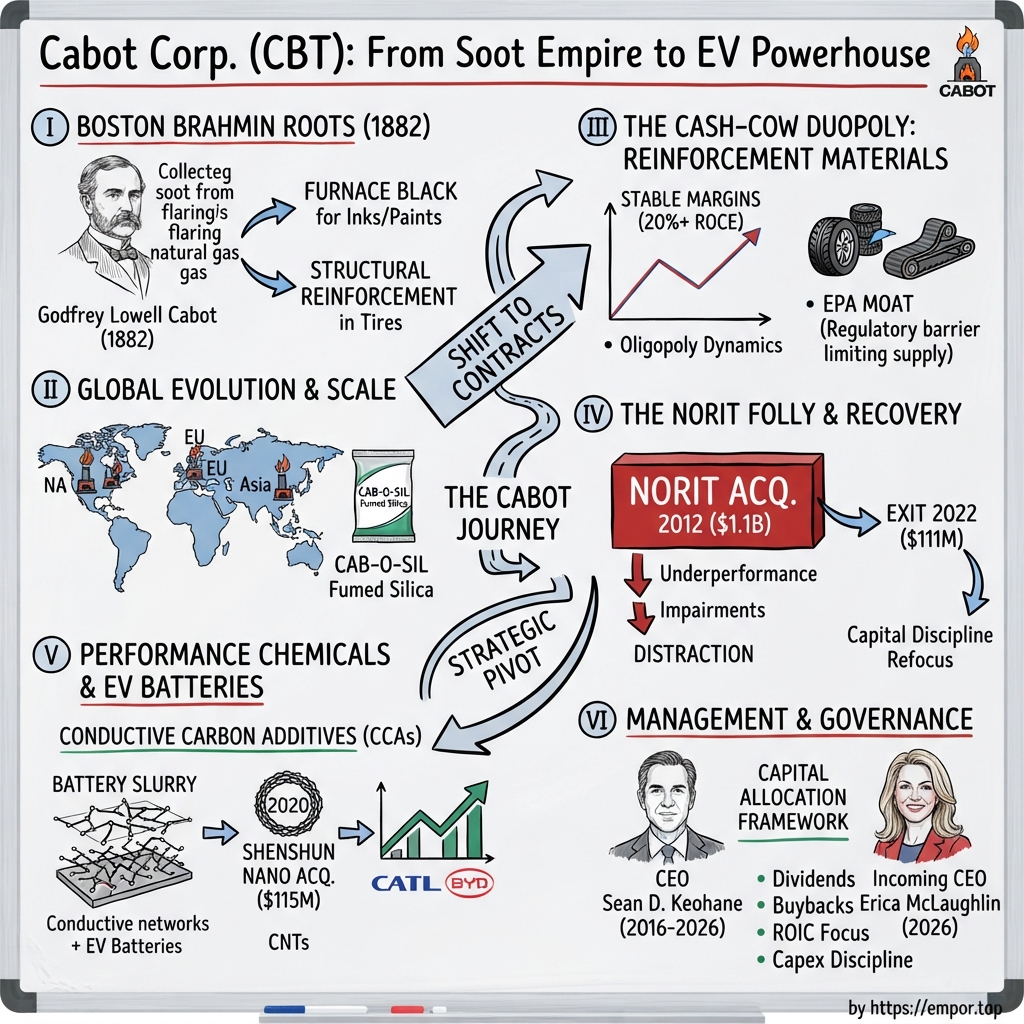
Cabot Corp. (NYSE: CBT): The Soot Empire Powering Tires and the EV Battery Revolution
I. Introduction & Episode Roadmap
On the morning of August 4, 2026, the third-quarter earnings call for Cabot Corporation dropped out mid-sentence. Chief Executive Officer Sean Keohane was explaining how conductive additives differ across battery chemistries when the line went dead. After an operator apologized twice and analysts waited on hold, Keohane reconnected, picked up mid-thought, and completed his explanation.1
The brief disruption underscored an enduring characteristic of the business: Cabot relies on executing an unglamorous industrial process with steady reliability. The Boston-based company's core product is carbon black—elemental carbon captured from the incomplete combustion of heavy petroleum feedstock—which it has manufactured since 1882.2 Although Cabot does not place its logo on consumer goods, its materials touch daily life across tires, smartphones, and grid-scale energy storage systems.
In fiscal 2025, Cabot generated approximately $3.7 billion in revenue, down from roughly $4.0 billion the prior year as volumes softened.[^3] Despite volume declines across both operating segments, adjusted EBITDA reached $804 million with a 22% margin, while adjusted earnings per share rose 3% to a record $7.25.3 Two segments drive these results: Reinforcement Materials, which sells reinforcing carbons to tire and industrial rubber makers, generated $2.34 billion in revenue and $508 million in segment EBIT; Performance Chemicals, which encompasses specialty carbons, fumed metal oxides, inkjet colorants, aerogels, and battery materials, generated $1.25 billion in revenue and $194 million in EBIT.2 Operating from Boston, roughly 4,100 employees oversee production facilities across the United States and more than 20 countries.2
On paper, carbon black operates like a standard commodity—produced from oil, sold by the metric ton, and priced in cents per kilogram by a few global suppliers and regional competitors. Yet Cabot reported an 18% adjusted return on invested capital in fiscal 2025,3 generating nearly $665 million in operating cash flow and $391 million in free cash flow from its $3.7 billion revenue base.3 Structural factors—including long-term customer qualification, specialized contracts, regulatory requirements, and geographic positioning—protect margins more than a simple commodity framework suggests.
However, recent financial results highlight ongoing operational strain. In fiscal 2026, Reinforcement Materials EBIT dropped 29% year over year in the March quarter and 24% in the June quarter after calendar 2026 tire maker contracts settled at lower prices.45 In response, management cut operating costs, closed a facility in Argentina, announced plans to close production lines in the Netherlands, and ceased fumed silica production in Barry, Wales.6 Consequently, full-year adjusted EPS guidance was lowered to a range of $6.15 to $6.45.5 Management also informed investors in November 2025 that the company would not achieve the three-year targets presented at its December 2024 Investor Day.37
Four core inflections define Cabot's current trajectory:
First is the commodity-to-contract shift: the transition from spot-market pricing tied to heavy fuel oil fluctuations to annual agreements with automatic feedstock pass-through formulas. Roughly 60% of Cabot's reinforcing carbons volume now moves under these formulaic contracts,2 stabilizing financial performance relative to raw material volatility.
Second is the Norit acquisition failure: a $1.1 billion purchase in 2012 that resulted in a $562 million single-year impairment before Cabot finally exited the business in 2022 for a headline price of $111 million.8910 The legacy of that capital allocation misstep shaped subsequent corporate strategy.
Third is the battery materials expansion: a $115 million acquisition of a Chinese carbon nanotube manufacturer in 2020 that developed into a business generating approximately $40 million in EBITDA for fiscal 2026, maintaining trailing twelve-month EBITDA margins near 24%.1154
Fourth is the 2026 executive leadership transition. Keohane will retire as president and CEO on September 30, 2026, concluding nearly 25 years at Cabot and more than a decade in the top role. CFO and Head of Corporate Strategy Erica McLaughlin will succeed him as president and CEO on October 1, 2026.12 Having joined Cabot in 2002, McLaughlin served as the primary investor contact on the press release announcing the 2012 Norit acquisition.8
The company's story begins where its carbon production starts.
 Subscribe on LinkedIn
II. Boston Brahmin Roots & Industrial Evolution (1882–1990s)
In 1882, a Harvard-educated son of a Boston chemical family bought a natural gas well near Worthington, Pennsylvania, and opened a plant to produce carbon black from the gas flame.13 Godfrey Lowell Cabot and his brother Samuel purchased the McCue well and built their first production facility that same year.13 At the time, the economics relied on converting a discarded waste stream into a marketable product. Western Pennsylvania had abundant natural gas but lacked pipeline infrastructure or large-scale customers, prompting producers to burn off surplus gas. The Cabots recognized that starving the flame of oxygen caused soot to deposit on cool surfaces, creating a fine black pigment that ink and paint manufacturers purchased as a commercial input.
For roughly four decades, the company focused primarily on pigments. Godfrey bought out Samuel's partnership stake in 1887 and spent subsequent years establishing an operating strategy centered on backward integration into raw materials. Rather than depending on third-party gas flares, he drilled proprietary gas wells. By the time he incorporated Godfrey L. Cabot, Inc. in 1922, the family controlled both its natural gas feedstock and its conversion facilities.13
The growth of the automotive industry subsequently altered the chemistry and scale of the business.
The discovery that carbon black functions as a structural reinforcement rather than a simple colorant transformed rubber manufacturing. When fine carbon particles are mixed into rubber, they bond physically with polymer chains, significantly increasing abrasion resistance and tensile strength. Without carbon black, a natural rubber tire wears out within a few thousand miles; with it, tread life extends by roughly an order of magnitude. Carbon black shifted from a specialty ingredient to a structural component of tires, and rubber manufacturing grew to consume the vast majority of global carbon black production.
What followed was a half-century of international expansion aligned with regional tire production hubs: Ville Platte, Louisiana, near Gulf Coast feedstock in 1943; Stanlow, United Kingdom, as Cabot's first European plant in 1948; Sarnia, Ontario, in 1951; Ravenna, Italy, in 1959; Argentina in 1962; Mauá, Brazil, in 1977; Indonesia and the Netherlands in 1981; and in 1988, an early expansion into China as one of the first U.S. industrial companies operating in the country.139
This geographic footprint reflects the physical economics of carbon black. Because carbon black is a low-density, high-volume powder, long-distance transportation costs degrade operating margins. Cabot addressed this freight constraint by constructing production facilities near major tire manufacturing plants. As Cabot outlines in regulatory filings, the company typically manufactures and sells within the same region, providing customers with localized supply chains while using its global network to cross-fill demand across borders when required.2 This distributed model created localized supply positions across global markets.
A second technical lineage began in 1958 when Cabot opened its first fumed silica facility in Tuscola, Illinois.13 Fumed silica—marketed under the CAB-O-SIL brand—is manufactured by burning silicon tetrachloride in a hydrogen flame to produce high-surface-area silica particles. The material thickens, reinforces, and controls liquid flow, serving as an additive in silicone sealants, adhesives, industrial coatings, and polishing slurries used in semiconductor wafer manufacturing.
This secondary product line established core engineering capabilities that extend beyond carbon black. Cabot defines four core competencies in its regulatory filings: manufacturing and handling fine particles, modifying particle surfaces to alter functionality, engineering particles to impart specific properties to customer formulations, and combining particles with other materials into formulated intermediates.2 Rather than operating strictly as a bulk commodity supplier, Cabot developed as a particle engineering firm that sells its largest commercial volumes in carbon formats.
The corporate structure consolidated over the mid-twentieth century. The various family-controlled entities merged into Cabot Corporation in 1960, and the company listed on the New York Stock Exchange in 1968, floating approximately 12% of its shares. Corporate headquarters moved to Boston in 1991.13 Cabot has maintained continuous dividend payments—and regular dividend growth—since its 1968 listing.3
By the late 1990s, Cabot's corporate profile was established: a globally distributed carbon black franchise generating steady cash flow, a specialized chemical portfolio producing higher operating margins, and a Boston industrial brand operating well past family management. However, capital allocation discipline remained an unresolved challenge—setting up a costly strategic misstep in the following decade.
III. The $1.1B Norit M&A Folly & Strategic Course Correction
On June 21, 2012, Cabot announced an agreement to acquire Dutch activated carbon producer Norit N.V. from affiliates of private equity firm Doughty Hanson and Euroland Investments for $1.1 billion.8
At the time, the transaction reflected a distinct phase of specialty chemical M&A. Norit operated 10 production plants with 760 employees, generating $360 million in trailing-twelve-month revenue and $92 million in adjusted EBITDA—valuing the business at approximately 12 times EBITDA. Then-CEO Patrick Prevost described the deal as a natural extension of Cabot's core research and application development capabilities that would accelerate its transformation into a higher-margin, less cyclical specialty chemical company. Chief Financial Officer Eduardo Cordeiro told investors that Norit delivered EBITDA margins above 25% and projected annual revenue growth of 10% to 12%. Management guided to earnings per share accretion of $0.20 to $0.25 in fiscal 2013 and $0.30 to $0.40 in fiscal 2014, funding the purchase with $200 million in cash, $300 million drawn on its revolving credit facility, and roughly $600 million in new long-term debt.8
The strategic rationale appeared compelling on paper. Activated carbon—porous carbon produced by steam- or chemically treating wood, coal, or coconut shells—adsorbs contaminants across municipal water treatment, food processing, and pharmaceuticals. Crucially, its growth trajectory was tied to environmental regulations, such as mercury capture at coal-fired power plants under U.S. Mercury and Air Toxics Standards (MATS). While tire demand fluctuated with automotive manufacturing cycles, regulatory mandates promised steady demand, offering Cabot a structural hedge against industrial cyclicality.
However, three distinct vulnerabilities undermined the acquisition over the following decade.
The regulatory thesis softened. As Cabot later disclosed in regulatory filings, the mercury-removal business was "largely dependent on the amount of coal-based power generation used in the United States and the continued regulation of those utilities" under MATS.10 Instead of expanding, domestic coal-fired power generation contracted under intense competition from inexpensive natural gas and utility-scale renewables. Each retired coal plant eliminated a key mercury-sorbent customer through macro energy shifts beyond commercial control.
The competitive moat was weaker than Cabot's core franchise. In furnace carbon black manufacturing, proprietary reactor geometry, burner placement, and thermal residence times determine particle structure and surface chemistry, requiring years of customer qualification into specific tire recipes. By contrast, activated carbon functions closer to a processed natural commodity. The barriers to entering municipal water carbon supply proved significantly lower than qualifying a specialized tire compound, leaving Cabot with a commodity switching dynamic despite paying a specialty acquisition multiple.
The write-downs came in waves. In the third quarter of fiscal 2015—three years after closing—Cabot's annual goodwill evaluation determined that the Purification Solutions reporting unit's fair value had fallen below its carrying value. The company recorded a $352 million goodwill impairment and a $210 million long-lived asset impairment, totaling $562 million pre-tax in a single fiscal year.10 The write-down resulted in a fiscal 2015 net loss of $334 million, or $5.27 per diluted share.10 By May 2016, the annual test showed fair value exceeding carrying value by just 9%, prompting management to warn in risk filings that failing to meet growth projections would trigger further impairments.10
The eventual restructuring was prolonged. In September 2020, Cabot agreed to transfer its lignite mine in Marshall, Texas—the captive feedstock source for its mercury sorbent business—to ADA Carbon Solutions for a nominal sum while agreeing to co-fund mine closure liabilities.9
Cabot finalized its exit on March 1, 2022, completing the sale of Purification Solutions to an affiliate of One Equity Partners.9 While the headline transaction value was announced at $111 million, regulatory filings recorded total expected cash proceeds of approximately $89 million net of cash transferred, comprising $79 million received at closing and a $10 million deferred receivable. Cabot recognized a $197 million pre-tax impairment in the first quarter of fiscal 2022 alongside a $10 million pre-tax loss on sale, resulting in a total after-tax loss on sale and impairment of $171 million for the fiscal year.9
In total, roughly $1.1 billion of capital deployed in 2012 yielded approximately $89 million in net cash recovery a decade later, alongside more than $750 million in cumulative pre-tax impairments.
Fourteen years after the announcement and four years after the final sale, the Norit experience offers three lasting insights into Cabot's operational governance:
First, the setback stemmed from thesis failure rather than operational misstep. Cabot executed integration and retained customer accounts, but acquired a business whose volumes relied on external power-market trends and whose pricing power lacked the customer qualification barriers of its core particle engineering platform.
Second, divestment discipline eventually prevailed. While management held the underperforming division for seven years after the initial $562 million write-down, it ultimately accepted market clearing prices in early 2022 when strong cash flow from core operations could absorb the balance sheet impact.
Third, post-Norit capital allocation shifted markedly toward conservation. Since the divestment, Cabot's largest transactions have remained targeted bolt-ons: a $68 million carbon black facility in Mexico acquired from Bridgestone that closed in January 2026,6 and a $27 million technology acquisition in October 2024 supporting battery materials.6 Management consistently outlines a disciplined three-part capital allocation framework to investors: reinvesting in existing assets, funding high-confidence growth initiatives, and returning surplus cash to shareholders.3
IV. Reinforcement Materials: The Cash-Cow Duopoly & Economic Engine
Every autumn, across corporate offices in Boston, Clermont-Ferrand, Tokyo, and Akron, negotiations begin that determine a substantial portion of Cabot's earnings for the coming year.
This annual contract negotiation represents a critical operational milestone. Cabot's supply arrangements with tire manufacturers typically run for one year.2 Roughly 60% of reinforcing carbons volume moves under these annual agreements, concentrated primarily in the Americas and Europe.2 Five major tire customers account for a material portion of segment revenue, and regulatory filings state that losing any single customer, or suffering a material reduction in volume, could adversely affect the segment until the business is replaced.2 The concentration risk is explicit.
During the November 2025 earnings call, analysts inquired about the progress of calendar 2026 negotiations. Keohane reported that roughly 25% of contracts were closed, compared to approximately 45% at the same point the prior year, attributing the delay to customers struggling to project their own demand. He declined to characterize pricing outcomes, citing competitive confidentiality.3
The financial impact soon became clear. Reinforcement Materials EBIT dropped 29% year over year to $93 million in the March 2026 quarter, and 24% to $97 million in the June quarter.45 Both declines stemmed from lower gross profit per ton resulting from the calendar 2026 contract settlements and heightened competitive intensity in Asia, which were only partially offset by higher volumes.5 Accepting lower prices to preserve market share demonstrated the vulnerability of the segment's earnings to annual negotiation cycles.
The pass-through mechanism, explained simply
The segment's defining structural feature is its contractual pricing mechanism. Cabot's supply arrangements "typically provide for sales price adjustments to account for changes in relevant feedstock costs including natural gas and, in many cases, changes in other relevant costs (such as the cost of CO2 credits in Europe, vendor financing and product delivery)."2
Because raw petroleum feedstock accounts for roughly two-thirds of carbon black manufacturing costs, selling at fixed prices would expose Cabot to severe margin volatility from crude oil fluctuations. Instead, formulaic contracts adjust invoice prices alongside feedstock index movements. In practice, Cabot sells a conversion spread—the value added by processing raw oil into engineered particles—rather than an unhedged commodity.
Addressing questions on the May 2026 earnings call regarding pass-through timing, Keohane stated that formula mechanisms were aligned years prior with actual raw material flows, asserting that "there is no lag in our contract mechanisms" and that the company moves rapidly on spot market pricing.4 Operational data from fiscal 2026 supports this assertion; when oil prices surged during Middle East tension in the June quarter, margin compression in Reinforcement Materials resulted from lower base contract pricing rather than feedstock pass-through lag.5
While pass-through formulas shield conversion margins from raw material volatility, they provide no protection against competitive pricing pressure—a distinction underscored by the 2026 financial results.
Why capacity does not simply arrive
The global reinforcing carbons market operates as an oligopoly rather than a duopoly. Cabot's annual report indicates that it competes with four major global peers alongside numerous regional producers, several of which export beyond their home markets.2 This globally scaled group includes Birla Carbon, Orion S.A., Tokai Carbon, Omsk Carbon Group, and PCBL Limited.
Capacity expansion across the industry is constrained less by corporate concentration than by stringent environmental permitting and capital requirements.
In November 2013, Cabot entered into a consent decree with the U.S. Environmental Protection Agency and the Louisiana Department of Environmental Quality regarding its three U.S. manufacturing facilities, addressing alleged Clean Air Act New Source Review violations.2 The EPA settlement mandated a $975,000 civil penalty, approximately $84 million in environmental controls, and $450,000 in community mitigation, targeting annual reductions of roughly 12,380 tons of sulfur dioxide and 1,975 tons of nitrogen oxides across facilities in Franklin and Ville Platte, Louisiana, and Pampa, Texas.14
Compliance expenditures ultimately exceeded initial projections. Cabot expects total capital outlays for these environmental controls to reach approximately $270 million through early 2026, with $241 million spent as of September 30, 2025, while remaining in discussions with regulators to extend the compliance deadline at Ville Platte.2 Segment environmental capital expenditures totaled $74 million in fiscal 2025, with an additional $60 million projected for fiscal 2026.2
This regulatory enforcement created significant structural barriers to entry. Because all major U.S. carbon black manufacturers entered similar EPA settlements,2 the domestic industry absorbed hundreds of millions of dollars in compliance expenditures without expanding production capacity. Combined with lengthy permitting timelines for greenfield facilities, these substantial capital requirements restricted Western capacity expansion.
However, environmental regulations also impose recurring costs. Annual filings note that operating these abatement controls permanently increases facility operating expenses.2 Furthermore, regulatory standards continue to tighten. Cabot's Sarnia, Ontario facility is currently non-compliant with provincial sulfur dioxide standards enacted on July 1, 2023, operating under an abatement plan requiring full compliance by July 1, 2028.2 In Europe, pending revisions to inorganic chemical industry standards could mandate additional sulfur and nitrogen oxide controls at Cabot's four European plants as early as 2028, under a four-year compliance window.2 These European facilities are already subject to compliance obligations under the EU Emissions Trading Scheme.2 Consequently, regulatory barriers require ongoing and substantial capital maintenance.
The import shock
The primary commercial threat facing the segment stems from international trade patterns in finished tires rather than new plant construction. Cabot's business model relies on localized tire manufacturing. When imported tires from Asia capture market share in North America, South America, and Europe, regional tire production declines—reducing domestic demand for reinforcing carbons in Cabot's higher-margin markets. Regulatory filings explicitly highlight that geographic shifts in tire manufacturing have reduced, and may further reduce, regional product demand and facility utilization across the Americas and Western Europe.2
Management disclosures in November 2025 illustrated the resulting utilization pressures across regional operations: North American facilities operated at 75% to 80% capacity, European plants maintained roughly 85% utilization due to regional capacity deficits and customer preference for local supply, South American utilization hovered in the 70% range, and Asian operations maintained high utilization while balancing volume against margin.3
By August 2026, trade statistics indicated initial shifts in import volumes. Keohane highlighted European Union antidumping duties on Chinese passenger car tires ranging from 24% to 45%, with potential countervailing duties slated for provisional implementation in August 2026 and definitive adoption expected by December.1 Reflecting these measures, EU tire imports declined 16% year to date through April compared to 2025 levels, while North American imports dropped approximately 3% and U.S. imports fell roughly 2%.1
While management noted these import declines as positive trends, trade policy remains an external variable capable of shifting with regulatory or macroeconomic changes.
The response: shrink to fit
To realign its manufacturing footprint, Cabot announced restructuring measures in May 2026, ceasing operations at its reinforcing carbons facility in Argentina and proposing production cuts across multiple lines at its Netherlands plant, subject to local consultation. Combined, these actions eliminate approximately 120,000 metric tons of annual capacity, aiming to generate $22 million in annual run-rate cost savings by mid-2027 at an estimated cash cost of $24 million spread over two to three fiscal years.4 Management indicated that affected customer volumes will be served from other facilities within Cabot's global network.4
Financial reporting reflected the immediate costs of these actions. Through the first nine months of fiscal 2026, Cabot recognized $38 million in Reinforcement Materials restructuring charges for severance, asset impairments, and accelerated depreciation, with an additional $8 million anticipated in the fourth quarter and $14 million scheduled for fiscal 2027.6 The facility closure in Campana, Argentina, also resulted in a $19 million discrete tax expense from valuation allowance adjustments, driving the June quarter's effective tax rate to 79% compared to the year-to-date baseline rate of 29%.56
Concurrently, Cabot expanded capacity in growth markets. The company completed an 80,000 metric ton expansion in Cilegon, Indonesia, during fiscal 2025 and finalized the $68 million acquisition of a Mexican carbon black facility on January 31, 2026, which contributed $26 million in revenue during its initial operating period.26 These additions contributed to a 5% increase in global volume during the June quarter, supported by a 10% volume increase in Asia Pacific and 4% growth in the Americas.5
Reinforcement Materials presents a dual picture: a structurally protected business characterized by regional supply networks, formula-based feedstock indexing, and high regulatory barriers to entry, currently navigating cyclical earnings headwinds driven by unfavorable annual contract pricing and shifts in global tire production. While contractual pass-through mechanisms preserve conversion spreads against raw material shocks, pricing power remains vulnerable to global manufacturing shifts and customer negotiations—making the performance of Cabot's Performance Chemicals segment increasingly critical to overall corporate results.
V. Performance Chemicals & The EV Battery Pivot
In December 2019, Cabot agreed to acquire a Chinese carbon nanotube producer that few Western investors recognized. The transaction closed on April 1, 2020, during the onset of the global pandemic, for approximately $115 million—comprising roughly $100 million in cash consideration and $15 million in assumed debt.11
The acquired entity, Shenzhen Sanshun Nano New Materials (known internally as SUSN), manufactured carbon nanotubes and possessed proprietary processes for dispersing them into stable liquid slurries. Cabot asserted at the time that the acquisition established it as the only supplier with commercially proven carbon black, carbon nanotube, carbon nanostructure, and dispersion capabilities across the conductive additive market.11
Six years later, that positioning forms the structural foundation of the company's growth strategy—making its operational reality central to any valuation analysis.
What a conductive additive actually does
The technical function rests on fundamental materials science.
A lithium-ion battery cathode consists of ceramic-like active materials, such as nickel-cobalt-manganese oxides or lithium iron phosphate, which store lithium effectively but possess low electrical conductivity. Without a conductive network, electrons cannot move efficiently between active particles and the current collector, rendering a portion of stored energy inaccessible during rapid discharge.
Conductive additives establish these electrical pathways. Conductive carbon black provides fine particles that fill interstitial voids and create short-range contact. Carbon nanotubes—elongated, highly conductive carbon cylinders—serve as primary conductors, spanning larger distances across the electrode matrix at low mass loadings. Replacing conventional carbon black with carbon nanotubes reduces total additive mass, freeing volume within the electrode for active storage material to increase energy density while enhancing fast-charging rates and cycle longevity.
The primary engineering challenge lies in dispersion rather than nanotube synthesis. Untreated carbon nanotubes agglomerate into dense clusters. A clumped nanotube provides negligible electrical connectivity across the cell. Commercial value depends on manufacturing a stable liquid dispersion in which individual nanotubes remain suspended, enabling battery manufacturers to integrate the slurry into automated coating lines with batch-to-batch consistency. SUSN's core value resided in this formulation technology.
During the August 2026 earnings call, Keohane outlined Cabot's positioning, noting that conductive additives remain necessary across all lithium-ion chemistries—including LFP, NCM, semi-solid-state, and dry-process architectures. Under this model, baseline demand remains independent of specific chemistry adoption, allowing Cabot to adjust its product mix based on customer priorities such as energy density or charging speed.1
While this commercial structure provides broad market exposure, public verification of proprietary dispersion performance remains limited because competitor technical data is confidential. Consequently, evaluation of the strategy depends primarily on financial and commercial metrics.
What the numbers show
Commercial results indicate steady growth on a modest baseline.
In the March 2026 quarter, battery materials revenue increased 43% year over year, supported by demand in China and Europe, while maintaining trailing twelve-month EBITDA margins near 24%.4 By the June quarter, management reaffirmed its full-year expectation of approximately $40 million in battery materials EBITDA for fiscal 2026, with trailing twelve-month EBITDA margins remaining near 24%.51 In fiscal 2025, the product line generated a 20% year-over-year increase in total contribution margin.3
Comparing $40 million in battery materials EBITDA to Cabot's $804 million in corporate adjusted EBITDA for fiscal 2025 shows that the business currently represents a small fraction of operating profit, despite accounting for a substantial portion of the growth thesis.
The segment's broader financial impact stems from its margin profile and growth trajectory. Generating 24% EBITDA margins within Performance Chemicals—a segment that earned $194 million in EBIT on $1.25 billion in revenue in fiscal 2025—provides a margin-accretive product mix.24 Performance Chemicals served as an operational offset during recent cyclical downturns: segment EBIT grew 18% in fiscal 2025, followed by year-over-year EBIT growth of 18% in the March 2026 quarter and 19% in the June quarter.345
Segment performance in the June quarter reflected two key drivers. Battery materials volumes expanded on electric vehicle and grid storage demand alongside expanded supply contracts with major global cell manufacturers. Concurrently, fumed metal oxide volumes increased in electronics applications—specifically fumed silica used in chemical-mechanical planarization for semiconductor fabrication, where Cabot recorded double-digit volume growth in 2025 driven by semiconductor manufacturing demand.53
Gross profit per ton also expanded as Cabot implemented price increases ahead of raw material inflation, including price adjustments of up to 20% on specialty carbons and compounds in March 2026.45 CFO Erica McLaughlin noted on the earnings call that gross profit per ton is projected to normalize in the fourth quarter as feedstock costs align with realized pricing.1
The bifurcation strategy, and the China problem
Management structures its battery materials strategy around two distinct geographic markets.
Approximately 75% of global battery manufacturing capacity is located in China, which accounts for the majority of Cabot's battery materials revenue.4 The domestic Chinese market features intense price competition from established local producers, including Jiangsu Cnano Technology, operating at commercial scale. In response, Cabot adopted what Keohane terms a "bifurcation strategy": maintaining competitive participation in China while building supply relationships in Western markets where localized production and technical support command higher commercial value.3
The Western expansion tests Cabot's competitive differentiation. As manufacturers such as CATL, BYD, and PowerCo SE construct battery facilities in Europe and North America, cell producers seek regional supply chains to reduce transport costs, mitigate import risks, and satisfy regional content regulations. Cabot's operational footprint includes existing conductive additive production facilities across the United States, Europe, and China.1 A multi-year supply agreement with PowerCo, announced in the December 2025 quarter, serves as a primary commercial benchmark for this strategy.4
Cabot is also expanding its battery product scope beyond conductive additives by supplying fumed metal oxides for cathode and separator coatings, alongside aerogels for thermal management in battery packs.4 These product lines leverage existing manufacturing infrastructure, limiting initial capital outlays.
The Michigan reversal, and what it tells you
A key operational adjustment occurred in mid-2026 regarding U.S. capacity expansion.
In September 2024, Cabot was selected for award negotiations for up to $50 million from the U.S. Department of Energy to construct a greenfield facility in Wayne County, Michigan. The proposed plant was planned as the first commercial-scale U.S. facility for battery-grade carbon nanotubes and conductive dispersions, with the grant representing nearly 30% of a projected $181 million capital outlay.15
During the August 2026 earnings call, management announced a change in strategy, replacing the proposed Michigan greenfield project with brownfield expansions at two existing U.S. manufacturing sites. Keohane cited evolving EV market conditions and growing demand for stationary energy storage, stating that brownfield additions offer greater capital flexibility to align new capacity with customer production schedules. The revised plan involves a total investment of approximately $125 million, with capacity scheduled to come online in 2028—a timeline estimated to support roughly three years of projected volume growth.1 When asked regarding the status of the $50 million DOE grant, McLaughlin stated that discussions with the agency remain ongoing.1
This operational shift reflects a disciplined capital allocation response: expanding existing facilities allows Cabot to pace capital outlays against verified customer off-take rather than building speculative greenfield capacity.1 Concurrently, it indicates a moderation in U.S. electric vehicle adoption expectations relative to initial projections. Management noted in November 2025 that shifts in federal regulatory policies had lowered near-term U.S. battery volume expectations.3
The strategic shift moves the commercial timeline for Cabot's primary Western battery expansion to 2028.
A structural factor supporting product demand is that non-automotive applications account for approximately 30% of total battery market demand, driven primarily by grid-scale and stationary energy storage systems.1 Expansion in utility-scale and data-center energy storage relies on power reliability and grid balancing requirements rather than consumer automotive adoption, providing conductive additive demand that is partially decoupled from electric vehicle sales cycles.
That strategic reality leaves execution squarely in the hands of the executive team leading Cabot through its next operational phase.
VI. Management Credibility, Capital Allocation & Governance
Perhaps the clearest window into Cabot's management discipline came from an unprompted admission of missed targets.
At its December 4, 2024 Investor Day in Boston, Cabot introduced three-year financial targets for fiscal 2024 through fiscal 2027, calling for an adjusted EPS compound annual growth rate of 7% to 10% and adjusted EBITDA of $0.9 billion to $1.0 billion by fiscal 2027. The company noted that it had achieved its prior three-year targets, delivering the upper end of an 8% to 12% adjusted EPS growth range and generating $1.2 billion in cumulative discretionary free cash flow against a goal of more than $1 billion.7
Eleven months later, during the November 4, 2025 earnings call, CEO Sean Keohane systematically detailed why those targets were no longer achievable. Automotive production had lagged forecasts, while Western markets failed to turn positive in fiscal 2025 or in forecasts for fiscal 2026. Although global tire production had been expected to expand, persistent Asian tire imports depressed regional demand and shifted volume toward lower-margin geographies. Policy shifts under the new U.S. administration reduced near-term electric vehicle battery projections, while a slower-than-expected interest rate easing cycle kept housing and construction activity subdued. Keohane concluded that "the implied recovery needed to achieve these targets by 2027 is not expected."3
Rather than quietly abandoning the metrics or pointing to a single external cause, management itemized each failed assumption in the order originally presented. This transparent accounting contrasts with the typical corporate approach of maintaining targets until the final quarter before resetting expectations.
However, a complete assessment requires balancing this candid admission against the timing of the original guidance. When Cabot set those targets in December 2024, several key headwinds—including elevated Asian tire imports, sluggish Western automotive production, and sticky interest rates—were already evident. Effective guidance discipline involves not only acknowledging shortfalls promptly, but also avoiding projections that rely on speculative recoveries. While Cabot demonstrated operational execution in fiscal 2025, its initial fiscal 2027 targets reflected an overly optimistic outlook.
Sean Keohane
Keohane spent nearly 25 years at Cabot, serving more than a decade as president and CEO after assuming the top role in 2016—meaning he inherited the troubled Norit acquisition rather than initiating it.12 His tenure has been defined by portfolio simplification, exiting non-core units, avoiding large-scale acquisitions, and expanding margins through operational discipline.
The financial results across his decade reflect this strategy. In fiscal 2025, Reinforcement Materials generated $508 million in EBIT and Performance Chemicals contributed $194 million, compared to fiscal 2016 when Cabot was still carrying the impaired Purification Solutions unit and generated $149 million in net income.210 Furthermore, fiscal 2025 yielded record adjusted EPS of $7.25 and an 18% adjusted return on invested capital despite volume contractions across both operating segments.3 Expanding profitability on lower volume highlights the impact of pricing power and cost controls over market tailwinds.
Throughout investor communications, Keohane has maintained a deliberate approach: framing macroeconomic challenges, outlining controllable operational adjustments, quantifying cost actions, and declining to discuss ongoing customer contract negotiations. Notably, he frequently provides detailed metrics, such as regional plant utilization rates and trade import percentages, allowing investors to track execution against specific operational benchmarks.31
Erica McLaughlin
McLaughlin joined Cabot in 2002 and has served as executive vice president, chief financial officer, and head of corporate strategy since 2018. Her career at the company includes roles as vice president of business operations for Reinforcement Materials, general manager of the tire business, and vice president of investor relations. She also sits on the board of Azenta Life Sciences and the advisory board of FM Global.12
This background provides operational, financial, and strategic breadth. Having led the tire business, she oversaw the annual customer negotiations that generate the majority of corporate earnings. Managing investor relations offered perspective on capital market expectations, while her tenure as CFO coincided with Cabot's shift toward stricter capital allocation. Non-executive Board Chair Michael Morrow, who took the role in October 2023, described her appointment as the outcome of a structured succession plan centered on continuity.1216
Her initial public comments as CEO-elect signaled strategic alignment with previous leadership, prioritizing core business execution, growth investments, innovation, and capital discipline.1 This continuity indicates that Cabot will maintain its established operational model rather than pursue a broad strategic pivot.
The principal leadership transition risk lies in filling the chief financial officer role. Cabot has launched an external search for a new CFO, who will manage financial reporting during a period marked by elevated non-GAAP adjustments stemming from footprint restructuring.126 In the June 2026 quarter, GAAP diluted EPS stood at $0.12 compared to adjusted EPS of $1.67—a $1.55 per share disparity driven by plant restructuring, asset impairments, and employee benefit plan terminations, including settlement charges for two U.K. pension plans.56 While excluded from adjusted earnings under Cabot's accounting policy, these charges reflect cash outlays and physical capacity reductions across the operating network, warranting close tracking over full fiscal cycles.
How the incentives are actually structured
Executive compensation design aligns closely with Cabot's focus on capital efficiency and cash generation.
According to the fiscal 2026 proxy statement, short-term incentive awards for fiscal 2025 were tied to three quantitative metrics: adjusted EBIT weighted at 60%, net working capital days weighted at 20%, and discretionary free cash flow weighted at 20%. Long-term performance share units granted in fiscal 2025 evaluated performance using adjusted EPS weighted at 65% and adjusted return on net assets (RONA) weighted at 35%.16 The board's compensation committee selected RONA to reinforce capital efficiency across the company's capital-intensive manufacturing base.16 Additionally, variable, performance-based incentive structures accounted for 88% of the CEO's total direct compensation opportunity and an average of 73% for other named executive officers.16
While this structure incentivizes cash conversion and asset productivity, two design elements merit scrutiny. First, the incentive plan lacks an explicit relative total shareholder return component, measuring performance against internal financial targets rather than peer group returns. Consequently, compensation outcomes depend heavily on management's target-setting calibration. Second, because adjusted EBIT and adjusted EPS serve as primary performance metrics, the same non-GAAP adjustments that elevate reported earnings directly impact incentive payouts—a factor of ongoing relevance as restructuring costs extend into fiscal 2027.
Where the cash actually went
Cabot's cash generation and capital deployment in fiscal 2025 demonstrated financial stability. The company generated $665 million in operating cash flow and $391 million in free cash flow, returning $264 million to shareholders through $96 million in dividends—supported by a 5% payout increase in May—and $168 million in share repurchases that reduced diluted shares by 3%. Cabot ended the fiscal year with a net debt-to-EBITDA ratio of 1.2 times and total liquidity of $1.5 billion.3
Share repurchases have provided consistent per-share accretion over the long term. Total diluted share count declined from approximately 63 million in fiscal 2016 to roughly 54 million in fiscal 2025, representing a 14% reduction over ten years.10[^3] Through the first nine months of fiscal 2026, Cabot bought back $101 million of common stock, temporarily pausing repurchases in the June quarter before signaling plans to resume buybacks in the fourth quarter.5 In May 2026, management raised the dividend by another 5%, bringing the annualized payout to $1.89 per share.4
The balance sheet has remained conservative despite broader industrial headwinds. As of June 30, 2026, Cabot held $250 million in cash against approximately $1.3 billion in total debt, maintaining $1.3 billion in liquidity and a net debt-to-EBITDA ratio of 1.4 times. Management plans to refinance a $250 million, 3.4% senior note maturing in September 2026 during the fourth quarter.512 Capital expenditure guidance for fiscal 2026 was narrowed to between $200 million and $215 million, trimming $15 million from the top end. McLaughlin indicated that this spending level serves as a baseline for future capital requirements, covering facility maintenance, regulatory compliance, and growth projects.1 Crucially, the $125 million battery materials expansion is funded within this annual capex envelope rather than requiring incremental capital debt.1
From an investor perspective, Cabot presents few traditional operational vulnerabilities: financial leverage remains low, the product portfolio is focused into two core segments, share count reductions have been steady, non-core assets were divested, and underperforming manufacturing capacity is being rationalized. Instead, the central strategic question centers on growth ambition: whether a company generating substantial cash flows should allocate more aggressively beyond annual 3% share repurchases and a $125 million brownfield expansion, given that its primary growth vector is a $40 million EBITDA battery materials line in a sector management expects to double by decade's end.1 The shadow of the Norit acquisition explains why Cabot's capital strategy remains firmly cautious.
VII. Strategic Frameworks: Hamilton Helmer's 7 Powers & Porter's 5 Forces
Evaluating Cabot through established strategic frameworks separates durable competitive advantages from transient operational strengths. Applying Hamilton Helmer's 7 Powers and Porter's Five Forces highlights where the company's moat is structural, where it is contingent on market conditions, and where market power is absent.
Hamilton Helmer's 7 Powers
Scale Economies — real, but regional rather than global. A global manufacturing network spanning multiple countries suggests corporate scale, but carbon black economics are fundamentally local. Because high transport costs relative to product value penalize long-distance shipping, the relevant unit of scale is the individual plant serving its regional tire cluster. Cabot's global footprint provides network optionality rather than standard unit-cost advantages over global peers. For example, when its facility in Campana, Argentina, became uneconomic, Cabot ceased operations there and supplied regional customers from other plants in its global network.4 Similarly, as battery gigafactories required distinct formulations across Asia and Europe, localized assets enabled Cabot to serve both markets directly.1 This flexibility represents genuine operational optionality rather than a global cost barrier.
Switching Costs — the strongest power in the portfolio, though variable by product. Qualifying a carbon black grade in a tire tread compound requires extensive testing for wear, wet grip, rolling resistance, and safety. Tire manufacturers rarely swap suppliers to capture minor per-kilogram cost savings, which explains why customer relationships endure for decades even as annual prices reset. The concentration risk disclosed in regulatory filings—where five major tire makers account for a material share of segment revenue—reflects this mutual lock-in.2 In battery materials, switching costs are potentially higher because qualifying a conductive dispersion locks the material into the customer's electrode coating process. However, because these relationships are newer, fewer incumbency positions are firmly established, leaving market share open to competition.
Process Power — moderate to high, though difficult to verify externally. Proprietary reactor geometry, burner design, and surface treatments dictate particle size, structure, and chemistry. Cabot's defined core competencies—particle synthesis, surface modification, particle engineering, and dispersion formulation—describe classic process power.2 Evidence of this capability appears in management's operational levers; for example, the fiscal 2026 cost program targeted $30 million in savings primarily through yield improvements achieved via accelerated process technology deployment.4 In an industry where raw material feedstock represents two-thirds of manufacturing costs, yield optimization provides material financial value. However, because competitors do not disclose unit yields, Cabot's relative process advantage over peers remains unverified from public data.
Cornered Resource — weak to moderate, and actively contested. The primary candidate is Cabot's conductive additive portfolio—spanning carbon black, multi-walled and single-walled nanotubes, carbon nanostructures, and dispersions—which management claims is uniquely comprehensive.1 If durable, this product breadth could constitute a cornered resource. However, two factors temper this assessment: the claim relies on company disclosures, and domestic Chinese carbon nanotube producers are rapidly expanding capacity in a market that accounts for roughly three-quarters of global battery cell manufacturing.4 A product advantage effective mainly outside China represents only a partial cornered resource.
Network Effects — none. Individual customer utility does not increase as other customers join the network. Cabot operates a conventional industrial manufacturing model where network effects do not apply.
Counter-Positioning — none. As the established incumbent, Cabot is the entity vulnerable to counter-positioning rather than the challenger deploying it. The primary long-term threat comes from sustainable carbon black—including recovered carbon from tire pyrolysis or bio-based feedstocks—which Cabot identifies in its annual filings as a competitive risk.2 Entrants offering verified low-carbon alternatives tailored to European tire makers' sustainability mandates could counter-position against incumbents whose cost structures rely on petroleum combustion.
Branding — low, with procurement qualifications. CAB-O-SIL maintains brand recognition within specialized industrial applications, and Cabot's EcoVadis Platinum rating—placing it in the top 1% of basic chemical manufacturers according to company disclosures—serves as an essential qualification credential for corporate sustainability audits.1 Rather than creating consumer brand equity or premium pricing power, these credentials function as necessary criteria to maintain status on approved vendor lists.
Porter's Five Forces
Threat of new entrants: very low in Western markets, but regionally variable. High capital costs and stringent environmental regulations restrict greenfield construction. Compliance obligations—including the $270 million U.S. consent decree, Ontario sulfur dioxide standards, pending EU emissions standards revisions, and EU Emissions Trading Scheme obligations—create formidable regulatory hurdles for new entrants in North America and Europe.2 However, these barriers do not extend to Asia, where regional capacity expansions have intensified competitive pressure and reduced pricing leverage.4
Bargaining power of buyers: high, exerting substantial margin pressure. High switching costs set a boundary rather than an absolute defense against customer leverage. During the calendar 2026 contract negotiations, tire manufacturers facing import competition and soft Western vehicle production negotiated lower contract pricing, resulting in a $105 million year-to-date reduction in Reinforcement Materials gross profit per ton.6 Although customer qualification discourages supplier changes, tire makers retain significant bargaining power to extract pricing concessions when their own operating margins contract.
Bargaining power of suppliers: moderate, but structurally unhedged against operational dependencies. Raw petroleum feedstock pricing is determined by global oil markets. Formulaic pass-through contracts effectively shield conversion margins from raw material price swings,4 though sharp crude spikes increase working capital requirements—such as the $44 million net working capital absorption in the June 2026 quarter.5 A more critical vulnerability stems from facility-level supplier reliance. At Barry, Wales, Cabot operated a fumed silica facility adjacent to a third-party siloxanes plant that supplied feedstock and received by-products. When Dow announced the closure of its siloxanes plant, Cabot was forced to cease primary fumed silica production at the site in the third quarter of fiscal 2026, incurring $19 million in restructuring costs through nine months, with an additional $7 million expected.236 This reliance demonstrates how localized supplier dependency can disrupt operations despite contractual raw material pass-throughs.
Threat of substitutes: low in tires, live in battery materials. Precipitated silica serves as a partial substitute in tread compounds to lower rolling resistance, as noted in company filings,2 but cannot replace carbon black's structural reinforcement throughout the tire matrix. In contrast, battery applications feature active substitution dynamics among conductive carbon black, multi-walled nanotubes, and single-walled nanotubes based on evolving price and performance requirements. Cabot's strategy of producing all three variants mitigates technology substitution risk across battery chemistries.
Competitive rivalry: moderate in Western markets, intense in Asia. Western markets operate under a relatively stable structure characterized by a small number of global suppliers, high regulatory entry barriers, and regional supply logistics. Conversely, Asian markets face heightened competitive intensity, forcing Cabot to adjust pricing and balance sales volume against margin preservation.43 Consequently, industry rivalry varies significantly by geography and depends directly on regional capacity utilization rates.
In summary, Cabot maintains a defensible market position supported by switching costs, localized supply networks, and high regulatory barriers to entry. However, these structural protections do not insulate the business from customer pricing pressure or cyclical downturns. These frameworks demonstrate that Cabot's competitive moat functions as a durable cash-generation floor rather than an unconstrained growth engine.
VIII. Investment-Story Spine & Skeptical Investor Stress Test
Every industrial company operates between an official strategic narrative and its underlying operational realities. Evaluating Cabot requires setting the bullish thesis alongside the core skeptical counterarguments.
Why Cabot wins from here
The core business is more resilient than its cyclical label. The bulk of tire demand stems from replacement rather than original equipment. Regulatory filings make the underlying mechanism explicit: replacement tire demand historically shows less cyclicality because it tracks miles driven rather than new vehicle sales.2 Keohane emphasized this dynamic when addressing consumer softening, noting that the portfolio serves a replacement tire market that is "generally quite resilient and largely nondiscretionary over time," alongside substantial infrastructure exposure.4 Fiscal 2025 tested that thesis, delivering record adjusted earnings per share despite declining volumes across operating segments.3
Cost and network actions are structural, not cosmetic. The $22 million annual run-rate benefit from shuttering 120,000 metric tons of capacity, the $30 million fiscal 2026 cost program, and yield improvements from process technology deployment represent permanent operational adjustments.4 Cabot is rationalizing low-utilization facilities in challenging regions while adding capacity in higher-growth markets such as Indonesia and Mexico. If Western tire production stabilizes, that operating leverage will apply to a leaner, higher-margin footprint.
Trade policy is turning, slowly. The European Union implemented antidumping duties on Chinese passenger car tires ranging from 24% to 45%, with potential countervailing duties slated for late 2026, contributing to a 16% year-to-date decline in EU tire imports through April.1 If Western tire production recovers even partially, the geographic mix shifts back toward Cabot's higher-margin regions in North America and Europe.3
The battery optionality is real, cheap and diversified. Cabot entered conductive additives through a $115 million acquisition and expanded the business to approximately $40 million in annual EBITDA at roughly 24% margins without committing to a dilutive mega-deal.115 Global battery demand is projected to more than double by 2030, with roughly 30% of current volume coming from non-automotive applications, particularly stationary energy storage supporting power grids and data centers.1 Furthermore, Cabot operates conductive additive manufacturing across the United States, Europe, and China—a global footprint unmatched by regional Chinese competitors as Western gigafactories scale.1
Cash generation funds the wait. Generating $391 million in free cash flow in fiscal 2025, alongside low balance-sheet leverage, investment-grade credit, and continuous dividend growth since 1968, provides Cabot the financial flexibility to navigate prolonged macroeconomic recoveries.3
Why it may not
The 2027 targets already failed, and that is the most concrete evidence available. Management's December 2024 plan targeted $0.9 billion to $1.0 billion in adjusted EBITDA by fiscal 2027 and annual adjusted EPS growth of 7% to 10%.7 Although fiscal 2025 delivered $804 million in adjusted EBITDA and record earnings per share, fiscal 2026 guidance calls for adjusted EPS to drop to between $6.15 and $6.45.35 With two of the three plan years elapsed, the earnings trajectory has turned downward. Regardless of management's transparency in resetting expectations, the company's multi-year target proved unachievable under prevailing market conditions.
Buyer power is proven, and the imports may not fully reverse. The calendar 2026 contract negotiations demonstrated that when tire manufacturers face margin pressure, they pass cost concessions downstream to suppliers. Nothing structurally prevents similar pressure in upcoming contract cycles. Furthermore, trade barriers may not fully reverse international shifts, as capacity constructed in Asia can continue competing globally. Keohane acknowledged this uncertainty in November 2025, stating it remained unclear whether duty levels would prove sufficient to shift trade flows.3
China overcapacity threatens both segments simultaneously. In Reinforcement Materials, management reported heightened competitive intensity in Asia Pacific pressuring regional pricing.6 In Performance Chemicals, Chinese carbon nanotube manufacturers compete directly in the domestic Chinese market, which generates the bulk of Cabot's battery materials revenue. Exposure to Chinese price competition across both primary operating segments reduces the diversification benefit of a two-segment portfolio.
Decarbonization is a permanent capital tax. Carbon black manufacturing generates carbon dioxide by fundamental design. Cabot's four European facilities operate under the EU Emissions Trading Scheme as benchmark rules tighten.2 Environmental capital outlays reached $74 million in fiscal 2025, with another $60 million budgeted for fiscal 2026—expenditures that maintain compliance without expanding production capacity.2 With Ontario sulfur dioxide standards taking effect by 2028 and tighter European standards pending, environmental compliance represents a recurring capital obligation rather than a one-time investment.
The battery business is not yet material, and the Western build slipped. Generating $40 million in EBITDA against an $804 million corporate total positions battery materials as strategic optionality rather than a primary profit driver.35 Additionally, proposed U.S. capacity shifted from a federal grant-supported greenfield plant to a brownfield expansion scheduled for 2028, with the status of the $50 million grant remaining unresolved.115 Slower adoption of electric vehicles in Western markets threatens to push the commercial returns of that expansion further into the future.
Customer concentration is disclosed as material. Five major tire manufacturers account for a material share of Reinforcement Materials revenue, and regulatory filings explicitly warn that losing a key customer could adversely impact segment performance until replaced.2 When those key customers exercise pricing leverage, customer concentration becomes a tangible operational risk.
The activist stress test
An activist investor examining Cabot would find little leverage on conventional targets: balance-sheet leverage stands at a conservative 1.4 times net debt to EBITDA,5 the operating structure is already streamlined into two core segments, and underperforming assets in Argentina and Wales are undergoing closure.
Instead, an activist challenge would focus on capital productivity and the credibility of the growth plan. A skeptical shareholder would highlight that Cabot generates roughly $400 million in annual free cash flow, returns $264 million to shareholders, and commits its remaining capital to a $125 million brownfield project delivering capacity in 2028—within a market management expects to double by 2030. If the growth opportunity is compelling, the capital deployment appears overly cautious; if market demand is less robust, the growth thesis rests on narrower support. Management's rationale—matching expansion directly to customer production schedules—reflects operational discipline,1 yet also illustrates a risk-averse posture shaped by past capital missteps.
A second area of scrutiny centers on the disparity between GAAP and non-GAAP adjusted earnings. In the June 2026 quarter, GAAP diluted earnings per share of $0.12 lagged adjusted EPS of $1.67 by $1.55 per share.5 When restructuring charges recur across multiple fiscal years and operating segments, adjustments risk masking the ongoing cost of maintaining regional operations. While discrete plant closures yield clear financial returns—spending $24 million in cash to achieve $22 million in annual run-rate savings represents approximately a one-year payback4—management faces ongoing pressure to demonstrate that capital efficiency can be sustained without recurring restructuring.
Finally, leadership continuity presents both stability and strategic risk. CEO-elect Erica McLaughlin assumes leadership alongside an open CFO role during an active operational restructuring, emphasizing strategic continuity.121 While continuity offers stability during steady market conditions, Reinforcement Materials earnings fell roughly 25% year over year in recent quarters, raising questions among investors regarding whether broader strategic adjustments will be required.
IX. Material Risk Radar
Cabot's risk profile is remarkably legible because its primary operational vulnerabilities are disclosed, quantified, and mechanically traceable to specific manufacturing plants and commercial contracts. Five risks are material enough to model.
1. Feedstock volatility and working capital, not margin lag. The conventional concern—that oil spikes compress margins because contract prices lag—is largely mitigated by pass-through formulas designed to match the actual flow of raw material.4 The primary, observable exposure is to the balance sheet. When crude oil prices rose sharply in the June 2026 quarter, Cabot absorbed $44 million in incremental net working capital, which reduced operating cash flow for the quarter to $75 million.5 In specialty carbons, where spot pricing is more common, the exposure is immediate but temporary: Cabot implemented price increases of up to 20% ahead of rising costs in March 2026, subsequently advising investors that gross profit per ton would normalize as raw material costs caught up.41 Consequently, fluctuations in crude oil primarily impact Cabot's working capital lines rather than its conversion margins.
2. China: revenue exposure, competitive intensity, and cash repatriation. Roughly a third of Cabot's workforce is based in the Asia-Pacific region—with three-quarters of those employees located in China, where the company has manufactured products since 1988.2 The majority of battery materials revenue originates in China, which accounts for approximately 75% of global battery cell manufacturing capacity.4 This geographic concentration creates three distinct vulnerabilities. First is competitive intensity: local carbon nanotube and carbon black producers are pricing aggressively, a dynamic already dampening regional Reinforcement Materials pricing.6 Second is geopolitical risk: trade and technology restrictions could complicate the transfer of Chinese-developed dispersion technology to Western plants, directly challenging Cabot's strategy of establishing localized Western production. Third is cash repatriation friction: Cabot's tax provision for the first nine months of fiscal 2026 included discrete expenses partly attributable to dividend withholding taxes from its Chinese subsidiary, illustrating the tax drag associated with repatriating foreign earnings.6
3. Environmental compliance as a recurring capital obligation. Three specific regulatory compliance timelines carry defined capital obligations. At the Ville Platte, Louisiana facility, Cabot is currently negotiating an extension for required environmental controls under its existing EPA consent decree.2 At Sarnia, Ontario, the plant remains out of compliance with provincial sulfur dioxide standards enacted in July 2023; it is operating under an abatement plan that mandates full compliance by July 1, 2028, with regulatory filings noting that operations have not been restricted to date.2 In Europe, pending revisions to Best Available Techniques Reference (BREF) documents could mandate additional sulfur dioxide and nitrogen oxide emissions controls across Cabot's four European manufacturing plants by 2028, under a four-year implementation window.2 Each requirement represents a facility-specific capital commitment. The Sarnia plant warrants close tracking, as operating under a temporary regulatory abatement plan leaves facility utilization subject to administrative discretion.
4. Battery chemistry and demand-mix shift. Management maintains that conductive additives are required across all battery chemistries, rendering Cabot agnostic to specific cathode adoption trends.1 While this holds true for current commercial cell formulations, alternative manufacturing architectures present technical uncertainties. Solid-state cell designs and dry-process electrode manufacturing alter how additives are integrated, potentially reshaping technical requirements. CEO Sean Keohane listed semi-solid-state and dry-process architectures among the emerging technologies Cabot intends to supply.1 The primary risk is not the obsolescence of conductive additives, but the potential devaluation of Cabot's proprietary liquid dispersion technology if battery makers transition away from wet slurry coating processes. This represents a long-term technological threat to the highest-margin segment of the battery franchise.
5. Execution risk in a simultaneous leadership and restructuring transition. Cabot is executing a major operational restructuring while undergoing executive leadership turnover. Within a twelve-month window, the company is transitioning its CEO on October 1, 2026, conducting an external search for a CFO, closing plants in Argentina and Wales, consulting on production line closures in the Netherlands, expanding brownfield battery capacity at two U.S. sites, and refinancing a maturing senior note.1261 Regulatory filings explicitly highlight the associated operational risks: negotiating severance agreements, absorbing higher-than-expected demolition, site clearing, environmental remediation, or asset retirement costs, and consolidating manufacturing volume into remaining facilities without disrupting customer supply.6 Maintaining customer supply during facility closures is commercially vital. Because Cabot plans to fulfill existing customer contracts from alternative plants within its global network, any operational disruptions or service degradation could compromise customer relationships—turning customer switching barriers against the company.
Two secondary risks warrant ongoing monitoring. Legacy respirator liabilities stemming from a subsidiary's pre-1995 business involving occupational health claims carried a $33 million reserve as of September 30, 2025—down from $35 million the prior year—reflecting $2 million in cash payments during fiscal 2025 and zero net charges in fiscal 2024 or 2025.2 This legacy exposure remains stable but relies partly on a $400,000 annual administration fee from Aearo Technologies, which Aearo retains the right to discontinue.2 Second, the co-location dependency at Barry, Wales—where feedstock supply and byproduct processing relied on an adjacent third-party facility—illustrates an operational vulnerability shared across several of Cabot's fumed metal oxides plants.2
X. 1–3 Critical Investor KPIs to Watch
While Cabot provides extensive public disclosures, evaluating the company's operational trajectory relies primarily on three key performance indicators.
1. Reinforcement Materials gross profit per ton. Although Cabot does not report gross profit per ton as a primary headline figure, it serves as the underlying driver of segment earnings. For example, management attributed the June 2026 EBIT decline "primarily to lower gross profit per ton resulting from the outcomes of our calendar year 2026 customer agreements," while the nine-month segment decline reflected a $105 million hit from the same factor.16 The metric consolidates three structural elements: annual contract pricing, raw material pass-through efficiency, and regional product mix, given that margins in Europe and North America significantly exceed those in Asia.3
Watching unit profitability rather than segment EBIT isolates core pricing power. Segment EBIT combines volume and pricing, and fiscal 2026 volume figures were boosted by greenfield additions in Indonesia and an acquisition in Mexico.5 Gross profit per ton eliminates volume distortions. If unit margins stabilize through the calendar 2027 contract negotiations while volumes hold, the recent margin pressure reflects a typical cyclical downturn; a continued decline would signal a structural erosion of Cabot's pricing power and customer switching barriers.
2. Battery materials EBITDA and EBITDA margin. Management has outlined specific operational benchmarks for battery materials: approximately $40 million in projected fiscal 2026 EBITDA, trailing twelve-month EBITDA margins near 24%, and 43% year-over-year revenue growth in the March 2026 quarter.54
Evaluating both top-line growth and margin expansion is critical because the two metrics can diverge. Volume growth alone can be bought by offering aggressive price concessions in the competitive Chinese market, whereas elevated margins in isolation could indicate price defense at the expense of market share. The investment thesis requires Cabot to expand at or above an industry growth rate expected to compound at roughly 16% annually through 2030, while maintaining EBITDA margins in the mid-20% range.4 If margins compress toward corporate averages as production scales, the technological differentiation of Cabot's conductive dispersions would prove weaker than claimed. Investors should monitor the Western revenue mix as brownfield capacity comes online in 2028, which will test whether regional technical support and supply security command higher pricing power.
3. Performance Chemicals segment EBIT. Performance Chemicals serves as the principal earnings offset while Reinforcement Materials navigates its contract pricing reset. Segment EBIT grew 18% in fiscal 2025, followed by year-over-year increases of 18% in the March 2026 quarter and 19% in the June 2026 quarter.345 The segment encompasses higher-margin specialty applications, including fumed silica for semiconductor polishing, conductive carbons for high-voltage power cables—a market projected to grow roughly 8% annually through 2030—and battery materials.3
Segment performance should be evaluated against management's long-term target of 1.5 to 2 times global GDP growth over a full cycle, compared to low single-digit volume growth projected for fiscal 2026 amid subdued automotive and construction activity.1 The spread between current volume trends and the full-cycle target indicates the extent of cyclical upside remaining in the segment, while clarifying how much of recent EBIT growth stems from product mix and pricing rather than volume expansion.
A deliberate omission: consolidated revenue. Consolidated revenue provides limited insight into operational performance because raw petroleum feedstock accounts for roughly two-thirds of manufacturing costs and passes directly to customers via formulaic pricing mechanisms. Consequently, top-line revenue fluctuates primarily with global crude oil prices rather than underlying volume or conversion margins. This disconnect was evident in fiscal 2025, when revenue fell approximately 7% even as adjusted earnings per share reached a company record.[^3]3 Consolidated top-line figures are secondary to unit margins and segment EBIT in assessing business health.
XI. Business & Investing Playbook Lessons
Four broader business and investment lessons emerge from Cabot's industrial trajectory.
Lesson 1: Contract design can convert a commodity into a spread business — but it shifts exposure rather than eliminating it. Cabot's ability to earn respectable returns selling elemental soot rests on commercial architecture: its supply agreements pass feedstock costs through by formula, allowing the company to sell a conversion spread rather than an unhedged commodity.24 Value was created as much in the legal and commercial functions as in the engineering laboratory.
However, removing input-price risk does not eliminate pricing risk. Cabot's contracts insulated it from crude oil spikes during the June 2026 quarter, but provided no shelter when tire manufacturers extracted lower conversion margins during annual contract negotiations.5 Contract structure reallocates risk rather than erasing it; assuming that feedstock pass-through formulas guarantee earnings stability overlooks downstream market power.
Lesson 2: Regulatory burdens create entry barriers and permanent operating liabilities simultaneously — with geographic position determining which dominates. Environmental compliance outlays of roughly $270 million across three U.S. facilities—matched by domestic peers under EPA consent decrees—restricted industry expansion capital and erected formidable entry barriers.214
Yet those same mandates increase recurring operating costs, arrive unpredictably, and apply unevenly across global regions.2 Western producers bear European Union Emissions Trading Scheme costs alongside Ontario and European Union regulatory deadlines, whereas Asian competitors exporting finished tires carry only their local regulatory overhead. A regulatory moat that shields Western plants from new carbon black competitors provides no protection against imported tires manufactured under lighter regulatory regimes. Evaluating a regulatory barrier requires determining what it excludes and whether primary competition originates beyond its reach.
Lesson 3: The primary cost of a failed acquisition is the lost decade, not the initial purchase price. The transaction metrics for Norit were stark—deploying roughly $1.1 billion in capital to yield approximately $89 million in net cash recovery—yet the true cost lay in ten years of absorbed management attention, balance-sheet strain, and constrained strategic flexibility as the asset was written down in stages.8910
A key early indicator appeared in Cabot's fiscal 2016 disclosures, which showed the reporting unit's fair value exceeding its carrying value by just 9%, accompanied by explicit warnings that missing growth targets would trigger further impairments.10 That filing signaled early that the asset's recorded value lacked structural support. Slim goodwill cushions in annual impairment testing serve as vital early-warning signals; when a single-digit margin coincides with a thesis dependent on external policy trends, substantial write-downs become a matter of timing rather than probability.
Lesson 4: Targeted technology bolt-ons outperform large revenue acquisitions — provided the capability translates across markets. The $115 million acquisition of Sanshun Nano New Materials secured specialized carbon nanotube dispersion technology and established customer relationships with Chinese battery cell manufacturers.11 Six years later, the unit anchors a product line generating 24% EBITDA margins that management views as vital to corporate growth.14
The ultimate test remains whether that technical capability translates geographically. The growth narrative assumes that dispersion expertise developed in Shenzhen can be deployed across European and American facilities at comparable quality and cost, even as U.S. capacity expansion has shifted out to 2028.1 A technology acquisition is only cost-effective if the underlying capability is portable across global manufacturing hubs. Monitoring Western battery revenue over the coming three years will indicate whether Cabot acquired scalable particle technology or simply established a localized Chinese business.
XII. Epilogue & Outro
Cabot's trajectory into 2026 reflects notable historical continuity.
In 1882, two brothers purchased a gas well in western Pennsylvania after discovering how to turn flare gas into commercial carbon black.13 In 2026, Cabot supplies engineered carbon particles for lithium-ion batteries supporting power grids and artificial intelligence data centers, applying that same underlying chemistry to modern energy demands.1 Across 144 years, the company's core capability has remained consistent: synthesizing fine particles, controlling their surface chemistry, and formulating them into specialized customer applications.2
When Erica McLaughlin assumes leadership on October 1, 2026, she will inherit an enterprise that is structurally sounder than the business Sean Keohane took over in 2016: streamlined into two operating segments, carrying a conservative 1.4 times net debt-to-EBITDA ratio, generating steady cash flow, and operating a growing battery materials line that did not exist a decade ago.512 Yet she also steps into the role during a period of operational strain, marked by an annual contract pricing reset in Reinforcement Materials, plant closures across three continents, an open CFO search, and a multi-year financial framework that predecessor leadership acknowledged would not be achieved.36
The operational milestones defining her early tenure are already clear. Calendar 2027 contract negotiations this autumn will determine whether recent pricing concessions in Reinforcement Materials represent a temporary cyclical decline or a lasting structural shift. In battery materials, the resolution of discussions regarding the federal Department of Energy grant will clarify the funding structure for U.S. expansion,1 while the planned 2028 online date for domestic conductive additive capacity will test Western customer demand.1 Environmental compliance requirements also loom in 2028, including the July deadline at Sarnia, Ontario, and pending European Union emissions standards revisions.2 Operational execution will depend on completing facility consultations in the Netherlands to preserve customer volumes,6 alongside consistent tracking of Reinforcement Materials gross profit per ton.
For long-term industrial chemical investors, Cabot presents a distinct investment profile: an established, capital-intensive cash generator backed by regional supply networks, paired with a compact, high-margin growth option in battery materials. Leadership's capital allocation has been shaped by a major M&A misstep a decade ago, leading to years of disciplined capital conservation. Whether that cautious posture represents necessary prudence or excess timidity remains the core judgment for investors. The company's operational history provides evidence for both conclusions—making Cabot a compelling case study in industrial adaptation.
References
-
Cabot Corporation Q3 Fiscal 2026 Earnings Call Transcript — Financial Modeling Prep, 2026-08-04 ↩↩↩↩↩↩↩↩↩↩↩↩↩↩↩↩↩↩↩↩↩↩↩↩↩↩↩↩↩↩↩↩↩↩↩↩↩
-
Cabot Corporation Annual Report on Form 10-K for fiscal year ended September 30, 2025 — U.S. Securities and Exchange Commission, 2025-11-24 ↩↩↩↩↩↩↩↩↩↩↩↩↩↩↩↩↩↩↩↩↩↩↩↩↩↩↩↩↩↩↩↩↩↩↩↩↩↩↩↩↩↩↩↩↩↩
-
Cabot Corporation Q4 Fiscal 2025 Earnings Call Transcript — Financial Modeling Prep, 2025-11-04 ↩↩↩↩↩↩↩↩↩↩↩↩↩↩↩↩↩↩↩↩↩↩↩↩↩↩↩↩↩↩
-
Cabot Corporation Q2 Fiscal 2026 Earnings Call Transcript — Financial Modeling Prep, 2026-05-06 ↩↩↩↩↩↩↩↩↩↩↩↩↩↩↩↩↩↩↩↩↩↩↩↩↩↩↩↩↩↩↩
-
Cabot Corporation Reports Third Quarter Fiscal Year 2026 Results (Form 8-K, Exhibit 99.1) — U.S. Securities and Exchange Commission, 2026-08-03 ↩↩↩↩↩↩↩↩↩↩↩↩↩↩↩↩↩↩↩↩↩↩↩↩↩↩↩
-
Cabot Corporation Quarterly Report on Form 10-Q for the quarter ended June 30, 2026 — U.S. Securities and Exchange Commission, 2026-08-04 ↩↩↩↩↩↩↩↩↩↩↩↩↩↩↩↩↩↩
-
Cabot Corporation Highlights Growth Strategy and 3-Year Financial Targets at Investor Day (Form 8-K, Exhibit 99.1) — U.S. Securities and Exchange Commission, 2024-12-04 ↩↩↩
-
Cabot Corporation to Acquire Norit N.V., the Global Leader in Activated Carbon (Form 8-K, Exhibit 99.1) — U.S. Securities and Exchange Commission, 2012-06-21 ↩↩↩↩↩
-
Cabot Corporation Annual Report on Form 10-K for fiscal year ended September 30, 2022 — U.S. Securities and Exchange Commission, 2022-11-23 ↩↩↩↩↩↩
-
Cabot Corporation Annual Report on Form 10-K for fiscal year ended September 30, 2016 — U.S. Securities and Exchange Commission, 2016-11-23 ↩↩↩↩↩↩↩↩↩
-
Cabot Corporation Completes Acquisition of Shenzhen Sanshun Nano New Materials Co., Ltd (SUSN) — Business Wire, 2020-04-01 ↩↩↩↩↩
-
Cabot Corporation Announces Planned Leadership Transition (Form 8-K, Exhibit 99.1) — U.S. Securities and Exchange Commission, 2026-07-30 ↩↩↩↩↩↩↩↩
-
Cabot Corporation Clean Air Act Settlement — U.S. Environmental Protection Agency, 2013-11-19 ↩↩
-
Cabot Corporation Selected for Award Negotiation for $50 Million from the U.S. Department of Energy to Support Domestic Battery Supply Chain — Business Wire, 2024-09-20 ↩↩
-
Cabot Corporation 2026 Proxy Statement (Schedule 14A) — U.S. Securities and Exchange Commission, 2026-01-27 ↩↩↩↩
 LinkedIn
 WhatsApp
 Reddit
 Hacker News
 Email
Email Kindle
 RSS Feed
 Spotify
 Apple Podcasts
 Amazon Music
 Audible
 YouTube