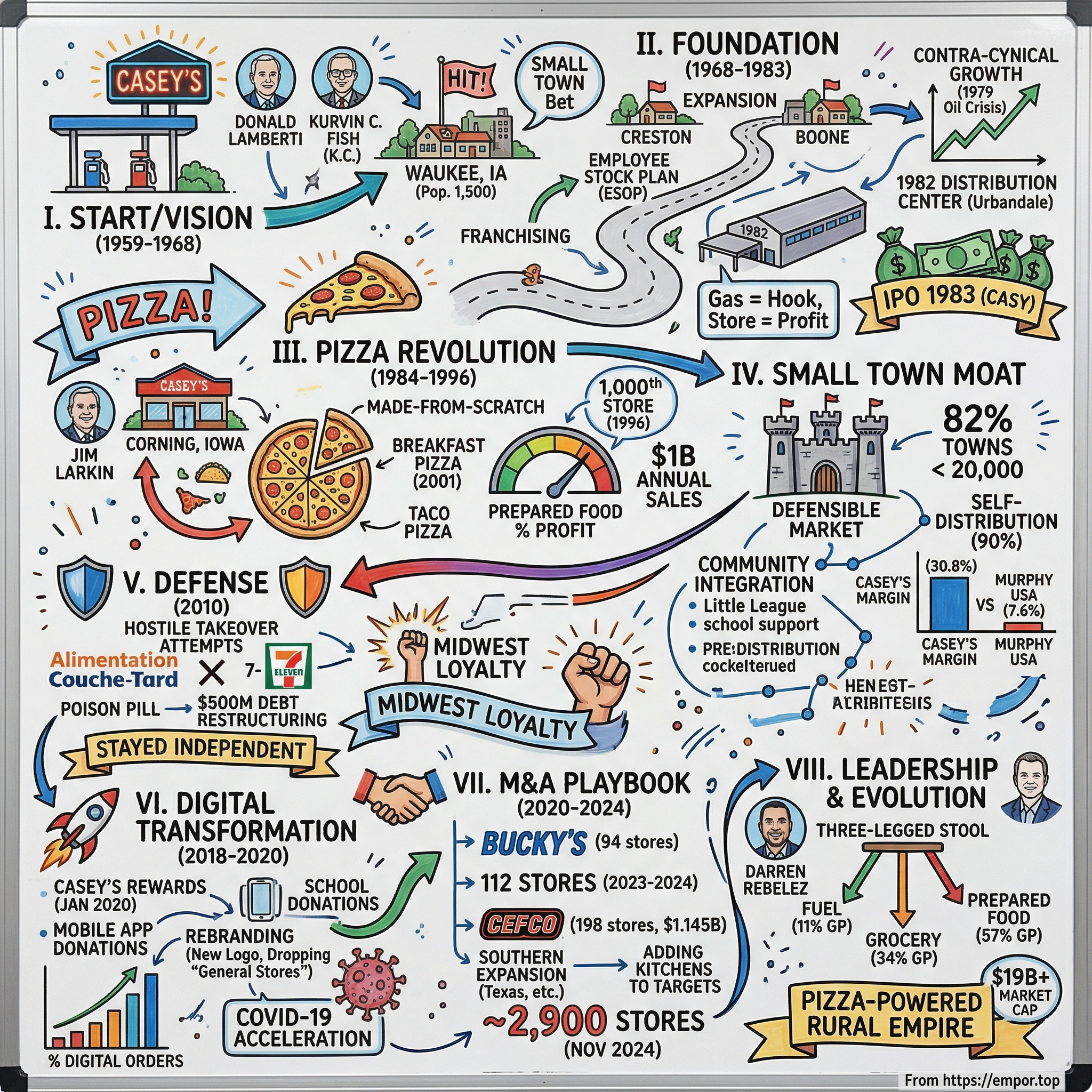
Casey's General Stores: The Midwest's Pizza-Powered C-Store Empire
I. Introduction & Episode Roadmap
On a Friday evening in a town of four thousand people somewhere in western Iowa, the busiest kitchen for twenty miles in any direction sits behind a beverage cooler, under fluorescent lights, next to a rack of motor oil. Someone is stretching dough mixed from flour and water that morning. Someone else is running the register while a pickup truck fills up at pump three. By nine o'clock, the store will have sold gasoline, a twelve-pack of beer, a gallon of milk, a lottery ticket, and eleven large pizzas—and the pizzas will have generated more gross profit than everything else combined.
That store belongs to Casey's General Stores, and the arithmetic of that single evening encapsulates the entire investment thesis.
Casey's has become the fifth-largest pizza chain in the United States measured by kitchen count, a distinction the company claims based on third-party location data.1 It is also the nation's third-largest convenience store operator by store count.1 As of April 30, 2026, the company operated 2,944 stores across nineteen states, with roughly half of them concentrated in Iowa, Missouri, and Illinois, and about 71% of the store base located in communities of fewer than 20,000 people.2 In fiscal 2026, it generated $17.6 billion in revenue, $714 million in net income, and close to $1.5 billion in EBITDA.2 In April 2026, it joined the S&P 500, replacing Hologic.3
The central puzzle is why this model works at all. Standard retail orthodoxy dictates that density wins: place stores where population is concentrated, amortize distribution across short routes, and rely on foot traffic for marketing. Casey's did the exact opposite. It expanded into sparsely populated towns, built full-service kitchens inside gas stations, managed its own long-haul distribution freight, and refused to franchise to achieve scale. From fiscal 2010 through fiscal 2020, that strategy compounded EBITDA at roughly 9% annually; from fiscal 2023 through fiscal 2026, EBITDA compounded at roughly 16% per year.1 Few retailers in any category sustain that level of performance.
The complete narrative is more complex than the highlight reel, resting on five core threads.
The first thread is the small-town positioning—the premise that Casey's found an uncontested market in rural communities ignored by national chains. While historically true, company SEC filings show this focus has been steadily diluted, even as management stopped disclosing the specific metric required to measure that shift.
The second thread is the kitchen. Prepared food drives the core of Casey's earnings. However, running a food service operation inside a convenience store is not a feature installed overnight; it is an operating capability built over four decades, marked by visible execution failures along the way.
The third thread is corporate governance and survival under pressure—spanning a 2010 hostile tender offer from Alimentation Couche-Tard, a competing buyout approach from 7-Eleven, and a 2017–2018 activist investor campaign that culminated in three directors departing the board in a single week.
The fourth thread is the current executive regime. Chief Executive Officer Darren Rebelez joined in June 2019 from IHOP by way of 7-Eleven and ExxonMobil. Under his leadership, the company has spent well over $1.7 billion acquiring competing convenience store chains, most consequentially the 198-store CEFCO chain across Texas and the Gulf South.4
The fifth thread is the economic mechanism—what actually protects the profit pool, how durable each component is, and which drivers are temporarily elevated. In fiscal 2026, a year in which earnings per share rose 31%, a large share of the profit improvement came from fuel margins that management itself attributed to a conflict in oil-producing regions and to industry-wide pricing behavior, rather than operational enhancements Casey's built.2[^3]
That is where the analysis concludes. It begins with a founder who did not want to put his own name on the sign.
 Subscribe on LinkedIn
II. The Origin Story: Donald Lamberti & The Rural Counter-Thesis (1959–1983)
The founder was Donald Lamberti. The family business began in Des Moines in 1935, when Domenic Lamberti—an Italian immigrant and former coal miner—started delivering coal and ice. Over time, the delivery route evolved into a neighborhood grocery store with a couple of gasoline pumps out front.5 In 1960, his son Donald left his accounting studies at Drake University to take over the store while his father was ill.5 That single corner store provided the entire foundation for what followed.
The pivotal relationship in the company's early development was with a gasoline salesman named Kurvin C. Fish. In 1967, Fish persuaded Lamberti to acquire an Ames, Iowa, oil company that owned four Square Deal service stations for $200,000, paying $40,000 down.5 Fish joined as an operator. When naming the converted locations, Lamberti opted against using his surname. "We talked about calling it 'Lamberti's General Stores,'" he later recalled, "but there are a lot of folks who don't like Italians."5 They selected Fish's initials instead, converting "K.C." into Casey's.
The first Casey's store opened in Boone, Iowa, in 1968 inside a converted three-bay gas station. It reached its third-year profit projections within twelve months.5 Subsequent locations followed in Creston, Waukee, and Saylorville, with each store built smaller than the last yet outperforming initial expectations.
This early expansion established the core rural strategy. In a town of a few thousand residents, consumer demand is insufficient to support an independent grocery store, gas station, bakery, liquor store, and restaurant. Operated separately, each venue falls short of the volume required to cover fixed overhead. However, consolidating all five offerings inside a single footprint—sharing one roof, parking lot, refrigeration setup, and staff—allows the consolidated store to operate profitably. Rural retail demand is not necessarily too small; rather, it cannot be profitably divided among multiple operators. The first entrant to aggregate that demand secures a durable local advantage, as a second entrant would compete for half the volume against the same fixed cost structure.
Lamberti codified this insight into an operational rule of thumb: target towns with populations under 5,000, where Casey's could serve as the primary commercial hub. Decades later, the company's fiscal 1996 annual report demonstrated the durability of that focus—approximately 72% of all Casey's stores were located in towns with fewer than 5,000 residents, while only about 6% operated in communities with populations above 20,000.6 That high concentration formed the foundation of the company's early competitive moat, though that demographic balance would shift in subsequent decades.
Subsequent expansion combined internal growth with franchising. After Ashland Oil acquired Fish's refinery in 1970, Casey's took on financial partners and adopted a franchise model—a capital-light strategy to add store count that the modern business eventually reversed completely.5 Between the late 1970s and 1979, the chain roughly doubled from 119 stores to 226, expanding even as energy-crisis pressures forced competing operators to retreat.5 By the end of 1983, the footprint spanned eight states with 191 company-operated stores and 215 franchised locations, generating $188.5 million in net sales.5
Two strategic decisions from this era created compounding operational advantages over the following four decades. The first was vertical integration in distribution. In 1983, Casey's opened a 55,000-square-foot warehouse in Urbandale, Iowa.5 For a regional chain of a few hundred rural stores, building self-distribution required significant upfront capital in a function most retailers outsourced. However, rural delivery routes presented steep cost challenges; third-party distributors serving scattered, low-volume stores charged higher rates or delivered inconsistently. Operating its own fleet turned a logistical hurdle into a fixed-cost asset that became more efficient as store density grew. The 490,000-square-foot Store Support Center built in Ankeny, Iowa, in 1990—which remains the company's headquarters and primary distribution facility—is the direct descendant of that investment.2
The second pivotal choice was accessing public capital markets. In October 1983, Casey's completed an initial public offering, selling roughly a quarter of its outstanding shares at $15 per share.5 Management used a portion of the proceeds to buy back interest in regional store-operating subsidiaries, marking an early step in what eventually became an ongoing corporate consolidation effort.
Franchising, while instrumental to rapid unit expansion in the 1970s, introduced operational trade-offs between speed and control.5 As late as fiscal 1996, franchisees operated 182 of the chain's 983 stores.6 In prepared food service, quality consistency is central to brand reputation; inconsistent food execution between locations dilutes the brand with limited corporate recourse. Casey's eventually shifted strategy, transitioning to a fully company-owned and operated store network. Management now positions this structure as a competitive advantage over a restaurant industry that is roughly 75% franchised, noting that direct ownership eliminates royalty leakages, provides complete control over pricing and menu choices, and allows chain-wide operational changes to be deployed simultaneously.1 While unwinding franchise agreements required decades, total store control became an essential foundation for the modern operating model.
The strategic lesson of this initial era is specific. Casey's did not invent rural retail or the convenience store model. Instead, it identified a distinct unit-economic dynamic: small, underserved markets reward an operator willing to consolidate multiple retail categories under one roof. By investing early in proprietary logistics and distribution, the company ensured that this local economic advantage could be scaled efficiently across multiple states. However, during this period, Casey's had not yet established the signature product category that would make its business model exceptionally difficult to replicate.
III. The Pizza Inflection: Converting C-Stores into Kitchens (1984–2009)
Installing a working kitchen inside a gas station in 1984 presented significant operational hurdles. A retailer required refrigerated storage for perishables in buildings designed for shelf-stable goods, food-safety training for store employees drawn from small local labor pools, and a supply chain delivering mozzarella and fresh dough ingredients on reliable schedules to isolated towns. Furthermore, all of this had to operate alongside a core traffic driver—gasoline—sold at gross margins of roughly ten cents on the dollar.
Casey's began marketing made-from-scratch pizza in 1984.6 By 1985, the offering expanded to 85 locations; by 1986, the company was selling pizza by the slice and operating a commissary in Creston, Iowa, to prepare sandwiches.5 A decade later, pizza kitchens operated in 902 stores, representing roughly 92% of the chain.6
The model succeeded in rural markets not because Casey's out-cooked national pizza chains, but because national chains were entirely absent. Franchise operations like Domino's and Pizza Hut required larger trade areas to justify the overhead of standalone locations. Casey's, by contrast, had already absorbed the capital expenses—the building, parking lot, utilities, and baseline staffing—to sell fuel and tobacco. Adding a kitchen represented an incremental use of an existing fixed asset. Instead of carrying the full overhead of a standalone restaurant, the kitchen incurred only the marginal costs of ingredients and additional labor hours. This counter-positioning created an economic advantage that neither traditional convenience stores nor national restaurant chains could easily match.
The financial impact appeared clearly in the company's mid-1990s disclosures. Non-gasoline merchandise generated roughly 41% of retail sales but accounted for about 74% of retail gross profit, with prepared food gross margins averaging approximately 52% from fiscal 1994 through fiscal 1996, compared to roughly 10% for fuel.6 By fiscal 1996, the chain expanded to 983 total stores—comprising 801 company-operated locations and 182 franchised units—generating $954.8 million in net sales and opening its 1,000th store in Altoona, Iowa, later that year.65 While subsequent narratives often rounded this performance to a billion-dollar milestone, official filings placed net sales at $954.8 million.
Operating a scratch kitchen introduced significant execution complexity. Store staff mixed dough daily from raw ingredients, managing a precise proofing process inside facilities built primarily for retail convenience and fuel sales. Supplying these kitchens required integrating store operations directly with internal distribution centers rather than relying on third-party broadline distributors, linking the company's warehousing strategy directly to its culinary model. Managing this system with hourly store labor in small markets presented scaling challenges that Casey's addressed through standardized training. Today, the company runs formal kitchen manager development programs and reports having certified more than 15,000 team members on pizza execution.21
From this era emerged the fundamental commercial structure Casey's maintains today: a three-legged business model. Fuel drives customer traffic to the site; grocery and general merchandise build basket size; and prepared food generates a disproportionate share of gross profit. While each segment carries inherent limitations independently, combined they allow a single fixed-cost base to capture multiple consumer purchasing occasions.
Testing the claim: was the kitchen ever a plug-and-play profit engine?
The conventional narrative suggests that scratch-made pizza provided Casey's with an immediate, highly defensible profit engine. However, historic filings reveal a more gradual development.
First, corporate reporting patterns reflect this progression. Through the 1990s, Casey's did not break out prepared food as a distinct revenue category on its income statement. Instead, filings split retail sales between gasoline and a broader grocery and general merchandise category, discussing prepared food only qualitatively.6 A standalone reporting line for prepared food and dispensed beverages was introduced only after the segment achieved sufficient scale and stability to warrant separate disclosure.
Second, gross margins required decades to mature. Prepared food gross margins averaged approximately 52% in the mid-1990s,6 compared to 58.6% in fiscal 2026.2 Accumulating those six percentage points of gross margin required thirty years of systematic improvements in waste reduction, procurement scale, distribution efficiency, and store-level execution. This structural gain represents an accumulated operational capability—what strategy literature terms process power—that is difficult for competitors to replicate quickly.
Third, the segment remains sensitive to commodity price fluctuations. Cheese represents the company's largest single raw ingredient cost, with price shifts directly impacting performance: a six-cent-per-pound year-over-year drop in cheese prices in the fourth quarter of fiscal 2026 added approximately 15 basis points to prepared food gross margin.[^3] Management's ongoing quarterly sensitivity tracking demonstrates that input cost variations continue to influence segment profitability.
Consequently, the competitive moat is more nuanced than simplified marketing narratives suggest. Casey's food service business derives its defensibility from geographic positioning and decades of operational refinement rather than an easily replicable concept. Going forward, the primary test of this capability will be whether prepared food gross margins can remain near the 58% to 59% range as the company integrates hundreds of newly acquired stores across new geographic regions and labor markets.
By the late 2000s, these underlying operational capabilities remained largely unrecognized by the broader market. External observers primarily saw a mid-cap Midwestern retailer with extensive real estate assets and a modest valuation. In 2010, an outside suitor moved to exploit that gap.
IV. Battle for Independence: The 2010 Hostile Takeover Siege
On March 9, 2010, the board of Casey's received an unsolicited proposal from Alimentation Couche-Tard, the Quebec-based operator of Circle K, to acquire all outstanding shares for $36.00 per share in cash. The board reviewed the offer with advisers and rejected it unanimously. On April 9, Couche-Tard made the proposal public.7
The ensuing tactical battle illustrated classic hostile takeover mechanics. On April 16, 2010, the board adopted a shareholder rights plan—a poison pill designed to dilute any acquirer crossing a specified ownership threshold.8 On June 2, Couche-Tard launched a formal tender offer at $36.00 per share and simultaneously announced plans to nominate a full nine-director slate at the upcoming annual meeting.7 This two-track approach sought to bypass the board by purchasing shares directly from investors while replacing the directors blocking the acquisition.
Casey's responded with a leveraged recapitalization. On August 9, 2010, the company issued $569 million of 5.22% senior notes and used the proceeds to fund a Dutch auction self-tender offer, repurchasing 13,157,894 shares at $38.00 apiece for roughly $500 million, while prepaying older senior notes at an $11.3 million cost.8 Management effectively borrowed heavily to repurchase about a quarter of the company's outstanding shares at a price above the hostile offer. The move served a dual purpose: it raised a defensive barrier by increasing debt, reducing available shares, and establishing a higher valuation reference point, while also signaling management's conviction in the business. If the board maintained that $36.00 undervalued the company, backing that claim with a $500 million share buyback at $38.00 offered concrete proof.
Couche-Tard raised its offer twice, first to $36.75 per share on July 22 and then to $38.50 on September 1. The board rejected both proposals, asserting publicly that neither reflected the company's standalone prospects.89 Bidding intensified on September 7 when Casey's disclosed an unsolicited preliminary proposal from a third party at $40.00 per share. Two days later, the company identified the bidder as 7-Eleven and authorized discussions, while maintaining that Casey's intrinsic value substantially exceeded $40.00 per share.8
The contest concluded in three stages. At the annual meeting on September 23, 2010, shareholders re-elected all eight incumbent directors and rejected Couche-Tard's governance proposal, effectively turning back the hostile slate.8 On September 30, Couche-Tard allowed its offer to expire without purchasing any shares.8 Finally, on November 3, Casey's disclosed that 7-Eleven had returned with a revised proposal of $43.00 per share. The board determined that even $43.00 failed to reflect the company's long-term growth opportunities and ended discussions.8 Defending independence proved costly, totaling about $6.9 million in legal and advisory fees during the fourth quarter of fiscal 2010 and another $15.8 million across fiscal 2011.78
Governance rules also favored management. Casey's is incorporated in Iowa, where the state Business Corporation Act allows boards considering takeover offers to evaluate impacts on employees, suppliers, customers, creditors, and local communities—not solely shareholder returns—and imposes a three-year moratorium on business combinations with an interested shareholder unless specific approvals are met.2 This framework granted Casey's board broader latitude to resist takeover bids than standard Delaware corporate governance law would typically permit.
This legal latitude aligned with the personal background of the board. Chief Executive Officer Robert Myers had spent nearly three decades at Casey's, while director Jeffrey Lamberti carried the founder's family name. For a board deeply rooted in the company's history, the continuity of the enterprise, its workforce, and its rural communities were central priorities. Iowa law gave directors the legal standing to protect those interests alongside financial metrics. Whether that resistance ultimately served shareholders or simply insulated incumbent management remains a nuanced question: while the company eventually created value far exceeding the $43.00 offer, that expansion occurred only after significant operating delays and substantial board turnover.
The strategic defense also reshaped the company's balance sheet. Beyond advisory expenses, the recapitalization added $569 million of ten-year debt at a 5.22% interest rate while reducing outstanding shares by roughly 25%—permanently altering Casey's capital structure under pressure.8 While retiring shares at $38.00 later proved to be an excellent financial decision given the stock's long-term trajectory, the self-tender was fundamentally a defensive tactic designed to impede an unwanted acquisition.
The takeover battle left two contrasting interpretations.
The optimistic view, which management subsequently embraced, holds that outside suitors evaluated Casey's strictly as a fuel-and-real-estate operator, failing to recognize the high-margin potential of its proprietary kitchen model. The company's subsequent stock performance over the next decade and a half lends credibility to this perspective.
The critical view notes that the board rejected a guaranteed $43.00 per share cash payout at a time when the business produced a fraction of its current earnings. While boards that decline cash offers implicitly promise superior standalone returns, Casey's required nearly a decade, an extended period of sluggish performance, and an activist campaign before that long-term value materialized.
V. The Activist Crucible & Re-Platforming (2017–2020)
By the mid-2010s, performance in the company's highest-margin business began to stall, as reflected in its annual reports. Prepared food same-store sales growth slowed from 12.4% in fiscal 2015 to 8.4% in fiscal 2016, 4.8% in fiscal 2017, and 1.7% in fiscal 2018.1011 Grocery same-store sales followed a similar downward trajectory, decelerating from 7.8% to 1.9% over the same four-year period.1011
In regulatory filings, management attributed the slowdown to a weaker agricultural economy that depressed customer traffic, heightened promotional activity from competitors, and unseasonal weather.11 While farm income was indeed depressed during those years, a durable competitive advantage is meant to insulate a retailer during cyclical downturns. Four consecutive years of decelerating growth in prepared food demonstrated that macroeconomic headwinds were directly straining Casey's core profit driver.
Activist investors stepped in. JANA Partners disclosed a stake in November 2017 and called for a comprehensive strategic and financial review.12 Simultaneously, a separate investor group—comprising JCP Investment Management, BLR Partners, and investor Joshua Schechter—accumulated a position to pressure the board. This group had previously pushed convenience store operators The Pantry and CST Brands into sale transactions earlier in the decade. Although Casey's possessed defensive tools—including a history of shareholder rights plans, protective Iowa corporate governance laws, and a board accustomed to resisting hostile suitors—it faced mounting pressure from four years of slowing same-store sales and the absence of a modern digital loyalty program.
The governance standoff culminated on March 1, 2018, when three long-standing directors—Board Chair Robert J. Myers, William C. Kimball, and Jeffrey M. Lamberti—notified the board of their retirement, effective March 6.13 Myers had served nearly thirty years at Casey's, including nearly a decade as chief executive officer, while Lamberti represented the founding family line. To fill the vacancies, the board elected Donald E. Frieson, former executive vice president of operations at Sam's Club; David K. Lenhardt, former chief executive officer of PetSmart; and Allison M. Wing, former chief marketing and digital officer at Ascena Retail Group—bringing in dedicated expertise across retail operations, corporate transformation, and digital marketing.14 H. Lynn Horak, an independent director since 2009 and retired regional chairman at Wells Fargo, assumed the role of board chair, formally separating the chairman and chief executive roles.14
Alongside the board changes, Casey's instituted structural corporate governance reforms. The company adopted proxy access, allowing a group of up to twenty shareholders holding at least 3% of outstanding shares for three years to nominate up to two directors or 20% of the board; implemented a majority voting standard for uncontested director elections, which shareholders formally ratified in September 2018; and established strict director age and tenure limits.1315 Having spent 2010 constructing anti-takeover defenses, the board spent 2018 lowering governance barriers to shareholder accountability.
Concurrently, management unveiled a comprehensive value creation plan centered on three primary operating initiatives: a digital engagement platform to introduce mobile ordering, personalized marketing, and a customer loyalty program; a commercial fleet card program projected to increase fuel sales by 2% in its first full year; and a price optimization engine to centralize fuel pricing while rationalizing in-store merchandise pricing and assortment. The plan also targeted $200 million in cumulative store-level operating expense savings by fiscal 2021 and established a new $300 million share repurchase authorization through fiscal 2020.16
Crucially, management established explicit multi-year same-store sales targets for fiscal 2021, providing a direct benchmark for execution: driving fuel gallon growth of at least 4%, grocery growth of at least 6%, and prepared food growth of at least 10%.16
Grading the promise against the outcome
These quantitative commitments provided an explicit test of management's execution credibility.
When fiscal 2021 concluded, prepared food same-store sales had declined 2.1%, fuel gallon volume fell 8.1%, and grocery and general merchandise grew 6.6%.17 Casey's met its grocery target but missed its fuel and prepared food goals by substantial margins.
Management attributed the shortfalls in fuel and prepared food directly to the COVID-19 pandemic and associated mobility restrictions.17 While public health disruptions severely affected foot traffic, historical filings indicate that growth had already stalled prior to the pandemic. In fiscal 2019—the first full pre-pandemic year under the plan—prepared food same-store sales grew just 1.9%, grocery rose 3.6%, and fuel gallons declined 1.7%.17 In fiscal 2020, which experienced only two months of pandemic disruptions, prepared food same-store sales fell 1.5%, grocery grew 1.9%, and fuel gallons dropped 5.1%.17 The operational momentum required to hit 10% prepared food growth had failed to materialize well before the pandemic began.
The evidence suggests that Casey's established ambitious growth targets without an established operational mechanism to achieve them, before an external macroeconomic shock obscured whether the strategy could have succeeded. Consequently, investors must evaluate management's subsequent strategic plans—which focus on controllable metrics like absolute EBITDA growth and unit expansion rather than aggressive same-store sales projections—as a more disciplined framework for corporate guidance.
The most consequential leadership change occurred in June 2019, when the board named Darren Rebelez as chief executive officer. Rebelez possessed executive experience tailored to Casey's specific operational model: he served as president of IHOP Restaurants from 2015 to 2019, expanding digital ordering and off-premise sales; worked as executive vice president and chief operating officer at 7-Eleven from 2007 to 2014, managing large-scale convenience retail operations; held earlier managerial roles in fuel supply and pricing at ExxonMobil; and served as an officer in the U.S. Army.18 His background combined executive leadership across all three core business pillars: food service, convenience retail, and fuel operations.
Over the next eighteen months, Rebelez systematically restructured the executive suite, recruiting a chief merchandising officer in October 2019, a head of prepared food in February 2020, a chief human resources officer in January 2020, a chief operating officer in June 2020, and Steve Bramlage as chief financial officer in May 2020 following senior finance roles at Aramark and Owens-Illinois.118 Concurrently, the company expanded its logistics infrastructure, opening its third distribution center in Joplin, Missouri, in April 2021 to support southern expansion alongside existing hubs in Ankeny, Iowa, and Terre Haute, Indiana.2
The operational re-platforming yielded tangible digital capabilities across the business. The Casey's Rewards program, launched following the activist intervention, expanded to more than 10 million members by the end of fiscal 2026, with enrollment growing 29% during fiscal 2026 and ninety-day active users increasing approximately 140% since fiscal 2023.21 Management streamlined the digital ordering architecture, reducing the steps to order a pizza from eleven clicks to three. Over a three-year period, mobile application sales compounded at approximately 16% annually, total digital channel sales grew at roughly 18% per year, and third-party delivery—expanded to more than 2,000 stores—increased order volume by nearly 30% in fiscal 2026.1 Additionally, the company launched a retail media network, Casey's Access, monetizing vendor promotional placement in a program that management reported expanded its corporate marketing budget by over 70% relative to fiscal 2023 levels.1
While activist intervention catalyzed these digital investments, high loyalty enrollment and app downloads represent operational inputs rather than financial outcomes. The fundamental economic test is whether digital engagement drives incremental spending. Management notes that rewards members visit and spend roughly four times as much as non-members; however, this metric reflects internal customer correlation rather than a controlled measurement of incremental demand.1 High-frequency customers naturally opt into rewards programs, making it difficult to isolate the program's net contribution to top-line growth.
Ultimately, the activist campaign did not force a sale of the company. Instead, it replaced incumbent governance, brought in a new executive leadership team, and established a digital infrastructure that the prior administration had lacked. Whether this modern operating platform justifies Casey's valuation depends on the durability of its underlying economics—the central subject of the analysis that follows.
VI. Under the Hood: Segment Economics, Self-Distribution, & Helmer's 7 Powers
Strip away the narrative and Casey's is three businesses sharing one building, with relative profit contributions that diverge sharply from top-line revenue.
In fiscal 2026, prepared food and dispensed beverage generated $1.78 billion in revenue—about 10% of the company's $17.56 billion top line—and $1.04 billion in gross profit, roughly 24% of the total, at a 58.6% margin.2 Grocery and general merchandise produced $4.56 billion in revenue, about 26% of the total, and $1.64 billion in gross profit at a 35.8% margin.2 Fuel produced $10.62 billion in revenue—over 60% of the top line—and $1.50 billion in gross profit at a 14.1% margin, or 42.6 cents per gallon.2
Translated into plain financial terms, every dollar of prepared food revenue yields roughly 59 cents in gross profit, while every dollar of gasoline revenue yields about 14 cents. Fuel functions less as a standalone profit driver than as a low-cost customer acquisition channel. It fills the parking lot with minimal marketing expense, leaving store operations to convert foot traffic into higher-margin inside purchases. The company reports that roughly 70% of inside guest visits do not include a fuel purchase at all—demonstrating that the store interior has developed its own independent customer pull.1
The physical moat: owning the trucks
Casey's operates three distribution centers—a 290,000-square-foot facility adjacent to its headquarters in Ankeny, Iowa; a 340,000-square-foot center in Terre Haute, Indiana, opened in February 2016; and a 300,000-square-foot center in Joplin, Missouri, opened in April 2021—and runs a fleet of more than 500 tractors.2 Most existing and planned stores sit within roughly 500 driving miles of one of these three hubs, representing the network's optimal efficiency radius. Outlying locations, such as stores in Florida, are supplied through a third-party partner.2 The company also self-distributes the majority of its fuel and owns a terminal in Waco, Texas, delivering roughly two billion gallons on its proprietary fleet in fiscal 2026, up about 20% year-over-year.21
This distribution structure matters far more in rural markets than in dense urban environments. Delivery cost per case depends on route density and stop volume, both of which are naturally lower across rural routes. Third-party broadline distributors typically charge premium rates to cover those logistics or decline the business altogether. By owning its logistics network, Casey's converts a variable delivery cost that rises with geographical dispersion into a fixed asset that scales with store density. Each incremental store added within an existing service radius lowers average delivery costs across the surrounding footprint. This internal logistics efficiency allows the company to operate profitably in small markets that competitors avoid.
This logistics foundation explains why the artificial intelligence initiatives management highlighted at its June 2026 investor day represent more than routine technology marketing. An AI-enabled demand forecasting tool reduced warehouse inventory dollars by 33%, cut store order lines requiring manual adjustment by 94%, improved merchandise availability by 550 basis points, and expanded distribution capacity by roughly 300 stores without constructing new facilities.1 Unlocking 300 stores of logistics capacity through software optimization rather than real estate expansion reflects tangible capital efficiency, though these management-reported figures remain unverified by independent third parties.
Reading Casey's through the 7 Powers framework
Counter-positioning represents the company's clearest strategic advantage. Traditional convenience stores rely on third-party packaged foods at slim margins; installing a scratch kitchen requires restructuring the store-level labor model, hiring specialized culinary talent, and absorbing spoilage risks. Conversely, national pizza chains cannot retaliate by adding fuel pumps and beer caves without fundamentally changing their real estate footprints and operating models. Existing competitors in both categories can observe Casey's playbook but cannot replicate it without disrupting their own legacy operations—the classic definition of counter-positioning.
Scale economies provide a structural cost advantage, though one bounded by geography. Casey's distribution efficiency operates primarily within a 500-mile radius of its three fulfillment centers. Outside that footprint, the company functions like a conventional retailer relying on third-party logistics. This geographical boundary serves as an important constraint on management's Sunbelt expansion narrative.
Cornered resource is the most debated element of the thesis. Management asserts that Casey's controls near-monopoly real estate positions in small towns where limited demand deters secondary entrants. Independent evidence supporting this claim emerged from regulatory oversight rather than corporate disclosures. When the Federal Trade Commission reviewed Casey's acquisition of Bucky's in 2021, the agency alleged that the transaction would reduce retail fuel competitors to three or fewer across seven local markets in Nebraska and Iowa, requiring the divestiture of six locations.19 An antitrust regulator's formal finding of local market concentration provides stronger empirical evidence for market power than self-reported corporate metrics.
However, SEC filings that document this rural real estate advantage also track its gradual dilution. In fiscal 1996, approximately 72% of Casey's stores operated in towns with fewer than 5,000 residents.6 By fiscal 2010, that proportion declined to 61%, falling to 60% in fiscal 2011.78 Management continued disclosing store concentration on a sub-5,000 population basis through fiscal 2020.20 By fiscal 2022, that share dropped to 51%, while stores in communities with more than 20,000 residents grew to 25%.21 Beginning in fiscal 2024, Casey's eliminated the sub-5,000 metric altogether, adopting a broader metric showing that approximately 72% of stores operated in areas under 20,000 residents in fiscal 2024, and 71% in both fiscal 2025 and fiscal 2026.22232
This reporting change is material. The company broadened the population threshold on the single metric that defined its core competitive moat at the exact point when the underlying concentration was declining. While a benign interpretation suggests that footprint diversification made a 20,000-resident threshold more descriptive of the modern store network, a more skeptical view indicates management masked a deteriorating trend. In either case, investors evaluating the small-town monopoly thesis no longer have access to the underlying historical data series needed to verify its continuity.
Process power—the specialized kitchen execution capability developed over decades—remains the company's most defensible asset, residing in standardized operational routines and thousands of trained team members rather than proprietary software or patents. From fiscal 2024 through fiscal 2026, Casey's reduced store-level labor hours by approximately 5% cumulatively while improving store employee turnover by roughly 70 percentage points and achieving a reported guest satisfaction rating of 75%.1 Expanding food service volume while lowering labor hours and employee turnover reflects process power in practice.
Across standard competitive dynamics, inside buyer power remains low in rural markets where the nearest alternative retail option requires a long drive. At the pump, however, buyer power is substantial; fuel is a transparently priced commodity easily compared via mobile apps, which explains why Casey's prices competitively and treats fuel sales primarily as a customer acquisition channel. The threat of substitutes presents a more immediate challenge: value retailers like Dollar General have expanded aggressively across rural markets, competing directly for the high-margin fill-in grocery purchases that complement Casey's food service sales.
Ultimately, Casey's segment economics reflect a distinct operating model resting on three pillars: a durable culinary capability, an internal distribution network bounded by geographic range, and a small-town real estate footprint that corporate disclosures show has diluted by roughly twenty percentage points over three decades. The primary driver of that strategic dilution has been accelerated store acquisitions.
VII. The M&A Aggregator: Bucky's, CEFCO, & Texas Invasion (2020–2026)
Consider the seller on the other side of these transactions: a family operating a dozen convenience stores across central Nebraska for two generations. Credit card interchange fees consume an increasing share of fuel transactions, local wage rates rise independently of store sales, and cigarettes—historically a primary inside profit driver—remain in structural decline. Developing a mobile application, launching a digital loyalty program, and installing a scratch kitchen present capital and operational demands far beyond the capacity of an independent regional operator.
That independent seller represents Casey's core growth algorithm.
Industry statistics presented by Casey's in June 2026 illustrate the consolidation pressure across the market. Of the roughly 151,975 U.S. convenience stores operating in 2025, approximately 95,672 belonged to operators managing ten stores or fewer.1 Between 2022 and 2025, regional chains operating between 51 and 200 stores shrank 8.5%, while mid-sized operators with 201 to 500 locations contracted 5.8%. In contrast, large operators managing 501 or more stores expanded by 6.8%.1 The middle market is consolidating rapidly as national chains absorb smaller networks. Within this environment, Casey's acquired 736 stores over the past decade, including 387 locations in the three fiscal years leading into 2026.1 Management also cited a National Association of Convenience Stores (NACS) survey indicating that roughly 70% of industry respondents are unprofitable on inside retail sales alone without fuel revenue, while locations offering restaurant-quality food generate approximately twice the EBITDA per store.1 If those survey findings reflect broader industry trends, the operational divide separating scale operators like Casey's from small independent chains continues to widen.
Bucky's: the template, and the friction
On November 9, 2020, Casey's agreed to acquire Buchanan Energy, owner of Bucky's convenience stores, for $580 million in cash. The transaction price included tax benefits valued at $80 million, reducing the net investment to $500 million—representing approximately 10.6 times Bucky's trailing twelve-month EBITDA, with $23 million in annual synergies targeted by the third year.24 On a post-synergy basis, the purchase multiple compressed to roughly 7.2 times EBITDA. This valuation gap reflects the core acquisition thesis: purchase regional networks at multiples below Casey's public trading multiple, then compress valuation further by introducing kitchen capabilities and operational scale that independent sellers cannot support.
The transaction added 94 company-operated retail stores and 79 dealer locations, introducing a new operational capability: managing wholesale fuel supply contracts for dealer sites Casey's does not directly operate, creating an additional earnings stream and future acquisition pipeline.24 Steve Buchanan, whose family founded the business in 1980, framed the sale around Casey's operating model, noting, "The addition of Casey's pizza to our existing high-volume stores will be celebrated by our customers."24
The transaction encountered regulatory and operational friction. Management originally expected the acquisition to close by the end of calendar 2020.24 Instead, closing was delayed until May 2021 following regulatory intervention. On April 28, 2021, the Federal Trade Commission issued a complaint and consent order requiring the divestiture of six retail fuel outlets—three Casey's and three Bucky's locations—to Western Oil II and an affiliate within ten days of closing, while imposing a ten-year prior-notice requirement on future retail fuel acquisitions near the affected markets.19 The Commission approved the consent order by a 4–0 vote.19
Integration demands also created temporary margin pressure. In fiscal 2022, operating expenses increased 19.8%, including $15.0 million in one-time transaction and integration costs, while prepared food gross margin declined from 60.1% to 59.2%—a drop management attributed primarily to broader cost inflation.21 This gross margin trajectory highlights an important operational detail: Casey's prepared food margin peaked at 60.1% in fiscal 2021, and the 58.6% margin reported in fiscal 2026 remains below that prior high.212 Prepared food margins have not followed an uninterrupted upward trend; rather, segment margins have remained flat to slightly down over a six-year period even as prepared food expanded its share of total revenue.
Operating alongside large-scale M&A is an organic unit expansion strategy. Casey's maintains a dual-engine growth framework in which management targets roughly half of annual store additions through new store construction and half through bolt-on acquisitions, treating major corporate transactions as opportunistic rather than routine.[^3] Proprietary network planning models evaluate potential build sites based on demographic density and traffic patterns, with company disclosures indicating that stores constructed between fiscal 2021 and fiscal 2023 outperformed legacy stores across disclosed metrics.1 Chief Executive Officer Darren Rebelez has attributed the recent shift toward acquisitions to construction cost economics: elevated building costs made purchasing existing locations, executing remodels, and adding kitchen infrastructure more cost-effective than building new sites from the ground up.[^3] Additionally, management maintains an active land bank to resume organic site construction if acquisition multiples inflate.[^3] This strategic flexibility provides an important safeguard, as overpaying for acquisitions represents a primary operational risk in retail consolidation.
CEFCO: the largest bet, and the honest ledger on it
On July 25, 2024, Casey's signed an equity purchase agreement to acquire Fikes Wholesale and Group Petroleum Services—owner of CEFCO Convenience Stores—for $1.145 billion in cash, announcing the transaction the following day.254 Bloomberg reported the transaction as the largest acquisition in Casey's history.26 The transaction price included roughly $165 million in tax benefits for a net investment of $980 million, representing approximately eleven times CEFCO's pro forma adjusted 2023 EBITDA, with roughly $45 million in annual run-rate synergies expected upon completion of kitchen installations.4 On a post-synergy basis, the valuation multiple compressed to near 7.4 times EBITDA.
The acquisition comprised 198 retail stores—148 in Texas and 50 across Alabama, Florida, and Mississippi—alongside a dealer network, a fuel terminal in Waco, Texas, and a central commissary supporting the Texas store base.4 Fikes traced its origins to a single filling station opened in Cameron, Texas, in 1952.4 Driven by the transaction, fiscal 2025 became the largest store growth year in Casey's history, adding 35 new builds and 235 acquired units.[^3]
This expansion raises a central strategic question: can Casey's successfully export its rural Midwest kitchen playbook into Texas and the Gulf South?
Early execution evidence remains mixed. On the financial side, the acquired stores immediately diluted key consolidated operating metrics. In the fourth quarter of fiscal 2025, the CEFCO portfolio reduced consolidated prepared food gross margin by roughly 160 basis points and compressed fuel margin by about two cents per gallon.[^3] Chief Financial Officer Steve Bramlage explained on an earnings call that CEFCO's legacy food offering was protein-centric and lacked pizza, creating a structural drag on prepared food margins prior to remodeling.[^3] The realization of synergies has also followed a multi-stage timeline: while fuel pricing adjustments began immediately and corporate overhead was rationalized shortly thereafter, inside-store procurement synergies remained constrained by inherited vendor supply contracts running through the end of calendar 2026. Furthermore, the largest synergy bucket—kitchen retrofits—depended on local permitting and construction schedules,[^3] leading management to build essentially zero kitchen conversion contributions into its fiscal 2026 operational assumptions.[^3]
Casey's has also pruned non-performing locations from the acquired portfolio. The company exited roughly ten acquired stores in Mississippi after concluding that site locations and projected capital returns did not justify ongoing operations, contributing to a total of 41 store closures in fiscal 2026 that generated approximately $42 million in proceeds.2[^3] While representing a minor rationalization rather than a strategic failure, these closures underscore that not every location in the company's largest acquisition met internal return hurdles upon secondary review.
Moreover, the competitive dynamic in the Sunbelt differs fundamentally from Casey's core Midwestern footprint. Texas features established, high-affinity convenience and fuel brands, including Buc-ee's large-format travel centers, Allsup's with its regional food customer loyalty, 7-Eleven's Stripes banner, and a dense network of fuel-focused independent operators.
Initial operational performance indicators, however, offer constructive signals. Rebelez noted on the fiscal 2025 year-end earnings call that operations in Texas and Florida were performing in line with internal expectations, highlighting strong customer response to pizza at three proof-of-concept conversions in Texas, alongside higher fuel sales volumes offsetting thinner fuel margins as modeled.[^3] By the end of fiscal 2026, Casey's had converted approximately 50 CEFCO locations to its full store format, with management reporting post-remodel sales exceeding internal projections. An additional 130 stores are scheduled for conversion during fiscal 2027. With each location offline for four to six weeks during remodeling, Rebelez characterized the near-term financial impact as roughly neutral to fiscal 2027 performance, with net financial accretion expected in fiscal 2028.[^3]
In summary, the Sunbelt expansion thesis remains unproven, operating on different economic assumptions than the original Midwestern strategy. Rather than establishing small-town retail monopolies in uncontested trade areas, Casey's is deploying its food service capabilities into higher-density, highly competitive markets where it operates as one of several established retail options. This model implies higher store sales volumes balanced against reduced local pricing power. The empirical test of this strategy will be visible in Casey's disclosed prepared food same-store sales and consolidated inside gross margins through fiscal 2027 and fiscal 2028, as the 130 scheduled store retrofits complete their initial post-remodel operating cycles.
VIII. Management, Governance, & Capital Allocation Audit
In June 2023, Chief Executive Officer Darren Rebelez presented a three-year strategic plan centered on three operational pillars: accelerating food service sales, expanding store count, and enhancing operating efficiency. The plan targeted 8% to 10% annualized EBITDA growth and at least 350 net new or acquired stores.1 Three years later, on June 24, 2026, management presented its multi-year report card at an investor meeting in New York.
The results exceeded every headline metric in the original guidance: Casey's added 504 stores against its 350-store target, compounded EBITDA at 16% annually versus the 8% to 10% goal, expanded inside gross margin by 230 basis points, generated $1.68 billion in cumulative free cash flow against $1.25 billion projected, and expanded return on invested capital by 90 basis points.1 In fiscal 2026 alone, diluted earnings per share reached $19.16 on net income of $714 million—both rising 31% year-over-year—while return on invested capital finished at 12.7%, its highest level since fiscal 2018, and annual free cash flow reached $722 million.2[^3]
Exceeding a three-year guidance framework across every metric represents a notable operational milestone. However, evaluating the sustainability of that performance requires analyzing its underlying components, as a significant portion of the financial beat stemmed from external commodity market conditions rather than internal execution.
Management originally based its three-year financial framework on fuel margins in the mid-30-cent per gallon range, but actual realization averaged 40 cents per gallon over the period.1 In fiscal 2026, fuel margin reached 42.6 cents per gallon, up from 38.7 cents in fiscal 2025. The company's annual report explicitly notes that retail fuel margins were historically elevated during the year—especially in the fourth quarter—and remain subject to sudden, unpredictable shifts.2 Across roughly 3.5 billion gallons of fuel sold annually, each additional cent of margin generates approximately $35 million in gross profit. Consequently, the five-cent spread between planned and realized fuel margins contributed roughly $175 million in annual gross profit driven by market conditions rather than internal strategic initiatives.
This commodity windfall does not negate operational progress elsewhere: inside gross profit grew significantly, unit expansion accelerated beyond initial targets, and operating expense growth remained below EBITDA growth in each year of the plan.1 Nevertheless, a rigorous evaluation of management must isolate structural operational gains from favorable commodity cycles—a distinction that corporate disclosures themselves make clear.
The people and the incentives
Rebelez has served as Chief Executive Officer, President, and Board Chair since June 2023, with Judy Schmeling acting as Lead Independent Director.18 The board maintains no fixed policy requiring the separation of the chief executive and board chair roles, choosing instead to evaluate leadership structure periodically.18
This combined structure prompted a shareholder proposal at the 2024 annual meeting requesting a policy requiring an independent board chair. The resolution failed, receiving approximately 20% support, with 6,396,742 votes in favor and 25,028,680 opposed.27 A concurrent proposal requesting greenhouse gas emissions reporting received similar minority support and was also defeated.27 Shareholders considered a Scope 3 emissions proposal at the 2025 annual meeting, while the 2026 meeting agenda includes a proposal on shareholder special meeting rights that the board opposes.2818 These votes reflect steady, minority-backed shareholder pressure regarding corporate governance at a firm that maintained an independent chair for five years following its 2018 board overhaul before re-combining the roles.
Executive compensation design aligns heavily with financial performance metrics. The annual incentive plan paid out at 161% of target in fiscal 2026—up from 109% in fiscal 2025—supported by record EBITDA of $1.48 billion and a 4.2% increase in inside same-store sales.18 The annual incentive formula weights EBITDA at 60% and inside same-store sales growth at 40%.18 For the fiscal 2024–2026 long-term incentive plan, performance shares linked to EBITDA and relative return on invested capital vested at the maximum 200% of target; combined with a total shareholder return ranking in the 93rd percentile of the S&P 500—representing a 249% total return—a relative TSR modifier elevated the final payout to 250% of target.18 Variable, performance-based pay accounts for 89% of Rebelez's target compensation and averages 80% for other named executive officers.18 The executive compensation structure received 98% shareholder approval at the 2025 annual meeting.18
A governance vulnerability remains in the structure of these incentives. Because the annual incentive plan assigns a 60% weight to EBITDA, executive payouts benefit directly from fuel margin expansion. In fiscal 2026, fuel gross profit supplied approximately $260 million of the company's $569 million total gross profit expansion—a profit line that management attributes primarily to industry pricing dynamics and macroeconomic volatility rather than internal operational execution.2 While maximum executive payouts during favorable commodity cycles conform to board-approved compensation plans, shareholders voting on executive pay are effectively endorsing incentive structures that reward cyclical tailwinds alongside operational outperformance.
The capital allocation ladder
Management maintains a consistent capital allocation framework across investor presentations and public earnings calls: prioritizing EBITDA- and ROIC-accretive unit expansion, maintaining balance sheet strength around a 2.0 times net debt-to-EBITDA target, returning cash through dividends at a 15% to 20% target payout ratio, and allocating residual capital to share repurchases.1
Capital deployment has closely tracked these stated priorities. As of April 30, 2026, debt leverage stood at 1.5 times EBITDA, supported by $1.4 billion in total liquidity and a 4.3% weighted-average interest rate.1 In June 2026, the board raised the quarterly dividend by 14% to $0.65 per share, marking the company's 27th consecutive annual dividend increase since cash distributions began in fiscal 1991.[^3]2 Share repurchases remained modest, totaling $62.2 million in the fourth quarter of fiscal 2026, though the board expanded the buyback authorization to $1.0 billion on June 4, 2026, and management projected approximately $200 million in repurchases for fiscal 2027.2[^3] Meanwhile, fiscal 2027 capital expenditure guidance of roughly $800 million—primarily funding CEFCO kitchen retrofits—dwarfs expected net interest expense of $95 million, confirming that capital deployment remains focused on store-level investments.[^3]
The primary qualification to management's acquisition record is its brief timeline. Both the Bucky's and CEFCO transactions closed after 2020 and remain within their synergy implementation periods, with the CEFCO portfolio already undergoing minor store divestitures. Acquiring regional store networks at lower multiples and introducing higher-margin food service capabilities represents a sound consolidation thesis supported by initial results; however, it does not yet constitute a multi-cycle track record. Management's long-term returns framework—targeting double-digit returns on invested capital and approximately 15% steady-state returns by years five and six—remains a projected benchmark rather than an established outcome.1
Two additional structural factors warrant consideration in an operational audit. The first is debt structure and covenant risk. Casey's funds its operations primarily through privately placed senior notes maturing between 2028 and 2034 with coupons ranging from 2.85% to 5.43%, supplemented by an $850 million revolving credit facility, a $50 million line of credit, and an $850 million term loan executed in October 2024 to finance the CEFCO acquisition.2 While a 4.3% blended cost of debt and 1.5 times leverage provide borrowing capacity beneath management's 2.0 times leverage target,1 the senior notes contain financial maintenance covenants. The company's annual report lists covenant compliance as a risk factor, highlighting that financial flexibility remains contingent on sustaining earnings performance.2
The second factor involves operational risk inherent in food service. Annual SEC filings highlight foodborne illness, product contamination, mislabeling, and store hygiene failures as risks capable of causing brand damage, litigation, and regulatory sanctions—an operational risk profile that conventional fuel retailers do not share.2 Filings also cite cybersecurity and payment-card data security risks, noting that artificial intelligence adoption could increase the sophistication of cyber threats—a relevant exposure for a retail network processing approximately 800 million annual customer transactions.21 While no material litigation or accounting restatements are pending, the food service operations that generate Casey's premium profit margins introduce operational risks that scale directly with kitchen count.
IX. Activist & Short-Seller Stress Test (Historical Falsification)
If a skeptical investor sat down with the fiscal 2026 annual report and looked for the load-bearing wall, they would find it in an unexpected place — not in pizza, but in a commodity margin the company explicitly declines to forecast.
Stress test 1: fuel is the profit pool, not the loss leader
The comfortable framing is that high-margin food insulates Casey's from the electric-vehicle transition and secular fuel decline. The numbers complicate it. Fuel supplied about 34.6% of fiscal 2026 gross profit — more than prepared food's roughly 24%.2 Fuel gross profit rose approximately $260 million year over year, accounting for close to half of the company's entire $569 million gross profit increase.2 The category described as a traffic driver is, right now, the largest single contributor to profit growth.
And the margin driving it is explicitly cyclical. Fuel margin per gallon has moved from 18.6 cents in the third quarter of fiscal 2018, to 34.9 cents in fiscal 2021, to 36.0 cents in fiscal 2022, to 38.7 cents in fiscal 2025, to 42.6 cents in fiscal 2026 — with a fourth-quarter fiscal 2026 print of 46.9 cents.1621232[^3] On that final call, Rebelez attributed the quarter's strength to the choppiness of wholesale price movement during a conflict affecting oil-producing regions, noting that the volatility "enabled us to capture a bit more margin than we might have otherwise done."[^3] Bramlage separately flagged the fourth quarter as a difficult comparison for fiscal 2027.[^3]
Management does offer a structural argument, and it is not trivial. On the same call, Bramlage argued that industry cents per gallon have historically tracked consumer price inflation, and that the two-thirds of the industry operating ten stores or fewer have no lever other than fuel margin to offset rising costs — no prepared food business, no procurement scale, no digital platform.[^3] The logic is sound: if the marginal price-setter in each local market is a small operator under cost pressure, industry margins ratchet up.
But the sensitivity is severe and worth sizing. At roughly 3.5 billion gallons, a five-cent reversion in cents per gallon removes on the order of $175 million of gross profit — more than 11% of fiscal 2026 EBITDA — with essentially no offsetting cost relief, because the store cost base is fixed against gallons.2 The fiscal 2027–2029 plan is modeled on mid-40-cent fuel margins, above the fiscal 2026 average and far above the mid-30s the prior plan assumed.1 That is not a conservative anchor.
On volumes, the company's own guidance concedes the point: fiscal 2027 same-store gallons are guided to negative 1% to positive 1%, and the three-year plan assumes fuel gallons approximately flat.[^3]1 Total gallon growth comes from adding stores, not from selling more per store. Meanwhile electrification remains a distant threat inside this footprint — 282 charging stations at 64 stores across 14 states, with the company noting that consumer EV demand in its Midwest markets has been comparatively lower than on the coasts.2 The near-term risk is not electric vehicles. It is the fuel margin cycle turning while the plan assumes it does not.
The falsification metric here is explicit: same-store fuel gallons growth measured against inside same-store sales growth, plus reported cents per gallon. If gallons stay flat-to-down and cents per gallon reverts toward the high 30s while inside comps hold in the mid-single digits, the food business is genuinely carrying the company. If both weaken together, the flywheel argument was partly a fuel cycle in costume.
Stress test 2: rural demographics and the cost of labor
The claim that rural markets insulate Casey's from labor inflation does not survive contact with the operating expense line. Operating expenses rose 19.8% in fiscal 2022 and 11.2% in fiscal 2026, the latter driven by operating 40 more stores, a full year of CEFCO, higher variable compensation and charitable contributions, and same-store employee expense.212 In the fourth quarter of fiscal 2026, same-store employee expense alone accounted for about 1.5 percentage points of a 10.1% operating expense increase, driven by labor rates while hours stayed roughly flat, and Bramlage described roughly 4% wage rate growth across the store base as the planning baseline.[^3] Rural does not mean cheap. It means a thin labor pool where a single competing employer moves the local wage.
Casey's mitigation is real and measurable rather than rhetorical: about 50 process improvements removing non-value-added complexity, a cumulative 5% reduction in same-store labor hours over three years, roughly 70 percentage points of turnover improvement, and more than 180 further efficiency projects identified across store employee and non-employee cost lines.1 Store employee expense represented 43% of fiscal 2026 operating expenses.1 The explicit next-phase objective is to grow food volume and store count without a one-for-one operating expense increase.1
That is the right objective. It is also the harder version of the problem, because the easy hours have been taken out — same-store labor hours fell only 0.2% in fiscal 2026 after 2.4% in fiscal 2025.[^3] The efficiency lever is decelerating.
Stress test 3: the deceleration that preceded the transformation
The final stress test is the one already documented: the four-year slide in prepared food comps from 12.4% in fiscal 2015 to 1.7% in fiscal 2018, through a period with no loyalty program, no digital ordering and a static menu, while national pizza chains ran aggressive promotional pricing.1011 The lesson is not that the moat failed. It is that the moat is conditional on innovation cadence. When Casey's stopped changing the menu and ignored digital, a rural location advantage did not stop customers from driving elsewhere or ordering elsewhere.
The current management team has clearly internalized this. In fiscal 2026 they launched a thin-crust platform, expanded specialty pizza, added a sauced wings and fries platform now in roughly 850 stores, introduced a frozen carbonated beverage line and a coffee program, and ran an exclusive energy drink partnership.[^3]1 Rebelez noted that the top four pizza chains the company tracks took roughly 2.5% of price over the past year while Casey's took none, and has taken none for a couple of years, leaving whole pizzas priced $1 to $3 below national brands.[^3] Holding price while competitors raise it is a deliberate share-taking decision that trades near-term margin for traffic — and traffic did grow about 3% in the fourth quarter against ticket growth of about 2.5%.[^3]
That mix — growth led by traffic rather than price — is the healthiest possible composition of a comp, and it is the strongest single piece of evidence that the food business is currently winning rather than merely inflating.
X. Competitive Landscape & Market Structure
A simple thought experiment illustrates why rivals rarely replicate Casey's model directly: consider the structural barriers facing a large urban convenience operator seeking to enter rural Iowa.
An entrant would first need to acquire or build several hundred locations merely to justify constructing a dedicated distribution center; until reaching that scale, every case delivered would carry higher freight costs than the incumbent's network. The operator would then need to install kitchens and train an organization with no scratch-cooking experience inside tight labor markets where Casey's has long stood as a primary private employer. Furthermore, expansion would require entering trade areas that federal regulators have characterized as containing three or fewer fuel competitors—meaning a new entry would immediately divide an already modest local sales volume.19 Finally, the ultimate revenue prize per store in a small town remains smaller than that of an established urban corner.
These entry barriers explain why the map of American convenience retail resembles a series of distinct regional territories rather than an active battlefield. Kwik Trip and its Kwik Star banner dominate the upper Midwest through deep vertical integration across dairy, bakery, and meat production. Wawa and Sheetz control dense Mid-Atlantic and Appalachian corridors with made-to-order menus and strong customer followings. Casey's occupies the small towns of Iowa, Missouri, Illinois, and Indiana. Because each operator has optimized its logistics and store layout for its home geography, entering a rival's core market creates immediate structural disadvantages.
National chains like 7-Eleven and Alimentation Couche-Tard's Circle K compete on a different plane, leveraging global purchasing scale, fuel procurement power, and aggressive corporate acquisitions across high-traffic suburban and urban intersections. Their past acquisition attempts—Couche-Tard's 2010 hostile tender offer and 7-Eleven's competing bid—demonstrated that major industry consolidators recognized the asset value of Casey's network, even if they ultimately failed to agree on a purchase price.
The more decisive competitive battle, however, takes place not against rival convenience stores, but against traditional restaurants.
Casey's management explicitly positions the company as a "convenience QSR," backed by broader restaurant industry trends. Limited-service restaurant profit margins contracted by roughly 200 basis points between 2019 and 2026 under sustained wage and input inflation, while the broader quick-service industry remains roughly 74% franchised and increasingly dependent on off-premise takeout.1 By contrast, Casey's operates a 100% company-owned store network, eliminating franchise royalty fees while retaining complete corporate control over menu pricing, promotional campaigns, and operational rollouts.1 Relative to publicly traded quick-service peers, management reported capturing food market share, noting that approximately 60% of Casey's stores operate in media markets where the chain holds the leading pizza market share.1
Furthermore, roughly half of Casey's stores have no national pizza or wing chain within a five-mile radius.1 That absence of direct restaurant competition underpins the company's recent expansion into hot chicken wings. Chief Executive Officer Darren Rebelez told analysts in June 2026 that the wings platform could eventually rival the pizza business in scale, though he cautioned that pizza took four decades to establish.[^3] Initial operational metrics indicate that guests purchasing a wings-only basket increased their prepared food order frequency by 30%, while customers adding wings to a pizza order generated baskets roughly 50% larger, with the long-tested Des Moines market generating same-store sales growth around 20%.1[^3] Crucially, whole pizza sales volume in stores featuring the wings platform continued growing at a high-single-digit rate, indicating that the new menu category expanded purchasing occasions rather than cannibalizing core sales.[^3]
Beyond the store interior, a critical competitive dimension operates at the wholesale fuel rack. Over the three years leading into fiscal 2026, Casey's built out what management terms its third-generation fuel capability—combining advantaged rack supply contracts, internal risk management, and physical logistics anchored by the Waco terminal acquired in the CEFCO transaction.1 By the fourth quarter of fiscal 2025, roughly 3% of total fuel volume moved through this self-supply channel, supported by the integrated fuel team from Fikes.[^3] Total fuel volume expanded from 2.67 billion gallons in fiscal 2023 to approximately 3.52 billion gallons in fiscal 2026—a 32% increase—as the network grew to serve roughly 275 dealer and commercial clients while operating about 370 stores equipped with high-speed diesel lanes.1 Because fuel procurement is a pure scale game, capturing fractions of a cent per gallon across 3.5 billion gallons generates substantial profit expansion. It also makes acquired store networks immediately accretive, as re-contracting fuel supply provides rapid cost synergies that do not depend on local building permits or kitchen retrofits.
Two specific competitive pressures warrant ongoing monitoring. First, value retailers like Dollar General have expanded across rural markets, capturing market share in fill-in grocery items, though they offer neither fuel nor hot prepared food. Second, traditional tobacco products face steady secular volume declines across the industry. Casey's has responded by reallocating store display space toward alternative nicotine products, which Chief Financial Officer Steve Bramlage identified as the single largest contributor to recent grocery margin expansion.[^3] While expanding alternative nicotine offerings boosts segment profitability in the near term, harvesting higher margins from a shrinking tobacco category represents a product mix shift rather than a sustainable long-term growth engine.
On balance, Casey's competitive position remains highly defensible across its rural core, even as it faces targeted competition along its retail edges. That dynamic leads directly into the broader strategic lessons of its operating model.
XI. Playbook: Lessons for Builders & Investors
Strip Casey's down to its core operational playbook, and six transferable strategic principles emerge.
Go where competitors refuse to scale—and be honest about why they refuse. The rural retail opportunity was never hidden; it was simply unappealing to operators built for high-density markets. Casey's advantage stemmed from tailoring its retail format to smaller trade areas rather than discovering an unseen market. The generalizable lesson is to seek markets where consumer demand exists but cannot be profitably subdivided among multiple players, then serve as the sole aggregator. The caveat is that the same unit-economic math protecting small-town locations also limits individual store volume, forcing this business model to compound through store count expansion rather than explosive single-store growth.
Use a low-margin traffic driver to feed a high-margin manufacturing operation under the same roof. Fuel is not a high-return standalone business, but it functions as an effective customer acquisition channel with a positive gross margin—essentially providing near-zero-cost foot traffic. The transferable insight is that the customer acquisition channel and the primary profit engine do not need to be the same product, provided they share a single fixed-cost base. The caveat, evident in Casey's fiscal 2026 financial performance, is that a traffic driver can temporarily act as a primary profit driver during favorable commodity cycles—a dynamic corporate leadership teams seldom highlight.
Control logistics before scale makes it obvious. Building the initial Urbandale warehouse in 1983 appeared premature for a regional chain of a few hundred stores. Decades later, three distribution centers and a fleet of more than 500 tractors enable a store in a town of 2,000 residents to stock over 3,000 items at competitive prices.52 Proprietary logistics requires heavy upfront capital and delivers efficiency only after route density takes hold, requiring management to build out distribution capabilities ahead of demand based on strategic conviction. The digital counterpart to this principle is using software to sweat physical assets: an artificial intelligence demand forecasting system generated distribution capacity for roughly 300 additional stores without constructing new facilities.1
Accept an activist's diagnosis without adopting their prescription. In 2018, Casey's rejected calls for a corporate sale while embracing nearly every operational and governance recommendation—refreshing the board, adopting proxy access and majority voting, establishing an independent board chair, and funding a digital platform and customer loyalty program.1416 Resisting a buyout while implementing structural reforms became a high-return decision, executed under significant shareholder pressure. The lesson for corporate boards is that activist investors often diagnose operational symptoms accurately even when their proposed structural remedy is flawed. The lesson for investors is subtler: once performance improved, the board recombined the chief executive and chairman roles, demonstrating that governance concessions made during crises may prove temporary.18
Set public targets using controllable metrics. The company's 2018 strategic plan committed to explicit three-year same-store sales growth targets—metrics tied to external variables like agricultural economic conditions, weather, competitor promotions, and an unforeseen pandemic. Casey's missed two of the three targets by wide margins.1617 Conversely, the 2023 strategic plan established targets centered on absolute EBITDA growth, net unit additions, and free cash flow generation—and outperformed every milestone.1 The divergence stemmed less from executive luck than from target selection: the later leadership team anchored public commitments to internal operational levers. For executives, this distinction separates genuine accountability from external exposure; for investors, management's choice of guidance metrics signals how effectively leadership understands its operational drivers.
Generate acquisition value by adding capabilities the seller cannot finance. The financial mechanism is direct and repeatable: acquire individual sites at $4.5 million to $5.5 million all-in including retrofits at multiples below ten times pre-synergy EBITDA, then capture synergies equal to 30% to 50% of the seller's trailing EBITDA by introducing food service, private labels, internal distribution, and scale purchasing, aiming for mid-teens returns on invested capital by year three.1 In one highlighted example, a converted Illinois store generated sales volume roughly 75% above its pre-remodel baseline.1 This strategy relies on discipline in avoiding strategic purchase premiums. However, this acquisition model has operated at scale for only six years, and recent transactions have already required divesting non-performing locations.
The overarching takeaway across these principles centers on time horizon. Nearly every structural advantage in Casey's business model required decades to mature—taking thirty years to expand prepared food gross margins by six percentage points, four decades to build food service credibility so rural consumers select a gas station over a traditional restaurant, and more than forty years to evolve a single warehouse into a logistics network supporting nearly three thousand stores. None of those foundational investments would have met a standard three-year capital payback threshold when initiated. Enterprise value built over long horizons relies on leadership willing to fund capabilities before they appear obvious, achieving proper market recognition long after those initial investments cease looking like missteps.
XII. Bull vs. Bear Case & Key Investor KPIs
Casey's enters fiscal 2027 following the strongest three-year operational stretch in its history, its recent inclusion in the S&P 500, and a June 24, 2026 investor presentation outlining another multi-year outlook: 8% to 10% annualized EBITDA growth, at least 400 net new stores, roughly $2 billion in cumulative free cash flow, inside margin expansion, mid-single-digit inside same-store sales growth, and flat fuel gallon growth over fiscal 2027 through fiscal 2029.1 Fiscal 2027 guidance specifically calls for EBITDA growth of 8% to 10%, inside same-store sales growth of 2% to 5% with an inside gross margin above 42%, operating expense growth of 5% to 7%, and at least 120 net new stores split evenly between acquisitions and organic builds.[^3] First-quarter results were scheduled for release after the market close on September 8, 2026, with an earnings call scheduled for the following morning.29
The bull case rests on three concrete operating mechanisms rather than speculative growth assumptions. The first is consolidation arithmetic: in an industry where more than 95,000 stores belong to sub-scale operators facing mounting cost pressures, mid-sized chains are contracting while large operators expand.1 Casey's operates a repeatable conversion playbook across an identified white space where roughly 75% of towns under 20,000 residents within its existing distribution footprint do not yet have a Casey's location.1 The second mechanism is inside margin mix optimization: private-label offerings now span nearly half of grocery categories with SKU counts up about 20% over three years, alternative nicotine products replace declining cigarette sales at higher gross margins, energy drink sales have grown at 16% annualized per store per day, and holding roughly 1,500 liquor licenses makes Casey's the fourth-largest license holder among U.S. retailers.1 The third mechanism is the expanding food platform: rolling out hot wings chain-wide over two years, leveraging a loyalty base of 11 million members whose 90-day active count has grown 140% since fiscal 2023, and capitalizing on rewards members who visit and spend roughly four times more than non-members.1
The bear case does not challenge the reality of these operational initiatives, but questions whether current earnings reflect peak conditions. Fiscal 2026 fuel margin reached 42.6 cents per gallon—a cyclical high management characterized as volatile and unpredictable—yet the new three-year plan models fuel margins in the mid-40s.21 With same-store fuel gallons guided flat, total fuel profits can expand only by acquiring additional stores. Furthermore, the company's historical small-town real estate advantage has diluted: stores in towns under 5,000 residents fell from 72% in fiscal 1996 to 51% by fiscal 2022, after which management ceased disclosing the specific metric.621 Sunbelt expansion also trades rural market concentration for head-to-head competition against established brands like Buc-ee's, Allsup's, and 7-Eleven. Meanwhile, prepared food gross margin peaked at 60.1% in fiscal 2021 and has not recovered to that level,21 while store-level labor efficiency gains are decelerating.[^3]
Through the two strategic frameworks. Applying Michael Porter's Five Forces framework, supplier power remains low and continues to decline as scale expands; buyer power is low inside the store but substantial at the pump; entry barriers into core small-town markets remain high, as FTC market concentration reviews confirm; substitute threats are moderate and rising along retail edges from discount retailers and quick-service delivery; and competitive rivalry is intense primarily in newly targeted Sunbelt markets.19 Applying Hamilton Helmer's 7 Powers framework, counter-positioning and process power represent Casey's two primary structural advantages. Scale economies provide a clear cost benefit, though one geographically bounded by distribution center range. The cornered-resource claim on rural real estate has weakened based on historical store concentration data. Branding exerts moderate pricing power—holding leading pizza market share across roughly 60% of its media markets—yet holding menu prices fixed while national competitors raise prices reflects the strategic behavior of a market-share acquirer rather than an unconstrained price-setter.1[^3]
This brings the analysis to a synthesis. Casey's remains a structurally advantaged operator executing a repeatable consolidation strategy across a fragmented long tail of independent stores, supported by a food service capability built over decades that traditional convenience stores and national quick-service chains struggle to match. Concurrently, recent financial performance benefited significantly from elevated fuel margins outside management's control, its core rural real estate concentration has diluted over time, and its largest acquisition to date remains early in its multi-year conversion schedule.
Both realities exist simultaneously. An investor's evaluation depends on tracking the empirical evidence that will determine which force dominates.
The three KPIs that matter
Prepared food and dispensed beverage same-store sales, combined with consolidated inside gross margin. This metric provides a direct test of whether food service capabilities successfully transfer into acquired chains, new geographic regions, and expanded menu categories like hot wings. Traffic-driven same-store growth validates the underlying competitive moat, whereas price-driven gains indicate temporary margin harvesting.
Fuel margin in cents per gallon, evaluated alongside same-store fuel gallon volume. Fuel margin represents the largest single swing factor in reported earnings, with each cent per gallon generating approximately $35 million in gross profit. If fuel margins revert toward historical levels in the high 30-cent range while inside same-store sales remain durable, the core food thesis is validated. Conversely, if fuel margins and inside sales volume soften together, recent earnings acceleration reflected cyclical tailwinds rather than structural gains.
Net unit growth and post-synergy transaction multiples. The consolidation algorithm depends on acquiring regional operators at valuation multiples below ten times pre-synergy EBITDA, then compressing effective multiples toward seven to eight times through food service retrofits and operational scale. Tracking store additions against the 400-unit target and monitoring acquisition multiples will indicate whether market consolidation remains value-accretive or whether asset competition is inflating purchase prices.
References
-
Casey's 2026 Investor Day Presentation (Form 8-K, Exhibit 99.1) — U.S. SEC EDGAR, 2026-06-24 ↩↩↩↩↩↩↩↩↩↩↩↩↩↩↩↩↩↩↩↩↩↩↩↩↩↩↩↩↩↩↩↩↩↩↩↩↩↩↩↩↩↩↩↩↩↩↩↩↩↩↩↩
-
Casey's General Stores Form 10-K for fiscal year ended April 30, 2026 — U.S. SEC EDGAR, 2026-06-22 ↩↩↩↩↩↩↩↩↩↩↩↩↩↩↩↩↩↩↩↩↩↩↩↩↩↩↩↩↩↩↩↩↩↩↩
-
Casey's General Stores Set to Join S&P 500 — S&P Dow Jones Indices, 2026-04-06 ↩
-
Casey's Announces Agreement to Acquire 198 CEFCO Convenience Stores (Form 8-K, Exhibit 99.1) — U.S. SEC EDGAR, 2024-07-26 ↩↩↩↩↩
-
History of Casey's General Stores, Inc. — FundingUniverse / International Directory of Company Histories ↩↩↩↩↩↩↩↩↩↩↩↩↩↩
-
Casey's General Stores Form 10-K for fiscal year ended April 30, 1996 — U.S. SEC EDGAR, 1996-07-26 ↩↩↩↩↩↩↩↩↩↩
-
Casey's General Stores Form 10-K for fiscal year ended April 30, 2010 — U.S. SEC EDGAR, 2010-06-29 ↩↩↩↩
-
Casey's General Stores Form 10-K for fiscal year ended April 30, 2011 — U.S. SEC EDGAR, 2011-06-28 ↩↩↩↩↩↩↩↩↩↩
-
Casey's Rejects Couche-Tard's Unsolicited Hostile Takeover Bid — Reuters, 2010-09-08 ↩
-
Casey's General Stores Form 10-K for fiscal year ended April 30, 2017 — U.S. SEC EDGAR, 2017-06-29 ↩↩↩
-
Casey's General Stores Form 10-K for fiscal year ended April 30, 2018 — U.S. SEC EDGAR, 2018-06-29 ↩↩↩↩
-
Activist Investor JANA Partners Takes Stake in Casey's General Stores — The Wall Street Journal, 2017-11-13 ↩
-
Casey's General Stores Form 8-K reporting director retirements, new directors and by-law amendments — U.S. SEC EDGAR, 2018-03-07 ↩↩
-
Casey's General Stores Announces Board Refreshment With Appointment of Three New Independent Directors and New Board Leadership (Form 8-K, Exhibit 99.3) — U.S. SEC EDGAR, 2018-03-07 ↩↩↩
-
Casey's General Stores Form 8-K reporting 2018 annual meeting voting results — U.S. SEC EDGAR, 2018-09-05 ↩
-
Casey's Discloses Increased Value Creation Plan and Reports Third Quarter Results (Form 8-K, Exhibit 99.1) — U.S. SEC EDGAR, 2018-03-07 ↩↩↩↩↩
-
Casey's General Stores Form 10-K for fiscal year ended April 30, 2021 — U.S. SEC EDGAR, 2021-06-25 ↩↩↩↩↩
-
Casey's General Stores 2026 Definitive Proxy Statement (Schedule 14A) — U.S. SEC EDGAR, 2026-07-22 ↩↩↩↩↩↩↩↩↩↩↩
-
FTC Requires Divestitures as Condition of Casey's General Stores, Inc.'s Acquisition of Buck's Intermediate Holdings, LLC — Federal Trade Commission, 2021-04-28 ↩↩↩↩↩
-
Casey's General Stores Form 10-K for fiscal year ended April 30, 2020 — U.S. SEC EDGAR, 2020-06-26 ↩
-
Casey's General Stores Form 10-K for fiscal year ended April 30, 2022 — U.S. SEC EDGAR, 2022-06-24 ↩↩↩↩↩↩↩
-
Casey's General Stores Form 10-K for fiscal year ended April 30, 2024 — U.S. SEC EDGAR, 2024-06-24 ↩
-
Casey's General Stores Form 10-K for fiscal year ended April 30, 2025 — U.S. SEC EDGAR, 2025-06-23 ↩↩
-
Casey's General Stores Announces Agreement to Acquire Buchanan Energy and its 94 Bucky's Convenience Stores (Form 8-K, Exhibit 99.1) — U.S. SEC EDGAR, 2020-11-09 ↩↩↩↩
-
Casey's General Stores Form 8-K reporting Equity Purchase Agreement with Fikes Wholesale, Inc. — U.S. SEC EDGAR, 2024-07-26 ↩
-
Casey's Strikes $1.15 Billion Deal for C-Store Chain CEFCO — Bloomberg, 2024-07-26 ↩
-
Casey's General Stores Form 8-K reporting 2024 annual meeting voting results — U.S. SEC EDGAR, 2024-09-04 ↩↩
-
Casey's General Stores 2025 Definitive Proxy Statement (Schedule 14A) — U.S. SEC EDGAR, 2025-07-23 ↩
-
Casey's Investor Relations Portal — Casey's General Stores, Inc. ↩
 LinkedIn
 WhatsApp
 Reddit
 Hacker News
 Email
Email Kindle
 RSS Feed
 Spotify
 Apple Podcasts
 Amazon Music
 Audible
 YouTube