The Operating System of the Digital Aisle: The Maplebear (Instacart) Story
I. Episode Intro: The Anti-Amazon Coalition & The Digital Shelf
On the morning of May 6, 2026, Instacart's leadership team dialed into an earnings call to announce a pair of numbers that would have sounded like science fiction to anyone who had watched the company's stock chart three years earlier. In the first quarter of 2026, gross transaction value — the total dollar value of everything customers bought through Instacart, before the company takes its cut — crossed ten billion dollars in a single quarter for the first time, landing at $10,288 million. Total revenue crossed a billion dollars for the first time, at $1,019 million. GAAP net income was $144 million, up 36% year over year.1
The company's own chief executive, Chris Rogers, opened his prepared remarks with a line of almost defiant simplicity: "the headline is simple. Our strategy is working."12 It was the ninth consecutive quarter of double-digit GTV growth. In mid-July 2026 the stock traded around $46, giving Maplebear Inc. — the legal name almost nobody outside the SEC filing room uses — a market capitalization of roughly $11 billion.2
That $11 billion number deserves a moment of contemplation, because it is the entire story of this company compressed into a single figure. It is higher than the roughly $9.9 billion the company was worth when it went public in September 2023.7 It is also barely a quarter of the $39 billion that Andreessen Horowitz, Sequoia Capital, and D1 Capital Partners paid up for in March 2021, at the absolute zenith of pandemic delivery mania.6 Instacart is simultaneously one of the great post-IPO grinds — a company that has compounded operating performance quarter after quarter while the market slowly re-rated it upward — and one of the great venture capital haircuts of the 2020s. Both things are true. Holding them in your head at once is the price of admission to understanding this business.
Here is the tension that animates everything that follows. Instacart runs two businesses stapled together, and they have almost nothing in common except the customer.
The first is a physical logistics operation. Someone taps an app, a gig worker drives to a supermarket, walks the aisles with a phone, picks out produce and pasta and paper towels, substitutes the out-of-stock items, checks out, drives to a house, and carries the bags to a door. That business generated $733 million of revenue in the first quarter of 2026 — which sounds enormous until you note that it represented just 7.1 cents on every dollar of merchandise moved.1 It is capital-light but labor-heavy, exposed to fuel prices, wage floors, weather, and the political mood of every city council in America.
The second is a software business that would be recognizable to anyone who has studied Google or Meta. Because Instacart sits between millions of shoppers and thousands of stores, it knows exactly what people are about to buy. It sells that moment of intent to consumer packaged goods companies — the PepsiCos and Nestlés and Kraft Heinzes of the world — as sponsored placements, search listings, and display ads on the digital shelf. That business generated $286 million in the same quarter, up 16%, the fastest growth in advertising since the third quarter of 2023.1 It carries margins that logistics people can only dream about.
So which company is this? A messy, low-margin, regulation-exposed delivery network that happens to sell some ads? Or a high-margin retail media network that has been forced to run a delivery fleet as its customer acquisition cost? The bull case and the bear case on Maplebear both start from the same observation and end in opposite places.
The road to answering that question runs through some genuinely improbable history: a founder who failed at twenty consecutive startup ideas and hacked his way into Y Combinator by sending an investor a six-pack of beer; a business that began by scraping supermarket websites without permission and marking up the prices; the moment in 2017 when Amazon bought Instacart's most important partner and Silicon Valley wrote its obituary; a pandemic that turned it into a public utility and then a private-market mirage; a leadership relay that carried the company from a founder-visionary to a Facebook product chief to a career commercial negotiator; and an ongoing attempt to push the digital shelf out of the phone and into the physical supermarket aisle, riding on a shopping cart with a screen bolted to the handle.
It starts, as these stories often do, with an empty refrigerator.
 Subscribe on LinkedIn
II. The Scraper Era & The YC Hustle
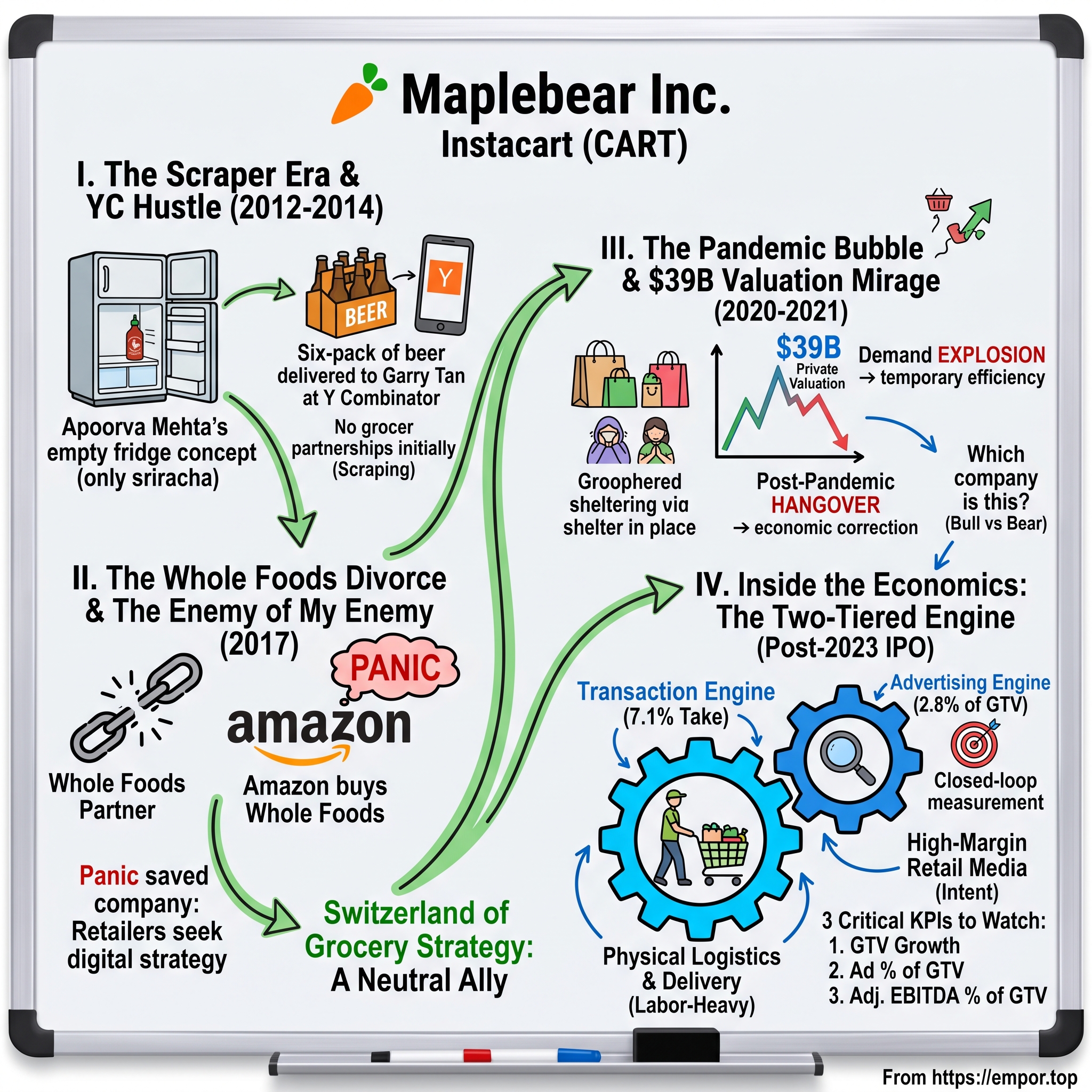
The refrigerator in question sat in a San Francisco apartment in the summer of 2012, and according to the story Apoorva Mehta has told many times since, it contained a bottle of sriracha and not much else. Mehta had spent two years in Seattle as a supply chain engineer at Amazon, building the unglamorous machinery that moves packages from fulfillment centers to doorsteps. He had then quit, moved to San Francisco, and proceeded to fail — by his own count — at roughly twenty startup ideas in a row. A social network for lawyers. An advertising network for gaming. None of it worked.
What made the twenty-first idea different was that it was the only one Mehta actually knew something about. He had spent his professional life inside the world's most sophisticated logistics company, thinking about the last mile. And he had noticed something odd: the single largest category of American consumer spending — groceries — had been essentially untouched by e-commerce. Books had gone online. Electronics had gone online. Milk had not. Every previous attempt to fix that, most famously Webvan, had died trying to build warehouses and truck fleets from scratch, burning through hundreds of millions of dollars of infrastructure capital before the demand ever showed up.
Mehta's insight was to invert the model. Don't build warehouses — America already has 40,000 of them, and they're called supermarkets. Don't buy trucks — every gig worker already owns a car. The physical infrastructure of grocery distribution already existed, fully built and fully paid for. What was missing was the software layer sitting on top of it. Instacart would be, in effect, an asset-light overlay on somebody else's capital expenditure.
He built the first version in about three weeks. Then came the problem of money, and the now-canonical piece of Silicon Valley folklore. Mehta had missed Y Combinator's Summer 2012 application deadline by more than two months. He worked his network, got introductions, and received polite variations on "no." Y Combinator partner Garry Tan told him plainly: "You could submit a late application, but it will be nearly impossible to get you in now."4
Mehta heard the word "nearly." He opened his own app, placed an order for a single six-pack of beer, and had it delivered to Tan at Y Combinator's headquarters. Tan called within thirty minutes. A meeting with four partners followed, and then an acceptance — with the partners acknowledging the precedent they were setting: "We haven't let anyone in this late. Ever."4
It is a fantastic story, and it is worth pausing on why it worked, because the reason is not "audacity." Mehta didn't send a pitch deck. He sent a demonstration that the product existed and functioned — that an order placed in an app resulted in beer arriving at a door. In a category littered with the corpses of companies that had raised money on decks, shipping working software was itself the argument. That instinct — build the thing, then show it — recurs throughout the company's history.
The vampire model
What Mehta built next was structurally brilliant and ethically ambiguous in roughly equal measure. Instacart in its earliest form had no relationships with grocers at all. None. It scraped retailer websites for product catalogs and prices, displayed those items in its own app at a markup, dispatched independent contractors to walk into physical stores as ordinary customers, buy the goods with a company-issued payment card, and deliver them. The company captured the spread between the shelf price and the app price, plus fees.
From a startup-mechanics standpoint this was elegant. Instacart needed no partnership negotiations, no integration engineering, no legal agreements — it could launch in a new city the moment it recruited enough shoppers. Growth was gated only by demand and driver supply. The company could move at software speed through an industry that moved at supermarket speed.
From the grocers' perspective, it looked like parasitism. Consider what was actually happening from the point of view of a regional supermarket chain. A third party was displaying your prices — often inaccurately — attaching a markup you had no say in, and then blaming you when a customer received bruised avocados or the wrong brand of yogurt. That third party was building a direct relationship with your customer, and accumulating a purchase-history dataset on that customer that you would never see. If a shopper switched from your store to a competitor on the Instacart app next week, you would have no idea it had happened and no way to win them back. Meanwhile, the physical shoppers Instacart sent into your aisles were clearing your shelves during peak hours, competing with your actual walk-in traffic for the last of the ripe bananas.
The grocery industry is not a high-margin business. American supermarkets typically run net margins in the low single digits. Retailers in that position guard two things with unusual ferocity: their price image and their customer data. Instacart was compromising both, without permission and without paying for the privilege.
The fork in the road
By 2014, Instacart's leadership had reached a strategic decision point with no comfortable option. Path one: keep scraping, keep growing fast, and accept that the company was on a collision course with cease-and-desist letters, technical blocking, and litigation from an industry with deep pockets and long memories. Path two: give up the unilateral speed advantage, walk into retailers' offices, and try to convince them that Instacart was an ally.
Instacart chose the second path, and the choice defined the next decade. The first marquee partnership came with Whole Foods Market in 2014 — a relationship that deepened in 2016 into a five-year delivery agreement giving Instacart exclusive rights to deliver Whole Foods' perishable items.5
The template that emerged from those negotiations is the single most important structural fact about this business. Instead of positioning itself as an intermediary that owned the customer, Instacart offered to be plumbing: the grocer's catalog, the grocer's brand, the grocer's prices, with Instacart supplying the software and the labor and taking a fee. It was a fundamentally lower-margin, less glamorous, less "platform-like" position than the scraper model. It also happened to be the only position that a grocery industry with the power to block the company would tolerate.
That pivot — from extraction to enablement — is the thing to file away, because three years later, an event that looked like it would destroy Instacart instead proved the pivot was the smartest decision the company ever made.
III. The Whole Foods Divorce & The Enemy of My Enemy
Friday, June 16, 2017. Amazon announced it was acquiring Whole Foods Market for $13.7 billion.5
For Instacart, the news landed like a structural failure. Whole Foods was the company's flagship partner — the retailer that had validated the enablement model, the brand that made Instacart credible in every subsequent sales meeting. The five-year exclusive perishables agreement, signed the previous year, still had roughly four years left on it, but the counterparty was now owned by the one company on earth that most wanted Instacart dead.5 Amazon had capital, logistics infrastructure that made Instacart's look like a lemonade stand, a Prime membership base numbering in the hundreds of millions, and now, physical stores in the wealthiest zip codes in America.
Silicon Valley's verdict was swift and near-unanimous. Instacart was a dead company walking. It had built a business on partnering with retailers, and the most fearsome retailer in history had just bought its best partner and declared its intention to take the rest.
The verdict was wrong, and the reason it was wrong is one of the great strategic reversals in modern business.
The panic that saved the company
Amazon's announcement did not just threaten Instacart. It terrified every grocery executive in North America. Kroger's stock fell. Supervalu's fell. The entire sector repriced in an afternoon, because the market instantly understood the implication: Amazon was no longer an online bookstore dabbling in fresh food. It now owned four hundred-plus physical stores, a national brand in premium grocery, and the willingness to lose money on delivery for as long as it took.
Every chief executive of every traditional supermarket chain in America woke up on the following Monday with the same question on their desk: what is our digital strategy? And for the overwhelming majority of them, the honest answer was that they did not have one.
Consider what building one would have required. A grocery chain would need to construct real-time inventory integration across hundreds of stores, so the app knows whether store #412 actually has the 2% milk right now. It would need to build a consumer-facing app that people would actually download and use. It would need to recruit, background-check, train, insure, and manage a fleet of independent contractors across dozens of metropolitan areas. It would need to build routing and batching algorithms so a single worker can profitably shop two or three orders on one trip. It would need payments infrastructure, fraud detection, customer support for the wrong-item problem, and a substitution engine smart enough to know that a shopper who ordered organic whole milk would rather have organic 2% than conventional whole.
That is not a project. That is a multi-year, multi-hundred-million-dollar technology company, sitting inside a business that earns two or three cents on the dollar and whose core competency is negotiating with produce suppliers. A regional chain with $8 billion in revenue simply could not do it. Even a national chain would need years — years it did not have, because Amazon was moving now.
And there, holding the only pre-built solution in the market, stood Instacart.
The Switzerland play
What followed was the defining commercial land grab of Instacart's history. The pitch essentially wrote itself: we are not your competitor, we are your armory. Your brand, your prices, your customer, our technology and our labor. We will never open a store. We will never launch a private-label cereal. Our entire business model depends on your survival.
This was the "Switzerland of grocery" strategy, and its power lay in a piece of game theory rather than a piece of technology. Instacart's credible neutrality — the fact that it had structurally foreclosed the option of becoming a retailer itself — was precisely what made rival chains willing to plug the same vendor into their systems. Kroger and Albertsons and Publix and Costco would never have agreed to share a technology platform owned by a company that might one day compete with them. They would share one owned by a company whose only enemy was their enemy.
The retailer roster expanded relentlessly through the late 2010s: Kroger, Albertsons, Publix, Costco, Aldi, Sprouts, Wegmans, and hundreds of regional and independent banners. By the time of the IPO prospectus, Instacart could claim more than 1,400 retail banners on the platform.7 By the end of 2025, that number exceeded 2,200 banners, representing nearly 100,000 individual stores.3 The company's own framing is that it reaches over 98% of North American households.3
There is an important caveat, and it is the one every serious analyst of this business returns to. Breadth of coverage is not the same thing as balance of power. That same 10-K discloses that Instacart's top three retailers accounted for approximately 43% of GTV for the year ended December 31, 2025 — a concentration essentially unchanged from 2023, when it was also about 43%, and only marginally different from 2024's 42%.3 Nine years of adding retail banners has moved that number almost not at all.
So the honest reading of the post-2017 land grab is dual-edged. Instacart genuinely converted an existential threat into the largest commercial opportunity in its history, and it did so by correctly diagnosing that its own weakness — neutrality, low margins, no ownership of the end relationship — was the exact property its customers required. That is real strategic insight, not luck. But it also built a business in which a small handful of counterparties, each far larger than Instacart itself, control nearly half the volume. That structure would be tested in the years ahead, and it remains the single most important thing a long-term owner of this business has to think about.
Before that test came, though, came something nobody modeled: a global pandemic that made grocery delivery an emergency public service.
IV. The Pandemic Bubble & The $39B Valuation Mirage
In March 2020, the demand curve for grocery delivery did not shift. It exploded.
Within days of American cities issuing stay-at-home orders, Instacart went from a convenience service used mostly by affluent, time-constrained households to something closer to critical infrastructure. Delivery slots that had been available on demand were booked out for a week. The company's shoppers — independent contractors with no health benefits and no hazard pay — were suddenly described in the press as essential workers, walking into crowded supermarkets during an airborne pandemic on behalf of customers who would not.
The scaling problem was brutal and immediate. Demand was not the constraint; supply of labor was. Instacart onboarded shoppers at a pace that would have been unthinkable in any normal year, and even so, the bottleneck persisted for months. Order volumes and gross transaction value rose several-fold. Grocers who had spent two years slow-walking Instacart integrations were now calling the company asking to be onboarded in weeks.
The mirage in the unit economics
Here is where the story gets analytically interesting, because the pandemic did not just increase Instacart's volume. It temporarily and dramatically improved its unit economics — in ways that looked structural and turned out to be circumstantial.
Three things happened at once. First, basket sizes ballooned. A household stocking up for two weeks of isolation places a much larger order than one topping up on Tuesday night. Because a meaningful chunk of Instacart's transaction take is proportional to basket value while the cost of fulfilling an order is closer to fixed — the shopper's time and drive are roughly the same whether the basket is $60 or $220 — bigger baskets flowed almost directly to contribution margin.
Second, order density spiked. When everyone in a neighborhood is ordering groceries simultaneously, the routing algorithm can batch multiple orders into a single store trip and a single delivery route. Batching is the closest thing this business has to a genuine scale economy: two orders shopped on one trip cost dramatically less per order than two separate trips. Density made batching easy.
Third, marketing spend collapsed to near-irrelevance. Customer acquisition cost, normally one of the largest line items in a consumer platform, essentially went to zero because customers were arriving unbidden and desperate.
Put those together and, for several quarters, Instacart looked like a company that had cracked the code on profitable grocery delivery — the problem that had killed Webvan and every successor. The private markets responded exactly as you would expect. After raising a total of $525 million across three rounds during 2020 alone, the company raised another $265 million in March 2021 at a valuation of $39 billion, more than double the $17.7 billion mark it had carried the previous October. Andreessen Horowitz, Sequoia Capital, and D1 Capital Partners led. The stated plan was to grow corporate headcount by roughly 50% during 2021.6
Then-CFO Nick Giovanni articulated the thesis that justified the price: the company expected the shift in shopping behavior "to be a new normal."6
The hangover
It was not the new normal. It was a spike.
As vaccines rolled out and the physical world reopened through 2021 and 2022, every one of the three tailwinds reversed. Households returned to stores, and order frequency on the platform slowed. Basket sizes contracted as stock-up behavior gave way to routine top-up shopping — the same fixed cost of fulfillment now spread across less merchandise value. Delivery density thinned, making batching harder. And customer acquisition costs went from zero back to expensive, because the company now had to convince people to order groceries online rather than simply catch them.
Simultaneously, the cost side deteriorated. Post-pandemic labor markets tightened sharply; gig platforms had to raise effective pay to keep shoppers on the road. Fuel prices spiked. General inflation raised the nominal cost of everything the company touched.
The $39 billion valuation had capitalized peak-cycle economics as though they were structural. The private market's correction was swift and, for the venture funds that marked their books to public comparables, humiliating. Mutual fund holders including Fidelity and T. Rowe Price repeatedly wrote down their Instacart positions across 2022. The company itself cut its internal valuation multiple times before going public.7
The lesson here is not subtle, but it is worth stating precisely because investors keep relearning it. A demand shock that improves margins because of temporary density and temporary basket inflation is not the same thing as operating leverage. Genuine operating leverage persists when volumes normalize; cyclical margin expansion evaporates. The market's error in 2021 was not overestimating grocery delivery's long-run size — online grocery has, in fact, continued to grow, exceeding 19% of total US grocery spending by the first quarter of 2026.19 The error was assigning software multiples to a business whose core economics remained those of a labor-intensive service.
That distinction — between the business that moves the groceries and the business that monetizes the attention — is exactly what the next chapter of the company would be built around. But first, it had to face the public markets and tell them the truth about itself.
V. The S-1 Reality Check, The Mehta Exit, & The Executive Relay
Going public forces a company to say out loud what it actually is. For Instacart, the S-1 was less a marketing document than a confession, and the price it accepted reflected it.
On September 21, 2023, Maplebear Inc. completed its initial public offering, issuing and selling 14,100,000 shares at $30.00 per share and receiving net proceeds of $392 million after underwriting discounts and offering costs.3 Including selling shareholders, the offering raised roughly $660 million in total and valued the company at approximately $9.9 billion on a fully diluted basis.7 Shares opened at $42 in a burst of enthusiasm, then closed the first day at $33.70.7
Read that pricing carefully. Management and its bankers deliberately accepted a valuation roughly 75% below the private peak. The tell that this was a considered choice rather than a distressed one: the business being sold was substantially better than the one that had commanded $39 billion. The prospectus showed a company that had turned genuinely profitable, reporting $242 million of net income in the first half of 2023 against a $74 million loss in the same period of 2022.7 Instacart went public more profitable and less valuable than it had been two years earlier — a near-perfect illustration of how much of a private mark can be multiple rather than performance.
The prospectus also disclosed, without euphemism, the concentration problem: top three retailers at approximately 43% of GTV.7 Companies do not volunteer that fact. Risk-factor disclosure obligations extract it. But there is a difference between a company that buries a concentration disclosure and one whose entire pitch depends on the market accepting it, and Instacart chose the latter.
The founder walks
Apoorva Mehta did not stay for the second act. He had stepped down as chief executive in 2021, moved to executive chairman, and left the board entirely at the IPO. As of the 2026 proxy statement, he appears in the company's filings only as a passive holder: 22,280,677 shares, roughly 9% of the company — no longer an officer, no longer a director.10 He has since gone on to found and lead a health technology venture; his specific post-Instacart financial arrangements beyond the disclosed stake are not disclosed in company filings.
Founder departures at IPO are usually read as a negative signal. In this case the more defensible reading is that Mehta's particular gifts — the audacity to scrape a competitor's website, the improvisational hustle that turns a six-pack into an accelerator slot — are enormously valuable in a company's first five years and progressively less relevant in a company that must negotiate multi-year enterprise contracts with Fortune 100 retailers. The skills that build a company are frequently not the skills that operate one.
The Simo playbook
The person who took the chief executive's chair in August 2021 was Fidji Simo, and her hiring was one of the more revealing decisions in the company's history. Simo had spent roughly a decade at Facebook and had run the Facebook app itself — the flagship product, the one with billions of users. Crucially, she was not a logistics executive. She was a product and monetization executive who had spent her career figuring out how to place advertising inside a consumer surface without destroying the consumer experience.
Hiring her was a statement about what management believed the company was. Simo's diagnosis was that Instacart could not win by being the best delivery service, because delivery is a commodity and commodities compete on price. What it could win at was being the technology layer for the entire grocery industry — an enterprise software business with a media network attached, where the delivery marketplace served as the demand-generation engine rather than the profit engine.
Under her tenure the company aggressively scaled Instacart Ads into a business that would cross a billion dollars of annual revenue, and assembled the enterprise and in-store technology stack that management now calls Instacart Enterprise and Connected Stores. Whether that repositioning ultimately produces software-like returns is still an open question — we will interrogate the evidence in the sections that follow — but as a diagnosis of where a low-margin intermediary could find durable profit, it was a coherent thesis, executed consistently over four years.
The 2025 relay
Then, on May 7, 2025, Simo notified the board of her intention to resign as chief executive "to pursue another opportunity."26 The opportunity was OpenAI, where she joined as Chief Executive Officer of Applications, reporting directly to Sam Altman.8
The board moved with unusual speed and, notably, internally. On May 26, 2025, it appointed Chris Rogers as chief executive, effective August 15, 2025, and added him to the board as a Class II director.9 Simo remained as board chair for a transition period, then informed the company on November 21, 2025 of her decision to step off the board entirely; three days later the board appointed Rogers as chairperson.27
Rogers is a different animal from either of his predecessors. He is not a founder and not a Silicon Valley product executive. He joined Instacart in July 2019 as Vice President, Global Retail, and became Chief Business Officer in September 2022.9 (The frequently repeated claim that he joined as CBO in 2019 is incorrect — he spent three years running retail partnerships first.) Before Instacart he spent nearly eleven years at Apple, most recently as Managing Director of Apple Canada, and began his career at Procter & Gamble.9 He now carries the title of Chief Executive Officer and Chairperson.30
What that résumé describes is a commercial negotiator: someone whose formative professional experience was selling into and managing large retail and consumer-goods relationships. Given that Instacart's central strategic problem is the balance of power with a handful of enormous retail counterparties, promoting the person who spent six years managing exactly those relationships is a logical choice. It is also, unavoidably, a choice that signals consolidation rather than reinvention.
Emily Reuter serves as chief financial officer. Contrary to a common misdating, her appointment came in May 2024, not 2025: Nick Giovanni resigned effective immediately after the Q1 2024 10-Q filing, and the company appointed Reuter — then VP of Finance, and previously a senior finance executive at Uber where she led investor relations and the IPO — the same day.28
Incentives: read the proxy, not the press release
Executive alignment at Instacart is worth examining carefully, because the widely circulated version of it is wrong.
Rogers' 2025 compensation totaled $29,847,540, of which $28,432,183 was stock awards — salary was $742,046, with a $367,749 bonus and $267,804 of non-equity incentive.10 So the headline framing is accurate as far as it goes: roughly 95% of his pay was equity. His CEO package terms set base salary at CAD $1,370,000 per year, granted a promotion RSU award of approximately USD $15 million vesting over roughly two years, and made him eligible for a further approximately USD $15 million annual refresh award in 2026.9
But equity-heavy pay is not the same as equity-heavy ownership, and here the proxy tells a more sobering story. As of the 2026 proxy's beneficial ownership date, Rogers held 87,063 shares — less than 1% of the company.10 At the mid-2026 share price that is worth roughly $4 million, not the $45 million figure that circulates in secondary summaries. For context, the same table shows Simo at 546,148 shares and Reuter at 158,399.10 The CEO pay ratio disclosed for 2025 used annualized compensation of $16,450,644 against a median employee figure of $227,439 — a ratio of about 72 to 1.10
The fair conclusion is that Rogers' incremental incentive is powerfully tied to the stock through unvested RSUs, but his accumulated stake is modest relative to his annual pay. That is normal for a recently promoted internal executive. It is also a reason not to overstate the "skin in the game" narrative. Meanwhile, ownership remains concentrated among early backers — Sequoia at roughly 12% and D1 Capital at roughly 11% as of the 2026 proxy, alongside Mehta's 9% — which the 10-K itself flags as a governance consideration, noting that officers, directors, and principal stockholders acting together retain the ability to significantly influence matters put to stockholders.310
On capital allocation, the record under the new regime is unambiguous and, so far, consistent with what management said it would do. In fiscal 2025 the company repurchased $1,386 million of stock — roughly $1.4 billion — including $1.1 billion in the fourth quarter alone, and reduced shares outstanding from 264,642,275 a year earlier to 240,615,063 as of February 2026.11 That is a genuine, measurable share count reduction of roughly 9% in a single year, not the cosmetic buyback that merely offsets stock compensation. The count kept falling through the first half of 2026, reaching 235,029,814 shares outstanding as of April 30, 2026.29 The company also announced a $1 billion increase to its repurchase authorization alongside Q1 2026 results, and established a $500 million unsecured revolving credit facility.121
An activist would push on the other side of that ledger. Buying back nearly $1.4 billion of stock while simultaneously acquiring companies (Wynshop in 2025, Instaleap in 2026) and telling investors the business needs reinvestment to accelerate growth is a set of statements in mild tension with each other. Reuter's own framing on the Q1 call — that fundamentals "give us the flexibility to reinvest to further accelerate growth, pursue strategic M&A, and opportunistically return capital" — is doing a lot of work with the word "and."1 The honest test is not whether management can articulate all three; it is whether GTV growth actually accelerates from here, or whether the buyback turns out to have been the primary driver of per-share results.
To evaluate that, you have to open up the engine.
VI. Inside the Economics: The Two-Tiered Engine
Imagine watching a single Instacart order from above.
A customer in a suburb taps through an app and assembles a basket: milk, chicken breasts, a bag of apples, tortilla chips, laundry detergent, a bottle of wine. Call it $113 — which happens to be the average order value on the platform in the first quarter of 2026.1 A gig shopper accepts the batch, drives to a partner supermarket, and walks the aisles with a phone that directs them item by item in an optimized route. When the requested brand of detergent is out, the app suggests a substitute and the customer approves it from their couch. The shopper pays with a company card, loads the car, drives to the house, drops the bags at the door. Perhaps forty-five minutes to an hour and a half of human labor and a few miles of driving.
Now watch the money.
The transaction engine
Of that $113 basket, Instacart's transaction revenue capture was about 7.1 cents on the dollar in the first quarter of 2026 — $733 million on $10,288 million of GTV.1 That take rate comes from several sources: delivery fees, service fees, the pricing spread or revenue share negotiated with the retailer, and Instacart+ membership fees.
Against that sits the cost of actually doing it: payments to shoppers, insurance for those shoppers, payment processing fees on the full basket value (which is a genuinely painful line — the card networks charge on the entire $113, while Instacart only keeps $8 of it), customer support, and the cost of making customers whole when the avocados arrive bruised.
The residue, after those costs, is what shows up as gross profit. In the first quarter of 2026 total GAAP gross profit was $738 million — 7.2% of GTV and 72% of revenue.1 And here is the detail worth noticing: that 7.2% figure was down from 7.4% a year earlier.1 Transaction revenue as a percentage of GTV was flat year over year, which Reuter attributed to fulfillment efficiencies being "largely offset by lower payment revenue," while gross margin as a share of GTV declined because payments to publishers scaled with the expansion of Carrot Ads and off-platform partnerships.12
Translate that into plain English. Instacart is getting better at the physical act of delivering groceries — the batching and routing improvements are real — but those gains are being consumed elsewhere in the P&L. And a portion of the advertising growth investors most prize is coming through arrangements where Instacart shares revenue with the retailer whose site the ad appears on, which mechanically dilutes the reported margin even as it grows the dollars. That is not a scandal; it is the arithmetic of an enterprise-led strategy. But it means "advertising is high margin" is a claim that needs to be inspected at the incremental level rather than assumed.
The advertising engine
The second engine is the one that changes the character of the entire business.
When a shopper types "chips" into the Instacart search bar, they are not browsing. They are within minutes of a purchase decision, with a credit card already on file and a basket already open. That is the highest-intent moment in consumer marketing, and it is worth vastly more to a snack company than a banner ad on a news site. Frito-Lay does not have to hope you remember the ad next time you're at the store; the store is the app, and the shelf is the search results page.
That is what retail media is: advertising sold at the exact point of purchase, with closed-loop measurement. Instacart can tell PepsiCo not just that an ad was seen, but that it was seen by a household that then bought the product, and whether that household had bought the competing product the previous month. Traditional television and digital display advertising can almost never close that loop.
In fiscal 2025, advertising and other revenue reached $1,065 million — 2.9% of GTV, up 11% year over year.11 In the first quarter of 2026 it grew 16% to $286 million, the fastest advertising growth since the third quarter of 2023.1 The company reported over 310 Carrot Ads partners and over 9,000 brand partners on the platform as of the fourth quarter of 2025.1
Management's long-term target, reaffirmed by Rogers on the Q1 2026 call, is advertising at 4–5% of GTV.12 That is the single most consequential number in the entire bull case, and it deserves scrutiny rather than acceptance. Getting from 2.8% to 4% on a GTV base of roughly $40 billion would add well over a billion dollars of high-margin revenue with modest incremental cost. Getting stuck at 2.8% while GTV growth decelerates leaves you with a low-margin delivery business trading at a software-adjacent multiple.
What would falsify the target? Watch whether the ratio actually moves. Advertising was 2.9% of GTV for full-year 2025 and 2.8% in the seasonally weak first quarter of 2026 — advertising is seasonally high in Q4 and low in Q1 as advertisers deploy budgets.31 So the honest statement is that ad-to-GTV has been roughly flat for several years while both numerator and denominator grew. The mix has improved and the absolute dollars have compounded, but the ratio — the thing that proves margin expansion rather than volume growth — has not yet made a decisive move toward the target.
The symbiosis, and its fragility
The elegant version of the story is that the two engines feed each other: the delivery marketplace acquires and retains high-intent shoppers, the advertising business monetizes them at software margins, and the advertising profits subsidize a delivery service priced too cheaply for a standalone logistics company to match. Volume begets audience; audience begets ad dollars; ad dollars fund the volume.
The fragile version is that this only works if Instacart continues to own the shopping session. Every dollar of GTV that migrates to a retailer's own white-labeled site — which is exactly what Instacart's enterprise strategy encourages — is a dollar where Instacart shares the advertising economics rather than keeping them. And every dollar that migrates to a different consumer app entirely is simply lost.
Seven Powers and Five Forces, honestly applied
Run Hamilton Helmer's framework against this business and three of the seven powers show up with real evidence, while others are conspicuously absent.
Scale economies are present but bounded, and they are local rather than global. The relevant unit is not "Instacart's national scale" but "order density in this zip code this hour." Two orders batched into one store trip cost dramatically less per order than two separate trips. That means Instacart's cost advantage in dense suburbs where it has high share is genuine, and its cost advantage in thin markets is near zero. National scale does not automatically confer local density — which is precisely why a competitor with high density in a specific city can compete profitably there regardless of Instacart's overall size.
Switching costs are the strongest power in the portfolio, and they sit on the retailer side rather than the consumer side. A grocer running Storefront Pro has wired Instacart into its product catalog, real-time inventory feeds, pricing systems, loyalty program, and payment flows. Ripping that out is a multi-quarter engineering project with a high risk of breaking e-commerce during the transition. Instacart's enterprise disclosures give some measure of adoption: more than 380 Storefront e-commerce sites, with 70-plus net-new Storefronts launched in 2025 versus 30-plus in 2024.11 Note the acceleration — that is the most concrete evidence available that the enterprise lock-in thesis is working, not just being asserted.
Cornered resource applies in a narrow but real sense: real-time inventory integration across roughly 100,000 stores is not a dataset anyone can replicate quickly, because it was assembled one retailer negotiation at a time over more than a decade.3 Knowing whether a specific store has a specific SKU on the shelf right now is the hard problem in online grocery, and it is a problem solved by relationships as much as by engineering.
What is conspicuously absent is branding power and network effects in their strong form. Consumer loyalty in delivery is weak — the same household will happily use whichever app has the promotion this week — and the two-sided network here is much shallower than a marketplace like Airbnb, because shoppers are fungible labor rather than differentiated supply.
Porter's five forces are, frankly, unfriendly. Buyer power is high on both sides: retailers are enormous and concentrated, and CPG advertisers can shift budgets to Amazon or Walmart's ad network in an afternoon. Supplier power — gig labor — is rising, driven not by worker bargaining but by legislation. Threat of substitutes is severe, since the substitute is a customer simply driving to the store, which most Americans still do. Rivalry is intense and well-capitalized. Only barriers to entry offer comfort, and that comfort comes from the integration work rather than from capital intensity.
Which is why the company's most interesting strategic bet is not about delivery at all. It is about following the customer into the physical store.
VII. The "Connected Stores" & M&A Playbook
Here is the number that keeps Instacart's strategy team awake: online is still the small part of grocery. Even after six consecutive quarters of e-grocery growth above 20% year over year, online represented just over 19% of total US grocery spending as of the first quarter of 2026.19 Four out of five grocery dollars are still spent by a human being pushing a metal cart through a physical store.
If Instacart is only a company that operates in the online 19%, its addressable market has a hard ceiling and its advertising inventory is capped at whatever screen real estate exists inside a phone. The Connected Stores strategy is the attempt to break that ceiling by pushing the digital shelf out of the app and into the aisle.
Caper: the cart with a screen
On October 19, 2021, Instacart announced the acquisition of Caper AI for $350 million in cash and stock.13 Caper built AI-powered smart shopping carts: a physical cart with cameras and weight sensors that identify items as you drop them in, plus an interactive touchscreen on the handle. No scanning, no checkout line — you pay at the cart and walk out. Caper had already built relationships with Sobeys in Canada, Schnucks, Wakefern, and Auchan, and had piloted a branded version called KroGO with Kroger.13
Was $350 million too much? On conventional metrics, almost certainly. This was a hardware company with minimal revenue, sold at a price that assumed a future that had not yet arrived, paid for in 2021 currency — meaning partly in Instacart stock that was itself wildly overvalued at the time. A disciplined acquirer would have balked.
The strategic logic is more defensible than the price. Consider what a Caper Cart actually is from an advertising perspective. It is a screen, at eye level, in the hands of a customer who is standing in a physical aisle, whose basket contents are known in real time, and whose location within the store is known. It can display a coupon for a competing soda brand at the precise moment the cart rolls into the soda aisle. It can show a running basket total — which, according to Instacart, is one of the features shoppers value most, alongside coupon recommendations.18
More fundamentally, it converts the single largest blind spot in consumer data into measurable inventory. For a century, the physical store has been a black box: retailers knew what was sold at the register but almost nothing about what was considered, picked up, put back, or walked past. The smart cart makes in-store behavior legible in the way that web analytics made online behavior legible in the 1990s. If that works at scale, it is a genuinely new advertising medium rather than a better version of an existing one.
Deployment is scaling but remains early. Instacart tripled its smart cart store count in 2025 versus 2024, with carts operating in more than 100 cities across 15 states and more than a dozen retail banners — including nearly 20% of Wakefern's stores, plus Schnucks, Sprouts, Wegmans, Geissler's, and Good Food Holdings, with international deployments at Coles in Australia and a Morrisons pilot in the UK.1812
Tripling off a small base is still a small base. And there are credible skeptics: retail consultant Chris Walton argued that "the value is still fairly unproven," questioning whether customer-facing technology investments are the right priority versus operational efficiency.18 That is the correct posture. Smart carts are capital equipment that a grocer must buy or lease, in an industry with famously thin margins and a long history of expensive in-store technology fads. The company has not disclosed unit economics for Caper — neither the revenue per cart nor the payback period for the retailer. Until it does, the smart cart thesis rests on deployment counts and anecdote rather than demonstrated returns.
The rest of the shopping list
Caper was one piece of a broader roll-up of grocery software:
FoodStorm, acquired October 7, 2021 for undisclosed terms, was an Australian order-management platform for catering and prepared foods.14 The strategic rationale was sharper than it appears: prepared foods showed up in 21% of Instacart baskets and drove larger baskets and higher frequency, and it is one of the few genuinely high-margin categories in a supermarket.14 Owning the software that runs the deli counter's order flow embeds Instacart in operations, not just e-commerce.
Rosie, acquired September 7, 2022, brought branded e-commerce sites and apps for independent grocers — a segment too small for Instacart's enterprise sales motion to serve profitably one at a time.15
Eversight, also acquired in 2022, added AI-driven pricing and promotion optimization, which now appears in the company's Connected Stores product list alongside Caper Carts, Carrot Tags, FoodStorm, In-Store mode, Out of Stock Insights, and Storefront.3
Wynshop, acquired May 1, 2025 for undisclosed terms, brought enterprise e-commerce technology and relationships with Wakefern, United Supermarkets, and the Independent Grocers Alliance — folded into the Storefront Pro platform.16
Instaleap, announced April 14, 2026, was the most strategically novel of the set. Founded in Colombia in 2019, Instaleap provides fulfillment software to nearly 100 grocery retailers across roughly 30 countries in Latin America, Europe, and the Middle East, including Cencosud, Continente, Jerónimo Martins, Lulu, and SPAR.1712 Terms were not disclosed.
Instaleap matters because it resolves a strategic dead end. Instacart's marketplace has never operated outside North America, and building gig delivery networks country by country would be enormously expensive and would collide with far more aggressive labor regimes in Europe. Instaleap lets the company sell software into international grocers without ever hiring a driver abroad. As Chief Commercial Officer Ryan Hamburger framed it, the opportunity is "to expand internationally through an enterprise-led strategy that empowers retailers."17
From aggregator to vendor
Step back and the pattern across all of this is a single directional shift: from consumer marketplace toward enterprise software vendor. Carrot Storefronts and Storefront Pro charge grocers recurring fees to run their own branded websites, with Instacart providing the technology and, often, the fulfillment labor behind the scenes.
Management cites specific proof points for the value: Storefront Pro delivers "an over 10 percentage point lift in online sales and a more than 5 percentage point lift in 90-day new user retention," per Rogers on the Q1 2026 call, and ALDI relaunched its US website and app nationwide on Storefront Pro with Instacart as exclusive fulfillment partner.121
Treat those lift figures as vendor-supplied. They are not audited, the methodology is not published, and the comparison baseline is not disclosed. What is verifiable and more persuasive is the behavioral evidence: the count of Storefronts grew by 70-plus in 2025 after 30-plus in 2024, and a retailer of ALDI's scale chose to make Instacart its exclusive fulfillment partner across its owned digital properties.111 Large retailers making exclusive multi-year technology commitments is a stronger signal than any lift statistic, because those retailers have every incentive to build in-house if the math favors it.
The catch is the one already flagged: the more successful the enterprise strategy, the more of the economics Instacart shares. Which brings us to the people trying to take those economics away entirely.
VIII. The Competitive Gauntlet & The Risk Radar
Picture the American grocery consumer in the summer of 2026, phone in hand, deciding how to get dinner ingredients. There are now at least four credible apps competing for that tap, and only one of them needs to make money on the delivery.
Walmart: the structural problem
Walmart is the largest grocer in the United States and it does not need Instacart for anything. It has thousands of supercenters positioned within a short drive of most of the American population, meaning it already owns the fulfillment infrastructure Instacart has to rent. It has a membership program in Walmart+ that bundles delivery into a broader value proposition. And critically, it does not mark up grocery prices for delivery — because for Walmart, delivery is a customer retention tool for a $600 billion retail business, not a profit center that must stand on its own.
The results are visible in the market data. As of the first quarter of 2026, Walmart was approaching a 40% share of total US e-grocery sales, having gained share faster than Amazon, propelled specifically by delivery — and particularly by ultra-fast orders fulfilled in an hour or less, which represented 18% of all delivery orders in the quarter.19
That is the single most uncomfortable fact in this entire story. The fastest-growing segment of online grocery is being won by a vertically integrated competitor that can price delivery at or below cost indefinitely, and against whom Instacart's structural answer — "we are neutral, we serve everyone else" — is by definition unavailable.
Instacart's response has been to attack the price problem directly by convincing retail partners to move to price parity, meaning items on Instacart cost the same as in-store. Hy-Vee and Raley's moved to parity in the first quarter of 2026, with Fareway and several local independents following, and Rogers has stated that retailers at parity grow faster on the platform.112 The logic is sound: markup was always the least defensible part of the consumer proposition. But parity also, mechanically, reduces the transaction take on those baskets. It is margin traded for volume, and the bet is that the volume compounds into more advertising inventory.
DoorDash and Uber Eats: the frequency attack
The aggregators come at Instacart from a different and arguably more dangerous angle.
DoorDash and Uber Eats built their businesses on restaurant delivery, a category with far higher purchase frequency than grocery. A household might order groceries online twice a month; it might order restaurant food twice a week. That frequency advantage translates into a lower customer acquisition cost, a more habitual app, and a subscription — DashPass, Uber One — that a consumer is already paying for. Adding groceries to an app you open eight times a month is much easier than convincing someone to download a new one.
Both have pushed hard into the category. Grocery and retail now account for roughly a fifth of both platforms' delivery volume. DoorDash announced an agreement to acquire Deliveroo on May 6, 2025 at 180 pence per share — approximately £2.9 billion, a 44% premium — creating a platform spanning 40-plus countries and roughly 50 million monthly active users.20 It has since been consolidating its global advertising inventory across DoorDash, Wolt, and Deliveroo into a single commerce media platform.
That last point is where the competitive threat bites hardest. Instacart's advertising business competes for the same CPG budgets as DoorDash's, Uber's, Amazon's, and Walmart's — and the 10-K enumerates the field explicitly: third-party monetization platforms like CitrusAd, Criteo, Moloco, and Quotient; first-party retailer networks operated by Amazon, Kroger, Target, and Walmart, several of which are simultaneously Instacart partners; and DoorDash and Uber Eats.3 Retail media is not a category Instacart invented and does not dominate. It is a crowded auction in which Instacart's differentiation is the specificity of its grocery purchase data.
Concentration: correcting the record
The partner concentration risk is real, and the figure is the roughly 43% of GTV from the top three retailers already discussed.3 If any one of those relationships were renegotiated on materially worse terms or brought in-house, the effect on transaction margins would be immediate and severe.
But one widely repeated version of this risk needs correcting. There is no pending Kroger–Albertsons merger as of July 2026. A federal court in Oregon issued a preliminary injunction on December 10, 2024, and a Washington state court issued a permanent injunction the same day; Albertsons terminated the merger agreement that day and sued Kroger in Delaware Chancery Court for willful breach, seeking damages plus the $600 million termination fee, with Kroger filing counterclaims in March 2025.23 What remains is not a merger but litigation — trial is scheduled to begin October 19, 2026.23
That matters analytically in both directions. The specific catastrophe scenario of a merged mega-grocer dictating terms to Instacart is off the table for now. But the underlying dynamic did not disappear: each of these retailers remains individually enormous relative to Instacart, and each is separately building its own retail media capability. Kroger, in fact, appears in Instacart's own 10-K as a competitor in advertising while remaining a partner in fulfillment.3 Frenemy is not too strong a word.
Labor and regulation: the cost floor rises
The gig labor question is the risk most likely to compress margins on a recurring basis, because it operates through legislation rather than markets.
The classification battle itself has gone reasonably well for the industry. California's Proposition 22, effective December 2020, preserved independent contractor status while requiring minimum earnings guarantees and healthcare subsidies, and the California Supreme Court upheld it as constitutional on July 25, 2024. Instacart's own filings acknowledge that Prop 22 compliance has increased costs in California and that those costs are expected to remain elevated.3 Numerous classification suits remain outstanding, with thousands of alleged individual claims in arbitration, but per the FY2025 10-K, no putative class or collective action has reached class certification.3
The more immediate pressure is municipal minimum-pay legislation. New York City extended its delivery-worker minimum pay rate to third-party grocery delivery workers under Local Laws 123 and 124, taking effect January 26, 2026 at $21.44 per hour excluding tips, rising to $22.13 on April 1, 2026.24 Instacart sued the city's Department of Consumer and Worker Protection in federal court on December 3, 2025 challenging the laws on preemption and constitutional grounds; on January 23, 2026 the judge denied Instacart's request for a preliminary injunction.25
The mechanism to understand is this: a legislated hourly wage floor for independent contractors converts a variable cost into something closer to a fixed one. Instacart's model depends on paying per batch, which lets the algorithm optimize toward density. A per-hour floor breaks that optimization in the affected market and forces the company to pass costs through as explicit regulatory fees — which raises the consumer price and suppresses order volume, or absorb them and compress margin. Neither outcome is good, and the policy is spreading city by city rather than resolving.
The FTC settlement: a disclosure problem, not a labor problem
The most damaging recent event to the company's credibility was not about workers at all. It was about how the company described its own prices to customers.
On December 18, 2025, the Federal Trade Commission announced that Instacart would pay $60 million in consumer refunds to settle a lawsuit alleging deceptive practices.21 The complaint, filed in the Northern District of California, made three allegations: that Instacart advertised "free delivery" on first orders while charging mandatory service fees adding 7.5% to 15% to the order cost, disclosed only at checkout; that it advertised a "100% satisfaction guarantee" while issuing credits instead of refunds and burying the refund option in a self-service menu; and that it failed to clearly disclose Instacart+ free-trial auto-enrollment terms, charging "hundreds of thousands of consumers" without express informed consent.22 The Commission vote was 2-0.21
Per the FY2025 10-K, FTC staff asserted consent-negotiation authority in July 2025, the consent order became final on January 13, 2026, the settlement involved no admission of liability, the $60 million was accrued at December 31, 2025, and paid in January 2026.3 The accounting impact was concentrated and visible: fourth-quarter 2025 GAAP net income fell 46% year over year to $81 million, driven by higher general and administrative expense from non-recurring legal and regulatory matters including the FTC settlement.11 The cash impact showed up the following quarter, contributing to the 10% year-over-year decline in operating and free cash flow in Q1 2026.12
Note precisely what this was and was not. It was not, as sometimes described, primarily about shopper tipping or gig pay disclosures — the FTC's allegations were about consumer-facing fee, refund, and subscription disclosures.22 That distinction matters, because it locates the problem in the company's consumer monetization practices rather than its labor practices. The three alleged behaviors — hidden mandatory fees, a guarantee that quietly delivered credits instead of cash, and free trials that converted without clear consent — are the classic playbook of a company under pressure to improve unit economics without raising headline prices.
For a company whose entire competitive position now rests on convincing retailers to entrust their customer relationships to it, that is a reputational liability with real commercial consequences, not just a $60 million line item. It also sits awkwardly beside the price-parity initiative: the company is now asking consumers to believe that Instacart pricing is transparent and matches in-store, roughly one year after settling federal charges that its pricing disclosures were deceptive. The parity push may well be a genuine strategic conviction. It is also, conveniently, the strongest possible answer to the FTC's critique.
AI: threat and opportunity in the same product
One final item on the risk radar, and it is the one analysts pressed hardest on the most recent call.
Instacart has integrated with both ChatGPT and, as of the first quarter of 2026, Anthropic's Claude, letting users build grocery carts inside an AI assistant.1 It is also building its own Cart Assistant, a conversational shopping experience in test with roughly 25% of US customers.12
On the Q1 call, Wolfe Research's Shweta Khajuria asked the obvious question: if an AI agent is choosing between Instacart, DoorDash, and Uber Eats on the consumer's behalf, doesn't that risk disintermediating Instacart's organic traffic entirely? Rogers did not quantify the risk. He framed the AI platforms as "an incremental demand channel in a very large, underpenetrated category," emphasized "maintaining control of the experience and our data," and said Instacart surfaces data "in a very controlled way to minimize any disintermediation risk."12
That answer is strategically coherent and analytically unsatisfying, and it is worth being blunt about why. If consumers begin their grocery journey inside a general-purpose AI assistant rather than in a branded app, the value of owning the consumer interface — which is where Instacart's advertising inventory lives — declines. An agent does not look at sponsored search results. Instacart would be relegated to being a fulfillment API, which is a commodity. Management's counter-position is essentially that its enterprise and data assets, not its app, are the durable moat — which is consistent with everything else the company has been doing since 2021, but which has not yet been tested by an actual shift in consumer behavior.
Separately, KeyBanc's Justin Patterson asked about guardrails on AI and token costs. Reuter declined to forecast, calling it "something that's evolving real time" and "something we're monitoring and adapting to really quarter-by-quarter."12 Honest, but a reminder that the cost side of the AI push is currently unmodelable.
Management also declined, when pressed by Bernstein's Nikhil Devnani, to break out enterprise economics separately from marketplace, with Rogers saying they view enterprise "less as a stand-alone line item" and Reuter stating "we don't break out the specifics of economics."12 For investors trying to determine whether the enterprise pivot is actually margin-accretive, that disclosure gap is material. It is the most legitimate thing an activist could push on: a company whose entire narrative is a transition from low-margin logistics to high-margin software declines to show the margin structure of the software.
IX. Playbook: Business & Investing Lessons
Strip away the specifics and this story yields four transferable lessons — three about strategy and one about people.
The Switzerland strategy: neutrality is a product. When a dominant platform threatens an entire industry, the incumbents' collective need for a counterweight becomes the single largest business opportunity in the sector. But the opportunity is only capturable by a company that can make its neutrality credible — which usually means voluntarily and permanently foreclosing the option of competing with its own customers. Instacart could never open a supermarket or launch a private label. That constraint, which looks like weakness on a strategy slide, is exactly what allowed direct rivals to run the same vendor. The lesson generalizes: in industries facing platform disruption, the arms dealer position is often more durable than the combatant position, but only if the arms dealer permanently gives up the option to pick a side.
Subsidized logistics: use the low-margin business to build an audience, then monetize the audience. Delivery, standing alone, is a structurally poor business. Labor is the dominant cost and does not deflate with scale the way compute does. Density gains cap out. Competitors with vertically integrated fulfillment can price below your cost indefinitely. The value is not in the delivery; it is in the purchase intent that delivery generates, which can be sold to brands at margins delivery will never earn. Retail media networks — Amazon's, Walmart's, Instacart's — are the clearest recent example of a general pattern: the profitable layer is frequently not the layer that does the visible work. The corollary is a warning, though. This model only holds while the logistics business retains the customer relationship. The moment someone else owns the interface — a rival app, a retailer's own site, an AI agent — the subsidy runs one direction with nothing coming back.
Switching costs beat brand in commodity services. Consumer loyalty in delivery is close to nonexistent; households will switch apps for a $10 promotion and switch back the following week. What is genuinely sticky is a retailer's engineering integration — catalog feeds, inventory APIs, loyalty systems, payment flows, in-store hardware. Those take quarters to rip out and carry real operational risk during migration. An investor evaluating any consumer-facing platform should ask which side of the market the lock-in actually lives on, and be suspicious when a company points to consumer brand affection as its moat.
Incentive realism: match the leader to the era, not to the myth. The relay from Mehta to Simo to Rogers is a reasonably clean illustration of leadership matched to problem. A founder-hustler was the right person to invent the category and talk his way into an accelerator. A product-and-monetization executive from a company that had solved advertising at planetary scale was the right person to diagnose that the future was media and enterprise software rather than logistics. A career commercial negotiator with a decade at Apple and six years running Instacart's retail relationships is a defensible choice for an era in which the central question is the balance of power with a handful of very large partners.
That said, resist the temptation to read the sequence as a triumph of governance design. Simo left mid-stride for a more exciting job at OpenAI; the board reacted rather than executed a plan. And the incoming chief executive holds an accumulated stake of 87,063 shares against a $29.8 million pay package — heavily equity-weighted going forward, but modestly owned today.10 "Highly aligned" is a claim that should be checked against the ownership table, not the compensation table.
Those four lessons all converge on the same question: has the transition from logistics company to technology company actually happened, or is it still a narrative? The answer lives in a small number of numbers.
X. Epilogue & The 3 Critical KPIs to Watch
Stand in the middle of a ShopRite in New Jersey in the summer of 2026 and you can see both halves of this company at once. Near the entrance, a rack of Caper Carts with screens on the handles, waiting. In the back, a staging area where gig shoppers assemble orders for delivery. On the shelf edges, digital Carrot Tags. In the aisles, ordinary customers who have never used the app and never will. Instacart is trying to be present in all of it.
The state of play in mid-2026 is a company that has genuinely earned its way back. Nine consecutive quarters of double-digit GTV growth, a first-ever $10 billion quarter, a first-ever $1 billion revenue quarter, expanding adjusted EBITDA, and a share count reduced by roughly 9% in a year.111 Full-year 2025 delivered GTV of $37,224 million, revenue of $3,742 million, GAAP net income of $447 million, and adjusted EBITDA of $1,087 million — the last of those up 23% on 11% revenue growth, which is what operating leverage looks like when it is real.11
The state of play is also a company whose gross profit as a share of GTV declined year over year, whose most important competitor is taking share faster than anyone, whose advertising-to-GTV ratio has been roughly flat while management targets a level nearly twice as high, whose CFO has explicitly warned that "the pace of margin expansion in 2026 [will] moderate versus 2025," and which declines to disclose the segment economics that would let an outsider verify the central claim of its strategy.11912
Both are accurate. Neither settles the argument.
The three numbers that will
One: GTV growth rate. This is the market-share referendum. Instacart competes against Walmart's vertically integrated delivery, DoorDash's and Uber's frequency advantage, and Amazon's logistics. If GTV growth holds in double digits while total US e-grocery grows above 20%, Instacart is losing relative share even while growing — a distinction that matters enormously. If GTV growth decelerates into single digits, the advertising business loses its inventory growth engine and the whole two-engine thesis weakens simultaneously. Watch it against the industry growth rate, not in isolation.
Two: advertising and other revenue as a percentage of GTV. This is the profitability referendum, and it is the cleanest single test of whether the "we are a software company" narrative is true. Management has publicly committed to 4–5% over the long term against roughly 2.8–2.9% today.1211 Every basis point of movement toward that target is high-margin revenue on an existing volume base. Several years of a flat ratio would suggest the ceiling is structural rather than a matter of execution — that CPG budgets, not Instacart's product, set the limit. Adjust for seasonality: Q4 runs high, Q1 runs low.3
Three: adjusted EBITDA as a percentage of GTV. This is the operating-leverage referendum, and it is the right denominator because it measures profit against the total economic activity the platform touches rather than against the fee revenue Instacart happens to book. It reached 2.9% in the first quarter of 2026 and for full-year 2025.111 Sustained expansion would confirm that batching efficiency, ad mix, and cost discipline are compounding. Stagnation or contraction — particularly if it coincides with rising regulatory fee pressure in more cities — would suggest that the labor cost floor is rising as fast as the efficiency gains.
Three numbers. Growth, mix, and leverage. Everything else in the story is commentary.
The final surprise
If there is one underappreciated thing in this business, it may be the least glamorous: a shopping cart with a screen on it.
For a hundred years, the physical retail store has been the largest commercially significant blind spot in the modern economy. Retailers have known what came out of the register and essentially nothing about what happened in the aisles. Every dollar of trade promotion, every shelf-placement negotiation, every end-cap display has been priced on inference and habit rather than measurement.
A cart that knows what you picked up, where you were standing, what you put back, and what you eventually paid for closes that loop — turning the four-fifths of grocery spending that still happens offline into inventory that can be targeted, measured, and sold the way a search result is sold. If that works, the smart cart will have done to physical retail what the tracking pixel did to the web, and the most consequential asset Instacart owns will turn out to be a $350 million hardware acquisition that looked, at the time, like an overpayment made with bubble-era currency.13
If it does not work — if retailers balk at the capital cost, if shoppers ignore the screens, if the advertising dollars never materialize at the promised rate — then Instacart remains what its critics have always said it is: a well-run, disciplined, cash-generative logistics business with a good advertising side hustle, competing against opponents who do not need to make money on the same activity.
The company has been declared dead once and was wrong-footed by its own success once. It has earned the right to have its claims taken seriously. It has not yet earned the right to have them taken on faith.
XI. Outro
The arc of Maplebear Inc. runs from an unauthorized scraper marking up strangers' groceries, through the moment Amazon bought its best customer and accidentally handed it the entire rest of the industry, through a pandemic that inflated it to $39 billion and a reopening that deflated it to a tenth of that, to a public company in mid-2026 that clears more than $10 billion of merchandise a quarter and earns roughly ten cents on each of those dollars.
The through-line is a company that has repeatedly been forced to accept a less glamorous position than it wanted — enablement instead of extraction, plumbing instead of platform, vendor instead of aggregator — and has been rewarded each time for accepting it. Whether that pattern holds through the AI transition, and whether the advertising ratio finally moves toward management's target, are the two open questions that will determine what this business is worth a decade from now.
The evidence to watch is public, quarterly, and specific. The three KPIs above will answer the question faster than any narrative will.
References
-
Instacart Announces First Quarter 2026 Financial Results (Exhibit 99.1 to Form 8-K) — Maplebear Inc. / SEC EDGAR, 2026-05-06 ↩↩↩↩↩↩↩↩↩↩↩↩↩↩↩↩↩↩↩
-
Maplebear Inc. (CART) Stock Price and Statistics — StockAnalysis, 2026-07-20 ↩
-
Annual Report on Form 10-K for the Fiscal Year Ended December 31, 2025 — Maplebear Inc. / SEC EDGAR, 2026-02-26 ↩↩↩↩↩↩↩↩↩↩↩↩↩↩↩
-
Amazon's $13.7 Billion Acquisition of Whole Foods Is a One-Two Punch for Instacart — Fortune, 2017-06-16 ↩↩↩
-
Instacart raises $265M at a $39B valuation — TechCrunch, 2021-03-02 ↩↩↩
-
Instacart makes long-awaited public market debut — Grocery Dive, 2023-09-19 ↩↩↩↩↩↩↩
-
Instacart CEO Fidji Simo is joining OpenAI — TechCrunch, 2025-05-07 ↩
-
Form 8-K reporting appointment of Christopher Rogers as Chief Executive Officer — Maplebear Inc. / SEC EDGAR, 2025-05-28 ↩↩↩↩
-
Definitive Proxy Statement on Schedule 14A — Maplebear Inc. / SEC EDGAR, 2026-04-09 ↩↩↩↩↩↩↩
-
Fourth Quarter and Full Year 2025 Shareholder Letter (Exhibit 99.1 to Form 8-K) — Maplebear Inc. / SEC EDGAR, 2026-02-12 ↩↩↩↩↩↩↩↩↩
-
Instacart (CART) Q1 2026 Earnings Call Transcript — The Motley Fool, 2026-05-07 ↩↩↩↩↩↩↩↩↩↩↩↩↩↩↩
-
Instacart buys smart cart maker Caper AI for $350M — Grocery Dive, 2021-10-19 ↩↩↩
-
Instacart acquires catering software firm FoodStorm — Grocery Dive, 2021-10-07 ↩↩
-
Instacart buys e-commerce tech provider Rosie — Grocery Dive, 2022-09-07 ↩
-
Instacart buys e-commerce solutions provider Wynshop — Grocery Dive, 2025-05-01 ↩
-
Instacart acquires Instaleap to expand its enterprise platform internationally — TechCrunch, 2026-04-14 ↩↩
-
Instacart tripled its smart cart store count this year — Modern Retail, 2025-11-25 ↩↩↩
-
U.S. eGrocery Hyper-Growth Trend Driven by Dueling Fulfillment Innovations — Brick Meets Click, 2026 ↩↩↩↩
-
DoorDash Announces Agreement to Acquire Deliveroo — DoorDash Investor Relations, 2025-05-06 ↩
-
Instacart to Pay $60 Million in Consumer Refunds to Settle FTC Lawsuit Over Allegations it Engaged in Deceptive Tactics — Federal Trade Commission, 2025-12-18 ↩↩
-
Complaint, FTC v. Maplebear Inc. d/b/a Instacart, No. 3:25-cv-10783 (N.D. Cal.) — Federal Trade Commission, 2025-12-18 ↩↩
-
Albertsons Companies, Inc. Annual Report on Form 10-K for the Fiscal Year Ended February 28, 2026 — SEC EDGAR, 2026-04-27 ↩↩
-
Major Victory for NYC Delivery Workers: Landmark Protections Take Effect Today — NYC Department of Consumer and Worker Protection, 2026-01-26 ↩
-
Instacart sues New York City over grocery delivery worker pay rules — Grocery Dive, 2025-12 ↩
-
Form 8-K reporting notice of resignation of Fidji Simo as Chief Executive Officer — Maplebear Inc. / SEC EDGAR, 2025-05-08 ↩
-
Form 8-K reporting resignation of Fidji Simo from the board and appointment of Christopher Rogers as Chairperson — Maplebear Inc. / SEC EDGAR, 2025-11-25 ↩
-
Form 8-K reporting resignation of Nick Giovanni and appointment of Emily Reuter as Chief Financial Officer — Maplebear Inc. / SEC EDGAR, 2024-05-08 ↩
-
Quarterly Report on Form 10-Q for the Quarterly Period Ended March 31, 2026 — Maplebear Inc. / SEC EDGAR, 2026-05-07 ↩
-
Chris Rogers, Chief Executive Officer and Chairperson — Instacart Company Site ↩
 LinkedIn
 WhatsApp
 Reddit
 Hacker News
 Email
Email Kindle
 RSS Feed
 Spotify
 Apple Podcasts
 Amazon Music
 Audible
 YouTube