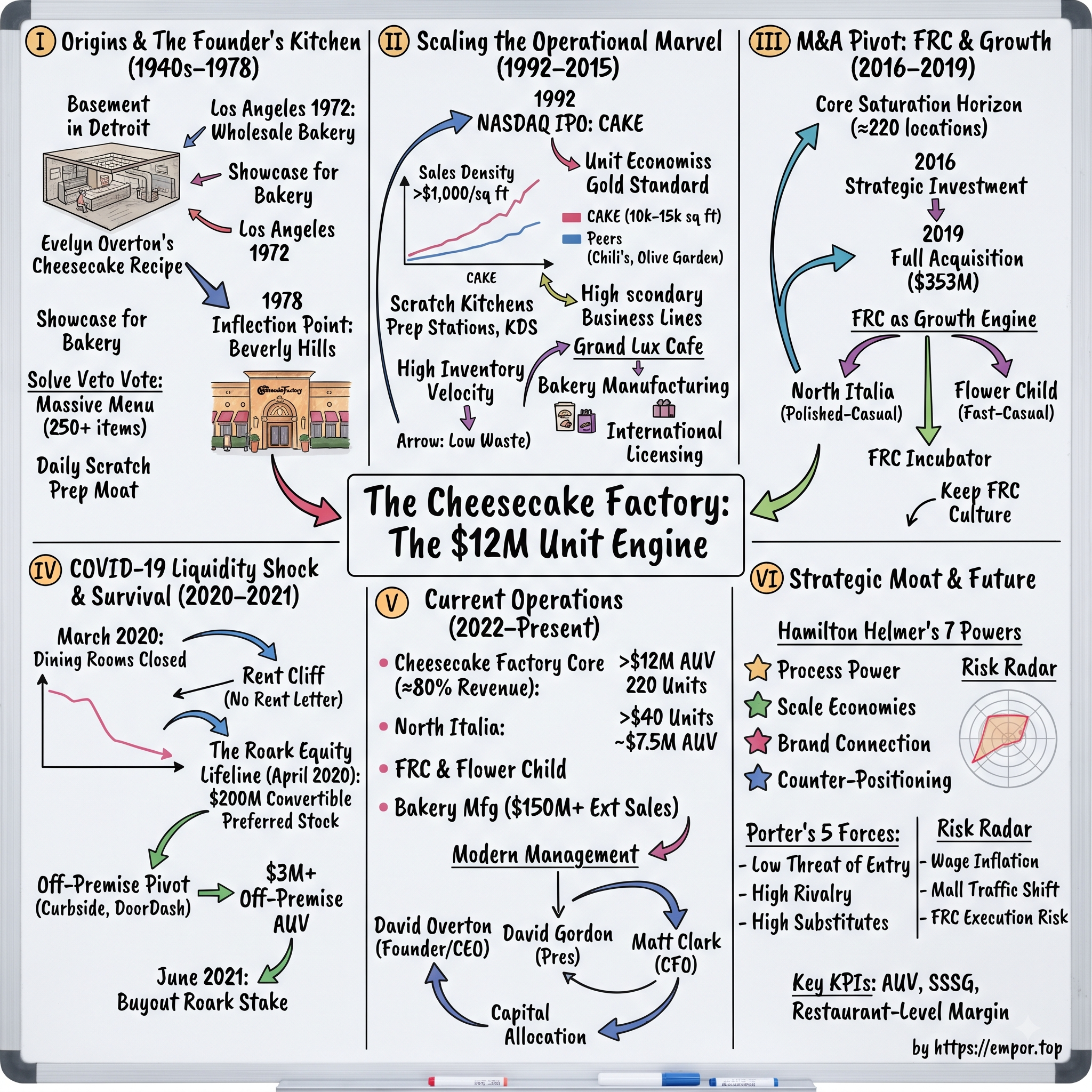
The Cheesecake Factory: The $12M Unit Engine
I. Introduction & Episode Roadmap
There is a particular kind of chaos that happens in a Cheesecake Factory kitchen at 7:15 p.m. on a Saturday. Somewhere in a 10,000-square-foot box anchored to a shopping center, a line cook is finishing a Thai lettuce wrap while, three feet away, another is searing a filet, and a third is assembling a chopped salad that requires eleven separate components, none of which arrived at the restaurant pre-made. Out front, a host is quoting a ninety-minute wait to a party of six who will cheerfully accept it. In the back, a dessert case holds roughly sixty varieties of cheesecake that were baked not in that kitchen but in a plant in Calabasas Hills, California, or Rocky Mount, North Carolina, and trucked in.
Every instinct in modern restaurant operations suggests this approach should fail. The conventional wisdom of the industry, refined over four decades of chain expansion, dictates that menus should shrink, prep should be centralized, kitchens should be simplified, and labor should be de-skilled. Complexity is treated as the enemy of consistency, and consistency as the guardrail against failure. The Cheesecake Factory does close to the opposite. Its namesake menu spans roughly 225 items before accounting for beverages and desserts.1 Rather than collapsing under that operational weight, its restaurants generate average unit volumes that no other major American restaurant chain matches.
The performance gap is substantial. According to Circana's 2026 U.S. restaurant rankings, The Cheesecake Factory led all major chains with an average unit volume of roughly $12.8 million, compared with $7.9 million for Texas Roadhouse, $7.2 million for Chick-fil-A, and $5.8 million for Olive Garden.2 In practical terms, a single Cheesecake Factory generates more than twice the annual sales of an average Olive Garden, despite operating a far more complex model. That operational and financial anomaly forms the central subject of this analysis—its origins, its durability, and its implications for equity investors.
The company as it stands in August 2026
The Cheesecake Factory Incorporated trades on the NASDAQ Global Select Market under the ticker CAKE, with corporate headquarters at 26901 Malibu Hills Road in Calabasas Hills, California.1 As of the second quarter of fiscal 2026, ended June 30, 2026, the company owned and operated 375 restaurants across the United States and Canada, with an additional 36 Cheesecake Factory locations operated internationally under licensing agreements.3 The portfolio is organized across four reporting segments: the core Cheesecake Factory chain; North Italia, a polished-casual Italian concept; Fox Restaurant Concepts, a Phoenix-based incubator housing Flower Child alongside a rotating lineup of restaurant brands; and an "other" segment comprising Grand Lux Cafe, the bakery manufacturing operations, and licensing royalties.
In fiscal 2025, revenue rose 4.7% year over year to $3.75 billion, generating net income of $148.4 million.1 Performance accelerated in fiscal 2026. Second-quarter revenue reached $1,029.6 million—the company's first billion-dollar quarter—while net income hit $68.4 million, producing diluted earnings per share of $1.41 compared to $1.14 a year earlier.3 For the full year, management projects revenue of approximately $4 billion.4
Public markets have responded to the momentum. By early August 2026, CAKE shares traded near $107, up from a 52-week low of approximately $43, lifting the company's market capitalization to roughly $5.3 billion.5 This sharp repricing highlights the central question facing investors: how much of the profit expansion reflects permanent operational improvements versus temporary tailwinds from favorable consumer demand?
Where this story is going
Four primary themes frame the analysis.
The first is the company's origin: a Detroit homemaker's cheesecake recipe, a Los Angeles wholesale bakery, and a founder with no prior restaurant experience who opened a Beverly Hills location in 1978 primarily to showcase his mother's desserts.6 The core strategic premise established by that opening—building a menu so broad that no individual in a dining group vetoes the destination—remains the operational foundation of the business.
The second is site selection and concept saturation. By the mid-2010s, the flagship brand faced a diminishing supply of high-grade real estate capable of supporting $12 million unit volumes. To open new growth avenues, the company acquired Fox Restaurant Concepts and the remaining stake in North Italia in October 2019 for $308 million at closing, plus deferred considerations and earn-out provisions.7 Evaluating whether this transaction represented a disciplined expansion strategy or a costly hedge against flagship maturity remains a key debate.
The third is operating leverage and liquidity risk. When dining rooms closed in March 2020, a company operating 294 leased locations with zero owned real estate demonstrated the downside of fixed cost structures. The resulting strain—marked by a public declaration to landlords that rent would be withheld, followed by a $200 million convertible preferred equity issuance to Roark Capital on terms reflecting the market conditions of the time—serves as a case study in financial flexibility during extreme stress.89
The fourth is the current operational divergence. In fiscal 2026, the flagship Cheesecake Factory chain achieved restaurant-level operating margins of 20%—which management characterized as a decade high—even as the North Italia concept reported consecutive years of negative same-store sales.4 Evaluating the company requires balancing these contrasting performance trends across the portfolio.
The investigation begins with the underlying foundation: a home baker in a Detroit basement.
 Subscribe on LinkedIn
II. Origins & The Founder's Kitchen: From Detroit to Beverly Hills (1940s–1978)
In the 1940s, Evelyn Overton clipped a cheesecake recipe out of a Detroit newspaper. She adapted it, refined it, and built enough local demand that customers began ordering cakes directly. After closing an initial small bakery to raise her children, she moved operations into the family basement, supplying cakes to high-end Detroit restaurants.6
This detail is often polished into corporate legend, but its structural mechanics matter. The Overtons were not restaurateurs; they ran a manufacturing operation with a single core product, an adapted recipe, and a wholesale distribution channel. The founding premise of the enterprise was that the cheesecake was the primary asset, while dining operations would later serve as its distribution vehicle.
The last-savings bet on Los Angeles
In 1972, Evelyn and her husband, Oscar Overton, invested their remaining savings to relocate to Los Angeles and open The Cheesecake Factory Bakery, supplying wholesale desserts across the region.6 Company filings trace corporate origins to that moment: "Our business originated in 1972 when Oscar and Evelyn Overton founded a small bakery in the Los Angeles area."1
The move represented a late-career wager by a couple working without an established local network. Wholesale baking carries notoriously thin margins, price-sensitive buyers, and zero consumer brand equity accruing to the supplier. The Overtons supplied third-party dining rooms, meaning patrons who ate their cheesecakes rarely knew who baked them.
Their son David was pursuing an entirely different path. After leaving Detroit for law school in San Francisco in 1967, he dropped out to play drums on the Bay Area rock circuit—including gigs at the Straight Theater—until age twenty-seven.10 He possessed no formal hospitality background; he was a musician facing declining career momentum just as his parents were exhausting their savings.
February 25, 1978: the showroom
David Overton launched the first Cheesecake Factory restaurant in Beverly Hills on February 25, 1978.10 The original storefront was conceived primarily as a retail showcase for his parents' wholesale desserts.6
Two unconventional design choices made by a founder with no restaurant management experience ultimately defined the company's operating model.
The first was menu scale. Restaurant industry consensus then—and now—favored tight, standardized menus to control kitchen complexity. Overton built an expansive menu instead, later describing the strategy as breaking conventional rules to accomplish what industry peers considered impossible.10 The commercial logic extends beyond merely offering broader choice: group dining functions as a veto system. When four people pick a restaurant, they rarely choose an individual favorite; they choose the location no single diner vetoes. A steakhouse loses vegetarians, a sushi bar loses picky eaters, but a menu spanning pasta, burgers, salads, Asian-inspired entrees, steaks, and a heavy dessert case wins by elimination. This approach expands the addressable dining occasion, raising the weekly volume potential of a single location.
The second decision was scratch preparation. Frozen and pre-portioned ingredients were becoming standard across chain dining to ensure operational consistency and curb labor costs. The Cheesecake Factory rejected pre-made inputs for its core prep, establishing a tradition of preparing more than 250 menu items fresh from scratch inside each location.6 While this choice gave the expansive menu credibility, it introduced significant operational friction—a challenge the company spent the subsequent four decades attempting to turn into a competitive asset.
On opening day, the Beverly Hills location generated a line out the door.6 Long wait times quickly became a signature feature of the brand. In restaurant economics, a persistent multi-hour queue signals that demand generation is solved; execution then becomes an exercise in throughput management.
What the origin story actually explains
While popular narratives frame the chain's rise as a series of fortunate accidents, the business effectively inverted standard restaurant development. Most chains establish a dining concept first and subsequently build supply chain infrastructure to support it. The Cheesecake Factory began as a bakery manufacturer that established restaurants to capture retail distribution. Decades later, the parent company continues to own and operate two manufacturing facilities that produce roughly sixty cheesecake varieties and desserts for its restaurants, international licensees, and third-party commercial clients.1 The bakery unit is not an adjacent diversification; it remains the foundation of the business.
For investors, the lasting takeaway from this founding era is straightforward: menu breadth and scratch kitchens were not cost efficiencies, but demand engines acquired at an operational penalty. The company's long-term trajectory hinged on whether unit volumes could scale high enough to absorb that structural complexity. The next phase of expansion tested that balance.
III. The IPO & Scaling the Operational Marvel (1992–2015)
By the late 1980s, the Overtons faced a challenge common to successful independent operators: guest demand had outpaced available capital. The wholesale bakery needed room to expand, leading to the opening of a 16,400-square-foot facility in Calabasas Hills in 1986, followed by a 60,000-square-foot plant in 1995.6 While the existing restaurants proved highly profitable, the family lacked the balance sheet required to test whether the high-volume concept could scale beyond Southern California.
Going public to buy geography
The Cheesecake Factory Incorporated was incorporated in Delaware in 1992 and listed on the NASDAQ under the ticker CAKE.16 The initial public offering provided the capital required to fund a national expansion without forcing the company to franchise its store model.
That decision departed from standard casual-dining practices. Franchising allows a chain to convert dining operations into a capital-light royalty stream, accelerating unit growth and expanding corporate margins while shifting capital expenditures and store-level execution risks to franchisees. The Cheesecake Factory rejected that route, choosing to keep all domestic locations company-operated. The company leases every restaurant location rather than purchasing real estate, directing its capital into leasehold improvements, kitchen infrastructure, and dining room fixtures.1 International expansion remains the sole exception, managed through regional licensing agreements.
This corporate structure aligned with the operational demands of the business. Franchising succeeds when menus are streamlined and kitchen workflows easily standardized. Managing a high-complexity, scratch-based kitchen required strict centralized control. In exchange for control over execution and unit economics, the company accepted higher capital intensity and a slower pace of store expansion.
The real estate thesis, and why $1,151 per square foot matters
The company's real estate strategy focused on anchoring premier retail developments that combined shopping, dining, entertainment, office space, and residential density.1 Securing these locations required significant upfront investment. Corporate disclosures indicate that the chain's custom layout and detailed interior finishes push build-out costs well above casual-dining averages, averaging approximately $1,100 per square foot.1
Justifying those construction requirements required exceptional sales density. In fiscal 2025, mature Cheesecake Factory locations averaged approximately $12.4 million in annual sales, or roughly $1,151 per productive square foot.1 In practical terms, each square foot of dining space generates roughly one dollar in annual revenue for every dollar spent on initial construction. That payback profile allows the company to underwrite expensive premier real estate that lower-volume competitors generating $4 million per box cannot support.
That sales volume underpins the company's operating margin structure. Fixed occupancy expenses, general management salaries, utilities, and supervisory overhead remain relatively stable regardless of store sales. Spreading those fixed overhead costs across more than $12 million in revenue creates structural operating leverage. This margin cushion offsets the higher variable labor and prep costs inherent in a scratch kitchen.
Running a kitchen like a factory floor
To execute a menu of more than 225 scratch-made items at scale, the company organized its kitchens around short-run manufacturing principles. Workplaces are divided into specialized prep and cooking stations, each dedicated to specific menu categories, with guest orders routed electronically to balance ticket times. Production schedules rely on automated forecasting to align daily prep with expected guest traffic and limit food waste.
The broad menu also provides a structural hedge against input cost volatility. Management notes that its highly diversified menu limits exposure to individual agricultural commodities, allowing cost pressures in one category to be offset by stability or declines in others.1 Where focused concepts function as leveraged bets on specific proteins or grains, a multi-category menu behaves more like a diversified commodity basket. In fiscal 2025, food and beverage costs declined to 21.7% of revenues from 22.5% in the prior year, driven primarily by favorable commodity inflation across key categories.1
Maintaining execution in this environment requires store-level labor stability. Management frequently cites its manager recruitment, training, and retention programs as central operational drivers.1 Internal metrics support that emphasis: the company earned a spot on Fortune's "100 Best Companies to Work For" list for a thirteenth consecutive year in 2026, while the combined internal management promotion rate across The Cheesecake Factory and North Italia concepts reached 47% in fiscal 2025.13 Experienced management remains a vital input for controlling prep accuracy and kitchen labor efficiency.
The concepts and channels that grew around the core
During this period of national expansion, three auxiliary growth channels took shape.
Grand Lux Cafe originated in May 1999, when the developers of The Venetian in Las Vegas invited Overton to create a custom dining concept for the resort. Overton designed a 20,000-square-foot, 550-seat venue inspired by European bistros, trattorias, and pastry shops.11 While the format generated strong sales volumes in high-traffic entertainment settings, its large footprint and high capital requirements limited its suitability for broader national rollout. Grand Lux Cafe remains a minor component of the company's "other" reporting segment, with management closing one location in early 2026.12
Bakery manufacturing expanded alongside restaurant footprint growth. The company operates a 60,000-square-foot plant in Calabasas Hills and a 100,000-square-foot manufacturing and distribution center in Rocky Mount, North Carolina—both fully owned, representing a rare real estate asset on the corporate balance sheet.1 In addition to supplying corporate restaurants and international licensees, the division distributes packaged desserts to supermarkets, foodservice distributors, warehouse clubs, national retailers, and international accounts across roughly twenty-five countries under The Cheesecake Factory At Home brand.1
While external retail sales are sometimes highlighted as an independent growth pillar, financial disclosures indicate a modest scale. External bakery sales totaled $17.2 million in the fourth quarter of fiscal 2025 and $13.9 million in the first quarter of fiscal 2026, representing an annualized business well under $100 million against consolidated corporate revenues approaching $4 billion.1213 The manufacturing division's primary value is internal: it secures consistent dessert quality, captures manufacturing margins in-house, and protects the dessert case as a proprietary brand asset.1
International licensing offered an asset-light vehicle for global expansion, launching with its first Middle Eastern location in Dubai in 2012.6 By mid-2026, international partners operated 36 licensed locations.3 Under these agreements, licensees provide the growth capital and manage operational risk while paying royalties and purchasing proprietary bakery items from the parent company.
By the mid-2010s, this multi-channel model had fully matured. That operational success created a strategic challenge: the flagship brand was approaching natural store-count limits in top-tier domestic real estate, forcing management to evaluate external growth vectors.
IV. The M&A Pivot: Fox Restaurant Concepts & Growth Incubation (2016–2019)
Every expanding retail concept eventually encounters real estate constraints. The Cheesecake Factory's store model relies on high-density, premier locations capable of generating eight-figure annual sales. By the mid-2010s, the company had secured most of the prime domestic sites meeting those criteria.
Management has consistently maintained a long-term target of approximately 300 company-owned Cheesecake Factory restaurants domestically over time.1 With 216 locations operating as of February 23, 2026,1 that ceiling implies a low-single-digit annual expansion rate for the core concept. In practice, management has recently opened roughly five to six flagship locations per year.3
For a business built on a national expansion narrative, this saturation ceiling posed a strategic choice: transition into a mature, cash-generative return vehicle, or acquire new growth drivers.
2016–2019: dating before marriage
Management opted to develop alternative growth engines through a staged investment strategy. Beginning in 2016, the company took minority stakes in North Italia and Flower Child, two emerging concepts developed by Sam Fox's Phoenix-based Fox Restaurant Concepts. By the time of the full acquisition, the company had deployed $88 million into both concepts over the preceding three years in anticipation of their purchase.7
This multi-stage structure reflected deliberate capital allocation discipline. Securing minority ownership with a path to full control provided management with three years of internal operating data before committing the balance sheet. This approach mitigated the valuation and operational risks typical of competitive restaurant auctions, allowing the company to test store-level unit economics in practice before buying.
October 2, 2019: the deal
The transaction closed on October 2, 2019. The company acquired North Italia and Fox Restaurant Concepts, including Flower Child, for $308 million in initial consideration at closing—a figure that included $12 million set aside for customary post-closing adjustments. The agreement structured an additional $45 million payable ratably over the following four years, alongside an earn-out tied to the financial performance of FRC's remaining concepts outside North Italia and Flower Child. To finance the upfront purchase, the company drew $285 million under its restated credit agreement on October 1, 2019.7
Combining the $88 million in prior investments with deferred payments pushed total committed capital toward $440 million before earn-outs—a substantial transaction relative to the company's $2.48 billion of revenue in fiscal 2019.14 Rather than a modest bolt-on acquisition, the deal represented a debt-financed strategic commitment at the peak of the economic cycle.
Did they overpay?
In 2019, public casual-dining chains traded at high-single-digit enterprise value to EBITDA multiples, weighed down by market concerns over fast-casual competition and delivery shifts. Against those industry benchmarks, the transaction carried a premium growth multiple rather than a traditional casual-dining valuation, reflecting a purchase of small store footprints with long expansion runways.
The deal's valuation aligns more closely with high-growth fast-casual and polished-casual peers than with mature operators like Darden Restaurants or Texas Roadhouse. However, justifying that premium depends entirely on whether North Italia and Flower Child can scale their store counts efficiently over time. Consequently, the transaction's ultimate return on capital cannot be evaluated solely on 2019 entry multiples, but on whether the brands achieve the unit volume and store count needed to support that price tag—a scorecard that Section VI shows remains split.
The strategic logic, stated plainly
During the fourth-quarter fiscal 2019 earnings call, David Overton framed the acquisition as reinforcing the company's position in experiential dining, outlining 2020 development plans for up to twenty new units—comprising six Cheesecake Factory locations, six North Italias, and eight FRC concepts—to support an 8% total revenue growth objective.15 By expanding beyond the flagship brand's annual capacity of roughly six openings, the acquisition effectively tripled the company's annual store expansion potential.
Beyond immediate store additions, FRC provided a multi-concept incubation platform. Corporate filings describe FRC as an independent Phoenix-based subsidiary operating as an incubator for dining concepts, backed by an established ecosystem for talent, menu, and design development.1 Among these, management identified Culinary Dropout, The Henry, and Blanco as primary candidates for future expansion.1
For a parent company managing a mature core chain, an internal concept incubator functions as an operational research and development division. While such creative infrastructure offers strategic flexibility, quantifying its long-term return on invested capital presents an ongoing analytical challenge.
Governance: keeping the founder's shop intact
The initial integration strategy emphasized operational autonomy. FRC remained headquartered in Phoenix in roughly 22,000 square feet of leased office space,1 preserving its creative focus under founder Sam Fox while integrating into the parent company's supply chain and site-selection infrastructure.
By the fourth quarter of fiscal 2025, management's approach to oversight had evolved. When questioned by Jefferies analyst Andy Barish regarding FRC's organizational structure and leadership transitions, Chief Financial Officer Matt Clark stated that all business units were meeting or exceeding expectations. Clark disclosed that the parent company had appointed a senior Cheesecake Factory operations executive to the Phoenix leadership team, asserting that "we'll all look back on this being one of the most successful restaurant acquisitions."12
While management presents this operational transfer as a success, installing core corporate leadership within the incubator highlights the structural tension between preserving brand culture and imposing corporate standardization.
Regardless of the transaction's strategic rationale, the immediate macro environment proved challenging: five months after closing, nationwide dining room closures suspended operations across both the core chain and the newly acquired portfolio.
V. The COVID-19 Liquidity Cliff & The Roark Equity Lifeline (2020–2021)
Financially, a 10,000-square-foot leased restaurant with an empty dining room represents fixed rent obligations, management payroll, utility expenses, and perishable inventory—all backed by zero dining-room revenue. Across 294 locations, those fixed costs meant expenses could not be cut fast enough to match the collapse in sales.8
In March 2020, The Cheesecake Factory faced that liquidity wall and took an unusual public step for a major company: it formally notified its landlords that rent payments were stopping.
The letter
On March 18, 2020, Chief Executive Officer David Overton sent a letter to landlords stating that The Cheesecake Factory and its affiliated concepts would not pay April 2020 rent, citing a severe drop in guest traffic that created significant financial strain. The letter requested patience and landlord support while acknowledging that the company could not predict the ultimate length or severity of the shutdown.8
When the letter leaked, it immediately generated national headlines regarding commercial lease enforcement. As one of the first prominent, publicly traded anchor tenants to announce rent non-payment, the company signaled a broader risk to commercial real estate: if a high-volume chain could not pay rent, the financial stability of retail shopping centers was widely in question.
The strategic rationale presented clear trade-offs. Operationally, preserving cash during an indefinite shutdown protected liquidity, leveraging the chain's position as an anchor tenant that landlords could not easily replace. Reputationally, the action proved costly. A company that had spent decades building strong landlord and employee relations drew public and political criticism, particularly as corporations navigated access to government relief programs. Management deliberately traded short-term reputation for immediate liquidity.
What the shutdown actually did to the P&L
First-quarter results for fiscal 2020 illustrated the speed of the financial reversal. Comparable store sales at The Cheesecake Factory dropped 12.9% for the quarter, shifting from roughly 3% growth through February to a 46% decline in March. North Italia experienced an identical pattern, moving from 5% growth through February to a 48% drop in March, resulting in a 12% quarterly decline. The company closed the quarter with $81 million in cash against $380 million in total debt after drawing $90 million on its credit facility, while instituting employee furloughs, executive pay cuts, spending reductions, and a halt on new store development.16
For full-year fiscal 2020, revenue contracted to $1.98 billion from $2.48 billion in the prior year, generating a net loss of $253.4 million, or $6.32 per share.14 The operating leverage that drives elevated profit margins during high-volume periods amplified losses during the volume collapse. High average unit volumes require persistent guest traffic to absorb fixed occupancy costs; when traffic halts, operating losses accumulate rapidly.
April 20, 2020: the cost of certainty
On April 20, 2020, the company secured emergency capital by entering into a subscription agreement with RC Cake Holdings LLC, an affiliate of Roark Capital Group. Roark purchased 200,000 shares of Series A Convertible Preferred Stock for $200 million in a transaction that closed concurrently with signing.9
The deal terms reflected the high cost of emergency capital at the onset of the pandemic.
The preferred shares ranked senior to common equity in dividend distributions and liquidation rights, carrying a 9.5% annual dividend payable in cash or through payment-in-kind shares at the company's option.9 Preferred holders possessed the right to convert into common stock at $22.23 per share—a strike price set when the equity traded near depressed multi-year lows.9 The company paid a 1% commitment fee on the aggregate investment.9 Roark received a board seat for as long as it maintained at least 25% of its initial position, alongside information rights, preemptive participation rights on future equity offerings, and a put option allowing holders to demand redemption at the liquidation preference after ninety months.9 David Overton and affiliated entities executed a support agreement committing their shares in favor of the conversion feature.9
In return, Roark agreed to a three-year standstill and a voting commitment supporting management's board nominees.9
While the preferred structure carried expensive terms—combining a high senior yield, a low conversion price, and redemption protections—it eliminated near-term insolvency risk during a period of capital market illiquidity. The infusion raised cash balances to approximately $260 million by April 30, 2020, compared to $81 million six weeks earlier.16
The off-premise pivot that made the recovery possible
During the dining room closures, operational survival depended on off-premise sales channels developed prior to the crisis.
During an update in May 2020, President David Gordon noted that weekly off-premise sales at core Cheesecake Factory locations had annualized to nearly $4 million per restaurant. Digital ordering represented roughly 80% of off-premise volume, with the company's proprietary online ordering platform expanding faster than third-party delivery to become its highest-margin off-premise channel. More than one-third of delivery orders originated from new customers, with weekly new delivery users roughly doubling compared to February levels.16
Generating an annualized $4 million per location through takeout and delivery allowed restaurants to cover store-level operating costs without open dining rooms. An exclusive partnership with DoorDash, renegotiated in late 2019, provided prominent app placement across local delivery zones—a crucial distribution channel when digital platforms served as the primary store window.16
The crisis demonstrated that off-premise infrastructure built for consumer convenience could adapt into a primary operational vehicle when physical locations were restricted.
June 2021: buying the equity back
As dining demand recovered faster than anticipated in 2021, management acted to recapitalize the balance sheet and retire the high-cost preferred stock.
On June 10, 2021, the company executed a repurchase agreement to buy back 150,000 preferred shares for $447.0 million in cash. Concurrently, it reached a conversion agreement covering the remaining 50,000 preferred shares, converting them into 2,400,864 common shares plus $10.4 million in cash, with both transactions closing on June 15, 2021.17
To fund the transaction, the company executed a simultaneous two-part capital markets offering, issuing 3,125,000 common shares and $345 million in 0.375% Convertible Senior Notes due 2026 with an initial conversion price of approximately $78.40 per share.17
This refinancing restructured the corporate capital stack. By replacing preferred equity convertible at $22.23 per share with convertible notes struck at $78.40 per share alongside a modest common stock offering, management reduced potential share dilution while lowering its capital cost from a 9.5% dividend coupon to a 0.375% note interest rate.917 Extinguishing the preferred structure cost approximately $457 million in cash and stock to settle a $200 million initial investment. However, leaving the instrument intact would have allowed Roark to convert into approximately 9 million common shares at $22.23 while the stock traded above $50.
The rapid buyout reflected disciplined capital management under stress: securing expensive emergency liquidity when market access was constrained, then immediately retiring the expensive instrument once normalized refinancing channels reopened.
With balance sheet stability restored, analytical focus shifted back to the long-term growth trajectory of the operational concepts.
VI. Current Operations, Segment Breakdown & Modern Management (2022–Present)
On July 28, 2026, The Cheesecake Factory reported the first billion-dollar quarter in its history. Revenue of $1,029.6 million, net income of $68.4 million, diluted EPS of $1.41, adjusted EPS of $1.44 — and comparable restaurant sales at the namesake brand up 5.8% year over year.3
The composition of that comp is what matters. Pricing contributed 3.0%, mix 0.1%, and traffic 2.7% — meaning more human beings walked through the doors, outperforming the Black Box casual dining index by roughly 350 basis points. Annualized unit volumes exceeded $13.5 million and restaurant-level margin reached 20%, described by management as the highest in a decade.4
Positive traffic in casual dining in 2026 is genuinely rare. Most of the segment has been manufacturing comps out of price for three years, which is a wasting asset — every point of price you take is a point of future elasticity you spend. A comp built on traffic is a comp that can repeat.
The four businesses, honestly assessed
The Cheesecake Factory core remains roughly 72% of revenue. Fiscal 2025 sales were $2,688.8 million, on 216 restaurants as of February 2026, with average sales per location of approximately $12.4 million and an average guest check including beverages and desserts of about $31.79.1 Off-premise runs approximately 21% of restaurant sales; alcohol contributes 11%.1
The fiscal 2025 detail is the more instructive picture, because it shows the business before the 2026 acceleration. Full-year comparable sales rose 0.1%, built from a 2.4% increase in average check (4.3% of menu pricing offset by a 1.9% negative mix shift) against a 2.3% decline in customer traffic.1 In other words: for all of fiscal 2025, the core brand was doing exactly what the rest of casual dining was doing — pricing its way to flat.
What changed is instructive. Management deliberately introduced lower-priced "bites and bowls" — accepting negative menu mix in exchange for accessible price points — and simultaneously brought planned pricing down to roughly 3% for 2026 from the 3.5%–4% range of late 2025.12 On the fourth-quarter call, Clark described the combined effect as an effective 2% when netting price and mix, "well below where the industry is."12
That is a deliberate margin-for-traffic trade, and by mid-2026 it appears to have worked: mix turned essentially neutral at +0.1% while traffic turned positive.4 The bites did not cannibalize entrées; they attached to them. Gordon's framing on the first-quarter call was that guests were "attaching bites along with the rest of their meal," and that early fears of check management did not materialize.13
An investor should note the honest caveat: one strong quarter against a soft prior-year comparison does not establish a trend, and management's own third-quarter guidance of $980–990 million in revenue with an adjusted net income margin of roughly 4.3% implies sequential deceleration.4
North Italia is the problem child, and management has not pretended otherwise. Fiscal 2025 sales grew 15.5% to $345.9 million — but that growth was entirely units. Comparable sales declined approximately 2%, driven by a 5% traffic decline partially offset by a 3% check increase.1 The deterioration continued: comps of -4% in the fourth quarter of 2025, -2% in the first quarter of 2026, and -3% in the second quarter of 2026, with the mature restaurant-level margin falling to 15.6% from 18.2% a year earlier.12134
Management's explanations have been specific rather than evasive, which is worth something. They have attributed the weakness to sales transfer from newly opened restaurants cannibalizing existing ones, the Los Angeles fires, weakness in the lunch daypart, and broader industry trends.12 They have also produced a plan: a dedicated lunch section with lighter options and thoughtful pricing, lower-priced pasta options, deployment of the guest-feedback platform used at Cheesecake Factory, and expanded local marketing.134
Two things cut against them. First, cannibalization is a self-inflicted wound — the company is opening six to seven North Italias a year into markets where it already operates, and roughly half of 2026 openings are in existing markets.12 Second, and more troubling for the long-term thesis, the company still targets approximately 200 domestic North Italia locations and roughly 20% average annual unit growth.1 Sustaining that ambition while mature-store comps decline for eight consecutive quarters is exactly the pattern that has destroyed value at other multi-concept restaurant companies: growing units into a concept whose four-wall economics are drifting the wrong way.
The counter-evidence is real, though. New North Italia openings are performing exceptionally: two fourth-quarter 2025 openings averaged weekly sales exceeding $182,000, an annualized AUV over $9 million, and a Brea, California opening in early 2026 produced the busiest opening week in the concept's history.1213 If new units open at $9 million and mature units drift toward $7.5 million, the honest interpretation is that the concept has real demand and a maturation problem, not a demand problem. That is a meaningfully better situation — but it is also the interpretation management would prefer, and it deserves scrutiny rather than acceptance.
Flower Child is the genuine success. Fiscal 2025 sales rose 27.8% to $185.3 million, with comparable sales up approximately 5%.1 The acceleration since has been striking: comps of +10% in the first quarter of 2026 and +13% in the second, with annualized AUVs reaching $5.3 million and restaurant-level margins of 20.1%.134 Off-premise runs approximately 55% of Flower Child sales — a fundamentally different channel mix from the rest of the portfolio.1
Gordon's explanation for why it is taking share is worth quoting in substance: he has argued Flower Child is winning from quick-service and fast-casual competitors who "have had to take much more price to protect margins over time," while Flower Child has not.13 That is a testable claim, and the 13% comp with roughly 8% of it from traffic supports it.4
The constraint on Flower Child is not demand; it is people. Management has repeatedly said growth is gated by the pipeline of general managers and executive chefs, and has held the growth rate at roughly 20% for that reason, with Gordon acknowledging it could eventually go faster.1213 A company that says its growth constraint is talent, and then declines to accelerate past it, is telling you something credible about how it thinks. The company sees potential for approximately 700 domestic Flower Child locations against 43 operating as of February 2026 — a runway that, if even partially real, matters more to the equity than anything happening at the core brand.1
Other FRC grew fiscal 2025 sales 18.4% to $355.1 million, with average sales per location of approximately $6.7 million.1 The concept-level results have been strong: three fourth-quarter 2025 openings including a Culinary Dropout and a Henry averaged an annualized AUV over $8.7 million, and a Henry that opened in Phoenix in early 2026 did average weekly sales exceeding $280,000 in its first four weeks — an annualized AUV over $14 million.1213 The company targets approximately 10% to 15% average annual unit growth for the aggregate Other FRC portfolio.1
The caution here is structural rather than numerical. A portfolio of a dozen small brands is harder to underwrite than one large brand: it carries more corporate overhead per unit, less purchasing leverage, and more execution risk per opening. It also produced four closures in January 2026 — two Cheesecake Factories, one Grand Lux Cafe, and one Blanco — which management characterized as anticipated with none further expected in 2026.12
The people running it
David Overton, Chairman and Chief Executive Officer, has run this company since he opened the first restaurant in 1978 — approaching forty-nine years, which places him among the longest-tenured founder-CEOs in American public markets.110 His alignment is real and his brand stewardship is evident in the consistency of the concept over decades. He has been candid about his own view of the formula: dedication and hard work with great service in a casual environment, and a refusal to move away from making things fresh in-house.10
The governance question that comes with any forty-eight-year founder-CEO is succession, and it is unresolved in public disclosure. Overton's prepared remarks on recent calls have been brief and increasingly ceremonial, with operational and financial substance handled by Gordon and Clark. That is a functional arrangement. It is not a succession plan, and the company has not disclosed one.
David Gordon, President, is the operator. He joined the company in 1993 as a manager, worked through general manager, area director of operations, and regional vice president roles, served as chief operating officer, and was named President on February 19, 2013.18 Thirty-three years inside the same restaurant system is an unusual credential, and it shows in how he talks: his answers on calls are consistently about retention, execution, incident rates, and staffing pipelines rather than strategy abstractions. On the first-quarter 2026 call he pushed back on a macro-framed question by pointing to retention "quarter after quarter after quarter," which he argued "has a flywheel effect of guests wanting to come back."13
Matt Clark, Executive Vice President and Chief Financial Officer, joined in 2006 as Vice President of Strategic Planning and became CFO in 2017, having previously held finance roles at Groupe Danone, Kinko's, and The Walt Disney Company. He holds an MBA from the University of Southern California.19
Clark's disclosure style is a genuine analytical asset. He routinely volunteers the components of comparable sales — price, mix, and traffic separately, by concept — quantifies weather impacts on a net-of-prior-year basis, and flags accounting noise rather than letting it flatter results. When gift card breakage added $17.3 million to fiscal 2025 revenue because of a change in historical redemption patterns, he stripped it out of the fourth-quarter comparison explicitly and identified how many basis points of each expense line it distorted.112 That is not standard practice; many managements would have let a one-time revenue benefit sit inside a headline.
He is also willing to decline. Asked repeatedly for rewards-program membership numbers and app download metrics, Gordon and Clark have consistently said they will not disclose them.134 Investors may find that frustrating, but a management that refuses to give a metric is preferable to one that gives a flattering metric and then stops when it turns.
Capital allocation: the record
Fiscal 2025 generated $301.3 million of operating cash flow against $146.2 million of capital expenditure, leaving roughly $155 million of free cash flow. The company returned $153.9 million through buybacks and $52.2 million through dividends — a total return above free cash flow, funded partly by a net increase in borrowings.14
On February 12, 2026, the board raised the quarterly dividend by $0.03 to $0.30 per share and increased the share repurchase authorization by 5.0 million shares to 66.0 million.12 Cumulatively through December 30, 2025, the company had repurchased 59.9 million shares at a total cost of $1,983.6 million.1
Fiscal 2026 plans call for approximately $210 million of cash capital expenditure supporting as many as twenty-six openings, with roughly three-quarters of those in the second half.124 Balance sheet leverage is modest: $575 million principal of 2.00% convertible senior notes due 2030, after repaying the remaining $69.0 million of 0.375% converts in the second quarter of 2026, against total available liquidity of $561.7 million.3
The honest assessment: this is a disciplined but not conservative capital allocator. Returning more than free cash flow in a year of heavy growth capex, while raising the dividend and expanding the buyback, is a bet that the current earnings level is durable. It has been vindicated so far in 2026. It would look different in a recession.
That question — how much of this is structural and how much is cyclical — is where the analysis has to get rigorous.
VII. The Strategic Moat: Hamilton Helmer's 7 Powers & Porter's 5 Forces
Frameworks add value when applied rigorously. The key test for The Cheesecake Factory is not whether it possesses competitive strengths, but whether those advantages endure when rival operators attempt to counter them.
Hamilton Helmer's 7 Powers
Process Power — the primary claim, and a durable one. Helmer defines Process Power as embedded organizational activity sets that enable lower costs or superior products, achievable only through an extended commitment and resistant to rapid replication. A scratch kitchen executing over 225 menu items at roughly $12 million to $13 million in annual sales per location presents a compelling case.
The obstacle to copying this model is not secrecy—the kitchen layout and menu are entirely visible. The barrier lies in the time and capital required to build equivalent capabilities. A competitor attempting to replicate the system would need to re-engineer kitchen workflows, retrain store management, construct specialized forecasting systems, and absorb years of elevated labor costs and food waste during transition—all while operating existing restaurants. The company's 47% internal management promotion rate and thirteen consecutive years on Fortune's "100 Best Companies to Work For" list reflect the deep human infrastructure supporting this execution.13 That operational culture cannot be acquired quickly on the open market.
A clear test of Process Power is whether margins can expand independent of volume growth. In fiscal 2025, The Cheesecake Factory generated a 17.6% restaurant-level margin at its core chain—a 60 basis point expansion year over year—despite virtually flat comparable sales of 0.1%.12 Expanding operating margins on flat traffic indicates genuine process productivity rather than cyclical demand strength.
Scale Economies — real, but narrower than the headline. High average unit volumes allow the company to amortize fixed occupancy expenses, store manager compensation, and regional supervision across more than double the sales of an average casual-dining competitor. That dynamic creates a structural per-unit scale advantage tied directly to the large-box format.
However, unit-level scale differs from corporate scale. Operating roughly 216 domestic flagship restaurants, The Cheesecake Factory lacks the raw purchasing leverage of a larger corporate operator like Darden Restaurants, which runs over 2,000 locations. The company's commodity cost stability stems primarily from category diversification across its broad menu rather than purchasing power over suppliers.1
Counter-Positioning — the strongest and most durable power. Counter-positioning occurs when an incumbent declines to adopt a challenger's superior business model because doing so would damage its core business. That structural dynamic protects The Cheesecake Factory. A competitor generating $4 million to $6 million in unit sales cannot adopt a 225-item scratch menu because its lower sales base cannot absorb the required labor and prep waste. An operating model that is accretive at $12 million in sales becomes economically unviable at lower volume thresholds. Competitors avoid copying the model out of rational self-interest rather than operational oversight.
Consequently, the industry-wide trend toward menu contraction widens the company's competitive moat. As peers trim menus to curb labor costs, they weaken their appeal to mixed dining groups, ceding the broad-demand occasion to The Cheesecake Factory.
Branding — present, but distinct from pricing power. The brand commands strong mindshare for special occasions and desserts, allowing the chain to grow with minimal traditional advertising. Executive commentary highlights substantial organic visibility through media references, supported by social media engagement rates estimated at two to three times casual-dining averages.134
However, brand power under Helmer's framework requires charging a price premium for an equivalent product. An average check of $31.79 reflects generous portions and broad variety rather than premium pricing.1 The brand functions as a traffic engine rather than a driver of excess pricing power.
Switching Costs, Network Economies, Cornered Resource — largely absent. Casual dining features minimal consumer switching costs and negligible network effects. While the Cheesecake Rewards program and a revised mobile app—which ranked among the top downloaded application categories during its second-quarter 2026 launch—aim to foster repeat visits,134 management does not disclose active membership or frequency metrics, leaving the structural impact of these initiatives unverified.
Porter's Five Forces
Bargaining power of buyers: high, but mitigated by group consensus. Diners face low switching costs and abundant dining alternatives. However, the company mitigates buyer power through the group decision-making process. By offering a menu that eliminates vetoes among dining parties, the concept wins occasions where group consensus is required.
Threat of new entrants: low at the format level, high at the dining occasion. Replicating the flagship format requires build-out costs of approximately $1,100 per square foot, specialized kitchen infrastructure, and decades of operational refinement, creating high barriers to entry.1 However, substitute formats—including fast-casual chains, specialized dining concepts, and upgraded grocery meal solutions—continue to compete for guest spend across individual dining occasions.
Bargaining power of suppliers: moderate and structured to limit risk. Broad menu diversification prevents reliance on any single agricultural commodity, while in-house bakery operations secure the core dessert supply. Management projected full-year fiscal 2026 commodity inflation at approximately 2.5%, keeping input cost volatility manageable.12
Threat of substitutes: high and persistent. Off-premise dining options, fast-casual alternatives, and convenience-oriented meal services represent ongoing substitutes. Management counters this threat by positioning the brand as an experiential dining destination rather than a transactional convenience, with Chief Financial Officer Matt Clark emphasizing consumer demand for high-value dining experiences.13 Additionally, maintaining a 22% off-premise sales mix indicates that the company has integrated takeout and delivery channels rather than resisting them.12
Competitive rivalry: intense across format models. Compared to casual-dining peers like Darden, Texas Roadhouse, Brinker, BJ's Restaurants, and P.F. Chang's, The Cheesecake Factory leads in sales density per square foot. However, competitors achieve strong financial returns through simpler models. Texas Roadhouse, with an average unit volume of $7.9 million, delivers robust returns through operational simplicity,2 while Brinker's Chili's brand has demonstrated how value positioning can drive comparable sales growth. Peer chains do not need to match The Cheesecake Factory's operational complexity to compete effectively for market share.
Myth vs. reality
Three common assertions regarding the business model warrant scrutiny.
First, that the bakery functions as an independent, high-margin growth engine. External bakery sales account for well under $100 million annually against corporate revenues approaching $4 billion.1213 The bakery's primary value lies in quality control, brand protection, and capturing internal manufacturing margins, rather than serving as a major wholesale driver.
Second, that high sales density guarantees high net profit margins. The company's net income margin typically ranges between 4% and 5%, with management projecting approximately 5.4% for fiscal 2026.144 While strong unit volumes produce robust restaurant-level margins, corporate overhead of roughly 6.5% of sales, annual preopening expenses of $35 million to $36 million, and depreciation of approximately $115 million absorb a significant portion of store-level profits.12
Third, that menu complexity is an operational burden tolerated for marketing reasons. Menu breadth serves as the primary demand engine that generates $12 million-plus unit volumes. Those high volumes in turn generate the revenue density required to absorb elevated labor and prep costs. Complexity and sales volume form an interdependent operational loop.
VIII. Investment-Story Spine, Bear vs. Bull & Risk Radar
Why this wins from here
The bull case rests on three legs, and they are of unequal quality.
The strongest is Flower Child. A fast-casual concept compounding comparable sales at 10–13% with roughly 20% restaurant-level margins, off-premise at 55% of sales, and a stated domestic potential of approximately 700 locations against 43 operating is the single most valuable asset in the portfolio relative to its current contribution.1413 At $185.3 million of fiscal 2025 revenue it is roughly 5% of the company.1 If it reaches even 200 units at current volumes, it becomes a business comparable in size to today's North Italia and Other FRC combined. That is the option the 2019 acquisition actually bought, and it is looking better than the concept the company paid the most attention to.
The second leg is the core brand's cash generation and margin trajectory. Twenty percent restaurant-level margin, positive traffic, and a deliberate decision to run pricing below industry inflation while still expanding margin is evidence of an operating system working well.4 The core throws off the cash that funds twenty-six openings a year and $200 million of shareholder returns.
The third and weakest leg is North Italia's runway. The 200-unit target and 20% growth ambition are management assertions currently contradicted by eight quarters of negative comparable sales and 260 basis points of mature-margin compression.14 The new-unit volumes are encouraging. The mature-unit trend is not. An investor should underwrite this leg at a heavy discount until comps inflect.
What breaks the case
Labor cost and California concentration. The company's largest market is also the country's most aggressive wage-legislation environment. Management has modelled net total labor inflation of low-to-mid single digits for fiscal 2026.13 It is worth being precise about one commonly cited risk: California's AB 1228, which set a $20 hourly minimum for fast food employees effective April 1, 2024, applies to limited-service restaurants that are part of chains with more than sixty locations nationally where customers order and pay before eating.20 The Cheesecake Factory and North Italia are full-service and fall outside that definition; Flower Child is limited-service but operated 43 locations as of February 2026, below the threshold.1 The real exposure is indirect — wage floors in one segment pull up market wages in adjacent segments, and a full-service operator competing for the same hourly workers absorbs that spillover without the pricing latitude of a fast-food chain.
Traffic dependence on price. Fiscal 2025 was a year in which the core brand's flat comp was entirely price, with traffic down 2.3%.1 Fiscal 2026 reversed that. The bear observation is that the reversal coincided with a deliberate price reduction, a new value menu, a heavily marketed app launch, and easy comparisons. Distinguishing structural share gain from a well-executed promotional cycle requires several more quarters of data than currently exist.
Consumer cyclicality and the "K economy." Clark has been explicit that many of the company's concepts benefit from higher-income cohorts, and has invoked the two-speed consumer directly.13 That is a candid framing, and it cuts both ways: a portfolio levered to affluent discretionary spending outperforms in a bifurcated economy and underperforms sharply when asset prices fall. The fiscal 2020 loss of $253.4 million is the historical proof of what happens when the operating leverage inverts.14
Occupancy and landlord exposure. Every restaurant is leased.1 The company's own risk disclosures flag the economic health of its landlords and other tenants in the retail centers where it operates.1 Anchored mall and lifestyle-center real estate has been a decade-long structural headwind, and the company's premium-site strategy means its fortunes are partly tied to the health of centers it does not control.
Execution risk in a twenty-six-opening year. Roughly three-quarters of fiscal 2026 openings are scheduled for the second half.12 Back-loaded development calendars compress training, preopening, and ramp risk into a narrow window. Preopening expense of $35–36 million is real cash, and the company's own disclosures note that food and labor costs run higher at new restaurants until management learns to forecast their volumes.112
Technology and disclosure. The rewards app is presented as a growth driver. Because the company declines to disclose membership counts, frequency lift, or incrementality, investors are asked to accept a qualitative claim about a quantitative program.4 That is a legitimate governance criticism, even from a management team that discloses more than most elsewhere.
The activist stress test
A skeptical investor would press on four points.
Portfolio complexity. The company runs a namesake casual-dining chain, a polished-casual Italian brand, a fast-casual health concept, a dozen-odd incubator brands, a Las Vegas-born grand cafe, two owned bakery plants, an international licensing business, and a consumer packaged goods program. General and administrative expense runs approximately 6.5% of sales.12 The sum-of-the-parts argument — that Flower Child alone might command a growth multiple unavailable to the consolidated entity — is not unreasonable.
The counterargument is stronger than it first appears. Flower Child's growth is gated by management talent, and that talent pipeline runs through the parent's training and promotion infrastructure. Separating it would sever the thing constraining it. The bakery, similarly, is worth more inside than outside. Complexity here is mostly load-bearing.
Two corporate hubs. Maintaining Calabasas Hills and a separate Phoenix headquarters for FRC duplicates overhead. Management's position is that Phoenix's independence preserves the incubation capability — while simultaneously having inserted a senior Cheesecake operations executive into that team.12 The activist question is fair: if you are standardizing operations anyway, what exactly is the second headquarters buying?
Capital returned above free cash flow. Fiscal 2025 returns of $206 million exceeded roughly $155 million of free cash flow, with the gap bridged by net borrowing, while the company simultaneously raised the dividend and expanded the buyback.1412 In a year of accelerating unit growth, that is aggressive rather than disciplined.
Growth into weakness at North Italia. Opening six to seven units a year, roughly half into existing markets, while acknowledging sales transfer as a cause of negative comps, is the clearest capital-allocation vulnerability in the story.12 Management is effectively spending capital to cannibalize its own mature base and asking investors to trust that the aggregate market opportunity justifies it.
The accounting asides. Two items merit a note. The $17.3 million gift card breakage benefit recognized in fiscal 2025 came from a change in estimated redemption patterns — a non-cash, judgment-driven revenue item that management did strip out of its own comparisons.112 And the company recorded a $15.9 million loss on debt extinguishment in the first half of fiscal 2025 related to its convertible notes.3 Neither is a red flag; both are the kind of judgment and one-time items an investor should locate rather than ignore. The third bakery facility announced in Charlestown, Indiana in October 2023 remained described as under evaluation in the fiscal 2025 10-K — a multi-year capital commitment that has been deferred without much explanation.1
The three KPIs that matter
Everything above collapses into three numbers worth tracking every quarter.
1. Comparable sales decomposition — specifically the traffic line, by concept. Not the headline comp. Management discloses price, mix, and traffic separately for The Cheesecake Factory and North Italia on nearly every call.1312 A comp built on price is borrowed; a comp built on traffic is earned. The core brand's swing from -2.3% traffic in fiscal 2025 to +2.7% in the second quarter of fiscal 2026 is the single most important datapoint in the current story.14 Watch whether it holds when the comparison base gets harder.
2. Restaurant-level operating margin, by concept. The consolidated number hides the divergence. The core brand at 20%, Flower Child at 20.1%, and North Italia at 15.6% tell three different stories inside one company.4 Management's stated objective is roughly 25 basis points of four-wall margin expansion per year across the portfolio, and North Italia's stated long-term target range is 16% to 18%.12 These are specific, checkable promises.
3. Average unit volumes at North Italia and Flower Child. The core brand's AUV is the proof of a business that already exists. The growth concepts' AUVs are the proof of a business that has to exist for the equity story to work. North Italia's drift from $7.6 million toward $7.4–7.9 million against new-unit openings above $9 million, and Flower Child's climb from $4.7 million to $5.3 million, are the leading indicators of whether the 2019 acquisition compounds or stalls.1413
The primary-evidence trail
For an investor wanting to test this narrative from source documents: the fourth-quarter fiscal 2019 call sets out the original FRC strategic rationale and the unit-growth math that justified it; the first-quarter fiscal 2020 call documents the liquidity response, the landlord negotiations, and the terms of the Roark investment in management's own words; and the four calls from the fourth quarter of fiscal 2025 through the second quarter of fiscal 2026 contain the live debate on pricing elasticity, the bites-and-bowls mix trade, the rewards app, North Italia's recovery plan, and opening cadence.151612134 The Q&A sections are consistently more informative than the prepared remarks, particularly the exchanges with Sara Senatore of Bank of America and Jeff Bernstein of Barclays on value positioning and pricing, and with Brian Mullan of Piper Sandler on Flower Child's growth constraints.12
IX. Playbook & Key Takeaways
Forty-eight years after a former rock drummer opened a Beverly Hills storefront to market his mother's cheesecakes, the company generated its first billion-dollar revenue quarter. What strategic lessons emerge from that expansion?
Complexity, managed rigorously, can become a moat rather than a liability. The restaurant industry's standard practice favors operational simplification, and for most operators that instinct is correct because they lack the sales volume needed to absorb broad menus and scratch preparation. The Cheesecake Factory's key operational takeaway is not simply to expand choices, but to build operational capabilities that competitors cannot copy because doing so would destroy their own unit economics.
Solve for group consensus, not individual preference. The veto-vote framework represents the most portable insight from the business model, extending well beyond hospitality. In transactions involving dining parties or multi-person purchasing decisions, the winning concept is often not the single favorite of one participant, but the option that generates no objections from the group. Designing an offering to eliminate vetoes requires a different strategy than optimizing for niche preference.
High sales density solves structural cost challenges. Store rent, management compensation, and supervisory overhead remain largely fixed per location. Whether a concept can support premier real estate, scratch prep, or elevated build-out expenses depends entirely on its ability to generate high sales volume. Generating roughly one dollar in annual sales for every dollar invested in construction underpins the operational model, making practices that thrive at $12 million in unit sales untenable at $5 million.
Concept incubators provide growth optionality, though returns can be unpredictable. The company acquired Fox Restaurant Concepts primarily to scale North Italia as a national polished-casual brand. Seven years after the transaction, North Italia faces declining mature-store comparable sales, while Flower Child—the smaller fast-casual concept—compounds sales at double digits with top-tier restaurant-level margins. This dynamic does not invalidate multi-concept acquisition strategies, but highlights the value of acquiring flexible incubation platforms rather than single concepts, paired with objective monitoring of underlying unit performance.
Pay for liquidity in a crisis, and retire expensive capital when conditions normalize. Issuing convertible preferred stock to Roark Capital represented high-cost emergency financing during the 2020 market disruption, and repurchasing those shares fourteen months later required significant capital beyond the initial principal. Yet both actions served a clear purpose: securing immediate liquidity during extreme illiquidity, and promptly retiring expensive capital structure protections once conventional refinancing channels reopened.
References
-
Form 10-K for fiscal year ended December 30, 2025 — The Cheesecake Factory Incorporated, SEC EDGAR, 2026-02-23 ↩↩↩↩↩↩↩↩↩↩↩↩↩↩↩↩↩↩↩↩↩↩↩↩↩↩↩↩↩↩↩↩↩↩↩↩↩↩↩↩↩↩↩↩↩↩↩↩↩↩↩
-
The Cheesecake Factory, Chick-fil-A lead AUVs among major restaurant chains — Restaurant Dive ↩↩
-
The Cheesecake Factory Reports Results for Second Quarter of Fiscal 2026 (Form 8-K, Exhibit 99.1) — SEC EDGAR, 2026-07-28 ↩↩↩↩↩↩↩↩↩
-
The Cheesecake Factory Q2 FY2026 Earnings Call — BigGo Finance, 2026-07-28 ↩↩↩↩↩↩↩↩↩↩↩↩↩↩↩↩↩↩↩↩↩↩
-
The Cheesecake Factory Inc. (CAKE) Stock Quote and Market Data — The Wall Street Journal ↩
-
Form 8-K: Completion of Acquisition of North Italia and Fox Restaurant Concepts — SEC EDGAR, 2019-10-02 ↩↩↩
-
Cheesecake Factory Can't Pay Its April Rent, Asks Its Landlords for Help — The Motley Fool, 2020-03-26 ↩↩↩
-
Form 8-K: Subscription Agreement for Series A Convertible Preferred Stock with RC Cake Holdings LLC (Roark Capital) — SEC EDGAR, 2020-04-20 ↩↩↩↩↩↩↩↩↩
-
2017 Golden Chain Award winner: David Overton — Nation's Restaurant News ↩↩↩↩↩
-
The Cheesecake Factory Incorporated Announces the Opening of Grand Lux Cafe at The Venetian in Las Vegas — The Cheesecake Factory Investor Relations, 1999-05-13 ↩
-
The Cheesecake Factory (CAKE) Fourth Quarter Fiscal 2025 Earnings Call Transcript — The Motley Fool, 2026-02-19 ↩↩↩↩↩↩↩↩↩↩↩↩↩↩↩↩↩↩↩↩↩↩↩↩↩↩↩↩↩↩↩
-
CAKE First Quarter Fiscal 2026 Earnings Call Transcript — The Motley Fool, 2026-04-29 ↩↩↩↩↩↩↩↩↩↩↩↩↩↩↩↩↩↩↩↩↩
-
The Cheesecake Factory Incorporated (CIK 0000887596) Annual and Quarterly Filings — SEC EDGAR ↩↩↩↩↩↩
-
Cheesecake Factory Inc (CAKE) Q4 2019 Earnings Call Transcript — The Motley Fool, 2020-02-19 ↩↩
-
Cheesecake Factory Inc (CAKE) Q1 2020 Earnings Call Transcript — The Motley Fool, 2020-05-05 ↩↩↩↩↩
-
Form 8-K: Underwriting Agreements, Convertible Senior Notes due 2026, and Repurchase and Conversion of Series A Convertible Preferred Stock — SEC EDGAR, 2021-06-10 ↩↩↩
-
The Cheesecake Factory Names David M. Gordon as President — The Cheesecake Factory Investor Relations, 2013-02-19 ↩
-
Annual Reports and Proxy Statements — The Cheesecake Factory Investor Relations ↩
 LinkedIn
 WhatsApp
 Reddit
 Hacker News
 Email
Email Kindle
 RSS Feed
 Spotify
 Apple Podcasts
 Amazon Music
 Audible
 YouTube