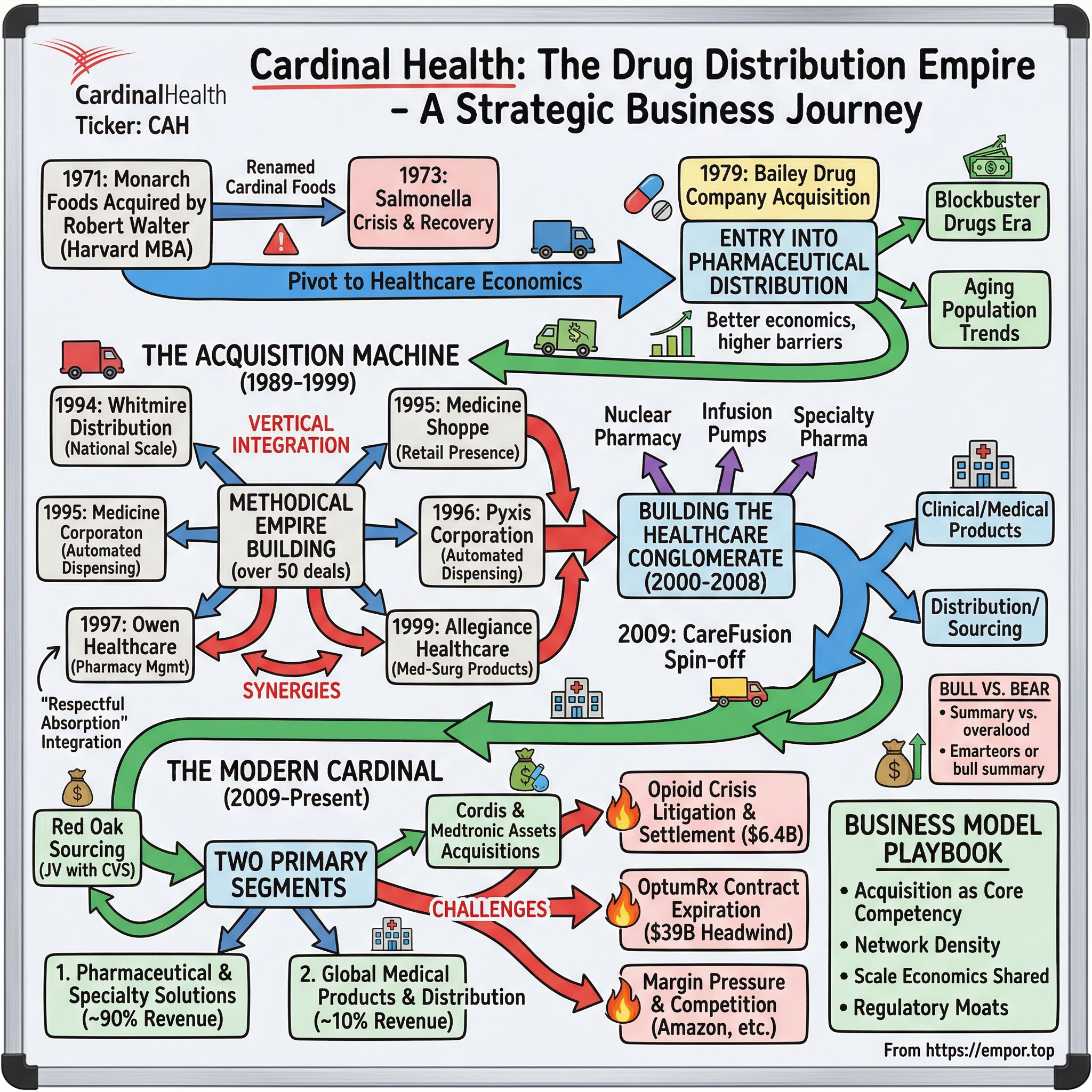
Cardinal Health: The Middleman's Quarter-Trillion-Dollar Empire
I. Introduction & Episode Roadmap
At 4:00 in the morning, inside an anonymous warehouse off an interstate in Ohio, Texas, or Georgia, a conveyor belt moves plastic totes past a wall of pick-to-light bins. Somewhere in that building sits a vault—caged and camera-monitored—holding Schedule II narcotics that cannot leave the premises without a serialized electronic record. By 7:00 a.m., a driver drops those totes at the back door of an independent strip-mall pharmacy. The pharmacist, who placed a single order the previous afternoon, receives every one of the several hundred different medications she needs for the day. She never sees an invoice from Pfizer, Teva, or Novo Nordisk. She sees one invoice from a single company.
That company, in fiscal 2026, moved $254.2 billion of goods—a 14% increase over the prior year—and kept roughly a penny and a half of operating profit on each dollar of revenue.1 Cardinal Health's non-GAAP operating earnings reached $3.6 billion on that revenue base, while its gross margin came in at $9.8 billion, or under four cents on the dollar.12 A grocery retailer would consider those economics catastrophic. Cardinal Health considers them its core business model.
Thin margins are survivable because margin is the wrong denominator. A distributor's returns stem from turning inventory many times a year against a small asset base largely financed by its suppliers. Earn one and a half cents on a dollar, turn that capital rapidly enough, and the return on capital actually at risk can be perfectly respectable. It is a business measured in velocity rather than markup—which is why the two metrics that matter most are how much volume flows through the network and how much of each dollar the counterparties on either side allow the distributor to keep.
The paradox at the center of this story is that thinness serves as the moat. A business generating a 1.4% operating margin on a quarter-trillion dollars of revenue is nearly impossible to attack, because there is no fat margin to undercut. It is also difficult to love, because a 1% swing in operating costs erases the entire profit pool. Everything critical about Cardinal Health—its origins, its missteps, and its current strategy—stems from the tension between those two structural realities.
Some scale markers clarify the sheer size of the operation. Cardinal employed approximately 63,900 people globally as of June 30, 2026, with roughly 18,100 working outside the United States and about 37,000 working across distribution centers, manufacturing facilities, and pharmacies.3 It operates manufacturing plants across ten countries outside the U.S., including Costa Rica, the Dominican Republic, Malta, Malaysia, and Thailand, while managing global operations from an owned headquarters at 7000 Cardinal Place in Dublin, Ohio.3 Its equity is held by roughly 5,598 shareholders of record—reflecting that institutional investors control nearly the entire float.3
The historical arc follows a clear pattern. A 25-year-old Harvard Business School graduate bought an Ohio grocery wholesaler in 1971, discovered that grocery wholesaling lacked defensible economics, and pivoted the same warehouse-and-truck model to pharmaceuticals.4 Over three decades of serial acquisitions, that business became one of three primary intermediaries standing between nearly every American drug manufacturer and every American pharmacy. Then management decided distribution scale could serve as a foundation for broader expansion, spending roughly $8 billion over a decade acquiring medical device and supply manufacturers—only to write off most of that capital. During the late 2010s, the company absorbed the legal and financial consequences of distributing prescription opioids at scale. In 2022, an activist fund stepped in. Since then, earnings per share have more than doubled, the stock has emerged as a top performer in American healthcare, and management has redeployed billions of dollars into a new strategy: acquiring and managing physician practices.
Three consensus claims worth testing before the story starts.
First, observers argue that losing the OptumRx contract in 2024 proved customer concentration does not matter. The episode proved a narrower, more precise reality: that low-margin volume matters little. Those are distinct claims, and the distinction becomes urgent considering Cardinal's distribution agreement with CVS Health—accounting for 28% of fiscal 2026 revenue—runs through June 30, 2027, with no renewal publicly announced as of this writing.35
Second, supporters claim activist intervention fixed the medical products segment. While the operational direction improved, the magnitude fell far short. At its June 2023 investor day, management set a segment profit target of "$650M+ in FY26" for Medical.6 By August 2024, management revised that fiscal 2026 target down to approximately $300 million.7 The segment ultimately delivered $258 million in fiscal 2026—and $100 million of that stemmed from a one-time tariff refund, leaving roughly $158 million in underlying profit compared to the original $650 million projection.12
Third, market narrative holds that Cardinal has evolved into a disciplined, tuck-in acquirer. Yet between December 2024 and November 2025, the company deployed approximately $7.2 billion in cash to acquire physician practice management platforms and a home-delivery diabetes supply provider.3 By the third quarter of fiscal 2026, Cardinal recorded a $184 million goodwill impairment on the first of those transactions.3
Ahead: Bob Walter's produce warehouse and the salmonella recall that prompted his pivot; the roll-up that created a triopoly and the conglomerate push that nearly undid it; a $1.944 billion medical device acquisition resold six years later for nearly half its purchase price; the Drug Enforcement Administration suspending a key Florida distribution center's license; a $6 billion opioid settlement that functions as an ongoing annual cash obligation; Elliott Management, Jason Hollar, and the fastest earnings growth in the company's modern history; the mechanics of how drug distribution generates returns; the strategic pivot into physician practice management; and the core catalysts that will determine whether the investment thesis holds.
One framing carries through the entire narrative. Cardinal Health has never faced a demand problem; prescription medication usage in the United States rises steadily every year, requiring a logistics pipeline. Instead, Cardinal faces a value capture challenge—the constant struggle of how much economic value a logistics middleman can retain when flanked by massive, highly sophisticated pharmaceutical manufacturers on one side and retail pharmacy giants on the other. Every strategic move in Cardinal's history, from Allegiance to Solaris Health, represents an attempt to solve that fundamental equation.
 Subscribe on LinkedIn
II. The Robert Walter Origin Story: Produce, Salmonella, & The Pivot (1971–1988)
Ten tons of prepackaged roast beef, contaminated with salmonella, pulled back off shelves and out of warehouses.8 That was one of the formative operating experiences of Cardinal's first decade, and it explains a foundational temperament. Robert D. Walter spent his early career learning that a distributor's entire franchise rests on the integrity of what moves through its buildings—and that the distributor, not the manufacturer, is left holding the bag when safety fails. Forty years later, the company would confront that same lesson on a far larger scale with prescription hydrocodone.
Walter was 25 years old and freshly out of Harvard Business School when, in 1971, he acquired Monarch Foods, a small grocery wholesaler in Columbus, Ohio, through a leveraged buyout.48 He renamed it Cardinal Foods—after the Ohio state bird and his high school mascot.4 The romance ended there. Regional grocery wholesaling in the 1970s was a business of trucks, loading docks, thin spreads, and retail customers who could cancel their contracts on 30 days' notice.
And leave they did. The structural problem Walter encountered was not local competitive intensity, but disintermediation from above: as supermarket chains consolidated through the 1970s, the larger regional operators built their own distribution centers and bypassed middlemen entirely. A regional wholesaler's scale advantage—buying at lower prices through higher volume—evaporates the moment a customer grows large enough to buy directly from food processors. This delivered the founder his first crucial business lesson: aggregating regional supply chains does not create durable scale economies if the customer can credibly self-supply. Walter concluded that the solution was not building a better grocery wholesaler, but moving a different product through the same delivery network.
That mechanism governs Cardinal's economics to this day. A distributor's gross margin represents the gap between what it pays suppliers and what it charges buyers, and that gap is capped by the customer's next-best alternative. If a customer can build its own warehouse, the distributor's markup cannot exceed the customer's internal cost of self-warehousing. If a customer cannot—because it lacks purchasing scale, or because the product requires specialized security and regulatory clearance—the distributor can retain a wider spread. Everything Cardinal has done since 1979 represents an effort to remain in the second scenario, while its primary long-term risk remains that major customers will grow into the first.
Pharmaceuticals provided the structural answer. Around 1979, Walter acquired the Bailey Drug Company, a small drug distributor in Zanesville, Ohio, about 60 miles east of Columbus.49 The purchase price went unrecorded in major financial registries, underscoring how small the operation was. Rechristened Cardinal Distribution, the business gained three advantages grocery lacked: prescription demand was growing steadily as the U.S. population aged and government health programs expanded; retail pharmacy was highly fragmented across tens of thousands of independent stores incapable of self-warehousing; and pharmaceutical handling required strict security, licensing, and record-keeping that supermarket chains could not easily replicate.
The macro timing aligned exceptionally well. The 1980s launched the modern era of branded pharmaceuticals, characterized by blockbuster drug launches, list price increases that outpaced inflation, and expanding third-party insurance coverage that shielded consumers from out-of-pocket costs. For an inventory-holding wholesaler, steadily rising list prices generated automatic inventory appreciation profits on goods already stored in the warehouse prior to the advent of modern fee-for-service contracts. Walter had positioned the business in a sector with structural tailwinds.
Public capital arrived in 1983, when Cardinal completed an initial public offering on the NASDAQ at a split-adjusted price of $1.03 per share.4 That single share would compound over the next 43 years into equity worth well over $200. Virtually none of that long-term value originated from the grocery distribution business Walter initially bought.
The public listing provided acquisition currency rather than corporate prestige. Walter deployed the proceeds to execute a systematic roll-up: buy regional distributors, consolidate their volume into Cardinal's distribution network, and leverage the lower cost structure to win larger accounts.8 Equity financing made distribution roll-ups economic whenever the acquirer's stock traded at a valuation premium to the private assets being acquired—a financial dynamic that drove growth for the next decade and a half, but eventually created pressures that culminated in an accounting scandal.
The decisive operational pivot occurred in 1988, when Walter sold Cardinal's original food distribution operations—Cardinal Foods, Midland Grocery, and Mr. Moneysworth—to Roundy's for $27 million.9 Despite divesting the core business that gave the company its name, Cardinal's total revenues grew by roughly a third that year.9 The pharmaceutical division had already eclipsed the founding enterprise. Walter had successfully converted a low-margin grocery wholesaler into a specialized healthcare distributor by recognizing that core logistics capabilities—bulk purchasing, break-bulk sorting, overnight delivery, and customer trade credit—were portable across product categories, even when the original category lacked defensible economics.
That divestiture required an unusual degree of strategic discipline. Walter sold his original business while it was still cash-flow positive because he recognized its underlying unit economics could not be fixed. Early exit from a deteriorating industry represents a rare form of capital allocation discipline. Decades later, subsequent management teams would face structurally similar challenges in medical products, taking years longer to reach the same conclusion.
Two enduring characteristics of modern Cardinal Health emerged from this formative era. The first was a permanent awareness that a customer's alternative options dictate the distributor's economic ceiling—making Cardinal's history a continuous effort to raise that ceiling. The second was a reliance on acquisitions as the primary engine of revenue growth, a strategy that reshaped the pharmaceutical supply chain when executed well, but nearly destroyed the company when applied without discipline.
III. The Acquisition Machine: Rolling Up Pharma & Conglomerate Expansion (1989–2008)
The arithmetic of the next 15 years illustrates the sheer velocity of the expansion. Cardinal's revenues stood at $429 million in 1986. They passed $1 billion in 1991, reached $7.8 billion by 1995, exceeded $25 billion by 2000, and hit $44.4 billion in 2002.9 That trajectory reflected a systematic consolidation engine rather than organic sales growth.
The logic of a distribution roll-up is straightforward, defining the structure of the modern industry. In wholesaling, unit costs fall as delivery density rises—more volume passing through the same warehouse, more stops along an existing truck route, and greater purchasing leverage with manufacturers. An acquirer can pay full market value for a competitor and still generate attractive returns because the combined entity operates on a lower cost base than the independent units. Repeat that process continuously, and the industry consolidates until only a handful of national operators can serve major healthcare accounts.
Cardinal executed that playbook repeatedly. The 1994 merger with Whitmire Distribution added more than $2.25 billion in annual sales along with western U.S. coverage, elevating Cardinal to the nation's third-largest drug distributor; that same year, the company adopted the name Cardinal Health, Inc.89 Then came a proposed transaction that would have consolidated the market even further.
While distributors were acquiring regional peers, their buyers were consolidating even faster—a reality rarely highlighted in investor presentations. Hospital systems merged into regional networks with centralized procurement offices, retail drug chains acquired independent pharmacies, and group purchasing organizations aggregated purchasing power across thousands of facilities. Every wave of supply-side consolidation was matched by a corresponding wave of buyer consolidation. As a result, distribution margins compressed steadily throughout the era even as total volume grew, with scale savings frequently passed along to buyers to win or retain accounts.
In 1998, Cardinal agreed to acquire Bergen Brunswig, the third-largest wholesaler, while industry leader McKesson agreed to buy fourth-ranked AmeriSource. The two deals would have reduced the four primary players to two. The Federal Trade Commission blocked the transactions, with William J. Baer, director of the FTC's Bureau of Competition, summarizing the competitive stakes: "These four companies are the nation's largest drug wholesalers. They provide critical overnight delivery of pharmaceuticals. If allowed to merge into two firms, the two surviving companies would control over 80 percent of the prescription drugs sold through wholesalers in the country."10 The FTC's regulatory filing detailed the core value proposition of wholesale distribution—enabling a retail pharmacist to place a single daily order with one distributor and receive next-morning delivery across hundreds of medication lines, eliminating the need to manage separate accounts with individual drug manufacturers.10 In July 1998, a federal district court enjoined both mergers, leading both parties to abandon their plans. The resulting "Big Three" market structure remains an enduring legacy of that court ruling, though Cardinal achieved further scale three years later by acquiring Indianapolis-based Bindley Western in 2001.9
What these acquisitions ultimately secured was prime vendor status—becoming the exclusive distributor through which a pharmacy or hospital system routes the vast majority of its purchasing, streamlining inventory workflows in exchange for volume commitments.3 Prime vendor agreements represent the primary mechanism for long-term customer retention in pharmaceutical wholesaling, available only to distributors offering comprehensive product lines and national logistics networks. Acquired entities like Whitmire and Bindley Western were valued not primarily for their standalone profits, but for the regional volume and coverage essential to securing prime vendor contracts.
With a national distribution network established, Cardinal's leadership sought to leverage its direct access to hospital pharmacy buyers by distributing higher-margin products through the same pipeline—the core thesis behind its expansion into a broader healthcare conglomerate. The commercial rationale held that if delivery trucks were already visiting hospital loading docks daily, Cardinal could sell those same institutions high-margin dispensing hardware and medical supplies.
Beginning in the mid-1990s, Cardinal executed that strategy through a series of major transactions. It acquired Pyxis, a prominent manufacturer of automated medication dispensing cabinets, in an $870 million stock swap in 1996; bought Houston-based hospital pharmacy manager Owen Healthcare in 1997; and added Allegiance, the largest medical-surgical distributor in the U.S., in 1999.89 By the mid-2000s, Cardinal operated across four distinct segments: drug wholesaling, medical supply manufacturing, hospital pharmacy management, and clinical hardware production.
The multi-segment strategy strained operational controls, manifesting first in financial reporting issues. In July 2007, Cardinal settled an SEC investigation into historical financial disclosures from fiscal years 2000 through 2004, paying a $35 million civil penalty, agreeing to retain an independent consultant, and consenting to an injunction against future securities violations.11 The company had previously restated earnings following an internal review in October 2004, subsequently replacing its chief financial officer, chief accounting officer, and controller, while establishing a chief ethics and compliance officer role.11
The structural lesson was clear: operating a high-volume business on a 1% margin while maintaining an aggressive acquisition narrative creates persistent pressure to meet earnings targets. When consolidated margins hover near 1% and reported growth depends on seamless acquisition integration, small adjustments in accounting judgment can significantly alter short-term financial performance. This dynamic underscores why investors in low-margin, serial-acquirer business models must scrutinize segment reporting and non-GAAP metrics—a discipline that remains directly applicable to Cardinal's financial reporting today.
Leadership changed during this period as Robert Walter stepped down as chief executive in April 2006, handing executive leadership to former Procter & Gamble executive R. Kerry Clark.
The appointment underscored the strategic shift. Walter built Cardinal through dealmaking and supply-chain execution; the board selected a consumer packaged goods executive whose background centered on brand management and end-consumer marketing. While aligned with a strategy focused on proprietary healthcare products, that executive profile differed sharply from the operational discipline required to run a low-margin, volume-driven distribution business. Over the next several years, Cardinal confronted the fundamental misalignment between its core wholesaling operations and its technology segments.
The conglomerate structure was eventually unwound on August 31, 2009, when Cardinal completed the spin-off of CareFusion—the clinical technology business housing Pyxis and the Alaris infusion platform. Cardinal distributed roughly 81% of CareFusion shares to shareholders (0.5 CareFusion shares for each Cardinal share) and retained approximately 41 million shares for divestment within five years, while George S. Barrett assumed the roles of chairman and chief executive officer of the remaining enterprise.12 Medical device manufacturer Becton, Dickinson later acquired CareFusion for $12.2 billion.
The outcome disproved the commercial synergy thesis. While management anticipated that hospital relationships would drive cross-selling across equipment and supply lines, medical technology required clinical sales reps, lengthy R&D development cycles, complex FDA oversight, and gross margins measured in tens of percent—operational demands fundamentally incompatible with a high-velocity logistics business measured in basis points. Combining both models under one corporate structure generated overhead costs rather than cross-selling efficiencies, making the spin-off a clear tactical reset.
The historic precedent remains highly relevant because Cardinal repeated a variation of the same diversification strategy in subsequent years.
Beyond operational complexity, the conglomerate era imposed substantial financial and corporate costs. Between the earnings restatement, SEC penalties, and associated shareholder litigation, the period concluded with a restructured balance sheet and an overhauled governance framework—including new financial leadership, a dedicated compliance infrastructure, and a board cautious of acquisition-driven growth narratives.11 That institutional experience established a backdrop that influenced activist investor engagement fourteen years later.
IV. The Medical Segment Misadventure: Cordis & Patient Care (2009–2021)
Following the spin-off of CareFusion, executive leadership sought new high-margin product categories to complement the core wholesaling footprint. On October 4, 2015, Cardinal Health closed its purchase of Cordis from Johnson & Johnson for $1.944 billion in cash.13 Cordis manufactured stents and catheters—interventional vascular devices used in hospital catheterization laboratories. Chief executive George Barrett framed the acquisition around favorable demographics, citing an aging population, rising demand for minimally invasive procedures, and health systems seeking cost-effective care.13 Management projected that the transaction would be slightly dilutive in fiscal 2016, become accretive by more than $0.20 per share in fiscal 2017, and generate over $100 million in annual synergies by the fiscal 2018 exit rate.13
Those financial projections failed to materialize. Cordis brought aging product lines into a competitive market where established rivals like Medtronic, Boston Scientific, and Abbott Laboratories were investing heavily in next-generation stent technology. Meanwhile, integrating a complex global manufacturing and supply chain footprint proved far more difficult than acquiring it. On August 2, 2021, Cardinal completed the sale of Cordis to private equity firm Hellman & Friedman for approximately $1 billion, with the buyer assuming specified liabilities while Cardinal retained certain working capital accounts.14 Then-chief executive Mike Kaufmann characterized the divestiture as demonstrating "our disciplined portfolio evaluation approach."14
Divestiture did not erase lingering liabilities. Selling a medical device unit does not transfer its historical product litigation. Cardinal retained liability for claims alleging personal injuries caused by Cordis OptEase and TrapEase inferior vena cava filters—small metal cages implanted in veins to catch blood clots. In April 2023, the company executed a settlement agreement that, subject to specified conditions, resolved approximately 4,375 filter claims for $275 million. Cardinal continued to carry an accrual for remaining claims, which stood at $29 million as of June 30, 2026—seventeen years after the devices were sold and five years after divesting the business.3
Even as Cordis struggled, Cardinal expanded its medical products commitment. In July 2017, the company completed the $6.1 billion acquisition of Medtronic's Patient Care, Deep Vein Thrombosis, and Nutritional Insufficiency businesses.[^15] The transaction added gloves, gowns, drapes, syringes, wound care, and fluid management lines that became the manufacturing core of the Global Medical Products and Distribution (GMPD) segment. Strategic logic dictated that manufacturing proprietary consumables under the Cardinal Health brand would transform a thin-margin distribution operation into a products business with defensible gross margins.
The decision to double down reflected broader industry pressures. Pharmaceutical distribution margins were flattening, retail buyer consolidation was accelerating, and executive leadership sought a secondary growth engine isolated from the pricing leverage of major pharmacy chains. While the strategic motivation was understandable, the execution proved flawed: Cardinal bought manufacturing capacity for commodity consumables and sold those items into the most price-disciplined procurement channel in American healthcare.
A severe global supply chain disruption exposed the structural flaws in this approach. Following the COVID-19 pandemic, input costs for medical consumables—including resins, nitrile, ocean freight, domestic transportation, and factory labor—spiked sharply and simultaneously. Cardinal's medical products were sold predominantly through multi-year contracts negotiated with hospital group purchasing organizations (GPOs), which treat standard consumable items as fungible commodities. When production costs rise while selling prices remain contractually fixed, a manufacturer possesses no pricing power—holding instead a fixed-price forward commitment on an unhedged basket of input costs.
The structure of hospital procurement reinforced this disadvantage. Health systems rarely negotiate purchases individually; instead, they buy through GPOs that aggregate volume across hundreds or thousands of member facilities to run competitive tenders on categories like exam gloves, surgical gowns, and intravenous sets. Cardinal's two largest GPO relationships, with Vizient and Premier, accounted for 29% of total company revenue across numerous contracts in fiscal 2026.3 Applying a corporate brand to standard medical supplies did not alter buyer behavior. Procurement committees evaluate specification-based tenders where the lowest compliant bid wins, limiting a distributor's ability to command premium pricing.
The resulting financial fallout unfolded across several fiscal cycles as cost inflation collided with fixed contract pricing. Inflation elevated manufacturing inputs in fiscal 2022 while selling prices remained capped, prompting Cardinal's largest single write-down. Fiscal 2023 represented the operational trough, as lower shipment volumes and unfavorable product mix compounded elevated operating costs. Fiscal 2024 brought relative cost stabilization alongside a third, smaller write-down.15 Three consecutive years of impairments reflected a progressive revaluation of the entire segment. Cardinal recorded pre-tax goodwill impairment charges in the GMPD segment of $2.1 billion in fiscal 2022, $1.2 billion in fiscal 2023, and $675 million in fiscal 2024.153 By March 31, 2024, the segment's goodwill balance was entirely eliminated.3 As of June 30, 2026, cumulative goodwill impairments against the GMPD segment reached $5.4 billion.3 At its fiscal 2023 trough, the division generated an operating loss of $147 million.7
Evaluated against the approximately $8 billion Cardinal invested to build its medical products division, the enterprise failed to validate the manufacturing moat thesis. Owning production facilities did not generate pricing power; instead, it transformed a variable-cost distribution business into a fixed-cost manufacturing operation vulnerable to input inflation and dependent on institutional buyers.
Impairments were not isolated to standard medical supplies. The Nuclear and Precision Health Solutions business carries an accumulated goodwill impairment of $829 million.3 Cardinal's history of acquiring adjacent health assets and subsequently writing down their valuation extends across multiple business units, illustrating the recurring risks of acquisition-led diversification.
Yet while the medical segment was consuming capital, a larger crisis was compounding within the core pharmaceutical division—a challenge that would ultimately carry financial and legal liabilities exceeding the cost of its failed acquisitions.
V. The Opioid Crisis & Legal Retribution (2014–2022)
In February 2012, the Drug Enforcement Administration (DEA) issued an order to show cause and immediately suspended the registration of Cardinal Health's Lakeland, Florida distribution center to distribute controlled substances, asserting that the company had failed to maintain required controls against diversion.16 For a distributor, a suspended controlled-substance registration is not merely a fine. It removes authorization to handle an entire product category from a specific facility—the regulatory equivalent of padlocking the vault.
That enforcement action followed prior regulatory scrutiny. In October 2008, Cardinal Health agreed to pay $34 million in civil penalties to settle allegations brought by seven U.S. Attorneys' offices that it failed to report suspicious orders of hydrocodone to the DEA, subsequently distributing those drugs to pharmacies filling illegitimate prescriptions from rogue internet websites. The Department of Justice stated that Cardinal's conduct "allowed the 'diversion' of millions of dosage units of hydrocodone from legitimate to non-legitimate channels."17 Cardinal operated 27 DEA-registered distribution facilities at the time.17
Legal exposure accumulated in layers that no single settlement could resolve. In 2018, New York passed an Opioid Stewardship Act establishing an annual surcharge on opioids sold or distributed within the state. Cardinal continues to disclose state opioid assessments as a recurring operating item, separating out in its non-GAAP reconciliations the portion of assessments that applies retrospectively to prior sales periods.3 Opioid liability ultimately evolved from isolated litigation into a permanent expense category encompassing federal civil penalties, state statutory assessments, multi-district litigation, third-party payor and hospital class actions, and municipal claims.
The underlying regulatory framework explains why distributors bore direct responsibility under federal law. Under the Controlled Substances Act, a distributor is not a passive delivery pipe. It holds a federal license that carries an affirmative obligation to design and maintain controls capable of detecting orders of unusual size, frequency, or pattern, and to report those suspicious orders to the DEA. A small-town pharmacy ordering hundreds of thousands of oxycodone tablets represents a red flag with a purchase order attached, not merely a high-volume account. The industry's long-standing implicit defense—that physicians prescribe, pharmacists dispense, and intermediaries bear no duty to question order patterns—directly conflicted with statutory obligations.
Regulatory and legal enforcement escalated over the following decade. In May 2012, Cardinal reached a settlement with the DEA resolving administrative actions against the Lakeland facility while leaving civil penalty exposure open. In December 2016, the company entered into comprehensive settlements with the Department of Justice covering Lakeland and other controlled substance investigations, including at its Kinray subsidiary. Cardinal agreed to pay $44 million in exchange for federal prosecutors and the DEA agreeing to forgo further administrative or civil actions related to those matters. In January 2017, without admitting liability, Cardinal paid $20 million to settle a separate lawsuit brought by the Attorney General of West Virginia.16
These enforcement actions preceded a much larger national resolution. In July 2021, Cardinal Health, McKesson, and AmerisourceBergen, alongside manufacturer Johnson & Johnson, announced a global settlement framework valued at approximately $26 billion to resolve claims brought by state and local governments.6 The National Opioid Settlement Agreement took effect on April 2, 2022, after 46 of 49 eligible states, the District of Columbia, all eligible U.S. territories, and more than 90% of participating political subdivisions joined the agreement. Cardinal's share of the settlement totaled $6.0 billion payable over 18 years—placing its financial obligation at the lower end of the initial $6.4 billion range.18 Beyond cash payments, the settlement imposed binding injunctive terms requiring the three major distributors to establish a joint data clearinghouse that aggregates order volumes across companies to assist state anti-diversion oversight.18
Four years after the agreement took effect, the financial obligation functions as a predictable, structured liability. During fiscal 2026, Cardinal made $417 million in total opioid-related payments, including its fifth annual settlement installment of $366 million, followed by a sixth annual payment of $374 million in July 2026. As of June 30, 2026, Cardinal carried an accrued liability of $4.3 billion, with payments scheduled through 2038.3 Measured against fiscal 2026 adjusted free cash flow of approximately $5.0 billion, an annual outlay near $370 million represents a manageable cash drain—accounting for roughly 8% of free cash flow on a fixed contractual schedule.13
The broader economic consequence of the settlement extends beyond cash flow to the industry's cost and compliance structure. Under the court-ordered injunctive relief, every major distributor must maintain automated order-monitoring algorithms, enhanced compliance governance, independent oversight, and comprehensive reporting systems. Cardinal explicitly notes in its risk disclosures that operating these compliance programs "may result in unforeseen costs or operational challenges."3 For an established distributor, those requirements represent a recurring operating expense. For a potential new entrant seeking to build a national pharmaceutical distribution network, they create a formidable regulatory barrier. The opioid litigation simultaneously penalized the incumbent distributors and further entrenched their collective market dominance.
Investors must also evaluate key accounting estimates governing these legal reserves. The $4.3 billion accrued liability reflects estimated future payments under settlement agreements, which management cautions "may differ from the payments that we have already made."3 Additionally, Cardinal maintains reserve estimates for unasserted claims across other matters, including remaining Cordis device litigation, which company disclosures describe as inherently unpredictable and highly subjective.3 Rather than signaling immediate risk, these disclosures confirm that the total legal liability on the balance sheet remains a modeled estimate subject to periodic revision.
By mid-2022, Cardinal Health presented a distinct financial profile: a resilient core pharmaceutical distribution franchise, a medical products segment generating substantial operational losses, a multi-billion-dollar long-term legal liability, and a stock price that had stagnated for years. That combination of strong cash generation and operational underperformance created the exact conditions for activist intervention.
VI. Activist Intervention & The Jason Hollar Turnaround (2022–Present)
Jason Hollar assumed the role of chief executive at Cardinal Health on September 1, 2022. Four days later, the company entered into a formal cooperation agreement with activist investor Elliott Management.
The terms were specific. Effective September 6, 2022, Cardinal appointed four independent directors: Steven K. Barg, Elliott's global head of engagement, alongside Michelle M. Brennan, Sujatha Chandrasekaran, and Christine A. Mundkur. The board also established a three-member Business Review Committee—chaired by Hollar alongside Barg and independent director Akhil Johri—to evaluate corporate strategy, portfolio structure, capital allocation, and core operations.19
That structural design proved notable. Rather than granting the activist control of a committee, the agreement gave Elliott a single seat on a body chaired by Cardinal's own chief executive. The arrangement ensured management maintained operational ownership while giving the activist direct oversight of strategic execution. The committee dissolved on July 15, 2024, returning ongoing governance responsibilities to the full board.7 Regulatory filings show that Elliott fully exited its Cardinal Health position in the fourth quarter of 2024.20
The operational shift under Hollar and Chief Financial Officer Aaron Alt reshaped both executive communication and financial reporting. Quarterly investor calls adopted a structured rhythm: a simplified organizational model, five operating segments each targeted for profit growth, a clear capital allocation framework, and specific guidance targets tracked against reported earnings. Alt summarized the fourth quarter of fiscal 2026 bluntly: "We did what we said we would do."2 While that summary accurately reflects the core distribution business over the four-year period, execution across other divisions presents a more complex record.
Measured by financial returns, the activist turnaround delivered strong headline growth. Non-GAAP diluted earnings per share expanded from $5.85 in fiscal 2023 to $7.53 in fiscal 2024,7 rising to $8.24 in fiscal 2025,21 and reaching $10.95 in fiscal 2026, excluding a one-time tariff benefit.1 Shareholder returns mirrored that earnings acceleration: a $100 investment in Cardinal Health stock on June 30, 2021, grew to $463.19 by June 30, 2026, compared to $187.50 for the S&P 500 Index over the same five-year window.3
Evaluating management requires examining the precise drivers of those earnings and determining whether initial strategic commitments were fulfilled. Across both dimensions, the performance record reveals distinct operational trade-offs.
The Medical Improvement Plan highlights substantial target-setting challenges. At its June 2023 investor day, management targeted Medical segment profit of $650 million or more by fiscal 2026, alongside preliminary fiscal 2024 guidance of approximately $400 million.6 Actual fiscal 2024 segment profit came in at $92 million.7 By August 2024, management reduced the fiscal 2026 profit target by more than half, to approximately $300 million.7 Fiscal 2025 guidance was narrowed downward during the year—to between $130 million and $140 million, down from an earlier range of $130 million to $150 million—22 with the segment ultimately delivering $135 million.21 Entering fiscal 2026, guidance was reset lower again to roughly $150 million.23 Although the segment reported $258 million in fiscal 2026 profit, $100 million of that total stemmed from non-recurring tariff refunds under the International Emergency Economic Powers Act;1 Alt confirmed to analysts that underlying fourth-quarter profit was $50 million and explicitly classified the tariff benefit as non-recurring.2 Segment guidance for fiscal 2027 stands at $200 million to $220 million, representing roughly $50 million in underlying growth above the adjusted base.1
In short, a business division projected to generate over $650 million in fiscal 2026 delivered approximately $158 million in underlying profit after two downward target revisions. Operational progress remains evident: the division rebounded from an operating loss of $147 million in fiscal 2023 to sustained profitability, supported by six consecutive quarters of mid-single-digit sales growth for U.S. Cardinal Health branded products alongside cost reductions.2 However, empirical results indicate that restructuring stabilized a low-return business rather than establishing the mid-sized profit engine originally promised to investors.
Earnings growth was primarily driven by core distribution and non-operating factors. Profit in the Pharmaceutical and Specialty Solutions segment rose 23% in fiscal 2026 to $2.783 billion, while the three smaller growth units in the Other reporting category expanded 37% to $707 million.3 Below the operating line, non-GAAP effective tax rates declined from 28.9% in fiscal 20247 to approximately 19% in fiscal 2026, while share repurchases reduced outstanding float—including $1.35 billion spent buying back stock in fiscal 2026 at an average price of $187 per share.2 While tax efficiency and share reductions expand earnings per share, they reflect financial engineering rather than structural competitive advantage; when analyst Kevin Caliendo questioned the sustainability of the tax rate on the fourth-quarter call, management confirmed the 19% to 20% range is expected to persist into fiscal 2027.2
The company demonstrated genuine operating leverage in its core operations. During the fourth quarter of fiscal 2026, gross profit expanded by 16% while consolidated selling, general, and administrative expenses grew by 9.5%—reflecting the network efficiency of a distribution business absorbing higher volume without a proportionate rise in operating overhead, even while funding automation investments and absorbing acquired operations.2 Wall Street analysts focused on the sustainability of those underlying drivers: Eric Coldwell analyzed medical brand revenue to test normalized growth trends, while Elizabeth Anderson questioned whether specialty earnings would transition from volume distribution toward higher-margin services as recent acquisitions were integrated.2 Both inquiries highlighted market focus on the underlying composition of long-term earnings growth.
Capital returns have increasingly shifted toward share repurchases over dividends. Cardinal paid dividends per share of $2.00 in fiscal 2024, $2.02 in fiscal 2025, and $2.04 in fiscal 2026—representing modest annual increases of roughly 1%—before raising the quarterly payout to $0.5158, or $2.06 annualized.3 While the annual dividend increase streak remains intact, share buybacks serve as the primary mechanism for returning capital to shareholders. In August 2026, the board approved a $5.0 billion increase in share repurchase authority, expanding total authorization to $6.4 billion.12
Executive compensation design aligns management incentives with relative market performance. Performance share units granted under executive plans vest from zero to 240% of target based on operational goals and Cardinal's total shareholder return relative to the S&P 500 Health Care Index.3 Benchmarking total shareholder return against a sector index establishes a more demanding performance hurdle than absolute earnings-per-share metrics, which can be inflated through share repurchases. A notable governance structure accompanies this framework: Cardinal maintains dual Class A and Class B common shares, with Class B shares carrying one-fifth of a vote per share on most corporate matters.3
Capital allocation discipline is confronting renewed scrutiny as acquisition spending accelerates. Despite management's emphasis on disciplined capital deployment, Cardinal invested $5.3 billion in acquisitions during fiscal 2025 and an additional $1.9 billion in fiscal 2026, financed in part by issuing $2.9 billion and $1.0 billion in new long-term debt, respectively; consequently, net interest expense surged 62% in fiscal 2026 to $348 million.3 Over the same period, unallocated corporate expenses rose from $634 million to $1.135 billion.3
That unallocated corporate expense line highlights the compounding costs of organizational complexity. Cardinal excludes restructuring, amortization, acquisition-related compensation, impairments, and litigation charges from segment reporting.3 As a result, segment profit—the metric highlighted in management guidance and market commentary—omits substantial transaction and integration expenses associated with the acquisition program. While total segment profit rose 29% in fiscal 2026 to $3.748 billion, consolidated GAAP operating earnings grew by a more modest 15% to $2.613 billion, widening the divergence between operational segment metrics and GAAP results.3 Furthermore, Cardinal recorded a $184 million pre-tax goodwill impairment on the Navista and Integrated Oncology Network reporting unit in fiscal 2026, alongside a $122 million impairment on its retained 16% equity stake in Outcomes—a pharmacy software business merged into Transaction Data Systems and partially divested in fiscal 2024.3 Recording two impairments in a single fiscal year on recent capital deployments underscores the ongoing execution risks of acquisition-led growth.
The operational record presents a clear portrait of management: effective operators of the core distribution network, disciplined cost and tax managers, and reliable executioners of share repurchases, but less accurate in projecting performance within the medical segment. The ultimate test of this leadership team lies in the execution of its largest recent capital commitments.
VII. Core Business Economics: The Big Three Oligopoly & Segment Deep Dive
Start with the scale of the enterprise. In their most recently reported fiscal years, McKesson generated consolidated revenues of $403.4 billion, Cencora brought in $321.3 billion, and Cardinal Health reached $254.2 billion—moving roughly $979 billion of pharmaceutical distribution volume across just three companies.24251 These three intermediaries sit between nearly every drug manufacturer selling in the United States and virtually every setting where a prescription is filled. Cardinal's own annual filing lists its national-reach competitors as precisely two names: McKesson and Cencora.3
The margins reveal how the business actually functions. McKesson earned $6.5 billion in operating profit on its $403.4 billion in revenue, or about 1.6%.24 Cencora generated $4.2 billion in adjusted operating income on $321.3 billion, roughly 1.3%.25 Cardinal's non-GAAP operating earnings came in at 1.4% of revenue.1 Three companies, three distinct executive teams, three decades of independent corporate strategies—yet operating margins land within thirty basis points of one another. That structural convergence indicates that industry economics are dictated far more by market design than by individual execution.
How a distributor actually makes money. Two distinct business models operate within the same physical warehouse. The first involves branded pharmaceuticals: high-cost, patent-protected drugs where the distributor purchases inventory at a published wholesale acquisition cost and receives compensation primarily through fee-for-service agreements with manufacturers. In this channel, the distributor acts as a logistics manager and short-term financier, earning minimal pricing spread while generating massive top-line revenue relative to net profit. The second model centers on generic drugs: low-cost medications where multiple manufacturers compete to supply the same molecule. Here, the distributor negotiates aggressive bulk purchasing rates and resells to pharmacies at a wider margin spread. While generic sales yield smaller total dollars, they deliver significantly higher profitability per unit. This distinction explains Wall Street's focus on "brand-to-generic conversion"—when a blockbuster medication loses patent exclusivity, distributor revenue contracts while gross profit expands. Chief Financial Officer Aaron Alt underscored this dynamic during the fourth-quarter fiscal 2026 call, stating that management naturally prefers the profitability associated with generic conversions.2
The branded channel requires additional examination, as it accounts for the largest revenue volumes and the thinnest percentage margins. Cardinal earns compensation from branded manufacturers primarily through distribution service agreements—negotiated fees for specified operational services including inventory handling, reporting analytics, launch support, and chargeback administration.3 Chargebacks represent the most operationally demanding of these processes: a manufacturer establishes a baseline list price but negotiates lower net prices with hospitals, clinics, and government buyers. The distributor sells the product at the customer's negotiated rate and subsequently reclaims the price differential from the manufacturer. Managing chargebacks across hundreds of billions of dollars in transaction volume presents a major operational compliance risk, while precise execution serves as an essential core capability. Because fee-for-service contracts dominate this segment, growth in branded drug volume expands top-line revenue far faster than it expands net earnings.
A third economic driver remains absent from traditional margin calculations: working capital float. Because distributors typically collect payments from pharmacies faster than they settle invoices with drug manufacturers, supplier capital effectively finances the balance sheet. Cardinal generated $5.2 billion in operating cash flow in fiscal 2026—more than double its GAAP operating earnings—while reporting a total shareholders' deficit of $2.7 billion.3 Negative book equity for an enterprise generating over $5 billion in cash flow does not indicate financial distress; rather, it reflects decades of equity repurchases supported by negative working capital cycles.
Red Oak, and what it costs. Because generic pharmaceuticals generate the bulk of segment profit, procurement scale serves as a central competitive requirement. In December 2013, CVS Caremark and Cardinal announced Red Oak Sourcing, a 50/50 joint venture that became operational on July 1, 2014, with an initial 10-year term to negotiate generic supply contracts for both parent companies.26 The venture required minimal capital expenditure and no physical infrastructure, leveraging the combined purchasing power of the largest U.S. pharmacy chain and a major distributor to secure lower pricing from generic manufacturers. However, access to that purchasing volume carries a substantial price tag: Cardinal agreed to pay CVS $25 million per quarter over the venture's duration—an estimated after-tax present value of $435 million at announcement—and annual disclosures confirm that these quarterly payments remain ongoing.263 Cardinal amended the agreement in August 2021 to extend the joint venture through June 2029.3 That financial structure clarifies the balance of power within the supply chain: Cardinal pays approximately $100 million annually to its primary customer to maintain shared generic purchasing scale.
The two companies subsequently extended this collaborative model to biologic therapeutics. Announced in 2024, Averon—a joint venture between CVS Health and Cardinal Health—focuses on sourcing biosimilars, which are close copies of biologic drugs that enter the market following patent expirations and operate economically like generic drugs.7 Biosimilar adoption represents a significant opportunity for margin expansion because it shifts purchasing volume from low-margin branded service fees into higher-margin distribution spreads. However, market adoption has frequently trailed management forecasts, as legacy rebate structures in the branded channel often incentivize pharmacy benefit managers and intermediaries to favor higher-list-price original biologics over lower-cost biosimilar alternatives.
Concentration, and the OptumRx experiment. Cardinal maintains an exceptionally concentrated customer and supplier network. CVS Health accounted for 28% of fiscal 2026 revenue and 22% of gross trade receivables, while Cardinal's five largest customers combined generated 43% of total revenue; additionally, sales to hospital members of two primary group purchasing organizations, Vizient and Premier, represented 29% of total revenue.3 Supply channels mirror this concentration, with the top five drug manufacturers accounting for 39% of revenue and the single largest supplier generating 13%.3
This concentration created a real-world test when OptumRx—which accounted for 17% of Cardinal's fiscal 2024 revenue, or roughly $39 billion—allowed its pharmaceutical distribution contracts to expire at the end of June 2024 without renewal.3 Standard concentration-risk analysis suggests that losing a sixth of total corporate revenue would severely impair operating performance.
The financial results proved otherwise. Fiscal 2025 consolidated revenue declined by only 2% to $222.6 billion as new customer volume partially offset the loss, while Pharmaceutical segment revenue fell 3% to $204.6 billion. Crucially, Pharmaceutical segment profit rose 12% to $2.3 billion, and consolidated non-GAAP earnings per share grew 9%.21 Company disclosures explained the underlying dynamic: sales to OptumRx involved high-volume, low-margin mail-order business that generated margins substantially below the segment average.3 In practice, Cardinal had been deploying logistics capacity and working capital at near-breakeven rates.
The speed of that volume recovery provides evidence regarding national distribution capacity. By the second quarter of fiscal 2026, Cardinal reported a 19% increase in consolidated revenue to $65.6 billion, with Pharmaceutical segment revenue also rising 19%, driven by brand and specialty expansion among existing and new accounts.23 Eighteen months after shedding a sixth of its top-line volume, the enterprise was expanding faster than prior to the contract expiration. This trajectory supports the premise that national pharmaceutical distribution infrastructure is scarce and rapidly reallocated, countering arguments that Cardinal faced structural market share loss.
The critical takeaway is not that customer concentration is irrelevant, but that margin density dictates economic impact while top-line volume remains secondary. This distinction reframes customer risk rather than eliminating it. Unlike the OptumRx contract, the CVS relationship encompasses core retail distribution at standard margins, combined with Red Oak procurement, the Averon biosimilar joint venture, and an over-the-counter product partnership.2 The primary distribution agreement extends through June 30, 2027.5 Addressing the CVS contract on the fourth-quarter call, Chief Executive Jason Hollar highlighted the breadth of the partnership, noting that several strategic initiatives extend beyond the expiration date of the distribution agreement while emphasizing that a distributor's 1% margin model reflects a fundamentally different operational role than that of a retail pharmacy.2 Chief Financial Officer Aaron Alt added that fiscal 2027 guidance assumes a consistent book of business.2
The resulting segment breakdown highlights Cardinal's profit structure: in fiscal 2026, Pharmaceutical and Specialty Solutions generated $234.8 billion in revenue and $2.783 billion in segment profit; Global Medical Products and Distribution delivered $12.7 billion in revenue and $258 million in profit; while the Other category—comprising Nuclear and Precision Health Solutions, at-Home Solutions, and OptiFreight Logistics—produced $6.8 billion in revenue and $707 million in profit.13 That final division represents 2.7% of consolidated revenue but generates approximately 19% of total segment profit, indicating that the portfolio mix shift driving margin expansion is concentrated within the company's smallest business units.
Within that group, OptiFreight Logistics represents a distinct asset model. Rather than holding inventory, OptiFreight manages freight logistics and shipping operations for healthcare providers, deriving fee income by optimizing third-party transportation expenditures.3 The business operates with minimal capital and inventory requirements, expanding alongside logistics complexity rather than pharmaceutical volume. In an enterprise where most revenue streams require substantial working capital, a fee-based logistics management service provides high-margin cash flow, demonstrating that Cardinal's profit composition is far more diversified than its top-line revenue figures imply.
VIII. Hidden & Future Optionality: Specialty Networks & at-Home Solutions
A community oncology practice in Tennessee presents a very different operational challenge than a traditional wholesale warehouse. It is a medical business defined by high-value chemotherapy inventory, payer reimbursement mix, physician retention, and administrative overhead that a small practice struggles to manage independently. Cardinal Health's most consequential strategic shift over the past three years has been its bet on acquiring and operating the management service platforms behind those clinical practices.
The strategic rationale reflects a fundamental shift in drug spending. Specialty pharmaceuticals—spanning oncology, rheumatology, immunology, and cell and gene therapies—are high-cost treatments that often require refrigeration or cryogenic handling, alongside complex patient support and reimbursement navigation administered in physician offices rather than retail pharmacies. For a distributor, these specialized therapies yield higher service fees, technical barriers to entry, and stickier customer relationships. Cardinal's specialty revenue grew by more than 25% in fiscal 2026.2
Cardinal began acquiring practice infrastructure in January 2024, agreeing to buy Specialty Networks for $1.2 billion in cash—a multi-specialty platform of group purchasing organizations across gastroenterology, urology, and rheumatology serving over 11,000 providers, alongside clinical research and data analytics capabilities.27 The transaction represented an aggregation of independent physician networks and clinical data rather than a traditional logistics asset.
Acquisitions accelerated sharply over the subsequent two years. Cardinal acquired Integrated Oncology Network in December 2024 for $1.1 billion; a 73% stake in gastroenterology platform GI Alliance in January 2025 for approximately $2.8 billion; Advanced Diabetes Supply Group in April 2025 for approximately $1.0 billion; Urology America in May 2025 for $381 million in cash and equity; and urology management organization Solaris Health in November 2025 for approximately $1.9 billion in cash.3 Management consolidated these practice platforms into two primary structures: The Specialty Alliance, a multi-specialty management services organization in which Cardinal holds roughly a 76% stake, and Navista, its oncology practice alliance.3
In total, Cardinal deployed approximately $7.2 billion in cash across those transactions in under twelve months, on top of the $1.2 billion paid for Specialty Networks. That capital commitment matched the scale of the company's 2015–2017 medical products expansion, but was executed in a fraction of the time.
The most technically demanding specialty segment involves cell and gene therapies. Unlike standard pharmaceuticals, these treatments require personalized logistics: a patient's cells are extracted, frozen, transported to a manufacturing facility, re-engineered, and returned for administration under strict chain-of-custody protocols. Cardinal built specialized third-party logistics capabilities for these therapies, with Chief Executive Jason Hollar reporting that the company exclusively services nearly half of the cell and gene therapy market and supports roughly three-quarters of total market volume, alongside signing two commercialization agreements for therapies expected to reach market in fiscal 2028.2 Management also set a target of roughly $1 billion in Biopharma Solutions revenue by fiscal 2028.2 These forward targets reflect commercial ambitions that remain to be validated in reported financial results.
The at-Home Solutions segment presents a simpler, recurring delivery model. Operating through Edgepark and the acquired Advanced Diabetes Supply platform, the unit delivers medical supplies—including continuous glucose monitors, diabetes test strips, ostomy care, and wound care products—directly to patients managing chronic conditions, billing insurers and Medicare directly. The economics generate recurring demand as patients reorder supplies indefinitely. Management reported a 99% fill rate and record on-time shipping performance in the fourth quarter of fiscal 2026, noting that integration synergies for Advanced Diabetes Supply were running ahead of schedule.2 The segment also launched its ContinuCare Pathway program and formed a supply partnership with Publix Super Markets.23
A third growth driver operates alongside specialty distribution. The Nuclear and Precision Health Solutions division operates radiopharmacies and manufacturing facilities producing radioactive diagnostic and therapeutic agents—including contract manufacturing for Xofigo and distribution rights for the imaging agent Lymphoseek—supporting nuclear imaging and theranostics, where targeted molecules identify and treat tumors.3 Cardinal chose to retain and invest in the division after evaluating strategic options in 2023, committing additional capital to its Center for Theranostics Advancement.6 However, the business retains an accumulated pre-tax goodwill impairment of $829 million from prior write-downs, underscoring that current growth assets can carry historical capital losses.3
The rapid pace of practice management acquisitions quickly encountered financial headwinds. In the third quarter of fiscal 2026—fifteen months after closing the Integrated Oncology Network deal—Cardinal recorded a $184 million pre-tax goodwill impairment on its Navista and ION reporting unit. Management cited "changes in the risk profile of the business plans, resulting in an increase in the discount rate" to reflect revised operating assumptions and base financial performance.3 In practice, the unit underperformed its original acquisition targets, reducing the recognized asset value on Cardinal's balance sheet.
Regulatory scrutiny has also emerged. In November 2023, Cardinal received a Civil Investigative Demand from the U.S. Department of Justice examining potential violations of the Anti-Kickback Statute and False Claims Act related to a 2022 transaction involving a group purchasing organization and a minority stake in a rheumatology managed services organization.3 Because federal anti-kickback laws prohibit financial arrangements that could influence prescribing decisions, combining drug distribution with physician practice management introduces heightened compliance risks.
Policy shifts present additional operational headwinds. Proposed reforms to the 340B drug pricing program could modify eligibility standards and discount flows for hospitals and clinics, directly affecting practice economics. Meanwhile, drug price negotiations under the Inflation Reduction Act have begun impacting wholesale acquisition costs, which management estimated as a 500-basis-point top-line headwind for the Pharmaceutical segment, while projecting no adverse impact on fiscal 2027 segment profit.2 Direct ownership of physician practices exposes Cardinal to reimbursement and regulatory shifts that previously affected only its pharmacy and hospital customers.
These developments highlight three broader analytical considerations. First, acquiring physician practice managers represents a strategic expansion into clinical management with distinct operating risks—including physician compensation, payer negotiations, 340B legislative exposure, and minority partner alignment. Analyst Lisa Gill raised these regulatory dynamics during the fourth-quarter earnings call, inquiring about 340B reform impacts on health system clients.2 Second, the strategy is shared across the distributor oligopoly: McKesson expanded its oncology and multispecialty segment sales by 31% to $48.4 billion in fiscal 2026, while Cencora cited its January 2025 acquisition of Retina Consultants of America as a key driver of fiscal 2025 performance.2425 Competing for similar practice assets risks inflating purchase prices and diluting strategic differentiation. Third, the long-term returns of physician practice management platforms remain unproven, with early write-downs already on record.
The performance of the specialty strategy will be measured against near-term financial targets. Management projected Pharmaceutical segment profit growth of 8% to 11% in fiscal 2027, with announced acquisitions expected to contribute 2 to 3 percentage points of that expansion.2 The key test for investors will be whether organic growth meets targets without requiring additional impairment charges.
IX. Competitive Moat & Strategic Frameworks (7 Powers & 5 Forces)
Consider a hypothetical scenario: suppose a well-capitalized competitor decided to challenge the Big Three for national pharmaceutical distribution. What capabilities would an entrant need, and where would the effort break down?
Scale economies serve as the primary barrier to entry, driven by fixed warehouse automation, high route density, and massive purchasing leverage. Applying Hamilton Helmer's framework at the individual firm level reveals a key nuance: Cardinal is the smallest of the three major distributors by revenue.24251 Relative scale is therefore an industry-wide barrier that protects Cardinal rather than a unique competitive advantage over its immediate peers. To offset this relative disadvantage in generic purchasing, Cardinal relies on Red Oak Sourcing to pool volume with CVS Health—a structural arrangement under contract through June 2029.
Switching costs are moderate and easily overstated. Recent history demonstrates that major accounts remain mobile: OptumRx departed in 2024, taking 17% of Cardinal's top-line revenue, illustrating that large buyers can migrate when terms dictate. Conversely, Cardinal secured a long-term extension with Kroger during fiscal 2026 and announced a renewal with the largest customer in its medical products segment.2 Deep operational integration—encompassing ordering software, inventory tracking, chargeback administration, and automated replenishment—increases friction and switching expense, but does not lock in large buyers when economic incentives shift.
A secondary competitive threat mirrors the disintermediation that pushed Robert Walter out of grocery wholesaling decades earlier. Cardinal's annual disclosures explicitly list self-warehousing retail chains and customers developing internal supply management capabilities among its competitors.3 Major pharmacy chains already handle a portion of their own warehousing, demonstrating that customer self-supply remains an ongoing structural ceiling on distributor pricing power rather than a speculative threat.
Process power represents Cardinal's most durable and difficult-to-replicate operational asset. Operating high-security controlled-substance vaults under DEA oversight, executing serialized unit-level tracking under the Drug Supply Chain Security Act, managing cold-chain and cryogenic logistics for cell therapies, and delivering orders by early morning requires deep institutional infrastructure rather than simple capital deployment.3[^29] Maintaining these operational standards across a network requires substantial human capital; Cardinal employed approximately 63,900 people globally as of June 30, 2026, including roughly 37,000 working across distribution centers, manufacturing plants, and pharmacy locations.3
The complexity of compliance under the Drug Supply Chain Security Act illustrates the height of this operational barrier. The statute mandates national standards requiring prescription drugs to be labeled and traced at the individual package level to detect counterfeit, stolen, diverted, or adulterated inventory.3[^29] Executing this requirement obligates distributors to attach unique identifiers to every saleable unit, maintain interoperable electronic ownership records across ownership transfers, and operate rapid quarantine protocols for suspect items. Constructing this infrastructure across hundreds of thousands of product lines and tens of thousands of retail partners requires years of systems integration—a capital commitment unlikely to yield returns for a new market entrant operating on thin distribution margins.
Counter-positioning and cornered resources are virtually absent across the sector. Incumbents can readily replicate emerging distribution models, and no player possesses a unique proprietary asset, aside from contractual arrangements like Red Oak.
An additional competitive vector exists where Cardinal operates simultaneously as a provider and a competitor. Company filings identify third-party logistics (3PL) providers and specialty distributors as competitive threats, even as Cardinal operates its own 3PL division for manufacturers.3 For pharmaceutical companies launching specialized therapeutics, contracting directly with a 3PL to handle logistics offers an alternative to wholesale distribution. While 3PL fee-for-service arrangements represent a minor share of overall market volume, the model is expanding within high-margin specialty categories.
Evaluated under Porter's Five Forces framework, buyer power is the defining structural force and remains exceptionally high. With a single customer accounting for 28% of fiscal 2026 revenue and two group purchasing organizations representing an additional 29%, pricing terms are determined by a small group of institutional buyers.3 Supplier power is strong and asymmetric: branded drug manufacturers establish wholesale acquisition costs and set fee-for-service terms, while generic producers face consolidated buyer counterweights like Red Oak. Threat of new entrants is extremely low, constrained by high capital requirements, thin operating margins, complex state licensing, DEA controlled-substance oversight, DSCSA track-and-trace rules, and mandatory anti-diversion compliance frameworks. Although technology-focused firms have attempted to re-engineer pharmacy fulfillment, none have displaced the core wholesale distribution architecture.
The limits of technological disruption explain why software platforms have not disintermediated wholesale distribution. Software optimizes ordering, matching, and price discovery, but information management is not the binding constraint in drug logistics. The true operational bottlenecks involve licensed physical infrastructure, DEA-monitored controlled-substance vaults, specialized cold-chain and cryogenic facilities, unit-level serialization, and the balance-sheet capacity to finance trade credit for thousands of retail pharmacies. Competing for distribution contracts yielding a 1.4% operating margin requires replicating this physical and regulatory architecture at national scale—an economically unappealing proposition for tech-focused entrants. Threat of substitutes remains low but persistent. Cardinal's disclosures note that the company competes directly with manufacturers distributing products straight to end customers.3 While direct-to-patient shipping channels have expanded for select high-value therapies, the core economics of daily, multi-item replenishment across tens of thousands of pharmacies continue to favor centralized wholesale networks.
In sum, pharmaceutical wholesaling remains a structurally protected oligopoly where Cardinal occupies the third-largest position by volume. The primary determinant of long-term investor returns is not defending the market against outside entrants, but managing the economic split between major drug manufacturers and consolidated retail buyers.
X. Bull vs. Bear Case & Stress Test
The bull case, stated at the strength the evidence supports.
First, the core pharmaceutical business is performing strongly. Fiscal 2026 revenue expanded 14% while Pharmaceutical segment profit grew 23%, driven by branded and specialty volume, generic program execution, and recent acquisitions. Management noted that fourth-quarter top-line performance absorbed two roughly offsetting factors: a GLP-1 demand tailwind and wholesale acquisition cost reductions under the Inflation Reduction Act, each representing about 500 basis points of revenue.32 Underlying prescription demand remains demographic and non-discretionary.
Second, the portfolio mix is shifting toward higher-margin operations. Segment profit across the three units in the Other reporting category expanded 37% in fiscal 2026, with management guiding to 15% to 18% profit growth in fiscal 2027, while specialty revenue grew more than 25%.12 Management's long-term targets—reconfirmed at its June 2025 investor day and in August 2026—project 12% to 14% annual non-GAAP earnings-per-share growth, with fiscal 2027 guidance set above that trend at 13% to 15%, or $12.40 to $12.60 per share.281
Third, cash generation remains substantial, supporting direct capital returns to shareholders. Cardinal generated $5.0 billion in adjusted free cash flow in fiscal 2026, repurchased $1.35 billion in shares, expanded total buyback authorization to $6.4 billion, and planned roughly $1.0 billion in fiscal 2027 share repurchases against approximately $700 million in capital expenditures.12
Fourth, balance sheet liquidity has been restructured to support operations. Cardinal closed fiscal 2026 with $4.9 billion in cash, reached its targeted leverage ratio, and on August 7, 2026, consolidated three legacy credit agreements into a single $4.0 billion, five-year revolving credit facility expiring in August 2031.23 For an enterprise financed substantially through supplier payables, committed liquidity of this magnitude acts primarily as protection against working-capital disruptions rather than speculative expansion capital.
The bear case, and the activist's questions.
The customer contract renewal timeline presents immediate concentration risk. The primary distribution agreement with CVS Health runs through June 30, 2027.5 Accountable for 28% of total revenue, CVS operates as a joint venture partner and the largest domestic pharmacy chain. The agreement faces renegotiation within ten months, with no renewal publicly announced. Meanwhile, the Red Oak Sourcing agreement extends through June 2029. Management's fiscal 2027 guidance explicitly assumes a stable customer base, even though the expiration of the OptumRx contract demonstrated that major accounts can depart.2 The upcoming renewal window represents a critical operational pivot for the firm's medium-term earnings trajectory.
Fiscal 2026 performance flatters baseline growth expectations. While consolidated revenue expanded 14% in fiscal 2026, Pharmaceutical segment revenue growth is guided to moderate to between 3% and 5% in fiscal 2027. Management characterized this deceleration as a return to normalized demand following periodic spikes in fiscal 2026, compounded by wholesale acquisition price headwinds resulting from Inflation Reduction Act implementation.2 Consequently, extrapolating fiscal 2026 top-line expansion across future periods misstates normalized baseline growth.
The divergence between GAAP and non-GAAP earnings merits close inspection. Cardinal excluded $1.16 per share in acquisition-related cash and share-based compensation costs from non-GAAP earnings in fiscal 2026, up from $0.51 per share in fiscal 2025, alongside $1.47 per share in intangible amortization and transaction expenses.3 These items reflect tangible capital outlays tied to practice platform acquisitions. Diluted GAAP earnings per share reached $7.23 compared to reported non-GAAP earnings of $11.26—a spread exceeding $4.00 per share.13 This widening gap highlights how recurring transaction expenses reduce reported net income relative to adjusted operational metrics.
The medical products segment continues to yield low operating returns. At the midpoint of fiscal 2027 guidance—approximately $210 million in profit on roughly $13 billion in revenue—the Global Medical Products and Distribution segment projects an operating margin of roughly 1.6%, following $5.4 billion in cumulative goodwill write-downs.3 Meanwhile, peer McKesson has pursued a strategic separation of its Medical-Surgical Solutions business.24 The structural contrast raises ongoing governance questions regarding whether retaining low-margin medical supply manufacturing alongside wholesale distribution serves long-term capital efficiency.
The practice management strategy combines operational, financial, and regulatory complexities. The rapid expansion into physician practice management introduces multiple risk vectors: elevated financial leverage, with long-term obligations of $7.0 billion and annual net interest expense up 62%; governance friction across a 76%-owned multi-specialty platform with minority physician partners; regulatory scrutiny under an open Department of Justice Civil Investigative Demand into anti-kickback and false claims compliance; policy sensitivity surrounding 340B drug pricing and Inflation Reduction Act provisions; and an early $184 million goodwill impairment on acquired platforms.3
Input cost volatility and geopolitical instability threaten thin segment margins. Chief Financial Officer Aaron Alt advised analysts that fiscal 2027 guidance incorporates a modest tariff refund benefit to offset elevated fuel and commodity expenses, noting that potential geopolitical escalation in the Middle East could push medical segment profit toward the lower end of guidance.2 For a division operating on thin single-digit margins, small shifts in transportation or material costs directly alter segment performance.
Generic price deflation remains a persistent risk to gross margin stability. Cardinal's annual risk disclosures note that competitive and pricing pressures across generic pharmaceuticals have historically reduced earnings, occasionally offsetting the purchasing benefits achieved through Red Oak Sourcing.3 Because generic margin spreads generate a substantial portion of pharmaceutical segment profit, systemic price deflation across generic molecules directly compresses overall profitability.
Management has provided investors with a specific near-term performance benchmark. Alt projected first-quarter fiscal 2027 medical segment profit at roughly half the prior-year period's level due to foreign currency headwinds and customer purchasing timing, with year-over-year growth expected to resume in subsequent quarters, backloading profit realization into the fourth quarter.2 Back-half-weighted operational guidance increases execution risk, making third-quarter results a critical test of the division's fiscal 2027 turnaround trajectory.
In summary, while Cardinal's core pharmaceutical distribution network maintains strong operational momentum, its long-term performance remains tightly bound to customer concentration risks—most notably the upcoming CVS contract renewal—and the financial returns on more than $8 billion in capital deployed into physician practice management platforms.
XI. Playbook: Key Lessons & Forward KPIs
Volume is vanity; margin density is sanity. The OptumRx contract expiration stands as a clear natural experiment in modern distribution economics: Cardinal lost roughly $39 billion in annual top-line revenue yet earned more money in subsequent periods. The generalizable lesson across intermediation businesses is that revenue measures throughput rather than value creation. An analyst's primary job is to determine what each dollar of top-line revenue actually delivers in gross profit.
Adjacency is not synergy. Cardinal has now run variations of the same diversification experiment twice at scale—first with Pyxis and Allegiance in the 1990s, and later with Cordis and the Medtronic Patient Care portfolio in the 2010s. Both attempts demonstrated that sharing a healthcare customer relationship is not the same as operating a compatible business model. After deploying roughly $8 billion into medical products, Cardinal has written off $5.4 billion in cumulative Global Medical Products and Distribution goodwill.3 Whether recent physician practice platform acquisitions represent a third iteration of that same error or a genuine extension of the specialty distribution franchise remains an open strategic question.
Activists can act as catalysts without guaranteeing operational outcomes. Elliott Management's engagement coincided with governance reform, tighter cost discipline, portfolio focus, and a quadrupling of Cardinal's total shareholder return over five years.3 However, that intervention did not produce the Medical segment earnings originally promised. Both observations hold true, and both should inform how investors evaluate future management targets.
Targets reflect a disclosure choice with distinct segment patterns. Management consistently met or exceeded core distribution guidance through fiscal 2025 and fiscal 2026. Conversely, Medical segment guidance was repeatedly reduced over three consecutive fiscal years. Investors should weight forward projections across the two divisions accordingly.
Segment definitions require scrutiny before evaluating headline profit metrics. Cardinal's segment profit calculation excludes restructuring expenses, intangible amortization, acquisition-related compensation, impairments, and litigation costs, while its non-GAAP earnings omit a further list of expenses that grew materially in fiscal 2026.3 While standard across peer distributor disclosures, set-aside expenses in a business earning roughly a penny and a half on the dollar can easily exceed reported operating profit—making the financial reconciliation table, rather than the headline figure, the primary document for analysis.
The KPIs that matter. Evaluating Cardinal's performance centers on three primary metrics.
First: Pharmaceutical and Specialty Solutions segment profit growth, isolated from acquisition contributions. Management disclosed that announced acquisitions are expected to add 2 to 3 percentage points to the 8% to 11% segment profit growth guidance for fiscal 2027.2 Isolating organic profit growth reveals whether the core wholesale franchise and specialty strategy are compounding naturally or relying on purchased top-line volume.
Second: Medical segment profit measured against the $200 million to $220 million fiscal 2027 guidance range. Following a profit target that dropped from $650 million to $300 million and ultimately to roughly $150 million, meeting this revised range represents a test of operational credibility as much as profitability. Reaching the target without non-recurring items would mark the first empirical evidence in four years that the segment restructuring plan is delivering as projected.
Specific operating outcomes would falsify these investment assumptions rather than reflect routine variance. On the first metric, organic pharmaceutical profit growth slowing to low single digits while reported growth hits guidance would indicate that practice acquisitions are buying top-line expansion rather than compounding returns. On the second metric, another mid-year reduction to medical segment guidance—repeating the pattern of fiscal 2025—would indicate that unit cost inflation remains unhedged. On customer relationships, a CVS contract renewal executed on compressed terms would manifest not as lost volume, but as pharmaceutical segment profit growth undershooting targets while delivery throughput holds steady.
Management has also published sufficient modeling detail for investors to verify operational arithmetic: projected fiscal 2027 interest and other expense of $240 million to $290 million, a non-GAAP effective tax rate of 19.0% to 20.0%, approximately 233 million diluted shares, capital expenditures of about $700 million, and adjusted free cash flow of $3.5 billion to $4.0 billion.1 Variances across those modeling lines will explain much of any gap between reported earnings per share and underlying operating performance.
Third: the customer contract calendar. The primary operational milestone remains the resolution of the CVS distribution agreement expiring June 30, 2027, alongside the Red Oak Sourcing term ending June 2029.53 For a high-velocity distributor, no income statement metric carries greater weight than whether its largest customer relationship is renewed, and on what economic terms.
XII. Epilogue: The Indispensable Middleman
Every decade since the 1990s has produced a confident prediction that the pharmaceutical middleman was about to be disintermediated by technology. Every decade, the middleman has grown larger.
The reasons are unglamorous and durable. Physical goods must move under temperature-controlled conditions on a daily cycle to tens of thousands of locations, each ordering a few units of hundreds of different products. Controlled substances require licensed vaults, registered facilities, and monitoring regimes operating under court-supervised injunctive terms. Track-and-trace mandates require serialized, unit-level chain-of-custody records across every transaction.[^29] Cold-chain and cryogenic handling for cell and gene therapies demand infrastructure that did not exist a decade ago. And beneath it all sits the distributor's least discussed core function: credit. Cardinal purchases inventory from manufacturers and extends payment terms to pharmacies, absorbing the working capital burden of American drug retailing onto its own balance sheet—which is precisely why it can report a shareholders' deficit and $5.2 billion in operating cash flow in the same fiscal year.3
A drug manufacturer could, in principle, ship directly to every pharmacy in the country. To do so, it would need to build warehouses, manage delivery fleets, secure state licenses, staff credit departments, and maintain compliance infrastructure just to serve buyers who want only a few units of its drugs alongside hundreds of products from its competitors. The economics of direct distribution have never worked for broad-portfolio retailing, and no technological shift on the horizon alters that calculus.
What has changed—and what makes the current strategic pivot compelling rather than merely stable—is that Cardinal is no longer content to act solely as a wholesale intermediary. Acquiring oncology, gastroenterology, and urology practice management platforms shifts the company from the space between manufacturer and pharmacy directly into the clinical setting where medications are prescribed and administered: closer to the patient, closer to the reimbursement dollar, and closer to the regulatory authorities overseeing prescribing practices. Equity markets have rewarded that ambition before execution has been fully demonstrated.
The narrative comes full circle to an Ohio warehouse. Robert Walter's insight in 1979 was that the logistics capability he had built for grocery distribution was far more valuable when applied to pharmaceuticals—a growing market, fragmented on the retail side, and heavily regulated to deter low-cost entrants. Nearly half a century later, the enterprise he named after a state bird moves a quarter-trillion dollars of medication annually while retaining roughly a penny and a half of operating profit on each dollar of revenue.1
The business was never meant to be glamorous. Its core value to healthcare infrastructure lies in its predictability: it operates every morning, noticed only when the chain breaks. Operating history demonstrates that Cardinal cannot manufacture medical supplies profitably, just as it demonstrates that losing a major low-margin customer does not impair core cash generation. What remains unproven is whether the company can successfully manage physician practices, and whether it can renew on favorable terms the customer agreement generating more than a quarter of its revenue.
Those two open questions—the returns on $8.4 billion in newly deployed capital and the eventual renewal terms of the CVS relationship—will dictate the next chapter of the enterprise.
References
-
Cardinal Health Reports Fourth Quarter and Fiscal Year 2026 Results and Provides Fiscal Year 2027 Guidance — Cardinal Health Newsroom, 2026-08-11 ↩↩↩↩↩↩↩↩↩↩↩↩↩↩↩↩↩↩
-
Cardinal Health (CAH) Q4 2026 Earnings Call Transcript — The Motley Fool, 2026-08-11 ↩↩↩↩↩↩↩↩↩↩↩↩↩↩↩↩↩↩↩↩↩↩↩↩↩↩↩↩↩↩↩
-
Cardinal Health, Inc. Annual Report on Form 10-K for the fiscal year ended June 30, 2026 — U.S. Securities and Exchange Commission, 2026 ↩↩↩↩↩↩↩↩↩↩↩↩↩↩↩↩↩↩↩↩↩↩↩↩↩↩↩↩↩↩↩↩↩↩↩↩↩↩↩↩↩↩↩↩↩↩↩↩↩↩↩↩↩↩↩↩↩↩↩↩↩↩↩↩↩
-
Cardinal Health celebrates 50th anniversary, launches year of service — Cardinal Health Newsroom, 2021-01-07 ↩↩↩↩↩
-
Cardinal Health Extends Pharmaceutical Distribution Agreements with CVS Health — PR Newswire, 2021-08-11 ↩↩↩↩
-
Cardinal Health Investor Day to Highlight Long-Term Value Creation — Cardinal Health Form 8-K Exhibit 99.1, 2023-06-08 ↩↩↩↩
-
Cardinal Health Reports Fourth Quarter and Fiscal Year 2024 Results and Raises Fiscal Year 2025 Guidance — Cardinal Health Form 8-K Exhibit 99.1, 2024-08-14 ↩↩↩↩↩↩↩↩
-
History of Cardinal Health, Inc. — FundingUniverse (International Directory of Company Histories) ↩↩↩↩↩
-
FTC Will Seek To Block Mergers of Nation's Four Largest Drug Wholesalers into Two Companies — Federal Trade Commission, 1998-03 ↩↩
-
Cardinal Health Announces Resolution of SEC Investigation; U.S. Attorney's Office Closes Related Inquiry — Cardinal Health Form 8-K Exhibit 99.01, 2007-07-26 ↩↩↩
-
Cardinal Health Completes Spinoff of CareFusion Corp. — Cardinal Health Form 8-K Exhibit 99.1, 2009-09-01 ↩
-
Cardinal Health Completes Acquisition of Cordis — PR Newswire, 2015-10-05 ↩↩↩
-
Cardinal Health completes sale of Cordis business to Hellman & Friedman — PR Newswire, 2021-08-02 ↩↩
-
Cardinal Health, Inc. Annual Report on Form 10-K for the fiscal year ended June 30, 2024 — U.S. Securities and Exchange Commission, 2024 ↩↩
-
Cardinal Health, Inc. Quarterly Report on Form 10-Q for the quarter ended December 31, 2016 — U.S. Securities and Exchange Commission, 2017 ↩↩
-
Cardinal Health Inc. agrees to pay $34 million to settle claims that it failed to report suspicious sales of widely-abused controlled substances — U.S. Department of Justice, 2008-10-02 ↩↩
-
Distributors Approve Opioid Settlement Agreement — Cardinal Health Newsroom, 2022-02-25 ↩↩
-
Form 8-K: Elliott Investment Management Cooperation Agreement — Cardinal Health SEC Filing, 2022-09-06 ↩
-
Elliott exits Cardinal Health, cuts NRG Energy in Q4 — TipRanks / The Fly, 2025-02 ↩
-
Cardinal Health Reports Fourth Quarter and Fiscal Year 2025 Results and Raises Fiscal Year 2026 Guidance — Cardinal Health Newsroom, 2025-08-12 ↩↩↩
-
Cardinal Health Reports Third Quarter Fiscal Year 2025 Results and Raises Fiscal Year 2025 Outlook — PR Newswire, 2025-05-01 ↩
-
Cardinal Health Reports Second Quarter Fiscal Year 2026 Results and Raises Outlook — Cardinal Health Form 8-K Exhibit 99.1, 2026-02-05 ↩↩↩
-
McKesson Reports Fiscal 2026 Fourth Quarter and Full Year Results, Provides Fiscal 2027 Guidance — McKesson Corporation, 2026-05-07 ↩↩↩↩↩
-
Cencora Reports Fiscal 2025 Fourth Quarter and Fiscal Year End Results — Cencora, Inc., 2025-11-05 ↩↩↩↩
-
CVS Caremark and Cardinal Health Announce Creation of Largest Generic Sourcing Entity in U.S. — PR Newswire, 2013-12-10 ↩↩
-
Linden Agrees to Sell Specialty Networks to Cardinal Health — Linden Capital Partners, 2024-01-31 ↩
-
Cardinal Health Details Momentum and Updated Long-Term Value Creation Plans at Investor Day — Cardinal Health Newsroom, 2025-06-12 ↩
 LinkedIn
 WhatsApp
 Reddit
 Hacker News
 Email
Email Kindle
 RSS Feed
 Spotify
 Apple Podcasts
 Amazon Music
 Audible
 YouTube