Camden National: The Maine Bank That Bought Its Way North
I. The Deposit That Has to Stay
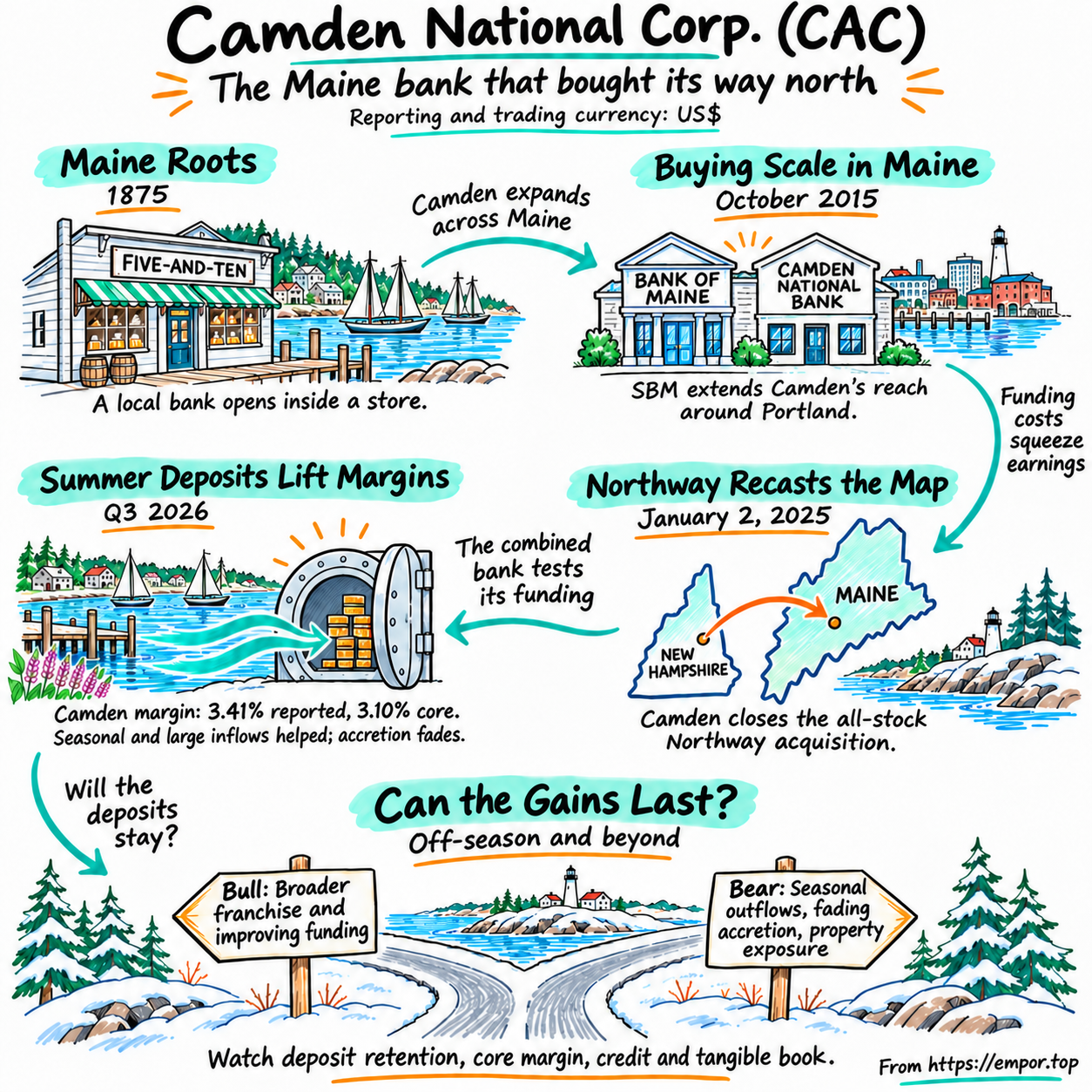
Somewhere in Northern New England, in the summer of 2026, a treasurer at a large commercial customer moved money into a Camden National Bank account. Nobody outside the bank knows the customer's name, and Camden has never said. What shareholders know is what happened next. Over the third quarter, deposits at the bank rose about 5%, to roughly $5.85 billion, and core deposits, the checking, savings and money-market balances that banks prize most, grew about 7%.1 With that cash coming in the front door, Camden could stop paying for money it had been renting out the back. Borrowings, mostly advances from the Federal Home Loan Bank, fell from about $644 million at the end of 2025 to about $374 million by the end of September.2 And the net interest margin, the bank's spread between what it earns on assets and what it pays for funding, climbed to 3.41%, up 15 basis points in a single quarter.1
That is the kind of quarter a regional bank dreams about. It is also the kind of quarter a careful investor reads twice. On the call that followed, management said plainly that part of the deposit growth came from seasonal inflows and from large customers, alongside new relationships and a high-yield savings product.3 Seasonal money has a habit of leaving with the season. Large customers can move large balances with a few keystrokes. The question hanging over that summer inflow is the question hanging over the whole company: was this money that came to stay, or money that was passing through?
It matters because Camden is, at heart, a very simple machine. In 2025 about 79% of its revenue came from net interest income, the spread between the interest it collects on loans and securities and the interest it pays depositors and lenders.4 The remaining fifth came from fees: deposit services, wealth management, card transactions, mortgage sales. There is no hidden software business here, no insurance float, no exotic trading desk. If Camden can gather deposits cheaply and lend them out sensibly, it makes money. If it cannot, nothing else in the business is large enough to save it.
So the story of Camden National is the story of three questions that sit on top of that one machine. The first is about the deal that recast the company. On January 2, 2025, Camden completed its all-stock acquisition of Northway Financial, the New Hampshire holding company behind Northway Bank, and in doing so turned a Maine bank into a Northern New England one.5 Did that make Camden stronger, or just bigger? The second is about the franchise. Camden's pitch has always been local relationships, the banker who knows the town, the lender who knows the harbor and the mill and the motel. Can those relationships hold deposits and keep credit losses low when the cycle turns harsher than it has been? The third is about the numbers. Net income has rebounded sharply since a slump in 2023. Is the current earnings level a new run rate, or a flattering moment built partly on merger accounting and easy comparisons?
A word on what exactly is being examined. The company listed on NASDAQ under the ticker CAC is Camden National Corporation, a bank holding company headquartered in Camden, Maine. Its principal operating subsidiary is Camden National Bank, which it owns outright.4 Since the Northway closing, Northway's former customers and branches sit inside the same consolidated company, so every figure in this story is for the combined group. There is no parent above it, no controlling shareholder, and no separate listed entity to disentangle.
The arena is worth picturing too. Northern New England is a place of long winters, summer people, small cities and a great deal of rural road between them. Camden competes there against national banks with enormous marketing budgets, against bigger regional banks, against mutual savings banks that answer to no shareholders, against credit unions that pay no federal income tax, and increasingly against a phone app that lets a customer move money to an online bank paying a higher rate. Camden's bet is that being local still counts for something in that contest. The summer deposit was one piece of evidence for that bet. Whether it was a durable piece is what the rest of this story is about. To understand why it matters so much, it helps to start at the beginning, in a back room of a five-and-ten-cent store.
 Subscribe on LinkedIn
II. A Local Franchise Learns to Grow
In 1875, in the coastal town of Camden, Maine, a new bank opened for business in space it shared with the local Five and Ten Cent Store.6 Camden was a shipbuilding and mill town then, with schooners on the ways and woolen mills on the river, and its merchants needed a place to keep their money and somewhere to borrow against the next voyage. More than 150 years later, the bank's main office still operates from that original site, now the anchor of a network of 72 branches stretched across Maine and New Hampshire.6
For most of its history, Camden National was exactly what its name suggested: a national bank serving Camden and the towns around it. It became a public company in 1997, but the shape of the business barely changed with the listing.4 It took deposits from people and businesses it knew, made loans to people and businesses it knew, and kept the difference. What changed over the following decades was reach. Branch by branch and deal by deal, the bank pushed outward from midcoast Maine into the rest of the state, including the 2008 acquisition of Union Trust Company, an old Down East bank based in Ellsworth.7
The clearest measure of how far that push went is the Federal Deposit Insurance Corporation's annual Summary of Deposits, which counts the deposits sitting in every bank branch in the country each June. In 1998, the year after the listing, Camden held about 3% of the deposits in Maine's bank branches. By 2025 it held about 9.9%.8 In a mature, slow-growing state, more than tripling a share of the deposit pool over a generation is a real accomplishment. It made Camden the third-largest holder of branch deposits in Maine, behind only TD Bank, the American arm of Canada's Toronto-Dominion, at about 13.2%, and Bangor Savings Bank, a large mutual savings bank, at about 12.1%.8
Those numbers tell a story of scale, but it is worth being precise about what kind of scale. A share of just under one-tenth of a state's deposits is meaningful. It buys brand recognition, a branch near most customers, enough size to spread technology and compliance costs over a larger base, and a seat at the table for most of the state's commercial lending. It does not buy control. Camden is not the price-setter in Maine. TD and Bangor Savings each hold more, and behind them sit Northeast Bank, KeyBank, First National and a dense web of local savings banks and credit unions. In some individual rural counties Camden may be the dominant name; statewide, it is one of several serious competitors fighting over the same households and the same businesses.
There is also a ceiling built into the map. Maine has roughly 1.4 million people, an older population than most of the country, and an economy where growth is steady rather than spectacular. A bank that already holds a tenth of the deposits in such a place cannot grow much faster than the state itself without taking customers from someone else, and taking customers usually means paying up, either in deposit rates or in loan pricing. That is the strategic tension at the heart of every successful small-state bank. The home market gives familiarity, loyalty and local knowledge. It also limits how big the bank can become organically, and it invites every rival in the state to compete for the same pool of money.
Gregory Dufour, who joined Camden in 2001 as senior vice president of finance, rose to president of the bank in 2004 and became chief executive of the holding company on January 1, 2009, spent his tenure working that tension.9 When he retired at the end of 2023, Camden had grown from just over $2 billion of assets to $5.7 billion, with more than 57 banking centers.9 Part of that growth came the slow way, with new relationships and the gradual climb in deposit share. Part of it came the fast way.
That is the hand-off into the next chapter. At some point, a bank that has saturated its home market faces a choice that every regional franchise eventually confronts. It can wait for Maine to grow, which it will do slowly. Or it can buy another franchise and its customers outright, paying a premium for scale it would take years to earn. In 2015, Camden made its first large bet on the second option.
III. The 2015 Bet That Changed Camden's Scale
On March 30, 2015, Camden announced that it had agreed to buy SBM Financial, the Portland-based holding company for The Bank of Maine.10 It was not a dramatic diversification. Camden was not buying an insurance company, a payments business, or a bank in a faraway state. It was buying more of what it already had: more Maine branches, more Maine depositors, more Maine borrowers, especially in the southern part of the state and around Portland, where the economy was strongest and where Camden's midcoast roots gave it less natural presence.
The deal closed in October 2015.11 The price, as later laid out in the company's acquisition note, was about $136.7 million.11 Only about $26.1 million of that was cash. Roughly $108.6 million was paid in newly issued Camden shares, and about $2 million took the form of replacement stock options for SBM's people.11 In other words, around four-fifths of the purchase was paid for with Camden's own stock.
That choice deserves a moment, because it is the template for everything that follows in this story. Paying with stock has obvious attractions for a bank. Cash is the raw material of lending and the cushion regulators watch most closely; spending it on an acquisition shrinks capital ratios just as the bank takes on a larger balance sheet. Shares preserve that cushion. But stock is not free money. Every new share issued to SBM's owners was a share that diluted Camden's existing holders, giving them a smaller slice of a bigger bank. If the acquired business earns more per share than the stock it cost, the deal creates value. If it does not, existing owners have quietly paid for growth that belongs to someone else.
The early evidence was encouraging. Net income, about $21.0 million in 2015, the year of the deal and its one-time costs, rose to $57.2 million by 2019.1213 Some of that climb came from the larger bank, some from a 2018 cut in the federal corporate tax rate that lifted after-tax earnings at every American bank, and some from the ordinary growth of a well-run franchise. Separating those strands precisely is impossible from the outside, because the acquired bank was folded into Camden and stopped reporting on its own. What can be said is that SBM did not blow up. There was no write-off of the purchase, no credit disaster from the acquired loan book, and earnings kept growing for years afterward. That is a pass, not a distinction. Proving that SBM produced superior returns would require tracing post-deal earnings per share and tangible book value per share against what Camden would have earned alone, and that counterfactual simply does not exist in public.
Then came the pandemic and the strangest rate environment in modern banking history. With the Federal Reserve holding rates near zero and the government flooding the economy with stimulus, deposits poured into banks across the country, and mortgage refinancing went into overdrive. Camden's net income reached $59.5 million in 2020 and peaked at $69.0 million in 2021.144 Then the cycle turned. As the Fed raised rates at the fastest pace in four decades, the cheap deposits that had poured in began to demand a price, and the loans and securities bought in the low-rate years kept earning low-rate yields. Camden's net income fell to $43.4 million in 2023, a decline of more than a third from the peak in two years.4
That slump is the first great falsification test in Camden's record. A franchise whose local relationships made its funding truly sticky and cheap would, in theory, have sailed through a rate shock better than its peers. Camden did not sail through. It took the hit that most deposit-funded regional banks took, which says that its deposits, however loyal, still repriced when the rest of the market did. The decline was not a disaster and did not threaten the bank, but it narrowed the claim. Local relationships helped Camden keep customers. They did not let it keep those customers at yesterday's price.
And so the question that SBM had seemed to answer came back in a harder form. After a decade of growth, Camden found its earnings sliding with the rate cycle and its home market as contested as ever. Could it restore earnings organically, one relationship at a time? Or would it need another acquisition to change the trajectory? Before following management to its answer, it is worth slowing down and looking at the machine itself, because everything about that answer depends on how the machine works.
IV. The Spread Is the Business
Imagine a retired schoolteacher in Rockport who keeps $40,000 in a Camden savings account. To her, it is simply her money in her bank. To Camden, it is raw material. The bank pays her interest on that balance, and then puts the money to work: a loan to a contractor building a house in Belfast, a mortgage on a commercial building in Portland, a slice of a mortgage-backed security bought in the bond market. Each of those assets pays Camden more than it pays the teacher. The gap between the two, multiplied across billions of dollars, is the business.
That gap is what bankers call net interest income, Camden's main source of revenue.4 The other $52.5 million came from non-interest income: fees for deposit services, money from managing trusts and investment accounts, interchange from debit and credit card swipes, gains on selling mortgages into the secondary market, and income from life-insurance policies the bank owns on its employees.4 Those fee businesses are useful. They do not depend on the level of rates in the same way, they deepen relationships, and the wealth business ties Camden to some of its most affluent customers. But they are a supporting cast. A bad year for the spread cannot be offset by a good year for fees, because the fees are a fraction of the size.
The life cycle of the business runs in a loop. Camden gathers deposits. It lends them out and invests what it does not lend. It collects interest and fees. It pays its staff, its technology vendors and its rent. It sets money aside for loans that will go bad. Whatever is left after taxes is profit, which the bank either retains to support future growth or returns to shareholders as dividends and buybacks. Each step in that loop is a place where something can go wrong.
This is also why the usual tools for judging a company's cash generation do not work on a bank. For an industrial company, an analyst compares reported profit with the cash actually coming in, looking for warning signs like unpaid invoices or ballooning inventory. For a bank, deposits, loans and securities are the operating balance sheet itself. A surge in deposits looks like a flood of cash; a surge in lending looks like a drain. Neither tells you much about the quality of the business. The right questions for a bank are different: how stable is the funding, how much of it is cheap core deposits versus expensive borrowings, how much liquidity is on hand if depositors leave, and how much capital stands between the depositors and any losses.
The heart of the risk is timing. Loans and deposits do not reprice together. A five-year commercial real-estate loan made at a fixed rate keeps earning that rate for five years, whatever the Federal Reserve does. A savings account can be repriced overnight, and a depositor who finds a better rate down the road or online can leave by the end of the week. When rates rise quickly, the bank's funding costs climb faster than its asset yields, and the spread compresses. That is exactly what squeezed Camden in 2022 and 2023. When rates stabilize or fall, the process can reverse: old, cheap loans mature and are replaced by new ones at higher yields, while deposit costs ease, and the spread widens again.
The third quarter of 2026 shows that reversal in motion. Average deposit costs fell to 1.55%, and total funding costs to 1.63%.2 Part of the improvement came from the summer deposit inflow, which let the bank repay expensive borrowings, and part from deposits simply costing less as rate expectations eased. The result was the 3.41% margin. But there is a clue in the company's own numbers that a careful listener should hold onto. Camden also reports what it calls a core margin, which strips out the extra income that comes from the accounting marks on Northway's acquired loans. That core margin was 3.10% in the quarter.1 The difference between the two figures, about three-tenths of a percentage point, is the accounting tailwind from the acquisition. On a bank of about $7 billion of assets, that gap is worth something on the order of $20 million a year, which is roughly what purchase accounting contributed in 2025.14 It is real income, recorded under the rules. It is also temporary, and a later chapter returns to what happens when it fades.
The other caveat is about the deposits themselves. Management also cited its high-yield savings product as a source of growth.3 The high-yield savings product is a revealing detail. It is, by definition, a product that competes on price. Deposits won by offering a better rate are not worthless, because they fund loans and can deepen into a fuller relationship. But they are not the same as deposits won because a business owner trusts her banker. They are the kind that leave when someone else offers more.
Which brings the mechanics back to the question that matters most for valuing the franchise. A bank that is merely a spread machine is a commodity: anyone with a charter and capital can run one, and the profits will drift toward the industry average. A bank with a genuine local advantage, a reason customers keep their money there even when competitors offer different rates and slicker apps, can earn more than average for a long time. Camden's whole case rests on being the second kind. So what, exactly, is a Maine relationship worth?
V. What a Maine Relationship Is Worth
Drive up U.S. Route 1 through the midcoast, and the Camden National signs come along at a steady rhythm: Thomaston, Rockland, Camden, Belfast, and onward Down East. The bank operates 56 branches in Maine alone.4 In many of these towns, it is not merely a bank but one of the larger employers on Main Street, the sponsor of the Little League team and the lender that financed the hardware store's expansion. Ask a Camden executive what the company's advantage is, and some version of that picture will come back: local presence, local decisions, local knowledge.
The picture is real, but an investor has to test it against the economics. The useful frame is a quick tour of the forces that shape any bank's profits, carried through the specifics of Camden's markets.
Start with customers, the bank's depositors. They hold enormous bargaining power in principle, because a deposit can be moved at almost no cost. In practice, most households and small businesses do not shop their checking account every month; inertia, direct-deposit setups, bill-pay links and personal relationships keep them in place. That inertia is the closest thing a retail bank has to a switching cost. But it weakens exactly when it matters most. When rates rise and the gap between what a local bank pays and what a money-market fund pays becomes large, even loyal customers move their excess balances. Camden's experience in 2022 and 2023 showed as much.
Borrowers are the second set of customers, and they too have choices. A commercial borrower with a good property and solid cash flows can get bids from TD, KeyBank, Bangor Savings, local savings banks, and in larger deals from out-of-state lenders and private credit funds. Camden can win that business through speed, judgment and familiarity, but it rarely wins by being the only option.
Then there are rivals and the threat of new ones. Statewide, Camden competes with larger banks and local institutions. New physical entrants are rare, because building a branch network from scratch is slow and expensive and because a bank charter brings heavy capital and regulatory requirements. But the digital entrant does not need a branch. An online bank can gather deposits from Maine without a single employee in the state.
Finally, there are the suppliers that matter for a modern bank, which are less the depositors who supply funds and more the technology vendors that supply the core systems, the digital banking platforms and the data tools. Camden, like most community banks, runs on a core platform from Jack Henry, the same vendor Northway used, which was one of the stated reasons the merger could be integrated smoothly.15 Those vendors give a mid-sized bank capabilities it could never build alone. They also create dependency: the bank's digital experience can only be as good as the vendor's roadmap, and its cybersecurity exposure extends to every third party it connects to. The company's own risk disclosures identify vendor, cyber and operational risk as material, though it does not disclose any concentration of spending with individual suppliers.2
Put together, the proposed moat looks like this. Branch reach and local knowledge help Camden attract deposits that a stranger could not, and help its lenders judge borrowers that a stranger would misprice. Established relationships make customers slower to leave. Those are plausible advantages. The harder question is whether they translate into persistently cheaper funding or better risk-adjusted returns than peers, and on that point the public evidence is thin. Camden does not disclose deposit retention rates by customer cohort. Its funding costs fell with the market and rose with the market. The 2023 earnings slump showed that whatever stickiness the franchise has, it did not shield the bank from the rate cycle. The honest verdict is that the advantage exists in a narrower form than the marketing suggests: it is a real but modest edge in a contested market, not a fortress.
There is one more piece of the franchise that needs careful handling, because it is where local expertise and local risk become the same thing. Banks do not have customer concentration in the way an industrial supplier does; no single depositor or borrower accounts for a large share of Camden's revenue, and the company reports none. Its consequential concentration is in what it lends against. At the end of September 2026, commercial real estate made up 44% of Camden's loans.2 Within that, two categories stand out. Lessors of nonresidential buildings, the owners of offices, shops, warehouses and similar properties, and lessors of residential buildings, the owners of apartments, each accounted for about 12% of total loans. Together they made up more than half of the commercial real-estate book, at 28% and 27% respectively.2
That concentration is the double edge of being a local bank in Northern New England. Real estate is the asset local bankers know best. A lender who has watched a particular street in Portsmouth or Portland for twenty years can judge a building's rent roll and the strength of its tenants better than an algorithm in another state. That is a genuine skill. It is also a concentrated bet on the same regional economy. If tourism softens, if the remote-work migration that pushed up Maine housing demand reverses, or if office and retail values fall, the knowledge that helped Camden make those loans will not stop them from going bad together. Local expertise makes property concentration manageable. It does not make it safe.
Technology belongs in the same proportion. Camden has invested in digital account opening, online banking and, as management described on the third-quarter call, a data partnership with Snowflake intended to make its outreach to customers more targeted.3 Its furniture, equipment and data-processing expense rose from $14.4 million in 2024 to $17.8 million in 2025, a jump of almost a quarter, and kept rising in 2026, which management attributed to customer-facing digital tools.42 Those investments are necessary to keep up. A customer who cannot open an account on a phone will open one elsewhere. But keeping up is not the same as pulling ahead, and nothing in the filings establishes digital banking as a source of advantage against TD or KeyBank, which spend on technology at a scale Camden cannot match.
Two mechanisms could break whatever advantage Camden has. One is credit: a downturn in commercial real estate turns local expertise into concentrated exposure. The other is funding: if competitors, digital or physical, push deposit rates higher, Camden has to match them or watch balances leave, and either way its spread narrows. Both are cyclical. And that slump is where the current chapter of Camden's story begins, with a new chief executive arriving to find earnings at their lowest level in years.
VI. The Earnings Slump That Set Up a New CEO
In August 2023, Camden's board announced that Gregory Dufour would retire at the end of the year and named his successor: Simon Griffiths, a 50-year-old executive from Citizens Bank.9 Griffiths was not a Maine banker by upbringing. He held a law degree from the University of Sheffield in England, had started his American banking career at Washington Mutual in 2002, moved to Santander Bank as head of its retail network, and joined Citizens in 2015, where he rose to run core banking, overseeing retail and business banking across nearly 1,100 branches.9 His Maine connection was a seasonal home in Hancock County; he moved his family to the state for the job.9 He joined Camden around November 20, 2023, as chief operating officer and became president and chief executive on January 1, 2024.9
The choice said something about what the board thought Camden needed. Dufour was a finance executive who had built the bank steadily over two decades. Griffiths was a retail banking operator from a much larger institution, a man used to running thousands of branches, digital channels and sales processes at scale. He arrived at a bank whose earnings had just fallen to $43.4 million, the lowest since well before the pandemic.4
It would be easy to tell this as a before-and-after story, with the slump as the old regime's failure and the recovery as the new leader's triumph. The record does not support that framing. Bank earnings respond to rates, funding costs and credit provisions, and the 2023 low followed the fastest rise in interest rates in four decades. Banks across the country saw the same squeeze. By the same token, the recovery since then has coincided with a stabilizing rate environment, which helped every deposit-funded lender. Net income recovered from the 2023 low to $65.2 million in 2025.4 That is a real improvement in reported results. But the 2025 figure includes the first year of Northway, with its purchase accounting, its one-time costs, an unusually large credit provision, and a deferred-tax benefit tied to the acquisition.2 Assigning the rebound to Griffiths's operating strategy alone would credit him with the weather.
What can be judged is what he chose to do. His defining move was Northway, announced within nine months of his taking the top job. Around it, he has pushed deposit growth, investment in digital tools and data, a new layer of commercial bankers, cost discipline as the two banks combined, and, in 2026, the resumption of share buybacks. He has also reshuffled the team: on the second-quarter 2026 call, the company announced that Kate Brunelle became chief credit officer on July 1, succeeding Ryan Smith, who moved back to lead commercial banking.16 Changing the person who signs off on credit in a bank with concentrated commercial real-estate exposure is not a small decision, and it is one to watch.
Pay tells part of the alignment story. The proxy reported Griffiths's total compensation at $1.50 million in 2023, a partial transition year, rising to $2.32 million in 2025.17 Over the same period, net income rose from $43.4 million to $65.2 million. Pay and profits rose together, and the board says 57% of his target compensation is contingent on performance, with a 2025 annual incentive of about $604,000.17 Correlation is not proof of alignment, though, because the profit recovery included the cycle and the acquisition accounting, and a bonus plan that pays on reported earnings pays on both. Shareholders did not object. In May 2026, the say-on-pay vote passed with about 11.9 million votes for and about 151,000 against, an approval rate near 99%.18 Directors and executive officers together held about 2.06% of the shares, which is a modest stake for a bank of this size; management's fortunes are tied to the stock, but not heavily.17
The sharper test of credibility is the deal case itself. When Camden announced Northway in September 2024, management told investors it expected to cut 35% of Northway's cost base, with three-quarters of the savings arriving in 2025 and all of them in 2026.15 That is a specific, checkable promise, and 2026 is the year it is supposed to be fully visible. The company has not published a line-by-line reconciliation of realized savings against the original target, so outsiders have to infer it from the expense base. The clearest window is the efficiency ratio, which measures how many cents of operating cost the bank spends to earn a dollar of revenue. In the third quarter of 2026, it improved to 54.6% on a reported basis, from 55.4% in the second quarter; on the company's adjusted basis, it was 52.4%.1 For a community bank, the low-to-mid fifties is respectable rather than exceptional. It is consistent with the savings largely arriving, but the technology spending rising at the same time means the merger savings are being partly reinvested rather than falling straight to the bottom line.
That leaves the test where it should be. A management team earns credibility by explaining results through measurable drivers, not through optimism, and by delivering what it promised on the timetable it promised. Griffiths's first big promise was Northway. To judge it, one has to go back to the September morning when he asked shareholders to underwrite it.
VII. Northway: The Deal That Recast the Map
On September 10, 2024, Camden held an investor call to explain why it was buying Northway Financial. Griffiths opened by calling it a rare opportunity to build a premier Northern New England bank.15 Northway was a New Hampshire institution with about $1.3 billion of assets, roughly $1 billion of deposits and almost as much in loans.15 Its branches covered much of the state, and Camden emphasized that the combined bank would have branches within 15 miles of 12 of the 20 New Hampshire towns and cities with the highest household incomes.15 Management also claimed that the combined company would hold the largest deposit share among community banks across Maine and New Hampshire combined, a carefully constructed boast that excluded the national and big regional banks and the mutual savings giants that outsize it in each state.15
The strategic logic was clean. Camden had pushed its Maine share about as far as organic growth could take it in a hurry. New Hampshire was next door, wealthier on average, and growing faster, with a similar mix of small cities, rural towns and seasonal economies. Northway had a similar mix of loans and a solid base of core deposits.15 Rather than open branches across the border one at a time, Camden could buy a ready-made franchise and its relationships in a single step. Only the two Portsmouth branches, where the two banks overlapped, were slated for consolidation.15
The price was paid entirely in stock. Northway shareholders would receive 0.83 Camden shares for each of theirs, a fixed ratio that meant the dollar value of the deal would float with Camden's share price.15 At Camden's closing price of $37.90 on the day before the announcement, the deal was worth about $86.6 million, or about 139% of Northway's tangible book value, and a core-deposit premium of 2.6%.15 Those two ratios are the right place to start judging it. Tangible book value is the bank's equity after stripping out goodwill and other intangibles, roughly what would be left for shareholders if the bank were wound down at book. Paying 139% of it means paying about $1.39 for each dollar of hard equity. The core-deposit premium expresses the same price differently: how much Camden paid above book value, as a share of the core deposits it was acquiring. A premium of 2.6% means Camden was paying a small sum for each dollar of stable funding it gained.
Were those prices sensible? The merger materials put them next to benchmarks. Northway's advisers compared the deal's price-to-tangible-book figure, calculated at 138.4%, with the median of recent comparable bank deals: 128.5% for a national group and 139.5% for a regional group.19 In plain terms, Camden paid about what other buyers had paid for similar banks in the region, and somewhat more than the national norm. It was not an outlier. It was not a bargain either. And comparable transactions only tell you what other buyers were willing to pay; they say nothing about whether those deals, or this one, would earn their cost back.
What happened next showed the double edge of paying in stock. Between announcement and closing, Camden's share price rose. Because the exchange ratio was fixed, the value of what Northway's owners received rose with it, and by the January 2, 2025 closing, the consideration was worth about $96.5 million.5 Camden issued 2,283,782 new shares to complete the deal.5 The number of shares given away did not change, so the dilution to existing Camden owners was what had always been planned. But anyone measuring the purchase price in dollars would note that Northway's shareholders captured an extra $10 million of value from the rally.
What were Camden shareholders asked to believe in exchange? Management's announcement case assumed the 35% cost savings, no revenue synergies at all, and, on that basis, that Camden's earnings per share in 2026 would be about 33% higher on a reported basis than they would have been without the deal.15 On a cash basis, which strips out the amortization of the intangible assets created in the acquisition, the expected 2026 boost was about 12%.15 The gap between those two numbers is itself a clue. A large part of the reported earnings uplift was expected to come from accounting, specifically from the accretion of the discounts on Northway's loans, rather than from the underlying cash earnings of the combined bank.
The cost side of the ledger was just as specific. Camden expected the deal to reduce its tangible book value per share by about 16% at closing, and estimated it would take about 3.3 years of extra earnings to build that value back.15 Tangible book dilution of that size is meaningful. It happens because Camden issued new shares worth more than the hard equity it acquired, and because the deal created goodwill and a core-deposit intangible that do not count as tangible equity. Management argued on the call that, adjusted for unrealized bond losses and the loan marks, the deal was immediately accretive to tangible book with no earn-back at all.15 That argument has some logic, because the marks will be earned back through income over time, but it asks shareholders to look past the reported number, which is usually a sign to look harder.
There was a further subtlety in Northway's loan book. Because Northway's loans had mostly been made when rates were lower, they were worth less than face value in a higher-rate world. Camden marked them down by about 8.6% for interest rates and another 1.1% for expected credit losses.15 After those marks, Northway's loans came onto Camden's books at about $775.7 million, alongside about $971.7 million of deposits.4 The interest-rate mark is the key to understanding the next chapter of this story. When a loan bought at a discount pays off at full face value, the discount is recorded as income over its life. That is how a deal with a small core-deposit premium can still carry a large tangible-book hit, and how reported earnings can rise faster than the underlying business.
So the price was defensible against precedent, and the strategic logic was clear. The deal earns its keep only if the savings have arrived in full, if the acquired funding base has proved as stable as advertised, and if Northway's borrowers have performed as the credit mark assumed. Those are not questions a merger presentation can answer. They are answered by the income statements that follow, and those income statements, as the next chapter shows, need careful reading.
VIII. The New Earnings Run Rate Has to Survive the Accounting
At first glance, Camden's 2026 results look like a triumph. Net income for the first nine months of the year was $67.7 million, against $42.6 million in the same period of 2025, a jump of almost 60%.2 In the third quarter alone, the bank earned $22.8 million, or $1.34 a diluted share.1 Return on tangible common equity, the measure most bank investors watch, reached about 17.5%.1 Griffiths told shareholders the company was well positioned to deliver sustained earnings growth.1
The headline figure, though, compares a clean year with a messy one. The first nine months of 2025 carried the one-time costs of closing Northway and converting its systems, and an unusually large provision for credit losses. Part of that provision was the accounting requirement to reserve for acquired loans on day one, and part came from a syndicated commercial borrower that filed for bankruptcy.2 The 2025 numbers also included an acquisition-related deferred-tax benefit that flattered that year's earnings in the other direction.2 Strip out those comparison effects and the picture changes. Third-quarter 2026 net income was up 8% from the third quarter of 2025, a solid result and a far more realistic guide to the pace of underlying improvement than the nine-month surge.2
Then there is the accounting that keeps giving. When Camden marked Northway's loans down to fair value, it created a discount that is recognized as interest income as those loans are repaid or mature. In 2025, that purchase-accounting accretion added about $20.5 million to income.4 To put that in proportion, it was equal to almost a third of the year's net income, although the two are not strictly comparable because accretion is counted before tax. This is not an accounting trick. The rules require it, and the income reflects real economics: Camden effectively bought those loans cheaply and is being paid back in full. But it is temporary by design. As the old Northway loans run off, the accretion shrinks, and in quarters when borrowers repay early, it can spike.
The gap between the reported and core margins is how the accretion shows up in the margin. In the third quarter, the reported margin was 3.41% and the core margin, excluding accretion, was 3.10%.1 As the acquired loans roll off, that gap will narrow, and the reported margin will converge toward the core one unless the core margin itself keeps rising. A bank that looks like it earns a 3.4% spread today may, in two or three years, look like one that earns a 3.1% spread, unless the underlying funding and lending improve enough to fill the gap.
That is why the operating clues matter more than the headline. And some of them are genuinely encouraging. The core margin is the number to follow, and the direction of funding costs is moving the right way. Borrowings fell sharply, from about $644 million at the end of 2025 to about $374 million by September 2026, because deposit growth allowed Camden to repay Federal Home Loan Bank advances.2 Replacing borrowed money with customer deposits is exactly the kind of improvement that persists, if the deposits persist. Tangible book value per share, the metric the Northway deal had diluted, reached $31.40 at the end of September, up 10% from a year earlier.1 That is a meaningful step back toward the pre-deal level, built partly on retained earnings and partly on recovering bond values as rates eased.
The deposits, however, are the hinge again. Management did not describe the third-quarter inflow as purely core relationship money. It cited seasonality and large commercial inflows alongside new relationships and the high-yield savings product.3 Maine's economy has a strong seasonal rhythm. Summer businesses fill their accounts in July and August and draw them down through the winter; municipalities collect property taxes on a calendar; large commercial depositors move money as their own cycles demand. A deposit balance measured at the end of September captures the high tide. The real test will be what remains in the first quarter of 2027, after the off-season drawdown.
Across the calls of 2026, the difference between prepared remarks and the analyst Q&A has been instructive. In the scripted portions, management has emphasized deposit growth, margin expansion and the success of the integration. Analysts have pressed on the questions that matter for a run rate: how much accretion will remain, how much of the deposit growth is seasonal, and where the margin goes next.320 Management has answered the accretion question with numbers, publishing the core margin alongside the reported one each quarter, which is a good disclosure habit. On deposit retention and the future path of the margin, the answers have been broader, framed around momentum and the bank's positioning rather than a quantified forecast. That is common in banking, where the next quarter depends on rate decisions nobody controls, but it means investors have to keep score themselves.
The clean test, then, is to watch three numbers as the accounting benefits fade. The core margin should hold or rise even as accretion shrinks. Funding costs should keep falling, or at least not rise, as seasonal deposits leave. And non-interest expense, once integration costs disappear and the savings are fully in, should grow slowly enough that rising revenue reaches the bottom line. If all three move the right way, the 2026 earnings level is a genuine new floor. If the core margin slips back as the summer money drains out, then some of this year's success was the tide, not the boat. And there is one more number that could overwhelm all three: the cost of loans that go bad.
IX. When the Loan Book Meets a Regional Downturn
In 2025, a borrower Camden did not originate and could not fully control went bankrupt. It was a syndicated commercial loan, meaning a large credit split among several banks, with Camden holding a piece arranged by another lender.2 The company has not named the borrower. What it disclosed was the consequence: additional reserves, part of the heavy provision that weighed on 2025 earnings and flattered the 2026 comparison.2 No comparable charge was recorded in 2026.2
The episode matters out of proportion to its size because of what it reveals about how bank credit actually breaks. Broad measures of loan quality, such as delinquencies and nonperforming loans as a share of the book, tend to look quiet for long stretches. Then a single large borrower fails, and a quarter's earnings move. Syndicated loans carry an extra wrinkle for a community bank, because they are precisely the loans where its local-knowledge advantage is weakest. Camden is buying a slice of someone else's relationship, priced and structured by someone else, often with a borrower outside its core towns.
Today, the broad measures are strong. In the third quarter of 2026, nonperforming loans were just 0.16% of total loans, the allowance for credit losses covered those nonperforming loans about 5.8 times over, and annualized net charge-offs, the loans actually written off after recoveries, were 0.07% of the book.2 Those are excellent figures by any standard, the kind of numbers that suggest disciplined underwriting and a healthy regional economy. They also describe a moment, not a cycle. Credit metrics are at their best at the end of good times, when borrowers have had years of rising values and low vacancies. The loan book's real test arrives when those conditions reverse.
That concentration is what makes the test consequential.2 A regional downturn in property values would hit the core of Camden's lending. A sustained office slump in Portland or Portsmouth, a fall in tourism-driven retail traffic along the coast, or a reversal in the housing demand that drove up Maine rents would all show up in the same corner of the book. A watchful investor should look past today's nonperforming balances to the loans one step earlier in the process: criticized and classified loans that the bank itself flags as showing weakness, and the outcomes when collateral is actually sold.
There are also exposures that do not show up as loans yet. At the end of 2025, Camden had about $880 million of commitments to extend credit and about $4.7 million of standby letters of credit.4 Those are normal for a bank. Credit lines, construction draws and approved loans waiting to fund are how banks serve their customers, and most commitments are never fully drawn. But in a stress period, borrowers tend to draw on their lines just when the bank would prefer they did not, so commitments are worth watching alongside the funded book.
On the other side of the balance sheet, liquidity is solid. At the end of September 2026, Camden reported about $1.9 billion of available primary liquidity, meaning cash, unpledged securities and borrowing capacity it could tap quickly.2 Against that stood about $990.9 million of deposits that were both uninsured by the FDIC and not collateralized, about 17% of the total.2 Those are the deposits most likely to run in a crisis, the lesson the regional bank failures of 2023 taught every investor. Camden's liquidity covers them nearly twice over. That is a comfortable cushion, but the uninsured balance has grown along with the large-customer inflows, which is the other side of the summer deposit story. Big depositors bring funding; they also bring the kind of funding that leaves quickly when nerves fray.
Capital is the final line of defense, and here too the picture is healthy. Camden's total risk-based capital ratio was 14.82% at the end of September, comfortably above the regulatory thresholds for a well-capitalized bank.2 Neither Camden nor its bank subsidiary publishes a credit-rating agency rationale in its filings or investor materials, so the public evidence of its credit standing is the regulatory capital, liquidity and asset-quality data rather than an agency opinion. Camden reported no material legal contingencies, and its auditor, RSM US, gave clean opinions on both the 2025 financial statements and internal controls.4
The mechanism that matters is simple. If commercial real estate weakens, provisions and collateral losses rise. If deposit competition intensifies, funding costs rise. Either can overwhelm the bank's modest fee income, and both tend to happen in the same kind of downturn. Camden's current numbers say it enters that possibility from a position of strength. They do not say it is immune. Which leaves the central question of the investment case: given all of this, how should anyone think about what the franchise is worth?
X. Analysis & Bear vs. Bull Case
Picture the third-quarter numbers as a scoreboard. By the standards of American community banks, the results are strong. The market's job is to decide how much of that strength is durable, and the market has been willing to pay for it. In June 2026, Camden's own investor presentation cited a forward price-to-earnings ratio of 9.4 times and a price of about 1.7 times tangible book value, based on a market snapshot dated June 8.21 By the end of September, with the shares at $55.35 against tangible book value of $31.40 per share, the stock traded at about 1.76 times tangible book and roughly ten times the third quarter's annualized earnings.1 Those are dated snapshots, not current multiples, and they will have moved since. But they say something clear. The market is valuing Camden at a premium to the value of its hard equity, which is a statement that investors believe the franchise can earn above its cost of capital for some time.
The bull case starts with geography. Camden now has a strong position in Maine, a real presence in New Hampshire, and a combined deposit franchise that management can credibly describe as the largest among community banks across the two states. The funding mix is improving: borrowings have been cut almost in half since the end of 2025, and core deposits made up about 88% of deposits at the end of September.1 Credit losses are minimal. The Northway cost plan should be fully in the numbers by now, and if the core margin keeps rising as old fixed-rate loans reprice, the bank could lift its returns without needing another major deal. Add tangible book value per share that is recovering, and the bull sees a bank compounding steadily from a much larger base.
The bear case starts with the same numbers and reads them differently: the acquisition tailwind will fade, the summer deposits may leave, and a real-estate downturn would test the bank's concentrated exposure. The 2023 earnings slump showed that the franchise does not escape the rate cycle. The bear sees a well-run, ordinary community bank priced as if its best quarter were its typical one.
The frameworks help settle the argument. Run through the competitive forces, and the picture is of a business where customers hold real but latent bargaining power, rivals are numerous and some are much bigger, regulation and capital requirements keep out new physical entrants but not digital ones, and technology vendors hold growing influence over the product. That is the profile of a competitive industry, in which above-average returns must be earned and defended rather than assumed.
Hamilton Helmer's framework of seven sources of durable advantage sharpens the point. Camden has some scale economies: a bigger balance sheet spreads technology, compliance and marketing over more revenue, and Northway added to that. But TD, KeyBank and Bangor Savings are larger in Maine, so scale is not a power Camden holds over its biggest rivals; it is a power it holds over smaller local banks. It has a modest switching cost, rooted in the inconvenience of moving a business's operating accounts, loans and payment links; that cost is real for commercial customers and weak for rate-sensitive savers. It has a branded local presence, but the brand does not command a premium price in any measurable way, since Camden's deposit costs track the market. There is no network effect, no proprietary technology, no exclusive resource. If Camden has a power, it is a thin form of what Helmer calls process power: an accumulated, hard-to-copy skill at underwriting local borrowers and managing local relationships. That skill is plausible and supported by low historical losses, but it has not yet been tested by a deep regional real-estate downturn since the bank grew to its current size.
So the moat, argued in full, comes down to this. Camden has a credible franchise with a real local edge, measured by a deposit share that tripled over a generation and a credit record that has been clean. It does not yet have a proven durable moat in the sense of returns that persist above peers through a full cycle, because the rate shock from 2021 to 2023 cut its earnings by more than a third. The history narrows the claim rather than rejecting it.
A skeptical activist would focus on capital allocation. Camden has now made two large stock-funded acquisitions, SBM in 2015 and Northway a decade later. Neither was a disaster. But both diluted existing owners, and Northway carried a 16% hit to tangible book that management is asking shareholders to see past. The Northway price was near regional deal benchmarks, so the issue is not that Camden overpaid by the standards of other buyers. The issue is that execution risk sits entirely with Camden's shareholders. The test is not the purchase price but realized savings and the recovery of tangible book value per share, and on that test the evidence so far is encouraging rather than conclusive.
The activist would also note the buybacks. Camden resumed repurchases in 2026, after issuing more than two million shares for Northway, buying back 85,131 shares in the first nine months at an average of about $46.55, under an authorization covering 850,000 shares.2 Buying back a few percent of what was just issued is a reasonable signal, but at that pace the buybacks are symbolic rather than material. The quarterly dividend of $0.42 a share, about a 3% yield at the September price, is the larger return of capital.1
The rate shock remains the historical check on every claim the bull makes: earnings fell sharply between 2021 and 2023.4 The current rebound has to prove that it can survive a rate and credit cycle, not merely a period of falling funding costs and quiet credit.
Three measures will decide which case wins. The first is the core net interest margin and the deposit costs underneath it, which are moving in the right direction.12 The second is credit migration: current losses remain very low, with the criticized-loan trend as the early warning.2 The third is tangible book value per share, which is recovering.1 If those three keep moving the right way after accretion and integration effects fade, the bull case is earning its premium. If they turn, the premium is the first thing to go.
VIII. Playbook: Business & Investing Lessons
Step back from the quarter-by-quarter detail and Camden's story becomes a parable about how small-market banks are built and how they can be broken. A bank opens in the back of a five-and-ten in a shipbuilding town. Over a century and a half, it becomes one of the three largest holders of deposits in its state. Then, needing to grow faster than its state allows, it spends its own shares to buy its way across the border. Every step along that path left a lesson.
The first lesson comes from the long climb in deposit share, from about 3% of Maine's branch deposits in 1998 to almost 10% in 2025.8 That climb is real, and it was hard-won. But the 2023 earnings slump showed that the customers Camden had won still expected to be paid what the market paid. A local bank earns scale one relationship at a time, but every relationship is still contestable. For founders building any business on loyalty, the lesson is that loyalty is a discount, not an exemption. It buys a little patience from customers. It does not stop them from noticing a better price. For investors, the observable test is deposit retention through a full rate cycle, not deposit growth in a good quarter.
The second lesson belongs to Northway. Camden paid 139% of tangible book, close to what other buyers in the region had paid, and estimated it would take 3.3 years to earn back the dilution.15 By the standards of bank mergers, that was a fair price. But a fair price is not a return; the savings and credit performance have to arrive. Merger presentations are designed to make deals look sensible on paper, and most of the time the paper is honest. What the paper cannot guarantee is that the 35% cost cuts will be realized, that the acquired customers will stay, and that the acquired borrowers will repay. Investors who want to judge a deal should watch realized expenses and tangible book per share, not the multiples on announcement day.
The third lesson comes from the swing between 2021 and 2023. A bank that earned $69 million at the peak earned $43 million two years later, without a credit crisis and without a strategic blunder, simply because the cost of its funding rose faster than the yield on its loans.4 A bank's best year is not its run rate when the funding cycle can turn faster than its loan book. That lesson cuts both ways. It warned against extrapolating 2021. It warns equally against extrapolating the bright third quarter of 2026, when funding costs were falling and accretion was flattering the margin.
The fourth lesson is about accounting that looks like growth. The Northway loan marks created income that will run off by design. The gap between Camden's 3.41% reported margin and its 3.10% core margin is the size of that gift.1 An acquisition's first years always look better on reported earnings than on cash earnings. The discipline is to keep two sets of books in one's head, and to give credit only for the core.
Each lesson points to behavior that can be observed: whether deposits stay after the season turns, whether the expense base reflects the savings promised, whether credit quality holds in the property book, and whether tangible book value per share keeps compounding. Those four observations, more than any management narrative, will decide what kind of bank Camden has become.
IX. Epilogue
Tonight, as the last weekend of November settles over Northern New England, Camden National is a different company from the one Simon Griffiths joined three years ago. It has about $7.1 billion of assets, a footprint stretching from the Maine coast deep into New Hampshire, a single core system serving customers of both former banks, and a third quarter that looked as good as any in its recent history.1 The merger is complete. The systems are converted. The hard part of a deal, the part that is about plumbing, is over. The part that is about economics is just beginning.
The first moments that will decide this chapter are already on the calendar. The fourth-quarter results, due in late January, will show what happened to the summer deposits as Maine's seasonal businesses drew down their accounts through the autumn. If balances hold up and funding costs keep falling, the case that the third quarter's inflow reflected new relationships rather than passing tides will strengthen considerably. If deposits shrink and Camden has to borrow again to fund its loans, the margin gains of 2026 will look more like weather than climate.
The full-year 2026 expense base, which will appear in the same report and in the annual filing that follows in early spring, is the moment of truth for the Northway cost plan. The Northway savings target was due in full in 2026.15 If non-interest expense, stripped of integration charges and the deliberate technology investment, shows that savings in full, Griffiths will have delivered his first big promise on schedule. If the savings are partly offset by new costs without a clear return, the deal's case will rest more heavily on revenue that it was never modeled to produce.
Then there is the slow fade of the accretion. With every quarter, more of the old Northway loans mature or repay, and the gap between the reported and core margins narrows. The quarters of 2027 will show whether the core margin can rise fast enough to replace that income, through new loans at today's yields and cheaper deposits. That is the cleanest single test of whether the bigger bank is a better bank.
Behind all of it, the credit book is seasoning. Commercial real estate, the bank's largest and most concentrated exposure, is now overseen by a new chief credit officer.16 Nonperforming loans are low and charge-offs are minimal, but those are the numbers that change last. The early signals will come in criticized loans, in recoveries on troubled credits, and in whether any more syndicated borrowers stumble.
And quietly, quarter by quarter, tangible book value per share will either keep climbing back from the dilution of the merger or stall as buybacks and dividends absorb the earnings. With an estimated 3.3-year earn-back from the January 2025 closing, the clock points to roughly the spring of 2028 as the moment by which the dilution should have been rebuilt.15
Each outcome maps onto one of the questions this story began with. Deposit retention will say whether local relationships can hold money through a season. The expense base and the core margin will say whether Northway made Camden stronger or just bigger. Credit migration will say whether the franchise can keep losses low when its markets turn. None of those answers is in yet. The tension that remains is the one every regional bank lives with: the numbers today are good, and the cycle has not yet asked its question.
X. Outro
Go back to that summer deposit, the money a large customer moved into a Camden account in the third quarter of 2026. It arrived quietly, in a bank that began in the back of a five-and-ten in a Maine harbor town, and it did something visible almost immediately. It helped Camden repay borrowed money and improve its margin. That is the whole business in miniature. A bank does not manufacture anything. It earns a living by being the place where people choose to leave their money.
Now picture the same account in February, with snow on the coast road and the summer businesses shuttered for the season. Will the balance still be there? Camden's history says its relationships and discipline have limits. Its future says something more ambitious: that the trust built in small towns for a century and a half can scale across a wider territory without losing the discipline that made it worth anything. Camden bought a wider map; now it has to show that the money follows the relationships.
References
-
Q3 2026 Earnings Release — Camden National Corporation, 2026-10-27 ↩↩↩↩↩↩↩↩↩↩↩↩↩↩↩↩↩
-
Q3 2026 Form 10-Q — Camden National Corporation, 2026-11-05 ↩↩↩↩↩↩↩↩↩↩↩↩↩↩↩↩↩↩↩↩↩↩↩
-
Q3 2026 Earnings-Call Transcript — Camden National Corporation, 2026-10-27 ↩↩↩↩↩
-
2025 Form 10-K — Camden National Corporation, 2026-03-06 ↩↩↩↩↩↩↩↩↩↩↩↩↩↩↩↩↩↩
-
Northway Merger Closing Release — Camden National Corporation, 2025-01-02 ↩↩↩
-
Camden National Bank Honors 150th Anniversary with Community Well-Being Day — Camden National Bank, 2025-09-11 ↩↩
-
FDIC BankFind Suite — Summary of Deposits, Federal Deposit Insurance Corporation ↩↩↩
-
Camden National Corporation Appoints Simon Griffiths as Successor to CEO — Camden National Bank, 2023-08-21 ↩↩↩↩↩↩
-
SBM Financial Acquisition Announcement — Camden National Corporation, 2015-03-30 ↩
-
2017 Form 10-K, acquisition note on SBM Financial — Camden National Corporation, 2018 ↩↩↩
-
2020 Year-End Shareholder Letter — Camden National Corporation, 2021 ↩
-
Northway Merger Investor Call Transcript and Financial Assumptions, Form 425 — Camden National Corporation, 2024-09-10 ↩↩↩↩↩↩↩↩↩↩↩↩↩↩↩↩↩↩
-
Q2 2026 Earnings-Call Transcript — Camden National Corporation, 2026-07-28 ↩↩
-
2026 Proxy Statement — Camden National Corporation, 2026-04-03 ↩↩↩
-
2026 Annual Meeting Results, Form 8-K — Camden National Corporation, 2026-05-21 ↩
-
Northway Merger Proxy Statement/Prospectus, Form 424B3 — Camden National Corporation, 2024-11-04 ↩
-
Q4 2025 Earnings-Call Transcript — Camden National Corporation, 2026-01-27 ↩
-
June 2026 Investor Presentation — Camden National Corporation, 2026-06-18 ↩
 LinkedIn
 WhatsApp
 Reddit
 Hacker News
 Email
 Kindle
 RSS Feed
 Spotify
 Apple Podcasts
 Amazon Music
 Audible
 YouTube