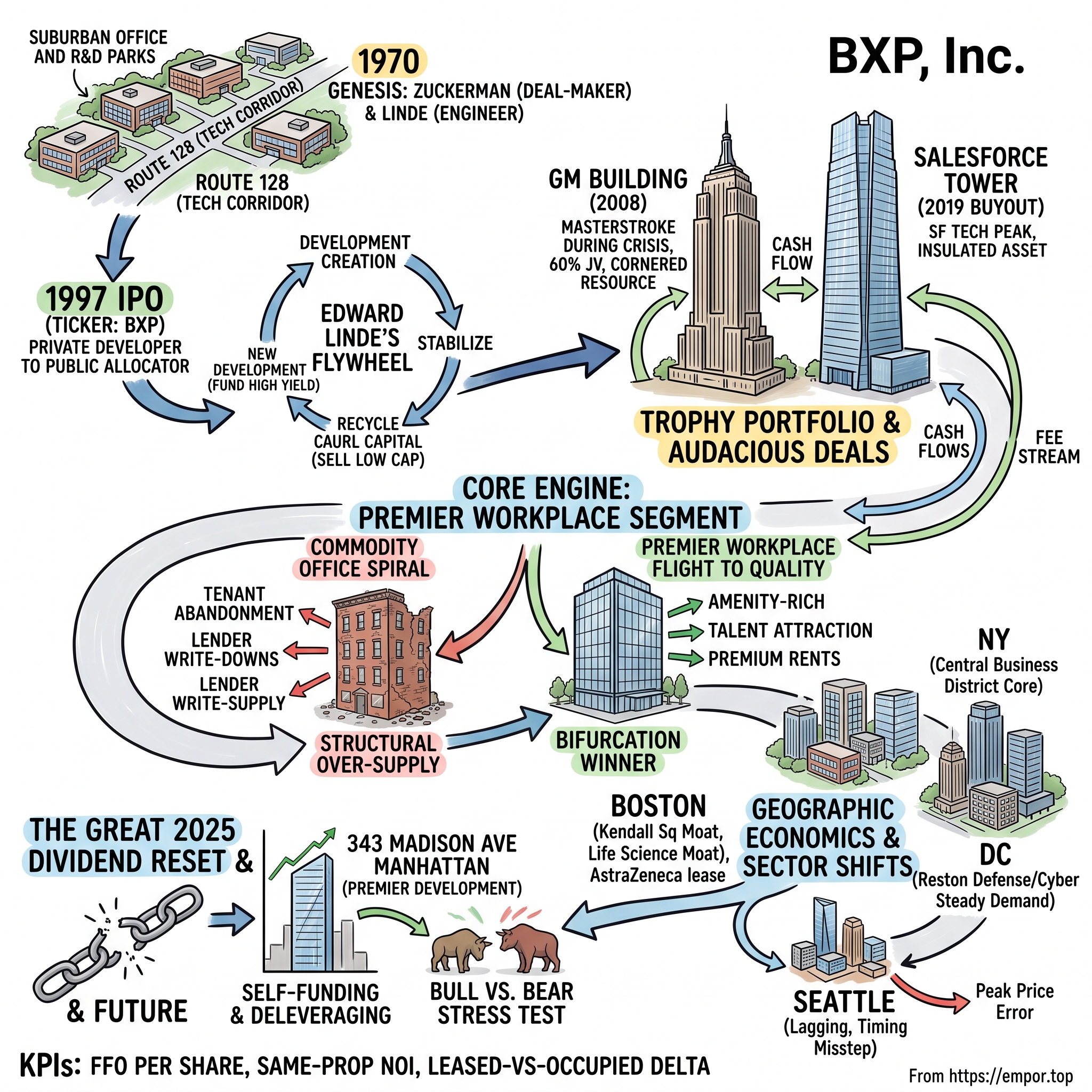
BXP, Inc.: The Empire of Premier Workplaces
I. Introduction & Episode Roadmap
Walk into the lobby of 200 Clarendon Street in Boston — the tower most people still call the John Hancock — and look up. Sixty stories of blue glass, the tallest building in New England, a mirror that has thrown back the city's sky since the 1970s. Then open a newspaper from almost any month between 2020 and 2026 and read the headline that has hung over the entire American office industry like a fog: the office is dead. Hybrid work, empty downtowns, half-lit floors, landlords handing keys back to their lenders. Two images, one industry, and a contradiction that refuses to resolve.
BXP, Inc. — the company that spent five decades building towers exactly like that one — sits precisely on the fault line. As of mid-July 2026 its equity was worth roughly $11 billion, and it remains the largest publicly traded developer, owner, and manager of premier office properties in the United States.[^1] It owns pieces of the most recognizable skylines in the country: the General Motors Building on Fifth Avenue, Salesforce Tower in San Francisco, the life-science towers of Kendall Square, the glass canyons of Reston Town Center outside Washington. And yet its stock has spent years being priced by a market that cannot decide whether it is looking at a fortress or a melting ice cube.
The thesis this story tests is not that "office survives." It is something narrower and more interesting: that the commercial real estate market has split violently in two. On one side, the commodity building — the anonymous 1980s Class B tower with low ceilings, tired systems, and a location no one is fighting over — is facing a genuine structural death spiral, as tenants abandon it and lenders write it down toward the value of the land beneath it. On the other side, the premier building — new or renovated, amenity-rich, in a location that literally cannot be reproduced — has held its tenants, its rents, and its pricing power. BXP has bet its entire existence on being on the winning side of that split. The job here is to interrogate that bet honestly: where the evidence supports it, where it is management narrative, and where the company's own decisions have undercut it.
This is a long arc. We will start in 1970 with two men who could not have been more different — a media-mogul showman and a quiet engineer — and the office parks they built along a Massachusetts highway before Silicon Valley existed. We will watch the 1997 IPO force a swashbuckling private developer to grow up into a disciplined public allocator of capital. We will relive the single most audacious deal in modern office history — paying a record $2.8 billion for the GM Building in the teeth of the 2008 crisis — and ask whether it was genius or luck. We will follow the company west to San Francisco's tallest tower, and then to Seattle, where it arrived with a checkbook at very nearly the worst possible moment. We will dissect the engine that actually pays the bills, the painful 2025 dividend cut that management insists was strength rather than surrender, and finally the bull and bear cases as a skeptical investor would war-game them. Let's begin in the suburbs of Boston.
 Subscribe on LinkedIn
II. Legends of Boston: Zuckerman, Linde, and the 1970 Genesis
In 1970, the phrase "technology corridor" did not yet mean Northern California. It meant Route 128, the semicircular highway looping around Boston, lined with the defense contractors, minicomputer makers, and research spin-offs that MIT and Harvard threw off like sparks. And it was there, not in Manhattan, that two young men decided to build an empire out of drywall and parking lots. Mortimer B. Zuckerman and Edward H. Linde founded Boston Properties in 1970, and the partnership worked precisely because the two founders were opposites bolted together.1
Zuckerman — a Montreal-born, Wharton- and Harvard-trained deal-maker — was the front man, the promoter, the accumulator of connections and cash.2 Over the following decades he would become as famous for media as for concrete: he bought The Atlantic, acquired and ran U.S. News & World Report as its editor-in-chief, and owned the New York Daily News, turning himself into a fixture of the New York–Washington power circuit.2 That was not a distraction from the real estate business; it was part of it. Zuckerman's rolodex, his access to institutional capital, and his appetite for the biggest, most visible trophy assets became a recurring feature of how Boston Properties operated. He is today the company's chairman emeritus, a living link to its founding.1
Edward Linde was the other half of the brain — the operator, the builder, the man obsessed with the unglamorous variables that actually determine whether a development makes money: construction cost per square foot, the leasing pipeline, the budget held to the dollar. If Zuckerman opened the doors, Linde made sure the buildings behind them got built on time and leased to tenants who paid. That division of labor — showman and engineer, capital and craft — is the founding DNA of the company, and it is worth holding onto, because the discipline Linde embedded would later become the whole investment story.
The early playbook was suburban and shrewd. Boston Properties rode the Route 128 boom, developing modern office and R&D parks for the technology and defense tenants clustering along the highway — America's original tech corridor, a decade before "Silicon Valley" entered the vocabulary. In the 1970s, Route 128 was where the future was being built: Digital Equipment, Data General, and a constellation of minicomputer and defense-electronics firms needed modern, flexible space that the aging brick warehouses of downtown Boston could not provide. Boston Properties supplied it, learning in the process the lesson that would define the firm — that the most valuable tenants are the ones whose businesses are growing fastest, and that a landlord who can build exactly what those tenants need, quickly and well, captures the premium.
But the ambition was never going to stay in the suburbs. The firm's defining trait, visible from the start, was a refusal to compete in the commodity middle. Rather than own a large number of ordinary buildings, it wanted a smaller number of the best buildings in the best locations, and it wanted to control every step of creating them. That is why the company built out a genuinely full-service platform — development, construction management, leasing, and property management all under one roof. In an industry where most players specialize in one slice, BXP's integration meant it could move faster, control quality, and capture the margin that outsiders would otherwise take. In 1979 it put that platform to work in Washington, D.C., chasing the deep, recession-resistant demand of federal agencies and the law firms, lobbyists, and trade associations that orbit the capital — tenants who sign long leases and rarely leave.
Then came the audacious leap: New York. In the mid-1980s, Boston Properties developed 599 Lexington Avenue, a 50-story tower on a prime Midtown corner above a subway hub — an outsider from Boston planting a flag in the most competitive and unforgiving office market on earth. It was a Zuckerman kind of move: high-profile, high-stakes, and in the single most-watched real estate arena in the country. The tower became one of the firm's enduring cash engines and its beachhead in a market it would spend the next four decades deepening. The through-line from Route 128 to Lexington Avenue is the same instinct that still drives the company: find the location others cannot replicate, build the best thing on it, and lease it to tenants who can pay.
What matters for the story is not any single building but the pattern that hardened in these decades. Boston Properties did not want to own ordinary buildings in ordinary places. It wanted the best corner, the tallest tower, the tenant everyone else coveted — and it wanted to control the whole process from the drawing board to the leasing office. That is an expensive, capital-hungry way to run a real estate company. For most of the 1970s and 1980s it was funded the way private developers always funded themselves: with bank debt, partnership equity, and the personal relationships of the two founders. By the mid-1990s that model was straining against its own ambition — and the capital markets were about to offer a radically different way to grow.
III. Going Public: Navigating the 1990s REIT Revolution
To understand why June 1997 was a hinge in this company's history, you have to understand what a real estate investment trust actually is — because the acronym hides a genuinely elegant piece of financial plumbing. A REIT is a company that owns income-producing real estate and, in exchange for distributing almost all of its taxable income to shareholders as dividends, pays essentially no corporate income tax. Congress created the structure in 1960 so that ordinary investors could own a slice of large commercial buildings the way they owned shares of a manufacturer. For most of its history it was a sleepy backwater. Then the early-1990s real estate crash changed everything.
That crash — overbuilding, a credit crunch, a wave of developer bankruptcies — taught the industry a brutal lesson about leverage. Private developers who had financed themselves with short-term bank debt discovered that when the banks stopped lending, the whole edifice could collapse in months. The public REIT emerged from the wreckage as the antidote. By selling shares to the public, a developer could raise permanent equity capital that never had to be repaid, refinanced, or rolled over. The trade-off was discipline: public shareholders demanded transparency, quarterly accountability, and a coherent story about how capital was being allocated. The swashbuckling private developer had to become a professional allocator.
Boston Properties made that leap in June 1997, listing on the New York Stock Exchange under the ticker BXP.[^1] The IPO was not merely a financing event; it was a change of identity. Overnight, a company built on the instincts and relationships of two founders became a public entity whose every major decision would be measured against a share price and a cost of capital that the market, not the founders, set. The company also adopted the "UPREIT" structure common to the era, in which the founders and long-time partners could contribute their buildings into an operating partnership in exchange for units rather than cash, deferring the enormous capital-gains taxes they would otherwise owe. This bit of tax engineering is not trivia — it is why so many private real estate dynasties chose to go public in the 1990s, and it is part of why insiders like the founders retained meaningful economic alignment with public shareholders for decades afterward.
The philosophy that Edward Linde carried into the public era is the thread that ties the whole company together, so it is worth stating plainly. Linde insisted that BXP be a developer first and a landlord second. The distinction sounds academic; it is everything. A passive landlord buys finished buildings and collects rent — a bond-like business that competes on price and gets whatever return the market hands out. A developer creates value: it identifies an underpriced or underused site, builds a best-in-class tower at a cost well below what that finished tower is worth, leases it to blue-chip tenants at premium rents, and thereby manufactures an asset worth far more than it cost to build. The genius of the model is what comes next — capital recycling. Once a development is stabilized and its value has been proven by the market, BXP can sell it at a low capitalization rate (meaning a high price relative to its income), harvest the gain, and redeploy the proceeds into a new development yielding far more. Sell the mature, low-yielding asset; fund the new, high-yielding one. Repeat.
This is the intellectual core of BXP, and every chapter that follows is a variation on it. It is also, importantly, a strategy that only works when two conditions hold: the company can access capital cheaply, and the spread between what buildings cost to build and what they are worth stays positive. When interest rates are low and premier office demand is strong, the flywheel spins beautifully. When rates spike and demand fractures — as both would after 2022 — the same flywheel can run in reverse. Keep that fragility in mind, because the story is about to reach its most triumphant chapter, and triumph is exactly when the risks are easiest to forget.
IV. The GM Building Masterstroke: Exploiting the Macklowe Crisis
The General Motors Building is the kind of asset that real estate people talk about the way art dealers talk about a Vermeer. Fifty stories of white Georgia marble on the eastern edge of Central Park, occupying the entire block front of Fifth Avenue between 58th and 59th Streets — the single most valuable retail-and-office coordinate in the United States, home to the glass-cube Apple store buried in its plaza. There is exactly one of it, and there will never be another. In the spring of 2008, it was about to change hands in the most spectacular forced sale of the decade.
The seller was Harry Macklowe, a legendary and legendarily aggressive New York developer who had made a catastrophic bet. In early 2007, at the absolute peak of the pre-crisis market, Macklowe had bought a portfolio of seven Manhattan office towers for roughly $7 billion — financed almost entirely with short-term debt, some of it a bridge loan due in a matter of months. It was the kind of deal that looks like genius for exactly as long as credit is cheap and available. When the credit markets seized up in 2007–2008, Macklowe could not refinance. To satisfy his lenders, he was forced to put his crown jewel on the block. The GM Building — the asset he loved most — went up for sale into a market that was visibly beginning to burn.
Boston Properties won it. In June 2008, a partnership led by BXP agreed to acquire the GM Building, together with three other Macklowe properties, in a transaction valuing the tower alone at roughly $2.8 billion — widely reported as the highest price ever paid for an American office building.4[^6] Read that date again: June 2008. Lehman Brothers would collapse three months later. On its face, this looks like the textbook definition of catching a falling knife — paying a world-record price for an office tower at the very lip of the worst financial crisis since the Depression. A skeptical investor in June 2008 would have been entirely rational to call it reckless.
Two things made it something closer to masterstroke than madness, and both are lessons in structure over price. The first was the joint-venture architecture. BXP did not buy the building with $2.8 billion of its own balance sheet and a mountain of leverage. It structured a partnership in which it held a 60% controlling interest and brought in deep-pocketed co-investors to fund the rest — including a Goldman Sachs real estate opportunities fund backed by Middle Eastern sovereign wealth from Kuwait and Qatar, and the Dubai-based investment firm Meraas Capital.4 BXP put in a controlling slice of the equity, took the management and leasing fees, and retained the upside — while sharing the dollars-at-risk with partners whose capital was patient and whose pockets were effectively bottomless. When the crisis hit, BXP's exposure was a fraction of the headline price.
The second thing was the nature of the asset itself. A commodity office tower bought at the peak in 2008 would have been devastated. But the GM Building is not a commodity; it is what strategy writers call a cornered resource. Its tenant roster commanded the highest rents in the city, its retail was irreplaceable, and its scarcity meant that even through the crisis, lenders and appraisers never stopped believing in it. The proof came later. Around 2013, minority stakes in the building changed hands in a transaction that valued it at roughly $3.4 billion, drawing in new investors including 张欣 Zhang Xin, the co-founder of the Chinese developer SOHO China, and the Safra banking family.5 By 2017 the property was appraised at more than $4.8 billion.5 The building BXP had been mocked for overpaying for had nearly doubled in value while the rest of the office world convulsed.
There is a second, subtler dimension to the deal worth drawing out, because it explains how BXP earns more than rent. As the controlling partner and operator, BXP did not merely own 60% of the building's economics; it collected management and leasing fees for running the asset on behalf of the entire partnership, including the portion its co-investors owned. This is the fee-engine that recurs throughout the company's history: by being the operator of record on assets far larger than it could buy alone, BXP earns a stream of income on other people's capital. It is a capital-light layer sitting on top of a capital-intensive business, and it is one of the reasons a company of BXP's size can control such a disproportionate share of America's trophy office stock. The trade-off, which a critic would flag, is complexity — a web of joint ventures with sovereign funds and family offices makes the balance sheet harder to read and the true economic exposure harder to pin down than a simple wholly-owned portfolio would be.
The lesson the company drew from the GM Building would echo for the next two decades: irreplaceable assets survive things that kill ordinary ones, and clever partnership structures let you own the trophy without betting the company on it. It was a lesson BXP would carry three thousand miles west, to a city and an industry that were, in 2013, just beginning the greatest boom in their history.
V. Salesforce Tower: SF's Tech Peak and the Hines Buyout
For most of its history San Francisco had a skyline that seemed almost apologetic — a low, fog-wrapped downtown where the Transamerica Pyramid stood nearly alone. Then the cloud-computing boom of the 2010s arrived, poured a decade of venture capital into the city, and demanded a skyline to match. BXP built it. In partnership with the developer Hines, the company developed the Transbay Tower on a site above the city's new transit center — a slender, tapering 1,070-foot spire that, on completion in 2018, became the tallest building in San Francisco and one of the tallest west of Chicago.[^8]
The economics of the project captured the era. Total development cost ran to more than $1.1 billion, in a joint venture where BXP held the overwhelming majority — 95% — and Hines the remaining 5%.[^8] The masterstroke was the anchor lease. Salesforce, the cloud-software company that had come to symbolize the entire San Francisco tech economy, agreed to a massive, long-term commitment that gave the tower its name and set record-high rents for the market. A building anchored by a single blue-chip tenant on a multi-decade lease is about as close to a bond as commercial real estate gets — a long, predictable stream of contracted cash from a creditworthy payer. The tower opened as a monument to a boom that seemed like it would never end.
Which brings us to April 2019, and a transaction that reads very differently depending on where you stop the tape. That month, BXP bought out Hines' remaining 5% interest in the tower for approximately $210.9 million in cash, a payment reduced to a net outlay of about $186.8 million after adjustments for preferred equity.[^9]6 The significance is in the arithmetic: paying $210.9 million for 5% implies a value for the entire building of roughly $4.2 billion — and industry reporting pegged the deal at a record price of around $2,790 per square foot, the richest ever for a U.S. office tower.5 BXP was, in the spring of 2019, buying full control of the San Francisco skyline at the absolute secular peak of the West Coast tech-office cycle, months before a pandemic no one saw coming would gut downtown San Francisco more thoroughly than any American office market.
Why buy out a partner at the top at all? The logic was straightforward and revealing: BXP already controlled and operated the tower, and buying the last 5% simplified ownership of an asset it considered a permanent keeper, letting it capture 100% of the upside from a lease it believed was one of the best in the country. Owning a trophy outright, rather than sharing it, is the reward a developer gives itself for conviction. The problem is that conviction and timing are different things.
Here the neutral analyst has to hold two facts in tension. On one hand, the timing of the buyout was, in hindsight, dreadful — BXP concentrated its ownership at the top, right before the market that surrounded the tower fell apart. San Francisco's broader office district would go on to post some of the highest vacancy rates in the country, and street-level downtown became a national symbol of the work-from-home era. On the other hand, the specific asset proved the premier-workplace thesis in its purest form. Salesforce remained locked into its long lease at rents set in a hotter market, and the tower itself stayed effectively full even as buildings a few blocks away emptied out. The trophy was insulated from the decay around it precisely because it was the trophy.
The tower also sits within a broader San Francisco footprint that predates the tech boom and complicates the simple narrative. BXP has long owned Embarcadero Center, the sprawling multi-tower complex on the city's waterfront that functions as a small downtown unto itself, with office, retail, and public space knitted together across several blocks.3 That asset base gives BXP a deeper, more diversified position in San Francisco than a single trophy tower would suggest — but it also means the company's fortunes are tied to a city whose downtown recovery has been among the slowest and most politically fraught in the country. The premier-quality thesis has held at the level of the individual best building; whether it holds across an entire portfolio in a structurally weakened market is a harder and still-unresolved test, and San Francisco is where that test is most acute.
But a single insulated tower does not make a strategy, and BXP's leadership drew a broader, more dangerous conclusion from a decade of West Coast wins: that the way to grow was to plant more flags in more tech cities. That instinct — expansion at the moment of maximum confidence — was about to be tested by the harshest capital cycle in forty years.
VI. WFH Shock, the Seattle Expansion, & Overpaying at the Peak
In March 2020 the fundamental product BXP sells — the physical place where people work — was, almost overnight, declared optional. Offices across the country went dark. White-collar work relocated to kitchen tables and spare bedrooms, and it functioned well enough that a genuinely existential question hung over the entire industry: when this is over, will companies ever need all that space again? For a company whose net operating income came overwhelmingly from office and lab buildings, this was not a headwind. It was a referendum on the reason for its existence.
The threat was not merely lower occupancy; it was a permanent reduction in the intensity of demand. Even if every worker eventually returned, a company that lets its people work from home two days a week arguably needs less space than before — and if enough companies reach that conclusion at once, the office market faces not a cyclical dip but a structural oversupply that takes a decade to absorb. That is the mechanism that has haunted office valuations ever since, and it is why the stocks of office landlords, BXP included, spent years trading at levels implying the market did not fully believe in the recovery. The bet BXP made in response was that the pain would land unevenly — that its premier buildings would keep their tenants while the commodity stock bore the brunt of the contraction. That bet is the entire investment case, and it was being placed with real money at the moment of maximum uncertainty.
BXP's answer, in the depths of the uncertainty, was to expand — and specifically to diversify away from its historical strongholds of Boston, New York, San Francisco, and Washington by entering a fifth major tech market: Seattle. The logic was defensible on paper. Seattle was the home of Amazon and a major Microsoft hub, a city whose office demand was driven by exactly the kind of cash-rich technology tenants BXP wanted. The company moved twice. In 2021 it entered the market by acquiring a stake in Safeco Plaza, a 50-story downtown tower, in a deal with a headline value around $465 million; BXP invested roughly $72.6 million for a one-third joint-venture interest, keeping its own capital at risk deliberately small.[^9] Then, in May 2022, it went bigger and bolder, acquiring Madison Centre — a 37-story, LEED Platinum trophy tower — for approximately $730 million.7
The Madison Centre purchase is where the neutral analyst has to be blunt, because the timing is hard to defend. May 2022 was, almost to the month, the top of the post-pandemic asset-price cycle. The Federal Reserve had just begun the most aggressive interest-rate tightening campaign in four decades; the cost of capital that underwrites every real estate valuation was about to more than double. Within months, the same technology giants that were supposed to fill Seattle's towers announced sweeping layoffs and embraced remote work more durably than almost any other sector. BXP had bought a trophy at close to peak pricing, using the flywheel logic of a low-rate world, just as the world changed regimes.
It is worth being fair about the structure, though, because BXP did not repeat the leverage mistake that had ruined the very seller it once feasted on. Its Seattle entry was made through a joint venture in which it invested only a modest slice of its own capital for a minority interest, precisely the risk-sharing discipline that runs through its history. So the Seattle stumble is a pricing and market-selection error, not a balance-sheet-threatening one — the damage is to returns and reputation, not to solvency. That distinction matters when weighing how serious the misstep really was.
The verdict is visible in the portfolio today. Seattle contributes only a low-single-digit share of BXP's net operating income — roughly 2%, the smallest of any of its markets — and the city's office recovery has conspicuously trailed the others. Management has not pretended otherwise. On the Q4 2025 earnings call, the executive who runs BXP's West Coast region conceded that Seattle "has kind of lagged San Francisco, call it, a year to 18 months," while pointing to some growth demand from existing tenants as a reason for cautious optimism.9 That is a notably candid admission for a management team, and it matters for how we judge the rest of the story: it is evidence that BXP's leaders will name a misstep rather than bury it. But it is also a real misstep — a rare and instructive failure of the capital-cycle discipline the company otherwise prides itself on. The lesson is uncomfortable and universal: the premier-quality strategy protects you from the wrong building, but nothing protects you from paying the wrong price at the wrong moment in the rate cycle. Buying the best asset at the top is still buying at the top.
Seattle is the exception that sharpens the rest of the analysis. To understand why BXP has largely thrived where so many office landlords have foundered, we have to leave the deal narrative behind and open up the engine itself.
VII. Core Engine: "Flight to Quality" Segment & Geographic Economics
Strip away the trophy towers and the record-breaking deals, and BXP is a machine that converts square footage into rent in a handful of the most expensive zip codes in America. Understanding how that machine is weighted — by what it rents and where — explains almost everything about why the company has held up while the broader office market has cracked.
Start with what BXP rents. The overwhelming majority of its rental revenue — on the order of 90% — comes from office and laboratory space, the premier workplaces at the heart of the thesis.3 The remainder is a thin garnish: ground-floor retail in its towers (mid-single digits as a share of revenue), a small and growing sliver of luxury residential built on redeveloped office land, and a tiny hotel exposure.3 This is not a diversified real estate company; it is a concentrated bet on high-end workplaces, with a little optionality attached. When office is in favor, that concentration is leverage. When office is in question, it is risk. There is no hiding place in the portfolio.
Now consider where. BXP's net operating income is anchored in Boston, which contributes the largest share of any single market — well over a third — driven substantially by its dominant position in Cambridge's Kendall Square, the densest life-science cluster on earth.3 New York, home to the GM Building and 599 Lexington, is the second pillar. San Francisco and Washington, D.C. form the next tier, with Los Angeles and Seattle trailing as minor, selective exposures. The geographic concentration is deliberate: these are the "gateway" markets where the highest-paying tenants cluster, and where the barriers to building a competing tower — land, permits, capital, time — are highest.
Washington deserves a closer look, because its story runs counter to the coastal-tech narrative. BXP's most valuable D.C.-area asset is not in the federal core at all but in Reston, Virginia — Reston Town Center, a live-work-play district that has become the gravitational center of the region's defense and cybersecurity economy. On the Q4 2025 call, the executive running BXP's Washington business described the tenant base there as "a who's who" of defense and cyber corporate campuses, with employees who live in the surrounding neighborhood and treat the town center as their first stop.9 That matters analytically: defense and cybersecurity demand is driven by federal budgets and national-security priorities, not by the discretionary hiring cycles of technology firms, which gives Reston a different — and steadier — demand engine than San Francisco or Seattle. It is a quiet example of how BXP's geographic spread buys it exposure to demand drivers that do not all move together.
The life-science business is the other pillar worth understanding on its own terms, because BXP's posture toward it has shifted in a revealing way. During the biotech funding boom of 2020–2021, laboratory space was the hottest product in commercial real estate, and BXP leaned in hard — most visibly in Kendall Square. But when biotech funding cooled and early-stage drug companies stopped signing leases, demand for wet-lab space softened. Management has been candid about it: on the Q3 2025 call, Linde described demand for wet-lab space as "tepid," with requirements from very early-stage clients staying limited.11 BXP responded not by doubling down everywhere but by pruning — exiting the life-science business on the West Coast entirely while remaining committed to the sector through its established Boston-region holdings.9 That is a notable act of discipline: retreating from a sector in the markets where it lacked a durable edge, while concentrating on the one cluster — Cambridge — where its position is close to unassailable. The AstraZeneca lease at 290 Binney is the flagship of that concentrated bet.
Here is the "flight to quality" paradox that defines the current moment, and it deserves to be stated carefully rather than as a slogan. The office market has not uniformly collapsed; it has bifurcated. On the Q4 2025 call, CEO Owen Thomas framed premier workplaces as roughly the top 14% of space and 7% of buildings in BXP's five core central-business-district markets, and noted that direct vacancy for that premier tier was 11.6% — some 560 basis points lower than the broader market.9 A quarter earlier, on the Q3 2025 call, he had put the same gap at 11.7%, some 5.7 percentage points below the wider market — a consistent story across quarters rather than a one-time talking point, which is worth noting when weighing whether the claim is real or rhetorical.11 BXP's own central-business-district portfolio ran tighter still, at roughly 89.9% occupied and 93.4% leased in early 2026.10 The mechanism behind the gap is straightforward: in a hybrid-work world, companies use their physical office as a tool to attract and retain talent, and if you are only going to ask employees to come in three days a week, the space has to be worth the commute. A beautiful, well-located, amenity-rich building earns that commute; a tired commodity tower does not. The flight to quality is really a flight from the mediocre, and it concentrates demand into exactly the tier BXP owns.
The leasing numbers management reports quarter to quarter give the thesis some texture. In 2025 the company executed leases on more than 1.7 million square feet of space that had been sitting vacant — the metric that matters most, because it is filling empty space rather than merely renewing tenants already in place.9 The third quarter of 2025 was particularly strong: President Douglas Linde described a roughly 1.5-million-square-foot quarter that ran about 39% above the same period a year earlier and roughly 130% of the five-year average for a third quarter.11 Those are the kind of figures that suggest genuine demand momentum in the premier tier rather than a dead-cat bounce. The skeptic's caution is that leasing volume is cyclical and lumpy, and a single strong quarter proves less than a trend; the fair reading is that the direction has been up, but off a depressed base, and the absolute occupancy level — still short of 90% — shows how much ground was lost.
One demand driver deserves its own note, because it inverts a popular fear. The reflexive worry about artificial intelligence is that it will shrink white-collar headcount and therefore office demand. BXP's leasing executives have argued something close to the opposite in their own markets: on the Q1 2026 call, Linde noted that technology and AI tenants had grown from roughly half of leasing demand in San Francisco to a substantially larger share, and pushed back directly when analysts pressed the point.10 That does not settle the long-run question — AI's effect on the number of desks a company needs is genuinely unknown — but in the near term, the AI build-out has been a source of premier-office absorption in exactly BXP's best market, not a drag on it. It is a reminder that the same technological force can look like a threat from thirty thousand feet and a customer up close.
That said, the skeptic's rejoinder deserves airtime. "Premier" is partly a self-serving category — every landlord claims its buildings are the good ones — and the vacancy gap, while real, still means more than one in ten premier square feet sits empty. The thesis is directional, not absolute. And the strongest single piece of evidence for it is not office at all but life science. In Kendall Square, BXP has been developing 290 Binney Street, a roughly 570,000-square-foot laboratory building that was leased in its entirety — 100% pre-leased — to the pharmaceutical giant AstraZeneca on a long-term lease before it opened, with rent commencing in April 2026.13 Signing a global drugmaker to a fully committed 15-year lab lease, years before delivery, is about the clearest demonstration possible that in the right sub-market, for the right tenant, BXP remains the partner of choice. It is worth noting the company financed even this jewel conservatively, selling a 45% interest in the Binney Street assets to Norway's sovereign wealth fund manager, Norges Bank Investment Management, in a deal that valued the package at roughly $1.66 billion — recycling capital out of a stabilized winner exactly as the founding playbook prescribes.13
Myth versus reality on "the office is dead." The consensus headline of the 2020s is worth fact-checking against BXP's own numbers, because the truth is more precise than the slogan. The myth is that office as an asset class is uniformly doomed. The reality visible in BXP's portfolio is a bifurcation so sharp it is almost two different industries: premier space running in the high 80s to low 90s on occupancy and pushing rents, and commodity space bleeding tenants toward vacancy rates that in some markets exceed 25%. What died is not "the office"; it is the average, undifferentiated building in a location no one is fighting over. But the reality also refuses to flatter BXP entirely — even its premier tier carries double-digit vacancy, its total occupancy sits below 90%, and it took a historic dividend cut to navigate the downturn. The honest reading is neither "office is dead" nor "BXP is immune," but something narrower: the quality premium is real and measurable, and it has been enough to keep BXP standing, but not enough to make the last five years anything other than hard.
How does this leave BXP against its closest public peers? The comparison is instructive. As of mid-July 2026, BXP's equity market capitalization of roughly $11 billion made it substantially larger than Vornado Realty Trust, at around $7.7 billion, and several times the size of SL Green, at roughly $3.6 billion.[^21][^22] But size is not the whole story; concentration is. Vornado is a bet on a single New York district around Penn Station, and SL Green is an almost pure-play Manhattan office landlord — both far more exposed to the fortunes of one city than BXP, whose income spreads across five markets and, crucially, into the non-cyclical demand of the life-science sector.[^21][^22] That diversification is a genuine structural edge over the pure-play Manhattan names, and it is the reason BXP is often treated as the bellwether for the entire premier-office category. The question every investor has to answer is whether that edge is worth what it costs to maintain — and the answer lives in how BXP allocates its capital.
VIII. Capital Allocation & The Great 2025 Dividend Reset
For twenty-nine consecutive years, through recessions and a financial crisis and a pandemic, BXP had paid its dividend without cutting it. For a REIT, the dividend is not a nicety; it is close to the entire point. The whole structure exists to pass income through to shareholders, and a long unbroken dividend record is a badge of reliability that income-focused investors treasure. So when BXP's board gathered before its September 2025 investor day, the decision it was weighing carried a weight far beyond the arithmetic.
The people making that call are worth knowing. Owen D. Thomas has been chief executive since 2013, and he came to the job from the commanding heights of institutional finance — a former head of Morgan Stanley's global real estate business and a former chairman of Lehman Brothers who joined after that firm's collapse. He is, by reputation and by temperament, a numbers-driven, balance-sheet-first executive rather than a swashbuckling developer — a deliberate contrast to the founding generation. Alongside him is Douglas T. Linde, president since 2007 and the son of co-founder Edward Linde, who runs the leasing engine and carries the operational lineage of the company in his surname. Their compensation is heavily weighted toward performance equity rather than cash: in 2024 Thomas's total reported compensation was in the low teens of millions of dollars and Linde's around nine million, the bulk of it in stock tied to results.16 The board went further in 2025, granting Thomas a special award reported to be worth up to roughly $25 million — but payable only if he could double BXP's depressed share price, an unusually explicit bet that management pay should follow shareholder recovery rather than precede it.15 A skeptical investor can read that award two ways: as admirable alignment, or as a rich pay-to-recover package granted after the stock had already fallen. Both readings are legitimate.
Then, in September 2025, came the reset. The board cut the quarterly dividend from $0.98 per share to $0.70 — a 29% reduction — the first cut in the company's history as a public REIT.[^12]8 The stated logic was that the cut would retain roughly $50 million of cash per quarter, about $200 million a year, to be redeployed into development and deleveraging rather than paid out.8 Management's framing was pointed: this was not a distress signal but a reallocation, a decision to fund the company's own growth from retained cash instead of from expensive debt or dilutive equity issued at a depressed share price.
The neutral analyst has to weigh that framing against the alternatives, and here the math is genuinely on management's side. Consider the position BXP was in by 2025. Interest rates had stabilized at levels far above the cheap-money era in which its debt had been struck; management noted on the Q4 2025 call that a new 10-year unsecured bond would price somewhere around 5.5% to 5.75%, roughly 150 basis points above the sub-4% coupons on much of its existing debt.9 Issuing new equity to fund development, meanwhile, would have meant selling shares at a beaten-down price — the most dilutive and value-destructive way to raise money. Against those two bad options, retaining $200 million a year of the company's own cash flow is the cheapest capital available. The dividend cut, viewed coldly, was less a retreat than a recognition that self-funding had become the rational choice.
That retained cash flows into two channels. The first is the development pipeline, and the flagship is 343 Madison Avenue, a ground-up office tower rising near Grand Central in Manhattan. The building is a near-perfect illustration of why BXP believes premier development still pencils out even in a bruised market. On successive calls through 2025 and into 2026, management walked analysts through the leasing progress: an early commitment from a financial-services client for a portion of the tower, growing to roughly 29% leased by the Q1 2026 call, with negotiations underway on another quarter of the building.910 The New York leasing executive noted on the Q4 2025 call that demand for large financial-services blocks was "very strong" and that rents in the relevant segment had risen roughly 15% over the prior year — a striking data point in a market the headlines had declared dead.9 BXP projected a cash return on cost in the 7.5%–8% range upon delivery around 2029, comfortably above the roughly 8% threshold return management has said it requires to start a project, and — true to the founding playbook — it set out to bring in a private-equity partner for 30% to 50% of the equity so it could build the trophy without shouldering all the risk.10 The skeptic's counterpoint is timing: committing capital to a tower that will not deliver until the end of the decade is a multi-year bet on demand conditions no one can forecast, and the return figures are management projections, not realized results.
The second channel is the balance sheet. Management has run an aggressive capital-recycling program, raising more than $1.2 billion in net proceeds from selling non-core assets — land, apartments, older buildings — since the September 2025 investor day, against a target of roughly $1.9 billion by 2028.910 It also extended and upsized its main revolving credit facility to $2.25 billion with a 2030 maturity, part of a broader expansion of its unsecured credit lines, buying itself liquidity and time.14
On the question of management credibility, the record cuts both ways and deserves an honest ledger rather than a verdict. In the plus column: Thomas and Linde have set out a specific, quantified plan — a defined asset-sale target, a named development pipeline, an explicit funding logic — rather than vague reassurance, and they have been willing to say uncomfortable things out loud, from the Seattle lag to tepid lab demand to the near-term dilution their own asset sales cause. That candor, and the narrative consistency across successive calls, is what a disciplined allocator sounds like. In the minus column: the dividend cut, however well-reasoned, is itself the reversal of a decades-long implicit promise, and it came only after the share price had already fallen sharply; the Seattle purchases were a real error of the very capital-cycle timing management prides itself on; and the special pay award tied to doubling the stock invites the question of whether incentives were being reset generously after a period of underperformance. None of this is disqualifying, but a skeptical investor should treat the "disciplined institutional allocator" label as a hypothesis being tested in real time, not a settled fact.
Put together, the capital-allocation story of 2025–2026 is one of a management team behaving as though it believes its own thesis: cutting a sacred dividend, selling the mediocre, and pouring the proceeds into premier development it can fund itself. Whether that judgment proves right depends entirely on questions no one can yet answer — whether the development delivers on time, whether the rate environment cooperates, whether premier demand holds. What can be judged now is the behavior, and the behavior has been consistent, explained, and internally coherent. The playbook it reflects is worth extracting on its own terms.
IX. Playbook: Durable Business & Investing Lessons
Step back from the individual deals and three durable lessons emerge from BXP's five decades — each of them useful well beyond commercial real estate.
The first is the power of the joint venture as a risk-shield and a fee-engine at once. From the GM Building in 2008 to Salesforce Tower to the 45% sale of the Binney Street labs to Norway's sovereign fund to the ongoing hunt for a partner on 343 Madison, BXP has repeatedly followed the same structural instinct: own control and the economics of the trophy, but share the dollars at risk with patient institutional capital.41310 This does two things simultaneously. It keeps BXP's own balance sheet from being bet on any single asset, and it generates a stream of management and leasing fees from partners' capital — letting the company earn on far more real estate than it could ever own outright. The generalizable lesson: when the assets are enormous and lumpy, how you structure ownership can matter more than what you pay.
The second lesson is that in an industry facing secular disruption, the extremes win and the middle dies. The last five years have been a live experiment in exactly this. Commodity office buildings have been decimated — written down, handed back, converted or demolished — while premier, irreplaceable assets have held their tenants and their rents. There was no safe middle ground. This is a pattern that recurs across disrupted industries: as a category splits, capital and customers rush to the top and abandon the average, and the worst place to be is neither cheap nor best. BXP's entire strategy is a wager that being unambiguously at the top is the only durable position.
The third lesson is the hardest, and it is about the courage to cut. Maintaining a dividend you can no longer comfortably fund — borrowing or issuing stock to protect a number for the sake of an unbroken streak — is a form of vanity that destroys value slowly. Cutting it to self-fund higher-returning growth is painful, invites a retail-shareholder backlash, and is often the more disciplined choice. BXP's 2025 reset is a case study in choosing balance-sheet reality over narrative comfort. The credibility of a capital allocator is built precisely in moments like that — when the disciplined decision is also the unpopular one. Whether the market ultimately rewards the choice is a separate question, and it is the one the final analysis has to confront head-on.
X. Analysis & Stress Test: 7 Powers, 5 Forces, and Bear vs. Bull
Every business story eventually has to be stress-tested against frameworks colder than narrative, and BXP rewards the exercise because its advantages are real but bounded.
Hamilton Helmer's 7 Powers. The most durable power BXP holds is the cornered resource — irreplaceable geography. You cannot build another Fifth Avenue block front, another site above San Francisco's transit hub, another Kendall Square. These are scarce coordinates in permanently high demand, and their scarcity is the deepest moat in the business. Second is scale economies, expressed locally: BXP's dense, contiguous footprint in Boston and Cambridge lets it offer campus-scale solutions to life-science and technology tenants that a fragmented owner cannot match, and gives it real pricing power with contractors and vendors. Third are switching costs: a corporate tenant that has spent tens of millions of dollars building out a custom headquarters — specialized labs, trading floors, branded lobbies — is genuinely locked in, because reproducing that investment elsewhere is enormously disruptive and expensive. Fourth is brand, in the specific institutional sense that matters here: large enterprise tenants and sovereign co-investors prefer transacting with a counterparty they know will fund the tenant improvements, complete the building, and never default on a construction loan. That reliability is itself an asset.
What BXP conspicuously lacks are the powers that generate explosive returns — there are no network effects, no counter-positioning, no process power that rivals cannot copy. This is a moated business, not a compounding-machine business, and its powers protect margins more than they drive growth.
Porter's Five Forces sharpen the risks. The threat of substitutes is the defining force of the era: working from home is a partial substitute for the office itself, and it has permanently reduced the intensity of demand per employee. That is a structural, not cyclical, headwind, and no amount of premium quality fully neutralizes it. Barriers to entry, by contrast, are extraordinarily high — the capital, land, and expertise required to build a competing premier tower are prohibitive, which is why BXP faces few genuine new entrants. Bargaining power sits increasingly with tenants in a soft market, and the bargaining power of capital — lenders and equity partners — has risen sharply with interest rates. Rivalry among existing landlords is fierce but fragmented. The net picture: formidable defenses against new competition, but a genuine and unresolved threat from the substitution of physical space itself.
The bear case is not hard to build, and an honest analyst must give it full weight. Start with the refinancing cliff. The majority of BXP's debt was struck at low fixed rates in the cheap-money era, and as those obligations mature they will be refinanced at materially higher rates — the roughly 5.5%–5.75% a new 10-year bond would cost today versus sub-4% coupons on the way out.9 Every dollar of debt that rolls over at higher cost is a direct, structural drag on funds from operations, the industry's core profit measure. Second is the capital-expenditure trap that reported FFO politely obscures: winning and keeping premier tenants requires enormous, recurring outlays for tenant-improvement allowances and leasing commissions — the fit-out money landlords front to attract tenants — and this cash cost is a real and heavy drain on free cash flow that headline FFO figures do not fully capture. A building that is "89.9% occupied" is also a building that periodically spends heavily to stay that way. Third is the Seattle precedent: if remote work deepens or the tech hubs stay soft, the peak-priced acquisitions face long-term write-downs, and Seattle may not be the only market where the cycle was misjudged.
Before the bull case, the honest analyst should sit with what BXP's own analysts push back on, because the toughest questions on the recent calls map neatly onto the risks. On the Q4 2025 call, Evercore's Steve Sakwa pressed management on whether it would keep selling assets to sharpen the portfolio even at the cost of near-term FFO dilution — a pointed way of asking whether the capital-recycling program is value-creating or merely value-shuffling; Thomas conceded the near-term dilution but argued that land and non-core sales are accretive over time.9 JPMorgan's Anthony Paolone probed whether AI was quietly cannibalizing office demand beyond BXP's walls, and on the Q1 2026 call Barclays' Brendan Lynch asked the most fundamental question of all: why should anyone believe this office cycle is different from the prior decades in which the sector chronically underperformed despite a growing economy?10 Linde's rebuttal — that much of the AI-doom discourse does not match the actual absorption BXP is seeing in its markets — is a claim about the future dressed as an observation about the present, and it is exactly the kind of assertion an investor should hold management accountable to over the coming years. That the skepticism in the Q&A centered on secular demand and asset-sale dilution, rather than on liquidity or solvency, is itself informative: the market's worry about BXP is about growth and the terminal value of office, not about survival.
The bull case rests on evidence, not just hope. Total portfolio occupancy rebounded sequentially from 86.7% at the end of 2025 to 87.4% in the first quarter of 2026, and the leased percentage of roughly 90.9% points to a "shadow pipeline" of signed-but-not-yet-occupied leases — space where the tenant has committed and the rent has not yet started flowing.1012 That gap has been building visibly across quarters: management described the spread between leased and occupied space at roughly 1.4 million square feet in the third quarter of 2025, and by the first quarter of 2026 it had grown to roughly 1.6 million square feet of signed leases on currently vacant space.1110 That is contracted future revenue with a high probability of arriving, and it is the single most concrete, near-term reason to believe earnings will grind higher regardless of what the secular debate concludes. BXP raised its 2026 FFO guidance to a range of $6.90 to $7.04 per share at the Q1 2026 report, a modest but real upward revision that signals stabilization.12 And beneath it all sits the Cambridge life-science moat — the AstraZeneca lease being its purest expression — a demand engine tied to drug development rather than to the office cycle, and therefore far less exposed to the work-from-home question.
The synthesis a neutral investor should hold is this: BXP's advantages are genuine, durable, and concentrated at the premium end where the evidence says demand has held — but they are defensive moats against decline, not engines of rapid growth, and they are being tested simultaneously by the two forces that can erode even a great real estate franchise: a higher cost of capital and a structurally softer demand for the underlying product. The company's own management has behaved with unusual discipline and candor in confronting both. Whether discipline is enough to outrun the math of refinancing and substitution is the open question — and it is the right question to keep watching.
The KPIs that matter most. Three metrics cut through the noise. First, FFO per share, the ultimate gauge of profitability and dividend safety, against management's $6.90–$7.04 guide for 2026 — the number that tells you whether the self-funding strategy is working. Second, same-property NOI growth, which strips out the noise of acquisitions and sales to reveal the organic pricing power of the existing portfolio. Third, and most specific to this moment, the leased-versus-occupied delta — the speed at which that 1.6-million-square-foot shadow pipeline of signed leases converts into cash-paying occupancy. That single spread captures execution, demand, and the timing of the earnings recovery all at once.
XI. Epilogue & Outro
BXP's story is, in the end, a story about focus taken to an extreme. For fifty years the company has refused the easy diversification that tempted so many of its peers — the mid-tier suburban office park, the commodity tower in a secondary market, the safe average building at a safe average price. Instead it doubled down, again and again, on the most expensive, most irreplaceable, most trophy real estate in America's economic gateways, and it built the discipline — the joint ventures, the capital recycling, the willingness to cut a sacred dividend — to keep owning that real estate through cycles that destroyed lesser landlords.
That focus is both the case for the company and the whole of its risk. By concentrating on the premier tier, BXP has positioned itself on the winning side of the great office bifurcation, with the operating evidence — occupancy grinding higher, a shadow pipeline of signed leases, a fully pre-leased lab tower anchored by a global drugmaker — to support the claim. But concentration cuts both ways. The same company has no cheap commodity assets to hide behind, no meaningful diversification outside high-end workplaces, and a balance sheet that must now refinance cheap debt into an expensive world while funding its own growth from a cut dividend. There is no safety in the average here, because BXP has spent five decades deliberately abandoning the average.
It is worth naming what would falsify the bull case, because a thesis you cannot break is not a thesis. If the leased-to-occupied pipeline converts and same-property income turns positive while the dividend stays covered, the disciplined-allocator story will have earned its label. But if refinancing costs climb faster than rents, if the premier vacancy gap narrows as more new supply chases the same top tier, or if a second Seattle-style misjudgment surfaces in the development pipeline, then the quality premium will look less like a moat and more like a temporary reprieve. The evidence to date supports the narrower version of the thesis — quality has mattered, measurably — but the next few years of FFO, same-property NOI, and lease conversion will decide whether that edge compounds or merely holds the line.
For founders and allocators watching from the outside, the enduring lessons are the ones this company keeps re-teaching: that proactive capital recycling beats passive collection, that creative partnership structures let you own trophies without betting the firm, and that a pristine institutional reputation is the most valuable asset a real estate company owns when the credit markets freeze and everyone else is a forced seller. BXP built its empire by being the buyer when others had to sell, and the builder when others could only wait. Whether that empire compounds from here, or merely endures, is the question its next decade will answer.
References
-
Multifaceted Real Estate and Media Magnate: Mortimer B. Zuckerman, WG '61 — Wharton Magazine ↩↩
-
BXP, Inc. Annual Report on Form 10-K for FY 2024 — U.S. Securities and Exchange Commission ↩↩↩↩
-
Boston Properties, others to buy GM Building, three others from Macklowe — Reuters, 2008 ↩↩↩
-
Boston Properties takes sole ownership of Salesforce Tower for $187m — IPE Real Assets, 2019 ↩↩↩
-
BXP SEC Filings Gateway (CIK 0001037540) — U.S. Securities and Exchange Commission ↩
-
BXP Expands in Seattle Market With Acquisition of Madison Centre — BusinessWire, 2022-05-17 ↩
-
BXP slashes quarterly dividend by 29% as part of strategic reset — Investing.com, 2025-09-08 ↩↩
-
BXP (BXP) Q4 2025 Earnings Call Transcript — The Motley Fool, 2026-01-28 ↩↩↩↩↩↩↩↩↩↩↩
-
BXP (BXP) Q1 2026 Earnings Call Transcript — The Motley Fool, 2026-04-29 ↩↩↩↩↩↩↩↩↩
-
BXP (BXP) Q3 2025 Earnings Call Transcript — The Motley Fool, 2026 ↩↩↩↩
-
BXP Q1 FFO & Revenues Top on Occupancy Gains, '26 View Raised — Zacks via Yahoo Finance, 2026 ↩↩
-
BXP Completes Sale of 45% Interest in Kendall Square Life Sciences Property — BusinessWire, 2024-03-25 ↩↩↩
-
BXP Upsizes Unsecured Credit Facility to $2.95 Billion — BusinessWire, 2025-03-28 ↩
-
BXP offers $25M bonus if CEO Owen Thomas can double struggling stock price — Crain's New York Business, 2025 ↩
-
BXP, Inc. Definitive Proxy Statement (DEF 14A) via EDGAR — U.S. Securities and Exchange Commission ↩
 LinkedIn
 WhatsApp
 Reddit
 Hacker News
 Email
Email Kindle
 RSS Feed
 Spotify
 Apple Podcasts
 Amazon Music
 Audible
 YouTube