Blackstone Mortgage Trust: The Loan Book That Has to Prove Itself Twice
I. The quarter the dividend promise changed
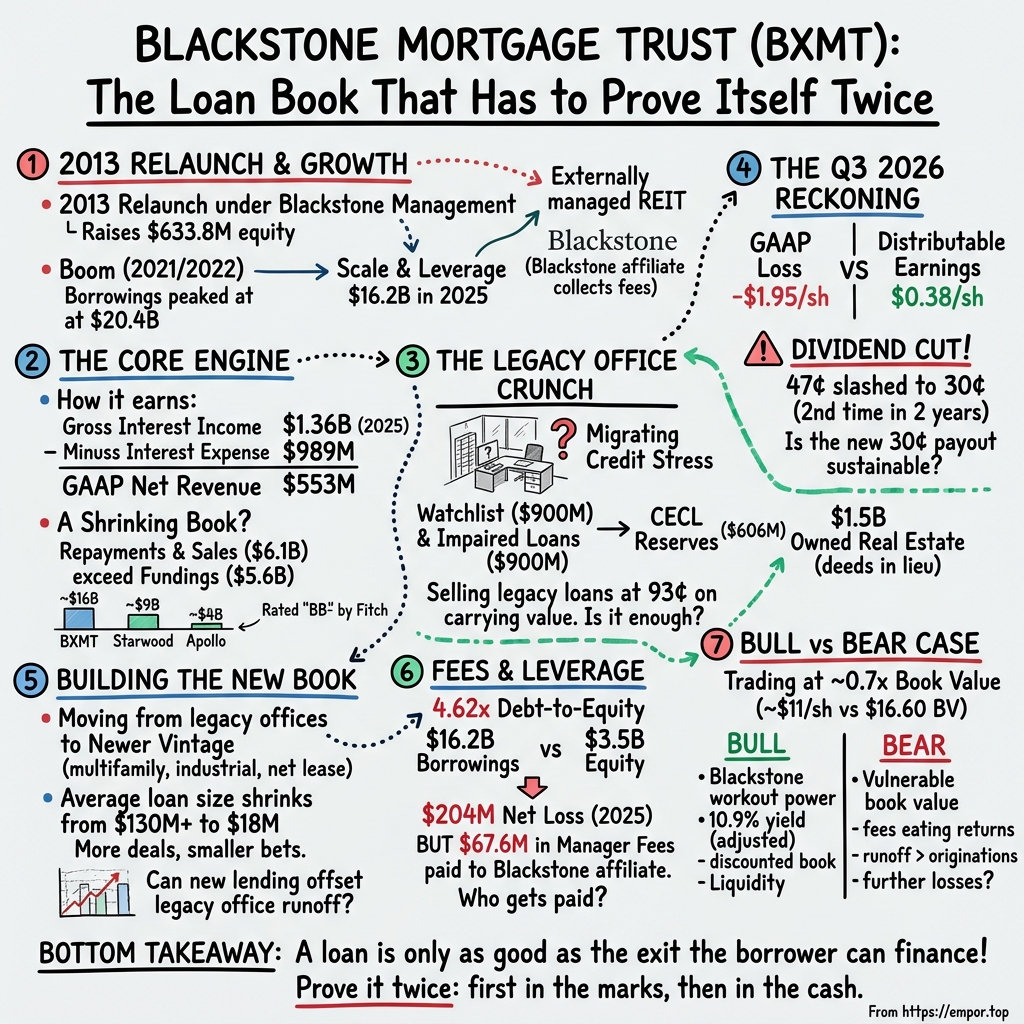
On October 29, 2026, Blackstone Mortgage Trust told its shareholders two things in the same breath. The first was that it had lost $327 million in the third quarter, or $1.95 for every share outstanding.1 The second, a few lines later, was that the board had set the next quarterly dividend at 30 cents, down from the 47 cents that had become the company's familiar rhythm for two years.1 For a company whose shares are owned mostly by people who want the dividend, the second number landed harder than the first.
The two numbers belonged to the same story, but they did not look like it at first. Beside the GAAP loss, management put a different measure on the same page: distributable earnings of 38 cents a share, or 42 cents before realized losses.1 That is the measure mortgage REITs use to describe the income available to pay shareholders, and on that measure the quarter looked almost ordinary. The gap between minus $1.95 and plus 38 cents is the whole puzzle of this company. Distributable earnings leave out most of the valuation losses that GAAP books when a lender decides a loan, or a building it has taken back, is worth less than it thought. Those losses do not vanish. They are simply waiting to become real, in cash, when the asset is sold.
What went into that $327 million loss? The largest piece was a $264.8 million increase in the company's reserves against expected credit losses, which pushed the total reserve to $606 million.21 Another $63.9 million came from marking down loans the company had decided to sell, and $36.4 million more was an impairment on property BXMT already owned after earlier foreclosures.2 On the earnings call, management described the quarter's impairments as about $800 million of loans, mostly legacy office and one hotel.3 In plain English, BXMT spent the quarter admitting that some of its older loans would not come back at face value, and it booked that admission all at once.
There was a brighter half to the screen, and the company led with it. The watchlist, the bucket of loans management considers at real risk, fell 56% in a single quarter to about $900 million, its lowest level since the end of 2019.1 Ninety-three percent of the loan portfolio was performing.1 And BXMT had sold nearly $1 billion of loans during the third quarter and through October at 93 cents on their carrying value.13 That last figure is the one investors should hold onto. A carrying value is the lender's own estimate of what a loan is worth after reserves. When buyers paid 93 cents on that estimate, they were telling the market that the estimate was about seven cents too generous on those particular loans.
That raises an uncomfortable question about the loans that were not sold. If the loans BXMT chose to sell cleared at a discount to their marks, are the loans still on the books marked more accurately, or did the company sell the ones it was most eager to be rid of? There are two readings. The optimistic one is that BXMT used the sale to flush out its hardest cases, took the discount as the price of speed, and has now rebased the rest of the book. The skeptical one is that a buyer's 93 cents is the closest thing to a real-world audit the market has, and it said the books were too high. On the call, analysts pressed precisely on that point: whether the sale recoveries implied more marks to come, and whether the impairments had now been fully recognized.3 Management's answer was that the quarter's actions had addressed the bulk of the legacy problem. That is a claim, and it will be tested asset by asset.
So the story sets three questions on the table from its opening scene. Have the losses on loans written during the property boom finally been recognized? Can new lending replace the income that disappears as old loans repay, default or get sold? And does the Blackstone platform that runs this company, for a fee, earn that fee for the people who own the shares?
The dividend announcement sharpens all three. This is the second time in roughly two years that BXMT has reset a payout that management had described as sustainable. In mid-2024 the company cut its quarterly dividend from 62 cents to 47 cents and said the new level was sustainable relative to long-term earnings power.4 Now the 47 cents is gone too. A dividend is not a promise in any legal sense, but for an income stock it is the most visible promise a management team makes. Twice now, the loan book has moved faster than the promise. To understand why, the story has to go back to the moment the current company was born, out of the remains of a different one.
 Subscribe on LinkedIn
II. The 2013 relaunch left a short history with a long shadow
Most companies with a long ticker history have a founding myth. BXMT has something closer to a resurrection. Before it was Blackstone Mortgage Trust, the listed shell was Capital Trust, a commercial real estate finance company that had come through the 2008 financial crisis badly damaged, with a legacy portfolio of troubled loans and securities and a small investment-management and servicing business on the side.5 In late 2012 that management business was sold to Blackstone, and in May 2013 the company took a new name, a new manager and a new strategy.5
The relaunch was a financial event as much as a rebranding. The company completed a 1-for-10 reverse stock split, changed its name to Blackstone Mortgage Trust, and sold 25.875 million new shares at $25.50 each in a public offering that raised $633.8 million after costs.65 Wall Street treated it like a fresh IPO, which in economic terms it was: almost all of the equity that would power the next decade of lending came in after the name change, and it came in because investors were buying the Blackstone name on the door.
That matters for anyone reading a long financial history of BXMT. The data series runs back further than 2013, but the business it measures does not. Revenue of about $184 million in 2014 had grown to roughly $1.5 billion by 2025, an eightfold increase that looks spectacular on a chart.7 But almost all of that growth was the deployment of new capital into a new lending business rather than an old business compounding, and the revenue figure itself is a gross interest number, not the net revenue a lender keeps after paying its own lenders. Treat 2013 as the start of the present company, not as a clean beginning for every historical metric.
What exactly did investors buy in that relaunch? BXMT is a real estate investment trust that makes commercial mortgage loans. It has no employees.7 Every officer who runs it is an employee of Blackstone or one of its affiliates, and the company is externally managed by BXMT Advisors, an indirect Blackstone subsidiary, under a management agreement that pays fees.7 This is the single most important structural fact about the company, and it is easy to blur. Blackstone is one of the largest real estate investors in the world. BXMT is not Blackstone. Its results belong to BXMT's shareholders; Blackstone's scale, personnel and relationships belong to its manager, and are rented to BXMT through that agreement.
The growth years were fast. Through the rest of the 2010s, the company kept raising equity and borrowing against the loans it made. Total assets went from about $4.6 billion at the end of 2014 to about $17 billion in 2020, and then, in the low-rate lending boom of 2021 and 2022, to roughly $25 billion.7 Borrowings followed the same arc, peaking at about $20.4 billion in 2022 before falling to roughly $15.7 billion in 2024 and $16.2 billion in 2025.7 Shareholders' equity peaked at about $4.6 billion in 2021 and has since slid to about $3.5 billion.7
Look at that sequence through a lender's eyes. The company grew its balance sheet fastest exactly when property prices were highest and borrowing was cheapest, because that is when borrowers wanted loans and when bank financing for lenders was most available. Loans written in 2021 and 2022 were sized against property values and rent rolls that, for many office buildings in particular, would not survive the next three years. Return on equity tells the same story compressed into a single line: high single digits through most of the 2010s, then negative in 2024 and only about 3% in 2025.7
There is a deeper reason this matters. BXMT's loans are short. At the end of 2025, the maximum remaining maturity in the portfolio was about two and a half years.7 That design was meant to be a strength: short loans reprice quickly, and floating-rate coupons rise with interest rates. But short loans also mean that every borrower has to come back to the market for a refinancing within a few years. If, when that day comes, the building is worth less than the loan, the borrower has a choice to make, and the lender inherits the consequences.
So the growth decade left two legacies. It built genuine scale, which gave BXMT access to bank financing and securitization markets that smaller lenders struggle to reach. It also left a concentrated book of large, short-term loans secured by properties whose refinancing prospects could change sharply when interest rates did. The investor underwriting BXMT today is not underwriting a steady mortgage lender with a decade of uninterrupted compounding. It is underwriting a loan book that has been built, stressed and partly rebuilt, and is now being asked to rebuild again.
To judge whether that rebuild can work, the next step is to open the machine itself. What does BXMT actually sell, and where does the money it reports as revenue go?
III. The $1.36 billion interest line that becomes $553 million
Start with the 2025 income statement, because it contains a disappearing act. BXMT collected about $1.36 billion of gross interest income that year.7 It paid about $989 million of interest to its own lenders.7 After netting those two and adding property revenue and other items, the audited statement shows total net revenue of about $553 million.7 A business that looks like a $1.4 billion revenue company from one angle is a roughly half-billion-dollar business from another, before it has paid its manager, its operating costs or any credit loss.
That is not a trick. It is what a leveraged lender is. BXMT's basic trade is simple to describe. It originates, or occasionally buys, a large loan secured by a commercial property, typically an apartment complex, a warehouse, an office tower or a hotel. It funds that loan partly with its own equity and mostly with borrowed money from banks, securitizations and bond investors. It collects interest from the borrower, pays interest to its own lenders, and keeps the difference. If all goes well, the borrower eventually repays the full principal, usually by refinancing or selling the property, and BXMT recycles that money into the next loan.
The pricing of that trade is quoted as a spread over a floating benchmark rate. At the end of 2025, the loan portfolio carried a weighted-average cash coupon of 3.19 percentage points over the benchmark, and an all-in yield, including fees, of 3.39 points over it.7 The average loan was written at about 65% of the property's value at origination.7 Think of it like a bank's mortgage book, but for buildings rather than houses, with the important difference that the borrower pays interest only and the loan matures in a few years rather than amortizing over decades.
The difference between gross interest and net revenue is the lender's own funding cost, and that is where leverage comes in. Suppose BXMT makes a $100 loan earning the benchmark plus about 3.2 points. It might fund perhaps $75 to $80 of that with secured borrowing at the benchmark plus a much smaller spread, and the rest with shareholders' equity. The equity earns its own share of the coupon plus the gap between what the loan pays and what the borrowing costs, multiplied across the borrowed portion. That is how a 3-point spread becomes a high-single-digit or low-double-digit return on equity in good years. It is also why a small change in credit losses can wipe out a year's earnings: the equity cushion under each loan is thin by design.
The customers of this business are not like customers of a software company. A borrower does not subscribe. It takes a loan, pays interest for as long as it needs the money, and leaves the moment a cheaper lender, a sale or a long-term refinancing appears. BXMT does not report a recurring-revenue share or a standard contract length, because the concept does not fit.7 What determines how long the income lasts is loan maturity, repayment behavior, the borrower's access to refinancing, and the value of the building. A lender that writes excellent loans in a strong market can see its income fall simply because borrowers repay early.
That is exactly what has been happening. In 2025, BXMT funded about $5.6 billion of loans and received about $6.1 billion back through repayments and sales.7 The company was busy, but the loan book got smaller, because more money came out than went in. Investors used to industrial companies tend to read fundings as capital spending and repayments as a kind of sales. That analogy breaks here. For a lender, new loans are the inventory and repayments are the inventory leaving the shelf. A shrinking book means fewer dollars earning a spread next year, no matter how active the origination team is.
There is a second reason the headline revenue line misleads. Market-data providers record BXMT's 2025 revenue at about $1.5 billion, which is closer to its gross interest and property income than to the audited net figure.7 Nothing is wrong with either number; they simply measure different things. The trouble begins when someone computes a price-to-sales ratio or an operating margin on the gross figure and compares it with an industrial company. The economics of BXMT are better explained by four lines: the spread it earns, the speed at which loans repay, the credit losses it takes, and the cost of the money it borrows.
On those four lines, the recent decline in earnings is not mysterious. In the first nine months of 2026, net interest income fell by about $51.7 million compared with the same period a year earlier.2 The company attributed the decline primarily to lower average loan balances and to loans moved onto cost-recovery accounting or converted into owned real estate.2 Cost recovery is a quiet but important phrase. When a lender has doubts that a loan will be repaid in full, it stops recognizing interest as income and applies any cash it receives to principal instead. The loan is still on the books, but it no longer contributes to earnings. When a lender forecloses, the loan becomes a building, and the building's rent replaces the coupon, usually at a much lower yield after operating costs.
So the challenge facing BXMT is not simply to avoid new losses. It is to replace the interest income that has stopped flowing from impaired loans while those loans are being resolved, and to do it with a smaller equity base than it had three years ago. That is a harder problem than the quarterly distributable-earnings figure alone suggests, because distributable earnings can look stable while the earning asset base quietly shrinks beneath it.
Which brings the story to the question every lender eventually faces. If the business is borrowing money cheaply to lend it out a little more expensively, against buildings anyone can inspect, what stops a competitor from offering the same loan at a slightly lower spread? Put differently: what, if anything, does the Blackstone name on the door actually buy?
IV. Blackstone's platform is a sourcing advantage, not a proved moat
Picture the public commercial mortgage REIT industry in mid-2024 as a map. On that map, BXMT is the largest territory by a distance. Green Street's sector analysis put its U.S. commercial real estate loans at roughly $16 billion, against about $9 billion at Starwood Property Trust and about $4 billion at Apollo Commercial Real Estate Finance.8 Together, the three largest listed commercial mortgage REITs held roughly a third of the U.S. loans in that sector.8 If scale were a moat, BXMT would have the widest one among public peers.
But the map leaves out most of the territory. Listed mortgage REITs are a small slice of the market for commercial real estate debt. Banks, life insurers, private-credit funds, debt funds and the commercial mortgage-backed securities market all compete for the same borrowers.8 A large apartment owner seeking a $200 million bridge loan can call a dozen lenders, and it will. That single fact shapes almost everything about BXMT's competitive position.
Run through the forces that govern any lending business. Borrowers have real bargaining power, because a well-located building with a credible sponsor is a desirable credit and lenders bid for it. Rivalry is intense, because lenders compete not only on spread but on loan size, flexibility and speed, and a lender that wants to grow its book can always win more business by accepting a lower spread or a higher loan-to-value. Substitutes are everywhere, from a bank term loan to a securitized fixed-rate mortgage to simply selling the building. New entrants appear whenever returns look attractive, and private-credit funds raised large amounts of capital for exactly this purpose. Even suppliers, which for a lender means the banks and bond investors who finance it, can change the economics after a loan is made by tightening terms or raising funding costs. None of these forces is unusual. Together they explain why a 3-point spread over the benchmark is a market price, not a premium.
Where could BXMT have an edge? The most plausible place is sourcing. Blackstone's real estate business owns and finances a vast amount of property and maintains relationships with large sponsors, brokers and banks. Personnel who see a broad flow of transactions can choose which ones to lend against, and market information from Blackstone's equity side can sharpen underwriting. Fitch, which rates BXMT BB- with a stable outlook, names the Blackstone affiliation, manager resources and adequate liquidity as strengths.9 The relationship also gives BXMT credibility with financing counterparties, which can lower its own funding costs at the margin.
There is also workout skill. When a loan goes wrong, the lender has to decide whether to extend, restructure, sell or foreclose, and if it forecloses, it has to operate a building. A manager affiliated with one of the world's largest property owners plausibly knows how to do that better than a small, standalone lender. This is not trivial in a cycle where the outcome depends more on recovery values than on new originations.
Now test the claim against the mechanism that would break it. A sourcing advantage would show up as better loans: lower loss rates than peers through a full cycle, or higher spreads for the same risk. The record does not show either clearly. BXMT's office exposure went sour along with the rest of the industry; the Q3 2026 impairments were concentrated in legacy office and a hotel, the same collateral that hurt peers.3 Fitch's own rationale puts the limits beside the strengths: a narrow commercial real estate focus, elevated office nonaccruals, leverage above peers, secured funding, and REIT distribution requirements that limit how much capital the company can retain.9 The Blackstone name did not make BXMT's collateral more valuable, and it did not stop borrowers from walking away from buildings worth less than their loans.
Borrower concentration is another place investors look for an edge and find instead a gap in disclosure. BXMT does not report the share of interest income coming from its five or ten largest borrowers.7 It does publish loan-level details about collateral, location and internal risk ratings, and for a lender those are more useful than a customer table anyway. At the end of 2025, the company had 131 loans with about $18.2 billion of principal, an average of roughly $140 million each, which means any single large loan going bad can move a quarter's results.7
Then there is the allocation question. BXMT's manager is part of a larger Blackstone real estate credit business that runs other funds and accounts. Opportunities, and sometimes capital, can be allocated among them. BXMT discloses related-party transactions, including cases where its borrowers used new loans to repay loans held by Blackstone-advised vehicles.7 What it does not publish, and what no shareholder can therefore check, is a multi-year, after-fee comparison of the returns and losses on BXMT's loans against comparable Blackstone accounts. Without that, the claim that BXMT receives superior opportunities because of its parentage remains plausible but unproven.
The fair verdict is a narrowed one. Scale and Blackstone access are real advantages in sourcing, financing and workouts, and they help explain how BXMT built the biggest book among public peers. But the evidence does not establish exclusive deal access, superior risk-adjusted returns after fees, or anything resembling a durable moat. The test the story can carry forward is concrete: if the advantage is real, it should appear in the next vintage of loans, as originations at spreads that hold up after financing costs and credit outcomes that beat the industry. The legacy book, unfortunately, is where that advantage has been weakest. That is where the story goes next: to the loans that turned into buildings.
V. The office loans that became properties
In the third quarter of 2026, a loan on a mixed-use property in the San Francisco Bay Area stopped being a loan. The borrower handed the keys to BXMT through a deed in lieu of foreclosure, a polite name for a borrower conceding that the property is worth less than what it owes and transferring it to the lender rather than fighting a foreclosure in court.2 The loan was already impaired. On BXMT's books, it now became owned real estate, joining a portfolio of buildings the company never set out to own.
That transfer is a small version of the whole cycle. When interest rates rose sharply in 2022 and 2023, office buildings were hit twice: their financing costs jumped, and their tenants were shrinking their footprints. Borrowers whose loans came due could not refinance at the old size. Some put in more equity, some negotiated extensions, and some gave the buildings back. For BXMT, each giveback turned a loan earning interest into a property that has to be leased, maintained and eventually sold.
Before following that path, it is worth clearing away a misleading measure. Standard screens show BXMT with about 31 debtor days in 2025, which looks like a business that collects its bills in a month.7 For a lender, the measure is close to meaningless. BXMT does not send invoices. Its assets are loans and the interest accruing on them, about $133 million of accrued interest at the end of 2025 and about $120 million at September 2026.72 The question is not how fast those are collected, but whether the principal behind them comes back at all.
The best evidence for that is BXMT's internal risk-rating scale, where 1 is very low risk and 5 means impaired or a loss is likely. At the end of 2024, loans with a net book value of about $1.8 billion carried the worst rating of 5, and about $2.7 billion carried a 4.7 A year later the picture had shifted: the 5-rated bucket had shrunk to about $175 million, while 4-rated loans had edged up to about $2.8 billion.7 Some of the worst loans had been resolved, sold or converted into property, while a fresh group of loans had slipped into the category just above impaired. That is what a credit cycle looks like in the middle: the problems are moving, not disappearing.
Fitch's December 2025 review caught the same motion from outside. It noted that office exposure had fallen to 30% of net book value at the third quarter of 2025, from 39% at the end of 2024, but that 4-rated assets had risen to about 15% of net book value.9 The office problem was shrinking as a share of the book, yet the overall pool of loans management considered at elevated risk was still large.
Then came the third quarter of 2026. Six more loans became impaired.1 At the same time, the watchlist fell 56% to about $900 million.1 Both statements are true, and the difference between them matters. A smaller watchlist means fewer loans are in the uncertain middle zone. But part of the reason they left the watchlist is that they were moved into the impaired category, sold, or reserved against, not that they were cured. At September 2026 the company reported about $900 million of impaired loans and about $1.5 billion of owned real estate, alongside the smaller watchlist.1 Credit stress has not disappeared. It has migrated from uncertain loans into reserves, held-for-sale marks and buildings.
Follow one problem loan along that path and the economics become clear. First, collateral values fall, and the lender sets up an asset-specific reserve, an estimate of the loss based on what the building would fetch. By September 2026, $444 million of BXMT's $606 million reserve was asset-specific, tied to identified problem loans, while $162 million was a general reserve for losses not yet tied to any loan.1 Next comes a resolution: a sale of the loan, a modification, or a foreclosure. If BXMT takes the building, the asset moves onto the balance sheet at an estimate of fair value, and the loan's reserve is charged off. From then on, the building generates rent but also costs: property taxes, leasing commissions, tenant improvements and management. Finally, the building is sold, and only then does the market deliver its verdict in cash.
Each of those steps rests on judgment, which is why BXMT's auditor singled two of them out. The 2025 audit opinion was unqualified, on both the financial statements and internal controls, but it identified two critical audit matters: the fair value of collateral underlying impaired loans, and the allocation of purchase price when the company takes ownership of real estate.7 Critical audit matters are not findings of error or control failure. They are the auditor's way of telling investors where the numbers depend most heavily on subjective estimates. For BXMT, those estimates are exactly where the investment case lives.
The owned real estate portfolio is the part of the story most investors underestimate. At September 2026 the company carried about $1.34 billion of owned real estate, net, largely acquired through loan resolutions and consolidations rather than deliberate investment.2 Buildings like these can recover. A well-capitalized owner with patience can lease up a half-empty office tower and sell it into a better market. But they also tie up equity that earns little, they require capital to improve, and their values move with the very property market that produced the original loss. The $36.4 million impairment on owned real estate in the third quarter shows that even after foreclosure the marks can keep moving.2
The verdict on this part of the story is mixed, and it should be stated plainly. The lower watchlist and the shrinking 5-rated bucket are real evidence that BXMT has worked through a large share of its legacy problems. The quarter's loss, the continued reserve build and fresh impairments say that recovery is incomplete. The evidence that would settle it is not another quarter's reserve figure. It is the cash: what the remaining office loans, watchlist assets and owned buildings fetch when they are finally sold, compared with what BXMT says they are worth today. The nearly $1 billion of sales at 93 cents is the first large sample, and it came in below the marks.
While those old loans are being worked out, BXMT has to build a new book beside them. That is the second half of the race.
VI. The next loan book is being built while the old one runs off
On the third-quarter 2026 call, management described a quarter of new lending that looked nothing like the portfolio of 2021. The company said it had made roughly $500 million of new investments, including newer-vintage loans on apartments and industrial property, alongside investments in net lease properties, homebuilder finance and bank loans.3 The average new position was smaller. A few years earlier BXMT's average investment had been more than $130 million; management said the recent average was about $18 million.3 Management said newer strategies had grown to nearly 10% of the portfolio.3
That is a deliberate change in shape. The old BXMT was a bridge lender writing nine-figure floating-rate loans on large buildings in major cities. The emerging BXMT is trying to add smaller, more numerous positions across a wider set of collateral, including assets that look more like corporate credit than real estate loans. The question is whether it is building a second engine or simply diversifying a shrinking first one.
The 2025 runoff continued: originations or acquisitions were about $5.7 billion, while repayments and sales exceeded fundings, at about $6.1 billion versus $5.6 billion.7 By September 2026, the portfolio had 114 loans with about $14.6 billion of principal, down roughly a fifth from year-end.27 Some of that decline was deliberate: loans sold to reduce problem exposure, loans transferred into owned real estate. But one quarter's $500 million in new investments does not refill that.
The Q1 2026 call had already set up this diversification narrative, presenting the new strategies as additions that broaden BXMT's opportunity set rather than as a change in identity.10 That call also disclosed the company's first data-center loan.10 It is a tempting headline in an era when data centers are the hottest asset in real estate, but one loan is evidence of underwriting optionality, not of a data-center lending franchise. Nothing in the filings suggests it is material to earnings.
The smaller average position cuts both ways. Smaller loans reduce single-asset concentration: when one $18 million position goes bad, it barely registers in a quarter, whereas a single $300 million office loan can define one. But a smaller average size also means more transactions are needed to deploy the same capital, more underwriting work per dollar, and a greater reliance on the manager's ability to source deal flow at scale. And some of the new categories, such as bank loans and homebuilder finance, are markets where BXMT has no long public track record. The right measures are realized cash yields and returns after the cost of financing them, not the number of new strategies on a slide.
It is also worth being precise about what BXMT has not done. BXMT has made no material corporate acquisition. Its capital deployment consists of loan originations, purchases of loans and securities, and properties taken through foreclosure. The properties it owns are the results of credit outcomes, not a strategy of buying real estate. Nor do the filings provide deal-level comparisons that would let an outsider judge whether BXMT overpaid for the loans it bought or the properties it now holds. The only honest test is the one the market will eventually provide: recoveries compared with carrying values, and realized yields on the new loans.
Underneath all of this sits the question of capital discipline. BXMT has four broad uses for each dollar of capital. It can lend it out at a spread. It can use it to resolve problem loans, for example by funding improvements to a foreclosed building so it can be sold for more. It can repay debt. Or it can buy back its own shares. The company has done some of the last: about 6 million shares repurchased in 2025 for about $109 million, at an average of around $18.20, and another 2.77 million shares in the first nine months of 2026.72 On the Q3 call, analysts pushed on exactly this trade-off, asking how management weighed new originations against buybacks with the stock well below book value.3
That question deserves weight. When a stock trades at around 70 cents on each dollar of book value, a buyback that retires shares at that discount is, mechanically, an investment in the existing portfolio at a 30% markdown. If management believes the book is fairly marked, buying it back at that price is hard to beat with a new loan earning a 3-point spread. If management prefers to keep originating, it is implicitly saying either that it needs the new income to cover the dividend and the fixed costs of the platform, or that it doubts the book is worth its stated value. Neither reading is comfortable. The repurchases at $18.20 in 2025 also offer a sobering footnote: the shares now trade far below that level.11
The sharper version of the question is whether BXMT needs originations simply to offset runoff. A lender that must lend to stand still is exposed to the temptation of writing marginal loans to keep the book from shrinking. A lender that can shrink comfortably can afford to wait for better spreads. BXMT's dividend history suggests which of those positions it has been in. That history is the next scene.
VII. A dividend called sustainable, twice
Go back to the summer of 2024. BXMT had just cut its quarterly dividend from 62 cents to 47 cents. On the second-quarter call, management explained that the new level reflected a sustainable payout relative to the company's long-term earnings power, and that the lower dividend would free up capital to invest in new loans as the cycle turned.4 The numbers that quarter supported the framing on the surface: distributable earnings of 49 cents a share, against a 47-cent dividend.4
By the third quarter of 2024, management was still describing the payout as sustainable, while also forecasting a period of rebuilding before earnings would recover.12 Those two statements sat together uneasily. A dividend set close to current earnings is only sustainable if earnings do not fall, and a rebuilding period is, almost by definition, a period when earnings are under pressure. Investors were being asked to accept both a stable payout and a shrinking earnings base.
What happened next is visible in the accounts. Dividends paid in cash fell from about $421 million in 2022 to about $322 million in 2025, reflecting both the cut and a slightly smaller share count.7 But GAAP earnings fell faster. In 2024 the company lost about $204 million.7 In 2025 it earned about $109 million, which meant dividends paid were nearly three times net income.7 For most of the 2010s, BXMT paid out roughly what it earned, with a median payout around 100%. That pattern broke after 2020 and has not repaired.
The third quarter of 2026 brought the arc to its turn. The company paid a 47-cent dividend for the quarter. It reported a GAAP loss of $1.95 a share and distributable earnings of 38 cents, or 42 cents before realized losses.1 Then it announced the 30-cent level for the next quarter.1
To understand why distributable earnings could hold near 40 cents while GAAP showed such a loss, it helps to know what the adjusted measure excludes. Distributable earnings, as BXMT defines it, removes noncash items such as increases in CECL reserves, depreciation on owned real estate and certain unrealized gains and losses. It includes a loss only when the loss is realized, typically when a loan is sold, resolved or charged off.7 The logic is that reserves are estimates, and a dividend should be paid out of income, not out of changes in estimates. The risk is the mirror image: when the estimates eventually become realized losses, they will hit distributable earnings then, often in large lumps. The gap between the 42 cents before realized losses and the 38 cents after them in the third quarter is a small preview of that.
Distributable earnings is also not cash flow in the ordinary sense. Interest on a loan on cost-recovery accounting is excluded from income even if some cash arrives. Payment-in-kind interest, where a borrower adds interest to the loan balance rather than paying it, can be counted as income before any cash changes hands. So the measure is best thought of as management's estimate of recurring earning power, useful but not audited and not the same as cash available to pay shareholders.
Against that backdrop, the reset to 30 cents looks better covered. Thirty cents a quarter is meaningfully below the 38 cents of distributable earnings in the third quarter. Management said it expects the new dividend to be covered in the fourth quarter of 2026 and through 2027, and that it believes the level can be sustained through different rate and credit conditions.3 That is a more conservative posture than in 2024, with a larger margin between earnings and payout.
But the honest framing is that this is guidance to test, not proof. One quarter of adjusted earnings is not a track record, and the forces that eroded earnings after 2024, a shrinking loan book, loans moving onto cost recovery and foreclosed buildings earning less than loans, have not stopped. The quarter's 38 cents already includes loans that will not be on the books next year, because they were sold in October. The decisive evidence will be several consecutive quarters of distributable earnings after realized losses, set against the 30-cent payout, together with realized recoveries on impaired loans that do not force further write-downs.
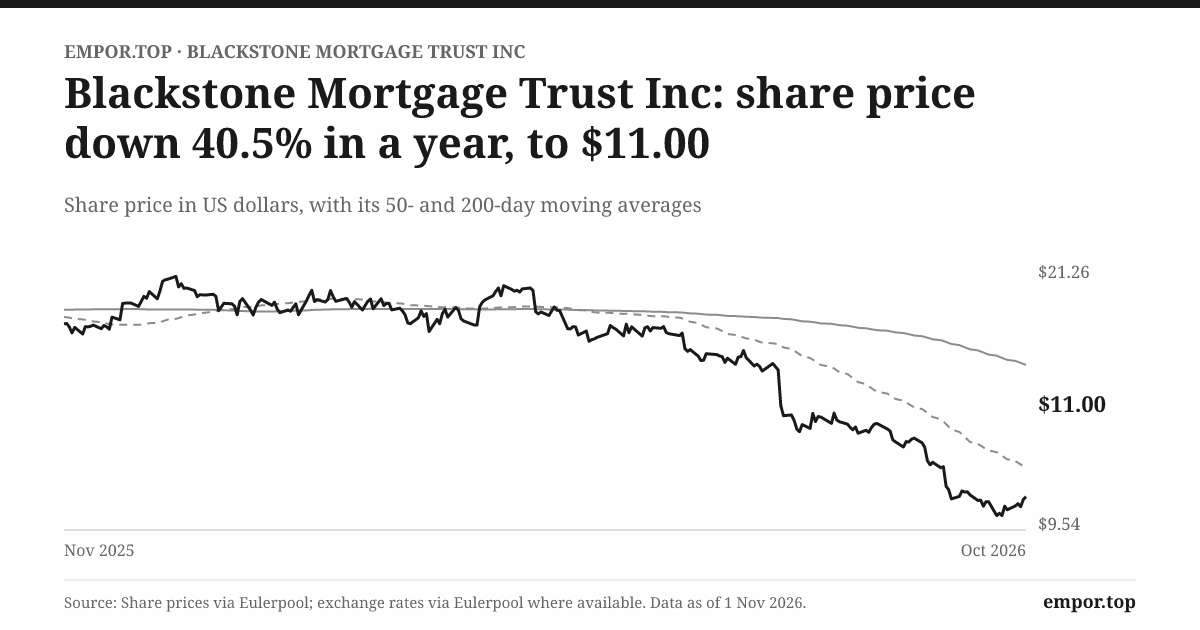
There is a simple market consequence that many screens have not caught up with. A widely published dividend yield for BXMT on November 1, 2026 stood at about 17%, calculated from the old 47-cent quarterly rate.11 At a 30-cent quarterly rate, and a share price of about $11, the annualized yield is closer to 11%. Investors attracted by the headline number are looking at a payout that no longer exists.
The credibility test is now straightforward. In 2024 management called the dividend sustainable, and it was cut again. In 2026 management says the new level is covered. Coverage over the next several quarters will say more about this team than any statement on a call. And that raises the governance question this story has been circling since the opening scene: who decides, who pays, and who benefits when BXMT is repairing its loan book?
VIII. Who gets paid when BXMT is still repairing loans?
In 2025, BXMT's shareholders lived through the aftermath of a $204 million net loss the year before and a thin recovery to about $109 million of net income. Over that same year, the company paid its external manager $67.6 million in management fees.7 In 2024, the year of the loss, the fee had been $74.8 million.7 That is the scene that frames the governance question: a business working through its worst credit cycle since the relaunch, and a fee that kept arriving regardless.
The structure of the fee explains why. Under the management agreement, BXMT pays its Blackstone-affiliated manager a base fee of 1.50% a year on equity, as the contract defines it, plus an incentive fee of 20% of adjusted earnings above a 7% return hurdle, payable only if Core Earnings over the prior three years have been positive.7 The base fee scales with the size of the equity base. It does not require positive GAAP earnings, and it does not shrink because loans go bad, except to the extent that losses reduce contract-defined equity. The incentive fee, which does depend on performance, was zero in 2024 and 2025, after $44.2 million in 2023.7 At the end of 2025, BXMT owed $16.4 million of accrued management fees, and $14.5 million at September 2026.72
Put the fee beside the economics described earlier and it looks larger. Against the $553 million of audited total net revenue in 2025, the management fee was roughly an eighth of what BXMT kept after paying its lenders, and a much larger share of what was left after credit losses. Against a gross revenue figure of $1.5 billion, it looks like a modest 4% to 5%. The net figure is the more useful comparison.
The people running BXMT today arrived in the middle of the repair job. Timothy Johnson became chief executive in November 2025, after leading Blackstone Real Estate Debt Strategies, the credit arm whose resources BXMT relies on, since 2022.13 He also chairs the board.13 Katharine Keenan, who preceded him as CEO, remained a named executive officer for 2025.13 Austin Peña serves as president.13 Johnson's mandate is not to build a lender from scratch, as the 2013 team did, but to finish resolving the legacy book, rebuild earnings and restore investor trust in the dividend. He steps into that role as the senior figure in Blackstone's broader real estate credit business, which means the conflicts and the advantages of the external structure sit with the same person.
His personal stake is meaningful in dollars and small in proportion. The 2026 proxy reported Johnson's beneficial ownership at 527,900 shares as of April 13, 2026, and all executive officers and directors together held about 1.18% of the company.13 The largest holders were index and institutional managers: BlackRock at about 15%, Vanguard at about 10.9%, and Blackstone Inc. at about 5.75%, a figure that includes shares held by the manager and affiliates.13 No controlling shareholder is identified. That leaves governance largely in the hands of the board's independent directors, who make up a majority of the nine seats and run the audit, compensation and risk committees.13
Executive pay at BXMT is unusual, because BXMT does not pay its executives' salaries. Johnson's 2025 compensation from BXMT, about $1.13 million, consisted entirely of stock awards; Keenan's was about $1.17 million.13 Blackstone affiliates paid the named executive officers a further $2.7 million in salary, cash bonus and incentive participation for 2025.13 Those are separate flows, and the $2.7 million is not a measure of total management cost. But the scale comparison is instructive: the management fee BXMT pays is roughly 25 times the cash affiliates paid its named executives. Most of the fee pays for the platform, people, systems and overhead of the manager, and for Blackstone's return on providing them.
Related-party transactions sharpen the picture. In 2025, BXMT's borrowers used proceeds from five new BXMT loans to repay about $899.1 million of performing loans held by Blackstone-advised vehicles.7 In another case a Blackstone-advised vehicle financed a borrower's repayment of about $148.8 million to BXMT.7 The company says these transactions were initiated by borrowers and priced at market terms.7 In some loans involving Blackstone-controlled borrowers, BXMT says a third-party co-lender negotiated terms, and BXMT gave up certain non-economic rights.7 The explanation is plausible, and disclosure is better than silence. But the conflict is structural: when one part of the Blackstone system refinances out of another, the shareholders of each part depend on the manager to have priced the trade fairly, and outsiders cannot verify it independently.
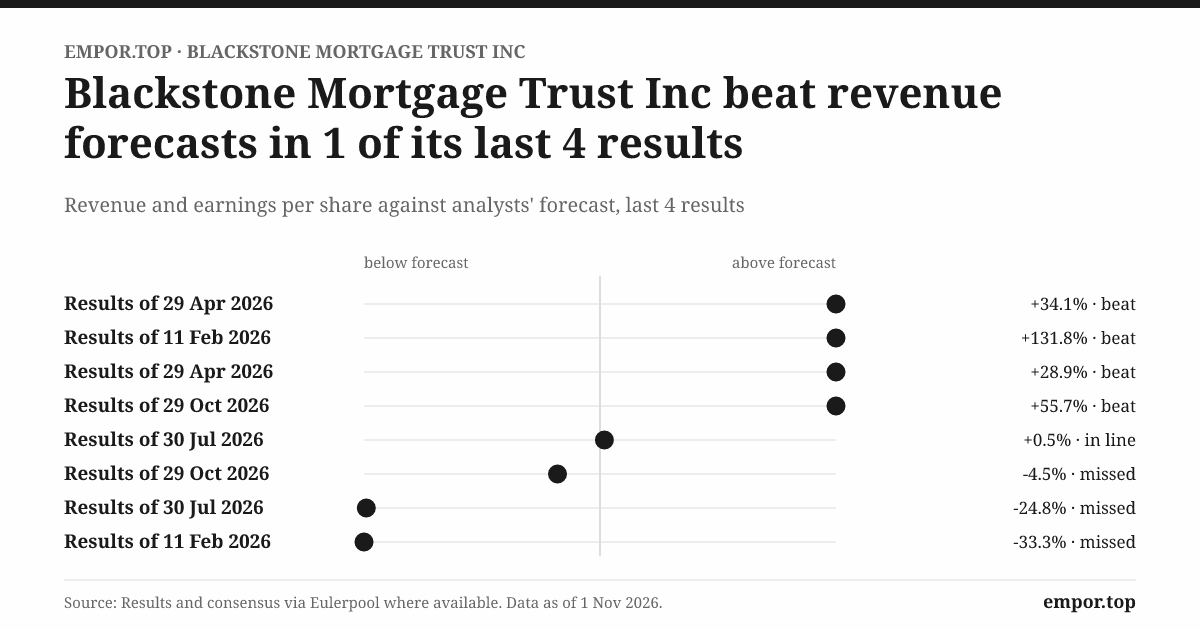
Then judge the management team the way the market eventually will, by behavior over time. The earlier assurance that the 47-cent dividend was sustainable did not hold. In between, the explanation for weaker earnings shifted from interest rates and a market waiting for recovery toward the more specific mechanics of loans on cost recovery and a smaller loan book. On the most recent call, management did quantify more than in earlier periods: the impaired balance, the sale recoveries, the size of new investment and the expected dividend coverage.3 That is to its credit. The record of forecasting, however, is weak.
Shareholders have registered a modest view. At the June 2026 annual meeting, say-on-pay received about 77.4 million votes for and 5.3 million against, while auditor ratification passed with about 128.3 million votes for and 1.1 million against.14 Roughly 6% opposition on pay, in a company with a cut dividend and a deeply discounted share price, is a mild dissent signal, not evidence of organized pressure.
An activist reviewing this structure would ask a pointed set of questions. Should the base fee be calculated on a measure closer to market value or adjusted for book-value losses? Should the board demand an after-fee performance comparison with comparable Blackstone credit accounts? Should buybacks take priority over new lending? None of those questions has been forced publicly, but they are the right ones.
The verdict is narrow but clear. Blackstone contributes a real platform and genuine credit capability, and the external structure gives a small public company access to resources it could not afford alone. But BXMT pays a base fee through weak earnings, carries conflicts in allocation and affiliate transactions, and has not published the evidence that would prove the manager's net contribution exceeds its cost. The unresolved test is a multi-year, after-fee credit and return record compared with similar Blackstone accounts. Until it exists, the relationship is valuable but unproven. And whatever the manager's value, it operates inside a balance sheet built largely on borrowed money.
IX. Borrowed money, REIT payouts and the room to maneuver
Put the December 2025 balance sheet on the screen and one ratio dominates. BXMT had about $16.2 billion of borrowings against about $3.5 billion of shareholders' equity, a debt-to-equity ratio of roughly 4.6 times.7 For every dollar shareholders had at risk, the company had borrowed more than four and a half. Jump forward to the third-quarter 2026 presentation, and management emphasized two numbers designed to reassure: about $1.3 billion of liquidity, and 89% of debt that was not subject to mark-to-market margin calls from lenders.1
Both halves of that picture are true, and the question is which one dominates. Leverage is the reason BXMT earns a decent return on a loan spread of about 3 points. It is also the reason a few points of collateral loss can erase years of retained earnings. The company has survived the cycle so far with its funding intact, which is not a trivial achievement for a leveraged lender. But survival is not the same as room to grow.
The funding stack has several layers, each with its own risk. As of September 2026, the largest piece was secured credit facilities from banks, about $7.2 billion, which finance specific loans.2 Next came securitized debt, about $2.6 billion, where loans are pooled and sold to bond investors in collateralized structures.2 There was about $1 billion of asset-specific debt tied to individual loans.2 At the corporate level, BXMT had about $1.9 billion of term loans, about $1.2 billion of senior secured notes and about $266 million of convertible notes.2 The secured facilities are generally matched to the loans they finance by currency, index and term, and the company says they lack the capital-markets mark-to-market provisions that forced some lenders to sell assets in previous downturns.2
That matching is the heart of BXMT's defense. In a classic mortgage-REIT crisis, a lender's bank looks at falling collateral values and demands more cash, forcing the lender to sell good assets at bad prices. Non-mark-to-market funding limits that risk, because margin calls are tied to credit events in the specific loans rather than to market swings. It does not remove it. Banks can still require paydowns when individual loans deteriorate, and every facility eventually matures and has to be renewed.
The corporate debt adds different risks. Term loans and senior secured notes must be refinanced in the capital markets on their own schedules, at whatever spread investors demand for a BB- issuer. Convertible notes add a dilution risk if they are settled in shares. The covenants in BXMT's financing agreements, including a minimum fixed-charge coverage of 1.3 times, a minimum tangible net worth of $3.6 billion and a limit on debt at 83.33% of total assets, are not close to breaking on the figures disclosed, but they mark the boundaries inside which the company must operate.7 A tangible net worth floor of $3.6 billion against shareholders' equity of about $3.5 billion at year-end is not directly comparable, because the covenant uses a contractual definition, but it is a reminder that continued book-value losses would eventually tighten that room.
Fitch provides the outside view. Its BB- rating, affirmed in December 2025 with a stable outlook, is below investment grade.9 It credits Blackstone's platform, risk-management resources and liquidity, but holds the rating back because of leverage above peers, concentrated office exposure, reliance on secured funding and the REIT requirement to distribute most taxable income, which limits retained capital.9 That last point is the subtle one. A bank can retain earnings to rebuild capital after a loss cycle. A REIT has to distribute at least 90% of its taxable income to keep its tax status, so it cannot simply sit on profits to rebuild. The dividend reset to 30 cents partly reflects that constraint.
Near-term pressure has eased. On the third-quarter call, management said the company's first-quarter 2027 maturities were largely prefunded.3 That is real relief, but it is not a permanent answer to refinancing risk, because BXMT's liabilities, like its loans, keep coming due. There are also obligations running the other way: as of September 2026, BXMT had about $915 million of unfunded commitments across 42 loans, money it has promised to advance to borrowers for construction, leasing or improvements as projects progress.2 Those commitments require liquidity, and they also depend on the borrowers continuing to perform.
Readers used to industrial companies often reach for cash from operations and free cash flow to judge whether a company can fund itself. For BXMT, those measures mislead. Operating cash flow was about $276 million in 2025, from net income of about $110 million plus noncash items, mainly CECL provisions and depreciation.7 But the real cash engine of a lender, principal lent and principal collected, runs through investing cash flows. In 2025, BXMT funded about $5.6 billion and collected or sold about $6.1 billion.7 A free-cash-flow yield calculated on operating cash alone ignores both, and should not be read as the company's capacity to lend or to pay dividends.
The capital-allocation choice comes back here with more force. Every dollar BXMT lends must earn more than the value of conserving it or using it to buy back shares at a discount. With equity reduced, leverage above peers and the REIT payout requirement in place, management cannot do everything at once: make new loans, buy back stock, fund commitments, carry foreclosed buildings and pay a dividend. The 30-cent dividend is, among other things, a decision to keep more capital inside the company. Whether that capital earns its keep is the core of the investment debate.
X. Analysis & Bear vs. Bull Case
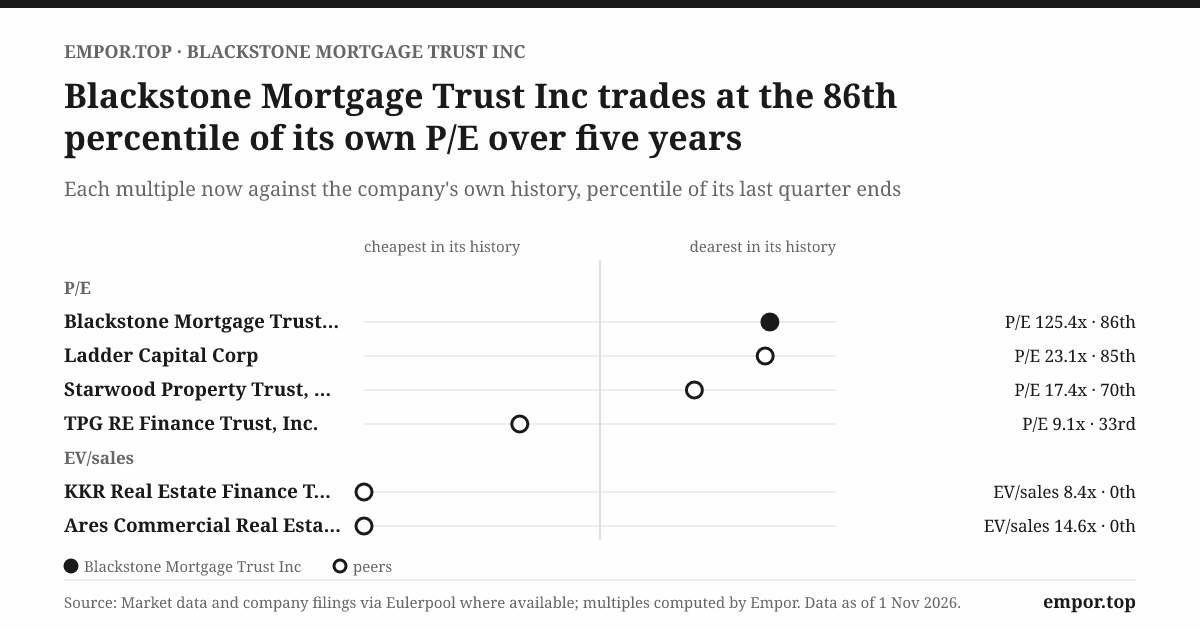
At about $11 a share, BXMT trades at roughly 0.7 times its book value per share of about $16.60.111 In other words, the market values each dollar of equity that BXMT reports at about 66 cents. The same screens also show a trailing P/E of about 125 times.11 That figure is not useful. The P/E is computed on trailing earnings of minus $2.24 a share, so it does not represent an earnings multiple in any conventional sense. The only valuation lens that carries real meaning here is book value, and the question it poses is whether that book is worth what it says.
Peers offer context, with care, because their snapshots come from different dates and providers, and their book values are not of equal quality. Starwood Property Trust traded around 0.71 times book in late October 2026.15 TPG RE Finance Trust was around 0.48 times in September.16 Ladder Capital traded around 0.87 times in July.17 Apollo Commercial Real Estate Finance was near 0.49 times in late July.18 BXMT sits in the middle of that range. The market is not treating it as a distressed outlier, but it is also not paying a premium for the Blackstone name. The discount implies that investors expect either more losses on the existing book, a lower return on equity for years, or both.
The key performance indicators that will decide which story wins are few. The first is realized recovery against carrying value: what BXMT gets in cash when it sells loans or foreclosed properties, compared with its marks. The most recent reading is nearly $1 billion of sales at about 93 cents on carrying value, a sign that marks were still somewhat too high on those assets.1 The second is the balance between new loans and runoff: whether originations at adequate spreads start to offset repayments and resolutions. The latest reading is a loan book that fell from about $18.2 billion of principal at the end of 2025 to about $14.6 billion by September 2026.72 The third is distributable earnings after realized losses against the new dividend, latest reading 38 cents against a 30-cent dividend still to be paid.1 If all three move the right way at once, the recovery thesis is working. If one fails, the others will be harder to sustain.
The Porter analysis points to a structurally competitive business with no demonstrated pricing power or switching costs. Hamilton Helmer's 7 Powers framework reaches the same result: Blackstone's deal flow and information are BXMT's strongest potential advantage, but they belong to the manager, which allocates opportunities among several vehicles. Scale and process skill may help, but BXMT has not shown that they produce superior returns after fees. The honest conclusion is that BXMT has scale and access, not a demonstrated moat.
The bull case begins there and still finds something worth considering. The book trades at a discount. Credit metrics have improved, with a much smaller watchlist and the worst risk-rated bucket largely cleared. The company has a large sourcing platform, enough liquidity to fund commitments and new loans, mostly non-mark-to-market funding, and a dividend now set below current distributable earnings. If the 93-cent sales were the worst of the book, and the remaining assets resolve near their marks, book value stabilizes, earnings recover as new loans replace runoff, and a 0.7 times book valuation looks too pessimistic. The bull's version of the Blackstone advantage is that it shows up in the next vintage, written after valuations reset and at better structures.
The bear case is equally specific. Book value remains exposed, because the sales evidence says marks were optimistic and the owned real estate portfolio still carries market risk. The recovery could continue to consume earnings, with foreclosed buildings earning little and realized losses arriving in distributable earnings. New lending may not replace runoff at attractive spreads in a market crowded with private credit. And the management fee, paid on equity regardless of earnings, dilutes returns to shareholders during exactly the period when returns are thinnest. In this version, the stock is cheap for a reason, and the discount to book reflects what the book will actually yield in cash.
Both cases contain plausible claims that remain untested. The bull's "Blackstone advantage" is plausible but unproven after fees. The bear's "more losses ahead" is plausible but should be tested against the next round of sales and foreclosures, not inferred from one large reserve quarter. There is also a third possibility the market may underweight: the repair succeeds on credit but fails on earnings. If asset sales reduce office exposure and the watchlist, but income shrinks faster than costs, book value could stabilize while returns on equity stay too low to justify the current platform. That outcome is not a collapse, but it is not a recovery either.
The analysts on the third-quarter call circled exactly these points. They asked about the 93-cent recovery on sold loans, whether impairments on the remaining book had been fully recognized, what dividend coverage would look like in 2027, and how management weighed new originations against buybacks.3 Management's answers emphasized progress on legacy resolutions and confidence in coverage.3 The answers that matter more will come in cash.
What would change the view? Repeated sales at or above marked values would support the recovery case. So would a stable reserve balance, new loans earning spreads that hold up after financing costs, and several quarters of distributable earnings comfortably covering 30 cents. Further book-value erosion, larger realized losses, or another dividend reset would weaken it decisively. Those signals are concrete enough to track, and none of them depends on taking anyone's word.
XI. Playbook: Business & Investing Lessons
Return to the summer of 2024, when a 47-cent dividend was described as sustainable, and then to the autumn of 2026, when it became 30 cents. The distance between those two moments is the BXMT playbook, and its lessons are about lending through a cycle when leverage and payout requirements magnify everything.
The first lesson is that a loan is only as good as the exit the borrower can actually finance. BXMT's legacy loans showed how a short maturity can become a credit risk when refinancing disappears. For investors in any lender, the question is not how much the collateral is worth today. It is who will lend against it on the day the loan comes due.
The second lesson is that a lower watchlist is a lead, and cash recovery is the answer. The watchlist's 56% drop in the third quarter of 2026 was a lead; the sale recoveries at about 93 cents on carrying value were the answer. A watchlist measures management's worry. A sale price measures a buyer's conviction. For an investor reading any lender's results, the second number is the one that settles the argument.
The third lesson is that a dividend promise is a forecast, not collateral. BXMT's two dividend resets show why. The gap between adjusted earnings, GAAP losses and realized credit costs was an early warning. The lesson for founders and managers is equally sharp: the cheapest way to lose credibility is to call something sustainable when its sustainability depends on a market you cannot control.
The fourth lesson is that platform scale is not shareholder return. Blackstone's large real estate credit platform gives BXMT sourcing, financing relationships and workout skill. But the shareholder owns BXMT, not the platform, and pays for access through a base fee. Scale only creates value for the shareholder when the net, after-fee result beats what the shareholder could have earned elsewhere. Without that benchmark, the platform is an asset of the manager first.
Underneath all four sits the question BXMT cannot settle in a single quarter. Can it rebuild a smaller book that earns enough to cover its costs, its fees and its dividend, without relying on a balance sheet that grows every year? The relaunch of 2013 answered a different question: whether the Blackstone name could attract capital. It could. The question now is whether that capital, once lent, comes back.
XII. Epilogue
Tonight, Blackstone Mortgage Trust is smaller than it was a year ago: its loan book has shrunk to about $14.6 billion of principal, reserves stand at about $606 million and its watchlist is the smallest in nearly seven years.21 The dividend has been reset to 30 cents a quarter. The company sold nearly $1 billion of loans at a discount to their marks and says it has addressed the bulk of its legacy problem.13 Those are the facts on the ground as the next chapter begins.
The first moment to watch is the next portfolio update, which will show whether the sale program cleared the hardest cases or merely the most liquid ones. If the remaining legacy office and hotel loans resolve near their current carrying values, the 93-cent sales will look like the price of moving quickly, and book value will hold. If more loans have to be sold or foreclosed below their marks, reserves will rise again and the discount to book will look earned. Reserve movements matter here as much as sale prices. A reserve balance that stabilizes or falls through resolution rather than through charge-offs would be the clearest signal that the recognition phase is ending.
The second moment is the first 30-cent dividend payment and the earnings that sit behind it. Management has said it expects the new level to be covered through 2027.3 Each quarter now becomes a test of that guidance, measured not by distributable earnings before realized losses but after them. A dividend comfortably covered for several quarters in a row would begin to rebuild the credibility the two resets consumed. Any shortfall would raise the question of a third reset, which the market would punish far more harshly than the second.
The third moment is quieter but may matter most. It is the balance between what BXMT lends and what it gets back. The company says its newer strategies are now nearly a tenth of the portfolio.3 If they grow into a real second engine at yields that hold up after financing costs, the company can stop shrinking. If originations only offset runoff, or require thinner spreads to win, the platform will be busy without being more profitable.
Behind all of this sit the liabilities. First-quarter 2027 maturities are largely prefunded, but more debt will follow, and unfunded loan commitments still have to be honored.32 Liquidity must remain adequate while leverage stays above peers and the REIT payout rules keep most income flowing out the door.
Each of these moments maps onto the story's central questions. Recoveries will say whether the legacy losses have been recognized. Originations will say whether new lending can replace runoff. And the after-fee return, over the next several years, will say whether the Blackstone platform earns its cost for the people who own the shares. The answer will come from what BXMT collects, what it lends next, and what remains for shareholders after the manager has been paid.
XIII. Outro
Go back to October 29, 2026, and the split screen that opened this story. On one side, a GAAP loss. On the other, distributable earnings. Beneath both, a new dividend.1 Three numbers, each true, each describing the same loan book from a different distance.
That is the nature of a mortgage lender. A loan is recorded at one value, reserved down to another, sold at a third, and only the last one is cash. BXMT has spent two years moving its legacy loans along that path, from performing to watchlist to impaired to owned to sold, and every step has required the company to prove its numbers again. It is a lender that must prove its assets twice: first in the marks, then in the cash it recovers. The marks have been taken. The cash is still arriving.
In mortgage lending, the mark is only the beginning of the story.
References
-
Blackstone Mortgage Trust Third Quarter 2026 Earnings Presentation — SEC, 2026-10-29 ↩↩↩↩↩↩↩↩↩↩↩↩↩↩↩↩↩↩↩↩
-
Blackstone Mortgage Trust Form 10-Q for the quarter ended September 30, 2026 — SEC, 2026-10-30 ↩↩↩↩↩↩↩↩↩↩↩↩↩↩↩↩↩↩↩↩
-
Blackstone Mortgage Trust Q3 2026 Earnings Call Transcript — Stock Analysis, 2026-10-29 ↩↩↩↩↩↩↩↩↩↩↩↩↩↩↩↩↩
-
Blackstone Mortgage Trust Second Quarter 2024 Earnings Call Transcript — Blackstone Mortgage Trust, 2024 ↩↩↩
-
Blackstone Mortgage Trust Amendment No. 1 to Form S-11 — SEC, 2013 ↩
-
Blackstone Mortgage Trust 2025 Form 10-K — SEC, 2026-02-11 ↩↩↩↩↩↩↩↩↩↩↩↩↩↩↩↩↩↩↩↩↩↩↩↩↩↩↩↩↩↩↩↩↩↩↩↩↩↩↩↩↩↩↩↩↩
-
Commercial Mortgage REITs 101 — Green Street, 2024-10-10 ↩↩↩
-
Fitch Affirms Blackstone Mortgage's IDR at BB-, Stable Outlook — MarketScreener, 2025-12-10 ↩↩↩↩↩
-
Blackstone Mortgage Trust Q1 2026 Earnings Call Transcript — Stock Analysis, 2026-04-29 ↩↩
-
Blackstone Mortgage Trust Investor Relations — Blackstone Mortgage Trust ↩↩↩↩
-
Blackstone Mortgage Trust Third Quarter 2024 Investor Call Transcript — Blackstone Mortgage Trust, 2024 ↩
-
Blackstone Mortgage Trust 2026 Definitive Proxy Statement — Stock Titan, 2026-04-29 ↩↩↩↩↩↩↩↩↩
-
Blackstone Mortgage Trust 2026 Annual Meeting Results, Form 8-K — SEC, 2026-06-26 ↩
-
Apollo Commercial Real Estate Finance Price-to-Book — FinanceCharts ↩
 LinkedIn
 WhatsApp
 Reddit
 Hacker News
 Email
 Kindle
 RSS Feed
 Spotify
 Apple Podcasts
 Amazon Music
 Audible
 YouTube