First Busey Corporation: The Prairie Consolidator's $18 Billion Leap
I. The Leawood Shock and the $18 Billion Bet
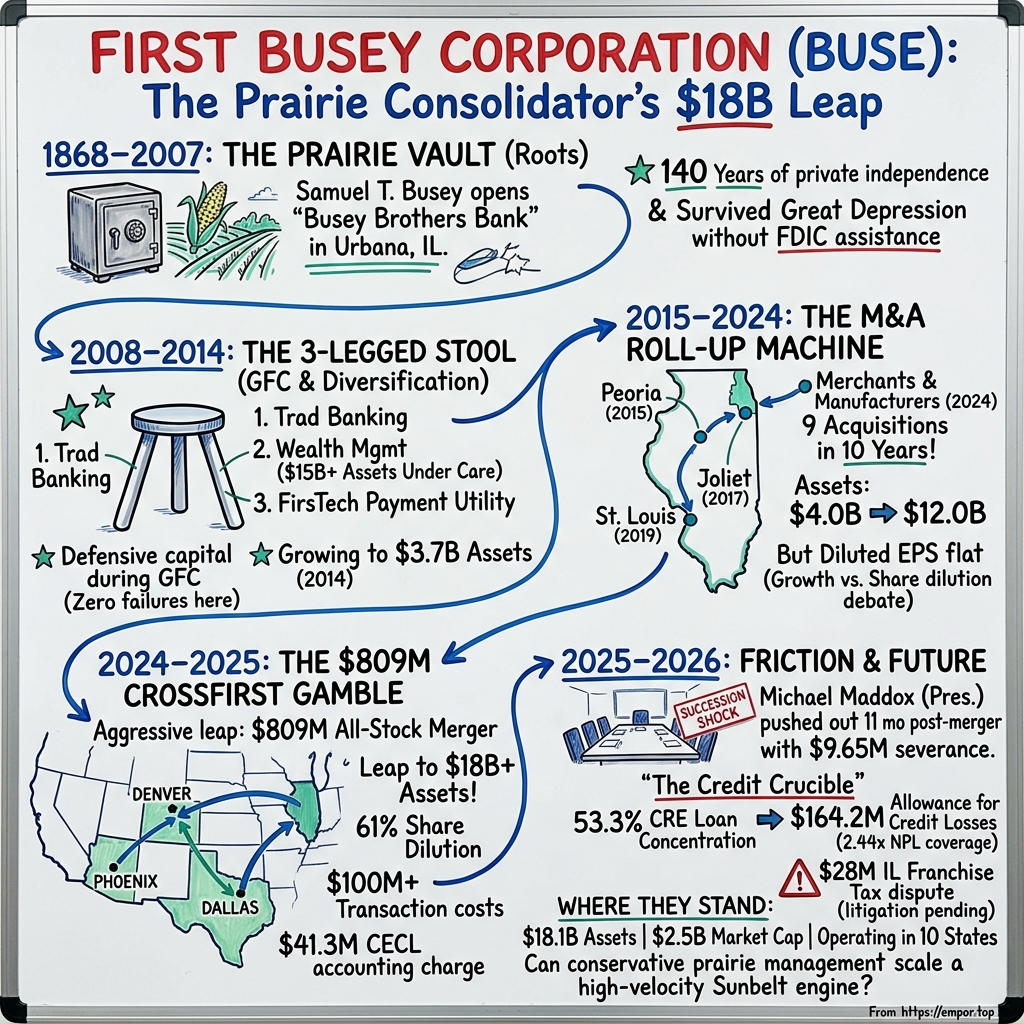
On January 27, 2026, the man who was supposed to run First Busey Corporation one day left the company.1 Michael J. Maddox had founded and led CrossFirst Bankshares, a fast-growing commercial bank based in Leawood, Kansas. Less than eleven months earlier he had sold it to First Busey in the largest deal the Illinois bank had ever done, and he had become its President and Vice Chairman, the designated heir to a chief executive who had run the place for more than two decades.4 His exit came with about $4.4 million in cash severance, a $1.1 million bonus for 2025, a $4.2 million retention payment and accelerated vesting of his stock.4 Add up the cash alone and the departure cost about $9.65 million.
Severance packages are not unusual in banking. What made this one strange was the timing. Mergers between banks are sold to investors as marriages of people as much as balance sheets, and this one had been pitched in August 2024 as a combination of two complementary franchises with a clear line of succession.[^9] Busey paid about $809 million in stock for CrossFirst, issuing roughly 33.5 million new shares, which expanded its share count by about 61%.1 By the time the corner office emptied, those new shareholders, many of them former CrossFirst owners, held a large slice of a company whose future leadership had just reverted to the old guard from Champaign, Illinois.
There is a small irony on the company's own letterhead. First Busey's principal executive offices are now listed at 11440 Tomahawk Creek Parkway in Leawood, Kansas, the old CrossFirst address, while Busey Bank itself remains headquartered in Champaign.1 The holding company moved its official front door to Kansas, and then the Kansan who came with that door left.
That is the scene from which this story starts, because it captures the question every First Busey shareholder is now living with. For a century and a half, Busey was the quiet county-seat bank of East Central Illinois. Over the last decade it turned itself into a serial acquirer, and with CrossFirst it became a ten-state commercial lender with about $18.1 billion of assets at the end of 2025.1 The leap was real. The open question is whether it created durable value for each share, or whether it imported cultural fracture and balance-sheet friction faster than it imported earnings power.
Four questions run through everything that follows. The first is whether a decade of all-stock deals built genuine commercial scale or merely inflated the balance sheet while diluting per-share earnings. The second is whether Busey's fee engines, a wealth management franchise and a payments business called FirsTech, can protect it as interest rates fall and deposit costs bite. The third is whether its heavy concentration in commercial real estate across the Midwest and the Southwest is a disciplined, well-reserved niche or a slow-burning hazard. The fourth is smaller but revealing: what an unresolved dispute with the State of Illinois over roughly $28 million in franchise taxes says about the friction of growing quickly across state lines.1
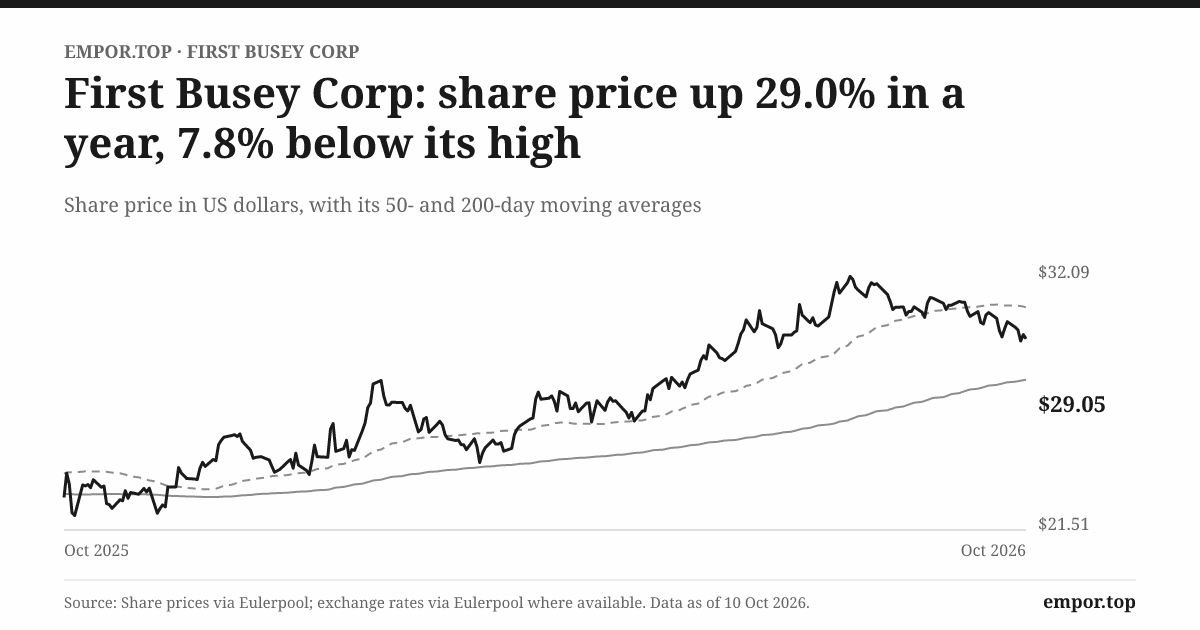
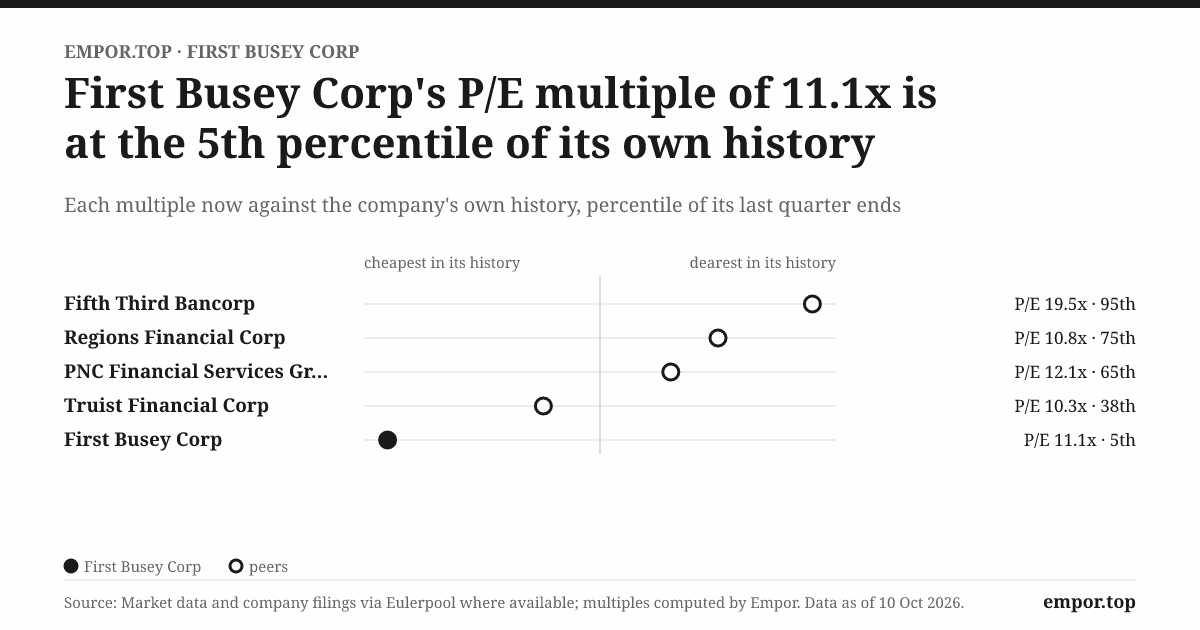
Today the market's answer is cautious rather than hostile. At $29.06 a share on October 10, 2026, First Busey is worth about $2.5 billion and trades at about 11 times its trailing earnings, against a five-year median closer to 18 times.2 Its wealth arm looks after more than $15 billion of client assets.1 Investors are paying a modest price for a bank that has finished the expensive part of its biggest merger and has not yet proven it can run what it bought. To understand why that discount exists, and whether it is deserved, the story has to start on the prairie, a long time before anyone in Kansas had heard of Busey.
 Subscribe on LinkedIn
II. The Prairie Vault: 140 Years of County-Seat Banking (1868–2007)
Urbana, Illinois, in 1868 was a county seat in a sea of corn and prairie grass, a town that had recently won a fight to host a new state institution called the Illinois Industrial University, the school that would become the University of Illinois. That year, the Busey family opened a bank there.[^14] Its customers were the people any prairie bank served: farmers who needed money to plant before they could sell a harvest, merchants who needed credit to stock shelves before the farmers paid, and a growing university town that needed somewhere safe to keep its payroll.
The founding story matters less for its romance than for the business model it locked in. A bank in a farm county lives on relationships. The banker knows which family has worked which section of land for three generations, which merchant pays on time, which farm will survive a bad price year. Deposits come from those same families, and they tend to stay put, because moving a farm account to another bank means explaining yourself to strangers. Economists call these deposits "low beta," meaning that when market interest rates rise, the bank does not have to raise what it pays them nearly as fast. That cheap, sticky funding is the oldest asset Busey owns, and it is the very thing CrossFirst would later want to marry.
For more than a century, the bank stayed local. It was not the kind of institution that showed up in national financial history, and that was the point. Champaign-Urbana offered something rare in rural Illinois: an economy anchored by a large public university and the hospitals and services around it, which smoothed out the boom-and-bust of agriculture. Busey grew alongside its towns.
In 1980 the family bank became the subsidiary of a holding company, First Busey Corporation, which in time listed its shares on NASDAQ.1 The holding-company structure was the standard move for American banks of that era. It allowed the group to own more than one bank, to raise capital in public markets, and eventually to add businesses that were not strictly banking, like trust and investment management. In hindsight, that 1980 restructuring was the quiet precondition for everything Busey would become, because a holding company can buy other banks with its own stock.
The person who would use that tool most aggressively was Van A. Dukeman. He took the helm in the early 2000s and became Chairman and CEO, and by 2026 he had been running the company for a generation.4 Dukeman's style, as seen through his record rather than his speeches, has two sides. On the lending side he has been conservative, steering the bank away from the speculative construction and condominium loans that later destroyed many of its Illinois neighbours. On the capital side he has been bold, treating Busey's stock as a currency and spending it repeatedly on other banks.
Why would a conservative lender become an aggressive acquirer? The answer is the economics of being small. A bank with $2 billion of assets must still pay for the same cybersecurity, regulatory reporting, compliance staff and core software that a bank five times its size needs. Those costs do not shrink in proportion to the balance sheet, so a small bank spends a larger share of every revenue dollar just staying licensed and secure. Meanwhile, a county-seat bank in slow-growing central Illinois cannot easily find enough new borrowers to grow into those costs. The choice for a well-run community bank in the 2000s was stark: get bigger by buying others, sell yourself to someone who already had, or accept a slowly shrinking return on the capital owners had entrusted to you.
By 2007, Busey had chosen to get bigger. It had already merged with Main Street Trust, a neighbouring Champaign institution, building a local franchise of real substance. Then the financial system started to crack, and the question of growth was replaced, briefly, by the question of survival.
III. Surviving the Great Financial Crisis and Building the Fee Buffer (2008–2014)
In the autumn of 2008, Illinois was about to become one of the worst places in America to own a bank. Across the state, and especially in the Chicago suburbs, small lenders had spent the boom years writing loans for subdivisions, condominium towers and land that developers expected to flip. When the housing market broke, the collateral behind those loans lost much of its value almost overnight. Over the next four years, dozens of Illinois banks were seized by regulators and sold off by the FDIC, one of the heaviest tolls of any state in the country.10
Busey was not untouched. It carried its own share of troubled loans and felt the pressure on earnings that every regional lender felt. But it did not fail, and it did not need to be rescued by a stronger buyer. The reason is unglamorous. Its book was weighted toward the borrowers it had always known, central Illinois farms, businesses and households, rather than speculative suburban development. The conservative relationship underwriting from the prairie era turned out to be a moat of a particular kind: not one that earns outsized returns in good times, but one that keeps the bank alive in bad ones.
The crisis also clarified something about Busey's business model that management chose to build on. Lending profits rise and fall with interest rates and credit losses. A bank whose only income is the spread between what it earns on loans and what it pays on deposits is hostage to both. So Busey leaned into two businesses that earn fees rather than spreads, turning its company into what could be described as a three-legged stool: traditional commercial banking, Busey Wealth Management, and a payments company called FirsTech.1
Wealth management is the simpler of the two to understand. Busey's trust officers and advisers manage money for families, foundations and, unusually, farms. In central Illinois, a large share of family wealth is farmland, and the families who own it often need someone to manage leases, collect rents, handle crop insurance and eventually pass the land to the next generation. A trust company that does this well holds the relationship for decades, sometimes for generations. The fees are earned on assets under care, carry no credit risk because the bank is not lending its own money, and require relatively little capital. That combination means a high return on the equity tied up in the business, which is exactly what a bank recovering from a credit crisis wants more of.
FirsTech is stranger, and worth a moment of explanation. It processes bill payments: when a resident pays a water bill to a municipal utility, or a phone bill to a regional telecom, the money and the data about who paid what have to flow from the payer to the biller's account and books. FirsTech handles that plumbing for utilities, municipalities and other billers, through lockboxes for paper checks, online and phone payments, and point-of-sale networks. It is a payments utility hidden inside a bank, and in principle it offers something banks rarely have, revenue that grows with transaction volume rather than with the loan book.
By the end of 2014, the post-crisis Busey was a small, solid institution. It had about $3.7 billion of assets, reported revenue of about $167 million and earned about $32 million, a net margin near 19%.3 Its return on equity of about 7% was respectable for a cautious bank rebuilding after a crisis, but not exciting.1 The bank had survived. The question was what it would do with survival in an industry where the cost of staying independent was rising every year.
The answer came quickly, and it would define the next decade: Busey would go shopping.
IV. The Roll-Up Machine: Nine Deals in Ten Years (2015–2024)
The playbook took its clearest shape in Joliet. In 2017, Busey bought First Community Financial Partners, a commercial bank in the suburbs southwest of Chicago, for roughly $270 million, paid mostly in Busey stock.1 Joliet was not a prairie county seat. It sat in the dense, wealthier, faster-moving collar of suburbs around Chicago, full of mid-sized businesses that needed commercial loans and treasury services. With one deal, a bank from Champaign had planted a flag in the most valuable banking market in its home state.
Joliet was part of a series. Busey counts nine acquisitions between 2015 and 2025, culminating with CrossFirst.1 Before that, the string included South Side Trust & Savings in Peoria, The Banc Ed Corp, whose bank served Edwardsville and the Illinois side of greater St. Louis, Cummins-American in suburban Chicago, and, in April 2024, Merchants and Manufacturers Bank Corporation in Chicago's western suburbs, bought for about 1.4 million Busey shares worth roughly $34 million.1 Each deal followed a similar pattern. Find a smaller bank, often family-influenced or with an ageing leadership, in a market adjacent to existing Busey territory. Pay in stock. Convert its customers to Busey systems, cut overlapping branches and back-office jobs, and fold its deposits into the larger funding base.
The logic was the consolidation thesis described earlier, put into action. The regulatory and technology overhead of a modern bank rewards size, and there is a widely discussed rule of thumb in the industry that a bank needs to reach something like $10 billion of assets before its cost base becomes efficient. Busey's balance sheet obeyed. Total assets rose from about $4.0 billion at the end of 2015 to about $12.0 billion at the end of 2024, a compound growth rate of a little over 11% a year.13
Now comes the test that matters to a shareholder rather than to a regulator. A bank tripling its assets should, if the deals are well priced, earn much more per share. Diluted earnings per share was $1.35 in 2015. In 2024 it was $1.96.3 That is growth of about 45% over nine years, or roughly 4% a year, while the asset base grew almost three times as fast. Earnings per share peaked at $2.33 in 2023 and then fell back.3 Net income itself did better than EPS, because the deals did add earnings, but every one of those earnings dollars now had to be shared among far more shares.
Where did the gap go? Three leaks explain most of it. First, every all-stock acquisition hands the seller's shareholders a piece of the combined company, and Busey usually paid a premium to book value to win the deal, so the buyer's existing owners gave up more than they got in accounting value. Second, each integration brought one-time costs, severance, system conversions, legal fees, that hit earnings in the year of closing. Third, the 2022 and 2023 rate-hiking cycle squeezed every regional bank's margins, as deposit costs caught up with loan yields. The industry backdrop explains some of the weakness, but not the shape of it: the asset line kept rising while the per-share line stayed close to flat.
The verdict on the roll-up decade is therefore narrower than the company's own framing of it. The roll-up did build scale and a real suburban Chicago franchise, and the bank came through the period without a credit accident. It did not compound earnings per share at anything like the pace its balance sheet grew. For a long-term owner, that distinction is everything. A bank can triple in size and leave its original shareholders only modestly richer.
By 2024 Busey sat at about $12 billion in assets, past the $10 billion line, in a home market with slow population growth and plenty of competition. It had cheap deposits but not enough borrowers who wanted to use them. The next deal would have to be different in kind, not just in size, and it would have to come from outside Illinois.
V. The $809 Million CrossFirst Gamble (2024–2025)
On August 27, 2024, Van Dukeman and Mike Maddox stood together to announce that First Busey would combine with CrossFirst Bankshares.[^9] The pitch was a story of complementary halves. CrossFirst, founded in Kansas in 2007, had grown quickly into a commercial lender of roughly $7.6 billion with offices in Kansas City, Wichita, Tulsa, Oklahoma City, Dallas, Phoenix, Denver and other Sunbelt and Mountain cities.[^9] It was good at finding borrowers, especially commercial and industrial companies and real estate investors in fast-growing metro areas. It was less good at gathering cheap deposits, so it relied more heavily on higher-cost funding.
Busey had the opposite problem. Its central Illinois customers handed it plenty of low-cost deposits but did not want to borrow enough to use them. Put the two together, the theory went, and Busey's cheap money would fund CrossFirst's loan growth, while CrossFirst's metro markets would give Busey a growth runway the prairie could not provide. It was a tidy theory, and it had genuine economic logic.
The price was paid in stock. When the deal closed on March 1, 2025, Busey issued about 33.5 million common shares, valued at about $795 million at the closing share price of $23.72, plus a small issue of preferred stock that replaced CrossFirst's own.19 Total consideration came to about $809 million, an implied value of roughly 1.2 times CrossFirst's tangible book.7 Busey's common share count rose by about 61%, and its shareholders' equity jumped from about $1.4 billion to about $2.5 billion by year-end.1 Part of what Busey bought was intangible: it recorded about $82 million of core deposit and customer relationship intangibles, the accounting value of the relationships CrossFirst's bankers had built.1 That number is worth remembering, because those relationships were embodied in people, and some of those people would soon leave.
Then the accounting arrived. To explain it, one needs a short tour of a rule called CECL, short for Current Expected Credit Losses. Under CECL, a bank must set aside reserves for the losses it expects over the entire life of a loan on the day it books the loan. When a bank acquires another bank's loans, it first marks them to fair value, which already discounts them for expected losses. Then, for loans not judged to have deteriorated already, CECL requires the buyer to book a fresh reserve as if the loans were brand new. The same expected loss is effectively counted twice, once in the price and once in the provision. Bankers call it the CECL double count, and it is a pure accounting artefact, but it hits the income statement in real dollars.
Busey took fair value of about $6.0 billion of CrossFirst loans, of which about $4.7 billion were in the non-deteriorated category, and booked an immediate day-one provision of about $41.3 million on them.1 Add roughly $100 million of pre-tax merger-related expenses during 2025, from severance and contract terminations to system conversion costs, and the first quarter after closing was ugly.1 Busey reported a GAAP net loss of about $29 million for the March 2025 quarter.2 For the full year 2025, diluted EPS came in at $1.52, the lowest level in years.1
Not all the friction was accounting. On February 18, 2025, eleven days before the deal closed, Busey's chief financial officer, Jeffrey D. Jones, was terminated without cause, receiving about $1.05 million in severance and about $0.64 million in cash for forfeited awards.4 The company did not frame the departure as a dispute, and it does not explain the reasons in its proxy. The fact pattern is simply unusual: a CFO removed on the eve of the most complex accounting event in the company's history. The seat was not permanently filled until Christopher H.M. Chan became CFO on October 8, 2025.4
Operationally, integration moved on schedule. CrossFirst Bank was merged into Busey Bank on June 20, 2025, a little more than three months after closing.1 By the second quarter of 2025, the combined company was earning money again, and by the second half the run-rate looked like a substantially bigger bank.2 The quarterly revenue line, which had hovered around $160 million before the deal, ran closer to $280 million in the quarters after it.2
So what did Busey actually buy? It bought the geographic escape route it needed, into Dallas, Phoenix, Denver and Kansas City, at a price that was not extravagant relative to book value. It also bought a 61% expansion of its share count, a year of accounting noise, and a management team whose leader would be gone in under a year. Whether the trade works depends on whether the bank can earn materially more per share than it did before the deal, and on whether CrossFirst's bankers and borrowers stay. The first of those can be measured in the earnings engine itself, so that is where the story turns next.
VI. The Engine Under the Hood: The Banking Mechanics and Fee Moats
Picture two rooms in Champaign. In one, trust officers review farm leases and portfolio allocations for families who have banked with Busey for generations, part of a wealth platform that looks after more than $15 billion of client assets.1 In the other, FirsTech's operations staff route bill payments from residents to utilities and municipalities, a flow of small transactions that has nothing to do with Federal Reserve meetings. Both rooms are what management points to when it argues that Busey is more than a spread lender. The numbers show how much weight each room actually carries.
Start with the core. In 2025, Busey's net revenue of about $720 million split roughly four-fifths and one-fifth: about $570 million of net interest income and about $150 million of fees.1 The interest business is the familiar machine. Busey earned an average yield of about 6.1% on its loans and paid an average of about 2.3% on its deposits, which, blended across all its assets and funding, produced a net interest margin of 3.03%.1 That margin barely moved over three years, 3.02% in 2023 and 3.00% in 2024, which tells you something useful.1 Busey absorbed the most violent rate cycle in four decades and a giant merger without its core spread breaking. That stability is a credit to the deposit franchise. It is also a ceiling, because a 3% margin is ordinary for a regional bank, not exceptional.
The interest-rate exposure is modest and slightly asset-sensitive. Management's own simulation shows that an instant one-percentage-point rise in rates would lift net interest income by about 1.8% over a year, while a one-point fall would cut it by about 2.4%.1 In plain terms, Fed cuts are a mild headwind rather than a threat.
Now the fee rooms. Wealth management earned about $69 million of fees in 2025, close to a tenth of net revenue, and it was running at about $20 million a quarter by mid-2026.12 Treasury management services and card and ATM fees added roughly $35 million between them.1 FirsTech brought in about $20 million.1
Here is the moat question in its sharpest form. The wealth business has genuine switching costs. A family that has entrusted farm management and estate planning to the same trust department for decades faces real friction and real risk in moving. The commercial treasury business has a version of the same stickiness, because once a mid-sized company has wired its payroll, receivables and payables into a bank's software, changing banks means re-plumbing its finances. Those are real, if modest, advantages. Scale is emerging too. Core data processing and software costs were about $43 million in 2025, up sharply from about $27 million in 2024 because of integration, but they are now spread across an $18 billion balance sheet rather than a $12 billion one.1 Whether that spreading produces lasting operating leverage is still to be shown, since 2025's cost line was inflated by the work of combining two systems.
FirsTech is where the company's narrative and its own segment disclosure diverge. Management has long presented FirsTech as a technology-enabled growth kicker. The segment note in the annual report tells a less flattering story: FirsTech recorded net losses of about $0.8 million in 2023, $0.7 million in 2024 and $1.8 million in 2025.1 A payments business with $20 million of revenue that loses money three years running, while absorbing software reinvestment, is not a profit engine. It may be a strategic one, it gives the bank a relationship with municipal and utility clients that a plain lender would not have, but on the evidence of its own books, it is a cost centre with revenue, not a moat.
So the three-legged stool is really a stool with one thick leg, one solid leg and one thin one. The bank still generates the overwhelming majority of profit. Wealth management is the genuine countercyclical cushion, a business that would look valuable inside any regional bank. FirsTech is an option that has not paid off. The fee share of about 21% is meaningful, but it is not high enough to change how the stock behaves when credit worries surface, and that is exactly where the post-merger bank's real risk now lives.
VII. The Credit Crucible: Commercial Real Estate in the Post-SVB Era
At the end of 2025, Busey's loan ledger looked nothing like the farm-county book of its youth. Portfolio loans had grown from about $7.7 billion a year earlier to about $13.6 billion.1 More than half, about $7.2 billion, was commercial real estate. Another quarter, roughly $3.4 billion, was commercial and industrial lending. Residential mortgages were about $1.9 billion, and construction and land development, the riskiest corner of real estate lending, was about $1.3 billion.1
This is the post-SVB question for every regional bank. After Silicon Valley Bank and Signature Bank failed in March 2023, investors and regulators turned a hard eye on two things: whether deposits could flee, and whether commercial real estate, especially office buildings emptied by remote work, would produce the next wave of losses.11 A bank with more than half its loans in commercial real estate, much of it newly acquired in Dallas, Phoenix and Denver, was always going to be examined closely.
The warning lights are real. Non-performing loans, those no longer paying as agreed, rose from about $23 million at the end of 2024 to about $54 million at the end of 2025 and about $67 million by June 2026, or about half a percent of loans.12 Classified assets, the broader bucket of loans that examiners would flag as substandard, roughly doubled during 2025, from about $85 million to about $175 million, and then rose another 30% in the first half of 2026 to about $226 million.12 Part of that rise is mechanical: Busey absorbed a loan book that came with its own problem credits, including about $1.3 billion of loans already judged to have deteriorated at acquisition.1 But a 30% jump in six months, well after the deal closed, is not purely inheritance. It means problem loans are still being identified.
Against those warnings stand the actual losses, which remain small. Net charge-offs, money the bank has finally written off, were about $9 million in 2025, or 0.08% of average loans.1 The allowance for credit losses was about $174 million at year-end 2025 and about $164 million at June 2026, about 1.24% of loans, enough to cover non-performing loans about 2.4 times over.12 One early indicator moved the right way: loans 30 to 89 days past due, the waiting room before default, fell by about half in the first half of 2026, from about $16.5 million to about $8.1 million.2 That suggests problem credits are being worked out or reclassified rather than cascading. The auditor, RSM, singled out both the allowance methodology and the fair-value marks on CrossFirst loans as critical audit matters, which is a reminder that these figures rest on judgement.1
There is one subtle point in the reserve trend. The allowance fell from $174 million to $164 million in six months while classified assets were rising.12 That is not necessarily wrong, because acquired-loan reserves are released as those loans are paid down or resolved, and provisions in the first half of 2026 were only about $5 million.2 But it means the coverage cushion is thinning as problem loans grow, and an investor should watch that gap.
Liquidity is the firmer ground. Busey's securities portfolio, about $2.75 billion at year-end 2025, is mostly U.S. Treasuries and agency mortgage securities, carrying unrealized losses of about $110 million that were shrinking as yields eased.1 More important, the bank has pledged about $6.9 billion of loans to secure borrowing lines, with about $5.05 billion of capacity at the Federal Home Loan Bank and $1.85 billion at the Federal Reserve's discount window.1 Uninsured deposits, the kind that ran from SVB, are about 28% of total deposits, a fraction that is well covered by those lines.1
The verdict is that Busey's credit record supports its reputation for conservative underwriting, and nothing in the current loss numbers suggests a crisis. What the record cannot yet prove is that the CrossFirst book will behave like the Illinois book did. The heritage bank never had a large exposure to Sunbelt multifamily and office real estate; the acquired one did. The classified asset line is the single number most likely to change the market's mind, in either direction. And because credit risk lives in loans that bankers originated and still manage, it connects directly to the most uncomfortable part of the story, what happened in the executive suite.
VIII. The Corporate Fracture and the $28 Million Tax Fight
Return to the January 2026 boardroom. When Busey and CrossFirst announced their merger, Mike Maddox was to become President of the combined company and its CEO-in-waiting, a clear signal to CrossFirst's bankers and clients that their culture had a seat at the head of the table.[^9] His departure eleven months after closing reset that signal. Succession now sits once again with the Champaign leadership that built the roll-up.
What did it cost? The cash to Maddox, about $9.65 million across severance, bonus and retention, plus accelerated equity, was disclosed in the 2026 proxy.4 Neither the company nor Maddox has publicly described the reason for the separation in detail, and the company's disclosures characterize it as a separation rather than a cause-based termination.6 An investor is left with the outcome rather than the explanation. Two of the most senior people involved in the merger, the legacy CFO and the acquired CEO, were gone within a year, and both left with substantial payments.
The legacy leader, meanwhile, was well rewarded. Van Dukeman's total compensation was about $4.0 million in 2025, up from about $2.9 million in 2024, and he was entitled to a further $5.6 million cash retention payment, paid on March 1, 2026.4 Retention bonuses for a long-serving CEO through a merger are not uncommon, but the juxtaposition is hard to miss: the incoming successor was paid to leave while the incumbent was paid to stay.
Shareholders did not revolt. At the annual meeting on May 20, 2026, say-on-pay passed with about 97% of votes cast, the amended equity plan with about 94%, and all twelve directors were re-elected with more than 95% support.5 The register is institutional and dispersed, led by Wellington Management at about 8.4%, BlackRock at about 7.6% and Dimensional at about 5.7%, with insiders holding under 4%.4 Those holders evidently judged the turnover tolerable as long as integration stayed on track. Strong votes are a fact worth weighing, but they measure institutional patience, not proof that the culture holds. The test is whether CrossFirst's commercial bankers stay, and that test is still being run.
The second friction point is in a courtroom. The Illinois Secretary of State, Alexi Giannoulias, issued Busey a notice claiming more than $28 million in unpaid corporate franchise taxes, a figure that includes about $17.4 million of interest and a small amount of penalties.1 Illinois franchise tax is calculated on a company's paid-in capital, and the dispute turns on how that capital is measured and apportioned, an issue that grows as a holding company issues hundreds of millions of dollars of stock to buy banks. On November 25, 2025, Busey sued in both federal court in the Northern District of Illinois and Illinois state court, arguing the state's approach departs from long-standing practice and raises constitutional problems.112 It has accrued nothing, judging the loss neither probable nor estimable, and nothing had been accrued as of mid-2026.2
How much does it matter? A full loss would cost roughly $28 million, or about 12% of the $229 million Busey earned over the twelve months to June 2026.2 That is a bad quarter, not a threat to capital. The more interesting signal is what the dispute reveals. Most of the claim is interest, which means the disputed liability built up over years. An acquisitive company that has used its stock as currency over and over has, in the state's view, been underpaying a tax keyed to that very stock. Whatever the court decides, the case is a reminder that serial M&A carries administrative costs that never appear in a merger announcement.
With the governance and legal friction mapped, the remaining question is relative: how does this bank, warts included, stack up against the competitors it now faces across ten states?
IX. Competitive Benchmark and Strategic Positioning
Set Busey's scorecard beside its neighbours and the picture is of a bank that is now big enough to be compared with serious regional players, and is being priced as the weaker member of that group. Regional banking in America is squeezed from two sides. Above sit the giant national banks, JPMorgan Chase and Bank of America among them, with technology budgets and brand reach no regional can match. Below sit small community banks and credit unions that compete on local intimacy. A bank of Busey's size wins only if it combines enough scale to invest in technology and treasury services with enough local presence to keep relationships.
Its closest comparables illustrate the range. Commerce Bancshares of Kansas City, a larger bank with a celebrated trust business and a conservative balance sheet, has long been valued at a premium for exactly the qualities Busey aspires to.11 Old National Bancorp is a larger Midwestern consolidator that pursued a similar acquisition strategy at a bigger scale, with a large Chicago presence. Enterprise Financial Services of St. Louis is the most direct analogue, a commercial-focused lender with offices in Kansas City and the Southwest. Mid-cap regional peers broadly traded at about 10.5 to 13.5 times forward earnings and 1.1 to 1.5 times tangible book in 2026.2
Busey sits at the cheap end of that range. At about 11 times trailing earnings, it trades far below its own five-year median of about 18 times, though that median is inflated by the depressed earnings of the merger year.2 Price to book is about 1.1 times, and price to tangible book, which strips out goodwill and intangibles, is about 1.3 times against tangible book of $22.25 a share.2 The dividend yields about 3.5%.2
The returns explain the discount. Return on equity collapsed to about 5.5% in 2025 because of merger charges and recovered to about 9.6% over the twelve months to June 2026.2 Return on assets, which was about 0.7% in 2025, is rebounding toward the 1% level that marks an average-to-good regional bank.2 Those are recovering numbers, not superior ones; history suggests Busey has rarely sustained return on equity much above 10%, and even in its best years of 2022 and 2023 it earned about 10% to 11%.1
Capital and credit ratings are solid. Busey Bank's common equity tier 1 ratio was about 11.2% and total risk-based capital about 13.9%, well above regulatory minimums.8 KBRA, which reaffirmed its ratings in May 2026 and reviewed them again in August, rates the holding company's senior debt BBB+ and Busey Bank's deposits A-, with a stable outlook, citing the granular deposit franchise and diversified fees as strengths and commercial real estate concentration and integration risk as constraints.8
The positioning verdict is that Busey has reached the size class it wanted, and its balance sheet is sound enough to stay there. What it has not yet done is earn the returns that justify a peer-level multiple. The market is pricing a bank whose profitability must still be proven at its new scale. That makes the bull-and-bear debate a question of whether 2026's recovery is a new baseline or a temporary rebound.
X. The Bull vs. Bear Case
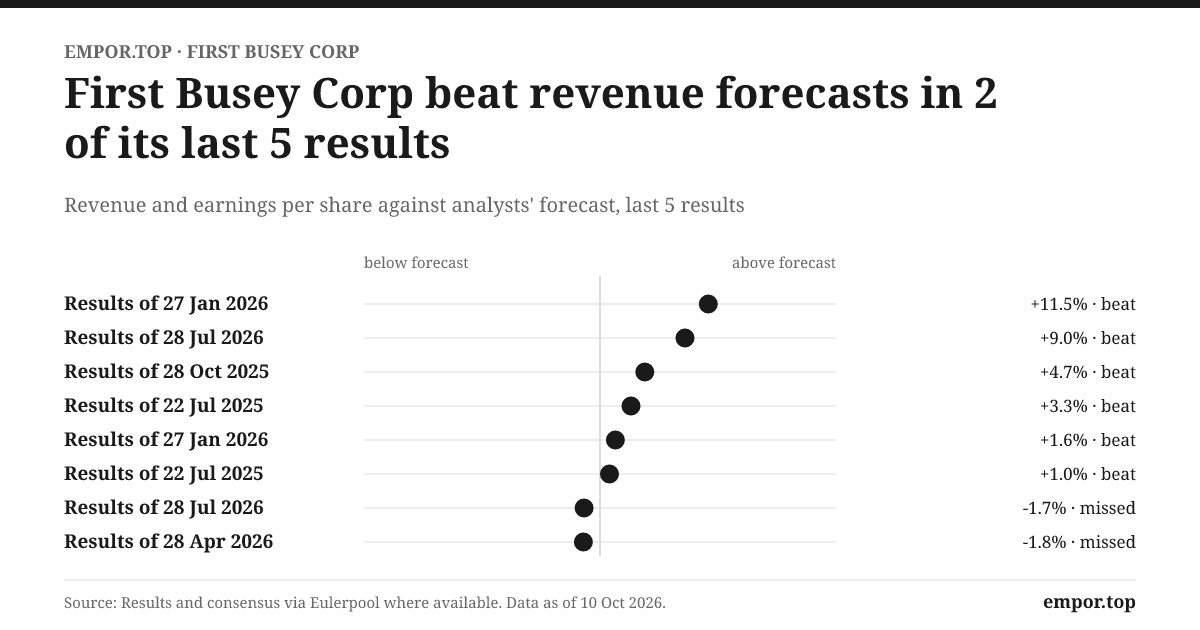
The second-quarter 2026 report was the best evidence yet for the optimists. Diluted EPS was about $0.69 for the quarter, against about $0.52 a year earlier, and twelve-month earnings reached about $2.59 a share.2 Annualize the quarter and the bank was earning at a pace near $2.76 a share.2 Yet in October, the stock sat at $29.06, still below its 52-week high of $31.52.2 The two sides of the argument are built on that gap.
The bear case begins with credit. Classified assets rising by nearly a third in six months, in a book that is now more than half commercial real estate, is the kind of trend that can turn into provisions if refinancing remains expensive for office and multifamily owners. A bank earning around $230 million a year can absorb a lot, but a few bad metro projects would quickly erase the "accounting noise is over" story. The second bear argument is people. Commercial lending relationships belong, in practice, to the bankers who manage them. When the founder of the acquired bank leaves within a year, along with the legacy CFO before the deal closed, the risk is that high-producing lenders in Dallas, Phoenix and Kansas City follow, taking clients and deposits. The third is FirsTech's persistent losses, which dilute the fee story. The fourth is the Illinois tax claim, roughly a quarter's worth of earnings if lost.
The bull case begins with simple arithmetic. With roughly $100 million of merger costs and the CECL double count behind it, the bank's earnings power is materially higher than its 2025 results suggested. Twelve-month net income of about $229 million compares with $135 million in 2025.21 The wealth franchise gives a steady fee floor near $70 million to $80 million a year. Charge-offs remain tiny, and reserves cover problem loans more than twice. Management has also shown willingness to return capital, expanding the buyback authorization by 4 million shares in December 2025 and repurchasing about 1.25 million shares in the fourth quarter.1 The dividend payout, which ballooned to about 67% of 2025's depressed earnings, falls back to under 40% on twelve-month earnings.1
To weigh those arguments, it helps to run the moat through two frameworks once. On Porter's five forces, buyer power is moderate: commercial borrowers can and do shop loans among banks, which limits pricing, though treasury integration raises their cost of switching. Supplier power, in a bank's terms the power of depositors, is the force that bit hardest in 2023, and Busey's ability to hold its margin near 3% through that cycle suggests its core depositors are less rate-sensitive than many peers'. The threat of substitutes is real in payments, where fintechs and larger processors compete with FirsTech, and in deposits, where money-market funds offer higher yields. Entry threat for full-service banking is low because charters, capital and regulation are barriers. Rivalry is intense in every metro Busey now serves.
On Hamilton Helmer's seven powers, the case is thinner. Switching costs are the clearest power, real in wealth management and commercial treasury. Scale economies are emerging but not yet proven by a sustained drop in cost per dollar of assets. Counter-positioning, network effects and cornered resources are essentially absent. Brand and process power are strong in central Illinois and largely untested in Phoenix and Dallas, where Busey is a new name. History therefore narrows the moat claim to a smaller version: Busey has a durable deposit and fiduciary franchise at home, and an acquired commercial engine whose stickiness depends on people who have just watched their founder leave.
Three numbers will settle the argument better than any narrative. The first is return on assets, about 0.7% in 2025 and normalizing toward 1% in 2026; sustaining above roughly 1.1% would mark the merger as genuinely accretive.2 The second is classified assets, about $226 million at June 2026 and rising.2 The third is total loans, which declined modestly from about $13.6 billion to about $13.2 billion in the first half of 2026, a drift that could reflect deliberate run-off of unwanted credits or the start of relationship leakage.2
Weighing it all, the bull side holds the stronger hand on the evidence available today, because the earnings recovery is visible in reported results while the credit deterioration is still mostly in classification rather than losses. That conclusion holds only as long as classified assets crest and loan balances stabilize; a further rise in either would shift the weight decisively.
XI. Playbook: Business & Investing Lessons
The first lesson belongs to the Joliet-to-M&M decade. Busey's assets roughly tripled between 2015 and 2024 while diluted earnings per share rose by less than half, which is the clearest illustration in regional banking of a truth that every acquisitive company eventually meets. Size is not the same as value per share, and a bank that issues its own stock to buy growth must earn more on the new capital than its owners gave away. When you pay for growth with newly printed shares, you build an empire for the regulators and a treadmill for the shareholders.
The second lesson belongs to Mike Maddox's January exit. Mergers of complementary franchises are sold on people as much as balance sheets, and the succession plan was part of what CrossFirst's shareholders and bankers were told they were getting. When that plan collapses inside a year, with nearly ten million dollars in cash flowing to the departing heir, the buyer has to be judged on what remains. When an acquired CEO exits inside a year with eight figures in severance, you didn't buy a management team, you bought a loan ledger and an empty corner office.
The third lesson belongs to the trust officers in Champaign. Busey's net interest margin barely moved through the most violent rate cycle in forty years, but it never rose above ordinary, and the business that actually earns a premium return on capital is the one that manages farmland and family fortunes without lending a dollar. The payments arm, meanwhile, shows that fee income is only a cushion when it is profitable. In regional banking, net interest margin is weather you cannot control; fiduciary wealth management is the roof you build overhead.
The fourth lesson belongs to the first quarter of 2025, when a bank that charged off almost nothing reported a net loss of about $29 million. The CECL double count and roughly $100 million of merger costs turned an ordinary closing into an apparent disaster, and investors who read only the headline missed the earnings power underneath. The reverse is also true: a clean quarter can hide rising classified assets. CECL day-one accounting treats an acquired performing loan like a bad debt that must be paid for twice.
XII. Epilogue
Tonight, First Busey holds about $18.2 billion of assets across ten states, with CrossFirst's bank folded into Busey Bank, its systems converted and its merger costs largely behind it.2 Its earnings have rebounded to a run-rate the company had never reached before. Its leadership, after a year that saw two senior departures, again rests with the Champaign team that built it.
Three moments will decide the story's central questions. The first is the 2026 annual report, due early next year, which will show whether commercial loans and deposits in Kansas City, Dallas, Denver and Phoenix grew or bled after Maddox's departure. Stable balances would answer the cultural-fracture question in Busey's favour; continued shrinkage would suggest the relationships walked out with the people.
The second is the classified asset line in the third- and fourth-quarter 2026 reports. If the roughly $226 million of substandard loans plateaus and charge-offs stay near their historical lows, the reserve cushion looks ample and the discount to peers looks unjustified. If it keeps climbing and the allowance keeps thinning, the market's caution will have been right.
The third is in the courtrooms of Rockford and Champaign County, where Busey's suits against the Illinois Secretary of State are pending.12 A dismissal of the state's claim or a modest settlement would close a distraction; a loss would cost roughly a quarter's earnings and invite questions about how a company built on stock-for-stock deals priced the taxes those deals created.
Behind all three sits the tension that has defined Busey for a decade. Van Dukeman has built the regional commercial bank he spent twenty years assembling. The question that remains is whether a leadership team raised on the patient banking of the prairie can run a fast-moving Sunbelt commercial engine from Champaign, without the founder who built that engine at its side.
XIII. Outro
In 1868, the Busey family opened a bank in Urbana to serve the farmers, merchants and young university around it.[^14] The prairie it lent to then is still out there, flat and productive, and so is the bank, which survived panics, the Depression, the savings-and-loan era and a financial crisis that took down dozens of its Illinois neighbours. That small agricultural depository has become an eighteen-billion-dollar institution with offices from Illinois to Arizona.
For most of its history, Busey's genius was not doing the thing that killed other banks. Its last decade was a deliberate decision to do something harder: to grow into a size where survival was no longer the only measure. First Busey spent a century and a half proving that conservative prairie banking could survive any storm; its greatest gamble was deciding that survival was no longer enough.
References
-
First Busey Corporation Form 10-K for the Fiscal Year Ended December 31, 2025 — U.S. Securities and Exchange Commission, 2026-02-26 ↩↩↩↩↩↩↩↩↩↩↩↩↩↩↩↩↩↩↩↩↩↩↩↩↩↩↩↩↩↩↩↩↩↩↩↩↩↩↩↩↩↩↩↩↩↩↩↩
-
First Busey Corporation Form 10-Q for the Quarterly Period Ended June 30, 2026 — U.S. Securities and Exchange Commission, 2026-08-06 ↩↩↩↩↩↩↩↩↩↩↩↩↩↩↩↩↩↩↩↩↩↩↩↩↩↩↩
-
First Busey Corporation Form 10-K for the Fiscal Year Ended December 31, 2024 — U.S. Securities and Exchange Commission, 2025-02-27 ↩↩↩↩
-
First Busey Corporation Definitive Proxy Statement (Schedule 14A) for the 2026 Annual Meeting of Stockholders — U.S. Securities and Exchange Commission, 2026-04-09 ↩↩↩↩↩↩↩↩
-
First Busey Corporation Form 8-K: Submission of Matters to a Vote of Security Holders — U.S. Securities and Exchange Commission, 2026-05-22 ↩
-
First Busey Corporation Form 8-K: Executive Separation and Departure of Michael J. Maddox — U.S. Securities and Exchange Commission, 2026-01-29 ↩
-
First Busey Corporation Registration Statement on Form S-4/A (CrossFirst Merger) — U.S. Securities and Exchange Commission, 2024-11-08 ↩
-
KBRA Surveillance Report: First Busey Corporation — Kroll Bond Rating Agency, 2026-08-14 ↩↩
-
First Busey Corporation Completes Merger With CrossFirst Bankshares — Business Wire, 2025-03-03 ↩
-
Illinois Community Bank Consolidation and Mid-Cap Dynamics — American Banker, 2025-06-15 ↩
-
Commercial Real Estate Exposure and Regional Bank Valuations — S&P Global Market Intelligence, 2026-03-12 ↩↩
-
First Busey Corporation v. Alexi Giannoulias (No. 3:25-cv-50488) Docket — U.S. District Court for the Northern District of Illinois via CourtListener, 2025-11-25 ↩↩
 LinkedIn
 WhatsApp
 Reddit
 Hacker News
 Email
Email Kindle
 RSS Feed
 Spotify
 Apple Podcasts
 Amazon Music
 Audible
 YouTube