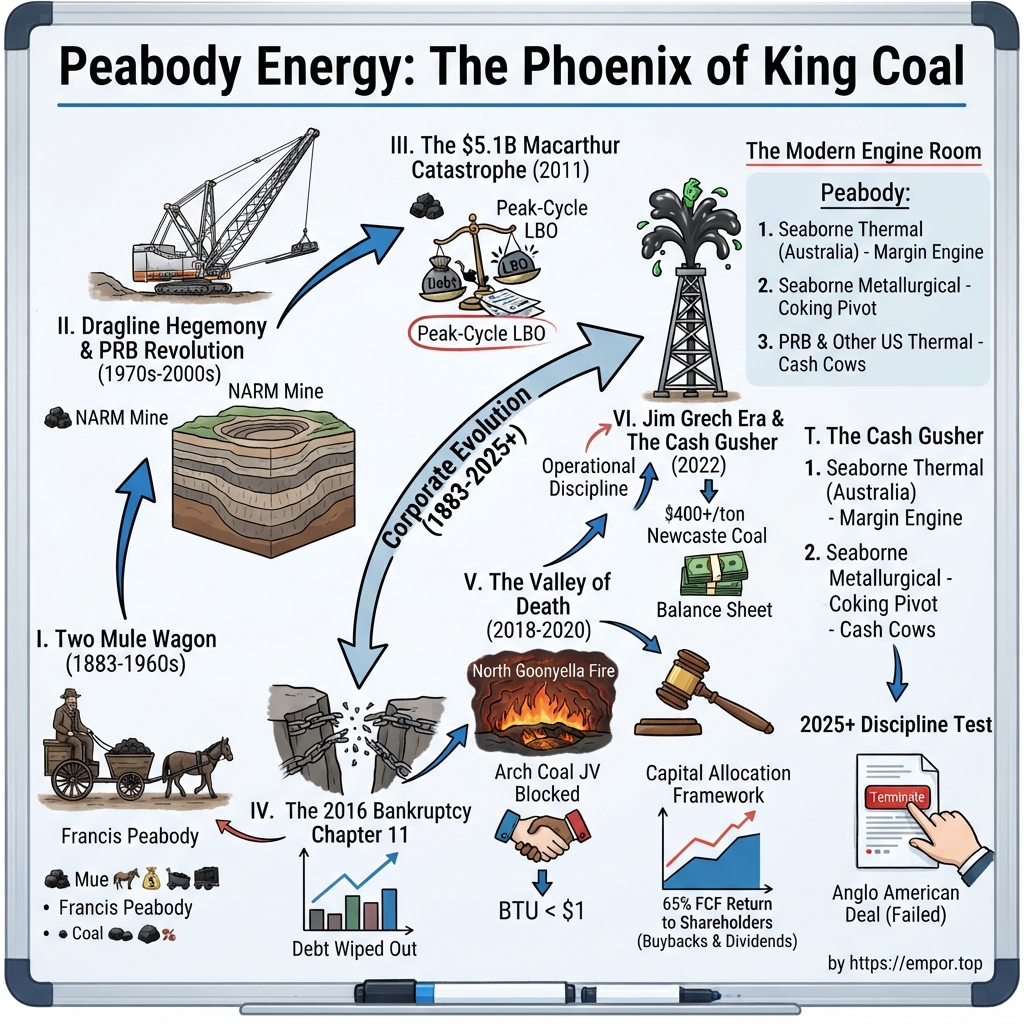
Peabody Energy: The Phoenix of King Coal
I. Introduction & Episode Roadmap (00:00:00 – 00:15:00 | 15 min)
The Cold Open: A Fire in Queensland and a Signature Not Given
On the morning of August 19, 2025, the executive leadership of Peabody Energy made a rare move in the mining sector: they walked away from the largest acquisition of their careers.
Nine months earlier, Peabody had agreed to acquire Anglo American's Australian steelmaking coal portfolio for up to $3.775 billion—a package of Bowen Basin mines designed to pivot the company from a domestic thermal coal producer with an overseas auxiliary into a major global metallurgical coal supplier.1 Then, on March 31, 2025, an underground ignition event disrupted operations at Moranbah North, the flagship asset in the transaction. Months passed without an identified root cause or a confirmed schedule to resume longwall extraction at the production volumes and unit costs assumed in the deal model. Anglo itself estimated holding costs of roughly $45 million per month while the mine remained idle.2
Citing a material adverse change, Peabody terminated the agreement. Anglo immediately contested the decision, asserting the incident caused "no damage to the mine or equipment," arguing the contractual threshold had not been met, and announcing plans to pursue arbitration for wrongful termination.3
The decision marked a critical inflection point. Fourteen years earlier, a previous Peabody management team faced a comparable Australian coal asset at a different stage of the commodity cycle and made the opposite choice: raising the purchase price, taking on debt, and closing the deal. That decision culminated in the largest coal bankruptcy in American history.
The Scale of the Thing
Peabody traces its history to 1883, when Peabody, Daniels & Co. started as a retail coal dealer in Chicago before expanding into extraction with its first Illinois mine in 1888.4 Today, the company operates 16 active mining complexes across the United States and Australia, structured across four reportable segments: Seaborne Thermal, Seaborne Metallurgical, Powder River Basin, and Other U.S. Thermal. In 2025, Peabody produced 120.3 million tons of coal and employed roughly 5,400 people.5
At the core of the portfolio sits Wyoming's North Antelope Rochelle Mine, or NARM, which produced 65.0 million tons in 2025—accounting for more than half of Peabody's total output—using draglines and bulldozers to uncover coal seams thick enough to swallow a four-story building.5 NARM remains the largest coal mine in the United States. It operates without a preparation plant: coal is extracted directly from the ground, loaded onto unit trains stretching over a mile long, and hauled straight to electric utility power plants.
The Central Paradox
Peabody presents an instructive corporate dilemma. On April 13, 2016, the company filed for Chapter 11 protection seeking to restructure approximately $10.1 billion in debt.6 In 2018, an underground fire shut down its primary Australian metallurgical mine. In 2020, antitrust regulators blocked a domestic joint venture designed to stabilize its core Powder River Basin business, and the stock traded below one dollar. Yet, propelled by the 2022 global energy crisis and a revised approach to capital discipline, the company eliminated its senior secured debt and resumed returning capital to shareholders.
That recovery, however, has not followed a straight line. For the twelve months through June 2026, Peabody reported a full-year 2025 net loss of $52.9 million on revenue of $3.86 billion, followed by a loss in the first quarter of 2026 and a second-quarter 2026 net loss of $90.6 million, generating adjusted EBITDA of just $24.0 million.78 The primary headwind was not a structural decline in thermal coal demand, but rather the redeveloped Centurion project—the rebuilt mine replacing the asset lost to the 2018 fire—which absorbed capital during an extended and difficult commissioning ramp.
Episode Roadmap
The narrative proceeds in eight parts. First, the foundational years: a Chicago distributor that expanded during the electrification of the Midwest and later capitalized on the Clean Air Act's demand for low-sulfur Powder River Basin coal. Second, the commodity supercycle and the 2011 Macarthur Coal acquisition, an example of buying reserves at peak valuation using fixed-income leverage. Third, the subsequent downturn, the impact of the shale gas boom, and the 2016 Chapter 11 reorganization that extinguished common equity. Fourth, the dual operational and antitrust crises of 2018 through 2020. Fifth, the post-restructuring cash generation under Chief Executive Jim Grech during the 2022 energy shock. Sixth, an operational analysis of how Peabody's four segments generate cash flow today. Seventh, the capital-allocation test posed by the Centurion redevelopment and the terminated Anglo transaction. Finally, an evaluation of the principal risks and structural assumptions underlying the current bull case.
The through-line explores an essential question for legacy commodity businesses: what is an enterprise worth when terminal decline is widely expected, but the exact timeline remains uncertain? Over its history, Peabody has alternated between aggressive debt-funded growth and defensive cash harvesting. The mechanics and outcomes of those strategic shifts form the foundation of the company's modern valuation.
 Subscribe on LinkedIn
II. The 140-Year Foundation: Two Mules to Dragline Hegemony (1883–2000) (00:15:00 – 00:32:00 | 17 min)
Chicago, and the Business of Keeping People Warm
Francis S. Peabody's enterprise began not with extraction, but with distribution. In 1883, he and a partner purchased coal wholesale to supply Chicago residences and businesses—a hauling and merchant operation serving a city expanding its coal-fired heating, steam generation, and early electrical grids. Five years later, in 1888, the firm integrated upstream into extraction by opening its first Illinois mine.4
This operating sequence—initiating operations in distribution before moving backward into production—established a lasting commercial pattern. Peabody's initial competitive advantage stemmed from logistical proximity to demand rather than superior geology. For the subsequent century, the company generated its most resilient returns when placing volume beside captive utilities and industrial consumers, while its most vulnerable periods occurred when capital was deployed to chase cyclical spot prices.
The initial Illinois Basin era relied on underground shaft mining, unionized workforces, and high-sulfur bituminous deposits railed across regional networks. Peabody listed on the Chicago Stock Exchange in 1926 and moved to the New York Stock Exchange in 1949. In 1955, it merged with Sinclair Coal Company, an established surface miner—marking its first strategic shift toward large-scale open-cut extraction rather than deep underground tunneling.4
The Clean Air Act, and the Accidental Birth of the Powder River Basin
Environmental regulations subsequently reshaped domestic coal logistics. The Clean Air Act amendments of 1970 and subsequent revisions imposed stringent caps and penalties on sulfur dioxide emissions. Because bituminous coal from Illinois and Appalachia carried heavy sulfur concentrations, electric utilities faced a capital choice: install costly flue-gas desulfurization scrubbers or switch boilers to lower-sulfur fuel sources.
Wyoming's Powder River Basin held the fuel that met those standards. Although sub-bituminous PRB coal delivered lower heat content per pound than Appalachian deposits, its low sulfur content solved the regulatory compliance challenge. Crucially, the geometry of the deposits offered a transformative operational advantage: coal seams dozens of feet thick lay beneath shallow overburden, accessible via surface excavation rather than deep shaft operations.
The underlying economics defined Peabody's modern cost structure. Underground extraction faces inherent mechanical constraints: cutting rates at the coal face, ventilation requirements for methane management, and strict workforce safety limits within subterranean tunnels. By contrast, Powder River Basin surface mining functions primarily as a high-volume earthmoving operation. Electric draglines—cranes the scale of office buildings equipped with buckets that strip more than one hundred tons of rock and soil in a single swing—remove the overburden to expose broad horizontal coal seams. Electric shovels then load the coal into haul trucks for direct transfer to railheads, driving pit-head cash costs to a fraction of underground mining benchmarks.
Peabody opened the North Antelope mine in 1983 and the adjacent Rochelle mine in 1985, consolidating the two operations in 1999 into North Antelope Rochelle.4 By the close of the century, Peabody had become the world's largest private-sector coal producer. In fiscal 2000, the company sold 179.2 million tons of coal, representing more than 16% of total U.S. coal consumption and outpacing its nearest domestic competitor by nearly 50%.9
The Corporate Musical Chairs
A critical, often overlooked dimension of this history is that for three decades Peabody operated without permanent corporate independence. Instead, the company functioned as a corporate asset passed between financial and industrial holding entities. Kennecott Copper acquired Peabody in 1968, only to be compelled by antitrust authorities to divest it in 1977 to Peabody Holding Company, an investor consortium. Hanson plc, the British industrial conglomerate, purchased the company in July 1990. A 1997 corporate demerger transferred Peabody into The Energy Group, a publicly traded UK entity, before Lehman Brothers Merchant Banking Partners acquired the business in a May 1998 leveraged buyout.4
Through an investor's lens, this ownership chain meant that Peabody spent the late twentieth century being levered, restructured, and transferred by financial sponsors operating on short fund cycles rather than multi-decade resource horizons. When the company returned to public equity markets—filing an initial public offering of 20 million shares priced between $18.00 and $22.00, listing on the NYSE under the ticker BTU, and directing a substantial portion of proceeds to extinguish term debt—Lehman's merchant banking arm maintained a 54% majority ownership stake upon completion.9
Emerging from a leveraged buyout structure with a financial sponsor retaining majority control, Peabody stood at the threshold of a prolonged global commodity expansion. That capital structure—combining high fixed-debt obligations with volatile commodity cash flows—framed the strategic choices that would test the company over the following decade.
III. The China Supercycle & The $5.1B Macarthur Catastrophe (2001–2011) (00:32:00 – 00:58:00 | 26 min)
When the Whole World Wanted Coal
In December 2001, seven months after Peabody returned to the public markets, China joined the World Trade Organization. Over the following decade, Chinese steel production roughly quintupled. Each ton of blast-furnace steel required metallurgical coal—baked into coke to serve both as a high-temperature heat source and as the chemical reducing agent that strips oxygen from iron ore. Blast furnace steelmaking remains an elemental chemical process with no commercial synthetic substitute, and coking coal was its essential reagent.
For a company that had spent more than a century selling lower-margin thermal coal to regulated American utilities under predictable, long-term contracts, the seaborne export market presented an entirely different commercial landscape. Domestic utility contracts functioned like annuities: steady, inflation-indexed, and operationally modest. By contrast, seaborne metallurgical coal sold to international industrial consumers—such as Nippon Steel, POSCO, and China's rapidly expanding mill fleet—cleared on spot benchmarks capable of doubling within a single year.
Peabody made its initial entry into that trade in 2006 by agreeing to acquire Excel Coal Limited—described in Peabody's announcement as one of Australia's largest independent coal companies—at A$9.50 per share, initially securing a 19.99% interest before acquiring the remainder through a scheme of arrangement.10 The transaction delivered operating mines and development assets across New South Wales and Queensland, providing Peabody with direct exposure to international prices set by global seaborne demand rather than Midwestern utility procurement departments.
Encouraged by those initial returns, management embraced the seaborne pivot as a corporate imperative. The strategic thesis—that domestic thermal coal was a mature, low-growth annuity while seaborne metallurgical coal offered substantial long-term value creation—correctly identified the secular expansion of Asian steelmaking. Where the strategy failed, however, was in the timing of the entry and the financial leverage used to execute it.
"Advanced Energy for Life"
By 2010 and 2011, under Chief Executive Gregory Boyce, this thesis hardened into an aggressive corporate doctrine. Supported by China's post-2008 infrastructure stimulus, global monetary easing, and ongoing electrification across developing economies, Peabody asserted that seaborne coal enjoyed multi-decade structural growth drivers. As seaborne coking coal prices surged past $300 per metric ton, the company formalized its public advocacy under the banner "Advanced Energy for Life."
This posture reflected a classic commodity pitfall. Management extrapolated a demand trend that was genuine—industrialization across Asia did continue—while underestimating the massive supply response that sustained high prices would elicit across global basins. In cyclical extractive industries, elevated prices do not signal an enduring competitive moat; they function as a capital magnet, incentivizing rival producers worldwide to bring new tonnage online.
The Deal
The culmination of this expansionist strategy arrived with Macarthur Coal, the world's leading producer of low-volatile pulverized coal injection coal—or PCI, a product injected directly into blast furnaces to displace higher-cost coke. Operating open-cut mines in Queensland's Bowen Basin, Macarthur had long been a target of takeover speculation.
In August 2011, Peabody partnered with ArcelorMittal through a joint bidding entity, PEAMCoal, to launch an all-cash takeover offer. Their initial bid of A$15.50 per share valued Macarthur's equity at roughly A$4.7 billion. When the Macarthur board held out, the partners raised the offer to A$16.00 per share, lifting the equity valuation to approximately A$4.8 billion—a revised price the board endorsed on August 30, 2011.11 Following Chinese regulatory approval in October, the consortium crossed the control threshold on October 25, securing a relevant interest of roughly 59.85% of Macarthur's shares.12
Benchmarking the Overpayment
Strip away the transaction mechanics, and the acquisition suffered from three compounding vulnerabilities, any one of which might have been manageable in isolation.
First, the valuation was anchored to peak-cycle commodity pricing. Mine valuation relies on projected output multiplied by operating margin, discounted over time. When financial models assume seaborne metallurgical coal will remain near or above $300 per ton, and the clearing price subsequently falls toward a fraction of that peak, an acquisition multiple that appeared defensible at the top of the cycle becomes permanently impaired.
Second, Macarthur's operations carried a structurally rising cost profile. Open-cut extraction at Coppabella and Moorvale faced worsening strip ratios—requiring operators to move steadily larger volumes of overburden rock for every ton of coal recovered as pits deepened. In addition, the mines were encumbered by Australian rail and port contracts containing strict take-or-pay clauses. These agreements require producers to pay for dedicated logistics capacity regardless of whether coal is transported and shipped. When export volumes fall, the fixed charges persist.
Third, and fatally, Peabody financed the buyout primarily with fixed-rate debt issued into a buoyant high-yield credit market at the top of the cycle. Volatile, price-taking commodity cash flows were tied to inflexible, long-dated coupon obligations. While commodity revenues can drop by more than half during a cyclical retreat, bond coupon requirements do not change.
The failure of the transaction did not stem from unviable geology; several of the former Macarthur assets remain in Peabody's metallurgical segment today, generating operating cash flow. Rather, the miscalculation lay in capital structure. Funding a volatile, cyclical resource with equity produces disappointing returns during a downturn; funding that same asset with billions in debt at the peak of a supercycle transfers the entire enterprise from equity holders to creditors.
For Peabody, that transfer took just over four years to unfold.
IV. The Great Unraveling & The Chapter 11 Cleanse (2012–2017) (00:58:00 – 01:25:00 | 27 min)
Two Squeezes at Once
Peabody's collapse was not triggered by an isolated shock. Instead, it was driven by the simultaneous convergence of a cyclical downturn in the seaborne business and a structural transformation across the domestic power sector.
The structural disruption unfolded in the United States. Surging American shale gas production, unlocked by horizontal drilling and hydraulic fracturing, flooded domestic power markets with natural gas at prices that periodically fell below $2.50 per million BTU. This shift fundamentally altered wholesale power economics. Grid operators dispatch generation assets in ascending order of marginal operating cost, dispatching the lowest-cost units first. For decades, coal-fired power plants occupied the base of that dispatch curve, running continuously as baseload generation. Plentiful, low-cost gas inverted that hierarchy. Highly efficient combined-cycle gas turbines undercut coal-fired plants on marginal fuel cost, reducing coal fleet capacity factors from more than 70% of annual operating hours to seasonal peaking duty during extreme summer heat and winter cold.
For a coal producer, declining volume can prove far more damaging than falling spot prices. Open-cut coal mining functions as a high-fixed-cost operation. Multi-million-dollar draglines, progressive environmental reclamation requirements, long-term take-or-pay rail contracts, and salaried site labor do not adjust downward with lower mine throughput. When carloads drop, that inflexible overhead must be absorbed by fewer aggregate tons, driving unit costs sharply higher.
Concurrently, the global seaborne cycle reversed. Substantial capital investments deployed across global mining basins between 2008 and 2011—spurred by the same elevated commodity pricing that underpinned Peabody's Macarthur acquisition—entered commercial service between 2012 and 2015. As this new supply arrived on the market, international benchmark prices for both thermal and coking coal fell by more than half.
The financial fallout was swift. Annual interest expense consumed hundreds of millions of dollars at a time when operating cash flows were deteriorating. Management pursued conventional distressed-company balance-sheet remedies: debt exchange offers swapping senior unsecured notes for junior-lien instruments, open-market bond repurchases at deep discounts, and selective non-core asset sales. While these measures preserved near-term liquidity, none resolved a debt load that remained structurally misaligned with the company's diminished earnings power.
April 13, 2016
On April 13, 2016, Peabody Energy Corporation and the majority of its domestic subsidiaries filed voluntary petitions under Chapter 11 of the U.S. Bankruptcy Code in the Eastern District of Missouri to restructure approximately $10.1 billion in funded obligations. The company excluded its Australian operating subsidiaries from the filing and secured $800 million in debtor-in-possession financing to sustain ongoing operations, comprising a $500 million term loan, a $200 million bonding accommodation facility, and a $100 million cash-collateralized letter of credit facility.6
The bonding accommodation facility reflected a critical, industry-specific operational requirement. Regulators require coal operators to post surety bonds guaranteeing future mine reclamation and environmental restoration. These reclamation liabilities cannot be discharged through reorganization, and commercial sureties become reluctant to extend credit to an insolvent operator. Managing and collateralizing reclamation sureties would remain a persistent balance-sheet constraint for Peabody over the ensuing decade.
Pre-petition common equity was canceled in the reorganization. Ownership of the restructured enterprise transferred to senior debt holders—primarily distressed credit funds that had acquired bond claims at substantial discounts to par in order to convert their positions into controlling equity stakes.
Emergence, and What Was Actually Fixed
Peabody emerged from Chapter 11 on April 3, 2017, concluding an eleven-month restructuring that eliminated more than $5.2 billion in funded debt relative to pre-filing levels.1314 The exit was capitalized via a $1.5 billion equity recapitalization, divided between a $750 million rights offering for eligible noteholders and a $750 million private placement of preferred equity with institutional investors.13
The company relisted on the New York Stock Exchange under its historical ticker, BTU, featuring a de-leveraged balance sheet, a streamlined corporate cost base, and a management mandate emphasizing cash generation over reserve expansion.
Yet the emergence narrative masked a fundamental operational reality: bankruptcy repaired the balance sheet, but it could not alter secular market forces. The structural displacement of coal within U.S. electricity generation continued; total domestic coal output in 2023 had dropped to less than half its 2008 peak, and the Energy Information Administration projected further domestic volume contractions through 2026.15 Meanwhile, seaborne markets remained exposed to international commodity volatility. The reorganization provided balance-sheet runway and capital flexibility, rather than an enduring competitive moat.
Equity investors initially embraced the recapitalized company. Within eighteen months, however, an unexpected operational crisis would demonstrate that an unencumbered balance sheet provides limited protection against a disaster underground.
V. The Valley of Death: North Goonyella, FTC Defeat, and Near-Liquidation (2018–2020) (01:25:00 – 01:46:00 | 21 min)
September 1, 2018
On September 1, 2018, gas readings began climbing at the 9 North longwall panel of the North Goonyella mine in Queensland's Bowen Basin. Management evacuated all personnel from the underground workings—a swift response the company later cited as having prevented injury or loss of life.16
What followed was a protracted operational crisis. Coal in a confined underground space is prone to spontaneous combustion: oxidation generates heat, elevated temperatures accelerate further oxidation, and without intervention, the coal can ignite without an external spark. Over several weeks, working alongside technical specialists and in coordination with the Queensland Mines Inspectorate, Peabody attempted to halt the reaction from the surface by injecting inert gas, sealing subterranean air pathways, and attempting to starve the coal seam of oxygen. Those efforts failed. An underground fire took hold in late September, forcing the mine to be sealed.1617
North Goonyella was Peabody's highest-margin operation, extracting premium hard coking coal—the premier tier on the metallurgical quality spectrum—for international steelmakers. With the shafts sealed, production halted entirely and remained offline for years. Rather than generating operating cash flow, the asset required continuous expenditures for care, maintenance, and atmospheric monitoring, while triggering substantial non-cash impairment charges.
The disruption damaged Peabody's core post-restructuring strategy. The emergence plan had relied on a financial barbell: predictable domestic cash flows from low-cost thermal surface mines anchoring the balance sheet, paired with high-margin seaborne metallurgical exports driving upside. The fire disabled the metallurgical arm at the precise moment domestic thermal coal faced escalating competitive pressure.
The Arch Joint Venture, and the Limits of Scale
Management sought to stabilize the domestic business through operational consolidation. In 2019, Peabody and rival Arch Coal proposed combining their Powder River Basin and Colorado thermal assets into a joint venture. The operating rationale was clear: adjacent Wyoming surface mines sharing equipment fleets, draglines, overburden stripping sequences, and rail loop infrastructure could strip out significant overhead. In a market characterized by structural volume contraction, lowering unit costs faster than revenues decline is one of the few levers available to operators.
The Federal Trade Commission viewed the transaction differently. The agency filed suit to block the combination, asserting that Peabody and Arch were the two dominant producers in a distinct antitrust market—Southern Powder River Basin coal—and that the joint venture would eliminate head-to-head competition between them.18
On September 29, 2020, the U.S. District Court for the Eastern District of Missouri granted the FTC's motion for a preliminary injunction, finding a reasonable probability that the transaction would substantially lessen competition in Southern PRB coal. Following the decision, the companies abandoned the joint venture.1918
The judicial ruling hinged on product market definition. Rather than accepting the mining companies' argument that coal competed against low-cost natural gas and renewable generation in wholesale power markets, the court adopted the FTC's narrower definition based on basin-specific coal properties. The commercial result was severe: denied the consolidation that capital-intensive sectors typically employ to manage decline, the basin's two largest producers were required to continue competing against one another for an eroding utility customer base.
The 2020 Precipice
The onset of the COVID-19 pandemic intensified these structural strains. Widespread commercial disruptions curtailed electricity demand, while natural gas prices dropped to multi-year lows, rendering coal-fired generation uneconomic across much of the domestic grid. Peabody posted steep net losses and burned cash, driving its equity valuation to levels reflecting substantial distress and elevated restructuring risk.
The resolution arrived out of court. In December 2020, Peabody executed a comprehensive transaction support agreement with all of its revolving lenders and letter-of-credit issuing banks, alongside roughly 65% of the holders of its 6.000% senior secured notes due 2022. Completed in early 2021, the agreement extended substantial near-term debt maturities out to December 2024, converted the existing revolving credit facility into new term debt and a dedicated letter-of-credit facility, removed the restrictive net leverage covenant, and secured a four-year standstill agreement with the company's surety bond providers.20
The surety standstill proved decisive. In coal mining, commercial surety underwriters guarantee environmental reclamation liabilities; had those providers demanded immediate cash collateral against outstanding bonds during a liquidity trough, Peabody would have faced potential liquidation. The standstill neutralized that threat, providing the company four years of operating runway.
Within two years, a global energy crisis would transform that defensive balance-sheet structure into historic cash generation.
VI. The Resurrection: Jim Grech, the 2022 Energy Shock, and the Cash Gusher (2021–2023) (01:46:00 – 02:12:00 | 26 min)
An Operator, Not a Visionary
In May 2021, Peabody's board announced that James Grech would become President and Chief Executive Officer effective June 1. His background marked a deliberate departure from the prior era: more than thirty years in coal and natural resources, most recently as chief executive of thermal coal producer Wolverine Fuels, following leadership roles as President of Nexus Gas Transmission and Chief Commercial Officer at Consol Energy. He held an electrical engineering degree from Lawrence Technological University and an MBA from the University of Michigan.21
The appointment signaled a retreat from high-profile corporate dealmaking. Grech brought no investment banking pedigree, no tenure at global strategy firms, and no record of promoting an "energy transition" narrative. Instead, his career had centered on the operational and commercial realities of a mature extractive industry: managing mine-site costs, moving tonnage, and negotiating contracts with utilities, rail carriers, and surety underwriters.
The shift in corporate posture was immediate. Where previous management had promoted coal under the banner of global energy poverty alleviation, Grech framed the company's objective as a straightforward operating mandate: mine the coal safely, honor customer commitments, control costs, and return excess cash. Whether that discipline would prove enduring or merely situational became a central question for investors, but the operational focus marked a distinct change from the preceding decade.
February 2022, and the Largest Windfall in Modern Coal History
In February 2022, Russia's invasion of Ukraine upended global energy markets. Sanctions on Russian coal compelled European utilities to scramble for alternative seaborne cargoes just as natural gas markets entered acute shortages, pulling coal-fired generation back online across regions that had planned for its retirement. High-energy thermal coal loaded at Australia's Port of Newcastle—historically pricing between $70 and $90 per metric ton—spiked to historic records, briefly trading above $400 per ton.
For Peabody, the resulting earnings expansion was unprecedented. Full-year 2022 revenue rose to $4.98 billion, producing net income attributable to common stockholders of $1.30 billion, or $8.31 per diluted share. Adjusted EBITDA reached $1.84 billion—more than doubling the $916.7 million generated in 2021—while operating cash flow reached $1,173.6 million and free cash flow totaled $1,144.9 million.22
The scale of that cash inflow stood in sharp contrast to the company's recent balance-sheet distress: only eighteen months earlier, Peabody had been negotiating standstill agreements with commercial sureties to preserve operating liquidity.
What Management Did With It — The Actual Test
In cyclical commodity sectors, windfall earnings occur periodically; how capital is deployed during those peaks determines long-term shareholder value. In 2011, peak-cycle cash generation led to the debt-financed takeover of Macarthur Coal. In 2022, management reversed that playbook, directing operating cash toward balance-sheet de-leveraging rather than reserve expansion. In 2022, the company repaid all remaining senior secured debt during the fourth quarter and eliminated the covenant architecture that had constrained it.22 Operating cash flow went directly to extinguish funded debt before capital was allocated to shareholder returns.
State authorities moved in parallel to capture a portion of the resource rent. Effective July 1, 2022, the Queensland government restructured its coal royalty schedule, replacing a system capped at 15% with three progressive tiers: 20% on the portion of the average price above A$175 per metric ton, 30% on the portion above A$225, and 40% on the portion above A$300.23 Because the tiers operate on a marginal basis, the top 40% rate applies only to the pricing increment above A$300. Nevertheless, the mechanism reshaped the economics of Australian coal mining: it captured a substantial share of windfall profits during commodity spikes while leaving operators fully exposed to production costs and falling prices during cyclical downturns. Any evaluation of Peabody's Australian cash generation during market upswings must account for this sovereign levy.
The Capital Return Framework
On April 17, 2023, having eliminated all senior secured debt, Peabody's board established a formal shareholder return framework: pledging to return at least 65% of annual available free cash flow to shareholders, retroactive to January 1, 2023, alongside a regular quarterly cash dividend of $0.075 per share and a new authorization to repurchase up to $1.0 billion of stock.24 The company defined available free cash flow as operating cash flow minus investing cash flow and distributions to noncontrolling interests, adjusted for changes in restricted cash and collateral arrangements—a formula designed to accommodate ongoing surety bonding requirements.
Execution under the framework, however, remained modest relative to the total windfall. Peabody completed a $183.1 million repurchase program during 2024 and conducted no share buybacks at all during 2025, maintaining the quarterly dividend throughout.7 That suspension did not stem from ordinary market volatility; it coincided directly with the capital outlays required to redevelop the Centurion mine and the balance-sheet commitments associated with the pending Anglo American acquisition.
The capital allocation record of the post-2021 era reflected a nuanced evolution. Debt was extinguished rapidly and in full, marking a clear departure from the fixed-leverage strategy of 2011. Yet shareholder returns remained secondary to internal reinvestment and corporate expansion: as capital requirements mounted at Centurion and a multi-billion-dollar acquisition approached closing, share repurchases halted. The operational discipline fortified the balance sheet, even as the strategic ambition for reserve growth resurfaced.
VII. The Modern Business & Segment Deep Dive: Four Engines, One Balance Sheet (02:12:00 – 02:48:00 | 36 min)
Segment 1: Seaborne Thermal — The Quiet Profit Engine
Within Peabody's portfolio, the Australian seaborne thermal operation stands out as the business that has consistently generated returns above its cost of capital, despite attracting less investor attention than the metallurgical assets.
The assets comprise Wilpinjong, an open-cut mine in New South Wales that produced 10.5 million tons in 2025 and supplies both domestic Australian power generators and seaborne export customers, and Wambo, where open-cut extraction produced 3.5 million tons; underground operations at Wambo ceased in September 2025.5 The mined product consists of high-energy, low-sulfur thermal coal shipped through the Port of Newcastle to utilities across Japan, Taiwan, and South Korea, alongside growing volumes into Southeast Asia.
In 2025, the segment sold 15.4 million tons at an average realized price of $58.97 per ton against costs of $44.55 per ton, generating $222.2 million of adjusted EBITDA—the largest single segment contribution in a difficult year.7 That operational spread of roughly $14 of margin per ton on a product requiring limited washing or complex processing underpinned the unit's cash flow.
The structural vulnerability of the segment is currency and price exposure. Realized export prices are determined by international Newcastle index benchmarks rather than contractual utility agreements, while operating costs are denominated in Australian dollars against U.S. dollar revenues. Consequently, an appreciating Australian dollar compresses operating margins regardless of mine-site productivity. In the second quarter of 2026, seaborne thermal delivered $52.1 million of adjusted EBITDA on 3.0 million tons, realizing $74.85 per ton against costs of $57.93 per ton—pricing that improved upon the 2025 average and prevented wider quarterly losses for the consolidated company.8 On the company's July 2026 earnings call, Chief Commercial Officer Malcolm Roberts attributed that pricing strength to geopolitical tensions disrupting liquefied natural gas supplies, noting that Newcastle 6,000-kilocalorie benchmark product averaged $137 per metric ton during the quarter, more than 35% above the prior year.25
The dynamic highlights a central tension in the investment case: during early 2026, the company's most profitable business segment achieved its results primarily through external energy-supply dislocations rather than internal operational enhancements.
Segment 2: Seaborne Metallurgical — The Ambition and the Wound
Peabody's metallurgical portfolio in 2025 comprised the Coppabella open-cut mine at 2.0 million tons, Shoal Creek in Alabama at 1.8 million, Metropolitan in New South Wales at 1.7 million, Moorvale at 1.2 million, and Centurion at 0.6 million as development coal was extracted ahead of a longwall restart that commenced in February 2026.5 For full-year 2025, the segment shipped 8.6 million tons at an average realized price of $120.88 per ton against unit costs of $114.31, generating $56.4 million in adjusted EBITDA.7
That realized margin of roughly $6.50 per ton stood in stark contrast to the $14 per ton earned by seaborne thermal. A premium steelmaking product generated less than half the unit margin of standard thermal coal. This margin inversion represented a defining feature of Peabody's 2025 financials, driven almost entirely by the development overhead and operational ramp of Centurion.
The project brought the company's operating history full circle: Centurion is the redeveloped North Goonyella mine, rebuilt with redesigned ventilation, inertisation, and atmospheric monitoring systems to target premium hard coking coal across a reserve base that management projects will sustain commercial extraction for 25 years or more.7 In corporate presentations, Peabody described Centurion as an asset that "immediately vaults to the top of Peabody's coal operations."7 By the third quarter of 2025, the company had committed more than $680 million to its redevelopment and expansion.26
However, commissioning the underground asset proved technically demanding. In the first quarter of 2026, the metallurgical segment posted an adjusted EBITDA loss of $7.0 million, with management citing an estimated $80 million negative impact from commissioning disruptions—including electrical and mechanical faults that slowed cutting rates alongside roof-control challenges—prompting the company to reduce its full-year 2026 Centurion sales guidance from an initial 3.5 million tons to 2.5 million tons.27 Performance deteriorated further in the second quarter of 2026, when the segment recorded a $17.0 million adjusted EBITDA loss as costs of $155.08 per ton exceeded realized revenue of $148.04 per ton.8 On the July 2026 earnings call, Grech disclosed that the longwall face was navigating a geological fault zone spanning roughly 20% of the panel with approximately 300 meters remaining to be cut, which management expected to clear during the third quarter of 2026.25
In underground coal mining, producing below cash cost can reflect the normal friction of ramping complex extraction equipment through disturbed strata, or it can indicate structural operational vulnerabilities. Because both conditions present identical near-term financial profiles, unit cost progression and longwall cutting rates at Centurion represent the critical operational metrics for the company.
Segment 3: Powder River Basin — Enormous, Essential, and Barely Profitable
In Wyoming, output from NARM at 65.0 million tons, Caballo at 11.7 million tons, and Rawhide at 7.8 million tons formed a segment that delivered 84.5 million tons of sales in 2025, serving as the company's volumetric anchor.5 The segment generated $175.8 million of adjusted EBITDA on realized revenue of $13.64 per ton against operating costs of $11.56 per ton.7
That spread yielded roughly two dollars of margin per ton. Operating the nation's largest surface extraction complex requires moving hundreds of millions of cubic yards of overburden each year to generate razor-thin unit margins. The business model functions because of sheer volume and minimal sustaining capital intensity, as fully depreciated draglines and shovels installed decades earlier continue operating with modest incremental outlays.
The vulnerability of a two-dollar unit margin lies in how rapidly it can turn negative under adverse operating conditions. In the second quarter of 2026, the Powder River Basin segment shipped 16.4 million tons at a realized price of $13.63 per ton against costs of $14.06 per ton, generating an adjusted EBITDA loss of $7.1 million.8 Mild spring weather and subdued utility power burn proved sufficient to push segment margins underwater. Furthermore, delivered fuel costs to power plants remain dominated by rail freight charges levied by BNSF and Union Pacific, over which Peabody exercises neither control nor substantial commercial leverage. As a result, the company's low extraction costs at the pit head do not automatically translate into a decisive price advantage at utility plant gates.
Segment 4: Other U.S. Thermal — The Underappreciated Cash Box
Peabody's Other U.S. Thermal segment comprises a portfolio of higher-energy mines: Bear Run in Indiana producing 4.7 million tons, Wild Boar producing 2.1 million, Gateway North in Illinois at 2.0 million, El Segundo and Lee Ranch in New Mexico at 1.8 million, Twentymile in Colorado at 1.8 million, and Francisco at 1.3 million, all contracted to regional generating stations.5 In 2025, the segment sold 13.4 million tons at an average realized price of $52.82 per ton against costs of $47.49 per ton, producing $71.4 million of adjusted EBITDA.7
The commercial durability of this segment rests on logistical proximity rather than geological scale. These operations sit close to customer boilers, utilizing short-line rail, barge, or truck haulage that avoids the long-distance freight charges that weigh on Powder River Basin shipments. Regional utility customers operating boilers designed for specific local coal chemistry face significant technical and economic hurdles in substituting alternative fuels on short notice, creating a relatively insulated market for captive mine volumes.
Sizing the Novelty: R3 Renewables and the Rare Earth Program
On March 1, 2022, Peabody announced the formation of R3 Renewables, a joint venture with Riverstone Credit Partners and Summit Partners Credit Advisors established to develop utility-scale solar generation and battery storage on reclaimed coal acreage across Indiana and Illinois, targeting more than 3.3 gigawatts of solar capacity and 1.6 gigawatts of storage across six sites over five years.28 Four years after its launch, the venture appears in Peabody's 2025 annual report strictly as an equity-method investment rather than as a primary operating segment.5
Evaluated from a capital-allocation standpoint, R3 Renewables represents land-use optionality rather than a structural hedge against declining coal demand. Its underlying economic value is tied to control of surface rights positioned adjacent to regional electrical interconnection points—an asset of tangible but modest scale that has yet to generate material cash distributions. Operationally and financially, Peabody remains almost exclusively an extraction company.
A similar assessment applies to the company's critical-minerals exploration. Peabody has been evaluating rare earth elements and critical minerals within its Powder River Basin overburden and coal seams, while engaging with federal officials regarding potential domestic supply chains.26 Grech has argued that Peabody possesses a distinct competitive advantage: because the company already excavates hundreds of millions of tons of earth annually, the incremental cost of recovering secondary minerals would be substantially lower than that of a greenfield mining developer. However, preliminary sampling does not constitute a certified mineral reserve, laboratory characterization does not provide a commercial processing flowsheet, and none of these initiatives produce immediate revenue. Given Peabody's operational record with multi-year project executions—including the protracted timeline between the 2018 North Goonyella fire and initial production at Centurion—market participants assign negligible economic value to the program until commercial volumes are processed and sold.
These operational realities establish the backdrop for the two capital-allocation decisions that will determine whether modern management establishes an enduring record of stewardship or repeats the strategic pitfalls of the 2011 cycle.
VIII. The Capital Allocation Drama: Centurion, Anglo American, and the Discipline Test (2024–2026) (02:48:00 – 03:16:00 | 28 min)
Rebuilding the Mine That Burned
Reopening the underground complex that precipitated the company's deepest post-bankruptcy crisis consumed hundreds of millions of dollars over the better part of a decade. Strip away the dramatic narrative, however, and the decision to redevelop Centurion rested on defensible industrial logic.
Metallurgical coal occupies a fundamentally different position in the energy transition than thermal coal. While thermal coal competes directly against natural gas, solar, wind, and battery storage to generate fungible electricity, metallurgical coal faces no scaled commercial substitute in conventional blast-furnace steelmaking. In that process, coal serves not merely as a combustible fuel, but as an indispensable chemical reducing agent that strips oxygen from iron ore. While hydrogen-based direct reduced iron and scrap-fed electric arc furnaces continue to expand, neither technology currently displaces integrated blast-furnace capacity at meaningful global scale.
Consequently, a long-life, premium hard coking coal reserve differs fundamentally from a mature Powder River Basin surface mine, lending strategic credibility to management's decision to deploy organic growth capital there. Peabody published a net present value estimate of $2.1 billion for Centurion based on a benchmark price assumption of $225 per metric ton, projecting annual production of 3.5 million tons in 2026 rising to 4.7 million tons by 2028 across an estimated reserve life exceeding 25 years.7
Yet those projections arrived with significant execution caveats disclosed by management itself. Following persistent underground commissioning challenges, the company reduced its full-year 2026 Centurion sales target to 2.5 million tons in May 2026, and by July lowered expectations further, guiding to between 1.5 and 2.0 million tons of sales for the second half of the year.2725 Furthermore, an NPV modeled at $225 per ton depends heavily on benchmark pricing assumptions—the identical vulnerability that validated the Macarthur acquisition on paper in 2011. For investors, Centurion's multi-decade mine life reflects demonstrable geology, but the headline net present value remains an optimistic commodity price forecast wrapped in engineering projections.
November 2024: The Deal That Would Have Doubled the Company
Anglo American spent 2024 restructuring under intense market pressure, having fended off a takeover bid from BHP by committing to simplify its portfolio through non-core asset sales. When Anglo put its Australian steelmaking coal business on the block, Peabody emerged as the winning bidder.
The transaction structure announced on November 25, 2024, reflected deliberate structural caution. Total consideration of up to $3.775 billion comprised $2.05 billion in upfront cash at closing, $725 million in deferred cash, up to $550 million in a price-linked earnout, and $450 million in contingent consideration tied specifically to the reopening of Anglo's Grosvenor mine.1 The acquisition package encompassed operating stakes in Moranbah North, Grosvenor, Aquila, and Capcoal, alongside their associated joint-venture interests.
The framework demonstrated meaningful institutional memory. Only roughly 54% of the headline consideration was due at closing, while the remainder depended on commodity benchmarks staying high enough to fund the payout or on an idled mine successfully resuming operations. To recycle capital and mitigate balance-sheet exposure, Peabody concurrently arranged a back-to-back sale of the Dawson thermal mine to PT Bukit Makmur Mandiri Utama.2 This was not the 2011 playbook of deploying inflexible debt to pay a fixed peak valuation; the agreement built in explicit financial shock absorbers.
March 31, 2025: The Fire, Again
On March 31, 2025, an underground ignition event at Moranbah North halted longwall extraction. In the months that followed, technical assessments stalled without identifying a root cause or establishing a firm operational timetable to resume mining.
The parallels were unmistakable: an underground Bowen Basin longwall operating in gassy seams, a combustion event, and an indefinite operational halt. It was the precise failure mode that destroyed North Goonyella in 2018 and the same hazard that had previously idled Anglo's Grosvenor complex. Peabody's executive team understood the operational trajectory from direct experience: nitrogen inertisation, protracted regulatory scrutiny, years of care-and-maintenance expenses, and substantial capital absorption with zero saleable output.
Peabody terminated the purchase agreement on August 19, 2025, stating that discussions had failed to yield a revised structure compensating the company for the long-term impact of the shutdown, and noting that Moranbah North—which was targeted to produce 5.3 million tons of saleable coal in 2025—lacked any clear schedule to resume longwall extraction at modeled volumes and unit costs.2 Anglo contested the termination, asserting that the mine and equipment remained undamaged, that the disruption did not satisfy the contractual threshold for a material adverse change, and that a workforce-endorsed risk assessment supporting a restart had already been completed.3
The Arbitration
On September 23, 2025, Anglo subsidiaries initiated International Chamber of Commerce arbitration in London, alleging wrongful termination, seeking a formal declaration that the ignition event did not constitute a material adverse change, and claiming unspecified damages. Anglo refunded $29 million of Peabody's $75 million transaction deposit, while retaining $46 million that Peabody demanded be returned as it reaffirmed its position that a material adverse change had occurred.29
The arbitration represents an unquantified legal contingency. Contractual material adverse change provisions face high legal bars in commercial dispute forums, where standards typically require showing a durationally significant impairment to an asset's fundamental earnings power. Anglo's position—that an incident causing no physical machinery damage and having an established path toward restart falls short of a material adverse change—presents a credible legal argument. Peabody has established no balance-sheet reserve for an adverse ruling and provided no estimated range of loss. While management has expressed public confidence in its legal standing, an adverse arbitration ruling carrying potential damages remains a meaningful financial tail risk.
Even prior to any arbitral award, the direct financial toll was significant: Peabody recognized $54.0 million in acquisition termination costs in the third quarter of 2025 alone, primarily reflecting bridge-financing commitments and advisory fees.26
Weighing the Discipline Claim
Evaluating management's capital allocation discipline requires balancing conflicting evidence regarding whether the company has permanently moved past its historical appetite for debt-fueled expansion.
In support of management's discipline, several actions stand out: leadership deployed the historic 2022 energy windfall to extinguish funded debt rather than finance acquisitions; structured the Anglo transaction with substantial earnout and operational contingencies; and walked away when the flagship mine failed, absorbing tens of millions in sunk fees and facing international arbitration rather than closing on an impaired asset.
The counterarguments, however, are equally compelling. The agreed consideration of up to $3.775 billion was comparable in scale to the 2011 Macarthur transaction, committed against a substantially smaller domestic production footprint. The deal was struck when metallurgical prices were elevated above historical mid-cycle averages, and capital returns to equity holders halted entirely during 2025 to conserve cash for the purchase. Furthermore, management championed the acquisition in expansive strategic terms until the underground ignition compelled a retreat; walking away was driven by an operational disruption rather than voluntary capital moderation.
A balanced assessment clarifies the record: modern management demonstrated that it will not close on a visibly compromised asset and that it structures transactions with greater financial protection than prior leadership. The record does not prove, however, that Peabody has permanently renounced large-scale mergers and acquisitions. While Grech emphasized organic operational execution and a commitment to the capital return framework during the July 2026 earnings call,25 verifying that discipline will require several consecutive quarters of sustained cash returns to shareholders rather than capital accumulation for another multi-billion-dollar acquisition during the next commodity upswing.
Alignment
Executive compensation aligns with these operational priorities, structured around adjusted EBITDA, free cash flow conversion, safety metrics, environmental compliance, and relative total shareholder return, according to the company's proxy statement.30 Insider ownership among executive officers remains modest as a percentage of outstanding shares, typical for an enterprise whose equity was reallocated to creditors in Chapter 11 rather than retained by founders. Crucially, the incentive structure emphasizes cash generation and operational safety rather than raw volumetric expansion—an executive scorecard explicitly designed to discourage a return to growth at any cost.
IX. The Acquired Playbook: Business & Strategic Powers (03:16:00 – 03:38:00 | 22 min)
Running Helmer's Framework Against a Sunset Industry
Hamilton Helmer's 7 Powers framework poses a fundamental question: what enables an enterprise to maintain differential returns that competitors cannot arbitrage away? When applied to Peabody, the answers prove considerably more modest than the company's volumetric scale suggests.
Scale Economies—real at the pit, diluted at the plant gate. NARM's dragline fleet, pit geometry, and contiguous reserve position allow it to extract coal at a cash cost no smaller domestic surface mine can match. Yet the 2025 segment economics—generating roughly two dollars of operating margin on a product realizing less than fourteen dollars per ton—demonstrate the limits of that advantage in practice.7 Rail freight to Midwestern and Southeastern utility boilers frequently exceeds the mine-mouth price of the coal itself, allowing BNSF and Union Pacific to capture the bulk of the delivered value chain. Peabody possesses massive scale in extraction but none in transportation, which represents the majority of delivered fuel costs. In the Powder River Basin, scale provides operational survivorship rather than commercial pricing power.
Cornered Resource—genuine but depleting. Control of contiguous thick-seam, low-sulfur Wyoming coal and prime Bowen Basin metallurgical leases represents a resource base that cannot be replicated by newcomers, largely because the regulatory permitting window for greenfield coal development across both jurisdictions is effectively closed. The fundamental limitation, however, is that an extractive deposit remains a wasting asset. Over decades of operation, strip ratios rise as pits deepen, steadily forcing the underlying cost curve of an aging surface mine upward even with rigorous operational discipline.
Switching Costs—modest and frequently overstated. Electric utility boilers are engineered around specific coal specifications: calorific value, grindability, moisture content, and ash chemistry. A power station designed for low-sulfur Powder River Basin sub-bituminous coal cannot seamlessly transition to burning high-sulfur Illinois Basin bituminous fuel without costly modifications. That technical constraint creates meaningful commercial stickiness in supplier relationships, which explains why the Other U.S. Thermal segment consistently captures wider unit margins than the Powder River Basin. The switching cost that determines commercial viability, however, is not between competing coal basins; it is between coal and natural gas. That substitution occurs dynamically at the grid dispatch level on an hourly basis, requiring zero incremental capital outlay once a combined-cycle gas turbine operates on the system.
Counter-Positioning—absent. Peabody operates as the legacy incumbent in a mature, contracting sector. It possesses no novel business architecture that competitors would harm their core franchises to adopt, nor does it hold a structural advantage against the cheaper, lower-emission substitutes capturing wholesale market share.
Process Power—present in underground longwall extraction, but demonstrably fragile. Safely managing a deep, high-gas longwall mining system is a complex engineering discipline developed over years that can unravel rapidly under adverse conditions. Peabody's operational history provides vivid evidence of that fragility: the 2018 underground fire at North Goonyella and the protracted commissioning bottlenecks at Centurion in 2026 were both execution setbacks occurring within the same geological formation and operational discipline.1627 The company's reported global safety incidence rate of 0.71 per 200,000 hours worked in 2025, cited as an all-time company record and well below the mining industry average, reflects disciplined operational standards.5 Yet aggregate safety statistics can obscure operational vulnerability; underground coal hazards are governed not by normal distributions, but by severe tail risks.
Network Economies and Branding—not applicable. Coal functions as a standardized industrial commodity sold against technical specifications rather than a consumer brand, and extraction produces no network effects.
Porter's Five Forces
Threat of substitutes: high and structurally asymmetric. In thermal power generation, coal consistently loses dispatch priority to natural gas when fuel prices fall, and to utility-scale solar and wind whose marginal operating costs approach zero once capital is deployed. The critical asymmetry in the energy complex, however, is that displacement depends on fuel availability and infrastructure delivery: when regional gas supplies face acute constraints or renewable additions lag rising demand, grid operators rely on existing coal capacity to preserve system reliability. That dynamic drove the European fuel scramble in 2022 and supported domestic burn during subsequent utility load spikes.
Bargaining power of buyers: moderate to high. Regulated U.S. utilities operate under state decarbonization targets and integrated resource plans that treat coal-fired generation as a transitional cost to be phased down. In seaborne markets, major industrial utilities—such as JERA in Japan and KEPCO in South Korea—conduct competitive international tenders across multiple export basins, actively substituting Indonesian, Australian, Colombian, or South African supply based on net calorific value and landed price.
Bargaining power of suppliers: moderate, but concentrated at critical logistics chokepoints. Equipment manufacturing remains dominated by a supplier duopoly in Caterpillar and Komatsu, while skilled labor across both the U.S. and Australia retains bargaining power. The decisive pricing power, however, sits with freight haulers. In the Powder River Basin, BNSF and Union Pacific control the rail corridors that transport virtually all mine production. In Queensland and New South Wales, rail haulers such as Aurizon and dedicated coal export terminals occupy comparable bottlenecks, using long-term take-or-pay commitments to shift volume and market risks back onto mining balance sheets.
Rivalry: intense and consolidating across competing basins. The defining competitive realignment of the period was the January 14, 2025 completion of the merger between CONSOL Energy and Arch Resources into Core Natural Resources, trading under the ticker CNR. The transaction combined premier metallurgical and thermal longwall mining complexes with dedicated East Coast export terminal capacity, targeting between $110 million and $140 million in annualized operational synergies.31 This combination secured the inter-basin consolidation that antitrust regulators blocked Peabody and Arch from achieving within the Powder River Basin in 2020. In domestic metallurgical markets, Peabody faces specialized operators including Alpha Metallurgical Resources and Warrior Met Coal, while in international seaborne markets it contends with diversified global miners such as Glencore, Whitehaven Coal, and Yancoal Australia.
Barriers to entry: exceptionally high, creating an unusual industrial supply dynamic. Permitting a new commercial-scale coal mine in either the United States or Australia is virtually impossible under current regulatory frameworks, while global financial institutions and commercial banks have broadly restricted underwriting greenfield coal capacity. This produces a distinct market structure: an extractive industry facing terminal demand contraction that simultaneously operates with an almost completely inelastic supply ceiling. Incumbent producers contend with zero threat from new entrants, competing only against existing operators and the depletion of their own reserve bases. That dynamic explains why existing coal assets can generate immense cash flow during supply dislocations—and why that cash flow cannot be reinvested at compounding returns over multi-decade horizons.
Evaluated through both strategic frameworks, Peabody's competitive advantages are defensive rather than generative. They serve to mitigate structural decline and magnify periodic commodity windfalls rather than underwrite durable multi-year growth. That reality frames the central valuation question: how much of the prevailing bull case survives a rigorous examination of the company's historical record and forward market assumptions?
X. Skeptic's Stress-Test & The Historical Falsification Layer (03:38:00 – 04:00:00 | 22 min)
Every claim below is tested against the strongest disconfirming evidence in Peabody's own operating record, closing with a definitive verdict and a measurable tripwire.
Falsification Test 1: "PRB scale is an unassailable low-cost moat."
The claim: The immense extraction scale of North Antelope Rochelle guarantees low-cost survival and resilient cash flow generation across commodity cycles.
The disconfirming record: Total U.S. coal production in 2023 fell to less than half its 2008 peak, and the Energy Information Administration projected persistent domestic volume contractions through 2026—a fifteen-year structural retreat that no operator's extraction scale has been able to halt.15 In 2025, Peabody's Powder River Basin segment generated an operating margin of roughly two dollars per ton, and then swung to an adjusted EBITDA loss of $7.1 million in the second quarter of 2026 as shipments softened and realized pricing weakened.78 The economic mechanism is straightforward: when basin volumes decline, inflexible obligations—including equipment maintenance, rail commitments, and environmental reclamation liabilities—must be absorbed across fewer tons, driving unit costs structurally higher even at efficiently operated mines. Furthermore, when Peabody sought to mitigate that operating deleverage by combining its operations with Arch Coal, a federal district court endorsed the Federal Trade Commission's antitrust challenge and blocked the joint venture.19
Verdict: The claim is rejected in its strong form and narrowed substantially. Scale determines which operator survives the longest in the basin—Peabody will almost certainly outlast smaller regional peers—but it does not create a durable economic moat or protect cash margins during demand downturns. The appropriate mental model is a wasting annuity characterized by negative operating leverage. Tripwire: PRB cash margin per ton. If realized margins fail to sustain above roughly two dollars per ton across a full operating year of normal weather, the segment operates primarily as a high-volume logistics utility carrying reclamation liabilities rather than a reliable engine of economic profit.
Falsification Test 2: "Underground metallurgical coal is the high-margin promised land."
The claim: Shifting capital allocation toward Centurion and seaborne metallurgical exports transforms Peabody from a contracting domestic thermal miner into a secular resource growth company.
The disconfirming record: This thesis faces direct counter-evidence within the company's recent operational history. The underlying asset caught fire in September 2018 and sat idle for years without commercial output.16 Reconstructing the complex absorbed more than $680 million in capital through the third quarter of 2025.26 When longwall extraction commenced in February 2026, the commissioning ramp encountered severe friction: electrical and mechanical faults, roof-control challenges while cutting through a geological fault zone, and a full-year sales guidance cut from an initial 3.5 million tons to 2.5 million within three months of startup, followed by second-half expectations lowered to between 1.5 and 2.0 million tons.2725 Across the first six months of 2026, the seaborne metallurgical segment generated operating losses, culminating in the second quarter when unit costs of $155.08 per ton exceeded realized revenues of $148.04 per ton.8
At the portfolio level, full-year 2025 results revealed that the metallurgical segment earned a unit margin of roughly $6.50 per ton, less than half the spread generated by the seaborne thermal business.7 Rather than acting as a profit driver, the metallurgical segment operated as a drag on consolidated earnings.
Verdict: The claim remains unproven. While metallurgical coal is insulated from the power-sector substitution displacing thermal coal, and the Centurion reserve base is geologically proven, underground longwall extraction in gassy Bowen Basin seams carries severe tail risks capable of consuming years of operating cash flow. Tripwire: Centurion sales volumes and unit cash costs measured against guided second-half benchmarks. Delivering 1.5 to 2.0 million tons at costs approaching normalized run-rates would provide the first tangible confirmation of operational turnaround. Further volume shortfalls or renewed geotechnical disruptions would signal that these setbacks reflect chronic operational vulnerabilities rather than temporary commissioning friction.
Falsification Test 3: "Capital allocation discipline is permanently ingrained."
The comprehensive evaluation of this claim was established in Section VIII, concluding that the record demonstrates a measured improvement—specifically a willingness to walk away from an impaired asset and the use of contingent transaction terms—rather than an absolute commitment to capital moderation. Two subsequent capital actions provide further context.
First, execution under the shareholder return framework has diverged from its stated intent. In 2023, the board pledged to return at least 65% of available free cash flow, completing $183.1 million of repurchases in 2024 before suspending buybacks entirely throughout 2025 while the Anglo American transaction remained pending.247 While the policy's formal definitions permitted that adjustment, freezing returns during an active takeover demonstrated that capital allocation prioritizes reserve expansion over shareholder distributions when the two objectives compete.
Second, the company's capital management during the second quarter of 2026 warrants critical review. Peabody issued $250 million of convertible senior notes due 2031 at a conversion price of $38.32, effectively adjusted to $50.61 via a capped call transaction, and directed balance-sheet cash to repurchase $241.2 million principal of its 2028 convertible notes for $386.8 million—a transaction management presented as effectively retiring 5.0 million shares and elevating year-to-date capital returns above 100% of free cash flow.825
While restructuring convertible debt mitigates potential share dilution, the transaction essentially refinanced one convertible instrument with another while deploying $145.6 million in cash premiums above par value during a quarter in which the company posted a consolidated net loss of $90.6 million.8 Management argued that the transaction reduced borrowing costs and preserved corporate flexibility.8 Nevertheless, categorizing debt-refinancing outlays as shareholder returns represents a presentation choice rather than an operational distribution, and investors should distinguish between returns funded by operational free cash flow and those engineered through capital structure adjustments.
Verdict: Capital allocation has improved considerably compared to the debt-fueled Macarthur acquisition in 2011, but long-term discipline has yet to be demonstrated across a complete commodity cycle. Tripwire: Capital deployment over the subsequent four operating quarters. Consistent shareholder distributions funded strictly through organic free cash flow, paired with restraint from large-scale corporate acquisitions, would confirm that capital discipline has taken hold.
Falsification Test 4: "The balance sheet is a fortress."
The claim: Ample cash reserves and net-cash positioning make Peabody structurally resilient against cyclical commodity downturns.
The disconfirming record: Peabody wiped out its pre-petition equity in the 2016 Chapter 11 reorganization and narrowly avoided a second restructuring in 2020 only by securing emergency standstill agreements.620 Furthermore, the balance sheet carries significant structural liabilities that conventional enterprise value screens often overlook. As of December 31, 2025, asset retirement obligations for active and closed domestic operations totaled $476.4 million, set against regulatory surety bonding requirements of $878.6 million, reflecting the gap between discounted accounting liabilities and gross regulatory bonding exposure.5 Mine reclamation constitutes an inescapable legal obligation that expands in present-value terms as asset lives wind down. In 2020, it was surety collateral demands, rather than operating income declines alone, that brought the company closest to insolvency.
Verdict: The claim holds in a conditional form. Available liquidity of $959.1 million against cash and equivalents of $526.3 million as of June 30, 2026—bolstered by transactions that released roughly $350 million in restricted cash and collateral while expanding the revolving credit facility to $400 million—provides substantial operating headroom.825 However, that capital structure represents solvency through a routine downcycle rather than structural immunity to a prolonged commodity trough. Tripwire: Restricted cash balances and collateral postings pledged to surety underwriters. A steady rise in required surety collateral would indicate that the balance-sheet pressures of 2020 are beginning to re-emerge.
XI. Bear vs. Bull Case & Key Forward KPIs (04:00:00 – 04:18:00 | 18 min)
The Bull Case, Stated Honestly
First, the domestic sunset is being deferred by tangible load growth. American electricity demand has resumed expanding after two decades of stagnation, propelled by data center construction, industrial onshoring, and broad electrification. During Peabody's third-quarter 2025 earnings call, Grech cited "compelling growth from AI and data centers" alongside rising coal market share as supporting fundamentals, pointing to a 14% year-to-date increase in Powder River Basin volume.26 Management reinforced that outlook by establishing full-year 2026 Powder River Basin volume guidance between 82 and 88 million tons, setting the 85-million-ton midpoint above 2025's 84.5 million tons of actual shipments.7 If power demand compels regulated utilities to postpone scheduled coal-plant retirements, the terminal value of the domestic surface portfolio extends significantly—and in an extractive enterprise valued on an anticipated decline curve, the duration and slope of that trajectory drive enterprise valuation.
Second, organic metallurgical expansion avoids Anglo American's liabilities. If Centurion successfully navigates its geological fault zone and achieves guided operational run-rates, Peabody secures multi-decade exposure to premium hard coking coal developed organically at a fraction of the cash consideration required for the Anglo American portfolio—while avoiding the operational and financial liabilities of Moranbah North entirely.7
Third, structural supply constraints create meaningful price asymmetry. Because commercial lenders and institutional asset managers broadly refuse to finance greenfield coal projects, and new mining permits remain virtually unobtainable across Tier-1 jurisdictions, any regional supply shock or unexpected demand surge flows directly into spot clearing prices without prompting a capping supply response. The energy dislocations of 2022 illustrated how powerful that pricing mechanism can become.22 Operating with an unencumbered balance sheet and a formal shareholder return framework, Peabody is positioned to direct periodic commodity windfalls toward capital returns rather than allocating capital to peak-cycle corporate acquisitions.
The Bear Case, Stated Honestly
First, domestic coal contraction remains structural, rendering the current demand reprieve a temporary deferral rather than a secular reversal. Utility boiler retirements are driven primarily by unit age, environmental compliance capital mandates, and state-level clean energy standards rather than near-term fuel economics. Fifteen consecutive years of domestic coal production declines establish a formidable historical base rate to bet against.15
Second, the sovereign absorbs the financial upside in Australia. Queensland's progressive royalty structure ensures that the provincial treasury captures an escalating share of precisely the benchmark price spikes upon which the bull thesis depends.23 Consequently, the pricing asymmetry investors underwrite yields a disproportionate return for the state government while leaving private operators to absorb elevated production costs during cyclical downturns.
Third, Centurion remains an execution-dependent turnaround that has repeatedly missed targets. Every additional month of commissioning delays expends capital without delivering saleable tonnage, prolonging losses in a metallurgical segment that generated negative adjusted EBITDA across the first half of 2026.827
Fourth, the Anglo American arbitration constitutes an unquantified legal contingency. Precedent indicates that buyers invoking contractual material adverse change provisions face high evidentiary hurdles in commercial dispute forums, and Peabody has established no balance-sheet reserve nor disclosed an estimated range of potential financial loss.29
Fifth, shareholder return disclosures obscure deteriorating operational earnings. Full-year 2025 operating cash flow of $336 million alongside a consolidated net loss of $52.9 million—followed by consecutive quarterly net losses through the first half of 2026—does not reflect an enterprise generating consistent underlying cash flow.7
The Three KPIs That Actually Matter
The fundamental investment case reduces to three operational metrics that warrant quarter-by-quarter tracking.
First: Centurion sales volume and unit cost per ton. This single metric determines whether the metallurgical portfolio functions as an engine of high-margin cash flow or persists as an ongoing capital drain. It provides the only operational area where management's technical execution can be measured directly against its published targets.
Second: Powder River Basin shipped tonnage and cash margin per ton. Volume confirms whether the narrative of artificial-intelligence load growth is translating into physical utility coal burn. Cash margin per ton verifies whether that volume generates economic profit. Both indicators are essential; volume expansion alone provides limited benefit if thin operating margins turn negative during mild weather or rail service disruptions.
Third: Seaborne realized pricing relative to unit cost across both Australian segments. This operational spread serves as the primary swing factor for consolidated free cash flow. It integrates seaborne benchmark pricing, the Australian-dollar exchange rate, and progressive Queensland royalty deductions into a single, transparent measure of portfolio profitability.
XII. Epilogue: The Institutional Lessons of Peabody Energy (04:18:00 – 04:35:00 | 17 min)
Lesson 1: The Curse of Peak-Cycle Debt
The most destructive capital-allocation error in cyclical extraction is purchasing reserves at peak commodity prices using fixed-income debt. Peabody's 2011 Macarthur transaction serves as a classic textbook case: the right asset class, a defensible industrial rationale, an active bidding contest, and a financing structure that converted commodity price volatility into an inflexible, long-term claim on the enterprise.1112 Four and a half years later, pre-petition equity was extinguished in Chapter 11.6
The generalizable insight centers on the interaction between valuation and capital structure rather than either factor in isolation. An operator that overpays with equity underperforms; an operator that overpays with fixed debt risks liquidation. Every commodity cycle produces leadership teams that grasp that principle in the abstract yet disregard it in practice, because at the peak of a cycle an acquisition appears accretive against prevailing forward forecasts.
Lesson 2: The Value of Walking Away
Terminating the Anglo American transaction carried immediate, measurable costs: $54.0 million in termination charges recognized in a single quarter, a disputed $46 million deposit, and an ICC arbitration carrying an unquantified damages claim.2629 It also meant abandoning the primary strategic expansion of executive management's tenure, announced with broad ambition and terminated under technical scrutiny.
Whether that decision ultimately validates management's discipline will depend on outcomes that remain unresolved: the arbitral award in London and Moranbah North's actual operating record over subsequent years. If the idled mine resumes production smoothly and achieves projected run-rates, the termination will be viewed as an expensive retreat. If the asset remains impaired or requires protracted remediation, Peabody will have prevented importing another compromised underground complex onto a recapitalized balance sheet.
What can be established without waiting for an arbitral ruling is narrower: an executive team with direct experience managing a sealed underground mine declined to absorb an unquantified geotechnical hazard on another company's property, incurring tens of millions in sunk fees to walk away. In an extractive sector where corporate momentum has routinely compelled operators to close on impaired acquisitions, that termination demonstrated institutional memory functioning as a risk filter.
Lesson 3: Managing the Long Goodbye
The fundamental dilemma in Peabody's modern history is strategic, confronting every capital-intensive business operating through structural demand contraction.
In mature resource sectors, three paths are theoretically available. First, harvest existing reserves, minimize reinvestment, and distribute cash—the approach that maximizes net present value if terminal decline is certain. Second, redeploy capital into adjacent, less vulnerable subsectors—Peabody's pivot toward seaborne metallurgical exports. Third, pursue corporate diversification into unfamiliar industries, a path that has historically destroyed capital across the coal mining sector and one that Peabody has largely avoided; R3 Renewables remains an equity-method land play rather than a corporate transformation.285
Peabody has pursued harvesting and redeployment in tandem, and the friction between them clarifies the company's financial profile. The Powder River Basin and Other U.S. Thermal segments are being harvested for cash. Centurion is absorbing that capital during an extended, capital-intensive commissioning ramp. Cash generated by domestic surface extraction has funded the underground redevelopment, explaining why capital returns to shareholders have been sporadic and why an enterprise operating without net debt reported consolidated losses through the first half of 2026.
That capital allocation represents a clear corporate wager: that premium metallurgical coal offers an enduring commercial market across the multi-decade transition away from thermal generation, and that Peabody can operate a deep underground longwall safely and profitably. The company's corporate history suggests the demand premise is sound, while subterranean execution has repeatedly proven to be the critical operational vulnerability.
Whether Peabody's latest corporate recovery endures will not be decided by macroeconomic price forecasts or investor presentations. It will be determined underground in Queensland, one longwall shear at a time.
References
-
Anglo American to generate up to US$4.9 billion of total cash proceeds from sale of steelmaking coal business — Anglo American, 2024-11-25 ↩↩
-
Peabody Terminates Planned Acquisition with Anglo American — PR Newswire / Peabody Energy, 2025-08-19 ↩↩↩
-
Anglo American update on sale process for steelmaking coal business — Anglo American, 2025-08-19 ↩↩
-
Peabody Energy Corporation Form 10-K for the Fiscal Year Ended December 31, 2005 — U.S. Securities and Exchange Commission ↩↩↩↩↩
-
Peabody Energy Corporation Form 10-K for the Fiscal Year Ended December 31, 2025 — U.S. Securities and Exchange Commission ↩↩↩↩↩↩↩↩↩↩
-
Peabody Energy Announces Chapter 11 Filing, Form 8-K Exhibit 99.1 — U.S. Securities and Exchange Commission, 2016-04-13 ↩↩↩↩
-
Peabody Reports Results for the Quarter and Year Ended December 31, 2025 — PR Newswire / Peabody Energy, 2026-02-05 ↩↩↩↩↩↩↩↩↩↩↩↩↩↩↩↩
-
Peabody Reports Results for the Quarter Ended June 30, 2026 — PR Newswire / Peabody Energy, 2026-07-29 ↩↩↩↩↩↩↩↩↩↩↩
-
Peabody Energy Corporation Form S-1/A Registration Statement — U.S. Securities and Exchange Commission, 2001 ↩↩
-
Peabody Energy Announcement on Excel Coal Acquisition, Form 8-K Exhibit — U.S. Securities and Exchange Commission, 2006-09-18 ↩
-
PEAMCoal Increases Offer for Macarthur Coal to A$16.00 Per Share, ArcelorMittal Form 6-K — U.S. Securities and Exchange Commission, 2011-08-30 ↩↩
-
Peabody Energy and ArcelorMittal obtain majority interest in Macarthur Coal — ArcelorMittal, 2011-10-25 ↩↩
-
Peabody Energy exits chapter 11 in less than a year — Jones Day, 2017-04 ↩↩
-
Peabody Energy emergence from chapter 11 bankruptcy — Davis Polk, 2017 ↩
-
U.S. production of all types of coal has declined over the past two decades — U.S. Energy Information Administration ↩↩↩
-
Incident at North Goonyella Coal Mine — Resources Safety & Health Queensland ↩↩↩↩
-
Peabody Releases Initial Learnings From North Goonyella Incident — PR Newswire / Peabody Energy, 2019 ↩
-
Peabody Energy/Arch Coal, In the Matter of — Federal Trade Commission ↩↩
-
Statement of FTC Bureau of Competition Director Ian Conner on Peabody Energy Corporation and Arch Coal's Abandonment of Their Proposed Joint Venture — Federal Trade Commission, 2020-09 ↩↩
-
Peabody Completes Exchange Transaction, Extends Substantial Portion of Near-Term Debt Maturities, Eliminates Net Leverage Ratio, Finalizes Surety Standstill Agreement — PR Newswire / Peabody Energy, 2021 ↩↩
-
Peabody's Board Appoints James Grech As The Company's Next President And CEO — PR Newswire / Peabody Energy, 2021-05-05 ↩
-
Peabody Reports Results for Fourth Quarter and Year Ended December 31, 2022 — PR Newswire / Peabody Energy, 2023-02-14 ↩↩↩
-
New progressive royalties for record Queensland coal prices — Queensland Government Ministerial Media Statements, 2022 ↩↩
-
Peabody Announces Robust Shareholder Return Program — PR Newswire / Peabody Energy, 2023-04-17 ↩↩
-
Peabody Energy (BTU) Q2 2026 Earnings Call Transcript — StockAnalysis, 2026-07-29 ↩↩↩↩↩↩↩
-
Peabody Reports Results for Quarter Ended September 30, 2025, Form 8-K Exhibit 99.1 — U.S. Securities and Exchange Commission, 2025-10-30 ↩↩↩↩↩↩
-
Peabody Reports Results for the Quarter Ended March 31, 2026 — PR Newswire / Peabody Energy, 2026-05-05 ↩↩↩↩↩
-
Peabody Announces Launch of R3 Renewables, a Joint Venture in Collaboration with Riverstone Credit Partners and Summit Partners Credit Advisors — PR Newswire / Peabody Energy, 2022-03-01 ↩↩
-
Peabody Energy Corporation Form 8-K on Anglo American Arbitration — U.S. Securities and Exchange Commission, 2025-10-03 ↩↩↩
-
Peabody Energy Corporation Definitive Proxy Statement (Schedule 14A) — U.S. Securities and Exchange Commission, 2025-03-27 ↩
-
Successful Completion of Merger Creating Core Natural Resources — PR Newswire, 2025-01-14 ↩
 LinkedIn
 WhatsApp
 Reddit
 Hacker News
 Email
Email Kindle
 RSS Feed
 Spotify
 Apple Podcasts
 Amazon Music
 Audible
 YouTube