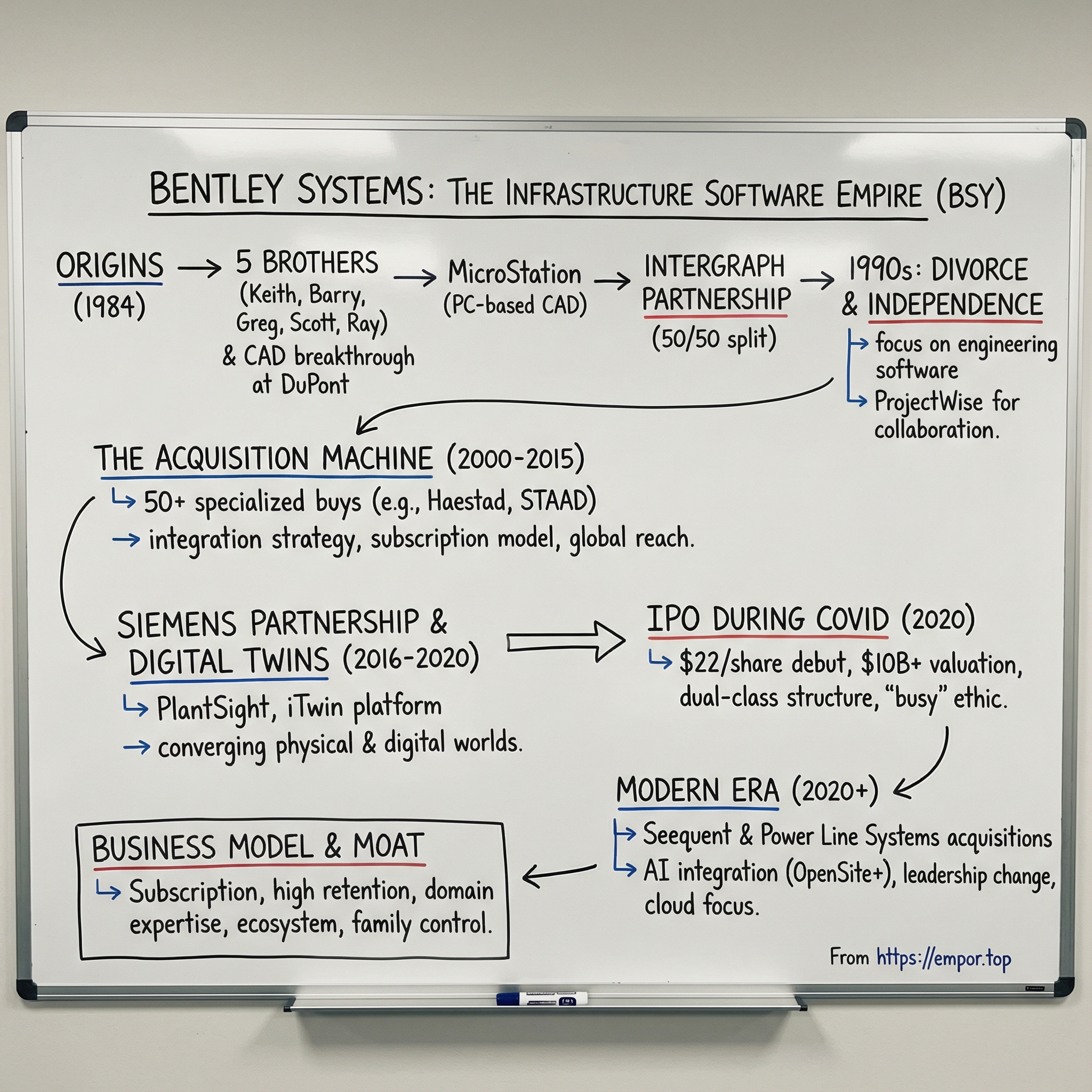
Bentley Systems: The Infrastructure Software Empire
I. Introduction & Opening Story
There is a particular kind of company that most people will never knowingly encounter, yet whose software underpins almost every major physical structure built today. Whether crossing a bridge in Ohio, riding a commuter rail line outside London, drinking municipal water in São Paulo, or drawing power from a transmission tower in Virginia, the underlying drawings, structural models, load calculations, and inspection records were likely created using software developed in Exton, Pennsylvania.
Bentley Systems does not pour concrete or string electrical wire. Instead, it provides the modeling and simulation engines that engineers use to design those assets, along with the cloud systems that store and manage structural data across their 50- to 100-year operational lifespans.
Management often describes this role as the industry's "digital quartermaster" — a phrase Executive Chair Greg Bentley used on the company's February 2026 earnings call.1 Yet a quartermaster remains essential only as long as the underlying supply chain remains unchanged.
The scale of the thing. For the twelve months ended December 31, 2025, Bentley reported total revenue of $1.502 billion, an 11.0% increase year over year. Subscription revenue reached $1.377 billion, while annualized recurring revenue grew 11.5% in constant currency to $1.462 billion.2 The company serves nearly 42,000 accounts across 189 countries with approximately 5,800 employees. It sells almost entirely through direct channels, including its Virtuosity inside-sales platform, which generated about 94% of total revenue in 2025.3
Revenue is split nearly evenly between two customer segments: engineering and construction firms that design and build capital projects account for 52%, while the owner-operators who maintain those assets generate the remaining 48%.3 Customer concentration is low: no single account represented more than 2% of revenue in any of the last three years — a notable degree of diversification for a company whose end customers are frequently public sector entities.3
This financial profile reflects a business that is not dependent on any single contract, country, or government stimulus program. Instead, Bentley functions as a broad toll on global engineering activity, which makes the current market debate over its business model particularly significant.
The 2024 watershed, correctly sequenced. Bentley operated as a private company for 36 years before listing on Nasdaq in September 2020, and it remains controlled by the Bentley family. That governance structure shaped two major events in the spring of 2024.
On March 21, 2024, at the opening of its London headquarters during its 40th anniversary year, Bentley announced that Greg Bentley would step down as chief executive on July 1, with Chief Operating Officer Nicholas Cumins succeeding him as the company's first non-family CEO.4 A month later, Bentley confirmed preliminary discussions with Schneider Electric regarding a potential strategic transaction. On May 22, 2024, Schneider announced that "those discussions are now mutually terminated and no transaction was agreed upon."5
While common commentary suggested the executive succession was prompted by the failed transaction, the corporate timeline shows the reverse: the CEO transition was announced before the talks with Schneider became public. This sequence indicates that the leadership handover was a planned generational transition rather than an alternative to a sale, underscoring both management's deliberate planning and the limited influence of public shareholders under the existing voting structure.
The tension worth following. Bentley has established a highly predictable vertical software business, characterized by a 99% account retention rate, a 109% dollar-based net revenue retention rate, and operating margins that expand by roughly 100 basis points annually.3 At the same time, its dual-class capital structure leaves public shareholders with virtually no governance leverage.
In 2026, the company faces a fundamental strategic question: whether artificial intelligence will enhance the value of software licenses per engineer or reduce the overall headcount of engineers requiring licenses. Investors have responded cautiously, driving the stock to repeated 52-week lows through 2026 — down nearly 25% year to date at its trough — amid concerns that AI "could undercut the company's traditional software model."6
The company's trajectory spans four decades: from a $5,000 graphics terminal in Delaware through a high-risk distribution partnership, an abandoned initial public offering, two decades of targeted acquisitions, a long-term investment in digital twin technology, a pandemic-era public listing, and now an AI strategy that management has chosen not to monetize immediately. Evaluating this next phase requires examining how a software provider built on engineering workflows adapts when the nature of engineering work itself begins to change.
 Subscribe on LinkedIn
II. The Five Brothers & Origins (1984–1990)
In 1983, inside E.I. du Pont de Nemours in Delaware, electrical engineer Keith Bentley ran into a costly operational bottleneck. DuPont's design drawings were stored on Intergraph workstations costing roughly $70,000 apiece.7 With limited access to these high-priced machines, engineers who merely needed to view a drawing—to verify a dimension before ordering steel—had to wait in line alongside those creating new designs.
On his own time, Keith developed a software workaround called ViewDGN. The program enabled an ordinary graphics terminal costing about $5,000 to read Intergraph drawing files, effectively replacing a $70,000 hardware constraint with a far cheaper terminal.7
He offered the software to Intergraph, but the company declined, preferring to protect its workstation hardware margins. As Keith later reflected, a modest acquisition by Intergraph at that moment would have prevented Bentley Systems from ever existing.7
This origin story established the economic premise that guided the company for the next four decades: engineering value is constrained by the cost of accessing design data, and the provider that unbundles that access secures a defensible market position. Intergraph's rejection reflected a classic incumbent dilemma—protecting hardware margins at the expense of software expansion—a dynamic that recurred in subsequent technology shifts from personal computing to the cloud and artificial intelligence.
The brothers. Keith left DuPont in the spring of 1983, moved to California, and joined his brother Barry—then a chemical engineering doctoral student at Caltech—at a startup selling laboratory data software.7 Recognizing that computer-aided design for engineering represented a far larger market than laboratory tools, the brothers shifted focus. They began commercial sales of their renamed software, PseudoStation, in June 1984 before formally incorporating Bentley Systems in California on September 5, 1984.78
The five Bentley brothers who assembled around the business established a distinct division of labor that endured for decades.
Keith, born in 1958, led product architecture as president from 1984 to 1995 and chief executive officer from 1984 to 2000. He then served as chief technology officer for over two decades until early 2023, retiring from his executive role at the end of that year while remaining a board director.9 Barry, born in 1956, held a doctorate and provided scientific discipline. Scott, a Wharton graduate born in 1957, joined as the first employee to manage operations, while Ray, born in 1960, was the youngest.7
Greg, born in 1955, joined in 1991 after founding and running Devon Systems International, a financial trading software firm he sold to SunGard Data Systems in 1987. He subsequently served on SunGard's board and audit committee from 1991 through 2005.9 As the only brother with prior experience scaling, selling, and governing a software company, Greg brought corporate finance expertise that later proved vital when structuring Bentley's initial public offering, managing debt financing, and navigating acquisition approaches.
The $7,943 experiment. Rather than relying on cost-plus modeling or competitor benchmarks, the brothers set pricing by demonstrating PseudoStation to prospective users and polling their willingness to pay. While standard market research suggested a $9,000 price point, user feedback averaged out to $7,943. First-year sales reached approximately 80 copies at an average realized price near $7,500.7
These modest early volume figures underscored a business still selling a niche utility software tool. Growth accelerated with MicroStation, the company's full CAD platform, which was demonstrated on a Compaq 286 at an Intergraph user event in Orlando in the spring of 1985 and released for MS-DOS in 1986.8 By mid-1989, approximately 20,000 copies of MicroStation were in active use at around $3,000 per license—a price point designed to compete directly with AutoCAD.8
Pricing directly against customer value rather than internal development costs established a commercial strategy that eventually evolved into the company's modern consumption-based licensing models.
The deal that made and nearly unmade them. In January 1987, Intergraph acquired a 50% equity stake in Bentley Systems for $3 million, creating a four-person board split equally with two seats each.8
The strategic logic benefited both parties: Bentley gained global distribution and market validation, while Intergraph secured a personal computer strategy without internal software development. By 1992, Intergraph had generated $79 million in sales of MicroStation.8
Testing the claim that the partnership was a low-risk accelerant. However, the partnership introduced substantial operational risks. The equal board split left corporate governance vulnerable to deadlock, while Intergraph retained control over end-customer relationships. For seven years, Bentley operated primarily as an isolated development lab without direct access to its user base.
Bentley reclaimed its commercial independence through legal foresight rather than capital expenditure. Legal counsel David Nation had inserted a clause allowing Bentley to reclaim direct sales rights if Intergraph launched a competing product. When Intergraph released a competing application named DMView, the protective clause was triggered.10
The companies announced a restructured agreement in May 1994, with Bentley assuming full marketing and sales responsibility on January 1, 1995, even as Intergraph maintained its 50% equity position.10 The corporate separation concluded through subsequent legal agreements that favored Bentley. Under a 1999 settlement, Intergraph paid Bentley approximately $13.7 million, returned 3 million Class A shares, and agreed to discontinue using Bentley's proprietary plotting libraries.11 By December 31, 2001, Intergraph's ownership had declined to roughly 29% of fully diluted stock, and sales through Intergraph accounted for just 2.4% of Bentley's revenue.11
While Bentley incurred severe channel-concentration risk and delayed its internal go-to-market capabilities for years, contractual protections enabled the company to reclaim its customer relationships, core intellectual property, and independence along with cash compensation.
Early contractual optionality proved crucial, establishing a precedent for how the Bentley family evaluated future strategic partnerships and acquisition proposals.
Assuming commercial independence required a rapid organizational buildout. Within eight months of taking control, Bentley transitioned from a dedicated software laboratory into a full-scale enterprise operating global sales, marketing, and distribution. Within a year, the company expanded to 275 employees and 350 worldwide resellers, reaching nearly $100 million in annual revenue.8
III. MicroStation & The Engineering Software Revolution (1990s)
In the spring of 1994, across from Intergraph's user group conference in Huntsville, Alabama, Bentley set up product demonstrations in a vacant shopping center and named it "MicroStation Mall."8
The venue choice signaled a shift. Bentley was no longer just an engineering software developer; it was establishing itself as an independent commercial organization directly courting enterprise customers. Throughout the 1990s, two technological shifts reshaped the computer-aided design market: personal computers replacing proprietary Unix workstations, and Autodesk dominating lower-cost 2D drafting. Bentley responded by carving out a specialized position in high-complexity infrastructure engineering.
Building a company in eight months. Following its commercial independence, Bentley structured itself into three primary operating units: Keith led product development, Greg managed distribution and corporate strategy, and Scott directed operations and services. The company recruited executives from Intergraph and other software firms to establish a direct sales organization.8
This commercial expansion rapidly reduced channel concentration. By 1997, Bentley generated between $160 million and $170 million in annual revenue, with sales through Intergraph dropping to roughly 13% of total revenue—a share that fell to approximately 2% by mid-2002.8 By replacing its primary distributor within four years, Bentley insulated its business model from single-channel distribution risks.
The technical fork. Product architecture during this era reflected a strategic divergence between Bentley and Autodesk. While Autodesk optimized AutoCAD for volume 2D drafting on personal computers, Bentley designed MicroStation for complex, large-scale 3D models requiring precise coordinate systems, such as highway corridors, bridges, and plant facilities.
The launch of MicroStation Version 8 demonstrated this focus on enterprise scale. Introduced at Bentley's September 2000 user conference and released in mid-2001 following a 13-month development cycle, Version 8 expanded coordinate storage from 48-bit to 64-bit floating point, increased maximum file sizes from 32 megabytes to 4 gigabytes, and expanded structural levels per file from 63 to unlimited. It also added native support for both DGN and DWG file formats and integrated the Parasolid solid modeling kernel.8
These technical enhancements solved practical engineering challenges. Higher coordinate precision prevented rounding errors across extensive geographic alignments, ensuring spatial accuracy across large infrastructure sites. Expanded file capacities allowed entire transportation projects to be stored in single, unified models rather than fragmented files. These capabilities positioned MicroStation as an industry standard for heavy civil engineering projects.
The strategic concession. As Autodesk captured the commercial building architecture market with its DWG format and later Revit platform, Bentley shifted its focus away from vertical commercial design. Instead, management concentrated resources on civil infrastructure, including roads, bridges, rail networks, water systems, and power utilities.
This strategic division remains evident in the company's financial profile. Commercial and facilities projects account for approximately 5% of sector-attributable annualized recurring revenue, whereas public works and utilities represent roughly 59%.3 By relinquishing commercial building design, Bentley established a concentrated footprint in capital-intensive public infrastructure sectors.
The collaboration insight. By the mid-1990s, management recognized that managing project data across distributed teams was becoming as critical as creating design drawings. Major infrastructure projects frequently suffered from coordination errors when multiple engineering firms operated on outdated file versions.
To address document control, Bentley introduced TeamMate and OfficeMate, culminating in the January 1998 launch of ProjectWise. The platform managed MicroStation, AutoCAD, and Microsoft Office files in their native formats across distributed server networks.8
ProjectWise altered the customer value proposition by transforming software from an individual design utility into an enterprise system of record. While individual drafting applications could be substituted, a centralized collaboration platform used concurrently by project owners, prime contractors, and subconsultants created high switching costs during multi-year infrastructure projects.
Testing the claim that the proprietary DGN format was an unassailable moat. The market trajectory indicates that proprietary file formats alone did not secure Bentley's position; in commercial building design, format exclusivity failed to prevent Autodesk from dominating the market.
Bentley's customer retention stemmed instead from a combination of domain-specific civil engineering workflows and public procurement specifications. According to the company's 2002 registration statement, Bentley software was deployed across 46 U.S. state departments of transportation, as well as engineering enterprise Bechtel, the U.S. Army Corps of Engineers, and the San Antonio City Public Service Board.11 When public transportation departments specified MicroStation standards in contract bidding requirements, engineering contractors adopted the software to maintain compliance. Furthermore, MicroStation Version 8's native DWG support reflected a deliberate choice to enable cross-format interoperability rather than relying on a closed file ecosystem.
The quiet business-model transition. Financial performance at the turn of the century highlighted an early shift toward recurring revenue. Total revenue reached $180.2 million in 2000 and $202.6 million in 2001. More significantly, subscription revenue grew from $96.8 million to $123.6 million over that period, while perpetual license sales declined from $70.3 million to $61.5 million. As a result, subscriptions expanded to represent over 61% of total revenue.11
By 2001, Bentley offered three purchasing models: traditional perpetual licenses with optional SELECT maintenance agreements, monthly subscription licensing priced at approximately one-eighteenth of the upfront license cost, and vertical portfolio subscriptions tailored for building, plant, civil, and municipal markets.8
This early transition from upfront perpetual license fees to recurring subscriptions occurred while Bentley remained private, establishing a precedent for recurring revenue and consumption-based licensing that management expanded in subsequent decades.
That business model stability faced new scrutiny as the company prepared for its first attempt at a public listing.
IV. The Acquisition Machine: Building Through M&A (2000–2015)
In April 2002, Bentley Systems filed a registration statement with the Securities and Exchange Commission. The filing detailed a company with $202.6 million in revenue, profitable in 1997, 1999, and 2001—though loss-making in 1998 and 2002—generating roughly 52% of sales in North America, and listing its principal stockholder, Intergraph, among its direct competitors.118
On September 16, 2002, following the severe downturn in technology equities, Bentley withdrew the filing.8
A caution about the flattering version. Subsequent commentary often attributed the withdrawal to executive concerns over the governance burdens and independent-director requirements of the newly enacted Sarbanes-Oxley Act. However, primary corporate records from the period do not verify that rationale. The factual record supports a simpler explanation: the offering was pulled due to unfavorable market conditions for software companies.8
That distinction clarifies how observers interpret management's capital markets history. Rather than representing a principled stand against public governance, the withdrawal reflected an ordinary commercial decision driven by prevailing market pricing.
The withdrawal had significant long-term consequences. Bentley remained private for another 18 years, using that extended period away from quarterly public scrutiny to acquire dozens of specialized engineering software developers and integrate their tools into a unified platform.
The roll-up, and what it was actually assembling. The acquisition campaign systematically targeted civil engineering sub-disciplines.
Bentley acquired GEOPAK, a civil design affiliate dating from around 1995, in October 2001.8 In December 2000, it bought Intergraph’s civil engineering, plot-services, and raster-conversion lines—including InRoads—for an initial $24.6 million, reacquiring the product lines that competed directly with its own software.118 It expanded into international transportation software by acquiring UK-based roadway design developer Infrasoft in 2003.8 On August 2, 2004, Bentley added hydrologic and hydraulic modeling firm Haestad Methods, which generated over $16 million in annual revenue, for an undisclosed sum.12 Subsequent deals added structural analysis, process plant design, and geotechnical borehole data management tools to the portfolio.
Bentley also deployed strategic minority investments to manage capital efficiency. Rather than buying targets outright, it initially acquired minority stakes—such as a 25% position in plant visualization vendor Jacobus Technology in late 1994, which expanded to majority control by early 1997—allowing management to evaluate emerging technologies before committing full acquisition capital.8 For a privately held company managing cash carefully, minority investments provided low-risk exposure to complementary technologies.
Why comprehensiveness is the product. The strategic logic rested on customer purchasing behavior. Large engineering enterprises bid across diverse project types—ranging from highway bridges and mines to water treatment facilities. As noted in Bentley’s 2025 annual report, such enterprises tend to favor an infrastructure engineering software vendor whose portfolio correspondingly spans their full breadth.3
Portfolio breadth served as a primary competitive defense. Every engineering discipline outside Bentley's product suite created an opportunity for a customer to maintain a rival software vendor, establishing an entry point for competitors to expand their footprint. Programmatic acquisitions were designed as much to deny competitors market footholds as to generate immediate revenue synergies.
Reinvestment. Bentley consistently reinvested approximately one-fifth of its annual revenue into engineering development. In 2025, research and development expenses totaled $307.6 million on $1.502 billion in revenue—or 20.5%—up from $281.2 million in 2024 and $274.6 million in 2023.3 Two decades earlier, the company reported 2006 revenue of $389 million after investing over $200 million in combined product development and acquisitions across 2005 and 2006.8
Maintaining this investment level across private ownership, debt-financed acquisitions, and market cycles underscored management's capital allocation priorities. To support development cost-effectively, Bentley built major software engineering centers in Lithuania, maintaining development teams in Vilnius and Kaunas for over two decades to work on ProjectWise, SYNCHRO, and the iTwin Platform.13
Testing the claim that programmatic M&A produced clean synergies. Technical reality presents a more nuanced picture than commercial performance alone suggests.
Acquiring a geotechnical database or a hydraulic solver is straightforward; unifying their underlying schemas with a bridge modeling engine requires multi-year software re-engineering. Bentley has conducted this data integration work continuously since the late 1990s, and recent annual disclosures still describe its products as becoming increasingly data-centric to take advantage of digital twin and artificial intelligence capabilities.3
Four decades after its founding, schema integration remains an ongoing effort rather than a finished milestone.
This evidence supports a refined view of Bentley's acquisition strategy. The commercial success of the strategy is demonstrated by a 99% account retention rate and a broad portfolio that encourages enterprise consolidation.3 However, the ongoing cost is reflected in research and development expenses that continuously consume roughly a fifth of revenue to support ongoing schema unification.
Consequently, research and development spending serves partly as the ongoing maintenance cost of managing a broad software portfolio rather than purely discretionary growth capital. If research and development spending as a percentage of revenue rises without a corresponding increase in organic recurring revenue, software integration is consuming more capital than it returns.
By the mid-2010s, Bentley had assembled a comprehensive software portfolio. The next strategic challenge was defining how customers would manage and leverage that aggregated asset data over long operational lifespans—a challenge that soon drew the attention of a major industrial partner.
V. The Siemens Partnership & Digital Twin Revolution (2016–2020)
For most of its history, Bentley's software went quiet at the exact moment physical infrastructure became operational.
Engineers designed a bridge and contractors built it. The underlying models were then archived for decades while the physical asset weathered, absorbed traffic beyond initial design assumptions, and underwent periodic manual inspections with clipboards. While the design phase of a project typically spans three years, the asset's operating life can extend for a century. Historically, Bentley monetized only the three-year design window.
In November 2016, a strategic alliance with Siemens expanded that scope. The two companies committed at least €50 million to develop joint engineering solutions, with Siemens acquiring approximately €70 million of secondary Bentley shares under an agreement that continued until Bentley completed its public listing.14 The joint innovation program subsequently produced PlantSight, an enterprise platform that combined Siemens' plant engineering and industrial IoT tools with Bentley's OpenPlant and iTwin technology to link operational telemetry directly to 3D engineering models.
For institutional investors, the primary significance of the partnership extended beyond PlantSight. A major industrial conglomerate committing substantial equity capital to a private software firm validated that Bentley's underlying design models possessed commercial utility beyond traditional computer-aided design. The alliance also placed a strategic industrial acquirer on Bentley's capitalization table years before a potential public listing.
The digital twin, stripped of marketing jargon. A digital twin is a dynamic digital representation of a physical asset, continuously updated with real-time operational data.
Where a static design model describes how an asset was originally engineered, a digital twin tracks its current condition: deck deflection measurements, recent bearing inspection logs, historical de-icing salt application, and structural anomalies identified in high-resolution drone imaging.
Commercially, this technology shifts the underlying software unit of sale from a finite capital project to an ongoing physical asset. By extending its reach into operational lifespans, Bentley sought to expand its addressable market from engineering design hours to long-term asset value under management.
The technical execution proved more complex than the underlying concept. Building a functional digital twin required unifying disparate discipline schemas—geotechnical data, structural calculations, hydraulic models, and sensor streams—into a single interoperable data framework. This represented the data-integration challenge accumulated across decades of programmatic acquisitions, positioning the iTwin platform as the structural consolidation of the company's software suite rather than a standalone application.
Testing the claim that digital twins produced rapid commercial returns. Financial results demonstrate that near-term monetization remained limited, a reality management explicitly acknowledged.
On the company's February 2026 earnings call—nearly ten years after launching the Siemens partnership—Executive Chair Greg Bentley offered a direct evaluation of the business: "Our comparatively small proportion of revenue from asset performance to date in relation to years of investment shows how slow this had been to significantly grow."1
This statement established a benchmark for evaluating long-term technology investments against realized financial returns.
The delay stemmed primarily from structural industry conditions. Between 2016 and 2019, municipal utilities and state departments of transportation lacked the cloud architecture, sensor networks, and internal technical staff required to process continuous operational data. Public infrastructure managers maintained conservative procurement standards, limiting the deployment of unproven software platforms on critical infrastructure. Additionally, reality-capture technologies were not yet sufficiently cost-effective to construct digital models without expensive, custom field surveys.
The historical evidence shows that while the digital twin concept remained valid, its adoption timeline was delayed by roughly a decade. Adoption speed has recently improved as input costs have fallen. Lower-cost drones, mobile cameras, and artificial intelligence image processing have enabled what Greg Bentley termed "instant on" digital twins.1 Driven by these cost reductions, Bentley's asset analytics business reached a $50 million annualized run-rate for asset consumption revenue in 2025.1
Relative to the company's $1.502 billion in total 2025 revenue, that $50 million run-rate represents approximately 3%—reflecting tangible growth, yet remaining modest in relation to a decade of development spending.
For market participants assessing Bentley's ongoing artificial intelligence initiatives, this adoption curve offers a useful historical baseline. Management has demonstrated accurate long-term technical vision while consistently overestimating the pace of customer adoption. The key metric remains the asset consumption run-rate: if it expands into a material share of recurring revenue over the coming years, the digital twin thesis will achieve commercial validation; if growth plateaus, digital twins risk remaining a technically sophisticated capability with constrained top-line impact.
Before these public market dynamics could unfold, Bentley moved to complete its initial public offering, selecting one of the most unusual market environments in modern economic history.
VI. The IPO Story & Going Public During COVID (2020)
In March 2020, as engineering firms worldwide transitioned to remote work, a structural bottleneck emerged across physical infrastructure projects. Design files had historically resided on local office servers. When those offices closed, maintaining multi-firm and international project workflows required a cloud-connected data environment accessible from anywhere—a capability ProjectWise had built over the preceding two decades. A collaboration platform previously viewed as an operational best practice rapidly became an essential infrastructure tool.
What the prospectus actually showed. The financial disclosures in Bentley's registration statement revealed a business that had already completed its primary business-model transition. For 2019, total revenue reached $736.7 million, with international markets accounting for roughly 58% of sales, while annualized recurring revenue stood at $697.7 million as of June 30, 2020.15
The prospectus also detailed a shift toward usage-linked commercial models. Annualized recurring revenue derived from contracts with consumption terms of less than one year grew from 9% at the end of 2017 to 25% by year-end 2019, and reached 29% by mid-2020, driven by the expansion of its E365 program.15 This transition tied revenue growth directly to software usage rather than static license seats, introducing a distinct risk profile that continues to shape modern market evaluations.
The public offering was not designed to raise growth capital. Instead, it established liquidity for long-time employees, facilitated estate planning for the founding family, and provided an exit mechanism for early institutional investors, including Siemens.
The listing. On September 23, 2020, Bentley priced 10,750,000 shares of Class B common stock at $22.00 per share—above its revised target range—raising approximately $237 million. The stock rose 52% on its first day of trading to close at $33.49. The initial public offering achieved management's core objectives: establishing a liquid public currency and market valuation without diluting corporate voting control.
The governance architecture, correctly described. Understanding Bentley's capital structure is central to analyzing its public equity investment case. The company established a dual-class share structure where publicly traded Class B common stock carries one vote per share, while Class A common stock—held primarily by the Bentley family—carries 29 votes per share and converts one-for-one into Class B shares.159 Upon completing the offering, the Bentley family held approximately 57.4% of total voting power, while the broader Bentley Control Group held approximately 67.4%. This concentration qualified Bentley as a "controlled company" under Nasdaq listing rules, exempting it from requirements to maintain a majority of independent directors on its board.15
The prospectus explicitly outlined this governance dynamic, noting that Class B shareholders "will not have a meaningful voice" in corporate governance.15
The structure contains a conditional sunset provision tied to executive leadership. If none of Barry, Gregory, Keith, or Raymond Bentley serves as an executive officer or director, the voting power of Class A shares steps down from 29 votes to 11 votes per share.15 Unlike perpetual super-voting structures common among technology issuers, governance control remains contingent on active family participation in corporate management.
Testing the claim that a public listing gave outside shareholders governance leverage. Public market disclosures demonstrate that listing did not grant outside shareholders meaningful governance leverage.
As of March 31, 2026, the Bentley family beneficially owned approximately 52% of outstanding Class B stock—with roughly 20% held individually by the founding brothers and 32% held by family members, trusts, and controlled entities—while retaining majority voting control through Class A shares.9 The eight-member board of directors comprises four Bentley brothers, the chief executive officer, and three independent directors.9
Bentley has elected not to adopt an independent-majority board structure and does not maintain a dedicated compensation committee; instead, its fully independent Nominating and Sustainability Committees fulfill those duties.9 Janet B. Haugen serves as Lead Independent Director, presiding over executive sessions of the independent board members.9
This voting structure effectively insulates management from traditional shareholder activism, such as proxy contests, board representation demands, or binding votes. Outside shareholders retain only the liquidity to enter or exit positions at prevailing market prices.
Rather than serving as a potential catalyst for governance restructuring, family voting control functions as a permanent feature of the equity security that public markets price continuously. While public listing did not establish independent shareholder oversight, the family's voting control has coincided with long-term capital reinvestment and a fully diluted share count that compounded at approximately negative 1% annually over the subsequent five years.16 That governance model faced a direct test when voting control encountered a major external acquisition proposal.
VII. The Modern Era: AI, Acquisitions & Growth (2020–Present)
On April 19, 2024, Bentley confirmed what the market had suspected: it was in preliminary discussions with Schneider Electric about a potential strategic transaction, and had formed a special committee to explore options including a joint venture or a merger with Schneider's software business.
Five weeks later the talks were dead. Schneider's statement was terse — mutually terminated, no transaction agreed, and the company remained focused on its "consistent capital allocation priorities."5 Reporting at the time indicated the controlling family had declined to support a structure in which it would lose control or transfer too much of the combined value.
That is the clearest available demonstration of what dual-class control means in practice. A very large industrial acquirer arrived, and the answer was no — not from a board weighing a premium against standalone value, but from a family weighing continuity. Bentley shares fell on the news. Whether that was value destruction or value preservation depends entirely on what one believes the next decade holds, which is the honest and unsatisfying answer.
The two acquisitions that reshaped the company. Bentley announced on March 11, 2021 that it would acquire Seequent, the New Zealand leader in geological and geophysical modeling, for $900 million in cash plus 3,141,361 Class B shares — approximately $1.05 billion in total. The deal closed on June 17, 2021.17 On November 16, 2021 it agreed to acquire Power Line Systems, the Madison, Wisconsin developer of software for overhead electric transmission line and structure design, for approximately $700 million; that closed on January 31, 2022.18
Both look, five years on, like unusually well-chosen assets — and it is worth being precise about why, because "great acquisition" is easy to assert after the fact.
Seequent gave Bentley the subsurface: the ground beneath every tunnel, mine and foundation, which is the single largest source of cost overruns in heavy construction. You cannot see what you are digging into, and every surprise is expensive. Resources is now roughly 27% of sector-attributable ARR and, through the first half of 2026, Bentley's fastest-growing sector, driven by mining demand tied to critical minerals.316
Power Line Systems gave Bentley the grid. On the August 2026 call, Cumins disclosed a specific and checkable proof point: PLS revenue outside the United States is now as large as the entire PLS business was at acquisition.16 That is the kind of statement that distinguishes a real distribution synergy from a narrative one — Bentley took a domestically concentrated product and globalized it through an existing sales machine. He also quantified the demand backdrop, citing an estimated 35 gigawatts of additional U.S. grid capacity required by 2030.16
The smaller, stranger deals. In 2023, Bentley's iTwin Ventures arm acquired Blyncsy, which derives roadway condition data from crowdsourced dashcam imagery using AI — turning ordinary vehicles into a distributed inspection fleet.19 On September 6, 2024, Bentley acquired Cesium, creator of the 3D Tiles standard adopted by the Open Geospatial Consortium and the foundation for streaming very large 3D geospatial datasets; terms were not disclosed.20
In December 2025 it closed the acquisitions of Talon Aerolytics — asset analytics for telecom and utilities — and the technology and technical expertise of Pointivo, covering drone data processing, AI-powered damage detection and geolocation. The deals were announced January 5, 2026; terms were not disclosed.21
Testing the claim that the platform acquisitions came without balance-sheet strain. They did not.
Bentley funded them substantially with debt, including $575 million of 0.375% convertible senior notes due mid-2027 issued in June 2021, on top of $678 million of 0.125% convertible notes due 2026.32 Leverage rose and stayed elevated through a period of sharply rising rates.
Management's own framing is the most useful evidence. Greg Bentley described having "resolutely worked down the debt leverage we incurred to finance the platform acquisitions," and said that only "since late last year" — meaning late 2025 — did reaching a roughly 2x target range free the company to allocate more capital to discretionary repurchases.16 CFO Werner Andre characterized year-end 2025 net debt leverage of 2.1x as a four-year low.2
Four years is a long time to be constrained. The calibrated verdict: the deals were strategically sound and are now demonstrably contributing, but the claim that they were absorbed without cost is false. The cost was roughly four years of reduced strategic flexibility — paid, as it happens, during the window when the stock was expensive and buybacks would have been least attractive anyway. Whether that is good luck or good sequencing, the record does not distinguish.
The new operator. Nicholas Cumins joined Bentley in 2020 as Chief Product Officer ahead of the IPO, became Chief Operating Officer in 2022, took the CEO role in July 2024 and joined the board that September.922 He came from SAP, where he was general manager of SAP Marketing Cloud from 2018 to 2020.9
His public register is notably different from Greg Bentley's. Where Greg speaks in long, allusive constructions about decades and technology generations — a style that is genuinely distinctive and occasionally impenetrable — Cumins is procedural: priorities, sequencing, what has been validated and what has not.
The leadership bench around him has also turned over. James K. Lee joined as Chief Operating Officer in January 2025; Werner Andre has been CFO since January 2022; Julien Moutte serves as Chief Technology Officer; and Chief Revenue Officer Brock Ballard, appointed in 2023, arrived from sales leadership roles at Dassault Systèmes and Autodesk.9 Greg Bentley retains the title of President, which he has held since June 1996, alongside Executive Chairperson.9
The AI commercialization plan, and its candid caveat. On the August 2026 call, Cumins stated the sequence explicitly: "our priority remains in order, adoption, exploration and validation with monetization to follow," adding that "earning adoption and trust first is precisely what will let us capture our fair share of the value."16 Management has indicated that meaningful monetization of agentic API consumption is a 2027 matter.
Investors should read that as a candid admission that the AI revenue opportunity is currently unpriced, unvalidated and being deliberately deferred. That is defensible strategy. It is also, unavoidably, an unproven one, and it means any valuation crediting AI upside today is crediting a product that has not been sold.
Where the numbers stand. ARR reached $1.494 billion at the end of the first quarter of 2026, growing 11.5% in constant currency, then $1.536 billion at June 30, 2026 with growth accelerating to 12% — all organic — while net revenue retention held at 109%.2316 Trailing-twelve-month free cash flow was $498 million, up 15%.16
Capital allocation has broadened accordingly. Bentley paid $85.0 million of dividends in 2025, deployed $155 million on share repurchases in the first half of 2026 alongside $42 million of dividends, and management has stated capacity to fund dividends, ongoing repurchases and up to $400 million in programmatic acquisitions annually.3162
Against all of that, the shares spent 2026 making new lows on fears the model is about to be disrupted.6 The operating results and the share price have been telling opposite stories for the better part of a year, which is either an opportunity or a warning depending on which one is early.
VIII. Business Model & Competitive Moat
A single metric explains more about Bentley's underlying business model than any traditional margin figure. On the February 2026 earnings call, Executive Chair Greg Bentley disclosed that Bentley's software costs, on average per user day, represent only about 3% of an engineer's fully burdened daily labor cost.1
Three percent. A civil engineer whose time costs several hundred dollars a day is equipped with roughly ten dollars worth of Bentley software.
That single ratio forms the foundation of the company's entire competitive position, cutting in two directions at once. On one hand, the incentive for a customer to swap out Bentley to cut software expenses is exceptionally weak; any potential savings are trivial compared to the operational disruption and professional risk involved. On the other hand, it demonstrates that Bentley captures only a modest fraction of the economic value its software enables. That gap represents either immense latent pricing power or empirical evidence that customers simply do not value the software as highly as management maintains.
Management argues for latent pricing power, attributing the low ratio to owner-operators' "archaic norm of paying by the hour and often based on low bid for engineering services, perversely disincenting advances in productivity."1 While that diagnosis is plausible, it remains unproven. The ratio has remained static for four decades, offering weak support for claims of imminent expansion.
How the money actually flows. Subscriptions generated 92% of revenue in the second quarter of 2026, while legacy perpetual licenses shrank to roughly 2%.16 Three distinct commercial models drive these revenues:
E365 is an all-inclusive, consumption-based enterprise plan with uniform global pricing billed primarily on daily usage, structured with negotiated floors and ceilings.3 The underlying mechanics are crucial: the floor guarantees Bentley a baseline revenue stream regardless of user activity, while the ceiling protects the customer from cost overruns during high-volume periods. At annual renewal, both thresholds reset based on actual usage, making these adjustments a key indicator of enterprise pricing power. Chief Executive Nicholas Cumins reported that floor and ceiling resets averaged roughly a 10% uplift in the second quarter of 2026, characterizing the increases as "a clear vote of confidence" from enterprise accounts regarding their own project pipelines.16
Virtuosity, the company's e-store, sells twelve-month named-user subscriptions to small and medium businesses, capturing the long tail of engineering consultants who were historically under-licensed. Virtuosity added over 600 new accounts in the second quarter of 2026, with new logos contributing 300 basis points to annualized recurring revenue growth.163
Cloud Services Subscriptions are billed quarterly based on user count and are mandatory alongside E365.3
The resulting economics. In 2025, gross profit reached $1.224 billion on $1.502 billion in revenue, representing an 81.5% gross margin.3 GAAP operating margin expanded to 24.1%, up from 22.3% the prior year, while adjusted operating income excluding stock-based compensation reached 28.6% of revenue.2 Free cash flow reached $520.2 million, or roughly 35% of total revenue, while operating cash flow of $538.5 million converted at over 100% of GAAP operating income.2
These cash dynamics are driven by upfront annual billing and a negative working capital structure, which Chief Financial Officer Werner Andre confirmed remains intact despite quarterly timing fluctuations.16 For investors, the practical implication is that quarterly cash flow exhibits higher volatility than revenue due to the timing of collections—a dynamic management had to clarify twice in 2026 after first-half free cash flow declined year over year purely because of comparison timing effects.16
Myth versus reality. Three prevailing consensus narratives about Bentley require critical re-examination.
Myth: the .dgn file format serves as the primary moat. Reality: MicroStation has natively read and written Autodesk's DWG format since Version 8, and Bentley's most lucrative offerings are format-agnostic collaboration and simulation platforms.8 The true moat consists of public specification mandates, domain-specific physics engines, and complex multi-party project workflows rather than proprietary file formats.
Myth: Bentley is a pure directional play on government infrastructure spending. Reality: the company maintains broader sector diversification. Roughly 41% of annualized recurring revenue originates outside public works and utilities, distributed across resources, industrial, and commercial or facilities sectors.3 International markets account for two-thirds of total revenue, while direct exposure to geopolitical friction in China represents only about 2% of ARR.1615 In addition, customer concentration remains minimal, with no single account representing more than 2% of revenue.3
Myth: a 109% net retention rate demonstrates expanding pricing power. Reality: the metric indicates that existing accounts increase their annual spend through a combination of price adjustments, seat additions, tier upgrades, and usage consumption. However, dollar-based net revenue retention moderated from 110% to 109% between 2024 and 2025, holding steady at 109% for five consecutive quarters.316 The performance reflects stability rather than acceleration.
Seven Powers, honestly scored. Switching costs represent Bentley's strongest and most verifiable strategic advantage: a 99% account retention rate sustained through economic volatility, rising interest rates, and a global pandemic provides empirical behavioral proof of customer lock-in.3
Cornered resource advantages exist but are narrower than often asserted. Decades of embedded regional design codes, municipal regulatory standards, and validated simulation models cannot be quickly replicated—though competitors can acquire them, much as Bentley did through programmatic deals and Autodesk accomplished by acquiring Innovyze.
Scale economies are evident in product development, where $307.6 million in annual research and development spending creates an insurmountable barrier for niche point-solution vendors.3 However, that scale advantage does not extend to larger peers like Autodesk, Hexagon, or Trimble.
Network economies are the weakest of the four claimed advantages. Multi-firm collaboration through ProjectWise creates substantial coordination lock-in within an individual capital project, but that advantage does not network across the broader industry like a multi-sided marketplace. A new infrastructure mega-project can choose a competing platform at inception. Investors should view Bentley's network effect as project-scoped rather than market-scoped—a tangible but strictly bounded moat.
Five Forces, war-gamed. New entrants confront substantial barriers. A new market entrant must build advanced 3D modeling tools, incorporate decades of localized engineering regulations, and convince licensed professional engineers to assume legal liability by certifying designs generated by unproven software.
Buyer power is weak at the individual enterprise level but significant at the specification level, where public project owners dictate software requirements. The primary commercial threat stems not from customer price negotiations, but from public authorities mandating open data standards or alternative software suites.
Substitutes pose a major threat in commercial building design—a segment Autodesk largely controls—but remain weak across subsurface modeling, electric transmission line design, and heavy civil engineering.
Supplier power is minimal, as underlying cloud hosting infrastructure remains commoditized.
Rivalry is oligopolistic and asymmetric. Autodesk remains the primary competitive threat, expanding into Bentley's core domain by acquiring water infrastructure software provider Innovyze for $1 billion in March 2021—marking Autodesk's largest transaction at the time.24 Trimble competes in field positioning and construction execution, Hexagon in geospatial and industrial plant software, Dassault Systèmes and PTC in manufacturing lifecycle management, and specialized niche vendors in structural physics.
The most acute long-term threat, however, comes from outside traditional competitive boundaries: the potential for general-purpose artificial intelligence to reduce the total number of engineer-days required to complete infrastructure projects—an outcome that directly challenges a software business model built on monetizing engineering labor hours.
IX. Playbook: Key Lessons & Strategy
Lesson 1: Losing a market on purpose can be the highest-return decision available. Bentley did not lose commercial building architecture gracefully; it lost decisively to Autodesk and stopped committing capital to compete there. Reallocating that capital into civil infrastructure, subsurface modeling, and electrical grid software yielded business segments with significantly higher switching costs, as public sector buyers operate under strict specifications rather than private developers constrained by tight project budgets and deadlines. The broader strategic principle: retreat is capital-efficient when the abandoned market segment possesses structurally inferior economics compared to the segment being consolidated.
Lesson 2: Contractual optionality can substitute for capital. The escape clause that freed Bentley from Intergraph was drafted years before it was needed and cost nothing to include.10 Companies dependent on a single channel partner routinely assume the only exit mechanisms are buyout or litigation. Contractual optionality offers a third path, provided it is established in advance before commercial interests diverge.
Lesson 3: Consumption pricing aligns revenue with customer activity — while transferring cyclical risk to the vendor. Bentley's E365 program charges enterprise accounts based on daily usage with negotiated revenue floors and ceilings.3 The commercial benefit is automatic participation in expanding customer activity without renegotiating contracts, combined with institutionalized price increases during ceiling resets. The corresponding risk is symmetric: during a severe economic downturn, customer usage can contract without contract cancellations, leaving agreed revenue floors as the vendor's sole defensive barrier. Bentley's consumption model has not yet been tested through a prolonged global infrastructure recession.
Lesson 4: Mandates outperform features — and create reciprocal risk. Securing a position within government procurement specifications creates a more durable barrier to entry than superior software functionality. However, reliance on regulatory mandates presents a dual-edged vulnerability. The same public authorities that specified proprietary Bentley formats can mandate open data standards or alternative software platforms. This regulatory channel represents a direct mechanism through which market share could erode, deserving greater analytical weight than generic public sector budget risks.
Lesson 5: Platform integration is an ongoing operational expense rather than a static asset. Acquiring a specialized software solver represents a single transaction; integrating its data schema across a shared enterprise platform requires continuous engineering investment. Bentley's research and development spending—which consumes approximately 20% of annual revenue—functions primarily as the ongoing carrying cost of maintaining a comprehensive software suite.3
Lesson 6: Ownership structure dictates long-term strategy. Major strategic decisions across Bentley's history—remaining private through 2020, funding a decade-long investment in digital twin technology before achieving broad commercial adoption, and declining a strategic combination with Schneider Electric—stem directly from its governance architecture. Controlled voting power enabled executive leadership to execute multi-year development cycles while insulating management from public shareholder opposition if those long-term bets lagged. These twin outcomes are structurally linked, requiring public equity investors to weigh the benefits of patient capital against the absence of traditional governance recourse.
X. Bear vs. Bull Case & Valuation
The bull case, stated at its strongest. Bentley sits at the intersection of several demand cycles that are not obviously correlated with each other — grid buildout, critical minerals, water, transportation, and data-center-driven electrification.
Cumins described accounts reporting healthy backlogs extending well into 2027, with U.S. public funding "robust" at federal and state level and supplemented by private capital.16 Geographic detail from the same call adds texture rather than uniform optimism: Latin America strong on mining, the United Kingdom driven by large ongoing programs, the Middle East recovering as accounts returned to work despite conflict, Australia bouncing back strongly followed by India — and Germany notably slow, where the €500 billion infrastructure fund is in place but deployment has lagged as firms backfill existing deficits.16 That last detail is worth holding: announced government money is not the same as engineering activity, and the lag can run for years.
The incumbency data Greg Bentley disclosed in August 2026 is the most concrete version of the bull case. Some 470 of the 610 ENR global top design firms outside China are Bentley accounts, averaging nearly $1 million of ARR each. Some 346 top owner-operators outside China are accounts, spending over $330 million annually in run-rate terms — about 20% of the business — and 153 of those owners have already adopted Bentley Infrastructure Cloud, accumulating the engineering data that would make AI-enabled digital twins valuable.16
Bentley's AI approach is deliberately open: six Model Context Protocol servers released as of August 2026, letting accounts drive Bentley applications from whichever assistant they standardize on — Bentley Copilot, Anthropic Claude, Google Gemini or OpenAI ChatGPT.16 In plain terms, an MCP server is a translator that lets an AI assistant issue instructions a Bentley application will actually execute, with the engineering itself still performed by proven, deterministic code rather than by a language model guessing.
Cumins framed the logic as complementarity: the applications are deterministic and trusted, the models are probabilistic and good at reasoning, and "our applications and today's AI models are far more powerful together than apart."16 At the PLS user conference in Madison, that translated into a demonstration where a user could ask, in ordinary language, which transmission line spans would thermally limit the interconnection of a proposed data center.16
The bear case, stated at its strongest. Begin with the fact that the bear case is currently winning. Through 2026 the stock repeatedly hit fresh 52-week lows on fears that AI will undercut the traditional software model, compounded by a broad rotation out of legacy software names and a reported year-over-year decline in free cash flow at one interim point.6 Greg Bentley acknowledged the derating directly in February 2026, saying that "market perceived risks of AI interloping seem to have discounted our value thereafter to nearly terminal."1
The mechanism the market fears is specific. Bentley monetizes attended consumption — an engineer, at a screen, using software for a day. If agentic AI lets one engineer do the work of three, the number of billable software-days could fall even as total engineering output rises.
Management's counter is that the opposite happens: engineering capacity is the binding constraint on infrastructure delivery, so productivity gains get absorbed by more work rather than fewer workers, and API consumption by AI agents becomes an entirely new and larger revenue line. Both stories are internally consistent. Only one is currently supported by evidence, and it is management's — ARR growth accelerated to 12% in the second quarter of 2026, all organic, with retention stable.16 But that evidence measures a period before agentic tools were widely deployed, which means it tests almost nothing about the thesis in dispute.
Greg Bentley's structural defenses deserve weighing rather than dismissal, because several are genuinely hard to argue with. Public infrastructure regimes require a licensed professional engineer to personally seal deliverables under penalty of law — a requirement that "cannot be met by casually adopted unproven AI tools."1 Bentley's applications are almost devoid of the forms, transactions and text that characterize the administrative software most exposed to AI replacement.1 And the training-data problem is real: project data in ProjectWise is proprietary to the engineering organization, and "there is no such credential data publicly accessible to be scraped for such training."1
These are meaningful barriers. They are also barriers to speed rather than to eventual substitution — and Bentley's own decade-long digital twin timeline is a reminder that this industry's slowness protects incumbents right up until it doesn't.
Three further bear points deserve weight. First, the AI opportunity is unmonetized by management's own choice, deferred to 2027. Second, asset analytics — the nearest-term AI revenue line — is described by Cumins himself as "a rather lumpy business where we depend a lot on big deals," and reaching the top of the ARR guidance range requires momentum to continue and an acquisition and large asset analytics deals to land together.16 Greg Bentley's own gloss, that each factor is "relatively likely, but they all have to happen together," is an unusually honest statement of conditional guidance and should be read as one. Third, governance permanently caps the terminal outcome: no takeover premium is available without family consent, as 2024 demonstrated.5
The activist stress test. A skeptical long/short investor would press on four things.
Governance: no compensation committee, three independent directors out of eight, and a controlled-company exemption from the independent-majority board rule.9
Capital allocation: is repurchasing stock at what management calls fundamentally accretive levels a genuine signal — or a family holding 52% of the economics using corporate cash to support a depressed price?169 Both readings fit the facts.
Disclosure: Bentley's primary profit metric, adjusted operating income less operating stock-based compensation, is non-standard. Notably, though, the company declined to adjust out the cost of its new enterprise finance and quote-to-cash platforms at go-live in the second quarter of 2026, absorbing them within the margin commitment.16 That is the behavior of a management team that takes its own metric seriously, which is a point in its favor.
Refinancing: $575 million of convertible notes mature in mid-2027, addressed in advance by a $550 million Term Loan A drawn under the credit facility accordion, with net debt leverage at 1.9x and roughly $1.2 billion of facility capacity available.16 The maturity is handled; the cost of capital is simply higher than the 0.375% coupon it replaces. There is also a modest FX drag — roughly $5 million of revenue in the first half of 2026, with an incremental $8 million to $10 million flagged for the second half at prevailing rates.16
On valuation. Bentley's multiple compression through 2026 was driven by sentiment rather than by deterioration in the operating numbers: ARR growth accelerated, retention held, and free cash flow guidance of $500 million to $570 million was reaffirmed alongside revenue guidance of $1.685 billion to $1.715 billion.216
The most informative valuation datapoint is behavioral rather than arithmetic. Management deployed $155 million on repurchases in the first half of 2026, buying 3.1 million shares in the second quarter alone, at a price Greg Bentley said made repurchasing "accretive just on financial fundamentals" at the company's marginal financing cost.16 That is a controlling family with excellent information choosing to increase its economic stake. It is a signal worth noting and not worth over-reading, since insiders are routinely wrong about their own stock.
The KPIs that matter. Three, and only three, are worth tracking closely.
First, constant-currency organic ARR growth — the cleanest single measure of whether demand and pricing are intact, and the number that would break first if AI compressed seat consumption.
Second, dollar-based net revenue retention, currently 109%, which isolates whether existing accounts are still expanding. A drift toward the mid-100s would signal that consumption is being squeezed rather than that new logos are simply scarce.
Third, asset consumption revenue run-rate — the $50 million line management has made the proof point for converting AI and digital twins into money.1
The first two test whether the existing business is holding. The third tests whether the new one is actually arriving. Given this company's decade-long record of being right about direction and early about timing, the third is where the burden of proof genuinely sits.
XI. Epilogue & Future Outlook
In August 2026, an analyst asked Executive Chair Greg Bentley about Prometheus and a partnership between a major European AI developer and an aerospace manufacturer for engineering simulation—the kind of AI-native ventures that theoretically threaten legacy software architectures.
Bentley's response was characteristically indirect yet telling. He suggested that such developers operate at a scale where "providing software tools can't turn out to be very much of what it has in mind given the relative size of that market compared to its scale."16
In practical terms, the infrastructure engineering software market may be too specialized or modest in total addressable revenue to command the primary focus of a frontier AI developer. That assessment offers both reassurance and risk for Bentley's competitive position: reassurance, because domain-specific complexity has insulated the company through four decades of computing shifts; risk, because relying on market size as a defensive barrier lasts only as long as larger AI platforms remain uninterested.
The concrete roadmap. Bentley has committed to instrumenting its software applications so that artificial intelligence agents can invoke modeling and simulation functions directly, with commercial monetization of API consumption scheduled to begin in 2027.16 Management describes the workflow as design optimization executed at machine speed—allowing an automated agent to systematically evaluate geometry, structural dimensions, materials, and load capacities across a solution space that an engineer billing by the hour could not practically explore.1
The company is also expanding asset analytics across roadways, telecommunications towers, and electrical grid infrastructure. The deployment of AI-driven digital twins for utility poles serves as a primary template, automating structural analysis for a market where, as Greg Bentley noted, the United States contains roughly 180 million distribution poles subject to statutory inspection every five years.1 Bentley's commercial objective is to reduce annual monitoring costs enough to persuade owner-operators to inspect assets continuously, converting a mandated periodic check into a recurring subscription service.
Simultaneously, Bentley is integrating Cesium's 3D Tiles streaming standard into its iTwin platform to render infrastructure data at planetary scale.20 Meanwhile, computer-vision provider Blyncsy has progressed from initial testing to a statewide contract in Hawaii, while expanding into road maintenance and capital planning workflows in Alabama.1 While these contracts provide early operational proof points, they remain targeted deployments rather than a primary revenue contributor—reiterating the lesson from Bentley's digital twin history that technical validation frequently precedes widespread commercial adoption by several years.
Cumins' mandate. Chief Executive Nicholas Cumins has defined management's focus across earnings presentations: transitioning Bentley from a provider of desktop engineering tools into the underlying engineering engine supporting whichever artificial intelligence assistant a customer selects—an approach he described as "deliberately open" and "not a walled garden."16 This open architecture reflects both strategic focus and competitive reality: while Bentley avoids competing directly for the general assistant interface, its success depends on ensuring its specialized physics and calculation engines remain indispensable regardless of which front-end model dominates.
What can actually be said with confidence is narrower than either extreme market narrative suggests.
Bentley maintains a highly sticky customer base, reflected in its historical 99% account retention rate and deep integration across major global design firms and infrastructure owner-operators. Its subscription model generates predictable cash flows with consistent operating margins, supported by a controlling founding family that operates with a multi-decade horizon and minimal governance leverage for public shareholders.
However, the central strategic question remains open: whether artificial intelligence will expand software spend per engineer or reduce the total billable headcount required to execute capital projects. Management has chosen to build adoption before monetizing its AI capabilities, asking public investors to wait while the model is validated in the field.
Four decades ago, the founding brothers recognized that access to engineering design data was constrained by hardware costs, building a business by lowering those barriers. Today, management faces a parallel challenge: global engineering capacity remains constrained while physical infrastructure demand continues to grow. If software and automated agents allow engineers to deliver complex projects faster, the economic value generated should far exceed traditional license fees.
Whether Bentley successfully captures that expanded value or sees its traditional licensing model unbundled by new technology will determine the outcome of its fifth decade.
References
-
Bentley Systems Q4 and Full Year 2025 Earnings Call Transcript — Bentley Systems Investor Relations, 2026-02-26 ↩↩↩↩↩↩↩↩↩↩↩↩↩↩
-
Bentley Systems Announces Fourth Quarter and Full Year 2025 Results and 2026 Financial Outlook (Form 8-K, Exhibit 99.1) — SEC EDGAR, 2026-02-26 ↩↩↩↩↩↩↩
-
Bentley Systems, Incorporated Annual Report on Form 10-K for the fiscal year ended December 31, 2025 — SEC EDGAR, 2026 ↩↩↩↩↩↩↩↩↩↩↩↩↩↩↩↩↩↩↩↩↩↩↩
-
Marking its 40th Anniversary, Bentley Systems Announces CEO Transition Plan — Bentley Systems, 2024-03-21 ↩
-
Schneider Electric Announces Termination of Discussions with Bentley Systems — Schneider Electric, 2024-05-22 ↩↩↩
-
Bentley Systems Stock Sinks As AI Fears Intensify — TipRanks, 2026 ↩↩↩
-
Bentley Systems Incorporated — History of CAD, Shapr3D ↩↩↩↩↩↩↩↩↩↩↩↩↩↩↩↩↩↩↩↩↩
-
Bentley Systems, Incorporated Definitive Proxy Statement (Form DEF 14A) — SEC EDGAR, 2026 ↩↩↩↩↩↩↩↩↩↩↩↩↩
-
Declaration of Independence — The Bentley Story, Chapter 4 ↩↩↩
-
Bentley Systems, Incorporated Registration Statement on Form S-1 — SEC EDGAR, 2002 ↩↩↩↩↩↩
-
Bentley Systems Announces New Office and Major Expansion in Vilnius — Bentley Systems ↩
-
Siemens and Bentley Systems strengthen their strategic alliance and joint investment initiatives — Siemens AG ↩
-
Bentley Systems, Incorporated IPO Prospectus (Form 424B4) — SEC EDGAR, 2020-09-23 ↩↩↩↩↩↩↩
-
Bentley Systems (BSY) Q2 2026 Earnings Call Transcript — The Motley Fool, 2026-08-06 ↩↩↩↩↩↩↩↩↩↩↩↩↩↩↩↩↩↩↩↩↩↩↩↩↩↩↩↩↩↩↩↩↩
-
Bentley Systems Enters into ~$1.05 Billion Agreement to Acquire Seequent, Global Leader in 3D Modeling Software for the Geosciences — Seequent, 2021-03-11 ↩
-
Bentley Systems Enters into Agreement to Acquire Power Line Systems for $700 Million — Goodwin Procter, 2021-11-17 ↩
-
Bentley Systems' iTwin Ventures Acquires Blyncsy, Breakthrough Innovator in AI Services for Transportation Operations and Maintenance — Bentley Systems, 2023 ↩
-
Bentley Systems Acquires 3D Geospatial Company Cesium — Bentley Systems, 2024-09-06 ↩↩
-
Bentley Systems Acquires Talon Aerolytics, and Pointivo Technology, for Asset Analytics Leadership — Bentley Systems, 2026-01-05 ↩
-
Nicholas Cumins Takes Charge as CEO of Bentley Systems, Ushering in a New Era — Bentley Systems, 2024-07-01 ↩
-
Bentley Systems Announces First Quarter 2026 Results — Bentley Systems Investor Relations, 2026-05-07 ↩
-
Autodesk to Acquire Water Infrastructure Technology Provider Innovyze for $1 Billion — Engineering News-Record, 2021-02-24 ↩
 LinkedIn
 WhatsApp
 Reddit
 Hacker News
 Email
Email Kindle
 RSS Feed
 Spotify
 Apple Podcasts
 Amazon Music
 Audible
 YouTube