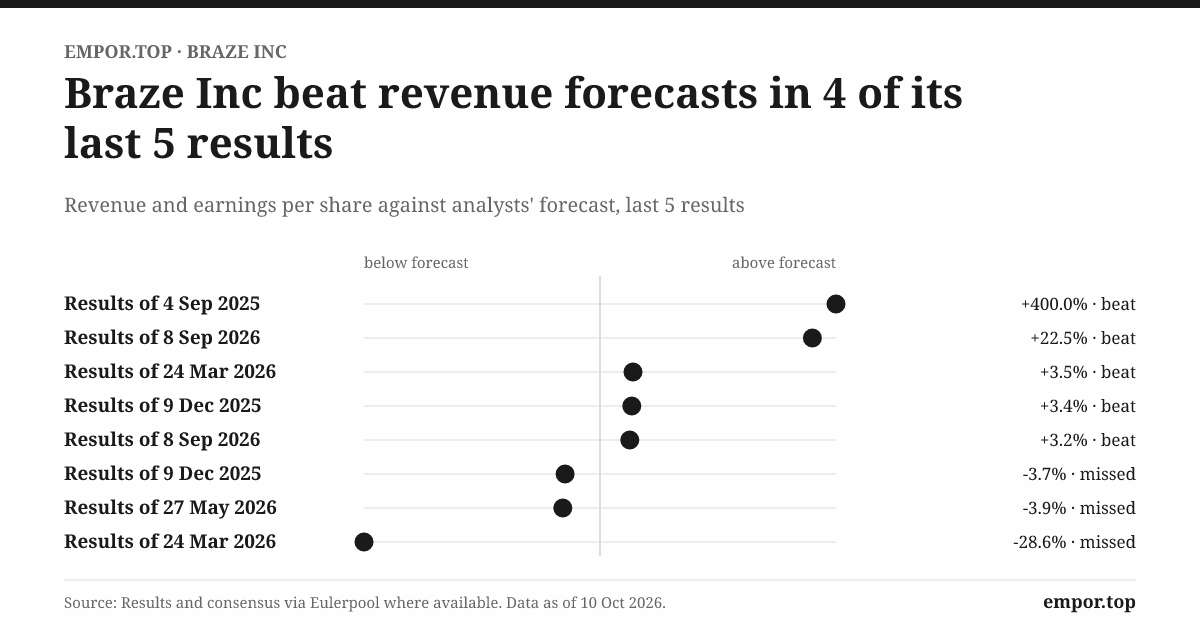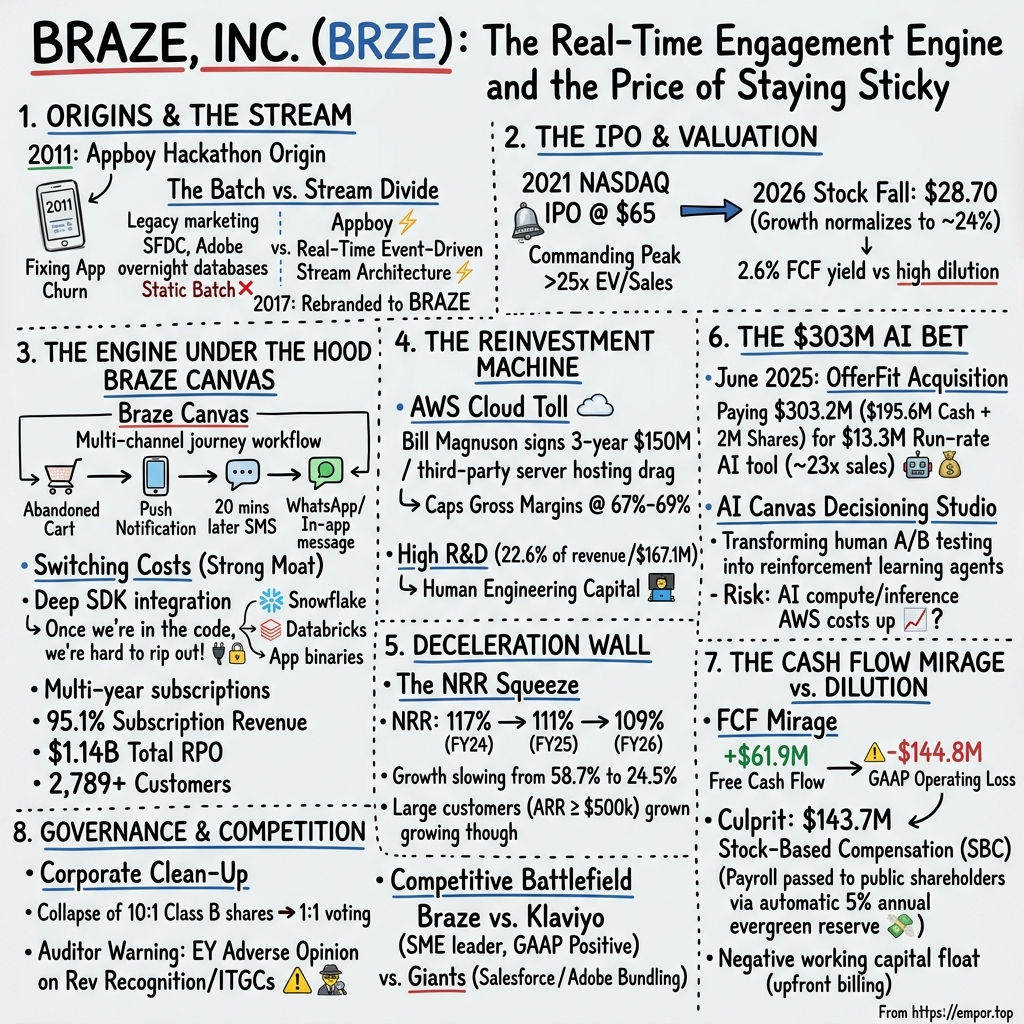
Braze, Inc.: The Real-Time Engagement Engine and the Price of Staying Sticky
I. The $65 Promise and the Push Notification Economy
On November 17, 2021, Braze shares began trading on the NASDAQ under the ticker BRZE. The company had priced its initial public offering at $65 a share, selling eight million shares, about 6.7 million of them new stock, and it took in roughly $411.5 million in net proceeds.12 Late 2021 was the high-water mark of the software boom. Interest rates sat near zero, and investors paid for growth, not profit. At its peak the market valued Braze at more than 25 times its sales, a price that made sense only if the company kept growing at its pre-IPO pace for many years.3
The idea behind that price was simple, and in its day it was radical. Marketing had been built around email: a list, a weekly blast, a report the following Monday. The smartphone changed what a company could know about a customer and how fast it could act on it. A shopper who drops a cart, a subscriber who stops opening the app, a traveller whose flight just moved: each of these is a moment, and a moment does not wait for Monday's batch. Braze sold the software that lets a consumer brand notice that moment and answer it inside the same session, through a push notification, an in-app message, an SMS, an email or a WhatsApp message, whichever channel the customer is most likely to see.4
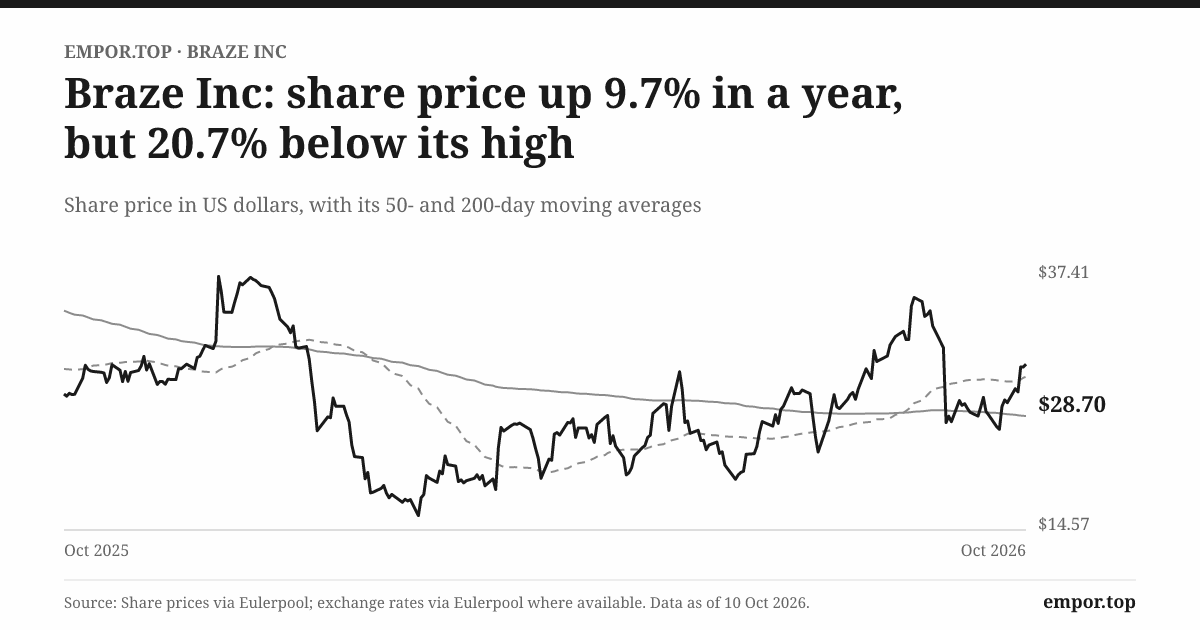
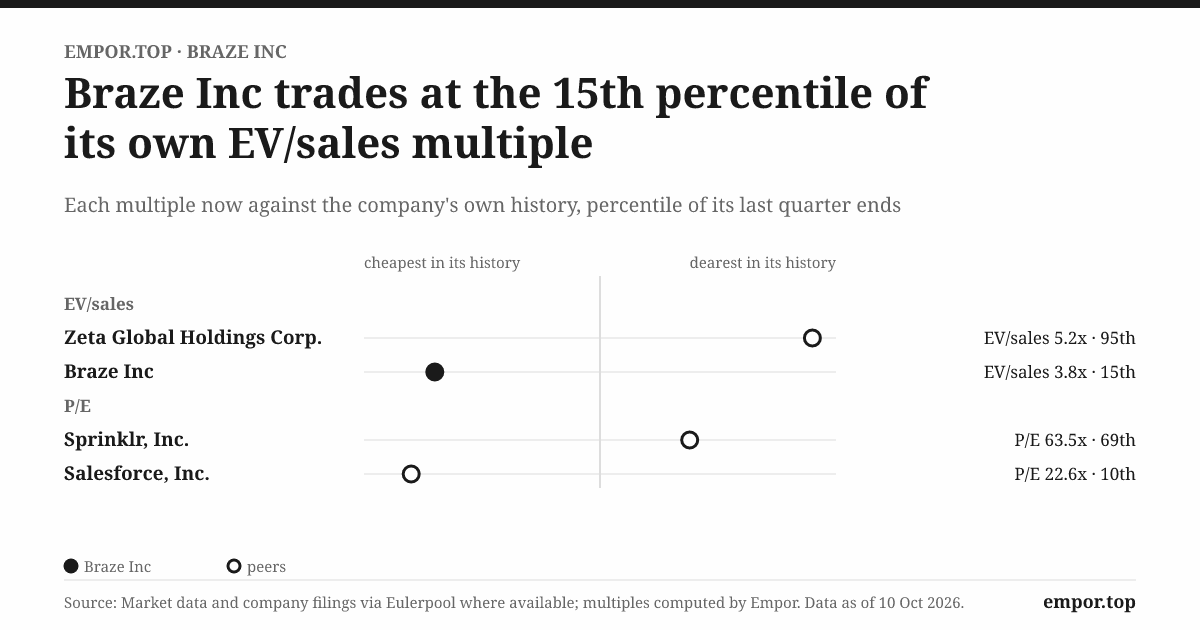
Almost five years later, the promise looks half kept. On October 10, 2026, Braze stock closed at $28.70, about 56% below its IPO price and about 21% below its high of the past year.3 The business did not shrink. Trailing revenue reached about $832 million, more than three times what it was in the year it listed, and the company held about $414 million in cash and marketable securities with no bank debt at all.52 What changed was the price the market is willing to pay for each dollar of that revenue. At an enterprise value of about $2.9 billion, Braze trades at about 3.8 times sales, roughly one seventh of its listing-era peak.3
That gap between a growing business and a shrinking multiple is what this story is about, and three questions follow from it. The first is about cash. Braze now reports positive free cash flow, but it has never reported a full-year GAAP profit, and it pays its people heavily in stock. Is the cash real, or is it payroll moved off the cash statement and onto the share register? The second is about the future. In June 2025 Braze paid about $303 million for OfferFit, a young artificial-intelligence company, betting that software that decides what to send will be worth more than software that merely sends it.65 Can that bet restart customer expansion without eating the company's already thin cloud margins? The third is about trust. In March 2026 Braze's auditor, Ernst & Young, issued an adverse opinion on the company's internal controls over financial reporting, citing weaknesses in the IT systems that touch revenue recognition, and the weakness was still open six months later.52 That happened in the same season that the founders' super-voting shares disappeared.
None of these questions is fatal on its own. Together they explain why a company that won its technical argument against the legacy marketing clouds still trades like a company with something to prove. To see why the architecture won, the story has to go back to 2011, when nobody was asking Braze for profits because Braze did not yet exist.
 Subscribe on LinkedIn
II. The Appboy Pivot: From Hackathon Demo to Real-Time Stream (2011–2017)
The company that became Braze was incorporated in Delaware in 2011 under a name that sounded like a children's toy: Appboy.21 The founders were Bill Magnuson, Jonathan Hyman and Mark Ghermezian. Magnuson and Hyman were engineers. Magnuson, who would become chief executive and still runs the company fifteen years later, is the rare founder who has stayed in the job through every stage from demo to public company. The trio's origin is usually told as a hackathon story from the startup circuit of New York in 2011, and whatever the stage, the problem they picked was very concrete.
In 2011 the App Store was three years old, and app developers had discovered an awkward fact. Downloads were easy to buy and hard to keep. Most users opened a new app a handful of times and then forgot it existed. A developer could see this happening in the analytics but had very few tools to do anything about it. The marketing software that big companies used was built around email addresses and customer relationship databases. It did not understand a push token, the unique address that lets a server tap a particular phone on the shoulder. It did not know what a user had just done inside an app. It could not act quickly enough to matter.
Appboy started as a toolkit for those developers: a small piece of code, a software development kit or SDK, dropped into the app, which reported what users did and let the developer message them back. The commercial insight was in what sat behind that SDK. The incumbents of marketing technology, Salesforce through its purchase of ExactTarget, Oracle through Eloqua, Adobe through Omniture and its Campaign product, had grown up treating customer data like a ledger. Data was loaded into tables, queried overnight, segmented into lists, and acted on in scheduled batches. That design was perfectly sensible when the channel was a weekly newsletter.
Magnuson and Hyman built the opposite. Their system treated each tap, purchase and session as an event in a continuous stream, processed as it arrived, so that a rule like "if this user abandons checkout, message them in ten minutes" could fire for millions of users at once without anyone running a report. A useful way to picture the difference is the gap between reading yesterday's newspaper and listening to a live radio feed. The batch systems could tell a marketer, very accurately, what had happened. The stream told the marketer what was happening, early enough to change it.
That choice is the deepest root of Braze's competitive position, and it was expensive. Stream processing at consumer scale means ingesting enormous volumes of small events, keeping user profiles current in near real time, and paying for the computing to do so continuously. The cost of that architecture shows up later in this story as a gross margin that never looks like classic software. In the early years, it showed up as product superiority. Mobile-first consumer brands, the ride-hailing, food-delivery, streaming and gaming apps whose businesses lived or died on daily active users, found that Appboy spoke their language.
The growth that followed was fast. By the fiscal year that ended in January 2020, the company was producing about $96 million in revenue, and it grew that by 56% the following year and by about 59% the year after that.34 Two decisions in between turned a developer tool into an enterprise vendor. The first was going multi-channel: if the engine already knew what a customer was doing, it could pick email, SMS or an in-app message as easily as push, which put Appboy into direct competition with the email clouds rather than merely next to them. The second was the name. In 2017 the company dropped Appboy for Braze, a word chosen to sound less like a consumer gadget and more like a supplier to chief marketing officers at large brands.1
The rebrand was cosmetic; the move upmarket was not. Selling to large brands changed the shape of the business. Contracts got bigger and longer, sales cycles got slower, and customers began to ask for features that had nothing to do with phones: data warehouse connectors, governance, compliance, multi-brand controls. Braze's later fights about pricing, retention and margins all trace back to that pivot, from a tool developers loved to a platform procurement departments negotiate. To understand those fights, it helps first to look under the hood at what exactly a Braze customer pays for.
III. The Engine Under the Hood: Real-Time Canvas vs. The Marketing Cloud
Picture the growth team at a large online retailer building what Braze calls a Canvas. A Canvas is a visual flowchart of a customer journey. On the screen, a box says "cart abandoned." An arrow leads to a push notification that fires within minutes. Another arrow waits twenty minutes and checks whether the customer came back; if not, it sends an SMS with a discount code. A third branch waits until the next morning and sends a personalized WhatsApp message, or an email for customers who never opted into messaging apps. Each branch is measured, and the team can see which path converts best.
Nothing in that flowchart is exotic to a marketer in 2026. What is valuable is that it runs, reliably, for tens of millions of people at once, with each person's path decided by what that person actually did seconds earlier. That is the product Braze sells, and the way it charges for it explains both the strength and the friction in its business model.
Almost all of the money is subscription. In the year to January 2026, subscription revenue was about $702 million, 95% of the total, and professional services such as onboarding and implementation made up the rest, about $36 million.5 The services line is small on purpose; it exists to get customers live, not to make money. The subscription itself is priced in tiers indexed to the size of the audience a customer engages, usually measured in monthly active users, plus allowances for data and for message volumes across push, in-app, email, SMS and WhatsApp, with premium modules, including the AI decisioning products that arrived with OfferFit, sold on top.5 Contracts typically run one to three years, are billed in advance annually or quarterly, and carry non-cancelable minimum commitments.5
That structure gives Braze unusual visibility. At the end of July 2026, the company had about $1.14 billion of remaining performance obligations, which is the accounting name for contracted revenue not yet recognized, and about $700 million of that was due to be recognized within twelve months.2 Put another way, Braze entered the second half of its fiscal year already holding contracts for roughly the next twelve months of subscription revenue. A customer who becomes unhappy cannot simply walk away mid-contract; the worst it can do is refuse to renew, or renew smaller.
The customer list is broad. Braze counted about 2,789 customers at the end of July 2026, up from about 2,044 in early 2024, and no single customer has accounted for 10% of revenue in any recent year.25 That matters, because it means the company's risk is not one big client walking out; it is many clients each spending a little less. The pricing unit makes that easy, which is the catch hidden in an otherwise attractive model. When a customer's own app usage dips, or when its procurement team decides it is paying for more message capacity than it uses, the tier is the obvious place to cut. A seat-based software vendor loses revenue when a customer fires people. A Braze-style vendor loses revenue when a customer audits its audience.
The other side of that ledger is how hard Braze is to remove. A brand that uses Braze has embedded the Braze SDK inside its iOS app, its Android app and its website. Its engineering team has written code to call Braze when key events happen. Its data team has connected Braze to a warehouse like Snowflake or Databricks. Its marketers have built hundreds of Canvases, and its compliance team has signed off on how consent and unsubscribes are handled. Replacing Braze means shipping new versions of the company's own apps, re-plumbing data pipelines, rebuilding every journey, and retraining people, all while running the risk that messages stop going out during the switch. For a company whose revenue depends on those messages, that risk is the moat.
So the model has two personalities. Once installed, Braze is very hard to evict. But the amount each customer pays is negotiable at every renewal, because the pricing unit tracks usage that the customer can shrink. Braze tends to lose customers slowly through right-sizing rather than quickly through cancellation, and that pattern runs through the rest of its history. Before getting to the slowdown, though, there is a cost underneath every message that explains why this software company has never had software margins.
IV. The Reinvestment Machine: R&D Discipline vs. The $150 Million AWS Toll
Among the commitments disclosed in Braze's annual report is a contract with Amazon Web Services: a multi-year minimum purchase commitment totaling $150 million over three years.5 It is an ordinary piece of paper for a modern software company, and it says a great deal about this one. Braze does not own data centers. Every event it ingests, every user profile it updates and every message it sends runs on someone else's computers, mostly Amazon's, with data workloads on providers like Snowflake as well. Those bills arrive whether or not the software is priced well.
That is why Braze's gross margin sits where it does. On subscription revenue, gross margin was about 67% in the year to January 2026.5 The classic benchmark for mature software companies runs in the high 70s or above. The difference is the cost of running a real-time stream at consumer scale, plus the pass-through costs of certain channels. An SMS, for example, does not travel for free: carriers and aggregators charge per message, and some of that cost lands in Braze's cost of revenue. A batch email system can schedule its heavy lifting overnight on cheap capacity. A streaming system must be awake at every moment, with enough capacity for the Black Friday spike, and that is a structurally more expensive way to run a business.
The analogy is a restaurant versus a cookbook publisher. A publisher writes the recipe once and sells it a million times at almost no added cost. A restaurant earns its money cooking each meal fresh, and the ingredients scale with every plate. Braze is closer to the restaurant than its software label suggests. Scale helps, because the company gets better at engineering efficiency and negotiates bigger volume discounts, but it cannot remove the fact that more customer activity means more compute.
Where Braze does choose how to spend, it spends on engineers. Research and development cost about $167 million in the year to January 2026, roughly 23% of revenue, and has hovered in that range as a share of sales for three years even as the dollar amount climbed.5 That money goes into streaming ingestion, the Canvas workflow tools, data infrastructure and, now, AI decisioning. Headcount tells the same story: from about 1,489 full-time employees in January 2024 to 1,988 two years later.5 By contrast, physical investment is tiny. Capital spending on property and equipment was under $10 million in the same year, about 1% of revenue, and capitalized software development only a few million dollars more.5
That ratio is the clearest statement of what kind of company Braze is. Its real capital is people, and the main input those people consume, besides salaries, is rented cloud capacity. That is efficient in the sense that Braze never has to build a data center, and inefficient in the sense that it captures less of each revenue dollar than a pure software vendor would. It also means the company's most important reinvestment does not show up as capital expenditure at all. It shows up as operating expense and as stock compensation.
The conclusion is not that Braze is badly run, but that it is not yet harvesting. It is still building, and its cost base has a floor tied to volume that further growth will not erase. That floor matters most when growth slows, because a company with 67% gross margins needs a lot of revenue growth to outrun its own payroll. Which is exactly the problem that arrived in 2023.
V. The Deceleration Wall and the Net Retention Squeeze (2023–2026)
By 2023, the questions on Braze's earnings calls had a theme. Analysts wanted to know why the company's dollar-based net retention rate kept slipping. Net retention, or NRR, is the single most watched number in subscription software. It compares what a group of customers pays today with what the same group paid a year earlier. Anything above 100% means existing customers are spending more, before a single new customer is counted. For a company like Braze, NRR is the engine: land a brand, then grow with it.
In its hyper-growth years, the engine ran hot. Revenue grew about 59% in the year to January 2022 and 49% the year after.34 Then the macro environment turned. Interest rates rose, venture funding for consumer apps dried up, and the corporate software buyer, who had added tools freely during the pandemic, began auditing every line. Braze's growth fell from about 33% in the year to January 2024 to about 25% in the year to January 2026.5 The retention numbers explain the mechanism. NRR fell from 117% in the year to January 2024 to 109% two years later.5
What happened inside customers is the story behind those numbers. In the boom, a growth team expecting its audience to double would buy a bigger tier in advance. When growth did not arrive, or when the finance team started asking whether all that message capacity was used, the renewal became a negotiation. Braze rarely lost the logo; the switching costs saw to that. But it often had to renew at a size that matched actual usage, not hoped-for usage. That is the disconfirming evidence on Braze's pricing power. In the downturn of 2023 and 2024, the company could not force price increases through; it had to accommodate right-sizing to keep customers.5
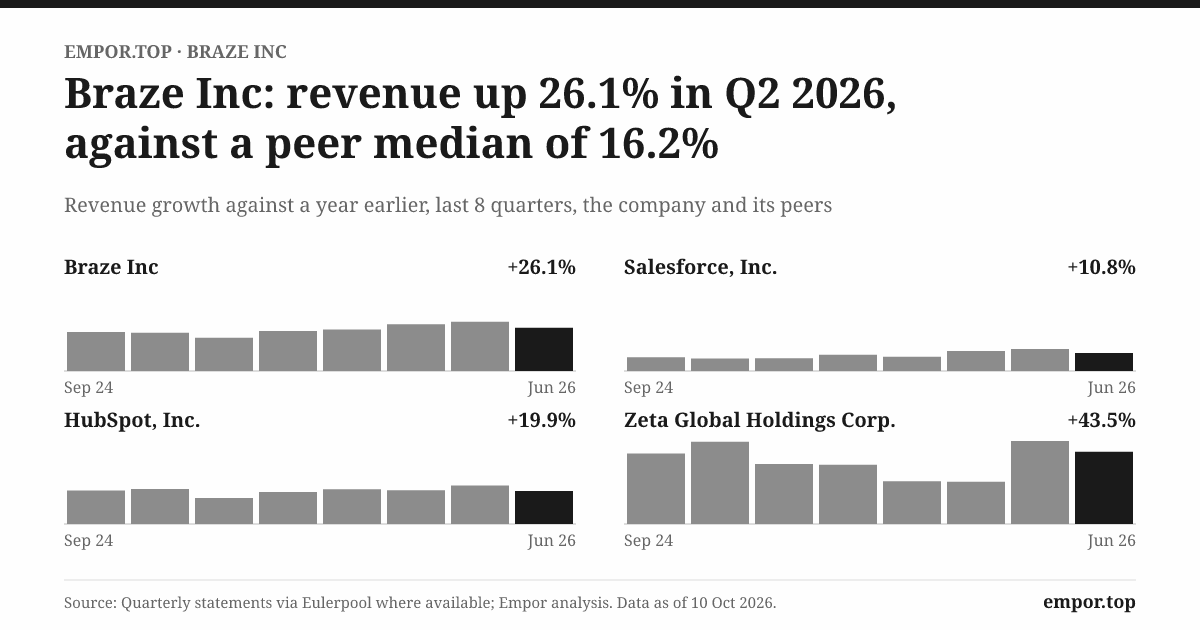
There is a more generous reading of the same period, and the evidence supports part of it. Braze's large customers, those paying at least $500,000 a year, kept growing in number: from 202 in early 2024 to 361 by the end of July 2026.25 That is a sign the upmarket strategy was still landing. Retention among those large customers held at about 110%, roughly in line with the company overall.5 And the most recent quarters show a stabilization. NRR held at 110% in the quarter to July 2026, and revenue in that quarter reached about $227 million, up 26% year on year.2 Part of that growth came from OfferFit, which joined the company in June 2025, so the organic acceleration is smaller than the headline suggests.2
So what does the record actually say about the moat? It narrows it. Braze's switching costs are real enough to keep customers, as the steady growth in customer counts and the very low concentration show. They are not strong enough to protect what those customers spend when budgets tighten. The claim that Braze grows automatically with its customers is rejected for a downturn and only partly restored in the recovery. The company that once compounded at close to 60% now compounds at the mid-20s, and nothing in the record suggests the old rate is coming back without something new to sell.
Management's answer to that problem was to buy something new. The question was whether it paid the right price.
VI. The $303 Million AI Bet: Buying OfferFit to Automate the Marketer (June 2025)
On June 2, 2025, Braze completed the largest acquisition in its history. It bought OfferFit, Inc., a Boston-area company whose software uses reinforcement learning, a branch of AI in which a system learns by trying actions and keeping score, to decide what offer, message, channel and timing each individual customer should receive.65 Braze had announced the deal in early May.6 The final consideration was about $303 million: roughly $196 million in cash and about 2.02 million Braze shares.5
The strategic logic is easiest to see from the marketer's desk. In a traditional Canvas, a human designs the journey. She decides that the discount should be 10%, that the SMS goes out after twenty minutes, and she runs an A/B test to check. Each test takes weeks, and only a few variables can be tested at a time. OfferFit's pitch was to replace that guesswork with a learning agent that tests thousands of combinations continuously and personalizes the answer for each customer. For Braze, this was both an opportunity and a defense. If generative and agentic AI could eventually write and run campaigns end to end, the valuable layer of the stack would move from the pipes that deliver messages to the brain that decides them. Owning the brain was a way to avoid becoming a pipe.
The price is where the skepticism starts. OfferFit brought only about $13 million of annualized revenue.5 Paying $303 million for it meant a multiple of roughly 23 times sales, at a time when Braze's own stock traded below four times sales. Put plainly, Braze used currency the market valued cheaply, its own cash and shares, to buy an asset at a price the market would not have paid for Braze itself. That is not automatically a mistake; early AI teams were expensive everywhere in 2025, and what Braze bought was arguably capability, not revenue. But it puts a heavy burden on the follow-through.
The balance sheet records that burden. Of the purchase price, about $233 million was booked as goodwill, the accounting residue left when a buyer pays more than the identifiable assets are worth, and it is not deductible for tax.5 Another roughly $57 million was booked as developed technology, which Braze will amortize as a non-cash expense over coming years.5 Goodwill does not shrink on its own; it sits there until a test shows the business is worth less than what was paid, and then it gets written down in one go. If OfferFit's technology does not become a meaningful, paid part of Braze's offering, that is the line where the disappointment will eventually appear.
Braze has folded the technology into a product it sells as the BrazeAI Decisioning Studio, positioned as a premium add-on to Canvas.5 Whether it is selling well is not yet clear from the outside. Braze has not broken out Decisioning Studio revenue as a separate line, so investors can see total growth and retention but cannot isolate how much of either OfferFit drives. The record so far is a reasonable product thesis, a stabilizing retention rate and an absence of hard numbers on the thing that matters.
There is also a cost question that cuts against the margin story. Reinforcement learning agents and large language models need compute. If Braze's customers start running AI decisions on every message, Braze's own cloud bills rise with them, on top of the AWS commitment. An AI add-on that sells at a high price could lift margins. One that has to be bundled cheaply to compete, while burning inference costs, could push subscription gross margin below the 67% baseline. The first year of results does not yet settle which version is true, and the subscription gross margin line in each filing is where to watch it.
The OfferFit deal also has a quieter consequence. Those 2.02 million new shares joined a share count that was already growing every year for a different reason. To understand why the market is skeptical of Braze's cash generation, the next step is to follow the money from the income statement to the cash flow statement, and then to the share register.
VII. The Cash Flow Mirage: Dilution Subsidy and the $144 Million Stock Bill
When Braze reported its results for the year to January 2026, two numbers sat side by side that look as though they describe two different companies. The income statement showed an operating loss of about $145 million and a net loss of about $131 million.5 The cash flow statement showed about $71 million of cash generated by operations and about $62 million of free cash flow after capital spending.5 How does a business lose $131 million and generate $62 million in the same year?
The answer has two parts, and they deserve to be weighed very differently.
The first is the customer float. Braze bills in advance. A customer signing a one-year contract pays for the year up front, and Braze records the money as deferred revenue, a liability, until it delivers the service month by month. As the business grows, the pile of prepaid money grows with it. Deferred revenue reached about $347 million by the end of July 2026, and it grew by about $57 million during the year to January 2026 alone.25 That is real cash, and it is not borrowed from a bank; it is effectively an interest-free loan from customers. It is also not profit. It is cash collected for work Braze still has to do, and its flow depends on continued growth. If growth stopped, the float would stop adding cash.
The second part is stock compensation, and it is much bigger. Braze paid its employees about $144 million in stock-based compensation in the year to January 2026, roughly 19.5% of revenue.5 Because that expense is paid in shares rather than cash, accountants add it back when computing operating cash flow. On its own, the add-back was about twice the company's entire operating cash flow.5 Take it out and treat it as the salary it is, and Braze's operating cash flow for the year was deeply negative.
The long view makes the point with even more force. Across the seven fiscal years from 2020 to 2026, Braze's net losses added up to about $639 million, while its cumulative operating cash flow was a positive $43 million, and its cumulative free cash flow was still slightly negative.3 The gap of nearly $700 million was filled mostly by stock pay and by the growing float, plus non-cash charges like the amortization of sales commissions.5 The cash did not come from profits. It came from customers paying early and employees being paid in shares.
Paying people in stock is not a trick, and almost every high-growth software company does it. But it has a cost, and the cost lands on outside shareholders through dilution. Braze's 2021 equity plan includes what is called an evergreen provision: each year, the pool of shares available for grants automatically increases by 5% of shares outstanding, unless the board chooses a smaller number. On February 1, 2025, that added about 5.2 million shares to the reserve.5 A pool is not issuance, but it signals the scale management plans to use. At today's market value of about $3.2 billion, a $144 million annual stock bill is equivalent to giving away roughly 4.5% of the company each year.35
In March 2026, Braze's board approved the company's first share repurchase program, of up to $100 million, and the company immediately put $50 million to work through an accelerated share repurchase with a bank.2 It received an initial delivery of about 1.72 million shares, which were retired.2 Compare that with the 2.02 million shares issued to buy OfferFit less than a year earlier, before any of the annual employee grants are counted, and the buyback looks less like a return of capital than a partial mop-up. To actually shrink the share count, Braze would need to buy back stock at roughly the pace it issues it, which at current prices means spending most or all of its free cash flow, and then some.
The verdict is clear and worth hedging only once. Braze's free cash flow is genuine in the narrow sense that the money arrives in the bank. It is not genuine owner earnings, because the largest single reason it is positive is that employees accept shares instead of cash, and outside shareholders bear that cost through dilution. For the cash flow to become real in the owner's sense, either stock compensation has to shrink as a share of revenue, or GAAP operating losses have to close so that cash generation does not depend on the add-back. The most recent quarter shows movement on the second front: an operating margin of minus 8% in the quarter to July 2026, the best in the company's public history.2 The share count, not the cash line, is where to judge whether that progress reaches shareholders.
There is one more piece of the money trail, and it concerns not the cash itself but the systems that count it.
VIII. The Corporate Clean-Up: Collapsing Class B and the Ernst & Young Red Flag
On January 30, 2026, without a ceremony, Braze's dual-class share structure came to an end. Under the company's certificate of incorporation, every share of Class B common stock, carrying ten votes each, automatically converted one-for-one into ordinary Class A stock carrying one vote, and Class B was retired.52 For the four years since the IPO, the founders and early backers had held voting control out of proportion to their economic stake. Now one share meant one vote.
The new shareholder map shows how dispersed control has become. At the proxy record date in May 2026, CEO Bill Magnuson owned about 4.9% of the company, co-founder Jonathan Hyman about 1.8%, Battery Ventures, through partner Neeraj Agrawal, about 5.1%, and MCG7 Capital, an entity associated with the early investor group, about 6.0%.7 Directors and executive officers as a group held about 12.5%.7 No single holder can now outvote the market. That is good governance by the usual standards, and it also means management is now more exposed to institutional shareholders than it has ever been.
That exposure arrives at an awkward moment for pay. Magnuson's total compensation for the year to January 2026 was about $14.2 million, almost all of it in stock awards.7 Executive performance share units paid out at the maximum 200% of target, because revenue beat its goal by a few percentage points and non-GAAP operating margin, which excludes stock compensation and some other charges, reached the 4% threshold.7 The same year, the company's GAAP operating loss was about $145 million.5 The incentive design is not unusual in software, and shareholders approved the prior year's say-on-pay vote with about 99% support.7 But it pays executives on the measure that excludes the very stock compensation that dilutes shareholders. An activist would start here.
The more serious signal came from the auditor. In its report on the year to January 2026, Ernst & Young gave Braze's financial statements a clean opinion, meaning it found them fairly stated. But it gave an adverse opinion on internal control over financial reporting.5 The cause was a material weakness in IT general controls, the basic rules governing who can access financial systems and how changes to those systems are tested and approved. Those weaknesses touched the systems used for financial reporting and revenue recognition.5
To a non-specialist, this can sound either alarming or trivial, and it is neither. A material weakness in IT controls does not mean the numbers are wrong. Braze has not restated any prior financial statements.5 It means the company could not demonstrate that the guardrails around its systems were strong enough to prevent or catch a material error in time. For a business whose revenue is recognized automatically across thousands of contracts with different tiers, add-ons, durations and billing schedules, those guardrails are the reporting foundation.
What makes this a live issue rather than a footnote is persistence. In its quarterly report for the period to July 2026, Braze said the material weakness had not yet been remediated.2 Six months is not a long time in remediation terms; fixing access and change-management controls often takes several quarters, because the auditor needs to see the new controls operate for a period before signing off. But it does mean the next annual audit carries a binary outcome. Either Ernst & Young confirms the fix, or the adverse opinion repeats, and a second consecutive year would raise harder questions about management's control environment just as the governance shield of dual-class voting has gone.
There is no sign of a related-party problem behind any of this. The only disclosed related-party dealings are routine purchases of monitoring software from Datadog, where Braze director David Obstler is chief financial officer, amounting to under $4 million a year.5 The issue is process, not self-dealing. Still, investors are being asked to take Braze's revenue engine on trust in the same year its auditor said the controls around that engine were not good enough. That matters most in the competitive arena, where every rival is arguing that its platform is the safer choice.
IX. Competitive Moats & The Battlefield: Braze vs. Klaviyo vs. The Giants
Imagine a large American retailer running a request for proposals for its customer engagement platform. On the shortlist sit three kinds of vendor. Braze, the real-time specialist. Klaviyo, the e-commerce native that grew up inside Shopify stores and is now pushing upmarket. And Salesforce or Adobe, the incumbents who already sell the retailer its CRM, its analytics or its content tools and who can bundle marketing into a much larger contract at a discount. A fourth option sits in the background: build a composable stack on the company's own data warehouse, feed it through tools like Census or Hightouch, and use Twilio for the actual sending.
This is the war game Braze plays at every major renewal, and Hamilton Helmer's 7 Powers is a useful scoreboard.
The strongest power Braze holds is switching costs, and the record supports it. Customer counts kept rising through the slowdown, no customer accounts for 10% of revenue, and the large-customer count nearly doubled in two and a half years.25 Customers do not leave lightly once the SDK is in their apps. But, as the retention squeeze showed, switching costs protect the account, not the spend. That narrows the power: strong against displacement, weak against right-sizing.
Scale economies are modest. Braze is large enough to negotiate meaningful cloud commitments, but gross margins near 67% show that its scale has not turned into a cost advantage over rivals who also rent cloud capacity. Network economies, the idea that each customer makes the product better for others, are weak in the usual sense; one brand's messages do not improve another's. OfferFit could change that slightly if decisioning models learn across customers, but Braze has not shown evidence of that, and data-sharing rules limit it.
Cornered resource is moderate at best. Braze's streaming architecture is real intellectual property, built over a decade. But talent and AI models are contestable, and the 23-times-sales price paid for OfferFit is itself evidence that Braze felt it needed to buy, not merely build, its next capability. Brand is meaningful among mobile-first growth teams and less so in boardrooms, where Salesforce and Adobe have deeper relationships. Process power, the embedded operating know-how that rivals cannot copy, is plausible in Braze's ability to run real-time journeys at scale, but it is the kind of edge that erodes as cloud data platforms mature.
Counter-positioning is the power that made Braze, and it is weakening. In 2011, incumbents could not copy the stream architecture without cannibalizing their batch products. In 2026, the warehouse vendors Snowflake and Databricks have made the customer's own data the center of gravity, and composable tools let a sophisticated company assemble Braze-like capability without Braze. Meanwhile Klaviyo counter-positions Braze from below with simpler, cheaper, e-commerce-focused tooling.
Porter's five forces tell a consistent story. Buyer power is high: large enterprises negotiate hard on tiers, and Braze's retention record shows it gave ground. The threat of substitutes is moderate to high, from composable stacks and from the incumbents' bundles. Supplier power is meaningful, because cloud providers and SMS carriers set much of Braze's cost floor. Rivalry is intense, with Klaviyo pushing up, Salesforce and Adobe defending down, and Twilio operating the pipes. The threat of new entrants is moderated by the integration effort a newcomer must overcome, but AI-native startups are exactly what the OfferFit deal was meant to pre-empt.
The market's pricing reflects this map. Braze, at about 3.8 times sales, trades at a noticeably lower multiple than Klaviyo, which reports positive GAAP income, and a higher one than Twilio, which is slower-growing and more of a utility.3 Investors seem to be saying that Braze's growth is better than a utility's but its profit profile is not yet good enough to earn a premium. The company has the strongest real-time engine in the field, a moat that holds customers but not their budgets, and a price that assumes the profits remain to be proven.
Before weighing the bull and bear cases, it is worth stepping back to ask what this fifteen-year story teaches beyond Braze itself.
X. Playbook: Business & Investing Lessons
The first lesson goes back to two engineers choosing a stream over a database in 2011. The stream always beats the batch, as long as the customer's world moves faster than the batch. Appboy's architectural bet created a product lead that the largest marketing clouds in the world spent a decade failing to close, because they could not rebuild their foundations without breaking the products that paid their bills. Founders tend to look for edges in features. Braze found it in the plumbing, and the plumbing is still its best argument.
The second lesson comes from the year Braze reported $62 million of free cash flow and a $131 million net loss. Free cash flow without share-count discipline is a payroll you have chosen not to count. When stock compensation is twice operating cash flow, the cash on the statement is a loan from the shareholder register, and the bill arrives as dilution. Any investor looking at a young software company should ask one question before admiring its free cash flow: is the share count falling?
The third lesson is OfferFit's price tag. Never pay 23 times sales with a currency the market values at four. Buying an expensive AI asset with cheap stock and hard cash can still be the right move if it defends the franchise, but it turns an acquisition into a promise that goodwill will someday be earned. Founders should treat that kind of deal as a commitment they will be held to, and investors should mark the goodwill line as a scoreboard.
The fourth lesson lives inside the customer's phone. The moat is the SDK, not the campaign editor. Braze kept its logos through the worst software downturn in a decade because its code was inside its customers' apps, not because its flowchart was prettier. But a moat that keeps the logo does not keep the budget. Stickiness and pricing power are different animals, and Braze's history is the clearest proof in modern software that you can have the first without the second.
XI. Analysis: The Bull vs. Bear Case
Imagine an investment committee debating BRZE at $28.70. On the table are a 2.6% free cash flow yield, about $414 million of net cash, and an operating margin that just reached minus 8%. Also on the table are seven straight years of GAAP losses, a stock bill that dwarfs operating cash flow, and an auditor's adverse opinion. Each side of the table can build a coherent case from the same filings.
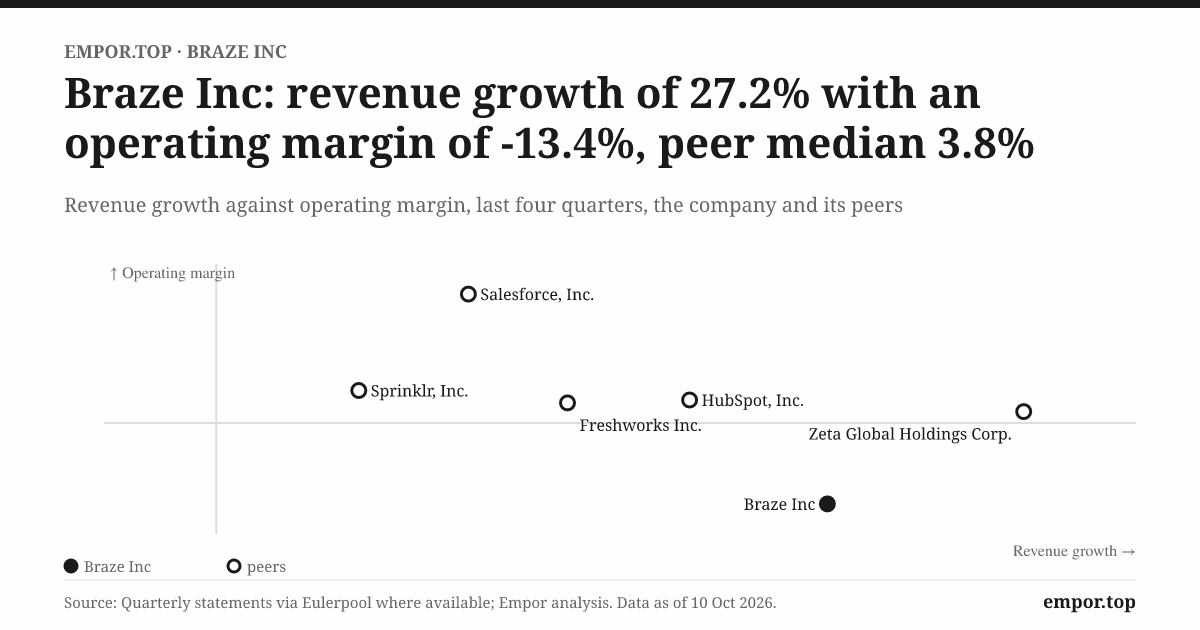
The bull case starts with operating leverage. In the quarter to July 2023, Braze lost about 31 cents of operating profit for every dollar of revenue. In the quarter to July 2026, it lost about 8 cents.32 That is a 23-point improvement in three years, achieved while revenue growth held in the mid-20s. If that trajectory continues, GAAP operating breakeven sits within reach in the next couple of years, and a company that turns GAAP-profitable while growing 20%-plus could earn a different multiple. The bull adds that OfferFit turns Braze from a delivery channel into a decision engine, which is the kind of product that justifies a premium budget line rather than a utility one. And the balance sheet is clean: no bank debt, a large cash cushion, receivables collected in about 65 days with low write-offs, and about $1.14 billion of contracted revenue already in hand.325
The bear case starts with the share register. With stock compensation running around $144 million a year, Braze issues the equivalent of several percent of its market value annually, and its first buyback did not cover even the OfferFit issuance.52 To the bear, the 2.6% free cash flow yield is fiction once dilution is counted. The second leg is cost. The AWS commitment and the move into AI decisioning mean more compute per dollar of revenue, and if Decisioning Studio becomes a bundled feature rather than a premium product, subscription gross margins could slide below the current mid-60s level. The third leg is trust: an un-remediated material weakness in the controls around revenue systems, in a year when founder control has dissolved and executive bonuses paid at maximum on a non-GAAP measure.
Weighing the two, the evidence leaves the bull's operating-leverage argument intact but unproven, because most of the improvement came from revenue growing faster than costs, and stock compensation is still near a fifth of revenue. The AI argument remains a thesis, not a result, because the company does not yet disclose the revenue it generates. The bear's dilution argument is the strongest single point on the table, because it is grounded in seven years of numbers rather than projections. The case turns on whether Braze can reach GAAP breakeven while pulling stock compensation down toward something like 10% of revenue; achieving one without the other would not settle it.
Three numbers will decide which side was right. The first is the net diluted share count: whether buybacks actually shrink it or merely slow its rise, given the 1.72 million shares retired so far against continued grants. The second is subscription gross margin, about 67% in the year to January 2026: a slide below 66% would say AI compute is eating unit economics.5 The third is dollar-based net retention, stable at 110% in the latest quarter after falling from 117%: stabilization above roughly 112% would be the first real evidence that OfferFit is restarting the expansion engine.25 Everything else is commentary around those three.
XII. Epilogue
Tonight, Braze is an indispensable piece of infrastructure for roughly 2,800 consumer brands. It decides when a phone buzzes, which message lands in an inbox, and increasingly which offer a customer sees.2 It is no longer a hyper-growth upstart and not yet a profitable enterprise platform. It is in the middle stretch, where the stories of software companies are usually decided.
Three moments in the coming months will move the story. The first is the Form 10-K for the year ending January 31, 2027, expected next spring. In it, Ernst & Young will either confirm that the IT control weakness has been fixed or repeat its adverse opinion. A clean report would remove the trust overhang at almost no cost. A second adverse report, or a broader one, would turn a process issue into a management credibility issue.
The second is the first full year of OfferFit inside Braze. By next spring, Decisioning Studio will have been on sale long enough for its effect to show up in retention and gross margin, even if the company keeps declining to break out its revenue. If net retention climbs while gross margin holds, the 23-times-sales price begins to look like foresight. If retention stalls and margins slip, the $233 million of goodwill becomes the most important number on the balance sheet.
The third is capital allocation. The board still has $50 million of its repurchase authorization left. Whether it expands that authorization, and whether stock grants shrink as a share of revenue, will show whether management sees dilution as a cost to be managed or a currency to be spent.
The tension that remains is the one this story opened with. Bill Magnuson has proved that mobile-first, real-time engagement is a better way to talk to customers. He has not yet proved that it is a better way to make money for the people who own the company.
XIII. Outro
In 2011, a small team of engineers looked at apps losing their users within days and built a way to tap each of those users on the shoulder at the right moment. Fifteen years later, that tap happens billions of times a day, on phones around the world, for brands that would not dream of switching it off. The engineering problem was solved long ago.
What is left is the financial one, and it is stubborn in exactly the way real-time systems are: it does not wait for the batch. Braze mastered the millisecond stream that commands consumer attention. Now it must prove it can turn that attention into economic profit for the shareholders who paid for the journey.
References
-
Registration Statement on Form S-1 / Prospectus Rule 424(b)(4) — Braze, Inc., 2021-11-18 ↩↩↩
-
Form 10-Q Quarterly Report for Period Ended July 31, 2026 — Braze, Inc., 2026-09-09 ↩↩↩↩↩↩↩↩↩↩↩↩↩↩↩↩↩↩↩↩↩
-
Braze, Inc. Investor Relations Landing Page — Braze, Inc., 2026-10-10 ↩↩↩↩↩↩↩↩↩↩
-
Form 10-K Annual Report for Fiscal Year Ended January 31, 2022 — Braze, Inc., 2022-03-31 ↩↩↩
-
Form 10-K Annual Report for Fiscal Year Ended January 31, 2026 — Braze, Inc., 2026-03-25 ↩↩↩↩↩↩↩↩↩↩↩↩↩↩↩↩↩↩↩↩↩↩↩↩↩↩↩↩↩↩↩↩↩↩↩↩↩↩↩↩↩↩
-
Braze Announces Agreement to Acquire OfferFit to Power AI Decisioning — Braze Press Release, 2025-05-08 ↩↩↩
-
DEF 14A Notice of 2026 Annual Meeting and Proxy Statement — Braze, Inc., 2026-05-18 ↩↩↩↩↩
 LinkedIn
 WhatsApp
 Reddit
 Hacker News
 Email
Email Kindle
 RSS Feed
 Spotify
 Apple Podcasts
 Amazon Music
 Audible
 YouTube