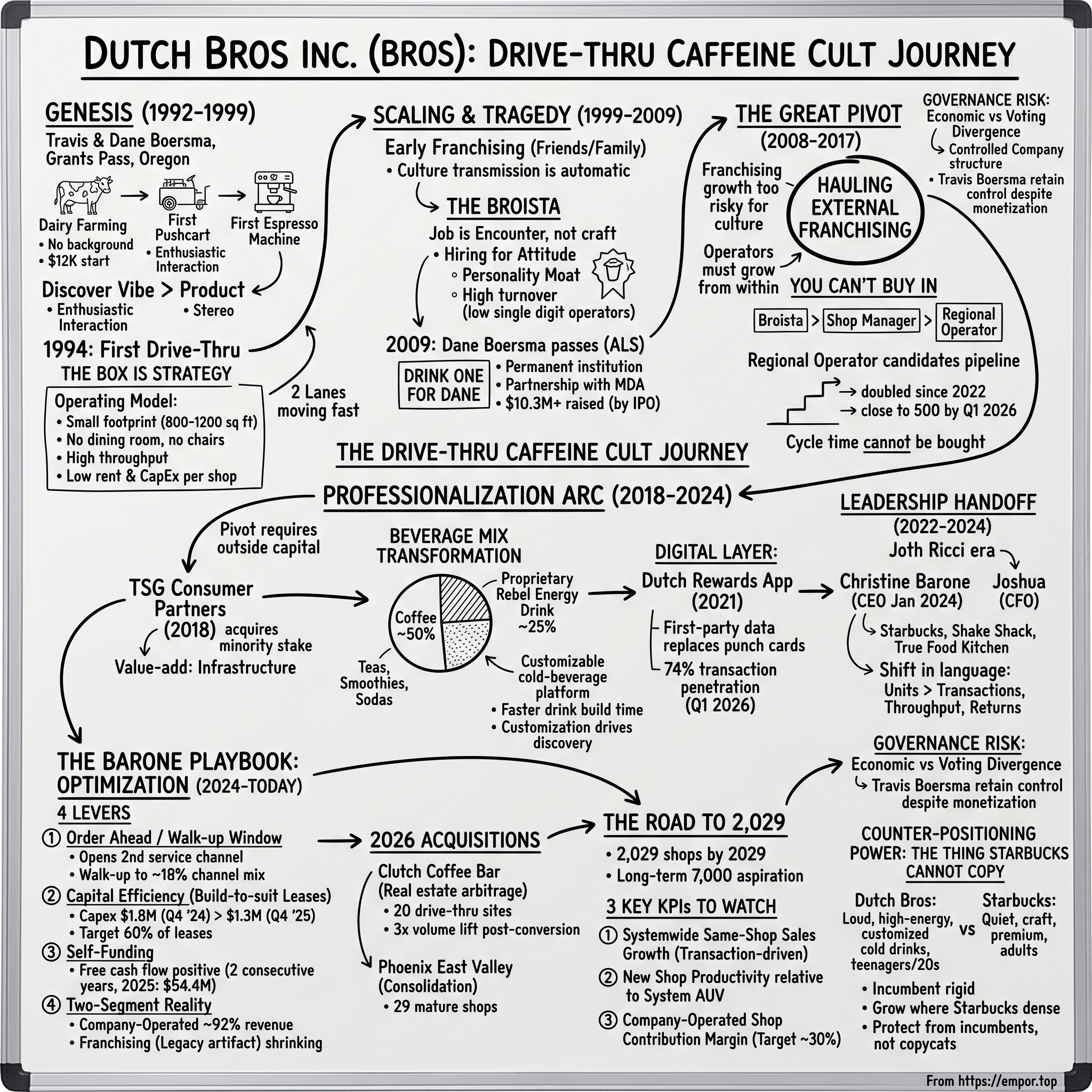
Dutch Bros Inc.: The Drive-Thru Caffeine Cult
I. Introduction & Episode Roadmap
Pull into a Dutch Bros at 7:15 on a Tuesday morning and the first thing you notice is that nobody is being quiet.
There is music — actual music, at volume, usually something with a beat. There is a person in a branded T-shirt standing outside in the weather with a tablet, walking the line of cars, taking orders through your driver's-side window, occasionally leaning in to ask how your week is going and meaning it. There are two lanes of cars, sometimes wrapping around the building and out into the parking lot, and the line is moving faster than the length of it suggests it should. Inside the small building — and it is small, roughly 800 to 1,200 square feet, with no dining room, no armchairs, no laptops, no ambient jazz — a crew of people in their early twenties is assembling drinks that look less like coffee than like something you'd order at a Dairy Queen: blended, iced, layered, dyed improbable colors, and customized to a degree that would give a Starbucks shift supervisor a small stroke.1
Roughly 85% of the business goes through that drive-thru window.1
This is a company that did $1.64 billion in revenue in 2025, operates 1,177 shops across 25 states as of the end of March 2026, and carries a market capitalization around $11 billion.23 And it started, in February 1992, as two brothers with a pushcart, one espresso machine, and about twelve thousand dollars they didn't really have.
The hook: Travis and Dane Boersma were third-generation dairy farmers in Grants Pass, Oregon, watching their family's business get squeezed out of existence. They had no food-service background. They picked coffee more or less because it was cheap to start. Thirty-four years later, the company they built is one of the fastest-growing restaurant chains in America and one of the very few concepts that has managed to grow directly into Starbucks' teeth without being flattened.
The paradigm shift: Starbucks won the last forty years by selling the "third place" — the idea that a coffee shop could be the space between home and work, a room you'd want to sit in. Dutch Bros won by rejecting the premise entirely. No third place. No place at all, in fact. Just a box, two windows, a parking lot, and a promise that the ninety seconds you spend there will be the most enthusiastic human interaction of your commute. It is a fundamentally different product: not coffee as an experience of place, but coffee as an experience of people, delivered through a car window, in under two minutes, with your name on it.
Where this story goes:
- Culture as an operating system, not a slogan. Dutch Bros has a rule that sounds almost quaint: you cannot buy your way into running a shop. Every operator must come up through the counter. We'll test whether this is a genuine competitive advantage or a nice story that happens to correlate with a good business.
- The beverage mix. Coffee is roughly half of sales. The proprietary Rebel energy drink is roughly a quarter.4 That single fact reframes what kind of company this is — and it explains a great deal about margins, speed of service, and who walks in the door.
- The professionalization arc. A family business took private-equity money in 2018, hired an outside CEO, went public in 2021, and by 2024 was being run by a former Starbucks executive with a former Shake Shack finance leader in the CFO chair. That's a specific kind of transition, and it has costs as well as benefits.
- The unit-economics engine. Systemwide average unit volume hit a record $2.16 million in the first quarter of 2026, on shops that now cost about $1.3 million in cash to open.2 Those two numbers, together, are the entire investment case.
- The road to 2,029. Management has committed publicly to 2,029 shops by 2029, with a long-term aspiration of 7,000.5 That's the promise. The rest of this piece is about whether the evidence supports it, and what would falsify it.
One framing note before we start. Dutch Bros is currently in the middle of an exceptionally good run — seven consecutive quarters of transaction growth, guidance raised twice, comparable sales accelerating rather than decelerating.2 Very good runs are precisely when narratives get least reliable, because everything management says appears to be working. The useful analytical work here is separating what this company has structurally earned from what a favorable moment has temporarily lent it.
 Subscribe on LinkedIn
II. The Grants Pass Genesis: Dairy Farming to Drive-Thru Joy (1992–1999)
Grants Pass, Oregon, in the early 1990s was not a growth market. It sat in the Rogue Valley, a part of southern Oregon whose economy had been built on two things — timber and dairy — and both were in trouble at the same time. The spotted-owl litigation and the federal forest-management fights had gutted logging employment across the Pacific Northwest. And on the dairy side, a combination of tightening environmental regulation and the relentless consolidation economics of milk production was making small family herds unviable.
The Boersma family had been milking cows there for three generations. The name was Dutch; the grandparents had immigrated, and the brothers would later name the business in their honor.5
Travis and Dane Boersma were, by any conventional read, badly positioned. They were farmers whose farm was dying. Neither had a restaurant background. What they had was a hunch, borrowed from the espresso culture that was then percolating south from Seattle, that people would pay real money for a drink that cost very little to make.
February 1992. They spent roughly $12,000 on an espresso machine and a single pushcart and set it up in downtown Grants Pass.6 Dane, who had run a Dairy Queen franchise, had the operating experience and some of the capital; Travis had pushed the idea.6 There was no business plan in any meaningful sense. There was a cart, a machine, some beans, and a stereo.
Here is the part of the origin story that matters commercially, and it is easy to romanticize past: the product wasn't the differentiator, and they figured that out fast. Espresso in 1992 Oregon was a novelty but not a secret; anyone could buy the same machine. What the Boersmas discovered on that sidewalk was that in a town where a lot of people had just lost their livelihoods, the ninety seconds of genuine, unforced enthusiasm they delivered with the drink was worth more than the drink. Customers came back not for the espresso but for the interaction. That is a very old insight in retail, but it is rarely institutionalized. Dutch Bros institutionalized it.
They added four more carts. And then, in 1994, came the structural decision that defined everything after: they built their first drive-thru.6
Why the box mattered more than the coffee
It's worth dwelling on what a drive-thru-only beverage stand actually does to an operating model, because it is not intuitive and it is the single most underappreciated element of this company.
Think of a traditional coffee shop as a restaurant that happens to serve coffee. It needs a dining room, which means square footage, which means rent. It needs seating, restrooms, HVAC for a customer space, and staff attention split between the counter and the floor. Its capacity is bounded by how many seats it has and how long people occupy them. A customer who buys a $6 latte and sits for ninety minutes with a laptop is, from a revenue-per-square-foot standpoint, a problem wearing headphones.
Now strip all of that out. Keep only the production line and two windows. What's left is a machine that converts a very small footprint into a very large number of transactions per hour. Rent per shop collapses. Capital cost per shop collapses. Utilization stops being a function of seating and becomes a function of throughput — how many cars you can serve per peak hour. And because the customer never leaves the vehicle, the interaction is compressed into a window where high energy is not just tolerated but genuinely welcome.
That geometry is why a Dutch Bros shop of roughly 800 to 1,200 square feet can produce average unit volumes north of $2 million — a figure that would be extraordinary for a full-service restaurant occupying five times the space.12
There is also a cultural inversion worth naming. Seattle's coffee aesthetic in the 1990s was quiet, faintly literary, deliberately European — the coffeehouse as a place for thinking. Dutch Bros went the opposite direction on every axis: loud, unpretentious, sweet, fast, and aggressively friendly. It was a parking-lot party rather than a reading room. That was not a marketing positioning exercise dreamed up in an agency; it was what two dairy farmers with a stereo naturally built. But it turned out to be, decades later, a defensible position precisely because it was the opposite of what the incumbent was optimized for.
For investors, the lesson embedded in these first seven years is that Dutch Bros' most durable asset was created before anyone was thinking about assets. The company backed into a real-estate format with structurally superior economics, and it backed into a service culture that couldn't be replicated by writing a check. Neither was strategic. Both became strategy later.
What came next was the hard part: figuring out how to copy it.
III. Scaling the Cult & Facing Tragedy (1999–2009)
Every successful single-location business eventually faces the same question, and most of them get it wrong: how do you make the second one as good as the first?
Dutch Bros' answer, through the late 1990s and 2000s, was franchising — but a very particular, very informal kind. The early franchisees were not professional multi-unit operators shopping a franchise disclosure document against three other concepts. They were friends. They were family. They were customers who loved the place so much they wanted one in their town. The system expanded outward from Grants Pass across Oregon, into Washington, and down into Northern California, propelled less by capital than by enthusiasm.
This worked for a while, and it worked for a reason that is easy to miss. When your franchisees are people who already love the brand as customers, cultural transmission is nearly automatic. Nobody has to teach them the vibe; they came for the vibe. The franchise agreement was almost beside the point.
The broista
Somewhere in this decade the frontline role acquired a name — "broista" — and with it, a job description that has almost nothing in common with what the word "barista" implies.
A barista's job, in the classic formulation, is craft: extraction, milk texture, consistency. A broista's job is encounter. The training emphasis is on remembering names, remembering orders, asking about the customer's day and actually listening to the answer, moving to the music, handing out stickers. The drinks are, deliberately, not artisanal. They are sweet, cold, customizable, and fast. The craft is in the human interaction, not the cup.
This distinction has a real financial consequence that shows up decades later. A business built on beverage craft has to hire and retain skilled labor, and its quality is bounded by the worst barista on shift. A business built on personality can hire for attitude in a very deep labor pool — overwhelmingly young, often first-job — and train the beverage build as a repeatable process. It also means the company's competitive edge lives in its hiring and culture systems rather than in its recipes, which is both harder to copy and harder to maintain at scale. We'll come back to whether it has in fact been maintained.
2009
Then the company's founding partnership ended.
Dane Boersma was diagnosed with ALS — amyotrophic lateral sclerosis, the neurodegenerative disease that progressively strips a person of the ability to move, speak, and eventually breathe, while typically leaving the mind fully intact. He died in 2009.5
The way a company metabolizes a loss like that tells you something real about it. Dutch Bros' response was to turn it into a permanent institution. Drink One for Dane became an annual day on which the system's shops donate the day's proceeds to the fight against ALS, in partnership with the Muscular Dystrophy Association. By the time of the 2021 IPO, the effort had raised more than $10.3 million.5 The 2026 edition was held on May 15, and CEO Christine Barone closed the first-quarter earnings call by flagging it to analysts — an unusual thing to spend closing remarks on when you've just raised guidance.7
It would be easy to file this under corporate-social-responsibility boilerplate. It isn't, quite, and the reason is worth being precise about. A giveback day where every shop donates a full day of revenue is expensive — it's not a marketing line item, it's a P&L event. And it is scheduled, publicized, and staffed by the same young workforce whose engagement is the company's core operating input. The mechanism at work is that the company gives its frontline employees a concrete, non-abstract reason to believe the culture rhetoric is real. Whether that converts into retention and service quality is an empirical question; management points to Gallup engagement scores in the top 15% of all companies and operator-level turnover in the low single digits as evidence.7 Those are management-supplied figures, not independently audited, but they are at least specific and falsifiable rather than vague.
Travis Boersma took sole leadership. And within roughly the same window, he reached a conclusion that would define the next fifteen years of the company: the franchising model that had built Dutch Bros was starting to break the thing it had built.
IV. The Great Pivot: Halting Franchising & The Internal-Only Operator Model (2008–2017)
Here is the tension that almost every enthusiast-founded brand eventually runs into.
Franchising is the cheapest growth capital in the restaurant industry. Someone else funds the building, someone else signs the lease, someone else takes the operating risk, and you collect a royalty on the top line. It is capital-light, high-margin, and infinitely scalable in theory. This is why the American restaurant landscape is overwhelmingly franchised.
The problem is what happens to the franchisee pool as you scale. The first cohort are believers. The second cohort are believers with money. By the third or fourth cohort — once the brand is proven and the returns are visible — you start attracting people whose relationship to the concept is purely financial. They have run the model in a spreadsheet. They know what labor percentage the P&L supports. And the thing that makes Dutch Bros work, the ninety seconds of unforced enthusiasm at the window, is precisely the thing that shows up in a spreadsheet only as cost.
An operator optimizing for return will schedule thinner. Will hire cheaper. Will decide that the person walking the line of cars in the rain with a tablet is a luxury. Each of those decisions is individually rational and collectively fatal to the brand.
By 2008, Dutch Bros had already begun tightening the screws: candidates for shop ownership were required to have worked inside the brand for at least three years before they could own one.8 That was the first structural defense. Then, in 2017, the company stopped selling franchises to outsiders entirely and shifted to a company-operated growth model with all new operators recruited from within.8
What "you can't buy in" actually means
The rule is simple to state and brutal to satisfy. To run Dutch Bros shops, you start behind the counter as a broista. You work. You demonstrate both operational competence and cultural fit over a period of years. You become a shop manager. And only then — after the company has watched you at close range for a long time — can you be selected as a regional operator, the role that runs a cluster of shops.
No outside capital gets you in. No prior multi-unit franchise experience gets you in. A twenty-year McDonald's franchisee with a hundred million dollars and an impeccable operating record cannot buy a Dutch Bros.
This is, in Hamilton Helmer's taxonomy from 7 Powers, a candidate for cornered resource — an asset the company has preferential access to that competitors cannot obtain at attractive terms. But it's worth being careful about the claim, because "our culture is our moat" is the single most over-asserted sentence in consumer investing, and it is usually unfalsifiable nonsense.
So let's make it falsifiable. What would we expect to see if the operator pipeline were a genuine constraint on competitors and a genuine asset for Dutch Bros?
We'd expect the pipeline to be scarce — meaning it should be the visible bottleneck on growth, not an afterthought. It is. Management has repeatedly framed shop-opening capacity in terms of operator availability, and discloses the pipeline as a hard number: roughly 400 regional operator candidates at the start of 2025, roughly 475 by year-end, and close to 500 by the first quarter of 2026.57 Management noted that the pipeline had nearly doubled since the end of 2022 — over a period in which the company also roughly doubled its system shop count and more than doubled its company-operated base.5
We'd expect it to produce portability — operators willing to relocate to markets where the brand has no presence. On the first-quarter 2026 call, Barone described a coach who had been with the company over a decade, relocating across multiple markets with a team of operators following her, now opening Greater Chicago.7 The first Chicago-area shop was pacing to roughly $4 million in annual volume — nearly double the system average.7
We'd expect labor supply to be abundant at the entry level, since the whole model depends on hiring for attitude. In 2025 the company received over 780,000 applications for about 19,000 shop roles — roughly forty applicants per opening.7
That is a reasonably coherent evidence set. But three honest caveats belong here.
First, these are all company-disclosed figures with no external verification, and the definition of "operator candidate" is set by the company. A pipeline number that management controls the definition of is a soft metric.
Second, the model has a real cost that the culture framing tends to obscure: it caps growth at the rate you can grow humans. A franchised competitor can open fifty shops next year by finding fifty franchisees with capital. Dutch Bros cannot. It must have grown those fifty operators, internally, over the preceding several years. That is a genuine structural constraint, and it is why the 2,029-by-2029 target is fundamentally a human-capital forecast wearing a real-estate costume.
Third — and this is the part a skeptic should press hardest on — the internal-only rule has never been stress-tested at the scale Dutch Bros is now approaching. It is one thing to promote from within when you have 300 shops in seven Western states and every operator has personally met the founder. It is another at 1,177 shops across 25 states, and a very different thing at 2,029. Culture transmission is a chain, and chains attenuate. The company has not yet demonstrated that it can maintain fidelity at three or four hops from the source.
What is undeniable is the trade the company made: it gave up the cheapest growth capital in the industry in exchange for control. That decision meant Dutch Bros would need to fund its own expansion. Which meant it would need outside money.
V. Private Equity Catalysis: TSG Consumer Partners & The Playbook for Scale (2018–2021)
By 2018, Dutch Bros had a problem that looked like a good problem. Demand for new shops vastly exceeded the family's ability to fund them, and the company had just voluntarily switched off the franchise-fee spigot that would otherwise have paid for growth.
On October 1, 2018, TSG Consumer Partners announced it had acquired a minority stake. Financial terms were not disclosed.9 It was the first time since 1992 that anyone outside the Boersma family owned a piece of the business.
TSG was a specific kind of buyer. The firm's track record was in consumer brands with cult characteristics — the kind of businesses where the moat is affection rather than technology. It had prior coffee exposure through Stumptown. This was not a financial engineer looking to lever up a stable cash flow; it was a growth-equity investor whose value-add proposition was infrastructure.
And infrastructure is precisely what Dutch Bros lacked. This was a company that, until quite recently, had been running a loyalty program on paper punch cards. It had no meaningful digital customer data. Its real-estate site selection was, by later management's own account, considerably less rigorous than it would become. Its supply chain was regional. Its finance function was built for a private family business, not for a national platform.
The mandate was to industrialize all of it without killing the thing that made it work — the hardest assignment in consumer growth investing, and the one that has destroyed a long list of beloved regional brands.
The company brought in Joth Ricci as CEO, with Travis Boersma moving to executive chairman. Ricci's background was Oregon consumer brands — Stumptown Coffee Roasters and Adelsheim Vineyard among them — which made him something of a hybrid: professional enough to build systems, regional enough to be culturally legible to the Grants Pass crowd. The stated ambition at the time was roughly 800 shops within five years.9
The Rebel
The most consequential product decision in the company's history was not about coffee.
Coffee is a global soft commodity. Its price is set on futures markets, driven by Brazilian weather and Vietnamese harvests and currency moves, and it is entirely outside the control of anyone who sells a cup of it. It also has a demand problem: hot coffee is seasonal and skews toward an older customer.
So Dutch Bros built its own energy drink. Rebel is a proprietary energy-drink base, made to the company's specification, and then customized in-shop with the same wall of flavored syrups that powers everything else on the menu — blended, iced, layered, in combinations the customer invents.
Think about what this does mechanically. A latte requires grinding, dosing, tamping, extraction, and milk texturing — a sequence of steps with real time cost and real variance depending on who's making it. A Rebel drink is pour, add, blend, lid. It is dramatically faster. In a business whose binding constraint at peak is cars served per hour, drink build time is not a detail; it is the throughput ceiling. Faster drinks mean more transactions from the same box with the same crew.
The economics compound from there. Because the base is proprietary rather than a licensed national brand, Dutch Bros isn't paying a Red Bull or Monster margin on top of its own retail markup — it captures both layers. The base has a long shelf life, which simplifies inventory in a shop with limited storage and only a few deliveries a week.7 And the syrup-based customization creates something no packaged energy drink can offer: a nearly infinite personalized menu, which drives both trial and the social-media-native discovery loop that has fueled the brand's growth among younger customers.
By 2025, coffee accounted for roughly half of sales and Rebel roughly a quarter of the menu mix, with teas, lemonades, smoothies and sodas making up the rest.4 That is the real answer to "what business is Dutch Bros in." It is not a coffee chain that also sells energy drinks. It is a customized cold-beverage platform where coffee is the largest single category and the fastest-growing structural advantage sits outside it.
This also reframes the competitive picture in a way that matters. When large quick-service chains launched energy offerings in 2025 and 2026, analysts pressed management repeatedly on the threat. Barone's answer on both the fourth-quarter 2025 and first-quarter 2026 calls was consistent: that Dutch Bros created the customized energy category, that the competitive products are standardized rather than built-to-order, and that broader category advertising may expand the pool of energy-drink customers rather than take share.57 Asked directly about a Starbucks energy launch in the first quarter of 2026, she said the company had seen no impact.7
That is a plausible argument and it is also, so far, unverifiable from outside. "We see no impact" is exactly what management would say whether or not it were true, and the honest position is that competitive erosion in a category like this shows up with a lag, in transaction data, not in a quarter's headline comp. It is a claim to monitor rather than accept.
The digital layer
The other TSG-era build was Dutch Rewards, which replaced the punch cards with a mobile app and launched in early 2021.10 The strategic point was not the free-drink mechanic — every chain has one. It was first-party data: knowing who each customer is, what they order, how often they come, and how they respond to an offer.
Punch cards produce zero information. An app produces a customer graph.
By the time the company was preparing to go public, it had a professional management team, a proprietary high-margin product line, a digital customer channel, and a growth model that consumed capital rather than generating it from franchise fees. All of which pointed in one direction.
VI. The S-1 & The IPO Bonanza: Coffee as a Tech Multiple
On September 15, 2021, Dutch Bros listed on the New York Stock Exchange at $23 a share, raising approximately $484 million.11
It closed its first day at $36.92 — a gain of about 61%.11 Travis Boersma, a dairy farmer's son from Grants Pass, became a billionaire on paper that afternoon, with a stake then valued around $2.4 billion.11
At listing, the company operated a little over 470 shops in 11 states, employed roughly 17,000 people, and had done $327 million in revenue the prior year.1112
Why the market paid up
The S-1 landed in front of restaurant analysts with a set of numbers that were, frankly, difficult to reconcile with the category they were filed under.13
The headline was average unit volume: roughly $1.7 million per shop, having grown about 3% during 2020 — a year in which most of the restaurant industry was fighting for survival.14 Drive-thru-only formats had a very good pandemic, and Dutch Bros was almost purely drive-thru.
But the AUV alone wasn't the story. The story was AUV relative to invested capital. A $1.7 million-volume restaurant is unremarkable if it costs $4 million to build. It is remarkable if the box is under a thousand square feet with no dining room. The combination produced cash-on-cash returns that looked less like a restaurant and more like a specialty-retail franchise system — except Dutch Bros owned the shops rather than collecting a royalty, which meant every incremental unit added actual EBITDA rather than a small fee stream.
Layer on the growth math. If a company can open new shops at a mid-teens annual rate, self-fund them out of operations eventually, and hold same-shop sales positive — Dutch Bros had by then strung together a long run of consecutive positive same-shop sales years, a streak that reached 19 years by the end of 2025 — you have a compounding machine whose growth is bounded by execution rather than by demand.5
The market responded by pricing BROS on growth-company multiples rather than restaurant multiples. That was a choice with consequences that would surface later; a premium multiple is a loan against future execution, and the interest comes due whenever growth wobbles.
The governance structure
The IPO also locked in a control arrangement worth understanding precisely, because it is a live governance issue today rather than a historical footnote.
Dutch Bros uses a multi-class share structure. The publicly traded Class A shares carry one vote each. High-vote classes, controlled by Travis Boersma, carry up to ten. At the IPO, that arrangement gave Boersma approximately 74% of total voting power despite owning roughly 41% of the economics.1211 TSG held roughly 31% of the company at listing.11
The result is that Dutch Bros qualifies as a "controlled company" under NYSE rules, which permits it to opt out of certain board-independence requirements that would otherwise apply.4 The 10-K explicitly flags that this may limit minority-shareholder protections.4
The bull framing is that control insulates a long-duration, culture-dependent strategy from quarterly pressure. There is something to that: an activist demanding that Dutch Bros unlock value by re-franchising the base and harvesting royalties would be proposing to dismantle the operator pipeline, and a controlled structure makes that conversation impossible.
The bear framing is that it makes management structurally unaccountable. If execution deteriorates, public shareholders have no mechanism. They can sell; they cannot vote for change.
That tension has become sharper as Boersma has monetized. Through pre-arranged Rule 10b5-1 plans, entities he controls sold 1.4 million Class A shares on June 10 and 11, 2026, for approximately $92.5 million, at weighted-average prices between roughly $60 and $64.15 Those plans were adopted in February 2026.15 Programmatic 10b5-1 selling by a founder is the most defensible form of insider sale and shouldn't be over-read. But the structural point stands and deserves stating plainly: the economic and voting interests are diverging over time. A founder can sell down his economic stake substantially while retaining voting control through the high-vote class. That is not an accusation of bad faith; it is simply the arrangement shareholders own, and it belongs in any assessment of governance risk.
The company that emerged from the IPO had capital and a mandate. What it did not yet have was the operating discipline to spend that capital well.
VII. The Leadership Handoff: The Ricci Era to Christine Barone (2022–2024)
The two years after the listing were, in retrospect, the company's adolescence — the period where a private-company operating model met public-market expectations and the seams showed.
Growth continued at pace. Revenue climbed from $497.9 million in 2021 to $739.0 million in 2022 and $965.8 million in 2023.16 Dutch Bros pushed hard into Texas, Oklahoma and the broader Southwest — markets that would later prove enormously important, but that at the time stretched a supply chain and a management bench built for the Pacific Northwest.
The profitability picture was less flattering. The company posted a net loss in 2022, and 2023 net income was a rounding error against nearly a billion dollars of revenue.16 Post-pandemic inflation hit every input at once — dairy, labor, packaging — and a company opening shops as fast as Dutch Bros was could not lean on cost leverage to absorb it. Cash flow told the same story: operating cash flow of $59.9 million in 2022 against capital expenditures of $187.9 million, and $139.9 million against $228.5 million in 2023.16 The growth engine was running on external funding, including a $331 million equity issuance in 2023.16
That is the context for the leadership change.
Christine Barone
Barone joined as President in February 2023 and became CEO in January 2024.1718 Her background is a near-perfect match for the specific gap Dutch Bros had.
She spent years in leadership roles at Starbucks — the one company on earth that has solved, at scale, every problem Dutch Bros was about to encounter: digital ordering throughput, loyalty economics, real-estate site selection discipline, and supply-chain design for thousands of small-format units. Then she spent from August 2016 to February 2023 as CEO of True Food Kitchen, a high-growth restaurant brand, which gave her the experience of actually running a P&L and a development pipeline rather than a function inside a giant.17
The pairing matters. A pure Starbucks executive might have brought process and crushed the culture. A pure independent-restaurant CEO might have preserved the culture and failed to build the systems. Barone's public posture has consistently been systems-builder-inside-existing-culture: on earnings calls she leads with people, engagement, and the operator pipeline before she gets to numbers, and the operating initiatives she has driven are relentlessly infrastructural.57
Joshua Guenser was announced as incoming CFO in January 2024.18 His background includes senior finance roles at Shake Shack and Starbucks — again, a specific fit: Shake Shack for small-format high-AUV unit development, Starbucks for scale.
Boersma remained executive chairman, setting strategic direction and presiding over the board.
What changed in the language
The most useful way to assess a management transition is not to read the press release but to compare how the company talks about itself before and after.
The pre-2024 Dutch Bros narrative was fundamentally about unit count. Shops opened. States entered. White space. The post-2024 narrative is about transactions, throughput, and returns. Barone and Guenser talk about orders per peak hour, order-ready-on-arrival rates, capital expenditure per shop, build-to-suit lease mix, and the composition of same-shop sales between price, mix and traffic.57
That shift is visible in what they guide on and what they refuse to guide on. Guenser gives explicit bridges — how many basis points of cost-of-goods pressure, how many points of pricing rolling off and when, how much SG&A leverage.7 He also declines, repeatedly, to break out figures that would let analysts model things he doesn't want modeled: he would not decompose company-operated versus system same-shop sales guidance when Mizuho's Nick Setyan asked directly, and Barone declined Goldman Sachs' request for trackable food-program metrics like attach rate and daypart mix.5
That's a mixed credibility signal, and it should be recorded as one. On the positive side, the specificity of the margin bridges is genuinely high, and the company has been forthright about headwinds — Guenser flagged that coffee-cost changes flow through the P&L with a two-to-three-quarter lag due to inventory turns, which is exactly the kind of disclosure that makes it harder for management to blame surprises later.5 On the negative side, selective disclosure around new initiatives means investors are asked to take the food program's contribution largely on faith.
The final piece of the professionalization was incentive design. The company's disclosed operating targets and public guidance now center on same-shop sales growth, transaction growth, and adjusted EBITDA rather than shop count alone — the shift from a "how many did we open" scoreboard to a "did the ones we opened work" scoreboard.57
Which brings us to what that new scoreboard has actually produced.
VIII. The Barone Playbook: Optimization, Mobile Ordering, & Real Estate Discipline (2024–Today)
There is a specific moment on the fourth-quarter 2025 earnings call that captures the entire Barone era in one exchange.
Citi's Jon Tower asked whether competitors flooding into Dutch Bros' markets were driving up the cost of real estate. Barone said no — and then pivoted to the number she clearly wanted on the record: average capital expenditure per shop had fallen from $1.8 million in the fourth quarter of 2024 to $1.3 million in the fourth quarter of 2025.5
A roughly 28% reduction in the cash cost of a new shop, achieved in twelve months, in an environment of elevated construction and financing costs. That single line does more for the return profile of this business than a percentage point of comparable sales would.
The four levers
1. Order ahead. Dutch Bros introduced mobile ordering for the first time in company history in 2024, reaching roughly 90% of the system and 96% of company-operated shops, and mixing at about 7% of transactions late that year.10 By the fourth quarter of 2025 it had reached approximately 14% of transactions, and roughly 15% by the first quarter of 2026.57
The interesting mechanism isn't the app. It's what the app did to the building. Dutch Bros shops have a drive-thru window and a walk-up window, and historically the walk-up window was underused — roughly 10% of channel mix. Order ahead activated it, pushing walk-up to about 18% of channel mix in the fourth quarter of 2025.5 In a business where the binding constraint is throughput at peak, opening a second effective service channel is equivalent to adding capacity without adding real estate. It also fed the loyalty program: Dutch Rewards penetration has run above 70% of transactions every full quarter since order-ahead launched.5
Notably, Barone has explicitly refused to set an internal target for mobile-order mix, saying the company follows what customers want rather than pushing a channel, and that the metric she actually tracks is whether the order was ready on arrival.57 That is either admirable customer-centricity or a convenient way to avoid being held to a number. Probably some of both.
2. Capital efficiency. The capex reduction came primarily from shifting toward build-to-suit leases — arrangements where a developer constructs the building to the company's specification and Dutch Bros leases it, rather than funding the construction itself. Approximately 45% of leases were build-to-suit in 2025, against a long-term target of roughly 60%.5
This is a real improvement but it is not free, and management has been honest about the trade. Build-to-suit converts upfront capital into ongoing rent. In the first quarter of 2026, occupancy and other costs rose to 17.8% of company-operated shop revenue, up 130 basis points year over year, of which Guenser attributed about 50 basis points directly to the build-to-suit shift.7 The economic question is whether the return on the capital not spent exceeds the capitalized cost of the incremental rent. For a company that can redeploy capital into new shops earning attractive cash-on-cash returns, it very likely does. But the reported shop-level margin will look structurally worse as this mix shifts, and investors need to separate that optical effect from genuine deterioration.
3. Self-funding. In 2025 the company generated $295.5 million of operating cash flow against $241.1 million of capital expenditure — free cash flow of roughly $54.4 million, the second consecutive year of positive free cash flow.16 That is the milestone. A growth-retail concept that funds its own expansion no longer needs to choose between the pace of openings and the health of the balance sheet.
The caveat is that the margin of safety is thin. Free cash flow of $54 million on a company generating $1.64 billion of revenue is not a fortress; it is a company that just barely covers its own growth. And 2026 capital expenditure guidance of $270 million to $290 million against an adjusted EBITDA range of $370 million to $380 million means the self-funding claim holds but does not leave much room.7 Total liquidity stood at approximately $698 million at the end of March 2026, including $264 million of cash and an undrawn revolver.7
4. The two-segment reality. Dutch Bros reports two segments, and the split has become lopsided by design. In 2025, company-operated shops generated $1.509 billion of the $1.638 billion total — about 92% — with franchising and other contributing $128.8 million.316
That franchising segment is a legacy artifact, not a strategy. It is the residue of pre-2017 agreements, and it is shrinking in relative terms every year both because company-operated growth outpaces it and because the company periodically buys franchisees out. It is high-margin and stable, but it is not where the enterprise value lives. Anyone modeling Dutch Bros as a franchise royalty business is modeling the wrong company. Worth noting too: when Mizuho's Nick Setyan attributed a beat in that line to the new consumer-packaged-goods business, Guenser corrected him — the growth was predominantly product sales to franchisees, not CPG.7
The 2026 acquisitions
Two transactions in the first half of 2026 marked a genuine strategic evolution.
Clutch Coffee Bar, announced January 14, 2026. Dutch Bros agreed to acquire the 20-unit drive-thru chain founded by Darren Spicer in 2018 in Mooresville, North Carolina, for approximately $20 million — the company's first-ever acquisition of another brand.19205 Clutch's last day operating under its own name was January 16.19
The strategic logic is not brand acquisition. It is real estate arbitrage. Dutch Bros did not want the Clutch brand; it closed every location, renovated, and reopened them as Dutch Bros.20 What it bought was twenty existing, permitted, purpose-built drive-thru coffee sites in two states where it had almost no presence — instantly, without the two-to-three-year site-selection-permitting-construction cycle. Guenser noted on the Q4 call that the founder was a former Dutch Bros employee and the stands already looked and functioned much like Dutch Bros shops, making the conversion capital light.5
The early results are the most genuinely interesting operating datapoint of 2026. Seven converted shops reopened during the first quarter. All-in capital including allocated purchase price ran approximately $1.4 million per shop — in line with a ground-up build.7 And the converted shops were producing, on average, more than three times their pre-conversion volumes, already running above systemwide AUV.7
Think carefully about what that implies. The physical asset didn't change. The location didn't change. The drive-thru geometry didn't change. What changed was the sign, the menu, the operating system and the people. A roughly 3x volume lift on identical real estate is about as clean a natural experiment on brand and operating strength as the restaurant industry ever produces. It is a small sample — seven shops — and the opening period benefits from novelty and pent-up demand, so durability is unproven. But it is meaningfully better evidence for the brand thesis than anything in a management deck.
The Phoenix East Valley franchise, announced May 12, 2026. Dutch Bros agreed to acquire 29 shops from Jim Thompson, a franchise owner retiring after nearly twenty years with the brand.21 Financial terms were not disclosed. The transaction is expected to close in the third quarter of 2026 and was explicitly not included in the 2026 guidance issued on May 6.21
This is a different kind of deal — not expansion but consolidation. It brings a mature, dense, high-performing market fully in-house, converting a royalty stream into full shop-level economics. It also quietly illustrates a structural feature of the post-2017 model: as legacy franchisees age out, the company has a natural pipeline of buy-in opportunities in exactly the markets it knows best. That is optionality most analysts don't model.
Both deals share a discipline worth crediting. Barone was explicit on the Q4 call that acquisition opportunities have to land in line with the company's normal cost of building shops.5 So far they have. If that discipline slips — if Dutch Bros starts paying strategic premiums for real estate to hit the 2029 number — that would be an early warning signal worth watching closely.
IX. Playbook: Business & Investing Lessons
Strip away the sticker giveaways and the loud music and there are three transferable mechanisms here.
Counter-positioning: the thing Starbucks cannot copy
Helmer's counter-positioning describes a newcomer adopting a business model the incumbent cannot match without damaging its own existing business. It is the rarest and most powerful of the seven powers, and Dutch Bros is close to a textbook case.
Starbucks' entire architecture — its real estate, its brand equity, its customer base, its premium price point — is built around coffee as craft and the store as a place. Its most valuable customers are adults who associate the brand with a certain kind of quality and calm.
For Starbucks to compete head-on with Dutch Bros, it would have to lean into loud music, sugar-forward customized cold drinks, exuberant drive-thru service, and a price-value proposition aimed at teenagers and twenty-somethings. It can do pieces of this — it has drive-thrus, it launched energy offerings — but doing it wholesale would put its core brand at risk. The incumbent's strength is precisely what prevents it from responding.
This is the structural reason Dutch Bros has been able to grow so aggressively in markets where Starbucks is dense. And there's a corroborating datapoint from the Q1 2026 call that's genuinely counterintuitive: Barone told Gordon Haskett's Jeff Farmer that the company's highest-AUV shops consistently operate within about half a mile of legacy competitors.7 Proximity to Starbucks isn't a drag — it's a signal of a validated coffee-consuming trade area that Dutch Bros can then out-serve on speed and experience.
Two caveats. First, counter-positioning protects you from the incumbent, not from a copycat with the same model. The real competitive threat to Dutch Bros isn't Starbucks; it's the growing field of small-format drive-thru beverage concepts building the same box for the same customer. Second, counter-positioning works until the newcomer scales enough to become an incumbent itself, at which point the same rigidity sets in.
Process power and the cornered resource, revisited
We've covered the operator pipeline. The additional lesson worth extracting is about what kind of moat can be bought and what kind must be grown.
A competitor can buy real estate. It can buy equipment, hire a supply chain, license an app, and outbid Dutch Bros on any given corner. What it cannot do is compress time. If the model requires an operator to have spent three-plus years inside the culture before running shops, then a competitor starting today is, structurally, three years behind on its binding constraint no matter how much capital it has.
That is the real content of the "culture is a moat" claim when it's true. It's not that the culture is nice. It's that the culture is a manufacturing process with a long cycle time, and cycle time cannot be bought.
The corresponding weakness, stated once more because it's the crux of the bear case: a moat made of cycle time is also a governor on speed.
Brand and the loyalty flywheel
Dutch Rewards ended 2025 with more than 15 million members and approximately 72% of system transactions, up four points from 2024, and reached an all-time high of 74% of transactions in the first quarter of 2026.57
Seventy-four percent is an extraordinary figure for a business where the average transaction is a few dollars and takes ninety seconds. For context, most restaurant loyalty programs would consider 30% identified-transaction penetration a strong result.
What that penetration buys is not discount-driven loyalty — it's a measurement instrument. When three-quarters of transactions are attached to a known customer, the company can run genuine experiments: segment by frequency, test win-back offers, measure whether a limited-time drink drove incremental visits or just shifted existing ones. Barone described the progression on the Q1 2026 call — from broad offers, to win-back campaigns, to frequency-tier campaigns, to "streaks" mechanics — and framed the program as still early in personalization.7
The evidence that this is working rather than just being described is circumstantial but real. The first-quarter 2026 limited-time-offer window drove roughly a 30% increase in LTO unit velocity year over year, and merchandise drops delivered approximately 50% higher sales lift than comparable prior-year drops.7 Those are the kinds of improvements you'd expect from better targeting rather than better luck.
The honest counterweight: Guenser attributed a large share of the Q1 outperformance specifically to LTO strength, which is by definition non-recurring.7 A quarter driven by an unusually good product drop is a good quarter, not necessarily a good trend.
The private-label lesson
The Rebel story generalizes into one of the cleanest strategic lessons in consumer retail: when you control the last mile, you should think hard about who owns the product.
Dutch Bros could have sold Red Bull. It would have been easier, required no development, and come with built-in demand. Instead it built a proprietary base. The result is that it captures both the manufacturing margin and the retail markup, controls the specification, and — crucially — owns a product that cannot be bought anywhere else, which converts a commodity beverage into a destination reason.
The company has now begun testing the reverse direction: a consumer-packaged-goods line of creamers, coffee pods, ground coffee and ready-to-drink products in retail outlets.5 Management has framed it primarily as a brand-awareness engine rather than a profit center, reporting velocity ahead of expectations and, in select segments, higher SKU-level velocity than the category leader in its initial retailers.7
Treat this claim with appropriate skepticism. Initial-wave velocity in a launch window, in retailers the brand chose, is the most flattering possible cut of CPG data. It is also a genuinely different business — one where Dutch Bros has no distribution advantage, no service differentiation, and competes on shelf against companies that are very good at shelf. If CPG grows into something material, it will be a new source of risk as much as a new source of profit, and the "diworsification" question becomes live. For now it is small enough that Guenser declined to size it separately.7
X. Analysis & Bear vs. Bull Case: The Road to 2,029
So: does this work from here?
Let's stress-test it properly, starting from what the industry structure actually permits.
Porter's five forces, applied honestly
Rivalry: high and intensifying. This is the most important force and the one where the company is most exposed. The small-format drive-thru beverage category has become the fastest-growing format in American food service, and Dutch Bros is no longer the only well-capitalized player building the same box. Add the incumbents: large quick-service chains launched energy and cold-coffee platforms through 2025 and 2026, and analysts on both the Q4 2025 and Q1 2026 calls pressed management on it four separate times.57 Management's answers were confident and consistent but not evidence-backed — "we don't believe we've seen any impact" is an assertion, not a datapoint.7
Buyer power: low individually, high in aggregate. No single customer matters. But the switching cost for a $6 iced drink is roughly zero, and the customer base skews young and price-sensitive. Barclays' Jeffrey Bernstein raised precisely this on the Q1 call, asking whether a discretionary beverage concept was vulnerable to a spike in gas prices.7 Management said no change in trend. The structural point stands: this is a habit, not a contract.
Supplier power: moderate and currently biting. Green coffee is the clearest example. Prices remained in the $2.80 to $3.00 range through the first half of 2026 and were the single largest identified headwind to shop margins.7 Guenser's disclosure that price changes flow through with a two-to-three-quarter inventory lag is important: it means today's coffee market determines margins three quarters out, and investors should track the commodity, not the reported number.
Threat of substitutes: real. Every energy drink, convenience-store cold brew, home espresso machine and canned RTD is a substitute. The offset is customization — you cannot buy a blended, half-sweet, custom-flavored Rebel from a cooler.
Threat of new entrants: high. This is the uncomfortable one. Building a drive-thru coffee stand is not hard. Capital requirements are modest. Real estate is available. The barrier is not the box; it is the operator pipeline and the brand — which is exactly why the durability of those two things is the whole question.
The bull case
Geographic runway is genuine, not rhetorical. Twenty-five states, 1,177 shops, with the entire eastern half of the country effectively unpenetrated.2 The target of 2,029 shops by 2029 implies roughly mid-teens annual unit growth from here — a rate the company has already been sustaining, having opened 154 shops in 2025 and guided to at least 185 in 2026.37
The unit economics are, on current evidence, real and improving. Record AUV of $2.16 million in the first quarter of 2026, against a $1.3 million average build cost, with company-operated shop contribution margin of 28.3% in the quarter and approximately 28.9% for full-year 2025.237 That is a shop that returns its cash investment quickly.
New shops are not diluting the average. This is the single most important operational datapoint and it is easy to skip past. Management has repeatedly stated that new shop productivity is running in line with systemwide AUVs.7 For a company opening at mid-teens rates, new units performing at system average — rather than well below it, as is typical when a chain reaches into unfamiliar geographies — is the thing that keeps the model compounding.
Density is producing, not cannibalizing — in at least one large market. Texas is the company's largest comparable-shop state by unit count, with over 200 shops, and it produced almost 20% same-shop sales growth in the first quarter of 2026.7 If fortressing destroyed value, Texas is exactly where it should be visible. It isn't. That is the strongest single rebuttal to the cannibalization bear case currently available.
Self-funded growth, digital penetration, and a demonstrated conversion playbook round it out.
The bear case, argued seriously
Cannibalization is deferred, not disproven. The fortressing strategy — deliberately clustering shops in existing markets — inevitably transfers sales between locations. Management's own framing acknowledges this obliquely: Barone has said that initial openings in new markets may deliver elevated volumes but that "durability is driven by density."7 Translation: first-mover shops in a virgin market post spectacular numbers; as you infill, per-shop volumes normalize. Guenser confirmed that newer vintages contribute a disproportionate share of comparable-sales growth relative to legacy markets, while noting all vintages remain positive.7 The bear reading is that headline comps are currently flattered by a heavy mix of young, high-momentum units, and that as the base matures and infills, the comp will decay toward something much closer to inflation. Texas is encouraging but it is one market with a specific demographic profile.
Labor and regulatory exposure. California's AB 1228 raised the minimum wage for large fast-food chains to $20 an hour effective April 1, 2024 — the highest fast-food wage floor in the country, representing an approximate 8% wage increase in the state's fast-food sector relative to elsewhere.22 California remains a meaningful part of the Dutch Bros base. Neither the Q4 2025 nor Q1 2026 call contained management commentary specifically on California wage costs, and the company does not separately disclose California labor exposure — so the precise impact is not disclosed. What is observable is that labor ran 26.2% of company-operated shop revenue in both quarters, favorable year over year, which management attributed almost entirely to sales leverage rather than structural efficiency.57 Guenser was explicit and, to his credit, deflationary about it: labor is "not actually an area that we look to drive a meaningful amount of leverage in," and is an area where the company intends to reinvest.7 Investors should not extrapolate recent labor leverage. Further state-level wage legislation is a genuine margin risk with no offsetting mechanism other than price.
Cultural scaling friction. The untested assumption in the entire 2029 plan is that a service model built on Pacific Northwest exuberance travels. The Clutch conversions in the Carolinas and the Chicago opening are early positive signals, but they are a handful of shops in a novelty window. Nobody knows yet whether the operator pipeline can hold cultural fidelity at 2,000 units across 40 states, and the company has no historical precedent to point to because no one has done this with this model.
Margin structure is drifting the wrong way for structural reasons. Set aside coffee, which is cyclical. The build-to-suit shift permanently raises occupancy as a percentage of revenue. The food rollout is explicitly margin-dilutive — Guenser said plainly it would be dollar-accretive but put pressure on margin percentage.5 Management maintains a long-term contribution margin goal of approximately 30% and argues that normalized coffee prices get most of the way there.57 That target now depends on a commodity assumption the company does not control.
Valuation is the loudest risk. At roughly $66 per share in mid-July 2026, Dutch Bros carried a market capitalization near $11.4 billion and an enterprise value around $12.3 billion — roughly 33 times the midpoint of 2026 adjusted EBITDA guidance and about 46 times trailing twelve-month EBITDA.167 Those are not restaurant multiples; they are growth-platform multiples. Multiples like that embed years of flawless unit growth and positive comps. The mechanism of risk is arithmetic rather than narrative: at that multiple, a two-point deceleration in comparable sales or a visible slip in the opening cadence doesn't reduce the value by two points, it triggers a re-rating. The stock traded between roughly $44.58 and $74.65 over the preceding year — a range that tells you the market has not settled on what this business is worth.23
The activist stress test. What would a skeptical investor push on? Three things. First, the controlled-company structure combined with a founder steadily monetizing his economic stake — a governance arrangement with no shareholder recourse. Second, selective disclosure: management declines to break out food attach economics, CPG contribution, or company-versus-system comp guidance, which are precisely the metrics needed to verify the growth narrative. Third, the capital-allocation question — with free cash flow thin and acquisitions now in the mix, is Dutch Bros disciplined enough to walk away from real estate it wants but shouldn't pay up for? So far the answer appears to be yes. The 2029 target creates the incentive for it to become no.
The KPIs that matter
Three, and only three.
1. Systemwide same-shop sales growth, decomposed into transactions versus price and mix. This is the master metric. Transaction growth is the honest signal — it means more people are showing up, which is the only sustainable form of growth. Price-driven comps are borrowed from the future. Dutch Bros posted 8.3% system same-shop sales on 5.1% transaction growth in the first quarter of 2026, with about 1.5 points of price, and management has flagged that roughly a point of price rolls off at the start of the third quarter.7 Watch whether transaction growth holds when the pricing tailwind disappears.
2. New shop productivity relative to system AUV. Not the number of openings — the quality of them. As long as new shops open at or near system average volumes, the growth model compounds. The moment new-shop AUV starts falling meaningfully below system average, it signals that the company is reaching for weaker sites or that market density is saturating, and the entire 2029 arithmetic changes.
3. Company-operated shop contribution margin. The four-wall profitability of the base, currently in the high 28% range against a stated ~30% goal.37 This is where every cost pressure — coffee, wages, occupancy mix, food dilution — ultimately lands, and where the durability of the unit economics is either confirmed or refuted.
XI. Epilogue & Outro
Return to the pushcart for a moment.
In February 1992, two brothers who knew nothing about coffee set up a cart on a sidewalk in a town whose economy was collapsing, because it was the cheapest business they could think of starting. The thing they accidentally discovered — that in a hard place, people will pay for the feeling of being genuinely glad to see them — turned out to be more durable than anything they could have designed on purpose.
What Dutch Bros did afterward was rarer than the discovery. Most companies that stumble onto a cultural asset either fail to notice or monetize it until it's gone. Dutch Bros noticed, and then made a decision most boards would have vetoed: it deliberately shut off the fastest, cheapest growth channel available to it — outside franchising — in order to protect something that doesn't appear anywhere on a balance sheet.
That decision is the reason the business looks the way it does today, for better and for worse. Better, because the operator pipeline is a genuine, cycle-time-protected constraint on anyone trying to copy the model. Worse, because it means growth is rate-limited by how fast you can grow people, and because it forced the company to raise outside capital, accept a private-equity partner, go public, and eventually hand the keys to professional managers from Starbucks and Shake Shack. The culture that made the internal-operator rule possible is now being scaled by executives who did not grow up inside it. That is not a criticism — it may well be necessary — but it is the central tension of the next five years, and it is unresolved.
The numbers, for now, support the story. Record average unit volumes on a shrinking capital cost per shop. Seven consecutive quarters of transaction growth. Guidance raised. Free cash flow positive two years running. Converted Carolina stands doing three times their prior volumes on identical real estate. A market where the incumbent's greatest strength is structurally what prevents it from responding.
But the numbers also carry a warning that is easy to miss inside a good run. Comps are currently flattered by a young shop base and an unusually strong product-innovation window. Margins are being held up by sales leverage that management itself has said not to extrapolate. Coffee costs are a headwind the company does not control. The multiple assumes years of uninterrupted execution. And the single most important assumption in the entire plan — that Grants Pass exuberance travels intact to Chicago, Charlotte and points east — is the one with the least evidence behind it, because the evidence doesn't exist yet.
What to watch: whether Christine Barone can push this brand from 1,177 shops toward 2,029 and eventually a stated long-term aspiration of 7,000 without the ninety seconds at the window becoming a script instead of a conversation.45 Every scaled service brand in history has faced that erosion. Dutch Bros' entire thesis is that its promotion rules make it the exception. That claim will be tested, unavoidably and publicly, over the next four years — and unlike most of what appears in an investor deck, it is a claim that will produce an answer.
References
-
Dutch Bros Inc. Form 10-K for fiscal year 2025 — SEC filing summary, StockTitan ↩↩↩
-
Dutch Bros Inc. Reports First Quarter 2026 Financial Results — StockTitan, 2026-05-06 ↩↩↩↩↩↩
-
Dutch Bros Inc. Reports Fourth Quarter and Fiscal Year 2025 Financial Results — StockTitan, 2026-02-12 ↩↩↩↩↩
-
Dutch Bros 2025 annual report shows rapid growth — BROS Annual Report (Form 10-K), StockTitan ↩↩↩↩↩
-
Earnings call transcript: Dutch Bros Q4 2025 sees strong earnings beat — Investing.com, 2026-02-12 ↩↩↩↩↩↩↩↩↩↩↩↩↩↩↩↩↩↩↩↩↩↩↩↩↩↩↩↩↩
-
Dutch Bros (BROS) Q1 2026 Earnings Transcript — The Globe and Mail, 2026-05-06 ↩↩↩↩↩↩↩↩↩↩↩↩↩↩↩↩↩↩↩↩↩↩↩↩↩↩↩↩↩↩↩↩↩↩↩↩↩↩↩↩↩↩↩↩
-
Dutch Bros' Ambitious 5-Year Growth Plan Pays Off — QSR Magazine ↩↩
-
Dutch Bros Coffee gets investment from TSG Consumer Partners — Restaurant Business Online, 2018-10-01 ↩↩
-
How Dutch Bros is Driving Guest Loyalty and Growth Through Mobile Ordering — QSR Magazine ↩↩
-
Dutch Bros Coffee IPO Brews Oregon's Newest Billionaire — Forbes, 2021-09-15 ↩↩↩↩↩↩
-
Dutch Bros Coffee IPO Pricing Sweet as Its Syrup — The Wall Street Journal, 2021-09-15 ↩↩
-
Dutch Bros executive chairman Boersma sells $92.5m in shares — Investing.com, 2026-06 ↩↩
-
Dutch Bros Inc. annual financial statements (FY2020–FY2025) as filed with the SEC, CIK 0001866581 — SEC EDGAR ↩↩↩↩↩↩↩
-
Dutch Bros appoints Christine Barone as new CEO — World Coffee Portal ↩↩
-
Dutch Bros Acquiring Carolina Chain Clutch Coffee Bar — Daily Coffee News, 2026-01-14 ↩↩
-
Dutch Bros acquires 20-unit coffee chain — Restaurant Dive, 2026-01 ↩↩
-
Dutch Bros to acquire Phoenix East Valley franchise with 29 shops — Investing.com, 2026-05-12 ↩↩
-
Labor Market Effects of California's $20 Fast-Food Minimum Wage — National Bureau of Economic Research ↩
-
Dutch Bros Inc. (BROS) market quote and 52-week trading range — NYSE listing data via Financial Modeling Prep ↩
 LinkedIn
 WhatsApp
 Reddit
 Hacker News
 Email
Email Kindle
 RSS Feed
 Spotify
 Apple Podcasts
 Amazon Music
 Audible
 YouTube