Banco BTG Pactual: The Partnership That Kept Buying Itself Back
I. The bank that came back from the brink
On the morning of November 25, 2015, Brazilian federal police arrested André Esteves, the billionaire who controlled and ran Banco BTG Pactual.1 The accusation had nothing to do with the bank's own books. Prosecutors alleged that Esteves had worked with Senator Delcídio do Amaral to interfere with the testimony of a former Petrobras executive caught up in the sprawling Lava Jato corruption investigation. But for a bank, the distinction between "the founder is accused" and "the bank is in trouble" lasts about as long as it takes a corporate treasurer to call the trading desk. Within two days, BTG's units had fallen by about a quarter.1 Over those same two days, clients pulled about R$4.2 billion out of the bank's most liquid fixed-income funds, roughly a third of what those funds held.2
What happened next is the reason this story is worth telling. Esteves did not run the response. He could not. A week after the arrest, the bank's senior partners swapped shares so that Esteves's controlling common stock passed to a group of seven of them, and the man who had built the firm in his own image was suddenly outside the control chain.13 The partners went to Brazil's deposit-guarantee fund, the Fundo Garantidor de Créditos, and secured a credit line of up to R$6 billion, backed by more than its value in loans and guaranteed personally by the top shareholders.1 Then they started selling. A stake in the hospital chain Rede D'Or went first.3 A Swiss private bank bought only the year before went next.4 The list of assets on the block eventually ran to eleven companies and financial institutions.4
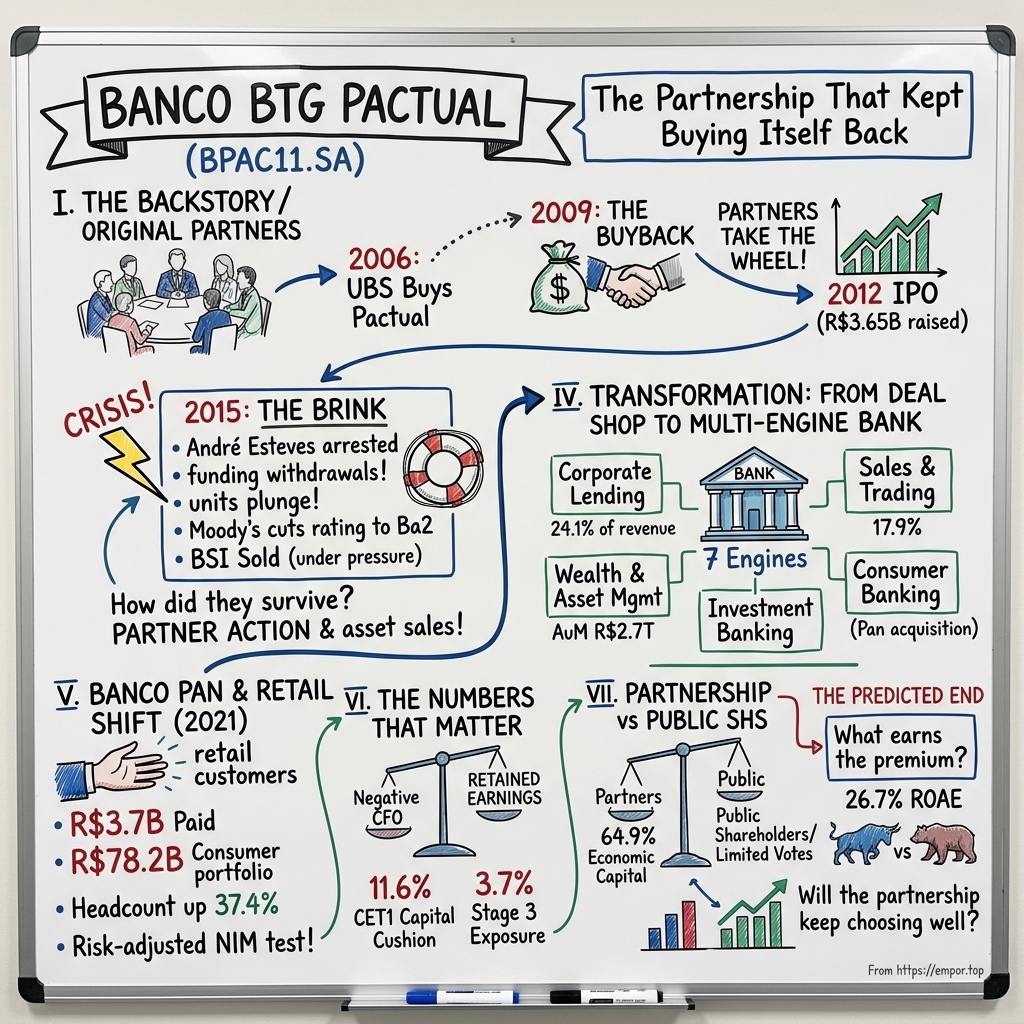
Eleven years later, the same institution looks almost unrecognisable. In the second quarter of 2026, BTG reported an adjusted return on average equity of 26.7%, a number that would be exceptional for any large bank anywhere, never mind one headquartered in a country with Brazil's interest-rate volatility.5 Net profit grew by about 36% a year in reais between 2015 and 2025.6 And the partners, the people who sold assets in the winter of 2015 to keep the lights on, still own about 64.9% of the bank's economic capital.7
That is the paradox at the centre of this episode. The 2015 crisis exposed how much of BTG rested on one founder's reputation and on the confidence of the clients who funded it. Today, the company presents itself as a diversified financial platform with seven business lines, more than R$2.7 trillion of client assets under management and administration, and a consumer bank bolted onto an investment bank.5 Is that diversification real, or is it a bigger version of the same bet on market confidence?
Three questions run through the story. The first is whether BTG can keep earning returns in the mid-twenties as it adds lower-margin, higher-loss consumer credit through Banco Pan. The second is whether a partnership that holds most of the votes aligns with the public unit holders who own the rest of the economics, or merely tolerates them. The third is whether capital and credit risk stay contained as the balance sheet grows at a pace no traditional Brazilian bank would attempt.
Before any of that, it helps to draw the boundary carefully. The listed company, Banco BTG Pactual S.A., trades on B3 as BPAC11 units. It consolidates its operating subsidiaries, including Banco Pan, its asset managers, and its offshore banks in the United States, Luxembourg and Latin America.8 It does not consolidate the partnership's own holding vehicles above it, or unlisted investment companies such as BTG Pactual G7 Holding, which show up only as related parties.8 When this story talks about BTG's returns and risks, it means the listed bank. When it talks about the partnership, it means the people and vehicles that control it.
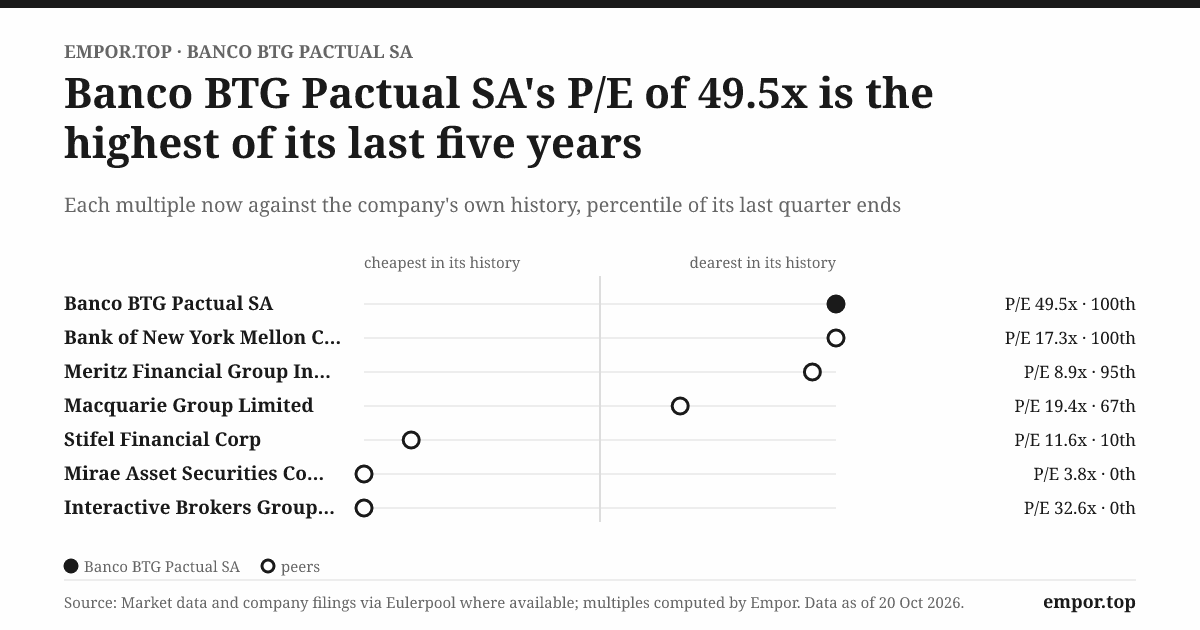
There is also a valuation puzzle to flag at the outset, because it shapes how every number later in the story should be read. Popular data screens in October 2026 showed BTG at roughly 49.5 times trailing earnings, more than six times its own five-year median of about 7.7 times, alongside a price-to-book ratio of 1.7 times that looks almost ordinary for a top Brazilian bank.9 Both figures cannot be telling the same story, and neither is quite right. The real price the market is paying sits between them and is demanding in its own way. But untangling it requires first understanding what BTG actually is, and that begins with a sale, a buyback, and a group of partners who decided they wanted their bank back.
 Subscribe on LinkedIn
II. Pactual leaves UBS—and the partners take the wheel
Pactual was born in 1983 as a small Rio de Janeiro brokerage and investment house, and by the 2000s it had become the closest thing Brazil had to a domestic Goldman Sachs: a bank run by partners who earned their stakes, traded aggressively, advised on the country's biggest deals and lived by the idea that the people taking the risk should own the consequences.10 André Esteves embodied the culture. He had arrived at Pactual at the end of the 1980s in a junior role and rose through the trading side to become one of its leading partners, and eventually its controlling one.11 He was known for an obsessive work rate, a trader's comfort with risk and a habit of thinking about the bank's capital as if it were his own money, which in large part it was.
In 2006, the partners sold Pactual to UBS. For the Swiss bank, it was a bet on emerging markets at the peak of the pre-crisis boom, and it bought a ready-made Brazilian franchise. For the Pactual partners, it was a liquidity event that turned decades of retained earnings into cash. Esteves stayed for a time inside UBS, but by 2008 he and a group of former Pactual partners had left and set up BTG, a new investment firm.12
Then the world broke. The 2008 financial crisis left UBS with enormous losses on American mortgage securities and an urgent need to shrink risk and rebuild capital. In April 2009, UBS agreed to sell UBS Pactual to BTG Investments, the vehicle Esteves and his partners had built.12 Law firm Simpson Thacher, which advised UBS, described the aggregate price as about US$2.5 billion.12 That headline number hides the more revealing structure. UBS's own quarterly report broke the consideration into roughly US$667 million in cash plus BTG's assumption of a residual payment obligation of about US$1.6 billion, and UBS expected to book a small loss.13
Why does that structure matter? Because it shows the difference between buying a franchise and buying a balance sheet. BTG was not writing a cheque for the full value of what it got back. A large part of the "price" was an obligation BTG took over, a promise to pay that sat alongside the business it was acquiring. A forced seller in a financial crisis had handed the original owners their creation back at a price that was mostly deferred, from a buyer whose biggest asset was knowing exactly what the business was worth. It was, in effect, a leveraged management buyback of a bank, and it gave the returning partners a powerful lesson that would echo through the next fifteen years: when others need to sell, a partnership with conviction and patient capital can buy.
The deal also set a template. The new BTG Pactual would be an owner-operator bank in the most literal sense, with partners holding the equity directly and earning more of it through performance. The partnership model works like a ratchet. Each year, the best performers are offered more of the firm, paid for in part with bonuses, and retiring partners sell their stakes back to the group. Capital and control circulate among the people running the business rather than leaking out to passive investors. That is the alignment case, and it is genuine.
But the template contained a test. A private partnership can take whatever risks its partners are willing to bear. A listed bank cannot ask outside shareholders to bear partnership-level risks without giving them a voice. That tension arrived in April 2012, when BTG Pactual listed on B3 in an initial public offering that raised about R$3.65 billion.14 The money gave the bank capital for expansion and a liquid currency for acquisitions.
The structure the partners chose for the listing said everything about who would stay in charge. Investors bought units, not shares, and each BPAC11 unit bundles one common share, which votes, with two class A preferred shares, which do not.7 That means two-thirds of every unit a public investor owns carries no vote at all. Meanwhile, the partners' main vehicle, BTG Pactual Holding Financeira, owns about four-fifths of all common shares plus every one of a separate class of preferred shares that never trades.7 The arithmetic of control is simple. Outside investors hold roughly 31% of the bank's total share capital, but only about 16% of the voting common stock.7
None of this was hidden. The prospectus laid out the structure and investors bought it anyway, because the pitch was compelling: a high-return, partner-run franchise in a large emerging market, with the partners' own wealth on the line. The question the IPO left open was not whether the partners would control the bank. It was whether that control would serve public holders well on the day something went badly wrong. Three and a half years later, that day arrived.
III. The arrest that forced a different bank
When the police came for Esteves in late November 2015, BTG had spent three years using its IPO money and its credit to build something much bigger than a Brazilian investment bank. It had bought into Banco Pan, the consumer lender rescued after an accounting scandal at the old Panamericano.15 It had built principal investments across energy, real estate and healthcare. Most ambitiously, in July 2014 it had agreed to buy BSI, a Lugano-based private bank, from the Italian insurer Generali for CHF1.5 billion.16 BSI was supposed to make BTG a global wealth manager, giving it a Swiss platform to serve the rich clients of Latin America and beyond.
The problem with that kind of growth is that it depends on funding, and funding depends on trust. An investment bank that relies on institutional deposits, wholesale funding and repo lines is only as strong as its counterparties' willingness to keep rolling those lines over. When the founder of such a bank is arrested, nobody needs evidence of wrongdoing at the bank itself to start asking for their money back. Prudence is enough. That is exactly what happened.
The partners' response came in a sequence, and the sequence matters because it reveals what the partnership model can and cannot do. First came leadership. On December 2, Esteves left the control group and the seven top partners took over his common shares.1 He resigned from his executive roles, and economist Persio Arida, a former president of Brazil's central bank and a senior BTG partner, became the public face of the restructuring.4 Roberto Sallouti, a Pactual veteran who had grown up inside the trading and principal-investment culture, emerged as the operating leader and has served as chief executive since then.11
Second came liquidity. The FGC line, extended on December 4, was the bank's financial oxygen. It was secured by more than 120% of its value in BTG's loans and personally guaranteed by the top seven partners.1 By the end of 2015, BTG had drawn R$5 billion of it.1 That detail deserves a pause. A bank whose story is "partners with skin in the game" had to put that skin up as literal collateral. The partners were not merely invested in the outcome. They had personally guaranteed the credit line that kept the bank funded.
Third came the asset sales. The 12% stake in Rede D'Or went to Singapore's sovereign fund for about US$406 million.4 Reuters reported the sale alongside the news that Esteves was leaving control, which tells you how tightly the two were linked in the market's mind.3 Further disposals followed across the portfolio, and the bank shrank its balance sheet hard. Total assets, measured in dollars, fell from about US$76 billion at the end of 2015 to about US$32 billion a year later, a contraction of more than half that reflected both the sales and the collapse of the real.6
How did management describe all this as it happened? In the fourth-quarter 2015 earnings release, published in early 2016, the bank's message centred on liquidity first and profits a distant second: it emphasised the cash it had raised, the deposits it had kept, the capital ratios it had preserved and the assets it had sold or agreed to sell.17 That emphasis was the right one, but it also conceded the central point. The funding pullback had been severe enough that preserving the institution, not growing it, was the only strategy. Rating agencies cut the bank into speculative grade as the crisis unfolded, adding to the cost and difficulty of rolling wholesale funding.17
The annual numbers show the damage. On the consolidated figures, BTG's reported revenue for 2015 collapsed to almost nothing, about US$84 million, and the bank booked an operating loss of about US$1.2 billion; net profit survived at about US$219 million only because of tax effects and gains elsewhere.6 Those revenue figures are distorted by how a bank's trading losses and gains net out, so they should not be read like an industrial company's sales. But the direction is unmistakable. This was a near-death year.
The clearest test of BTG's capital allocation under stress is BSI. BTG had agreed to pay CHF1.5 billion for the Swiss bank in 2014.16 In 2016, with liquidity the priority, it agreed to sell BSI to EFG International for a mix of cash and EFG shares, and the two sides later had to negotiate a final price after closing adjustments.18 The final figure landed below BTG's original cost.18
It would be easy to call the BSI purchase an overpayment. The record supports something narrower. BTG paid a full price for a business that came with acquired capital, and it sold under duress at a lower price, so a loss was crystallised. But the sale was forced by a liquidity crisis that had nothing to do with BSI's own operations, and a seller racing to raise cash rarely gets its best price. The fair conclusion is that the acquisition did not survive contact with the crisis, and that a bank stretching for global scale had not left itself enough room to hold on to its bet. That is a lesson about funding fragility as much as about price.
Was 2015 proof of institutional resilience? Partly. The partners moved fast, they put personal guarantees behind the bank, they sold good assets as well as bad ones, and they repaid the entire FGC line by October 2016.1 Few banks that lose the trust of their funders survive at all, and fewer still return to growth within a year. The 2016 accounts showed net profit of about US$1.5 billion, helped by gains on the very disposals that had saved the bank.6
But the episode also falsifies the strongest version of the partnership pitch. The claim was never just that partners care about their capital. It was that a partnership spreads judgment, relationships and leadership across many people, so that no single individual is the firm. In November 2015, the market tested that claim and it partly failed. The arrest of one man triggered a funding run on the whole institution. The partners proved they could rescue the bank, but not that the bank was immune to a crisis centred on one person.
The coda makes the point sharper. Esteves was later cleared in the courts, and in April 2022 he returned as chairman of the board.11 Sallouti remains chief executive, which means the bank has had continuity of operating leadership for more than a decade. Yet the founder whose arrest nearly broke the firm is back at the top of its governance. Partner continuity and dependence on a prominent founder are not the same thing, but they are not opposites either. At the April 2026 annual meeting, outside shareholders made clear that control and accountability are still live questions.
The bank that came out of 2016 was smaller, more liquid and chastened. What it did next, rebuilding not just as a deal shop but as a lender, wealth manager and eventually a consumer bank, is the subject of the next chapter.
IV. From deal shop to a bank with several engines
Open BTG's second-quarter 2026 results and the first thing that strikes you is the shape of the revenue table. There are seven businesses lined up side by side, and the one you might expect to dominate, investment banking, is near the bottom.5 The bank that was once known for advising on Brazil's biggest mergers, trading aggressively and making principal bets now earns more from lending to companies than from any other single line. Total adjusted revenue for the first half of 2026 was about R$20.3 billion, up about 24% from a year earlier, and adjusted net profit reached about R$9.95 billion, up about 31%.5
The easiest way to understand the business is to follow a client through it. Picture the finance director of a Brazilian utility. She might borrow from BTG to fund a transmission line, use BTG to issue debentures in the local market, hedge the currency and interest-rate risk on that debt with BTG's trading desk, park the company's surplus cash in a BTG fund, and, in her personal life, keep her family's investments with BTG's wealth arm. Every one of those touchpoints produces a different type of revenue with a different relationship to risk.
The lending book and the trading desk
Start with the largest. Corporate Lending & Business Banking produced 24.1% of second-quarter revenue, about R$2.5 billion, on a portfolio of about R$288.5 billion.5 The economics of that book are those of any corporate lender. BTG earns the spread between what borrowers pay and what its funding costs, plus structuring fees when it designs bespoke financings, and it pays away part of that in credit losses when borrowers fail. Because BTG's funding comes largely from time deposits and bond markets rather than cheap current accounts, its funding cost is higher than that of a deposit-rich universal bank, which means it has to win through pricing, speed and structure rather than through a raw cost-of-funds advantage. The book is skewed toward sectors that tend to be stable cash generators: utilities account for about a fifth of credit risk, with agribusiness, financial institutions, real estate, oil and gas and telecoms each smaller slices.5
That concentration in utilities is a reasonable choice for a lender. Regulated power and transmission companies tend to have predictable cash flows, though they are also capital-hungry, which is why they borrow so much. The concentration is not a crisis waiting to happen, but it does mean a large part of BTG's biggest revenue line is a bet on a handful of infrastructure sectors and on the Brazilian regulatory framework that governs them.
Contrast that with Sales & Trading, which produced 17.9% of quarterly revenue, about R$1.86 billion.5 Here, BTG makes money by facilitating client trades, making markets in bonds, currencies and equities, and structuring derivatives. It is good business in active markets, and BTG has historically been one of the best in Brazil at it. But it is also the line most exposed to market conditions and to the bank's own risk appetite. A quiet market or a sharp dislocation can cut this revenue fast. The fact that it reached R$3.7 billion in the first half of 2026 says that BTG's trading engine remains formidable and that recent Brazilian markets have been kind to it.5
Then there is a line many investors skim past: Interest & Others, which produced 17.4% of second-quarter revenue, about R$1.8 billion.5 This is essentially the return BTG earns on its own capital and its liquidity reserves, much of it parked in Brazilian government bonds. When Brazil's policy rate sits in the mid-teens, as it did through much of 2025 and 2026, the bank's own equity earns a rich return just by sitting in government paper. That is real money, but it is not a franchise. It is a function of the interest-rate cycle. If Brazil's central bank cuts rates materially, this line will shrink, and nothing in BTG's competitive position can prevent that.
What the fee businesses really charge
Asset Management produced 7.7% of second-quarter revenue and about R$3.0 billion in 2025, on assets under management and administration of about R$1.36 trillion.5 Wealth Management & Personal Banking produced 14.0% of quarterly revenue and about R$5.0 billion in 2025, on wealth under management of about R$1.31 trillion.5 Together, client assets came to about R$2.7 trillion.
The pricing units here are worth understanding, because they tell you how durable the fees are. An asset manager typically charges a management fee as a percentage of the money it runs, from a few hundredths of a percent for passive or administered money up to a percent or two for hedge funds and private equity, plus performance fees on the funds that beat their benchmarks. A wealth business earns custody fees, advisory fees and distribution fees on products sold, plus banking income on client deposits and loans.
Run the simple arithmetic and the blended yields turn out to be modest. R$3.0 billion of asset-management revenue on roughly R$1.3 trillion of assets implies an average fee of something like a quarter of a percent. R$5.0 billion of wealth revenue on a similar base implies around four-tenths of a percent. Those averages say that a large share of BTG's asset base is low-fee money, much of it fund administration and institutional mandates, rather than high-fee alternative funds. That is not a criticism. Scale in administration is sticky and cheap to service. But it means headline asset totals overstate the earning power behind them, and performance fees, which depend on markets, can swing the line materially from year to year.
Investment Banking, the line most associated with the BTG name, produced only 4.1% of quarterly revenue, roughly R$430 million.5 BTG has led Latin American league tables for years, and rating agencies cite that market position as a strength.19 But visibility is not the same as contribution. Advisory and underwriting fees are the most cyclical revenue a bank earns. They matter for relationships, because the bank that runs a company's IPO often wins its lending and hedging business too, but they no longer carry the earnings.
Then there is the newest engine, Consumer Finance & Banking, which produced 14.9% of quarterly revenue, about R$1.55 billion, through Banco Pan and the digital lender MeuTudo.5 That business is so different in character from the rest that it gets its own chapter.
Management's central claim about this mix is that more than 60% of revenue is recurring, which insulates the bank from downturns in trading and underwriting.5 It is worth testing what that claim actually counts. Add up Corporate Lending, Consumer Finance, Wealth and Asset Management, and you get just over 60%. In other words, the "recurring" label requires treating the entire corporate loan book and the entire consumer book as recurring income. That is defensible in the sense that loans earn spread every month until they mature. But lending income is only recurring if borrowers keep paying, and its true quality is revealed by credit losses, not by the revenue line. A corporate loan book of R$288.5 billion earns recurring spread right up until a large borrower defaults, as BTG learned with Americanas.
The remaining 40% is the market-sensitive and rate-sensitive part: Sales & Trading, Interest & Others and Investment Banking. That is a large share for a bank that markets itself as diversified. A fairer description is that BTG has shifted from a bank dominated by trading and principal investment to a bank where about a third of revenue comes from fee-generating client franchises, another third from lending, and the final third from markets and treasury. It is genuinely more diversified than in 2015. It is not insulated.
Who are the competitors? There is no single peer set, because BTG competes in different arenas against different rivals. In corporate lending and deposits, it competes with Itaú Unibanco, Bradesco, Santander Brasil and the state banks, all of which have far larger branch-based deposit franchises and, therefore, cheaper funding. In wealth and investment distribution, its sharpest competitor is XP, the platform that disrupted Brazil's banks by giving investors access to products beyond the big banks' own funds. In advisory and trading, BTG competes with Itaú BBA and Bradesco BBI at home and with the global investment banks in larger cross-border deals.
The question for an investor is whether asset gathering creates real switching costs or mostly reflects rising markets. A wealthy family that has its custody, loans, estate planning and personal banking at one institution faces genuine hassle in moving. That is a real source of stickiness. But BTG's results materials emphasise asset totals more than they quantify client retention, wallet share or fee yields by product, which makes it hard for an outsider to separate net new money from market appreciation in the growth of that R$2.7 trillion. The strongest version of the diversification thesis would show net inflows holding up in a falling market. Until that is observed through a full cycle, the claim is plausible but unproven.
What the second-quarter table does prove is that BTG is no longer a deal shop. The question is whether its newest and most different engine, the consumer bank, will add to the returns or dilute them.
V. Banco Pan turns the partnership toward retail
The story of Banco Pan starts with a scandal that was not BTG's. In 2010, auditors and Brazil's central bank uncovered a multi-billion-real accounting hole at Banco Panamericano, the consumer lender then owned by the television entrepreneur Silvio Santos, and the deposit-guarantee fund stepped in to keep it alive.15 In 2011, BTG bought Silvio Santos's controlling stake, sharing control with CaixaPar, the investment arm of the state bank Caixa Econômica Federal, which had bought into Panamericano before the hole was found.15
For a decade, Pan sat inside BTG's orbit as a co-controlled investment, a turnaround project in payroll loans, vehicle finance and credit cards. Then, in 2021, BTG made its move. Banco Sistema, a BTG vehicle, agreed to buy CaixaPar's 49.2% of Pan's voting shares for about R$3.7 billion, taking sole control.15 Pan became a consolidated subsidiary, and later fully part of the BTG group.8 In one transaction, a bank that had been built for corporates, institutions and the wealthy acquired a mass-market consumer lender serving millions of ordinary Brazilians.
The strategic logic is easy to state. Pan gave BTG access to retail lending, retail deposits and consumer distribution at a scale that would have taken years to build from scratch. The consumer-finance portfolio reached about R$78.2 billion by the second quarter of 2026, up about 24% from a year earlier.5 Retail customers bring cheaper and more diversified funding over time, a captive base for BTG's digital investment products, and a revenue stream that does not depend on mergers or market volatility.
Was R$3.7 billion a good price? The acquisition price alone cannot settle that. A useful test would compare the payment with Pan's book value and earnings at the time, the control premium implied by moving from shared to sole control, and the capital Pan subsequently needed. BTG already shared control of Pan, so part of what it bought was the right to run it without a state-owned partner, and that has strategic value beyond any multiple. The honest verdict is that the purchase price does not reveal whether BTG overpaid. What will reveal it is risk-adjusted earnings after credit losses, integration costs and the capital Pan consumes.
That last point is why consumer lending is a different animal from everything else at BTG. A payroll loan, repaid by direct deduction from a public servant's or pensioner's salary, is one of the safest forms of consumer credit in Brazil. A vehicle loan is secured on a car that loses value the moment it leaves the dealership. A credit card or personal loan is unsecured and carries the highest losses. Consumer lending earns much wider spreads than lending to utilities, but it gives back a large part of those spreads in provisions, and the losses arrive in waves when unemployment rises. The relevant number is not the gross margin. It is the margin left after credit costs, divided by the capital the book consumes.
The mix also changes BTG's operating shape. Total headcount rose from about 8,854 in the second quarter of 2025 to about 12,169 a year later, a jump of more than a third.5 Over the same period, the adjusted efficiency ratio, which measures costs as a share of revenue, improved from about 38.5% to about 37.1%.5 Management presents this as operating leverage: more people, but revenue growing faster than costs.
That reading deserves care. Pan had been consolidated since 2021, so a headcount jump of that size in a single year looks more like Pan's workforce being brought fully into BTG's own count as the group absorbed its subsidiary than like a wave of organic hiring.58 If that is right, the efficiency improvement says that the combined group is running at a lower cost ratio, which is good, but it does not prove that every new hire is earning its keep. An investor would want to see Pan's cost base and BTG's wholesale cost base reported separately over several years to know which side is driving the improvement. BTG's segment disclosure reports Consumer Finance & Banking revenue, but it does not give the full allocated profit and loss for each engine that would answer the question cleanly.
There is a smaller deal that serves as a check on how the group allocates capital in retail. In October 2021, Pan agreed to buy Mosaico, the owner of price-comparison sites Buscapé, Zoom and Bondfaro, in an all-share deal.20 Mosaico had listed on B3 only that February, raising about R$1.2 billion, and by the time Pan bid, its shares had fallen about 70% from the IPO.2021 Pan offered 0.8 of its own shares for each Mosaico share, issuing about 101 million new shares, which at Pan's closing price the Friday before the announcement were worth about R$1.75 billion, plus warrants that would add more shares if Pan's stock rose above R$24.20 The deal closed in March 2022.21
The logic was that shoppers comparing prices online could be offered Pan's credit at the moment of purchase. But it was a deal paid in Pan stock at the top of the 2021 fintech boom, for a company that public markets had already marked down by two-thirds. BTG does not report Mosaico as a separate line, so outsiders cannot see whether that funnel ever produced meaningful credit volume. On scale, Mosaico was small beside the Pan acquisition itself, so it should not dominate the verdict. But it is a reminder that the retail strategy has included bets made in the spirit of the moment, and that not every piece of the consumer build-out comes with a public scorecard.
What, then, would settle the Pan question? The single most useful number is the risk-adjusted net interest margin in Consumer Finance & Banking: the spread the book earns after subtracting credit losses. Next to it sit delinquency, the cost of risk and the return on capital allocated to the business. If that risk-adjusted margin holds steady while the book keeps growing in the mid-twenties, Pan is adding to BTG's returns. If it compresses as growth reaches riskier borrowers, BTG will have bought volume at the cost of quality.
For now, the evidence is supportive but incomplete. Group returns have risen even as Pan's book has grown, which suggests the consumer bank is not dragging the whole bank down. But a growing loan book flatters results early, because new loans earn interest before they have had time to go bad. The real test of Pan will come in the first Brazilian credit downturn after its integration, and that test lives on the balance sheet, which is where the story turns next.
VI. The numbers that matter when bank cash flow misleads
Open BTG's cash-flow statement for 2025 and you might think you were looking at a company in distress. Operating cash flow was negative by about US$4.4 billion and free cash flow by about US$4.8 billion.6 Over the past decade the operating cash line has lurched from strongly positive to strongly negative and back again, with no apparent pattern. Yet over the same years, net profit rose almost every year and shareholders' equity grew from about US$8.2 billion at the end of 2022 to about US$12.5 billion at the end of 2025.6 How can a business that keeps "burning cash" keep getting richer?
The answer is that for a bank, the cash-flow statement measures something different. When an industrial company sells a product, cash comes in. When a bank makes a loan, cash goes out, and that outflow is recorded as an operating activity because lending is the bank's operation. When it buys government bonds for its liquidity reserve, cash goes out again. When it takes in a deposit or borrows in the repo market, cash comes in. So a bank that is growing its loan book and securities portfolio faster than its deposits in a given year will show a negative operating cash flow, no matter how profitable those loans are. Negative operating cash flow in a year of rapid loan growth is a sign of expansion, not a failure to convert profit into cash.
The better question for a bank is where the earnings went. The answer is mostly into equity. BTG has retained most of its profit, paying out a median of about 27% in dividends over the past twelve years, with about 25% in 2025.6 The extremes tell their own story: a payout of only about 14% in 2020, when the bank was conserving capital for the Pan deal and the digital build-out, and about 119% in 2015, when dividends were paid on a year whose profit had collapsed.6 The retained profits became regulatory capital, which is the raw material a bank needs to grow its loan book. That is why equity reached about R$79.6 billion by June 2026.5
The other side of a growing balance sheet is funding. BTG's unsecured funding reached about R$405.3 billion in the second quarter of 2026, up about a third in a year.5 Almost half came from time deposits, Brazil's ubiquitous certificates of deposit, and more than a third from debt securities, mainly local Letras Financeiras and international bonds.5 Demand deposits, the cheap current-account money that gives Itaú and Bradesco their funding advantage, were only about 3% of the total.5 That mix is the cost of having been built as an investment bank. BTG pays market rates for most of its money, which is why it needs to earn more on what it lends. It also means BTG's liabilities should not be read as corporate net debt. They are the raw material of the business, and their maturity profile and cost matter more than their size.
Now for the quality of what that funding buys. Since January 2025, Brazilian banks have reported credit quality under CMN Resolution 4,966, a rule modelled on the international IFRS 9 standard. Think of it as a traffic light. Stage 1 loans are performing normally, and the bank provisions for twelve months of expected losses. Stage 2 loans have deteriorated significantly, and the bank must provision for losses over their whole remaining life. Stage 3 loans are impaired. At the end of June 2026, about 93% of BTG's R$406.8 billion of credit exposure was in Stage 1, about 3% in Stage 2, and about 3.7%, or R$15.24 billion, in Stage 3.5 For a bank with a large consumer book, a Stage 3 share under 4% is not alarming, but it is not trivially small either, and because the new standard is so recent, there is no long history against which to judge the trend.
The best historical test of how BTG recognises bad credit came in January 2023, when the retailer Americanas disclosed a vast accounting fraud and filed for bankruptcy protection. BTG had about R$1.2 billion of exposure and provisioned all of it across the fourth quarter of 2022 and the first quarter of 2023.22 The speed of the write-down is a point in BTG's favour: it took the hit quickly instead of dribbling it out over years. But it is also a reminder that a large corporate book carries concentrated single-name risk, and that one filing can erase the lending spread on that exposure.
The cushion and where it is soft
On the regulatory measures, BTG looks strong. Its total Basel ratio was 16.0% in the second quarter of 2026, with common equity Tier 1, the highest-quality capital, at 11.6%, and its liquidity coverage ratio, which measures liquid assets against a 30-day stress scenario, at about 160%.5 Those numbers comfortably exceed Brazilian minimums.
But a capital ratio is a fraction, and both the top and the bottom depend on judgment. BTG's auditor, PwC, gave a clean opinion on the 2025 accounts but flagged three key audit matters, the areas that required the most judgment.22 The first was the fair value of complex Level 2 and Level 3 instruments, assets whose prices come from models rather than live markets. The second was the new expected-credit-loss models under Resolution 4,966. The third was the recoverability of about R$4.2 billion of deferred tax assets at Banco Pan, which depend on projections that Pan will earn enough taxable profit in future years to use them.22
That third point links directly back to the Pan thesis. Deferred tax assets are a claim on future tax savings, and regulators deduct much of their value from common equity. If Pan's future profits disappoint, those assets could be written down, which would reduce both reported profit and core capital. A bank with a CET1 ratio of 11.6% has a healthy buffer, but R$4.2 billion is not trivial next to that buffer.
BTG also carried legal and tax provisions of about R$2.14 billion, mainly related to disputes over the tax base for PIS and COFINS on financial revenue, the tax amortisation of goodwill from past mergers, and municipal service taxes.8 These are normal for a large Brazilian bank, but the goodwill disputes in particular reach back to the bank's acquisitive history.
Finally, hedging. BTG runs significant operations outside Brazil, and a falling real would shrink the value of those operations in reais and dent the capital ratio. To neutralise that, it held about R$27.8 billion notional of currency futures and forwards as net-investment hedges at the end of 2025, and the gains on those hedges almost exactly offset the translation losses on the offshore businesses.22 It also hedged about R$47.4 billion of fixed-rate assets and liabilities against swings in Brazilian interest rates.22 Hedging is risk management with a cost, not a guarantee. It protects against the risks it is designed for, but it leaves basis risk, where the hedge and the exposure move differently, and valuation risk, where both sides are measured with models.
For a bank, retained earnings are the cash-flow story, and on that measure BTG has converted profit into capital consistently. The weak points are in the judgments behind the numbers rather than the numbers themselves. Who makes those judgments, and how they are paid, is the next question.
VII. The partnership's return engine—and its public shareholders
On April 30, 2026, BTG Pactual held its annual and extraordinary shareholder meeting. It was, by the standards of most companies, a formality. The partners control the vote, so every resolution was always going to pass. But the voting tally recorded something the partners could not hide. About 587 million voting shares, about 8.9% of the votes present, voted against the cap on management compensation.23 About 292.5 million voted against the re-election of chief executive Roberto Sallouti to the board.23
Those percentages look small until you work out who could have cast them. The partners hold about 83.3% of the voting common shares.7 Outside investors hold about 16.4%.7 With roughly 7.3 billion common shares in issue, the outside-held common stock amounts to about 1.2 billion shares.14 So the 587 million votes against the pay proposal represent something like half of all the voting shares not held by the partners or the treasury. Roughly a quarter of outside voting shares opposed Sallouti. That is not a fringe protest. It is a large share of the people who own the bank without running it saying they disagree.
To understand why, map the control chain in plain language. At the top sit the partners, who own the bank through BTG Pactual Holding Financeira, BTG Pactual Holding S.A. and a set of partnership investment vehicles.7 Together, those vehicles hold about 83.3% of the votes and about 64.9% of the economic capital.7 Public investors own about 30.7% of total capital, mostly through the BPAC11 units.7 But because two of every three shares inside a unit are non-voting preferred shares, the public owns about 80% of the voting-less preferred class and only about 16% of the voting class.7 The structure lets the partners own just under two-thirds of the economics and wield well over four-fifths of the votes.
The alignment case for this structure is real. Partners have most of their personal wealth tied up in the bank. When BTG compounds book value, they get richer; when it takes a bad risk, they lose their own money, as they did in 2015, when they personally guaranteed the bank's emergency credit line. That is a stronger form of alignment than stock options, which reward upside without punishing downside.
The pay disclosures support the view that partners are mainly paid through ownership. In 2025, the listed bank paid its board and statutory executives about R$24.6 million in fixed compensation in total, across about nine board seats and fourteen executive officers, with the highest individual payments at about R$2.4 million.11 Against net profit of about R$14.5 billion, that is a rounding error.22 The listed bank pays its statutory directors no variable bonus or stock options directly.11 Performance pay flows through two larger channels: the bank-wide bonus pool, which was about R$1.0 billion in the second quarter of 2026 alone, implying a compensation ratio of about 19.5% of revenue, and the partnership economics above the listed bank.511
That second channel is where the governance question lives. Statutory pay is not total partner compensation. A partner's real reward comes from bonuses and from the right to buy more of the partnership at book value, which makes the partnership's internal pricing and allocation decisions economically significant. Public investors can see the bonus pool and the statutory pay, but they cannot see how the partnership allocates its equity among partners or at what price. The dissent on the compensation cap is best read as outside shareholders saying they cannot fully judge what they are approving.
How credible is management on behaviour rather than words? The record is mixed in an instructive way. On the positive side, the same operating leadership has run the bank since 2015, it brought the bank back from a funding run, repaid the emergency line within a year, and has since built multiple engines that are producing record returns. On the other side, the bank's history includes costly bets: BSI, sold at a loss under pressure, and Mosaico, bought at the top of a fintech boom. Those course corrections happened, which counts in management's favour, but they happened because the bank had to, not always because it chose to.
Related-party transactions deserve the same careful reading. The listed bank's 2026 reference form discloses balances with entities connected to the partnership. BTG MB Investments, an entity under common control, had about R$1.6 billion of derivative contracts with the bank, mostly currency hedges maturing as late as 2041, plus about R$465 million of deposits.8 The indirect controlling parent, BTG Pactual Holding S.A., had about R$500 million of the bank's notes and securities, with maturities through 2049.8 There are also banking facilities with Eneva, the energy company in which BTG holds a significant stake.8 The bank states that these transactions are conducted on market terms and approved by the board and audit committee.8 Against a bank with a balance sheet of well over R$700 billion, the disclosed balances are small.6 The concern is not their size. It is that the partnership sits on both sides of some transactions, and outside investors depend on the board's independent members, four of nine, to police the terms.11
So who wins from this structure? The partners clearly do: they keep control and gain from the compounding. Public unit holders also win, as long as the partners keep choosing well, because they share in the same returns on the same capital. The cost is that public holders have almost no tools if the partners stop choosing well. They cannot replace the board, block a deal or change pay policy. The April 2026 vote shows they know it. The dissent did not change any outcome, but it is a governance cost that a rational investor should price rather than wave away.
That cost matters most at the moment an investor is asked to pay a premium for the partnership's judgment, which brings the story to valuation.
VIII. What earns the premium—and what could take it away
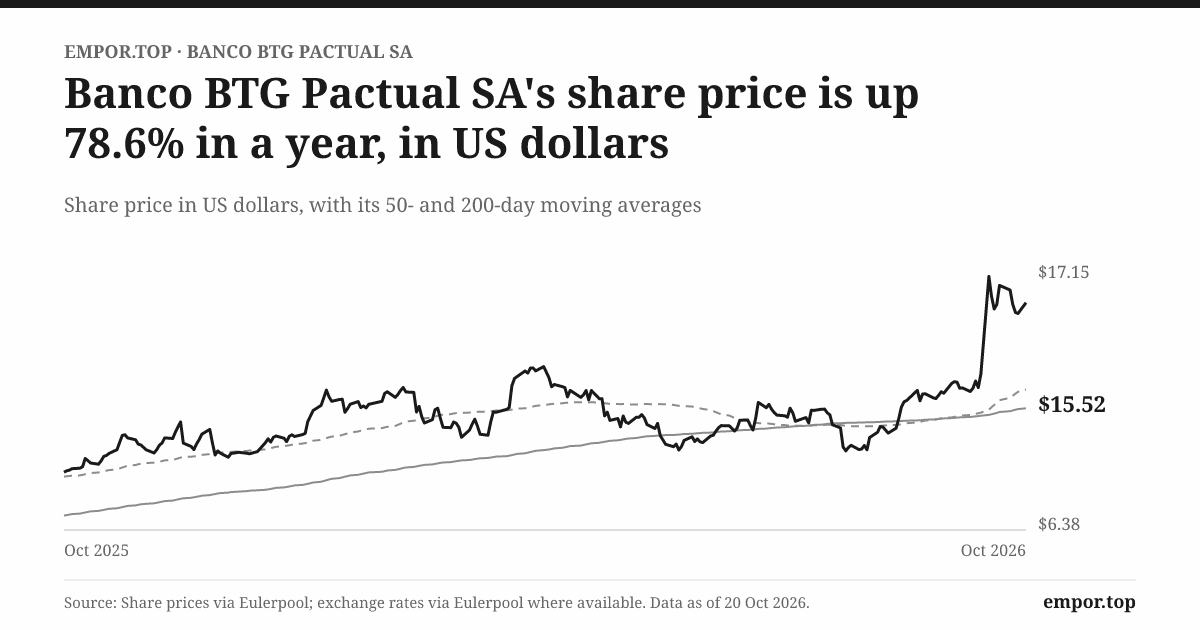
On October 20, 2026, BPAC11 units closed at about R$78.21, about 5.5% below their 52-week high and well above their low of about R$46.68 a year earlier.9 The units had nearly doubled from that low. Data screens that day showed a trailing price-to-earnings ratio of 49.5 times against a five-year median of 7.7 times, and a price-to-book ratio of 1.7 times.9 Taken at face value, those numbers say BTG had become wildly expensive on earnings while staying cheap on book, which is not possible for a bank whose return on equity was about 23% over the trailing twelve months.9
The reconciliation is worth doing step by step, because it changes the conclusion. BTG has about 3.89 billion units outstanding, each representing three shares, for about 11.67 billion shares in total.14 The unit price of R$78.21 multiplied by the unit count gives a market value of roughly R$304 billion. The headline market value on several screens, about R$900 billion, is almost exactly the unit price multiplied by the share count, which counts each unit three times. That error inflates the P/E roughly threefold. Divide the R$304 billion market value by trailing net profit of roughly R$18 billion, and the P/E is in the mid-to-high teens rather than near 50. On book, the error runs the other way. Equity was about R$79.6 billion in June 2026, or about R$20.60 per unit.59 At R$78.21 a unit, BTG trades at about 3.8 times book, not 1.7 times. The five-year median P/E of 7.7 times also mixes definitions and should not be relied on.
The corrected picture is more coherent and more demanding. A bank earning about 27% on equity and trading at about 3.8 times book is priced on roughly 14 times this year's annualised adjusted earnings and in the high teens on trailing reported profit. That is a substantial premium to Brazil's big incumbent banks, which trade at book multiples that are a fraction of that, and it implies the market expects BTG to sustain returns well above its cost of equity for a long time while still growing. It is not a bubble multiple. It is a franchise multiple, and it needs a franchise to justify it.
Why it could win, and why it might not
The bull case rests on four pieces of evidence. The first is returns: an adjusted ROAE of 26.7% in a quarter when the balance sheet was growing fast.5 The second is a growing base of fee-generating client assets, R$2.7 trillion, which produces revenue that does not depend on taking more credit risk.5 The third is efficiency: a cost-to-revenue ratio of about 37%, which is very low for a bank with BTG's mix of businesses.5 The fourth is relationships that span lending, wealth and advice, creating opportunities to sell more products to the same clients.
The bear case runs through mechanisms rather than headlines. Roughly two-fifths of revenue comes from trading, treasury and investment banking, which depend on market activity and interest rates. The treasury line, in particular, will shrink if Brazil's high policy rate falls. Consumer credit carries lower margins after losses and higher capital consumption than BTG's traditional business. Compensation is a large and rising cost, with a bonus pool sized as a share of revenue. Brazil remains a volatile macroeconomy where currency and rate shocks can hit capital. Funding competition is intense, and BTG pays market rates for most of its money. And concentrated partner control means outside holders bear the consequences of decisions they cannot influence.
Michael Porter's five forces help frame where BTG's position is strong and where it is merely competitive. Buyer power is high in the institutional and corporate segments, because large companies and pension funds multi-source their banking and push hard on price. The threat of substitutes is real in wealth, where platforms like XP and lower-cost passive products compete for the same money. New entrants face high barriers in banking licences and capital, but digital banks have shown that retail distribution can be built faster than incumbents expected. Supplier power, in a bank's case, is the cost of funding and the cost of talent, and BTG is exposed on both: it relies on market-priced deposits and must pay to keep its partners and traders. Rivalry with Itaú, Bradesco and XP is intense in every segment BTG operates in.
Hamilton Helmer's seven powers are a harder test, because they ask what lets a company earn more than its cost of capital for a long time. BTG has some evidence of scale economies in asset administration and wealth, where costs grow more slowly than assets. Its reputation, the closest thing to Helmer's branding, helps it win institutional mandates and large deals, though 2015 showed how fast reputation can turn into a liability. Its client relationships may create switching costs in wealth, where custody, loans and advice are bundled. And the partnership itself could be seen as a form of counter-positioning: a structure that incumbents with dispersed shareholders and salaried executives cannot easily copy. But the evidence base is thinner than the narrative. BTG does not publish retention rates, pricing trends, net flows by product or market shares in a form strong enough to prove these powers. The fair conclusion is that BTG has a strong franchise with several plausible sources of advantage, but not a proven moat.
How do peers compare? Itaú is the most relevant reference point for profitability among the large Brazilian banks; it earns returns in the low twenties with a vast deposit franchise and trades at a lower book multiple than BTG. Bradesco and Santander Brasil earn materially lower returns and trade accordingly cheaper. XP is a comparison only for wealth distribution and asset gathering, not for lending or treasury, so its earnings multiple says little about BTG's balance-sheet businesses. These are unlike businesses, and their multiples are context, not direct comparables.
Credit ratings add another lens. Fitch rates BTG BB+ with a stable outlook, Moody's rates its deposits Ba1 with a positive outlook, and S&P rates it BB.19 On national scales it holds the top grades, AAA, which means the agencies see it as among the strongest credits in Brazil.19 The agencies credit its profitability, liquidity and capital, but they also cite Brazilian macroeconomic volatility and capital-markets cyclicality as constraints, and the global ratings are effectively capped near the sovereign.19 No Brazilian bank can be safer than Brazil itself.
That leads to the three numbers that will settle this story. The first is risk-adjusted return on equity, which stood at an adjusted 26.7% in the second quarter of 2026.5 The second is fee revenue and net client inflows in asset and wealth management, which together show whether the R$2.7 trillion base is growing through client wins rather than market moves. The third is Stage 3 exposure and credit cost, especially in Consumer Finance & Banking, where Stage 3 stood at about 3.7% of total credit exposure in June 2026.5
Management's own framing in its quarterly releases leans on records: record revenue, record adjusted net profit, record client assets and returns above 25%.5 What the releases do not offer is a quantified bridge showing how returns would hold up if the treasury line shrank with falling rates, or what the consumer book would earn after losses in a recession. Those are exactly the questions a skeptical long-short investor would press, and the absence of a published bridge is itself informative. The record supports the claim that BTG earns exceptional returns today. It does not yet prove that it will do so in a weaker market, with lower rates and a larger consumer book.
IX. Playbook: Business & Investing Lessons
In 2009, the partners who had sold Pactual to UBS returned to buy it back from a Swiss bank desperate to shrink, paying with a few hundred million dollars in cash and a promise to settle the rest later.13 Six years later, the same partnership absorbed a crisis centred on its own founder, guaranteed the bank's emergency borrowing personally and sold some of its best assets to survive.1 A decade after that, it was running a seven-engine bank with returns that would be the envy of almost any lender in the world.5 The story is full of lessons, and the most useful ones belong to BTG and no one else.
The first: a partnership can move quickly; it can also make public investors spectators. In the week after Esteves's arrest, BTG's partners reorganised control, secured funding and began disposals with a speed no committee-run bank could match. The same structure that let them move so fast is the structure that gave about half of the outside voting shares no means of turning their dissent into anything but a statistic at the 2026 meeting. Founders who build partnership-run public companies should understand that the speed and the silence come as a package. Investors who buy them should price both.
The second: a crisis reveals what a bank is willing to sell. BSI was supposed to make BTG a global wealth manager. Within about eighteen months of agreeing to buy it, BTG agreed to sell it at a lower final price, because liquidity mattered more than ambition.1618 The disposal itself is not proof of poor judgment; it is proof that the bank had stretched for growth without leaving enough room to hold on to its bets when funding disappeared. The broader point for any financial institution is that an acquisition is only as safe as the funding behind the acquirer.
The third: a bigger balance sheet is not the same as a better franchise. Banco Pan brought BTG a consumer loan book of nearly R$80 billion and millions of retail customers.5 It also brought lower margins after losses, a large deferred tax asset that depends on future profits, and the sort of credit cycle BTG's corporate franchise had never had to manage at scale.22 Every lender looks brilliant while its loan book is growing quickly, because new loans pay before they have time to fail. Pan's value will be measured by its risk-adjusted margin and return on capital through a downturn, not by its size today.
The fourth: for a bank, retained earnings are the cash-flow story. An investor who judged BTG on its cash-flow statement would have concluded that it was burning billions of dollars a year. An investor who looked at equity, which grew by more than half between 2022 and 2025, would have seen a business compounding steadily.6 The lesson extends beyond BTG: in any financial institution, the test of profit quality is whether it becomes capital, and whether that capital survives the next credit cycle.
The thread running through all four is that recoveries and acquisitions only count as durable skill when returns survive the next cycle. BTG's partners have shown that they can survive a crisis and build something larger afterwards. Whether they can keep building without needing another rescue is the question its next chapter will answer.
X. Epilogue
Tonight, BTG Pactual is one of the most profitable large banks in Brazil, and the rating agencies still describe its Latin American investment-banking franchise as dominant.19 Its units sit near their highs, its returns on equity are in the mid-twenties, and its partners still own most of its economics and almost all of its votes. The story is strong. It is also unfinished.
The next quarterly release will bring a fresh set of numbers that will move the story forward or start to unravel it. The first set will come from Consumer Finance & Banking. If Pan's portfolio keeps growing in the mid-twenties while its risk-adjusted margin holds, the consumer bank will have proven it adds returns rather than diluting them. If the margin compresses or credit costs rise as Brazil's economy slows, the bank's highest-growth engine will become its biggest drag. The question to ask is not whether Pan is getting bigger. It is whether it is earning a return after provisions and capital.
The second set will come from asset and wealth management. If net inflows and fee yields hold up in a weaker market, BTG's client franchise will have demonstrated the stickiness the bulls claim. If asset growth stalls when markets fall, it will be clear that much of the growth reflected market appreciation rather than client wins. That distinction matters because the market's premium is partly a bet on these fee businesses.
The third set will come from capital. BTG's CET1 ratio of 11.6% gives it a solid cushion, but that cushion has to support a rapidly growing loan book, regular dividends and buybacks, and the possibility of write-downs on Pan's deferred tax assets.522 If Stage 3 exposures stay under control and the deferred tax asset is being used as planned, the bank will have room to keep growing. If either moves the wrong way, growth will have to slow to protect capital.
And then there is the rate cycle. When Brazil's central bank begins cutting its policy rate in earnest, the treasury line that earns a rich return on BTG's own capital will shrink. Management will need to show that the client businesses can grow fast enough to offset that. That is the first moment when the claim of diversification will meet a direct test.
The valuation question should wait until the numbers are on a like-for-like basis. Once the unit-based earnings and book value are reconciled, BTG trades at a large premium to Brazil's incumbents. That premium is earned only if returns stay above 25% through the next downturn, and the evidence today supports a strong current franchise rather than a settled claim that those returns are permanent. The tension that remains is the one that has followed BTG since 2009: a bank built on the judgment of its partners, asking public investors to trust that judgment without giving them the means to check it.
XI. Outro
In the first week of December 2015, a group of partners sat in a bank whose founder had just been led away by police, and they made a series of decisions that kept the institution alive: take control, borrow against your own name, sell what you must.1 They did not know whether it would work. Clients were leaving, ratings were falling, and the bank's future depended on whether counterparties believed the partners could hold it together.
Cut to the second-quarter 2026 results, and the same partnership runs a bank with seven engines, about R$2.7 trillion in client assets and an adjusted return on equity of 26.7%.5 It still owns about 64.9% of the economics.7 Very few financial institutions have come so close to failing and then become so much larger and more profitable.
What makes BTG unlike any other fast-growing bank is that its defining asset and its defining risk are the same thing. The partnership's capacity to reinvent the bank is what saved it in 2015 and built it since. The partnership's control is also why public investors must trust it to keep choosing well. The partners bought their bank back once from UBS, and then, in a sense, bought it back again from the brink. The question that will decide the next decade is whether they can keep turning crisis-tested judgment into durable returns for every unit holder, including the ones who do not get a vote.
References
-
Brazil: Banco BTG Pactual Emergency Liquidity Program, 2015 — Journal of Financial Crises, Yale School of Management, 2025-04-15 ↩↩↩↩↩↩↩↩↩↩
-
BTG sees $1.1b in fund withdrawals after arrest of controlling shareholder — Gulf News / Reuters, 2015-11 ↩
-
Esteves deixa controle do BTG nas mãos de outros sócios e banco vende fatia na Rede D'Or — Reuters via UOL Economia, 2015-12-02 ↩↩↩
-
BTG Looks To Restore Credibility By Selling Off Assets — Global Finance, 2016-01-08 ↩↩↩↩
-
Earnings Release 2Q 2026 — Banco BTG Pactual, 2026-08-11 ↩↩↩↩↩↩↩↩↩↩↩↩↩↩↩↩↩↩↩↩↩↩↩↩↩↩↩↩↩↩↩↩↩↩↩↩
-
Results Center: annual financial statements — Banco BTG Pactual ↩↩↩↩↩↩↩↩↩↩
-
Shareholding Structure — Banco BTG Pactual, 2026-06-30 ↩↩↩↩↩↩↩↩↩↩↩
-
Formulário de Referência 2026 — Banco BTG Pactual, 2026-05-30 ↩↩↩↩↩↩↩↩↩
-
Banco BTG Pactual Investor Relations: market and share information — Banco BTG Pactual, 2026-10-20 ↩↩↩↩↩
-
Banco BTG Pactual 2009 Financial Statements — Banco BTG Pactual, 2009 ↩
-
Formulário de Referência 2026: management, remuneration and board — Banco BTG Pactual, 2026-05-30 ↩↩↩↩↩↩↩
-
Simpson Thacher Represents UBS AG in $2.5 Billion Sale of UBS Pactual to BTG Investments — Simpson Thacher & Bartlett, 2009-04-21 ↩↩↩
-
UBS First Quarter 2009 Report: Sale of UBS Pactual — UBS, 2009 ↩↩
-
Formulário de Referência 2026: capital history and share count — Banco BTG Pactual, 2026-05-30 ↩↩↩
-
Generali agrees sale of BSI to BTG Pactual — Generali, 2014-07-14 ↩↩↩
-
Banco BTG Pactual 4Q 2015 Earnings Release — Banco BTG Pactual, 2016 ↩↩
-
EFG International and BTG Pactual reach an agreement on the final price for BSI — EFG International, 2017 ↩↩↩
-
Banco PAN, do BTG, fecha compra da Mosaico, desvalorizada 70% após IPO — Bloomberg Línea, 2021-10-04 ↩↩↩
-
Ações da Mosaico (MOSI3) deixaram de negociar na B3 nesta segunda-feira, com incorporação pelo Banco Pan (BPAN4) — InfoMoney, 2022-03-21 ↩↩
-
Demonstrações Financeiras 4T25 — Banco BTG Pactual, 2026-02-10 ↩↩↩↩↩↩↩↩
-
AGM/EGM Consolidated Voting Results — Banco BTG Pactual, 2026-04-30 ↩↩
 LinkedIn
 WhatsApp
 Reddit
 Hacker News
 Email
 Kindle
 RSS Feed
 Spotify
 Apple Podcasts
 Amazon Music
 Audible
 YouTube