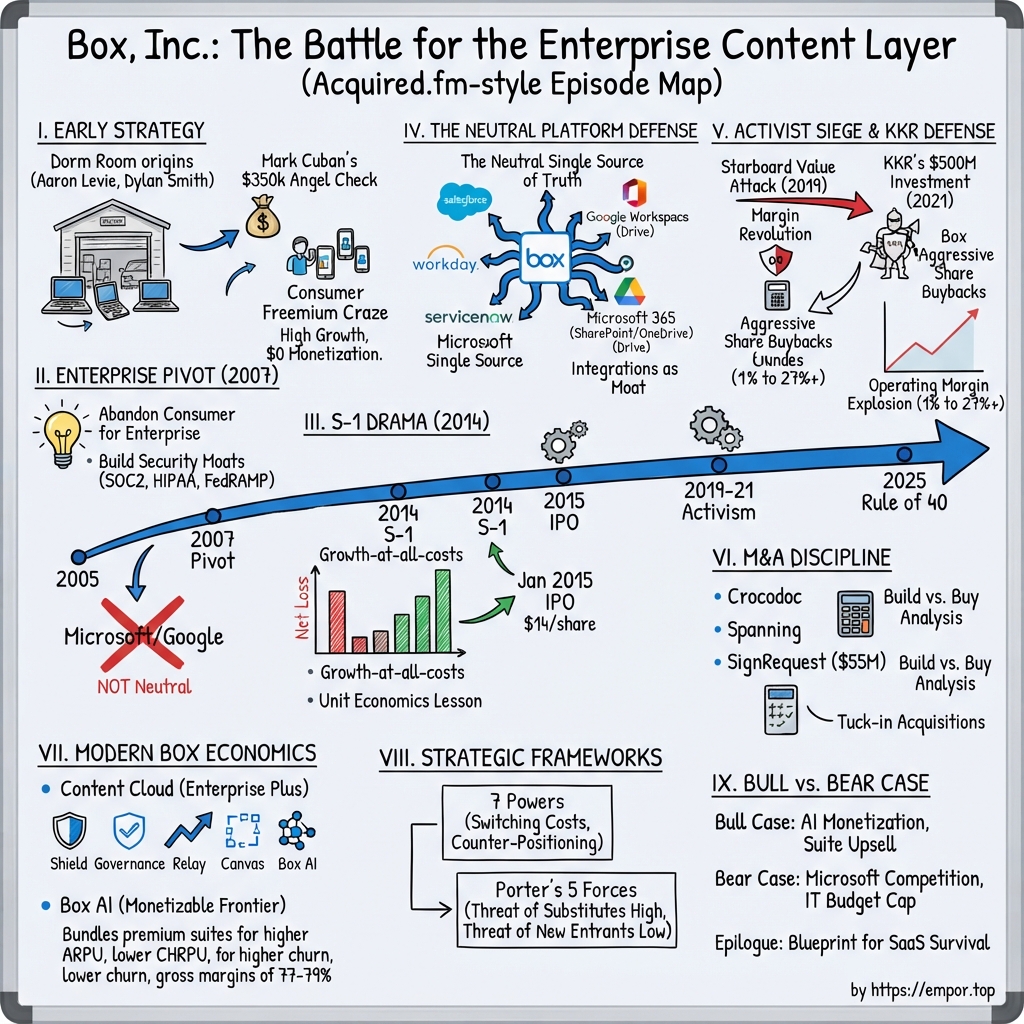
Box, Inc.: The Battle for the Enterprise Content Layer
I. Introduction & Episode Roadmap [00:00 – 09:00]
In 2005, a twenty-year-old business student at the University of Southern California began sending cold emails to potential investors. One landed in the inbox of Mark Cuban, owner of the Dallas Mavericks, who agreed to invest $350,000 before meeting Aaron Levie or any of his co-founders in person.5
Twenty-one years later, on May 26, 2026, Levie announced on an earnings call that Box had returned to double-digit revenue growth for the first time in over three years. First-quarter revenue reached $305.9 million, an 11% year-over-year increase, while net retention rose to 105%, non-GAAP operating margin reached 27.7%, and single-quarter free cash flow totaled $127.7 million.1
Between those two points lies an instructive survival story in enterprise software. Under conventional strategic assumptions, Box should have struggled to survive. It sells cloud file storage and content management to large enterprises—a category where its primary competitors, including Microsoft, Google, and Apple, offer comparable storage virtually free as an add-on to existing enterprise suites. Box explicitly identifies Microsoft SharePoint and OneDrive, Google Drive, and OpenText Documentum as competitors in its Form 10-K.2 From 2015 to 2019, public market investors largely anticipated that these bundled platform offerings would erode Box's market position.
The bundle did not eliminate Box. For investors in 2026, the critical questions are why the company survived and whether its defensive moats remain durable.
Management argues that Box evolved from a commodity storage vendor into a neutral, permission-aware, compliance-grade governance layer positioned between unstructured enterprise content and third-party applications, users, and AI agents. This thesis can be evaluated against operational metrics. On the supporting side, customers pay a 30% to 40% price premium to upgrade from Enterprise Plus to Enterprise Advanced, net retention expanded from 102% to 105% over two years, and remaining performance obligations grew 17% in fiscal 2026 alongside revenue growth of 8%.3 On the other hand, while management has cited AI as a key growth catalyst since 2023, measurable revenue acceleration appeared in reported financials only in fiscal 2026.
The company's financial evolution reflects a notable operational shift. In fiscal 2014, around the time of its initial S-1 filing, Box spent $171.2 million on sales and marketing to generate $124.2 million in revenue—spending $1.38 in go-to-market costs for every dollar of revenue—and posted a net loss of $168.6 million.6 By fiscal 2020, Box achieved its first full year of non-GAAP profitability, recording non-GAAP operating income of $9.3 million, or approximately 1% of revenue.11 By fiscal 2026, non-GAAP operating margin reached 28.3% and annual free cash flow reached $312.9 million on $1.177 billion in revenue.3 Rather than benefiting from a temporary product cycle, Box restructured its cost foundation under pressure from public markets and an activist investor campaign.
This episode examines several key phases: first, Box's dorm-room origins and early consumer focus; second, the 2007–2008 strategic pivot to enterprise storage and the capital-intensive infrastructure build that led to its initial public filing; third, the IPO and subsequent market scrutiny of its unit economics; fourth, its counter-positioning strategy against Microsoft and Google; fifth, the 2019–2021 Starboard Value activist challenge, KKR's preferred-equity investment—which a shareholder lawsuit characterized as an entrenchment tactic—and the subsequent margin expansion; sixth, Box's disciplined M&A history; and seventh, the current operating model, covering product suites, Enterprise Advanced tiers, AI units, and the API business Levie describes as "a file system for agents."22 The analysis concludes with an evaluation of strategic frameworks, management execution, core risk factors, bull and bear scenarios, and key operating metrics for future performance.
Start with the garage.
 Subscribe on LinkedIn
II. Dorm Rooms, Cold Emails, & Consumer File Sharing (2005–2007) [09:00 – 21:00]
The founding scene was unglamorous. In 2005, Aaron Levie was a business student at the University of Southern California, while his childhood friend Dylan Smith was attending Duke University. The problem they set out to solve was mundane and widespread: digital files were trapped on local hard drives, USB drives were easily misplaced, FTP servers required technical administration, and email attachments faced strict size limits. When sharing large files over the internet, users lacked a simple, reliable solution.
The early financing has become familiar Silicon Valley history. Levie and co-founders Dylan Smith, Sam Ghods, and Jeff Queisser initially raised approximately $80,000 from angel investors, partially funded by $20,000 Smith had won playing online poker.5 Levie then launched a cold-email campaign to prospective investors. Mark Cuban's $350,000 investment proved pivotal, providing Levie the financial runway and conviction to drop out of college.5
The contrast between the two founders shaped the company's early governance. Levie was the extrovert who would become one of enterprise software's most vocal public advocates. Smith provided the counterweight: the childhood friend who funded part of the seed round, assumed the chief financial officer role, and has held it for over two decades. That leadership pairing—a visionary CEO alongside a disciplined CFO—became a durable feature of Box's management structure, with both remaining in their roles in 2026.
In its early years, Box.net grew rapidly in consumer file sharing. Freemium storage served as an effective acquisition engine: users registered, invited collaborators, and expanded the product footprint without a direct sales force. Box briefly emerged as a notable competitor in consumer file storage alongside services like Megaupload and RapidShare, just as Dropbox was entering the market.
However, user growth did not translate into sustainable revenue, as consumers resisted paying monthly subscription fees for storage. Two structural forces eroded unit economics simultaneously. Hard drive cost per gigabyte declined rapidly, driving consumer expectations toward free storage, while webmail providers—most aggressively Google's Gmail—expanded attachment and storage limits to acquire users. When a product's core capability is bundled for free by competitors to support broader platform ecosystems, standalone offerings face severe economic headwinds.
In 2007, Levie and Smith concluded that consumer storage pricing would trend toward zero as tech conglomerates absorbed file sharing into their platforms. They recognized that sustainable revenue required targeting enterprise clients with complex requirements absent in consumer products: audit logs, granular access controls, document retention policies, legal discovery capabilities, and regulatory compliance tracking.
Executing this shift required abandoning Box's primary growth engine. At the time, the company's product, branding, and user base were entirely consumer-oriented. Pivoting to the enterprise market entailed a slower sales motion, a longer cash-conversion cycle, a complete rebuild of the permissions architecture, and a capital-intensive direct sales force funded by venture capital rather than organic viral growth.
The strategic pivot also caused shareholder friction. Cuban, whose initial investment thesis relied on consumer adoption, opposed the move. Box subsequently raised a Series A financing round led by Draper Fisher Jurvetson and used a portion of the capital to buy out Cuban's equity position.
This pivot illustrates a fundamental strategic principle: a distribution advantage reliant on a competitor's unwillingness to enter a market is inherently fragile. Box's founders correctly anticipated that platform conglomerates would commoditize consumer storage. However, transitioning to the enterprise market introduced an enduring strategic question: whether those same platform competitors would eventually commoditize enterprise content management as well.
By 2011, the enterprise pivot had generated sufficient commercial traction that Citrix reportedly offered approximately $600 million to acquire Box. The founders declined the acquisition and instead raised $81 million in venture capital.7 Rejecting a nine-figure buyout marked Box's transition from an early-stage startup into a growth-stage enterprise entity. To justify declining the acquisition offer, Box committed to an aggressive, capital-intensive expansion strategy to build a business worth a multiple of that valuation.
III. The Enterprise Pivot & S-1 Drama: Growth at All Costs (2008–2015) [21:00 – 38:00]
Transitioning to an enterprise sales model required a fundamental shift in strategy. Instead of selling simple cloud storage, Box focused on specialized compliance and security capabilities. For example, pitch meetings with pharmaceutical companies centered on enabling clinical research teams to share files securely with contract research organizations under permission structures compliant with regulatory standards and supported by verifiable audit trails. Each deal required dedicated specialists, legal and security reviews, and custom proofs of concept, stretching sales cycles across months while securing multi-year contracts.
Between 2008 and 2013, Box built a capital-intensive enterprise engine by re-architecting its platform around granular permissions, directory integration, and enterprise identity. The company pursued rigorous compliance certifications required by regulated buyers, including FedRAMP High, FINRA, GxP, HIPAA, and StateRAMP.2
These regulatory frameworks function as structural entry barriers rather than standard product features. FedRAMP High, the U.S. government's security baseline for sensitive systems, requires documenting hundreds of security controls, submitting to third-party audits, and maintaining continuous monitoring—a multi-year process costing millions of dollars. Similarly, GxP validation governs pharmaceutical records, HIPAA protects healthcare data, and FINRA enforces record retention for financial institutions. Because regulated enterprises cannot adopt unvalidated software, these arduous certifications served as defensive moats against potential competitors.
While competitors like Dropbox focused on consumer adoption, Box targeted corporate IT departments. By the time of its initial public filing, its customer base included major enterprises such as Ameriprise Financial, Bechtel, Eli Lilly, Gap, and Schneider Electric.6
On March 24, 2014, Box filed its initial Form S-1, revealing rapid top-line expansion alongside heavy operational losses. Revenue rose from $21.1 million in the year ended December 2011 to $58.8 million in fiscal 2013 and $124.2 million in fiscal 2014—representing consecutive annual growth rates of 179% and 111%.6 The platform registered 25 million users across more than 225,000 organizations, including over 34,000 paying accounts and deployments reaching up to 60,000 seats.6 Furthermore, Box had secured over 40% of the Fortune 500 as paying business customers.6
However, the filing also exposed steep financial deficits. Net losses expanded from $50.3 million in 2011 to $112.6 million in fiscal 2013 and $168.6 million in fiscal 2014, resulting in an accumulated deficit of $361.2 million by January 31, 2014.6 Sales and marketing expenses reached $171.2 million in fiscal 2014, consuming 138% of revenue—meaning Box spent $1.38 on customer acquisition for every dollar of revenue booked.6 Notably, the prospectus stated that the company did not expect to achieve profitability for the foreseeable future.6
This cost structure drew intense scrutiny from public market investors. The core debate centered on whether Box's aggressive spending represented a durable investment in long-term enterprise subscriptions or an unsustainable reliance on capital markets. Proponents noted that Box achieved a 79% gross margin in fiscal 2014 and argued that sticky enterprise contracts would yield favorable economics as the sales organization matured.6 Critics countered that burning $91.8 million in operating cash flow in a single year left the business vulnerable if revenue growth decelerated.6
Shifting SaaS market valuations forced Box to delay its public debut. The company amended its S-1 prospectus in July 2014, December 2014, and January 2015—a nine-month delay reflecting broader investor resistance to cash-burning growth models.
On January 22, 2015, Box priced 14,375,000 shares at $14.00 per share, above its expected range, raising $175 million at an initial valuation of approximately $1.67 billion.89 The stock opened on the NYSE the following day and closed 66% above its offer price.
The initial enthusiasm soon waned as public markets prioritized unit economics over top-line growth. Between 2015 and 2019, Box's stock traded primarily below or near its first-day closing price—a prolonged period of stagnation that activist investor Starboard Value later cited in its campaign against management.13
This outcome highlighted a central operational vulnerability: strategies reliant on continuously favorable capital markets leave companies exposed when investor sentiment shifts. Having navigated consumer commoditization in 2007, Box faced a new test as public markets challenged its customer acquisition economics—just as major tech incumbents mounted direct competition for enterprise cloud content management.
IV. The Neutral Platform Defense: Winning Against Microsoft & Google [38:00 – 54:00]
Consider the competitive environment facing a sell-side analyst in 2016.
A Fortune 500 chief information officer renews an enterprise software contract with Microsoft. Bundled into that agreement at zero incremental cost are OneDrive for individual cloud storage and SharePoint for team document management. Google Workspace presents a similar structure with Google Drive. Both incumbents deploy established enterprise sales teams, hold signed contracts, and incur negligible marginal costs to add storage capacity already underwritten by their broader platform suites.
Against those bundled offerings, Box sold a standalone subscription line item that required explicit justification during annual budget reviews. The market consensus was straightforward: Box offered a feature rather than an independent enterprise platform, leaving it vulnerable to commoditization by bundled competitors.
Box countered with a strategic positioning framework that management maintained for over a decade, built on an operational reality of large organizations: enterprise IT rarely standardizes on a single software vendor. Instead, companies simultaneously run Salesforce for customer relationship management, Workday for human resources, ServiceNow for IT service management, Slack and Microsoft Teams for collaboration, Zoom for video conferencing, Adobe for creative assets, and dozens of specialized line-of-business applications. Box's Form 10-K lists key integration partners including Adobe, Apple, Cisco, CrowdStrike, Google, Guidewire, IBM, Microsoft, Okta, Oracle-NetSuite, Palo Alto Networks, Salesforce, ServiceNow, Slack, USDM, Workday, and Zoom.2
In a multi-vendor environment, enterprise content management extends beyond baseline storage costs to address document authority, cross-system access, and centralized compliance governance.
Microsoft's architecture prioritizes keeping content within its proprietary ecosystem—an operational design aligned with a platform strategy. While SharePoint functions effectively within a Microsoft-centric infrastructure, cross-vendor workflows introduce operational complexity. When a contract originates in a legal software tool, undergoes multi-department review, requires digital execution, attaches to a customer record in Salesforce, and mandates a seven-year retention policy under FINRA rules before audit production, an enterprise faces a structural choice: maintain fragmented governance policies and data silos across separate applications, or store a single authoritative record in a neutral repository accessible across all tools.
Box targeted the neutral repository model. Rather than framing its product as a direct alternative to SharePoint file storage, Box pitched its platform as a unified governance layer enforcing security, retention, and access policies consistently across third-party applications. Under this framework, a data loss prevention policy restricted to a single vendor's application creates compliance exposure across the remaining software stack.
In strategic terms, this approach reflects a classic counter-positioning strategy: Box adopted a vendor-neutral operational model that incumbents could not replicate without undermining their own ecosystem incentives. While Microsoft could technically support deep integration with competing platforms like Google Workspace, its commercial model incentivizes centralizing workloads within Microsoft 365. True vendor neutrality remains structurally misaligned with the incentives of an ecosystem owner.
In practice, vendor neutrality enabled Box to defend its enterprise footprint without dominating the broader market. Box did not replace SharePoint across most enterprise accounts; instead, it secured defensible market share in high-governance use cases, including regulated industries, cross-organizational collaboration, and complex content workflows. In its public filings, Box characterizes the market as "fragmented, rapidly evolving and highly competitive, with relatively low barriers to entry for certain applications and services."2
The commercial value of neutral positioning appears in customer retention metrics rather than rapid market share expansion. Enterprises that integrated Box across identity frameworks, regulatory retention rules, and multi-application workflows faced steep migration costs, requiring the relocation of petabytes of governed content and re-validation of downstream compliance systems. As a result, Box's annualized full churn rate has remained at approximately 3%.1 For an enterprise software vendor competing against free bundled alternatives, a low churn rate indicates that switching costs remain a significant operational barrier.
Additionally, Box's relationship with major competitors highlights a co-opetition model. Both Microsoft and Google are listed as technology integration partners in Box's filings.2 Rather than requiring customers to abandon Microsoft 365, Box integrates directly with Microsoft editing applications: employees edit documents in Microsoft Word while the underlying file remains secured, version-controlled, and governed within Box's perimeter. This architecture allows enterprise clients to adopt Box's content governance layer without disrupting established end-user workflows.
However, strong customer retention did not accelerate top-line growth. From fiscal 2020 through fiscal 2025, Box's revenue expanded at a modest high-single-digit compound annual rate, rising from $696 million to $771 million, then to $874 million, $991 million, $1.038 billion, and $1.090 billion.3 While vendor neutrality provided a durable defensive moat, it did not generate rapid top-line expansion.
That combination of high customer retention and decelerating revenue growth set the stage for activist investor intervention.
V. Activist Siege, KKR Defense, & The Operational Margin Revolution (2019–2021) [54:00 – 01:12:00]
On September 3, 2019, Starboard Value disclosed a 7.5% stake in Box.12 Jeffrey Smith and Peter Feld's fund had a well-earned reputation in technology: it had run campaigns that reshaped boards, replaced executives, and — in the case of Darden Restaurants — replaced an entire board. Starboard's diagnosis of Box was not subtle, and in retrospect much of it was accurate.
The critique, laid out in Starboard's own words in its July 2021 open letter to shareholders, was that Box had "consistently underwhelmed and failed to execute on operational improvement opportunities," with "years of stock price underperformance, consistently missed targets, poor governance, and a lack of credibility with the investment community."13 Set against Box's actual financials, that was hard to dismiss. Fiscal 2020 revenue grew 14% and produced non-GAAP operating income of $9.3 million — about 1% of revenue — in a year the company celebrated as its first full year of non-GAAP profitability.11 By the standards of a company that had been public for five years and had spent more than a billion dollars cumulatively on sales and marketing, 1% margins were not a milestone. They were an indictment.
The first phase of the campaign ended constructively. In March 2020, Box and Starboard reached a settlement: two new independent directors recommended by Starboard and one selected by the company joined the board, three incumbent directors departed — including CFO Dylan Smith, whose seat on his own company's board Starboard had specifically targeted as a governance conflict — and the board formed an Operating Committee charged with improving growth and margins.13
There is a detail from this period that says more about the dynamic than any proxy filing. On September 3, 2020, Levie emailed Feld: "Just wanted to say thanks for all the pushing on us over the past year. We have a lot more we need to get done but we have a completely new way of seeing [the] world that is extremely helpful to how we're executing now. So, thanks."13 Starboard reproduced that email in its shareholder letter, which tells you how the relationship ended. But the email itself is evidence that the operational critique landed and was internalized.
What broke the truce was growth. In December 2020, Box missed on billings and large-deal growth and guided fourth-quarter revenue below consensus; the stock fell almost 9% the next day.13 By Starboard's calculation, Box's share price at that moment was 1% above where it had traded the day after the fund's 13D and 27% below its first-day-of-trading close from January 2015.13 Starboard escalated, telling the board privately that if Box chose to stay independent after a strategic review, leadership changes might be required.
Then came the defense — and this is where an investor should slow down, because the governance question here is genuinely contested and remains relevant to how one weighs this management team.
In January 2021, with roughly $275 million of cash on hand, Box raised $345 million through a convertible note issue.13 On April 8, 2021, with more than $500 million of cash on the balance sheet, Box announced a $500 million preferred equity investment led by KKR, structured as 500,000 shares of Series A Convertible Preferred Stock at $1,000 per share, carrying a 3% dividend and an initial conversion price ultimately set at $27.00.214 The stated purpose was to fund a Dutch auction self-tender of up to $500 million of common stock. John Park, KKR's Head of Americas Technology Private Equity, joined the board when the deal closed on May 12, 2021.14 Board Chair Bethany Mayer framed it as "the culmination of the Board's comprehensive review of a wide range of strategic options."14
Starboard's reading was less charitable, and it is the reading an activist-minded investor should take seriously. The preferred stock voted on an as-converted basis, and the original terms required KKR and the co-investors to vote in line with the board's recommendation.13 Starboard called the two financings — nearly $850 million raised by a company generating positive free cash flow every quarter and already sitting on cash — an attempt to "buy the vote."13 In May 2021, the Building Trades Pension Fund of Western Pennsylvania filed a class action alleging the board had breached its fiduciary duties in approving the financing and seeking to enjoin the voting provision. One day after the complaint was filed, the board eliminated the voting obligation.13
The tender offer that was supposed to justify the whole structure also underperformed. Box repurchased $238 million of stock at $25.75 per share, well short of the $500 million target, meaning the preferred issuance was immediately dilutive rather than accretive.13 KKR ultimately retained only $150 million of the $500 million, syndicating $350 million to other investors.13
CNBC reported in July 2021 that Starboard had been trying for months to remove Levie as CEO.16 Box took the fight public in its own SEC filings.17 The vote came at the annual meeting on September 9, 2021, and Box's slate won.15 Feld's response was pointed: the results, he said, "were heavily skewed by the voting rights tied to the preferred equity financing."15
So how should this be scored? Two things can be true at once, and both matter.
First, the defense worked, and the mechanism by which it worked was a capital structure that gave friendly holders a voting block — a structure a court complaint characterized as entrenchment and that the board partially unwound under legal pressure. That is a governance fact, not an opinion, and it is the single strongest item on any skeptic's list about this board.
Second, having won, management proceeded to execute Starboard's operating thesis almost in full. Non-GAAP operating margin went from roughly 1% of revenue in fiscal 2020 to 28.3% in fiscal 2026.113 Basic shares outstanding came down; in fiscal 2026 alone Box repurchased 9.7 million shares for $292.9 million, following 7.6 million shares for $211.5 million in fiscal 2025.2 Free cash flow reached $312.9 million.3 The company shifted from selling standalone seats to selling multi-product suites, which now account for two-thirds of revenue.3
The uncomfortable synthesis is that Box's management appears to have needed the activist. The margin transformation began under Starboard's pressure and continued after Starboard lost. An investor evaluating this team should hold both facts: they defeated an activist using a contested financial structure, and they then delivered the operational improvement the activist demanded. Credit for the second does not erase the first.
What it did buy them was the freedom to make their own bets on where the content layer was going next.
VI. M&A & Capital Deployment Record [01:12:00 – 01:24:00]
Throughout its public history, Box avoided using major acquisitions to compensate for slowing organic growth.
Between 2015 and 2021, enterprise software-as-a-service valuations rose sharply, giving high-flying vendors expensive stock to use as acquisition currency. DocuSign, for instance, traded above 20 times revenue at its peak in 2021, and content workflow assets fetched premium valuations. With top-line growth slowing and an activist investor pressing for operational changes, Box faced strong market pressure to pursue a large transaction.
Instead, Box maintained a disciplined strategy focused exclusively on targeted, technical tuck-in acquisitions.
Crocodoc (May 2013). Box acquired the Y Combinator-backed startup for cash and stock under undisclosed terms.10 Crocodoc developed software that converted documents into HTML5 and SVG formats, allowing files to render directly inside a web browser without requiring users to download heavy image files.10 That underlying rendering engine became foundational to Box's enterprise value proposition. Enabling users to securely preview, annotate, and review documents in a browser across any device reinforced Box's core claim of serving as a centralized, governed content repository.
SignRequest (February 2021, $55 million). Box acquired the Netherlands-based electronic signature startup—which had accumulated over 500,000 users since its 2014 founding—for $55 million, rebranding the tool as Box Sign.18 The transaction addressed a clear operational gap. Electronic signatures had become routine in document workflows, yet Box customers were frequently paying third-party providers like DocuSign for the service. By purchasing a functional asset at a modest price and bundling signature capabilities directly into its business and enterprise plans, Box converted revenue leakage into a retention feature.
The pricing contrast highlighted Box's capital discipline. Box spent $55 million to secure an internal signature engine in 2021, a year when market leaders in the category commanded valuations exceeding 20 times revenue. Rather than buying market share, Box acquired specific software capabilities to complete its native workflow. In its Form 10-K filings, Box describes Box Sign as integrated with Box Shield access policies and Box Relay automated workflows, while supporting 21 CFR Part 11 compliance as part of Box GxP Validation for life sciences clients.2 This integration illustrates management's broader strategy: standalone features gain defensive value primarily when embedded within Box's governance framework.
Crooze and Alphamoon (2024). Box acquired Alphamoon, a Poland-based artificial intelligence firm specializing in intelligent document processing, which combined large language models with proprietary optical character recognition to extract structured metadata from complex documents such as contracts, invoices, and financial statements; terms were not disclosed.2324 Together with Crooze, which added no-code application capabilities, these purchases supplied the technical foundation for Box Extract and Box Apps—the key capabilities anchoring the premium Enterprise Advanced subscription tier. Purchasing specialized extraction technology enabled Box to shorten its time to market on the core document extraction use case that management describes as its "killer app."4
Box's acquisition strategy is equally notable for what it avoided: the company did not buy legacy records-management providers, high-multiple security vendors, or adjacent software lines to artificially boost revenue growth. Instead, Box built its migration capabilities internally. Box Consulting oversees platform implementations, while Box Shuttle manages petabyte-scale content migrations from legacy file servers, legacy content repositories, and competing cloud tools.2 While many software vendors outsource complex data transfers to third-party integrators, Box developed proprietary migration tooling to eliminate a major barrier to enterprise adoption: customer reluctance to undertake complex data migrations.
On capital allocation more broadly, Box's strategy following the Starboard activist campaign has remained consistent. The company has returned cash to shareholders through buybacks to offset stock-based compensation dilution—in fiscal 2026, repurchases consumed more than 90% of free cash flow.22 In March 2026, the board authorized an additional $500 million share repurchase program; Box bought back 4.8 million shares for approximately $114 million in the first quarter of fiscal 2027, leaving roughly $445 million in remaining authorization as of April 30, 2026.1
Offsetting factors warrant equal attention. Stock-based compensation reached $233.7 million in fiscal 2026—representing nearly 20% of revenue—meaning share buybacks primarily absorb new equity issuance rather than significantly reducing net share count. Box also carries $460 million in 1.50% convertible senior notes due September 2029, issued in September 2024, and settled $205 million of its 2021 convertible notes in cash upon their January 15, 2026 maturity.222 Furthermore, the preferred equity issued to KKR remains outstanding, requiring $15 million in annual dividend payments. While Box maintains a solid liquidity position—ending the first quarter of fiscal 2027 with $479 million in cash, cash equivalents, restricted cash, and short-term investments—its capital structure remains more complex than a simple cash-compounding model suggests.1
Ultimately, Box's M&A strategy has proven value-accretive by avoiding dilutive, high-priced transactions while methodically filling core product gaps. The key long-term question for investors is whether small tuck-in acquisitions will be sufficient to keep pace with rapid technological shifts in an enterprise AI market where underlying models and capabilities evolve monthly.
VII. Core Business Deep Dive: Economics, Segments, & Box AI [01:24:00 – 01:42:00]
Strip away the narrative, and Box operates as a subscription business with a straightforward financial profile: virtually all of its revenue is recurring. Non-GAAP gross margin reached 82.3% in the fourth quarter of fiscal 2026, though management projects a slight moderation to between 81% and 81.5% for fiscal 2027—a step-down driven by the compute costs of AI features that standard storage software never had to support.221 International markets account for roughly 40% of revenue, with Japan generating about 65% of that overseas total, making the yen a meaningful driver of top-line results rather than a secondary currency effect.22 Consequently, Box flags the Japanese yen first among its currency risks in its Form 10-K.2 As of January 31, 2026, the company employed 2,912 people.2
Underlying this business model is a core commercial shift: moving from individual seat sales to multi-product suites.
Historically, selling standalone seats created structural headwinds. Clients purchased basic cloud storage at low per-user rates, utilized the service as a digital file repository, and evaluated renewals primarily on price. With few expansion paths, net expansion hovered near 100%, forcing growth to rely almost entirely on acquiring new accounts in a market where bundled competitors were already pre-installed.
The suite strategy altered those dynamics. By bundling security (Box Shield), governance and retention tools (Box Governance), workflow automation (Box Relay), electronic signatures (Box Sign), and eventually AI capabilities into unified pricing tiers, Box built multiple expansion vectors into each account. Suite customers now generate 67% of total revenue, up from 61% a year earlier.1 This mix shift drove the recovery in net retention; clients adopting multi-product suites integrate Box deeper into their operational workflows, improving both seat expansion and realized pricing.
In January 2025, Box introduced Enterprise Advanced, its premium subscription tier, bundling no-code application builders (Box Apps), configurable AI agents (Box AI Studio), automated document generation APIs, and expanded file size limits.21 Early commercial adoption represents a central pillar of the current bull thesis. Within its first year, Enterprise Advanced reached 10% of total revenue while capturing a 30% to 40% per-seat price premium over Enterprise Plus—matching the upper bound of management's original 20% to 40% guidance.22 By the first quarter of fiscal 2027, net retention within the Enterprise Advanced tier exceeded the company-wide average of 105%.14
These metrics provide tangible evidence of pricing power: clients paying a third more per seat for identical user counts indicates that buyers view the additional capabilities as high-value additions. However, CFO Dylan Smith offered an important caveat during the fourth-quarter earnings call, noting that initial Enterprise Advanced upgrades came primarily from existing Enterprise Plus clients—a pattern he described as natural self-selection among power users.22 While early adoption has validated demand among core accounts, broader market penetration will depend on converting less intensive users.
The broader strategic test over the next five years rests on how Box monetizes unstructured data.
An estimated 90% of enterprise information exists in unstructured formats—contracts, presentations, reports, media files, and internal documents. While structured data resides neatly in searchable database tables, unstructured content historically offered limited utility beyond basic keyword retrieval and file storage.
Large language models alter that dynamic by analyzing and synthesizing long-form documents. However, deploying generative AI across enterprise repositories introduces significant compliance risks: standard models lack inherent awareness of user access rights. An unconstrained AI assistant answering an inquiry regarding department salaries might pull restricted data from confidential HR files, creating severe data exposure.
Box's technical architecture addresses this risk by enforcing existing permission models on all AI queries. If an employee lacks authorization to view a specific document directly, the AI assistant cannot draw upon that file to generate answers. Consequently, Box's prior investments in regulatory compliance and strict access governance—such as FedRAMP High and GxP validations—have become critical enablers for enterprise AI adoption.
Complementing its permission architecture is Box's model-neutral approach. Box AI launched in May 2023 using OpenAI models before expanding to support multiple third-party providers.1920 Management now positions the platform as an intelligent routing layer, allowing enterprise clients to direct workloads to different frontier models based on cost and accuracy requirements. Box has served as an early launch partner for model updates from Anthropic, OpenAI, and Google.224 During the first-quarter fiscal 2027 call, Levie highlighted "token budgeting" as a central priority for chief information officers, arguing that a neutral broker can route routine extraction tasks to lower-cost models without sacrificing output quality—reducing total customer expense while expanding Box's overall subscription footprint.4
While this multi-model routing argument is strategically logical, it remains a management assertion that has yet to be broken out separately in disclosed financial results.
Product releases through fiscal 2026 and early fiscal 2027 aligned directly with this roadmap. Box Extract, which became generally available in the fourth quarter of fiscal 2026, converts unstructured files into structured metadata by automatically parsing dates, contract values, and key clauses.22 Box Shield Pro subsequently added agentic threat detection to the core security suite. In the first quarter of fiscal 2027, Box launched two core AI products: Box Agent, a unified assistant that searches and synthesizes content within established security boundaries, and Box Automate, a workflow engine designed to orchestrate tasks across human users, autonomous agents, and external enterprise systems.4 Together, these tools form a clear progression: converting raw documents into structured metadata, deploying AI agents to analyze that data, and automating multi-step business processes like vendor onboarding or legal review.
Levie identified document extraction as the platform's primary adoption driver, characterizing it as a key application for organizations managing high volumes of contracts, invoices, and financial filings, while noting that these workflows drive substantial consumption of AI processing units.4 This commercial traction indicates that initial enterprise AI revenue is originating from high-volume, routine document processing rather than open-ended conversational chat.
Monetization currently flows through three primary channels. The largest remains seat-based subscriptions via the Enterprise Advanced tier. The second is consumption-based AI units, which customers draw down to run native agents—a stream Levie described as expanding steadily alongside extraction workloads.4 The third channel is platform API consumption, where external AI agents built on third-party frameworks access and update Box content programmatically.
Regarding this programmatic channel, management has articulated a distinctive interface strategy. Asked on earnings calls whether third-party interfaces like ChatGPT, Claude, or Microsoft Copilot threaten Box's engagement, Levie stated that Box is not attempting to control the primary user interface.4 Instead, the company aims to embed its governance layer behind external applications, auditing and securing file interactions regardless of where the user prompt originates. As Levie summarized, software agents rely fundamentally on underlying document repositories to execute tasks.22
This strategy carries clear operational tradeoffs. Critics argue that ceding the user interface risks reducing Box to a commodity backend, placing pricing power in the hands of front-end application owners. Box counters that enterprise governance, access controls, document retention, and compliance auditing represent the defensible core of content management—critical capabilities dictated by regulatory requirements rather than surface-level software features.
Whether vendor-neutral backend governance provides sufficient long-term pricing power remains an open question. Public disclosures do not yet break out AI unit or API consumption revenue separately, and management has indicated that consumption-based platform revenue is not expected to materially alter net retention in fiscal 2027.22 Consequently, Box's AI initiatives currently manifest primarily as an incentive for customers to upgrade to higher seat-based subscription tiers rather than as a standalone revenue engine.
VIII. Strategic Frameworks: 7 Powers & Porter's 5 Forces [01:42:00 – 01:54:00]
Strategic frameworks are useful only when applied with discipline, which requires acknowledging when a competitive power is absent. Applied to Box:
Hamilton Helmer's 7 Powers
Switching costs — strong, and evidenced. This represents Box's most defensible power and the only one supported by clear quantitative data. When a large enterprise embeds Box into its retention schedules, identity and access management systems, cross-application workflows, and regulatory audit procedures, migrating away involves far more than moving data files. It requires re-certifying regulatory compliance, re-mapping complex permission trees, re-validating GxP- or FedRAMP-relevant controls, and accepting compliance risk during the transition. The quantitative proof lies in an annualized full churn rate of roughly 3%, sustained against free bundled alternatives.1 Crucially, Box specifically discloses full churn, while its management discussion and analysis acknowledges that customer budget scrutiny has increased partial churn, where customers stay but shrink.2 That distinction matters: the moat deters complete departures more effectively than it prevents seat contraction.
Counter-positioning — historically strong, now eroding. Vendor neutrality served as a genuine counter-position for a decade because Microsoft and Google could not credibly match it without undercutting their own ecosystem strategies. In the artificial intelligence era, however, this advantage has weakened for two reasons. First, frontier model providers remain inherently storage-neutral, as providers like Anthropic and OpenAI connect readily to SharePoint. Second, Microsoft has narrowed the cross-vendor gap with Copilot connectors. Consequently, while neutrality still differentiates Box from Microsoft, it no longer distinguishes the platform from the AI partners it relies upon.
Cornered resource — weak, and frequently overstated. Bullish arguments occasionally suggest that Box's accumulated enterprise content and permission metadata form a proprietary asset required by AI models. That claim does not withstand scrutiny. Box does not own customer data; clients retain ownership and can export their content at will. Furthermore, Box holds no rights to train models on customer files and would destroy its core compliance posture by attempting to do so. The platform possesses custody and governance tooling—which constitute switching costs rather than a cornered resource. Conflating custody with a cornered resource mischaracterizes the business.
Scale economies — modest. A gross margin above 81% reflects a mature infrastructure footprint, but Box lacks the absolute scale of cloud hyperscalers needed to secure a structural cost advantage. Moreover, rising AI inference costs exert downward pressure on profitability.
Process power, branding, and network economies — absent. Box maintains a respected enterprise brand, yet there is no evidence of a pricing premium independent of specific product features. Similarly, the product features no meaningful network effects, as an organization derives no added utility from Box simply because other companies use it.
Porter's Five Forces
Threat of new entrants — low, driven by regulatory barriers. Basic cloud file storage is simple to build. What cannot be built quickly is Box's extensive compliance coverage, including FedRAMP High authorization, GxP validation, FINRA-grade record retention, StateRAMP certification, and in-region data residency across multiple geographies via Box Zones.2 Securing these validations requires years of audits and tens of millions of dollars in investment. Box's filings describe low barriers to entry for certain applications, and that honesty is appropriate: the barrier protects the regulated-industry core, not the whole business.2
Buyer power — moderate to high, and rising. Enterprise procurement teams negotiate seat counts aggressively during budget cycles, and Box's own disclosure notes tightened budget scrutiny pressuring seat expansion.2 The Enterprise Advanced tier partially counters this dynamic by shifting negotiations from per-seat pricing to specialized capabilities, though buyers continue to hold leverage via low-cost bundled alternatives.
Supplier power — low, with emerging AI risk. Box operates a hybrid infrastructure model combining public cloud resources and dedicated data centers, preserving operational flexibility. However, AI model providers represent an emerging exception: if inference costs escalate faster than Box can pass those expenses to customers, gross margins will compress. The fiscal 2027 gross margin guide of 81%–81.5%, down from 82.3% in the fourth quarter of fiscal 2026, is the first visible instance of this.221
Threat of substitutes — high and permanent. Enterprise suites like Microsoft 365 and Google Workspace include cloud storage and collaboration tools that are "good enough" for a large fraction of use cases. This dynamic establishes a permanent structural ceiling on Box's addressable market.
Rivalry — high. Box competes with Microsoft and OpenText in content management, Microsoft and Google in file sync and share, and an expanding array of e-signature, workflow automation, AI, and security vendors as its product surface widens.2 Broadening the product footprint expands the competitor set—a critical consideration, as every new suite component invites a new specialized rival.
Evaluating Box through these frameworks yields a clear conclusion: the company possesses one strong power (switching costs), one decaying power (counter-positioning), and a narrow regulatory entry barrier, operating in an industry defined by permanent substitute pressure. This combination supports a defensible, cash-generative enterprise software business, rather than a compounding platform with broad structural pricing power. Investment theses requiring the latter misinterpret the underlying economics.
IX. Management & Governance Evaluation [01:54:00 – 02:04:00]
Aaron Levie is among the most visible chief executives in enterprise software, and that visibility cuts both ways for investors.
The strategic case for his leadership rests on two decisions that were non-obvious when made. In 2007, Levie pivoted Box away from consumer file sharing to target enterprise accounts at a time when consumer adoption was expanding and the enterprise product did not yet exist. In 2023, he positioned Box as a vendor-neutral, permission-aware content layer across multiple artificial intelligence models rather than committing exclusively to a single partner. Both strategic bets proved correct.
The counterargument centers on Box's operational performance between fiscal 2016 and 2021. During that period, the company expanded top-line revenue while generating minimal operating profit. Starboard Value's critique—pointing to missed financial targets and eroded capital markets credibility—was supported by Box's historical ratio of guidance to delivery.13 While subsequent margin expansion was substantial, it originated under activist pressure, as Levie acknowledged in written correspondence to Starboard.13
Co-founder Dylan Smith has served as chief financial officer since inception. His operational record since fiscal 2021 provides strong support for current management: non-GAAP operating margin expanded from roughly 1% to 28.3%, annual free cash flow reached $312.9 million, and share repurchases absorbed over 90% of free cash flow. Furthermore, guidance has turned conservative: Box exceeded its targets across headline metrics in recent quarters, including fourth-quarter fiscal 2026 non-GAAP earnings per share of $0.49 against $0.33 projected—though management transparently disclosed that tax items accounted for most of the beat, leaving a two-cent operational outperformance.322
Volunteering that tax decomposition reflects the reporting transparency that builds management credibility over time.
Executive communication across earnings calls has also maintained consistency. In March 2026, Smith outlined three operating priorities: accelerating revenue growth through go-to-market investments, driving internal efficiencies via AI tooling and lower-cost location strategies, and executing disciplined capital allocation.22 In May 2026, management reported results against those exact priorities in identical order.4 When asked why fiscal 2027 operating margins were guided flat rather than higher, Smith cited an intentional decision to reinvest capital into top-line growth rather than an operational ceiling, noting that Box had previously expanded margins during single-digit revenue growth periods.22 That provides a clear, verifiable rationale rather than a generic macroeconomic excuse.
Board governance presents a more complex record.
The 2021 governance refresh added Starboard-recommended independent directors alongside KKR's John Park while removing the CFO from the board—structural oversight improvements that Box initially resisted.1314 However, the mechanism protecting board control involved a preferred equity issuance that shareholder litigation alleged was structured to entrench management; the board eliminated the preferred voting commitment the day after the lawsuit was filed, and the accompanying self-tender missed its target, rendering the transaction dilutive.13 That preferred equity remains outstanding, requiring $15 million in annual dividends. While Peter Feld's assertion that the shareholder vote was skewed by preferred voting rights reflected an activist perspective, it was supported by the structural terms of the financing.15
Executive compensation structure shows both alignment and ongoing dilution. Both founders maintain substantial equity stakes, aligning their incentives with long-term shareholder value creation. Conversely, overall employee compensation relies heavily on equity: in fiscal 2026, stock-based compensation totaled $233.7 million on $1.177 billion in revenue—meaning nearly 20% of revenue went to equity grants that GAAP includes but non-GAAP metrics exclude.2 Consequently, the non-GAAP operating margin of 28.3% contrasts with a GAAP operating margin of 7.1% for fiscal 2026.3 While this divergence is common across software companies, it underscores why share repurchases serve primarily to offset dilution rather than return net capital. Evaluating the net share count trajectory reveals a positive trend: basic shares outstanding fell by over three million in fiscal 2026, and management guided weighted average diluted shares for fiscal 2027 to approximately 139 million, down two million from prior projections.224
For long-term investors, the governance record offers a balanced picture: management has demonstrated strong operational execution since 2021, sustaining margin expansion after activist pressure subsided. However, the defensive restructuring during the 2021 proxy contest remains a permanent record of how the board responds when corporate control is threatened. Furthermore, annual stock-based compensation of $233.7 million against $1.177 billion in revenue represents a continuous cost that share repurchases mitigate but do not eliminate.2
X. Stress Tests, Risk Radar, & Bull vs. Bear Case [02:04:00 – 02:18:00]
Evaluating Box's long-term outlook requires defining the specific operating conditions necessary for both the bull and bear thesis to hold, then tracking performance against concrete metrics.
Material Risk Radar
Microsoft closing the AI governance gap. This remains Box's most central operational risk. Box's AI positioning relies on the premise that enterprises require a vendor-neutral, permission-aware governance layer for fragmented content systems. If Microsoft enhances Copilot to reliably enforce cross-platform permissions with audit trails acceptable to compliance officers, a substantial portion of Box's upgrade pipeline could be at risk as enterprise clients choose to rely on bundled E5 licensing. While Box contends that Microsoft cannot maintain true neutrality across competing ecosystems like Google Workspace or Salesforce, that counter-argument faces pressure as Microsoft continues investing in cross-platform connectors.
AI feature commoditization and margin pass-through. Rapid advancements in document summarization and extraction continue to reduce processing costs. CEO Aaron Levie has framed model improvements as advantageous for Box, asserting that higher accuracy unlocks additional automatable enterprise workflows.22 However, if extraction features become standardized across competing content management tools, the 30% to 40% price premium commanded by Enterprise Advanced could face compression during contract renewals. Gross margin trends warrant close monitoring: management's projection for fiscal 2027 already stepped down roughly 80 basis points from fourth-quarter fiscal 2026 levels, indicating that if underlying AI compute and inference costs escalate faster than subscription pricing can absorb them, operating leverage could moderate.221
Seat-model exposure to agentic workflows. During the fourth-quarter fiscal 2026 earnings call, sell-side analysts questioned whether seat-based licensing faces long-term structural risks if AI automation reduces knowledge worker headcount.22 Levie responded that software agents generate a higher volume of documents requiring secure governance and storage, allowing Box to monetize through either seat expansions or platform consumption. While logically coherent, this monetization thesis remains unproven; consumption-based platform revenue is not yet separately disclosed, and management stated it will not materially impact net retention in fiscal 2027.22 Until consumption revenue is reported independently, seat-based exposure remains a key structural risk.
Foreign exchange volatility. With international markets generating roughly 40% of total revenue and Japan representing approximately 65% of overseas sales, Japanese yen fluctuations significantly impact reported top-line results.22 For example, in the first quarter of fiscal 2027, billings expanded 5% on a reported basis but grew 13% in constant currency—an eight-percentage-point foreign exchange drag that highlights how currency movements can distort underlying operational performance.1
Cybersecurity vulnerabilities. For a dedicated governance platform, security risks are central to business viability. A significant breach would directly undermine Box's primary market positioning as a secure enterprise repository. The risk environment is also expanding as autonomous AI agents from third-party tools like Anthropic's Claude and OpenAI interact with Box repositories. Levie noted that governing programmatic access requires developing granular controls, defending against prompt injection, and detecting unauthorized "rogue agents."4 Because legitimate agent credentials can be exploited to exfiltrate data through authorized access channels, managing this evolving attack surface represents both a potential product differentiator and an ongoing operational liability.
Key-person dependency. Box's Form 10-K explicitly identifies Aaron Levie as a key-person dependency.2 Given how extensively the company's strategic positioning and public narrative rely on his leadership, executive continuity remains an important consideration for investors.
The Bear Case
Growth remains structurally constrained under the bear perspective. Box delivered single-digit annual revenue growth for six consecutive fiscal years, and management's fiscal 2027 revenue guidance of approximately $1.28 billion projects growth of roughly 9%.1 A net retention rate of 105% indicates that existing customer accounts expand by only 5% annually prior to new client acquisition, while public disclosures highlight that ongoing corporate budget scrutiny continues to drive partial churn.2 Furthermore, the transition toward multi-product suites offers diminishing incremental returns; once the customer base migrates to Enterprise Advanced, the initial 30% to 40% price premium becomes part of the baseline revenue. CFO Dylan Smith similarly cautioned against expecting the realization of that price uplift percentage to expand significantly further.22 Meanwhile, bundled offerings from Microsoft maintain a permanent ceiling on Box's addressable market, while new product expansions into electronic signatures, workflow automation, and security place Box in direct competition with specialized competitors. Consequently, the bear thesis views Box as a mature, cash-generative enterprise software vendor whose top-line growth remains capped below 10%, relying primarily on share repurchases to drive per-share financial growth.
The Bull Case
The bull thesis does not depend on displacing Microsoft, but rather on validating three core operational conditions.
First, enterprise demand for governed unstructured content must represent genuine budget expansion rather than a re-labeling of existing IT spending. Supporting evidence appears in forward-looking booking indicators: remaining performance obligations expanded 17% in fiscal 2026 alongside revenue growth of 8%, while long-term RPO grew 22%, indicating that clients are committing to longer, larger contracts.3 Four consecutive quarters of accelerating revenue growth, culminating in an 11% increase in the first quarter of fiscal 2027—the first double-digit expansion since fiscal 2023—provides additional operational validation.4
Second, adoption of Enterprise Advanced must extend beyond early power users. Reaching 10% of total revenue within its first year indicates a substantial expansion runway if mainstream enterprise accounts convert at comparable premium rates.22
Third, consumption-based monetization—driven by native AI units and platform API integrations—must emerge as a distinct revenue stream. Successful monetization of non-seat consumption would decouple Box's growth trajectory from customer headcount trends. Management's long-term financial model targets annual revenue growth between 10% and 15% alongside non-GAAP operating margins of 34% to 37%.2627 During Box's Financial Analyst Day on March 19, 2026, Smith reiterated management's commitment to achieving these long-term targets.254
An activist evaluation of Box's current posture would center on three key operational questions: whether management's decision to hold fiscal 2027 operating margins flat to fund go-to-market investments generates sustainable revenue acceleration rather than a temporary uptick; whether annual stock-based compensation of $233.7 million remains appropriate for a single-digit growth business; and whether the Series A preferred equity, which carries a 3% dividend and a $27.00 conversion price, should be retired following the resolution of the original proxy contest.
XI. Earnings Call Evidence & Key Investor KPIs [02:18:00 – 02:26:00]
Reading Box's earnings calls in sequence offers the clearest test of whether the company's operational narrative has shifted or merely been re-framed.
Three events are particularly instructive. The fourth-quarter fiscal 2026 call on March 3, 2026, marked the pivot point, offering the first full-year framing of Enterprise Advanced, disclosing that the tier reached 10% of revenue in twelve months, and delivering the most complete articulation of the agentic strategy.22 The first-quarter fiscal 2027 call on May 26, 2026, provided operational confirmation as double-digit revenue growth returned, net retention reached 105%, and management raised full-year revenue guidance by $5 million on a reported basis, or $8.5 million in constant currency.41 The Financial Analyst Day on March 19, 2026, bridged the two calls by outlining the long-term financial model.2526
Analyst Q&A exchanges provided clearer insight into operational risks than the prepared management remarks.
Citi's Steven Enders opened the fourth-quarter call by asking whether generative AI was an opportunity or a threat to the content layer.22 William Blair's Jason Ader presented the two primary SaaS bear arguments directly to Levie: that applications risk becoming commodity back-end databases while an intelligence layer captures the value, and that seat-based pricing breaks if knowledge work is displaced.22 Morgan Stanley's Josh Baer asked whether Box needs to defend the user interface at all, given that enterprises are increasingly working through ChatGPT, Copilot, and Gemini.4 UBS's Taylor McGinnis asked when AI credits and Model Context Protocol access become "needle-moving."4
Levie maintained consistent responses across earnings calls, adhering to the position articulated a quarter earlier without altering the core thesis under questioning. He reiterated that Box should not fight for the interface, should integrate everywhere, and monetizes either through seats or through consumption depending on how the work happens.4 However, these responses remained architectural assertions rather than disclosures supported by granular financial metrics.
On operational details, Chief Financial Officer Dylan Smith provided specific guidance where visibility permitted while hedging on forward projections. When asked whether the full-year guidance raise reflected already-booked business or sales pipeline, Smith noted that the majority was prospective but within areas of strong visibility, while separating out the portion that had already occurred in the quarter.4 Addressing why implied second-half billings growth trailed the first half, Smith attributed the difference to prudent forecasting rather than revenue pull-forward, explicitly denying early renewals or payment-duration effects.4 Asked whether platform consumption would move net retention in fiscal 2027, Smith stated it would not.22 This disciplined messaging contrasts with the aggressive forward guidance that drew activist criticism between 2019 and 2021.
The evolving focus of management communications is also notable. Leadership has shifted emphasis away from pure seat counts toward suite mix, contract value, remaining performance obligations, and free cash flow per share—a reframing that aligns with the multi-product business model while de-emphasizing seat metrics during periods of broader IT budget scrutiny. Nevertheless, seat expansion remains a critical indicator; Smith noted that seat expansion surpassed price increases over recent quarters to become the primary driver of net retention.4
The Three KPIs That Matter
Evaluating Box's execution requires monitoring three core operating metrics:
1. Enterprise Advanced as a percentage of revenue. This metric serves as the direct measure of AI adoption converting into subscription revenue. Having expanded from zero to 10% of revenue in its first year, the key question is whether subsequent customer cohorts—those not previously enrolled in Enterprise Plus—upgrade at comparable rates.22 If adoption stalls in the low-to-mid teens, the AI catalyst remains confined to early power users. Conversely, if adoption approaches the 67% share occupied by total suites, management's long-term model becomes increasingly credible.
2. Net retention rate. Operating at 105%, with management guiding to 105% exiting fiscal 2027, this metric provides the primary benchmark for whether existing customers are genuinely expanding.4 Combining pricing, seat additions, consumption, and churn into a single figure, net retention must expand for Box to achieve its 10% to 15% long-term growth target. The underlying composition is equally critical: seat-driven expansion indicates broader operational integration compared to one-time tier upgrades.
3. Constant-currency revenue growth. As-reported figures can obscure operational performance. Because Japan accounts for approximately a quarter of total revenue, Japanese yen fluctuations can alter reported top-line growth by several percentage points in either direction.22 Constant-currency revenue growth provides the authoritative measure of underlying customer demand.
XII. Epilogue & Playbook Lessons [02:26:00 – 02:35:00]
A single contrast captures the company's full trajectory: a 20-year-old dropping out of college on the strength of a cold email, and a 41-year-old telling equity analysts that his company's opportunity is to serve as the file system for 100 times more software agents than human employees. The distance between those two moments spans 21 years, an abandoned consumer storage model, a defeated activist campaign, and an operating margin rebuilt from near break-even to nearly 30%.
Three core lessons emerge from this evolution.
Commoditization arrives from adjacent business models, not from direct competitors. Box's founders did not lose to Dropbox in consumer storage; they exited before the fight because they recognized that Google and Apple would distribute storage for free to support broader platform ecosystems. The instinct to ask who benefits from making a core product free proves more valuable than conventional competitor tracking. The irony is that Box subsequently spent a decade addressing the same question from investors watching Microsoft bundle SharePoint and OneDrive—and the answer was that regulated enterprises would pay for compliance and neutral governance even when basic storage was free. However, that defense was never guaranteed, and while it preserved the business, it also constrained top-line growth to single digits for years.
Neutrality is a real strategy, and it has a shelf life. Being the vendor no ecosystem owner can replicate is a genuine counter-positioning move, and it enabled Box to survive competition from bundled platforms. But neutrality delivers premium economics primarily when alternative ecosystems operate as walled gardens. As frontier artificial intelligence providers compete on openness and integrate across third-party tools, the differentiating power of Box's neutrality shifts from working across all enterprise systems to the narrower claim of governing how autonomous agents interact with enterprise content. That represents a more technical and specialized value proposition than broad ecosystem neutrality.
Activism can be a catalyst, and the catalyst still counts even when the activist loses. Starboard Value lost the 2021 proxy vote and exited its position, yet its operational thesis proved largely accurate. Box's margin expansion, share repurchase discipline, and shift toward multi-product suites reflect the exact operational reforms the activist demanded and management initially resisted. For investors, the takeaway is not that activist funds are invariably right, but that an operational critique and a proxy contest are distinct. A board can lose the argument on operating efficiency while prevailing in a vote through defensive financial engineering. Box's 2021 preferred stock transaction exemplifies that distinction, reinforcing why investors should evaluate management's operating performance independently from its corporate governance record.
A fourth implicit lesson is particularly relevant for evaluating Box over the next several years. Throughout its public history, Box faced repeated predictions of obsolescence from larger platform competitors—first from Google and Apple in consumer storage, then from Microsoft with SharePoint, and now from frontier AI developers building agentic user interfaces. In each instance, management pursued the same structural response: concede ownership of the top-level user interface to platform giants, while striving to make Box's governance infrastructure indispensable underneath. Aaron Levie has articulated this strategy directly, arguing that Box should avoid competing for front-end interface dominance and instead integrate its compliance layer into whichever agent platforms enterprises adopt.
This positioning establishes both a structural floor and a ceiling. The floor stems from mandatory compliance obligations: enterprise content governance, retention rules, and auditability remain strict regulatory requirements regardless of which interface end users prefer, explaining why Box's full churn rate has remained near 3% through repeated competitive cycles. The ceiling exists because backend infrastructure layers positioned beneath another vendor's primary customer relationship rarely command premium pricing over extended periods. Box has operated between that floor and ceiling for its entire public history. For investors, the central question is not whether Box can survive, but whether the expansion of AI agents enables a backend governance layer to capture a larger share of software value.
Today, Box operates as a business generating over $300 million in annual free cash flow on guided fiscal 2027 revenue of $1.28 billion, returning nearly all of that cash to shareholders, growing at high-single to low-double-digit rates, and betting that the proliferation of AI agents will increase the value of governed unstructured content.1 That operational thesis is coherent, and initial metrics—accelerating top-line growth, net retention expanding to 105%, strong adoption of the premium Enterprise Advanced tier, and remaining performance obligations growing at double the rate of revenue—provide early validation. Conversely, the thesis would be disproven if Enterprise Advanced adoption stalls, net retention degrades back toward 102%, or gross margins compress as compute inference costs outpace subscription pricing power.
The company that survived by avoiding commoditization must now prove it can achieve sustained growth by becoming indispensable. Those represent fundamentally different operational challenges, and Box has successfully completed only the first.
References
-
Box Reports First Quarter Fiscal 2027 Financial Results — Box Investor Relations, 2026-05-26 ↩↩↩↩↩↩↩↩↩↩↩↩↩↩
-
Box, Inc. Form 10-K for the fiscal year ended January 31, 2026 — SEC EDGAR ↩↩↩↩↩↩↩↩↩↩↩↩↩↩↩↩↩↩↩↩↩
-
Box Reports Fourth Quarter and Fiscal 2026 Financial Results — Business Wire, 2026-03-02 ↩↩↩↩↩↩↩↩↩
-
Box (BOX) Q1 2027 Earnings Call Transcript — The Motley Fool, 2026-05-26 ↩↩↩↩↩↩↩↩↩↩↩↩↩↩↩↩↩↩↩↩↩
-
Box co-founder: Cold email to Mark Cuban landed startup investment — CNBC, 2025-05-19 ↩↩↩
-
Box, Inc. Form S-1 Registration Statement — SEC EDGAR, 2014-03-24 ↩↩↩↩↩↩↩↩↩↩
-
After Rebuffing $600 Million Citrix Takeover, Box.net Closes $81 Million In New Funding — Forbes, 2011-10-11 ↩
-
Box Said To Price IPO At $14 Per Share, Will Raise $175M At $1.67B Valuation — TechCrunch, 2015-01-22 ↩
-
Box Announces Pricing of Initial Public Offering — Box Investor Relations, 2015-01-22 ↩
-
Box Acquires Crocodoc To Add HTML5 Document Converter And Sleek Content Viewing Experience To Cloud Storage Platform — TechCrunch, 2013-05-09 ↩↩
-
Box Reports Revenue of $696 Million for Fiscal Year 2020, Up 14 Percent Year-Over-Year, and Delivers First Full Year of Non-GAAP Profitability — Business Wire, 2020-02-26 ↩↩↩
-
Starboard Value takes 7.5% stake in Box — TechCrunch, 2019-09-03 ↩
-
Starboard Value LP, Form DFAN14A — Open Letter to Box Stockholders, SEC EDGAR, 2021-07-20 ↩↩↩↩↩↩↩↩↩↩↩↩↩↩↩↩
-
Box Announces Closing of Strategic Investment Led by KKR — Box, Inc. Form SC TO-C Exhibit 99.1, SEC EDGAR, 2021-05-12 ↩↩↩↩
-
Box wins proxy board battle with activist investor Starboard Value — TechCrunch, 2021-09-09 ↩↩↩
-
Activist investor Starboard has been trying for months to remove Box CEO Aaron Levie — CNBC, 2021-07-06 ↩
-
Box takes fight with activist investor public in SEC filing — TechCrunch, 2021-07-06 ↩
-
Box acquires e-signature startup SignRequest for new content workflows — TechCrunch, 2021-02-03 ↩
-
Box is partnering with OpenAI to bring generative AI tools across the platform — TechCrunch, 2023-05-02 ↩
-
Box Introduces Box AI to Bring Intelligence to Enterprise Content — Box Investor Relations, 2023-05-02 ↩
-
Box Delivers Intelligent Content Management to the Enterprise with New Enterprise Advanced Plan — Box Investor Relations, 2025-01-14 ↩
-
Box (BOX) Q4 2026 Earnings Call Transcript — The Motley Fool, 2026-03-03 ↩↩↩↩↩↩↩↩↩↩↩↩↩↩↩↩↩↩↩↩↩↩↩↩↩↩↩↩↩
-
Box acquires Alphamoon technology to revolutionize document intelligence — Box Blog ↩
-
Box Acquires Alphamoon To Boost Intelligent Document Processing — Forbes, 2024-08-27 ↩
-
Box to Host Financial Analyst Day — Business Wire, 2026-02-23 ↩↩
-
Box, Inc. (BOX) Analyst/Investor Day Transcript — Seeking Alpha ↩↩
-
Box Reaffirms FY26 Guidance, Touts $100B Market Opportunity At Analyst Day Event — Stocktwits ↩
 LinkedIn
 WhatsApp
 Reddit
 Hacker News
 Email
Email Kindle
 RSS Feed
 Spotify
 Apple Podcasts
 Amazon Music
 Audible
 YouTube