Bank of Hawaii: The Island Fortress and the Rate Shock
I. The Cash That Never Left Honolulu
On Friday, March 10, 2023, Silicon Valley Bank failed. By Sunday, Signature Bank had followed. Over that weekend the American regional banking system learned something that textbooks had treated as settled history: a bank can be solvent on paper on Thursday and gone by Friday afternoon, because depositors now move money with a thumb on a phone screen. On Monday morning the trading desks in New York and San Francisco did what trading desks do. They went looking for the next one.
They looked at banks with large uninsured deposits. They looked at banks with big piles of underwater bonds. And a fair number of them looked at a 126-year-old lender headquartered on Merchant Street in downtown Honolulu, roughly 2,400 miles from the nearest mainland branch of anything.
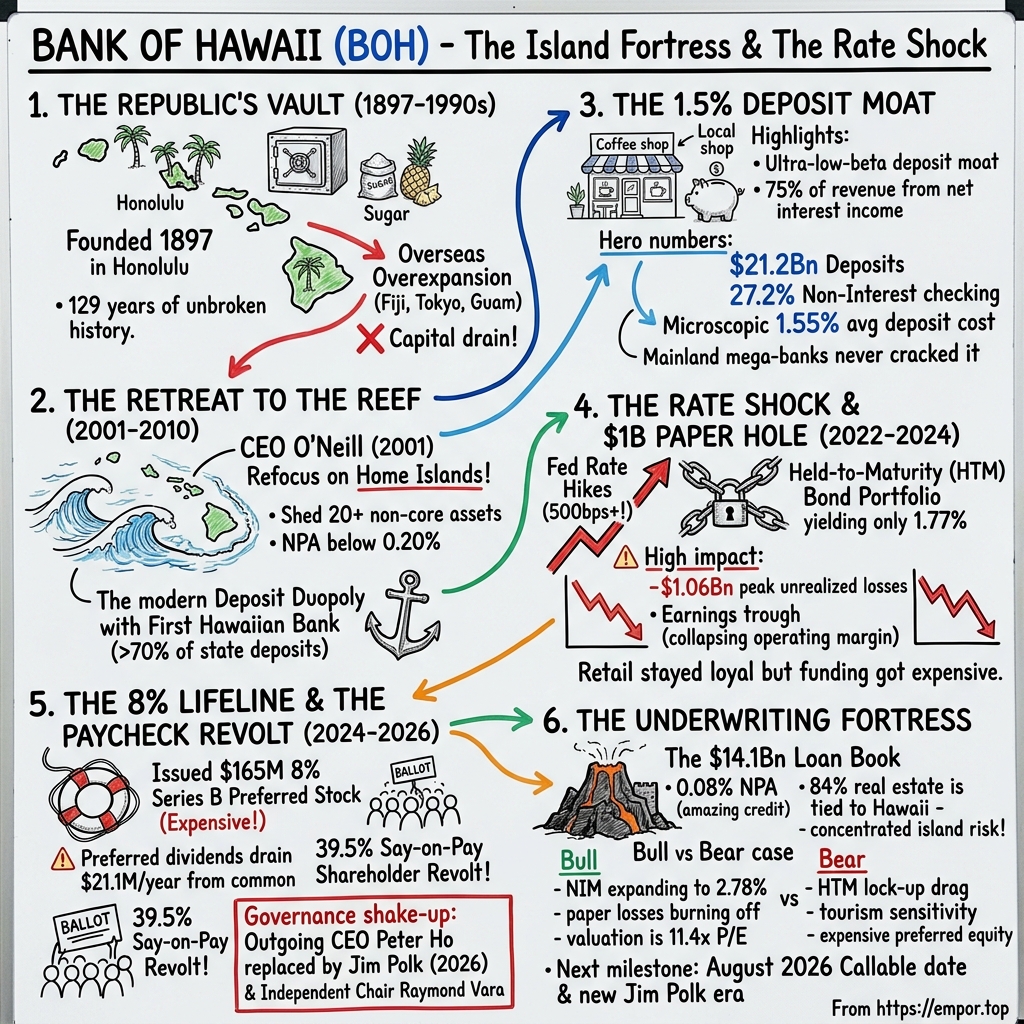
What happened next in Hawaii was, by the standards of that spring, almost boring. Branch lines did not stretch around the block. Local businesses did not wire their payroll accounts to a money-market fund. The deposits mostly stayed where they had been for decades. Bank of Hawaii ended 2025 holding about $21.2 billion of customer deposits, and more than a quarter of that money, about 27%, sat in checking accounts that pay no interest at all.1 In an era when depositors could earn 5% at a click, that number is the first clue to what kind of institution this is.
But the calm on the teller line hid a quieter reckoning in the balance sheet. During the pandemic, deposits had flooded into the islands, and the bank had parked much of that cash in long-dated mortgage bonds and home loans bought when interest rates were near zero. When the Federal Reserve raised rates faster than at any time in four decades, the market value of those bonds collapsed. At the end of 2024 the bank's securities portfolio was worth roughly $1.06 billion less than it had paid, a hole that, measured against the bank's entire shareholders' equity of about $1.7 billion, looked less like a dent and more like a crater.16 No depositor ran. Nobody needed to. The damage arrived instead as years of compressed earnings, an expensive emergency capital raise, and, eventually, an open rebellion by the bank's own shareholders.
That is the paradox at the heart of this story. Bank of Hawaii owns one of the stickiest, cheapest deposit franchises in American banking. And that very stickiness, the comfort of knowing the money would never leave, may have made it easier to lend that money out for thirty years at rates that would soon look absurd.
Four questions run through everything that follows. The first is whether the recovery in the bank's lending spread, the gap between what it earns on loans and bonds and what it pays depositors, can keep widening without the depositors finally asking for more. The second is whether the roughly $740 million of remaining paper losses on its bonds will melt away fast enough to rebuild the common shareholders' cushion before the next credit downturn arrives.1 The third is whether a new chief executive, Jim Polk, and a newly independent board chair, Raymond Vara, can repair the trust that broke in April 2026, when nearly 40% of the votes cast rejected the bank's executive pay plan.4 And the fourth is the deepest: whether a bank with most of its loans tied to real estate on a handful of volcanic islands deserves a premium for its insularity, or a discount for it.
Tonight, Bank of Hawaii is a $24.2 billion-asset institution that the market values at about $2.7 billion.1 Its shares change hands at roughly 11 times trailing earnings, about 1.4 times book value, with a dividend yield a little above 4%.1 Those are the multiples of a bank climbing out of its worst earnings stretch in a decade, which is exactly what it is. To understand why the climb matters, and why the hole was dug in the first place, the story has to start where the bank did: in a kingdom on the edge of becoming a territory.
 Subscribe on LinkedIn
II. The Republic's Vault (1897–1990s)
In December 1897, Honolulu was the capital of a country that would not exist much longer. The Hawaiian monarchy had been overthrown four years earlier by a group dominated by American-descended businessmen, and the government that replaced it, the Republic of Hawaii, was openly angling to be absorbed by the United States. Into that unsettled moment stepped a group of merchants, among them Charles Montague Cooke, Peter Cushman Jones and Joseph Ballard Atherton, who chartered a new bank under the Republic's laws.13 Within a year, the islands were annexed. The bank had been born under one flag and would grow up under another.
The founders were not speculators. They were the commercial establishment of the islands, tied to the sugar plantations and trading firms that would come to be known collectively as the Big Five, the handful of companies that controlled shipping, land and agriculture in territorial Hawaii. A bank in that world was less a retail storefront than a financial organ of a tightly knit economy: it financed the next sugar crop, carried the merchants' inventories, and held the cash of the families who owned the land. The relationships were personal, multigenerational and, crucially, local. That inheritance never fully left the institution, and it explains a good deal of what the 2023 short sellers missed.
The twentieth century tested the bank in ways few mainland lenders experienced. Territorial status meant Hawaii's economy answered to decisions made in Washington and to the price of sugar on world markets. The attack on Pearl Harbor in December 1941 put the islands under martial law for much of the war, and turned Honolulu into the logistical heart of the Pacific campaign. Then, in 1959, Hawaii became the fiftieth state, and the economy pivoted. Jet travel arrived almost simultaneously with statehood, and tourism, along with a permanent military presence, began to displace plantation agriculture as the engine of island wealth.
For Bank of Hawaii, that pivot was the making of the modern franchise. A bank built to finance sugar became the bank that financed hotels in Waikiki, shopping centers, condominiums and, above all, homes for a growing population on islands where buildable land was scarce and therefore expensive. The customers changed; the logic did not. The bank won because it was already there, already embedded in the families and firms that ran the place, and because the costs of building a rival branch network across several islands in the middle of the Pacific were high enough to discourage most would-be entrants.
Then came the temptation. Through the 1970s and 1980s, Bank of Hawaii looked at the vast blue map around it and saw an empire. It planted flags across the Pacific: in the American territories of Guam, Saipan and American Samoa, in French Polynesia, in independent island nations such as Fiji, and in the financial capitals of Asia, eventually spanning roughly half a dozen time zones at its widest reach.13 The vision was seductive. Hawaii was a small market; the Pacific Rim was enormous and growing fast. A bank that already understood island economies, the thinking went, could become the Bank of the Pacific.
The flaw in that vision was the same insight that made the home franchise so strong, run in reverse. In Honolulu, Bank of Hawaii had a century of relationships, a dominant share of local deposits and the logistical shield of the ocean. In Tokyo, Hong Kong or Singapore, it had none of those things. It was a small foreign lender competing against local giants and global money-center banks, without cheap deposits to fund itself and without the insider knowledge that made its Hawaii credit book so safe. In the smaller island nations it had local presence, but in economies too small and too volatile to support a profitable bank of scale. Expansion did not export the moat. It exported the balance sheet into places where the moat did not exist.
That pattern, strength at home and erosion abroad, is the first piece of historical evidence worth carrying forward. Whenever investors hear a geographically concentrated bank talk about diversification as a cure for concentration, Bank of Hawaii's own record is the cautionary tale. When the Asian financial crisis broke in 1997, the bill for the Pacific adventure came due, and it would take a new leader from the mainland to decide what the bank should stop being.
III. The Retreat to the Reef (2001–2010)
The man who arrived to clean up was not from Hawaii. Michael O'Neill was a mainland banker who had made his name as a finance executive and turnaround hand, and he took the top job at a bank that had overreached.13 The Asian crisis had left the overseas loan books impaired, the far-flung network was expensive to run, and the returns on the capital tied up across the Pacific were poor. His diagnosis was blunt and, for an institution that had spent two decades dreaming of an ocean-spanning empire, painful: the bank should stop trying to be everywhere, and go back to being unbeatable in one place.
What followed was a retreat, deliberately executed. The bank sold or wound down operations across the South Pacific and Asia, cut costs hard and refocused on the State of Hawaii plus the American Pacific territories of Guam and the Northern Mariana Islands, which share the US dollar and US banking law.113 It is a footprint that survives today: as of 2025 the bank still operates in Hawaii, Guam and the Commonwealth of the Northern Mariana Islands, and because every one of those places uses the dollar, currency risk is essentially absent from its books.1 The retreat was not glamorous. Nobody writes epic poems about closing branches in Port Vila. But it turned out to be the most valuable strategic decision in the bank's modern history.
Why? Because once the distraction was gone, the structure of the Hawaii market did the work. Bank of Hawaii and its cross-town rival, First Hawaiian Bank, together came to control well over 70% of the deposits in the state, with Bank of Hawaii alone holding roughly a third of the market, according to Fitch.111 Two banks, one archipelago, and an ocean keeping most competitors out. In economic terms, that is not quite a monopoly, but it is the next best thing for a lender: a stable duopoly in which neither side has much reason to start a price war for deposits, because both are already fat on cheap funding.
The real test of the retreat came in 2008. As the global financial crisis wiped out mainland lenders that had piled into subprime mortgages, construction loans and exotic securities, Bank of Hawaii came through with its profitability largely intact. That resilience was not luck. It reflected a lending culture that had been hardened by the overseas losses: conservative loan-to-value limits on property lending, an absence of subprime mortgage programs, and collateral concentrated in island land that was scarce by geography rather than by speculation. Even today, the bank's commercial real estate lending runs under a regulatory ceiling of 75% loan-to-value, and residential under 80%.1 That discipline would later define the bank's credit record, and it is worth noting what it did and did not protect against. It protected against borrowers defaulting. It did not protect against interest rates.
In November 2010, the bank handed the top job to Peter S. Ho, a Honolulu native who had risen through the institution's ranks.3 Ho would hold the combined roles of chairman and chief executive for fifteen years, an unusually long tenure in modern American banking. His era was one of steady, unspectacular excellence for most of its run. Net profit climbed from about $160 million in 2015 to around $225 million by 2019, the bank routinely paid out close to half its earnings as dividends, and return on equity sat comfortably in the mid-to-high teens, peaking around 17.5% in 2019.110 For a bank, those are elite numbers. A return on equity of 15% to 17% is what many larger lenders only dream of, and Bank of Hawaii posted them year after year with almost no credit losses.
The steady results also concealed a slower truth. Across the decade from 2015 to 2025, the bank's net profit grew by only about 2.5% a year.1 It was a high-return franchise, but a slow-growing one, which is exactly what an insular duopoly in a mature island economy should be. The question the Ho era never had to answer, at least not until 2022, was what happens when a slow-growing, high-return bank is suddenly handed more cash than its island economy can absorb. The answer to that question lies in the machinery of how this bank actually makes money.
IV. The Island Engine and the 1.5% Deposit Moat
Picture a small coffee shop in Kailua, on Oahu's windward side. The landlord who owns the building banks with Bank of Hawaii. So does the wholesaler who delivers the beans, and the shop owner whose payroll account clears there every two weeks. When the Federal Reserve pushed its benchmark rate above 5% in 2023, a mainland treasurer would have moved idle cash into Treasury bills within days. The coffee shop's operating balance mostly stayed put, earning nothing. The owner had a relationship with a banker, a line of credit tied to that relationship, and a strong sense that moving money for a few hundred dollars of interest was not worth the trouble.
Multiply that coffee shop by tens of thousands of businesses and households and you have the engine of Bank of Hawaii. It is, at bottom, a very simple machine. The bank takes in deposits, pays depositors little, and lends or invests that money at higher rates. The difference is called net interest income, and it accounts for roughly three-quarters of the bank's revenue.1 In 2025, that spread income came to about $537.5 million, up roughly 15% from the year before.1
The two numbers that drive that machine are worth holding in your head. On one side, the bank earned an average yield of about 4.03% on roughly $22.2 billion of loans and securities in 2025.1 On the other, it paid an average of just 1.55% on its deposits.1 Think of it as a shop that buys its inventory at a deep discount because its suppliers are loyal neighbors. A mainland regional bank reliant on rate-sensitive commercial deposits or brokered funding might pay well over 2% for the same money. That difference of a percentage point or so, compounded across $20 billion, is the moat expressed in dollars.
The remaining quarter of revenue comes from fees, about $179 million in 2025.1 The most strategically interesting slice is trust and asset management, about $49 million, because it reflects the bank's role as the fiduciary for Hawaii's wealthy families and institutions, a business that is sticky, capital-light and largely insensitive to interest rates.1 Card and merchant fees brought in about $56 million and deposit service charges about $34 million.1 Fees are not the bank's engine, but they are its ballast; they do not swing much when rates do, which matters a great deal for a bank whose core spread had just been crushed.
Why, then, have the national giants never stormed the beach? JPMorgan Chase, Bank of America and Wells Fargo have no meaningful branch networks in the islands. The reasons are mostly mundane: Hawaii is a small market of about 1.4 million people spread across several islands, branches are expensive to build and staff on scarce land, and the incumbents hold relationships that go back generations. A national bank can win Hawaii customers who want a credit card or a digital savings account, but winning a family business's operating account, its loans, its trust relationship and the owner's mortgage requires a local presence that is costly to replicate for a modest prize. That logic is strong, but not absolute: digital savings accounts from mainland banks and fintechs are just as available in Honolulu as in Houston, and the bank's own record shows customers did reach for yield. Time deposits above $250,000, the accounts most likely to be shopped for rate, stood at about $1.68 billion at the end of 2025, down from $1.87 billion a year earlier but well above where they sat when money was free.1 The moat is real for operating cash. It is thinner for idle cash.
There is another lock on the franchise that rarely makes headlines: the public sector. State and local government entities held about $2.1 billion of collateralized deposits at the bank at the end of 2025.1 When the state, the counties and their agencies bank with you, you are part of the plumbing of island governance. That money is not free, since public deposits typically must be secured by pledged bonds and often pay market-linked rates, but it is sticky and it reinforces the bank's centrality.
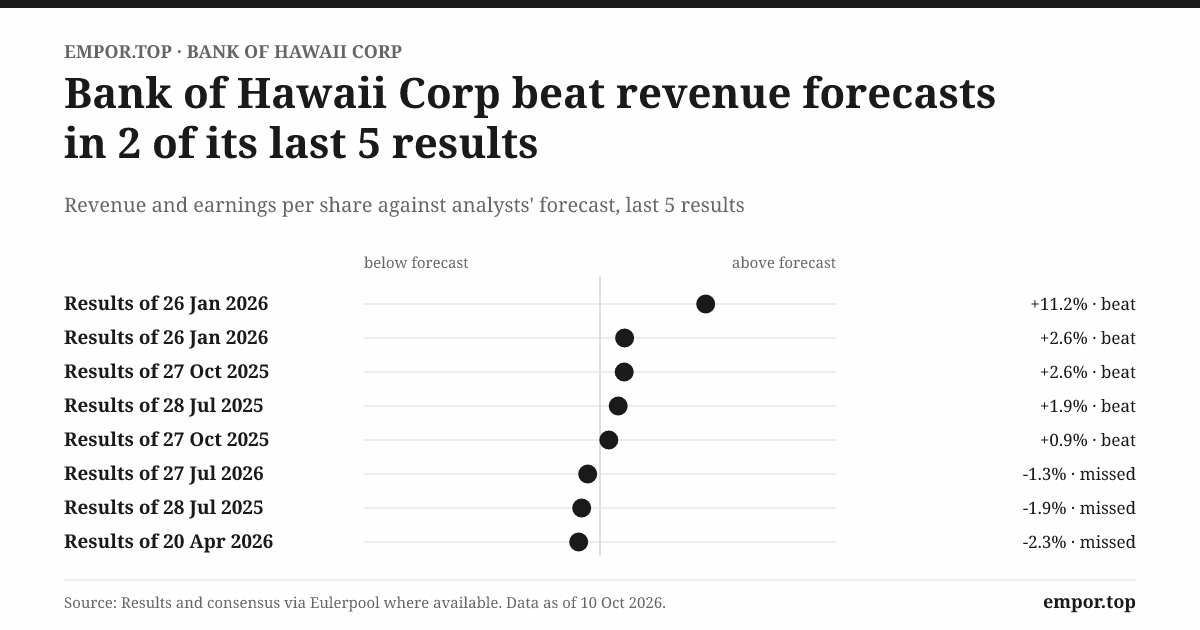
For an investor trying to judge whether earnings are real, the usual corporate tools fail here. For an industrial company, you compare profit with operating cash flow. For a bank, operating cash flow is a muddle of loan disbursements, deposit inflows and securities movements, so it tells you very little. The cleaner measure is pre-provision net revenue, or PPNR: revenue minus operating expenses, before setting aside money for bad loans. It strips out the accounting choices around reserves and shows the raw earning power of the franchise. In 2025, PPNR rose about 27%, from roughly $209 million to about $273.5 million.1 That matters because the headline profit rebound, up about 37.6% to roughly $205.9 million, could in principle have come from releasing loan-loss reserves. It did not. The bank actually took a modest provision of about $11.5 million in 2025.1 The recovery came from the spread itself, which is the kind of recovery that tends to persist.
The other half of the operating story is cost. The bank cut its full-time equivalent headcount from about 2,076 in 2022 to roughly 1,877 in 2025, nearly 200 fewer positions, while lifting capital spending on premises and technology to about $34.1 million in 2025 after two lean years near $9 million to $10 million.18 Data processing costs edged up as well.1 Read together, those numbers describe a bank trimming people and reinvesting in systems, a modernization rather than a harvest. Whether that reinvestment produces lasting operating leverage is one of the tasks now on Jim Polk's desk.
So the engine is sound, and in normal times it is extraordinary. The trouble is that the engine has two sides, and for three years the asset side of the machine was running in reverse. To see why, go back to the autumn when Hawaii was drowning in cash.
V. The Rate Shock and the $1 Billion Paper Hole (2022–2024)
The money came in waves. First, federal pandemic relief: stimulus checks, enhanced unemployment benefits and Paycheck Protection Program loans that landed in island checking accounts in 2020 and 2021. Then, as travel reopened, came the tourists, flush with savings and willing to pay record hotel rates. Island businesses had more cash than ever and fewer places to spend it. Bank of Hawaii's total assets swelled from about $18.1 billion at the end of 2019 to $20.6 billion a year later and about $23.6 billion by the end of 2022.110 In three years, the balance sheet grew by roughly 30%, almost all of it funded by deposits the bank had not had to fight for.
A bank with a deluge of deposits faces a simple problem: Hawaii's loan demand cannot grow 30% in three years. So the excess has to go somewhere. Leaving it as cash at the Federal Reserve earned almost nothing in 2020 and 2021. The obvious alternative, which hundreds of American banks chose, was to buy high-quality bonds: Treasury securities and mortgage-backed securities guaranteed by government agencies. Those bonds carry essentially no credit risk. What they carry is duration risk, the risk that their market value falls when interest rates rise, because a bond paying 1.5% for many years becomes much less valuable when new bonds pay 5%.
Think of it like signing a long lease on a building at a fixed rent just before property prices triple. The tenant is not in danger of eviction; the rent is still being paid on time. But the owner who locked in that rent has given away years of income he could have earned by waiting. The bank's bond portfolio was that lease, written from the landlord's side.
Bank of Hawaii made a choice that magnified the issue. It placed a large share of its securities into a held-to-maturity bucket. Under accounting rules, held-to-maturity bonds are carried at amortized cost, so their market declines do not hit reported equity. Available-for-sale bonds, by contrast, are marked to market each quarter through accumulated other comprehensive income, a line in shareholders' equity. Putting bonds in the held-to-maturity bucket was a sensible defensive move for reported capital, but it came with a promise: the bank intends to hold them until they mature. By the end of 2025 the held-to-maturity book still totaled about $4.25 billion, earning an average yield of only about 1.77%.1 The whole securities portfolio stood at about $7.76 billion.1
Then the Federal Reserve moved. Between March 2022 and July 2023, it raised its benchmark rate by 5.25 percentage points. At the end of 2024, the combined unrealized losses on Bank of Hawaii's available-for-sale and held-to-maturity securities reached about $1.06 billion.1 The cost was felt twice. First, as a market-value hole: if the bank had ever been forced to sell, those losses would have become real. Second, and more insidiously, as an earnings drag: billions of dollars were earning less than 2% while the cost of the deposits and borrowings funding them climbed relentlessly.
The income statement tells the story without needing commentary. Net profit slid from about $253 million in 2021 to a trough of roughly $149 million in 2024.1678 Over the same span, the operating margin, the share of revenue left after expenses and provisions, fell from about 47% to about 19%.1 Part of 2021's peak was flattered by the release of pandemic loan-loss reserves, so the true peak-to-trough decline was smaller than the headline suggests, but even on a generous reading, the bank lost roughly 40% of its earning power in three years. Return on equity fell from about 17% in 2022 to under 9% in 2024.1 For a bank that had made elite returns its identity, that is a fall from the penthouse to the parking garage.
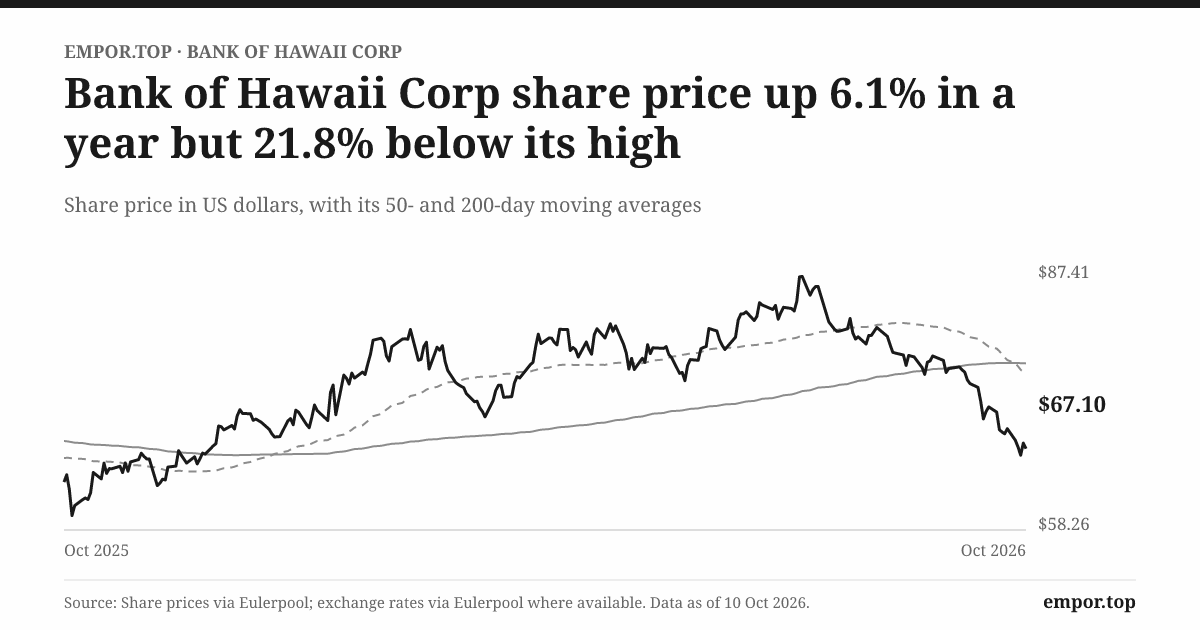
Which brings the story back to March 2023. When the short sellers came, they had a coherent case on paper. Bank of Hawaii carried large unrealized bond losses relative to its equity, and a meaningful share of its deposits exceeded the federal insurance limit, the exact combination that had felled Silicon Valley Bank. The share price, which had traded near $90 at the start of 2023, collapsed; over the past five years the stock's largest peak-to-trough fall reached about 63.5%.1
The short thesis failed on the one thing that mattered: the depositors. Silicon Valley Bank's depositors were a concentrated network of venture-backed companies who talked to each other on the same group chats and could move billions in hours. Bank of Hawaii's depositors were coffee shops, families, county governments and hotel operators who had banked there for decades. Retail deposits held. Where the island franchise did bend was price, not loyalty: commercial clients increasingly demanded a return on their larger balances, and the bank's cost of funds rose accordingly, with those large time deposits peaking at about $1.87 billion at the end of 2024.1 The moat prevented a run; it did not prevent a repricing. That distinction is the hinge of this entire story.
To bridge the gap, the bank leaned on wholesale funding. Here the commonly quoted data understates the reality. Financial data providers showed the bank's borrowings falling to about $92 million at the end of 2025, but that figure captures only operating lease liabilities. The bank's actual wholesale borrowings at year-end comprised $550 million of advances from the Federal Home Loan Bank of Des Moines at a weighted average rate of about 4.13%, plus $50 million of repurchase agreements and a small finance lease balance, roughly $608 million in total.1 That was down from about $747 million at the end of 2024, a sign the bank was steadily weaning itself off expensive borrowed money.1 It also retained about $2.1 billion of undrawn borrowing capacity at the Federal Home Loan Bank, a liquidity cushion that never needed to be tested.1
There was one final indignity. After the failures of Silicon Valley Bank, Signature and First Republic, the FDIC levied a special assessment on larger banks to replenish the deposit insurance fund. Bank of Hawaii's share came to about $11.8 million, payable in installments through 2026.1 The island bank whose depositors never wavered was asked to help pay for the mainland's failures. It was a small cost in the scheme of things, but a symbolic one.
What should investors take from those years? The verdict is clear: the liquidity side of the franchise passed the hardest test it could have faced, while the asset side failed a test management did not have to take. The bank did not need to put billions into long-dated bonds at the bottom of the rate cycle; it chose to, as did many peers. The stickiness of the deposits made that choice survivable. It did not make it costless. And once the losses were in the balance sheet, regulators and rating agencies started looking hard at the thinness of the capital cushion, which set up the most controversial chapter in the bank's recent history.
VI. The 8% Lifeline and the Paycheck Revolt (2024–2026)
On April 24, 2026, Bank of Hawaii held its annual meeting of shareholders. The proxy ballot contained the usual items: director elections, the auditor ratification and the advisory vote on executive compensation known as Say-on-Pay. In most years the Say-on-Pay vote is a formality. In 2025, Bank of Hawaii's had passed with about 97% support.5 This time, when the results were filed four days later, roughly 11.6 million shares had voted against the pay plan and about 17.3 million in favor.4 Nearly 40% of the votes cast said no. In the polite world of regional bank governance, that is not a protest; it is a revolt.
To understand why, follow the money from 2021 to 2025.
In June 2021, near the very bottom of the interest-rate cycle, the bank issued $180 million of 4.375% Series A perpetual preferred stock.19 Preferred stock sits between debt and common equity: it counts as Tier 1 regulatory capital, but it pays a fixed dividend that must be satisfied before common shareholders receive anything. At 4.375%, that was cheap capital. Then the bond losses arrived, and with them pressure on the capital ratios that regulators and rating agencies watch. In June 2024, at the height of the rate shock, the bank issued $165 million of Series B preferred stock, and this time the coupon was 8%.16 The net proceeds were about $160.6 million.1
An 8% coupon on perpetual preferred stock is expensive capital. It was raised precisely when the bank's share price was depressed and its funding costs were highest, which is to say, at the worst possible time to raise money. Management's defense is straightforward: issuing new common shares at a depressed price would have diluted existing owners even more, and preferred stock does not dilute ownership. That is true as far as it goes. But preferred dividends dilute earnings instead. Together the two series cost about $21.1 million a year, roughly $13.2 million for the Series B and $7.9 million for the Series A, which cut the profit available to common shareholders in 2025 from about $205.9 million to roughly $184.8 million.1 In other words, about a tenth of the year's profit went to preferred holders before the owners of the company saw a cent.
The preferred layer also shows up in how investors value the bank. Reported book value per common share stood at about $47.21, but after stripping out the $345 million of preferred equity and intangibles, tangible common book value was closer to $38.87.12 The stock's 1.4 times book multiple becomes roughly 1.7 times on a tangible common basis, which is the number a skeptical bank analyst would use.1
Meanwhile, buybacks stopped. The bank repurchased about $49.8 million of stock in 2022, roughly $9.9 million in 2023 and nothing at all in 2024.1 The dividend held, but in 2024 it consumed about 83% of net profit, the highest payout ratio in more than a decade.1 Repurchases resumed cautiously, at about $5 million in 2025, then accelerated to about $17 million in the second quarter of 2026, buying back roughly 216,000 shares at an average of about $78.60.12 With the stock now near $67, that last purchase already looks expensive, a small but telling reminder that buyback timing is not a management superpower.1
Now set the compensation alongside those numbers. In 2025, Peter Ho, in what would be his final full year as chief executive, received total compensation of roughly $6 million to $6.6 million, depending on the measure used.3 That included a base salary of about $925,000, an annual cash incentive of about $2.31 million, representing the maximum payout of 250% of target, and about $2.64 million in performance share units.3 The proxy's case was that 2025 earnings rebounded sharply and that the incentive metrics were met. The shareholders' implicit reply was that a maximum bonus for recovering from a hole the bank had dug itself, in a year when common holders were absorbing an 8% preferred drag and had seen buybacks frozen, did not align pay with their experience.
Who were those shareholders? Bank of Hawaii has no founding family, no controlling holder and no promoter. Its shares are held overwhelmingly by institutions. At the end of 2025, BlackRock owned about 14.7%, Vanguard about 11.5% and State Street about 5.5%, together nearly a third of the company.3 All directors and executive officers combined owned only about 1.5%.3 When the votes of passive giants and their proxy advisers turn against a pay plan, they do not usually sell. They do something more uncomfortable for a board: they keep voting.
By the time of the meeting, the leadership was already changing. Ho announced his retirement as chairman and chief executive effective March 31, 2026, ending a fifteen-year tenure.3 The board split the two roles he had held. Raymond P. Vara, Jr., the lead independent director, became independent chair, and James C. "Jim" Polk, a bank veteran of about 27 years who had served as president since July 2024 after stints as vice chair and chief banking officer, became president and chief executive on April 1, 2026.3 Bradley Satenberg had already succeeded Dean Shigemura as chief financial officer in June 2025.3 Polk owns about 125,000 shares, roughly 0.3% of the company, a modest stake but a real one.3
There is a tempting narrative that the revolt forced the leadership change. The timeline does not support it; the retirement and role separation were announced before the vote. What the vote did was redefine the new team's mandate. Polk inherits a franchise whose credit and deposits are in excellent shape, but whose owners have just told the board, in public, that they do not trust how the people running it are paid. A board can lose a vote once. A second large dissent in 2027 would be a governance problem of a different order.
One question remains before judging management fairly. If the bank was so careful about credit, why was it so careless about rates? Part of the answer is that the two disciplines require different instincts, and Bank of Hawaii had a century of practice in only one of them. The other part is that the same conservatism showed up somewhere else entirely: in a loan book that, through all of this, barely registered a loss.
VII. The Underwriting Fortress on a Volcanic Rock
Walk through downtown Honolulu and the office towers look much like office towers anywhere. Across America, from Chicago to San Francisco, the 2020s were brutal for commercial office buildings: remote work hollowed out demand, vacancies soared and lenders took losses as owners walked away from properties worth less than their mortgages. Many investors assumed every regional bank with a real estate book was sitting on a similar pile of trouble. In the case of Bank of Hawaii, the record says otherwise.
Start with the composition of the roughly $14.1 billion loan book. A little more than half, about 57%, is consumer lending: around $4.8 billion of residential mortgages and about $2.1 billion of home equity lines of credit.1 The rest, about 43%, is commercial: roughly $4.2 billion of commercial real estate, about $1.6 billion of commercial and industrial loans to businesses, and around $209 million of construction loans.1 That is the profile of a bank that lends mainly to homeowners and to landlords of apartments, warehouses and shopping centers, not a bank with a big appetite for speculative development.
The office question can be answered precisely. The bank's office exposure was about $336 million, roughly 8% of commercial real estate and only about 2.4% of total loans.1 Multifamily and industrial properties made up about 47% of the commercial real estate book.1 Even a severe loss rate on the office slice would dent a year's earnings rather than threaten the bank. The national office crisis is a real problem; it is just not this bank's problem in any material way.
The credit numbers are remarkable even by the standards of conservative banks. Net charge-offs, the loans actually written off after recoveries, were about $13.7 million in 2025, roughly 0.10% of average loans, and most of that came from consumer lending rather than commercial.1 The same rate held in the second quarter of 2026.2 Non-performing assets, the loans that have stopped paying, stood at about $11.5 million at the end of June 2026, around 0.08% of loans.2 Against that, the bank held an allowance for credit losses of about $147 million.2 Put differently, its reserves were roughly ten times the size of its problem loans. A bank that reserved for every non-performing loan ten times over would be described as cautious anywhere in America.
Fitch Ratings, which affirmed the bank's long-term rating at BBB+ with a stable outlook in July 2026, singled out that asset quality and the conservative risk culture as core strengths.11 Morningstar DBRS rates the company A, while Moody's withdrew its ratings in September 2025 at the company's request.11[^12] The auditor, Ernst & Young, issued clean opinions on the 2025 financial statements and internal controls; its one critical audit matter concerned the judgment inherent in the economic forecasts that drive the credit loss allowance, which is standard for banks.1
So is the underwriting fortress real? Yes. Two decades of results, including the 2008 crisis and the pandemic, are consistent with genuinely disciplined lending. But the fortress has a foundation it cannot change. About 84% of the bank's loans are secured by real estate, almost all of it in Hawaii.1 The pristine loss record is partly a product of conservative underwriting and partly a product of Hawaii's property market, where land scarcity has kept values high for generations. Those two explanations look identical until the second one stops being true.
The risks that could test it are specific. Hawaii's economy depends heavily on visitors, so a fall in Japanese tourist arrivals, a cut in mainland airline capacity or a slump in hotel revenue per available room flows quickly into local employment and business cash flow. Military spending is the other pillar, which ties island prosperity to decisions made in the Pentagon and Congress. And climate risk is no longer theoretical. The August 2023 Lahaina wildfire on Maui destroyed much of a historic town, and its aftermath has rippled through insurance pricing and property availability across the islands, raising costs for the very homeowners and landlords whose loans fill the bank's balance sheet. Fitch named this geographic and real estate concentration explicitly as a key ratings constraint.11
The calibrated verdict is this: history narrows the claim but leaves it standing. Bank of Hawaii's credit culture is genuinely exceptional, but its credit record is a joint product of skill and of an island property market that has never suffered a deep, sustained collapse in the bank's modern era. The record cannot tell investors how the book would perform in such a collapse, because one has not happened. The figure to watch is the size of criticized and classified commercial loans in the quarterly filings, the early warning signal that would appear well before charge-offs do.
That combination, an unbreakable deposit moat and a credit book bound to a single economy, frames the lessons this bank has to teach.
VIII. Playbook: Business & Investing Lessons
Inside the headquarters at 130 Merchant Street, two decisions a generation apart sit side by side in the bank's institutional memory. One is the retreat from the Pacific in the early 2000s, when the bank gave up an empire to master a few islands. The other is the bond buying of 2020 to 2022, when the bank took a windfall of deposits and locked it into paper that would yield less than 2% for years. The first decision built the modern franchise. The second cost it the better part of three years of earnings. Between them, they contain most of what this company has to teach.
The first lesson is that the riches are in the reef, not the ocean. The Bank of the Pacific dream was a bet that a bank skilled at serving one isolated market could carry that skill into many. It could not, because the skill was never really the bank's; it was the market's structure. Cheap deposits, generational relationships and an ocean-sized barrier to entry are properties of place, not portable capabilities. When the bank retreated to Hawaii and the US Pacific territories, returns on equity rose into the high teens and stayed there for most of two decades. For founders and investors, the wider principle is uncomfortable: what looks like a company's competence is often its position, and position does not travel. Retreat to where you cannot be beaten, and let the competitors drown in transit.
The second lesson is that a deposit moat protects against runs, not against regret. In March 2023, the island deposit base did exactly what it was supposed to do. Nobody ran. But the same stickiness that saved the bank from Silicon Valley Bank's fate also made it easy to treat cheap deposits as permanent and the assets bought with them as safe. They were safe from default; they were not safe from rates. A bank's liabilities and its assets live on different clocks, and Bank of Hawaii set them to different time zones. Depositors will forgive low rates, but the balance sheet never forgets duration.
The third lesson concerns the price of capital raised in a hurry. In mid-2024, the bank sold 8% preferred stock to shore up regulatory capital at the worst moment in the cycle, when its stock was depressed and every alternative was expensive. It was defensible as crisis management. But it transferred more than $13 million a year from common shareholders to preferred holders in perpetuity, or until the bank chooses to redeem it, and then the board paid the departing chief executive a maximum cash bonus for the recovery. Nearly 40% of votes cast rejected that arrangement. The wider principle for any board is that crisis capital is remembered at the next pay vote. When management pays 8% for an emergency buffer, shareholders will eventually audit the bonuses.
The fourth lesson is that pristine underwriting cannot diversify geography. A non-performing asset ratio of 0.08% is a record most banks would envy.2 But with about 84% of loans secured by island real estate, Bank of Hawaii is, in effect, a leveraged position in the long-run health of the Hawaiian economy, run by people who are very careful about which loans they make.1 Skill can choose the best borrowers on the island. It cannot choose a different island. Owning this bank means owning Hawaii, with a very good underwriter on the door.
Those lessons all point at the same uncomfortable truth: the franchise is excellent, and its owners still lost years of returns. The question tonight is what the market is paying for that combination.
IX. Analysis & Bear vs. Bull Case
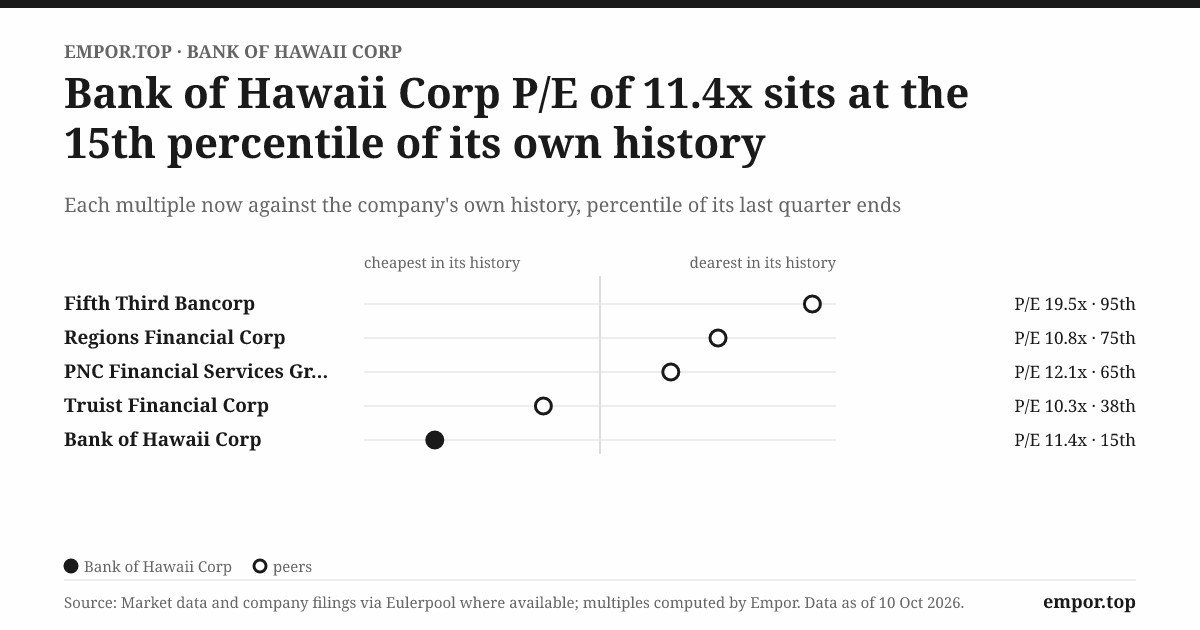
Imagine two analysts sitting across from each other in October 2026, the share price on the screen at $67.10, about 22% below its 52-week high.1 One holds up Bank of Hawaii's price-to-earnings multiple of about 11.4 and points out that it has traded at a median of about 13.9 over the past five years.1 The other points across Honolulu to First Hawaiian, the bank's twin, trading at roughly 11 times earnings and only about 1.1 times book value, and asks why Bank of Hawaii deserves any premium at all.12 Both are right about the facts. The disagreement is about what comes next.
Why the moat holds, and where it leaks
Before choosing sides, the franchise itself deserves one full assessment. Through the lens of Hamilton Helmer's seven powers, Bank of Hawaii's advantage rests mostly on two. The first is a kind of cornered resource: decades of relationships with island families, businesses, and state and county governments, embodied in about $2.1 billion of collateralized public deposits and a trust business that serves the islands' wealth.1 The second is switching costs. A business that runs its operating accounts, payroll, treasury management, credit lines and the owner's mortgage through one bank faces real friction in leaving, which is why about 27% of deposits sit in non-interest-bearing accounts.1 There is a dose of scale economics, too: a dense branch and ATM network across several islands is costly to replicate for a market of Hawaii's size. Missing from the list are network effects and counter-positioning; nothing about the bank gets better because more customers use it, and digital competitors are not structurally disadvantaged in copying its product, only its relationships.
Porter's five forces tell a consistent story. The threat of new entrants is low for full-service banking because of logistics, scale and loyalty, but higher for single products like savings accounts and cards. Rivalry is muted: a two-bank market with a combined share above 70% rarely produces deposit price wars.1 The bargaining power of buyers, here the borrowers, is constrained by the scarcity of alternatives for local commercial lending. The most interesting force is the bargaining power of suppliers, which for a bank means depositors. For most of the bank's history, depositors had almost none. The rate shock revealed that larger commercial depositors have more than the bank once assumed, as the rise in large time deposits showed. Substitutes, finally, are national digital banks and money-market funds; they cannot replicate a lending relationship, but they can and do siphon idle balances.
The moat is real, then, but it is a moat around operating cash and relationships, not around all deposits at all prices. That distinction runs through both cases.
The case for and the case against
The bull case starts with the spread. Net interest margin, the bank's earnings on assets minus its funding cost expressed as a share of earning assets, widened from about 2.16% in 2024 to 2.45% in 2025 and about 2.78% in the second quarter of 2026.12 That is about 62 basis points of expansion in roughly eighteen months, driven largely by old, low-yielding loans and bonds maturing and being replaced at today's higher rates. The mechanism is mechanical and largely locked in: every month, a slice of the 2020-vintage paper pays down and gets reinvested at rates far above what it was earning. Combined unrealized securities losses shrank from about $1.06 billion to roughly $740 million over 2025, and the portfolio throws off something like $900 million a year of cash for reinvestment.1 Quarterly profit has risen in step: second-quarter 2026 net income of about $63 million was roughly a third higher than a year earlier, and the operating margin climbed above 30%.12 On the bull view, an earnings yield near 8.7%, a dividend yield above 4% and resumed buybacks are being priced as if the trough were permanent, while the separation of chair and CEO offers a cleaner governance structure to address the pay revolt.1
The bear case starts with the same balance sheet, read from the other side. About $4.25 billion of held-to-maturity paper still yields roughly 1.77%, and at a run-off pace in the region of $400 million a year, it will take the better part of a decade to clear entirely.1 The repricing tailwind is real, but it is slow, and it depends on rates staying elevated; if the Federal Reserve cuts aggressively, reinvestment yields fall too. The $21.1 million annual preferred dividend remains a permanent claim on common earnings until redeemed, and redeeming the 8% Series B is not possible until 2029.1 Deposits slipped to about $20.9 billion at the end of June 2026 from $21.2 billion at year-end, and large time deposits remain well above pre-2022 levels.12 The bank still carries $550 million of Federal Home Loan Bank advances at about 4.13%.1 And above all of it sits the island risk: a sharp tourism downturn, a major airline capacity cut or another climate disaster would hit the collateral base of about 84% of the loan book at once.1
An activist looking at this bank would not find empire-building, related-party abuse or excessive leverage. The related-party dealings disclosed are ordinary-course; the largest is about $512,000 a year paid to an insurance brokerage where a director is an officer, a relationship that predates her board seat.3 What an activist would challenge is narrower and sharper: why the bank's interest-rate risk management allowed the 2020 to 2022 bond purchases at that scale, why the board paid a maximum cash bonus while common holders absorbed the cost of the 8% preferred, and whether Bank of Hawaii's capital ratios, which Fitch describes as modest relative to peers even with a common equity tier 1 ratio of about 12.1%, leave enough room for both buybacks and an eventual redemption of expensive preferred.111
What the price assumes
Weigh the evidence and the verdict is this: Bank of Hawaii is a high-quality island franchise whose core earnings are recovering on a mechanical, largely predictable path, and the market is pricing it at a discount to its own history but a modest premium to its closest peer. That premium over First Hawaiian appears to reflect the bigger trust and wealth franchise and the historically higher return on equity, about 12.4% over the past twelve months versus roughly 10.5% for its rival.112 The discount to its own past reflects the slow burn of the bond book, the preferred drag and a governance question still unanswered. The market seems to be assuming the recovery continues, but slowly, and that the next shock will not come from the islands themselves.
Three numbers will decide which analyst wins the argument. The first is net interest margin, last reported at about 2.78% and rising; the test is whether it pushes past roughly 2.85% while the bank's average deposit cost stays near or below 1.60%.2 The second is PPNR growth alongside the run-off of the low-yielding held-to-maturity book, the purest read on whether spread recovery is translating into earning power. The third is the Say-on-Pay vote at the 2027 annual meeting, which will show whether the new board has rebuilt the trust of the institutions that own a third of the company. Each one maps onto one of the central questions, and each one arrives on a calendar.
X. Epilogue
The first call date on the Series A preferred stock arrived in August 2026.1 It is a small event that captures a big dilemma. The 4.375% Series A is now cheap capital, raised in 2021 when money was nearly free. Redeeming it would cost about $180 million of cash and reduce Tier 1 capital, while saving only about $7.9 million a year in dividends.1 The 8% Series B, the expensive one, cannot be called until 2029.1 So the capital that shareholders most want gone is the capital the bank cannot yet retire, and the capital it can retire is the capital it has the least reason to touch. That paradox, cheap money redeemable and dear money locked in, is a neat summary of the bind the rate shock left behind. As of the second-quarter filing in late July, the bank had not announced a redemption, and with about $88.9 million left on its buyback authorization, the more likely near-term lever for common holders is repurchases rather than preferred retirement.2
The next milestones come quickly. The third-quarter results, due later this month, will be Jim Polk's second full quarter as chief executive and the first real test of whether margin expansion is holding up as rates evolve. If the margin keeps climbing toward 2.85% and beyond while deposits stabilize around $21 billion, the bull case will look less like hope and more like arithmetic. If deposit costs creep up and the margin stalls, the market will conclude that the repricing tailwind has largely run its course and that the bank's earning power is settling at a lower plateau than its pre-2022 history implied.
Polk's own first year will be judged on operating leverage. He inherits a leaner organization, with headcount down by about 200 since 2022 and technology spending stepped up.1 The test is whether that translates into expenses growing more slowly than revenue, without ceding the relationships that make the deposit base special to First Hawaiian. A 27-year insider brings deep knowledge of those relationships. He also brings the risk that an insider may be slow to challenge the habits that produced the bond-portfolio mistake. Both can be true at once.
Then comes the governance reckoning. The 2027 proxy statement, expected around March, will show how the compensation committee has responded to the 2026 revolt: whether cash incentives are more tightly tied to common shareholder outcomes, whether preferred dividends and capital costs enter the metrics, and whether maximum payouts are reined in. The April 2027 annual meeting will deliver the verdict. A Say-on-Pay vote back above 80% would mark the revolt as a one-time rebuke absorbed. Another vote near 60% would mark it as a lasting rupture between the board and its largest owners.
And underneath all of it, the islands. Hawaii's tourism trends, its housing market, its post-Maui insurance environment and the direction of military spending will determine whether the bank's pristine credit record holds. None of those are within management's control. All of them flow straight into the loan book.
So the tension remains exactly where it started. The deposit moat has been proven; the balance sheet is healing on a schedule; the credit book is clean. What has not been proven is whether the people now running the bank can turn a recovery that is largely mechanical into a renewal of trust that is entirely human.
XI. Outro
At dusk, the light over Honolulu Harbor turns gold and then violet, and the Aloha Tower, once the tallest building in the territory, looks small against the towers behind it. A few blocks inland, the bank that merchants chartered under a short-lived republic in 1897 is still taking deposits from the grandchildren of its first customers.13 In March 2023, when panic tore through mainland banking, the money in those accounts did not move. It did not move because island relationships run on decades, not clicks.
That is the enduring essence of Bank of Hawaii: a business blessed with almost unbreakable local loyalty, which gave away years of returns by forgetting that loyal money still has to be put somewhere sensible. The moat held. The bonds did not. The bank survived its own mistake because of the one thing no fintech can download and no mainland giant can ship across the Pacific: a century of being the bank that was already there. It now waits out the cycle on Merchant Street, paying its dividends and its preferred holders, hoping its owners will be as patient as its depositors.
References
-
Form 10-K for the Fiscal Year Ended December 31, 2025 — U.S. Securities and Exchange Commission (EDGAR), 2026-02-24 ↩↩↩↩↩↩↩↩↩↩↩↩↩↩↩↩↩↩↩↩↩↩↩↩↩↩↩↩↩↩↩↩↩↩↩↩↩↩↩↩↩↩↩↩↩↩↩↩↩↩↩↩↩↩↩↩↩↩↩↩↩↩↩↩↩↩↩↩↩↩↩↩↩↩↩
-
Form 10-Q for the Quarterly Period Ended June 30, 2026 — U.S. Securities and Exchange Commission (EDGAR), 2026-07-28 ↩↩↩↩↩↩↩↩↩↩↩
-
Definitive Proxy Statement on Schedule 14A — U.S. Securities and Exchange Commission (EDGAR), 2026-03-13 ↩↩↩↩↩↩↩↩↩↩
-
Current Report on Form 8-K (Submission of Matters to a Vote of Security Holders) — U.S. Securities and Exchange Commission (EDGAR), 2026-04-28 ↩↩
-
Current Report on Form 8-K (Submission of Matters to a Vote of Security Holders 2025) — U.S. Securities and Exchange Commission (EDGAR), 2025-04-30 ↩
-
Form 10-K for the Fiscal Year Ended December 31, 2024 — U.S. Securities and Exchange Commission (EDGAR), 2025-03-04 ↩↩↩
-
Form 10-K for the Fiscal Year Ended December 31, 2023 — U.S. Securities and Exchange Commission (EDGAR), 2024-02-29 ↩
-
Form 10-K for the Fiscal Year Ended December 31, 2022 — U.S. Securities and Exchange Commission (EDGAR), 2023-03-01 ↩↩
-
Form 10-K for the Fiscal Year Ended December 31, 2021 — U.S. Securities and Exchange Commission (EDGAR), 2022-03-01 ↩
-
Form 10-K for the Fiscal Year Ended December 31, 2020 — U.S. Securities and Exchange Commission (EDGAR), 2021-03-01 ↩↩
-
Fitch Affirms Bank of Hawaii Corporation Long-Term IDR at 'BBB+'; Outlook Stable — Fitch Ratings, 2026-07-21 ↩↩↩↩↩
-
First Hawaiian, Inc. (FHB) Valuation & Peer Multiples — Market Chameleon, 2026-10-10 ↩↩
-
Official Corporate Website — Bank of Hawaii Corporation ↩↩↩↩↩
 LinkedIn
 WhatsApp
 Reddit
 Hacker News
 Email
Email Kindle
 RSS Feed
 Spotify
 Apple Podcasts
 Amazon Music
 Audible
 YouTube