Bladex, Inc.: The Bank Built to Finance Latin America’s Trade
I. The $1 Billion Loan That Made Growth Look Different
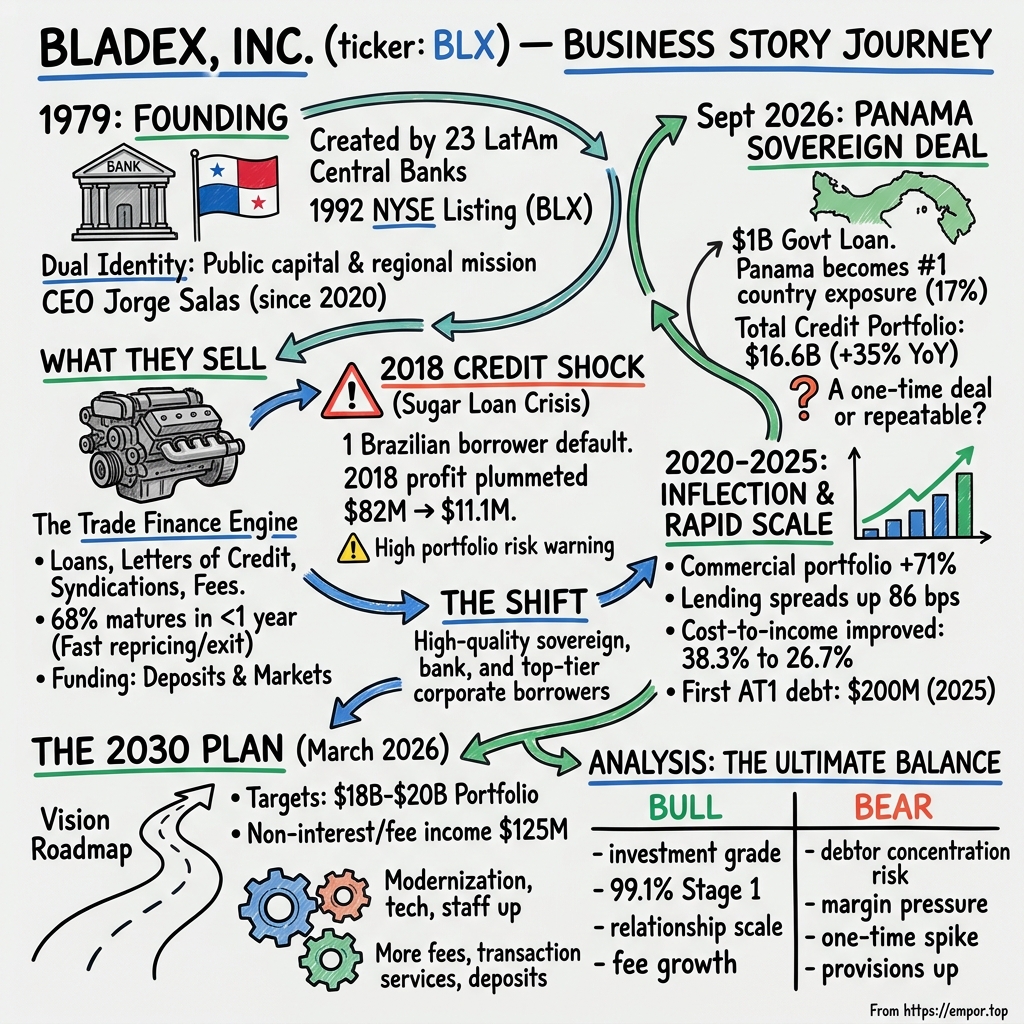
On September 9, 2026, a loan agreement closed in Panama City that would quietly redraw the map of a bank.1 The borrower was the Republic of Panama, acting through its Ministry of Economy and Finance. The lender was Bladex, a Panama-based trade bank that most American investors have never heard of, even though its shares have traded on the New York Stock Exchange since the early 1990s. The amount was up to $1 billion, for the country's general budgetary purposes.1
A week later, on September 15, Bladex put out the announcement, and one phrase in it mattered more than the rest. The bank called the facility the largest it had ever structured and granted.2 Samuel Canineu, the bank's chief commercial officer, said the deal showed Bladex's ability to structure large-scale financial solutions for the region.2 That was true. It also raised the question that hangs over this story: what does it mean when a bank built to finance coffee shipments, copper exports and letters of credit writes a billion-dollar cheque to a government?
By the end of September the answer showed up in the numbers. Bladex's total credit portfolio reached about $16.6 billion, up 35% from a year earlier.3 For a bank whose portfolio had grown at a respectable but unspectacular pace for most of the previous decade, that is a startling jump. Quarterly net profit rose about 15% from the same quarter of 2025, to roughly $63 million.3
Then look a little longer. Over the first nine months of 2026, net profit was about $186 million, up only about 9% on the same period a year before.3 The portfolio sprinted; the earnings jogged. That gap is the first clue. A bank's balance sheet can grow in a single afternoon when it signs one enormous loan. Its profits only grow when the loans it makes, across many borrowers and many quarters, earn more than they cost to fund and more than they lose to defaults.
The second clue is concentration. A year earlier, Panama made up about 5% of Bladex's commercial portfolio. By September 30, 2026, it was about 17%, and Panama had become the bank's largest country exposure.3 Bladex is incorporated in Panama and headquartered there, so in one sense this is a home-market loan to a sovereign the bank knows well. In another sense, it means roughly one dollar in six of the commercial book now rides on a single government's ability and willingness to pay.
Why would a government borrow a billion dollars from a regional trade bank rather than simply sell bonds? Bladex does not say what drove Panama's choice, and the facility's tenor was not disclosed in the announcements.21 But the general logic of such deals is familiar. A bank loan can be arranged quickly and privately, without the price risk of a public bond auction, and it can bridge a government's financing needs until market conditions improve. For the lender, a sovereign loan typically carries a lower interest margin than lending to a mid-sized exporter, because the borrower is larger and can shop elsewhere. The trade-off is volume for spread: lots of balance sheet, relatively little margin per dollar.
Analysts noticed. On the third-quarter earnings call in late October, the questions kept circling the same few points: could the growth continue without another deal like Panama, what would the transaction do to the bank's margin, and how hard was competition squeezing lending spreads?4 Management described the Panama loan as distinct from its typical origination and warned that the full-quarter effect of a large, thinly priced sovereign loan would weigh more noticeably on margins in the fourth quarter.4 That is a candid answer. It also confirms what the nine-month profit figure already hinted: the portfolio headline overstates how fast the underlying business is compounding.
So which is it? Is Bladex's sudden growth evidence of a stronger trade-finance franchise, or did one exceptional transaction make the numbers look bigger? The fairest verdict at this point is narrower than either. The quarter proves that Bladex can arrange very large transactions and earn from them, and that a sovereign will choose it as a lender. It does not yet prove that this pace of growth is repeatable.
The stakes run wider than one loan. This story turns on three questions. Can Bladex keep growing without giving away lending spreads or loosening credit standards? Can it turn its position inside Latin America's trade flows into more durable fee and deposit income, so that it depends less on the lending spread alone? And does the price the market puts on the bank leave room for that strategy to work?
Start with what Bladex is today. It is a bank with a credit portfolio of about $16.6 billion, nine-month profit of about $186 million, and investment-grade ratings from all three major agencies: BBB+ from S&P, Baa2 from Moody's and BBB from Fitch, each with a stable outlook.35 Yet the stock market valued the whole company at only about $1.9 billion in early November 2026, roughly what its accountants say its equity is worth, at a share price just under $50.6 Investors are being offered a bank at about its book value. Whether that is a bargain or a fair price for a cyclical lender depends on understanding what kind of bank this is, and that story begins in 1979, with a group of central bankers who had a problem.
 Subscribe on LinkedIn
II. A Regional Bank With a Public Market Price Tag
In the late 1970s, Latin America's exporters had a peculiar handicap. They could grow coffee, mine copper and make steel, but selling those goods abroad required dollars, and dollars had to be borrowed from banks in New York, London or Tokyo that often knew little about a mid-sized Colombian exporter or a Peruvian processor. When global credit tightened, those banks pulled back from the region first. Trade, the lifeblood of the region's economies, depended on lenders who were never sure they wanted to be there.
The region's central banks decided to build their own bridge. Bladex, formally Banco Latinoamericano de Comercio Exterior, began operations in Panama in 1979, founded by central banks of Latin America and the Caribbean to support foreign trade in the region.7 Its founding shareholder base represents 23 countries.7 The idea was simple: create a bank that understood the region, could gather dollar funding on international markets, and could lend it to the banks and companies that moved goods across borders.
Panama was a natural home. The country used the U.S. dollar, had a long tradition as an international banking center, and sat at the crossroads of the hemisphere's shipping lanes. A trade bank headquartered beside the Canal had a certain poetry to it.
Then came the twist that makes Bladex unusual. In 1992 the bank listed its shares on the New York Stock Exchange.8 A development-minded institution, owned by central banks, became a company that public investors could buy. That decision created a hybrid. The bank kept its regional purpose and its sovereign shareholders, but it now had to answer to quarterly earnings, dividend expectations and the share price.
Why would central banks want their trade bank on Wall Street at all? A listing does several things at once. It gives the bank a currency, its own shares, for raising equity when it needs to grow. It forces a level of disclosure, audit and governance that a closely held regional institution might otherwise avoid, which in turn makes it easier to borrow from international investors who want to see the books. And it imposes a discipline: a listed bank that lends badly sees its share price punish it in public, long before any regulator steps in. The trade-off is that a bank built to serve a region now also has to serve people who care only about returns.
What the listed company actually is deserves a sentence of precision. The consolidated figures investors see are those of Banco Latinoamericano de Comercio Exterior, S.A. and its subsidiaries, reported under international accounting standards, with intercompany balances eliminated.8 There is no group above it whose headcount, customers or market share can be borrowed for the story. What Bladex earns is what Bladex is.
The ownership design reflects that dual identity. Class A shares are held by central banks, state-owned banks and related institutions from the region. Class E shares are the public-market class traded in New York. For years there was also a Class B for banks and financial institutions, which converted into Class E during 2025.8 By the middle of 2026, about 81% of the bank's 37.6 million shares were Class E, and about 17% were Class A.9
The striking fact is who does not control it. At the end of 2025, no corporation or foreign government controlled Bladex, and no registered owner held more than about 5.3% of total voting capital.8 Among the Class A holders, Banco de la Nación Argentina owned about 2.8% of total common stock and Banco do Brasil about 2.6%.8 These are strategic stakes, and they give the region's state banks a seat at the table, but neither is a controlling owner in any normal sense.
That matters for two reasons. First, there is no parent company siphoning off value through royalties, management fees or intercompany loans. The bank's related-party disclosures cover directors and key managers, not a controlling group.8 Second, there is no one big owner who can force a strategy, block a takeover or rescue the bank in a crisis. Public shareholders get the benefits of a widely held company and the corresponding absence of a deep-pocketed backstop.
The people running it today are a professional management team, not founders or owners. Jorge Salas has been chief executive since March 2020, and the 2026 proxy statement names Miguel Heras as chairman of the board.10 The board mixes directors linked to the Class A institutions with independent directors, and in 2026 shareholders were asked to approve a change in the bank's legal name to Bladex, Inc., which shows how fully the brand has replaced the long Spanish name.10
What should investors make of the founding mission? The comfortable version of the story says Bladex has a protected niche: central banks created it, regional banks trust it, and so the trade flows come to it naturally. The record supports a more modest version. The mission gives Bladex access, credibility and relationships, including, as later chapters show, a meaningful slice of its deposits from those central-bank shareholders. But Bladex still competes for every borrower, every deposit and every transaction on price and execution. There is no law requiring Latin American exporters to bank with it.
Think of the founding mission as a letter of introduction rather than a guaranteed contract. It gets Bladex into the room. It does not close the deal. The bank's history shows how expensive it can be to forget that, and the clearest lesson came not from competitors but from a single borrower in Brazil's sugar fields.
III. The Sugar Loan That Cut Profit by Nearly Nine-Tenths
Sugar is a brutal business. Its price swings with Brazilian harvests, Indian export policy, ethanol mandates and the weather, and the mills that crush the cane borrow heavily to survive the lean years. In 2018 one of those borrowers, a Brazilian sugar company with debts to Bladex, ran into trouble as sugar prices fell and restructuring its obligations became harder.11
For a bank of Bladex's size, one bad loan can be a very loud event. Bladex is not a sprawling retail bank with millions of small loans whose defaults average out. It is a wholesale lender with a few hundred large clients, so a single name can move the whole income statement. In 2018 that is exactly what happened.
Profit collapsed from about $82 million in 2017 to about $11 million in 2018, a fall of nearly nine-tenths.116 The main culprit was provisions, the money a bank sets aside to cover expected losses, which reached about $57.5 million on financial instruments that year.11 On top of that came roughly $10 million of impairments on non-financial assets, and lending spreads that had narrowed as competition intensified.11 It was a collision of three forces at once: a commodity cycle, a concentrated exposure, and a market that was not paying the bank enough for the risk it took.
To understand why this matters, consider the arithmetic of a lender with thin margins. Bladex earns a little over 2 percentage points between what borrowers pay it and what it pays for funding. On a loan of $100 million, that spread might produce around $2 million a year before costs. Losing a large share of the principal on one such loan can wipe out years of earnings from many good ones. A trade bank's business is to be right on credit thousands of times; being badly wrong once costs more than being right a hundred times earns.
It helps to know how a bank like this recognizes a loss, because the same machinery runs through every later chapter. Under international accounting rules, a lender sorts its loans into three buckets. Stage 1 holds loans that are performing normally, and the bank reserves only for the losses it expects over the next year. Stage 2 holds loans whose risk has risen meaningfully since they were made, and the bank must reserve for losses over the loan's whole life. Stage 3 holds loans that are already impaired, where default has happened or is very likely. A sugar mill sliding from Stage 1 to Stage 3 in the space of a year forces the bank to recognize, all at once, a loss that might take years to play out in cash. That is why a single borrower could do so much damage so quickly to reported profit.
The dividend tells the story vividly. In 2018 Bladex kept paying shareholders roughly what it had paid before, about $61 million, even though profit had shrunk to a sixth of that.6 The dividend amounted to more than five times what the bank earned that year. That reflected confidence that the hit was a one-off, and it also showed how far the earnings had fallen below the bank's normal level.
The response came quickly. Bladex said it was shifting the portfolio toward higher-quality borrowers, including financial institutions, sovereign and quasi-sovereign entities, and top-tier corporations, and toward shorter-term trade exposures.12 The logic was defensive: lend to names that are less likely to default, keep maturities short so problems surface before they grow, and stop reaching for yield in sectors where one bad harvest can sink a borrower.
The recovery was swift. In 2019 provisions fell to about $0.4 million and profit rebounded to about $86 million.12 In a single year the bank went from a near-wipeout to earning more than it had before the sugar loss. That kind of snapback is the best argument that 2018 was a concentrated accident rather than a sign of broad rot in the portfolio. The rest of the book was largely performing; one name had broken.
But the comfortable conclusion, that the problem was fixed forever, does not survive contact with the later record. In 2023 Bladex wrote off about $21 million against one impaired borrower, a non-bank financial intermediary.8 At the end of 2025, credit-impaired loans had risen to about $38.7 million, more than double the roughly $17 million a year earlier, even though there were no write-offs in 2024 or 2025.8 Those numbers are small against a $12.6 billion portfolio, well under half a percent, but the direction matters. They show that single-name risk did not disappear with the sugar mill. It changed shape.
The fair comparison is careful. The 2018 Brazilian credit is a specific and material warning about what single-name and sector concentration can do to a bank of this size. It is not evidence that today's portfolio carries the same exposure; the bank's mix has shifted toward financial institutions and sovereigns, and its stage-by-stage credit quality, discussed later, looks strong. The lesson is narrower and more durable: Bladex's earnings are only as safe as its largest few exposures.
Which brings the story back to Panama. In 2018 one corporate borrower cost the bank most of a year's profit. In 2026 one sovereign borrower accounts for roughly a sixth of the commercial book. A sovereign is a very different credit from a sugar mill, and Panama is a borrower the bank knows intimately from its own doorstep, but the structural echo is hard to miss. The man responsible for deciding how much of that risk to carry arrived at Bladex just as the world was about to stop.
IV. The 2020 CEO Inherits a Bank at an Inflection Point
Jorge Salas walked into the chief executive's office in Panama City on March 9, 2020.13 Within days, the World Health Organization had declared a pandemic, borders were closing across Latin America, and the trade flows that Bladex existed to finance were seizing up. It is hard to imagine a worse first week for the new head of a trade bank.
Salas was not a stranger to the region's banking world. Before Bladex he had spent five years as president and chief executive of Banesco USA, and before that he was general manager of Banesco Panama.13 His predecessor, Gabriel Tolchinsky, stepped down in what the board described as an orderly, programmed succession, and the board said it had searched internally and externally for several months before choosing Salas.13 So the handover was planned. The pandemic was not.
The first posture was survival. Bladex prioritized liquidity, underwriting discipline and risk-adjusted returns, rather than growth.14 For a lender funded partly by short-term deposits and market borrowing, a sudden freeze in dollar markets is the nightmare scenario, so the instinct to hoard cash and lend carefully was the right one. The cost showed up in the results. Profit slipped to about $63 million in 2020 and stayed at about $62 million in 2021, and return on equity sat around 6%, well below what most shareholders would demand from a bank.6
What happened next is the core of the Salas era. In 2022 Bladex laid out a strategic plan running to 2026: grow the commercial book, improve pricing, expand fee-generating activity and make the bank more efficient.15 On the fourth-quarter 2022 earnings call, management set a target of a mid-teens return on equity by 2026, a bold ambition for a bank that had been earning in the single digits.[^16]
Then the numbers moved, quickly. Profit rose to about $92 million in 2022, about $166 million in 2023, about $205 million in 2024 and about $227 million in 2025.6 Return on equity climbed from about 6% to the mid-teens, peaking around 15% in 2024 before easing to about 13.5% in 2025 as the equity base grew.6 At the 2026 Investor Day, the company reported that between 2021 and 2025 its commercial portfolio grew about 71%, its lending spread widened by 86 basis points, and its cost-to-income ratio improved from about 38% to about 27%.16 Management said the plan's main objectives had been reached ahead of schedule.14
That is a genuine credibility point. Banks set targets all the time; fewer hit them early. On the specific promise of a mid-teens return by 2026, the bank delivered.
But how much of that was management, and how much was the market? The honest answer is that a lot of the tailwind was macroeconomic. When the Federal Reserve raised interest rates sharply in 2022 and 2023, banks that lend at floating rates and fund partly with equity and cheap deposits saw their income jump. Bladex's loans reprice quickly because most are short-term, so higher dollar rates flowed through to income fast. Deposit growth later helped lower funding costs too.
The bank's own 2025 annual report is the best evidence that the tailwind can reverse. It describes margin compression from abundant market liquidity and lower reference rates offsetting some of the gains from higher volumes.8 Net interest margin, the bank's income on its earning assets after funding costs, fell from about 2.49% in 2023 to about 2.36% in 2025.8 So the spread widening management celebrates for 2021 to 2025 was already narrowing by the end of the plan.
There is one decision in the Salas era that reveals the team's priorities more clearly than any slide. In 2020 and 2021, Bladex paid out roughly 60% to 70% of its profit as dividends, the habit of a mature bank with little to do with its capital. By 2023 the payout had fallen to about 22%.6 The dividend in dollars barely moved for three years, at around $36 million to $44 million, while profit nearly tripled.6 Management was choosing to keep the extra earnings inside the bank and lend them out. That is a bet on its own ability to earn more than shareholders could earn elsewhere, and the subsequent rise in return on equity says the bet paid off in this cycle. Only after the capital base had been rebuilt did the dividend jump, to about $72 million in 2024 and about $92 million in 2025.6
The per-share record shows the same arc. Diluted earnings per share went from about $1.60 in 2020 to about $6.08 in 2025, close to a fourfold increase over five years, with very little new share issuance along the way.6 For a public shareholder that is the number that matters most, and it is the clearest evidence that the growth of the Salas years reached the owners rather than being absorbed by dilution.
An activist looking at the same period would ask a sharper question: who else got paid? Compensation to directors and key management rose from about $10 million in 2023 to about $14 million in 2024 and about $17 million in 2025.8 In 2025 that was nearly a quarter of the bank's operating expenses, a large share for a small institution, even if it is only about 5% of revenue.8 Pay rose alongside profits, and much of it is variable and equity-linked, which aligns incentives. But a skeptic would note that pay has risen faster in the good years than profits have, and would want to see how the board responds the first time profits fall.
The fair verdict separates two things. The improvement in efficiency, from spending roughly 38 cents to earn each dollar of income to spending about 27 cents, is largely within management's control and looks like real execution.16 The growth in the portfolio also reflects choices Salas's team made about where to lend. The jump in returns, though, owed a great deal to the interest-rate cycle, and that part is the least likely to repeat on its own.
The team to watch through the next phase is small. Alongside Salas, the chief financial officer is Annette van Hoorde de Solís, and Samuel Canineu runs the commercial side, the person who quoted the Panama deal as proof of the bank's structuring capability.102 They are the ones who will have to show that the gains of the last plan persist as competition pressures spreads, and to do that they will need to make a convincing case about what, exactly, Bladex is selling.
V. What Bladex Sells When It Says “Trade Finance”
Picture a Chilean importer bringing in industrial machinery from Germany. The German seller does not want to ship until it is sure it will be paid; the Chilean buyer does not want to pay until the machinery is on a boat. Somebody has to stand in the middle and promise. That promise is a letter of credit: a bank guarantees the seller that payment will arrive once the shipping documents show the goods have left. For the importer, it is a key that unlocks the deal. For the bank, it is a fee.
Now picture a Brazilian soybean exporter that has contracts to sell abroad but needs cash today to pay farmers and truckers. A bank lends against those future export receipts for a few months, and is repaid when the buyers pay. That is pre-export finance, a short-term working-capital loan. Or picture a Colombian utility that needs $300 million for several years: a bank structures the facility, keeps a slice, and sells the rest to other lenders in a syndicate, earning an arrangement fee for its trouble.
These three scenes are, roughly, what Bladex sells. It lends to corporations, financial institutions and sovereign or state-owned borrowers, and it earns the spread between what those borrowers pay and what it pays for deposits and market funding.8 Around those loans it earns fees on letters of credit, credit commitments, structuring, syndication and related trade-finance services.8
The economics are dominated by lending. In 2025 Bladex earned about $271 million of net interest income, the spread business, and about $68 million of total other income, which included about $44 million of fees and commissions.8 The commercial business, lending to clients, produced about $243 million of net interest income, while Treasury, which manages the bank's liquidity and investment portfolio, contributed about $29 million.8 Put simply, roughly four out of every five dollars of revenue come from interest, and most of that comes from the commercial loan book.
A worked example makes the spread business concrete. Suppose Bladex lends $100 million for six months to a Peruvian bank that will on-lend it to local exporters. The Peruvian bank pays a floating rate tied to dollar benchmarks plus a margin. Bladex funds that loan partly with deposits from central banks and corporate clients, partly by borrowing in the markets, and partly with its own equity. The difference between the interest it receives and the interest it pays is its spread. At a net interest margin a little above 2%, that $100 million generates roughly $1 million over six months, out of which the bank must pay its staff, its systems and any losses. Then the loan matures, and the whole conversation about price starts again.
Treasury is the quieter half of the machine. At the end of 2025, Bladex held about $1.9 billion of cash and deposits at banks and about $1.4 billion of investment securities.8 Moody's noted that about 85% of the investment portfolio was investment grade in early 2025.[^18] That portfolio is primarily a liquidity reserve, a pool of assets the bank can turn into cash quickly if depositors withdraw or markets freeze, and secondarily an earner. Currency risk is also small in the reported numbers: because most loans are in dollars and the bank hedges much of the rest, net gains on derivatives and foreign exchange were only about $2.4 million in 2025.8 Trading and instrument gains can swing from year to year, so they are not a reliable source of growth.
Why would a borrower choose a specialist trade bank over a global giant? Three reasons stand out. Bladex knows the region's companies and banks, including mid-sized names that a global bank's credit committee in New York might not bother to analyze. It can arrange cross-border dollar credit, which local banks in many Latin American countries cannot easily do at scale. And it is focused: trade finance is its whole business, not a side product.
How much of that value can it keep? This is where the evidence turns sobering. Net interest margin fell from about 2.49% in 2023 to about 2.36% in 2025, and over the first nine months of 2026 it slipped further, to about 2.29%, down six basis points from a year earlier.83 On the third-quarter call, management described lending spreads as pressured by abundant dollar liquidity and by competition for high-quality borrowers.4 In other words, when money is plentiful, the best borrowers can shop around, and they do.
That is the heart of the moat question. A specialist position helps Bladex win business, but it does not stop a strong borrower from asking a global bank, a regional rival or the capital markets for a better price. The very shift toward higher-quality clients after 2018 makes this sharper: safe borrowers are exactly the ones with the most options.
The competitive field is crowded and uneven. Global commercial banks and large regional banks compete for the same borrowers and trade flows. Development banks, export-credit agencies and local lenders serve neighboring needs. Bladex's filings do not offer a market-share ranking across these different models, and building one would mean comparing apples, oranges and the occasional sovereign wealth fund.8 What can be said is that Bladex is one capable player among several, not the dominant one.
Short maturities cut both ways. At September 30, 2026, about 68% of the commercial portfolio was scheduled to mature within a year.3 That is a real advantage for risk management: if a borrower, a sector or a country starts to look shaky, the bank can decline to renew and the exposure melts away within months. It is also a structural limit on loyalty. A loan that matures in six months is a borrower who is back on the market in six months, comparing offers.
Customer concentration needs careful handling too. No single customer, or group of related companies, accounted for more than 10% of revenue in 2023, 2024 or 2025.8 That sounds reassuring, and on the revenue side it is. But borrower concentration is a separate idea: Fitch has flagged debtor concentration as a credit risk even while calling asset quality strong.17 A bank can have no customer above 10% of revenue and still have a handful of exposures large enough to hurt, as 2018 showed and as the Panama loan reminds.
Fees are growing, and that matters strategically. Fees and commissions rose about 37% in 2025.8 But these are transaction fees, earned when a deal is structured, a syndicate is closed or a letter of credit is issued. The bank does not disclose a recurring-revenue share, and its income is not contracted the way a software subscription is.8 A quiet quarter for deal-making is a quiet quarter for fees.
The verdict on what Bladex sells is clear. Lending is the economic core, and fee growth plus a deeper role in client flows are credible extensions. But this is a transaction business, not a recurring-revenue business, and today's spread pressure is evidence that buyers retain real bargaining power. Management knows this, which is why its next plan tries to change the mix.
VI. The 2030 Plan: More Fees, More Deposits, More Moving Parts
On March 24, 2026, Bladex's management stood before investors at its Investor Day and unveiled the next chapter: a strategy running to 2030.14 The previous plan had largely been about lending more, pricing better and spending less. The new one was about something harder: becoming more embedded in the trade flows the bank already finances, so that each client relationship generates more than one loan's worth of income.
The targets were specific. By 2030, management aims for a commercial portfolio of $18 billion to $20 billion, about $125 million of non-interest income, an efficiency ratio of 25% to 27%, and an adjusted return on equity of 16% to 17%.16 It also pointed to a net interest margin of about 2.30%.16 For context, the commercial portfolio stood at about $15 billion in September 2026, already approaching the lower end of the 2030 range after the Panama loan.3
The stated moves come in a few strands. Bladex plans to deepen relationships with existing clients, expand letters of credit and structured trade finance, grow syndications and project finance, and build treasury and transaction services that generate fees and bring in deposits.14 The logic is that a company whose trade shipments Bladex finances might also keep its operating cash there, pay suppliers through its systems, or hedge its currency exposure with it. Each of those adds a sliver of income that does not depend entirely on the lending spread.
The fee target deserves attention because it is the most ambitious. Total other income was about $68 million in 2025.8 Reaching about $125 million by 2030 means nearly doubling it in five years.16 That would shift the mix meaningfully, but it would still leave Bladex predominantly a lender. Even on the plan's own numbers, fees remain a supplement, not a replacement.
The investment behind the plan is visible in the cost base. Permanent staff rose from 268 at the end of 2023 to 372 at the end of 2025, an increase of nearly 40% in two years.8 Operating expenses climbed from about $57 million to about $71 million over the same period.8 Management attributes the increase to technology modernization, strategic initiatives, personnel and variable pay.8 This is a bank spending money to build capability before the revenue arrives, which is the right sequence, but also the one with risk attached: the costs are certain, the revenues are hoped for.
A skeptical investor would press on that sequence. Headcount rose by more than a third in two years, yet the bank's cost-to-income ratio kept improving because revenue grew even faster. That holds while the portfolio grows rapidly. In a year when spreads compress and lending flattens, the same cost base would push the efficiency ratio up, and the 25% to 27% target would be at risk. The test of the investment is not whether the bank can afford it in a boom, but whether it pays for itself before the next slowdown.
What has converted so far? Fees and commissions rose about 37% in 2025, and in the third quarter of 2026, fees and other non-interest income rose about 26% from a year earlier.83 Those are encouraging signs of activity. They are not yet proof that the newer services have become durable revenue streams. Part of a strong fee year can come from a few large structuring or syndication mandates, and the Panama transaction itself is an example of the kind of large deal that can flatter a period.
That brings back the Panama question, now in the frame of the plan. The total credit portfolio grew 35% in a year, and the plan targets portfolio growth, so a casual reader might conclude that the plan is ahead of schedule. Management itself pushed back on that reading. On the third-quarter call, executives called the Panama loan an exceptional opportunity, distinct from typical origination, and acknowledged that its low pricing would dilute margins more noticeably in the fourth quarter.4 The honest interpretation is that the underlying portfolio grew, but well below 35%, and the bank's largest country exposure jumped sharply as a result.
There is a positive way to read the deal as well. A sovereign that can borrow from global banks and bond markets chose Bladex for a billion-dollar facility. That is a credential. And a large, short-dated, low-risk sovereign exposure can be a way to put capital and liquidity to work while the bank builds its fee businesses. But the plan's quality test is growth that is broad, priced well and spread across many clients, not growth from one exceptional transaction.
The live version of the story on the earnings calls adds texture. The first-quarter call, held weeks after the Investor Day, was the first chance for analysts to probe the new plan against actual results.18 By the second quarter, the bank headlined a record credit portfolio and higher profitability.19 By the third, the conversation had moved to spread pressure and the sustainability of growth.4 That progression is worth noticing: as the year went on, the questions shifted from how big the bank could get toward how much each new dollar of lending was really worth. Investors should watch how the fourth-quarter and early 2027 calls describe growth guidance and spreads.
Technology claims deserve proportion. Modernizing core systems, digitizing trade documents and using artificial intelligence selectively can make the bank faster and cheaper to run, and can support transaction services. But Bladex itself lists operational, third-party, cyber, compliance and financial-crime risks among the hazards of this push, including reliance on outside core-technology suppliers and the use of AI.8 Technology is an execution enabler here, not a standalone growth business, and the company has not presented it as one.
The verdict on the 2030 plan is that it has a plausible path: deepen client relationships, improve funding and sell more services. Its fee targets and risk claims remain unproven until the bank reports sustained fee growth without margin or credit deterioration. And building all of this costs capital, which raises the question of how Bladex pays for its ambitions and who ultimately captures the reward.
VII. The Dividend, the AT1, and Who Owns the Upside
In September 2025, as its portfolio swelled, Bladex did something it had never done before: it issued $200 million of Additional Tier 1 notes.8 To an ordinary investor, AT1 sounds like jargon. In practice it is a clever piece of financial engineering, and it changes how the bank's profits flow to common shareholders.
Here is the plain-English version. Banks need capital, a cushion of money that can absorb losses before depositors and creditors get hurt. The best capital is common equity, but issuing new shares dilutes existing owners. AT1 notes are a middle path. They pay a fixed coupon like a bond, but they are designed to absorb losses like equity: if the bank's capital falls below a trigger, they can be written down. Regulators count them as capital; investors demand a high coupon for the risk.
For Bladex's common shareholders, that has a clear consequence. The AT1 coupon comes out of profits before anything is left for them. Over the first nine months of 2026, net profit was about $186 million, and earnings per share after the AT1 distribution were about $4.56.3 Comparing earnings per share across years now requires adjusting for that coupon. The AT1 bought the bank room to grow without issuing shares, but the room is rented, not owned.
Why choose AT1 rather than new shares? With the stock trading around book value, issuing common equity would have meant selling a slice of the bank at roughly what its assets are worth on paper, handing new investors a full share of future growth. AT1 caps what the new investors receive at their coupon. If the bank earns more on the money than the coupon costs, common shareholders keep the difference. If it earns less, they bear the shortfall. It is, in effect, a leveraged bet by the common shareholders on management's ability to lend the new capital profitably.
The capital position looks ample on the main measures. The bank's Tier 1 Basel III capital ratio was about 17.4% at the end of 2025, and its regulatory capital adequacy ratio was about 14.3% at September 2026.83 Those are healthy buffers, but the decline in the second figure through 2026 also shows how fast portfolio growth, including the Panama loan, consumes capital.
The funding model is broader than the headline borrowing figure suggests. Total borrowings of about $4.2 billion at the end of 2025 tell only part of the story.6 Deposits are central: they reached about $7.9 billion at September 2026, or about 56% of total funding.3 At the end of 2025, borrowings and debt of roughly $4 billion were split almost evenly between amounts due within a year and amounts due in one to three years, so refinancing is a constant, routine task rather than a distant cliff.8
Who supplies those deposits is the subtler point. Class A shareholders, mostly central banks and their designees, provided about 35% of total deposits at the end of 2025, down from about 38% a year earlier.8 That is a distinctive advantage: few banks can count on central banks as both shareholders and depositors. It is also a concentration. Bladex does not take retail deposits, and the bank itself warns that deposits from central banks and their designees are concentrated.8
The dividend has grown with the profits. Bladex paid about $92 million of dividends in 2025, a payout of about 41% of earnings.6 At the 2026 Investor Day, management set a long-term payout target near 40%.16 That is a shift from the pre-2022 years, when the bank routinely paid out 60% to 70% of profits, and it reflects a deliberate choice: keep more earnings inside the bank to fund growth in the portfolio and the platform.6
How aligned are the people making these choices? Directors and executive officers together beneficially owned about 4.1% of the Class E shares at the end of 2025, and Salas himself held 130,304 shares, including shares he could acquire within 60 days.10 At a share price near $50, his stake is worth roughly $6.5 million, a meaningful sum relative to his pay. His 2025 compensation included a $500,000 salary, a cash incentive of about $415,000 and a stock grant of $900,000.10 Shareholders gave the prior year's advisory pay vote about 90% support, a comfortable but not unanimous endorsement.10
Equity awards carry a small, steady cost. Total common shares rose from about 36.8 million at the end of 2024 to about 37.2 million at the end of 2025, partly because of restricted-stock grants and vesting.8 That is about 1% dilution in a year, modest by the standards of most listed companies, and the price of paying executives partly in stock rather than cash. It is worth watching mainly because it compounds quietly.
Insider ownership is not the same as control, and the distinction matters here. Executives and directors hold equity and face share-ownership guidelines, so they feel the share price. But no single holder controls the bank, and the Class A institutions keep a distinct role on the board and, as depositors, in the funding base.810 That arrangement gives public shareholders a fair seat but not a dominant one.
What about acquisitions? Many banks grow by buying others, and the capital-allocation story becomes a contest between purchase prices and value created. Bladex's 2030 strategy does not identify acquisitions as its growth engine, and its recent capital record consists chiefly of lending growth, technology and staffing investment, dividends and the AT1 issue.148 No recent common-equity rights issue or buyback was identified in the 2025 annual report and proxy.8 That simplifies the analysis: the returns on the bank's own lending are the whole game.
The verdict on capital is that it looks sufficient and management has real skin in the game, but the AT1 coupon reduces what reaches common shareholders, and the expansion plan must earn returns above the cost of this rented capital. With the money trail mapped, the story's moments can be pulled together into the lessons they teach.
VIII. Playbook: Business & Investing Lessons
Set two scenes side by side. In 2018, a single Brazilian sugar borrower helped drive Bladex's profit from about $82 million to about $11 million.116 In 2026, a single $1 billion sovereign transaction helped lift Panama from about 5% to about 17% of the commercial portfolio.3 One large exposure damaged earnings; one large deal reshaped the portfolio. Between those two moments lies almost everything worth learning from this bank.
The first lesson: a specialist earns its place by knowing which deal to refuse. Bladex's value to Latin American trade is not that it lends to everyone. It is that it understands the region well enough to say yes to the right borrower at the right price and no to the rest. The sugar loss was a reminder that one yes can outweigh a hundred good decisions, and the bank's turn afterward toward higher-quality borrowers and shorter tenors was an admission that refusal is part of the product. For founders building specialist businesses, the moat often lives in the discipline of saying no, not in the capacity to say yes. The Panama loan puts that lesson under a new kind of pressure, because the hardest deal to refuse is the one that is safe, large and flattering all at once.
The second lesson: short maturities buy the right to change your mind. About two-thirds of the commercial portfolio matures within a year.3 That means Bladex rewrites most of its book annually, and it can exit a weakening country, sector or name far faster than a bank making seven-year mortgages. The same feature means borrowers can leave just as fast. For investors, the insight is that flexibility is a two-sided contract: the right to reprice belongs to both parties, and in a world of abundant dollar liquidity, the borrower tends to exercise it first.
The third lesson: a fee is diversification only when it survives the next quiet quarter. Bladex's fees grew strongly in 2025 and again in 2026.83 Management wants them to roughly double toward $125 million by 2030.16 But a structuring fee earned on a large deal is not the same as recurring service income from thousands of transactions. The test of the fee strategy is not the best quarter but the dullest one, when no jumbo syndication closes and the bank has to rely on the plumbing of letters of credit, payments and cash management.
The fourth lesson hides in the dividend line. In 2018 the bank paid shareholders more than five times what it earned; five years later it was paying out barely a fifth of its profits and lending the rest.6 The same institution, in two different moods, made opposite choices with its capital, and the second choice is what funded the Salas-era growth. For investors the line to remember is simple: a payout ratio is a forecast in disguise. When a bank holds back its earnings, it is telling you it believes it can lend them out at better returns than you could earn yourself, and the results a few years later show whether it was right.
The fifth lesson is about origin stories. It is tempting to read Bladex's founding by central banks as a guarantee of customer lock-in. The evidence supports specialization, relationships and privileged funding, but not a cornered market. Strong borrowers negotiate, rivals compete, and spreads compress when liquidity is abundant. A founding mission can open doors for decades; it cannot stop a client from walking through someone else's. These lessons set up the question that public investors must answer with a price.
IX. Analysis & Bear vs. Bull Case
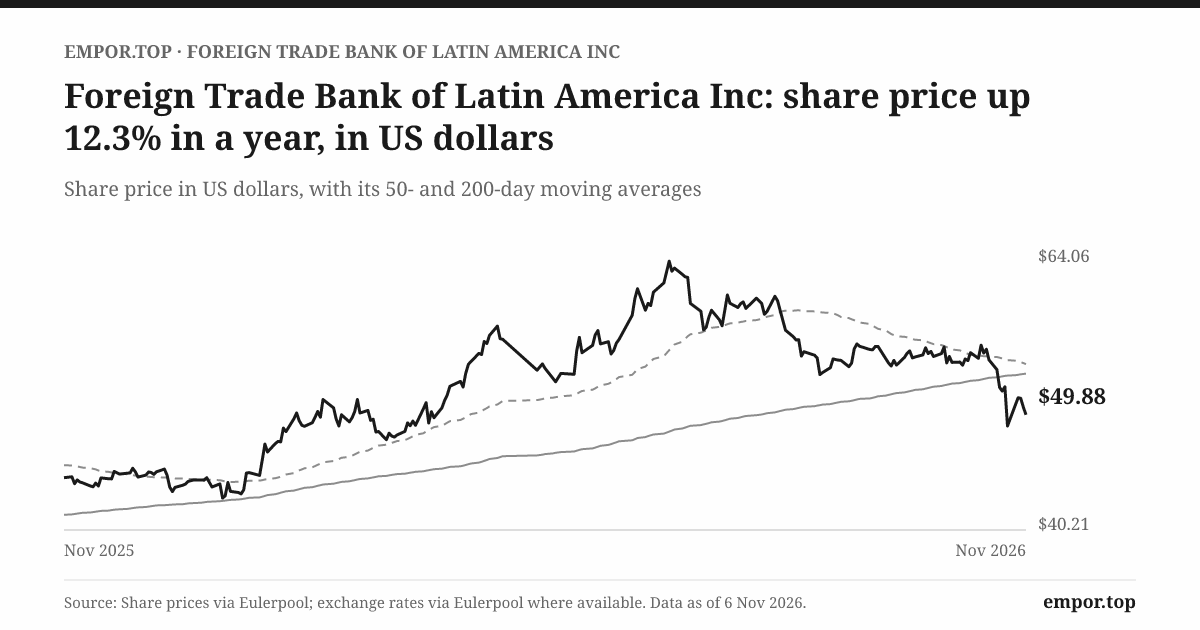
In early November 2026, Bladex shares traded at about $49.88, roughly 20% below their 52-week high of about $62.78.6 At that price the market valued the bank at about eight times its last twelve months of earnings and almost exactly its book value, with a dividend yield of about 5.4%.6 Is that the price of a cyclical lender, or a market missing a better trade franchise?
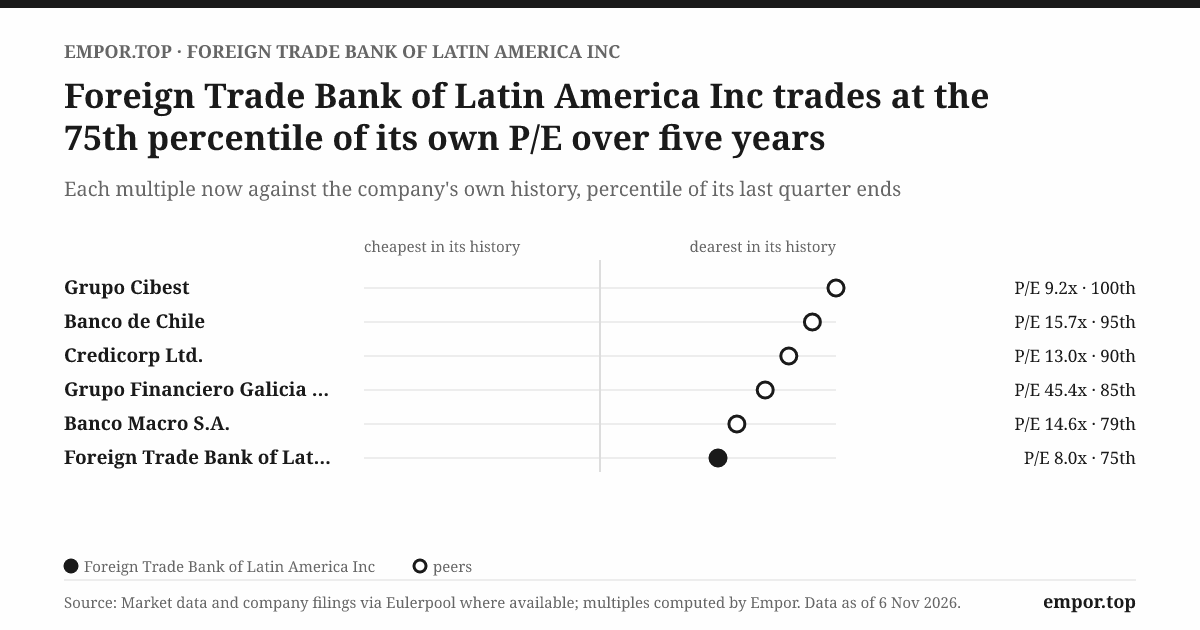
Start with the market's own memory. Eight times earnings looks cheap against most banks, but it is above Bladex's five-year median of about 6.5 times.6 Investors are already paying more for each dollar of Bladex's earnings than they did through most of the recent past. A comparison with a broad set of banks, including Scotiabank, BBVA, State Street and Credicorp, put Bladex at about 7.8 times earnings against a peer average near 9.3 times, but that group spans very different models, so it is context, not a benchmark.20 The fairer conclusion is that the market has already partly rewarded the Salas-era improvement and is now asking whether it lasts.
Turn the multiple upside down and it becomes easier to read. At eight times earnings, each share earns about 12.5% of its price each year.6 If Bladex pays out about 40% of that, as its policy implies, the shareholder collects a dividend yield in the mid-5% range and the bank retains the rest to grow the book. In plain terms, the market is offering a return that would look generous for a stable business and is asking investors to judge whether Bladex's earnings are stable enough to deserve it.
The price-to-book ratio of about one tells a cleaner story. A bank trading at book value is, roughly, being priced to earn its cost of equity and no more. With return on equity of about 13.5% over the last twelve months, Bladex is earning more than many investors would require, which suggests the market doubts those returns are sustainable.6 That doubt is the bear case in a single number.
The bull case rests on execution. The 2022–2026 plan improved spreads, efficiency, portfolio scale and returns, and hit its main objectives early.1416 All three rating agencies rate the bank investment grade with stable outlooks.5 And credit quality, measured by the stages lenders use to classify loans, is strong: about 99.1% of the credit portfolio was Stage 1, meaning performing with no significant increase in risk, at September 2026.3 Only about 0.4% was Stage 3, the impaired category, and reserves covered those loans about 1.4 times.3
The bear case starts in the same data. Impaired loans more than doubled in 2025, to about $38.7 million, and provisions increased in 2026 as the portfolio grew.83 Moody's lists fast credit growth and remaining market-funding concentration among its constraints, while Fitch flags borrower concentration.[^18]17 Rapid growth flatters asset-quality ratios in the short term, because new loans have not had time to go bad. The 35% jump in the portfolio means today's clean Stage 1 figure has not yet been tested by time.
The second bull argument is funding. Deposits grew about 22% in 2025 to about $6.6 billion and reached about $7.9 billion by September 2026, which lowers reliance on more expensive and flighty market borrowing.83 The 2030 plan aims to earn more from existing flows through fees, transaction services and treasury.14 If deposits keep growing from a broader set of corporate clients, Bladex's funding cost advantage widens.
The second bear argument is who supplies those deposits. Class A shareholders still provided about 35% of deposits at the end of 2025, and Moody's continues to cite significant market funding.8[^18] A bank whose deposits come heavily from central banks is stable as long as those central banks are comfortable, which is likely in normal times but not something public shareholders control. And the spread pressure management described on the third-quarter call shows that high-quality borrowers can and do negotiate.4
Now apply the competitive frameworks. Michael Porter's five forces start with buyers, and here buyer power is meaningful: high-quality borrowers have options, short maturities give them frequent chances to switch, and spreads have compressed as a result. Rivalry is intense, with global banks, regional banks and development institutions competing across overlapping products. Substitutes exist in the form of bond markets and export-credit agencies, especially for sovereigns and top-tier corporates. Supplier power, in the form of funding providers, is moderated by the deposit base but not eliminated, given market-funding concentration. The threat of new entrants is limited by regulation, funding access and regional expertise, which are real barriers but not insurmountable for large established banks.
Hamilton Helmer's seven powers sharpen the moat question. Bladex has no meaningful network effects or scale economies against global banks far larger than itself. Switching costs are low because loans are short and borrowers can shop each renewal. Branding works only in a limited way: the Bladex name carries credibility in Latin American trade circles, but it does not let the bank charge premium prices, as spread pressure shows. The best candidate is cornered resource: its relationship with central banks, which gives it privileged deposits, access and a founding role in regional trade. That is genuine, but it is a source of funding stability, not of pricing power over borrowers. Process power, the accumulated know-how of underwriting Latin American credit, may be the most durable advantage, and the post-2018 record supports it, though 2023's write-off and 2025's rise in impaired loans show it is not infallible.
Imagine an activist arriving at the annual meeting with a short list of challenges. The first would be concentration: why let a single sovereign reach about a sixth of the commercial book, and what limit does the board set on any one country? The second would be pay: management and director compensation has risen faster than the bank's operating expenses, and the activist would want to see how it moves in a down year. The third would be disclosure: the bank publishes no clean split between recurring transaction-services income and episodic structuring fees, which makes the fee strategy hard to judge from outside. None of these is a scandal. Each is a place where the bank asks investors to trust its judgment more than its disclosures allow them to verify.
There is also a legal and accounting check worth noting in passing. KPMG audits the bank, and its 2025 report raised no material weakness in internal controls, and the bank reported no litigation significant to its business.8 The main accounting judgment is the one every lender faces: how large to make its expected-credit-loss reserves. In a portfolio growing 35% a year, that judgment carries more weight than usual, because new loans have not yet shown how they will behave.
The conclusion from this analysis is that Bladex has real operating capabilities but not a protected position. Its edge is selective intermediation and privileged funding, not the ability to dictate terms. That is a narrower moat than the founding story suggests, but it is enough to earn decent returns if the bank stays disciplined.
The scorecard for tracking this can be kept to three measures. The first is commercial portfolio growth excluding exceptional sovereign deals, which shows whether the franchise is winning broad business; the total commercial book stood around $15 billion at September 2026, with the Panama loan making the headline figure hard to read.3 The second is Stage 2 and Stage 3 share together with reserve coverage, which today sit at about 0.9% of the portfolio combined and 1.4 times coverage on Stage 3.3 The third is net interest margin alongside fee income, which shows whether new services offset spread pressure; margin was about 2.29% over nine months, down six basis points.3
The decisive question is whether fee and deposit growth can offset competitive pricing without increasing credit risk. If they can, today's valuation probably underestimates the franchise. If they cannot, eight times earnings is a fair price for a well-run cyclical lender.
X. Epilogue
Tonight, Bladex stands at an awkward kind of peak. Its credit portfolio is the largest in its history, its strategy runs to 2030, and its single largest country exposure is a $1 billion loan that will, by all signs, mature long before the plan reaches its end. The next few quarters will reveal what kind of growth the bank has really built.
The first moment comes with the fourth-quarter 2026 results, expected early in 2027. Management has already warned that the full-quarter effect of the Panama loan will dilute margins more noticeably than in the third quarter.4 Analysts will also be listening for the first formal outlook for 2027, the first full year in which the Panama exposure can be measured against a normal flow of new business. The question is how much margin gives way, and whether the bank can show commercial growth outside the sovereign deal strong enough to reassure investors that the franchise is broad. If margin falls toward the low 2% range and underlying growth looks thin, the 35% headline will be remembered as a one-time inflation.
The second moment is the Panama loan's own path. If it is repaid or refinanced on schedule, Bladex will have shown that it can deploy capital into a large, short-term, low-risk opportunity and redeploy it into its core business. If the exposure lingers or grows, the concentration question will sharpen, particularly given that the bank's home sovereign now carries such weight in its book.
The third test is credit quality as the portfolio matures. Today about 99% of loans are Stage 1, but much of the book is new. The coming quarters will show whether Stage 2 and Stage 3 shares rise as the loans season, whether reserve coverage holds, and whether country concentrations stay manageable. A bank that grows 35% in a year will find out about its underwriting a year or two later.
Interest rates are the backdrop to all of it. The bank's 2025 annual report already blamed lower reference rates and abundant liquidity for squeezing margins.8 If dollar rates keep drifting down through 2027, Bladex's short-dated, floating-rate loans will reprice lower quickly, and some of the tailwind that lifted the last plan will run in reverse. The bank can partly offset this through cheaper deposits and more fees, but it cannot escape it. Margin guidance near 2.30% for 2030 implies management expects only modest further compression; any reading well below that would be an early warning.
The fourth question is funding. Deposits from Class A shareholders still form about a third of the base.8 If deposits from corporate clients grow faster, it will validate the plan's promise of transaction services that bring in cash. If the share of central-bank deposits stays high, the bank remains more dependent on a small group of depositors than its growth plans suggest.
The fifth test is the fee line. The 2030 plan targets about $125 million of non-interest income, a 2.30% margin, 16% to 17% adjusted return on equity and an $18 billion to $20 billion commercial portfolio.16 Those targets are testable. But the quality of growth matters more than reaching a headline portfolio size: a bank that hits $20 billion by stacking up sovereign loans at thin spreads would technically meet one target while missing the point of all the others.
Put the possibilities side by side and the shape of the next two years becomes clear. In the good version, the Panama loan rolls off or is refinanced on fair terms, commercial growth outside it runs at a healthy but unspectacular pace, fees climb steadily without a single jumbo deal to prop them up, and Stage 2 and Stage 3 loans stay below 1% of the book. That bank would be earning returns comfortably above its cost of equity with a broader funding base, and the market's habit of pricing it near book value would look stingy. In the bad version, spreads keep compressing, growth slows once the sovereign deal matures, a large corporate borrower somewhere in the region stumbles, and the cost base built for the 2030 plan starts to weigh on efficiency. That bank would look a lot like the Bladex of the late 2010s: competent, useful, and stuck at returns that justify no premium.
The Salas team has earned some credibility by hitting its last plan early. The next plan is harder, because it depends less on rising rates and more on persuading clients to give Bladex more of their business. The calls through 2027 should show whether transaction services are moving from investment to revenue, and whether management's explanations stay concrete when the questions get pointed.
XI. Outro
Go back to that September loan. A bank founded by central banks to help Latin American exporters find dollars lent a billion of them to the government of its own home country. In one sense, it was the founding mission come full circle: a regional institution with the reach and trust to finance a sovereign at scale. In another, it was a reminder that the bank now answers to public shareholders in New York, who will judge that loan by its spread, its risk and its effect on returns.
That dual identity is what makes Bladex unlike a conventional regional bank. It is a bridge between regional trade and global dollar finance, funded by central banks and markets, run by professionals and priced by investors. The Panama deal made the bridge longer. The years ahead will show whether it became stronger, and whether it can collect more tolls from the traffic it carries without bearing too much weight in the middle.
There is a fitting symmetry in where the bank sits. Bladex's headquarters lie in a city built around a canal, a piece of infrastructure that earns its living by charging ships to pass from one ocean to another. The canal's value lies not in owning the ships or the cargo but in being the shortest, safest route between two places that need each other. Bladex was built on the same idea for money: the shortest, safest route between Latin American trade and the world's dollars. A canal that lets in too much water at once floods its locks. A trade bank that lets in too much of one borrower risks the same. The billion-dollar loan to Panama was proof that the route is open. The test now is whether it stays safe.
References
-
Holland & Knight Advises Bladex on $1 Billion Financing — Holland & Knight, 2026-09-18 ↩↩↩
-
Bladex Structures USD 1.0 Billion Loan for the Republic of Panama — PR Newswire via Finviz, 2026-09-15 ↩↩↩↩
-
Bladex's credit portfolio grows 15% in the third quarter, reaching US$16,584 million (3Q2026 results release) — Bladex, 2026-10-26 ↩↩↩↩↩↩↩↩↩↩↩↩↩↩↩↩↩↩↩↩↩↩
-
Bladex, Inc. (BLX) Q3 2026 Earnings Call Transcript — Seeking Alpha, 2026-10-27 ↩↩↩↩↩↩↩
-
Investor Center: financial statements and market data — Bladex ↩↩↩↩↩↩↩↩↩↩↩↩↩↩↩↩↩↩↩↩
-
2025 Form 20-F — SEC, 2026-04-20 ↩↩↩↩↩↩↩↩↩↩↩↩↩↩↩↩↩↩↩↩↩↩↩↩↩↩↩↩↩↩↩↩↩↩↩↩↩↩↩↩↩↩↩↩↩
-
Bladex Announces Departure of Chief Executive Officer N. Gabriel Tolchinsky to Be Replaced by Jorge Salas — MarketScreener, 2020-01-27 ↩↩↩
-
Bladex Presents 2030 Strategy at Investor Day 2026 — Bladex, 2026-03-24 ↩↩↩↩↩↩↩
-
Rating Report: Banco Latinoamericano de Comercio Exterior — Fitch Ratings, 2025-06-05 ↩↩
-
Bladex Reports 2Q26 Results Driven by Record Credit Portfolio and Higher Profitability — Bladex, 2026-07-27 ↩
 LinkedIn
 WhatsApp
 Reddit
 Hacker News
 Email
 Kindle
 RSS Feed
 Spotify
 Apple Podcasts
 Amazon Music
 Audible
 YouTube