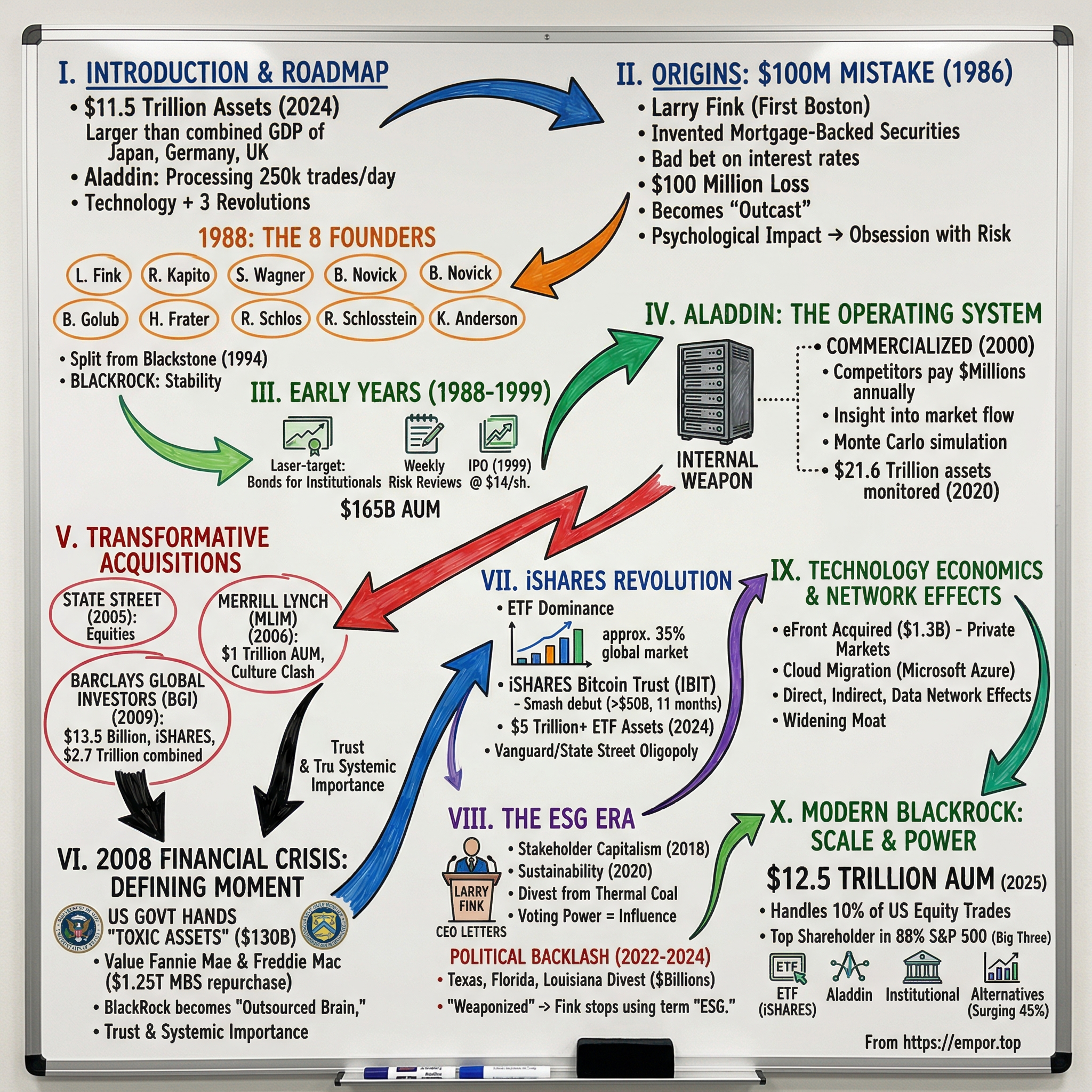
BlackRock: The Rise, Power, and Privatization of the Investment Management Colossus
I. Introduction & Episode Roadmap
On the morning of July 15, 2026, a conference operator named Shelley opened a call that is one of the more consequential quarterly rituals in global finance. Within four minutes, BlackRock's chief financial officer disclosed a figure that would have sounded implausible at any point in the firm's first three decades: assets under management of $15.3 trillion, built on $868 billion of net inflows over the preceding twelve months.12 That total exceeds the annual economic output of every country on earth except the United States and China, and stands roughly two-thirds larger than the total market value of Japan's stock market.
Yet scale alone is not the most revealing aspect of BlackRock. Many financial institutions have expanded rapidly. What distinguishes the firm is how it assembled that scale — and whether the strategic framework that drove its first thirty-eight years can sustain its next ten.
A clear financial baseline underscores this transition. BlackRock closed 2025 supervising $14.04 trillion, propelled by $698 billion in net inflows—its highest annual total to date—and 9% organic base fee growth. Full-year revenue reached $24.2 billion, up from $20.4 billion the prior year.331 Eight months later, the asset base had expanded by more than another trillion dollars.2 While management highlights these figures, overall asset growth reflects market appreciation as much as commercial momentum.
The core thesis is straightforward. In 1988, eight founders departed a Wall Street investment bank to establish a fixed-income firm backed by a borrowed $5 million credit line and a key insight: that institutional investors lacked a precise measurement of portfolio risk.5 They developed risk-analytics software before launching a single flagship fund. Thirty-eight years later, that platform—Aladdin—is embedded within insurers, sovereign wealth funds, and competing asset managers, while BlackRock has repeatedly deployed its balance sheet to acquire the capabilities demanded by shifting market cycles.
Here is the architecture of the story.
The risk-management DNA. BlackRock's catalyst was a $100 million loss on a mortgage trading desk at First Boston in 1986—a loss stemming not from speculative intent but from an inability to quantify complex risk.5 The firm was structured to eliminate that blind spot, creating risk technology that eventually developed into a standalone commercial business.
The asymmetric M&A playbook. The acquisitions of Merrill Lynch Investment Managers in 2006 and Barclays Global Investors in 2009 transformed a fixed-income specialist into the world's largest asset manager. The Barclays transaction, executed for $13.5 billion during the global financial crisis, brought iShares into the firm, establishing the low-cost indexing engine that has driven organic asset growth ever since.9
The technology moat. Aladdin began not as a commercial product strategy, but as an internal enterprise tool that clients subsequently requested to license. Technology services and subscription revenue reached $574 million in the second quarter of 2026, up 13% year over year, while annual contract value expanded 15%.12 Although it represents BlackRock's most defensible revenue stream, it remains its smallest core segment at under 10% of total revenue.
The privatization pivot. Between January 2024 and July 2025, BlackRock committed roughly $28 billion in cash and stock to acquire Global Infrastructure Partners, private-markets data provider Preqin, and alternative credit manager HPS Investment Partners.11[^14]12 This marks the largest strategic capital deployment in the firm's history. Management projects that private markets and technology will generate 30% of revenue by 2030, up from 15% at year-end 2024—an implicit acknowledgement that core public index management cannot sustain executive growth targets alone.14
The paradox of scale. At $15 trillion in assets, an asset manager operates as a systemic financial institution. BlackRock faces a state-led antitrust lawsuit concerning coal investments, has lost multibillion-dollar public pension mandates to political divestments, and remains subject to ongoing regulatory scrutiny regarding systemic risk designation.1617 Meanwhile, its 73-year-old founder has not publicly designated a successor.34
A central analytical discipline governs this evaluation: distinguishing BlackRock's demonstrated execution from management's strategic projections. The firm maintains an established record of accretive acquisitions, alongside a history of closing initiatives previously described as core priorities. Both elements are essential to evaluating its corporate trajectory.
Understanding how an enterprise founded on fixed-income risk analytics came to own global airports and data centers requires returning to a Manhattan trading desk in the spring of 1986.
 Subscribe on LinkedIn
II. Origins: Larry Fink & The $100 Million Bond Disaster (1976–1988)
The scene worth imagining is not a trading floor at its loudest, but at its quietest—a Friday in 1986 when the numbers came back and the mortgage desk at First Boston discovered it was carrying a directional bet nobody had consciously placed.
Laurence Fink had already established a notable reputation on Wall Street. Born in Van Nuys, California, in 1952, the son of a shoe-store owner and an English professor, he earned a political science degree and an MBA at UCLA before joining First Boston in 1976 as a bond trader.5 He proved adept at bridging quantitative specialists and institutional sales teams. By 1978, still in his mid-twenties, he became one of the youngest managing directors in the firm's history.5 He helped pioneer the market for mortgage-backed securities, pooling American home loans and slicing them into tranches that pension funds and insurers could purchase—generating substantial revenue for First Boston and establishing his standing at the firm.
Then interest rates moved unexpectedly. In 1986, Fink's department lost $100 million after rates fell and positions meant to hedge that exposure failed to do so.5 While survivable for First Boston, the loss derailed Fink's trajectory at the firm, moving him rapidly from heir apparent to an executive quietly navigated toward the exit.
What mattered analytically was the structural lesson Fink drew. Rather than simply adopting greater caution, he identified a core vulnerability: First Boston possessed skilled traders but lacked institutional technology to evaluate aggregate risk across positions in real time. The exposure lay not in any single trade, but in the absence of a unified portfolio view—the difference between tracking risk continuously and discovering it at quarter-end.
In 1988, Fink departed to co-found a new firm with seven partners: Robert Kapito, Susan Wagner, Barbara Novick, Ben Golub, Hugh Frater, Ralph Schlosstein, and Keith Anderson. The founding cohort proved unusually durable; Kapito remains president in 2026, while Golub served for decades as chief risk officer. Pitching Stephen Schwarzman and Pete Peterson at The Blackstone Group, the team secured a $5 million credit line and office space in exchange for a 50% equity stake, christening the venture Blackstone Financial Management.5
The enterprise began modestly: eight people in borrowed space with a business model centered on risk measurement. Lacking an established brand, distribution network, or proprietary trading edge, the founders pitched potential clients on solving the specific risk-blindness that had disrupted Fink's earlier desk.
Rather than selling outperformance, the firm offered transparency—promising pension funds and insurers precise visibility into portfolio behavior if interest rates moved by 100 basis points. As mortgage-backed securities grew increasingly complex, this framework resonated with institutional clients seeking risk controls rather than speculative returns. That low-margin, high-retention model established BlackRock's commercial identity as a predictable institutional option.
The founding myth, tested. Corporate narrative often frames the firm as having possessed an innate risk discipline that fully insulated it from market distress. Execution tells a more nuanced story. In its initial years, the firm maintained significant exposures to high-yield bonds and structured mortgages, leaving it vulnerable during the 1990–1991 credit crunch. Fink responded by broadening mandates toward investment-grade credit and formalizing the risk reporting clients demanded. The record shows not that BlackRock avoided risk entirely, but that management converted an early operational strain into institutional infrastructure faster than competitors did—establishing a pattern of metabolizing market shocks that recurred throughout its history.
The initial corporate structure also contained a governance constraint that would shape the subsequent six years. Fink had relinquished half the equity for a credit line and office space. In 1988, that agreement secured essential capital; by 1994, it posed a major strategic limitation.
III. The Separation, IPO, and Aladdin's Accidental Birth (1994–2004)
The break, when it came, was about compensation—which in asset management is another way of saying it was about who owns the franchise.
Fink wanted to issue equity to retain and attract key personnel. Schwarzman, watching his own stake dilute with each new partner, resisted. The disagreement proved unresolvable, and in 1994 Blackstone sold the unit—then managing roughly $23 billion—to PNC Bank Corp for $240 million.6 Schwarzman has since described the decision, with characteristic bluntness, as a "heroic" mistake.6 The stake he relinquished eventually compounded into an enterprise worth well over a hundred times what Blackstone received for it.
The five years inside PNC provided a period of structural consolidation. BlackRock operated with a patient owner, a bank balance sheet, and no public market demanding quarterly earnings growth. Management used the period to institutionalize operations, building out client reporting, risk analytics, and enterprise systems while competitors focused on the 1990s equity bull market. The firm that emerged established a reputation for operational consistency rather than market flair—a profile favored by institutional fiduciaries.
The rebranded BlackRock operated inside PNC with substantial autonomy, and on October 1, 1999, it went public on the New York Stock Exchange at $14 per share, closing the year with about $165 billion under management.7
The initial public offering did not generate immediate enthusiasm. Asset management in 1999 was overshadowed by dot-com underwriting, leading BlackRock to price below its initial target range. That reception shaped the firm's subsequent capital allocation strategy: management recognized early that its stock could be undervalued, instilling a willingness to issue shares primarily when acquiring strategic capabilities.
The more significant development occurring inside the firm had little to do with public markets.
What Aladdin actually is. Company lore holds that the initial version ran on a single workstation wedged between a refrigerator and a coffee machine, built largely by Charles Hallac and Ben Golub.22 The full name—Asset, Liability, Debt and Derivative Investment Network—reflects its technical scope. Conceptually, Aladdin operates as a unified analytical engine: it aggregates a client's holdings into a single database and simulates portfolio performance across thousands of stress scenarios. Functionally, it acts as a financial flight simulator, allowing chief investment officers to evaluate correlation breakdowns and market shocks before they occur.
The commercial expansion occurred around the turn of the millennium. Institutional clients that had observed BlackRock navigate mortgage-market volatility requested access to the internal platform, leading to the creation of BlackRock Solutions. Fink recognized that software licensing generated a distinct revenue profile compared to asset-management fees: recurring subscription revenue that remained stable even during market downturns.
The frictionless-SaaS claim, tested. While corporate narrative presents Aladdin as a natural platform extension, early commercialization faced significant headwinds. Selling risk software to competing asset managers required overcoming deep conflicts of interest regarding position transparency. Growth accelerated only after BlackRock established formal legal, technical, and informational barriers between its investment operations and software divisions. Even then, adoption required years of addressing client security concerns. The record indicates that Aladdin's competitive moat stemmed not from immediate technological superiority, but from long-term switching costs built through structural isolation. This historical friction provides context for BlackRock's current push to expand Aladdin into private markets, where position opacity and competitive sensitivities remain equally acute.
By 2004, BlackRock was a profitable, mid-sized fixed-income manager supervising a growing software unit. It remained far from a systemically central institution. The shift toward global scale resulted not from organic expansion alone, but from two large acquisitions executed over the following four years.
IV. The Megadeal M&A Spree: MLIM & The BGI Masterstroke (2005–2009)
In the spring of 2009, Barclays PLC faced a severe capital crunch. The British bank had refused a government bailout, leaving it eager to raise cash without surrendering equity to the state. It possessed one asset the broader market unambiguously wanted: Barclays Global Investors, home to the iShares exchange-traded fund franchise. Selling this crown jewel to avert nationalization was a decision forced by deteriorating alternatives.
BlackRock spent the preceding three years assembling the foundation for that moment.
Step one: buying distribution. BlackRock acquired State Street Research & Management in 2005 for $375 million, adding active equity capabilities. A far larger transformation occurred on February 15, 2006, when BlackRock and Merrill Lynch announced a deal to merge Merrill Lynch Investment Managers into BlackRock, creating a firm with nearly $1 trillion under management.8 The consideration was approximately $9.8 billion in stock, and Merrill emerged with a 49.8% economic stake and a 45% voting interest.8 The core strategic value lay less in the legacy mutual funds than in Merrill's extensive retail broker network—thousands of financial advisers whose recommendations moved household money. By absorbing this network, a specialized fixed-income institution acquired a massive consumer distribution channel.
Step two: becoming the government's contractor. When Bear Stearns collapsed in March 2008 and American International Group required a federal bailout that September, the Federal Reserve Bank of New York confronted a problem it was institutionally unequipped to solve: it owned vast portfolios of structured mortgage assets that lacked liquid market pricing. The Fed created three special-purpose vehicles—Maiden Lane, Maiden Lane II, and Maiden Lane III—and hired BlackRock Financial Management to manage and wind them down, under investment management agreements executed in 2008.10
While direct revenue from these Fed mandates remained modest, their strategic and political impact proved immense. The assignments established BlackRock as the institution Washington called to manage crisis assets—a credential no marketing budget could purchase. Conversely, the no-bid nature of several contracts created lasting political scrutiny over its proximity to government regulators. Investors must view BlackRock's federal relationships as both a structural competitive asset and an ongoing political liability.
Step three: the deal that made the company. On June 11, 2009, BlackRock agreed to acquire Barclays Global Investors, including iShares, for $13.5 billion.9 At the time, iShares held over $300 billion across more than 350 funds worldwide.9 The transaction closed on December 1, 2009, instantly making BlackRock the largest asset manager on earth.
The strategic rationale extended far beyond opportunistic crisis pricing. BlackRock acquired an operating model structured around powerful economies of scale, precisely as global investor demand shifted toward passive index investing.
Index products carry high fixed expenses—including index licensing fees, portfolio management technology, market-making networks, and cross-border regulatory infrastructure—alongside near-zero marginal costs per incremental dollar. As net inflows expanded post-2009, operating margins widened. Barclays relinquished a high-fixed-cost franchise just as structural industry flows began scaling its asset base.
The transaction also highlighted BlackRock's risk tolerance during market turmoil. Barclays sold BGI not because iShares was underperforming, but because the parent bank urgently required liquidity. While competing bidders hesitated, BlackRock funded a significant portion of the purchase price with its own stock despite a depressed equity valuation, accepting near-term share dilution to acquire a compounding franchise. That willingness to deploy equity during market stress to secure strategic platforms re-emerged during its acquisitions of Global Infrastructure Partners and HPS Investment Partners.
The seamless-integrator claim, tested. While corporate narrative often characterizes BlackRock's M&A execution as flawless, historical performance shows a more nuanced pattern. The Merrill Lynch Investment Managers transaction brought over a large book of legacy active equity mutual funds that underperformed, bled assets, and faced relentless fee pressure for years afterward. Retail active management proved far harder to integrate and defend than passive indexing—the acquired active franchise decayed, while the distribution relationships compounded. The evidence indicates that BlackRock excels at acquiring platforms and distribution, while achieving merely average results when acquiring investment performance. That distinction remains central to evaluating its current expansion into private markets, where firms like GIP and HPS rely fundamentally on specialized investment track records and human capital.
The BGI deal handed BlackRock the primary engine of modern asset management. The subsequent fifteen years would test how that machine performed when confronting competitors operating without traditional profit requirements.
V. The iShares Passive Engine & Scale Economies Moat
There is a chart that explains most of modern asset management, and it contains only two lines: capital flowing out of actively managed funds, and capital flowing into index funds. The lines crossed in the mid-2010s, and the trend has not reversed.
The underlying math is straightforward. After fees, the median active manager underperforms the index over long horizons, and that outcome is not a question of skill. Because the aggregate of all market participants is the market, active management becomes a negative-sum game once fees and transaction costs are deducted. Once retail investors and their advisers internalized that arithmetic, the central decision shifted from selecting a manager to selecting a cost-effective vehicle.
BlackRock positioned itself as the primary answer. By mid-2026, iShares supervised over $6 trillion across its global platform, driven by $178 billion in second-quarter net inflows and 12% organic base fee growth for the year to date.2 European iShares surpassed $1.5 trillion following $80 billion in first-half inflows, while locally domiciled Asia-Pacific iShares passed $100 billion.2
The breakdown of those flows illustrates the breadth of the platform. In the second quarter of 2026, core equity ETFs gathered $85 billion and index bond ETFs recorded a record $61 billion in net inflows, while active ETFs added $20 billion and precision exposures—international and sector funds used for tactical trading—added $15 billion.2 That dispersion demonstrates that iShares is not a single product line, but a multi-use financial infrastructure. A pension fund holding a broad market index and a hedge fund executing a two-week sector trade rely on completely different strategies, yet BlackRock monetizes both on the same operational architecture.
A myth worth dismantling before going further. A common assertion in public debate is that BlackRock "owns" a fifth of corporate America. It does not. BlackRock operates as a fiduciary agent: the underlying shares belong to pension plans, insurers, sovereign wealth funds, and individual investors, while BlackRock collects a management fee. The firm does not receive dividend payments, does not absorb capital losses, and faces client capital flight—as demonstrated by political divestments in states like Texas. What BlackRock does exercise is voting authority attached to those portfolio shares, making its Voting Choice initiative a critical governance mechanism rather than a routine administrative program.
A second misconception is common among equity investors: that an institution of BlackRock's scale is insulated from price competition. Disclosed fee trends demonstrate otherwise.
The scale flywheel, in plain terms. An exchange-traded fund functions as a pooled vehicle trading on an exchange like a stock. Higher trading volume narrows the bid-ask spread—the cost difference between buying and selling a share. For an institution executing orders in the hundreds of millions of dollars, bid-ask spreads can exceed the annual management fee. Consequently, liquidity attracts order flow, deep order flow reinforces liquidity, and the dominant fund in a category maintains its market share even when competitors introduce lower-fee alternatives. This structural network effect creates a formidable barrier to entry for lower-cost clones.
The pricing-power claim, tested — and this is the important one. Scale is often cited as conferring pricing power. The historical record indicates the opposite.
Vanguard's mutual structure returns profits to its funds, allowing it to price products near cost without shareholder pressure for margin expansion. State Street, which pioneered the ETF category with SPY, spent two decades ceding market share to cheaper entrants. Facing Vanguard's structural cost advantage, BlackRock did not exercise pricing power; it reduced fees. Throughout the 2010s, the firm repeatedly lowered expense ratios across its iShares "Core" series—cutting headline fees on flagship equity funds to a few basis points to defend market share. Disclosed figures show the average iShares fee fell by roughly a quarter between 2013 and 2017 alone, with fee compression persisting in subsequent years.23
Scale provides BlackRock not with the power to raise prices, but with the capacity to absorb lower prices while leveraging its cost structure to fund higher-fee product development. This distinction defines scale as a defensive moat rather than monopolistic pricing power.
That strategic shift is evident in the current asset mix. Management's response to passive fee compression has been to direct capital toward higher-fee categories. Active ETFs gathered over $70 billion in net inflows over the twelve months ending in mid-2026, elevating BlackRock from the seventh-largest active ETF provider to third in three years.2 Chief Financial Officer Martin Small noted on the second-quarter earnings call that demand for structural growth areas—including private markets, active ETFs, and systematic strategies—supported effective fee rates on net new flows.2
Digital assets as a distribution proof point. The iShares Bitcoin Trust, introduced in January 2024, became the fastest ETF to reach $10 billion in assets and held approximately $62 billion by late August 2026.30 At a 0.25% sponsor fee, the fund generated revenue that executives characterized as making digital asset ETFs among the firm's most profitable product lines.35 The underlying takeaway is less about cryptocurrency sentiment than execution capability: when regulatory approval opened the wrapper for a new asset class, BlackRock's distribution scale established market leadership within months against ten competing issuers.
Yet the commoditization dynamic affecting traditional indexes quickly re-emerged in digital assets. In April 2026, Morgan Stanley launched a competing bitcoin ETF with a 0.14% fee—undercutting IBIT by roughly 44%.29 The cycle mirrors the index fee wars of the 2010s: BlackRock establishes or dominates a category, a well-capitalized competitor cuts fees, and category-wide pricing compresses. Sustaining organic revenue growth requires BlackRock to continually migrate client capital into higher-margin products faster than existing franchises commoditize.
The one segment of BlackRock's business exempt from this fee compression cycle is the enterprise software platform that originated on an early trading desk.
VI. Aladdin: The Tech Platform Operating System of Finance
Every night, across data centers on multiple continents, a vast computational exercise takes place. Millions of individual securities are revalued, and thousands of stress scenarios are run across portfolios managed for insurers, sovereign wealth funds, corporate pension plans, and competing asset managers. By the time European markets open, the risk and valuation metrics are complete.
This is Aladdin, BlackRock's distinctive technology platform: a software business born out of internal necessity, licensed to direct commercial competitors, and operating with few direct peers at comparable scale.
Why it is hard to leave. High switching costs in enterprise software are often cited in theory, but in Aladdin's case they are rooted in core operational dependencies. The platform is not merely a risk reporting tool. It serves as the system of record for portfolio positions, the engine for asset allocation, the central conduit through which trades are executed, and the ledger feeding accounting and client reporting. Replacing it requires an institution to overhaul its middle and back office, retrain investment staff, revalidate risk models with regulators, and absorb operational risk during the transition—all while managing client assets. That represents a multi-year effort with significant execution risk and limited upside, leading institutional clients to renew contracts consistently.
The financial impact of that operational lock-in is reflected in the segment's financial results. Technology services and subscription revenue reached $574 million in the second quarter of 2026, a 13% increase year over year, while annual contract value—the metric tracking contracted recurring revenue—grew 15%.12 Management has consistently targeted long-term annual contract value growth in the low-to-mid-teens, maintaining that guidance across consecutive earnings calls.2
The platform's institutional footprint extends far beyond BlackRock's own investment desks. By 2019, Aladdin served as the operating system for more than 225 institutions, while eFront supplied software to over 700 clients across 48 countries.24 These deployments represent enterprise-wide integration across major financial institutions. Consequently, when management notes that Aladdin oversees tens of trillions of dollars in assets, that figure encompasses total capital managed by third-party clients using the software—a critical distinction from BlackRock's own $15.3 trillion asset base.
Evaluating that growth trajectory requires accounting for M&A contributions. Reported annual contract value expansion was bolstered by acquisitions: ACV rose 31% year over year in the fourth quarter of 2025 following the inclusion of Preqin, compared to 16% full-year growth, with Preqin contributing approximately $65 million in revenue during that quarter alone.3 As Preqin annualizes into the baseline throughout 2026, organic expansion becomes clearer. The 15% annual contract value growth recorded in the second quarter of 2026 provides a clearer indicator of underlying momentum, setting up upcoming quarters to test whether integrating private-market data drives cross-selling that Aladdin could not generate independently.
Buying the rest of the map. Aladdin was originally architected for public markets, where security pricing is continuous. Private assets operate differently: illiquid investments like infrastructure projects or private debt are revalued periodically by their managers. To bridge that analytical gap, BlackRock executed two major technology acquisitions. It acquired eFront, a provider of alternative investment software, in a $1.3 billion all-cash transaction announced in March 2019 and completed that May.24 It subsequently bought private-markets data provider Preqin for £2.55 billion in cash, closing the deal in March 2025.[^14]
The strategic goal is to offer institutional clients a unified platform that evaluates public equities and private credit under a single analytical framework. On BlackRock's July 2026 earnings call, Fink acknowledged that full integration remains an ongoing effort, stating, "We are not there. Nobody is there yet," while identifying the initiative as a central internal priority.2 His comment highlighted that building a seamlessly unified public-private analytics platform remains a work in progress rather than a finished product.
Macroeconomic and regulatory shifts could accelerate demand for these tools. Chief Financial Officer Martin Small pointed to a proposed U.S. Department of Labor safe-harbor rule for private assets in 401(k) plans—which would mandate standardized benchmarking for illiquid holdings—alongside growing investor scrutiny following valuation fluctuations in non-traded business development companies and private credit funds.2 Regulatory mandates for illiquid asset transparency create a favorable environment for Preqin's data tools. However, because BlackRock is simultaneously expanding its own private-market investment operations, selling independent benchmarking data to competitors revives the same conflict-of-interest concerns that initially delayed Aladdin's institutional adoption twenty years ago.
The B2C extension claim, tested. While Aladdin expanded successfully across institutional clients, attempts to extend BlackRock's technology directly to retail consumers faced clear limitations. In 2015, BlackRock acquired robo-adviser FutureAdvisor for approximately $150 million, framing the purchase as an entry point into digital wealth management. Eight years later, in early 2023, BlackRock unwound its direct-to-consumer operations, transferring roughly $1.75 billion in assets across 30,000 client accounts to Ritholtz Wealth Management.21 High customer acquisition costs and low average account balances rendered the direct retail strategy unviable for an enterprise of BlackRock's scale.
This outcome demonstrates a clear boundary for the firm's technology division: Aladdin excels when serving institutional clients with complex operational mandates and substantial budgets, but has not succeeded in direct consumer applications. That distinction is particularly relevant as BlackRock projects future growth from tokenized assets and digital wallet distribution. Evaluating this digital strategy requires monitoring whether digital-asset revenue reaches management's target of approximately $500 million by 2030—up from a baseline of roughly $110 billion in connected assets under management—and whether those inflows arrive via direct proprietary channels or through established third-party financial intermediaries.2
Aladdin provides BlackRock with predictable subscription revenue and high client retention, offering structural resilience beyond traditional asset management. However, software licensing alone cannot generate the aggregate earnings expansion management has promised. Reaching those long-term growth targets required deploying nearly $28 billion in corporate capital.
VII. The Private Markets Transformation: GIP & Preqin Megadeals (2024–2026)
On January 12, 2024, BlackRock announced it would acquire Global Infrastructure Partners for $12.5 billion — $3 billion in cash and roughly 12 million shares of stock.11 For a firm whose entire identity had been built on liquid, transparent, low-cost, daily-priced products, this was close to an ideological reversal. GIP owned stakes in airports, pipelines, and power assets. Nothing about it was liquid, transparent, low-cost, or daily-priced.
The rationale was arithmetic. A basis point earned on an index fund and a basis point earned on an infrastructure fund are not the same basis point — there are roughly one to two orders of magnitude between them. BlackRock's own second-quarter disclosures make the gap stark: fee yields in private markets run in the high tens of basis points, against low single digits for institutional index mandates. If public-index fees compress toward zero while the asset base grows, revenue growth eventually stalls regardless of flows. Management's Investor Day framing in June 2025 stated the problem and the answer together: private markets and technology were 15% of revenue at the end of 2024, and the ambition is 30% or more by 2030, within an aspiration of more than $35 billion of total revenue against roughly $20 billion in 2024.14
What was bought, and for how much. The GIP transaction closed on October 1, 2024, bringing Adebayo Ogunlesi and the GIP leadership team and creating a combined infrastructure platform of well over $100 billion.[^12] Preqin followed in March 2025. Then, on December 3, 2024, BlackRock agreed to acquire HPS Investment Partners for approximately $12 billion, paid entirely in BlackRock equity, closing July 1, 2025 and creating an integrated private credit franchise of roughly $220 billion alongside BlackRock's $3 trillion public fixed income business.1213
The results through mid-2026 have run ahead of the plan management laid out. Infrastructure client assets stood at $212 billion in the second quarter of 2026, against $42 billion a year earlier; private credit reached $123 billion from $87 billion.1 Total alternatives client assets were $715 billion, of which $556 billion was fee-paying.1 GIP closed its fifth flagship fund at $25.2 billion — described by BlackRock as the largest client capital raise ever completed for a private infrastructure fund — and private credit drew nearly $20 billion of net inflows in 2025, led by HPS's flagship franchises.4
The trajectory of the alternatives business across 2025 gives a cleaner read than any single quarter. Client assets in alternatives rose from $455 billion at the end of 2024 to $676 billion at the end of 2025, with fee-paying assets climbing from $377 billion to $529 billion over the same period.3 Most of that jump is acquired rather than gathered, which is exactly what should be expected in the first year after two large closings — the relevant question is what happens in the years when nothing is being bought.
Deployment tells you whether the capital is actually working. The first half of 2026 was among the busiest on record for the infrastructure platform, including a take-private of AES, the European ground-leasing business TCR, an acquisition stake in the mid-market solar developer Summit Ridge Partners, and the Aligned Data Centers transaction discussed below.2 Fundraising and deployment are different disciplines, and a platform that raises well but deploys slowly ends up returning uncommitted capital and disappointing on fees. So far, BlackRock is doing both.
Where the growth is actually coming from. Two mechanisms are doing most of the work, and both are more interesting than "BlackRock is big."
The first is insurance. Insurers hold long-dated liabilities and have spent fifteen years starved of yield. Fink told analysts in July 2026 that insurers with long liabilities could earn 150 to 350 basis points over Treasuries in private structures, that BlackRock had closed roughly $10 billion of high-grade and infrastructure debt mandates for insurers so far in 2026, and that the firm has around $800 billion of insurance assets it could convert.2 Converting even 5–10% of that pool from public to private mandates is, in his words, "a tremendous lift to our average net fees."2 This is the single clearest, most measurable path from the acquisitions to shareholder economics, and it is the one to watch.
The second is the AI infrastructure build-out. In October 2025, a consortium comprising the AI Infrastructure Partnership, Abu Dhabi's MGX, and BlackRock's GIP agreed to acquire Aligned Data Centers at an enterprise value of roughly $40 billion — the largest data center transaction announced to date — closing in July 2026.2627 Fink's framing on the call was that hyperscalers have gone "from balance sheet-light companies to major balance sheet needs," and are seeking partners who can supply both equity and the far larger debt component.2 The combination of GIP's origination and HPS's credit capability is the specific reason BlackRock can be at that table. Whether that is a durable structural advantage or a cycle-dependent one depends entirely on how long the capital intensity of AI persists — and that is not a question anyone can currently answer.
The dominance claim, tested. Management's implicit argument is that BlackRock's distribution scale makes private-markets leadership close to inevitable. The company's own history argues against inevitability. BlackRock tried to build private equity organically: Long Term Private Capital launched around 2018 with an ambition reported at more than $10 billion in an evergreen structure, ultimately converted to a conventional fund and closed at roughly $4.3 billion, and BlackRock did not raise a successor under that banner.25 That is not a catastrophe — it is a mediocre outcome in a business where relationships and track record, not distribution, are the binding constraint. It is also precisely why the firm ended up paying $24.5 billion for GIP and HPS rather than building.
There is a second, sharper piece of disconfirming evidence, and it comes from management itself. Asked about private credit in July 2026, Fink acknowledged "the idiosyncratic risk in some of the private credit the last quarter of last year," noted the "headlines related to the retail side," and reported that institutional clients now routinely ask whether discounts are available on private credit assets.2 He said credit quality had stabilized and payments had not deteriorated.2 Investors should hold both statements: BlackRock entered private credit near a cyclical high in fundraising and valuation, spreads have since widened, and the marks on illiquid credit are set by the manager, not the market. Nothing in the record so far suggests impairment. Nothing in the record so far constitutes a test, either — this book has not been through a genuine default cycle under BlackRock's ownership.
The balance-sheet consequence is unavoidable and worth stating plainly. Goodwill on BlackRock's books rose from $15.5 billion at the end of 2023 to $35.3 billion at the end of 2025, with intangible assets of a further $28.0 billion — a combined $63.3 billion against total stockholders' equity of $55.9 billion.31 More than the entire book value of the company now consists of the premium paid for acquired asset managers. If private-markets fundraising slows materially or fee rates compress in alternatives the way they did in index products, the impairment exposure is substantial. That is a real accounting judgment risk, not a theoretical one.
The revised claim that survives the evidence: BlackRock has bought genuine, top-tier private-markets capability and is monetizing it faster than planned through a distribution advantage — particularly with insurers — that Blackstone, KKR, Apollo, and Brookfield cannot match. It has not demonstrated that it can generate top-quartile private-markets returns through a full cycle, and until it does, the platform is a distribution business attached to someone else's track record. The KPIs that resolve it: progress against the $400 billion cumulative gross fundraising target set for 2025–2030, and the realized performance of the first HPS and GIP vintages raised under BlackRock ownership.15
Scale of this kind buys opportunity. It also buys enemies.
VIII. Politics, ESG Backlash, and Systemic Power Scrutiny
In January 2018, Larry Fink sent a letter to the chief executives of the world's largest public companies. It was titled "A Sense of Purpose," and its central claim was that a company which failed to demonstrate its contribution to society would eventually lose the license to operate. Coming from the person who controlled the voting shares of a substantial fraction of the S&P 500, it was not received as a philosophical musing.
For roughly four years, this was the dominant narrative about BlackRock. Fink's annual letters set the agenda for corporate governance debates. The firm joined climate coalitions, pressed portfolio companies on transition planning, and positioned itself as the adult supervising capitalism's long-term interests.
Then the politics inverted, and BlackRock discovered that being the world's most visible steward is a position with no defensible ground.
The attack from the right. Conservative US states began treating BlackRock's climate advocacy as a boycott of fossil fuels — and in several cases, as a violation of state law. The most consequential single action came on March 19, 2024, when the $53 billion Texas Permanent School Fund terminated BlackRock's management of approximately $8.5 billion of state assets, citing a 2021 Texas statute restricting investment with firms deemed to boycott energy companies.16 BlackRock's response called the move harmful to Texas schoolchildren and maintained it does not boycott any industry.16 Comparable divestments followed in other Republican-led states.
The legal escalation was sharper. In December 2024, Texas Attorney General Ken Paxton, joined by other states, sued BlackRock, State Street, and Vanguard, alleging the three had used their common shareholdings in public coal producers to conspire to constrict coal output and raise energy prices.17 The defendants' motion to dismiss was denied, allowing the case to proceed.18 The Department of Justice and Federal Trade Commission filed a statement of interest concerning anticompetitive uses of common shareholdings — a signal that the theory had federal attention rather than being confined to state politics.20
Vanguard subsequently settled with the eleven suing states, paying $29.5 million without admitting wrongdoing, agreeing to expand its investor-choice program, and agreeing that its US businesses would refrain from joining groups with climate-focused investment or stewardship objectives.19 The litigation against BlackRock and State Street continued.19
This is a material legal overhang and should be treated as one. The Vanguard settlement establishes a template — money plus binding constraints on stewardship conduct — and it raises rather than lowers the probability that BlackRock faces similar terms. The more consequential risk is not the cash. It is the precedent that common ownership across an industry can itself constitute an antitrust theory, which would touch the economics of index management generally.
The attack from the left. Progressive treasurers and climate groups have criticized BlackRock from the opposite direction, arguing that a firm which continues to hold every fossil fuel producer in its index products and has voted against a large share of climate-related shareholder proposals was never doing what it claimed. This critique is harder to litigate but harder to escape: a passive manager cannot sell an index constituent, which means BlackRock's ability to deliver on stewardship rhetoric was always structurally constrained.
The retreat. In 2023, Fink stated publicly that he had stopped using the term "ESG," describing it as weaponized and polarized. The language shifted to "energy transition" and pragmatic capitalism. BlackRock also expanded Voting Choice, its program allowing eligible clients to direct the votes attached to their own shares — a genuine structural response that reduces the concentration of decision rights at the centre while also, conveniently, reducing BlackRock's political exposure.
The stewardship claim, tested. BlackRock argued for years that proactive sustainability stewardship strengthened client relationships and asset growth. The record does not support that as stated. It produced measurable outflows of public mandates, state legislative restrictions, subpoenas, and an ongoing antitrust case — all with direct revenue consequences in 2022 through 2024 — while producing no identifiable offsetting inflow of comparable scale. The claim is rejected in its original form. What survives is narrower and still defensible: BlackRock's scale proved more durable than its political positioning, and the firm absorbed billions in politically motivated redemptions while continuing to grow overall. Investors should read this as evidence about the resilience of the distribution franchise, not as vindication of the stewardship strategy.
The common-ownership problem, stated fairly. Underneath the political theatre sits a genuine intellectual question that predates the culture war. Because index funds must hold every constituent of an index, the same three managers appear on the share register of nearly every large listed company in America, frequently as top-three holders of direct competitors. Academic work has argued this could soften competition even without any coordination, simply because a diversified owner is indifferent as to which of two rivals wins.
Whether that effect is real remains contested, and the empirical evidence is far from settled. But it is the intellectual foundation the Texas case is built on, and it is not going away regardless of how the coal litigation resolves. For investors, the practical exposure is not a fine. It is the possibility of a regulatory settlement that constrains how index managers vote — which would reduce BlackRock's influence without reducing its fee revenue, and would therefore be far less economically damaging than the headlines would suggest. That asymmetry is worth holding onto: the most likely bad outcomes here dent the franchise's power rather than its profits.
Systemic designation. The Financial Stability Oversight Council retains authority under Dodd-Frank to designate nonbank financial institutions as systemically important, and BlackRock's own risk disclosures acknowledge that such a designation would bring enhanced regulatory and capital requirements and direct Federal Reserve supervision.31 Regulators have so far focused on products and activities rather than designating asset managers themselves, and BlackRock has argued forcefully that the SIFI framework misapplies to agency businesses that manage other people's money rather than risking their own balance sheet. That argument has held for over a decade. It is worth noting, however, that BlackRock's own balance sheet is now considerably less agency-like than it was — the private-markets businesses involve seed capital, general partner commitments, and consolidated investment products — which weakens the cleanest version of the defense over time.
The political story and the succession story are linked, because the person who built the relationships that survived all of this is not young.
IX. Management, Governance, & Capital Allocation Record
There is a telling detail in how Laurence Fink manages BlackRock's quarterly earnings calls. He addresses broad strategic questions himself and passes technical inquiries directly to Chief Financial Officer Martin Small with a succinct directive: "Let me have Martin answer that." On the July 2026 call, Fink deployed that handoff three times in the first four questions.2 The gesture reflects operational delegation while providing a live preview of the long-term succession process overseen by the board.
The people. Fink, 73, has served as chief executive officer since co-founding the firm in 1988—an unbroken 38-year tenure that represents a notable governance anomaly among major public companies. His disclosed compensation reached $30.8 million for 2024, a 14% increase, with incentive metrics weighted toward long-term equity linked to organic fee growth, technology annual contract value, and return on invested capital.33 Co-founder Robert Kapito continues as president, supervising distribution and daily operations. Small, who previously headed U.S. Wealth Advisory before becoming CFO in 2023, has since assumed the role of global head of corporate strategy—a dual mandate that positions him as a prominent internal successor. Financial reporting identifies the broader candidate pool as including Small, Chief Operating Officer Rob Goldstein, International Head Rachel Lord, and Chief Product Officer Stephen Cohen, with Fink and Kapito actively mentoring the cohort while Fink expresses no immediate intention to retire.34 The firm's annual proxy statement confirms that succession planning remains a structured component of the board's routine governance reviews, covering both emergency scenarios and eventual retirement.32
From an institutional governance perspective, the setup presents clear vulnerabilities. A founder-CEO nearing four decades at the helm, managing a firm where sovereign and regulatory relationships are heavily client-facing and personally intermediated, creates key-person concentration risk. Despite an experienced executive bench, the absence of a designated successor or explicit transition timeline leaves the enterprise reliant on an informal process rather than a binding mechanism.
Capital allocation, examined honestly. BlackRock maintains a consistent policy of capital return, raising its dividend annually for over a decade. Most recently, the board declared a quarterly dividend of $5.73 per share on July 22, 2026, representing a 10% increase.28 Second-quarter share repurchases totaled $450 million, with management raising its forward guidance to at least $550 million per quarter—exceeding targets set in January—and projecting total shareholder returns of over $5.7 billion for 2026, a 16% rise from 2025.12
Across four decades, management has followed a clear capital framework: return steady cash to shareholders while deploying equity for transformational acquisitions. Major transactions—including Merrill Lynch Investment Managers, Barclays Global Investors, Global Infrastructure Partners, and HPS Investment Partners—were financed largely or entirely through stock. This strategy uses an appreciated equity currency to secure institutional capabilities that BlackRock could not build organically.
Equally revealing is what management has avoided. The firm has resisted overleveraging its balance sheet; total debt stood at approximately $15 billion at year-end 2025 against a robust equity base—a conservative structure given its cash generation.31 Furthermore, BlackRock has eschewed major diversification outside core asset management and financial technology, and has avoided using share buybacks to artificially mask operational softness during market downturns.
Yet stock-funded growth introduces equity dilution. The second quarter of 2026 illustrated that trade-off: adjusted operating income expanded 39% year over year, while adjusted earnings per share grew 15%.12 The differential reflects an expanded share count following the equity-funded acquisition of HPS. Existing shareholders financed a portion of operating growth through dilution. Consequently, increased buyback guidance functions partly as a structural offset to share issuance rather than purely as a capital-return signal.
While BlackRock's capital record demonstrates structural discipline, its execution is not without setbacks. The write-down of FutureAdvisor to a client-book transfer, the wind-down of Long Term Private Capital without a successor vehicle, and the prolonged integration of Merrill's legacy active equity funds highlight real operational friction. A comprehensive evaluation recognizes both the firm's strategic M&A execution and its failed initiatives.
Prepared remarks versus the Q&A. Recent earnings calls underscore the contrast between management's messaging and analyst scrutiny. Executive presentations highlight record top-line performance: record revenue, record operating income, record first-half inflows, and eight consecutive quarters of organic base fee growth meeting or exceeding internal targets.2 Question-and-answer sessions focus on underlying operational friction. On the July 2026 call, analysts pressed management regarding the sustainability of its 45.9% operating margin, potential distribution tolls as peers like Merrill and Schwab adjust platform fee structures, the pace of private-credit capital deployment, and Preqin's operational integration.2
Management provided specific counter-arguments. Regarding operating margins, Small declined to frame 45.9% as a ceiling, emphasizing that BlackRock achieved nearly 47% in 2021 prior to its recent alternatives acquisitions and noting that both GIP and HPS operate with fee-related earnings margins above 50%.2 On distribution costs, Small offered an explicit commitment: BlackRock's index ETF distribution "does not include tolls," the firm has "not been approached by any major U.S. distributors," and it is "not in any active negotiations."2 That measurable claim offers a benchmark for future disclosures, though management's margin outlook remains heavily dependent on broad market appreciation.
One underlying flow metric reveals a structural shift within the asset base. Institutional index strategies experienced $41 billion in net outflows during the second quarter of 2026, concentrated in low-fee equities, alongside $7 billion in cash outflows.2 While total net inflows reached $192 billion, the underlying mix shows BlackRock shedding lower-fee commodity index assets while capturing higher-fee flows in active and private strategies. This repositioning highlights that the institutional index platform—the core engine acquired through BGI—serves increasingly as a source of capital re-allocation.
Management's strategic commentary also signals a pivot toward retail retirement and wealth channels. LifePath Paycheck, BlackRock's target-date retirement product featuring guaranteed income options, reached $30 billion in assets under management, while the combined separately managed account, model portfolio, and wealth advisory platform approached $800 billion.2 Additionally, the firm announced it is assisting the U.S. Treasury on the Trump Accounts program, with two iShares ETFs scheduled for inclusion later in 2026.2 The commercial focus mirrors BlackRock's historical distribution strategy: embed products within default workplace retirement vehicles to capture long-term compounding inflows.
Finally, earnings quality metrics warrant careful monitoring. Second-quarter 2026 results included $170 million in non-operating net investment gains, driven by equity-method accounting and unrealized portfolio valuations, alongside a 7.3 million share stake in Securitize following its July 2026 public listing.2 Because non-operating investment income introduces quarterly earnings volatility, evaluating core operational performance requires isolating base management fees, software subscriptions, and operating margins.
X. Strategic Frameworks: Hamilton Helmer's 7 Powers & Porter's 5 Forces
Strip away the narrative and ask the structural question: what specifically prevents a competitor from taking this business, and where is the fence lowest?
Scale economies — dominant, and the foundation of everything. Index management requires substantial fixed operational investments alongside near-zero marginal costs per incremental dollar. BlackRock spreads those fixed costs across a broader asset base than any competitor. The evidence lies not in pricing power, but in cost absorption: BlackRock charges far less than it once did while remaining profitable at expense ratios that would prove loss-making for a subscale rival. The structural limitation is Vanguard's investor-owned setup, which makes Vanguard indifferent to corporate profits. As a result, scale economies in core indexing yield defensive survival and market dominance rather than supernormal profit margins.
Switching costs — dominant, but narrow. Aladdin's stickiness stems from deep operational integration rather than rigid contract terms. However, this advantage applies strictly to institutional clients; the unwinding of FutureAdvisor confirms that switching-cost power does not extend to retail wealth management.
Network effects — moderate and real, but confined to liquidity. Exchange-traded fund liquidity generates additional liquidity, protecting incumbents within specific fund categories against lower-cost clones. This functions as a product-level network effect rather than a firm-wide moat. A rival that captures an emerging asset category from inception—such as Morgan Stanley's launch of a lower-fee bitcoin ETF—encounters no liquidity penalty at launch.
Counter-positioning — historical, and largely spent. BlackRock twice deployed business models that legacy competitors could not replicate without damaging their existing revenue: licensing risk software to competing managers and expanding low-cost index ETFs while traditional firms protected high-fee active mutual funds. Both moves are now fully understood across the industry. A potential third play—offering blended public-and-private market portfolios that pure alternatives managers cannot match and index providers cannot originate—remains a strategic hypothesis rather than an established power.
Cornered resource — weak, with one exception. Investment talent remains mobile and quantitative strategies can be copied. The closest approximations to cornered resources are the accumulated Aladdin analytics database and long-standing federal crisis-management relationships, neither of which is proprietary by law. Preqin's historical private-markets database represents the most defensible discrete asset acquired recently, as multi-decade private market data cannot be recreated retrospectively.
Process power — genuine. Decades of proprietary risk modeling, portfolio construction architecture, and the systematic equity platform's roughly 1,000 alpha signals and AI research engine represent organizational know-how that is difficult to replicate.2 That capability is reflected in business momentum: systematic equity assets under management doubled from $200 billion to $400 billion over two years, with management reporting that over 90% of those assets outperformed peer medians or benchmarks across three- and five-year horizons.2 While that outperformance figure reflects management reporting rather than independent audit, net capital inflows support the trend.
Brand — moderate and politically fragile. The "iShares" name commands strong commercial recognition among advisers and retail investors. "BlackRock" carries a far more complex public profile. As recent state-level scrutiny demonstrates, a brand that attracts legislative bans and legal challenges is a commercial asset accompanied by clear political exposure.
Turning to broader industry structure, five competitive forces shape BlackRock's outlook:
New entrants face high barriers in index management and enterprise risk software, where required infrastructure and operational scale are prohibitive. The threat is substantially higher in private markets, where new boutiques form regularly and institutional allocators prioritize individual track records over broad corporate infrastructure. Two experienced dealmakers can launch a private credit fund; they cannot easily replicate iShares.
Buyer power is high and rising, representing the primary structural pressure on the business. Institutional allocators and financial advisers have driven passive index fees toward zero over fifteen years. Meanwhile, distribution intermediaries are asserting greater leverage: when major platforms like Merrill increase revenue-sharing demands or Schwab raises platform fees, the distribution channel claims a larger slice of manufacturer margins.2 Management contends BlackRock is exempt from these distribution tolls, an assertion worth monitoring against future operating margins rather than accepting outright.
Supplier power is low in traditional asset management, as individual portfolio managers rarely hold the firm hostage and systematic strategies diminish reliance on star stock pickers. Private markets alter this dynamic: acquiring firms like GIP and HPS means acquiring senior dealmakers whose ongoing retention directly impacts franchise value. Human capital retention among acquired investment teams represents a genuine supplier-power challenge for BlackRock.
Substitutes pose a moderate threat. Direct indexing, model portfolios, and customized separately managed accounts all substitute for traditional pooled funds. BlackRock addressed this shift by acquiring Aperio, expanding its assets under management to nearly $200 billion—roughly a fourfold increase since acquisition.2 The pattern is consistent: BlackRock acquires emerging structural substitutes rather than competing against them, protecting its distribution reach.
Rivalry is intense and structurally asymmetric. A cost-indifferent, investor-owned competitor leads low-cost index volumes, established alternative specialists hold deep relationships in private markets, and BlackRock faces capable peers across every product category.
The strategic framework reveals a fundamental tension: BlackRock's defensive powers are strongest in its slowest-growing core businesses, and weakest in the high-margin private markets it is actively acquiring. That structural trade-off defines the enterprise's next decade, and scale alone does not resolve it.
XI. Playbook: Business & Investing Lessons
Strip out the dates and the deal sizes, and BlackRock's thirty-eight years reduce to a handful of decisions that were each unpopular at the time and obvious afterward. Six of them generalize.
Metabolize the failure into infrastructure. The most repeatable pattern in BlackRock's history is not a static strategy; it is a reflex. A $100 million loss became a risk system. A near-death experience in early-1990s credit established a discipline around mandate breadth. A financial crisis that destroyed peer balance sheets became a federal contracting relationship. The generalizable lesson for operators is that defensible businesses are frequently built by someone solving a problem that personally humiliated them, because that founder continues working on the solution long after the broader market's sense of urgency fades.
Buy the platform, not the performance. BlackRock's acquisition history divides cleanly. When the firm purchased distribution networks, operational infrastructure, or proprietary datasets—Merrill's broker network, iShares, eFront, Preqin, and Aperio—the returns compounded. When it bought or built investment performance, results were mixed at best. The investor lesson is to scrutinize what an acquisition actually purchases: an asset whose value expands with the acquirer's scale, or an asset reliant on human talent remaining consistently superior at stock picking or market timing. GIP and HPS lean heavily toward the latter, which is why they carry more execution risk than headline integration figures currently suggest.
Sell the tooling to your competitors. Licensing Aladdin to rivals initially appeared to be arming the enemy. Instead, it converted a market-dependent fee stream into recurring, contracted revenue and embedded BlackRock inside the daily workflows of competing institutions. The broader operating principle: enterprise infrastructure built to solve a complex internal problem is often more valuable externally than the operating business it was created to support—provided an organization establishes strict firewalls to reassure clients and targets institutions with the budget to pay.
Pivot while the old engine still works. BlackRock committed roughly $28 billion to private markets and private-markets data while its exchange-traded fund platform was gathering record inflows, not after growth stalled. Executing a pivot from a position of strength requires allocating capital and accepting share dilution when core operations appear healthy. The counterweight—which management rarely emphasizes—is that purchasing capabilities at market peaks leaves substantial goodwill and intangible assets on the balance sheet, creating structural write-down exposure if market cycles turn.
Own the substitute before it owns you. When separately managed accounts and direct indexing emerged as potential substitutes for pooled funds—offering personalized, tax-optimized portfolios that threatened traditional mutual funds and ETFs—BlackRock did not defend the legacy structure. Instead, it acquired Aperio and SpiderRock to capture those flows internally. Legacy incumbents frequently resist this move because emerging substitutes appear small and margin-dilutive relative to established core franchises. The test of whether an executive team understands disruption risk is its willingness to fund the technologies that cannibalize its existing margins.
Scale converts a company into a political entity. Beyond a certain asset threshold, a financial institution ceases to operate merely as a vendor and becomes systemic infrastructure, where portfolio voting decisions draw public policy scrutiny and stewardship mandates become political targets. The operating implication is that institutions of this magnitude must budget for political capital as deliberately as technology infrastructure. Any strategy dependent on public corporate positioning carries structural costs that will not appear in a discounted cash flow model until they arrive as terminated mandates or legal challenges.
XII. Analysis & Bear vs. Bull Case
The bull case, stated at its strongest.
The strongest argument for BlackRock begins with distribution—the asset hardest for rivals to replicate and easiest for markets to undervalue. The firm reaches retail advisers, wirehouses, sovereign wealth funds, central banks, corporate pensions, and insurers across nearly every major market, in every product wrapper those clients select. Results from the second quarter of 2026 illustrated that operational breadth: net inflows arrived simultaneously from European retail exchange-traded funds, a $7 billion international pension mandate, a Latin American private equity outsourcing allocation, insurance separate accounts, and U.S. wealth platforms.2 Few competitors possess a distribution network broad enough to remain indifferent to which specific channel is in favor.
Second, the integration of private-markets acquisitions has progressed ahead of management's initial benchmarks on disclosed metrics. Moving insurance client capital from public fixed income into private debt and infrastructure mandates offers a clear, quantifiable expansion pathway rather than a theoretical addressable market.
Third, technology revenue continues to compound at a low-to-mid-teens percentage rate with recurring subscription visibility. Emerging regulatory demands for illiquid asset transparency provide a structural tailwind driving institutional adoption toward the private-markets analytics supplied by Preqin.
Fourth, operating leverage reflects genuine structural efficiency rather than cyclical flattery. The fee-related earnings margin—excluding performance fees and associated compensation—reached 46.5% in the second quarter of 2026, supported by acquired private-markets platforms that operate at higher structural margins than the legacy business.2
Fifth, a structural mix shift is accelerating top-line growth. Organic base fee growth of 10% over the trailing twelve months outpaced organic asset growth of roughly 7%, demonstrating that BlackRock is generating revenue faster than it expands its asset base—reversing a decade-long pattern in which total assets grew while revenue yield per dollar compressed.1
The bear case, stated at its strongest.
The most compelling counter-argument is that fee compression remains relentless. Every product category BlackRock has pioneered has faced aggressive price competition within years—from core index equities undercut by Vanguard and Fidelity to bitcoin ETFs challenged by Morgan Stanley at roughly half the fee.29 The historical record shows no instance where BlackRock successfully defended price premiums against determined low-cost competitors. Maintaining fee-rate stability requires constantly steering client capital into newer, higher-margin strategies, rendering revenue growth dependent on continuous product innovation rather than a pricing moat.
Second, the expansion into private markets carries substantial capital and credit risk. Goodwill and intangible assets now exceed total stockholders' equity, reflecting acquisitions completed during a period of high valuations and elevated interest rates. Furthermore, the acquired private credit portfolio has yet to navigate a full default cycle under BlackRock ownership. Management acknowledged idiosyncratic private credit stress in late 2025 alongside widening spreads.2 Because valuations of illiquid assets are set by managers rather than public markets, the divergence between carrying values and realized returns will emerge only as funds exit investments over the coming decade.
Third, political and legal liabilities present an asymmetric downside. The Texas-led antitrust case survived a motion to dismiss, Vanguard settled related claims through cash payments and binding conduct restrictions, and legal theories asserting that common ownership across competing companies violates antitrust law pose a structural threat to index management.1819 Compounding this exposure are political mandate withdrawals from state pension funds and the ongoing risk of nonbank systemic financial institution designation.
Fourth, financial distribution intermediaries are asserting increased bargaining power. Revenue-sharing adjustments at wirehouses and higher platform access fees at retail brokerages indicate that distributors are seeking a larger share of asset management economics. While management states that BlackRock currently avoids these distribution tolls, intermediate platforms remain positioned to extract fee concessions over time.
Fifth, key-person risk remains unhedged without a public succession timeline. BlackRock's institutional relationships with sovereign wealth funds and global regulators rely heavily on the personal credibility and network built by its founding chief executive over nearly four decades.
Reconciling them. These perspectives describe an enterprise with a highly defensible core paired with growth prospects that are more contingent than at any point in the past fifteen years. The public index platform remains resilient but offers limited organic top-line expansion. The private-markets division offers high fee yields but relies on acquired platforms whose long-term performance through credit cycles remains to be proven. Meanwhile, the technology services segment generates high-margin subscription revenue but accounts for less than a tenth of total revenue. Ultimately, evaluating BlackRock requires determining whether management can consistently drive capital into higher-fee products faster than industry-wide fee compression erodes legacy franchises—a strategy supported by recent quarterly performance, but constrained by multi-year pricing trends.
An activist investor evaluating the firm would likely accept the core business strategy while challenging three specific operational areas: the chief executive's open-ended tenure without a designated successor; the balance-sheet concentration of goodwill relative to book value alongside limited disclosure on acquired fee-related earnings; and the reliance on adjusted earnings metrics, given the notable spread between GAAP diluted earnings per share of $35.31 for 2025 and management's adjusted reporting.31
XIII. Financial Overview & Essential Investor KPIs
There is a point on every BlackRock earnings call when sell-side analysts pivot from broad strategic questions to specific basis points. The transition usually arrives around the fourth question, marking the moment when executive narrative meets underlying financial mechanics—because the enterprise ultimately resolves to a single arithmetic relationship.
BlackRock's income statement is simpler than its scale implies. Roughly four-fifths of total revenue derives from a single core calculation: an effective fee rate applied to a managed asset base.
Total revenue reached $24.2 billion in 2025, up from $20.4 billion in 2024, with GAAP diluted earnings per share of $35.31.31 That top line divides into four primary segments.
Investment advisory and administration base fees plus securities lending dominate, generating roughly three-quarters or more of total revenue—including $5.7 billion in the second quarter of 2026 alone, of which approximately $230 million was contributed by HPS.12 Technology services and subscription revenue represents the smallest but most defensible stream, producing $574 million in the second quarter of 2026, or about 8% of total revenue.1 Performance fees remain variable but are expanding alongside private markets, reaching $305 million in the quarter—including $115 million from HPS—up from $94 million a year earlier.12 Distribution fees and advisory services account for the remainder.
Two structural characteristics govern this financial architecture.
First, a substantial portion of top-line revenue fluctuates directly with broad market valuations rather than commercial execution. Consequently, record assets under management can be a misleading operational indicator; during periods when global equity indices advance significantly, the asset base expands regardless of net organic client flows.
Second, the cost structure maintains variable flexibility. Compensation expenses adjust alongside operating income and performance fees, dampening earnings volatility in both directions and preserving operating margins during market drawdowns. Total expenses increased 25% in the second quarter of 2026 against 31% top-line growth, with management projecting a mid-single-digit percentage increase in full-year general and administrative expenses once HPS and Preqin annualize into the baseline.2 The as-adjusted tax rate is running near 25%, a level management identified as a reasonable baseline assumption for the remainder of 2026 absent legislative modifications.2
Among BlackRock's extensive disclosures, three specific metrics dictate whether its corporate strategy is succeeding.
1. Organic base fee growth. This metric serves as the primary gauge of commercial performance, anchored by management's long-term target of 5% or higher through market cycles—a benchmark sustained for eight consecutive quarters and reaching 10% over the twelve months ending June 2026.1214 By adjusting for market movements and foreign exchange rates, organic base fee growth isolates net revenue expansion from asset inflation, capturing both net flows and underlying fee yield. Quarters characterized by asset expansion without corresponding organic fee growth indicate inflows into lower-margin products. Maintaining performance above management's 5% target through softer market cycles remains the critical operational test.
2. The effective fee rate trajectory. Disclosed quarterly on an equivalent day-count basis, the effective fee rate remained broadly flat sequentially in the second quarter of 2026, which management attributed to a product mix shift toward private markets, active ETFs, and systematic strategies.2 Stabilizing this metric is essential to the firm's strategic outlook: it demonstrates whether expanding into higher-fee alternatives and active products can counter persistent fee compression in core index portfolios. A renewed decline would signal that core fee compression is outpacing higher-margin product gains regardless of total asset inflows.
3. Technology services annual contract value growth. Annual contract value expanded 15% year over year in the second quarter of 2026, matching management's reiterated long-term target of low-to-mid-teens growth.12 This indicator holds strategic significance because it serves as the clearest measure of cross-selling integration across Aladdin, eFront, and Preqin while representing BlackRock's least market-sensitive revenue stream. A deceleration in contract value growth—particularly after Preqin's initial revenue contribution annualizes—would provide early evidence of friction in integrating its private-markets data platform.
Two secondary metrics provide confirming or disconfirming evidence: cumulative private-markets gross fundraising measured against the $400 billion target for 2025–2030, and the proportion of fee-paying alternative assets under management, which reached $556 billion out of $715 billion in mid-2026—underscoring that committed capital generates revenue only after transition into fee-paying status.115
XIV. Epilogue & Future Outlook
In the summer of 2026, BlackRock's most notable strategic initiatives are taking place outside the core public-market franchises that established its scale. Instead, corporate activity centers on a series of regulatory filings and digital partnerships that would have appeared implausible at any earlier stage of the firm's development.
The company has filed two registration statements with the SEC for tokenized money market funds—one a tokenized share class of an existing fund on Ethereum, the other a natively digital strategy featuring daily dividend reinvestment and designed to operate across multiple blockchains with third-party stablecoin-enabled subscriptions and redemptions.2 BlackRock manages roughly $60 billion of reserves for Circle, representing about a quarter of the stablecoin market by management's estimate, while holding approximately $110 billion in assets under management connected to digital assets against a stated target of building a $500 million revenue business by 2030.2 Chief Financial Officer Martin Small framed tokenized assets as "the spear tip into an entirely new distribution channel," pointing to five billion digital wallets holding more than $2 trillion in cryptocurrency.2
Stripping away the technical jargon reveals a familiar strategic pattern: BlackRock has historically expanded by establishing a distribution presence wherever client capital gathers. In 2006, that meant Merrill Lynch's retail broker network; in 2009, it meant public stock exchanges. The tokenization thesis posits that for a meaningful cohort of future savers, the primary financial account will be a digital wallet rather than a traditional brokerage account. If that premise holds, the firm is applying its long-standing distribution playbook to a new medium.
Whether that thesis translates into durable earnings remains unproven, and historical performance counsels restraint. Registration statements reflect strategic intent rather than commercial adoption, and products do not automatically generate net revenue. BlackRock previously acquired robo-adviser FutureAdvisor to reach retail investors directly, only to unwind the consumer operation eight years later. The analytical question is not whether BlackRock can tokenize a fund—a technical capability it has demonstrated—but whether it can efficiently acquire customers in a channel lacking established financial adviser intermediaries. The firm's corporate history offers limited evidence of success in un-intermediated retail distribution.
The near-term outlook is more legible. Capital deployment across infrastructure and private credit continues into what management characterizes as the early stage of a multi-year cycle driven by artificial intelligence data center demand, power grid modernizations, and the migration of corporate lending from regulated banks to asset managers under heightened capital rules. Concurrently, insurance institutions continue shifting public fixed-income portfolios into private credit structures to capture yield spreads. Meanwhile, the technology division is attempting to build the analytical layer integrating Aladdin and Preqin into a unified platform capable of presenting public and private holdings on a single dashboard—a capability Laurence Fink acknowledged does not yet exist anywhere, including at BlackRock.2
Governance presents a distinct, unresolved transition. At some point, a founder-chairman who has led the enterprise since 1988 will designate a successor, exposing how much of BlackRock's institutional standing depends on broad corporate infrastructure versus individual executive relationships. This remains the single largest unhedged strategic variable in the business—a timeline management controls but has elected not to formalize publicly.
The overarching theme connecting 1988 to 2026 is that BlackRock has consistently commercialized a singular core proposition under evolving brand names: an institutional claim to analyze and manage portfolio risk better than clients can independently, packaged in whatever financial wrapper the era demanded—a fixed-income mandate, a risk report, an enterprise software license, an index ETF, an infrastructure fund, or a tokenized pool. That proposition built the largest asset manager in financial history. It has also become increasingly vital to evaluate, as BlackRock channels client capital into private, illiquid asset classes where underlying risk is least transparent—returning the enterprise to the core challenge Laurence Fink set out to address following a bond trading loss forty years earlier.
References
-
BlackRock Reports Second Quarter 2026 Diluted EPS — BlackRock, 2026-07-15 ↩↩↩↩↩↩↩↩↩↩↩↩↩↩
-
BlackRock (BLK) Q2 2026 Earnings Call Transcript — The Motley Fool, 2026-07-15 ↩↩↩↩↩↩↩↩↩↩↩↩↩↩↩↩↩↩↩↩↩↩↩↩↩↩↩↩↩↩↩↩↩↩↩↩↩↩↩↩↩↩↩↩↩↩↩↩
-
BlackRock Reports Full Year 2025 Results — BlackRock earnings release filed with the SEC, 2026-01-15 ↩↩↩
-
Larry Fink's 2026 Annual Chairman's Letter to Investors — BlackRock, 2026-03-23 ↩
-
Larry Fink | BlackRock CEO & Cofounder — Britannica Money ↩↩↩↩↩↩
-
Schwarzman Says Selling BlackRock Was 'Heroic' Mistake — Bloomberg, 2013-09-30 ↩↩
-
BlackRock and Merrill Lynch Join Forces in Asset Management — PLANSPONSOR, 2006-02-15 ↩↩
-
BlackRock to Acquire Barclays Global Investors — BlackRock press release filed with the SEC, 2009-06-11 ↩↩↩
-
Bear Stearns, JPMorgan Chase, and Maiden Lane LLC — Board of Governors of the Federal Reserve System ↩
-
BlackRock Agrees to Buy GIP for $12.5 Billion in Infrastructure Push — Reuters, 2024-01-12 ↩↩
-
BlackRock expanding in private credit, buys HPS Investment Partners for $12 billion — CNBC, 2024-12-03 ↩↩
-
BlackRock Completes Acquisition of HPS — BlackRock, 2025-07-01 ↩
-
BlackRock looks to private markets, technology to power growth through 2030 — Pensions & Investments, 2025-06-12 ↩↩↩
-
BlackRock Targets $400 Billion Private-Market Fundraise by 2030 — Bloomberg, 2025-06-12 ↩↩
-
Texas Permanent School Fund terminates $8.5 billion from BlackRock as result of anti-ESG law — Pensions & Investments, 2024-03-19 ↩↩↩
-
Attorney General Ken Paxton Sues BlackRock, State Street, and Vanguard for Illegally Conspiring to Manipulate Energy Markets — Office of the Texas Attorney General, 2024-11-27 ↩↩
-
BlackRock, Vanguard, State Street bid to dismiss coal antitrust case fails — ESG Dive ↩↩
-
Vanguard settles coal antitrust suit with Republican states for $29.5M — ESG Dive ↩↩↩
-
Justice Department and Federal Trade Commission File Statement of Interest on Anticompetitive Uses of Common Shareholdings to Discourage Coal Production — U.S. Department of Justice ↩
-
BlackRock closes FutureAdvisor's retail business, moves clients to Ritholtz Wealth — InvestmentNews, 2023-02 ↩
-
How BlackRock's Aladdin Software Came to Rule Financial Risk — Risk.net, 2020-04-20 ↩
-
Can BlackRock Thrive Even as Fund Fees Fall? — The Motley Fool, 2018-03-21 ↩
-
BlackRock buys specialty alternatives software provider for $1.3 billion — Pensions & Investments, 2019-03-22 ↩↩
-
Private Equity Drove Two Canadians Crazy. At BlackRock, They're Trying to Fix It. — Institutional Investor ↩
-
Nvidia, Microsoft, xAI and BlackRock part of $40 billion deal for Aligned Data Centers — CNBC, 2025-10-15 ↩
-
AIP, MGX and BlackRock's GIP Close Acquisition of Aligned Data Centers — Aligned Data Centers, 2026-07-21 ↩
-
BlackRock Declares Quarterly Dividend of $5.73 on Common Stock — Business Wire, 2026-07-22 ↩
-
Morgan Stanley's bitcoin ETF opens today, giving BlackRock's $55 billion IBIT fund its toughest rival yet — CoinDesk, 2026-04-08 ↩↩
-
iShares Bitcoin Trust ETF (IBIT) Fund Fact Sheet — BlackRock iShares ↩
-
BlackRock, Inc. Form 10-K for fiscal year 2025 — SEC EDGAR, 2026-02-25 ↩↩↩↩↩↩
-
BlackRock, Inc. Form DEF 14A (2026 Proxy Statement) — SEC EDGAR, 2026 ↩
-
BlackRock CEO Larry Fink's pay rises 14% to $30.8 million in 2024 — Business Standard, 2025-04-05 ↩
-
BlackRock CEO Fink trains successors, with no imminent plan to retire — Reuters via Yahoo Finance ↩↩
-
Bitcoin ETFs Are Now BlackRock's Top Revenue Source, Exec Says — CoinDesk, 2025-11-29 ↩
 LinkedIn
 WhatsApp
 Reddit
 Hacker News
 Email
Email Kindle
 RSS Feed
 Spotify
 Apple Podcasts
 Amazon Music
 Audible
 YouTube