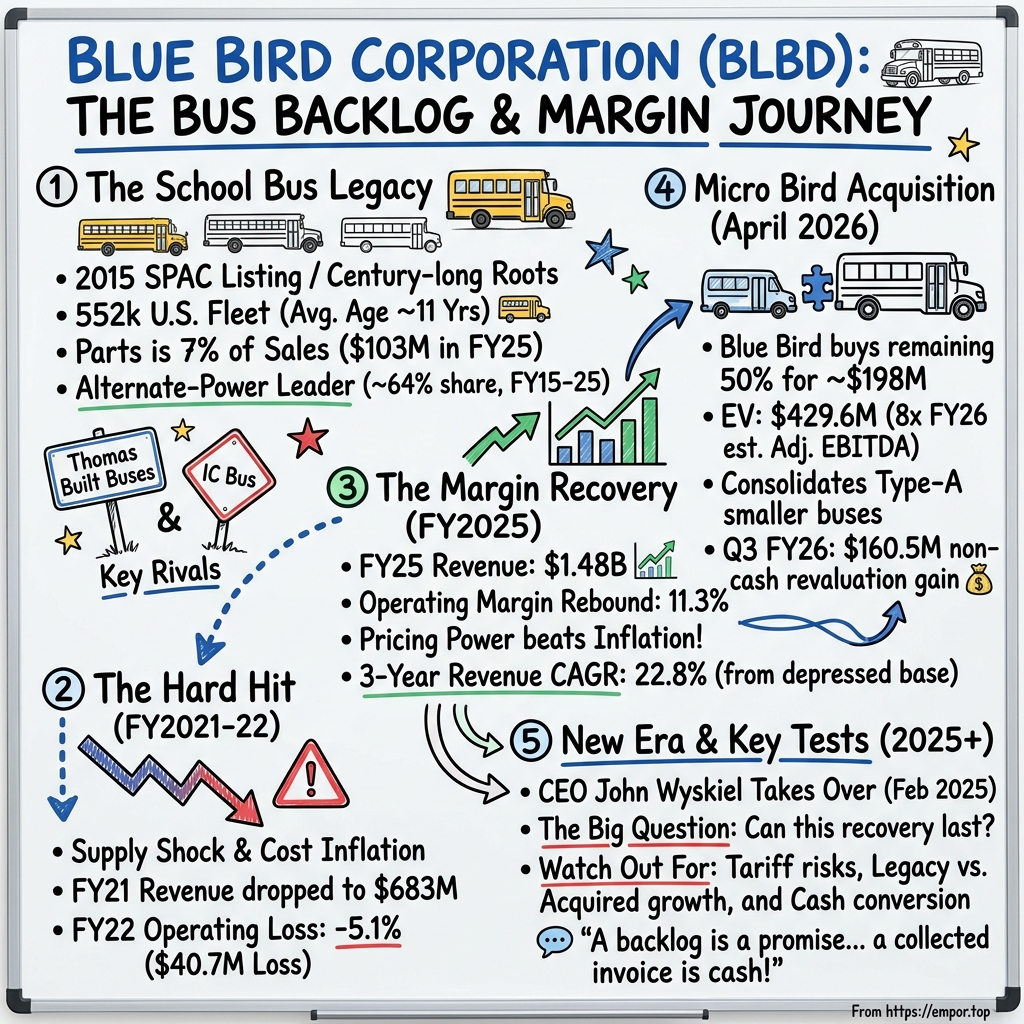
Blue Bird Corporation: The Bus Factory That Turned a Backlog into a Margin Story
I. One Quarter, Two Stories
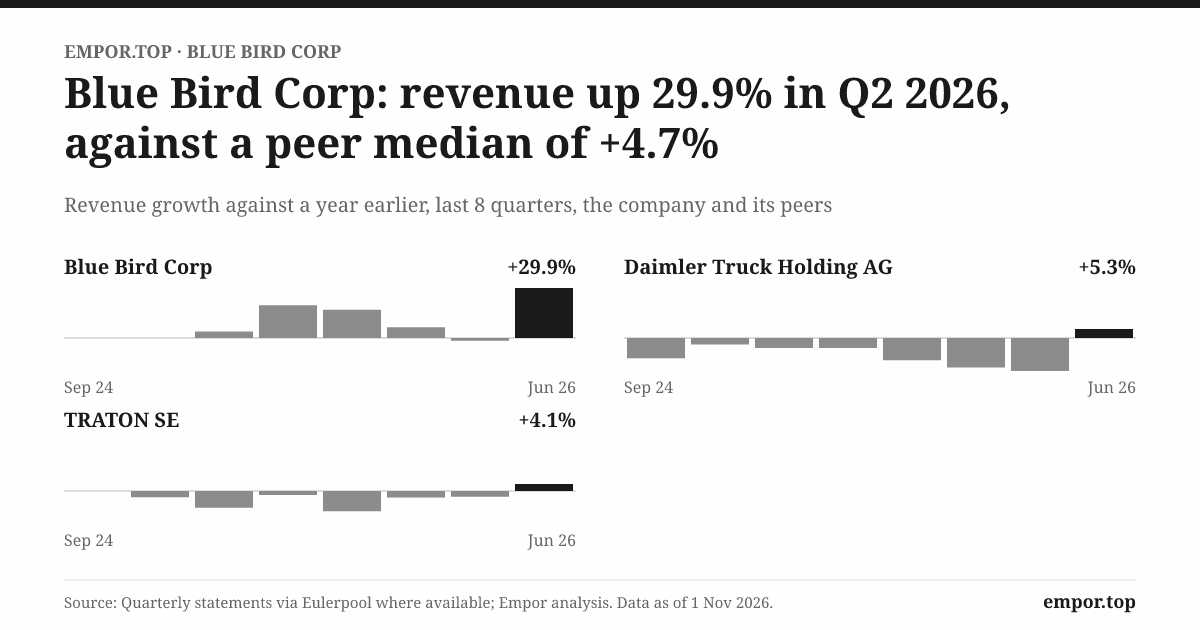
On August 5, 2026, Blue Bird Corporation told investors it had just finished the biggest quarter in its history as a public company. Revenue for the three months to late June came to about $517 million, almost 30% more than a year earlier, and net income came to $185 million, a figure that would have looked absurd next to anything the Georgia bus maker had reported before.1
For context, Blue Bird's net profit for the whole of its record fiscal 2025 had been about $128 million.2 Here, apparently, was one spring quarter that beat an entire record year.
Then came the footnotes. Of that $185 million, about $160.5 million was not cash from selling buses at all. It was a noncash gain that arose because Blue Bird had bought out its partner in Micro Bird, the Canadian small-bus maker it had co-owned for years, and accounting rules required it to revalue the half it already held at the price implied by the half it was buying.1
Nobody wrote Blue Bird a cheque for that $160.5 million. The gain was not even taxable.3 Strip it out, add back acquisition costs and a pension settlement charge, and the company's own adjusted net income for the quarter was $45 million, up from about $39 million a year earlier.1 That is a good quarter. It is not a miracle.
And the revenue line told a second, quieter story. Micro Bird, consolidated for the first time from April 1, contributed about $123 million of the quarter's sales.1 Take it away and the business that most people mean when they say "Blue Bird", the one that builds the full-size yellow school buses in Fort Valley, Georgia, brought in slightly less revenue than a year earlier, down about 1%, on about 7% fewer buses delivered.1
Management explained that a large batch of government and fleet buses had been built and parked, waiting to be handed over when school resumed in the next quarter.3 That explanation may well be right. But it means the headline growth rate in August 2026 measured a bigger company, not a faster-growing one.
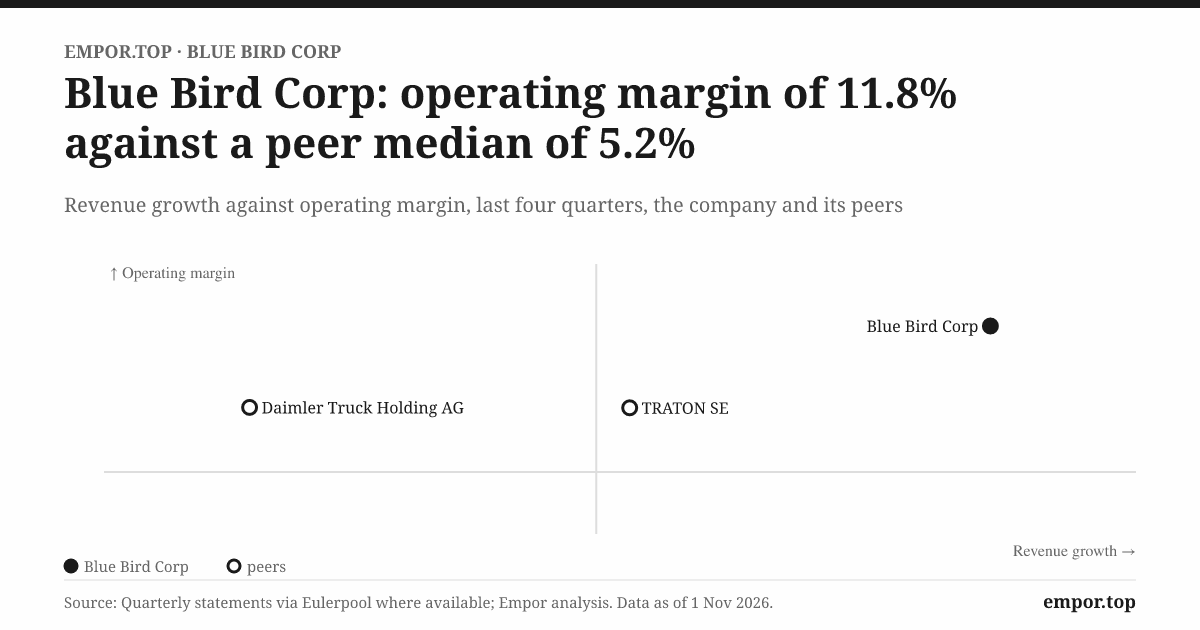
That gap between the headline and the footnote is the right place to start, because it captures the whole investment debate around Blue Bird in miniature. Over the previous four years the company had staged a dramatic recovery. It went from losing money in fiscal 2022, when it could not get the parts to finish its buses, to earning an operating margin above 11% in fiscal 2025.2
And now management had used that recovery as a springboard: it bought the rest of Micro Bird, and in the same August announcement it unveiled a plan to build Ford's next generation of strip chassis, the bare frames that sit under motorhomes and delivery vans.1
So this story asks three questions. The first is what gives a specialised manufacturer like Blue Bird its place in a market that only a handful of companies serve, and how much power that place really confers. The second is whether the margin recovery is a new, durable level of profitability or the top of an unusually favourable cycle. The third is whether taking full ownership of Micro Bird, and the expansion plans that followed it, will create value for shareholders or simply make the company larger.
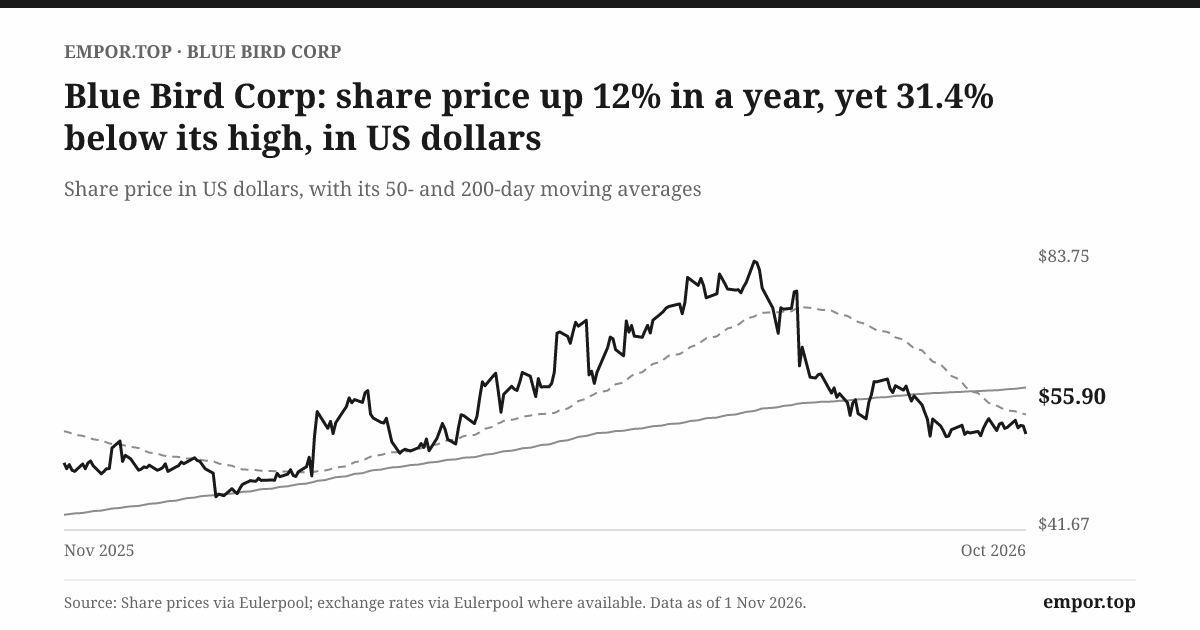
Blue Bird today is a Nasdaq-listed manufacturer worth about $1.8 billion at a share price of about $56 in early November 2026, roughly 31% below its high of the previous twelve months.4 Its core remains the full-size school bus, sold one specification at a time to school districts and contractors. A smaller, steadier parts business sells the components that keep those buses running.
And Micro Bird now adds the small "Type A" school buses and commercial shuttles that Blue Bird itself never made at scale.5 To understand which of those three pieces will drive the next chapter, it helps to understand how this particular company ended up on a public stock exchange in the first place.
 Subscribe on LinkedIn
II. The Company That Came Through the SPAC Door
Blue Bird's roots go back to 1927 in Fort Valley, Georgia, a small town in the peach country south of Macon, where the company still builds its buses today.2 For most of the following ninety years, its story was the story of the American school bus itself: a product that went from improvised wooden bodies bolted onto truck frames to the heavily regulated, purpose-built safety vehicle that carries millions of children every school day.
Blue Bird spent decades as a family business, and then passed through a sequence of financial and corporate owners, the last of which was Traxis Group, an affiliate of the private-equity firm Cerberus Capital Management.6
The listed company that investors trade today is a much younger creature. In February 2015, Hennessy Capital Acquisition Corp., a special purpose acquisition company, or SPAC, completed its business combination with School Bus Holdings, the parent of the Blue Bird operating companies, and took the Blue Bird name.6 A SPAC is essentially a pot of cash raised on the stock market with a promise to go and find a private company to buy. Hennessy had raised its money in 2014 and chose a school-bus maker as its target.
To acquire School Bus Holdings from Traxis, it handed over $100 million in cash and 12 million of its own shares, which meant that the private-equity seller took part of its payment in cash and kept a large stake in the newly public company.6 The deal came with the usual SPAC plumbing, including warrants and a 7.625% convertible preferred stock sold to outside investors, all registered for resale in a prospectus that March.6
It is worth being precise about what changed in that moment and what did not. The listing changed who owned Blue Bird and how it could raise money. It did not change the plant in Fort Valley, the dealers who sold the buses or the school districts that bought them. The ten-year revenue record that investors see, which runs from fiscal 2015 to fiscal 2025, is therefore mostly the record of the same operating business across a change of owner.
Over that decade revenue grew at about 5% a year, which is roughly the pace of a mature industrial business with a price-driven tailwind, not a growth company.2
Three makers left standing
The more useful history for an investor is the shape of the industry that Blue Bird inherited. The North American full-size school-bus market spent the second half of the twentieth century shedding manufacturers. Today Blue Bird names two principal competitors in its annual report: Thomas Built Buses, part of Daimler Truck North America, and IC Bus, part of Navistar.2
Each of those rivals sits inside a giant truck company that supplies it with chassis, engines and purchasing scale. Blue Bird is the odd one out. It is a standalone, independent company that designs and builds the chassis under its own conventional and transit-style buses rather than taking a frame from a corporate parent.2
That independence is the root of both Blue Bird's distinctiveness and its vulnerability. It means Blue Bird controls its own engineering choices, which is part of why it moved earlier and harder into propane and electric buses than its rivals. It also means it has no deep-pocketed parent to lean on when supply chains break, and no in-house engine plant to fall back on. For most of its public life that trade-off looked manageable. Then the pandemic arrived and tested it.
Blue Bird had sold about $1 billion of buses and parts in fiscal 2019.2 Two years later revenue had fallen to about $683 million, a decline of roughly a third, as schools closed, orders stalled and then the global shortage of semiconductors and components choked the factory.7 Fiscal 2022 was worse in a way the revenue line does not fully capture. Sales recovered to about $800 million, yet the company recorded an operating loss of about $41 million, because it had signed contracts to deliver buses at prices fixed before steel, components and freight costs soared, and because half-finished buses waited for parts that did not arrive.7
For every $100 of sales that year, Blue Bird lost about $5 before interest and tax.
The leadership of the company changed hands during the same period, and changed back. Phil Horlock, who had run Blue Bird since 2011 and through the SPAC transaction, stepped down as chief executive in October 2021, only to be reappointed in May 2023 to steer the recovery.8 That detail matters because the worst year, fiscal 2022, unfolded under an interim regime, and the recovery was led by the veteran who had run the company for most of its public life.
The turnaround did not come from a new team with a new strategy. It came from a familiar leader, the same factory and many of the same people, operating in a changed market.
So the SPAC door explains how investors got access to Blue Bird, but it is the fiscal 2022 trough that makes the recent story meaningful. A company that was losing money on every bus four years ago became one of the most profitable bus makers in North America. The obvious question is whether something durable changed in the business, or whether the market simply swung in its favour. To answer that, it helps to follow a single bus from the moment a school district decides it needs one.
III. A Bus Is Ordered Long Before It Is Delivered
Picture a transportation director at a mid-sized school district in, say, the Carolinas, sitting with a spreadsheet in the late winter. One column lists the district's buses by age. Several have passed the point where mechanics spend more time on them than drivers do. Another column lists the budget the school board will approve for the coming fiscal year.
A third lists what the state will reimburse. And the hardest column of all is the calendar: if the new buses are not on the road by the first day of school in August, the district will be running aging vehicles, or children will be waiting at the roadside.
That is how a Blue Bird bus begins its life, months before anyone in Fort Valley bolts a seat to a floor. The district does not walk into a showroom. It writes a specification, which is a long document describing exactly what it wants: seating capacity, engine and fuel type, wheelchair lifts, air conditioning, cameras, stop-arm design, and dozens of options that vary by state law.
It then buys, often through a competitive bid or a state contract, usually via a local dealer that represents one manufacturer. Blue Bird sells through a network of about 45 dealer locations, as well as directly to some large fleet operators and government customers.2 The dealer handles the relationship, the paperwork and much of the after-sale service. The factory builds the bus to order.
That structure shapes everything about Blue Bird's economics. Revenue is recognised when a finished bus is delivered and accepted, not when it is ordered and not while it is being built.2 The company does not disclose multi-year contracts, minimum purchase commitments or any recurring subscription-style revenue.2 In effect, Blue Bird is paid per unit, per delivery, and each unit is a new sale.
The rhythm of the school year
The school calendar sets the rhythm. Districts want buses delivered in the summer, ready for the new school year, so Blue Bird's revenue usually peaks in its fiscal third and fourth quarters, which run from April through September.2 That timing is not just a seasonal curiosity. Late in a quarter, the company often delivers big batches of buses to fleet operators on credit, and those invoices show up as receivables that turn into cash weeks or months later.2
So the same bus can land in one quarter's revenue and the next quarter's cash flow, and a shift of a few weeks in when a large customer takes delivery can move tens of millions of dollars between periods. The August 2026 quarter, with its parked fleet buses, was a live example.
Why does Blue Bird hold a durable place in this market at all? The first answer is demand that refuses to disappear. In its investor materials, the company describes a U.S. school-bus fleet of roughly 552,000 vehicles with an average age of about 11 years.9 A fleet that size, with a working life measured in a decade or more, has to be replaced at a steady clip simply to stand still.
On the August 2026 call, chief executive John Wyskiel pointed to more than 250,000 buses older than ten years as the reason he expected a fairly solid next season.3 That is the floor under the business. Children still have to get to school.
The second answer is specialisation. A school bus is not a truck with seats. It must meet a dense web of federal and state safety rules, it is built in relatively low volumes with a huge number of configurations, and the buyer is a public body that tends to value reliability, service and familiarity with the product.
That combination discourages new entrants. Building a factory, a dealer network and a compliance record from scratch to win a share of a market that sells tens of thousands of units a year is not an obvious use of capital for anyone outside the industry.
The third answer is product breadth, particularly in alternative fuels. Blue Bird bet early on propane buses and then on electric ones, and the company says it sold about 64% of all alternative-powered school buses sold in the United States from fiscal 2015 through fiscal 2025.9 Even by the middle of 2026, propane and electric models made up more than half of the units it sold in a quarter.3
That is a real proof point. When districts went looking for cleaner buses, Blue Bird had products ready, a dealer network that knew how to sell them, and years of field experience.
Then there is parts. Every bus on the road needs filters, brakes, mirrors, seats and electrical components over its working life, and Blue Bird sells those parts through the same dealers. It is a useful, steadier income stream, but it is small: about $103 million in fiscal 2025, against total revenue of about $1.48 billion.2 Parts smooth the cycle at the edges. They do not change the fact that Blue Bird lives and dies by bus deliveries.
Where the moat could leak
Now for the harder part. How much power does that position really give Blue Bird over its customers and suppliers? The honest answer is less than the word "moat" might suggest, and the company's own disclosures explain why.
Start with the buyers. A school district comparing bids can choose between three established manufacturers, and Thomas Built and IC Bus both sell diesel, gasoline, propane and electric buses of their own.2 There is no software lock-in, no proprietary consumable the district must keep buying, and no contractual obligation to stay. Switching costs exist, but they are soft ones: mechanics trained on a particular product, parts inventories, and a dealer relationship.
Blue Bird does not disclose how many of its customers buy from it again, how many bids it wins or loses, or what share of the conventional diesel and gasoline school-bus market it holds.2 It does not report any single customer above 10% of revenue, and it gives no top-customer concentration figure.2 So the most important evidence about customer loyalty, the kind that would prove a moat, is simply not public.
On the May 2026 call, an analyst asked directly about market share. Wyskiel's answer was revealing in its framing: order intake had been positive while the overall market was down, he said, and the company did not chase market share.10 The chief financial officer, Razvan Radulescu, added that production capacity, not demand, was the binding constraint, with the plant running close to its maximum on a single shift.10
That is an answer about discipline, and it is consistent with a company that has chosen price over volume. It is not a disclosure of share, and investors cannot independently test it.
The same call offered a small but telling counterpoint. Christopher Pierce of Needham asked why Blue Bird's share of alternative-powered sales had slipped. Wyskiel described the decline as mostly short-term, with diesel's share of the market rising, possibly because customers were buying ahead of expected changes.10 That is a reasonable explanation, but it also shows the limits of the alternative-fuel advantage: when buyers tilt back toward diesel, Blue Bird competes on the same ground as everyone else.
And when Pierce asked about the backlog, management said its target range was 3,000 to 4,000 units, and the head of investor relations, Mark Benfield, framed one to two quarters as the practical window of visibility.10 A backlog that covers a few months of production is valuable, but it is not the multi-year order book that some industrial companies enjoy. Blue Bird can see the next school year coming. It cannot see much further.
The supply side is where the vulnerability is clearest. Blue Bird relies on single suppliers or a small number of alternatives for some of its most critical components, including engines, emissions systems, control modules, steering systems and seats.2 A school bus cannot be shipped without an engine, and an independent manufacturer cannot conjure one from a sister division. Fiscal 2022 showed the consequence.
Electrification deserves its own caution. Blue Bird's leadership in alternative-powered buses is a genuine competitive advantage, but it is an advantage in a market whose size depends heavily on public money. Electric school buses cost far more upfront than diesel ones, and many districts buy them only when federal or state grants cover much of the difference. On the 2026 calls, management spent considerable time on the Environmental Protection Agency's Clean School Bus program, noting that earlier funding rounds remained intact while later rounds were still under review.10
By the third quarter, Blue Bird's electric backlog stood at about 776 units, down from more than 900 three months earlier, and many of those buses were scheduled for fiscal 2027.103 Technical capability and a history of share leadership do not, by themselves, establish that electric buses will be durably profitable, because the volume of the market is set in part by grant programs Blue Bird does not control.
Put together, the evidence supports a narrower version of the moat claim than the bullish one. Blue Bird holds a defensible position in a concentrated, specialised market with high barriers to entry, and it has a demonstrated lead in alternative fuels. But it competes against two well-financed rivals selling similar products, to price-conscious public buyers who can compare bids every year, while depending on suppliers it cannot easily replace.
The aging fleet guarantees that buses will be bought. It does not guarantee that Blue Bird will be paid a premium for them, and each bus still depends on a buyer's budget and a delivery window. Which raises the most important question in the whole story: if the moat is that modest, how did margins rise so far?
IV. The Margin Recovery Had to Survive the Factory Floor
In the spring of 2022, the Fort Valley factory floor told the story of the whole supply-chain crisis. Buses sat incomplete, waiting for parts. Contracts signed a year or more earlier fixed prices that no longer covered what the materials cost. The workforce was there, the orders were there, and the money was draining away.
For the fiscal year ending that September, Blue Bird lost about $41 million at the operating level, a negative operating margin of roughly 5%.7 The company also burned cash: operating cash flow was negative for the second year in a row.7
Three years later the same factory was producing one of the best results in the company's history.2 That swing of more than sixteen percentage points is the heart of the investment story, and how it happened determines whether it can last.
The popular version is that Blue Bird simply rebounded: the supply chain healed, buses flowed again and profits came back. The record shows something more specific. The rebound happened in a sequence. First, parts became available again and the backlog of half-built buses could be finished and delivered, which lifted revenue by about 41% in fiscal 2023 as the factory caught up.2 Second, and more important, the company repriced its product.
Contracts written at pre-inflation prices rolled off, and new orders carried higher prices. In its fiscal 2025 annual report, Blue Bird attributed the expansion of its gross margin to pricing actions that more than covered inflation and tariffs.2 Third, the mix shifted toward more expensive buses, including electric and propane models, and the plant ran at close to full capacity, spreading fixed costs over more units.
That price-led explanation shows up clearly on the 2026 calls. By the second quarter of fiscal 2026, Blue Bird's average selling price for a bus had reached about $151,000, more than 4% higher than a year earlier.10 By the third quarter, the legacy business's average price was up nearly 7% year on year, roughly $10,000 a bus, and Radulescu said that increase was mostly price, along with recovery of tariff costs and some electric mix.3 Wyskiel, asked about pricing, said the company remained "extremely disciplined".10
The quarterly pattern of fiscal 2026 shows how much of the work price was doing before Micro Bird arrived. First-quarter revenue was about $333 million, roughly 6% above the same quarter a year earlier.11 In the second quarter, revenue slipped about $6 million year on year to roughly $353 million as Blue Bird delivered slightly fewer buses because of fewer production days, yet gross margin edged up to about 20% and adjusted EBITDA reached a second-quarter record of about $51 million, a margin above 14%.10
In plain terms, the legacy company was selling fewer buses and making more money on each one. That is what pricing power looks like in the short run. Whether it is pricing power or simply a favourable moment depends on whether customers keep accepting those prices when the next downturn tightens their budgets.
Tariffs added a new layer in 2025 and 2026. Blue Bird imports some components, and tariffs that began in the second half of fiscal 2025 raised the cost of that inventory.3 On the May call, Radulescu told analysts that the company was managing several overlapping tariffs, including Section 232 duties on metals, toward a margin-neutral result, using price increases agreed with dealers and by moving some purchasing to other suppliers.10
The approach worked through mid-2026. It also means that part of the higher average selling price that flatters revenue growth is cost recovery, which adds dollars to sales but not to profit.
What the long record says
Set the recent run against the longer record and the picture sharpens. Over the decade from fiscal 2015 to fiscal 2025, revenue grew at about 5% a year. Over the five years from fiscal 2020 it grew at about 11% a year, and over the three years from the fiscal 2022 trough it grew at about 23% a year.2
The faster rates are real, but they are measured from a depressed base. A company that loses a third of its revenue and then recovers it will always show spectacular growth on the way back up. That is not a forecast of organic growth from here.
The third quarter of fiscal 2026 makes the point concrete. The legacy business, excluding Micro Bird, delivered about 2,290 buses, down from about 2,470 a year earlier, and its revenue slipped about 1%.3 Higher prices covered most of the lost volume, which is a sign of pricing strength, but they did not create growth. Management attributed the unit decline to timing, with a relatively large number of government and fleet buses sitting in finished goods for delivery when school resumed.3
That is plausible, and the fourth quarter will reveal whether it was right. But it means the most recent evidence of organic momentum is a business holding its revenue roughly flat on fewer units at higher prices.
Margins, too, deserve a careful reading. The legacy business earned an adjusted EBITDA margin of about 16% in the third quarter, a record for that quarter, according to management.3 Consolidated gross margin, though, fell to about 20%, down about 1.6 percentage points, partly because Micro Bird's buses carry lower margins than Blue Bird's own.3 Micro Bird's adjusted EBITDA margin in its first consolidated quarter was about 13%, compared with Blue Bird's legacy 16%.1 So the acquisition, at least initially, dilutes the very margin story that made Blue Bird's shares attractive.
There is also a labour dimension that the margin numbers alone do not show. In 2023, workers at the Fort Valley plant voted to join the United Steelworkers, and in May 2024 they approved their first union contract.12 A unionised workforce does not by itself threaten margins, but it does mean that labour costs are now set through collective bargaining rather than unilaterally, which reduces the company's flexibility in a downturn and makes the next contract negotiation one of the costs investors should watch.
What fiscal 2022 really proves
Here is the uncomfortable test for the margin story. The bull case says Blue Bird has a structural pricing advantage, a strong backlog and an aging fleet that guarantees replacement demand. All three of those things were also true going into fiscal 2022. The fleet was aging then. Demand was there. Orders were on the books. And the company still lost money, because it could not control its input costs or its suppliers' delivery schedules, and because it had locked in prices too far ahead.
That episode is direct evidence from the same business, in the same factory, with many of the same people, that a strong backlog and real replacement needs do not protect profits from a production shock.
What changed afterward is not proof that the vulnerability has gone. Management has shortened the lag between order and price, and it has passed through tariffs with notable success. Wyskiel told analysts in both May and August 2026 that the company was positioned to manage tariffs to "a margin-neutral outcome".3 But "margin-neutral" on tariffs means the company is protecting its percentage margin by raising prices, not that it has eliminated the cost.
That works when districts have budgets and grants to absorb higher prices. It is harder when budgets tighten. Blue Bird has not yet faced a full downturn in school-bus demand with its current pricing approach, and until it does, the 11% operating margin is best treated as a strong cycle-high outcome with a better pricing process behind it, not a proven new normal.
The forward test is specific. Over the next two or three quarters, investors will be able to see gross margins for the legacy and consolidated business with Micro Bird fully included. The useful question is how much of any margin change comes from price, how much from product mix, how much from tariff costs and how much from labour. If legacy margins hold near their recent level while unit volumes recover from the third-quarter dip, the case that something durable changed gains real weight.
If prices stall and margins slip back toward the single digits, the recovery looks more like a cycle that has peaked. That is the backdrop against which Blue Bird made the biggest acquisition in its public history.
V. Micro Bird Moves from the Footnotes to the Factory
On April 1, 2026, a line item that had sat for years near the bottom of Blue Bird's income statement became a factory, two plants, and about 950 people.10 That day Blue Bird completed its purchase of the remaining 50% of Micro Bird, the joint venture it had run with Groupe Autobus Girardin, a Quebec-based bus company controlled by the Girardin family.1
Until then, Blue Bird had reported only its share of Micro Bird's profit as a single number. Now every dollar of Micro Bird's revenue, every cost and every asset would flow into Blue Bird's consolidated accounts.
To see why Blue Bird wanted it, think about the size of a school bus. Blue Bird's own business is dominated by "Type C" buses, the conventional yellow bus with a hood sticking out in front, and "Type D" buses, the flat-nosed transit style. On the May 2026 call, Wyskiel said Type C buses were 90% of the market and about 80% of Blue Bird's sales.10 Micro Bird makes "Type A" buses, the smaller vehicles built on a cutaway van chassis that carry fewer passengers and serve special-needs routes, small districts and childcare.
It also makes commercial shuttle buses and integrated electric powertrains.5 Owning Micro Bird outright filled the smallest end of Blue Bird's product line and gave it a commercial shuttle business, which management said opened a "Buy America" opportunity for public buyers that must purchase domestically made vehicles.10
Eric Stine of Craig-Hallum pressed on timing during the May call, and Wyskiel described it as "a near-term event that will ramp", spanning federally funded transit and aviation buyers, large fleets and retail customers, with some state contracts already in the second year of five.10 The transaction presentation went further, saying the shuttle opportunity would effectively double Micro Bird's addressable market.5 That is an ambition, not yet a revenue line. The company has not disclosed how many shuttle buses Micro Bird sells, or at what margin.
The price was substantial. Blue Bird paid about $198 million for the remaining half of Micro Bird, subject to closing adjustments that brought the final consideration to about $202 million.13 The company put the total enterprise value of the business, including debt, at about $430 million, which it described as 8.0 times Micro Bird's estimated adjusted EBITDA for fiscal 2026.5 It paid 30% in cash and 70% in exchangeable shares, plus a single voting preferred share that lets those exchangeable shares vote alongside common stock.13
What 8.0 times actually measures
Is 8.0 times a good price? The multiple is the company's own benchmark, measured against its own forecast for Micro Bird's earnings in the first year of ownership. Blue Bird's transaction presentation showed Micro Bird's revenue growing from about $277 million in 2024 to about $328 million in 2025 and a guided $400 million in 2026, with adjusted EBITDA flat at roughly $40 million across 2024 and 2025 before a forecast step up to about $50 million.5
Divide $430 million by 8.0 and the implied earnings base is roughly $54 million, which is somewhat above the $50 million guidance shown elsewhere in the same presentation.5 Either way, the price assumed that Micro Bird's earnings would rise by a quarter or more in the year of the deal, after two years in which they had not grown. If the fiscal 2026 estimate proves optimistic, the true multiple paid was higher than 8.0.
There is no clean set of comparable public transactions for small school-bus makers, so the deal cannot be judged against an industry benchmark. A more useful comparison is internal. When Blue Bird paid 8.0 times forward EBITDA for Micro Bird, the stock market was valuing Blue Bird itself at roughly the same kind of multiple.
That means the deal was not obviously cheap or obviously expensive in relative terms. It also means it was not a bargain: Blue Bird used its own shares, valued at a similar multiple, to buy a business with lower margins than its own.
Blue Bird presented the deal as accretive, meaning it would add to earnings per share. The presentation projected a gain of about 8% to adjusted EPS in fiscal 2026 and about 9% in fiscal 2027.5 Those are forecasts, not results. The same presentation showed how the deal would be funded: about $139 million of new equity and about $154 million of cash, with roughly 2.7 million new shares taking the share count from about 32.6 million to about 35.3 million.5
That is dilution of roughly 8%, which is close to the size of the promised first-year accretion.
In other words, the deal was priced so that existing shareholders would end up with a slightly larger slice of a meaningfully larger pie, if the forecasts hold. Accretion is a common way to sell a deal, but it only tells investors that the acquired earnings per new share exceed the existing earnings per share. It says nothing about whether the return on the total capital committed will exceed what the company could have earned by, for example, buying back its own stock.
The seller joins the board
The funding structure and the governance consequences are linked. Because 70% of the consideration was paid in exchangeable shares, the Girardin family became a significant Blue Bird shareholder, with about 7.9% of the common stock on an as-converted basis.13 Steve Girardin joined Blue Bird's board under the transaction agreement.13
That is a sensible way to keep a founding family invested in the business they built. It also means a director now sits on the board who was, until April 2026, the counterparty on the other side of the most important deal the company had made in years.
It is important to be precise about what that relationship shows. The seller was the joint-venture partner, and its interests were directly represented in the negotiation. But Blue Bird's filings do not disclose related-party revenue or cost shares between the two companies, management fees, royalties or any pricing benchmark beyond the stated multiple.14
There is no evidence in those disclosures of broader related-party economics flowing to the Girardin family. The governance point is narrower: shareholders will want to see how the board handles future transactions involving Micro Bird's facilities, its debt or its former owners, now that one of those former owners is in the room.
The accounting of the deal is also where the August quarter's giant profit came from. When a company takes control of a business it already partly owned, U.S. accounting rules require it to revalue its old stake at fair value, and any difference from the book value is booked as a gain. Blue Bird's old 50% stake was carried at a modest historical amount, and the purchase price implied it was worth much more, so the company recorded a gain of about $160.5 million.1
That gain reflects value that had been building inside the joint venture for years. It is not new earnings, and it should be stripped out of any discussion of what the business earns on a recurring basis. The operating case for the deal rests on Micro Bird's actual results: about $123 million of revenue, $16.5 million of adjusted EBITDA and about $7 million of net income in its first consolidated quarter.1
The cash side of the transaction was more complex than the 30% headline suggests. Blue Bird also bought Micro Bird's Plattsburgh, New York manufacturing facility for about $16.5 million and paid off Micro Bird's debt, which the presentation estimated at about $73 million.5 By the third quarter, Blue Bird reported that it had repaid about $130 million of Micro Bird debt at closing, a larger figure than the presentation's net debt estimate, and the separate Micro Bird credit line had a zero balance.3
Acquisition accounting also added finance-lease liabilities of about $29 million to Blue Bird's balance sheet.14 The company ended the quarter with about $117 million of cash and about $142 million of untapped revolving credit.14
Now step back and test the deal against Blue Bird's broader capital record. The company's first capital transaction as a public entity was the 2015 SPAC combination itself, which brought a leveraged business to the public market. Over the following years, Blue Bird paid essentially no dividends; its only payout of note was about $4 million in fiscal 2017.2 In fiscal 2024 and fiscal 2025, as profits recovered, it spent about $10 million and about $40 million on share repurchases, plus another $10 million on shares connected with employee award exercises.2
It still had about $90 million left on its buyback authorisation in mid-2026.3 Micro Bird was the first large acquisition in its public history, and it was paid for largely with new equity.
That combination tells a mixed story about discipline. Buying back stock at the bottom of the cycle would have been the textbook disciplined move, but Blue Bird did not have the profits or the balance sheet to do that in fiscal 2022. Buying back stock as profits peaked, and then issuing shares to buy a lower-margin business, is a pattern investors should watch. The first full year of ownership will provide the real evidence: Micro Bird's revenue, its operating cash flow, its capital spending, its debt and lease obligations, and the return on the full consideration Blue Bird paid.
Those numbers, not the announced accretion, will show whether the deal earned its cost. And responsibility for those numbers rests with a chief executive who had been in the job for barely a year when it closed.
VI. John Wyskiel Inherits a Different Blue Bird
John Wyskiel had worked at Blue Bird before, a long time ago. From 2002 to 2004 he was general manager of Blue Bird Coach in Canada, back when the company still ran a Canadian operation of its own.8 He then spent about two decades at Magna International, the giant Canadian auto-parts supplier, rising to run Magna Seating, a business with about $6 billion in revenue and 33,000 employees, from 2020 to early 2025.8
Before Magna, he had held manufacturing, operations, engineering and sales roles at Dana Corporation and BorgWarner, two of the old guard of American automotive suppliers.8 He trained at Mohawk College in Ontario and is, by background and temperament, an operator: someone who measures success in plant throughput, supplier performance and cost per unit.
The board appointed him president and chief executive in January 2025, effective February 17.8 The handoff had not gone the way Blue Bird first announced. In August 2024 the company said that its president, Britton Smith, a U.S. Naval Academy-trained engineer who had led its electric-vehicle business, would take over as chief executive at the end of September 2024, and that Doug Grimm would succeed Kevin Penn as chairman.15
Smith's appointment did not take effect. Phil Horlock remained chief executive until February 16, 2025, when Wyskiel succeeded him.8 For a company whose shareholders value predictability, a planned succession that did not happen is worth noting, even if the eventual choice of an experienced manufacturing executive looks well suited to the business.
Wyskiel inherited a very different Blue Bird from the one Horlock had led through the crisis. Fiscal 2025, the year in which he took over, produced operating profit of about $167 million, against a loss of about $41 million three years earlier.2 He walked into a company at the peak of its recovery, facing new tariffs on imported components and a choice about what to do with its newly strong balance sheet. Within a year, he had answered that choice with the Micro Bird acquisition and then the Ford chassis plan.
Pay, ownership and the vote
How is Wyskiel paid, and how much of Blue Bird does he own? His fiscal 2025 summary compensation, covering roughly seven months in the job, was about $3.4 million, including a $250,000 cash sign-on payment and relocation and travel allowances.8 Horlock's fiscal 2025 total was about $6.6 million, much of it the accounting value of equity awards whose vesting the board accelerated to coincide with his retirement.8
Combined, the two chief executives cost about $10 million that year, a figure inflated by the transition and not a guide to the ongoing annual run rate. Those reported numbers are also not the same as cash in hand: much of the pay is restricted stock units that vest over several years and whose value depends on the share price.
Wyskiel's target annual bonus is 125% of his base salary, and his long-term equity target is 250%, split evenly between time-based and performance-based units.8 The annual bonus plan is driven mainly by adjusted EBITDA, and in fiscal 2025 the company's adjusted EBITDA of about $221 million came in at the very top of the plan's range, well above its $180 million target.8 Performance-based equity awards for fiscal 2026 vest on achievement of the same management incentive plan criteria.8
There is a quiet design issue here. Adjusted EBITDA rises when a company buys another company's EBITDA, regardless of the price paid. An incentive plan anchored on that metric rewards growth, but it does not, on its own, distinguish growth that earns a return from growth that does not.
Ownership is modest. As of January 2026, Wyskiel owned about 19,500 shares, worth roughly $1 million at the November 2026 price, and all directors and executive officers together owned about 1.1% of the company.8 The largest holders were index and institutional funds, led by Fidelity's parent FMR at about 12% and BlackRock at about 8%.8 This is a professionally managed company owned by institutions, not a founder-led business where management's personal fortunes rise and fall with the shares.
At the March 2026 annual meeting, shareholders approved executive pay by a wide margin, with about 24.6 million votes for and about 885,000 against.16 That is not a sign of a governance revolt. The more notable signal was that Doug Grimm, who had become chairman in 2024, received about 4 million votes withheld, a meaningful protest in a company where the overall level of dissent was otherwise low.16 Neither result is a verdict on management. Both are signals worth keeping an eye on as the board oversees a much more complex company.
Guidance as a track record
The best way to judge a new chief executive is to compare what he said with what happened. Wyskiel's record is short, but it is already informative. In February 2026, Blue Bird's investor presentation pointed to fiscal 2026 revenue of about $1.5 billion and adjusted EBITDA of about $225 million for the legacy business.9 By May, management had raised its legacy EBITDA forecast to $230 million, a margin of about 15%.10
After adding Micro Bird for the second half, it set consolidated guidance at $1.725 billion to $1.775 billion of revenue and $235 million to $255 million of EBITDA.10 In August, it kept the revenue midpoint unchanged at about $1.75 billion and nudged EBITDA up to about $247 million, while raising its free-cash-flow forecast.1 It also warned of a small reduction in fourth-quarter units compared with its previous plan.1
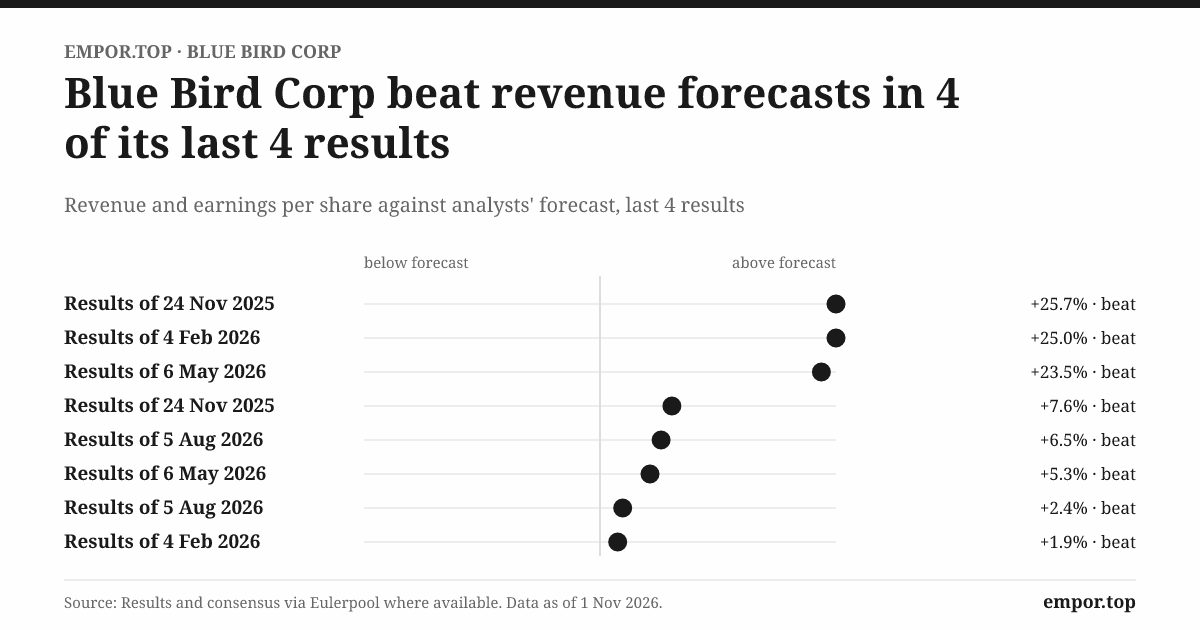
That is a pattern of modest, consistent upward revisions to profit guidance while volume expectations softened, which fits the price-over-volume strategy the company describes. It suggests a team that sets beatable targets and meets them. What the record does not yet show is how management behaves when it misses, because it has not had to explain a significant miss under Wyskiel.
The longer-term targets are where scepticism belongs. In May 2026, Blue Bird's medium-term target was about $2 billion of revenue and about $275 million of EBITDA, with a longer-term target of about $2.5 billion and $325 million to $375 million or more.10 By August, after the Ford chassis announcement, the long-term ambition had expanded to more than $500 million of EBITDA on about $3.3 billion of revenue by 2030 or later.1 On the same call, management gave a range of $400 million to more than $500 million on about $3 billion of revenue.3
Targets that grow with each new project, and that differ slightly between the press release and the call, are not evidence of bad faith. They are evidence that the company is now selling a growth story built on new ventures, rather than a recovery story built on the existing plant.
Those new ventures are large. Beyond Micro Bird, Blue Bird has described plans for a new Type C plant, a project of more than $300 million partly funded by an $80 million Department of Energy grant, with production targeted for late calendar 2028.10 It has announced plans to design and build the next-generation Ford F-53 and F-59 strip chassis, with a Ford collaboration running through 2033, the purchase of the Detroit Chassis plant assets, and an investment of about $90 million in 2027, about $50 million of it capital spending.1
Wyskiel said the chassis venture would expand Blue Bird's addressable market by $1.4 billion in "a largely two-player market".3
The analyst questions on the August call were almost entirely about this new venture, which says something about where the market's attention had moved. Stine asked whether Ford was the only route to market; Wyskiel called it the primary path.3 Michael Shlisky of D.A. Davidson asked why management's planning case of about 12,000 Ford chassis a year sat below historical volumes; Radulescu called it a conservative base case.3 Radulescu, answering Pierce, called it "a 10x bigger opportunity to enter the segment".3
The tone was confident and the numbers were deliberately cautious. But the venture ties a meaningful slice of Blue Bird's future to a single partner's product decisions through 2033, and it asks a school-bus company to master a new product for a new set of customers, motorhome and delivery-van builders, at the same time as it integrates Micro Bird and plans a new bus plant.
A skeptical investor would ask a simple question. After share buybacks, a major acquisition, a new plant and a chassis venture, what return threshold governs the next dollar? Management has said it intends to keep leverage below two times adjusted EBITDA and to refinance and expand its credit facility by the end of calendar 2026.3
That is a balance-sheet guardrail. It is not a return-on-capital commitment. Blue Bird has not published a hurdle rate for deciding between buying back stock, adding capacity, automating the factory or doing another deal, and its incentive plans do not appear to reward return on invested capital explicitly.
Comparing the prepared remarks with the analyst questions across the 2026 calls, management has been concrete about tariffs, backlog and unit timing, and expansive about new markets, but less precise about the incremental return each new project must earn. That gap is the main open question about this management team, and it frames the larger debate about what Blue Bird is worth.
VII. The Case for Blue Bird Depends on What Normal Means
Imagine an investor looking at Blue Bird's stock quote on November 1, 2026. The share price is about $56, which is more than 30% below where it traded at its peak during the previous twelve months.4 The company's market value is about $1.8 billion. A data provider's screen shows a price-to-earnings ratio of about 14 times, an enterprise-value-to-EBITDA ratio of about 9 times and a price-to-sales ratio of a little over 1 times.4 On the face of it, that looks like a reasonable price for a company that earns double-digit operating margins.
But the earnings multiple hides a trap. Trailing reported earnings now include the $160.5 million Micro Bird remeasurement gain, which on its own is worth about $4.50 a share, more than an entire year of Blue Bird's normal earnings. Leave the gain in, and the stock looks absurdly cheap at around seven times trailing earnings. Take it out, and the multiple rises to the mid-teens.
The data provider's 14 times sits somewhere in the middle and is best ignored. The more useful benchmark is enterprise value against management's guided adjusted EBITDA for fiscal 2026 of about $247 million, which works out to roughly seven times, and even that number embeds an operating margin that the company has not sustained through a downturn.1
Blue Bird does not have a five-year median price-to-earnings ratio worth comparing against, because its earnings were negative or negligible for much of that period, and its two main competitors are divisions of truck makers with no separately traded shares. So there is no clean way to say whether Blue Bird is cheap or expensive relative to its peers.
What the price appears to assume is the real question. At roughly seven times guided EBITDA, the market is not paying for a structurally higher-growth business. It is pricing Blue Bird as a cyclical manufacturer near the top of its cycle, with some value attached to the new growth projects. A buyer at this price is betting that the recent margin level is closer to normal than the market thinks, or that the new ventures will earn more than they cost.
The strongest case for the bull
The bull case rests on real evidence. Blue Bird came back from a genuine crisis, restored its margins and has held them through two years of tariff disruption. It has a broad dealer network, a product line that now runs from the smallest Type A bus to the largest transit-style vehicle, and a demonstrated lead in alternative-powered buses over the decade to fiscal 2025.9
The U.S. school-bus fleet is old and must be replaced. And the industry structure is favourable. Using Michael Porter's five forces, the threat of new entrants is low, because building a school-bus business from scratch requires a factory, a dealer network and a compliance record that no outsider has assembled in decades.
The threat of substitutes is limited in the near term: no technology has yet replaced the yellow bus for getting children to school in the United States. Rivalry is real but disciplined, with only three principal manufacturers competing for a market with steady replacement demand.
Through Hamilton Helmer's seven powers lens, Blue Bird's strongest claim is to what Helmer calls cornered resource and process power: decades of accumulated knowledge about building school buses, a dealer network that is hard to replicate and a lead in alternative-fuel know-how. There is some scale economy in its single large plant running near capacity. There is a modest switching cost for districts whose mechanics and parts inventories are set up for Blue Bird products.
But there are no network effects, no brand power of the kind that lets a company charge a large premium regardless of competition, and no counter-positioning against its two incumbents, who sell the same types of buses.
The equally specific bear case
The bear case is just as grounded in the record. The two remaining forces are where the moat leaks. Buyer power is significant: districts and fleet operators buy to budgets, use competitive bids and can choose among three established suppliers, and Blue Bird does not disclose customer concentration, retention or win rates.2 Supplier power is also significant, because certain critical components come from single sources or limited alternatives, and the fiscal 2022 crisis showed what happens when they stop arriving.2
The cash flow record carries a warning too. Fiscal 2025 operating cash flow was about $176 million and free cash flow about $153 million, impressive figures.2 But about $85 million of that operating cash came from collecting receivables that had built up at the end of fiscal 2024, when fleet customers took deliveries on credit late in the year.2
Over the first nine months of fiscal 2026, operating cash flow was about $115 million, with receivables a drag of roughly $71 million compared with a year earlier, partly offset by a customer advance of about $29 million.14
By the end of June 2026, receivables had climbed back to about $54 million and inventory had reached about $303 million, while cash had fallen by about $113 million over the nine months, a decline driven partly by the acquisition.14 Some of that is the normal seasonal pattern and some is Micro Bird. But it means a single year's free cash flow is a poor guide to Blue Bird's underlying cash generation, and the fourth quarter's collections will matter.
The balance sheet is solid but no longer as simple as it was. At the end of fiscal 2025, Blue Bird held about $229 million of cash and short-term investments against about $90 million of borrowings.2 By June 2026, after the acquisition, it had about $87 million of term-loan debt, about $29 million of finance leases and about $142 million available on its revolving credit facility.14 Its 2023 credit agreement requires total net leverage of no more than three times and a fixed-charge coverage ratio of at least 1.2 times.2
Those limits are comfortable at today's profits. They become relevant if earnings fall back toward the single-digit margins of the past, or if the new plant and the chassis venture absorb more cash than planned. Blue Bird has no public credit rating, so there is no independent agency view of its creditworthiness.
The electric-bus opportunity needs to be framed carefully. It is not a hidden separate business waiting to be revalued. It is a product transition inside the existing school-bus market, and its pace depends on federal and state funding, on how districts weigh the higher upfront cost against lower fuel and maintenance costs over time, and on how fast fleets are replaced overall.
Blue Bird's historical leadership in alternative fuels is an advantage. But federal funding for the Clean School Bus program has been subject to review, and the electric backlog shrank between the second and third quarters of fiscal 2026.3 Treating electrification as a growth engine that will carry Blue Bird regardless of policy would overstate what the evidence supports.
Weighed together, the case is neither a clear bargain nor a clear trap. The bull case is right that Blue Bird holds a defensible position in a concentrated market. The bear case is right that the position confers less pricing power than the recent margins imply, that cash flows are lumpy, and that the acquisition and new ventures add execution risk to a company that was, until recently, a single-plant manufacturer.
The historical record narrows the strongest bull claim, that Blue Bird's margins are structurally higher than in the past, to a smaller version: they are higher now, the pricing process has improved, and that remains unproven through a full cycle.
Three numbers will do most of the work of settling the argument. The first is legacy bus unit sales and revenue, reported separately from Micro Bird: in the third quarter of fiscal 2026, legacy units fell about 7% and legacy revenue about 1%.1 The second is margin, specifically adjusted EBITDA margin with a clear bridge between price, mix and cost: the legacy business earned about 16% in the third quarter, while the consolidated figure fell to about 14% as Micro Bird was added.3
The third is operating cash flow after working-capital movements, which was about $115 million for the first nine months of fiscal 2026, held back by rising receivables.14 Watch those three, and the rest of the story will follow. Which brings the story back to the simplest lesson Blue Bird teaches, the one that begins on the factory lot.
VIII. Lessons from a Bus That Has to Leave the Factory
Somewhere in Fort Valley at the end of June 2026, a row of finished buses sat waiting. They had been ordered by government and fleet customers, built to specification and parked until school resumed, and did not count as revenue until customers accepted them in the following quarter.3 That row of buses is the most useful image in Blue Bird's story, because it contains almost every lesson the company has to teach.
The first lesson is that a backlog is a promise; a delivered bus is revenue, and a collected invoice is cash. Blue Bird's long-term record of turning profit into cash is genuinely strong. Over the twelve years from fiscal 2014 to fiscal 2025, it generated about $530 million of operating cash flow against about $321 million of net profit, which means it collected considerably more cash than it reported in earnings, helped by depreciation and by a business model in which customers often pay soon after delivery.2
But that long-run strength coexisted with wild swings from year to year, as the recent cash-flow record shows.2 For founders and investors, the wider lesson is that in any business that ships large, lumpy orders, the timing of the handover is part of the economics, and an annual cash figure can mislead in both directions.
The second lesson is that in a specialised market, leadership is earned one delivered specification at a time. Blue Bird's dealer network and its record in alternative fuels are hard-won assets, built over decades of selling to school districts that care about reliability and service. But leadership in this kind of market is not permanent, because the customer can compare bids every year and the company does not publish the evidence, such as retention rates or share of the conventional market, that would prove its customers are locked in.
The wider lesson is that a strong competitive position in a public-procurement market is a renewable licence, not a property right: it must be won again with each order.
The third lesson is that an acquisition is a price paid today for cash the factory must produce tomorrow. The Micro Bird deal is a case in point: its accounting gain at closing was not a return.5 The return will appear only when Micro Bird's buses leave its own factories, its invoices are paid and the cash it generates exceeds what Blue Bird gave up to own it.
For anyone evaluating an acquisition, the lesson is to separate the accounting that happens on the day of the deal from the economics that unfold afterward, and to judge the deal only on the second.
The fourth lesson, and perhaps the most Blue Bird-specific of all, is that a cycle can make the same business look weak at the trough and extraordinary at the peak.
The skill that matters is not producing the best margin at the top. It is limiting the damage at the bottom, and Blue Bird has not yet shown that it can do that.
IX. Epilogue
As of November 2026, Blue Bird stands at an unusual point. It has finished the fiscal year that ended in late September, its first with Micro Bird consolidated for half the year, but the full-year results and annual report are still to come. The fourth quarter that management said would absorb the parked fleet buses has ended. The numbers that will show whether those buses turned into revenue, and whether the receivables turned into cash, will be published in the coming weeks.
The first thing to watch is organic growth. When the full-year results arrive, investors will be able to see legacy Blue Bird's unit sales and revenue for fiscal 2026, separate from Micro Bird. If the third-quarter dip in legacy units reversed in the fourth quarter as management predicted, it will support the story that the shortfall was timing, not demand. If legacy units fell for the year as a whole, it will suggest that higher prices are now doing more of the work than demand, and that growth depends increasingly on the acquisition.
The second is margin. Over the next two or three quarters, with Micro Bird fully consolidated, the company's gross margin and adjusted EBITDA margin will show how much of the recovery is durable. The key will be whether management provides a clear bridge showing how much margin movement came from price, how much from product mix, how much from tariffs and how much from labour. A company confident in its pricing power has every incentive to show that bridge clearly.
The third is cash. Receivables from the late-quarter fleet deliveries should be collected, and inventory built for school-year deliveries should convert into sales. The fiscal 2026 cash flow statement will show whether that happened, and Micro Bird's own operating cash flow will begin to show what Blue Bird actually bought.
The fourth is the acquisition itself. Over the next year, Micro Bird will have to deliver earnings that justify an enterprise value of about $430 million, and the new chassis venture and the planned Type C plant will begin to consume capital.5 The question that will hang over every quarterly call is whether these projects are earning their cost, or whether Blue Bird is using a peak-cycle balance sheet to buy growth that will look less attractive when the cycle turns.
The next year should clarify whether Blue Bird is growing through the cycle and the acquisition, or chiefly benefiting from timing and accounting. The tension that remains is the one the August quarter revealed: a company that looks bigger and stronger on paper, built around a factory that is still, at heart, selling one bus at a time to customers who are always, ultimately, buying to a budget.
X. Outro
Go back to that row of buses parked outside the Fort Valley factory in the summer of 2026. Each one is a product that nobody buys for fun and nobody can do without. Each was ordered months earlier by a district counting its pennies, built to a specification that runs to dozens of pages, and parked until a school calendar said it was time. None of them counted as revenue until it was delivered and accepted; the cash came when the invoice was paid.
That is what makes Blue Bird unlike a generic manufacturer. Its edge is real, but it is inseparable from execution: from turning a specialised product and a strong market position into delivered buses, collected cash and returns that outlast the cycle. The company has proven that it can earn its place when the market cooperates. The question it carries into its enlarged future is whether it can keep earning that place when the market stops cooperating, one yellow bus at a time.
References
-
Blue Bird Reports Fiscal 2026 Third Quarter Results — Blue Bird Corporation, 2026-08-05 ↩↩↩↩↩↩↩↩↩↩↩↩↩↩↩↩
-
Form 10-K for fiscal 2025 — Blue Bird Corporation / SEC, 2025-11-24 ↩↩↩↩↩↩↩↩↩↩↩↩↩↩↩↩↩↩↩↩↩↩↩↩↩↩↩↩↩↩↩↩
-
Blue Bird (BLBD) Q3 2026 Earnings Call Transcript — The Motley Fool, 2026-08-13 ↩↩↩↩↩↩↩↩↩↩↩↩↩↩↩↩↩↩↩↩↩↩↩
-
Blue Bird Corporation Investor Relations: stock information — Blue Bird Corporation, 2026-11-01 ↩↩↩
-
Acquisition of Micro Bird: Strategic Considerations and Deal Structure (Exhibit 99.2) — Blue Bird Corporation / SEC, 2026-02-17 ↩↩↩↩↩↩↩↩↩↩↩
-
Prospectus following the Hennessy Capital business combination — Blue Bird Corporation / SEC, 2015-03-16 ↩↩↩↩
-
Form 10-K for fiscal 2022 — Blue Bird Corporation / SEC, 2022-12-12 ↩↩↩↩
-
2026 Proxy Statement — Blue Bird Corporation / SEC, 2026-01-26 ↩↩↩↩↩↩↩↩↩↩↩↩↩
-
Investor Presentation, February 2026 — Blue Bird Corporation, 2026-02-06 ↩↩↩↩
-
Blue Bird (BLBD) Q2 2026 Earnings Call Transcript — The Motley Fool, 2026-05-06 ↩↩↩↩↩↩↩↩↩↩↩↩↩↩↩↩↩↩
-
Blue Bird Reports Fiscal 2026 First Quarter Results — Blue Bird Corporation, 2026-02-04 ↩
-
Workers at Georgia school bus maker Blue Bird approve their first union contract — AP, 2024-05-24 ↩
-
Form 8-K: Micro Bird acquisition agreement — Blue Bird Corporation / SEC, 2026-02-17 ↩↩↩↩
-
Form 10-Q for the quarter ended June 27, 2026 — Blue Bird Corporation / SEC, 2026-08-05 ↩↩↩↩↩↩↩
-
Blue Bird Announces CEO and Chairman Transition Plan — Blue Bird Corporation, 2024-08-07 ↩
-
Form 8-K: 2026 Annual Meeting results — Blue Bird Corporation / SEC, 2026-03-11 ↩↩
 LinkedIn
 WhatsApp
 Reddit
 Hacker News
 Email
 Kindle
 RSS Feed
 Spotify
 Apple Podcasts
 Amazon Music
 Audible
 YouTube