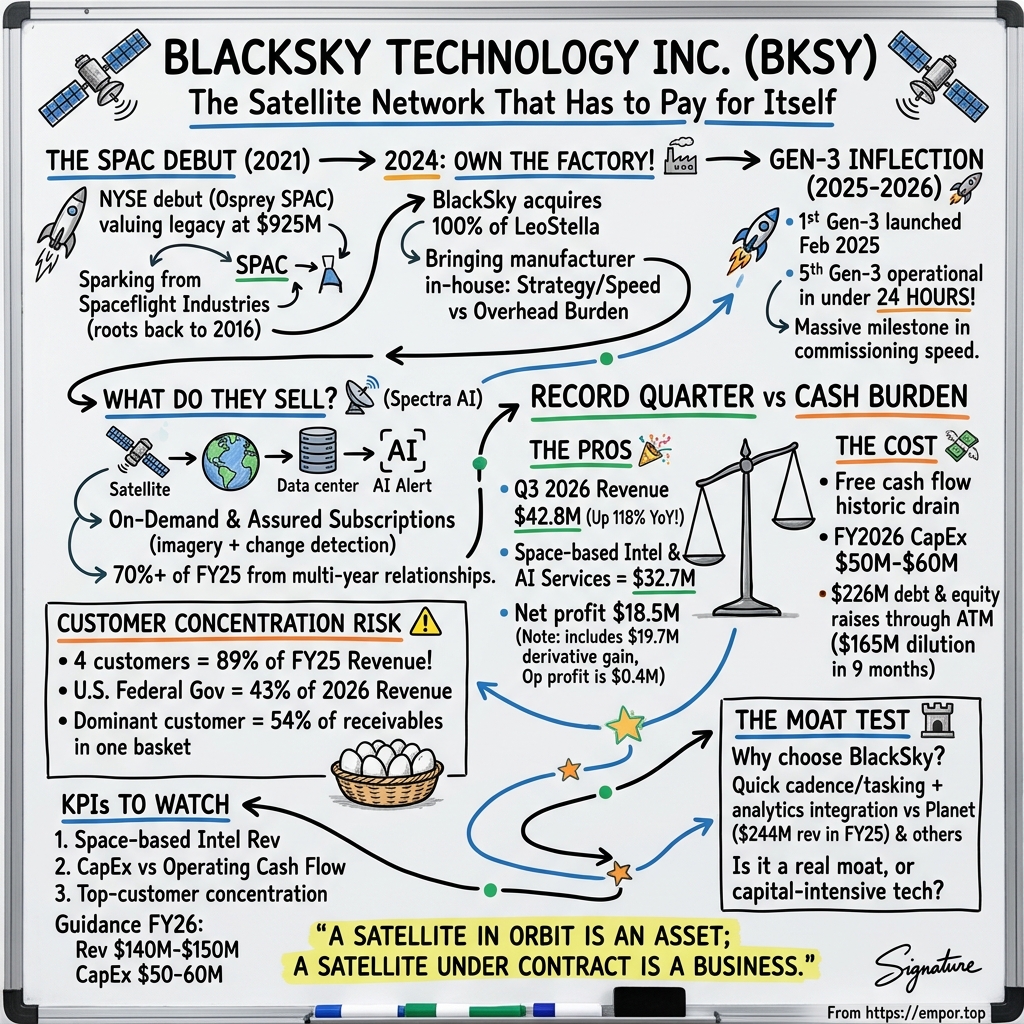
BlackSky Technology Inc.: The Satellite Network That Has to Pay for Itself
I. Five Satellites, One Quarter, and a Much Bigger Question
In September 2026, a small imaging satellite separated from its rocket in low Earth orbit and opened its eye. Less than 20 hours after launch it sent down its first image. Within 24 hours it was doing paid work for customers.1
That was BlackSky's fifth Gen-3 satellite, and the speed was the point. Commissioning a new imaging satellite, the slow work of checking its systems, calibrating its camera and tuning its pointing, has traditionally taken weeks or months. BlackSky's first Gen-3 had taken five days just to begin initial imaging, and longer still to reach full commercial service.2 The third needed about three weeks to enter commercial operations.3 The fifth needed a day.
Six weeks later, on November 5, 2026, chief executive Brian O'Toole opened the third-quarter earnings call by calling it "the strongest quarter in our company's history."1 On the numbers, he had a case. Revenue for the three months to September was $42.8 million, up 118% from $19.6 million a year earlier.14 After at least twelve straight quarters of operating losses, BlackSky earned an operating profit, a modest $0.4 million.4
The headline net profit looked much better: $18.5 million.4 But almost all of that came from somewhere other than selling satellite intelligence. A $19.7 million gain on the fair value of derivatives, an accounting remeasurement of equity-linked instruments whose value moves with the share price, did more for the bottom line than the entire operating business.4 Strip it out and BlackSky roughly broke even. For the first nine months of 2026, it was still loss-making.4
That contrast is the story of BlackSky in miniature. Above the atmosphere, things work, and increasingly they work fast. On the ground, the company behind those satellites lost money in every full year of its public history, burned cash in every one of those years, and funded the difference by borrowing and selling shares.56 Between 2019 and 2025, BlackSky's net losses added up to about $584 million, and its free cash flow, the cash left after paying for operations and capital spending, was negative by about $269 million.56
So the question this episode tries to answer is not whether the satellites are impressive. They plainly are. It is whether a business can be built on top of them that pays for itself.
There are three ways to frame that question, and they will follow the story the whole way through. First, can BlackSky convert technical performance into repeat subscriptions, the kind of revenue that shows up quarter after quarter without a new sales campaign? Second, can it finance the constellation, the fleet of satellites it needs to keep building and replacing, without repeatedly diluting its shareholders? Third, can a company whose revenue comes overwhelmingly from a handful of government and defense buyers produce dependable results when any one of those buyers can change a budget line?
It helps to keep three milestones separate, because the industry often blurs them. A satellite reaching orbit is an engineering achievement. A pilot that succeeds is a sales achievement. Revenue that recurs, renews and gets collected in cash is a business. BlackSky's third quarter contained all three kinds of news, mixed together. Part of the record revenue came from recurring imagery subscriptions. Part came from a seven-figure, two-month pilot with a major U.S. government customer.1 Part came from progress payments on building satellites for other countries.1
Management's own language on the call captured the ambition. O'Toole said the business had "reached an inflection point" where the annual run rate of its "high margin space-based intelligence services has grown to over $100 million."1 Chief financial officer Henry Dubois added that over 90% of every incremental dollar of services revenue was flowing to the bottom line, because the cost of running the satellites barely moved as sales grew.1
That is the investment case in one sentence: build the constellation once, then sell its capacity again and again at very high incremental margins. It is also exactly the claim that the company's history most needs to test, because BlackSky has been close to this kind of inflection before, and the record of what happened next is the right place to start.
 Subscribe on LinkedIn
II. The Company That Went Public Before the Constellation Was Proven
In the summer of 2021, the space industry was in the middle of a gold rush, and the currency was the special purpose acquisition company. A SPAC is a blank-check shell: it lists on a stock exchange with nothing but cash in a trust account and a promise to find a private company to merge with. When it does, the private company becomes public without a conventional initial public offering, and, crucially, it can publish long-range financial projections that a traditional IPO prospectus would almost never contain.
BlackSky's shell was Osprey Technology Acquisition Corp. Osprey had about $318 million sitting in its trust at the end of March 2021.7 The deal valued legacy BlackSky's equity at a base of $925 million, to be paid in Osprey shares at $10 each, and it came with an $180 million private investment, known as a PIPE, from institutional buyers at the same price.7 The merger closed on September 9, 2021, and the combined company began trading on the New York Stock Exchange as BKSY.8
What exactly were public investors buying? The operating company had a long and winding past. The Delaware corporation had been formed in 2014 under the name Spaceflight Industries, and it absorbed an earlier company, Spaceflight Inc., whose equity plan dated to 2011.7 For years it ran two quite different businesses: a launch-services arm that booked rides to orbit for other people's satellites, and BlackSky, an imaging and analytics business.
In 2020 it sold the launch division and booked a gain of about $30.7 million on the disposal, with part of the price still being settled with Mitsui at the time of the merger.76 In February 2021 the parent renamed itself BlackSky Holdings.7 By the time it went public, it was a single-purpose company.
The proposition it put to investors was distinct from that of the established satellite imagery giants. Legacy operators built a few very large, very expensive satellites and sold individual pictures, often of extraordinary quality, to customers who ordered them. BlackSky's idea was a constellation of many small, cheaper satellites that could revisit the same important places many times a day, plus software that would watch the images automatically, notice what had changed and deliver an alert. The customer would buy not a photograph but a stream of answers: is the ship still in port, are the aircraft on the apron, has the construction site moved.
When it filed its registration statement later in 2021, BlackSky had ten small satellites in commercial operation and said that once its constellation was fully deployed with 30 satellites it expected to revisit targeted locations every 30 minutes, which it described as "real-time" Earth observation.6 Its next-generation Gen-3 satellite was, in the company's own words, "still in development" and "may not be completed on time or at all."7
The projections were the part that sold the dream. Management's internal forecasts, published in the merger proxy, showed revenue climbing from about $40 million in 2021 to $114 million in 2022, $226 million in 2023, $389 million in 2024 and $546 million in 2025. Adjusted EBITDA, a measure of operating earnings before interest, depreciation and stock-based pay, was forecast to reach $246 million in 2025.7
Osprey's board said it relied mainly on the 2021 and 2022 numbers in valuing the deal and did not rely on the outer years, which it reviewed "to understand future growth opportunities."7 Its advisers compared BlackSky with two peer groups that, in hindsight, say a great deal about the moment. One was "new space": Virgin Galactic, AST SpaceMobile and Momentus.
The other was data and analytics software: Snowflake, Palantir, Datadog and others. On the projected 2022 revenue, BlackSky's deal valuation worked out to 9.7 times sales, against medians of 35 times for the space group and 18.5 times for the software group, which the board read as a significant discount.7
Here is what actually happened. BlackSky's revenue did grow quickly at first, from about $13 million in 2019 to $34 million in 2021, $65 million in 2022 and $94 million in 2023.69 Then the growth slowed sharply, to 8.5% in 2024 and 3.9% in 2025, when revenue reached $106 million.5 That was less than one-fifth of the $546 million projected for the same year. Adjusted EBITDA for 2025 was $0.9 million, not $246 million.510
That is not a rounding error. It is the difference between a company that, on its own forecast, would have been generating cash comfortably by now and one that still needed to raise outside money to finish its constellation. It is also a useful calibration for every forecast that follows in this story. When BlackSky's management projects the future, the historical record says to discount the outer years heavily and judge the company on the near-term numbers it actually delivers.
The public-market experience reflected the gap. In September 2024, BlackSky carried out a one-for-eight reverse stock split, combining every eight shares into one, a step companies typically take when a low share price threatens exchange listing standards or limits which investors can own the stock.5 Over the past five years, the shares have at their worst fallen almost 95% from a prior peak.11
None of this makes the 2021 listing a mistake for the company itself. It gave BlackSky several hundred million dollars of public capital to pursue a business that private markets alone might not have funded. But it does reframe what public investors paid for. They did not buy an operating intelligence business with proven economics. They bought a promise to build one, and the promise has taken far longer and cost far more than the projections implied.
What survived is the product idea, and to see whether it can still become a business, it is worth slowing down and following a single image from the sky into a contract.
III. From a Satellite Image to an Assured Subscription
Picture an analyst at a defense ministry somewhere in Europe who needs to know, every few hours, what is happening at a naval base 2,000 kilometers away. In BlackSky's world, the analyst does not call a sales representative and wait for a quote. They open Spectra, the company's software platform, mark the location and set how often they need it watched.
The request flows to the constellation. The next satellite passing within range points its camera, collects the image and downlinks it to a ground station. BlackSky's software processes the picture, runs its detection models across it, counting vessels, flagging aircraft, comparing today's scene with yesterday's, and delivers either the raw image, an alert, or a finished intelligence product back into the analyst's workflow. On a good day, the whole loop takes minutes rather than hours.
That workflow is what BlackSky sells, and it reaches the customer in two quite different commercial shapes.
The first, and the one the investment case rests on, is what the company calls space-based intelligence and AI services. Customers buy access to imagery and analytics through subscription plans, which BlackSky markets as On-Demand and Assured. An Assured subscription gives a customer priority rights to collect over its regions of interest, with service tiers and, in some contracts, annual capacity minimums; terms can be annual or multiyear.412 Think of it less like buying photographs and more like leasing a guaranteed share of a fleet's attention.
The clearest example came in early 2025, when BlackSky signed a seven-year contract worth more than $100 million with an existing international customer. The customer secured assured priority access over its region through 2032 and paid $32 million up front to lock in that priority.2 That deal shows what the subscription model looks like at its best: long duration, guaranteed minimums and cash in advance.
The second shape is project work, which BlackSky now splits into mission solutions and advanced technology. Mission solutions means building and delivering satellites and ground systems for other countries, often for sovereign constellations they will own. Advanced technology means government-funded development work on future capabilities. In both, revenue is recognized as the company makes progress against contract milestones, not as a customer uses a service.41
The third quarter of 2026 shows how the two engines combined. Services revenue was $32.7 million, about three-quarters of the total. Mission solutions contributed $4.7 million, roughly five times the prior-year level, and advanced technology programs added $5.4 million, up about 80%, mostly from development work on AROS, a planned wide-area mapping satellite intended to launch in 2028.1
The mix matters because the two engines behave differently. Services revenue, once a satellite is in orbit, carries very little extra cost: Dubois said services revenue grew by about $17 million year on year while the corresponding cost of sales stayed essentially flat.1 Project revenue, by contrast, carries the cost of the hardware being built, so it is lower-margin and lumpier. A quarter heavy with satellite deliveries can show strong revenue and weaker profit at the same time, which is precisely what management signaled for the fourth quarter.1
Who buys? Mostly governments. In the first nine months of 2026, the U.S. federal government accounted for 43% of BlackSky's revenue, and international customers, largely foreign defense and intelligence agencies, for 56%.4 The concentration question gets its own chapter later; for now, the important point is that this is a business of a few large, sophisticated buyers rather than many small ones.
How much of the revenue is truly recurring? This is where the commercial proof becomes incomplete. BlackSky does not disclose what share of revenue comes from subscriptions, what customers pay per image, per square kilometer or per seat, what its contract minimums add up to, or what proportion of customers renew.45
The company has offered a proxy. In its May 2026 investor presentation, it said more than 70% of 2025 revenue came from customers that had worked with BlackSky for multiple years, and it described multiyear take-or-pay subscriptions.12 That is a statement about how long customers have stayed, not about how much revenue is contractually locked in. A government agency can be a ten-year customer while its spending swings from one budget cycle to the next, and, as BlackSky learned in 2025, sometimes it does.
On the third-quarter call, an analyst from Jefferies asked the obvious question: how much of the services revenue came from pilots rather than from the steady subscription base? O'Toole did not give a number. He said pilots ranged from six-figure trials lasting a few months to seven-figure programs, and that the company should be expected to show "some variability quarter-to-quarter as the size and timing of the pilots can introduce some lumpiness on top of the subscription base."1 He added that the time it takes to turn a successful pilot into a subscription also introduces variability.1
Management did point to conversion examples. During the quarter, BlackSky completed a seven-figure, two-month Gen-3 pilot with a major U.S. government customer. An international defense customer that had started with a small Gen-2 pilot grew it into a seven-figure Assured subscription in under six months and then expanded it again. And HEO, a long-time partner that uses BlackSky satellites to photograph other objects in space, signed a seven-figure annual extension that added Gen-3.1
These are real signals of demand, and the speed of the international expansion is encouraging. But they are anecdotes chosen by management, not a conversion rate. A seven-figure pilot that ends after two months is, by definition, not yet recurring revenue. Until BlackSky discloses how many pilots convert, how large the converted contracts are and how often subscriptions renew, the subscription model remains a promising path to repeat revenue rather than a demonstrated one.
What is the customer actually paying for? Resolution is part of it, but only part. Several larger rivals offer sharp imagery. BlackSky's argument is that it combines frequency, the ability to look at the same place many times a day; low-latency tasking, getting a new request onto a satellite quickly; analytics that turn pictures into answers; and, for sovereign buyers, assured access that a government can count on in a crisis. Each of those could justify a premium. None of them can be priced from the outside, because BlackSky does not publish the pricing or retention data that would show whether customers pay more for them.
What can be measured is the capacity BlackSky has to sell, and for most of its history the company did not control the factory that produced it.
IV. The Bet on Owning the Factory
In a factory in Tukwila, just south of Seattle, technicians at a company called LeoStella spent the late 2010s and early 2020s bolting together BlackSky's satellites.6 LeoStella was not, at first, BlackSky's to command. It was a 50-50 joint venture, formed in 2018 with Thales Alenia Space, the satellite arm of the French-Italian aerospace group, and it was BlackSky's sole satellite manufacturer.7
That structure had made sense when BlackSky was small. A partner like Thales brought manufacturing know-how, supply-chain relationships and credibility, and splitting the cost of a factory spread the risk. But it also meant BlackSky's most important input, the satellites themselves, came from a company it only half owned, whose priorities, overhead and schedules it had to negotiate rather than set.
In November 2024, BlackSky bought out Thales's half. The accounting consideration for the remaining stake was strikingly small, about $0.8 million.5 To put that in perspective, BlackSky had paid LeoStella $27.1 million for satellites and services during 2024 before the deal closed.5
It would be tempting to call the purchase a steal, and equally tempting to call it a warning sign. Neither conclusion holds up. The consideration reflects the specific terms of a joint-venture unwind between two parties with an ongoing relationship; Thales remained a shareholder and a supplier, and the accounting value of what changes hands in such a transaction is not a market price for a standalone satellite manufacturer.5 The right question is not what BlackSky paid, but what owning the factory has done to its speed and economics since.
Management's rationale, given on the call in March 2025, was control. Henry Dubois said the acquisition gave BlackSky "full control over current and future satellite manufacturing capabilities, providing better visibility into our supply chain, production processes, deployment schedules, and long-term technology roadmap." He tied it directly to a target of having eight Gen-3 satellites in orbit by the end of the first quarter of 2026.2
That target is the cleanest test of the rationale, and the record is mixed. BlackSky did not have eight Gen-3 satellites in orbit by the end of March 2026. It launched its fifth in September 2026, said it expected two more before the end of the year, and pushed the eighth into early 2027.1 By that measure, the fleet arrived roughly a year behind the schedule management tied to the acquisition.
The other side of the record is just as concrete. The fifth Gen-3 was working within a day of launch.31 By the third quarter of 2026, BlackSky said it had more than 20 satellites in process at its production facility and that its first sovereign Gen-3, built for a customer, was ready to ship less than a year after the contract award.1 Owning the factory appears to have made BlackSky faster at getting each satellite working and better able to sell production capacity to other countries, even if the overall deployment pace still lagged its own promises.
There was also a bill, and it showed up immediately. Before the acquisition, LeoStella's overhead—back-office staff, management and employee benefits—was paid out of the invoices BlackSky paid for satellites, and BlackSky capitalized the entire invoice as part of the cost of the satellite asset. After consolidation, those same costs had to be recorded as operating expenses.2
The effect was visible in the 2025 numbers. In the first nine months of 2025, cash operating expenses rose to $56.6 million from $48 million a year earlier, and Dubois attributed about $9 million of the increase to LeoStella overhead that would previously have been capitalized.13 Even BlackSky's first full year of positive adjusted EBITDA, $11.6 million in 2024, would have been $13.4 million had LeoStella still been treated as a third-party supplier for the final two months.2
Nothing about the economics changed in that moment: the overhead existed before and after. What changed was where it appeared. Before, it was buried in the capitalized cost of satellites, to be depreciated over years. After, it hit the income statement right away. That makes comparisons between 2024 and 2025 treacherous, because the accounting perimeter moved, and it means part of the 2025 profit deterioration was a reclassification rather than a collapse in the business.5
But it would be a mistake to wave away the overhead entirely. A factory has fixed costs, and when it is building satellites for BlackSky's own fleet and for sovereign customers, those costs are well absorbed. When production slows, they are not. Owning the manufacturer converts a variable supplier invoice into a fixed operating commitment. That is a sensible trade if the factory stays busy. It is an expensive one if orders dry up.
The supply chain did not become fully internal either. BlackSky's annual report still identifies limited sources for certain components, and Thales Alenia Space supplied about $4.9 million of goods and services in 2025.5 Vertical integration removed one dependency but not all of them.
So the verdict on the LeoStella deal is narrower than either its admirers or its critics would like. It gave BlackSky control over production and evidently helped it commission satellites faster and offer sovereign builds. It did not deliver the fleet on the original schedule, and it brought manufacturing overhead inside the company's cost base. The real test is whether having a manufacturer and an intelligence service under one roof turns each dollar of capital into revenue faster than buying satellites from someone else would have.
That test runs straight through Gen-3, the satellite the factory was bought to build.
V. Gen-3 Turns a Technical Milestone into a Sales Test
On February 18, 2025, BlackSky's first Gen-3 satellite reached orbit. Within five days it had started imaging, and the early pictures were, in management's words, already "within expected quality specifications."2
To understand why the company had staked so much on this moment, it helps to think about what a camera in orbit can and cannot do. BlackSky's earlier Gen-2 satellites were built for frequency: many cheap eyes, revisiting often, but with resolution good enough to see a ship or an aircraft and not much finer. Gen-3 was designed to close that gap.
It offers 35-centimeter resolution, meaning each pixel represents a patch of ground roughly the width of a laptop, along with shortwave infrared imaging that can see through haze and distinguish materials, better agility in pointing, and improved communications.2 At that resolution, an analyst can begin to tell vehicle types apart, not just count them.
O'Toole described the image quality as "comparable to the best in the market." More strikingly, management said it believed the on-orbit cost of a Gen-3 satellite was between 10% and 15% of the on-orbit cost of recently launched satellites from legacy providers.2 If true, that is the economic heart of the strategy: near-premium images at a fraction of the capital cost, delivered from a fleet that can look more often.
It is worth being careful with that claim. It is management's estimate, not an independently verified cost comparison, and it compares BlackSky's small satellites with very different spacecraft built by rivals for different purposes. A cheaper satellite also tends to be a smaller one with a shorter design life, so the relevant figure is not the cost to build but the cost per useful image over the satellite's lifetime. BlackSky does not publish that.
What it does publish is demand evidence, and in 2026 it improved sharply. Services revenue in the third quarter reached $32.7 million, up 107% from a year earlier and up 34% from the second quarter.1 Management said it had already secured the backlog needed for services revenue to grow about 50% for the full year.1 Total contracted backlog stood at $355 million, of which management expected about $45 million to be recognized in the fourth quarter.1
Those are meaningful numbers, but the useful way to read them is as links in a chain. For Gen-3 to pay off, six things have to happen in order. The satellite has to be deployed. It has to be commissioned so that it produces sellable imagery. Customers have to test it in a pilot. The pilot has to turn into a subscription. The customer has to actually use the capacity it bought. And the invoice has to be paid.
The third quarter contained evidence at almost every link. The fifth satellite was commissioned in a day. Pilots were completed and some converted.1 Capacity use, management said, was rising.1 What the quarter did not contain was a company-wide measure of conversion, utilization or renewal. Each link was illustrated with an example; none was quantified across the business.
There is also a historical test of how reliably BlackSky converts technical milestones into revenue, and it is not flattering. When the first Gen-3 launched, management guided 2025 revenue to between $125 million and $142 million, 30% growth at the midpoint, and adjusted EBITDA to between $14 million and $22 million.2 The year came in at $106 million of revenue and $0.9 million of adjusted EBITDA.510 The satellite worked; the revenue it was expected to unlock in its first year mostly did not arrive on time.
Some of that shortfall had external causes, including a U.S. government contract reduction and a federal budget fight. Some came from the slower-than-planned pace of satellite deployments. Either way, the lesson from 2025 is that a working satellite and a growing revenue line are linked by a sales and procurement process that BlackSky does not fully control.
The 2026 numbers suggest the chain has started to work. Whether it keeps working depends on whether pilots keep converting at the pace of the third quarter, and whether those conversions survive their first renewal.
The capital bill, meanwhile, keeps arriving. BlackSky spent $15.4 million on capital projects in the third quarter and $46.5 million over the first nine months, and it kept full-year capital spending guidance at $50 million to $60 million, most of it for deploying the Gen-3 constellation.1 Management said the company was "well along" in its investments and expected to complete what it calls the baseline Gen-3 constellation in 2027.1
The word "baseline" has done some quiet work over time. In March 2025, management said it had sufficient cash and liquidity to deploy a baseline constellation of 12 Gen-3 satellites and "drive to positive free cash flow."2 By late 2026, it was describing a "right-sized, capital-efficient constellation" and talking about cash sufficient to complete the baseline in 2027, after it had raised substantial new equity in between.1 The ambition has not been abandoned, but its timing has slipped and its financing has changed.
The next leg of the story may be bigger than the commercial constellation itself. In the third quarter, BlackSky said it had been selected as the exclusive provider of very high-resolution optical satellites for a $1 billion international initiative to build what O'Toole called "the world's largest artificial intelligence infrastructure in space." The consortium plans an initial constellation of 50 satellites carrying radar, optical and other sensors, designed to serve users in France, across Europe and in the United Arab Emirates.1
It is easy to hear "$1 billion" and think it is BlackSky's revenue. It is not. The billion is the size of the consortium's initiative; BlackSky is one supplier within it, and its optical satellites are one sensor type among several. When an analyst asked whether BlackSky's share might be eight or nine figures, O'Toole declined to say.
He described the contract BlackSky had received so far as "just a small initial contract to get started," with definitive agreements for the larger contract still being negotiated.1 The opportunity could be substantial for a company of BlackSky's size. It is not yet revenue, and BlackSky has not said how much it expects to recognize or when.
There was also a smaller, more experimental announcement. SkyFi, a satellite-imagery marketplace, chose BlackSky as the first provider for a pilot in which Gen-3 imagery would feed automated facility-monitoring insights into an agent app from Robinhood, the retail brokerage. The idea was to let retail investors ask questions about activity at sites linked to public companies: vehicle output at factories, logistics at fulfillment hubs, data-center construction, even theme-park attendance.1
It is a clever demonstration that the same platform built for defense customers can serve commercial users through partners' software. It is also a pilot expected to run for several months, explicitly designed to test both the product and the business model, and not exclusive.1 Retail-investor imagery could become a channel. Today it is an experiment, and it should be weighed like one.
The deeper point about Gen-3 is about capacity. Every satellite launched adds the ability to collect more images. But capacity is only valuable when it is sold and used. An airline does not make money by owning planes; it makes money by filling seats. BlackSky's satellites are its planes, and the measure that matters is not how many are in orbit but how many of their seats are sold, at what price, and for how long. The company does not publish a utilization figure.
That leaves the financial statements as the place where all of this either adds up or does not, and they tell a more complicated story than the record quarter alone.
VI. A Record Quarter Meets a Cash-Consuming Buildout
Henry Dubois chose his words carefully when he reached the cash slide on the third-quarter call. BlackSky had delivered positive operating cash flow, he said, and it had done so "as part of our normal cost of operations." It did not include "any extraordinary one-time cash receipts such as prepayments, which, as you know, typically create large deferred liabilities."1
That caveat was aimed at a memory investors had not forgotten. In early 2025, a single $32 million customer prepayment had flattered BlackSky's cash balance.2 Dubois was signaling that this time the cash came from the business itself. It was a meaningful milestone for a company that had never produced a year of positive operating cash flow. It was also one quarter.
The longer record is the context the quarter has to be read against. Across the seven years from 2019 through 2025, BlackSky's operating cash outflows were much smaller than its cumulative accounting losses because a large share of the losses were non-cash charges: depreciation of satellites, stock-based pay, derivative swings and one-off write-downs.56 Capital spending left free cash flow deeply negative.56 No dividends were paid in any of those years; the cash went into the constellation.
The most recent full year went the wrong way. In 2025, BlackSky's net loss widened to $70.3 million, and the cash it used in operations jumped to $28.3 million from $6.4 million in 2024.5 Three things drove the deterioration. The operating loss itself was larger, partly because of the LeoStella overhead that had moved onto the income statement. Receivables rose sharply, meaning revenue had been booked but not yet collected. And there was a peculiar effect from the way BlackSky had refinanced its debt.5
That third item deserves a plain-English explanation. For years, BlackSky had borrowed from related-party lenders on terms that let interest accrue as additional debt rather than be paid in cash, an arrangement called payment-in-kind, or PIK. In July 2025, the company repaid those lenders $100.2 million of principal and accrued interest using proceeds from a new note issue.5
About $29.1 million of that PIK interest had accrued on the related-party debt, and its settlement weighed on the operating cash line even though the money came from the new notes.5 So part of 2025's worse operating cash flow was really the settlement of old interest, not a new problem. Free cash flow for 2025 was still negative by about $44.5 million.5
The third quarter of 2026 needs the same kind of decomposition. The quarter's net profit was mostly an accounting echo of the share price, not cash earned from customers.4 For the nine months, the derivative gain was only about $1.0 million, interest expense was about $11.4 million against interest income of $4.4 million, and the company remained in the red.4
Management prefers adjusted EBITDA, which strips out depreciation, stock-based pay and those derivative swings. On that measure the third quarter was a record $12.8 million, a 30% margin and more than double the second quarter's margin.1 That is a real improvement, but adjusted EBITDA ignores the single largest cost of this business, which is the satellites themselves. For a constellation operator, the honest measure of progress is operating cash flow minus capital spending, because both satellites and salaries have to be paid for in cash.
Where did the money come from to keep building? The balance sheet tells a financing story in three layers.
The first is a convertible note. In July 2025, BlackSky issued $185 million of 8.25% convertible senior notes due in 2033.5 A convertible note is debt that can turn into shares: holders receive interest, and if the share price rises above a set conversion price, initially $36.78, they can swap their notes for stock.
BlackSky cannot redeem the notes before August 2028.4 An 8.25% coupon is expensive for a convertible, which reflects how lenders priced BlackSky's risk at the time. The notes refinanced the costly related-party debt and lengthened the maturity profile, but they added a large fixed interest bill.
The second layer is satellite launch vendor financing, essentially paying for rides to orbit over time, secured by substantially all of the company's assets.4 Together with the convertible, total outstanding debt was $207.9 million at the end of 2025 and $226.0 million by September 2026.54 Some data providers report BlackSky's 2025 borrowings at only $15.5 million, a figure that understates the funded debt by an order of magnitude; the company's own debt note is the number to use.5
Separately, the company carried $10.4 million of operating lease liabilities, which are rent obligations rather than borrowings.4 Near-term maturities are modest: about $2.9 million in the rest of 2026 and $16.7 million in 2027, with the bulk, the convertible, due after 2029.4 The debt carries no financial-metric covenants.4
The third layer is equity. Through the first nine months of 2026, BlackSky sold about 4.2 million new shares through its at-the-market program, which lets a company dribble shares into the market at prevailing prices, at an average of $39.41 each. That raised about $165 million before roughly $5 million of commissions.4
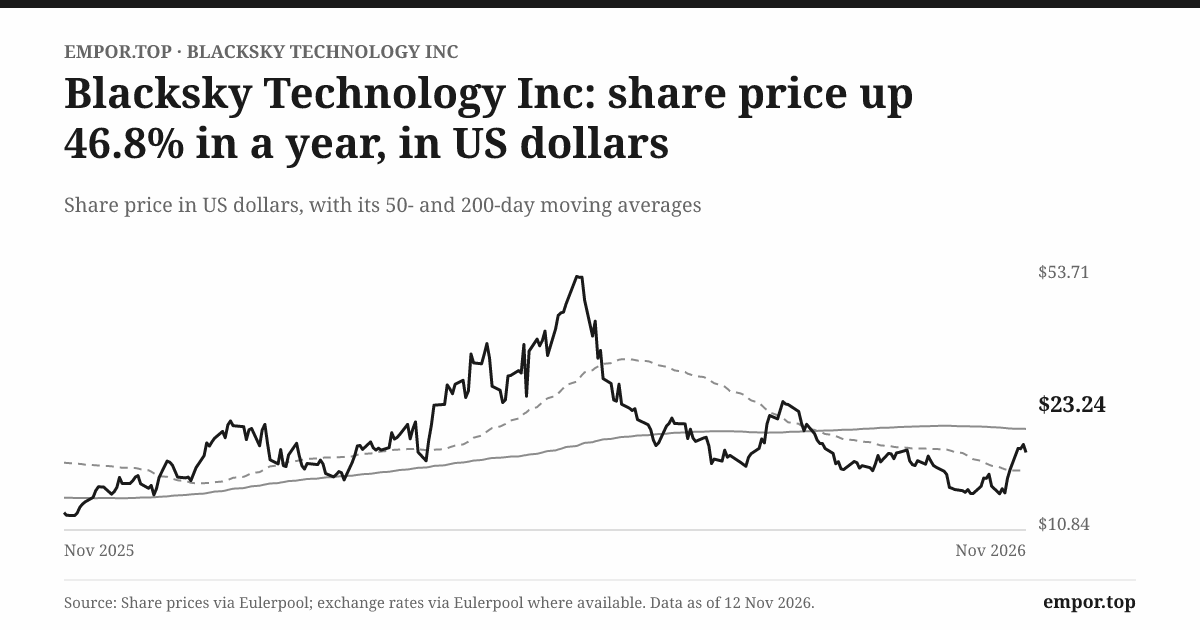
The timing was shrewd. BlackSky sold stock when the price was high; the shares traded as high as $51.41 during the past year.11 On November 12, 2026, they closed at $23.24, less than 60% of the average issue price.11 Investors who bought those new shares are sitting on losses; existing holders were diluted at a much better price than they would get today.
From the company's perspective, raising money at elevated prices is exactly what a capital-hungry business should do. From a long-term shareholder's perspective, it is a reminder that the constellation has been funded, in part, by issuing a larger slice of the company to new owners.
The result is a much stronger balance sheet than BlackSky has had in years. At September 30, 2026, it held $231.1 million of cash, restricted cash and short-term investments, most of it in U.S. government securities.4 Management said that was sufficient to complete the baseline Gen-3 constellation in 2027 "with ample cash available to pursue other strategic growth initiatives."1
That is a credible near-term statement, given the cash on hand and the remaining capital plan. But it is worth setting beside the March 2025 statement that the company already had "sufficient cash and liquidity to deploy a baseline constellation of 12 Gen-3 satellites and drive to positive free cash flow."2 Between those two statements, BlackSky issued a convertible note and raised about $165 million of new equity. The earlier sufficiency claim was not literally false; the company may simply have chosen to raise more to move faster. But it was not, in the end, how the constellation was paid for.
So the measurable test for the next year is simple to state. Take operating cash flow, subtract capital spending and watch the result over a full year of Gen-3 deployment, alongside how many new shares BlackSky issues to get there. If the gap closes without fresh equity, the third quarter will look like the turn. If it closes only with another round of share sales, the satellites will still be paying for themselves with shareholders' money.
And there is a further vulnerability in where the cash comes from, which is the subject of the next chapter: a remarkably small number of customers.
VII. The Customer That Can Make a Quarter
In August 2025, an adjustment to a single U.S. government contract quietly took about $4 million out of BlackSky's quarter.
The contract was EOCL, the Electro-Optical Commercial Layer, through which the National Reconnaissance Office, the U.S. agency that builds and operates spy satellites, buys commercial satellite imagery. BlackSky had been one of its suppliers, and at the end of 2024 the agency had extended BlackSky's subscription for Gen-2 imagery through mid-2026.2 Then, as the administration's proposed budget for fiscal 2026 took shape, the government adjusted the contract to reflect a lower potential baseline.13
Dubois explained the effect on the third-quarter 2025 call: BlackSky had expected imagery revenue to grow in the quarter, but revenue was "negatively impacted in August and September by approximately $4 million due to reductions made in the EOCL contract."13 Revenue for the quarter fell to $19.6 million, and nine-month revenue was flat with the prior year at $71.4 million.1314 Nine-month adjusted EBITDA was a loss of $7.9 million; management said that excluding EOCL and the LeoStella overhead it would have been a profit of about $5 million.13
O'Toole, for his part, pointed to congressional committees that had proposed restoring EOCL funding and to a federal government shutdown that had slowed several active U.S. deals.13 He was candid that BlackSky would not know the outcome until the budget was final. It was, in short, a contract and timing exposure: nobody had stopped buying from BlackSky, and there was no customer failure. But one budget line at one agency had changed the shape of BlackSky's year.
That is what customer concentration means in practice. In 2025, four customers each accounted for more than 10% of BlackSky's revenue, and together they represented 89% of it. In 2024, three customers had represented 88%.5 For a company with roughly $100 million of revenue, that means almost all the business came from a group of buyers small enough to fit around a conference table.
The picture in 2026 is somewhat broader but still concentrated. In the first nine months, the U.S. federal government represented 43% of revenue, and two anonymized customers each represented 14%.4 International customers, at 56% of revenue, now outweigh the U.S. government, up from 50% a year earlier.4 On the third-quarter 2025 call, O'Toole had said international contracts made up more than 90% of the backlog at that point and predicted international revenue would outpace the U.S. government in 2026.13 That prediction has come true, which is a point in management's favor.
But international growth is not the same as diversification. If the new international revenue comes from a few large defense customers, BlackSky has swapped dependence on one government for dependence on a handful of others. BlackSky identifies few of its largest customers by name and does not publish a top-five or top-ten revenue share.45
Receivables tell the same story from another angle. When a company books revenue before it collects the cash, the gap shows up as accounts receivable, if it has invoiced, or as contract assets, if it has done the work but not yet billed.
BlackSky's net receivables jumped to $34.1 million at the end of 2025 from $14.7 million a year earlier, while its allowance for bad debts was only $50,000.5 Contract assets, which include unbilled revenue, were another $28.6 million.5 Put together, more than half a year's revenue was sitting on the balance sheet waiting to be turned into cash.
The company offered one reassuring detail: a significant invoice outstanding at year-end was collected in January 2026.5 That suggests the jump was at least partly a timing effect of a large bill raised late in the year, rather than a customer refusing to pay.
By September 2026, the concentration of what customers owed had, if anything, increased. One customer represented 54% of BlackSky's receivables, and two more represented 16% and 10%.4 BlackSky does not publish an ageing schedule showing how long balances have been outstanding, average days overdue, or customer-specific payment histories, so outsiders cannot tell whether the largest balance is current or late.4 What can be said is that a single counterparty owes more than half of everything BlackSky is waiting to collect.
There is an accounting judgment underneath all of this as well. Much of BlackSky's project revenue is recognized over time, based on estimates of how far along a contract is and how much it will cost to finish. The auditor flagged revenue recognition as a critical audit matter in 2025 because of exactly those estimates, including variable consideration.5
During 2025, BlackSky recorded an $8.4 million cumulative catch-up adjustment to contract assets, the kind of revision that happens when estimates of progress or cost change.5 The auditor gave a clean opinion on both the financial statements and internal controls.5 But the size of that adjustment, relative to a $106 million revenue base, shows how much reported revenue in any given quarter depends on judgment about long contracts.
Put concentration and estimation together and a pattern emerges. BlackSky's quarters are shaped by a few large decisions: a government budget line, a satellite delivery milestone, a large pilot. When those decisions break the company's way, as they did in the third quarter of 2026, the results can be spectacular. When they do not, as in the third quarter of 2025, the results can disappoint just as sharply. That is not a sign that the business is broken. It is a sign that the business is still small relative to its customers.
The growing international mix is a partial diversification signal, and it is real. The concentration has not yet fallen in a sustained way, and the largest receivable is larger than ever. Those facts set up the most important strategic question of all: if a few powerful buyers dominate BlackSky's revenue, what stops them from taking their business to someone else?
VIII. Does the Intelligence Layer Have a Moat?
Imagine a crisis breaks out overnight near a contested border, and an intelligence agency needs to know, within hours, whether armored vehicles are massing at a particular depot. It has options. It can task its own government satellites. It can call one of several commercial imagery providers. It can buy through an aggregator that sources pictures from many vendors. Or it can use BlackSky, which argues that its combination of frequent revisits, fast tasking, AI analytics and quick delivery gets the answer there first.
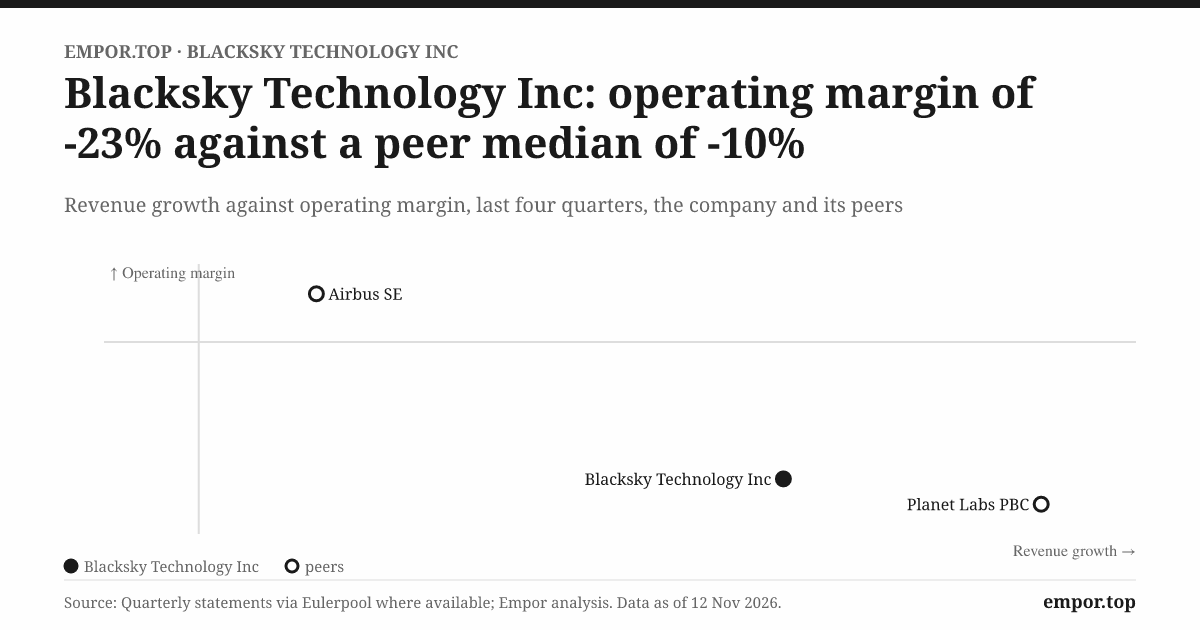
BlackSky's competitive set is crowded. Planet Labs runs the largest commercial fleet of Earth-observation satellites and reported roughly $244 million of revenue in its fiscal year 2025, more than twice BlackSky's $106 million.155 Vantor, the former imagery business of Maxar, operates very high-resolution satellites with a long history of supplying the U.S. government. Airbus sells optical imagery globally.
Satellogic is building a low-cost constellation. ICEYE operates radar satellites that can see through clouds and at night, which optical cameras like BlackSky's cannot. And governments themselves operate their own classified systems, alongside free public imagery from programs such as Europe's Sentinel satellites. BlackSky identifies alternative sensors, analytics providers and platforms among its competitive pressures.5
Size alone settles little. Planet's revenue is larger, but its product mix is different: it is built around imaging large areas of the Earth frequently at moderate resolution, while BlackSky concentrates on high-resolution, high-revisit monitoring of specific sites. The customer bases overlap only partly. There is no reliable public measure of market share in high-revisit, high-resolution intelligence, and reported revenue is not a substitute for one.
The cleanest way to ask whether BlackSky has a durable advantage is to run its industry through two frameworks: Michael Porter's five forces, which ask who holds the bargaining power in an industry, and Hamilton Helmer's seven powers, which ask what, if anything, lets a company earn persistently above-average returns.
Start with buyers, because they dominate this market. Governments are sophisticated, budget-constrained and politically accountable. They can redirect spending, re-bid contracts, split purchases among vendors and, as EOCL showed, cut a line when a budget changes. The customer base is highly concentrated, giving buyers very high power over BlackSky.5
Substitutes are plentiful. A customer can choose radar instead of optical, a government satellite instead of a commercial one, a lower-resolution provider with wider coverage, or free imagery for less time-sensitive work. Each substitute is imperfect, but together they cap how much BlackSky can charge for anything short of a truly time-critical need.
The threat of new entrants is moderate. Building and launching satellites has become far cheaper, which is the very trend BlackSky rode, so the same economics that let it compete with legacy giants let new constellations compete with it. Rivalry among existing players is intense and growing, as several venture-funded companies chase a defense market that budgets suggest is expanding. Supplier power is moderate: launch providers and specialist components are concentrated, and BlackSky still names limited sources for some parts, although owning its factory reduces exposure on the satellite itself.5
Now the seven powers. Scale economies: not yet. BlackSky is smaller than Planet and the legacy providers, and its cost advantage, if it has one, comes from design rather than size. Network effects: none in the conventional sense; one agency's use does not make the service more valuable to another. Counter-positioning: arguably yes, historically.
BlackSky's cheap, proliferated constellation and subscription model were hard for incumbents with large, expensive satellites to copy without undermining their own economics. That edge erodes as incumbents add smaller satellites of their own. Cornered resource: partial. Spectrum licenses, operating licenses and security clearances matter, but rivals hold them too.
That leaves switching costs and process power as the plausible moats. BlackSky says its analytics are integrated into customers' daily operations and that its AI models are proprietary, trained on its own data and built for real-time use rather than borrowed from generic third parties.1 If an agency has wired BlackSky's alerts into its workflows, changing provider is costly. And if BlackSky can sustain the rapid commissioning and delivery it has reported, that could reflect process power: an accumulated operating know-how that rivals cannot easily copy.
The trouble is that neither power can be verified from the outside. BlackSky does not disclose retention rates, net revenue retention, multi-vendor usage among its customers, switching rates or price realization over time.45 Those are exactly the measures that would show whether customers are locked in or simply happy for now. And there is evidence in BlackSky's own history that cuts the other way.
When the U.S. National Geospatial-Intelligence Agency moved its imagery purchasing from an older contract to a new marketplace called Luno, the transition "took longer than expected" and was the largest drag on BlackSky's imagery revenue in 2024, by O'Toole's own account.2 Large government buyers rearrange how they purchase, and when they do, incumbents' revenue moves with them.
The most plausible version of BlackSky's advantage is narrower than "moat." It is a strong position in a particular niche: time-sensitive monitoring of high-value locations, where the combination of revisit frequency, rapid tasking, AI analytics and speed matters more than raw coverage or the very finest resolution. In that niche, Gen-3's improved image quality closes the gap with premium rivals while keeping the frequency advantage. That is a differentiated product, and the 2026 sales results suggest customers value it.
But a differentiated product is not yet a moat. A moat is proved by behavior: customers who renew at rising prices, who concentrate rather than split their purchases, and who stay when a cheaper alternative arrives. The evidence that would settle the claim is specific. Repeat renewals of Assured subscriptions. A rising, disclosed subscription share of revenue. Lower customer concentration. And unit economics, revenue per satellite against the cost of building and launching it, that remain attractive as the constellation grows.
Until BlackSky shows those, its competitive advantage is best described as intact but unproven. And whether it gets proven depends heavily on the people steering the company, whose record now deserves its own examination.
IX. Brian O’Toole’s Test: Guidance, Pay, and Capital Allocation
Brian O'Toole did not come to BlackSky as a financier or a rocket enthusiast. He is a software and systems engineer who spent nine years at GE Aerospace, founded a small geospatial company called ITspatial, and served as chief technology officer of GeoEye, then one of the two dominant U.S. commercial imagery companies, from 2008 to 2013.6
In 2013 he founded OpenWhere, a start-up building geospatial intelligence software, and when BlackSky acquired it in June 2016 he became BlackSky's chief technology officer.6 He became president in November 2018, took on chief executive duties in early 2019, and has led the public company since the merger in September 2021.6
That background explains a lot about how BlackSky talks about itself. O'Toole's instinct is to describe the company as a technology stack: space, software and AI fused into one system. On calls he speaks in the language of architecture and capability, and his account of the business is consistently anchored on what the platform can do.
His finance chief has a complementary pedigree. Henry Dubois was chief financial officer of GeoEye from 2005 to 2012, during which, by BlackSky's account, the company grew revenue from about $30 million to $350 million, and he held executive roles including president, CFO and COO at DigitalGlobe, GeoEye's great rival.6 He joined BlackSky in August 2021 as chief development officer, focused on mergers and growth initiatives, and later became CFO.6 Between them, the two men have lived through the consolidation of the last generation of commercial imagery. They know how this industry's economics can turn.
The question is whether they have earned investors' confidence in the next turn. Three kinds of evidence bear on it: guidance, pay and capital allocation.
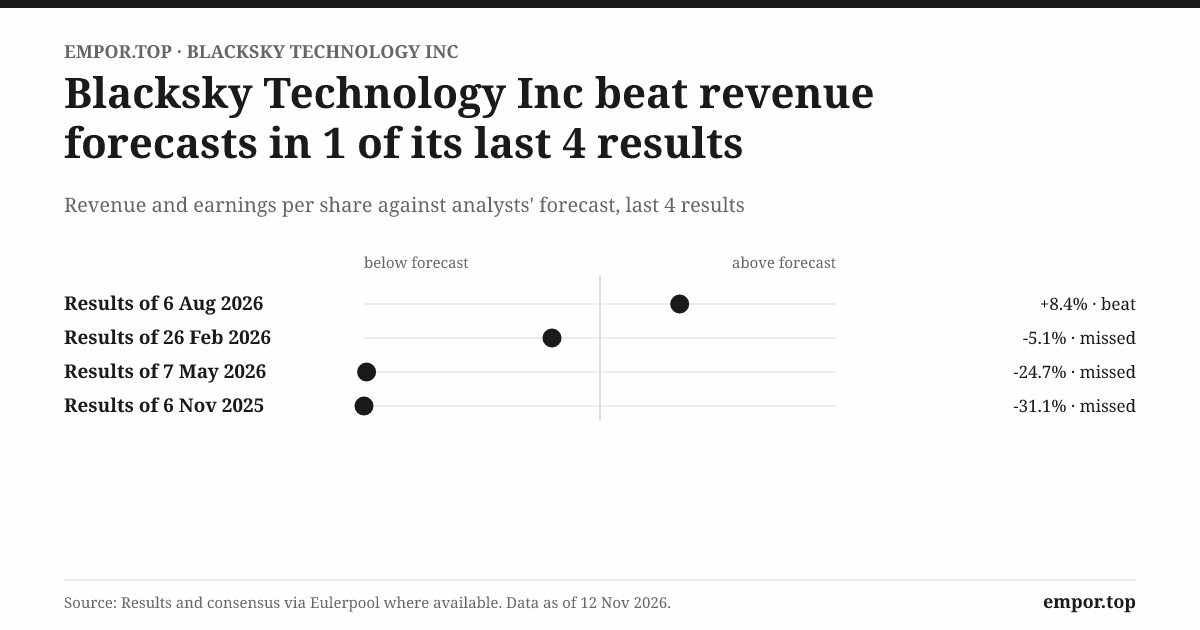
Guidance first. Management's original 2025 guidance proved too optimistic.2 In November 2025, it maintained the ranges while saying it was "actively working to close on a number of large sales opportunities" expected to affect the fourth quarter.13 The year ended well short of those ranges.510 Maintaining the range in November, when much of the year was already known, proved overly optimistic.
The 2026 record is different. Management raised its revenue and adjusted EBITDA guidance twice during the year, most recently to $140 million to $150 million of revenue and $18 million to $24 million of adjusted EBITDA, and said it had already secured the backlog to meet the revenue objective.1 If it delivers, 2026 revenue will be roughly a third higher than 2025's, close to the growth management originally promised for 2025, one year late.
The tone of the two calls tells the same story. In November 2025, O'Toole spoke about budget uncertainty, a government shutdown, EOCL marks in Congress and deal timing.13 In November 2026, he spoke about Gen-3 demand, subscription expansion, a multibillion-dollar pipeline and an inflection point.1 Both accounts may be accurate for their moment. The question for investors is whether guidance is becoming more reliable, and the only way to answer that is to track the next set of numbers against the stated ranges: revenue, adjusted EBITDA, operating cash flow and capital spending.
Pay next. O'Toole's total reported compensation for 2025 was $7.8 million, up from $2.5 million in 2024 and $3.4 million in 2023. Almost all of the increase was equity: $5.9 million of stock awards and $0.9 million of options.10 Dubois received $2.5 million, up from $2.2 million.10 O'Toole and Dubois received 80% of their target incentive payouts for 2025, even though revenue and adjusted EBITDA fell short of target; cash performance, which exceeded its target, carried the result.10
Reasonable people can read that two ways. A board might argue that equity awards align executives with shareholders, and that cash discipline in a capital-hungry year deserved reward. A skeptical shareholder might note that in a year when the company missed its two headline operating targets by wide margins and lost $70 million, the CEO's reported pay roughly tripled.
Shareholders' own verdict was split. At the 2026 annual meeting, the advisory vote on executive pay received about 8.96 million votes in favor and 6.94 million against, a level of dissent well above what most companies see.16 Director Susan Gordon, a former principal deputy director of national intelligence, received about 3.30 million votes for and 12.72 million withheld.16 The vote totals do not explain shareholders' motives, which may relate to attendance, other board commitments or committee responsibilities rather than performance. But dissent at that scale is a stewardship signal the board will have to answer.
Ownership matters to how those votes play out. The board has nine directors, eight of them independent, with a separate independent chair, William Porteous.10 No one controls BlackSky. The largest disclosed holders in 2026 were affiliates of Mithril at 5.7%, BlackRock at 5.6% and Seahawk SPV at 5.0%; O'Toole held 1.8%, and all directors and executive officers together held 5.2%.10
Two years earlier, Mithril had held 12.5% and Seahawk 11.0%.17 Share issuance and the reverse split complicate comparisons, but the early venture-era backers now own a much smaller slice, and management's own stake is modest. That makes BlackSky a company governed by a dispersed shareholder base, which is precisely why the vote results matter.
Finally, capital allocation. In two years, management made five major decisions: it took control of LeoStella, committed to Gen-3, repaid related-party debt and replaced it with convertible notes, then raised equity through the ATM.554 Each decision had a strategic logic, and the equity raise in particular was well timed. But the sequence also shows the distance between earlier funding plans and execution. An activist examining the record would press on that gap, on the pay outcome in a missed year, and on why the company still does not disclose subscription share, retention or receivable ageing, the metrics that would let shareholders judge management's claims directly.
O'Toole has led the company through a real technical transition and, in 2026, a real commercial acceleration. His credibility is improving, but it is still conditional, and the conditions are financial rather than technical. Which brings the story to the question every investor ultimately faces: what is the market currently paying for all of this?
X. Analysis & Bear vs. Bull Case
On November 12, 2026, BlackSky's shares closed at $23.24, giving the company a market value of about $836 million and an enterprise value, adding debt and subtracting cash, of about $853 million.11 A year earlier, enthusiasm about Gen-3 and defense budgets had pushed the shares as high as $51.41; at the low they had traded at $13.14.11 The stock's one-year volatility was about 100%, meaning its price had routinely swung by large fractions of its value.11
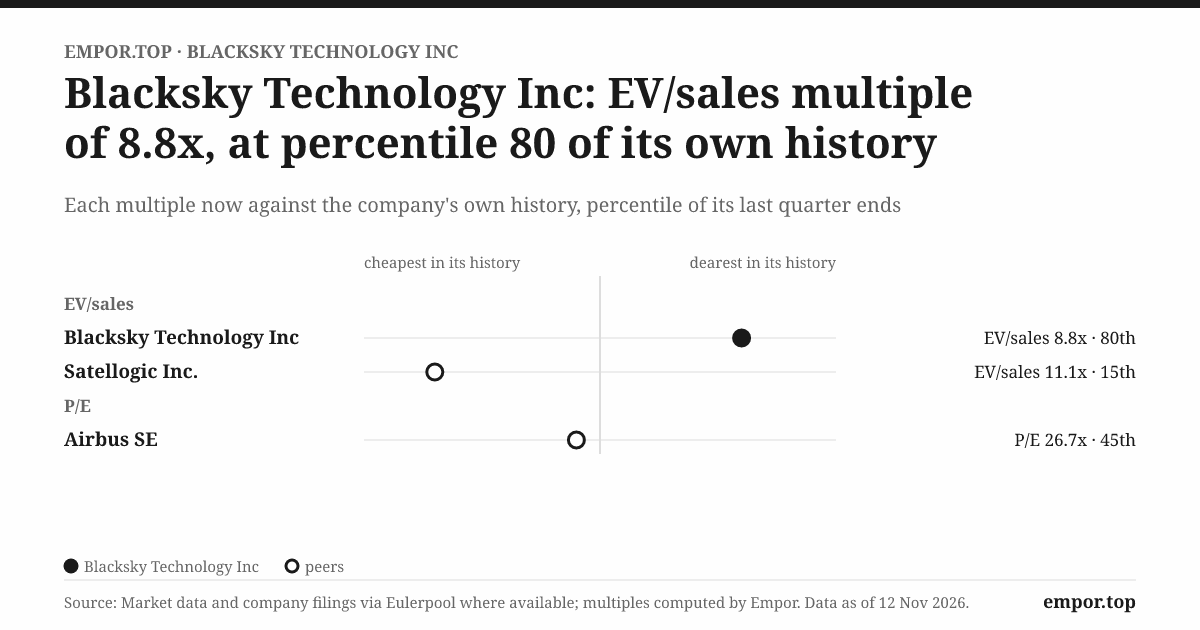
At that price, investors were paying about 8.8 times the company's sales over the past twelve months for the enterprise, and about 6.4 times sales for the equity.11 Free-cash-flow yield was negative, about minus 8.4%: for every $100 invested in the company at market value, the business consumed roughly $8 of cash over the past year.11
Against BlackSky's own history, the multiple had risen; on one provider's series, enterprise value was about 6.8 times sales at the end of 2025.18 Against listed peers, it was lower: Planet Labs traded around 12.4 times sales and Satellogic around 11.9 times in mid-November 2026.1920 Those peers differ enough in scale and mix that the comparison is context, not a benchmark.
What does an 8.8 times sales multiple assume? It does not assume today's business. A company with BlackSky's 2025 profile—flat revenue and negative cash flow—would rarely command that price. The multiple assumes that 2026's acceleration continues: that services revenue keeps growing quickly, that the very high incremental margins management describes turn into cash, and that capital spending falls once the baseline constellation is complete. In other words, the market is paying for the inflection O'Toole described, not for the record that preceded it.
The bull case follows that logic. Faster Gen-3 commissioning and pilot conversions build on the third quarter's sales momentum. Services revenue, with costs that barely rise as sales grow, outpaces everything else, so margins widen.
International and sovereign demand broadens the customer base, and the $1 billion consortium becomes a large mission-solutions program. Once the baseline constellation is built in 2027, capital spending eases, and operating cash flow finally covers it. In that world, the $355 million backlog is the visible part of a much larger opportunity.1
The bear case reads the same facts differently. The third quarter was unusually milestone-heavy, combining a large two-month pilot, satellite delivery progress and a derivative gain that flattered net income. The federal government and a handful of other buyers still drive results, and one budget change can erase a quarter's growth.
Satellites keep absorbing cash before the revenue they enable matures, and the constellation will need replacement as its satellites age. Each funding gap has so far been closed with expensive debt or new shares, transferring more of the future to new investors. And the 2021 projections and 2025 guidance both show how far management's expectations can run ahead of results.
Why might BlackSky win from here? Because it owns the whole chain, from factory to satellite to software to alert, and has demonstrated it can run that chain quickly. Its niche, time-sensitive monitoring of strategic sites, is the kind of work where speed and frequency matter and where defense budgets are growing. The third-quarter revenue, the backlog and the conversion examples are real evidence of demand. What is missing is the proof of durability: BlackSky does not disclose retention, subscription mix or customer-level economics.
Why might it not? Because its buyers are powerful and few, its substitutes are many, and its advantage rests on capabilities such as frequency, speed and analytics that rivals are also building. Because it has not yet shown a single year of positive free cash flow. And because the strongest form of its competitive claim, that customers find its service hard to replace, has not been tested by a disclosed renewal record.
Weighing the two, the historical record leaves the bull case intact but narrowed. The long run of losses and missed forecasts rejects the original 2021 version of the story, a company growing toward half a billion dollars of revenue by 2025. It does not reject a smaller, slower version: a niche intelligence provider whose services business is beginning to produce operating leverage. Whether that smaller version justifies today's multiple depends on whether 2026's growth persists without fresh dilution.
Three numbers will tell investors which story is unfolding. The first is space-based intelligence and AI services revenue and its share of the total: $32.7 million in the third quarter, about three-quarters of revenue, and growing fast.1 The second is operating cash flow minus capital spending, which was negative by about $44.5 million in 2025 and has only just turned positive at the operating line, before $46.5 million of nine-month capital spending.51 The third is customer concentration, in both revenue and receivables, where the largest receivable stood at 54% in September 2026.4
The falsifiers are just as clear. Consecutive quarters of operating profit and positive cash flow after capital spending, without a derivative gain doing the work, would strengthen the bull case decisively. Slowing services growth, a rising share of receivables owed by a single customer, or another large round of equity issuance would weaken it. The third quarter, with its derivative-assisted profit, settles neither.
XI. Business & Investing Lessons
Every company teaches something about its industry, but BlackSky teaches something very specific: what happens when a business that is part hardware, part software and part government contractor tries to prove its economics in public while it is still building the machine.
The first lesson begins with that fifth satellite turning on in under a day. In a constellation business, a satellite in orbit is an asset; a satellite under contract is a business. The founders and investors who study BlackSky should count contracted, renewing capacity, not spacecraft.
The second lesson comes from the Tukwila factory. Owning the factory can remove a bottleneck, but it also makes the bottleneck yours. Vertical integration is a bet on keeping the line busy. The bet pays only if demand keeps up.
The third lesson is about the cash on the balance sheet. A cash balance is a runway, not a return. BlackSky raised equity while continuing to spend on capital projects.41 The cash measures how long the company can keep building, not whether the building is paying off. The return shows up only when operating cash flow exceeds capital spending, year after year.
The fourth lesson is about who sits across the table. When customers are few, diversification is an operating metric. BlackSky's customer concentration, including the outsized receivable owed by one customer, shows why.54 For BlackSky, broadening the customer base is not a strategic aspiration to be mentioned at an investor day. It is a number to be reported every quarter, as important as revenue itself.
And there is a fifth lesson, drawn from the gap between the 2021 merger forecast and 2025 results. A projection made to sell a deal is a hypothesis, not a plan. That gap is the distance between engineering and commerce, and it is the distance every deep-technology company asks investors to finance.
XII. Epilogue
Tonight, BlackSky stands at its most promising moment since it went public, and its most exposed. The latest quarter brought record results and raised guidance, against a history of losses, debt and dilution, and a concentrated customer base.1
The next moments are already on the calendar. On December 2, 2026, management will hold an investor day in New York, where it has promised to share more about its vision and growth strategy.1 That will be the place to watch for the disclosures that would most change the investment debate: subscription share of revenue, renewal rates, utilization of the constellation and customer concentration. If they appear, investors will finally be able to measure the moat rather than infer it. If they do not, the debate will remain where it is.
Then comes the fourth quarter. The guidance implies a quarter heavy with satellite deliveries for sovereign customers, which will lift revenue but carry lower margins than services.1 Hitting the range would show that this time the raised targets held. Missing it would revive the memory of 2025.
Beyond the quarter, the questions lengthen. Will services revenue keep growing once it laps the strong third quarter, when the large U.S. government pilot will no longer be in the comparison? Will the adjusted EBITDA management highlights turn into operating cash flow, and will operating cash flow cover capital spending once the baseline constellation is complete in 2027?
Will the $1 billion consortium become a signed contract with a disclosed BlackSky share, and will that share be recognized on schedule? And will 2027 guidance, due in the first quarter, be set at a level the company can beat rather than chase?
Together, those answers will show whether BlackSky can turn technical performance into repeat sales, fund its constellation and broaden its customer base.
The next proof will not be another launch. BlackSky has already shown it can launch. The next proof is the cash statement.
XIII. Outro
High above the Earth, a Gen-3 satellite finishes a pass, stores its last image and turns toward the next target. Within 24 hours of launch, it was already doing paid work. On the ground, the company that built it is still spending $50 million to $60 million in 2026 to put more of them up there.1
That is BlackSky's story, in one frame. Its defining achievement is making space-based intelligence faster to bring online than almost anyone thought possible. Its defining test is making that speed produce durable cash. First light came in under a day. Shareholder returns are taking considerably longer.
References
-
Third Quarter 2026 Earnings Call Transcript — BlackSky Technology Inc., 2026-11-05 ↩↩↩↩↩↩↩↩↩↩↩↩↩↩↩↩↩↩↩↩↩↩↩↩↩↩↩↩↩↩↩↩↩↩↩↩↩↩↩↩↩↩↩
-
Q4 2024 Earnings Call Transcript — BlackSky Technology Inc., 2025-03-06 ↩↩↩↩↩↩↩↩↩↩↩↩↩↩↩
-
BlackSky's Third Gen-3 Enters Commercial Operations in Just Three Weeks Following Launch — BlackSky, 2025-12-17 ↩↩
-
Q3 2026 Form 10-Q — BlackSky Technology Inc., 2026-11-13 ↩↩↩↩↩↩↩↩↩↩↩↩↩↩↩↩↩↩↩↩↩↩↩↩↩↩↩↩↩
-
2025 Form 10-K — BlackSky Technology Inc., 2026-03-16 ↩↩↩↩↩↩↩↩↩↩↩↩↩↩↩↩↩↩↩↩↩↩↩↩↩↩↩↩↩↩↩↩↩↩↩↩↩↩↩↩
-
Registration Statement, Form S-1/A — BlackSky Technology Inc., 2021-12-08 ↩↩↩↩↩↩↩↩↩↩↩↩↩
-
Merger Proxy and Prospectus, Form S-4/A — BlackSky Technology Inc., 2021-08-02 ↩↩↩↩↩↩↩↩↩↩
-
BlackSky Announces Completion of Merger with Osprey Technology Acquisition Corp. — BlackSky, 2021-09-09 ↩
-
2026 Definitive Proxy Statement — BlackSky Technology Inc., 2026-07-23 ↩↩↩↩↩↩↩↩
-
Investor Relations: Stock Information — BlackSky Technology Inc., 2026-11-12 ↩↩↩↩↩↩↩↩
-
May 2026 Investor Presentation — BlackSky Technology Inc., 2026-05 ↩↩
-
Q3 2025 Earnings Call Transcript — BlackSky Technology Inc., 2025-11-06 ↩↩↩↩↩↩↩↩↩
-
Q3 2025 Results, Exhibit 99.1 — BlackSky Technology Inc., 2025-11-06 ↩
-
2026 Annual Meeting Results, Form 8-K — BlackSky Technology Inc., 2026-09-10 ↩↩
-
2024 Definitive Proxy Statement — BlackSky Technology Inc., 2024 ↩
 LinkedIn
 WhatsApp
 Reddit
 Hacker News
 Email
 Kindle
 RSS Feed
 Spotify
 Apple Podcasts
 Amazon Music
 Audible
 YouTube