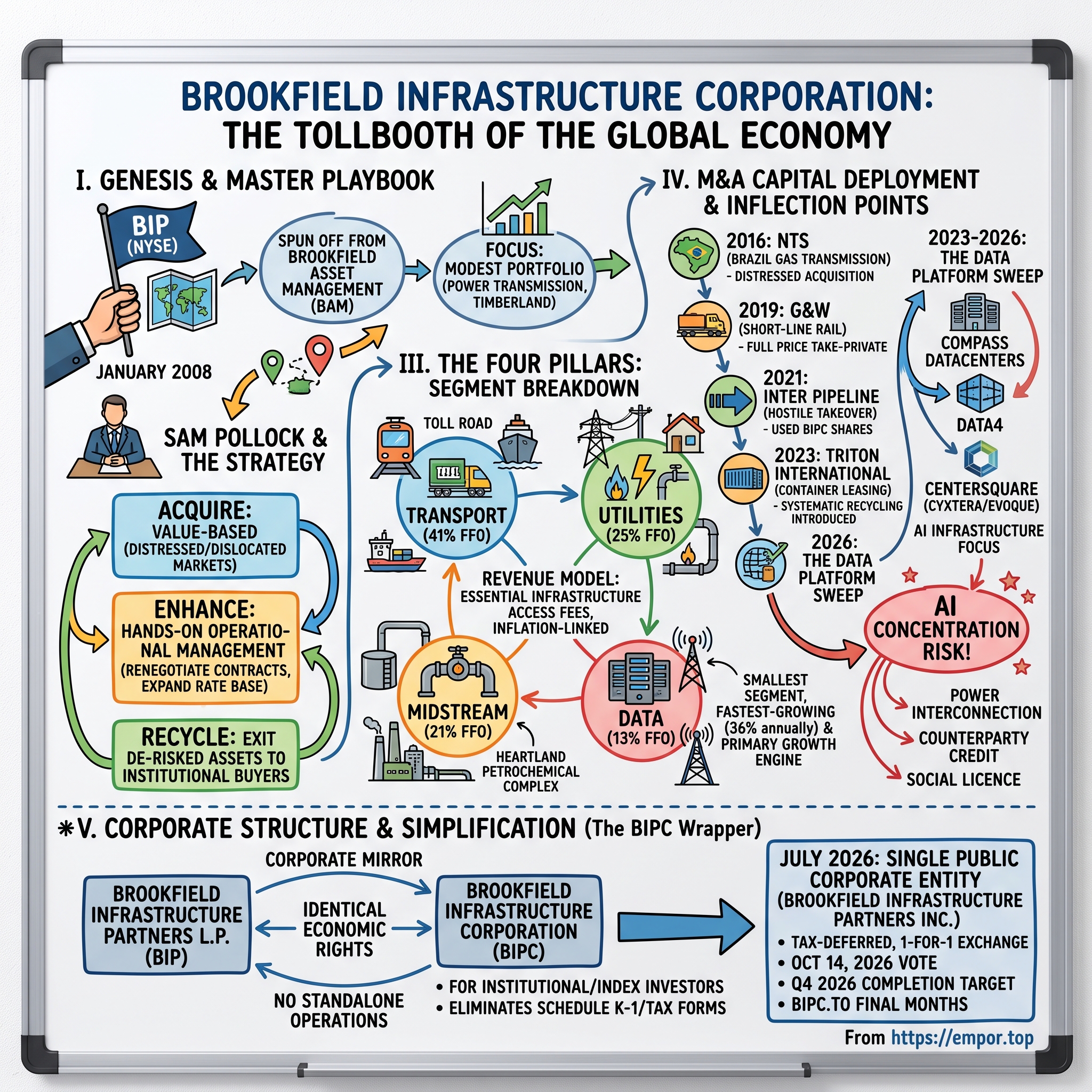
Brookfield Infrastructure Corporation: The Tollbooth of the Global Economy
I. Introduction & The Real-Asset Compounder
On the morning of July 30, 2026, David Krant opened Brookfield Infrastructure’s second-quarter earnings call with a routine review of operational numbers: funds from operations reached $702 million, representing 10% growth, alongside a distribution increase to $0.455 per unit.1 Deep in the prepared remarks, however, came an announcement that would have seemed improbable a decade earlier for a business known for Brazilian gas pipelines and Chilean power lines: the U.S. Department of Energy selected Brookfield to develop an AI data center campus in western Kentucky designed to support more than 1.2 gigawatts of compute.2
Because one gigawatt roughly equals the capacity of a large nuclear reactor, Brookfield’s 1.2-gigawatt project represents a massive commitment to machine-learning infrastructure, situated on federal land and backed by what an executive on the call described as potentially "up to $100 billion in private capital."2
This contract highlights the dual identity of Brookfield Infrastructure in 2026. On paper, it remains a traditional real-asset business, managing regulated gas transmission in Brazil, residential utility connections in the United Kingdom, freight rail in Australia, toll roads in Peru, and shipping containers running between Shenzhen and Long Beach. It collects steady tolls with cash flows indexed to inflation. Its credit rating stands at BBB+, and 90% of its debt carries fixed rates with an average maturity of eight years.4 Yet its fastest-growing digital infrastructure segment compounds at 36% annually, redirecting corporate focus toward fuel cells, GPU leasing, and power supply for next-generation computing facilities.2
What Brookfield Infrastructure Corporation actually is. BIPC is not an independent entity with standalone operations, but rather a corporate mirror. Created in 2020, each BIPC class A exchangeable subordinate voting share was structured to match the economic rights of one unit of Brookfield Infrastructure Partners L.P., offering identical dividends and a one-for-one exchange option into a BIP unit.6 Underneath, BIPC directly holds a subset of the group’s portfolio — including the Brazilian gas transmission system, U.K. regulated distribution assets, and global container-leasing operations — though the share price is designed to track the entire partnership.20 For investors on the Toronto Stock Exchange, purchasing BIPC provides exposure to Brookfield Infrastructure through a corporate structure suitable for institutional mandates, mutual funds, and standard equity accounts.
That structure answered a specific tax and administrative requirement. Holding a limited partnership unit generates a Schedule K-1 in the United States and specialized tax forms in Canada, creating paperwork that can restrict index eligibility and deter retail and institutional buyers. The corporate structure eliminated those barriers, allowing investors to trade the underlying assets through a standard share class.
And now the wrapper is being folded away. On July 21, 2026, Brookfield announced plans to consolidate BIP and BIPC into a single publicly traded corporation named Brookfield Infrastructure Partners Inc. Under the court-approved plan of arrangement, all BIP units and BIPC shares will exchange one-for-one for shares in the new corporate entity on a tax-deferred basis for Canadian and U.S. investors.3 Special securityholder meetings are set for October 14, 2026, with an August 21 record date, and management expects to complete the transaction in the fourth quarter.3 As a result, BIPC.TO is entering its final months as a distinct listed security.
The scale, for orientation. As of March 31, 2025, Brookfield Infrastructure carried an enterprise value of approximately $57 billion, generated trailing twelve-month FFO of about $2.4 billion, and held only $3.4 billion in corporate recourse debt, with the remainder structured as non-recourse debt at the operating subsidiary level.4 Cash flows are geographically diversified, with 67% generated in the Americas, 18% in Europe, and 15% in the Asia-Pacific region, while more than 80% of total FFO is denominated in or hedged to U.S. dollars.4 BIPC represents the smaller share class, with 119,982,167 class A exchangeable shares outstanding as of December 31, 2025, compared with a BIP market capitalization of about $20 billion.2027 While the two securities currently trade within a tight range of each other ahead of the one-for-one exchange, BIPC historically traded at a visible premium to BIP after 2020, reflecting the market value placed on avoiding partnership tax reporting.
This structure creates a distinct corporate trajectory. It traces how a Canadian asset manager carved out electric transmission and timberland during the 2008 financial crisis to build a global real-asset platform. It reflects a capital-recycling strategy that reported a 14% compound annual growth rate in cash flow per unit from 2009 through 2024.4 Finally, it underscores how a conservative infrastructure manager repositioned itself as a key landlord and financier for artificial intelligence infrastructure, bringing new growth opportunities along with customer concentration risks.
Key questions remain for prospective investors: Is this cash-flow growth sustainable, or does it reflect non-GAAP metrics and continuous balance-sheet expansion? Does the management fee paid to the parent entity secure proprietary deal flow, or does it impose an unnecessary friction on asset returns? And as the primary growth engine shifts toward AI data centers, does a platform built on contracted, inflation-linked utility returns face a shift toward higher cyclicality and reliance on capital spending from a small group of technology firms?
Evaluating these questions requires examining how the platform was initially constructed.
 Subscribe on LinkedIn
II. Genesis & The Brookfield Master Playbook
In January 2008, as credit markets began seizing two months before the collapse of Bear Stearns, Brookfield Asset Management distributed a special dividend consisting of a 60% interest in a newly formed Bermuda partnership, which began trading on the New York Stock Exchange under the ticker BIP on January 31, 2008.5 The starting portfolio was modest and focused on electricity transmission in North and South America, along with timber operations.5 Brookfield retained roughly 30% and installed itself as manager.5
Spun off into an emerging credit crisis, a leveraged, yield-oriented vehicle initially presented execution risks. However, the underlying rationale was structural rather than tactical. Having spent decades managing real assets such as hydroelectric dams, office towers, and transmission networks, Brookfield concluded that public markets systematically undervalued these businesses as slow-growth bond proxies. Private institutional investors, meanwhile, were beginning to treat infrastructure as a distinct asset class valued for long-duration, inflation-indexed cash flows well-suited to match pension liabilities. Purchasing assets at distressed or public-market valuations and later exiting at private-market multiples created an arbitrage opportunity that could endure for years.
The spin-off vehicle was established as the permanent public-market entity for that strategy, providing Brookfield with listed equity currency to finance acquisitions.
Sam Pollock and the shape of the strategy. Chief Executive Officer Sam Pollock, who has led the vehicle since its inception, joined Brookfield in 1994, working in corporate investments and private equity before taking responsibility for building the infrastructure franchise in 2006.7 A Queen's University commerce graduate and chartered professional accountant, Pollock became sole chief executive following the departure of former co-CEO Aaron Regent and has held the position since.25
Pollock's core strategy separates infrastructure returns into three distinct operational phases:
Acquire. Purchasing high-quality assets on a value basis, typically during market dislocations such as political volatility in Brazil, Canadian takeover fights, or bankruptcy auctions when competing capital is constrained.
Enhance. Applying hands-on operational management by renegotiating contracts, extending debt maturities, converting merchant risk into take-or-pay agreements, expanding capacity within existing footprints, and directing capital into regulated rate bases with predictable returns.
Recycle. Exiting de-risked assets to institutional buyers with lower return thresholds—such as sovereign wealth funds or pension plans—and redeploying the capital into higher-yielding opportunities.
Management targets an internal rate of return of 12% to 15% or better across this cycle, alongside a long-term FFO-per-unit growth target above 10%, annual distribution growth of 5% to 9%, and a target payout ratio of 60% to 70%.4 These published targets establish a clear benchmark for evaluating execution over time.
The model functions similarly to a commercial real estate developer who acquires underperforming properties, secures long-term creditworthy tenants, and sells the stabilized assets to insurance companies seeking bond-like yields. The primary profit driver is not ongoing operational yield alone, but the valuation spread between the acquisition entry yield and the lower return acceptable to institutional buyers. Brookfield executes this strategy across large-scale utility and transport networks, where contractual restructuring compresses the buyer's required discount rate.
The early expansion model. Between 2009 and 2015, the platform expanded primarily through steady asset accumulation across electric transmission in Chile and Brazil, Chilean toll roads, ports and freight rail in Australia and the U.K., British residential utility connections, and European telecom towers. Together, these acquisitions expanded FFO per unit at a 14% compound annual rate through 2024, with distributions compounding at 9% over the same span.4 By 2024, FFO per unit reached $3.12.4
While a 14% per-unit growth rate over fifteen years demonstrates long-term compounding discipline, it warrants context. FFO is a management-defined financial metric, and compounding growth from a small initial base during a decade of declining interest rates presents a different hurdle than generating equivalent growth on a $57 billion enterprise value in a higher-rate environment.
Asset recycling in practice. Disclosed asset sales in 2025 illustrate the execution of this strategy. Brookfield agreed to sell its share of an Australian container terminal operation for approximately $500 million, generating a reported 17% internal rate of return and nearly four times invested capital. It also closed the sale of a final 25% stake in a U.S. gas pipeline for about $400 million, yielding a reported 18% internal rate of return and three times capital since 2015.4 While these transactions demonstrate realized capital returns on exited assets, they represent specific deals selected for disclosure, whereas unexited portfolio holdings remain carried at management estimates.
Management fee architecture. Brookfield Infrastructure operates without direct executive employees, relying on external management by Brookfield Asset Management. Under its master services agreement, the partnership pays a base management fee of 0.3125% quarterly—or 1.25% annually—based on the combined market value of the group.20 In addition, a Brookfield subsidiary holds incentive distribution rights that allocate an increasing share of cash distributions to the manager once quarterly per-unit payouts cross established benchmark hurdles.20
Because the base management fee is calculated on market capitalization rather than net asset value or cash flow, the fee structure introduces distinct alignment considerations. As BIPC explicitly notes in its annual disclosures, tying fees to market valuation "may create an incentive for Brookfield to increase or maintain the market value of the group over the near-term when other actions may be more favorable to the company and shareholders."20 Likewise, the incentive distribution structure creates financial incentives to elevate distribution levels to trigger incentive payments.20
In exchange for this fee architecture, Brookfield Infrastructure accesses a global operating network that includes 12 corporate offices, over 300 investment professionals, and approximately 61,000 operating employees across the portfolio.4 Management contends this scale provides proprietary deal sourcing for off-market acquisitions and debt-financing capabilities that a standalone infrastructure entity could not replicate. Evaluating whether this operational network justifies a 1.25% market-cap fee and distribution sharing remains a central debate for investors, given that the platform has operated exclusively under external management.
The clearest assessment of how this strategy functions in practice lies within the composition and performance of the operating portfolio itself.
III. The Four Pillars: Segment Breakdown, Economics, & Materiality
Across its global operating footprint, Brookfield Infrastructure owns roughly 3,500 kilometres of natural gas pipelines and 3,140 kilometres of electricity transmission lines; a residential platform serving 10.4 million customers and 8.5 million utility connections; 36,300 kilometres of rail and 3,300 kilometres of toll roads; seven million twenty-foot-equivalent shipping containers; ten port terminals; 25,600 kilometres of midstream gathering and transmission pipelines with 570 billion cubic feet of gas storage capacity; 306,000 telecom towers; 28,000 kilometres of fibre optic cable; two semiconductor foundries; and more than 140 data centres.4
The underlying revenue model relies on a consistent mechanism across these diverse holdings: acquiring essential physical infrastructure that customers require and charging for access under long-dated contracts indexed to inflation. Approximately 85% of funds from operations (FFO) is protected from or linked to inflation, and about 85% is contracted or regulated.4 While this structure insulates tariffs on Brazilian gas pipelines or Peruvian toll roads from inflationary erosion during price spikes, it does not make earnings immune to broader economic forces—volume fluctuations, currency exchange rates, and the 15% of cash flow exposed to merchant and commodity pricing still influence results.
Over the twelve months ended March 31, 2025, the portfolio's FFO contribution broke down into four main segments: Transport at 41%, Utilities at 25%, Midstream at 21%, and Data at 13%.4 This mix highlights that despite its public profile as a defensive utility, Brookfield Infrastructure operates primarily as a global transportation, logistics, and energy infrastructure network.
Utilities — the floor, not the engine
The utilities segment generated $196 million of FFO in the second quarter of 2026, representing a 5% year-over-year increase.1 Expansion was driven by inflation indexation, capital additions to the regulated rate base, and the acquisition of a South Korean industrial gas business in 2025. These gains were partially offset by asset sales, including the largest concession in the Brazilian electricity transmission operation and the Mexican regulated natural gas transmission business.2
Reported segment performance reflects a net calculation where organic growth is reduced by divestitures. Consequently, a 5% growth rate achieved alongside major asset sales indicates underlying operational strength, while illustrating how the timing of capital recycling can alter headline metrics.
The economic model of regulated utilities relies on contractual predictability. Rather than selling commodities at market prices, a regulated utility agrees with government overseers on an approved valuation for its infrastructure assets—the "rate base"—and earns a designated return on that capital while recovering operating expenses. Adding approved capital expands the rate base and generates long-term contractual returns. Growth is therefore governed by approved capital expenditures rather than customer acquisition, making regulatory decisions on allowable returns the primary operational constraint and risk factor across jurisdictions in Brazil, Canada, and the United Kingdom.
In the first quarter of 2026 alone, Brookfield Infrastructure commissioned more than $500 million of total capital into its utility rate base.21 Meanwhile, the U.K. residential connections platform, in which BIPC holds a direct economic interest, operates under a distinct model. Rather than managing an established network, it installs new gas, electricity, water, and fibre connections for housing developments to secure long-term utility access fees. Growth is closely tied to British residential construction cycles, where management reported a 4% year-over-year increase in new connection sales and installations.20
Transport — the largest engine, and the one nobody talks about
Transport produced $311 million of FFO in the second quarter of 2026, representing a 7% increase when normalised for capital recycling.1 Transport volumes across rail, ports, and toll roads each rose between 3% and 7% year over year.2 The portfolio encompasses short-line and heavy-haul rail networks, toll road concessions in Latin America and India, port terminals, a North American railcar leasing business acquired on January 1, 2026, and the global intermodal container leasing operation established through Triton.2
The investment thesis for transport infrastructure rests on the geographic monopolies created by key trade corridors. Rail lines serving specialized terminals or toll roads navigating critical mountain passes face high barriers to entry and limited competition, allowing operators to collect long-term user fees tied to local inflation indices.
However, transport revenues remain subject to global volume cycles. On the second-quarter earnings call, management highlighted an operational connection between transport volume and technology expansion: Chinese exports grew nearly 20% year to date, driven in part by shipments of machinery, motors, transformers, pumps, valves, and tubing flowing through Brookfield’s container leasing operations, ports, and rail networks to supply data centre construction.2
This linkage demonstrates that artificial intelligence capital spending impacts broader logistics chains beyond data centres. Because moving electrical equipment and structural materials requires global shipping capacity, any potential slowdown in technology sector investments would affect container, port, and rail volumes alongside direct digital assets.
Midstream — the cyclical one, honestly labelled
Midstream FFO reached $183 million in the second quarter of 2026, rising 17% year over year as the second-fastest growing segment in the portfolio.1 Performance was supported by high utilization across Canadian midstream operations, favorable commodity pricing, and contributions from a newly acquired U.S. refined products pipeline system.2
The midstream segment accounts for most of the platform's 15% non-contracted cash flow exposure. While Brookfield has systematically converted merchant assets into fee-for-service and take-or-pay structures—extending contract durations at its Canadian gas business to nearly twelve years—segment earnings remain responsive to prevailing energy prices.21
Management identified a substantial pipeline of brownfield expansion opportunities, estimating roughly $8 billion in potential low-cost, high-return growth projects across its operating companies.21 In addition, Western Canadian and U.S. Gulf Coast natural gas assets are benefiting from structural demand shifts driven by liquefied natural gas (LNG) export facilities and power generation for computing infrastructure. Operating executives noted on the first-quarter call that policy frameworks in Alberta and across Canada remain supportive, with clients seeking expanded access to transmission facilities and $400 million in recently completed projects beginning to generate revenue.21
The segment's primary organic growth project remains the Heartland Petrochemical Complex in Alberta, acquired through Inter Pipeline. The approximately C$4 billion project encountered execution challenges, running several months behind schedule and roughly C$500 million over budget before its polypropylene facility was commissioned in July 2022 to process local propane into 525,000 tonnes of annual output.2324 The facility is now operational, serving as a key case study in complex project execution within the portfolio.
Data — 13% of cash flow, and effectively all of the narrative
Data FFO reached $154 million in the second quarter of 2026, up 36% year over year,1 following a 46% increase in the first quarter21 and full-year 2025 segment FFO of $502 million.19 Growth was driven by the integration of a U.S. bulk fibre network acquired in September 2025, data centre development income, and initial earnings from a partnership with Intel to construct semiconductor manufacturing foundries in Arizona.2
While Data remains the smallest segment by total cash flow, it represents the primary driver of incremental growth and corporate re-rating. Brookfield Infrastructure commissioned over $1.5 billion in capital projects during the second quarter of 2026, concentrated largely in digital infrastructure.1 Management maintains an annual target of deploying $300 million to $500 million in equity into AI infrastructure, though Chief Financial Officer David Krant noted on the second-quarter call that year-to-date deployment stood near $100 million, with the majority of capital outlays scheduled for future periods.2
Beyond data centre development, the segment holds 306,000 telecom towers, 28,000 kilometres of fibre optic cable, and 360,000 fibre-to-the-premise connections.4 Tower leases offer operating leverage, as adding multiple wireless carriers to existing structures incurs minimal incremental cost. Chief Executive Officer Sam Pollock highlighted demand from telecom operators expanding network density across Europe and Asia, alongside a multi-year transition from copper to fibre across U.S. markets.21
The portfolio also includes a capital partnership with Intel to finance semiconductor manufacturing facilities in Arizona.4 Management noted on the first-quarter call that Intel initiated initial wafer payments during the quarter, with remaining capital contributions expected over six months ahead of a full earnings run rate by 2027.21
The broader AI strategy focuses on four main areas outlined by management: integrated AI campuses, compute infrastructure through its Radiant platform, behind-the-meter power generation, and adjacent logistics.2 To address electrical grid constraints, Brookfield expanded its framework with Bloom Energy on June 30, 2026, increasing total planned capital expenditure from $5 billion to $25 billion for solid-oxide fuel cell deployments at data centres.17
Grid interconnection delays across North American power markets have led data centre developers to require on-site generation, as utility load queues demand substantial capital deposits and multi-year wait times.21 Prefabricated fuel cells provide rapid power deployment, allowing Brookfield to act as an energy supplier and infrastructure financier. Commercial terms reported by managing director Lief Williams include development yields in the high single digits to low double digits, annual contract escalators of 2% to 3%, and greenfield lease durations of 15 to 20 years.2 Concurrently, operating executives noted that data centre inventory for 2026 was fully committed, with 2027 capacity becoming limited.21
These long-term contracts secure cash flow visibility, though long-duration leases depend on sustained counterparty credit quality and ongoing demand for compute capacity over multi-year technology cycles.
IV. M&A Capital Deployment & Inflection Points: Benchmark Analysis
Brookfield Infrastructure’s acquisition track record spans major market cycles, providing a substantial basis for evaluation. Five primary transactions and strategic shifts illustrate the execution—and limits—of the platform's capital deployment strategy.
2016: Brazil, at the bottom
In 2016, amid a political and economic crisis in Brazil, state oil company Petrobras sought rapid asset divestitures. A Brookfield-led consortium—including CIC Capital and Singapore’s GIC—agreed to acquire a 90% controlling interest in Nova Transportadora do Sudeste (NTS), a major natural gas transmission network in southeastern Brazil, for approximately US$5.2 billion, structured as US$4.3 billion up front with the remainder due five years after closing.8
This transaction reflected Brookfield’s core investment strategy: purchasing essential infrastructure in volatile jurisdictions from forced sellers at favorable valuations. NTS operates more than 2,000 kilometres of pipeline serving Brazil’s industrial core under long-term, inflation-indexed ship-or-pay contracts. While perceived sovereign risk created an entry discount, the cash flows were contractually secured. NTS became a core cash-flow contributor to the platform, with a portion held directly within BIPC.20
This deal demonstrates Brookfield's key operational advantage: the willingness to underwrite contractual cash flows in jurisdictions that other institutional buyers avoid. This reflects organizational risk tolerance backed by a strong balance sheet rather than an intrinsic competitive moat.
2019: Rail, at a full price
In July 2019, Brookfield Infrastructure and GIC agreed to acquire short-line rail operator Genesee & Wyoming in a take-private transaction valued at approximately US$8.4 billion, paying US$112 per share in cash for a network spanning 120 freight railroads across North America, Europe, and Australia; the deal closed on December 30, 2019.9
Unlike NTS, Genesee & Wyoming was a fully priced acquisition of an established public company rather than a distressed asset. The purchase signaled a willingness to pay full valuation when management believed operational improvements were within its control. Short-line rail networks represent capital-intensive, local freight monopolies where small operational gains—such as higher railcar utilization, renegotiated haulage terms with Class I carriers, and property monetization—can compound over time.
Because G&W's financial results are not disclosed separately within segment reporting, external investors cannot independently verify specific investment returns. However, transport segment rail volumes have expanded in the mid-single digits, and Brookfield has maintained its carrying valuation without impairments or exits.
2021: The Alberta brawl
The contested acquisition of Inter Pipeline provided a visible test of Brookfield's capital discipline under public competition.
Brookfield initially submitted an unsolicited proposal valuing Inter Pipeline at roughly C$7.1 billion. After Inter Pipeline’s board rejected the offer and endorsed a competing friendly proposal from Pembina Pipeline in June 2021,10 Brookfield launched a hostile bid. It raised its offer to C$19.75 per share and ultimately to C$20 per share in cash or 0.25 of a BIPC share subject to proration, valuing Inter Pipeline at approximately C$8.6 billion.1011 Pembina subsequently withdrew, receiving a C$350 million breakup fee,11 leaving Brookfield as the winning bidder.
Two structural features defined the transaction. First, Brookfield used BIPC shares as acquisition currency. Created in 2020, BIPC allowed Brookfield to offer Canadian target shareholders a taxable corporate security rather than limited partnership units, demonstrating its utility as an M&A instrument.
Second, the contested takeover focused on the Heartland Petrochemical Complex, a large-scale project that was over budget and behind schedule at the time of the offer.23 By pursuing a competitive auction for an asset with active construction risk, Brookfield departed from its stated policy of avoiding auctions and development risk. Management absorbed the cost overruns and brought the plant into commercial operation in July 2022,24 helping drive Midstream FFO growth to 17%.1 Although the operational outcome was successful, the takeover showed that management's discipline around auctions and development risk remains flexible when pursuing high-priority targets.
2023: Containers, cheaply
In April 2023, Brookfield agreed to acquire Triton International in a cash-and-stock transaction valuing the equity at approximately $4.7 billion and enterprise value at $13.3 billion—a 35% premium over Triton's prior closing price. Shareholders received $85 per share, consisting of $68.50 in cash and $16.50 in BIPC class A shares,12 with the transaction closing on September 28, 2023.13
Triton, the world's largest lessor of intermodal freight containers, fits an infrastructure profile through its contract structure. While intermodal containers are standardized physical assets, they are leased to global shipping lines under multi-year, fixed-rate contracts. These long-duration leases provide predictable residual values, functioning more like asset-backed financing instruments than cyclical shipping investments.
Following the acquisition, Brookfield introduced a systematic capital-recycling model across the fleet. Rather than retaining the entire portfolio, management created a structure to sell majority stakes in fully contracted container lease portfolios to third-party institutional investors, completing a second transaction on July 1, 2026, for approximately $60 million net to BIP.2 This strategy applies capital recycling to specific contract tranches, establishing a repeatable funding mechanism from a single acquisition. Intermodal container leasing operations also represent one of the core businesses held directly inside BIPC.20
2023–2026: The data platform sweep
Brookfield built its digital infrastructure footprint through a series of targeted platform acquisitions. In June 2023, Brookfield Infrastructure and Ontario Teachers' Pension Plan agreed to acquire wholesale operator Compass Datacenters from RedBird Capital Partners and Azrieli Group alongside founder Chris Crosby in a transaction reported at approximately $5.5 billion.14 In Europe, Brookfield expanded by acquiring the Data4 platform.26 Later in 2023, the group acquired substantially all assets of retail colocation provider Cyxtera out of bankruptcy for $775 million, combining them with its existing Evoque platform to form Centersquare, which held roughly 330 megawatts of North American capacity.1516
These transactions targeted different operational models within digital infrastructure. Compass and Data4 operate as wholesale developers, constructing customized data center campuses for major hyperscale clients under long-term anchor leases in power-constrained markets.26 Cyxtera, by contrast, operated in retail colocation, renting shared rack space to corporate clients under shorter-term contracts—a model that had experienced financial distress as enterprise workloads shifted to public cloud platforms.
The turn-around of the retail colocation platform illustrates Brookfield's operational restructuring process. On the second-quarter 2026 earnings call, Chief Financial Officer David Krant outlined the progression: after an initial investment in 2018, Brookfield acquired over 40 sites through bankruptcy, expanded capacity from 115 megawatts to approximately 390 megawatts, and increased EBITDA more than fourfold. This culminated in an initial public offering on the New York Stock Exchange that raised roughly $1.2 billion in gross proceeds, with Brookfield retaining a 64% controlling stake and a path toward one gigawatt of total capacity.2
2025–2026: The pivot to partnerships
Alongside direct acquisitions, Brookfield has shifted toward bilateral corporate strategic partnerships to source capital deployment opportunities.
On the first-quarter 2026 call, Chief Executive Officer Sam Pollock described this channel, which establishes framework agreements with corporate partners seeking large-scale capital and operational execution. Management highlighted three active frameworks:
First, an exclusive equipment leasing platform established with a global investment-grade equipment manufacturer, where BIP expects to commit over $375 million in equity toward a total deployment target of $1 billion to $2 billion over 24 months, structured to eliminate residual value, interest rate, and refinancing risks.21 Second, an expanded framework with Bloom Energy for behind-the-meter power deployments, which added a $430 million project, bringing total committed capital under the framework to $1.6 billion against a BIP equity commitment of approximately $60 million.21 Third, the acquisition of New Zealand gas utility Clarus for an equity purchase price of roughly $70 million at BIP's share.212
This structure highlights capital efficiency, supporting a $1.6 billion capital program with $60 million in BIP equity. Under this approach, Brookfield originates and operates the projects, institutional partners and project debt provide the majority of funding, and BIP retains a high-return equity position.
However, this co-investment model also demonstrates the trade-offs of external management. While strategic partnerships allow BIP to participate in large-scale deals with limited capital outlays, the majority of transaction economics accrue to co-investors and parent-managed funds rather than directly to BIP securityholders.
Two structural caveats a benchmark analysis must include
First, BIP's share of headline transaction value is often modest. For example, when Brookfield announced the $9 billion acquisition of Colonial Enterprises—the largest refined products pipeline system in the United States, spanning roughly 5,500 miles at approximately nine times EBITDA—BIP's direct equity contribution was expected to be $500 million, or about 15% of total equity, with the balance funded by institutional co-investors.22 While headline announcements reflect multi-billion-dollar enterprise values, BIP's actual capital participation is much smaller. This structure is fully disclosed, but it means that per-share growth accruing to BIPC shareholders is more incremental than headline acquisition figures suggest.
Second, exit channels remain subject to market conditions. On the second-quarter 2026 call, Pollock noted that while private exit markets remained open, public equity markets had temporarily reopened after a five-year lull dating back to around 2020.2 However, he observed that the public listing window was "probably closed for the next little bit."2 This candid assessment highlights an important vulnerability: because Brookfield's funding model relies on asset recycling to finance growth, shifts in public or private market liquidity can affect the timing and proceeds of planned divestitures.
V. Management, Incentives, Governance, & Transcripts Analysis
Brookfield Infrastructure’s earnings calls follow a distinctive choreography. Chief Financial Officer David Krant presents the financial metrics, Chief Executive Officer Sam Pollock outlines strategic direction, and during the question-and-answer session, Pollock directs specific inquiries to operational heads. On the second-quarter 2026 earnings call, five executives participated: Krant, Pollock, Chief Operating Officer Ben Vaughan, Dave Joynt for transport, and Lief Williams for AI infrastructure.2 On the first-quarter call, Scott Peak addressed questions regarding data centres.21
This format serves as a governance signal. Requiring operating executives to detail operational trends—such as explaining a 20% surge in Chinese export volumes—provides direct insight into business performance and tests executive depth under unscripted analyst questioning. Conversely, distributing operational commentary across multiple leaders can diffuse accountability, making it harder to assign responsibility for specific execution shortfalls.
The tone across four quarters has been remarkably consistent. A comparison of the first-quarter and second-quarter 2026 calls demonstrates this discipline. In April 2026, Krant reaffirmed full-year funds from operations (FFO) per-unit growth guidance of more than 10% and noted that the board had "recently begun exploring whether a single combined corporate structure would be the best path forward," while declining to outline a specific timeline.21 When asked by RBC analyst Maurice Choy why the factors that prompted BIPC's creation in 2020 had evolved, Krant noted that while both structures "have served us well," management was reviewing a simplification model executed by a corporate affiliate.21 By July 2026, Brookfield presented a definitive consolidation plan featuring a securityholder vote and a tax-deferred, one-for-one share exchange.3 Across both quarters, FFO per-unit growth met the 10% target.121
This sequence illustrates deliberate narrative management: introducing strategic options without speculative timelines before delivering execution plans on a defined schedule.
Where analysts pushed hardest. Analyst questioning on the second-quarter 2026 call focused heavily on artificial intelligence capital deployment. TD Cowen analyst Cherilyn Radbourne observed that "the market has become more anxious about the CapEx going into AI and data centers and the timing of the payoff," inquiring whether contract terms were deteriorating across the industry.2
Pollock responded by pointing to external structural constraints rather than internal underwriting preferences: "the main guardrail, to be honest, is the fact that all these projects require a significant amount of debt capital. And in order to source that debt capital, you need to have highly — high-quality counterparties. And if you do not, then you are not going to be able to raise the equity capital."2
That argument relies on project finance discipline rather than managerial discretion. Under this framework, debt markets enforce counterparty standards because commercial lenders will not finance large-scale campuses backed by weak credit profiles. Without leverage, equity return targets become unachievable, preventing project execution. While this reliance on bank underwriting provides an external check, its effectiveness remains tied to credit market discipline, which has historically varied across economic cycles.
BMO analyst Devin Dodge raised concerns regarding community opposition to data centre developments. Vaughan acknowledged that local resistance was expanding across the United States, Europe, and Canada, centered on water usage, power grid impacts, and acoustic disruption. He outlined technical responses—including closed-loop cooling systems, power rate neutrality frameworks, and acoustic barriers—stating that Brookfield is "focusing on the geographies where developments are welcome."2 Vaughan characterized certain public criticisms as "false narratives," reflecting a defensive corporate perspective on community and environmental oversight.
Where the answers thinned out. Management disclosures were less detailed in two key areas.
When evaluating the market opportunity for AI infrastructure, Pollock provided a practical timeline, noting that delayed-draw capital structures mean "the significant dollars for the AI factories will come in a couple of years, as opposed to the next year or two."2 However, he also cited an internal estimate referencing "$7 trillion of potential opportunities."2 This broad addressable market figure lacks disclosed methodology and contrasts with near-term execution, where Brookfield deployed approximately $100 million in AI equity year to date against an annual target of $300 million to $500 million.2
Similarly, granular financial details regarding the Heartland Petrochemical Complex, management fee mechanics, and intercompany cost allocations remain limited in public filings. Financial reporting aggregates dozens of operating assets into four broad segments. As a result, investors cannot independently calculate asset-level returns for major acquisitions such as Inter Pipeline or Genesee & Wyoming from public disclosures, relying instead on management's reported internal rates of return.
Incentive alignment. The primary alignment mechanism stems from ownership structure rather than executive compensation design. Brookfield's equity interest remains unchanged following the corporate simplification, and management fees expand alongside market capitalization and cash distributions rather than reported accounting net income.320 This structure aligns the manager with equity valuation and distribution growth, while simultaneously creating incentives to maintain market capitalization, as highlighted in public risk disclosures.20
A test of consistency. Evaluating corporate performance requires comparing prior guidance against subsequent execution. Three recent examples illustrate this dynamic:
First, during the 2025 investor day, management projected annual equity deployment of approximately $500 million into AI infrastructure. On the second-quarter 2026 call, Krant reframed the target as a range of $300 million to $500 million annually and reported year-to-date deployment near $100 million, while noting that an expanded framework with Bloom Energy could move capital deployment toward the middle or upper end of the revised range.2 While management acknowledged the slower pace directly, the revision represents a moderation of initial expectations.
Second, in April 2026, management projected full-year FFO per-unit growth above 10% despite asset sales outpacing immediate reinvestment—a dynamic that temporarily depresses earnings when capital sits idle. Krant addressed the headwind, noting that the yield forgone on $1 billion in recycled assets was "somewhere in the mid-single digits" and manageable within full-year targets.21 Through the first two quarters of 2026, FFO per-unit growth remained at 10%.121
Third, regarding corporate structure, management progressed from stating in April 2026 that it had "recently begun exploring" a structural combination to presenting a finalized transaction plan with a set vote date in July.213 Management initiated the review publicly, avoided speculative timelines, and announced detailed terms within three months.
However, disclosure frequency remains a structural constraint. Brookfield holds an investor day annually—with the next scheduled for September 29, 2026, in Toronto—where multi-year targets are established.28 Between these events, financial analysis relies on four aggregated operating segments, non-IFRS cash flow metrics, and management's disclosed returns on realized investments.
Overall, Brookfield's executive team demonstrates operational consistency, technical fluency, and a focus on structural mechanisms over general assurances. Evaluating whether this framework provides sufficient visibility depends on an investor's tolerance for aggregated reporting and reliance on asset recycling.
VI. Industry Structure, Competitors, & Strategic Powers
When a government or corporation auctions a major infrastructure asset like a national gas transmission network, only a select group of global institutions possesses the capital scale, regulatory capacity, and operational capability to compete. Brookfield Infrastructure belongs to an elite tier alongside Global Infrastructure Partners (now part of BlackRock), KKR, Stonepeak, EQT Infrastructure, Macquarie, and a small number of sovereign wealth funds. Below this mega-cap group, the field of qualified bidders falls off sharply.
This capital concentration creates distinct market dynamics. When prime assets enter open auctions, competing bids from deep-pocketed infrastructure managers tend to push pricing to full valuations, compressing excess returns. As a result, the primary strategic goal is bypassing open auctions altogether. Chief Executive Officer Sam Pollock frequently emphasizes that Brookfield's preferred path involves bilateral origination through corporate strategic partnerships requiring long-duration capital, industrial carve-outs, and take-private transactions during public market dislocations.221 On the first-quarter 2026 earnings call, when asked about deploying capital into large transactions, Pollock described the market as "relatively calm and constructive" with "still a fair amount of buyers out there," explicitly stating that he "wouldn't describe this as an opportunistic market environment."21
This candid acknowledgment underscores that the pricing window for distressed or deeply discounted acquisitions has narrowed.
Compared to traditional listed infrastructure operators such as Enbridge or TC Energy, Brookfield follows a structurally distinct business model. While traditional operators retain and compound static asset portfolios, Brookfield continuously acquires, optimizes, and sells assets. This capital recycling model serves as a core growth differentiator, though it adds financial complexity: standard operator earnings follow predictable patterns, whereas Brookfield's results require continuous adjustments for acquisition timing and divestiture gains.
Applying Hamilton Helmer's 7 Powers:
Scale economies — Real but bounded. Brookfield's operational scale lowers procurement costs and provides access to global debt markets on favorable terms unavailable to mid-cap competitors. For instance, the group refinanced approximately $1.5 billion in non-recourse debt during a single quarter "with no incremental borrowing costs."21 However, because mega-cap peers like BlackRock's GIP and KKR possess comparable scale, this advantage protects against mid-market competitors rather than direct peers.
Cornered resource — The platform's most durable advantage lies in its origination network rather than individual physical assets. Operating across twelve offices with more than 300 investment professionals, supported by Brookfield Asset Management's global relationships, the platform secures off-market deal flow. Key bilateral transactions—such as the Bloom Energy framework, the Intel foundry partnership, and the NAVER and NVIDIA arrangement in South Korea—were negotiated directly rather than through competitive auctions.172
Switching costs — High at the asset level, driven by physical and contractual realities. Residential utility customers connected to the U.K. distribution network cannot economically switch providers, while technology hyperscalers signing 15-year data center leases with customized server racks face substantial barriers to relocation. While these high switching costs generate stable, contracted cash flows, the advantage attaches to whoever owns the asset rather than to Brookfield specifically.
Process power — Demonstrated in select turnarounds, though balanced by operational execution challenges. The restructuring of Centersquare—expanding capacity from 115 to 390 megawatts and increasing EBITDA more than fourfold ahead of a public listing—demonstrates operational execution.2 Conversely, cost overruns and delays at the Heartland Petrochemical Complex highlight the execution risks inherent in complex development projects.23
Counter-positioning — Effective against traditional listed operators. Brookfield's willingness to hold assets through construction risks, political volatility in emerging markets, or public-market disfavor creates an asymmetric advantage over pure-play listed utilities subject to quarterly earnings pressure. However, this advantage is shared by private equity infrastructure funds with similar long-term investment horizons.
Network effects — Limited. While localized synergies exist across connected port, rail, and logistics corridors, network effects do not serve as a primary competitive moat across the broader portfolio.
Brand — Targeted and functional. Brookfield's reputation as a reliable transaction counterparty capable of executing complex corporate carve-outs and multi-billion-dollar closings serves as a valuable deal tiebreaker with governments and corporate sellers, though it does not constitute a standalone barrier to entry.
Porter's five forces, applied to the operating assets rather than the manager:
Buyer power remains exceptionally low, as end-users of regulated utility connections, freight rail lines, and gas pipelines typically lack alternative suppliers. Supplier power is moderate but rising, particularly within digital and energy infrastructure, where critical hardware—including turbines, transformers, high-voltage equipment, and fuel cells—faces multi-year procurement lead times. Managing Director Scott Peak noted that data center customers increasingly favor developers who "have placed long-lead equipment orders," underscoring supply chain access as a primary operational bottleneck.21 Threat of new entrants is minimal due to high capital requirements and regulatory barriers. Threat of substitutes remains low for core physical networks, though long-term energy transitions could eventually alter demand for natural gas transmission over multi-decade horizons. Rivalry is modest at the operating asset level due to localized geographic monopolies, but intense at the acquisition level.
This structural evaluation indicates that while the underlying operating assets possess robust economic moats, Brookfield's managerial advantage centers on deal origination, operational restructuring, and capital execution. Because financial capital is highly mobile, maintaining this competitive edge requires continuous execution discipline across market cycles.
The competitive question that actually matters. Brookfield's peer set has evolved in ways that bear close monitoring by long-term investors. When Global Infrastructure Partners was independent, it competed solely for assets. Integrated within BlackRock, it competes for assets while accessing the largest capital distribution platform in asset management. Meanwhile, peers like KKR, EQT, and Stonepeak continue raising larger dedicated infrastructure funds. Simultaneously, a new class of direct competitors has emerged: technology hyperscalers and sovereign wealth funds deploying capital directly into digital infrastructure and power campuses without financial intermediaries.
As a result, expected returns on auctioned infrastructure assets have compressed toward fixed-income yields. Brookfield's strategic pivot toward bilateral frameworks, corporate carve-outs, and take-private transactions reflects a deliberate response to heightened auction competition, emphasizing off-market sourcing to protect targeted equity returns.
However, Brookfield retains a significant structural advantage through its parent ecosystem. Brookfield's digital infrastructure platform operates alongside sister businesses in renewable power, real estate, and private credit within Brookfield Corporation. When a technology hyperscaler requires powered land, dedicated generation capacity, facility construction, and debt financing, few organizations can offer a comprehensive solution across all four categories. On the first-quarter 2026 call, Scott Peak affirmed that collaborating with an affiliated real estate arm "certainly helps" in site selection, adding that parent-level scale provides crucial balance-sheet backing in power markets where utilities require substantial credit deposits to process grid interconnection applications.21 While this integrated ecosystem enhances deal execution for digital infrastructure projects, these broader organizational capabilities reside with the parent entity rather than within the listed public vehicle itself.
This structural relationship highlights the central question of corporate governance: the balance between leveraging parent-level capabilities and ensuring full alignment with public securityholders.
VII. Skeptical Investor Stress Test & Material Risk Radar
An activist investor building a short case against Brookfield Infrastructure would not begin with the physical assets. The short case starts with the corporate plumbing.
The complexity and fee critique. Until the corporate simplification closes, an investor faces a parent asset manager, a listed partnership, a corporate twin, an intermediate holding partnership, dozens of non-recourse operating subsidiaries, and a web of institutional co-investment vehicles that hold most of the equity in headline transactions. A base fee of 1.25% on market capitalization and incentive distribution rights flow to the external manager regardless of whether an individual asset performs.20 Corporate filings acknowledge the resulting conflicts, noting that the fee structure creates an incentive to maintain near-term market value and that Brookfield's fiduciary duties to shareholders are limited.20 The planned simplification preserves both the fee structure and incentive distribution rights unchanged.3 From a critical perspective, structural friction is being tidied rather than eliminated.
Is distribution growth funded by operations or asset sales? The answer is nuanced. Cash distributions have grown for seventeen consecutive years, compounding at a 9% annual rate since 2009 against a target payout ratio of 60% to 70% of funds from operations.419 Organic cash flow growth alone has tracked inside the company's stated 6% to 9% range.2 Consequently, current distribution payouts are covered by operating cash flow. However, capital deployment to generate future FFO growth relies directly on asset recycling. Management acknowledges this model, noting that the recycling program provides the flexibility "to fully self-fund the growth ahead."21 The company generated nearly $1.2 billion in proceeds during the first half of 2026 and roughly $1.4 billion in the equivalent 2025 period, against a stated two-year divestiture target of $5 billion to $6 billion.24
While self-funding through asset recycling is a coherent model, it depends on continuous demand from institutional buyers at valuations above carrying value. If private infrastructure valuations compress and public equity listing windows remain closed—a condition Chief Executive Officer Sam Pollock described as likely in the near term—the capital deployment engine slows, even if core operations remain stable.2
Non-GAAP reliance. Funds from operations adds back accounting depreciation, deferred taxes, and other items to net income.4 For multi-decade physical infrastructure like right-of-way corridors or natural gas pipelines, adding back accounting depreciation reflects long useful lives. For shorter-lived assets such as shipping containers, railcars, fuel cells, and data center hardware, physical wear requires ongoing capital replacement. As the portfolio tilts toward shorter-lived equipment, the gap between reported FFO and true economic earnings widens. In the second quarter of 2026, reported net income stood at $44 million compared to FFO of $702 million,1 with depreciation accounting for the primary difference.
Interest rates and refinancing. Mitigation mechanisms are structured into the balance sheet, including corporate liquidity exceeding $2.6 billion, over 95% fixed-rate non-recourse debt excluding Brazilian operations, no corporate debt maturities until 2027, and investment-grade BBB+ credit ratings reaffirmed by both major rating agencies.1 Non-recourse debt structures isolate individual asset risk, allowing a failing subsidiary to be reorganized without recourse to the parent. However, sustained higher interest rates increase discount rates applied by prospective buyers, compressing exit multiples on assets targeted for recycling. Managing Director Lief Williams acknowledged this dynamic in digital infrastructure, noting that development yields move in tandem with interest rates.2
The AI concentration risk radar. Four distinct operational exposures characterize the digital expansion:
Power interconnection. Electrical grid capacity represents the primary physical constraint on data center development. Brookfield's strategy—deploying behind-the-meter fuel cell generation through its partnership with Bloom Energy—routes around grid delays directly, supported by a fivefold framework expansion.17 However, this approach shifts the risk profile toward power generation project development rather than traditional utility toll collecting.
Counterparty concentration. Multi-decade lease agreements depend on tenant creditworthiness. While initial hyperscale tenants possess strong balance sheets, Managing Director Scott Peak noted that market demand has expanded toward "foundation model companies and inference operators."21 This broader customer cohort presents weaker credit profiles, leaving bank underwriting standards—where lenders evaluate tenant quality before providing project debt—as the primary guardrail against credit risk.
Social licence. Chief Operating Officer Ben Vaughan acknowledged growing community opposition to data center developments across North America and Europe over water usage, electrical grid capacity, and acoustic impacts.2 Local political pushback creates operational constraints on capital allocation and development timelines.
Timing. Public market concern centered on the timing of artificial intelligence capital expenditure returns, as highlighted by analyst Cherilyn Radbourne.2 Long-term contracted revenues shield Brookfield better than direct equity investments in technology hardware, but contracted cash flows remain subject to counterparty credit risk if tenant business models face financial stress.
Regulatory and political risk remains a structural factor across international jurisdictions. Tariffs and rate resets in Brazil, the United Kingdom, and Latin America are subject to political and regulatory decisions. Brookfield's divestitures of its Mexican regulated gas business and its main Brazilian electricity transmission concession reflect active portfolio repositioning away from specific regulatory frameworks.2
Currency and translation risk introduces volatility to reported results. Although over 80% of funds from operations is denominated in or hedged to U.S. dollars, unhedged exposure to Brazilian reais, British pounds, Australian dollars, and Indian rupees creates currency fluctuations.4 Segment growth metrics frequently require normalization, such as in the first quarter of 2025 when per-unit FFO grew 12% on a local-currency basis compared to a lower reported figure.4 Additionally, the fixed-rate debt profile carries a specific exception: over 95% of non-recourse debt is fixed excluding Brazil, where fixed-rate borrowing is less accessible.1 Consequently, Brazilian assets retain floating-rate interest exposure in a volatile local rate environment.
Additional balance sheet considerations. Reaffirmed BBB+ credit ratings from S&P and Fitch during the second quarter of 2026 support ongoing access to project-level debt financing.1 As a foreign private issuer filing under Form 20-F using IFRS accounting, the company provides less granular interim disclosure than domestic U.S. reporting entities, relying on fair-value estimates for unlisted operating holdings.20 Furthermore, Brookfield used exchangeable shares as acquisition currency in the Inter Pipeline and Triton International transactions, introducing equity dilution to fund holdings whose individual returns are aggregated within segment reporting.1112
Execution risk in megaprojects remains evident in complex developments. The Heartland Petrochemical Complex served as a clear reference case.23 The proposed western Kentucky AI data center campus—designed for 1.2 gigawatts of compute capacity with potentially $100 billion in total capital across consortium partners—represents a significantly larger undertaking involving federal land and dedicated power infrastructure.218 While Brookfield possesses substantial capital deployment capabilities, past project execution indicates potential schedule and budget variances during major build-outs.
Potential investor governance proposals. Structural voting control through class B shares and the general partner entity prevents hostile proxy challenges.20 Governance requests from institutional investors would likely focus on disclosure enhancements rather than structural changes.
Potential governance requests would include publishing sub-segment internal rates of return to independently verify realized returns against targets, disclosing maintenance-capital-adjusted cash flow alongside reported FFO to reflect physical equipment replacement costs across container and transport fleets, simplifying or capping incentive distribution rights, and establishing formal annual deployment targets for technology infrastructure relative to total cash flow.
None of those proposals are currently under consideration. The corporate simplification addresses trading liquidity and index eligibility for shareholders without altering the underlying management fee structure or reporting granularity.3
So where does that leave the investment case?
VIII. Investment-Story Spine: Bull vs. Bear & Key KPIs
Why this wins from here. Three distinct mechanisms underpin the bullish investment thesis, each supported by empirical evidence and subject to clear falsification tests.
First, automatic pricing. Approximately 85% of cash flow is indexed to inflation or set by regulated frameworks, with roughly 85% contracted or regulated.4 Rather than relying on brand-driven pricing power or customer negotiations, tariff adjustments are contractually embedded. The utility segment's ability to grow through inflationary periods without volume expansion demonstrates this mechanism in practice. The falsification test: if reported organic growth falls persistently below the targeted 6% to 9% range during positive inflation, contractual indexation is failing to translate into cash flow.
Second, AI adjacency built on power and logistics rather than technology risk. Brookfield is not betting on specific software or model winners; it is financing the physical inputs—power, facilities, shipping containers, and fibre networks—that computing demands. This thesis is supported by a data segment compounding at 36% to 50%, over $1.5 billion in capital projects commissioned in a single quarter, a $25 billion power framework, and expanding container and rail volumes driven by data center supply chains.1172 The falsification test: whether announced framework agreements convert into deployed equity at management's promised target of $300 million to $500 million annually. Through the first half of 2026, capital deployment reached roughly $100 million.2
Third, demonstrated capital recycling. The Centersquare turnaround—from bankruptcy assets to a $1.2 billion initial public offering with a 64% retained stake—and disclosed divestitures achieving 17% to 18% internal rates of return and three to four times invested capital represent realized cash returns rather than paper markups.24 The falsification test: transaction proceeds falling materially below carrying value, or a failure to meet annual recycling targets.
Why it might not. Three counter-mechanisms present concrete risks to the thesis.
First, cost of capital cuts both ways. Growth capital is generated by selling mature assets to institutional buyers whose willingness to pay depends on long-term interest rates. Chief Executive Officer Sam Pollock's assessment—a calm, non-opportunistic market with active buyers, alongside a public equity issuance window expected to remain closed in the near term—describes an environment where acquiring at deep discounts and exiting at elevated multiples are both increasingly difficult.212
Second, structural friction burdens equity returns. A 1.25% base management fee on market capitalization, incentive distribution rights on payout growth, disclosed conflicts of interest, and a corporate simplification that leaves external manager economics intact reduce net returns.203 Furthermore, the equity that BIP actually contributes to marquee deals represents a small fraction of headline values—such as $500 million of a $9 billion acquisition of Colonial Enterprises.22 Public shareholders receive the narrative scale of mega-cap transactions while capturing only a minority share of project economics.
Third, the asset mix is shifting toward higher operational risk. A portfolio where data assets generated 13% of cash flow at the start of 2025 has turned digital infrastructure into its primary growth engine, shifting capital allocation toward greenfield development, fuel cell deployments, GPU financing, and neocloud compute rather than traditional utility rate bases.42 While these higher-yielding assets offer attractive upside, they carry shorter asset lives and greater technology exposure. The risk profile is evolving faster than the defensive utility marketing suggests.
What would change the picture fastest. Three near-term catalysts will test management's execution. The October 14 vote will determine whether the corporate simplification proceeds as planned.3 The September 29 investor day will establish multi-year targets, providing a benchmark to evaluate whether the $300 million to $500 million annual AI deployment goal is reaffirmed or revised.282 Finally, second-half 2026 asset sales will demonstrate whether the capital recycling program can reach its target while public equity windows remain constrained—providing a direct test of private-market institutional demand.
The myth worth correcting. Consensus coverage frequently characterizes Brookfield Infrastructure as a diversified global utility with embedded AI optionality. Operating metrics indicate a different structure. Transport represents the largest segment at 41% of funds from operations, while utilities generate a quarter.4 Furthermore, AI exposure is not an isolated side option—it extends across container fleets, port terminals, freight rail, midstream gas pipelines, and power generation alongside data centers.2 Because these operating segments are interconnected through technology supply chains, a sharp contraction in artificial intelligence capital spending would affect multiple business units simultaneously.
The three key performance indicators. Three specific metrics will determine whether the investment thesis holds or degrades.
1. Organic FFO per-unit growth, excluding acquisitions and divestitures. Management evaluates performance against a target range of 6% to 9%, with recent growth tracking at or above the upper bound.2 This metric isolates underlying asset compounding from growth generated through deal volume.
2. Annual capital recycling proceeds and realized valuations relative to carrying value. Management established a two-year divestiture target of $5 billion to $6 billion, securing approximately $1.2 billion in the first half of 2026.42 Realizing proceeds at or above book value confirms private-market asset demand and funds future growth without dilutive capital raises.
3. Actual AI equity deployment against the $300 million to $500 million annual target. Framework announcements and gigawatt pipeline commitments reflect initial intent; deployed equity generating contracted yields converts narrative into cash flow. Management has provided an explicit benchmark against which execution can be measured.2
For BIPC shareholders, a specific event overrides near-term operational metrics. On October 14, 2026, securityholders will vote on consolidating the corporate twin into Brookfield Infrastructure Partners Inc. through a tax-deferred, one-for-one share exchange targeted for completion in the fourth quarter.3 Six years after creating a corporate share class to accommodate index funds and investors seeking to avoid partnership tax filings, Brookfield is collapsing the partnership to establish a unified corporate structure. The rationale—enhancing trading liquidity and simplifying index inclusion—mirrors the objectives that led to BIPC's creation.36 It represents a logical conclusion for an asset manager whose core strategy relies on acquiring assets, optimizing their structure, and monetizing the vehicle.
In the meantime, the physical networks continue collecting their contractual tolls.
References
-
Brookfield Infrastructure Reports Strong Second Quarter 2026 Results — GlobeNewswire via The Manila Times, 2026-07-30 ↩↩↩↩↩↩↩↩↩↩↩↩↩↩
-
Earnings call transcript: Brookfield Infrastructure posts solid Q2 2026 growth — Investing.com, 2026-07-30 ↩↩↩↩↩↩↩↩↩↩↩↩↩↩↩↩↩↩↩↩↩↩↩↩↩↩↩↩↩↩↩↩↩↩↩↩↩↩↩↩↩↩↩↩↩↩
-
Brookfield Infrastructure Announces Intention to Simplify Corporate Structure — GlobeNewswire, 2026-07-21 ↩↩↩↩↩↩↩↩↩↩↩
-
Corporate Profile, Brookfield Infrastructure — Brookfield Infrastructure Partners, May 2025 ↩↩↩↩↩↩↩↩↩↩↩↩↩↩↩↩↩↩↩↩↩↩↩↩
-
Brookfield Asset Management Completes Spin-off of Brookfield Infrastructure Partners L.P. — SEC EDGAR Form 8-K, 2008-01-31 ↩↩↩
-
Brookfield Infrastructure Completes Unit Split and Creation of Brookfield Infrastructure Corporation — GlobeNewswire, 2020-03-31 ↩↩
-
Brookfield Infrastructure Consortium to Acquire South American Natural Gas Transmission Utility — Brookfield Infrastructure Partners, 2016 ↩
-
Genesee & Wyoming Inc. to be Acquired by Brookfield Infrastructure and GIC in $8.4 Billion Transaction — Brookfield Infrastructure Partners, 2019 ↩
-
Takeover battle for Inter Pipeline ratchets up as Brookfield sweetens pot to $19.75 a share — CBC News, 2021 ↩↩
-
Brookfield Wins Inter Pipeline's Backing for C$8.6 Billion Deal — EnergyNow, 2021-07-28 ↩↩↩
-
Triton International to be Acquired by Brookfield Infrastructure in a $13.3 Billion Take-Private Transaction — Brookfield Infrastructure Partners, 2023-04-12 ↩↩
-
Triton International Announces Completion of Acquisition by Brookfield Infrastructure — Triton International, 2023-09-28 ↩
-
Brookfield Infrastructure and Ontario Teachers' to Acquire Compass Datacenters from RedBird Capital Partners and Azrieli Group — Compass Datacenters, 2023-06-20 ↩
-
Brookfield Acquires Substantially All of Cyxtera's Data Center Assets for $775 Million — Data Center Frontier, 2023 ↩
-
Brookfield Infrastructure's Evoque-Cyxtera Data Center Collaboration Emerges as Centersquare — Data Center Frontier ↩
-
Brookfield and Bloom Energy Expand AI Infrastructure Partnership to $25 Billion — Bloom Energy Investor Relations, 2026-06-30 ↩↩↩↩
-
NextEra and Brookfield Are Building a $100 Billion Data Center Campus in Kentucky — The Motley Fool, 2026-07-29 ↩
-
Brookfield Infrastructure Q4 2025 slides: FFO growth hits 6%, Data segment surges 50% — Investing.com ↩↩
-
Brookfield Infrastructure Corp details risks and Brookfield ties in 2025 Form 20-F — StockTitan SEC filing summary, 2026 ↩↩↩↩↩↩↩↩↩↩↩↩↩↩↩↩
-
Earnings call transcript: Brookfield Infrastructure misses EPS, revenue soars in Q1 2026 — Investing.com, 2026-04-29 ↩↩↩↩↩↩↩↩↩↩↩↩↩↩↩↩↩↩↩↩↩↩↩↩↩↩↩
-
Brookfield Infrastructure Announces the Acquisition of Colonial Enterprises — GlobeNewswire, 2025-04-04 ↩↩
-
'A shiny toy': The Alberta petrochemical complex at the heart of Brookfield's Inter Pipeline bid — BOE Report, 2021-02-24 ↩↩↩↩
-
Heartland Petrochemical Complex, Alberta, Canada — NS Energy Business ↩↩
-
Brookfield Infrastructure Partners names Sam Pollock sole CEO — RTTNews ↩
-
Brookfield's Data Center M&A Targets the AI Opportunity — Data Center Frontier ↩↩
-
Brookfield Infrastructure Q2 2026 slides: FFO rises 10% on broad strength — Investing.com, 2026-07-30 ↩
-
Events — Brookfield Infrastructure Partners Investor Relations ↩↩
 LinkedIn
 WhatsApp
 Reddit
 Hacker News
 Email
Email Kindle
 RSS Feed
 Spotify
 Apple Podcasts
 Amazon Music
 Audible
 YouTube