Biohaven Ltd.: The Pipeline That Has to Pay for Itself
I. The $430 Million Question
On October 20, 2026, a wire landed in Biohaven's accounts from Osaka. 小野薬品工業 (Ono Pharmaceutical) had sent $80 million, the upfront payment on a license for a family of experimental antibody-clearing drugs that Biohaven had invented but never sold.[^1][^2] Nine days later, on the morning it reported third-quarter results, the company could point to a second, larger check that had not yet arrived: $350 million that SK바이오팜 SK Biopharmaceuticals is due to pay when its worldwide license to Biohaven's Kv7 epilepsy platform closes.[^1]
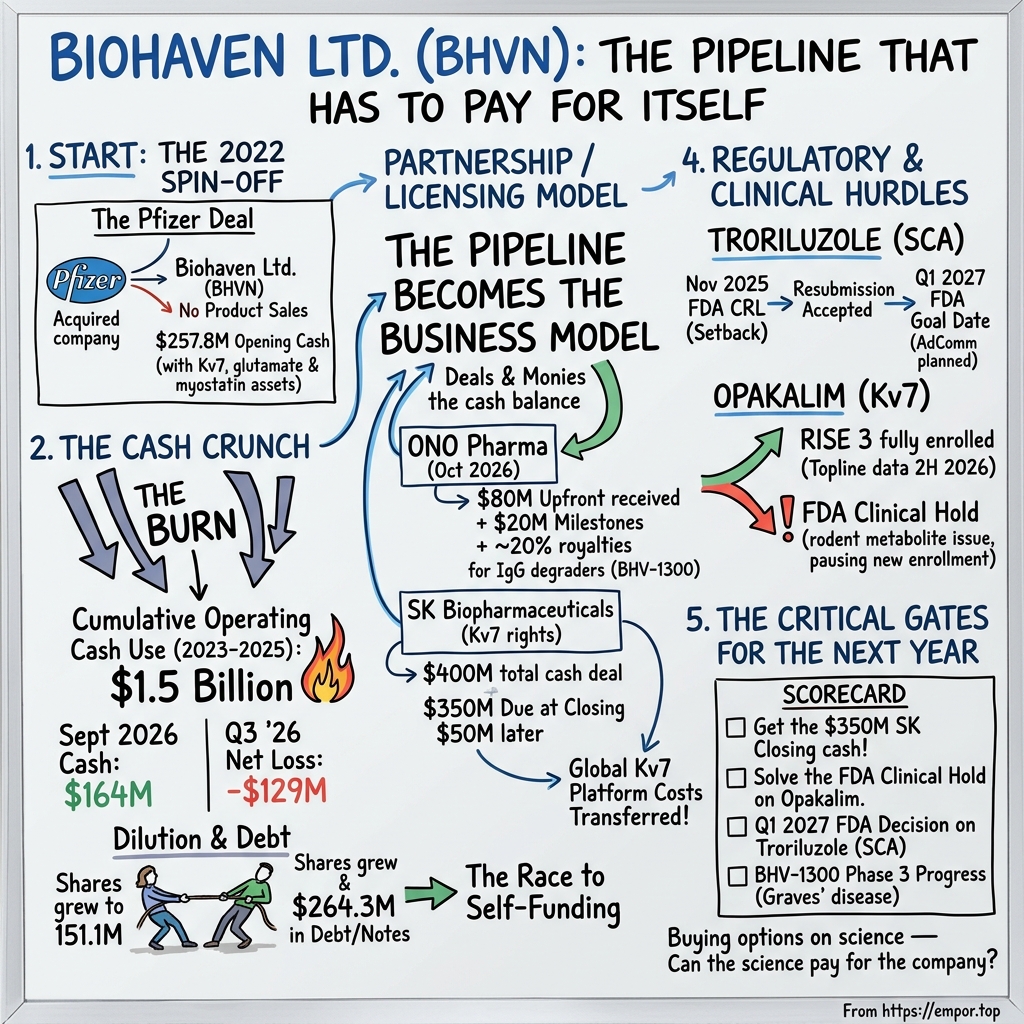
Put those two numbers side by side and the story sounds like a windfall. Put them beside the rest of the quarter and it sounds like a race. At the end of September, before the Ono money came in, Biohaven held about $164 million in cash, marketable securities and restricted cash.[^1] In the same three months it lost $129 million.[^1] A company that loses roughly that much every quarter and holds roughly that much in the bank is not living on savings. It is living on the next transaction.
The clock has slowed, which is the first piece of good news in the ledger. In the first quarter of 2025, Biohaven lost about $221 million; through 2026, the quarterly loss has settled at around $130 million.1[^1] That is a meaningful deceleration, roughly two-fifths less burn per quarter, and it came from deliberate choices about which experiments to keep running. But a slower clock is still a clock. At about $130 million a quarter, even the full $430 million from both partners would cover a little more than three quarters of losses at the current pace, before counting any new trials, any new programs or any cost of the debt.
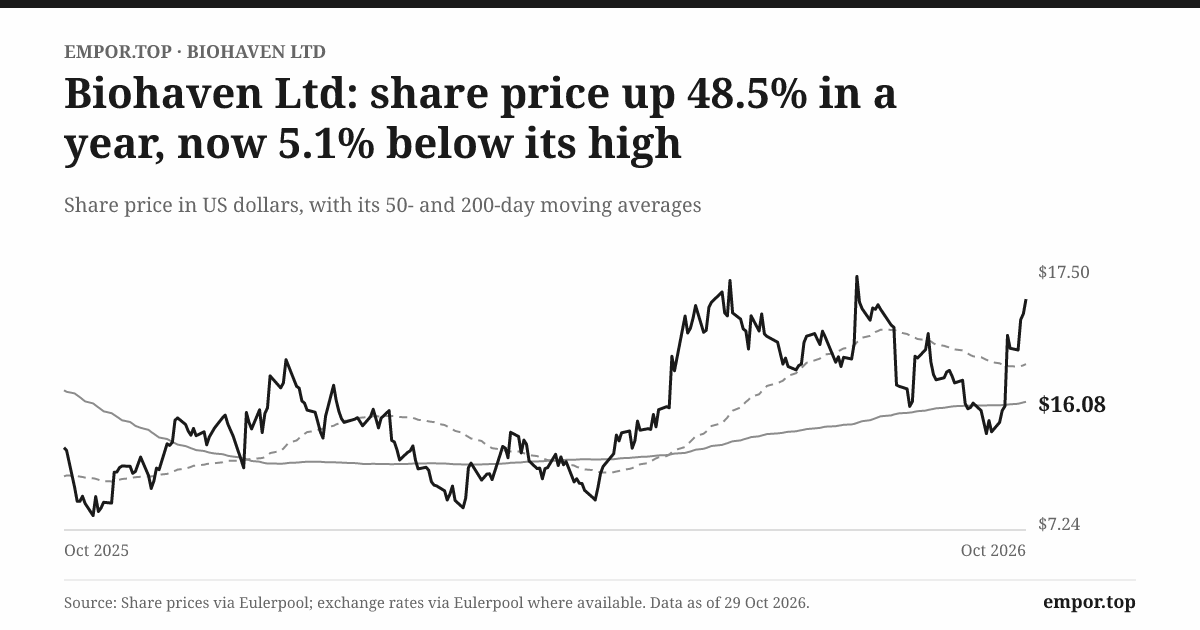
That is the unusual position from which to tell the story of Biohaven Ltd. It is a New Haven biotech with a public listing, a stock that has roughly doubled from its 52-week low to about $16, a market value of around $1.5 billion, and no history of selling a medicine.1 Through the end of 2025 it had reported no product-sales revenue at all.1 Its programs reach across epilepsy, a rare inherited movement disorder, autoimmune thyroid disease, kidney disease, obesity and cancer. Its income statement is a list of what science costs. Its balance sheet is a record of who has paid for it.
So the $430 million question, the Ono cash received plus the SK cash expected, is really four questions folded into one. The first is whether this pipeline can produce revenue of any kind, whether royalties, milestones or eventually product sales, before it needs another large round of capital. The second is whether licensing deals can arrive faster than the dilution and secured debt that have funded the company so far. The third is whether the sharp fall in research spending since 2024 reflects a sharper focus on the best bets or simply fewer credible bets left to make. And the fourth, the one that runs underneath the other three, is whether management's claims about its drugs survive the tests that matter: controlled trials, the Food and Drug Administration and paying partners.
There is also a boundary to draw before the story can start, because the name causes confusion. Many investors remember "Biohaven" as the migraine company that Pfizer bought for about $11.6 billion in 2022, the maker of Nurtec ODT.2 That company no longer exists as a public entity. Pfizer bought the former parent, Biohaven Pharmaceutical Holding Company, and kept the migraine franchise. What public shareholders kept was something else: a spun-off collection of experimental programs, some cash and a management team, listed as Biohaven Ltd.21 The $11.6 billion belongs to the old company's story. This story is about the pipeline that was left behind, and whether it can ever earn a price like that for itself.
The two partnerships signed in the autumn of 2026 change the near-term funding picture, and that matters. But neither, on its own, proves a repeatable business. A company that sells pieces of its future can do so only as long as it keeps producing pieces worth buying. To understand why the clock runs the way it does, the story has to go back to the day the pipeline became a company.
 Subscribe on LinkedIn
II. The Company Left Behind When Pfizer Bought Biohaven
October 3, 2022 was a strange kind of birthday. That morning the former parent distributed shares of a brand-new company, Biohaven Ltd., to its shareholders, and then, almost in the same breath, Pfizer completed its acquisition of that parent for $148.50 a share in cash.2 Shareholders of the old Biohaven walked away with a large check for the migraine business and a smaller piece of paper representing everything Pfizer did not want. Roughly 35.8 million shares of the new company were handed out in the distribution.3 Pfizer itself kept about 3% of the spun-off company, a small vote of interest from the buyer that had just paid billions for the sibling.2 Biohaven Ltd. began trading on the New York Stock Exchange the next day under the ticker BHVN.1
What exactly had been separated? Pfizer's interest was the calcitonin gene-related peptide franchise, the class of migraine drugs that included rimegepant, sold as Nurtec, and zavegepant.2 Everything outside that franchise went into the new company: the Kv7 ion-channel platform, a set of glutamate-modulating drugs that included troriluzole, a myostatin-blocking platform, assorted preclinical candidates and some research infrastructure.23 None of these was a product. All of them were options on future products.
The person who carried those options across the line was Vlad Coric, the psychiatrist who had co-founded the original Biohaven and who became chief executive of the new one.1 Coric trained at Yale, ran clinical research units there and worked in clinical development at Bristol-Myers Squibb before building Biohaven around intellectual property that came out of Yale research into glutamate modulators, the same scientific line that produced troriluzole.4 He had just done what few biotech founders ever do: taken a company from licensed university science to an approved, heavily marketed drug and a multibillion-dollar sale to one of the largest pharmaceutical companies in the world. The spin-off let him try again, this time with a head start in cash and molecules rather than a blank sheet.
The head start was real but finite. The 2022 prospectus recorded an opening cash balance of about $257.8 million.3 For a company planning several late-stage trials at once, that was a runway, not an endowment. It bought time to generate data, not freedom from the capital markets.
In fact, the capital markets were part of the plan from the first day. The same October 2022 prospectus described an offering of 20 million new shares alongside the distribution.3 By the end of 2022, cash and short-term investments stood at about $465 million, well above the opening balance, because new shareholders had already been asked to pay in.5 That detail is easy to skip and important to keep. Biohaven Ltd. was never designed to live on what it inherited. From its first weeks it was a company that would return to investors for money whenever the science needed funding, and the science, spread across several platforms, would need a great deal.
The Kv7 platform itself was a recent addition to the inheritance. The former parent had acquired it from Knopp Biosciences earlier in 2022, and the obligations that came with that purchase travelled into the spun-off company.3 Those obligations would later produce one of the largest single charges in Biohaven Ltd.'s history, and later still become part of what a licensee agreed to take over. Inherited assets, in other words, came with inherited bills.
There is a trap in reading the company's early financial history, and it catches anyone who looks at a long chart of Biohaven's losses. Before the spin, Biohaven Ltd. did not operate as a standalone business. The historical figures in its prospectus were carved out of the former parent, with costs allocated from a larger organisation that also housed a commercial migraine franchise.3 That is why long-run financial tables for "Biohaven" show years like 2021 with revenue and others with deep losses that have little to do with the company now listed. Those pre-spin numbers describe a different economic animal. The 2021 revenue line, for instance, reflects the old parent's world, not anything Biohaven Ltd. ever sold.1
The honest way to read the record is to begin where the company's own boundary begins. After the spin, the post-separation company's losses and capital raises are the true cost of running this pipeline on its own, and they would soon prove large. Within a year of listing, it had burned through a meaningful share of the opening balance; within two, it was raising hundreds of millions in public offerings; within three, it was borrowing against its future.1 None of that was a scandal. It was the normal arithmetic of a clinical-stage biotech that chose to run several expensive programs at once.
But it reframes the founding myth. The popular version says Biohaven's team had already proved it could turn science into a blockbuster, so the spun-off pipeline was the same team's second act. The record says something narrower. The team had proved it could develop and sell one drug class, then sell the company. The new company inherited the team and the cash, but not the cash-generating franchise, and its early financial history measures allocation, not performance.
What Biohaven Ltd. actually had to sell, if it was not selling medicines, is where the story turns next.
III. The Pipeline Becomes the Business Model
The Ono deal, announced on October 8, 2026, was a lesson in how a company with no products earns money.[^2] Biohaven granted Ono a license, for a set of Asian territories, to its IgG degraders, led by a molecule called BHV-1300.[^2] Ono agreed to pay up to $100 million in near-term money, made up of an $80 million upfront payment and a $20 million milestone, plus royalties of about 20% on sales in the licensed territory if the drugs ever reach patients there.[^2][^1] The $80 million arrived within two weeks.[^1]
To see why anyone would pay that, it helps to understand what BHV-1300 does. Many autoimmune diseases are driven by antibodies, the immune system's guided missiles, that have been mistakenly aimed at the body's own tissue. In Graves' disease, antibodies latch onto the thyroid and switch it on permanently, producing a flood of hormone. BHV-1300 is designed to act like a tow truck in the bloodstream: it grabs circulating IgG antibodies and hauls them to the liver for disposal, lowering the level of the harmful ones without the blunt instrument of suppressing the whole immune system. The approach grows out of a platform the company calls MoDE, for molecular degraders of extracellular proteins, which also traces back to Yale.[^1]1 BHV-1300 had moved into a Phase 3 trial in Graves' disease by the autumn of 2026.[^1]
Here is the business model in miniature. Biohaven does not sell a pill at a price per prescription. It does not have subscribers, recurring contracts or a stable unit of sale. It discloses no share of recurring revenue, because it has none.1 Instead it sells rights: the right to develop and commercialise a molecule in a territory, paid for in stages. A modest share arrives upfront. More arrives if development milestones are hit. The largest potential share, the royalty, arrives only if a drug is approved and patients actually take it. The company's annual report describes revenue in exactly these contingent terms, tied to collaboration and license arrangements rather than to product sales.1
The SK deal, signed in the late summer of 2026, makes the structure even clearer. Biohaven granted SK Biopharmaceuticals an exclusive worldwide license to its Kv7 platform, led by the epilepsy drug opakalim, known in earlier filings as BHV-7000.6 The stated cash consideration is $400 million: $350 million at closing and $50 million a year later.6[^1] On top of that come up to $150 million in development and regulatory milestones and royalties on future sales.6 In return, SK will take on the future costs of developing the Kv7 programs, including specified obligations Biohaven owed to Knopp Biosciences, the company from which the platform was originally acquired.63 Biohaven will give up control of worldwide development and commercialisation, and keep an economic tail.
Set the two deals side by side and the difference between cash and promise becomes vivid. Ono's money is mostly in hand. SK's larger sum is still contingent on the deal closing, which was subject to closing conditions when the company reported its third quarter.[^1] And in both deals, the parts that could make them truly large, the milestones and the royalties, depend on events no one controls: trial readouts, regulators and doctors' prescribing habits years from now.
That distinction matters because deal headlines are easy to misread. A partner's payment is evidence that a sophisticated buyer, with access to the data, thinks an asset is worth more than the price. It is not evidence that the drug works, that it will be approved or that patients will want it. SK and Ono are large companies placing bets; bets can be wrong, and the structure of their payments, with most of the value deferred, is itself a measure of how much uncertainty they think remains.
There is also a newer thread in the story. In its third-quarter update, Biohaven described a collaboration with Bexorg, a company that uses artificial intelligence and preserved human brain tissue to study how drugs behave.[^1] It is tempting to read such an announcement as a productivity engine. For now it is a discovery tool with no revenue attached, and its value will be measured the old-fashioned way, by whether the molecules it helps select succeed in human trials.
So the test for this business model can be put plainly. For every deal, a listener should ask three things: how much of the money is upfront and already received, how much is contingent on milestones that may never be reached, and how much depends on a product reaching patients and selling. On the two deals signed in 2026, the first category is $80 million, the second includes $350 million that should arrive at closing and more beyond it, and the third, the royalty stream, is still entirely theoretical. One or two deals do not make licensing a durable revenue line. The question is whether the company can keep producing assets that command checks like these, and the clearest test of that, for a drug that was supposed to be Biohaven's first product, did not go the way the company planned.
IV. A Drug That Was Nearly Ready to Sell Was Sent Back
On November 4, 2025, the FDA sent Biohaven a complete response letter for troriluzole in spinocerebellar ataxia.7[^10] A complete response letter is the agency's formal way of saying "not yet": the application, as submitted, cannot be approved. For a company that had spent years preparing troriluzole, which it planned to sell as Vyglxia, as its first commercial product, the letter was more than a delay. It was a verdict on the kind of evidence Biohaven had chosen to put in front of the regulator.
Spinocerebellar ataxia, or SCA, is a group of rare inherited diseases in which the cerebellum, the part of the brain that coordinates movement, slowly degenerates. Patients lose balance, then the ability to walk steadily, speak clearly or swallow safely. There was no approved treatment in the United States, which is why the disease community watched troriluzole closely and why the FDA's decision drew open dismay from patient advocates.8 Troriluzole is a prodrug of riluzole, an older medicine, designed to modulate glutamate, the brain's main excitatory chemical messenger, which can damage neurons when it accumulates.
The path to that letter began before the spin-off. In May 2022, the former parent reported that a Phase 3 trial of troriluzole in SCA had missed its primary endpoint, a change in a functional ataxia rating scale after 48 weeks.9 The company's explanation was that patients on placebo had declined more slowly than expected, leaving too little difference to detect, and it pointed to a numerical benefit in one genetic subtype, though that analysis was exploratory.9 When a randomised trial fails, a sponsor has two broad choices: run another randomised trial, which costs years, or look for a different way to show the drug works. Biohaven chose the second.
The new evidence came from a longer study that compared patients taking troriluzole for about three years with a matched group drawn from natural-history records, patients who had never received the drug and whose decline had been documented elsewhere.[^13] In September 2024 Biohaven reported that this externally controlled analysis met its primary endpoint, and it planned to file for approval across all SCA genotypes.[^13] In early 2025 the FDA accepted the application and granted priority review, and management spoke of preparing for a U.S. launch in 2025 if approved.[^14]
An external control is a bit like judging a new training programme by comparing your runners against race results from other clubs in other years. It can be informative, especially in rare diseases where placebo trials are hard to run, but every difference between the two groups, from how they were selected to how they were measured, becomes a possible explanation for the result. The FDA's letter landed precisely there. The agency concluded that substantial evidence of effectiveness had not been established and that the externally controlled study was not an adequate and well-controlled investigation, citing limited comparability between treated patients and external controls and the potential for selection and expectation biases.78 Biohaven argued that the study had met its prespecified endpoints and pointed to earlier FDA meeting minutes that had discussed what size of effect would be needed to overcome the biases of such a design.[^10]
That disagreement is the heart of the episode. The company believed it had cleared a bar the agency had described. The agency concluded that the evidence, as gathered, could not support the conclusion. Both can be sincere. But for an investor, the relevant fact is that a management team that had publicly prepared for a 2025 launch did not get one, and the reason was not a manufacturing detail or a labelling dispute. It was the evidentiary foundation of the application.
The story did not end there. The FDA accepted the resubmission for review and planned an advisory committee.[^1]10 Biohaven said the resubmission included additional supportive analyses.[^1] The resubmission also matters to the balance sheet: the company's secured lenders agreed to provide a further $150 million tranche if troriluzole is approved.1
An advisory committee is the FDA's version of calling in outside referees. Independent clinicians, statisticians and a patient representative hear presentations from the company and from agency reviewers, then vote on whether the evidence supports approval. The vote is not binding, but it is public, which makes it one of the few moments in drug development when the strengths and weaknesses of an application are argued in the open. For troriluzole, that means the agency's concerns about the external comparison will be laid out in briefing documents that investors and patients can read, and Biohaven will have to answer them in front of an audience rather than in private correspondence.
Acceptance for review is not approval, and it does not reverse the first decision. It means the FDA considers the package complete enough to examine. The advisory committee, where outside experts will weigh the evidence in public, and the agency's final action remain ahead. The question the panel will effectively answer is whether the new analyses address the specific concern in the 2025 letter, that the comparison group may not be a fair comparison, or whether they restate the same evidence with more statistics around it. Without a new randomised trial, the burden rests on analytical design rather than fresh data.
There is a legal echo, too. In July 2025, shareholders filed a securities class action alleging that Biohaven made misleading statements about troriluzole in SCA and opakalim in bipolar disorder.1 The allegations are not a finding of liability, and the company had not yet responded at the time of its annual report.1 But the lawsuit ties the regulatory record to the question of management credibility, a thread that runs into the CEO's record later in this story.
Troriluzole remains alive as a possible product. It is also the clearest example in the company's short history of the gap between "ready to launch" and "approved." While that drama played out, management was making a second, quieter decision about how much science the company could afford to keep doing.
V. The Portfolio Gets Smaller—and the Claims Get Sharper
The cuts did not come with a single dramatic announcement. They showed up in the spending lines. In the fourth quarter of 2025, Biohaven reprioritised its portfolio and reduced direct program spending, and by the third quarter of 2026 the effect was visible: research and development spending was about $102 million, down from about $141 million a year earlier, a drop of roughly $39 million in a single quarter's comparison.[^1][^16] The company attributed the fall to lower direct and preclinical program spending after the reprioritisation.[^1]
The temptation is to read the annual numbers as a productivity story. R&D rose from about $373 million in 2023 to a peak of about $796 million in 2024, then fell to about $635 million in 2025.1 A chart like that looks like a company that overspent and then learned discipline. The truth is messier. Inside the 2024 figure sat a single, unusual charge of $171.9 million tied to an amendment of the agreement with Knopp, the original owner of the Kv7 platform.1 Remove that, and 2024's underlying research spending was closer to $625 million, not very different from 2025's. Much of the apparent decline from the peak was the absence of a one-time payment, not a change in how the company ran its labs. The real reset began at the end of 2025 and is clearer in the 2026 quarters than in the annual totals.
So what is the slimmer portfolio asking investors to underwrite? At the late stage sit two programs whose fates are now partly in other hands: opakalim in focal epilepsy, now licensed to SK, and troriluzole in SCA, now back at the FDA. In the middle sits BHV-1300 in a Phase 3 trial in Graves' disease, with Ono holding Asian rights. Behind those are earlier programs: a degrader aimed at kidney disease, BHV-1400; the myostatin platform repositioned toward obesity; Kv7 work in Parkinson's-related indications; and a set of antibody-drug conjugates in oncology, including BHV-1530.[^1][^16]
How could the company cut so quickly? Part of the answer lies in how biotech research is bought. Biohaven does much of its work through contract research organisations, manufacturers, investigative sites and consultants, and it describes those research contracts as generally cancellable.1 That gives the cost base a flexibility a factory owner would envy: winding down a trial or a preclinical program can reduce spending within a few quarters rather than years. The same flexibility cuts the other way. Spending that can be turned off quickly can also be turned back on quickly, so lower R&D in 2026 is a choice that has to be renewed every quarter, not a structural change in the company's cost of doing science.
That is still a broad list for a company holding about a quarter's worth of losses in the bank before the Ono payment. Breadth has an appealing logic in biotech: more shots on goal, more chances that one works. But scientific breadth consumes resources long before it creates commercial value, and each additional program adds trial sites, manufacturing runs and staff. The honest way to read Biohaven's portfolio is to separate the handful of programs with decision points in the next year, troriluzole at the FDA, opakalim's pivotal readout and BHV-1300's Phase 3 execution, from the longer list of research options whose value is hard to see from outside.
The company's own record offers a concrete case of what happens to research options. In January 2025, Biohaven struck a collaboration with Merus, a Dutch antibody company, to co-develop three bispecific antibody-drug conjugates, combining Merus's antibodies with Biohaven's conjugation and payload chemistry.11 Biohaven paid the upfront consideration in shares and expensed it as research spending.12 Then Genmab acquired Merus, and in January 2026 Merus notified Biohaven that the three ADC programs were being terminated.12 Nothing Biohaven did caused that outcome; a change of ownership at the partner did. But the lesson is precise. A program can absorb money and management attention and then disappear for reasons entirely outside the company's control, leaving behind expense and some know-how but no asset. Investors weighing the oncology portfolio should remember that the most visible ADC alliance in Biohaven's history ended without producing a product.
The record of late-stage readouts carries a similar warning. In late 2024, taldefgrobep alfa, the myostatin drug, missed its primary endpoint in a Phase 3 trial in spinal muscular atrophy; Biohaven pointed to an unexpected placebo response and pivoted the platform toward obesity.13 In March 2025, opakalim failed to separate from placebo on the primary measure of mania in a Phase 2/3 bipolar disorder trial.14 Add the 2022 troriluzole miss and the 2025 complete response letter, and the pattern is hard to ignore: in its short standalone life, the company's late-stage programs have more often produced explanations than approvals. That does not mean the remaining programs will fail. It does mean the base rate inside this company is sobering, and pivots after misses, from SMA to obesity, from bipolar to epilepsy, deserve the same scrutiny as the original bets.
That is the frame through which to judge the newer language around the pipeline. Novel platforms, AI collaborations and slots at scientific conferences are not clinical efficacy. They are inputs. The output that counts is a successful controlled trial, an approval or a partner willing to pay cash for the result.
So is the 2025 reset disciplined concentration or a shrinking opportunity set? The evidence narrows the claim. Lower spending is real, and it helps the runway. But part of the decline came from the absence of a one-time charge, and the rest has not yet been tied to program-level milestones that would let outsiders see whether money is moving toward the best bets. Biohaven does not disclose spending by program in a way that lets investors track the reallocation. The confirmation would be two things: pivotal outcomes from the programs that kept their funding, and continued pruning when evidence weakens, explained with specific milestones rather than general strategic language. The most important test of that came in August 2026, when the company's best-known Kv7 asset attracted a buyer and a regulator's caution almost at once.
VI. Opakalim: The Deal and the Hold Arrive Together
For a few days in the late summer of 2026, Biohaven's Kv7 platform was the most validated asset it owned. SK Biopharmaceuticals, a Korean company that already sells an epilepsy medicine in the United States, had agreed to pay $350 million at closing and $50 million a year later for exclusive worldwide rights.6 Then, in early September, the FDA placed a partial clinical hold on the opakalim program, pausing enrolment of new patients in its pivotal epilepsy studies.615 The trade press summed up the timing bluntly: the drug suffered an FDA hold days after attracting a $350 million deal.15
The identity of the buyer explains a good deal about the price. SK's American business is built around XCOPRI, its own epilepsy drug, which generated about $127 million of U.S. sales in the first quarter of 2026 alone, up nearly half from a year earlier.16 A company like that already employs the neurologist-facing sales force, the payer relationships and the epilepsy-specific know-how that a new seizure medicine needs. For SK, opakalim is a second product to put in the same bag. For Biohaven, which has no sales force at all, licensing to a company with an established epilepsy franchise turns a launch it could not fund into a royalty it can wait for. That fit is the strongest argument that the deal reflects strategic logic rather than desperation. It is also a reminder of who held the stronger hand at the table: the company with a selling product and a growing cash stream, not the one with a shrinking cash balance.
To see why both events matter, it helps to know what opakalim is trying to do. Neurons fire when electrical charge builds up inside them. Kv7 channels are tiny gates in the cell membrane that let potassium flow out, which acts like a brake, calming the cell and making it harder to fire. In epilepsy, where neurons fire in runaway bursts, opening those gates is a way to restore the brake. An older drug, ezogabine, once used this mechanism but was withdrawn, so a cleaner, better-tolerated Kv7 opener has long been an attractive target. Opakalim is Biohaven's attempt at that.
The deal matters for two reasons at once. First, it monetises the platform: $400 million in stated cash is larger than Biohaven's entire September cash balance. Second, and just as important for the runway, it shifts the future cost of Kv7 development, including specified obligations to Knopp, onto SK.6 Late-stage epilepsy programs are expensive, and every dollar SK spends on them is a dollar Biohaven no longer needs to raise. Biohaven, in return, retains milestones of up to $150 million and royalties on future sales.6
Now read the hold precisely, because its scope is narrower than the headline. The FDA asked for additional nonclinical information about a metabolite, a by-product the body makes when it breaks down the drug, after toxicity was seen in a rat study in which that metabolite was given directly.17 New enrolment in the affected studies paused, but patients already randomised could continue to be dosed.617 RISE 3, one of the pivotal trials, had already finished enrolling, so the hold does not stop it from reading out; Biohaven said topline data remained expected in the second half of 2026.617 More than 600 patients had been randomised across the pivotal program.6
Management's reassurance was that more than 1,200 people had received opakalim across its clinical trials, with no adverse events identified as linked to the rodent finding.17 SK's side, for its part, said that outside experts with FDA toxicology experience had judged the finding likely to be specific to rodents, and noted that it had seen the metabolite data before signing.17 Those are meaningful points. They are also not the same as an answer. The relevance of the rodent findings to humans was unresolved when the hold was placed, and the FDA, not the sponsor, decides when it is resolved.17 A hold can be lifted quickly with the right data; it can also force study redesigns or new safety monitoring that change a drug's commercial profile.
The commercial bargain deserves its own reckoning. By licensing Kv7 worldwide, Biohaven traded control for certainty. It will no longer decide how opakalim is developed, priced or launched. SK will. If the drug becomes a large epilepsy franchise, Biohaven will share in that through royalties and milestones rather than owning the full economics, a smaller slice of a bigger, better-funded pie. If the drug stumbles, Biohaven has already banked, or is about to bank, most of the money it was ever certain to get. For a company with its cash profile, that trade looks rational. It also means the asset once presented as a potential Biohaven product is now a partner's product with a Biohaven royalty attached.
It is tempting to ask whether Biohaven sold too cheaply or SK paid too much. The honest answer is that the record does not support either claim. This is a license with staged payments, not an acquisition, and there is no clean like-for-like benchmark for a Kv7 epilepsy asset entering pivotal readouts under a partial hold. What can be said is that SK signed with full access to the data, which makes the deal real evidence of strategic value to an informed buyer. It is not proof that opakalim works.
The things to watch are concrete. The RISE 3 readout will say whether the drug reduces seizures convincingly. The FDA's response to the additional nonclinical work will say whether the hold is a speed bump or a redesign. The closing of the SK agreement will say whether the $350 million is cash or still a promise, and the next balance sheet will show whether it arrived. That last point matters more than it might seem, because by this stage of the story the company's financing had become as important as its science.
VII. The Cash Burn Turns Financing into Strategy
Biohaven's cash-flow statement for 2025 told a story that no press release needed to. Operating activities consumed about $609 million in the year.1 By September 30, 2026, it held about $164 million before the Ono payment arrived.[^1] That gap, between what the business spends and what it holds, is the reason financing stopped being a back-office function at Biohaven and became the strategy itself.
Start with the honest post-spin numbers. Net losses were about $408 million in 2023, $846 million in 2024 and $739 million in 2025.1 Operating cash use over those three years came to roughly $1.5 billion.1 Longer tables that run back to 2014 show cumulative losses of about $3.7 billion and operating outflows of about $2.7 billion, but those spans mix the former parent's history with the standalone company's and cannot be read as one continuous record.1 The figure that matters is the three-year one: on average, the standalone pipeline has consumed about half a billion dollars of cash a year.
There was a time when the bank balance itself helped pay the bills. In 2024, other income, mostly investment income and fair-value changes, came to about $39 million; in 2025 it fell to about $8 million, as the cash pile that earned the interest shrank.1 That is a small number against losses in the hundreds of millions, but it shows the self-reinforcing nature of the squeeze: the less cash a company holds, the less its cash earns, and the faster the remainder goes. Currency, by contrast, is a non-issue; Biohaven reports in dollars and describes its foreign-exchange exposure as immaterial.1
The gap between losses and cash burn is not hidden profit. It comes from non-cash expenses. Share-based compensation alone rose from about $29 million in 2023 to about $112 million in 2025, and license payments made in shares, along with fair-value movements, also inflated reported losses without draining the bank.1 Those share-based items do not cost cash, but they are not free. They are paid in dilution, which shows up in the share count rather than the cash balance.
And the share count is where the financing history becomes visible. Biohaven raised about $248 million net in an April 2024 public offering and about $270 million net in October 2024.1 In November 2025, shortly after the troriluzole letter, it sold 26.8 million shares at $7.50, raising about $189 million net.1 Alongside these offerings ran an at-the-market program, which lets a company sell shares into the market gradually; by early March 2026 it had sold 21.4 million shares through that channel for about $325 million net.1 The result is that shares outstanding rose from about 132.8 million at the end of 2025 to about 151.1 million by September 2026, an increase of nearly 14% in nine months.[^1] A long-term holder who did nothing during that period saw their slice of the company shrink by about an eighth.
Then came debt, which is a different kind of claim. In April 2025, Biohaven borrowed $250 million from purchasers affiliated with Oberland Capital in senior secured notes.1 "Secured" is the important word: the lender has a claim on the company's assets that ranks ahead of shareholders. The agreement also allowed a further tranche on specified conditions and up to $200 million for permitted strategic acquisitions with the lender's approval.1 It also included revenue-related payment and true-up provisions designed to protect the lender's recovery.1 At September 30, 2026, notes payable stood at about $264 million on the balance sheet.[^1]
Set that debt against what shareholders own and the change in the company's capital structure becomes stark. At the end of 2024, shareholders' equity was about $423 million and borrowings were a rounding error. A year later, equity had fallen to about $52 million while borrowings had risen to about $285 million, so that debt was more than five times the equity cushion.1 By the autumn of 2026, book value per share had turned negative.[^1] Book value is an imperfect measure for a research company whose real assets are patents and data, not factories. But it captures a shift in who stands first in line. In 2023, a Biohaven shareholder owned a company funded almost entirely by equity. In 2026, that shareholder owns what is left after a secured lender is repaid.
The accounting for that debt is itself a judgement worth flagging. Because the notes are carried at fair value, their value depends on assumptions about regulatory approvals, early redemptions and the company's own credit risk, all estimates with no market price behind them. The auditor singled out this valuation as its critical audit matter for 2025.1 The audit opinion was unqualified and no material weakness was reported.1 But it means that part of the movement in reported losses comes from re-estimating a liability, not from operations.
That matters when reading the third-quarter improvement. Net loss narrowed to $129 million from $173 million a year earlier, and earnings per share improved from a loss of $1.44 to a loss of $0.86.[^1] Part of that came from genuinely lower research spending. Part of the per-share improvement came simply from having more shares. And fair-value movements can push the reported loss around without any change in cash. A smaller loss is welcome. It is not revenue growth and it is not cash profitability.
Put the clues together and the reveal is uncomfortable but clear. Over three standalone years, Biohaven has funded a cash-consuming pipeline through repeated equity offerings, a steady at-the-market program and secured borrowing. The Ono payment and a completed SK closing could add roughly $430 million of non-dilutive cash and shift the funding mix toward licensing for the first time.[^1] At the 2025 rate of operating cash use, that would cover less than a year of spending, though lower R&D and the transfer of Kv7 costs to SK should slow the burn. The deals extend the runway. They do not establish self-funding.
No single "cash runway" number captures this. The right way to watch it is to track four things together in each quarterly report: cash after deal receipts, operating cash use, the size of the secured lender's claim and the share count. If licensing cash rises while share issuance falls, the strategy is working. If the share count keeps climbing even after the checks arrive, the deals were a bridge rather than a turn. Which leads to the harder question: what, beyond the next check, does Biohaven actually own that others cannot copy?
VIII. The Moat Is Still a Hypothesis
Imagine the view from SK's offices in the summer of 2026. A well-funded epilepsy company was deciding whether to license a Kv7 platform from a New Haven biotech that had never sold a drug. It had its own scientists, its own commercial organisation and its own list of alternatives. What made Biohaven's asset worth $400 million in stated cash rather than something SK could build or buy elsewhere? That question, asked from the buyer's chair, is the right way to think about Biohaven's competitive position, because Biohaven has no customers in the ordinary sense. Its customers are the pharmaceutical companies that license its molecules.
Start with the industry, because its shape explains most of what follows. Drug development is expensive, slow and uncertain, and Biohaven competes with large pharmaceutical companies and other biotechs that have deeper pockets, larger commercial organisations and programs aimed at the same diseases.1 In epilepsy, autoimmune disease and oncology, there are many credible approaches and many sponsors. The barrier to entry is not that others cannot try. It is that trying costs hundreds of millions of dollars and years, and most attempts fail.
Run that through Michael Porter's five forces and the picture is unusually lopsided. The buyers, licensees like SK and Ono, hold significant power, because there are only so many companies that can fund late-stage development and Biohaven needs their cash more urgently than they need any single asset. SK, with its own fast-growing epilepsy franchise, could have kept building internally; Biohaven had no comparable alternative for taking opakalim to market. Biohaven's financing position, laid bare in its cash balance, is visible to every counterparty across the table. The suppliers, contract research organisations, manufacturers and trial sites, matter operationally, but Biohaven says its research contracts are generally cancellable, which limits their leverage.1 Substitutes are everywhere: in Graves' disease, antibody-lowering drugs from other companies; in epilepsy, a crowded shelf of existing medicines. Rivalry is intense. And the threat of new entrants is real for any mechanism that works, because a successful proof of concept invites followers.
Hamilton Helmer's seven powers ask a sharper question: what would let Biohaven earn returns that competitors cannot arbitrage away? Scale economies, network effects and switching costs do not apply to a company with no product sales, no retention record and no market share. Biohaven reports no product-sales customers, so there is no concentration or retention series to examine.1 Brand does not yet exist in any commercial sense. The candidate powers are two. One is a cornered resource: patents and know-how around specific molecules and platforms like MoDE. The other is a kind of process power: the ability to originate or assemble assets that partners consider worth licensing.
On the first, the evidence is mixed but real. Biohaven has shown it will defend its intellectual property. In 2026 a jury found that RA Capital and Avilar had misappropriated a Yale trade secret relating to the MoDE platform, and in August a judgment confirmed a combined $4 million award to Yale and Biohaven, with post-trial motions pending.[^1] A trade-secret win does not prove a moat, and $4 million is small, but it shows the degrader know-how is contested territory others wanted. Patents, however, protect molecules, not mechanisms. A rival with a different molecule that clears antibodies or opens potassium channels can compete without touching Biohaven's patents.
On the second, the strongest evidence is the deals themselves. SK and Ono, both experienced drug developers, examined the data and committed money. That is a credible signal that Biohaven can produce assets of interest. But it is one data point per platform, and each comes with a caveat. For Kv7, a signed license is not a validated commercial position; the partial hold and the pending pivotal readout are the real tests of whether opakalim is differentiated. For degraders, the mechanism could create value in several antibody-driven diseases, but Phase 3 progress for BHV-1300 does not establish efficacy, approval or a durable advantage over other immunology approaches, some of them already marketed. For oncology, early activity in BHV-1530 is a research signal, and the Merus terminations show that technical programs can be discontinued before they become anything at all.12
There is a further wrinkle in the licensing model itself. Once Biohaven licenses an asset, the partner controls it. Pricing, positioning and development choices belong to SK or Ono. Biohaven's economic interest becomes a royalty, which is valuable but passive. That means the moat question changes after each deal: the protection that matters is the partner's, not Biohaven's. What Biohaven retains as a lasting edge is only its ability to do it again.
So the moat conclusion, stated once: credible asset-generation capability is plausible, supported by two informed licensing deals and a defended platform. Durable pricing power, switching costs and commercial advantage remain unproven, because there are no product economics to test. The event that would confirm the claim is a third independent licensing deal, or an approval, on an asset Biohaven originated. The event that would falsify it is a string of pivotal failures that makes partners less willing to pay upfront. Whether that capability compounds depends in large part on the person who has been allocating its capital since the beginning.
IX. The CEO's Bet Is Visible in the Share Count
Vlad Coric has spent his entire public career telling investors that a promising molecule deserves a chance. He is chief executive and chair of Biohaven Ltd., has led it since its formation, and before that led the former parent through the development and sale of its migraine franchise.118 Beside him sits Matthew Buten, the chief financial officer, who held the same role at the former parent from 2021.18 Their continuity is a strength in one sense: the people who negotiated an $11.6 billion sale know how to deal with large pharmaceutical buyers. It is also a limit, because the former company's success is not the standalone company's record.
Coric's style shows through in the pipeline he built: broad, scientifically ambitious and willing to take on hard diseases with unconventional evidence. His academic background as a Yale psychiatrist and clinical researcher runs through it, from glutamate modulation to the degrader platform that came out of Yale labs.4 So does a willingness to push. The troriluzole strategy, filing on an externally controlled study after a failed randomised trial and preparing for a launch in 2025, was a bet that a strong enough signal in a disease with no treatment would carry the regulator.[^14][^10] The FDA's answer in 2025 was that it did not.
Look at how he is paid. In 2025, Coric received a base salary of about $920,000, a cash bonus of about $460,000, which was a third below target, and options and restricted stock with a grant-date value of about $12.1 million.18 That grant-date figure is an accounting estimate of what the awards were worth when granted, not cash in hand; what he realises depends on where the shares go. Set against a company that lost $739 million in 2025, the cash component is modest; the equity component is large. The cut bonus suggests the board did respond to a hard year. But annual equity grants of that size also feed the dilution that shareholders have absorbed.
The counterweight is ownership. As of March 2026, Coric beneficially owned about 3.6% of the company, a meaningful personal stake that rises and falls with every shareholder's.18 The largest outside holders were Janus Henderson at 11.2% and Suvretta Capital at 6.8%, concentrated, specialist investors who presumably watch capital allocation closely.18 Shareholders approved executive pay in the April 2026 say-on-pay vote with about 87.5 million votes for and 4.2 million against, along with 32.1 million broker non-votes.19 That is a clear pass among those who voted, not a unanimous endorsement, and it says more about the large holders' confidence than about every shareholder's.
There is one governance detail that belongs in the record. Coric is an inventor on patents that Yale licenses to Biohaven, and he is entitled to a specified share of any related royalty revenues Yale receives.1 Biohaven's Yale-related expenses were small, about $1.5 million in 2025, and the company owed Yale nothing material at year-end.1 But it is a related-party link that could grow in importance if a Yale-derived drug, such as one from the MoDE platform, ever generates large royalties. The board has an independent compensation committee and independent directors, which is the mechanism for watching it.18
An activist would also raise the structure of the board. Coric is both chief executive and chair, which concentrates the job of proposing strategy and the job of overseeing it in one person.18 That arrangement is common among founder-led biotechs and is not a governance failure by itself. But in a company whose history includes a broad portfolio, repeated financing and a regulatory setback that followed confident launch preparations, the question of who challenges the founder's conviction is a fair one. The independent directors' answer will be visible not in proxy language but in decisions: which programs are stopped, how much equity is granted each year, and whether the next financing is sized to need or to opportunity.
Judge Coric, then, on behaviour over time rather than on pay. The record has three phases. In the first, from 2022 to 2024, the company spent heavily across a wide portfolio, funded by public offerings, and late-stage readouts in SCA, SMA and bipolar disorder disappointed.91314 In the second, through 2025, it borrowed against its future, received the troriluzole letter, raised equity at $7.50 a share and reprioritised.17 In the third, in 2026, it began selling rights, Kv7 to SK and degraders in Asia to Ono, and resubmitted troriluzole.[^1]6
The company's own communications track that arc. The fourth-quarter 2025 release framed the year around reprioritisation and the path back to the FDA.[^16] The second-quarter 2026 release emphasised pipeline progress and the capital position.[^26] The third-quarter release led with the two licensing deals and the resubmission, and quantified the cash received and expected.[^1] What management has quantified, it has mostly delivered: the Ono payment arrived, the resubmission was accepted. What it has left open are the questions only outcomes can answer, including when the hold lifts and whether SK closes on schedule.
A skeptical investor would push on one point above all. If the SK and Ono cash arrives, does it fund the few programs with the highest chance of success and lower the need to sell more shares, or does it simply extend a broad portfolio whose clinical evidence has not yet matured? A disciplined answer would show up as fewer programs, clearer milestones and a share count that stops rising. A less disciplined answer would show up as new programs, new platforms and another offering within a year. Coric's record so far contains both a costly breadth and a willingness, under pressure, to cut and to sell. The next twelve months will show which habit wins, and they will do so through a remarkably short list of events.
X. The Next Year Has a Short List of Tests
Picture the calendar pinned to the wall in New Haven. Four dates matter more than any others. The first is the FDA's review of troriluzole, with an advisory committee to come and a goal date in the first quarter of 2027.[^1]10 The second is the opakalim readout from RISE 3, which management has said remains on track for the second half of 2026, alongside the resolution of the partial hold.[^1]6 The third is the closing of the SK agreement and the arrival of $350 million.[^1] The fourth is the steady drumbeat of BHV-1300's Phase 3 trial in Graves' disease.[^1] For a company like this, those four gates matter more than any valuation ratio.
Take troriluzole first. A positive advisory committee vote and approval would give Biohaven its first product, unlock the conditional $150 million debt tranche and change the company's identity from a licensor to a drug seller.1 A negative vote or a second complete response letter would almost certainly end the SCA program in its current form. The middle case, approval with a narrow label or post-marketing study requirements, would make the drug real but small. In every case, the decision will be made on the same question the FDA asked in 2025: is the comparison fair?
Opakalim's readout is the other binary. Clean, convincing seizure reduction would validate the Kv7 bet, make SK's milestones more likely and lift the value of Biohaven's royalty. An ambiguous result, or a hold that drags on, would turn a strategic asset into a partner's problem with Biohaven's upside attached. Investors should distinguish carefully between a clean readout and a readout under an unresolved safety question; the second is worth much less.
The SK closing is the least scientific and perhaps the most important near-term event for the balance sheet. Until the cash arrives, it is a receivable in spirit only. The next quarterly report will show whether the cash balance jumped and how quickly operating outflow consumed it.
BHV-1300, meanwhile, is the program where Biohaven retains the most control outside Asia. Its Phase 3 execution, and the next decision on whether to take BHV-1400 into a pivotal trial, will show whether the company is concentrating or spreading again. Clinical progress here must be weighed against continued spend.
Two legal threads will run alongside the science, and neither is likely to decide the case on its own. The securities class action over statements about troriluzole and opakalim is at an early stage, and its course will be shaped by the very regulatory outcomes it concerns: an approval would weaken the narrative of overstatement, while a second rejection would strengthen it.1 The trade-secret judgment in Biohaven's and Yale's favour faces post-trial motions, and its modest award matters more as a marker of the degrader platform's defensibility than as cash.[^1] Investors should track both, but they should not mistake either for the main event.
Keep the scorecard narrow. Three measures matter most. The first is revenue recognised from royalties, milestones or products; through 2025 it was zero, and the quarterly results have shown zero ever since.1[^1] The second is the pair of operating cash use and shares outstanding; the most recent readings were about $609 million of operating cash use in 2025 and a share count that rose to about 151 million by September 2026.1[^1] The third is pivotal trial outcomes and regulatory status, now concentrated in troriluzole and opakalim.
The bull case is a sequence that could work. Troriluzole wins approval on the strength of the resubmitted analyses. Opakalim reads out cleanly, the hold lifts and SK closes, paying Biohaven's bills for a year while taking on the program's costs. BHV-1300 shows the degrader mechanism works in Graves' disease, inviting partners outside Asia. Licensing receipts and eventual royalties reduce the need for new equity, and the company becomes a self-sustaining originator of licensable assets.
The bear case is the same sequence breaking. The FDA rejects troriluzole again. Opakalim's data disappoint or the hold lingers. SK's closing slips. BHV-1300's Phase 3 runs long and expensive. The deal cash proves to be a one-time cushion, and within a year the company must again sell shares or draw on secured lenders whose claims sit ahead of equity.
Valuation offers little guidance. With no product revenue and negative earnings, the usual multiples are meaningless. The 0.0x enterprise-value-to-sales ratio is an artefact of zero revenue, not a sign of cheapness, and book value per share is negative.1 At about $1.5 billion in market value and $1.6 billion in enterprise value, the market is pricing the probability-weighted value of a few clinical and regulatory outcomes plus the licensing stream.1 The stock's rise from below $8 to about $16 over the past year suggests investors have already assigned meaningful odds to some of the bull case. That leaves the near-term events carrying more weight than usual.
Those events will decide whether Biohaven's story becomes a lesson about patience rewarded or patience exhausted. Either way, the company has already taught several lessons worth keeping.
XI. Lessons from a Company Still Waiting for Its First Product
Put two pieces of paper side by side. One is the 2022 prospectus, recording $257.8 million of opening cash for a company that had just been carved out of a blockbuster sale.3 The other is the third-quarter 2026 release, recording $80 million from Ono received and $350 million from SK expected.[^1] Between them lies a company that moved from spending inherited cash to selling rights to its future. What it teaches is specific to Biohaven, not generic biotech advice.
The first lesson comes from October 3, 2022. When Pfizer paid billions for the old Biohaven, it was tempting to treat the spun-off company as the same franchise in a new jacket. It was not. The new company inherited people and molecules, not the business that made the money. A listed company's history starts where its own economic boundary starts. For Biohaven, that boundary begins with a cash balance and a list of experiments, and every chart that blends the two eras flatters the experiments.
The second lesson comes from November 4, 2025. Biohaven had a priority review, a brand name and a plan to launch. What it did not have was an FDA convinced by its comparison group. "Ready to launch" is a plan; acceptance and approval are separate events, and the regulator decides which evidence counts. The resubmission now under review is a second chance to answer that question, not proof the first answer was wrong.
The third lesson comes from the autumn deals. SK's $400 million and Ono's $100 million are real money from informed buyers. But the structure of each, a modest certain sum followed by larger sums that depend on milestones and royalties, is the buyer's own measure of risk. A partner's check is evidence of interest; the milestone and royalty schedule tells you what remains unproven.
The fourth lesson comes from the share count. Between the end of 2025 and September 2026, about 18 million new shares appeared, on top of the offerings and at-the-market sales before them.[^1]1 Every one of them was the cost of keeping experiments alive while their results were unknown. A pipeline has a price even before the market can price its medicines, and it is paid by whoever owns the shares when the bills come due.
The fifth lesson comes from the misses themselves. When troriluzole's randomised trial failed in 2022, the explanation was a slow-declining placebo group. When taldefgrobep missed in spinal muscular atrophy, it was an unexpected placebo response. Each explanation may well have been true, and each led to a new plan: an external comparison, a pivot to obesity.913 But a company that is good at explaining misses can make its pipeline sound healthier than its scorecard. An explanation is a hypothesis; only the next trial makes it a fact.
For founders, the wider lesson is that optionality is not free. Every program is a call option, and options decay while they wait. For investors, it is that a company can create financing options before it creates durable revenue, and that the two should never be confused. Biohaven's partners and pipeline matter, but clinical proof and cash economics decide whether that promise compounds.
XII. Epilogue
Tonight, the company stands at a hinge. The FDA has accepted the troriluzole resubmission and scheduled its review for the first quarter of 2027, with an advisory committee to come.[^1]10 Ono's money is in the bank. SK's is expected but not yet received.[^1] The opakalim readout that management promised for the second half of 2026 has only weeks left in which to arrive.[^1] And somewhere in the background, the next quarterly report is already being drafted, with a cash balance, an operating outflow and a share count that will say more about the company's direction than any announcement.
The evidence that would strengthen the case is clear; so are the setbacks that would weaken it. The next annual report could describe a company whose pipeline has begun to pay its way, or one that needs another financing to keep its remaining trials alive.
Imagine the two versions of that report. Both could be written by the same management team about the same molecules. The difference between them will be decided over a handful of months, by referees in a hearing room, by seizure diaries in a pivotal trial and by a wire transfer from Seoul.
The central questions this story began with will be answered by those outcomes: whether the pipeline can produce revenue, licensing can outrun dilution, lower R&D means sharper focus, and management's claims survive.
The deal announcements have bought time and options. They have not yet bought a business. Owning a pipeline is not the same as owning a commercial company, and Biohaven's next year will show how far apart those two things still are.
XIII. Outro
Go back to the ledger from the opening scene. Those four numbers still capture the company: a pipeline that attracts buyers, and a clock that never stops running.[^1]
Biohaven has found buyers for pieces of its future. Now the science has to earn the next check.
References
-
Form 10-K for FY2025 — Biohaven Ltd./SEC, 2026-03-02 ↩↩↩↩↩↩↩↩↩↩↩↩↩↩↩↩↩↩↩↩↩↩↩↩↩↩↩↩↩↩↩↩↩↩↩↩↩↩↩↩↩↩↩↩↩↩↩
-
Pfizer Completes Acquisition of Biohaven Pharmaceuticals — Pfizer/Business Wire, 2022-10-03 ↩↩↩↩↩↩
-
Form 424B4 Prospectus — Biohaven Ltd./SEC, 2022-10-24 ↩↩↩↩↩↩↩↩
-
Form 8-K: SK Biopharmaceuticals license agreement and BHV-7000 program update — Biohaven Ltd./SEC, 2026-09-09 ↩↩↩↩↩↩↩↩↩↩↩↩↩
-
Complete Response Letter, NDA 210862 (troriluzole) — U.S. Food and Drug Administration, 2025-11-04 ↩↩↩
-
Dismay as FDA declines to approve Biohaven's ataxia drug — pharmaphorum, 2025-11 ↩↩
-
Biohaven Says Troriluzole Fails to Meet Primary Endpoint in Phase 3 Study in Spinocerebellar Ataxia — Global Genes RARE Daily, 2022-05 ↩↩↩↩
-
FDA Accepts Troriluzole NDA Resubmission for Spinocerebellar Ataxia — NeurologyLive, 2026-10-22 ↩↩↩
-
Merus and Biohaven Strike New ADC Collaboration — BioSpace, 2025-01 ↩
-
Biohaven fails phase 3 SMA test but plans talks with FDA, plots move into obesity — Fierce Biotech, 2024-11 ↩↩↩
-
BHV-7000 for Bipolar Disorder Fails in Phase 2/3 Trial — Psychiatric Times, 2025-03-04 ↩↩
-
Biohaven epilepsy drug suffers FDA hold days after attracting $350M deal — Fierce Biotech, 2026-09 ↩↩
-
SK Biopharm's XCOPRI U.S. sales in the first quarter of 2026 — The Korea Herald / Herald Business, 2026 ↩
-
Biohaven opakalim pivotal programme hit by FDA partial clinical hold — Clinical Trials Arena, 2026-09 ↩↩↩↩↩↩
-
2026 Definitive Proxy Statement — Biohaven Ltd./SEC, 2026-03-13 ↩↩↩↩↩↩↩
-
2026 Annual Meeting Results, Form 8-K — Biohaven Ltd./SEC, 2026-05-04 ↩
 LinkedIn
 WhatsApp
 Reddit
 Hacker News
 Email
 Kindle
 RSS Feed
 Spotify
 Apple Podcasts
 Amazon Music
 Audible
 YouTube