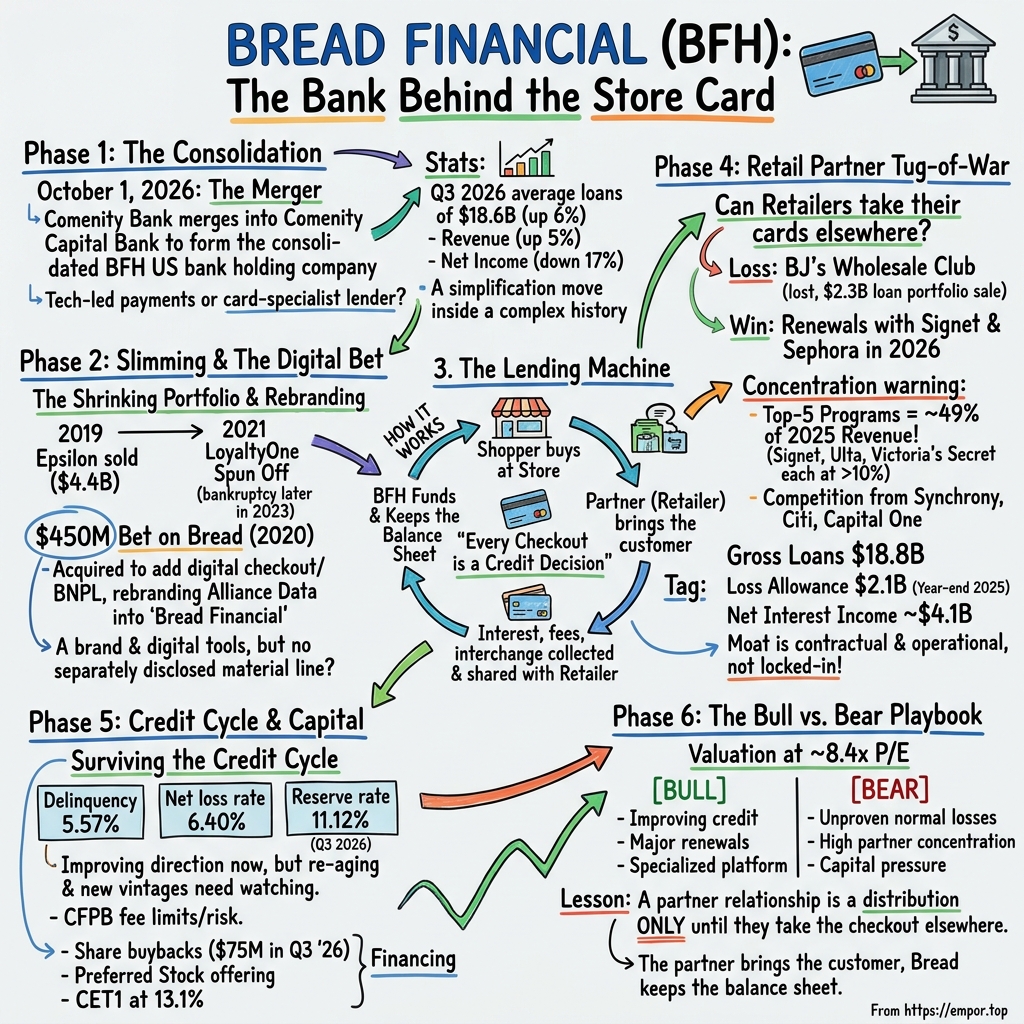
Bread Financial: The Bank Behind the Store Card
I. The Bank Merged on October 1
On the morning of October 1, 2026, nothing much changed at the checkout counters of America's jewelry stores, beauty chains and furniture showrooms. Shoppers still handed over cards with a Kay, Ulta or Victoria's Secret logo on the front. Cashiers still offered a discount for opening a new account. But behind those logos, a piece of corporate plumbing was quietly being rerouted. Comenity Bank, the institution that had carried the store-card balances of a generation of American shoppers, merged into its sister, Comenity Capital Bank, leaving Bread Financial with one bank instead of two.1
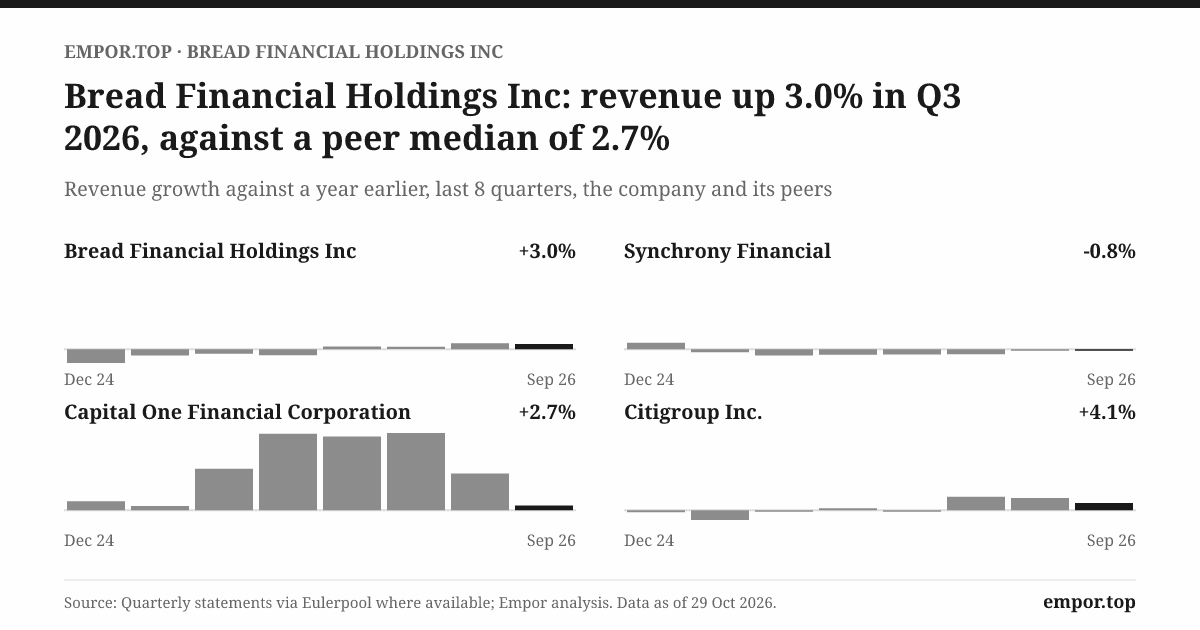
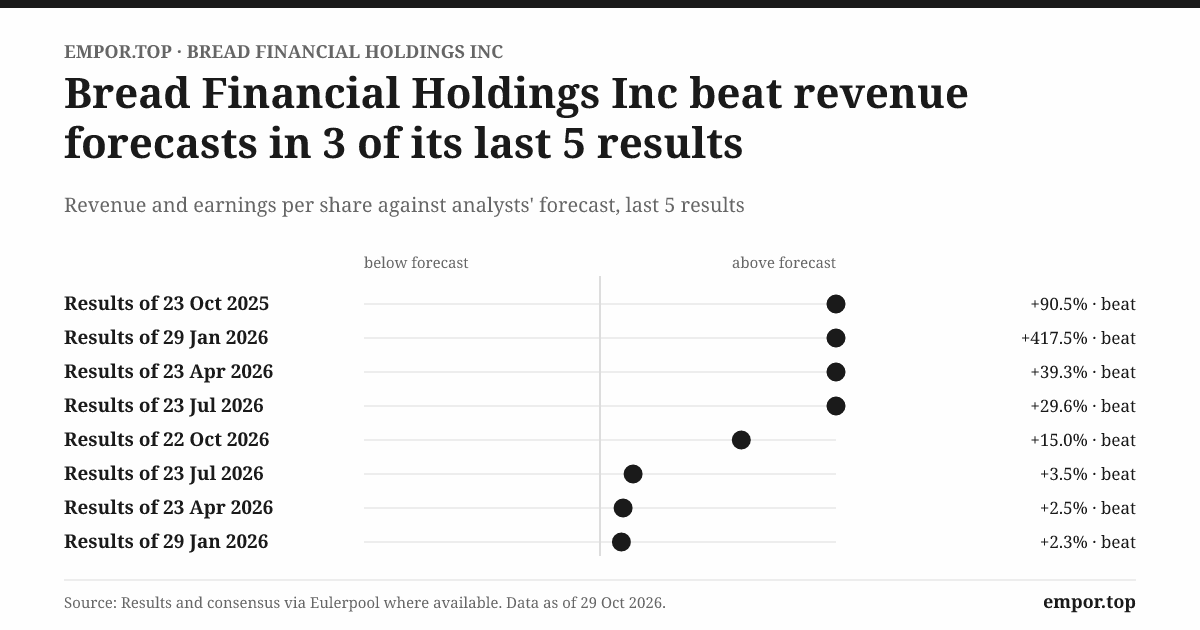
Three weeks later, on October 22, the company reported its third-quarter results, and they told a story with two halves.1 Average loans had risen 6% from a year earlier to about $18.6 billion, and revenue was up 5%. Credit, the thing that keeps any lender's managers awake, was getting better: fewer customers were falling behind, and fewer balances were being written off. Yet net income fell 17%, to $156 million.1 A company growing its loans, growing its revenue and improving its credit had earned less money than it did a year earlier. That puzzle, it turned out, had a mundane answer: a favorable $38 million tax item in the prior-year quarter had flattered the comparison, while pretax income actually rose about 6%.2 But the puzzle is a useful way into this company, because Bread Financial is a business where the headline and the mechanics rarely say the same thing.
Start with the name. "Bread" sounds like a fintech, the kind of company that lives inside a checkout button and talks about frictionless payments. And there is a real fintech inside the story: a New York start-up called Bread, bought in 2020 for its installment-lending and digital-checkout technology, whose name the whole company adopted two years later.34 The listed company, though, is something older and more consequential. Bread Financial Holdings is a US bank holding company. Its banks, the Comenity entities, originate and fund the loans; the holding company sits above them, issuing parent-level debt and equity and answering to bank regulators about capital.5 The overwhelming majority of what it earns comes from lending money to consumers through credit cards that carry other companies' brands.
That makes the investment question unusually clean, even if the answer is not. Bread is not a technology platform with a lending side business. It is a specialist lender whose distribution happens to run through retailers. Its fortunes turn on three things: whether it can grow loans while its credit keeps improving, whether it can keep the retailers that hand it customers, and whether the returns it earns on its balance sheet justify the risk of lending to American consumers, many of them outside the prime tier, at interest rates that routinely run above 30%.
The bank merger fits a pattern. For most of the past decade, this company has been rearranging itself. It began the 2010s as Alliance Data Systems, a three-headed conglomerate of store cards, a Canadian loyalty program and a giant marketing-data business. It sold the marketing business in 2019, spun off the loyalty business in 2021, bought the Bread start-up in between, renamed itself, and then spent several years cleaning up after a botched systems conversion.678 October 1 was the latest act of simplification: one bank, one charter to supervise, and, in the words of finance chief Perry Beberman, "greater flexibility to continue to grow consumer deposits as a core funding source."2
Simplicity has been management's watchword, and in some respects it has worked. Borrowings outside the deposit base have fallen to about $4.4 billion at the end of 2025, a fraction of the conglomerate-era load, and shareholders' equity has climbed back above $3 billion.5 Funding has moved toward deposits gathered directly from consumers. The company's regulators lifted a consent order in March 2026, and Moody's upgraded its parent-company debt in October.91
But the history of this company also carries a warning about simplification. One of its portfolio moves, the 2021 spinoff of the loyalty business, ended in bankruptcy within eighteen months, and a court trustee is now suing Bread for about $750 million on the theory that the spinoff stripped the new company of the cash it needed to survive.9 Those are allegations, not findings, and Bread is contesting them. Still, they are a reminder that a cleaner corporate structure is not automatically a better one for shareholders. Sometimes what gets left behind matters as much as what gets kept.
So the story of Bread Financial is the story of a company that kept getting smaller, and of what remained when it was done. To understand the lender that merged its banks on October 1, it is necessary to go back to the conglomerate it used to be, and to the spring weekend in 2019 when it decided to sell the part of itself that Wall Street had once valued most.
 Subscribe on LinkedIn
II. The Portfolio That Kept Getting Smaller
On Sunday, April 14, 2019, Alliance Data's board unanimously approved a deal that would have been almost unthinkable a few years earlier. It agreed to sell Epsilon, its data-driven marketing business, to the French advertising group Publicis for $4.4 billion in cash.6 Epsilon was the crown jewel the company had spent years building: a business that managed customer databases and email campaigns for big brands and, after a series of acquisitions, ran a large digital-advertising operation too. Now it was going to Paris.
To understand why, it helps to remember what Alliance Data had become. The company was born in 1996, when the private-equity firm Welsh, Carson, Anderson & Stowe merged two businesses it had acquired: J.C. Penney's transaction-processing arm and World Financial Network National Bank, the credit-card bank of The Limited, the Ohio retailer behind Victoria's Secret.10 It went public on the New York Stock Exchange in June 2001.10 Over the following decade and a half, management bolted on businesses until the company had three engines. Card Services issued and funded private-label and co-brand cards for retailers. LoyaltyOne ran AIR MILES, the coalition rewards program that millions of Canadians carried in their wallets, along with a Dutch promotions business called BrandLoyalty. And Epsilon sold marketing.7
The theory was that these pieces reinforced one another. A retailer that issued a store card through Alliance Data could also use Epsilon to market to those cardholders and a loyalty program to keep them coming back. Data from one business could sharpen the others. For a while, the market bought it. The trouble was that the pieces did not perform alike. The card business was a high-return lender, but marketing was being disrupted by Google, Facebook and the shift to programmatic advertising, and Epsilon's growth had slowed. Investors who wanted a lender did not want an ad agency, and investors who wanted an ad-technology company did not want a credit-card bank. The conglomerate was being valued as less than its parts.
Ed Heffernan, the chief executive who had built much of that empire, framed the sale as a homecoming. He called the deal "a trifecta win" for Alliance Data, Epsilon and Publicis, and said the company was "transitioning into a leaner, more focused organization."6 On the first-quarter call eleven days later, finance chief Charles Horn put it more bluntly: the sale "allows us to refocus our resources on our market-leading high-growth, high-ROI Card Services business."11
The price deserves a moment, because the two sides described it differently and both were telling the truth. Alliance Data's release called it roughly ten times Epsilon's trailing adjusted EBITDA.6 Publicis, the buyer, told its own shareholders that the net purchase price after a tax step-up was about $3.95 billion, which implied only 8.2 times 2018 adjusted EBITDA.12 The gap is the tax. Publicis could write up Epsilon's assets and deduct the step-up over time, so it effectively paid less than the headline. Alliance Data, for its part, said it would pay about $800 million in taxes on the sale and receive roughly $400 million back from Publicis toward them.11 After taxes and fees, it expected about $3.5 billion of cash.6 A seller announcing a ten-times multiple and a buyer announcing eight-times-and-change is a fairly good sign that the price was reasonable for both, not a steal for either.
What Alliance Data did with the money is the more revealing choice. Management said it would use the full amount to pay down corporate debt and buy back stock. Horn told analysts that somewhere between $1.9 billion and $2.4 billion would retire debt and about $1.1 billion would go to repurchases, bringing leverage down from about 2.4 times to about 1.7 times.11 The company had already spent $223 million buying back shares in the first quarter.11 This was a return of capital, not a reinvestment. Management was conceding that it had no better use for $3.5 billion inside the business than handing it back.
Not everyone on the call was sure the remaining company was better. Analysts asked, in various forms, whether Card Services would cost more to run without Epsilon's marketing machinery and whether the addressable market had shrunk.11 They were the right questions, and they foreshadowed what came next. Within weeks, Heffernan himself was gone. He resigned as chief executive on June 5, 2019, under a retirement agreement, and Melisa Miller, who had run Card Services for eight years, took the top job.13 She lasted about five months. In November the board announced that Miller had stepped down, Charles Horn would act as interim chief executive, and the company had hired an outsider: Ralph Andretta, the head of US cards at Citigroup, who would take over on February 3, 2020.14
The executive who arrived that winter had spent his career in big-bank card businesses: executive roles at American Express and Bank of America, then nearly a decade running Citi's US card operations.14 He was a card operator, not an empire builder, and that choice told investors where the board wanted the company to go. Within weeks of his arrival, the pandemic arrived too.
Andretta's first major moves came in quick succession. In October 2020 he bought Bread, the digital-payments start-up that would eventually lend the company its name, for an estimated $450 million.3 Then, in May 2021, he announced the company would spin off LoyaltyOne, the AIR MILES and BrandLoyalty businesses, as a separate public company.7 It was, he said, "a logical next step in our transformation journey."7
The spinoff's structure is where the story turns uncomfortable. LoyaltyOne was not a tiny business: it generated $765 million of revenue and $186 million of adjusted EBITDA in 2020.7 Alliance Data distributed about 81% of the new company, Loyalty Ventures, to its own shareholders and kept about 19%, with the stated intent to sell that stake.7 Before the distribution, Loyalty Ventures borrowed. It signed an $825 million credit agreement with a bank group, including $675 million of term loans, and used the borrowing to pay a $750 million cash distribution to Alliance Data on November 3, 2021.1516 Two days later the spinoff was complete.17 Alliance Data used the cash to reduce its own corporate debt, exactly as it had said it would.7
In other words, the parent sent its loyalty business into the world with a large new debt load and kept the borrowed money. That is a common enough spinoff design. It is also a design that works only if the spun business holds up. Loyalty Ventures did not. In June 2022, Sobeys, one of the largest sponsors of the AIR MILES program in Canada, said it would leave after the two sides "were unable to align on extension terms," withdrawing region by region over the following months.18 On March 10, 2023, Loyalty Ventures filed for Chapter 11 bankruptcy in Texas, and its Canadian operating company sought creditor protection at home; the same day it agreed to sell the AIR MILES business to Bank of Montreal as a stalking-horse bidder.19 A company that had been spun off as a standalone public business sixteen months earlier was being sold in pieces in a bankruptcy court.
The litigation followed. In February 2024, the trustee for the bankrupt estate, Pirinate Consulting Group, sued Bread Financial and its general counsel in the Texas bankruptcy court, alleging actual and constructive fraudulent transfers, among other claims; a parallel fiduciary-duty case was filed in Delaware's Court of Chancery. Each seeks about $750 million plus interest and costs. LoyaltyOne's Canadian entity separately sued in Ontario in 2023 for about $775 million.9 The heart of the trustee's argument is that the $750 million distribution left Loyalty Ventures leveraged and undercapitalized, in effect insolvent from the start. Bread disputes that. The record so far is mixed: the bankruptcy court allowed some claims to survive a motion to dismiss and, in January 2026, denied Bread's motion for partial summary judgment, which Bread is appealing; meanwhile a shareholder securities class action over the spinoff was dismissed with prejudice in March 2025.9 None of the fraudulent-transfer claims has been adjudicated. They should temper, not settle, the judgment on management.
Step back and the portfolio record looks like two different kinds of decision. The Epsilon sale was a clean cash realization at a fair price that funded real deleveraging. The LoyaltyOne spinoff extracted $750 million of cash for the parent but exported a fragile, indebted business to shareholders who received its stock, and that stock was essentially wiped out within two years. Whatever a court ultimately decides, the economic outcome for anyone who held on to their Loyalty Ventures shares was poor, and the contingent liability now sits with Bread.
There is a final consequence of all this rearranging, one that matters for anyone looking at the long-run numbers. Because the company sold Epsilon and spun off LoyaltyOne, its ten-year financial history describes several different businesses stacked on top of one another. Reported revenue shrank by about 3% a year over the decade to 2025, and net profit by about 1% a year, while the past three years show revenue up about 7% a year and profit up more than 30% a year.5 Neither figure is a clean read on the card business. The decade figure mixes in businesses that are gone; the three-year figure starts from a trough. The honest summary is that the surviving company is a focused card lender, and the meaningful track record begins in 2022.
What did that lender choose to become? The answer was hidden in the deal Andretta struck in his first autumn on the job, the one that gave the company its new name.
III. The $450 Million Bet on Bread
In the autumn of 2020, American retail was being forced online at a speed nobody had planned for. Stores had closed in the spring; shoppers who had never bought a sofa or a ring through a website were now doing exactly that. And at the digital checkout, a new kind of competitor was appearing alongside the store card: buy now, pay later. Affirm, Klarna and Afterpay were offering shoppers a simple promise of splitting a purchase into a few payments, often with no interest, approved in seconds inside the retailer's own checkout page. For a company whose business was store credit, that was not a curiosity. It was a challenge to the product itself.
On October 29, 2020, Alliance Data announced its answer. It would buy Bread, a company that described itself as "a technology-driven digital payments company offering an omnichannel solution for retailers and platform capabilities to bank partners," for estimated consideration of $450 million, about $100 million of it in Alliance Data stock.3 Bread was small: about 185 employees and more than 400 clients using its installment-loan or buy-now-pay-later products.3 Its chief executive, Josh Abramowitz, said the company had "always strived to reimagine payments in the digital age."3 Alliance Data's chief commercial officer, Val Greer, tied the deal to the moment, noting that "the COVID-19 pandemic has accelerated the adoption of digital technologies."3 Andretta said it "significantly expands our digital capabilities and payment options for our brand partners."3 Management expected the purchase to be accretive to earnings by no later than year three.3
The logic was straightforward. Alliance Data had hundreds of retail partners, a mature underwriting machine and decades of experience servicing card accounts; at the time of the spinoff announcement, Card Services counted more than 630 merchant partners.7 What it lacked was a modern, embeddable checkout product. Bread had the product but not the balance sheet, the partner list or the credit experience. Combine them, and a retailer could offer a shopper a store card, an installment plan or a pay-later split from a single provider, all funded by Comenity's banks.
Was $450 million a fair price? The honest answer is that nobody outside the company can say. The announcement gave no revenue or profit figures for Bread, so there is no basis to compute a purchase multiple, and no clean set of comparable deals to set it against. What can be said is that the deal was modest relative to the company's scale. Card Services alone generated about $3.8 billion of revenue in 2020.7 A $450 million acquisition was a capability purchase, a technology bolt-on, not a bet-the-company move.
The more interesting question is what success would have looked like. If the Bread acquisition worked, a few things should be measurable by now. Partners would be adopting the installment and pay-later products in large numbers. Those products would be generating a growing slice of credit sales and loan balances. New customers would be arriving through them at a lower acquisition cost than traditional card applications. And, somewhere in the income statement, there would be incremental profit that would not exist without the deal.
None of those things is disclosed. Bread Financial reports as a single continuing operating segment, and its annual filings describe its products, credit cards, the Bread Pay installment and pay-later offerings, and the Bread Savings deposit platform, without breaking out revenue, loans or profit for the products that came from the acquisition.5 The company does not say whether the deal met its year-three accretion target. Its pay-over-time loans appear in the credit tables, with a different charge-off clock from cards, but not as a separately sized business line.5 On the third-quarter 2026 call, management mentioned a home-security company, Vivint, among new BreadPay partners, a sign that the product is still being sold.2 A partner name is evidence of activity, not of scale.
What is visible is that the acquisition changed the company's identity far more than its income statement. In March 2022, Alliance Data renamed itself Bread Financial and moved its stock ticker from ADS to BFH.4 The new name signaled a digital, consumer-facing brand; the old one sounded like a data-processing utility from the 1990s. Bread Savings, the direct-to-consumer deposit brand, became the face of the company's funding strategy, and that strategy has been one of its clearer successes: consumer deposits reached $9.9 billion by September 2026, up 21% in a year.1 But a deposit brand built on a borrowed name is not the same thing as an installment-lending engine, and it would be a stretch to credit the 2020 deal for the deposit growth.
So the verdict is narrower than either the bulls or the skeptics might want. The Bread acquisition made strategic sense: it was a defensive purchase against a genuine threat, at a price that could not damage the company if it disappointed. But buy-now-pay-later has not become a visible second engine of growth at Bread Financial, and the company gives investors no way to measure whether it ever will. Treat it as a product capability inside a card lender, not as a separate business with its own valuation.
Which brings the story back to the lender itself. If installment loans are a feature and not the engine, then what, precisely, earns Bread its money? The answer begins at a checkout counter, with a shopper deciding whether to say yes to the card.
IV. Every Checkout Is a Credit Decision
Picture a shopper at a Kay Jewelers counter in a suburban mall. She has picked out a pair of earrings. The sales associate mentions that if she opens a Kay credit card today, she can spread the cost over several months and get a discount on this purchase. She fills in a short application on a tablet. Within seconds, a computer in Ohio has looked at her credit file, decided how much she can borrow, set her credit line and approved her. She walks out with the earrings. The retailer has made a sale it might otherwise have lost. And Bread Financial has made a loan.
Every economic question about this company is folded into that moment. The card carries the Kay name, but the balance belongs to Bread's bank. If the shopper pays in full when the bill arrives, Bread earns little from her beyond a sliver of transaction fees. If she carries a balance, Bread earns interest, at rates that the Consumer Financial Protection Bureau found routinely exceed 30% on retail cards. If she pays late, Bread can charge a fee. And if she stops paying altogether, Bread eats the loss. Meanwhile, the retailer that brought her in expects to be rewarded for doing so.
Where the money comes from, and where it goes
The principal revenue unit, then, is not a transaction but a balance: the outstanding money cardholders owe. Bread earns interest and fees on those balances under its cardholder agreements, recognizing the interest as it accrues.5 Card purchases also generate interchange, the small fee merchants pay on co-brand card transactions that run over the Visa or Mastercard networks. And then money flows the other way. Bread's agreements with its brand partners often require it to pay the retailer a share of the program's economics, through royalties, bonuses for new accounts or outright profit sharing. Bread records those payments, which it calls retailer share arrangements, as a reduction of revenue.5
The scale of each piece explains the business better than any single headline. In 2025, Bread's net interest income, the interest and fees it earned on loans minus what it paid depositors and bondholders, was about $4.1 billion.5 Its non-interest income was negative, at about minus $213 million, because the payments to retailers more than offset everything else in that bucket; even interchange revenue, which came to $416 million, is reported after deducting retailer shares.5 Put plainly, Bread makes its money lending, and then gives a meaningful slice of it back to the stores that bring it customers.
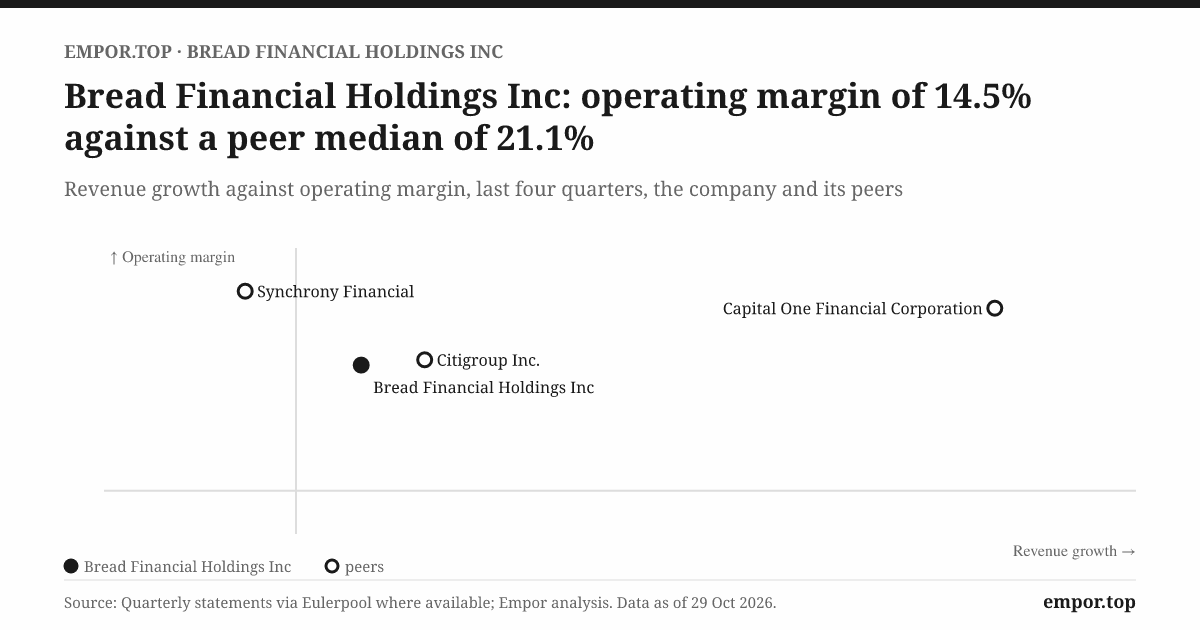
This is also why the company's "revenue" depends on who is counting. Bread's own definition of total net revenue, net interest income plus non-interest income, was a little under $4 billion in 2025, and that is the figure management guides to and the one that grew 5% in the third quarter of 2026.2 Standard financial databases, which tally gross interest and fees before funding costs, show a figure closer to $4.7 billion for 2025 and a quarterly growth rate of about 3%.5 Neither is wrong. But the gross figure is not comparable to an industrial company's sales, and calculating an "operating margin" on it says little about how profitable the lending actually is.
The real economics of each dollar of loans are best understood as a chain of subtractions. Start with the yield: what Bread charges cardholders in interest and fees. Subtract the cost of funding the loan, what it pays on deposits and securitization notes. Subtract the losses on customers who never repay. Subtract the retailer's share. Subtract the cost of running call centers, technology and collections. What remains, before tax, is the profit. Bread's net interest margin in the third quarter of 2026 was about 18.9%, meaning that for every $100 of interest-earning assets, it kept almost $19 a year after paying for its funding.2 That is an extraordinary spread by banking standards, several times what a typical mortgage lender earns. But its annualized net loss rate in the same quarter was 6.4%, meaning that roughly a third of that spread was consumed by bad debt before a single retailer was paid or a single employee's salary was covered.1
The ancillary lines matter, but only at the margin. In 2025, Bread earned about $116 million from payment-protection products, which suspend or cancel payments in certain hardships, and about $82 million from fees for paper statements.5 Together, those two sources of "other" income are not trivial; they equal about a third of the company's 2025 pretax profit. They are, however, operating income from the same cardholder base, not a separate earnings engine, and they carry their own regulatory scrutiny. Interest on the company's cash and securities, about $173 million in 2025, is mostly the return on liquidity parked at the Federal Reserve, not a treasury trading business.5
Why bigger is not automatically better
The chain of subtractions explains why loan growth, for a business like this, is a double-edged instrument. When Bread grows its loan book, revenue rises almost mechanically. But so does everything else. A bigger book needs more funding, which costs money. It needs more reserves, because accounting rules now require lenders to book expected lifetime losses on a loan when they make it, which means rapid growth depresses reported profit up front. It may involve newer, less-seasoned customers whose loss rates have not yet shown themselves. And if the growth comes from a new partner program, it may come with a richer retailer share.
That last effect was visible in the third quarter. Management said revenue was helped by loan growth, lower interest expense and higher interchange, but partly offset by higher retailer share arrangements and lower billed late fees.2 As credit improved and partner sales rose, Bread paid its partners more, because their programs were more profitable. Good credit, in other words, does not accrue entirely to Bread's shareholders. The company shares its upside with the stores.
The same quarter also showed the reserve mechanics at work. Bread added $21 million to its loss reserve in the third quarter of 2026, whereas a year earlier it had released $28 million.2 The difference, about $49 million of swing, is a reminder that a lender's earnings depend not just on what customers repay this quarter but on management's forecast of what they will repay in years to come.
The cash-flow illusion
That forecasting is also the reason the usual cash-flow measures mislead badly here. A generic screen of Bread's financials shows a free-cash-flow yield of more than 45% and operating cash flow running at three to four times net income.5 At face value, that is a company drowning in cash. It is not.
Consider 2025. Bread reported net income of $518 million and operating cash flow of about $2.1 billion.5 The biggest reason for the gap is a single line: a provision for credit losses of about $1.24 billion. A provision is a non-cash charge; it reduces profit when the company expects losses, but no cash leaves the building on that day. So the accounting adds it back in the cash-flow statement. The cash actually leaves later, when a loan is charged off and never repaid, and that loss shows up not in operating cash flow but in the investing section, as part of the money the bank puts into loans. In 2025, Bread's net lending into its card and loan book consumed about $1.35 billion of cash.5 Add the debt repurchases, the deposit flows and the regulatory capital that must be held against every new loan, and the "free" cash looks much less free.
The cleanest way to think about it is that a lender's operating cash flow is the map of its loan book. It tells you how much interest is coming in and how much is being reserved against losses, not how much is available to distribute. What a bank can actually return to shareholders is governed by its regulatory capital and its earnings after realistic losses, which is why this story will judge Bread's capital returns against its capital ratios, not against a cash-flow yield.
So the business, stripped to its mechanics, is a high-yield lender distributed through retailers. Its earnings are explained by five forces: how fast balances grow, what yield they carry, what the money costs, how many borrowers default, and how much is shared with partners. There is no subscription here, no recurring-revenue multiple. And of those five forces, one is controlled not by Bread but by the company whose name is on the card. Which raises the question that governs everything else: who actually owns the customer?
V. The Retailers Can Take Their Cards Elsewhere
For most of its life as a co-brand card, the BJ's Wholesale Club Mastercard had been an Alliance Data product. Then, on October 12, 2022, Capital One announced that it would become the exclusive issuer of BJ's co-brand card and buy the existing portfolio, with the new program launching in early 2023.20 Capital One's announcement did not mention its predecessor by name. It did not need to.
In February 2023, Bread sold the BJ's portfolio. The deal moved about $2.3 billion of loans off its books for $2.5 billion and produced a $230 million gain.5 On the surface that was a win, a premium price for a book of receivables. But it was also a vivid demonstration of the most important fact about Bread's business. The retailer controls the relationship with the shopper. When the contract comes up for renewal, the retailer can shop it around, and a bigger bank with a cheaper cost of funding can win it. Bread's balance sheet shrank by roughly an eighth in a single transaction, and the gain on sale was a one-time payment for a stream of earnings that would never come back.
A short list of very large partners
Fast-forward to the autumn of 2026, and the story read in the opposite direction. In September, Bread and Signet Jewelers, the parent of Kay, Zales and Jared, announced a long-term renewal, which also extended the program to Signet's online diamond retailer, Blue Nile.1 In October, Bread announced a long-term renewal with Sephora.1 Management described them as "2 of our top 10 partners."2 For a company that had watched one large program walk out the door, keeping two big ones was the best news it could deliver.
The reason those renewals mattered so much is concentration. Bread's five largest card programs accounted for about 49% of its 2025 revenue, excluding the gain on sale, and about 44% of its loans at year-end.5 Three partners, Signet, Ulta Beauty and Victoria's Secret, each accounted for at least 10% of revenue on their own.5 To put that in perspective, if any one of those three left, Bread would lose a tenth of its business, the kind of hit that typically takes years of new-partner wins to replace. Victoria's Secret, notably, is the descendant of the very retailer whose credit-card bank was one of Alliance Data's founding pieces in 1996, which says something about how long these relationships can run, and how much depends on them.10
Four banks, and a crowd of alternatives
The competitive arena is small and well defined. When the CFPB studied retail credit cards in December 2024, it named four primary issuers: Synchrony Financial, Citibank, Capital One and Bread Financial. Together, the agency found, these four issued more than 80% of store cards and held more than 80% of the market by purchase volume and outstanding balances.21 Bread is the smallest of the four, the specialist among giants. Synchrony is a much larger store-card specialist; Citi and Capital One are diversified banks with national deposit franchises, enormous marketing budgets and, in Capital One's case, its own payment network ambitions.
That is the field a retailer surveys when its contract comes up. And the menu is wider than the four banks. A retailer can steer shoppers toward general-purpose cards and simply accept their interchange fees. It can partner with a fintech checkout provider, the Affirms and Klarnas that pushed Alliance Data to buy Bread in the first place. It can run its own installment financing. Each alternative caps how much the retailer is willing to give up.
The case for Bread's position is real, though narrower than its marketing would suggest. Running a store-card program is genuinely hard. The issuer must underwrite customers who are, on average, riskier than general-purpose cardholders; the CFPB found that store cards approve applicants in the 620-to-720 credit-score range at rates roughly 20 percentage points higher than general-purpose cards do.21 It must integrate with the retailer's point-of-sale systems and website, run marketing campaigns tied to the retailer's promotions, service millions of accounts and collect from those who fall behind. Switching issuers means migrating every account, every system integration and every marketing process, which is costly and risky for the retailer as well. That is why programs tend to last many years, and why renewals are the norm.
The program also matters to the retailers' own economics. The CFPB found that between 2018 and 2023, store-card income averaged about 8% of gross profits for major retailers, and as much as about 15% for some.21 That is a powerful incentive for retailers to stay in the card business. It is also a powerful incentive for them to negotiate hard, because every dollar of program profit is a dollar to be split between retailer and bank.
What a renewal actually buys
This is where the Signet renewal becomes more instructive than celebratory. Retail Dive reported, based on Signet's disclosures, that the new agreement runs through 2035 and that Signet expected the profit sharing to bring it more than $1 billion over the life of the deal, with no loss sharing.22 Read that from Bread's side. The partner keeps a large slice of the upside when the program does well, and does not share the downside when customers default. Bread keeps the credit risk.
Management did not hide this. On the third-quarter call, Beberman said higher retailer share arrangements reflected "more value" being shared with partners as credit sales and loan yields rose and losses fell, and that newer partner programs and renewals "incorporate more of a profit share component."2 There is a respectable argument for that design: profit sharing aligns the retailer's incentives with Bread's, so the store wants the program to grow and to perform. But it also means that a renewal is not evidence of pricing power. If anything, it is evidence that, at the moment of renewal, the retailer extracted better terms.
Nothing in Bread's filings shows exclusivity guarantees that outlast the contract term or minimum volume commitments from partners, and the company warns that major partners can have early-termination rights.5 The contracts are long, which provides real visibility. They are not a lock.
A useful way to hear this tension is to compare the two halves of the third-quarter call. In prepared remarks, management walked through partner momentum: the Signet and Sephora renewals, a new Blue Nile card that would launch before the holidays, new home-furnishings programs with Raymour & Flanigan and Furniture First, and others including Academy Sports and AAA.2 The tone was expansive. When analysts got their turn, they kept circling the economics of those wins: what retailer share arrangements would do to margins, how much new programs would contribute and when. That is the right instinct. A partner list measures distribution. Program economics measure whether the distribution earns a return.
The verdict on Bread's moat is therefore a narrowed one. The company has a scaled, specialized operating platform in a concentrated market, and evidence that large partners renew. Those are genuine assets. But the BJ's departure shows that a large program can leave for a competitor, and the Signet terms show that renewal can come at the price of sharing more upside. The advantage is contractual and operational: hard to replicate quickly, but renegotiated every decade, and the customer relationship it rests on belongs to someone else.
The partner, though, is only half of the bargain. Bread can keep every retailer it has and still lose money if the customers who swipe those cards stop paying. And for two years, that was exactly the danger.
VI. The Recovery Has to Survive the Next Credit Cycle
At the end of 2025, Bread's loan book held about $18.8 billion of credit-card and other consumer loans.5 Of those, about $1.3 billion was at least 31 days past due, and about $676 million was more than 90 days past due, a stage at which borrowers were, in most cases, well on the road to never paying.5 Against that book, Bread had set aside an allowance for credit losses of about $2.1 billion, more than 11 cents for every dollar it had lent.5 For a company with about $3.3 billion of shareholders' equity at the time, the reserve alone was nearly two-thirds the size of everything shareholders owned.5
Those are the numbers of a business that lives very close to the edge of consumer stress. And yet, by the third quarter of 2026, they were moving in the right direction. Delinquency, the share of balances at least 30 days late, had fallen to 5.57%, about half a percentage point better than a year earlier. The net loss rate had fallen to 6.40%, about one full point better. The reserve rate stood at about 11.1%, down by about 0.6 points.12 Management lowered its full-year loss-rate outlook to between 6.9% and 7.0%, the second consecutive quarter it had improved that guidance.2
The question is what that improvement means.
Reading a loan book
For a non-specialist, it helps to think of a credit-card book as a conveyor belt. Every month, some customers fall one payment behind; some of those catch up, some fall further behind; and after about six months of non-payment, Bread charges the balance off, writes it down to zero and tries to collect what it can.5 Delinquency is a picture of who is on the belt now; the net loss rate is what falls off the end. Delinquency therefore leads losses by a few months, which is why a falling delinquency rate in 2026 gives management some confidence about losses into 2027.
The reserve is the lender's estimate of what will eventually fall off the belt, and it is the single largest judgment in Bread's accounts. Under current accounting rules, Bread must reserve for expected lifetime losses on its loans based on economic forecasts. When it grows faster, or when it expects a worse economy, the reserve rises and profits fall. When credit improves or the economy looks steadier, the reserve can be released and profits rise. A reserve rate above 11% is high by banking standards and appropriate for this kind of customer base. But it is an estimate, and if unemployment rose sharply, it would need to rise too.
There is one more technical lever worth understanding, because it can flatter delinquency numbers: re-aging. When a delinquent customer meets certain payment conditions, say, making several consecutive on-time payments, a lender may return the account to current status. That is a legitimate tool for customers genuinely recovering, and it is regulated. But it also moves balances off the delinquency tally. Bread re-aged about 3.0% of its loans in 2025, down from 4.1% in 2024 but above the 2.6% of 2023.5 The direction since 2024 is encouraging; the level still sits above where it was two years ago. Re-aging is one of the numbers worth watching precisely because it does not appear in the headline ratios.
The rebound math
The profit history makes the same point from a different angle. Bread's net income fell to about $223 million in 2022, the year of its systems-conversion troubles and the start of a credit downturn, then swung up and down through 2023 and 2024 before reaching $518 million in 2025.5 Measured from that 2022 trough, profit compounded at more than 30% a year over three years. That is rebound math, not a growth rate: the starting point was unusually low, and the comparison would look very different from a normal year. Over the decade, net income shrank slightly.5 Neither number tells you the normalized earning power of the card lender. Only a full credit cycle will.
The third quarter of 2026 is a small illustration of how noisy the near-term numbers can be: while net income fell on a favorable tax comparison, pre-provision net revenue, the earnings before credit costs and taxes, rose about 7%.2 The underlying business grew. The reported number simply lapped an unusually generous comparison.
Where the risk actually lives
So what could interrupt the recovery? The most direct risk is the consumer. Bread lends to a customer base where, by management's own count, about 64% of cardholders have a credit score above 650, which leaves more than a third below it.2 Those borrowers feel inflation, layoffs and rising rents first. On the third-quarter call, Beberman described consumers as resilient but more intentional and value-focused, and warned that "persistently weak consumer confidence" could hurt spending, borrowing or repayment.2 Asked by Sanjay Sakhrani of KBW about the direction of losses, he said he expected the loss rate to improve again next year, but that it "will not improve at the same degree of basis points" as in 2026.2 That is an honest answer, and an important one: the easy part of the recovery may be behind the company.
The second risk is funding. Bread pays interest on about $15.5 billion of deposits and on securitization notes and parent debt.9 Its margin has benefited from lower funding costs in 2026; management guided to a full-year net interest margin slightly above 2025's, partly for that reason.2 But management also warned of modest margin compression in the fourth quarter from seasonality, lower late fees and deposit-rate pressure.2 When rates are cut, the yield on card loans, much of it variable, tends to reprice before deposit costs do.
The third risk is regulatory, and it is not hypothetical. In March 2024, the CFPB finalized a rule cutting the safe-harbor late fee that large card issuers could charge to $8.23 For a lender like Bread, whose customers pay late more often than prime borrowers, that rule threatened a meaningful slice of revenue. It never took effect: it was stayed in litigation, and on April 15, 2025, a federal judge in Texas vacated it by consent judgment.2324 That removed the immediate rule as written. It did not remove the political attention. The CFPB's own December 2024 study found that 90% of retail cards carried a maximum interest rate above 30%, against 38% of general-purpose cards, and that the average private-label card from the top retailers charged 32.66% in December 2024.21 Those are the kinds of figures that draw legislators and regulators back, whoever is in power. Meanwhile, Bread's late-fee revenue is already falling for a different reason: as delinquency improves, fewer customers are billed late fees, which management cited as a drag on revenue and margin.2 Better credit, in a business that earns fees from customers who struggle, carries a small cost of its own.
Put the evidence together and the conclusion is clear, though hedged once. The direction of credit at Bread is favorable, and management has a credible case that its tighter underwriting since 2023 is showing up in the numbers. But one year of improvement, coming off a stressed period and lapping elevated losses, cannot establish what normal looks like for this book. The test is whether delinquency and losses keep improving, or at least hold, as new originations from programs such as the Signet renewal and the new furniture partners season into 2027. If the newer vintages perform as well as the older ones, the recovery becomes a new base. If they do not, the recovery will have been a pause.
And that test bears directly on the last big question, the one investors usually ask first: what should the company do with the profit the recovery is generating?
VII. A Cleaner Bank, and a More Expensive Capital Stack
Five days after the third-quarter results, on October 27, 2026, Bread priced a new security. It sold 5 million depositary shares representing its Series C preferred stock, at $25 each, raising $125 million, with an option for underwriters to buy 750,000 more.25 The coupon was 9.375%, fixed until December 2031 and then resetting to the five-year Treasury rate plus about 4.5 percentage points; the dividends are non-cumulative and begin in March 2027.25 In the same quarter that closed weeks earlier, Bread had repurchased about 700,000 of its own common shares for $75 million, and it still had $374 million left under its buyback authorization.19
Taken together, those two transactions summarize the capital question at Bread more precisely than any ratio. The company was buying back common stock and, almost simultaneously, issuing preferred stock that costs more than 9% a year.
The CEO and the record
The person responsible for those choices is Ralph Andretta, chief executive since February 2020.14 Andretta's tenure has been defined by three projects. The first was portfolio surgery: the Bread acquisition, the LoyaltyOne spinoff and the rename. The second was operational: rebuilding the company's technology after a painful transition. In June 2022, Bread moved its credit-card processing to outsourced partners, with Fiserv as its core processor, and moved tens of millions of records to the cloud. The result was a weeks-long failure that left many cardholders unable to pay their bills online in late June and early July, and led to a class action filed that summer.8 In November 2023, the FDIC issued a consent order against Comenity Servicing over weaknesses in IT systems development, project management, business continuity, cloud operations and third-party oversight arising from that transition.9 There were no fines. The FDIC terminated the order on March 31, 2026.9 That is a genuine course correction, achieved in about two and a half years. It does not erase the original failure, which hurt customers and partners and is part of the execution record.
The third project has been the balance sheet: shrinking parent debt, growing consumer deposits and restarting capital returns. Here the record is substantial. Corporate borrowings have fallen sharply since the conglomerate years, and the company bought back debt at a premium in both 2024 and 2025, recording losses on extinguishment of $117 million and $74 million respectively.5 Average consumer deposits rose to about 53% of total funding in the third quarter of 2026, from 47% a year earlier.2 In 2025, Bread returned about $350 million to shareholders through dividends and buybacks.[^26] And Moody's lifted the parent's senior unsecured rating one notch, from Ba2 to Ba1 with a stable outlook, in October 2026, what Beberman called "our second upgrade from Moody's in back-to-back years."2[^27] Ba1 is still below investment grade. It is a meaningful improvement, not a destination.
How has Andretta been paid for this? His reported total compensation was about $11.9 million in 2025, up from about $10.6 million in 2024 and $7.7 million in 2023; of the 2025 figure, about $7.0 million was equity awards and about $3.4 million incentive pay.[^28] Most of it, in other words, depended on performance or share price, and pay rose as earnings recovered from the 2023 low. Shareholders approved the prior-year program with about 95% of votes cast.[^28] Insider ownership is modest: directors and executive officers together held about 1.3% of the company, while the largest holders were index and quantitative managers, Vanguard at 13.6%, BlackRock at 11.9% and Dimensional at 7.2%, alongside the value-oriented Turtle Creek at 6.2%.[^28] There is no controlling shareholder to discipline management or to entrench it. The board and the market do that job.
Management's guidance record in 2026 has been reasonably disciplined. The company began the year expecting average loan growth in the low to mid-single digits and, by October, sharpened that to about 4%, while improving its loss-rate outlook twice.2 Raising guidance on credit while holding growth guidance steady is the pattern of a management team that set achievable targets rather than ambitious ones. It is a modest piece of evidence, but in a business where overpromising on loss rates is a classic failure, it counts.
The spinoff test
Any assessment of Andretta's capital allocation has to account for the Loyalty Ventures outcome, which remains under litigation.1618 What can be said is that a credible record of simplifying the business and returning capital sits beside a material counterexample, and that any broad claim of capital-allocation excellence has to survive it. The relevant questions for management, which its filings do not answer in detail, are what due diligence the board performed on the spun company's capacity to carry its debt, and what governance would prevent a repeat if the company ever separates another business.
Buybacks against the capital ratio
That is the context in which the preferred offering deserves scrutiny. Bread's common equity tier 1 ratio, the core measure of a bank's loss-absorbing capital relative to its risk-weighted assets, was 13.1% at the end of September 2026, about 0.9 points lower than a year earlier.12 Beberman walked analysts through the bridge. Earnings added about 3.1 percentage points of capital over the year. Buybacks and common and preferred dividends consumed about 3.4 points. Loan growth used about 0.7 points, and debt repurchase costs about 0.2.2 In plain English: over the past year, Bread distributed more capital than it earned, and the ratio fell as a result.
Then came the line that ties the two transactions together. Management said it expected "minimal repurchase activity in the fourth quarter, absent a preferred stock offering."2 Five days later, the preferred offering arrived. Preferred stock counts as capital for some regulatory purposes but not as common equity, so its main use here is to let the company hold its broader capital ratios while continuing to return common equity. The cost is a 9.375% dividend that ranks ahead of common shareholders.25
There is a defensible logic to this. If Bread's common stock trades at a modest multiple of earnings and the company believes it will earn returns on tangible equity in the twenties, then buying back common at that price and replacing it with preferred capital costing about 9% can increase earnings per common share. The skeptic's reply is just as clear. A lender with a speculative-grade parent rating, concentrated partners and a loss rate still near 6.4% is choosing to thin its common-equity cushion during a recovery, not after one has been proven. And in plain terms, it is borrowing quasi-permanent capital at more than 9% to buy back stock. That decision is only as good as the credit cycle that follows it.
Neither side of that argument is settled by the numbers available today. What the numbers do say is that capital returns are currently running ahead of capital generation, and that the new preferred is the instrument making that possible. The question for investors is whether the market price of the stock compensates for that choice, and for everything else this story has described.
VIII. Analysis & Bear vs. Bull Case
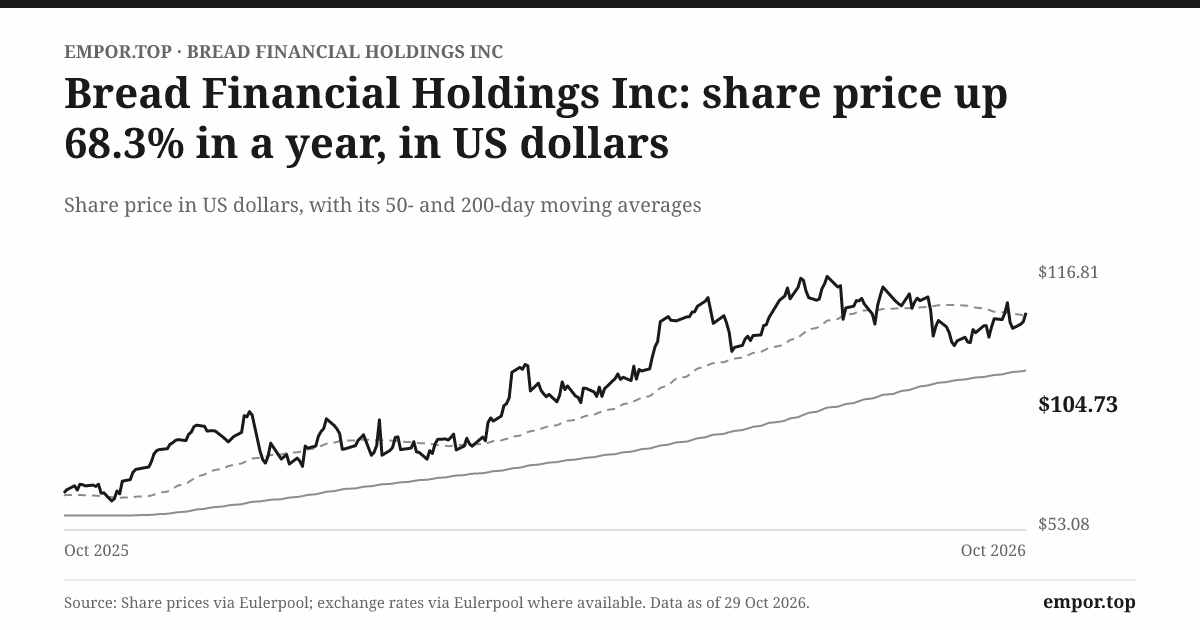
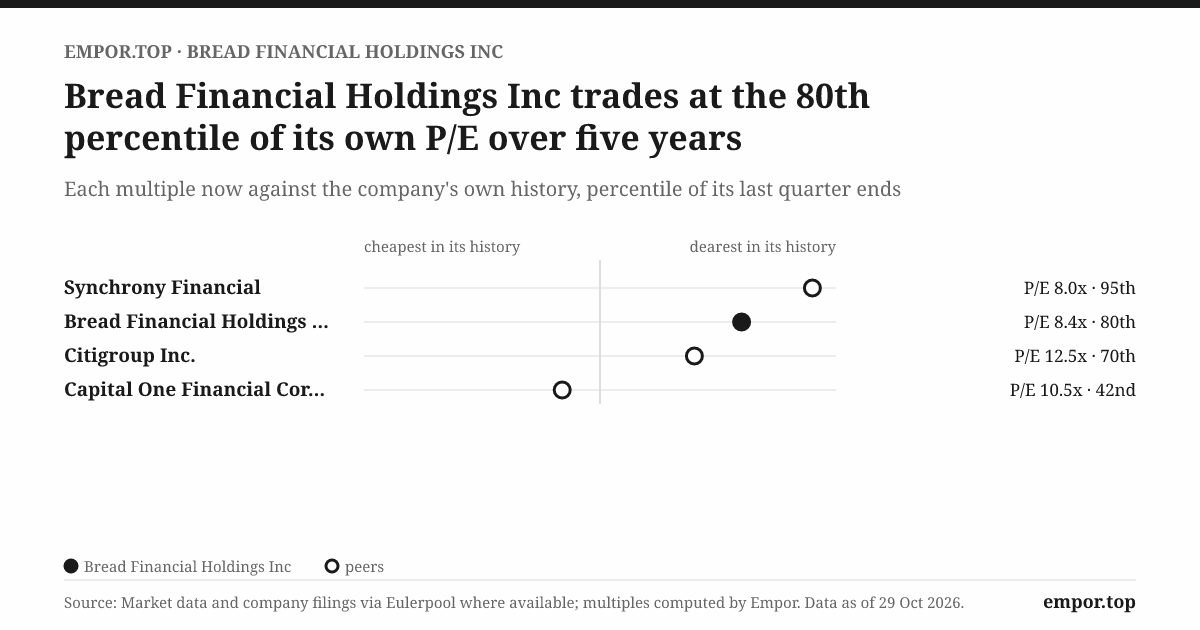
At the end of October 2026, Bread Financial's shares traded at about $105, roughly 8% below their 52-week high of about $113 and well above their low of about $60.[^29] The company was worth about $4.8 billion on the stock market. On trailing earnings of about $12.68 per share, that is a price-to-earnings ratio of about 8.4 times, and the stock traded at about 1.2 times its book value.1 In the third quarter, the company earned an annualized return on average tangible common equity of about 23.6%.1
Those figures can be read two ways, and the story so far explains why.
On one reading, Bread is a high-return lender at a single-digit multiple. A business that earns more than 20% on its tangible equity and trades not far above book value is, by the arithmetic of banking, priced for something to go wrong. On the other reading, the multiple is not especially low by this stock's own standards. Over the past five years, Bread's median P/E was about 5.1 times; today's 8.4 times is well above that.1 The market has already rerated the stock as credit improved. The shares fell by about 70% at their worst during the past five years, and the one-year volatility is about 39%, which is a reminder of how violently the market reprices this business when credit turns.[^29]
Before weighing the two cases, it is worth being clear about which measures belong in the conversation. For a lender, P/E, price-to-book, return on tangible equity, credit losses and capital ratios are the right tools. Enterprise-value-to-EBITDA and free-cash-flow yield, which look spectacularly cheap on generic screens, are not. They treat deposits as if they were ordinary corporate debt and loan-loss provisions as if they were spare cash, and as the earlier discussion of the cash-flow statement showed, neither is true.
The forces around a store-card lender
Start with the industry. Michael Porter's five forces give a sharp outline of where profit in store cards is decided.
Buyer power is the dominant force, and the buyers are the retailers, not the cardholders. Five partners supply about half of Bread's revenue, and three each supply at least a tenth.5 They can run competitive processes, demand profit sharing, and walk, as BJ's did. That is the single biggest constraint on Bread's returns. The cardholders themselves have limited individual bargaining power, which is why rates above 30% persist, but collectively they exert pressure through politics and regulation.
Rivalry is concentrated but intense. Four issuers dominate, and each renewal is a negotiation among a small number of credible bidders.21 Two of them, Citi and Capital One, have larger and cheaper deposit bases, which lets them bid aggressively for programs they want. Synchrony is larger in store cards.
The threat of substitutes is meaningful. General-purpose cards, pay-later providers and retailer-run financing all compete for the same checkout moment. The threat of new entrants into full-scale private-label issuing is lower, because it requires a bank charter, regulatory capital, underwriting data and servicing infrastructure, all of which take years to build.
Supplier power sits with the providers of funding and capital, depositors, securitization investors, bondholders, and with technology vendors. The deposit shift has reduced Bread's dependence on wholesale markets, but the 9.375% preferred coupon is a reminder that the capital markets still set the price of Bread's risk.25
Overlay Hamilton Helmer's seven powers, his test of what produces persistent excess returns, and the picture sharpens. Bread has some scale economies in servicing and technology, but it is the smallest of the four major issuers, so scale is not a relative advantage. It has real switching costs, because migrating a card program is painful for the retailer; those costs explain why renewals are common, but the Signet terms show they do not stop the retailer from extracting value at renewal. It has process power, in decades of experience underwriting and collecting from near-prime retail customers, which is genuine but hard to prove from outside and partly replicable by large rivals. It does not have network economies, a counter-positioning advantage, a cornered resource or meaningful consumer brand power; the brand on the card belongs to the retailer. The conclusion is that Bread's moat is operational and contractual: real enough to sustain a specialist franchise, not strong enough to protect its returns from partners and rivals.
The bull case, made concrete
The best argument for Bread starts with direction. Loans are growing again, about 7% on a period-end basis in the third quarter, with credit sales up about 9%.2 Delinquency, losses and reserve rates are all improving.1 Two top-ten partners have renewed for the long term, and new programs are arriving. The funding base is shifting toward consumer deposits, which are cheaper and more stable than wholesale funding. The regulatory overhang of the consent order is gone, the rating agencies are upgrading, and returns on tangible equity are in the twenties.1 If credit stays near current levels and the company can grow loans in the mid-single digits, today's earnings are not a peak but a base, and a P/E in the single digits would look undemanding in hindsight.
The bear case, made concrete
The best argument against begins where the bull case ends. Current returns are being earned in the recovery phase of a credit cycle, with reserve rates declining and loss rates falling from elevated levels. They are not normalized returns until they survive a downturn. The partner economics are shifting toward the retailers, with more profit sharing and no loss sharing, so the upside of good credit is increasingly shared while the downside is not. Concentration remains high, and each of the three largest partners is large enough to dent the business by leaving. Late fees are falling and remain politically exposed. And the capital ratio is falling while the company buys back stock, funded in part by 9%-plus preferred capital.
An activist-minded skeptic would put the question in one sentence. If management truly believes the stock is cheap and credit is improving, why is it raising expensive preferred capital to keep buying it back, rather than letting retained earnings rebuild the common-equity cushion first? The bull's answer is that returns on equity far exceed the cost of preferred. The skeptic's reply is that the returns are cyclically elevated and the preferred is permanent. That disagreement is, in effect, the investment case.
There is no clean peer valuation to settle it here. The CFPB's market data defines the competitive field, but the four issuers differ too much in mix, scale and funding for a simple multiple comparison to be meaningful without a carefully defined peer set.21 What the market price appears to assume is a recovery that continues but does not accelerate, and a P/E that has already risen from crisis levels toward something more ordinary.
Three numbers that will decide it
Three measures will tell investors which case is winning. The first is the net loss rate, read alongside delinquency and the performance of newer loan vintages; it stood at 6.40% in the third quarter, improving.1 The second is partner concentration, the share of revenue and loans from the top five programs, about 49% and 44% at the end of 2025, and the direction of the retailer share paid on those programs.5 The third is the CET1 ratio, 13.1% and declining, read together with buybacks, deposit costs and the new preferred dividends.1 If losses hold, concentration eases and capital stabilizes, the bull case strengthens. If any of the three moves the wrong way, the bear case does.
Behind those three numbers sit some lessons that reach beyond this one stock.
IX. Playbook: Business & Investing Lessons
Put three moments side by side. In April 2019, Alliance Data sold Epsilon for $4.4 billion and used the money to pay down debt and buy back stock.611 In November 2021, it spun off its loyalty business with $750 million of new debt and kept the cash.16 And in the autumn of 2026, it renewed two of its biggest store-card programs, on terms that gave the retailers a larger share of the profits.222 Those three moments contain most of what this company can teach.
The first lesson is about distribution that belongs to someone else. A partner relationship is a distribution advantage only until the partner can take the checkout elsewhere. When BJ's left, it took $2.3 billion of loans with it, and the gain on the sale was a one-time consolation for a stream of earnings that would never return.5 When Signet stayed, it stayed on terms that will reportedly send it more than $1 billion over the life of the contract with no share of the losses.22 Both outcomes come from the same fact: the retailer owns the shopper. For any business whose customers arrive through a partner's door, the right question is never just whether the partner renews. It is what the partner charges to stay.
The second lesson is about cash flow at a lender. A lender's cash flow is a map of its loan book, not spare cash in a drawer. Bread's operating cash flow has run at several times its net income for years, and a casual screen would call it a cash machine. But most of that gap is a non-cash provision for losses that will arrive later, as charge-offs, in a different part of the cash-flow statement.5 The only cash a bank can safely hand back is the cash its capital ratio says it can spare. Investors who apply an industrial company's free-cash-flow lens to a credit-card bank will find bargains that are not there.
The third lesson is about separations. A portfolio sale can simplify a company; a spinoff can still export risk to shareholders. The Epsilon sale converted a business into cash at a price both sides could defend, and that cash retired debt. The LoyaltyOne spinoff converted a business into a stock, loaded with debt, which shareholders received and which collapsed into bankruptcy within eighteen months; the parent kept $750 million, and now faces claims for roughly that amount.16199 Whether or not a court ever finds wrongdoing, the lesson for investors is to follow the cash in a separation. When a spun company borrows to pay its parent, shareholders of both should ask whether the child can survive the loss of its biggest customer.
The fourth lesson is about credit cycles. Recovery is not normalization. Bread's losses improved through 2026, and management raised its outlook twice.2 But the improvement comes after a stressed period, against an elevated base, and its own finance chief expects a smaller improvement next year.2 A lender proves its underwriting not when losses fall after a bad year, but when they stay contained through a bad one. Until the new vintages have been through a downturn, today's loss rate is a reading, not a verdict.
Underneath all four lies one durable idea. Bread's real asset is a specialized operating system for retail credit, built over three decades: the underwriting, the integrations, the servicing, the collections. Its value depends on three disciplines the company does not fully control, partner retention, credit performance and capital restraint, and on management executing all three through a full cycle.
X. Epilogue
Tonight, Bread Financial is a simpler company than it has been at any point in its history. The latest capital move leaves the question of buybacks unresolved.252
The next chapters will be written in a handful of moments. The first is the holiday season now beginning. Fourth-quarter credit sales will show whether the new Blue Nile program and the furniture partners are adding balances, and management has already said that the year-end comparison will be harder and that margins will compress modestly with seasonality, lower late fees and deposit-rate pressure.2 If balances grow while delinquency stays near its improved level, the case that 2026 marks a new base gains weight. If delinquency rises faster than normal seasonality after the holidays, the recovery thesis weakens.
The second moment arrives with the 2026 annual report early next year. It will disclose updated partner concentration: whether the top five programs still supply roughly half of revenue, or whether new partners have diluted that dependence. It will also show the year's re-aging rate and the age of the loan book, the first full read on whether the newer vintages are performing like the old. A lower re-aging rate alongside falling losses would be a strong signal. A rising one would mean the headline numbers deserve more skepticism.
The third moment is the slowest and the most important: the passage of 2027 itself. Management has said loss-rate improvement will be smaller next year.2 That is the moment the conveyor belt of new loans from the Signet renewal and other programs reaches maturity, and the first time in this cycle that Bread will be growing and absorbing the full cost of that growth at once. Watch the CET1 ratio across those quarters, alongside deposit costs, the new preferred dividends and the pace of buybacks. If capital holds steady while returns stay high, management's choice to keep buying back stock will look sound. If capital keeps falling while losses stop improving, it will look premature.
Hovering over all of it are two unresolved legacies. The fraudulent-transfer litigation over the Loyalty Ventures spinoff is active, and its outcome could range from nothing to a charge large enough to matter to a company of Bread's size.9 The 2020 acquisition that gave the company its name also remains hard to grade from outside.
So the thesis should strengthen only if three things happen together: loans grow without renewed credit deterioration, major programs stay on economics that still leave Bread an adequate return, and distributions are funded without wearing down the capital that protects against the next downturn. Each of those is plausible. None is yet proven.
XI. Outro
Go back to the counter at Kay Jewelers. The shopper has her earrings and a new card in her wallet. The card carries Kay's name, Kay's colors and Kay's promise of rewards. If she pays on time, Kay will collect a share of what Bread earns from her. If she does not, Bread alone will carry the loss.
That is Bread Financial in one image: a bank built around other companies' storefronts. Its edge is real when its systems and its credit judgment help those stores sell, and fragile the moment either the shopper or the loss curve turns. The retailer brings the customer. Bread keeps the balance sheet.
References
-
Q3 2026 Earnings Release — Bread Financial Holdings, Inc., 2026-10-22 ↩↩↩↩↩↩↩↩↩↩↩↩↩↩↩↩↩↩
-
Bread Financial (BFH) Q3 2026 Earnings Call Transcript — The Motley Fool, 2026-10-22 ↩↩↩↩↩↩↩↩↩↩↩↩↩↩↩↩↩↩↩↩↩↩↩↩↩↩↩↩↩↩↩↩
-
Alliance Data Announces Acquisition of Bread — SEC Exhibit 99.1, 2020-10-29 ↩↩↩↩↩↩↩↩
-
Alliance Data to Become Bread Financial — Business Wire, 2022-03-21 ↩↩
-
2025 Form 10-K — Bread Financial Holdings, Inc., 2026-02-13 ↩↩↩↩↩↩↩↩↩↩↩↩↩↩↩↩↩↩↩↩↩↩↩↩↩↩↩↩↩↩↩↩
-
Alliance Data Agreement to Sell Epsilon to Publicis — SEC Exhibit 99.1, 2019-04-14 ↩↩↩↩↩↩
-
Alliance Data Announces Plan to Spin Off LoyaltyOne — Bread Financial Newsroom, 2021-05-12 ↩↩↩↩↩↩↩↩↩
-
How badly was Bread burned by its online credit card payment glitch? — American Banker, 2022-08-05 ↩↩
-
Q3 2026 Form 10-Q — Bread Financial Holdings, Inc., 2026-10-27 ↩↩↩↩↩↩↩↩↩↩
-
2001 Annual Report on Form 10-K405 — Alliance Data Systems Corporation, 2002 ↩↩↩
-
Alliance Data Systems Q1 2019 Earnings Call Transcript — The Motley Fool, 2019-04-25 ↩↩↩↩↩↩
-
Publicis Groupe to Acquire Epsilon — Publicis Groupe, 2019-04-14 ↩
-
Form 8-K: CEO Retirement and Appointment — Alliance Data Systems, 2019-06-07 ↩
-
Form 8-K: Appointment of Ralph Andretta as CEO — Alliance Data Systems, 2019-11-18 ↩↩↩
-
Form 8-K: Credit Agreement — Loyalty Ventures Inc., 2021-11 ↩
-
Form 8-K: Completion of LoyaltyOne Spinoff — Alliance Data Systems, 2021-11 ↩
-
Form 8-K: Sobeys Exit from AIR MILES — Loyalty Ventures Inc., 2022-06-08 ↩↩
-
Form 8-K: Chapter 11 Filing and AIR MILES Sale Agreement — Loyalty Ventures Inc., 2023-03 ↩↩
-
Capital One and BJ's Wholesale Club Partnership — Capital One, 2022-10-12 ↩
-
Issue Spotlight: The High Cost of Retail Credit Cards — Consumer Financial Protection Bureau, 2024-12-18 ↩↩↩↩↩↩
-
Signet raises guidance; renews credit card deal — Retail Dive, 2026-09-09 ↩↩↩
-
Credit Card Penalty Fees Final Rule — Consumer Financial Protection Bureau, 2024-03-05 ↩↩
-
CFPB Credit Card Late Fees Rule Vacated by Texas District Court — Holland & Knight, 2025-04 ↩
-
Form 8-K: Series C Preferred Stock Pricing — Bread Financial Holdings, Inc., 2026-10-27 ↩↩↩↩↩
 LinkedIn
 WhatsApp
 Reddit
 Hacker News
 Email
 Kindle
 RSS Feed
 Spotify
 Apple Podcasts
 Amazon Music
 Audible
 YouTube