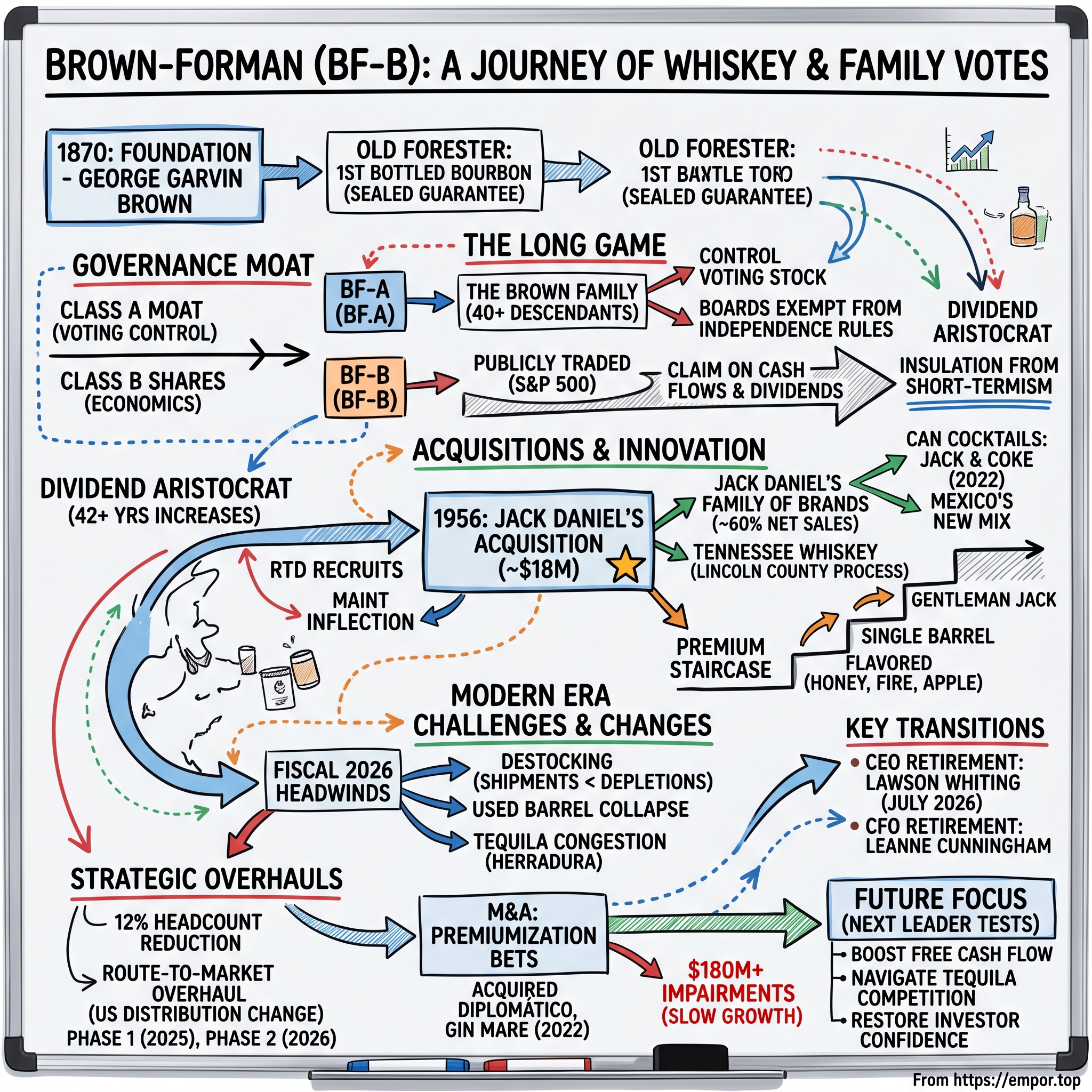
Brown-Forman Corporation: The Dynasty Built on Sealed Bottles & Sugar Maple Charcoal
I. Introduction & Episode Roadmap
In the spring of 2026, the global spirits industry briefly lost its composure over a company that had spent 156 years cultivating the opposite of drama. Reports surfaced in late April that Paris-based Pernod Ricard and Louisville's Brown-Forman had explored a "merger of equals" — a combination that would have bolted the world's most valuable American whiskey franchise onto a portfolio anchored by Irish whiskey. Those discussions ended almost as quickly as they leaked.3 Within days, the privately held Sazerac Company was reported to have floated an unsolicited approach valuing Brown-Forman in the neighborhood of $15 billion. That, too, was rejected.[^7]
Anyone surprised by the outcome had not read the company's charter. You cannot buy Brown-Forman (NYSE: BF-B). Not with $15 billion, not with a friendly French embrace, not with an activist's slide deck. Roughly forty descendants of a nineteenth-century pharmaceutical salesman control the voting stock, and until they decide otherwise, the company is not for sale at any price. That single structural fact — a family voting bloc sitting atop a publicly traded equity — is the hinge on which this entire story turns.
Here is the thesis, and it cuts both ways. Brown-Forman is one of the most durable consumer-goods enterprises America has ever produced. It walked through Prohibition, two world wars, and the near-death of brown spirits in the 1970s, and came out the other side owning Jack Daniel's, arguably the single most recognizable whiskey brand on the planet. But durability is not the same as momentum. As the company entered fiscal 2026, it was absorbing a brutal post-pandemic inventory hangover, a high-interest-rate squeeze on European demand, a congested and deflating tequila market, and fresh write-downs on the very premiumization deals that were supposed to define the current era. Fiscal 2026 net sales landed at roughly $3.9 billion, down about 1% reported and essentially flat organically, with reported earnings per share of $1.53, off from $1.84 the year before.[^1]1[^18] And then, on July 13, 2026, the architect of that premiumization strategy — CEO Lawson Whiting — announced he would retire.2[^5]
It helps to place Brown-Forman in the landscape of American consumer companies, because it is a genuine oddity. Most great CPG names — the Procters, the Colgates, the Kelloggs — long ago diffused ownership into the anonymous float, professionalized management, and organized themselves around the quarterly earnings call. Brown-Forman did the opposite. It stayed family-controlled through five generations, kept its headquarters in Louisville rather than migrating to a coastal financial capital, and built its entire identity around a small number of very old brands aged, quite literally, for years before they generate a cent. It is closer in spirit to a European luxury house — a Hermès or a family-controlled Champagne maison — than to a typical American packaged-goods conglomerate. That comparison is not incidental; it is the key to understanding both the company's remarkable staying power and the frustrations of the shareholders who own its economics but not its votes.
So this is a story caught mid-transition. Over the following sections we will walk through the castle wall of the dual-class share structure; the 1870 innovation of the sealed bottle and the 1956 acquisition that changed everything; the unmatched economics of the Jack Daniel's franchise and its ready-to-drink offspring; the roughly $180 million of impairments on Gin Mare and Diplomático; the biggest overhaul of U.S. distribution in six decades; and finally the competitive and governance stress tests that will determine whether the next generation of leadership can turn resilience back into growth. We begin where every Brown-Forman analysis must begin — not with a brand, but with a ballot.
 Subscribe on LinkedIn
II. The Brown Family Dynasty & The Class A Moat
Picture two doors into the same building. Through one door — Class A, ticker BF.A — walk the votes. Shares trade thinly, change hands rarely, and carry the right to elect the board. Through the other door — Class B, ticker BF-B — walks the money. Class B is the liquid, index-included, non-voting stock that sits in millions of retirement accounts and in the S&P 500. Public Class B holders own a claim on Brown-Forman's cash flows and dividends; what they do not own is a say in who runs the place. Roughly forty descendants of founder George Garvin Brown collectively control more than 70% of the voting Class A stock, a concentration that has held across five generations.
For the ordinary investor, the practical consequence of this two-door design is worth spelling out. Almost everyone who owns "Brown-Forman" owns Class B — it is the share included in the S&P 500 and the major indices, the one held by every index fund and most active managers, and by far the more liquid of the two. Class A, the voting stock, trades so thinly that its price can drift meaningfully from Class B's, sometimes at a premium (voting rights have value to those few who can use them) and sometimes at a discount (illiquidity has a cost). The gap between the two tickers is, in effect, the market continuously pricing the value of a vote that the family has already spoken for. What a Class B buyer is really purchasing is a claim on the economics of one of the world's great whiskey franchises, explicitly stripped of any influence over its direction — a bargain that is excellent in good times and quietly galling in bad ones.
This is not a loophole; it is the entire design philosophy. Under New York Stock Exchange listing rules, a company where more than 50% of the voting power is held by an individual or group qualifies as a "controlled company," which exempts it from requirements to maintain a majority-independent board or an independent nominating committee. Brown-Forman uses that exemption deliberately. The family's stated logic is that whiskey is a business measured in decades — bourbon sits in a barrel for four to twelve years before it earns a dollar — and that a controlling family can absorb a bad year, or a bad five years, in a way a quarterly-driven public board cannot.
The events of 2026 were the shield's stress test in real time. Both the reported Pernod Ricard merger talks and the reported Sazerac approach ran headlong into the same wall.3[^7] There is no hostile path here: a bidder cannot tender for control it is not permitted to buy, and an activist cannot win a proxy fight when the votes are locked inside one extended family. For the acquirer, this is frustrating. For the long-term Class B holder, it is genuinely double-edged, and honesty requires naming both edges. The upside is insulation from short-termism and from the value destruction that comes when premium brands get discounted to hit a number. The downside is that public shareholders will almost certainly never collect a takeover premium, and during operating slumps the stock tends to carry what might fairly be called a family-control discount — the market's price for illiquidity of control.
There is a strong case that, over the very long run, the family model has actually delivered. The clearest evidence sits in the dividend record. On the December 2025 earnings call, management noted that the board had just approved another quarterly increase, marking the forty-second consecutive year of dividend increases and the eighty-second consecutive year of paying a regular cash dividend — a streak that reaches back, unbroken, to the years immediately after repeal.[^13] That places Brown-Forman among a tiny club of "dividend aristocrats," and it is not a marketing statistic; it is a behavioral one. A dividend paid without interruption for more than eight decades is the financial signature of a company that refuses to bet the farm, that keeps leverage modest, and that treats the payout as a near-sacred obligation to the family members who depend on it for income. The same conservatism that irritates a growth investor is what has made the cash flow so bankable through wars, recessions, and category collapses.
The family also periodically returns capital in larger, lumpier ways. In October 2025 the board authorized the repurchase of up to $400 million of Class A and Class B stock, and by the end of that month roughly $99 million had already been bought back; the company has historically layered occasional special dividends on top of its regular ones when the balance sheet allows.[^13] The philosophy management articulates is a strict hierarchy: invest fully behind the brands first, then fund the regular dividend, then consider buybacks and specials. It is a deliberately unglamorous capital-allocation framework — and, notably, the one exception to that discipline in recent memory was the premiumization acquisition spree that produced the impairments we will come to. Even a fortress makes mistakes when it strays from its own rules.
Governance did not stand still through the turmoil. In July 2025, Marshall B. Farrer — a fifth-generation descendant of the founder with more than two decades inside the company, including a long run leading the international and travel-retail business — became Chairman of the Board, succeeding Campbell P. Brown. The transition matters because of what it signals about how the family manages itself. Rather than parking a passive heir in the chairman's seat, the Browns tend to elevate family members who have actually done the operating work, and they keep the roles of chairman and CEO separate, with a non-family professional running the company day to day. It is a hybrid that tries to capture the patience of family control while retaining the discipline of professional management — and, importantly, it means the roughly forty family owners speak with something close to one voice through the board, rather than fracturing into competing factions the way multi-generational dynasties so often do.
Executive incentives are structured around multi-year measures: organic net sales growth, operating income growth, and return on invested capital, rather than short-run volume. The intent is to make it financially irrational for managers to chase quarterly shipments by slashing price, the behavior that quietly kills premium alcohol brands. Whether that framework has actually restrained capital-allocation mistakes is a question the impairment charges force us to ask later — incentive design is a claim, not a result. What is beyond dispute is that this structure is the reason Brown-Forman exists as an independent company at all. To understand why the family guards it so jealously, we have to go back to a frustrated whiskey salesman in 1870.
III. Succinct Foundations: George Garvin Brown's Sealed Bottle & The 1956 Jack Daniel's Coup
In 1870, whiskey in America was sold the way milk once was: dipped from an open barrel, of unknown origin and frequently adulterated with everything from tobacco spit to turpentine. A young Louisville pharmaceutical salesman named George Garvin Brown looked at that mess and saw not a nuisance but a business model. His idea was radical in its simplicity — sell bourbon exclusively in sealed glass bottles, each carrying his signature as a personal guarantee of what was inside. The brand he built on that promise, Old Forester, became America's first bottled bourbon, and the sealed bottle itself became the first true trust mechanism in American spirits.5 Everything Brown-Forman is today descends from that one insight: that in a commodity business, a guarantee of consistency is worth more than the liquid itself.
The "Forman" in the name is worth a footnote of its own, because it explains the company's DNA. Brown funded the young venture with a physician friend and, crucially, brought in a business partner named George Forman to run the numbers while Brown ran the selling. The pairing of a relentless brand-builder with a disciplined operator became the template the company still follows a century and a half later — a family that sells romance about heritage while quietly obsessing over margin and inventory. When Forman later departed, Brown kept the name, and the hyphenated identity endured as a reminder that the enterprise was never a one-man cult of personality but a partnership built to outlive its founders.
That instinct for controlling quality carried the company through the event that killed most of its competitors. When national Prohibition arrived in 1920, the American distilling industry effectively ceased to exist — except for a tiny handful of firms permitted to bottle and distribute whiskey for "medicinal purposes," dispensed by prescription through licensed pharmacies. Brown-Forman was one of only a half-dozen companies granted such a federal permit. That license was more than a survival mechanism; it was a fourteen-year head start. While rivals dismantled their stills, sold their warehouses, and scattered their master distillers, Brown-Forman kept aged inventory maturing and its commercial machinery intact. So that when repeal came in December 1933, the company emerged not as a startup scrambling to lay down new whiskey — which would take years to become sellable — but as an incumbent with mature stock already on the shelf and a distribution relationship with pharmacists across the country. It is difficult to overstate how large an advantage that was in an industry where the product cannot be rushed; competitors who had to start from scratch spent the back half of the 1930s waiting for barrels to age while Brown-Forman was already selling.
The defining move, though, came in 1956, and it looked far less obvious at the time than it does in hindsight. Brown-Forman acquired the Jack Daniel Distillery of Lynchburg, Tennessee — a sleepy regional operation run for decades by the descendants of Jasper Newton "Jack" Daniel and his nephew Lem Motlow — for a sum generally reported at around $18 to $20 million. Put that number in context: for what would today be a rounding error, Brown-Forman bought a brand that now generates the majority of a nearly $4 billion company's sales. Few acquisitions in the history of American consumer goods have compounded so spectacularly. But nobody knew that in 1956. What the Brown family bought was not a big brand; it was a distinctive one, and they understood the difference between the two better than almost anyone.
Jack Daniel's is not bourbon, and that distinction is the whole point. Before the newly distilled spirit ever touches a barrel, it is dripped slowly through about ten feet of sugar maple charcoal — the Lincoln County Process — which mellows the whiskey and, under federal and Tennessee law, reclassifies it as "Tennessee Whiskey." That single production step carved out a category Brown-Forman could own rather than merely compete in. Bourbon is a crowded, commoditizing field with hundreds of entrants; Tennessee Whiskey, as a legally recognized style, is a much smaller room with Jack Daniel's seated permanently at the head of the table. The genius of Brown-Forman's stewardship over the following decades was to take a fiercely regional, dry-county product and make it a global emblem of a certain kind of American authenticity — helped along by cultural accidents like Frank Sinatra's very public devotion to the brand, which turned a Tennessee whiskey into a symbol of mid-century cool. The company protected the mythology obsessively: the small town, the statue of Mr. Jack, the story that the distillery sits in a county where you still cannot legally buy the product it makes. For long-term investors, this is the origin of the company's most valuable asset — not a recipe, but a defensible, non-commoditized identity, wrapped in a story, that no amount of competitor marketing can copy. That asset is where we turn next.
IV. The Crown Jewel: Inside the Jack Daniel's Empire & RTD Recruits
Walk into a bar almost anywhere on earth — Louisville, Lagos, São Paulo, Osaka — and point at the square bottle with the black-and-white label, and you will be understood without saying a word. That universality is the entire investment case for Brown-Forman compressed into one object. The Jack Daniel's family of brands drives roughly 60% of the company's total net sales, which means that when analysts model Brown-Forman, they are, to a first approximation, modeling the health of a single trademark. Flagship Black Label — Old No. 7 — moves somewhere in the range of 12 to 14 million nine-liter cases a year worldwide, a scale that a craft distiller cannot dream of and that gives Brown-Forman leverage over shelf space, distributor attention, and input costs alike.
There is a deeper economic point hiding inside that concentration. A whiskey brand at Jack Daniel's scale is close to the ideal business model: the input costs — corn, rye, barley, water, wood, time — are low relative to the price a globally beloved brand can command, and once the aging warehouses and cooperage are built, each incremental case is highly profitable. That is why Brown-Forman has historically run gross margins in the high-50s to low-60s percent, richer than most food and beverage peers and closer to a luxury-goods company than a grocery-aisle staple. The catch, and it is a real one, is that whiskey is enormously working-capital intensive: the company must distill and barrel product today that it cannot sell for four to twelve years, tying up cash in warehouses full of slowly maturing inventory. The brand generates fat margins on the way out; it demands patient capital on the way in. Understanding Brown-Forman means holding both facts at once.
The strategic genius of the franchise is not the flagship, however; it is the refusal to milk the flagship through discounting. Instead of cutting the price of Black Label to chase volume, management has spent decades building a staircase of higher-priced expressions on top of it. Gentleman Jack is charcoal-mellowed twice for a smoother profile. Single Barrel targets the premium craft-bourbon drinker willing to pay up for individuality. And the flavored line — Tennessee Honey, Tennessee Fire, and Tennessee Apple — does something subtler: it recruits people who do not actually like the taste of straight whiskey, converting them into buyers of the Jack Daniel's name. Each rung up the staircase carries a fatter margin than the one below it, which is how a mature brand keeps growing revenue faster than volume. This is what management means when it talks about premiumization within the flagship rather than through acquisition — and it is worth noting that this internally-generated version of premiumization has a far better track record than the acquired version.
Underpinning the whole edifice is advertising, and here fiscal 2026 marked a genuine inflection. At its October 2025 Investor Day, the company unveiled a new global Jack Daniel's campaign — "That's What Makes Jack, JACK" — which management described as the largest brand-building push in Jack Daniel's history, concentrated deliberately into the high-selling October–December window and extended into international airports through the travel-retail channel.[^13] The logic is defensive as much as offensive: in a soft category, share of voice matters, and a brand that goes quiet risks ceding cultural relevance to the flood of celebrity spirits and craft upstarts. Yet management was refreshingly candid on the December call that advertising cannot rescue a declining category on its own — when total distilled spirits takeaway is falling several percent, as one executive put it, "it's tough to say we're going to advertise our way out of this."[^13] That is an honest acknowledgment that brand strength sets the ceiling on pricing power, but macro demand still sets the floor on volume.
The most consequential recent chapter of that recruiting strategy is the move into ready-to-drink, or RTD — pre-mixed cocktails sold in cans. For readers who do not follow the beverage industry, this category exploded over the past decade because it solves a real consumer problem: it delivers a bar-quality cocktail with zero effort, at a beer-like price and a beer-like moment of consumption. The centerpiece of Brown-Forman's push was the launch of the official Jack Daniel's & Coca-Cola canned cocktail in late 2022 and 2023, a co-branded pairing of two of the most recognized trademarks in the world — a partnership that took a drink order people had been placing at bars for generations and put it in a can. This matters more than a novelty product line because RTDs have become financially material and because they function as a "recruiter" format: convenient, sessionable, and priced to reach younger legal-drinking-age consumers who may never buy a 750ml bottle but will happily grab a four-pack. In a category — spirits — that structurally struggles to recruit younger drinkers away from beer, seltzer, and cannabis, the RTD is the company's most credible answer to the generational question.
The Mexican market offers the most striking proof of the model, and it is not the one American investors expect. There, the company's New Mix line — billed as the world's first tequila-based RTD — has been one of its single strongest growth drivers, helping fuel 18% organic growth in the RTD portfolio in the first half of fiscal 2026.[^13] What makes New Mix especially instructive is that it thrived precisely because Mexican consumers were trading down: in a subdued economy where drinkers sought value, an affordable canned tequila cocktail was exactly the right product at the right price. Management has been unusually direct that this is a double-edged blessing — RTDs and agency brands carry lower gross margins than premium bottled spirits, so their rapid growth actually drags reported product mix downward even as it drives volume.[^13] It is a reminder that not all growth is equally valuable, and that a "recruiter" brand earns its keep in customers acquired, not margin per case.
The newest lever is Jack Daniel's Tennessee Blackberry, launched in the United States in August 2025 and rolled out in phases across the U.K., Germany, France and travel retail through the fiscal year. On the December 2025 earnings call, management described Blackberry as exceeding expectations, noting that at Tesco in the U.K. it was the best-performing new spirits launch of the period, with more than half of buyers new to the category and a double-digit repeat rate.[^13] The honest analytical read is twofold. On one hand, Blackberry demonstrably offset volume softness in standard Black Label and pulled the whole Jack Daniel's shelf along with it — real evidence of brand pull. On the other, a launch that big flatters shipments ahead of true consumer demand, and management itself conceded that shipments ran ahead of depletions during the rollout, a gap it expects to narrow.[^13] Innovation is buying time and mix; it is not, by itself, proof the underlying category has turned. That distinction — between a company's own execution and the tide of its industry — is exactly what the competitive landscape brings into focus.
V. The Spirits Matrix: Competitor Battles, Scale, and Industry Structure
To understand Brown-Forman's position, imagine the global spirits business as a handful of heavily armed empires and one fortified independent city-state. Brown-Forman is the city-state: smaller than the empires, but holding a fortress — American whiskey — that the others have never managed to storm.
The largest empire is Diageo, the London-based giant that leads the world in Scotch through Johnnie Walker and has muscled into tequila with Don Julio and Casamigos. For all its scale, Diageo's American whiskey footprint is comparatively modest, anchored by Bulleit at roughly 2.5 million cases — a fraction of Jack Daniel's. The most direct threat in Brown-Forman's home category is サントリー Suntory, the Japanese group that paid about $16 billion for Beam Inc. in 2014 and now operates as Suntory Global Spirits.8 Suntory commands the American whiskey volume market with Jim Beam, near 10 million cases, and owns the super-premium bourbon high ground with Maker's Mark, Knob Creek, and Basil Hayden. If anyone can contest Jack Daniel's on scale and heritage simultaneously, it is Suntory.
Then there is Sazerac — private, secretive, and aggressive — the same company reported to have circled Brown-Forman in 2026. Sazerac controls the allocated-bourbon cult market through Buffalo Trace, Pappy Van Winkle, and Blanton's, owns the high-volume juggernaut Fireball, and, tellingly, bought Southern Comfort and Tuaca from Brown-Forman itself for $543.5 million in 2016.7 The irony is thick: a company that Brown-Forman used as a disposal bin for unwanted brands later showed up as a would-be acquirer. Rounding out the field is Pernod Ricard, strong in Irish whiskey through Jameson but structurally light in American whiskey — precisely the gap that reportedly drove its interest in a merger.3
Each of these rivals reveals something about Brown-Forman's position by contrast. Diageo's scale lets it out-spend and out-distribute almost anyone, yet its repeated, expensive attempts to buy its way into American whiskey underline how hard the category is to enter from outside — heritage cannot be acquired at a premium if the seller will not sell. Suntory's Beam purchase gave it genuine bourbon depth, but it also saddled the group with the same category headwinds Brown-Forman faces, which is why "who is winning American whiskey" is increasingly a question of who is losing least. Sazerac's model is almost the philosophical opposite of Brown-Forman's: where Brown-Forman guards a small number of premium icons and returns cash to a family, Sazerac has assembled a sprawling, value-to-luxury empire — Fireball to Pappy — through relentless, opportunistic dealmaking, and its willingness to bid for Brown-Forman signals how much it covets a true blue-chip anchor. And Pernod Ricard's reported interest is the tell that, for all Brown-Forman's operational bruises, its core franchise is viewed by sophisticated strategic buyers as one of the few genuinely irreplaceable assets in global spirits.
Beneath the brand-versus-brand combat sits the industry's real power structure, and it is not flattering to the producers. In the United States, alcohol flows through a mandated three-tier system — a Prohibition-repeal-era legal architecture that survives to this day. Producers must sell to licensed distributors, who in turn sell to retailers; with narrow exceptions, a distiller cannot sell straight to a store or a bar. The system was designed after 1933 to prevent producers from controlling retail the way "tied houses" had fueled pre-Prohibition excess, but its modern consequence is an entrenched middleman tier that every brand must pass through. Over the past two decades those distributors have consolidated into a small number of behemoths — Southern Glazer's and Breakthru Beverage chief among them — each carrying tens of thousands of competing SKUs. When a single distributor represents dozens of suppliers, no individual brand automatically commands its sales force's attention; the distributor holds enormous bargaining power over shelf placement, menu listings, and which products get pushed. This is the structural reality that, as we will see, forced Brown-Forman into the largest distribution overhaul in its modern history — a producer trying to buy back the middleman's focus. Within its own portfolio, the segment map for fiscal 2026's roughly $3.9 billion in net sales is straightforward: whiskey remains the overwhelming majority, tequila is the second pillar via Herradura and el Jimador, and a long tail of rum, gin, and other investments makes up the rest.[^1] Two names beyond Jack Daniel's deserve attention because they represent the healthier, internally-built version of premiumization. Woodford Reserve, launched by Brown-Forman in 1996, has grown into the clear leader of the super-premium bourbon segment at around 1.5 million cases, riding the very craft-and-premium wave that Jim Beam's Maker's Mark and Knob Creek also serve — a rare case of Brown-Forman building a major brand from scratch rather than buying one. Old Forester, the 1870 original, has enjoyed a second life as the bourbon boom rewarded authentic heritage brands, anchoring the company's presence on Louisville's revived Whiskey Row. Together they demonstrate that Brown-Forman can create premium American whiskey equity organically; the open question, underlined by the impairments, is whether it can buy premium equity in categories where it has no such heritage. It is that long tail — the acquired premiumization bets — where the story turns painful.
VI. Premiumization M&A & The $180M+ Write-Down Hangover
Every era of Brown-Forman has a defining strategic bet, and Lawson Whiting's was a single word: premiumization. Whiting was not a marketer by training but a finance man — he had spent years as the company's chief financial officer and chief brand officer before becoming CEO in January 2019, only the seventh chief executive in the company's history and, notably, not a member of the Brown family. That background shaped his instincts: he thought in terms of portfolio construction, margin mix, and return on invested capital, and he brought a CFO's conviction that a spirits company should own fewer, better, higher-priced brands rather than a broad shelf of mediocre ones. From the time he took the top job, the plan was elegant on paper — shed the low-margin, standard-priced brands that dilute the portfolio, and use the proceeds to buy small, ultra-premium, high-margin international spirits with room to run. For several years, the selling half of that strategy looked like textbook portfolio discipline.
It is worth understanding why premiumization became the reigning strategy across the entire spirits industry, not just at Brown-Forman. For two decades the structural tailwind in developed-market alcohol was consumers "drinking less but better" — trading up from cheap, high-volume liquor to fewer, finer bottles, a shift that let producers grow revenue and margin even as total volumes stagnated. Every major spirits house reorganized around this insight, and it worked spectacularly through the 2010s and the pandemic years, when locked-down consumers splurged on premium bottles. Whiting's bet was simply the most concentrated version of the industry consensus. The problem, in hindsight, was that "drink less but better" quietly reverses in a downturn: when the consumer is squeezed, the very trading-up behavior that powered premiumization runs backward into trading-down — exactly what management observed at the high end in late 2025, where products above $100 were falling far faster than the mainstream. Premiumization, in other words, was never a permanent one-way escalator; it was a cyclical amplifier that magnifies both the boom and the bust.
The divestiture program itself was methodical. Southern Comfort and Tuaca went to Sazerac in 2016 as consumers migrated toward authentic straight whiskeys, a sale that generated a roughly $475 million one-time gain and cleanly exited a fading, once-iconic liqueur.7 Early Times and Canadian Mist followed to Sazerac in 2020, clearing out value-tier whiskey. In 2023, Brown-Forman exited vodka entirely, selling Finlandia to Coca-Cola HBC for $220 million and walking away from one of the most commoditized, promotion-dependent categories in all of spirits.6 And in fiscal 2024, it offloaded Sonoma-Cutrer wine to The Duckhorn Portfolio for a mix of cash and a 21.5% equity stake, trimming its exposure to the structurally challenged wine business.4 Read together, these moves tell a coherent story: management was willing to shrink revenue to raise quality, which is exactly what a premiumization thesis requires.
The buying half is where the thesis met reality. In 2022, Brown-Forman agreed to acquire Diplomático, a Venezuelan-origin ultra-premium sipping rum, for a price reported at around $725 million, and Gin Mare, a super-premium Mediterranean gin, for roughly $500 million.[^11][^12] The strategic logic was sound — both were high-margin, aspirational brands positioned in premium niches with European strength. The timing was catastrophic. These deals were struck at the peak of pandemic-era optimism, when spirits demand and asset multiples were both inflated. Then interest rates rose from near zero to above 5%, European consumer spending slowed sharply, and the growth projections underpinning the purchase prices simply failed to materialize.
The result was a sequence of non-cash impairment charges that landed like a slow-motion admission of overpayment. Fiscal 2025 brought a $47 million write-down on Gin Mare. Fiscal 2026 brought a far larger $132 million charge — roughly $87 million against Diplomático and $45 million more against Gin Mare — pushing the cumulative markdown on the two deals past $180 million in under three years.[^3] An impairment is an accounting judgment, not a cash outflow, but it is also a confession in numbers: it means the company's own auditors and management have concluded that the assets are worth materially less than what was paid. When roughly a quarter of the combined purchase price is written off within thirty-six months, the market is entitled to read that as evidence the original valuation was wrong.
The analytical conclusion is uncomfortable but clear: management paid multiples that only made sense if hyper-optimistic growth arrived on schedule, and it did not. Premium-spirits transactions have historically cleared in the range of 15 to 20 times EBITDA; the evidence of impairment suggests these went higher, on projections that hindsight has falsified. There is a defense, and fairness requires stating it: these were small brands bought for strategic optionality in categories — sipping rum and Mediterranean gin — that could plausibly become large, and the write-downs are non-cash and do not touch the dividend or the core Jack Daniel's engine. But the defense cuts only so far. This is precisely the sort of capital-allocation record a skeptical investor should hold against the very incentive framework — the multi-year ROIC targets described earlier — that was supposed to prevent exactly this behavior. A company that preaches discipline and then overpays at a cyclical peak has, at minimum, a credibility gap to close, and closing it will be one of the first tests of the next CEO. Whether the destruction was a strategic error or simply bad timing, it landed on top of an operating environment that was deteriorating for reasons that had nothing to do with M&A.
VII. The Post-Pandemic Hangover: Destocking, Tequila Congestion, and the Historic Route-to-Market Overhaul
To understand the strangest number in Brown-Forman's recent results, you have to understand the difference between two words that sound almost identical and mean completely different things: shipments and depletions. A shipment is a sale from Brown-Forman to a distributor — the moment revenue is recognized. A depletion is a sale from that distributor onward to a retailer or bar — the moment a real consumer is actually being served. In normal times the two track each other. In the aftermath of the pandemic, they violently diverged, and that divergence explains most of the pain of the last two years.
Here is the mechanism. During COVID-era supply-chain chaos, distributors hoarded inventory, holding 60 to 90 days of stock as insurance against shortages. Then interest rates spiked, and suddenly all that idle inventory became expensive to finance. So distributors did the rational thing: they slashed their holdings back toward 30 to 45 days to free up working capital. For Brown-Forman, this meant shipments fell well below actual consumer demand — the company was, in effect, being paid less even as drinkers kept buying at a steadier pace. Reported net sales declined while underlying depletions held up far better. This is why management spent much of fiscal 2026 pleading with investors to look through the shipment line to the depletion trend beneath it.
Layered on top of destocking were two headwinds management itself flagged as "somewhat unique to Brown-Forman." On the December 2025 call, executives disclosed that used-barrel sales — the business of selling emptied bourbon barrels to Scotch and Irish whiskey makers — had collapsed by more than 60%, and that net sales into Canada had fallen over 60% because American spirits had been pulled from shelves across most Canadian provinces amid a U.S.–Canada trade dispute. Together, management said, those two factors alone knocked more than two percentage points off first-half organic sales.[^13] These are not consumer-demand problems; they are the kind of idiosyncratic, hard-to-model shocks that make a single fiscal year a poor gauge of brand health.
The geography of demand told its own story, and it was a story of two worlds. On the December 2025 call, management reported that its emerging international markets grew a collective 12% organically in the first half, led by Mexico and Brazil, while the global travel-retail channel — airport duty-free shops, buoyed by passenger volumes finally surpassing pre-pandemic levels — grew 6%.[^13] Brazil was a standout, with the Jack Daniel's family growing more than 20% as the company expanded distribution and pushed Tennessee Apple and premium whiskey. Against that, the developed world sagged: net sales fell 6% collectively across developed international markets, with the United Kingdom down 13% and Germany down 8% as pressured European consumers saved more and drank less.[^13] The United States, the company's largest market, was roughly flat. The divergence is analytically important: it suggests the weakness is less about Jack Daniel's losing relevance and more about the macroeconomic squeeze on discretionary spending in high-income, high-interest-rate economies — a cyclical read rather than a structural one, though, as management conceded, the two are genuinely hard to disentangle.
Then there was tequila. For years, tequila was the industry's darling, growing double digits as agave-based spirits went mainstream. That gold rush drew a flood of new entrants and celebrity brands, and as growth cooled, the category congested and began to deflate. Brown-Forman's super-premium tequila, Herradura, felt it directly: in fiscal 2026, Herradura net sales fell around 9%, roughly 10% on an organic basis, as distributors and retailers destocked the category.[^1] There is a cruel twist buried in the tequila supply chain, too. The price of blue agave — the plant tequila is distilled from — had collapsed from its pandemic-era highs, which should have been a margin windfall. But because Brown-Forman's own demand had slowed, it was working through expensive, high-cost bulk tequila and aging inventory laid down when agave was dear, so the benefit of cheaper agave will not reach the income statement until that costly inventory clears.[^13] The company was, in other words, hit by destocking twice — once across its whole portfolio and again, specifically, in the tequila aisle — and denied even the consolation of falling input costs.
Management's response was not to wait it out. In January 2025 it announced a strategic restructuring that reduced global headcount by roughly 12% and closed the historic Louisville Cooperage — a wrenching decision for a company that had long prized making its own barrels, and one that traded a piece of its vertical-integration heritage for lower costs and outsourced wood supply. The workforce reduction carried a one-time post-retirement expense but was designed to permanently lower the SG&A base and, in management's framing, free up dollars to reinvest behind the brands.[^13] The early financial evidence that the discipline is working shows up not in the income statement but in the cash-flow statement: in the first half of fiscal 2026, free cash flow rose by $179 million to $236 million, driven by tighter working-capital management, reduced finished-goods inventory, and lower capital expenditure as the company finished a long cycle of distillery and warehouse expansion.[^13] For a business that spent the pandemic years pouring cash into capacity and inventory, the pivot toward cash generation is a genuine, if early, positive — and it is the kind of self-help that does not depend on the category turning.
Alongside the cost work, management undertook something genuinely rare: the first wholesale overhaul of its U.S. distribution network in more than sixty years. Phase 1, completed in 2025, realigned thirteen markets and installed Breakthru Beverage Group as the company's largest national distributor partner.[^9] Phase 2, announced in April 2026, tackled eighteen "control state" markets, appointing Johnson Brothers and Southern Glazer's across eleven of them.[^8] The mechanics of the switch were more fraught than the tidy phase labels suggest. California went live first, on May 1, 2025, and management later admitted the transition took longer than expected before recovering; the bulk of the remaining markets — thirteen of them, including the crown jewels of Texas and New York — went live simultaneously on August 1, 2025, meaning the company effectively re-plumbed a huge share of its domestic distribution in a single quarter.[^13] Changing distributors is not like changing a supplier; it means new sales representatives learning the portfolio from scratch, rebuilding relationships with thousands of individual bars and retailers, and inevitably losing some cocktail-menu placements and drink-list listings in the handover — precisely the "disruption" management acknowledged hit its smaller emerging brands hardest. That is the near-term cost. The strategic prize is threefold: dedicated sales focus, cleaner inventory visibility, and — the piece management was most eager to highlight — structurally better distributor terms that flow straight to the top line.
On the December call, management said the transitions were "complete" and already contributing, with U.S. depletion-based results running a striking six percentage points ahead of retail takeaway trends (roughly +3% versus −3%) — a gap driven by the improved terms, the Blackberry loading, and increased distributor investment behind the Jack Daniel's family.[^13] Whiting stressed that the improved terms are "permanent," not a one-quarter sugar high, which if true would represent genuine margin recapture from the middle tier.[^13] That is encouraging evidence of execution. It is also, by management's own admission, partly a timing benefit from loading new distributors, which makes the durability of the gain — and the eventual convergence of shipments back down to depletions — the thing to watch. The overhaul is a bet that better plumbing can claw back margin and bargaining power from the very buyers whose consolidation created the problem — and it is best understood through the lens of what actually constitutes a durable advantage.
VIII. Playbook: Porter's 5 Forces & Hamilton Helmer's 7 Powers
Strip away the brands and the family drama, and the question every long-term investor must answer is brutally simple: what, precisely, stops someone else from doing what Brown-Forman does? Hamilton Helmer's 7 Powers framework is a useful scalpel here, and applied honestly it yields three real powers and a candid acknowledgment of where the moat thins.
The first and by far the strongest is Brand. Jack Daniel's is not a preference; it is a cultural artifact, as legible in a Tennessee gas station as in a Tokyo cocktail bar. That equity is what lets Brown-Forman raise price slowly and steadily — "low and slow," in Whiting's own repeated phrasing — even through downturns, without triggering the volume collapse that would punish a lesser name.[^13] Brand is why the company can build a margin-rich staircase of expressions on a single trademark, and why a co-branded can with Coca-Cola instantly commands shelf space. It is the one power here that is genuinely extreme and genuinely hard to replicate, because it was accumulated over a century and a half and cannot be bought.
The second is a Cornered Resource, and it comes in two forms. The first is legal: the Lincoln County Process and the "Tennessee Whiskey" designation wall off a category that competitors cannot enter by definition. The second is physical: Brown-Forman is the only major spirits company that manufactures its own new white oak barrels. In an industry where every drop of bourbon and Tennessee whiskey must age in a charred new-oak barrel, controlling cooperage means controlling wood quality, guaranteeing supply, and managing cost when white oak runs short. The nuance — and a real one — is that the company has been shifting cooperage toward outsourcing and closed its Louisville Cooperage in the cost-cutting round, which trades some of that vertical control for flexibility and lower capital intensity.[^13] The resource is still a genuine edge; it is simply being managed more for cost than for control than it once was.
The third power, Scale Economies, is the most qualified. Brown-Forman is large enough to command distributor attention and preferred shelf placement that craft distillers cannot, and the freshly consolidated distribution network is designed to sharpen exactly that advantage. But in absolute terms Brown-Forman is a mid-sized player dwarfed by Diageo and Suntory, so scale is a moderate power at best — real against the small, thin against the giants.
Porter's Five Forces fills in the threats. The threat of new entrants splits cleanly by category: aging whiskey four to ten years before it can be sold is a formidable capital and time barrier — a would-be competitor must fund years of inventory before earning a dollar — but silver tequila can be distilled and bottled almost immediately, which is exactly why the tequila aisle flooded with entrants and then deflated. The bargaining power of buyers — meaning the consolidated distributors — is high, and the entire route-to-market overhaul was a direct attempt to claw some of it back. The bargaining power of suppliers is generally low for grain and glass but idiosyncratically high for two inputs: American white oak, where a genuine wood shortage can pinch every distiller at once, and blue agave, whose violent price swings whipsaw tequila economics. The threat of substitutes is real and arguably rising: premium RTDs, craft beer, wine, cannabis, and a genuine "sober-curious" cultural shift, now sharpened by the spread of GLP-1 weight-loss drugs that suppress the urge to drink. And competitive rivalry among the established players remains, in management's own recurring word, "rational" — the big suppliers have so far declined to start a price war, protecting industry margins, though that restraint is a behavior, not a guarantee.[^13] On the December call, management was directly pressed on whether the spirits slowdown is cyclical or structural and, tellingly, would not fully commit — conceding that trade-down was cyclical while allowing that GLP-1s and wellness trends were a "somewhere in the middle" question it could not yet resolve.[^13] An investor should treat that honest hedge as the single most important open question in the whole story. The powers protect the fortress; they do not guarantee the market keeps growing around it.
Myth versus reality. It is worth puncturing three comfortable narratives that surround this company. The first myth is that Brown-Forman possesses unlimited pricing power because Jack Daniel's is so beloved. The reality is more disciplined and more constrained: management deliberately prices "low and slow," and in the soft environment of late 2025 the company's overall portfolio pricing was actually down about 0.3% — close to flat, not aggressively higher.[^13] Brand equity buys the right to hold price without losing volume; it does not, in a weak market, buy the ability to push price meaningfully upward. The second myth is that premiumization is an unbroken success story. The reality is that the internally-generated premiumization of the Jack Daniel's family has worked beautifully, while the acquired premiumization of Gin Mare and Diplomático has, so far, destroyed value — the same word, two very different outcomes. The third myth is that the family structure means the company is sleepy and change-averse. The reality of fiscal 2025–2026 — a 12% headcount cut, a shuttered cooperage, and the largest distribution overhaul in six decades — is a company willing to inflict real short-term pain on itself. The family's patience, it turns out, buys the freedom to make disruptive changes without a proxy fight, not the license to avoid them.
IX. The Activist Stress Test, Risk Radar, and the 2026 Takeover Drama
Return, now, to the drama that opened this story, and ask the question a hard-nosed investor would ask: why would anyone bid $15 billion for a company posting flat organic sales and falling margins? The answer is the same reason the family will never sell — the sheer durability of Jack Daniel's cash flow. Sazerac was reportedly buying a fortress, not a growth story.[^7] Pernod Ricard reportedly wanted the one crown jewel its portfolio structurally lacks: a genuine American whiskey icon.3 Both approaches were, in a sense, compliments — external validation that the core asset is close to irreplaceable — and both were doomed by the ballot structure examined at the outset.
This is where the activist stress test becomes uncomfortable for public shareholders, because the very thing protecting the company also caps their upside. In an ordinary public company, a run of flat sales, $180 million of impairments, and a reactive strategy overhaul might invite an activist campaign or a premium takeout. At Brown-Forman, neither can happen without family consent. The dual-class structure functions as a golden cage: it protects long-term brand equity from short-term raiders, but it also ensures the Class B holder is highly unlikely to ever be bought out at a premium, and must instead sit through operating troughs with only the dividend and the family's patience for comfort. That is the trade every BF-B owner is making, whether they realize it or not.
A skeptical long/short investor would press on more than governance. The capital-allocation record is the obvious pressure point — the impairments are prima facie evidence that management overpaid at the top of a cycle, right after a framework built around ROIC discipline. Portfolio complexity is another: a long tail of small international brands (Diplomático, Gin Mare, Fords Gin, Glendronach) that individually move the needle little but collectively consume management attention and, now, write-down ink — the classic "diworsification" critique, in which a focused, high-return core is diluted by a scattering of subscale bets. An activist might reasonably argue that Brown-Forman would be worth more as a nearly pure-play Jack Daniel's, Woodford, and Herradura company, shedding the rest. And there is the question of whether the route-to-market overhaul is genuine margin recapture or simply a one-time inventory reload dressed up as strategy — a concern management's own "shipments ahead of depletions" disclosures make fair to raise.[^13]
Yet the same activist would run into hard limits, and they are instructive. On the balance sheet, there is little to attack: Brown-Forman has historically run conservative leverage, and its eighty-two-year dividend record is itself proof of a management that will not over-lever the company to juice returns.[^13] Disclosure is clean and consistent — the company has told the same "look through shipments to depletions" story for two years running, and its willingness on earnings calls to quantify unflattering headwinds like the 61% collapse in used-barrel sales and to openly wrestle with the structural-versus-cyclical question is the behavior of a management that explains its misses rather than hiding them.[^13] That candor is a genuine mark of credibility, and it should be weighed against the capital-allocation stumbles, not ignored because of them. The deepest limit, of course, is the one already established: even a perfectly reasoned activist thesis dies at the ballot box. There is no lever an outside investor can pull that the family does not control. For public Class B holders, this means the only realistic path to value creation is operational — the business getting better — rather than transactional. There will be no rescue by acquirer, no boardroom coup, no forced break-up. What you own is a bet on the brand and on the family's stewardship of it, full stop.
It is worth making the bull-and-bear spine explicit, because the whole investment debate reduces to a single tension. The bull case is that this is a temporary, cyclical trough in an extraordinarily durable franchise: destocking will end, the used-barrel and Canada headwinds are idiosyncratic and will lap, the cost cuts and route-to-market overhaul are permanent margin and focus improvements, free cash flow is inflecting upward, and the world's most iconic whiskey brand — protected by a legal category, its own cooperage heritage, and 156 years of trust — will resume its long compounding once the macro clears. The evidence for that case is real: the brand keeps gaining share in most European whiskey markets even as the category shrinks, emerging markets and travel retail are growing double digits and mid-single digits respectively, and innovation like Blackberry is demonstrably pulling in new-to-category consumers.[^13] The bear case is that the trough is at least partly structural: GLP-1 drugs and wellness culture are permanently capping alcohol consumption in developed markets, spirits are losing younger drinkers, the premiumization acquisitions revealed a capital-allocation problem rather than a one-off, and the family structure means public holders will absorb these disappointments with no takeout escape and no activist to force change. Both cases draw on the same facts; what separates them is the answer to the structural-versus-cyclical question that management itself will not yet call.
The risk radar beyond governance is concrete and worth naming by mechanism. Input-cost and agricultural risk: white oak scarcity, corn and grain pricing, glass costs tied to natural gas, and the peculiar dynamics of agave, where a Mexican oversupply could trigger a tequila price war that erodes Herradura's premium positioning. Execution risk: overhauling distributor relationships across two dozen-plus states at once is genuinely dangerous — a newly appointed distributor that fails to prioritize the portfolio can quietly surrender shelf space that takes years to win back, and management itself flagged early "disruption" among its smaller emerging brands during the transition, where lost menu and drink-list placements took time to rebuild.[^13] Geopolitical and trade risk: the Canada shelf removals and the tariff overhang are live reminders that a company producing iconic American spirits is uniquely exposed whenever "American" itself becomes a political liability abroad — an ordinary consumer-goods firm can source around a trade dispute, but Jack Daniel's cannot be made anywhere but Tennessee. Demand-structural risk: the GLP-1 and sober-curious question that management itself cannot yet answer. Concentration risk: with roughly 60% of net sales riding on a single brand family, any lasting cultural shift away from Jack Daniel's specifically — not just spirits generally — would be difficult to offset. None of these is fatal in isolation. Collectively, they explain why a fortress balance sheet and an iconic brand have still produced two years of going-nowhere results — and why the person chosen to lead next matters so much.
X. Epilogue & The Transition from Lawson Whiting
On July 13, 2026, Brown-Forman announced that Lawson Whiting would retire as President and CEO.2[^5] After nearly three decades at the company and seven years in its top job, Whiting departs as the architect of the premiumization era — the executive who reshaped the portfolio, launched the RTD engine, drove the Jack Daniel's & Coca-Cola partnership, and pushed through the most sweeping distribution overhaul in sixty years. He also leaves behind a portfolio bruised by more than $180 million in impairments on his signature acquisitions and a top line that has gone essentially sideways.[^3] His tenure is a genuinely mixed inheritance, and it would be dishonest to render it as either triumph or failure; it is both, unresolved.
The timing compounds the transition, because Whiting is not the only seat turning over. CFO Leanne Cunningham had already announced her own retirement effective at the end of fiscal 2026, with a successor search that management said on the December call could run into early calendar 2026.[^13] A company that prizes continuity above almost all else is thus replacing both its chief executive and its chief financial officer at the bottom of an operating cycle — an unusual concentration of change for an institution built to avoid exactly that. It raises a fair governance question: is this an orderly, planned generational handoff, or does the clustering of departures at a low point hint at deeper strategic disagreement about the path forward? Management has framed it as the former, and the family's history of smooth successions supports that reading, but the market will watch the successor announcement closely for signals — an internal, family-blessed promotion would signal continuity, while an outside hire from a larger rival would signal appetite for a sharper break.
The board's search committee inherits a pointed mandate on three fronts. First, finish the U.S. route-to-market transition and, crucially, prove the improved distributor terms are a permanent margin gain rather than a one-time reload — the "shipments ahead of depletions" gap has to close cleanly. Second, revitalize Herradura and navigate a possible tequila price war without surrendering the brand's premium positioning, a genuinely hard needle to thread when competitors are armed with cheap agave. Third, and most important for credibility, restore investor confidence in capital allocation after the Gin Mare and Diplomático overpayments — which most likely means a period of no large acquisitions, aggressive free-cash-flow generation, and steady return of capital through the dividend and buyback, letting behavior rather than rhetoric rebuild trust. The next leader's first real test will be whether the discipline the company preaches actually governs the next deal it does — or does not do.
For investors trying to separate signal from noise as that transition unfolds, three metrics matter above all others, and none of them is the headline revenue line — which, distorted by divestitures, currency, and the shipments-versus-depletions gap, is nearly uninterpretable on its own. The first is organic net sales growth. This is the company's own preferred measure precisely because it strips out acquisitions, divestitures, and foreign-exchange noise to isolate the underlying health of the brands the company actually owns and operates. When organic growth is flat, as in fiscal 2026, the brands are treading water; the moment it turns durably positive, the cyclical trough is likely ending. It is the single truest read on demand.
The second is gross margin, which reached 60.5% in fiscal 2026, up from about 58.9% the prior year.[^1][^18] Because the entire premiumization thesis is, at bottom, a claim about pricing power and mix, the gross-margin line is where that claim is either validated or exposed. The nuance to watch is why the margin moves: expansion driven by genuine price and premium mix is healthy, but expansion driven merely by the absence of divested low-margin brands is cosmetic, and margin pressure from fast-growing but lower-margin RTDs and agency brands can mask real pricing strength. An investor should read the margin bridge, not just the headline number.
The third is the estimated net change in distributor inventories — the single cleanest signal of whether the destocking cycle that has distorted two years of results has finally bottomed. As long as distributors are still drawing down stock, reported net sales will understate true consumer demand; the moment inventories stabilize and shipments re-converge with depletions, reported results should snap back toward the underlying depletion trend. That convergence, more than any single quarter's sales figure, will mark the true inflection point in this story. A skeptical investor will also keep half an eye on a fourth, slower-moving tell — the barreled-whiskey and finished-goods inventory on the balance sheet, which management has been deliberately drawing down to reduce working-capital intensity, a lever that boosts near-term cash flow but that cannot be pulled forever without eventually constraining future supply.[^13]
That is the whole story in three numbers and one question. Brown-Forman remains what it has been for a century and a half: a fortress brand, a family that will not sell, and a balance sheet built to wait. What it has to prove, now under new leadership, is that resilience — the ability to survive anything — can once again become the ability to grow. The sealed bottle George Garvin Brown signed in 1870 still guarantees what is inside. Whether the fifth generation can guarantee the same for the company's next chapter is the question the market will spend the coming years answering.
References
-
Brown-Forman reports flat sales on slower demand — Reuters, 2026-06-04 ↩
-
Brown-Forman CEO Lawson Whiting to Retire — The Spirits Business, 2026-07-13 ↩↩
-
Brown-Forman and Pernod Ricard End Merger of Equals Discussions — Financial Times, 2026-04-28 ↩↩↩↩
-
Brown-Forman Announces Agreement to Sell Sonoma-Cutrer Vineyards to The Duckhorn Portfolio — Brown-Forman Corporation, 2023-11-16 ↩
-
Old Forester — America's First Bottled Bourbon — Brown-Forman Corporation ↩
-
Brown-Forman Completes Sale of Finlandia Vodka — Brown-Forman Corporation, 2023-11-01 ↩
-
Brown-Forman Agrees To Sell Southern Comfort And Tuaca To Sazerac For $543.5 Million — Fox Business, 2016-01-14 ↩↩
 LinkedIn
 WhatsApp
 Reddit
 Hacker News
 Email
Email Kindle
 RSS Feed
 Spotify
 Apple Podcasts
 Amazon Music
 Audible
 YouTube