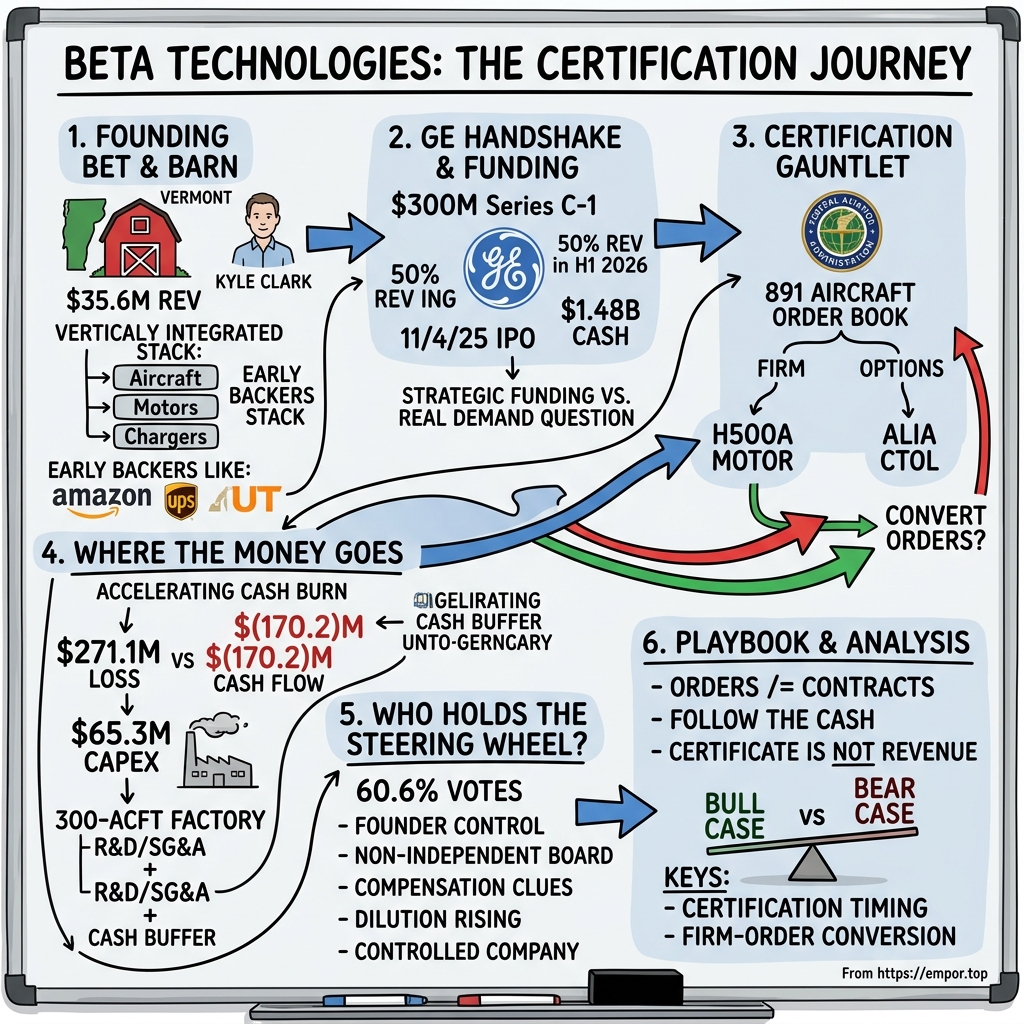
BETA Technologies: Can an Electric-Aircraft Maker Turn a $3.47B Order Book into Certified Aircraft?
I. Introduction & Episode Roadmap
Picture a hangar outside Burlington, Vermont, on a grey winter morning. A white aircraft with a long, glider-like wing sits on the apron. It has no fuel tank, no exhaust stack and no smell of jet-A. Its batteries are topped up by a squat charger, a box that looks more like a petrol pump than an aircraft part. The company that built the aircraft, the charger and the motor reported $35.6 million of revenue in 20251. It lost $745.9 million in the same year1. On 30 June 2026 it held about $1.48 billion of cash2. Public investors value it at well over a billion dollars.
How does a business that small, losing that much, command that kind of price? The short answer is that investors are not buying the 2025 income statement. They are buying a bet on a moment that has not yet happened: the day the US Federal Aviation Administration certifies an entirely new kind of aircraft, and the day customers who have signed letters and options start paying for delivered machines.
BETA Technologies sells three things. It sells the ALIA, an electric aircraft offered in a conventional take-off version (CTOL, meaning it uses a runway like any small plane) and a vertical take-off version (VTOL, meaning it lifts off like a helicopter). It sells electric motors, led by a propulsion unit called the H500A. And it sells chargers. It is pre-commercial in the plain sense of the word: it has not delivered certified aircraft to paying airlines. Its Class A shares started trading on the New York Stock Exchange on 4 November 20251.
Four questions run through this story, and the article returns to them repeatedly.
First, can BETA turn orders into certified, delivered aircraft before the cash runs out? The company reports interest in 891 aircraft worth $3.47 billion1, but most of that is optional.
Second, is the revenue real commercial demand, or strategic funding from GE Aerospace, which is at once an investor, a customer, a co-developer and a board-seat holder?
Third, is founder control a governance risk? Kyle Clark, the founder and chief executive, controls roughly 60% of the votes3.
Fourth, how much of the reported loss is actual cash? The headline loss and the cash burn turn out to be very different animals.
One discipline runs through every section. Technical capability and commercial success are different things. A first flight is not a sale. A certificate is not a customer. A famous logo on a press release is not a purchase order. Electric aviation has produced many technical firsts and very little revenue, and BETA has to be judged against that history rather than against its own ambitions.
The story starts in a place most aerospace companies do not: a founder's workshop in rural New England.
 Subscribe on LinkedIn
II. A Barn in Vermont: Kyle Clark and the Founding Bet
Kyle Clark is not the usual aerospace chief executive. He is a pilot and an engineer who flies the machines he builds, and BETA's public imagery leans heavily on that fact: the founder in the cockpit, the founder on the hangar floor, the founder strapping into a prototype. The company grew up in South Burlington, Vermont1, far from the aerospace clusters of Seattle, Southern California and Toulouse. That geography says something. BETA was not spun out of a defence contractor or an airline. It was built from the ground up by people who wanted to make an electric aircraft work end to end.
The defining choice was to build the whole stack. Most aerospace start-ups pick a layer. Some design the airframe and buy motors. Some make motors and sell them to airframers. Some build charging and hope someone else builds the aircraft. BETA chose all three: the ALIA airframe, its own electric propulsion and its own charging network1.
Why do that? The logic is coherent. An electric aircraft is a system. The battery, the motor, the thermal management and the charger have to be designed together, much as Tesla argued for cars a decade earlier. If the charger network does not exist, nobody buys the aircraft. If the motor is bought from a supplier, the airframer is hostage to that supplier's certification timetable. Owning everything means controlling the critical path.
The cost of that logic is also clear. Vertical integration multiplies the things that can go wrong. Each component needs its own engineering team, its own testing and in some cases its own certification. It also means the business has several products waiting for one door to open. Until the FAA certifies the aircraft, the motor and the charger are worth far less than they will be afterwards.
Early backers, early signals
BETA attracted marquee names early. Amazon, Lear and United Therapeutics show up as backers or partners in the company's filings1. United Therapeutics, the biotechnology company, was interested in flying organs for transplant, a niche where speed matters more than cost per seat. These relationships were real, and they gave the company credibility at a time when electric aviation was mostly slideware. They were not revenue. A partner's enthusiasm proves interest. It proves nothing about willingness to pay a sustainable price for a certified product.
The founder's grip
Clark holds all 8.5 million Class B shares, each carrying 40 votes3. That gives him about 60.6% of the votes3, and it makes BETA a "controlled company" under NYSE rules. Founder control cuts both ways in a capital-intensive, long-horizon business. It can protect a long-term plan from quarterly pressure. It can also remove the checks that stop a founder from spending too much, too early.
His pay gives one clue to incentives. Clark's total compensation rose from about $1.06 million in 2024 to about $15.86 million in 20253. Part of that was a $3 million bonus tied to the IPO3. Paying a founder a large IPO bonus in a year when the company lost three-quarters of a billion dollars is not unusual among recent listings, but it rewards a financing event rather than an operating one. The IPO raised money. It did not certify an aircraft.
The verdict on the founding bet is that the integrated stack is a deliberate and defensible strategic choice. Whether it becomes an advantage depends on two things that are not yet proven: certification, and unit economics once aircraft are delivered. Until both arrive, the integrated model is a promise with a large bill attached.
The first big outside test of that promise came not from a regulator but from one of the largest jet-engine makers in the world.
III. The GE Handshake: Partner, Customer, Investor, Board Seat
In September 2025, GE Aerospace wrote a $300 million cheque for BETA's Series C-1 preferred stock1. For a company that had been raising capital from venture funds and strategic partners, this was a different kind of endorsement. GE makes the engines on a large share of the world's commercial jets. Its interest suggested that electric and hybrid-electric propulsion had moved from science project to something a major incumbent wanted to own a piece of.
Two months later, BETA listed on the NYSE. In the first half of 2026, about half of its revenue came from GE.
That sequence is the centre of this section. It does not prove anything improper. It does mean that investors need to separate two questions that a simple revenue line blurs together: is anyone outside BETA's circle of investors paying for what it makes, and how much?
Four hats on one head
GE wears an unusual number of hats at BETA. It is an investor, through the preferred stock that converted at the IPO1. It is a customer, through a development contract on an electrified powertrain flight demonstration2. It is a co-developer of that technology. It holds warrants, which are rights to buy BETA shares in the future. And it has the right to designate a board member; Clark has agreed to vote his shares for GE's designee3. GE's Amy Gowder sits on the board3.
In the first half of 2026, BETA recognised $12.5 million of service revenue from GE, out of total revenue of $24.8 million2. That is roughly 50%. The quarterly filing lists a "Customer A" at 50% of first-half revenue without naming it2. The arithmetic makes it very likely that Customer A is GE, but the filing does not say so directly, and that inference should be held lightly.
The warrants add a twist. In the first half of 2026, BETA booked $11.3 million of warrant expense related to GE, and a further $49.8 million is still to be recognised on 2.6 million unvested warrants2. Warrants that vest as a commercial relationship progresses are, in effect, a sweetener paid in equity. Investors should read the GE revenue line and the GE warrant line together. One brings revenue in; the other gives value away.
How concentrated is the revenue?
GE is not the only large customer. Three customers above the 10% threshold made up roughly 50%, 13% and 14% of first-half revenue, and a fourth customer was 11% of second-quarter revenue2. About 86% of receivables were owed by those large customers2. A business this concentrated has little bargaining power over any one of them.
The mix tells the same story from another angle. In 2025, product sales were $12.4 million and services were $23.2 million1. By the first half of 2026, services were about 83% of revenue and products about 17%2. Service revenue here mostly means development contracts, with GE's flight demonstration the largest. Product revenue is mostly chargers, sold to customers such as the Florida Department of Transportation2.
Arm's length?
The filings describe GE as a related party and disclose the revenue and warrant amounts. They do not describe the pricing terms of the development work in a way that lets an outsider judge whether GE pays a market rate. The related-party note also refers to a notes payable balance of $32.9 million2, and its connection to GE is not spelled out clearly enough to lean on.
There is an asymmetry here that matters. A buyer that is also an owner has leverage over scope, price and timing. If GE wants a programme slowed, accelerated or re-scoped, BETA has limited room to say no, because the same party is its largest customer, a large shareholder and a voice in the boardroom. That is not a criticism of GE; it is the structural shape of the relationship.
The verdict
BETA's revenue is real cash for real engineering work. But half of first-half 2026 revenue came from one customer that is also an investor, a warrant holder and a board designee. The figure that matters is revenue excluding GE, and excluding the flight demonstration it is small: roughly $12 million in six months, much of it chargers. Commercial demand from unrelated buyers so far shows up mainly in charger sales. The claim that BETA has proven commercial demand narrows to a smaller one: it has proven that a few sophisticated buyers will pay for its engineering and its charging hardware. The proof that airlines will pay for certified aircraft is still ahead.
And that proof depends on a single gatekeeper in Washington.
IV. The Certification Gauntlet
In its 2025 annual report, BETA laid out a timetable that reads like a countdown. Type certification of the H500A electric motor was targeted for the first half of 2026. Type certification of the ALIA CTOL aircraft was expected about twelve months after that1. Those two dates are the hinge of the whole investment case. Before them, BETA is an engineering company with an unusually rich balance sheet. After them, it is an aircraft manufacturer with customers waiting.
A type certificate is the FAA's formal statement that a design meets its airworthiness standards. Think of it as the regulator signing off on the recipe, not on any individual cake. Each aircraft built afterwards still needs its own airworthiness certificate, and the factory needs production approval to build them at scale. For conventional aircraft the path is well trodden. For electric aircraft it is not, because the regulations were written for engines that burn fuel. The FAA has had to work out how to apply rules about fuel systems, engine failures and reserves to batteries and electric motors4.
That novelty is why schedules in this industry slip. Electric and hybrid-electric aircraft developers across the sector have watched their certification dates move right as the FAA refined its approach to powered-lift and electric propulsion4. BETA's decision to lead with the CTOL version is partly a bet on that dynamic. A conventional runway aircraft fits more easily into existing rules than a vertical take-off machine, which belongs to the newer "powered-lift" category.
What the order book actually is
BETA reports orders and options for 891 aircraft, valued at about $3.47 billion1. That headline needs immediate translation. Of the 891, 289 are firm orders and 602 are non-binding options1. An option is the right, not the obligation, to buy later. It is a seat reserved at a restaurant, not a meal paid for.
Even the firm orders are not revenue in the accounting sense. The cleaner measure is remaining performance obligations, or RPO: the contracted revenue BETA has not yet recognised. At 30 June 2026, RPO was $33.0 million, of which $21.5 million was expected within twelve months2. Set that against the $3.47 billion headline and the gap is stark. Contracted, recognisable revenue is about 1% of the number that appears in presentations.
The customer list is impressive. It includes UPS, United Therapeutics, Air New Zealand, Bristow, Metro Air Services and Republic Airways1. These are operators who fly cargo, medical missions, offshore helicopter routes and regional passenger services. They are exactly the customers who would use a short-range electric aircraft. But a name on an order list is not a delivery schedule, and the filings do not break down which of these customers hold firm orders and which hold options in a way that lets an outsider tally the binding commitments customer by customer.
Testing the certification-as-moat claim
The bull case treats certification as a moat: once BETA has the certificate, competitors face years of the same gauntlet. That claim deserves a falsification test, and the obvious place to look is the peer group.
Joby Aviation and Archer Aviation in the US, Eve in Brazil and Vertical Aerospace in the UK have all announced technical firsts, marquee airline partnerships and large conditional order books. Joby and Archer each reported years of flight testing and FAA progress before generating meaningful revenue56. Across the sector, the pattern has been that headline order books were dominated by conditional commitments, and that certification dates repeatedly moved later. The base rate for an electric-aircraft developer hitting its originally stated certification date is poor.
Weighed by relevance, BETA's position is somewhat better than the average peer's. A CTOL aircraft faces a simpler regulatory path than a powered-lift air taxi, and cargo and medical missions do not depend on persuading urban passengers to board something new. But the peer record rejects any claim that a certificate automatically produces revenue. It narrows the claim to this: certification is necessary, not sufficient. The confirming event is the combination of an ALIA CTOL type certificate and the conversion of options into firm, deposit-backed orders that show up in RPO.
What could go wrong in the air
Aviation risk is not only regulatory. A crash involving an electric aircraft, BETA's or a competitor's, could reset public and regulatory attitudes overnight. Batteries carry thermal-runaway risk, the industry term for a cell overheating and setting off its neighbours. BETA also depends on suppliers that must be ready to produce certified components at volume. The company lists product liability and certification delay among its main risks1, and they are the right ones to watch.
Certification decides whether there is a business. Whether BETA can afford to wait for it is a question about cash.
V. Where the Money Goes: Burn, Build-Out and the 300-Aircraft Factory
Drive past BETA's new production facility and the scale is the first thing that registers. The factory is designed to build more than 300 aircraft a year1. Meanwhile, the company reported $14.7 million of revenue in the second quarter of 20262. That is a factory built for an airline industry's worth of demand, attached to a revenue line the size of a mid-sized regional business.
Building ahead of certification is a classic aerospace gamble. If the certificate arrives on schedule and orders convert, the factory is ready and BETA captures demand before rivals. If the certificate slips, the factory is an expensive building with depreciation running and nothing to build.
The headline loss versus the cash loss
Start with a puzzle. BETA lost $745.9 million in 2025, but its adjusted EBITDA, a measure that strips out non-cash and one-off charges, was a loss of $304.1 million1. Where did the other $440 million go?
Most of it was not cash. Before the IPO, BETA's convertible preferred shares were carried at fair value, so as the company's valuation rose ahead of the listing, the accounting value of those shares rose too, and the increase hit the income statement as a loss1. The IPO also triggered stock compensation and warrant expense that had been waiting for a liquidity event1. None of this drained the bank account. It was the accounting echo of the company becoming more valuable on paper.
The cash flow statement gives the cleaner picture. In the first half of 2026, BETA's operating cash outflow was $170.2 million, against a net loss of $271.1 million2. So the business burns real cash at roughly two-thirds of the headline loss rate.
The problem is the direction. A year earlier, first-half operating cash outflow was $114.5 million2. The cash loss is rising by roughly half year on year.
What the spending buys
Research and development is the biggest line. R&D was $214.1 million in the first half of 2026, up 85% from $115.9 million a year earlier2. Some of that is not ongoing engineering. It includes the $11.3 million of GE warrant expense and $15 million of acquired in-process R&D from the purchase of Biocogniv2, a small acquisition covered in the next section. Strip those out and underlying R&D still rose sharply, reflecting certification testing and conforming aircraft builds.
Selling, general and administrative expense grew too, from $75.9 million in 2024 to $138.5 million in 2025, and to $90.8 million in the first half of 2026, up 68% year on year12. Management attributes the rise to headcount and salaries2. Some of that is the cost of being a public company. Some is the cost of building the commercial organisation before there is much to sell.
Capital expenditure is where the factory shows up. Capex was $65.3 million in the first half of 2026, against $11.8 million a year earlier2. That is more than a fivefold increase in a single year, and it is the clearest sign that BETA is spending for volume production before it has a certificate.
The treasury
The IPO transformed the balance sheet. Cash was $301.4 million at the end of 2024, $1.71 billion at the end of 2025 and $1.48 billion at 30 June 202612. Interest income rose to $20.1 million in 20251, a useful cushion but tiny against the operating loss. This is a business that runs on its IPO proceeds, not on its earnings.
A simple calculation helps. Add first-half operating burn of $170 million to first-half capex of $65 million and BETA consumed roughly $235 million of cash in six months. At that pace, $1.48 billion lasts a little over three years. But the pace is rising, and management has said it intends to seek additional funding to scale production2. The runway is long by start-up standards. It is not long enough to cover a multi-year slip plus a full production ramp without new capital.
Debt
BETA's borrowing is modest and specific. Its main facility is with the Export-Import Bank of the United States, with notes payable of about $184 million at 30 June 2026, of which $8.5 million is current and $175.4 million is due after one year2. Leases of about $22.7 million are a separate obligation2. The Ex-Im facility carries restrictive covenants and acceleration provisions if they are breached1. There is no credit rating. With nearly $1.5 billion of cash, there is no visible pressure from this debt today; the covenants matter mainly as a constraint on how freely BETA can borrow more later.
Currency exposure is minor in the reported numbers. Foreign customers such as Air New Zealand imply some future non-dollar sales, but the revenue base today is overwhelmingly American.
Growth versus loss
Revenue grew 136% in 20251. In August 2026, management raised its 2026 revenue guidance from $39–43 million to $42–50 million2. That is encouraging in direction. But the loss is growing faster than revenue in absolute dollars, which is what one would expect from a company still building toward its first commercial product.
The verdict is that the cash loss is much smaller than the headline loss, but it is accelerating. Reported losses overstate the cash drain, while the trend in operating burn and capex understates the coming funding need. The IPO bought time. It did not settle the question of how the factory gets filled.
Which brings the story to the capital markets, and to the question every pre-revenue company eventually faces: where does the next dollar come from?
VI. The Capital Raise and the Dilution Question
November 2025 was BETA's financial coming-of-age. In its IPO the company sold about 34.3 million Class A shares and raised roughly $1.1 billion of net proceeds1. Every series of preferred stock converted into Class A common1. In one stroke the company went from a venture-backed balance sheet to one of the best-funded electric-aircraft developers in the world.
The timing was good. The listing came after the GE investment had given BETA a blue-chip seal, and it captured public-market enthusiasm for aerospace electrification. Raising capital when the market wants it, rather than when the company needs it, is a sign of financial judgment.
The share count keeps moving
Listing was not the end of issuance. Class A shares outstanding rose from about 221.2 million in early March 2026 to about 225.4 million by 6 August 2026, with Clark's 8.5 million Class B shares unchanged12. The increase came from stock compensation, warrant activity and acquisition shares.
That last item was Biocogniv, bought for 715,587 Class A shares, worth about $10.8 million2. BETA recognised $15 million of acquired in-process R&D in connection with the deal2. The acquisition is small relative to BETA's balance sheet. There are no comparable deals in public view that would make it possible to say whether BETA paid too much or too little, so it earns a mention as a capital-allocation data point rather than a verdict.
Is this disciplined funding?
BETA's public record is less than a year long, which is too short to judge capital allocation properly. What can be judged is the structure. The company is funded by strategic equity (GE, Amazon and others), by public equity, and by a government-backed debt facility. It has not yet faced the hard test: raising new money after a setback.
The tests to watch are concrete. How large is the next raise, and at what price relative to the IPO? How much dilution comes through warrants, especially GE's? Does BETA make further acquisitions, and are they paid for in stock?
Holders and insiders
Amazon has been a long-standing backer1. Large institutions took positions after the IPO. Lock-up restrictions on pre-IPO holders, which typically last about six months, would have lapsed around May 2026, adding potential supply to the market. Clark filed Form 4 reports with the SEC in mid-August 20267; investors should read those filings themselves rather than rely on headlines about what they show.
Valuation as data
Revenue multiples are meaningless for BETA. A company with $35.6 million of revenue and a billion-dollar-plus valuation trades at a multiple that says nothing about its business; it is a price on future certification and conversion, not on present sales.
The more useful frame is cash and backlog. A meaningful slice of BETA's value is simply the cash on its balance sheet. What the market pays above that cash is the implied value of the technology, the customer list and the chance that certification arrives on time. The peers that the market uses as comparisons, Joby, Archer, Eve and Vertical Aerospace, are priced on the same kind of speculative logic, which means the sector tends to move together on regulatory news and funding conditions. The price embeds an assumption that BETA will be one of the survivors.
The capital raise removed near-term liquidity risk. It did not remove the scale-up funding question, and the share count is rising quietly beneath the headline. Who decides how that capital is spent is the next question.
VII. Who Holds the Steering Wheel? Control, Pay and Credibility
Look at BETA's boardroom. Nine directors sit around the table. Four are independent3. The other five include the founder and chief executive, the chief technology officer David Churchill and GE's designee Amy Gowder3. At most listed companies, a minority-independent board would breach exchange rules. At BETA it is allowed, because Clark's voting control makes BETA a controlled company, and controlled companies are exempt from the majority-independence requirement3.
What control means here
Clark's 60.6% of the votes means that, in practice, no shareholder vote can go against him. He can elect the board, approve or block a takeover and shape the company's long-term strategy without outside consent. The proxy does not set out Class B's share of economic ownership as clearly as it sets out voting power, but 8.5 million Class B shares out of roughly 234 million total shares implies something under 4% of the economics2. That gap between votes and economics is the core of the governance question. A shareholder who bears less than one-twentieth of the downside controls the direction of the whole company.
The counterweights are real but partial. GE's designee brings an independent strategic voice, though not an independent shareholder voice. Four independent directors provide oversight on audit and compensation. The voting agreement that ties Clark to GE's designee is a constraint on him as well as a privilege for GE.
Pay against performance
Clark's 2025 pay of about $15.86 million included a $5.1 million discretionary bonus, of which $3 million was the IPO bonus, $7.8 million of restricted stock units and about $2.3 million of options3. His base salary rose from about $530,000 to $815,000 in August 20253. Roughly two-thirds of the package was equity, which ties his reward to the share price. Roughly a third was cash bonus, paid in a year with a $745.9 million net loss.
Chief financial officer Herman Cueto joined in April 2025 and received about $4.88 million for the year, including a $500,000 IPO bonus3. General counsel Brian Dunkiel received about $2.85 million3. Severance for executives is six months of salary, or twice salary on a change of control within 24 months3.
The pattern is a familiar one for recent IPOs: large equity grants, IPO bonuses and discretionary cash. The concern is not the dollar amount but the trigger. Bonuses tied to a financing event reward management for raising money, not for delivering aircraft. Future pay should be judged by whether it shifts toward certification and delivery milestones.
Related dealings and pledges
The proxy refers to family and facility or aircraft leasing arrangements involving the founder3. Arrangements like these are common in founder-led companies, and the important questions are their size and whether they are priced at market. BETA prohibits pledging of company shares without written approval, and no pledges are disclosed3.
Credibility on guidance
Management's record is short, but so far it points upward. The 2026 revenue guide was raised in August2. The harder test is certification timing, where BETA set public dates in its annual report. The true measure of credibility will be how management communicates if those dates move: whether it explains why, sets a specific new plan and keeps its language consistent across calls, filings and investor presentations. On recent calls the themes to track are certification timing, the GE concentration, the funding need and the guidance raise. Investors should note which of those get concrete answers and which get general reassurance.
The verdict: control is concentrated and the counterweights are thin. The first annual meeting results, which show how independent shareholders vote on directors and pay, and Clark's insider filings are the early tests. So far, management has set targets and nudged revenue guidance up, which is the right direction. The certification date is the promise that matters most.
But even perfect governance cannot create a market. Whether BETA can win one depends on who else is racing toward the same regulator.
VIII. The Market for Electric Flight: Competitors and Moat
Imagine the field as a race in which every runner has already sprinted for years, raised billions and announced partnerships, and none has crossed the finish line. Joby and Archer chase urban air taxis in the powered-lift category56. Eve, backed by Embraer, pursues a similar market from Brazil. Vertical Aerospace in the UK has fought for funding while pressing toward its own certification. BETA runs a slightly different route: conventional take-off first, vertical later, cargo and medical missions before mass passenger service.
Industry structure
The buyers are cargo operators (UPS), medical logistics providers (United Therapeutics), offshore and regional operators (Bristow, Republic Airways, Air New Zealand) and potentially the military1. The FAA is the gatekeeper. Suppliers of battery cells and specialised components hold leverage because certified aerospace supply chains are thin.
Applying Porter's five forces:
Buyer power is high. BETA's revenue is concentrated in a handful of customers, led by GE. Airline and cargo buyers are sophisticated, price-sensitive and able to wait, especially since most of their commitments are options.
Supplier power is meaningful. Battery cells and certified components come from a narrow set of vendors. Vertical integration in motors and chargers reduces this risk but does not remove dependence on cell suppliers.
Substitutes are strong. Conventional piston and turbine aircraft and helicopters already do every mission BETA targets. Electric aircraft must win on operating cost, noise and emissions, not on capability alone.
The threat of new entrants is gated by certification. That is the one force that favours incumbents in this race, but it applies to well-funded rivals as much as to BETA.
Rivalry is intense. Several companies with large cash balances are competing for the same early customers and the same regulatory attention.
Helmer's 7 Powers
Scale economies: not yet. BETA has built capacity for scale, but scale economies require volume, and volume requires certification.
Network economies: a hypothesis. A charging network installed at airports could, in principle, make BETA's aircraft more attractive than rivals'. But chargers can be designed to industry standards, and evidence that customers are locked into BETA's network is thin.
Switching costs: potential, unproven. Once an operator trains pilots, mechanics and dispatchers on BETA's aircraft, switching becomes costly. None of that exists until deliveries begin.
Counter-positioning: the most interesting power. By going CTOL first, BETA chooses a regulatory path that rivals focused on powered-lift cannot easily copy without abandoning their core designs. If CTOL certification arrives well ahead of powered-lift, BETA has a window. If not, the counter-position becomes a smaller, less glamorous market.
Cornered resource: GE's partnership and BETA's motor intellectual property are valuable but not unique enough to stop a rival. GE can partner with others.
Process power: unproven. Process power comes from years of manufacturing learning, which BETA has not yet accumulated at volume.
Branding: relevant only in the narrow sense that operators trust certified aerospace brands, and BETA has not yet earned that track record.
Breaking the moat claim
The mechanisms that would break a moat claim are concrete: options that lapse instead of converting, customers who also order from rivals, orders cancelled or restructured, and renegotiated terms. The broader industry pattern is that operators commonly hedge by placing conditional orders with more than one electric-aircraft developer, which makes any single order book less exclusive than it looks.
The charger business is the one place where BETA already earns revenue from unrelated buyers. It is small, about $12.4 million of product revenue in 20251, but it is a useful clue: customers are willing to pay for BETA infrastructure even before the aircraft is certified.
The verdict is that the moat is unproven. BETA has vertical integration, a strong partner in GE, a credible customer list and a small but real charger line. It has no operating KPIs yet that a moat argument can rest on: no certified flight hours in commercial service, no deliveries, no unit cost. The CTOL-first counter-position is the most defensible element of the strategy, and its value depends entirely on timing.
What, then, can founders and investors take from a story that has not yet reached its climax?
IX. Playbook: Business & Investing Lessons
An order book is a conversation, not a contract. BETA's 891 aircraft sound like a factory's worth of demand. Then the numbers resolve: 602 are options, and contracted revenue sits at $33 million. Every investor in pre-commercial hardware should do this translation by reflex. Reserve your excitement for RPO and deposits; the rest is a waiting list that anyone can leave.
When your biggest customer is also your biggest friend, ask who is paying for what. GE invested $300 million, then supplied half of BETA's first-half revenue, holds warrants that vest along the way and sits in the boardroom. None of that is wrong. All of it means the revenue line and the funding line are braided together. The lesson for founders is that a strategic partner's money comes with strategic leverage. The lesson for investors is to subtract the friend before counting the customers.
Reported loss and cash loss are different animals; follow the cash. A $440 million gap between BETA's 2025 net loss and its adjusted EBITDA came mostly from accounting for preferred stock and IPO-triggered compensation. The cash drain was smaller. But the cash drain was also rising faster. The headline loss overstated the damage; the trend in burn understated the next bill. Neither number alone tells the truth.
A certificate is not a revenue line. The entire electric-aviation sector has spent years collecting technical firsts and conditional orders. BETA's certificate, whenever it comes, will be a door opening, not money arriving. The companies that win will be the ones that walk through the door fastest with aircraft customers will pay for.
Control is a feature until it is a bug. Clark's grip lets BETA build a factory before it has a certificate, the kind of long-term bet a committee might never approve. It also means that if the bet goes wrong, there is no shareholder lever to pull. Founder control is a wager on the founder. Make it knowingly.
X. Analysis & Bull vs. Bear Case
Picture two versions of the same day, some time in 2027. In the first, the FAA issues the ALIA CTOL type certificate roughly on the timetable BETA set out. UPS and Bristow announce firm conversions, RPO jumps, and the factory begins its first production runs. In the second, the date slips another year, operating burn passes $200 million in a half-year, and BETA announces a new equity raise at a price below its IPO. Both futures are plausible today. The investment case is the probability-weighted gap between them.
The bull case
BETA has about $1.48 billion of cash2, enough to fund several years of operations at current burn. Its customers are blue-chip operators. Its integrated stack means it controls its own motor and charger timetables. GE's investment and partnership give it a powerful ally. Its revenue guidance was raised from $39–43 million to $42–50 million2. And its CTOL-first strategy offers a regulatory path that is plausibly simpler than the powered-lift route rivals have chosen.
The bear case
Most orders are options, and contracted revenue is about 1% of the headline backlog. Operating burn is rising sharply, and capex has stepped up more than fivefold. Half of revenue comes from a single related party. Governance concentrates control in a founder with a small economic stake, overseen by a minority-independent board. The share count is drifting up. There is no revenue multiple that can justify the valuation, so the price rests on assumptions about the future.
The skeptic's stress test
A short seller would frame it this way. First, the GE revenue is partly a strategic subsidy: GE pays for development work and receives warrants in return, so the economic substance is closer to a funding relationship than a commercial sale. Second, the warrant expense, $11.3 million recognised and $49.8 million still to come2, is a direct transfer of value to a partner. Third, controlled-company status removes shareholders' ability to discipline management. Fourth, the factory is being built ahead of certification, which a skeptic would call capital spent on hope.
Each of those critiques has a reasonable rebuttal. GE's work is real engineering. Warrants are common in strategic partnerships. Founder control protects long-term bets. Building ahead of certification is how aerospace companies avoid losing the race. The weight of the critique depends on what happens next.
Risk radar
The mechanisms that matter: a certification delay would extend the cash runway problem and push the next raise into weaker conditions. A product-liability event after a crash, BETA's or a peer's, could reset regulatory and public attitudes. Battery cell supply could constrain production. A higher cost of capital would make the next raise more dilutive. And the Ex-Im facility's covenants could limit flexibility if BETA's financial position deteriorated.
Auditor and controls
Investors should read the annual report's controls section and the auditor's report directly for any material weakness or critical audit matter, particularly around the valuation of convertible preferred stock before the IPO, which was the most judgment-heavy accounting item in BETA's recent history. With roughly $1.5 billion of cash, a going-concern doubt would be inconsistent with the balance sheet.
The KPIs that matter
Three measures will tell investors more than any press release.
1. Certification milestones against stated dates. The annual report targeted H500A motor certification in the first half of 2026 and ALIA CTOL about a year later1. Each milestone met or missed is the clearest signal of execution.
2. Firm-order conversion and RPO. RPO stood at $33.0 million at 30 June 20262. Watch whether options convert to firm orders and whether RPO rises meaningfully as certification approaches.
3. Quarterly operating cash burn against cash. Operating outflow was $170.2 million in the first half of 2026, up from $114.5 million a year earlier, against $1.48 billion of cash2. The direction is rising.
The verdict: liquidity is strong and the commercial case is unproven. The investment case turns on certification timing and firm-order conversion, not on cash.
XI. Epilogue
Tonight, BETA sits in an unusual position. It has more money than almost any electric-aircraft developer has ever had at this stage, a factory nearly ready to build, a founder fully in control and a partner as heavy as GE beside it. What it does not yet have is the thing that turns all of that into a business: a certified aircraft and customers who have committed to paying for it.
The next moments will decide the four central questions.
The ALIA CTOL certification timeline is the first. If the certificate arrives close to the date management set, BETA becomes an aircraft manufacturer with a head start on its rivals. If it slips by a year or more, the story shifts from a technology race to a funding race, and the IPO cash becomes the clock.
The next quarterly report will show whether firm orders and RPO are growing. A rising RPO says options are becoming commitments. A flat RPO while certification approaches would say customers are waiting to see.
The first annual meeting vote results will show how independent shareholders feel about pay and board composition, the only voice they have in a controlled company. Clark's insider filings will show whether the founder is adding, holding or selling.
GE's share of revenue, excluding the flight-demonstration programme, will answer whether the revenue line is demand or support. If GE's share falls because others grow, BETA's commercial story strengthens. If it rises, the dependency deepens.
And the next funding decision will reveal how management reads its own runway. A raise from strength, before certification, would be prudent. A raise forced by a delay would be expensive.
The tension that remains is simple. BETA has the cash to survive a delay. It does not yet have the evidence to justify the order book.
XII. Outro
Go back to that Vermont apron: the white aircraft, the squat charger, the silence where an engine should roar. A company with $35.6 million of revenue and a $3.47 billion order book. Everything about BETA is built to be ready the moment the regulator says yes, and everything about its valuation assumes that moment comes soon.
Kyle Clark has built a machine that flies. The open question is whether he has built a business that pays. The aircraft may fly long before the business does.
References
-
Form 10-K for FY2025 — BETA Technologies, via SEC, 2026-03-09 ↩↩↩↩↩↩↩↩↩↩↩↩↩↩↩↩↩↩↩↩↩↩↩↩↩↩↩↩↩↩↩
-
Form 10-Q for the quarter ended 2026-06-30 — BETA Technologies, via SEC, 2026-08 ↩↩↩↩↩↩↩↩↩↩↩↩↩↩↩↩↩↩↩↩↩↩↩↩↩↩↩↩↩↩↩↩↩↩
-
DEF 14A proxy statement 2026 — BETA Technologies, via SEC ↩↩↩↩↩↩↩↩↩↩↩↩↩↩↩↩↩
-
FAA Advanced Air Mobility information — Federal Aviation Administration ↩↩
 LinkedIn
 WhatsApp
 Reddit
 Hacker News
 Email
Email Kindle
 RSS Feed
 Spotify
 Apple Podcasts
 Amazon Music
 Audible
 YouTube