Franklin Resources: The M&A Treadmill in the Active Management Ice Age
I. Introduction & Episode Roadmap
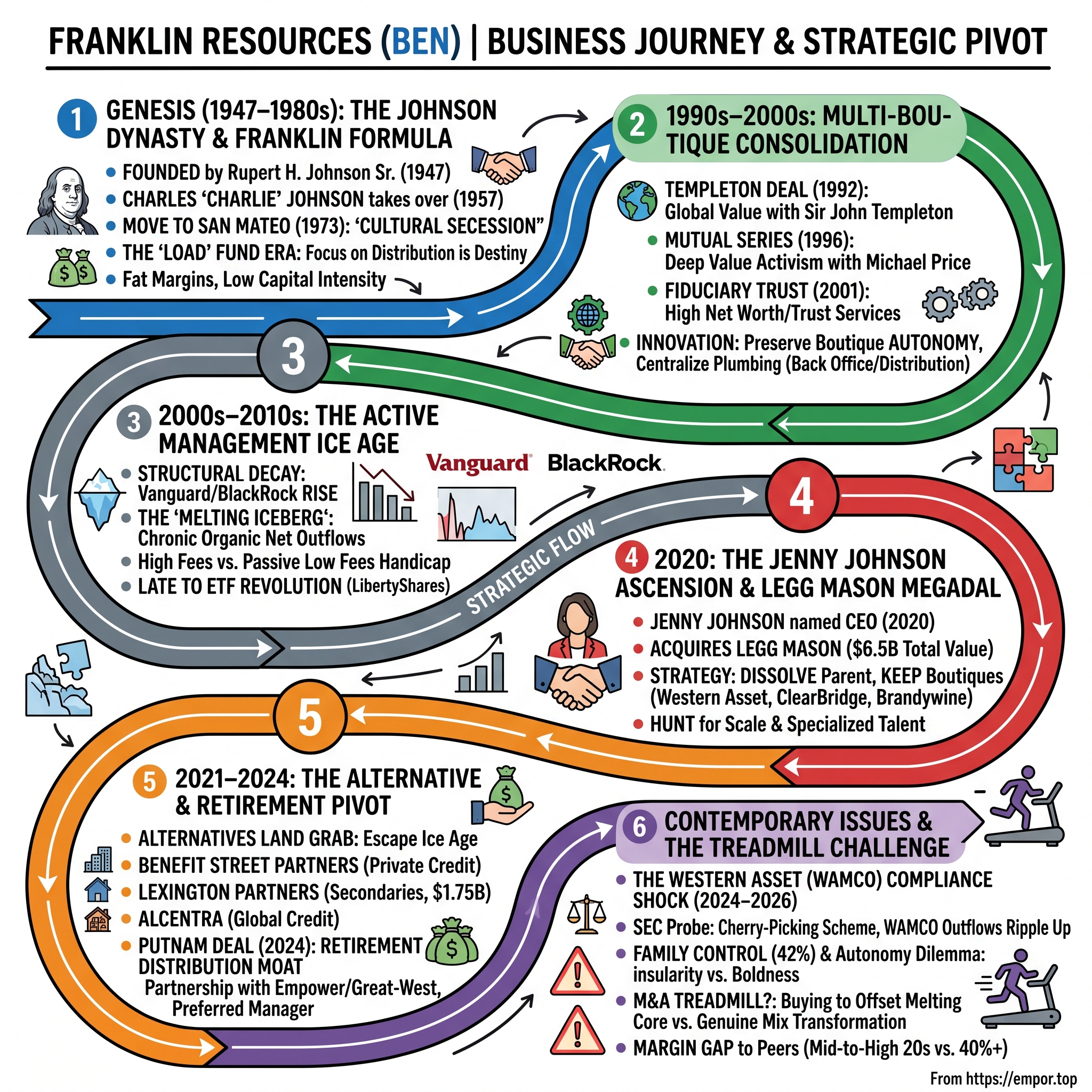
Picture the trading floor of a fixed-income powerhouse in Pasadena, California, in the autumn of 2024. For decades, Western Asset Management had been the crown jewel of American bond investing — a firm that ran hundreds of billions of dollars for pension funds, insurers, and sovereign wealth clients, its name a byword for institutional credibility. Then, almost overnight, the phones started ringing with redemption notices. The Securities and Exchange Commission had charged the firm's legendary co-chief investment officer, Ken Leech, with a scheme to funnel winning trades to favored accounts and stick losers to everyone else. Within months, tens of billions of dollars walked out the door. And Western Asset, it turned out, was not an independent house at all. It was a subsidiary — one boutique inside a sprawling, family-controlled empire called Franklin Resources.
That empire is the subject of this story, and it embodies one of the strangest paradoxes in modern finance. Franklin Resources — ticker BEN on the NYSE, a nod to Benjamin Franklin himself — manages roughly $1.68 trillion of other people's money, placing it among the largest asset managers on Earth.1 Yet this trillion-dollar public company is effectively controlled by a single family. The Johnsons, now in their third generation of leadership, own approximately 42% of the outstanding stock, a grip so tight that no outside CEO has ever run the firm and no activist has ever seriously threatened it.2
The central question that animates everything here is one of survival. Franklin built its fortune on a very twentieth-century business: high-fee, broker-sold, actively managed mutual funds. But the twenty-first century belongs to the index. Every year, investors pull hundreds of billions of dollars out of expensive active funds and pour them into the near-free passive products of BlackRock and Vanguard. It is a slow-motion ice age, and Franklin's traditional business is a species built for a warmer climate.
The company's answer has been M&A — relentless, expensive, sometimes debt-financed M&A. Since 2019, under a strategic pivot largely authored by Jenny Johnson, Franklin has spent billions acquiring rivals and specialists: Legg Mason for $4.5 billion, Lexington Partners for $1.75 billion, Putnam Investments for roughly $925 million, Alcentra, and Benefit Street Partners, among others.34[^5]5 The stated logic is transformation — turning a stodgy retail fund shop into a modern multi-asset titan with a fast-growing alternatives arm.
But there is a darker reading, and this piece will take it seriously. Is Franklin genuinely reinventing itself, or is it running on a treadmill — buying expensive, complex assets simply to paper over the relentless organic decay of its legacy funds? Every acquisition adds AUM to the top line. The harder question is whether it adds durable value, or merely disguises a business that is quietly bleeding.
We will trace the whole arc: from Rupert Sr. hawking mutual fund shares to retail investors in postwar New York, through the West Coast reinvention in San Mateo, the transformative Templeton and Mutual Series deals of the 1990s, the passive-era squeeze that hollowed out the core, Jenny Johnson's alternatives land grab, and finally the Western Asset compliance shockwave that tested whether a family that prizes autonomy can actually govern what it owns. Let's start where every dynasty starts — with a founder and a name.
 Subscribe on LinkedIn
II. The Genesis of the "Franklin Formula" & The Johnson Dynasty (1947–1980s)
In 1947, in a modest office in New York City, a brokerage man named Rupert H. Johnson Sr. hung out a shingle for a new venture and made a marketing decision that would outlive him by three-quarters of a century. He called it Franklin Distributors, after Benjamin Franklin — the founding father whose almanacs preached thrift, frugality, and the patient magic of compound interest.6 It was branding as philosophy. In an era when Wall Street was still associated in the public mind with speculation and the ghosts of 1929, Johnson positioned his conservative retail mutual funds as the sober, penny-saved-is-penny-earned alternative. The name told cautious middle-class savers exactly what they were buying: prudence.
For a decade it stayed small. Then, in 1957, the story took the turn that defines the company to this day. Rupert Sr.'s son, Charles B. Johnson — universally known as Charlie — took over as president and chief executive at the age of twenty-four.6 He inherited a rounding error of a business: a handful of employees and roughly $2.5 million in assets under management.6 To put that in perspective, that is less than the price of a nice house today, spread across an entire fund company. Charlie, later joined by his half-brother Rupert Johnson Jr., set out to industrialize what was essentially a cottage operation.
What kind of leader was Charlie Johnson? He was, by every account, the opposite of a Wall Street showman — patient, cost-obsessed, and allergic to the fashionable. He took the company public in 1971, raising the capital that would fund decades of expansion.6 But the more consequential decision came in 1973, when he pulled the headquarters out of New York and moved it across the country to San Mateo, on the San Francisco peninsula.6 The move was more than geography. It was a deliberate cultural secession from Wall Street — an attempt to build a firm that thought in decades rather than quarters, that valued common-sense, conservative investing over the noise and herd behavior of Manhattan trading desks. West Coast distance became part of the brand.
The engine that powered all of this was the "load" fund. In the 1970s and 1980s, Franklin's funds were sold through armies of brokers who collected a "front-end load" — a sales charge, sometimes 4% to 8%, skimmed off the top of every dollar an investor put in. To a modern investor accustomed to zero-commission apps, this sounds almost predatory. But at the time it was the industry standard, and it created an extraordinarily lucrative flywheel. Brokers had a powerful financial incentive to sell Franklin funds; Franklin, in turn, collected rich, recurring management fees on the assets those brokers gathered. The result was a business with fat margins and low capital intensity — you don't need factories to run money — that compounded beautifully alongside the great bull market that began in 1982.
Here is the analytical point that matters for everything to come. The load-fund era taught the Johnson family a specific, seductive lesson: distribution is destiny. The firm's edge was never really about having the single best-performing fund. It was about controlling the pipes through which retail money flowed — the broker relationships, the shelf space, the brand of prudence. That insight built the dynasty. It would also, decades later, become a trap, because the pipes themselves were about to be re-plumbed by index funds and discount brokers. But before the ice age arrived, Franklin would spend the 1990s doing something audacious: assembling a collection of investing legends under one roof.
III. Sir John Templeton & Michael Price: The Early Pioneers of Multi-Boutique Consolidation (1990s–2000s)
In the summer of 1992, Charlie Johnson made the deal that changed the company's name and its DNA. Franklin agreed to acquire Templeton, Galbraith & Hansberger for roughly $913 million — at the time one of the largest transactions the mutual fund industry had ever seen.7 The prize was not just assets. It was a person and a philosophy.
Sir John Templeton was already a living legend, arguably the greatest global value investor of the twentieth century. His defining move had become investment folklore: in 1939, as Europe plunged into war and most investors fled, he borrowed money to buy shares in 104 American companies trading below a dollar, and made a fortune as they recovered. Decades later he pioneered international investing when it was still exotic, famously loading up on Japanese equities in the 1960s when Western investors dismissed the entire country. His creed — "the time of maximum pessimism is the best time to buy" — was contrarianism as a discipline. For Franklin, a firm whose lineup was heavy on domestic bonds and conservative income funds, buying Templeton was a strategic transplant. It bolted a world-class global equity franchise onto a bond house, and the corporate identity rebranded to Franklin Templeton, the name it carries today.
Four years later, in 1996, Charlie did it again. Franklin acquired Heine Securities, the manager of the Mutual Series funds, for roughly $610 million — and with it came Michael Price, a very different kind of legend. Where Templeton was the courtly global contrarian, Price was the pugnacious deep-value activist of Wall Street, famous for buying distressed and bankrupt securities, agitating for corporate breakups, and once pressing Chase Manhattan into a merger that unlocked billions for shareholders. His style was combative, event-driven, and often litigious. Franklin now housed two of the most distinct investing cultures imaginable — the patient global value of Templeton and the hard-edged distressed-debt activism of Price — under a single corporate parent.
That, precisely, was the insight. In 2001, Franklin extended the collection again, acquiring Fiduciary Trust Company International for roughly $775 million in stock, pushing into wealth management and trust services for high-net-worth families and institutions.8 By stitching together Templeton, Mutual Series, and Fiduciary Trust, Charlie Johnson pioneered what the industry would later call the "multi-boutique" model — and it is worth pausing on, because it is the strategic template the entire modern story runs on.
The multi-boutique idea is elegant. Investment talent is temperamental; star managers do not thrive inside homogenized corporate machines. So instead of forcing every acquired firm to adopt one house style, you keep each boutique's investment culture autonomous, distinct, and often geographically isolated — Templeton in the Bahamas, Mutual Series in New Jersey, Franklin in California. The boutiques keep their brands, their processes, their identities. What you centralize is the boring, expensive plumbing: back-office operations, legal and compliance, technology, and — above all — retail distribution. You let a thousand investment flowers bloom, and you sell all their seeds through one giant sales channel.
The model worked spectacularly for a time. By the time Charlie handed the CEO title to his son Gregory Johnson — Jenny's older brother — in 2004, AUM had scaled to historic highs and Franklin had become one of the most valuable asset managers in the world. But the multi-boutique structure carried a hidden liability that would take twenty years to detonate. When you grant a boutique total investment autonomy, you also grant it the freedom to make its own mistakes — and to hide them from a parent that has deliberately chosen not to look too closely. Greg Johnson took the reins at the apparent peak. He could not yet see the tectonic shift building beneath him.
IV. The Active Management Ice Age & Structural Decay (2000s–2010s)
The glaciers came slowly, then all at once. For most of the 2000s, the active management industry told itself a comforting story: yes, low-cost index funds existed, but serious investors would always pay for skill, for the manager who could beat the market. Then two firms proved that story mostly wrong, and in doing so they froze Franklin's core business in place.
The first was Vanguard, whose founder Jack Bogle had spent decades preaching a heretical gospel: that in aggregate, active managers cannot beat the market after fees, so the rational move is to own the whole market at the lowest possible cost. For years this was a fringe view. In the 2000s and 2010s it became the consensus, and Vanguard's relentless, almost evangelical fee-cutting turned it into a tidal force pulling trillions of dollars toward near-zero-cost index funds. The second was BlackRock, which in 2009 acquired the iShares exchange-traded fund business from Barclays and instantly became the dominant force in passive investing, pairing scale with the technological muscle of its Aladdin risk platform.
For Franklin, the mechanism of decline was brutally simple, and it is worth explaining plainly because it is the crux of the whole bear case. Imagine two funds that own roughly the same stocks. One is a Franklin active fund charging, say, 0.75% to 1.00% a year — 75 to 100 "basis points." The other is an index fund charging 0.04%. Over a decade, that fee gap compounds into an enormous performance handicap for the active fund. To justify its fee, the active manager must beat the index by roughly a full percentage point every year, consistently, forever. Very few managers do that. And so, year after year, Franklin's high-fee flagship funds suffered what the industry euphemistically calls "organic net outflows" — the polite term for clients withdrawing more money than they deposit. This was the "melting iceberg": a giant, profitable block of assets slowly, inexorably shrinking, its high fees under permanent compression.
Franklin's response to the ETF revolution was, in a word, late. The firm's cultural DNA — its genuine pride in active stock-picking, the very thing it had spent decades acquiring in Templeton and Price — made it slow to embrace products that implicitly conceded active management's defeat. When Franklin finally launched its own ETF platform, branded LibertyShares, in the mid-2010s, it arrived years behind the scale leaders and never came close to challenging the low-cost volume champions. You cannot out-cheap Vanguard by starting a decade behind.
The market rendered its verdict on the stock. For years, BEN traded like a melting asset — its valuation multiple compressing from the premium once afforded to elite active managers down to a persistent discount, its shares chronically lagging both the broad market and diversified-scale peers. The message from public investors was unambiguous: a pure-play, high-fee active manager was a business in secular decline, and the market would pay accordingly. Franklin faced a stark choice — evolve into something structurally different, or slowly bleed to death as a beautifully run buggy-whip company. The person who would answer that challenge was already inside the building, and she happened to share the founder's last name.
V. The Ascension of Jenny Johnson & The Legg Mason Megadeal (2020)
In February 2020, Jennifer M. Johnson — Jenny — took over as chief executive of Franklin Resources, succeeding her brother Greg and becoming, at a stroke, one of the most powerful women in global finance.2 She was the third generation of Johnsons to run the firm and, in a family famous for continuity, something of a break in style. Jenny had come up through the operational trenches — technology, retail, the unglamorous machinery of the business — rather than the portfolio-management side. She understood the plumbing. And she had clearly concluded that patiently managing decline was not a strategy.
Her first major act as CEO was not a cautious settling-in. It was a bombshell. Within days of taking the top job, Franklin announced it would acquire its struggling rival Legg Mason for $4.5 billion in cash and assume roughly $2 billion of Legg Mason's outstanding debt — a transaction valued in total at around $6.5 billion.39 For a company that had spent a decade watching its own franchise erode, this was a declaration that Franklin intended to fix the problem by getting dramatically bigger.
To understand why Legg Mason was the target, you have to understand what Legg Mason was: essentially a mirror image of Franklin's own multi-boutique structure, but broken. It was a Baltimore-based holding company that owned a collection of genuinely premium, autonomous investment franchises — Western Asset in fixed income, ClearBridge in active equities, Brandywine Global, Royce, Martin Currie, the real-estate specialist Clarion Partners, and the hedge-fund platform EnTrust.3 Individually, several of these boutiques were world-class. But the parent company had been crippled by two things: a bloated, expensive corporate overhead layer sitting on top of the boutiques, and a heavy load of debt that starved it of flexibility. Legg Mason was a great collection of businesses trapped inside a bad holding company.
Jenny Johnson's playbook was to keep the collection and destroy the trap. The logic ran in four moves. First, dissolve Legg Mason's parent-level corporate layer entirely — the redundant executives, the duplicate functions, the very overhead that had strangled it. Second, and crucially, preserve 100% investment autonomy for each underlying boutique, because the entire value of the deal walked out the door every evening in the persons of the star managers, and any hint of heavy-handed integration could trigger a talent exodus. Third, aggregate the boring shared functions — administration, technology, distribution — to extract cost savings that management initially pegged at more than $200 million a year in run-rate synergies.3 Fourth, streamline the portfolio immediately by divesting EnTrust Global back to its own management team, concurrent with the closing.3
Now, the analytical read. On price, the deal looked like a steal. Franklin paid roughly $4.5 billion for a firm managing north of $800 billion — on the order of half a percent of AUM, a deep discount to the multiples paid in the marquee deals of the 1990s. That is what buying a distressed, debt-laden target gets you. But there was a real risk buried in the timing and the balance sheet: Franklin loaded up on debt to do the deal right as the COVID-19 pandemic detonated global markets in the spring of 2020. Doubling down with leverage at the onset of the worst market shock in a decade was a genuine gamble, not a sure thing.
The transaction closed on July 31, 2020.10 Overnight, it roughly doubled Franklin's total AUM to about $1.5 trillion and handed the firm two franchises it could never have built organically: a world-class institutional fixed-income business in Western Asset and a top-tier active equity shop in ClearBridge.3 On paper, Jenny Johnson had transformed Franklin's scale in a single stroke. Whether she had also imported a ticking compliance time bomb inside Western Asset was a question no one was asking in 2020 — but we will return to it. First, the pivot that mattered even more than scale: the hunt for assets the index funds could never touch.
VI. The Alternative Pivot: Lexington, BSP, and Alcentra ($270B+ Alternatives Land Grab)
If Legg Mason was about scale, the next phase was about escaping the ice age entirely — by fleeing to a corner of finance where the glaciers of passive investing simply cannot reach. That corner is "alternatives": private credit, private equity, real estate, and other assets that do not trade on public exchanges. Here is why they matter so much to a firm like Franklin, and it is worth spelling out because it is the load-bearing pillar of the entire bull case.
Public markets have been commoditized. Anyone can buy the S&P 500 for a few basis points, which is exactly why active fees keep collapsing. But private markets are different in three ways that an asset manager loves. First, the fees are high and durable — often ten times what a passive equity fund can charge — because these strategies genuinely require specialized skill and there is no index-fund substitute. Second, the capital is "locked up," frequently for seven to ten years, meaning clients cannot redeem on a bad Tuesday the way a mutual fund investor can; the assets are sticky. Third, alternatives generate performance fees — "carried interest," a share of the profits — which can be enormously lucrative in good years. For a firm trying to escape the melting iceberg, alternatives are the lifeboat: high-margin, hard to leave, and immune to the Vanguard price war.
Franklin's alternatives build actually predated the Legg Mason deal. The anchor was Benefit Street Partners, an institutional-grade direct-lending and opportunistic real-estate-debt platform that Franklin agreed to acquire in October 2018, bringing roughly $26 billion of private-credit AUM into the firm.5 Direct lending — where a firm lends money straight to mid-sized companies rather than through banks or bond markets — had become one of the hottest corners of finance, and BSP gave Franklin a genuine institutional foothold in it.
Then came the crown jewel of the alternatives push. In late 2021, Franklin agreed to acquire Lexington Partners, a global leader in "secondary" private equity, for $1.75 billion — structured as $1 billion in cash at closing plus a further $750 million paid out over three years.4 Secondaries are a beautifully sticky business worth understanding: when an investor in a private-equity fund wants to cash out early, they cannot simply sell their stake on an exchange, so they sell it to a specialist like Lexington at a negotiated price. Lexington is effectively the used-car market for private-equity stakes, and it is a market with few credible players and enormous barriers to entry. The deal added roughly $34 billion of exactly the kind of long-lived institutional capital Franklin craved. At around 5% of AUM, Franklin paid a premium multiple — far richer than the Legg Mason bargain — but the premium bought permanence: this was capital that would not evaporate in a retail redemption panic.
The following year, in 2022, Franklin rounded out the credit platform by acquiring Alcentra, one of Europe's largest alternative-credit managers, from BNY Mellon. The terms were $350 million in cash at close plus up to a further $350 million in contingent payments tied to performance thresholds, along with a commitment to buy roughly $305 million of related seed investments.[^5] Alcentra was folded into Benefit Street Partners to create a combined global alternative-credit powerhouse spanning both American and European markets. And inherited from the Legg Mason deal was Clarion Partners, a heavyweight real-estate manager that Franklin has pushed hard to distribute to both institutional and, increasingly, wealthy individual investors.
The scoreboard, by early 2026, was striking: Franklin's alternative assets had reached $273.8 billion, more than 15% of total AUM, and this was the fastest-growing, highest-margin part of the entire company.11 On the Q2 FY2026 earnings call, management reported raising $14.3 billion in alternatives in a single quarter — including $13.2 billion in private-market assets — putting the firm on pace to blow past its $25–30 billion annual fundraising target.12 That is the bull case in numbers: a genuine, scaled, growing alternatives franchise acting as a buffer against the erosion of the retail core.
But the skeptic should hold two caveats. First, private-market valuations are self-reported and lag public markets, which means the stickiness of alternatives is partly a feature of assets that are simply harder to mark and harder to flee — a comfort that works until it doesn't. Second, buying alternatives at premium multiples with acquired money is not the same as building organic franchise value; the treadmill question applies here too. Franklin found its lifeboat. The open question is whether it paid so much for the lifeboat that the economics of the rescue are thinner than they look. And there was one more piece to the strategy — not about products at all, but about owning the pipes through which retirement money flows.
VII. The Putnam Deal & The Retirement Distribution Moat (2024)
On the first day of 2024, Franklin closed a deal that looked modest next to Legg Mason but was, in its way, the most strategically revealing of the entire Jenny Johnson era. It acquired Putnam Investments, the venerable Boston fund manager, from the Canadian insurer Great-West Lifeco for approximately $925 million, paid primarily in Franklin stock.[^5]13
On its face, Putnam brought about $140 billion of AUM into the fold.14 But if the deal were only about buying another pile of mutual fund assets, it would have been exactly the kind of treadmill move the bears warn against — adding more of the same melting product. What made Putnam interesting was not the assets. It was the door those assets opened.
The real prize was the relationship with Great-West Lifeco and its enormous American retirement-services arm, Empower, one of the largest record-keepers of workplace retirement plans in the United States. Under the transaction, Great-West did not simply take the check and walk away; it became a long-term strategic shareholder in Franklin, taking a stake of roughly 6.2%, and entered into a partnership in which Franklin Templeton became a preferred asset manager across Great-West's vast retirement and insurance platforms.[^5]13 In plain terms, Franklin bought itself a privileged position inside the pipes that carry hundreds of billions of dollars of American 401(k) and defined-contribution savings.
Why does that matter so much? Because retirement money is the stickiest money in all of asset management, and understanding why is central to the bull case. When you pick funds inside your employer's 401(k), you rarely touch them again for decades — you contribute automatically from every paycheck, you don't chase performance, and the sheer inertia of the system keeps the assets in place through market panics that would send a retail brokerage investor running. This is the polar opposite of the "leakage" that plagues Franklin's traditional retail funds, where money is free to flee at the first sign of underperformance. By plugging into Great-West's retirement rails, Franklin scaled its defined-contribution AUM past $100 billion and, more importantly, secured a source of capital that behaves like an annuity: quiet, recurring, and hard to dislodge.13
This is the deepest and most defensible idea in the whole Franklin strategy, and it is worth stating as the analytical takeaway: in asset management, investment performance is fleeting and impossible to guarantee, but distribution — being embedded, by contract and by default, into the retirement plans of millions of workers — is a structural moat. It is the modern, institutional version of the very same insight Charlie Johnson exploited with load funds and broker relationships in the 1970s. The Johnsons have always believed that controlling the pipes beats owning the best-performing fund. The Putnam deal was that fifty-year-old conviction, updated for the age of the 401(k).
Of course, a skeptic notes that Franklin paid for this moat partly by handing a large slug of its own equity to Great-West and taking on a new 6.2% shareholder whose interests may not always align with the Johnsons'. And a preferred-manager arrangement is not the same as an exclusive one; the flows are a privilege, not a guarantee. Still, of all the pieces Jenny Johnson assembled, the retirement hook is the one with the clearest strategic logic. Which makes it all the more jarring that, even as this deal closed, a scandal was metastasizing inside the firm's most prestigious boutique — a scandal that would test whether the family's cherished model of autonomy was a source of strength or a governance blind spot.
VIII. Corporate Governance, Family Grip, & Management Credibility under Fire (The Western Asset SEC Probe)
Every family business eventually faces the moment that tests whether its defining trait is a superpower or a fatal flaw. For the Johnsons, that moment arrived through Western Asset — the fixed-income jewel of the Legg Mason deal — and it forced a reckoning with the two-sided nature of everything that makes Franklin unusual.
Start with the family grip itself, because it colors every judgment about this company. The Johnsons collectively control roughly 42% of Franklin's stock, with Rupert Johnson Jr. holding the largest individual stake at around 20% and Charles Johnson around 18%, while Jenny and Greg hold smaller personal positions.2 This concentration is a genuine double-edged sword, and honest analysis has to hold both edges at once. On the bull side, family control has given Franklin something almost no public company enjoys: the ability to think in decades, to execute enormous, dilutive, debt-financed M&A under acute market stress — as it did with Legg Mason in the teeth of the COVID crash — without fear of being second-guessed into paralysis by quarterly-focused outsiders. It has also underwritten one of the most consistent dividend records in American finance, the kind of multi-decade payout streak that earns a coveted place among the "Dividend Aristocrats."
On the bear side, the same control breeds insularity. A family that owns 42% of the votes is effectively immune to activist pressure; no outside investor can force a strategic rethink, a board shake-up, or a harder look at underperforming assets. Decisions that would trigger a proxy fight at a widely held company can be made around the Johnson dinner table. When the strategy is working, that autonomy is a gift. When it isn't, there is no external circuit-breaker.
Now layer on the structural weakness we flagged back in the 1990s: the multi-boutique model's supervision blind spot. The entire premise of the model is that you grant each boutique total investment autonomy and keep the parent's hands off the portfolio. But autonomy in investing sits uncomfortably close to autonomy in everything else, and it raises a question the industry too rarely asks out loud: when you have deliberately built a firm on the principle of not looking over your affiliates' shoulders, how exactly do you enforce parent-level compliance? How do you police a boutique you have promised not to interfere with?
Western Asset answered that question in the worst possible way. In late 2024, the SEC and the Department of Justice charged Ken Leech, Western Asset's celebrated co-chief investment officer, with a massive "cherry-picking" scheme — allegedly steering hundreds of millions of dollars of winning trades to favored accounts while dumping losing trades on disfavored ones, over a period of years.15 Cherry-picking is a straightforward-sounding fraud with an outsized impact on trust: if a manager can look at how a trade performed before deciding whose account to put it in, the "favored" clients get a rigged, risk-free edge and everyone else is quietly robbed. For a fixed-income firm whose entire value proposition was institutional-grade integrity, the allegation was existential.
The market reaction was swift and merciless, and it exposed the correlation risk buried in the multi-boutique structure. Institutional clients do not wait for verdicts; they redeem first and ask questions later. Western Asset hemorrhaged assets, and the damage rippled up to the parent — Franklin's Western Asset outflows became a dominant negative story across 2025, dragging the firm's headline flow numbers deep into the red even as other parts of the business grew, and AUM slid to around $1.54 trillion by the spring of 2025 amid the redemption wave.16 A failure at a single autonomous affiliate had triggered massive, correlated damage at the parent — precisely the scenario the boutique model was supposed to compartmentalize.
Resolution came in June 2026. Western Asset reached a $100 million civil settlement with the SEC, agreeing to a cease-and-desist order and a censure — without admitting or denying the findings — to resolve claims that it had failed to reasonably supervise Leech.1718 Days later, on June 12, 2026, Leech himself pleaded guilty to obstructing the SEC's investigation, just before his trial was set to begin, and the DOJ moved to close its investigation of the firm itself.19 The legal overhang lifted, but the reputational and franchise damage to Western Asset had already been done, and a chunk of the institutional client base that walked will not easily return.
The real test in an episode like this is management credibility, and it must be assessed by behavior over time rather than by any single statement. Across the 2024–2026 earnings calls, Jenny Johnson and CFO Matthew Nicholls consistently walked a careful line: acknowledging the Western Asset outflows as a discrete, named problem while working hard to steer analysts' attention to the health of everything else. On the Q2 FY2026 call, for instance, management pointedly noted that, excluding Western Asset, fixed income had posted $3.6 billion of positive net flows — its ninth consecutive positive quarter — a framing designed to quarantine the damage.12 That is legitimate disclosure, but it is also careful narrative management, and a skeptical investor is entitled to ask whether "ex-Western" is analysis or spin. To management's credit, the numbers they pointed to were real and the compliance remediation was concrete; to the bears' credit, the scandal validated the single deepest structural criticism of the whole enterprise. Which sets up the war-game: against sharper-focused peers, does Franklin actually win from here?
IX. Competitive Landscape: Why Win / Why Not Investment Spine
Line Franklin up against its peers and the strategic problem snaps into focus. This is an industry of scale and specialization, and Franklin has chosen to compete by being big and diversified — a strategy with real advantages and real seams.
Consider the war-gaming board. BlackRock (BLK) is the undisputed scale leader, the firm that won the passive era outright, layered on the Aladdin technology platform that has become the industry's risk-management operating system, and now runs operating margins comfortably above 40%. It is everything Franklin is not: a passive-first colossus with a genuine technology moat. T. Rowe Price (TROW) is the pure-play active competitor, but one with a far stronger organic brand, a sterling performance reputation, and deep, sticky roots in the retirement market — the very stickiness Franklin had to buy through Putnam. And Invesco (IVZ) is the closest structural analog, another hybrid that bolted a large passive ETF engine — anchored by its wildly successful QQQ franchise tracking the Nasdaq-100 — onto a legacy active business.
Run the two theses against that field. The "why win" case for Franklin rests on three legs. First, the alternatives franchise: a scaled, high-margin, sticky $273.8 billion book of private credit, real estate, and secondary private equity that is genuinely hard to replicate and structurally immune to the passive price war.11 Second, the Putnam/Great-West retirement hook, which converts fleeting retail flows into permanent, inertial institutional capital. Third, tangible evidence that the M&A is finally bearing fruit in the headline numbers — the record $16.9 billion of long-term net inflows in Q2 FY2026, following a strong preceding quarter, suggests the diversification may at last be outrunning the decay of the core.112 The ETF platform, too, has quietly scaled to $61.6 billion, up 67% year over year, and the Canvas custom-indexing tool hit a record $22.9 billion — signs that Franklin is no longer merely late to every modern product.12
Now the "why not" case, which is equally grounded in evidence. The melting iceberg has not stopped melting; the core high-fee retail mutual fund business remains in structural, long-term organic decline, and the acquisitions have masked that decay more than they have reversed it. The clearest tell is in the margins. Franklin's adjusted operating margin runs in the mid-to-high 20s — around 27% in fiscal 2026, with management guiding toward the high 20s and a 30%-plus target only in 2027.12 Set that against BlackRock north of 40% and T. Rowe Price in the mid-30s, and the gap is stark. It reflects the hidden cost of the multi-boutique model: all those autonomous star managers command rich compensation, and paying premium comp across a dozen boutiques is structurally more expensive than running one lean, scaled machine. Franklin has bought diversity at the price of efficiency.
Run it through Porter's five forces and the industry looks harsh from every direction. The threat of substitutes — passive index funds — is the defining force of the era and it has permanently compressed pricing on the core. Buyer power is rising as institutional and retail clients alike grow fee-conscious and quick to redeem. Rivalry is brutal, waged by better-capitalized scale players. The one comforting force is barriers to entry in alternatives and the sheer stickiness of embedded retirement distribution — which is precisely where Franklin has concentrated its bets.
Through Hamilton Helmer's 7 Powers lens, the picture is more revealing still. Franklin's genuine sources of power are narrow but real: switching costs and process power in alternatives (a Lexington secondaries franchise cannot be cloned overnight) and a form of cornered-resource-plus-scale advantage in retirement distribution via Great-West. What it conspicuously lacks is the thing BlackRock has in abundance — scale economies and the network-effect gravity of a platform like Aladdin. And its brand, once a genuine asset in the load-fund era, has been dented by the Western Asset affair. The activist stress test writes itself: a skeptic would challenge the sub-peer margins, the reliance on serial acquisitions to disguise organic outflows, the governance opacity of 42% family control, the complexity of running a dozen semi-independent boutiques, and a compliance culture that just cost $100 million to settle. Franklin can win from here — but only if alternatives and retirement flows grow fast enough to structurally outrun the core's decline. That is the whole ballgame, and it is not yet decided.
X. Playbook: Business & Investing Lessons
Step back from the quarter-to-quarter noise and Franklin Resources offers a set of durable lessons — about M&A, about family capitalism, and about what actually constitutes a moat in the money-management business.
The first lesson is the multi-boutique compromise, and the Western Asset affair is its perfect, painful illustration. When you execute M&A in asset management, you can buy AUM and you can extract back-office cost synergies — those are the easy parts, and Franklin has proven genuinely skilled at both. What you cannot buy, and cannot standardize by memo, is compliance culture. Autonomy in investing is a real competitive advantage; it keeps the talent and the performance. But autonomy without a strict, centralized oversight fence is an unmanaged risk, and a single rogue actor at a single affiliate can inflict correlated damage across the entire parent. The takeaway for investors evaluating any multi-boutique or roll-up model: ask not just what synergies management promises, but where the compliance fence is and who is actually watching.
The second lesson is the central tension of this whole story — the M&A treadmill versus genuine mix transformation. Acquiring assets to offset outflows is only a sound long-term strategy if the acquired assets structurally shift the firm toward a superior, higher-margin, stickier product mix. Buying more melting mutual fund AUM to replace melting mutual fund AUM is just running in place, burning capital to stand still. Buying a scaled alternatives franchise and a retirement-distribution moat is, potentially, real transformation. Franklin has done some of each, and the honest verdict is that the jury is still out — the flows have turned positive, but the margin gap to peers suggests the transformation is incomplete.
The third lesson is the stewardship of family control. Three generations of Johnsons have run this firm without ever handing the wheel to an outside CEO, and that continuity has been genuinely valuable — it enabled bold, contrarian, counter-cyclical moves, from the West Coast reinvention to the COVID-era Legg Mason gamble, that a more skittish public company might never have attempted. But the same control that enables boldness also removes the external accountability that catches mistakes early. Family stability is an asset precisely up until the moment it becomes insularity, and investors in BEN are, in effect, betting on the judgment and alignment of the Johnson family as much as on any spreadsheet.
The fourth lesson is the one that ties the whole seventy-nine-year arc together: distribution is the ultimate moat. From Rupert Sr.'s broker relationships in 1947, to the load-fund goldmine of the 1970s, to Jenny Johnson's 401(k) integration through Great-West in 2024, the Johnsons have operated on a single unchanging conviction — that in a business where investment performance is fleeting and impossible to guarantee, the durable edge is owning the pipes through which the money flows. Everything else — the star managers, the boutiques, the acquisitions — is in service of feeding product into channels the firm controls.
For an investor watching this story unfold from here, the noise is endless but the signal narrows to a very short list. Watch, above all, long-term net flows excluding Western Asset and excluding acquisitions — because that single number, more than any other, reveals whether the organic business is finally healing or merely being medicated by M&A. Watch alternatives fundraising and AUM, the growth engine and the highest-margin dollar in the building. And watch the adjusted operating margin, the honest scorecard of whether all this complexity is translating into profit or merely into scale. Those three metrics will tell you, quarter by quarter, whether Franklin Resources is genuinely escaping the ice age — or just running faster on the same treadmill.
References
-
Franklin Resources, Inc. Second Quarter 2026 Results (Form 8-K, Exhibit 99.1) — SEC/Franklin Resources, 2026-04-28 ↩↩
-
Franklin Resources, Inc. Proxy Statement (Form DEF 14A) — SEC/Franklin Resources, 2024 ↩↩↩
-
Franklin Templeton to Acquire Legg Mason, Creating $1.5 Trillion AUM Global Investment Manager — Franklin Resources, 2020-02-18 ↩↩↩↩↩↩
-
Franklin Templeton to Acquire Lexington Partners, a Global Leader in Secondary Private Equity and Co-Investments — Lexington Partners, 2021-11-01 ↩↩
-
Franklin Templeton Investments Announces Acquisition of Alternative Credit Manager Benefit Street Partners — Franklin Templeton, 2018-10-25 ↩↩
-
Franklin to buy Templeton for $913 million — UPI Archives, 1992-07-31 ↩
-
Franklin, Templeton to Form Mutual Giant — The Washington Post, 1992-08-01 ↩
-
Franklin Resources Inc. Form 8-K, Exhibit 99.1 (Legg Mason acquisition announcement) — SEC, 2020-02-18 ↩
-
Franklin Templeton Completes Acquisition of Legg Mason — Franklin Resources, 2020-07-31 ↩
-
Franklin Resources, Inc. First Quarter 2026 Results — Investor Presentation, Franklin Resources, 2026-01-30 ↩↩
-
Franklin (BEN) Q2 2026 Earnings Call Transcript — The Motley Fool, 2026-04-28 ↩↩↩↩↩
-
Franklin Templeton Completes Acquisition of Putnam Investments — Franklin Resources, 2024-01-01 ↩↩↩
-
Franklin (BEN) Closes Putnam Acquisition, Adds $142B in AUM — Yahoo Finance/Zacks, 2024-01-02 ↩
-
Wamco to Pay $100 Million in SEC Settlement Over Leech Trades — Bloomberg, 2026-06-05 ↩
-
Franklin Resources Q2 2025 slides: AUM falls to $1.54 trillion amid continued outflows — Investing.com, 2025-05-02 ↩
-
Franklin Resources Inc. Form 8-K (Western Asset SEC settlement) — SEC, 2026-06-04 ↩
-
Western Asset agrees to $100M SEC penalty over cherry-picking scheme — InvestmentNews, 2026-06-05 ↩
-
Ken Leech Pleads Guilty — Franklin Templeton Western Asset Pays $100m SEC Penalty — Lawyer Monthly, 2026-06-12 ↩
 LinkedIn
 WhatsApp
 Reddit
 Hacker News
 Email
Email Kindle
 RSS Feed
 Spotify
 Apple Podcasts
 Amazon Music
 Audible
 YouTube