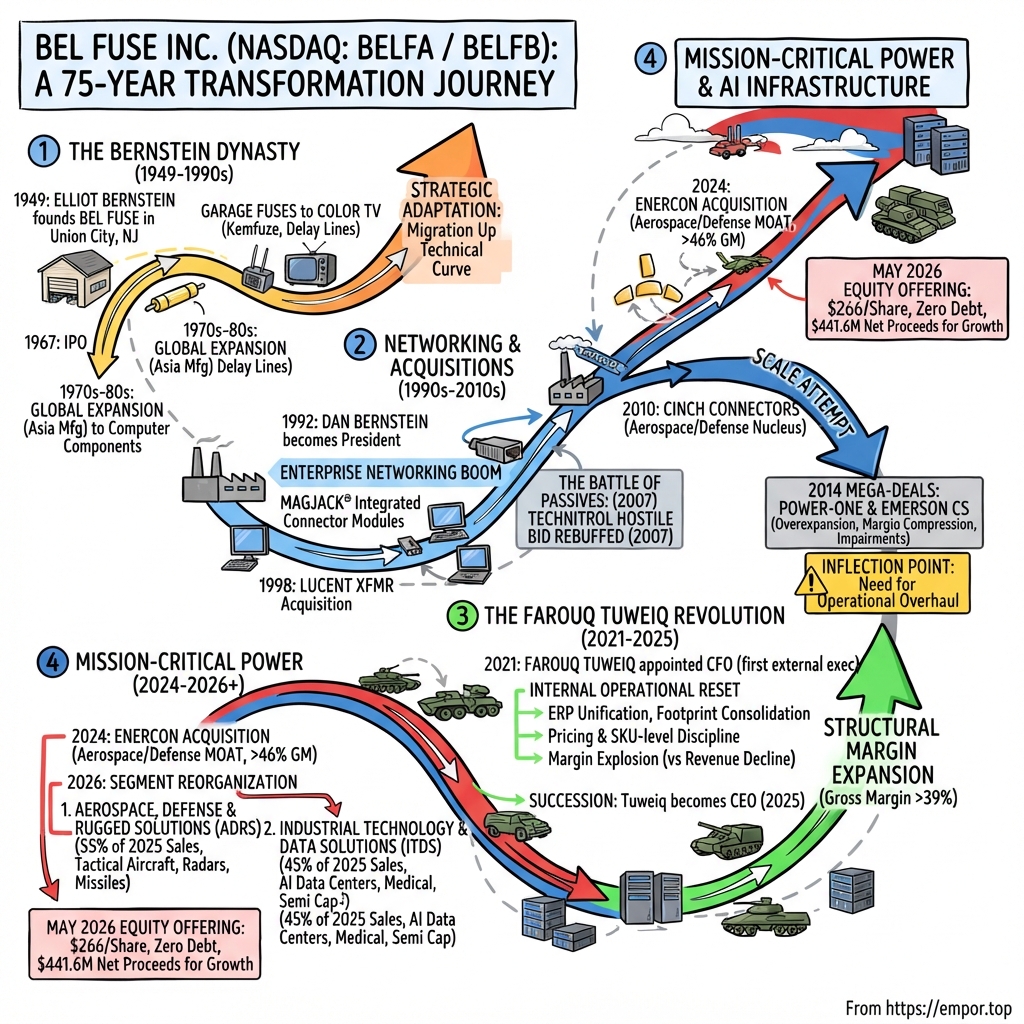
Bel Fuse Inc. (NASDAQ: BELFA / BELFB): The 75-Year Transformation from Passive Components to Mission-Critical Power
I. Prologue & The $266 Rebirth (00:00 – 00:15 / 15 Min)
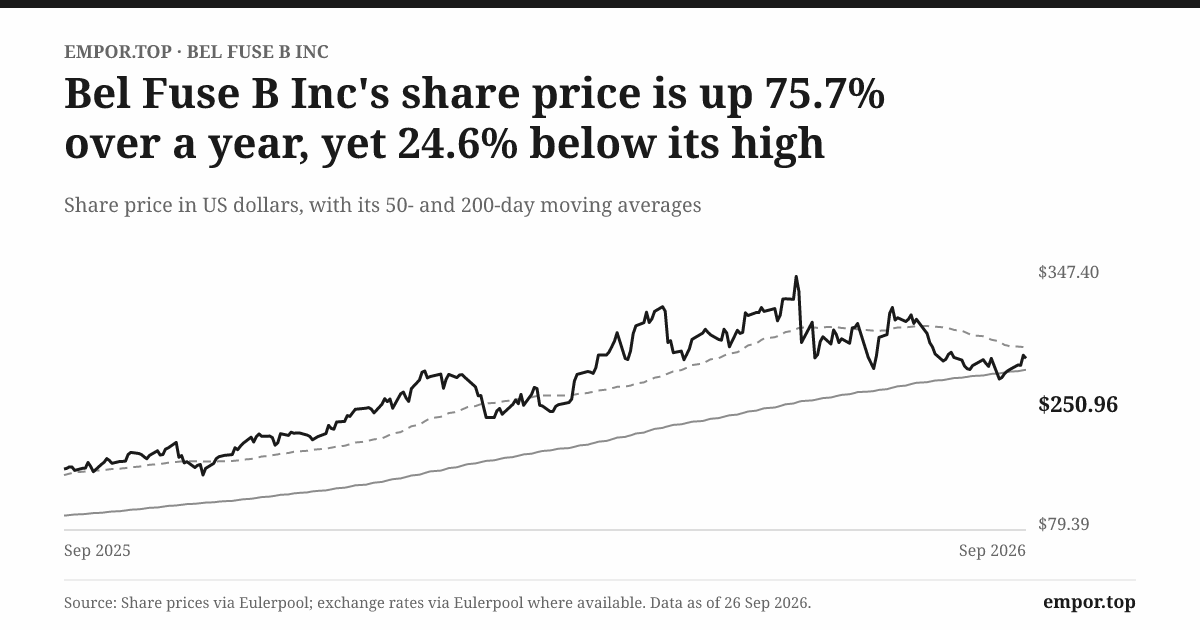
On the evening of May 13, 2026, bankers from Citigroup, BofA Securities, and Wells Fargo closed the books on an equity offering that would have seemed improbable just a few years earlier.
Bel Fuse Inc., a New Jersey component manufacturer founded before the commercial arrival of the transistor radio, priced an upsized offering of 1.5 million shares of its Class B common stock at $266.00 per share. The transaction raised roughly $399 million in gross proceeds before underwriting fees, alongside a 225,000-share greenshoe option for the underwriters.1
By the close of the second quarter of 2026, Bel reported net proceeds of $441.6 million—confirming that the overallotment option had been fully exercised—and applied the cash to pay off its revolving credit facility entirely.2 A company historically categorized as a low-margin fuse maker and magnetics supplier now held $306.1 million in cash, zero long-term debt, and $909.4 million in shareholders' equity.2
To put that balance sheet into perspective, consider where Bel stood in 2020. That year, the company generated $465.8 million in sales, delivered a 25.7% gross margin, and earned $12.8 million in net income—retaining less than three cents of profit from every dollar of revenue.3
Those results followed a net loss in 2019 and an $8.9 million goodwill impairment.3 Bel operated as a sprawling patchwork of acquired factories, legacy product lines, and regional brand names that struggled to create enterprise value beyond the sum of its disparate parts.
That history contradicts a common market misconception: that 2020-era Bel was burdened by unmanageable acquisition leverage. The audited figures tell a different story. At year-end 2020, Bel held $84.9 million in cash against roughly $115.6 million in total debt, leaving net debt at just $32.9 million following a 55% debt reduction during the year.3
Solvency was never the central risk. The structural challenge was operational return on capital: the business generated insufficient earnings from the assets it already controlled. For investors, that distinction clarifies the turnaround mandate. The requirement was not a balance sheet restructuring, but an operational overhaul of the income statement.
By 2025, operating performance reflected a fundamentally reshaped business. Bel reported record net sales of $675.5 million, a gross margin of 39.1%, and adjusted EBITDA of $142.9 million, or 21.2% of sales.4
A gross margin expansion of more than 13 percentage points within five years is uncommon for an industrial hardware manufacturer. That steep ascent raises a critical question for analysts: does the margin profile reflect permanent operational discipline, or a cyclical peak driven by post-pandemic pricing power and broad supply chain restocking?
The central strategic question is how a legacy supplier of fuses, discrete magnetics, and RJ45 Ethernet connectors transitioned into a provider of rugged power systems for tactical aircraft, armored ground combat vehicles, radar arrays, and missile defense platforms, while simultaneously seeking exposure to artificial intelligence data center architectures. That transformation rested on three strategic pivots.
First was the foundation of an established, family-managed business that historically acquired distressed assets at low multiples but deferred structural integration. Second was the arrival of an external finance executive in 2021 who enforced disciplined unit pricing, rationalized the manufacturing footprint, and pruned low-margin product portfolios. Third was a single scale acquisition: Israel-based Enercon Technologies, acquired at an enterprise value of $400 million, which tilted Bel's revenue base toward defense electronics.5
In March 2026, Bel formalized that operational shift. Management eliminated its legacy three-segment reporting structure and reorganized into two commercial units: Aerospace, Defense & Rugged Solutions, which generated roughly 55% of 2025 sales, and Industrial Technology & Data Solutions, which represented the remaining 45%.6 The resegmentation served as an explicit signal to public markets regarding how the business intends to be benchmarked against peers.
The executive architect of this operational shift is Farouq Tuweiq, an investment banker who formerly headed the industrial technology practice at BMO Capital Markets before Bel appointed him chief financial officer effective February 15, 2021.7 Promoted to chief executive officer in 2025, Tuweiq's operational and capital allocation track record represents the core thesis that institutional investors are underwriting today.
Fundamental questions remain unresolved. Can a 39% gross margin endure through cyclical corrections, or does it represent an unsustainable peak supported by transitory pricing tailwinds and elevated defense outlays? Can the company convert design wins in high-density power and optical networking into steady, multi-year production revenue? Finally, what governance risks stem from a dual-class share structure whose charter provisions have long restricted the effective voting power of substantial outside holders—an issue highlighted by longtime shareholder GAMCO in a December 2025 proposal?8
Evaluating those questions requires examining the company's origins: beginning with a returning World War II Marine holding an English literature degree and an $8,000 family loan.
 Subscribe on LinkedIn
II. Garage Fuses to Color TV: The Bernstein Dynasty (1949–1990s) (00:15 – 00:35 / 20 Min)
Elliot Bernstein never intended to build an electronics manufacturer. After returning from World War II, the Marine veteran used his English literature degree to secure a position at a major Manhattan advertising agency, only to lose his job in a widespread layoff, according to family accounts.9 Concluding that self-employment was the most dependable way to provide for a growing family, he set out on his own.
Backed by an $8,000 loan from his wife Sybil's mother, Bernstein partnered with Charles Lindeman to set up a workshop at 311 Mountain Road in Union City, New Jersey, just across the Hudson River from Manhattan.9 A military radar training course he had attended—arranged as a wedding gift from his Marine captain—became the foundation of his technical knowledge.9
Company lore offers competing explanations for the name. Elliot’s son, Dan Bernstein, later quipped that his father chose it because "Bell Labs was already taken," while Sybil maintained that the letters represented Bernstein, Lindeman, and an "E" connecting them.9 In any case, the business incorporated as Bel Fuse in 1949, initially producing automotive fuses before pivoting toward the defining consumer technology of the postwar era: television.10
That pivot marked the company's first critical adaptation. With RCA and Zenith controlling roughly 70% of the U.S. television manufacturing market, Bel secured early purchase orders from RCA for television-set fuses.9
Elliot developed the Kemfuze, which incorporated a chemical dab to withstand momentary electrical surges, sparing RCA the expense of dispatching service technicians to replace blown fuses in consumers' homes.9 Bel followed that success by engineering a television delay line—a component that synchronized video signals—priced at 75 cents when competing units sold for roughly $5, quickly scaling production to 75,000 units a week.9
In 1954, Elliot's brother Howard joined the firm after completing a doctorate at Temple University. Howard managed financial operations and non-television accounts, allowing Elliot to concentrate on product engineering.9 By 1959, expanding operations prompted a move to a one-story facility on Van Vorst Street in the Paulus Hook neighborhood of Jersey City.9
In 1966, Bel added International Business Machines as a customer, supplying delay lines for commercial mainframes.9 A modest initial public offering followed in 1967, with Elliot and Howard retaining majority voting control.10
The 1970s established an operational pattern that recurred across Bel's corporate history. In 1970, RCA and Zenith relocated television assembly to Asia to reduce costs, forcing Bel to follow its principal customers overseas or surrender the accounts.9
Elliot partnered with the Loh family to establish and manage manufacturing facilities in Hong Kong, Macau, and eventually mainland China. He framed the rationale directly: with operating margins "rapidly disintegrating" in consumer television components, Bel shifted commodity assembly offshore while redirecting domestic engineering toward more complex, higher-margin computer components.9 By 1983, corporate revenue surpassed $18 million, anchored by manufacturing operations in Hong Kong and Macau.10 Bel halted its final domestic assembly line on Van Vorst Street in 1993.9
That strategic cycle defined the company for seven decades: identify a high-value component during its early, technically demanding phase, generate attractive operating margins, and subsequently manage margin compression as the product standardized and commoditized. Bel's consistent response was to migrate up the technical complexity curve.
Dan Bernstein, Elliot's son, led the next generation of management. After graduating from SUNY Brockport, he worked as an assistant soccer coach at Colgate University until, by his own account, observing an alumni parking lot filled with luxury cars persuaded him that his long-term prospects lay in the family business.9
His mother recounted that he had announced an ambition to lead Bel Fuse as early as age 13.9 Dan trained under his father on international operational tours, revived a commercial fuse portfolio that had lapsed following the loss of Underwriters Laboratories approvals for the Kemfuze, and instituted more formal management controls beginning in the mid-1980s.9 He was appointed president in 1992.9
Under Dan's leadership, Bel capitalized on the enterprise networking expansion. In 1993, the company opened a research and development facility in Pleasanton, California, which management credited with establishing commercial partnerships with Cisco Systems, Hewlett-Packard, and 3Com, culminating in 3Com's Global Supplier Award in 1996.9 Its flagship product line became integrated connector modules marketed under the MagJack brand: an Ethernet port that integrated signal conditioning, filtering, and electrical isolation magnetics directly into the connector housing.11
The engineering proposition addressed a straightforward hardware problem. Every Ethernet port requires an isolation transformer to protect sensitive internal silicon from electrical noise, common-mode voltage, and transient spikes traveling along network cabling. Bel integrated that discrete magnetic circuitry directly into the physical jack, conserving valuable printed circuit board surface area and eliminating manufacturing assembly steps for network switch OEMs.
In 1998, Bel acquired the Transformer and Inductor Group of Lucent Technologies, the telecommunications spin-off from AT&T's Bell Laboratories. Dan characterized the transaction as absorbing "more than 100 years of Bell Labs' telecommunications engineering expertise."9 The financial expansion that followed marked the zenith of Bel's early networking era.
Net sales totaled $90.8 million with net income of $15.2 million in 1998, rose to approximately $120 million in 1999, and reached $145.2 million in 2000, generating $32.2 million in earnings—a net profit margin of roughly 22%.10
That 22% net profit margin in 2000 serves as a critical historical benchmark for evaluating competitive durability. If proprietary networking magnetics conferred a defensible economic moat, Bel would have been positioned to sustain premium profitability across cycles. Subsequent operating results proved otherwise.
In 2001, net sales contracted to $96 million and Bel posted a net loss of $12.2 million as the telecommunications capital spending bubble collapsed.10 Nearly two decades later, in 2019, the consolidated company achieved a gross margin of just 22.3% alongside a net loss.3
In operational terms, Bel's consolidated gross margin in 2019 barely equaled its bottom-line net margin from 2000. Even adjusting for a substantially evolved business portfolio by 2019, that margin decay reflects the erosion of product differentiation over time.
The underlying cause stemmed from structural customer dynamics rather than isolated market shocks. Enterprise networking customers concentrated their procurement leverage, qualified secondary manufacturing sources, and treated integrated connector modules as interchangeable hardware once mechanical footprints and pin-out configurations became industry standards. Bel's subsequent disclosures underscore the persistent exposure of discrete magnetics to downstream customer inventory swings: net sales in the Magnetic Solutions segment fell 40.2% in 2024 alone, driven primarily by inventory destocking at a major networking customer.1213
Those dynamics qualify any broad claims regarding pricing power in standard magnetics. While commercial networking magnetics generate cash flow during cyclical upswings, the product line operates fundamentally as a cyclical, price-competitive hardware component. Pricing resilience resides instead in specialized, highly customized, and harsh-environment applications that require rigorous qualification—the precise domain toward which Bel would eventually steer its portfolio.
Elliot Bernstein passed away in July 2001 at age 78, leaving Dan to assume the chief executive role during the trough of the technology downturn.9 The enterprise he inherited generated respectable profits in expansionary periods but remained vulnerable in downturns—and it was about to confront an immediate external challenge: an unsolicited takeover campaign from an industry rival.
III. The Battle of the Passives: Hostile Bids & Corporate Defenses (2007–2011) (00:35 – 00:55 / 20 Min)
On March 23, 2007, Technitrol, a component manufacturer whose product catalog overlapped with Bel's across networking and telecommunications markets, publicized an acquisition proposal it had pursued privately for months.
Technitrol proposed acquiring Bel for $40.30 per share in cash, valuing the transaction at roughly $480 million and representing a 38% premium for Class A shares alongside a 21% premium for Class B shares.14 Technitrol disclosed that it had submitted several undisclosed bids throughout 2006, including two offers at the same valuation that autumn, but that Bel's board had declined to engage in discussions.14
The rationale followed standard industrial consolidation logic: Technitrol argued that a merged enterprise would supply a broader product portfolio to networking, telecommunications, and automotive customers while generating "significant cost and expense savings" by combining administrative functions and sales forces.14
Technitrol subsequently sweetened its proposal to $43.00 per share, or approximately $514 million, before withdrawing the bid entirely on April 26, 2007, citing Bel's refusal to meet preliminary conditions or negotiate in good faith.15
Bel was able to rebuff the approach unilaterally because of its capital structure—an ownership design that links the 2007 takeover battle directly to its modern corporate governance debates. The company operates under two classes of common equity: Class A common stock carries full voting rights, whereas Class B shares generally carry no voting power but receive a dividend preference.11
Following a 1998 recapitalization, Bel inserted an unusual structural defense into its corporate charter: any shareholder acquiring 10% or more of the Class A voting stock without holding an equal or greater percentage of Bel's total outstanding equity across both classes combined must purchase sufficient Class B shares within 90 days, or forfeit the voting rights on its Class A shares.11
In practice, the restriction prevents an outside activist or competitor from quietly accumulating voting shares to force a transaction without committing substantial capital to the non-voting equity. The provision proved far from theoretical: Bel's 2020 proxy statement revealed that institutional shareholder GAMCO had its voting rights suspended on a 21.46% Class A position, leaving Dan Bernstein's personal holding of 379,632 Class A shares to represent 22.5% of the active voting pool.16
When the global financial crisis intensified in 2008 and 2009, operational priorities shifted abruptly. Bel's net sales contracted 30% to $183 million in 2009, prompting four-day workweeks and the reduction of its global manufacturing workforce from roughly 12,000 to 3,000 associates.9 Yet because the company entered the downturn with a conservative net cash position, management leveraged the industry trough to execute the most consequential transaction of Bel's first six decades.
In early 2010, Bel acquired Cinch Connectors from French aerospace group Safran for approximately $37.5 million in cash alongside roughly $1.5 million in assumed liabilities.17 Headquartered in Lombard, Illinois, Cinch generated roughly $56 million in 2009 sales and brought operating facilities in Vinita, Oklahoma; Reynosa, Mexico; and Worksop, England.17
Dan Bernstein characterized the acquisition as providing "immediate access to large and growing aerospace and military markets."17 The immediate commercial impact was substantial: overnight, Boeing became Bel's second-largest customer.9 At the time, the transaction appeared to be a modest industrial diversification.
In retrospect, Cinch established the operational nucleus of what eventually became the Aerospace, Defense & Rugged Solutions segment, which generated roughly 55% of Bel's total net sales by 2025.6 At an effective net outlay of roughly $39 million, the purchase represents one of the highest-returning capital allocations in Bel's history, although the absence of standalone historical segment filings means that return profile remains an informed analytical deduction rather than an audited figure.
With its balance sheet stabilized, Bel went on the offensive. On February 28, 2011, Bel launched a hostile bid to acquire Pulse Electronics—the rebranded Technitrol—offering $6.00 per share payable in cash or Bel Class B stock at the shareholder's election.18 Filings with the Securities and Exchange Commission trace Technitrol's 2007 hostile campaign and Pulse Electronics' subsequent corporate disclosures under the identical Central Index Key, establishing the formal record connecting the two entities.1419
The competitive reversal was stark: the family-managed firm that had successfully repelled a hostile takeover four years earlier was now executing its own unsolicited bid. Bel nominated an insurgent slate of directors, and in a May 2011 letter to Pulse shareholders, Bernstein argued that Pulse's board had rejected the proposal "summarily" to divert attention from "Pulse's poor performance."18 Pulse's board countered by expanding from six to eight seats and nominating three incumbent-aligned candidates to dilute the challenge.18
One tactical detail in that proxy correspondence revealed management's flexibility regarding governance. To make the acquisition palatable to Pulse shareholders, Bel indicated a willingness to adjust the purchase price, modify the cash-and-stock consideration, and even consider dismantling its own dual-class voting structure to facilitate the transaction.18
The concession was revealing: when balance sheet expansion and scale warranted, management viewed the protective voting arrangement as negotiable rather than inviolable. That flexibility offers valuable context for assessing subsequent corporate governance debates when outside shareholders challenged the structure.
Bel ultimately abandoned the Pulse campaign. The ensuing trajectory provided a cautionary counterfactual in industrial turnaround investing. In March 2015, burdened by persistent operating strain, Pulse agreed to a take-private transaction with affiliates of Oaktree Capital Management at just $1.50 per share alongside roughly $17 million in equity financing, citing "ongoing liquidity and capital needs."19 Three years later, after restructuring the business, Oaktree sold Pulse to Taiwan's 國巨 Yageo in 2018 for approximately 22 billion New Taiwan dollars, or roughly $735 million.20 By withdrawing its $6.00 bid, Bel preserved its capital and avoided absorbing years of operational losses. For Bel's shareholders, the immediate benefit was capital preservation rather than value realization.
The capital allocation lesson carried a dual implication. Walking away from Pulse at $6.00 shielded Bel's balance sheet from protracted operational distress. Yet the reality that a distressed debt specialist acquired the asset at a deep discount and subsequently monetized it at a substantial multiple demonstrated that underlying manufacturing assets held enterprise value under patient, disciplined operational oversight.
The contest also highlighted an organizational cost: between 2007 and 2011, executive leadership expended significant managerial bandwidth on public takeover maneuvers rather than on the less glamorous work of integrating Bel's disparate manufacturing facilities. That integration deficit would soon demand urgent resolution as Bel prepared to pursue sheer balance-sheet scale.
IV. The Mega-Deal Indigestion: Swallowing Power-One and Emerson CS (2014–2020) (00:55 – 01:25 / 30 Min)
In the spring of 2014, Dan Bernstein initiated the most aggressive expansion campaign of his career. On April 28, Bel agreed to acquire the Power-One Power Solutions business from Swiss engineering conglomerate ABB for approximately $117 million in cash.21
Power Solutions generated roughly $251 million in 2013 revenue, employed 2,015 associates across its San Jose, California headquarters and manufacturing facilities in Slovakia and China, and produced power conversion equipment for servers, storage arrays, networking hardware, and industrial systems.21
Less than three weeks later, on May 16, Bel agreed to purchase Emerson Network Power Connectivity Solutions for approximately $98 million, absorbing roughly $83 million in revenue, 525 employees, and a portfolio of radio-frequency, microwave, and optical connectivity brands that included Stratos, Trompeter, Midwest Microwave, and Semflex.22
Strategic context clarified the purchase prices. For ABB, the power supplies division was an orphaned asset inherited from an earlier corporate acquisition, prompting ABB chief executive Ulrich Spiesshofer to note that the unit would find "excellent growth opportunities" under Bel's ownership.21
Both transactions represented classic industrial carve-outs, where corporate sellers prioritized clean divestitures over premium multiples. Bel's internal corporate history recorded that multinational sellers such as ABB, Emerson, TE Connectivity, and Safran were often more focused on fair treatment of their workforces than on holding out for the final dollar of purchase consideration.9
On paper, the valuations appeared compelling. Bel acquired Power-One for less than half a year's sales, while Emerson Connectivity was priced just above one times revenue. Bernstein framed the acquisition thesis around sheer corporate scale.
Highlighting that the purchases marked Bel's third major transaction in 14 months, Bernstein projected that "all together, these acquisitions will increase our revenue from $283 million, pre-acquisition, to approximately $705 million annually."22 The premise assumed that nearly doubling top-line revenue would automatically generate purchasing leverage, commercial cross-selling, and operational efficiencies.
Subsequent operating results failed to validate that thesis. Reflecting partial-year ownership, Bel's consolidated net sales reached $487.1 million in 2014, rose to $567.1 million in 2015, and retreated to $500.2 million in 2016.11
The projected $705 million annual run-rate never materialized. Bel's annual revenue would not cross the $600 million threshold until 2022, when broad supply chain shortages and post-pandemic pricing power lifted receipts across the hardware sector.23 The discounted multiples had purchased revenue that contracted rather than compounded.
The bottom line revealed an even sharper operational strain. In 2016, Bel recorded a $101.7 million goodwill impairment alongside a $4.3 million intangible asset impairment across its North America, Europe, and Asia reporting units, culminating in a consolidated net loss of $64.8 million.11
A goodwill impairment serves as an explicit accounting acknowledgment that an acquired business cannot generate the economic returns originally modeled. Writing off more than $100 million just two years after deploying roughly $215 million across two marquee carve-outs was a sobering verdict, even accounting for the fact that annual impairment testing evaluated broader geographic units rather than the two acquisitions in isolation.
Why did the bargain purchases falter? Bel's disclosures regarding its physical footprint offer an answer. At the close of 2016, Bel operated 21 manufacturing facilities across seven countries, employing 7,694 full-time workers—including 5,385 across Asia—alongside approximately 1,055 temporary contract laborers.11
Total debt stood at $141.2 million, or 2.53 times adjusted EBITDA.11 For a hardware manufacturer generating roughly half a billion dollars in revenue, managing 21 separate factories across three continents created an unwieldy operational structure.
Each acquired division had arrived with its own manufacturing sites, enterprise software, and administrative overhead. Historically, Bel had favored an autonomous integration model; as Bernstein characterized the philosophy, management sought to "empower the people to do their jobs properly" rather than forcing subsidiaries into centralized corporate reporting.9 While that decentralized culture protected engineering morale and customer relationships, it deferred the hard work of eliminating redundant operational expenses.
Carve-outs from industrial conglomerates frequently trade at discounted valuations for structural reasons. Parent corporations often allocate shared overhead artificially, run non-core divisions as secondary priorities, and negotiate volume-based customer contracts to absorb plant capacity rather than generate operating margins. The buyer inherits stranded corporate overhead, legacy supply agreements, and factories sized for a prior era. Creating value in corporate carve-outs requires aggressive plant consolidation and rigorous contract renegotiation. Over the ensuing five years, Bel pursued that rationalization only incrementally.
The subsequent financial disclosures depicted a company working to overcome its structural fixed costs. Annual restructuring charges averaged roughly $2 million between 2014 and 2016 as management gradually consolidated operations.11 Yet measured restructuring could not fully offset persistent operational drag. Bel concluded 2019 with net sales of $492.4 million, a gross margin of 22.3%, a net loss of $8.7 million, and an additional $8.9 million goodwill impairment.3
Five years after the 2014 mega-deals, Bel remained well short of the revenue scale management had envisioned, while failing to earn the operating returns required to justify the capital deployed.
The operational record, however, also revealed underlying progress. By 2020, restructuring charges fell to $0.6 million as dedicated cost-reduction programs generated $6.1 million in savings, gross margin expanded to 25.7%, and net debt fell by more than half.3
Military sales expanded 60% that year, providing a resilient buffer as commercial aerospace demand contracted sharply during the pandemic.3 The foundational elements of Bel's eventual turnaround—an expanding defense portfolio and a rationalized cost structure—were taking shape before leadership transitioned.
The broader lesson remained definitive: buying non-core carve-outs at discounted revenue multiples does not create enterprise value on its own. The evidence was documented in Bel's own financial results: a revenue commitment that missed by roughly $200 million, an impairment charge exceeding $100 million within two years, and five years of depressed operating margins.
A more disciplined conclusion emerged: discounted carve-outs create value only when paired with rapid facility consolidation, operational restructuring, and pricing discipline. Viewed through that lens, the 2014 acquisitions were less a total failure than an unfinished operational overhaul awaiting decisive execution.
That execution would fall to an external finance executive who had spent years advising industrial component manufacturers on similar carve-out transactions, and who had watched Bel's structural challenges from the outside.
V. The Farouq Tuweiq Revolution: Operational Reset & Margin Explosion (2021–2024) (01:25 – 01:55 / 30 Min)
Farouq Tuweiq’s path to the executive suite of a Jersey City component manufacturer began in rural Jordan. Raised in a bicultural household by a Jordanian father and an American mother, he moved to the United States in 2000 after completing high school, working in nonprofit accounting while enrolled in community college.24 He subsequently earned a bachelor’s degree in finance and a master’s in accounting from Michigan State University, followed by an MBA from Georgetown University.24
Prior to entering investment banking, Tuweiq worked in audit at Ernst & Young and in financial planning at Schneider Electric’s North American headquarters.7 At BMO Capital Markets, he went on to lead and help build the industrial technology practice, advising electronic component manufacturers on mergers, acquisitions, and capital raising.7
Tuweiq later described himself as someone who "never really fit in anywhere," crediting the cultural tension between his Jordanian upbringing’s deference to elders and the American practice of challenging authority with shaping his managerial approach.24
When Dan Bernstein announced the hire in January 2021, he emphasized Tuweiq's "unique background in acquisitions, capital markets, finance, and accounting."7 Profile magazine subsequently reported that Tuweiq served as the company's first-ever chief financial officer—a detail that underscored how informally managed the corporate finance function had historically been inside the family-run enterprise.24
The operational turnaround he initiated focused on internal operational plumbing rather than high-profile dealmaking. In 2021, Bel consolidated fragmented enterprise resource planning systems across its legacy acquisitions, completing the migration in July 2021.24 In 2022, management consolidated four manufacturing facilities concurrently.24 Tuweiq instituted product-level profitability analysis, requiring operating teams to track, SKU by SKU, where the company generated actual returns.24
While enterprise software integration often sounds like routine administrative housekeeping, it served as the critical prerequisite for operational discipline. A manufacturer operating disparate software platforms across acquired subsidiaries cannot readily identify margin-dilutive SKUs, unprofitable accounts, or duplicate factory overhead.
That visibility enabled a three-pillar operational turnaround. The first pillar centered on pricing discipline and product pruning: identifying the minority of high-margin products and customers that generated the bulk of operating profit, demanding price increases across lower-margin business, and walking away when buyers refused to absorb the increases. In its public disclosures, management described that commercial strategy in broad strokes, with its 2022 earnings release characterizing "continuous pricing and cost discipline" as an "integral part of our company culture."23 Because Bel never disclosed specific counts of eliminated SKUs or abandoned accounts, the absolute magnitude of that pruning remains undisclosed.
The second pillar targeted structural footprint consolidation. At year-end 2016, Bel operated 21 manufacturing facilities; by the end of 2025, consolidated operations spanned 15 manufacturing facilities employing roughly 4,964 associates across 15 countries, even after absorbing Enercon.1125 In late 2024, Bel consolidated fuse manufacturing, an initiative management projected would generate $1.5 million in annual savings.13 In 2025, management announced plans to outsource a production facility in China and consolidate its Glen Rock, Pennsylvania operations by early 2026.26 Headcount trends illustrate the structural nature of that consolidation: a company that employed 7,694 full-time workers in 2016 generated significantly higher revenue in 2025 with roughly 4,964 associates.1125
The third pillar focused on balance-sheet discipline. Bel entered the turnaround with modest net debt from 2020, and by the close of 2022 the company carried $95.0 million in long-term debt against $70.3 million in cash.23 The durability of that balance sheet, however, would face its primary test with the subsequent acquisition of Enercon.
The operational overhaul yielded swift financial results. Consolidated gross margin expanded from 24.7% in 2021 to 28.0% in 2022, reached 33.7% in 2023, and climbed to 37.8% in 2024.2312 Adjusted EBITDA increased from $83.0 million in 2022 to $116.8 million in 2023.2312 Net earnings expanded from $24.8 million in 2021 to $52.7 million in 2022, reaching $73.8 million in 2023.2312
For institutional investors, the analytical challenge lay in isolating how much of that margin expansion stemmed from permanent structural efficiency versus a temporary, post-pandemic pricing window. Throughout 2021 and 2022, industry-wide component shortages enabled virtually every electronics supplier to push through price increases while downstream customers aggressively stockpiled inventory. A balanced assessment suggests that cyclical tailwinds drove a meaningful share of Bel's 2022 margin gains. Tuweiq's commentary in the 2022 results release was measured: while highlighting "profitable growth" and ongoing capital deployment into high-growth target markets, he cautioned that lower order bookings from networking magnetics customers were expected in 2023.23
The cycle's subsequent downturn provided the critical empirical test. In 2024, consolidated net sales contracted 16.4% to $534.8 million as networking OEMs and commercial distributors aggressively destocked excess inventory accumulated during the component shortage.12 Magnetic Solutions revenue plunged 40.2%, while Power Solutions and Protection sales fell 21.8%.12 In previous cycles, a revenue contraction of that severity would have severely compressed Bel's profitability due to fixed plant overhead. Instead, consolidated gross margin expanded by 410 basis points to 37.8%.12
That resilience provided compelling support for the structural turnaround thesis. When gross margins expand against a double-digit top-line decline, the improvement cannot be attributed to fixed-cost absorption or cyclical volume leverage. It indicates that management had genuinely restructured fixed manufacturing costs while shifting the underlying sales mix toward higher-value products.
The operational dynamics of that transition were evident during Bel's third-quarter 2024 earnings call. Net sales fell 22.1% year-over-year to $123.6 million, yet gross margin expanded to 36.1%.13 Executive leadership attributed the top-line decline primarily to reduced shipments to a major networking customer working through inventory, while highlighting that third-quarter order bookings had doubled compared to the second quarter.13 Questioned by analysts on whether the order recovery reflected underlying end-market consumption or channel restocking, management clarified that both factors contributed as customer inventories normalized.13 Management also disclosed that a labor strike at a commercial aerospace customer had delayed deliveries, prompting financial guidance that assumed zero Connectivity sales to that account for the balance of 2024.13
A rigorous investment thesis, however, requires confronting key counterarguments directly. Expanded gross margin is not synonymous with sustainable return on capital, nor does it establish permanent pricing leverage. A portion of the 2024 margin expansion was an arithmetic byproduct of product mix: the sharpest volume decline occurred in commercial networking magnetics, historically Bel's lowest-margin product category. If that commoditized volume rebounds, it could dilute consolidated margins. While the 2023–2024 operating results proved that Bel had successfully lowered its structural cost baseline, they did not yet prove that the business could sustain gross margins near 40% across a complete cycle marked by recovering commodity volumes and rising input costs.
What the operational reset did establish was that Bel's cash generation and balance sheet had strengthened sufficiently to pursue a transformative acquisition. The asset Tuweiq and the board targeted was not another discounted, orphaned carve-out.
VI. The Crown Jewel Bet: Enercon & The Aerospace/Defense Moat (2024–2026) (01:55 – 02:25 / 30 Min)
Headquartered in Netanya, on Israel's Mediterranean coast north of Tel Aviv, Enercon Technologies became the centerpiece of that next phase. In September 2024, Bel announced an agreement to acquire an 80% controlling interest in the business from private equity firm Fortissimo Capital.5
Enercon manufactured power conversion and networking systems for aerospace and defense applications across air, land, and sea, characterizing itself as the sole-source supplier for its products on the platforms it served.5 The company supported those programs through manufacturing operations in North America and India.5
The financial profile explained why Bel was willing to commit record capital. In the twelve months ended June 30, 2024, Enercon generated $110.7 million in sales, delivered a 46.0% gross margin, and earned $35.9 million in adjusted EBITDA—a 32.5% EBITDA margin.5
Bel agreed to pay $320 million in cash for the initial 80% stake based on an enterprise value of $400 million, alongside up to $10 million in earnout consideration tied to 2025 and 2026 performance targets, with an agreement to acquire the remaining 20% by early 2027 based on future EBITDA.5 The implied valuation multiple stood at roughly 11 times trailing EBITDA.5
The valuation contrasted sharply with the 2014 carve-outs. In those transactions, Bel had acquired low-margin revenue at discounted multiples; with Enercon, management purchased a business whose gross margin exceeded Bel's consolidated peak and whose EBITDA margin was roughly double Bel's corporate average. While the price per dollar of earnings was significantly higher, the underlying cash-flow quality was materially stronger, marking a fundamental strategic pivot toward premium defense electronics.
The transaction closed on November 14, 2024, funded with approximately $80 million in cash on hand and roughly $240 million in borrowings under Bel's revolving credit facility.27 Enercon contributed $20.8 million in sales during the partial fourth quarter of 2024, immediately elevating aerospace and defense to Bel's largest end market.12
By the third quarter of 2025, Enercon was generating $34.4 million in incremental quarterly revenue.26 For the full year 2025, aerospace and defense expanded to account for 38% of Bel's consolidated net sales.28
The economic durability of defense power conversion differs fundamentally from commercial networking magnetics due to the economics of qualification. When a specialized power unit is designed into a phased-array radar, an armored combat vehicle, or a missile guidance platform, it undergoes rigorous environmental and electrical certification as an integrated subsystem. Re-qualifying an alternative supplier requires substantial engineering expense, administrative recertification, and program risk that defense procurement managers are reluctant to incur for marginal component savings. Those formidable switching barriers protect pricing power and insulate operating margins at levels that commercial hardware markets typically erode through competitive bidding.
Yet that economic moat carries clear structural boundaries. Defense customers are not entirely price-insensitive over extended procurement horizons: sovereign buyers periodically re-compete programs, revise hardware specifications, and pressure prime contractors to cultivate dual-source supplier ecosystems. Enercon's premium margins depend on a highly concentrated customer base dominated by tier-one defense primes and sovereign defense ministries.
During Bel's second-quarter 2026 earnings call, executive management acknowledged that while order bookings remained robust, full budgetary funding for munition and equipment stockpile replenishment had not yet materialized, noting that government procurement cycles constrained the immediate velocity of revenue growth.29 While platform-level switching costs provide genuine commercial insulation, revenue timing remains exposed to sovereign defense appropriations and legislative delays.
Geographic concentration introduces an additional layer of operational risk. In its 2025 annual report, Bel incorporated a specific risk disclosure concerning its Israeli operations, citing potential disruptions from regional political instability, military conflict, and hostilities.25 Operational vulnerabilities materialized in practice: on the third-quarter 2025 earnings call, management disclosed that Israeli production sites had experienced temporary operational disruptions.26
Management also cited fluctuations in the Israeli shekel as a recurring foreign exchange headwind pressuring gross margins.28 While regional conflict has intensified global demand for tactical defense hardware, operating critical engineering and manufacturing assets within an active conflict zone introduces supply chain and operational risks that warrant ongoing investor scrutiny.
Corporate leadership transitioned as the integration unfolded. On February 3, 2025, Bel announced that Dan Bernstein would step down as chief executive after 24 years in the post and 46 years at the company to become non-executive chairman of the board, with Tuweiq designated as his successor.30 The corporate announcement credited Bernstein with completing 19 acquisitions and expanding annual revenue from under $100 million to more than $600 million during his tenure.30
The executive succession took effect on May 27, 2025.30 Concurrently, Lynn Hutkin, who had joined Bel in 2007 and served as vice president of financial reporting and investor relations, assumed the chief financial officer role.31 A certified public accountant in New Jersey, Hutkin had begun her career in audit at Arthur Andersen.31
The transition marked an institutional milestone: after 76 years of direct leadership by the Bernstein family, an external executive with an investment banking background assumed operational command, while the founder's son transitioned to board leadership and an internal finance veteran took over financial reporting. However, the dual-class voting architecture remained entirely intact—a governance dynamic explored in Section IX.
A commercial realignment on March 31, 2026, formalized that operational transformation. The newly formed Aerospace, Defense & Rugged Solutions (ADRS) segment integrated the legacy Connectivity Solutions business—anchored by Cinch—with Enercon under executive Tom Smelker, addressing aerospace, defense, space, energy, outdoor broadcasting, and specialized industrial markets.6
Conversely, the Industrial Technology & Data Solutions (ITDS) segment grouped the legacy power conversion, circuit protection, and discrete magnetics product lines under Steve Dawson, serving industrial automation, medical, semiconductor capital equipment, transportation, and enterprise data customers.6 Tuweiq stated that the new structure was designed to foster "greater customer intimacy, faster decision-making, and a more coordinated approach to delivering our full portfolio."32
Initial financial disclosures under the new reporting structure highlighted the contrasting margin profiles of the two divisions. In the first quarter of 2026, ADRS net sales increased 20.1% year-over-year to $99.8 million with a 41.5% gross margin, while ITDS revenue expanded 13.8% to $78.7 million, delivering a 36.6% gross margin.32
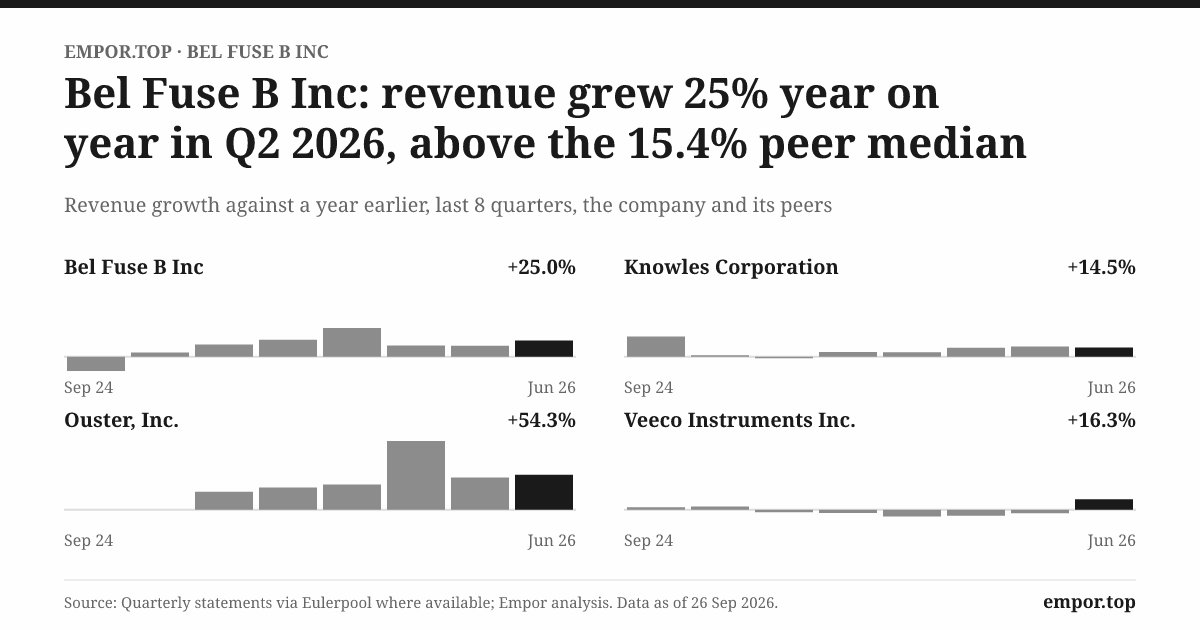
In the second quarter of 2026, ADRS revenue rose to $110.5 million at a 41.1% gross margin, while ITDS sales grew 31.1% to $100.2 million at a 38.8% gross margin.2 Within ADRS, defense-related revenue surged 28.4% to $66.5 million, more than offsetting year-over-year contraction in commercial aviation.29
That internal divergence provides critical context for assessing segment durability. High-margin defense orders drove ADRS performance, while commercial aerospace—the foundational customer base established through the Cinch acquisition—experienced cyclical contractions. Consequently, segment revenue and operating momentum remained heavily weighted toward tactical defense spending rather than commercial flight hours.
Meanwhile, management disclosed that Bel's manufacturing facility in Slovakia had secured qualification as a certified European defense supplier and won eight defense project awards, though leadership cautioned that those contracts were not projected to generate material revenue until late 2027.29 The milestone illustrated the elongated lead times inherent to defense qualification, where technical certification precedes commercial revenue by several years.
The May 2026 equity offering positioned the balance sheet to complete the transaction and pursue further expansion. Net proceeds were earmarked to repay outstanding borrowings under the credit facility, finance the acquisition of Enercon's remaining 20% equity interest, and support potential strategic acquisitions or commercial partnerships.1 By June 30, 2026, long-term debt had been eliminated entirely, down from $197.5 million at the close of 2025.2
On the balance sheet, the remaining 20% Enercon interest was recorded as a redeemable noncontrolling interest of $102.6 million, calculated using contractual EBITDA valuation multiples subject to an upside valuation cap set at 135% of the initial transaction valuation, as management clarified during the second-quarter 2026 call.29
From a capital allocation perspective, the equity offering presented distinct trade-offs. By issuing shares at historically elevated valuation multiples, management eliminated debt service obligations, fortified liquidity, and fully funded a committed buyout liability. Conversely, the issuance of approximately 1.7 million Class B shares diluted existing shareholders, while accumulating a substantial cash balance created reinvestment pressure.
Addressing capital allocation discipline on the second-quarter 2026 call, Tuweiq emphasized that Bel would maintain "organic investment and inorganic deals on separate tracks" while resisting premium valuations prevalent across the defense hardware sector.29 While that disciplined stance aligns with shareholder value preservation, execution will ultimately be judged by the pricing and integration of subsequent transactions.
Tuweiq's capital deployment record, however, also included an unforced error. In February 2023, Bel acquired a one-third minority interest in innolectric, a German manufacturer of electric mobility charging systems.33
By late 2025, as European electric vehicle subsidies weakened and industry participants curtailed investments, innolectric's majority shareholder ceased funding operations, precipitating insolvency proceedings on November 26, 2025; Bel consequently recorded a $13.1 million impairment charge in the fourth quarter of 2025 to write down its equity investment and associated loan receivables.334 That non-cash charge pushed Bel into a consolidated GAAP net loss of $5.4 million for the fourth quarter of 2025.4 While modest in comparison to the scale of Enercon, the write-down demonstrated that early-stage technology investments carried meaningful operational and underwriting risks.
Eighteen months post-announcement, Enercon had delivered on its financial commitments regarding top-line scale and gross margin accretion. Yet critical strategic questions remain: whether defense revenue growth will sustain once immediate ammunition and equipment replenishment cycles normalize, and whether Bel can acquire the remaining 20% interest in early 2027 without eroding aggregate transaction returns. As that defense integration proceeded, the other half of the business was mobilizing to capture an entirely different demand cycle in high-density data center power.
VII. The AI Power Squeeze & Data Center Realities (02:25 – 02:45 / 20 Min)
Inside a modern artificial intelligence data center, rows of high-density server racks packed with graphics processors consume as much electricity as a small municipal neighborhood. Each processor demands clean, highly regulated direct-current electricity, and every watt dissipated as heat must be evacuated by cooling infrastructure. Consequently, power conversion hardware—historically regarded as a low-margin commodity inside server enclosures—has emerged as a primary engineering bottleneck across high-performance computing.
The physical challenge centers on multi-stage voltage conversion. Grid electricity enters a data center facility as high-voltage alternating current and must be stepped down through successive stages into sub-one-volt direct current at the silicon processor core, with energy lost as heat at every transition. As rack power densities escalated toward 100 kilowatts and beyond, data center operators migrated toward higher-voltage DC distribution inside the rack and standardized power shelves—modular enclosures of power supply units that energize an entire compute bay. Open architecture standards, notably specifications developed by the Open Compute Project, enable hyperscale cloud providers to source these power shelves across multiple vendors. While standardization expands the addressable hardware market, it simultaneously lowers customer switching costs, commoditizing mechanical form factors and leaving suppliers vulnerable to price competition.
Bel’s exposure to high-performance computing resides within its Industrial Technology & Data Solutions segment, which pairs the commercial power conversion business largely inherited from the 2014 Power-One acquisition alongside legacy magnetics and connectivity product lines. Executive leadership began highlighting artificial intelligence opportunities during 2024. On the third-quarter 2024 earnings call, management noted that "some of the bookings have come from AI customers" and pointed to two major potential AI accounts entering 2025.13 By the fourth-quarter 2025 call, Tuweiq cited positive momentum in AI customer expansion, stating that Bel's components were being designed into power solutions for hyperscale operators.28
Disclosed operational metrics, however, provided a sobering baseline. On the third-quarter 2025 earnings call, management disclosed that AI-related sales totaled $3.2 million for the quarter, up from $1.8 million in the prior-year period, while cautioning that isolating the precise contribution of AI was difficult amid a broader inventory recovery across distribution channels.26 Against Bel's consolidated quarterly revenue of $179 million, that contribution represented less than 2% of sales.26 While market commentary often framed AI infrastructure as an imminent 15% to 20% growth driver for the business, the company’s audited disclosures reflected an early-stage revenue stream.
Operating disclosures showed acceleration during 2026, though the numbers warrant careful disaggregation. In the second quarter of 2026, management reported that "data solutions" revenue expanded 55% to approximately $58 million, driven by high-performance computing customers deploying hardware and "the beginning of a ramp related to recent project wins."29 While representing meaningful top-line expansion, data solutions encompasses a broader product basket than high-density AI server power. The grouping includes legacy networking interfaces and enterprise data infrastructure connectivity—product categories where Bel’s discrete magnetics have historically encountered severe customer inventory destocking and price erosion. Moreover, in March 2026, Bel completed the $16 million acquisition of dataMate from Methode Electronics, absorbing approximately $18 million in annual sales of Ethernet and broadband products across networking, data centers, industrial automation, and smart building applications.34 While an accretive bolt-on, dataMate represented an expansion of Bel's traditional networking and connectivity portfolio rather than a proprietary AI power franchise.
Evaluating whether Bel can establish a durable, high-margin position in AI server power requires testing management's narrative against structural industry realities. The primary counterweight lies in market architecture. High-volume merchant server power is dominated by large-scale Taiwanese manufacturers such as 台達電子 Delta Electronics and 光寶科技 Lite-On Technology, alongside specialized power electronics suppliers including Advanced Energy and Vicor. Hyperscale cloud operators maintain sophisticated global procurement organizations that routinely dual-source standard components to enforce aggressive price discipline.
Bel's corporate history reinforces that competitive reality. The business capitalized on the networking boom of the late 1990s, only to absorb a sharp contraction in revenue and net operating losses when telecommunications capital spending retreated.10 Similarly, the 2014 Power-One acquisition was predicated on enterprise server and data center demand, yet Bel experienced stagnant top-line sales and protracted margin compression across the following six years.113 More recently, the 2023 investment in innolectric represented a venture into electric-mobility charging infrastructure that ultimately collapsed into insolvency.33 While these historical episodes do not negate Bel's current commercial traction, they demonstrate that positioning for secular growth themes has historically carried substantial execution risk before generating sustained economic returns.
The empirical record points to a measured conclusion. Bel participates legitimately in data center infrastructure across power conversion modules, circuit protection, and specialized connectivity, and its second-quarter 2026 data solutions results demonstrate genuine commercial traction. Yet across the audited record, pure-play AI power remains an early-stage growth vector rather than the fundamental pillar supporting Bel's corporate valuation, and the company lacks the manufacturing scale to rival Taiwanese merchant giants in high-volume, standardized power shelves. For institutional investors, high-density computing exposure represents optional upside that must be validated through sequential quarterly execution.
The forward-looking operational test is straightforward. If Industrial Technology & Data Solutions sustains double-digit organic revenue expansion while preserving gross margins near the corporate benchmark of roughly 38% to 39%, that performance would indicate Bel is securing highly customized, mission-critical sockets. Conversely, if top-line gains are accompanied by gross margin compression—resembling the first quarter of 2026, when ITDS gross margin contracted 70 basis points year-over-year to 36.6%—it would indicate that data solutions revenue remains subject to the cyclical commoditization historically characteristic of enterprise hardware.32 That distinction leads directly to the broader strategic assessment of where Bel's competitive advantages truly reside.
VIII. Strategic Architecture: Porter’s 5 Forces & Hamilton Helmer’s 7 Powers (02:45 – 03:05 / 20 Min)
Consider two contrasting commercial interactions taking place on the same business day. In the first, a Bel application engineer sits alongside a defense program team reviewing a ruggedized power unit that has undergone years of thermal cycling, shock, vibration, and electrical qualification. Replacing that unit would disrupt flight-test schedules and trigger costly programmatic recertification.
In the second meeting, a Bel sales representative faces a commercial data center or enterprise networking procurement team reviewing a spreadsheet of three interchangeable, pin-compatible alternatives alongside strict unit-cost targets. Both exchanges occur within the same corporate structure, yet they reflect fundamentally disparate competitive positions. Corporate strategy at Bel centers on shifting a growing proportion of consolidated revenue from the second environment into the first.
Applying Hamilton Helmer's 7 Powers framework—which identifies the structural mechanisms enabling an enterprise to sustain returns above its cost of capital—reveals an asymmetric economic foundation.
Switching costs represent Bel's most defensible competitive advantage, though they remain concentrated almost entirely within aerospace and defense electronics. Once qualified into long-cycle military platforms, mission-critical subsystems are rarely engineered out, helping explain why Aerospace, Defense & Rugged Solutions sustained gross margins above 41% across the first half of 2026.322
Conversely, across standard networking magnetics and commercial merchant power, switching barriers are minimal. That structural vulnerability was underscored during the 2024 downturn, when Magnetic Solutions revenue plunged 40.2% in a single year as downstream customers liquidated surplus inventory.12 Bel commands substantial switching friction in one half of its portfolio, while functioning as a price-competitive merchant supplier across much of the other.
Cornered resources appear moderate rather than absolute. Military certifications, facility clearances, and long-standing supplier integration with defense prime contractors create meaningful barriers to entry. The recent defense qualification secured by Bel's manufacturing site in Slovakia exemplifies the deliberate assembly of those operational assets.29 Yet these credentials do not confer exclusive monopoly rights comparable to proprietary patents; well-capitalized aerospace peers routinely maintain identical operational clearances.
Process power—the institutional ability to execute complex manufacturing more effectively than competitors in ways that defy straightforward imitation—presents a compelling hypothesis, but remains unverified across a full cycle. The fact that Bel expanded consolidated gross margins during the steep 2024 revenue contraction demonstrates genuine structural efficiency.12
Nevertheless, public disclosures cannot yet establish whether that performance reflects proprietary manufacturing know-how in high-mix, low-volume assembly or simply the non-recurring financial benefit of pruning unprofitable product lines and consolidating redundant plants inherited from prior acquisitions. One-time footprint rationalization generates immediate margin relief, but cannot compound indefinitely.
Scale economies work against the enterprise. With 2025 net sales of $675.5 million, Bel operates at a fraction of the scale of broad-line connector and power conglomerates such as Amphenol, TE Connectivity, and Delta Electronics.4 Bel cannot match their absolute research and development budgets or comprehensive distribution networks. Consequently, the company's competitive positioning relies on serving high-specification niches where order volumes are either too customized or too small for global conglomerates to prioritize.
Network effects and counter-positioning do not apply to Bel's conventional merchant hardware model. Brand equity functions primarily as an operational reputation for reliability in severe environments—an asset that secures customer trust in military hardware, but does not support consumer-style price premiums.
Michael Porter's Five Forces framework clarifies the industry dynamics governing Bel's operating segments. The threat of new entrants is low within military-qualified subsystems, where certification hurdles and audit standards deter newcomers, but elevated across commercial power and standard passives, where offshore manufacturers can enter with modest capital commitments.
Buyer power operates as the primary pricing constraint within Industrial Technology & Data Solutions, where hyperscale operators and enterprise networking original equipment manufacturers command extensive procurement leverage. In contrast, buyer power is tempered within defense programs, where prime contractors prioritize reliability, delivery schedules, and technical compliance over marginal component savings.
Bel's 2025 annual report noted that no individual customer accounted for more than 10% of consolidated net sales, mitigating direct concentration risk, though substantial volumes routed through distributors and electronic manufacturing service providers can obscure underlying platform exposure.25
Supplier power remains moderate and rising. During the fourth-quarter 2025 earnings call, management cited escalating costs for gold, copper, and bare printed circuit boards, alongside statutory wage increases across production sites in China and Mexico.28 The company's 2025 annual report similarly highlighted sharp spikes in precious metal prices as an ongoing operating headwind.25
Bel countered by implementing price increases across select product lines in February and March 2026, which leadership characterized as a "surgical" pass-through targeting product categories facing the steepest input inflation.29 The market's willingness to absorb those price adjustments without volume erosion serves as an immediate test of Bel's real-world pricing power throughout 2026.
The threat of substitutes remains minimal for ruggedized interconnects and specialized power conversion units, which remain physical necessities within electrical architectures, but moderate across discrete magnetics, where advances in semiconductor integration gradually absorb passive functionality directly onto silicon. Meanwhile, competitive rivalry remains intense across all business lines: against Amphenol, TE Connectivity, ITT Cannon, and Glenair in harsh-environment connectors; against Delta Electronics, Lite-On Technology, Vicor, and Advanced Energy in server and industrial power; and against Pulse Electronics, Würth Elektronik, and TDK in magnetics.
This strategic architecture explains the core investment tension: Bel's competitive advantages are concentrated where qualification barriers and switching costs are high, and weakest where products conform to standardized form factors. The corporate reorganization into two commercial operating units makes that operational divide transparent to public markets, setting the stage for evaluating the corporate governance arrangements and market valuation multiples that follow.
IX. Activist Stress Test, Governance Reality, & The Bear vs. Bull Case (03:05 – 03:25 / 20 Min)
On December 9, 2025, David Goldman, general counsel of GAMCO Asset Management, delivered a letter to Bel's corporate secretary in West Orange, New Jersey. The correspondence enclosed a shareholder proposal for the 2026 annual meeting and noted that the submission was accompanied by Amendments 55 through 58 to GAMCO's Schedule 13D—a regulatory paper trail that testified to the multi-decade involvement of Mario Gabelli's investment firm with Bel.8 GAMCO requested that the board allow Class A voting shareholders to convert their shares into Class B common stock at their option.8
The economic rationale was straightforward. GAMCO highlighted that Class A shares, which carry one vote each, traded approximately $22 per share below non-voting Class B shares on December 8, 2025, despite Class B shares carrying an entitlement to cash dividends at least 5% higher than Class A shares.8
GAMCO characterized optional conversion as a "low-cost, governance-neutral reform" and explicitly proposed structural safeguards, such as conversion volume caps and execution windows, to respect the existing corporate charter.8 By late 2025, GAMCO held only 71,338 Class A shares, representing roughly 3.37% of the voting class.8 Five years earlier, the firm's 21.46% Class A position had seen its voting rights suspended under the charter's 10% ownership threshold.16
At the May 2026 annual meeting, GAMCO's conversion proposal was defeated, garnering 736,905 votes in favor against 1,016,457 votes opposed.35 While unsuccessful, the tally represented a notable minority vote in a share class where founding family insiders and long-standing holders exert decisive influence.
During that same meeting, the two director nominees up for election each faced more than 400,000 withheld votes, even as the advisory say-on-pay proposal passed comfortably.35 The voting pattern delivered a nuanced verdict: shareholders broadly endorsed executive compensation and operational execution, yet a significant constituency expressed dissatisfaction with board oversight and capital structure restrictions.
An activist stress test of Bel's corporate architecture reveals four structural pressure points. First, the dual-class voting framework continues to insulate insider control, reinforced by the 10% voting-suspension mechanism that historically neutralized major outside Class A accumulations.16 Second, Bel's own 2011 willingness to dismantle the dual-class architecture during its hostile pursuit of Pulse demonstrated that governance provisions become negotiable when management seeks strategic scale.18
Third, the substantial cash reserves accumulated following the May 2026 equity offering create capital deployment temptations, in a business where past acquisitions range from the high-returning successes of Cinch and Enercon to the $101.7 million goodwill impairment in 2016 and the $13.1 million innolectric write-off in 2025.1133
Fourth, Bel has not published explicit corporate return on invested capital targets, and executive compensation disclosures reviewed for this analysis show no formal metric tying executive incentive pay directly to audited ROIC thresholds—meaning investors cannot assume that capital returns govern incentive payouts.
The operational risk radar presents tangible challenges. Elevated defense appropriations cut both ways: Enercon benefits from global military modernization, yet its core engineering and manufacturing footprint is situated in Israel, where corporate disclosures explicitly identify armed conflict and regional hostilities as an ongoing business risk.25 Currency volatility introduces structural friction because Bel operates manufacturing facilities in China, Mexico, Israel, and Slovakia while reporting consolidated financials in U.S. dollars, with management repeatedly identifying fluctuations in the Mexican peso, Chinese renminbi, and Israeli shekel as margin headwinds.2826
Input cost inflation represents an additional headwind, with management highlighting sustained price increases in bare printed circuit boards and precious metals such as gold and copper.25 Furthermore, acquiring Enercon's remaining 20% equity interest in early 2027 is structured around contractual EBITDA multiples subject to an upside valuation cap, meaning that stronger underlying operating earnings at Enercon will directly elevate the cash outlay required to complete the buyout.29
The bull case rests on verifiable structural transformation. Bel is no longer primarily an enterprise networking magnetics supplier. Its larger operating segment serves aerospace and defense programs with gross margins exceeding 41%, bolstered by Enercon's historical adjusted EBITDA margins above 30%.52 The balance sheet holds zero long-term debt following the complete repayment of credit borrowings with proceeds from the May 2026 equity offering.2
Total backlog stood at $452.2 million at the end of January 2026, an increase from $388.1 million twelve months prior.25 For the third quarter of 2026, management projected net sales between $205 million and $225 million with gross margins of 39% to 41%, signaling confidence that elevated margin levels can be sustained through the cycle.2 Finally, executive leadership has consistently executed against its cost rationalization and SKU profitability commitments over a five-year horizon.
The counterbalancing bear case is equally grounded in operating data. Consolidated margin expansion was achieved partly during an extraordinary post-pandemic shortage and destocking cycle, and Industrial Technology & Data Solutions gross margin contracted 70 basis points year-over-year in the first quarter of 2026 even as sales expanded.32 Commercial aerospace revenue contracted year-over-year in the second quarter of 2026, confirming that commercial flight demand is not currently driving segment growth.29
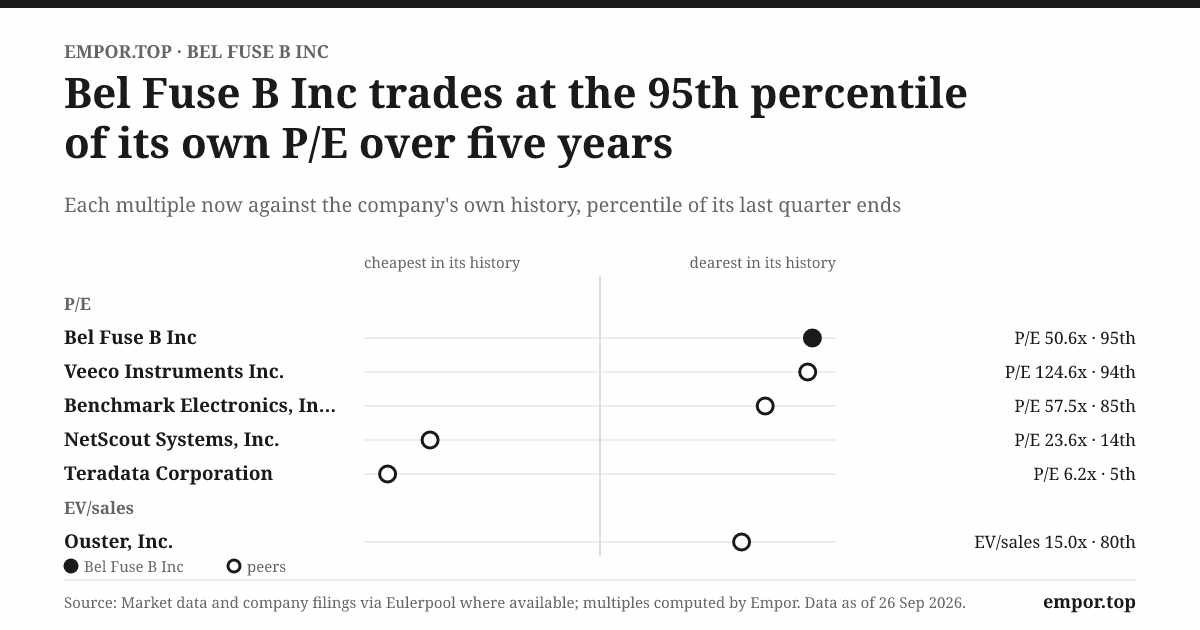
Commercial exposure to artificial intelligence infrastructure remains modest in disclosed dollar terms, accounting for less than 2% of sales in audited quarters.26 Defense qualification awards secured at the Slovakian facility will not translate into meaningful commercial revenue until late 2027.29 The dual-class voting structure remains intact, with Class A shares trading at a persistent market discount to Class B shares.8 Finally, the May 2026 equity offering introduced equity dilution at a valuation multiple that prices the enterprise for flawless execution.
Distinguishing corporate reality from market narrative provides the clearest analytical conclusion. The prevailing myth suggests that Bel has transformed into a pure-play aerospace and defense compounder commanding permanent 40% gross margins. The operational reality is that roughly half of the company operates as a high-margin, qualification-protected defense and rugged electronics business, while the remaining half functions as a restructured, higher-performing, yet inherently cyclical industrial and data hardware supplier.
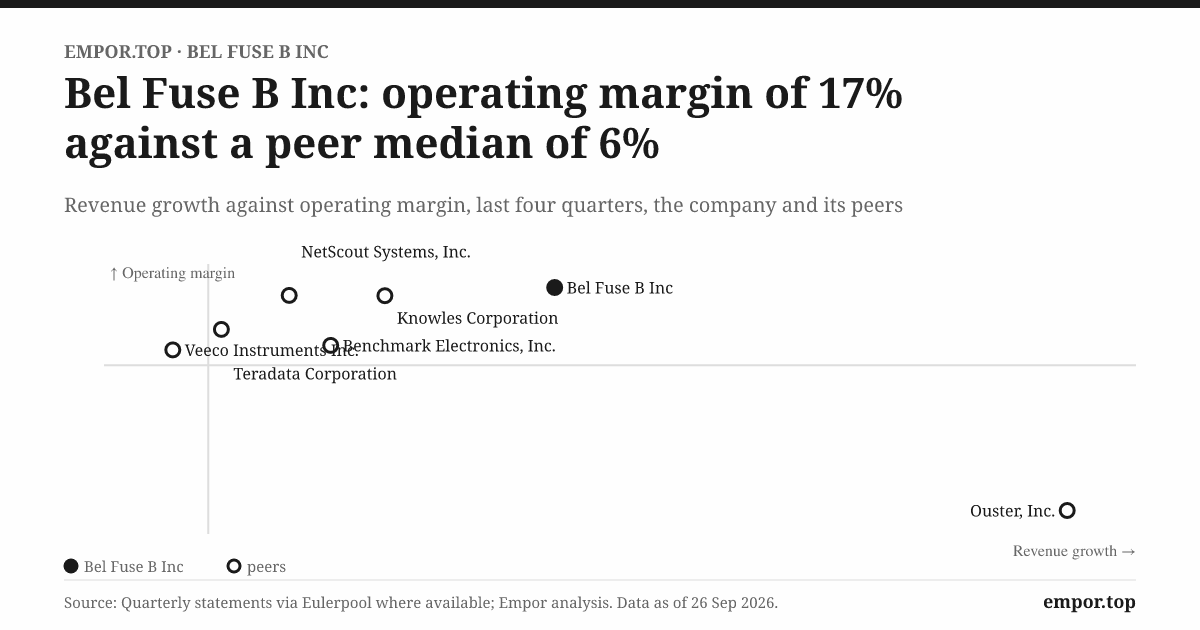
Consolidated operating margins reflect an amalgamation of both business models. Management's guidance for third-quarter 2026 gross margins of 39% to 41%, contrasted with its 37% to 39% guidance for the first quarter of 2026, confirms that profitability fluctuates within a broader operating corridor rather than compounding in an uninterrupted upward trajectory.24
For institutional investors, the fundamental analytical inquiry is not whether Bel Fuse has reshaped its business model; the operational restructuring is established by the financial record. The central question is how much of that margin expansion is structurally permanent—a determination that will be answered not by accepting bullish or bearish narratives, but by tracking unit-level pricing discipline, gross margin durability across segment cycles, and the disciplined deployment of Bel's post-offering cash reserves.
X. Playbook Lessons & Epilogue (03:25 – 03:40 / 15 Min)
In Jersey City, the building at 206 Van Vorst Street still stands with a façade dating to an 1850s carriage-making shop—a headquarters Bel moved into in April 2001, just months before Elliot Bernstein died and the telecom bubble burst.9 From its roof, employees watched the World Trade Center fall that September.9
The company that operated there has since relocated its corporate office to West Orange, sold off its legacy assembly lines, and rebuilt its portfolio around defense power systems and data infrastructure.8 The physical contrast captures the strategic transition: the same corporate brand and the same founding family chairing the board, but virtually every underlying operational asset remade.
The first operational takeaway is that disciplined execution can create as much economic value as technological invention. Bel did not introduce a breakthrough component between 2021 and 2025. Instead, management unified fragmented software systems, consolidated manufacturing plants, enforced SKU-level pricing discipline, and pruned low-margin product lines—lifting consolidated gross margin from 24.7% in 2021 to 39.1% in 2025.234
That represents an expansion of more than 1,400 basis points driven primarily by operational plumbing. The essential qualification is that part of that margin gain coincided with broad post-pandemic pricing power and industry shortages, and its full durability has yet to be tested across an extended period of weak cyclical demand accompanied by rising input costs.
The second lesson is that the headline multiple paid for an acquisition matters far less than what the buyer accomplishes with the asset after closing. The 2014 corporate carve-outs appeared cheap on revenue multiples yet disappointed, producing a steep top-line shortfall against the $705 million annual run-rate Dan Bernstein projected alongside a nine-figure goodwill impairment within two years.2211
By contrast, Enercon carried a higher price per dollar of earnings but delivered operating margins far above Bel's corporate average.5 The fundamental divergence lay in asset quality, customer switching costs, and the organization's capacity to integrate the business rather than defer structural overhead rationalization.
The third lesson centers on capital structure timing. Issuing equity when shares trade at historically elevated multiples to retire bank debt and fund committed buyout obligations is an opportunistic and defensible choice, and Bel executed the offering cleanly.12 Yet declaring it an unalloyed triumph of capital stewardship would be premature. The ultimate test depends on how management allocates the remaining cash balance, in a corporate history that includes high-returning acquisitions like Cinch alongside complete write-downs like innolectric.1733
For institutional investors, three operational indicators will determine whether Bel's structural transformation endures.
The first is consolidated gross margin across a complete hardware cycle. Management's quarterly guidance throughout 2026 has spanned a corridor of 37% to 41%.42 Maintaining that margin range as commercial networking volumes normalize and commodity input costs fluctuate would substantiate the thesis that profitability gains are permanent. A retreat toward the low 30s would indicate that gross margin was elevated by transitory pricing tailwinds rather than enduring pricing power.
The second indicator is organic revenue growth and order momentum within Aerospace, Defense & Rugged Solutions. Bel concluded 2025 with a book-to-bill ratio of 1.1.28 Sustained order intake exceeding shipments, combined with a recovery in commercial aviation demand and the conversion of European defense qualification awards into revenue by late 2027, would validate the multi-year durability of the defense growth engine.
The third indicator is return on invested capital following the equity expansion. With shareholders' equity exceeding $900 million, the enterprise must now generate competitive returns across a substantially expanded equity base compared to the capital structure that produced its initial margin turnaround.2 Because management publishes no formal corporate ROIC target, investors will need to calculate and evaluate those capital returns directly from audited filings.
Bel Fuse's 77-year trajectory—from a Union City garage workshop financed by an $8,000 family loan to an aerospace and defense power specialist with a net cash balance sheet—demonstrates that legacy industrial hardware manufacturers can execute meaningful strategic reinventions.
Yet that history also illustrates how protracted industrial transformations can be, how many discounted acquisitions can disappoint before integration discipline takes root, and how heavily capital allocation depends on executive leadership. The ultimate verdict will not be decided by corporate heritage or boardroom continuity, but by whether Farouq Tuweiq and his team can prove that recent margin gains, specialized defense positioning, and post-offering cash reserves compound into durable enterprise value rather than cresting at a cyclical peak.
References
-
Bel Fuse Inc. Announces Pricing of Upsized Public Offering of Class B Common Stock (Form 8-K Exhibit 99.2) — U.S. Securities and Exchange Commission, 2026-05-13 ↩↩↩
-
Bel Reports Second Quarter and First Half 2026 Results — GlobeNewswire, 2026-07-29 ↩↩↩↩↩↩↩↩↩↩↩↩
-
Bel Reports Fourth Quarter and Full Year 2020 Results (Form 8-K Exhibit 99.1) — U.S. Securities and Exchange Commission, 2021 ↩↩↩↩↩↩↩↩
-
Bel Reports Fourth Quarter and Full Year 2025 Results — Stock Titan, 2026-02-17 ↩↩↩↩↩↩↩
-
Bel Announces Agreement to Acquire Enercon Technologies — GlobeNewswire, 2024-09-19 ↩↩↩↩↩↩↩↩↩
-
Bel Announces Strategic Organizational Realignment (Form 8-K Exhibit 99.1) — U.S. Securities and Exchange Commission, 2026-03-31 ↩↩↩↩
-
Bel Fuse Appoints Farouq Tuweiq, Former Investment Banker, as Chief Financial Officer — GlobeNewswire, 2021-01-05 ↩↩↩↩
-
GAMCO Asset Management Shareholder Proposal Letter to Bel Fuse Inc. — U.S. Securities and Exchange Commission, 2025-12-09 ↩↩↩↩↩↩↩↩
-
The Bel Fuse Story (Corporate History Booklet) — Bel Fuse Inc. ↩↩↩↩↩↩↩↩↩↩↩↩↩↩↩↩↩↩↩↩↩↩↩↩↩↩
-
Bel Fuse Inc. Annual Report on Form 10-K for Fiscal Year 2016 — U.S. Securities and Exchange Commission, 2017 ↩↩↩↩↩↩↩↩↩↩↩↩↩
-
Bel Reports Fourth Quarter and Full Year 2024 Results — GlobeNewswire, 2025-02-18 ↩↩↩↩↩↩↩↩↩↩
-
Earnings Call: Bel Fuse Reports Q3 2024 Results, Optimistic Despite Sales Drop — Investing.com, 2024-10 ↩↩↩↩↩↩↩
-
Technitrol Offers to Acquire Bel Fuse — U.S. Securities and Exchange Commission, 2007-03-23 ↩↩↩↩
-
Technitrol Withdraws Offer To Acquire Bel Fuse For $43.00 Per Share In Cash — RTTNews, 2007-04-26 ↩
-
Bel Fuse Inc. Definitive Proxy Statement (Schedule 14A) — U.S. Securities and Exchange Commission, 2020-04-09 ↩↩↩
-
Bel Fuse Inc. Form 8-K Exhibit 99.1 on Cinch Connectors Acquisition — U.S. Securities and Exchange Commission, 2010-02-11 ↩↩↩↩
-
Bel Fuse Letter to Pulse Electronics Shareholders — U.S. Securities and Exchange Commission, 2011-05-03 ↩↩↩↩↩
-
Pulse Electronics Announces Agreement to Be Acquired by Oaktree Affiliates (Form 8-K Exhibit 99.1) — U.S. Securities and Exchange Commission, 2015-03-02 ↩↩
-
Yageo to Buy Pulse for NT$22 Billion — Taipei Times, 2018-05-23 ↩
-
Bel Agrees to Acquire Power-One Power Solutions from ABB for $117 Million (Form 8-K Exhibit 99.1) — U.S. Securities and Exchange Commission, 2014-04-28 ↩↩↩
-
Bel Agrees to Acquire Emerson Network Power Connectivity Solutions for $98 Million (Form 8-K Exhibit 99.1) — U.S. Securities and Exchange Commission, 2014-05-16 ↩↩↩
-
Bel Reports Fourth Quarter and Full Year 2022 Results (Form 8-K Exhibit 99.1) — U.S. Securities and Exchange Commission, 2023 ↩↩↩↩↩↩↩↩
-
Farouq Tuweiq Carves a Path to Purposeful Change at Bel Fuse — Profile Magazine, 2023 ↩↩↩↩↩↩↩
-
Bel Fuse Inc. Annual Report on Form 10-K for Fiscal Year 2025 — U.S. Securities and Exchange Commission, 2026 ↩↩↩↩↩↩↩↩
-
Earnings Call Transcript: Bel Fuse B Q3 2025 Beats Earnings Expectations — Investing.com, 2025-10 ↩↩↩↩↩↩↩
-
Bel Closes Its Previously Announced Acquisition of Enercon Technologies — GlobeNewswire, 2024-11-14 ↩
-
Bel Fuse Inc (BELFA) Q4 2025 Earnings Call Highlights — Yahoo Finance, 2026-02 ↩↩↩↩↩↩
-
Earnings Call Transcript: Bel Fuse Tops Q2 2026 Estimates — Investing.com, 2026-07 ↩↩↩↩↩↩↩↩↩↩↩
-
Farouq Tuweiq to Succeed Daniel Bernstein as CEO of Bel Fuse Inc. in May 2025 — GlobeNewswire, 2025-02-03 ↩↩↩
-
Bel Appoints Lynn Hutkin as Chief Financial Officer — GlobeNewswire, 2025-05-20 ↩↩
-
Bel Reports First Quarter 2026 Results (Form 8-K Exhibit 99.1) — U.S. Securities and Exchange Commission, 2026 ↩↩↩↩↩
-
Bel Announces Expected Impairment Charge Related to Innolectric Investment (Form 8-K Exhibit 99.1) — U.S. Securities and Exchange Commission, 2025-12-03 ↩↩↩↩↩
-
Bel Fuse Inc. Announces Acquisition of dataMate from Methode Electronics Inc — GlobeNewswire, 2026-03-05 ↩
-
Bel Fuse Inc. Form 8-K: Results of 2026 Annual Meeting of Shareholders — U.S. Securities and Exchange Commission, 2026-05-26 ↩↩
 LinkedIn
 WhatsApp
 Reddit
 Hacker News
 Email
Email Kindle
 RSS Feed
 Spotify
 Apple Podcasts
 Amazon Music
 Audible
 YouTube