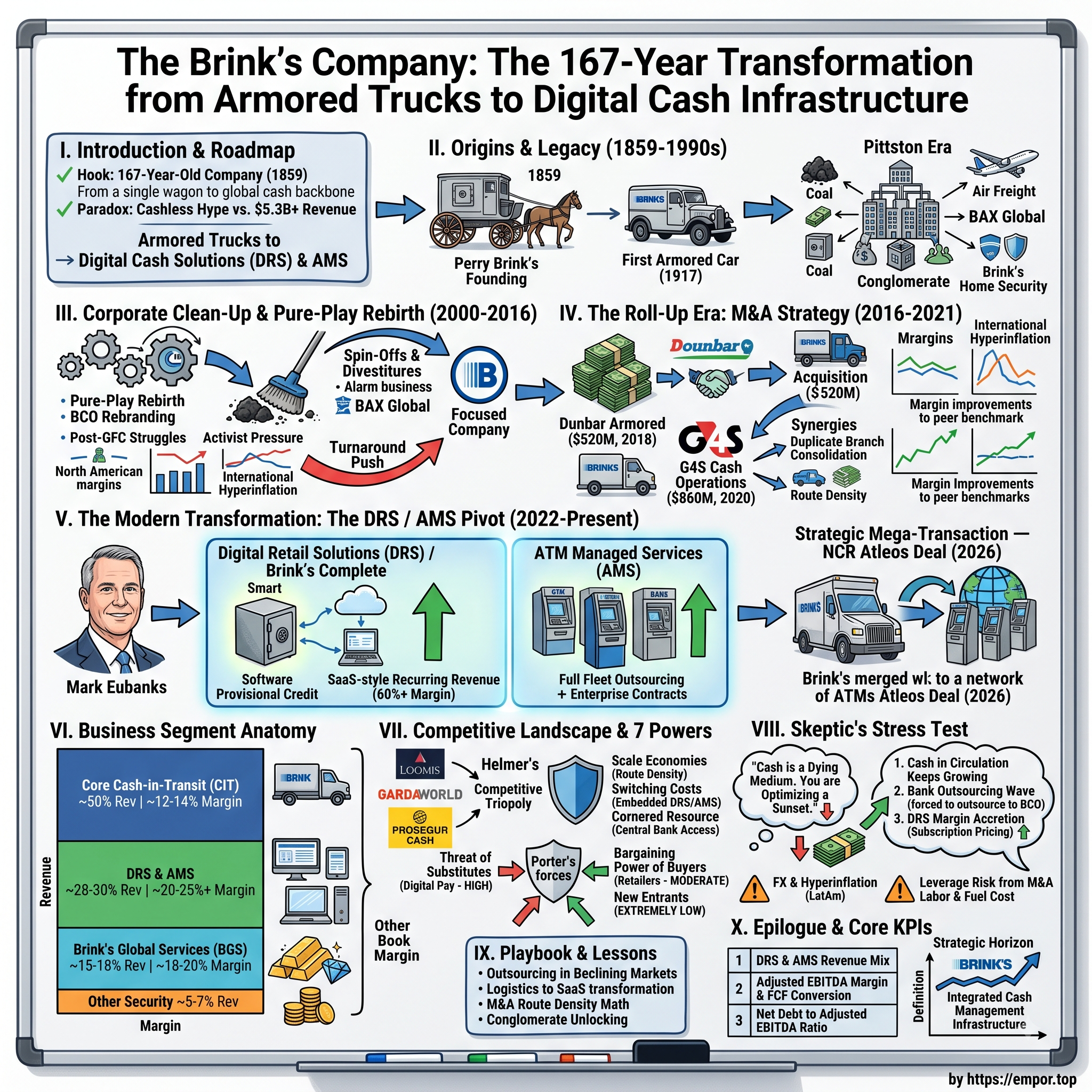
The Brink's Company: The 167-Year Transformation from Armored Trucks to Digital Cash Infrastructure
I. Introduction & Episode Roadmap
There is a particular sound familiar to anyone who has worked in retail: the double thud of an armored truck door, the clank of a hopper, and the click of a lock. It is a sound designed to be unremarkable. For 167 years, the core operational objective of Brink's has been to make the movement of client currency so routine that it goes largely unnoticed — right up until the moment something goes wrong.
The company began in 1859, when Perry Brink started hauling luggage and trunks around Chicago under the name Chicago City Express Company.5 By 1879, the family was selling stock as Brink's Express Company; by 1912, it had trademarked the arched logo still displayed on employee badges; and by 1919, it had opened its first branch outside Chicago, in Cleveland.5 Over the course of that evolution, the business transitioned from a local express delivery service into a specialized institutional intermediary standing between a enterprise's cash reserves and potential security risks.
This trajectory highlights an apparent paradox for Brink's in 2026. Dominant technology narratives over the past two decades have predicted the rapid displacement of physical currency by digital channels, including contactless payments, regional electronic networks such as Pix in Brazil and UPI in India, and digital asset infrastructure. Yet The Brink's Company (NYSE: BCO) generated $5.26 billion in revenue, $977 million in adjusted EBITDA, and $436 million in free cash flow in 2025.1 Its adjusted EBITDA margin expanded 40 basis points that year to a record 18.6%.1 Despite operating in a sector widely assumed to be in secular decline, the company has continued to report record financial results.
The explanation lies not simply in cash's persistence, but in how Brink's has systematically transformed its service model over the past four years. The traditional cash-in-transit model relied on route schedules and staffing: clients paid for armored trucks to arrive at fixed intervals, with pricing determined by trips, stops, and headcount. The expanded business model — operating through ATM Managed Services and Digital Retail Solutions (AMS/DRS) — focuses on managed operational outcomes. Retailers deposit cash into on-site Brink's smart safes and receive provisional bank credit overnight, while financial institutions outsource entire ATM fleets to improve network uptime. Under this structure, Brink's optimizes route timing and pickup schedules dynamically. In the second quarter of 2026, AMS/DRS revenue grew 14% organically, marking fourteen consecutive quarters of mid-teens or higher growth and pushing annualized segment revenue past $1.5 billion — more than double its level three years earlier.3
While central to the company's growth strategy, this transition carries significant balance-sheet considerations. Brink's operates with notable debt leverage, and its GAAP results reflect substantial non-cash and restructuring adjustments: in 2025, GAAP earnings per share stood at $4.70 compared with non-GAAP adjusted earnings per share of $8.05.1 Furthermore, in February 2026, Brink's announced a $6.6 billion acquisition of NCR Atleos — the largest transaction in company history — which is projected to push pro forma leverage above three times net debt to EBITDA and roughly double the scale of the enterprise.4 Having previously emphasized balance-sheet discipline upon reaching target leverage levels, management's decision to re-leverage the business raises critical questions regarding capital allocation and execution risk.
The roadmap for this analysis covers the company's full evolution: first, its 19th-century origins and the period when the cash logistics provider was owned by a coal conglomerate. Next, the corporate restructuring of the 2000s and the activist shareholder interventions that accelerated strategic change. The focus then turns to industry consolidation through acquisitions such as Dunbar and G4S, alongside the underlying economics of route density. Following that is an examination of the Mark Eubanks management era, the pivot to digital retail solutions, and the strategic rationale behind the Atleos acquisition. Finally, the analysis details segment unit economics, evaluates the competitive landscape against Loomis, GardaWorld, and Prosegur, and stress-tests the long-term outlook for physical currency.
The story begins with a single wagon, an entrepreneur, and a rapidly expanding 19th-century Chicago.
 Subscribe on LinkedIn
II. Origins & Legacy: Stagecoaches, Coal Conglomerates, & The Brink's Brand (1859–1990s)
Chicago in 1859 was a boomtown built on mud. Its population had roughly quadrupled in a decade, rail hubs were converging, and the city lacked a reliable method to move high-value cargo across town. Perry Brink launched his enterprise with a simple proposition — a wagon for hire transporting trunks and parcels — but the business steadily migrated toward whatever customers were most anxious to safeguard. Within a generation, that meant company payrolls.
The pivot from general freight to cash logistics established the company's core value proposition: customers were not simply paying for transport, but for the transfer and mitigation of operational risk. A factory owner in 1890s Chicago did not merely need cartage; he sought to avoid personally transporting thousands of dollars in gold coin down public streets on payday.
The consequences of security failures were immediate and severe. Following a fatal payroll robbery in 1917, Brink's began deploying armored transport — initially retrofitting buses with steel side panels before commissioning a purpose-built armored car in 1923.6 Beyond hardware upgrades, this shift defined operational standards for the cash-in-transit industry, establishing protocols for crew sizing, vehicle security, and custody transfers that were subsequently codified by insurers and regulators. In 1927, management placed the company logo on previously unmarked vehicles on the premise that visible deterrence was more effective than stealth.5 Prominent branding itself became a central component of the security product.
That brand identity faced a major test on January 17, 1950, when eleven disguised robbers entered the Brink's counting room in Boston's North End. The perpetrators stole $1.22 million in cash and $1.56 million in checks and securities — a $2.775 million haul that marked the largest armed robbery in U.S. history at the time.7 Dubbed the "crime of the century" by federal investigators, the case remained unsolved for nearly six years until a participant confessed shortly before the statute of limitations expired.7 Less than $60,000 of the stolen assets was ever recovered.
Paradoxically, the heist reinforced rather than damaged the firm's market standing. Rather than undermining public confidence, "The Great Brink's Robbery" embedded the company into popular culture as a benchmark for high-value custody. In security logistics, public awareness of the underlying risk can heighten customer demand for institutional protection, conferring a persistent brand advantage over regional peers.
The Pittston detour
Despite establishing a dominant brand in physical financial security, Brink's spent the subsequent four decades operating as a subsidiary of a diversified conglomerate.
The Pittston Company, a bituminous coal producer, began building a equity stake in Brink's during the 1950s and completed the acquisition in 1959.5 Pittston subsequently expanded into adjacent service sectors, acquiring air-freight forwarder Burlington Air Express (later BAX Global) and launching Brink's Home Security in 1983.5 By the 1990s, the parent corporation governed coal mining operations, heavyweight air cargo, residential security monitoring, and armored transport under a single board.
This corporate structure created significant valuation friction for public shareholders. While the cash logistics unit generated stable, contract-based revenue with high customer retention, the core coal business introduced commodity cyclicality alongside long-dated liabilities, including black lung benefit claims, retiree medical obligations, and environmental remediation costs. Concurrently, the air-freight division operated as a capital-intensive business in direct competition with integrated carriers. Equity analysts covering energy commodities were ill-equipped to evaluate cash security operations, while security-focused investors avoided underwriting mining liabilities.
In an effort to address the conglomerate discount, the company issued separate tracking stocks for its primary business divisions in the 1990s. However, because tracking equities altered dividend allocation without legally unbundling assets, corporate debt, or governance structures, the financial performance of the cash logistics business remained constrained by the parent company's balance sheet.
This multi-decade period highlighted two structural dynamics. First, customer and institutional trust in the Brink's operating brand proved resilient against parent-level capital misallocation. Second, high-margin logistics businesses can trade at depressed valuation multiples when constrained by legacy corporate structures — setting the stage for the corporate restructurings that followed.
III. The Corporate Clean-Up & Pure-Play Rebirth (2000–2016)
The corporate unwinding began with a name change. In 2004, The Pittston Company formally renamed itself The Brink's Company, acknowledging that cash logistics had become its primary economic engine.5 The decision signaled a definitive strategic pivot: once the parent corporation adopted the brand of its security business, its remaining non-core subsidiaries were targeted for divestiture.
The restructuring proceeded across three main operations. First, management systematically exited coal mining while running off or settling long-dated retiree health and black lung obligations — a complex, multi-year process that stripped legacy liabilities from the balance sheet. Next, on November 16, 2005, Brink's agreed to sell its heavyweight freight forwarding unit, BAX Global, to Deutsche Bahn AG for approximately $1.1 billion.8 Generating roughly $2.4 billion in annual revenue, BAX was sold at less than 0.5 times sales, reflecting the challenging economics of airfreight forwarding at the time. Following the sale, then-Chief Executive Michael Dan stated that the company would focus "entirely on security-related services."8
The final phase occurred in October 2008, when Brink's completed the spin-off of Brink's Home Security Holdings to shareholders as an independent, NYSE-listed company.9 Executed during the onset of the global financial crisis, the spin-off parted with a division characterized by predictable recurring monthly revenue and high customer retention — high-margin subscription economics that Tyco's ADT unit subsequently acquired in 2010 under the rebranded Broadview Security name. While divesting home security sharpened management focus on cash logistics, it also removed a stable cash flow stream. Consequently, Brink's spent much of the following decade and a half attempting to rebuild subscription-style economics within its traditional transport network.
The lost decade
Divesting peripheral operations left Brink's as a pure-play cash logistics provider, yet operational performance continued to lag.
From 2009 through 2015, Brink's underperformed relative to its global peers, particularly in North America. The North American operations suffered from fragmented transport routes, branch vaults that were oversized relative to cash throughput, legacy labor agreements, and inconsistent pricing discipline. As a result, Brink's North America operated with margins in the mid-single digits, whereas European competitors consistently achieved low-double-digit operating margins. In a route-based, high-fixed-cost industry, a five-percentage-point margin gap provided competitors with significant flexibility to underbid Brink's on commercial tenders while remaining profitable.
International operations presented a contrasting dynamic. Across cash-reliant markets in Latin America — including Brazil, Mexico, Argentina, Colombia, and Chile — Brink's captured organic growth as commercial banks expanded cash outsourcing. However, reported financial results were frequently distorted by foreign exchange volatility. In Argentina, for instance, local revenue growth of 40% in peso terms often translated into reported U.S. dollar declines after accounting for currency devaluation and hyperinflationary adjustments. Because headline reporting masked underlying volume growth, the international division's performance remained underappreciated by public markets.
By 2015, a stagnant share price and persistent margin differential attracted activist scrutiny.
Starboard arrives
On October 5, 2015, activist hedge fund Starboard Value LP disclosed a 12.4% stake in Brink's and issued a public letter to the board of directors.10 Starboard highlighted "a long track record of poor performance and failed turnaround attempts" and asserted that management could "significantly improve profit margins to levels in-line with or better than its direct peers."10 The letter further suggested evaluating a strategic combination with a global competitor.
Starboard's campaign focused on operational execution rather than financial restructuring. Having already achieved pure-play status through earlier divestitures, Brink's faced direct questions as to why a leading industry brand generated industry-lagging margins.
The intervention resolved quickly. In January 2016, Brink's announced the retirement of CEO Thomas Schievelbein and entered into a board representation agreement with Starboard, appointing three new independent directors. Shortly thereafter, turnaround executive Doug Pertz was appointed president and chief executive officer.
The structural takeaway was clear: the company's margin underperformance represented an execution and governance gap rather than an inherent flaw in the cash logistics model. Because the performance shortfall was measurable against direct peers operating similar route networks, operational discipline under new leadership offered a direct path toward margin expansion — setting the stage for a period of aggressive industry consolidation.
IV. The Roll-Up Era: Scale, Route Density, & Mega-Acquisitions (2016–2021)
When Doug Pertz assumed the chief executive role in 2016, Brink's possessed a strong global brand and depressed profit margins, alongside a crucial structural advantage: in route-based logistics, the market incumbent with the highest stop density per mile holds a commanding cost edge.
Understanding this edge requires focusing on a key operating metric that does not appear directly on financial statements: route density. An armored truck departing a branch vault at dawn incurs largely fixed costs regardless of whether it completes eight stops or fourteen. The two-person security crew receives the same pay, vehicle depreciation and insurance remain constant, and fuel consumption varies insignificantly across short urban distances. Vault processing and branch overhead are similarly fixed. As a result, the incremental revenue generated by an additional stop along an existing route drops almost entirely to operating profit.
Conversely, this high fixed-cost structure creates substantial downside sensitivity. When stop counts decline, fixed expenses do not shrink proportionally, producing negative operating leverage. In any given metropolitan market, this dynamic can allow the lead operator to run profitably while the second-ranked competitor loses money doing identical work with identical equipment.
Pertz's turnaround strategy focused on consolidating route density, shuttering redundant branch vaults, optimizing travel paths, and raising North American margins toward European benchmarks. In cash-in-transit logistics, the fastest mechanism for expanding density is acquiring competitors whose routes overlap with existing accounts.
Dunbar (2018): the cleanest deal in the story
On May 31, 2018, Brink's agreed to acquire Dunbar Armored for $520 million, combining the second- and fourth-largest cash-in-transit operators in the United States.11 Dunbar, headquartered in Hunt Valley, Maryland, employed roughly 5,400 people, ran 78 branches, and operated more than 1,600 armored vehicles.11 The transaction closed on August 13, 2018.12
Management projected approximately $40 million to $45 million in annual cost synergies from route density, branch optimization, and administrative streamlining, targeting full integration over three years with the majority of savings realized within two.11 Relative to the $520 million purchase price, these targeted synergies were central to the deal's economic rationale: folding Dunbar's customer stops onto existing Brink's routes effectively reduced the net acquisition multiple.
The Dunbar transaction was structurally straightforward due to extensive geographic overlap. In typical corporate mergers, customer overlap poses cannibalization risks; in route-based logistics, overlap generates value. Merging parallel routes allowed two partially filled trucks serving the same neighborhood to be replaced by a single vehicle, eliminating excess trucks, crew shifts, and real estate leases.
The integration carried operational risks, including fleet maintenance needs, systems migration, and potential customer churn among clients who had previously chosen Dunbar over Brink's. However, the subsequent performance of the North American division demonstrated the strategy's impact: by mid-2026, North American trailing-twelve-month EBITDA margins reached nearly 19.8%, up significantly from the mid-single-digit operating margins of the pre-Starboard era.3
G4S (2020): the audacious one
In early 2020, Brink's launched a broader international roll-up. On February 26, 2020, the company announced an agreement to acquire the majority of G4S plc's cash operations for approximately $860 million, spanning 17 markets and adding 14 new countries to the Brink's network.13 The acquired operations generated roughly $800 million in pro forma 2019 revenue, $85 million in operating profit, and $115 million in adjusted EBITDA.13
The purchase price represented approximately 7.5 times EBITDA before synergies—a reasonable multiple for an international cash network, provided operational synergies materialized. However, within three weeks of the announcement, COVID-19 lockdowns curtailed global retail foot traffic, causing cash usage to fall sharply. Brink's 2020 financial results reflected the shock, recording revenue of $3.69 billion, operating income of $213.5 million, and net income of $16.0 million—compared with net income of $105.2 million in 2021 and $170.6 million in 2022 as transaction volumes recovered.
Brink's proceeded to close the transaction in phases throughout 2020. By April 6, 2020, the company completed the acquisition of G4Si—the international secure logistics and storage unit—along with cash operations across seven initial markets, including the Netherlands, Belgium, Ireland, and Hong Kong.14 Additional markets closed later that month.14
Completing the deal during a pandemic involved significant strategic trade-offs. The transaction allowed Brink's to acquire licensed, insured, and regulator-approved cash logistics assets across 17 countries from a parent company facing divestiture pressure—an asset package unlikely to return to the market. Retreating due to a temporary macroeconomic shock would have sacrificed long-term international scale. At the same time, integrating 14 unfamiliar national markets—each with distinct labor regulations, licensing structures, and foreign exchange exposures—strained management resources during an operational crisis. Ultimately, company revenue expanded from $3.69 billion in 2020 to $4.20 billion in 2021 and $4.54 billion in 2022, establishing the international footprint that drives the Rest of World segment.
The ceiling on consolidation
By 2021, the limits of the traditional roll-up strategy were becoming clear. Acquiring market density in North America faced heightened regulatory scrutiny following the Dunbar deal. More fundamentally, consolidating market share in mature economies offered diminishing returns in a market where underlying physical cash transaction volumes were no longer growing. While route consolidation generated strong cash flow and margin expansion, long-term valuation growth required expanding beyond legacy armored transport.
That reality set up the company's next strategic phase: transitioning from a pure-play cash trucking provider into a managed digital cash solutions partner.
V. The Modern Transformation: Mark Eubanks & The DRS / AMS Pivot (2022–Present)
Mark Eubanks does not come from security. He comes from elevators, and that turns out to matter more than it sounds.
Eubanks joined Brink's in September 2021 under a pre-announced succession plan and assumed the roles of president and CEO effective May 6, 2022, with Doug Pertz moving to executive chairman.15 Immediately before Brink's, he was president of Europe, Middle East and Africa for Otis Worldwide. Before that, he ran Eaton Corporation's electrical products group — six operating divisions and roughly $6 billion of annual revenue — having arrived there when Eaton acquired Cooper Industries in 2015, where he was president of Cooper Lighting.15 He holds an electrical engineering degree from the University of Florida and an MBA from Emory.15
The Otis detail is the tell. Otis sells elevators, but Otis makes its money on service contracts: a maintained installed base, recurring revenue, technicians dispatched on optimized routes, and a business model where the equipment is essentially an entry ticket to a decades-long relationship. Eaton's electrical business works similarly — engineered products embedded in customer infrastructure, monetized over time. Eubanks arrived at Brink's having spent his entire career in businesses that converted hardware into subscriptions and dispatch into density.
He then applied that template to armored cars.
What DRS actually is
Strip away the acronym and Digital Retail Solutions is a straightforward trade: the retailer gives up control of when the truck arrives, and gets their money faster.
Here is the mechanism in plain terms. A store manager at close of business currently counts the drawer, reconciles it, bags it, locks it in a back-office safe, and waits — sometimes days — for a pickup, during which the cash is dead capital sitting in a steel box. Under DRS, the same manager feeds notes into a Brink's smart safe or front-office recycler on the sales floor. The device validates and counts each note, and the software transmits the deposit total to Brink's, which credits the retailer's bank account — typically overnight — before a truck has touched anything.16 Brink's is effectively extending provisional credit against cash it can see but has not yet collected, taking on the custody and validation risk in exchange.
Two consequences follow, and they point in opposite directions for the two parties, which is why the deal works.
For the retailer: the cash converts to bank balance overnight instead of in three days, employee time spent counting collapses, and shrink drops because the software tracks deposits down to the individual teller.16 Eubanks described the Paradies Lagardère rollout — a travel retailer running over 700 airport stores across North America, operating brands including Chick-fil-A, Starbucks, and Jimmy John's — as solving exactly these pain points, with recyclers and smart safes integrated directly into the retailer's point-of-sale software.16
For Brink's: the service-level commitment changes from "we will arrive within your appointment window" to "your money will be in the bank overnight." That is a profound operational unlock. Once Brink's controls the timing, it can route the truck when it is efficient rather than when it was promised — adding the stop to an existing trip already passing nearby, or letting the safe fill for another two days.16 Every scheduling constraint removed is density created.
This is the part worth dwelling on, because it explains why DRS is not merely a higher-margin product line but a change in the shape of the cost curve. In the old model, adding a customer meant adding capacity roughly linearly: more stops on fixed schedules eventually require another truck and another crew. Asked directly about incremental margins on the Q2 2026 call, Eubanks argued that as the business shifts away from "this linear investment of capacity to serve an incremental customer, the network effect and the density continues to drive up those incrementals higher and higher."3 He also pointed at what he called "trapped productivity" sitting inside existing conventional cash-in-transit customers who have not yet converted.3
Treat that as a hypothesis with supporting but not conclusive evidence. It is directionally consistent with the North American margin trajectory. It has not yet been tested through a genuine volume downturn.
What AMS actually is
ATM Managed Services is the same logic pointed at banks instead of retailers.
A modern ATM is not a cash box. It is a networked computer with a cash dispenser, a card reader, a check scanner, an operating system requiring security patches, a compliance surface, and a customer-experience obligation. Running a fleet of them requires cash forecasting, replenishment logistics, first- and second-line hardware maintenance, software management, and regulatory reporting. Banks built these capabilities when branches were profit centers and ATM volume was high. As volume per machine declines and branch networks shrink, the fixed cost of maintaining an internal ATM operations department gets spread over fewer transactions until it becomes indefensible.
Brink's takes the whole thing. The bank keeps the customer relationship and the brand on the fascia; Brink's runs everything behind it.
The wins cited through 2026 illustrate where this is landing. In Europe, Brink's outsourced BPCE's network in France — over 10,000 locations — and in the second quarter of 2026 was awarded a full ATM outsourcing agreement for a consortium of European banks.3 In Southeast Asia, Brink's won Bank Mandiri, Indonesia's largest national bank, servicing more than a third of an estate exceeding 13,000 ATMs, following an earlier win with Security Bank in the Philippines.3 Eubanks made the scale point vividly: Mandiri's total estate is larger than that of many top-ten US banks.3
The pattern here is the analytically important part. AMS is winning fastest where cash usage is growing and bank consolidation is high — Latin America, Southeast Asia — and where European regulators and bank cooperatives have already normalized outsourcing. It is winning slowest exactly where the bull case needs it most: large US financial institutions. Pressed on this repeatedly, Eubanks has been notably careful rather than promotional, saying of full outsourcing by major American banks: "That's not — I'm not ready to talk about that today."3 That is a straight answer to an uncomfortable question, and it is worth crediting.
Incentives and the leverage promise
Management has tied compensation to the metrics that matter for this transformation — organic growth, margin, cash conversion, and returns on capital — and Eubanks has described that alignment as a driver of the cultural shift toward AMS/DRS, arguing on the Q2 call that "our incentive comp worked" in pushing the organization toward these lines.3
The capital allocation framework has been stated consistently for years: net debt to adjusted EBITDA of 2.0x to 3.0x, and once inside that band, at least 50% of free cash flow returned to shareholders.3 Brink's ended 2025 at 2.7x, having repurchased $209.4 million of stock and paid $42.3 million of dividends during the year.1
Then, in February 2026, it announced a deal that will push leverage to roughly 3.4x at close.16
The Atleos bet
On February 26, 2026 — the same day it reported 2025 results — Brink's announced a definitive agreement to acquire NCR Atleos Corporation in a cash-and-stock transaction valued at approximately $6.6 billion.4 Atleos shareholders receive $30.00 in cash plus 0.1574 Brink's shares per share, an implied $50.40, representing a 24% premium to the prior close and 26% to the 30-day VWAP.4 The consideration comprises 13.3 million Brink's shares and $2.2 billion of cash, plus assumption of approximately $2.6 billion of Atleos debt.4 Brink's shareholders will own roughly 78% of the combined company and Atleos shareholders roughly 22%.4 Morgan Stanley Senior Funding provided $4.5 billion of committed bridge financing.4
What Brink's is buying: NCR Atleos generated $4.354 billion of revenue in 2025 with $830 million of adjusted EBITDA at a 19.1% margin, up 90 basis points.17 Its Self-Service Banking segment did $2.881 billion of revenue at a 26.1% EBITDA margin, and its Network segment — anchored by Allpoint, the world's largest retail-based surcharge-free ATM network with roughly 55,000 machines globally and 40,000 in the US — did $1.265 billion at a 28.4% margin, though Network EBITDA declined 11% year over year.17 Atleos serves an installed base of roughly 600,000 ATMs and booked record ATM-as-a-Service contract value in Q4 2025, exceeding $200 million of quarterly total contract value for the first time, with annualized recurring revenue of $288 million.17
Brink's is targeting $200 million of annual run-rate cost synergies within three years, at least 35% EPS accretion against 2027 consensus, and combined revenue of approximately $10 billion.4 Eubanks and CFO Kurt McMaken lead the combined company; one Atleos independent director joins the Brink's board.4
The strategic logic has one genuinely elegant component that goes beyond cost-cutting. Brink's servicing an ATM and Brink's servicing a retailer's smart safe are, physically, the same technician driving to the same shopping center. Allpoint machines sit in the very retail locations Brink's already visits. Eubanks illustrated this with a new DRS enterprise agreement covering more than 5,000 US retail locations, noting that Atleos's Allpoint network has ATMs in all of those locations — one truck, one stop, two revenue streams.3 That is density created by combination rather than by acquisition of overlapping routes, which is a different and arguably better trick.
The skeptical items are equally clear. Brink's is paying a full price for a business whose largest and highest-margin segment saw EBITDA decline in 2025. It is taking leverage to 3.4x with a promise to be below 3x by the end of 2027.16 The bridge is $4.5 billion. And the company that spent 2016–2025 earning credibility by hitting operational targets is now asking to be judged on a synergy program that will not be verifiable until 2029.
Execution so far has been better than the base rate. As of the Q2 2026 call, Brink's had received US antitrust early termination — significant, since the US represents nearly 40% of combined pro forma revenue — plus clearances in Brazil, India, Turkey, and Colombia; foreign direct investment clearance across most of the eurozone including France, Germany, Spain, Italy and the UK; money transmitter licensing in more than 80% of required US jurisdictions; and shareholder approval from both companies with over 99% of votes cast in favor.3 The expected close moved forward to early in the first quarter of 2027.3
Approvals are not integration. But a deal running ahead of schedule on the regulatory track is at least evidence that the diligence was competent. To judge whether the price makes sense, you have to understand what the underlying businesses actually earn.
VI. Segment-Level Anatomy & Business Unit Economics
A closer examination of the 2025 income statement reveals how Brink's translates its $5.26 billion in revenue into bottom-line profits.
Cost of revenue consumed $3.90 billion, leaving $1.36 billion in gross profit. Selling, general, and administrative expenses accounted for $778 million, resulting in operating income of $588.5 million. After deducting $245.5 million in interest expenses — a substantial ongoing cost for a levered, asset-heavy business — and $143.3 million in taxes, net income stood at $199.7 million.1
The contrast between reported figures is instructive. Management emphasizes adjusted EBITDA of $977 million, representing an 18.6% margin.1 By contrast, net income of $199.7 million yields a 3.8% net margin. This spread reflects structural cost drivers rather than accounting artifice: $290.8 million in depreciation and amortization represents ongoing capital consumption of armored trucks, smart safes, and vaults, while $245.5 million in interest represents senior lender obligations. Evaluating the enterprise solely on EBITDA obscures these ongoing capital requirements.
The counterweight to modest net margins is cash generation. Free cash flow reached $436 million in 2025, substantially exceeding net income as depreciation and amortization outpaced capital expenditures.1 This differential aligns with the company's operational transition. As revenue shifts toward Digital Retail Solutions and ATM Managed Services, capital intensity declines. Chief Financial Officer Kurt McMaken has framed improving cash conversion as a direct result of "changing the business model, focusing on AMS and DRS because it's less capital intensive."3 Free cash flow conversion of EBITDA reached 45% in 2025 and 46% on a trailing-twelve-month basis by mid-2026.13
How the business is actually reported
Contrary to common market perceptions, Brink's does not report Global Services as a standalone segment. Instead, financial reporting is organized across four geographic segments — North America, Latin America, Europe, and Rest of World — while revenue is split across two primary lines of business: Cash and Valuables Management (CVM), which generated 72% of 2025 revenue, and AMS/DRS, which accounted for 28%.18 Global Services — encompassing the cross-border transport of bullion, diamonds, banknotes, and high-value cargo — is embedded within CVM.
This financial architecture highlights the operational transition management emphasizes to investors. CVM represents the traditional transport infrastructure alongside specialized logistics, whereas AMS/DRS represents the higher-margin growth platform. Consequently, market evaluation increasingly focuses on the shifting mix between these two business lines.
Cash and Valuables Management: the density machine
CVM encompasses conventional cash-in-transit, vault-based cash processing, standard ATM replenishment, and Global Services. Operating under a high-fixed-cost structure, the division's growth profile remains modest. In the second quarter of 2026, CVM organic growth was slightly positive, as solid Global Services volume and pricing discipline were counterbalanced by clients transitioning into AMS/DRS offerings.3 In the first quarter of 2026, CVM expanded 1% organically, with contract repricing offsetting several percentage points of conversion drag.16
This conversion drag represents controlled self-cannibalization. Approximately one-third of DRS implementations stem from converting existing Brink's cash-in-transit clients, while the remaining two-thirds represent new commercial accounts previously unvended or secured from competitors.16 Each migration shifts revenue from CVM into AMS/DRS at higher operating margins and lower capital intensity. While evaluating CVM in isolation might suggest a stagnant core, consolidated results demonstrate a deliberate exchange of legacy revenue for higher-margin contracts.
Within CVM, Global Services has provided a temporary operational tailwind. Heightened volatility across precious metals markets throughout 2025 and early 2026 increased bullion shipments between secure vaults and financial centers, boosting segment volumes.3 Management has cautioned that this demand is cyclical rather than structural, noting during the first-quarter conference call that "these markets are volatile" and declining to project similar volume strength through the second half of the year.16
AMS/DRS: the mix engine
Annualized AMS/DRS revenue reached $1.5 billion across the twelve-month period ending in the second quarter of 2026 — more than double its run-rate three and a half years prior — representing 29% of total revenue by the fourth quarter of 2025.31 The segment added $50 million in organic revenue growth during the second quarter of 2026, representing a 14% expansion rate, following approximately $50 million in organic expansion at a 15% rate in the first quarter.316
The quality of this expansion depends on its underlying composition. McMaken noted during the second-quarter call that AMS/DRS growth was "mostly volume" rather than price increases, reflecting new client locations rather than contract repricing.3 In route-based logistics networks, volume expansion drives operational density and operating leverage in ways price adjustments cannot match.
Financial flow-through metrics reflect this structural leverage. In the second quarter of 2026, $54 million in total organic revenue expansion generated $21 million in additional EBITDA — representing a 39% incremental flow-through margin, compared with the overall corporate EBITDA margin of 18.5%.3 New revenue is generating nearly double the operating margin of the legacy baseline, offering concrete evidence that the business model shift is enhancing underlying unit economics.
The regional picture
Second-quarter 2026 performance highlights the company's regional profile. North America generated $445 million in revenue with 2% organic growth and $70 million in operating profit; Latin America reported $352 million in revenue at 2% organic growth with $61 million in operating profit; Europe recorded $377 million in revenue at 2% organic growth with $52 million in operating profit; and Rest of World generated $219 million in revenue with 15% organic growth and $52 million in operating profit.2
These figures reflect distinct regional dynamics. Rest of World remains the smallest segment by revenue but matched Europe's operating profit on 58% of its sales base. Latin America continues to deliver the firm's highest operating margins, supported by elevated physical cash reliance and consolidated banking clients. Meanwhile, all three mature geographic divisions decelerated to 2% organic growth during the quarter, which executive leadership attributed to client-driven schedule shifts in AMS/DRS rollouts moving from the second quarter into the second half of the year.3
While management cited specific corporate implementations to support this timing explanation, sustained performance in subsequent quarters will determine whether deployment delays reflect temporary schedule shifts or broader demand moderation. Third-quarter 2026 guidance projecting $1.365 billion to $1.415 billion in revenue and $263 million to $283 million in adjusted EBITDA implies sequential organic acceleration along with approximately 60 basis points of margin expansion to 19.6% at the midpoint.2
In North America, operational execution remains central to the financial outlook. Trailing-twelve-month EBITDA margins reached 19.8% by the end of the second quarter of 2026, approaching a 20% milestone that Eubanks has framed as an intermediate target, remarking that "it's not a destination. It's only going to be a point in time that we maybe take a short victory lap with the team and celebrate, but keep moving."3 Considering the segment operated at mid-single-digit margins a decade earlier, this expansion highlights the impact of route consolidation and operational discipline.
The durability of these segment economics depends on the company's ability to maintain its positioning against market competitors.
VII. Competitive Landscape, 7 Powers & Porter's 5 Forces
The absence of venture-backed startups in cash logistics illustrates the formidable barriers surrounding armored transport. Launching a greenfield competitor requires securing substantial equity capital, procuring armored vehicle fleets, hiring and licensing armed personnel, obtaining money transmitter authorizations across multiple jurisdictions, underwriting insurance for high-value cargo, constructing fortified branch vaults, and persuading institutional treasurers to trust an unproven operator with physical cash reserves. Customer acquisition hurdles present an almost insurmountable obstacle.
As a result, competitive dynamics are defined by a small cadre of established global and regional incumbents.
The field
Loomis AB (Stockholm: LOOMIS) represents the most direct public comparable, operating a similar route-based cash management model. Loomis reported 2025 revenue exceeding 30 billion Swedish kronor, reflecting 6% currency-adjusted growth and a record EBITA margin of 12.7%, up 70 basis points year over year.19 Loomis's strategic evolution mirrors that of Brink's: SafePoint — its smart-safe solution — alongside foreign exchange and global services expanded to roughly 41% of total revenue in 2024, up from 36% in 2021.19 While margin definitions differ (EBITA versus adjusted EBITDA), the strategic convergence is clear: both peer firms are expanding technology-enabled, recurring revenue streams atop their established transit networks. Historically, Loomis has maintained a more conservative capital allocation policy and a less aggressive approach to full-scope ATM outsourcing.
GardaWorld, the privately held Canadian security firm backed by founder Stephan Crétier and BC Partners, acts as a primary pricing dynamic in North America. Operating outside public quarterly reporting constraints enables GardaWorld to pursue market share on terms that listed peers might avoid. Additionally, GardaWorld operates a broader physical security services division, creating wider client relationships while spreading corporate focus beyond core cash logistics.
Prosegur Cash (Madrid: CASH) maintains a dominant presence across Spanish-speaking markets, competing directly with Brink's in Latin America — the industry's highest-margin region.
Crucially, competition in cash logistics takes place metro-by-metro rather than globally. Global market share carries limited operational relevance; the decisive metric is route stop density within proximity of a specific branch vault. This local concentration explains why industry expansion relies on regional bolt-on acquisitions, and why Chief Executive Mark Eubanks dismissed a competitor's Peru acquisition during the first-quarter 2026 earnings call, noting that Brink's had exited Peru years earlier, held no overlapping cost base there, and viewed that market as isolated from its competitive positioning.16 In route-based logistics, density does not transfer across borders.
Reading the powers
Applying Hamilton Helmer's 7 Powers framework highlights three established structural advantages for Brink's, alongside one more debated position:
Scale economies represent the fundamental power, operating primarily at the local market level. The unit-cost efficiency derived from route density is mathematical: folding additional client stops into existing runs drives incremental profitability, validating the synergy targets achieved in past regional roll-ups. While global footprint offers limited advantage in routine cash-in-transit, it provides leverage in equipment procurement, technology development amortization, and multinational client service. Management has cited global supply chain and procurement consolidation across 52 countries as an active source of working capital discipline and cost improvement.16
Switching costs have strengthened significantly through the expansion of digital solutions. Conventional cash-in-transit contracts carry low friction, as clients can readily transition to an alternative transport provider. By contrast, Digital Retail Solutions (DRS) embeds hardware directly into store locations, integrates with point-of-sale systems, and links into retailer treasury and cash-forecasting software. Replacing a DRS deployment requires re-engineering daily store workflows across hundreds or thousands of retail sites. ATM Managed Services (AMS) creates even higher stickiness: financial institutions that decommission internal ATM operational teams face steep structural hurdles to rebuild those capabilities, while multi-year enterprise contracts formalize that operational reliance.
Cornered resource and process power exist through regulatory licenses, central bank vault access, armed transit permits, and long-standing insurance underwriting arrangements. These operational barriers shield the broader oligopoly from new entrants rather than insulating any single provider from its direct peers.
Counter-positioning remains the most contested power claim. The proposition that commercial banks cannot operate cash infrastructure as cost-effectively as specialized logistics providers is accurate, but reflects conventional operational cost advantage rather than true counter-positioning. Banks face no business-model conflict preventing them from outsourcing; rather, several European institutions have responded by forming banking co-operatives to consolidate ATM operations internally. While Brink's secured a major European banking consortium contract in the second quarter of 2026,3 the prevalence of shared banking co-operatives confirms that financial institutions maintain viable structural alternatives to full third-party outsourcing.
The five forces, honestly assessed
Threat of substitutes is high and structural. The secular expansion of electronic payment networks, contactless transactions, and real-time bank transfers continues to reduce physical currency transaction volume in mature markets, representing the principal long-term structural risk.
Threat of new entrants is near zero. High capital intensity, stringent regulatory licensing, insurance requirements, and institutional trust barriers effectively close the market to new competitors.
Supplier power is low. Transport vehicles, smart safes, and fuel represent commoditized inputs. Standard client contracts feature index-linked fuel surcharges, which management notes has protected operating margins with at most a single quarter's lag.16 Specialized labor represents the primary exception: armed drivers and vault technicians operate in tight labor markets, serving as an inflation-sensitive operating expense.
Buyer power is moderate and expanding among large enterprise accounts. Major retail chains and enterprise banks maintain leverage during contract renewals and can solicit competitive bids among the leading global providers. However, high switching costs associated with DRS and AMS platforms help temper client mobility.
Rivalry is disciplined but persistent. Most major metropolitan markets host three or four established operators. Record operating margins recorded by both Loomis and Brink's in 2025 indicate that major incumbents are currently competing on service capability and network coverage rather than aggressive price discounting.
This competitive structure yields a protected market position operating atop a physical cash volume base in developed economies that is gradually contracting — framing the core strategic balance management must navigate.
VIII. Skeptic's Stress Test: Bull vs. Bear Case & Risk Radar
Put a short-seller in the room and the pitch writes itself in three sentences.
Cash is a dying medium. Brink's is optimizing a sunset industry with $2.6 billion of net debt, about to add several billion more for an ATM company whose largest segment saw EBITDA decline last year. When route density finally decays, those fixed vehicle and vault costs become toxic operating leverage in reverse.
That case deserves a real answer, not a deflection.
Where the bear case is strong
The substitution risk is not hypothetical. In markets with successful instant-payment rails, cash share of transactions has fallen fast and permanently. Brink's four largest revenue geographies include two — North America and Europe — where this dynamic is most advanced, and both delivered just 2% organic growth in Q2 2026.2 The company's growth is currently carried by AMS/DRS conversions and by Rest of World, not by the underlying cash market in developed economies.
The earnings-quality question is legitimate. In Q2 2026, GAAP EPS was $1.07 while non-GAAP EPS was $2.13 — roughly half of reported adjusted earnings was excluded from GAAP results.2 The full-year 2025 gap was similar, at $4.70 GAAP versus $8.05 non-GAAP.1 These adjustments cover items including Argentina hyperinflationary remeasurement, reorganization costs, and acquisition-related expenses, and each is individually defensible. But a company where the adjustment bridge is persistently as large as the earnings themselves is one where an investor should read the reconciliation rather than the headline. Acquisition-related cash costs alone were guided at $50–60 million for 2026, and to management's credit these were separately disclosed in the cash flow statement specifically so investors could isolate them.16
The capital allocation critique is the sharpest one. Brink's spent nearly a decade telling investors that 2.0x–3.0x leverage was the right range, reached 2.7x, returned roughly $250 million to shareholders in 2025, and then committed to a transaction that takes leverage to approximately 3.4x.116 An activist could reasonably ask: if the standalone business genuinely compounds free cash flow toward $12+ per share with expanding margins, why does it need a $6.6 billion acquisition at a 24% premium? The honest answer is that Brink's is buying vertical integration in ATMs because its own AMS offering was not full-stack — Eubanks has effectively conceded this, framing Atleos as the path to "a full vertical solution where customer outcomes can be better controlled" and therefore a catalyst for bank outsourcing decisions.16 That is a coherent rationale. It is also an admission that organic AMS was not going to get there alone.
Where the bull case has evidence
Cash in circulation is not the same as cash transactions. The bear case conflates two different quantities. Physical currency outstanding has continued to grow in most major economies, driven by store-of-value demand, inflation, and large informal economies — even as cash's share of point-of-sale transactions declines. Brink's revenue is driven substantially by the logistics of the stock as well as the flow: vault storage, interbank movement, central bank distribution, and cross-border bullion and banknote transport. That is a materially different exposure than "how many people tap versus pay cash at Starbucks."
Declining volume can increase outsourcing revenue. This is the counterintuitive mechanism at the heart of the investment case, and it is the strongest argument the bulls have. As cash volume per bank branch and per ATM falls, the fixed cost of a bank running its own cash operations gets spread over fewer transactions until self-performance becomes economically absurd. At that point the bank does not stop handling cash — regulatory and customer obligations prevent that. It outsources. Brink's share of a shrinking pool can grow faster than the pool shrinks, for a long time. The evidence is in the AMS win pipeline: BPCE, the European consortium, Bank Mandiri, Security Bank. Eubanks has sized the addressable market as potentially two to three times current levels over a decade, which should be treated as a management estimate rather than a fact, but the directional logic holds.3
The revenue model itself is changing shape. Under conventional CIT, if a retailer's cash volume drops 20%, Brink's revenue from that retailer drops. Under DRS, the retailer pays a recurring fee for a service and installed equipment. Volume decline erodes the value proposition slowly rather than the revenue immediately. Fourteen consecutive quarters of mid-teens-or-better organic growth in this line is the single most persuasive datapoint in the entire bull case, because it is long enough to rule out a one-off.3
Margin expansion is verified, not promised. Company adjusted EBITDA margin has moved from roughly 15% in 2020 to 18.6% in 2025, with North America climbing from mid-single-digit operating margins a decade ago toward 19.8% on a trailing basis.13 Trailing-twelve-month EBITDA crossed $1 billion for the first time in Q1 2026, and trailing free cash flow crossed $500 million in the same quarter.16 These are realized results, not guidance.
The risk radar
Currency and hyperinflation. Latin America contributes outsized margin and outsized noise. Argentina has been the worst offender, with hyperinflationary accounting distorting reported results for years. As of 2026 the picture is improving — management noted that at prevailing rates Argentina was no longer an FX headwind and that reduced noise would let investors see the business on a more apples-to-apples basis — but consumption there remains depressed under government austerity.3 FX contributed $37 million of Q2 2026 revenue growth and $71 million in Q1, meaning currency has been a real tailwind that will not repeat indefinitely; full-year FX benefit expectations were already cut from 2–3% to 1.5–2.5% between the Q1 and Q2 calls.316
Leverage and refinancing. Interest expense ran approximately $63–64 million per quarter through the first half of 2026, or just over $250 million annualized, on the standalone business.316 Adding Atleos's $2.6 billion of assumed debt against a $4.5 billion bridge makes the interest line the largest single swing factor in post-close earnings. Brink's has done sensible preparatory work — refinancing the secured portion of the bridge in March 2026 to absorb $1.6 billion of Atleos bank debt at a rate more than a full percentage point better than Atleos's existing cost — which is concrete evidence of financing competence rather than hope.16 Still, the deleveraging path from 3.4x to below 3.0x within roughly a year depends on EBITDA growth and synergy delivery arriving on schedule.
Labor and wage inflation. The largest cost line is people, many of them unionized, in roles requiring firearms licensing and background clearance. Wage inflation compresses margins directly and cannot be automated away in the CIT business. It can, notably, be partially engineered away by DRS — every eliminated truck stop is eliminated labor — which is another way of saying the pivot is defensive as well as offensive.
Execution and integration. Brink's will spend 2027 and 2028 integrating a company nearly its own size across dozens of jurisdictions while simultaneously running the AMS/DRS conversion program. Management has created a dedicated integration team isolated from day-to-day operations, which is the correct organizational design.16 It is also the design every acquirer describes before every difficult integration.
Regulatory and licensing. Money transmitter licensing, foreign direct investment review, and antitrust are ongoing conditions to closing, with clearance achieved in a majority but not all required jurisdictions as of August 2026.3 The remaining items sit in parts of Europe, Latin America, and Asia-Pacific, and management has declined to detail confidential processes.
The single most important thing to understand about this debate is that both sides can be right for a long time. Cash's transactional share can keep falling while Brink's revenue and margins keep rising, because outsourcing penetration is a faster-moving variable than cash displacement. What the bear case ultimately requires is not that cash declines — it is that outsourcing penetration saturates before cash displacement finishes. That is the crossover an investor is really underwriting.
IX. Playbook: Business & Investing Lessons
1. In a structurally declining market, own the infrastructure rather than chase the volume.
The instinctive response to secular decline is to diversify away from the core. The more valuable response is often to consolidate within it — becoming the multi-tenant infrastructure provider that industry participants rely on as they downsize internal operations. This strategy succeeds when three conditions hold: the underlying activity remains mandatory (such as commercial cash handling for banks), the fixed costs of self-performance are high, and the number of capable outsourcing partners is small. Under those conditions, market share gains achieved through outsourcing can outpace underlying volume contraction for a decade or more. This pattern extends beyond physical cash into sectors such as mainframe services, print logistics, physical mail, and legacy industrial maintenance. The critical discipline lies in recognizing that this is a market-share consolidation strategy with a finite runway, requiring investors to price terminal value cautiously rather than assuming perpetual growth.
2. Convert transactions into workflows, and the multiple follows the model.
The mechanical difference between a traditional cash-in-transit model and a digital solutions platform is that the customer stops purchasing an armored truck run and begins buying an integrated operational outcome. The deeper strategic insight lies in capturing the scheduling right. By committing to overnight funds availability rather than a rigid physical pickup window, Brink's converts a customer constraint into an internal route-optimization variable — and internal optimization variables compound over time. The key lesson for operators is to identify commitments that are expensive for the provider to fulfill but offer limited incremental value to the customer, trading them for terms that are simple for the provider to execute and highly valuable to the client. Those operational asymmetries are where sustainable margin expansion lives.
3. In route-based businesses, geographic overlap is the asset, not the liability.
Standard corporate merger logic treats customer overlap as revenue at risk of cannibalization. In density-driven logistics, the opposite is true: overlap generates synergy. The Dunbar acquisition succeeded because Brink's and Dunbar vehicles were covering the same metropolitan streets, making synergy realization immediate and physical — redundant armored trucks were retired, branch leases terminated, and transit crews consolidated onto shared routes. The strategic corollary serves as a warning: acquisitions that expand geographic footprint without adding route overlap increase total revenue but generate minimal operational synergy, requiring them to be underwritten on standalone cash flows rather than integration assumptions. The G4S transaction largely fit this second pattern, carrying a full purchase multiple for geographical reach.
4. Unbundling legacy liabilities is a prerequisite, not a strategy.
The Pittston conglomerate era demonstrates how long an attractive operating business can remain depressed inside an unwieldy corporate structure. Yet the aftermath is equally instructive: unbundling non-core divisions between 2004 and 2008 did not automatically resolve operational underperformance. Brink's spent another seven years lagging direct peers as a pure-play cash provider before activist shareholder intervention catalyzed operational reform. Structural simplification removes the corporate shield masking underperformance; it does not generate operational efficiency on its own. For investors evaluating "sum-of-the-parts" unlocking theses, the essential question is what specific operational mechanisms change the day after corporate divisions are separated.
5. Judge management on the gap between what they said and what happened.
The executive track record at Brink's offers a nuanced study in corporate governance and accountability. Operational margin targets established after 2016 were systematically achieved, elevating North American EBITDA margins from mid-single digits toward the 20% benchmark. Capital allocation discipline was maintained until the Atleos transaction prompted management to temporarily exceed its net leverage target, accompanied by an explicit commitment to return below three times net debt to EBITDA by late 2027. Financial disclosure has remained measured, isolating non-recurring integration costs and acknowledging cyclical precious-metals tailwinds rather than framing them as permanent growth. While past execution does not guarantee a seamless integration of Atleos, it establishes a verifiable operational track record — the baseline from which future execution risks must be measured.
X. Epilogue, Core KPIs, & Strategic Horizon
As Mark Eubanks approaches his fifth anniversary at Brink's in September 2026, he noted on the second-quarter conference call that he was "even more excited about the opportunities that remain" — standard executive commentary that gains substance only when evaluated against the underlying arithmetic.3 Trailing-twelve-month adjusted EBITDA surpassed $1 billion for the first time in the company's 167-year history, trailing free cash flow reached $468 million, and the recurring-revenue line doubled over three years while the legacy core business held its ground.316
What comes next is the largest strategic wager in company history, and its success will be evaluated over years rather than quarters. If the Atleos transaction closes in the first quarter of 2027 as planned, 2027 will be an integration period defined by elevated leverage, 2028 will focus on operational synergy delivery, and only by 2029 will empirical results show whether the targeted $200 million in run-rate cost savings — and the promised route density between Allpoint ATMs and Brink's retail stops — represent structural value creation or spreadsheet assumptions.
For investors monitoring that trajectory, three key metrics carry the primary analytical signal.
AMS/DRS as a percentage of total revenue. This serves as the primary operational KPI, encapsulating revenue growth, margin expansion, capital intensity, and customer switching costs within a single metric. The business line reached 29% of total revenue by the fourth quarter of 2025, with management projecting it to approach a third of sales by year-end 2026.116 Continued expansion of this ratio signals that the high-margin mix engine remains active. Conversely, a plateau would place the broader investment case under pressure, given that traditional cash transport offers limited standalone volume growth.
Adjusted EBITDA margin, together with free cash flow conversion. Operating margin indicates whether the shift toward digital solutions generates superior unit economics, while cash conversion measures the underlying quality of reported earnings. Brink's achieved an 18.6% adjusted EBITDA margin and a 45% free cash flow conversion rate in 2025, while guiding for 30 to 50 basis points of margin expansion alongside 40% to 45% cash conversion in 2026.12 Because management maintains that cash conversion should expand structurally as capital intensity declines, any persistent failure of conversion rates to trend higher over time would challenge the core premises of the business model.
Net debt to adjusted EBITDA. This metric tracks capital allocation discipline and leverage management. Executive leadership has committed to reaching approximately 2.3 times leverage on a standalone basis by year-end 2026, expanding to roughly 3.4 times upon closing the Atleos acquisition, and deleveraging back below 3.0 times by the end of 2027.316 These explicit, time-bound targets apply to the largest transaction in company history; adherence to this deleveraging schedule will serve as a primary benchmark for evaluating management execution over the coming multi-year integration.
A clear thematic continuity links the firm's origins to its current strategy. Perry Brink's founding insight in 1859 was that commercial clients would pay an institutional partner to assume the risk of moving physical value across a city. The core value proposition remains unchanged, even as the mechanisms of custody have evolved. The horse-drawn wagon gave way to the armored truck, the truck expanded into a metropolitan route network, the route network anchored a secure vault system, and that physical infrastructure is now pairing with software that grants merchants provisional bank credit before a vehicle ever dispatches. Whether the upcoming chapter confirms that a 167-year-old logistics provider can transform into a digital financial infrastructure platform — or simply leaves behind a larger, more highly leveraged cash carrier — remains the central question public markets will evaluate over the next three years.
References
-
Brink's Announces Fourth-Quarter and Full-Year 2025 Results — GlobeNewswire, 2026-02-26 ↩↩↩↩↩↩↩↩↩↩↩↩↩↩
-
Brink's Delivers Strong Second-Quarter Results — GlobeNewswire, 2026-08-05 ↩↩↩↩↩
-
The Brink's Company Q2 2026 Earnings Call Transcript — Seeking Alpha, 2026-08-05 ↩↩↩↩↩↩↩↩↩↩↩↩↩↩↩↩↩↩↩↩↩↩↩↩↩↩↩↩↩↩↩↩↩↩
-
Brink's to Acquire NCR Atleos for $6.6 Billion, Creating Leading Financial Technology Infrastructure Company — GlobeNewswire, 2026-02-26 ↩↩↩↩↩↩↩↩
-
Brink's Robbery — Federal Bureau of Investigation, Famous Cases ↩↩
-
Deutsche Bahn to Buy BAX Global Division — The Washington Post, 2005-11-16 ↩↩
-
Brink's Home Security Holdings, Inc. Form 10-K for Fiscal Year 2008 — SEC EDGAR ↩
-
Starboard Sends Letter to CEO and Board of Brink's and Discloses Increased 12.4% Ownership Stake — PR Newswire, 2015-10-05 ↩↩
-
Brink's to Acquire Dunbar Armored — GlobeNewswire, 2018-05-31 ↩↩↩
-
Brink's Completes Acquisition of Dunbar Armored — GlobeNewswire, 2018-08-13 ↩
-
Brink's to Acquire Majority of G4S Cash Operations for $860 Million — GlobeNewswire, 2020-02-26 ↩↩
-
Brink's Completes Next Phase of G4S Cash Acquisition — GlobeNewswire, 2020-04-06 ↩↩
-
Brink's Appoints Mark Eubanks as President and CEO; Doug Pertz to Serve as Executive Chairman — GlobeNewswire, 2022-03-17 ↩↩↩
-
The Brink's Company Q1 2026 Earnings Call Transcript — Seeking Alpha, 2026-05-06 ↩↩↩↩↩↩↩↩↩↩↩↩↩↩↩↩↩↩↩↩↩↩↩↩
-
NCR Atleos Corporation Reports Strong Results in 2025 — NCR Atleos Investor Relations, 2026 ↩↩↩
-
The Brink's Company 2025 Annual Report (Form 10-K, fiscal year ended December 31, 2025) — SEC EDGAR, 2026 ↩
-
Loomis Full-Year Report January–December 2025 — PR Newswire, 2026-02-04 ↩↩
 LinkedIn
 WhatsApp
 Reddit
 Hacker News
 Email
Email Kindle
 RSS Feed
 Spotify
 Apple Podcasts
 Amazon Music
 Audible
 YouTube