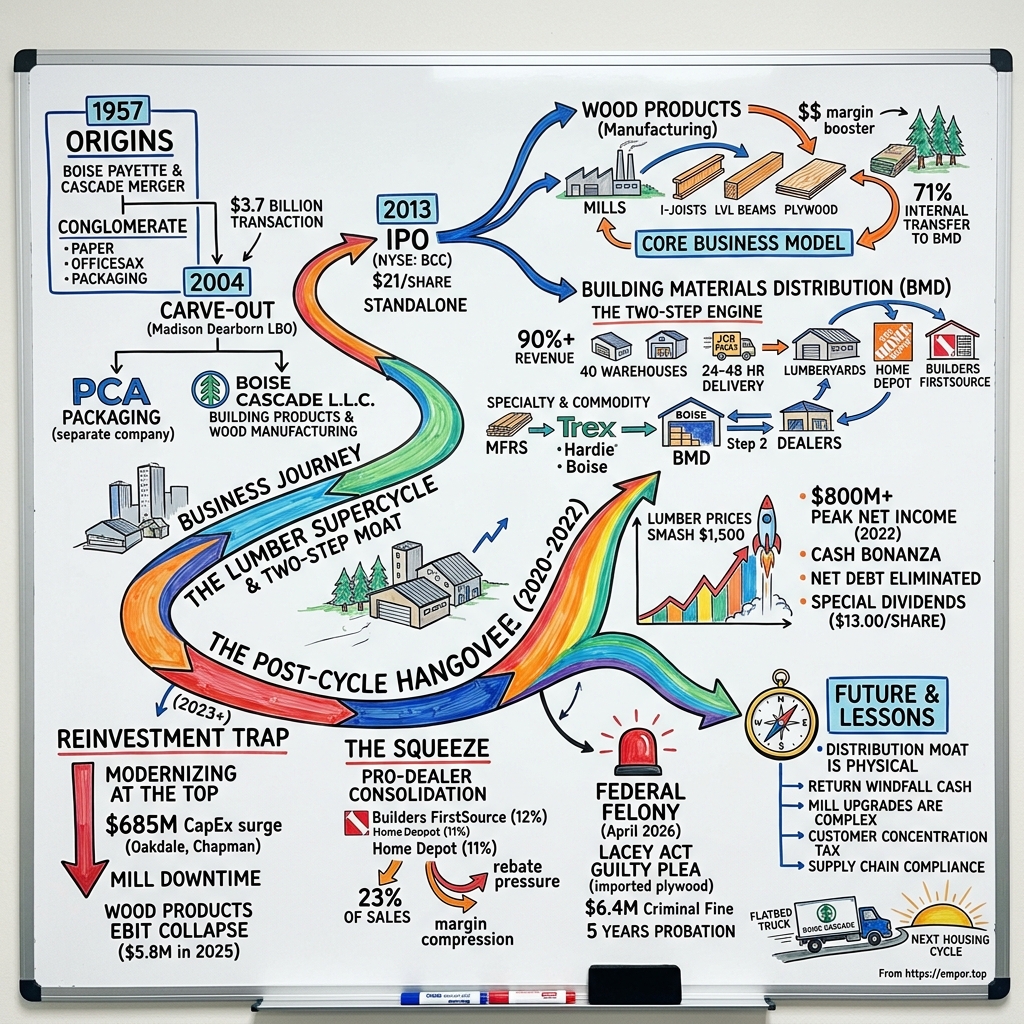
Boise Cascade Company: The Lumber Supercycle, the Two-Step Moat, and the $800 Million Peak
I. Introduction & Episode Roadmap
Picture the spring of 2021. Across America, people who had never thought about framing lumber suddenly had opinions about it. A sheet of plywood at the local home center cost what a nice dinner used to. Contractors were rationing studs. Homeowners stuck at home wanted decks, additions and second offices, while builders raced to put up new houses for families leaving cities. Sawmills that had been run lean for a decade could not hire fast enough, and rail lines out of Canada were jammed.
In Boise, Idaho, on a stretch of the Boise River, sat a company most investors had never thought hard about. Boise Cascade did not chop down forests to make headlines, and it did not sell to consumers. It ran warehouses, trucks and a handful of veneer and engineered-wood mills. And for about twenty-four months it became one of the most profitable businesses, per dollar of market value, in American industry.
The scoreboard tells the story in two numbers. Revenue, which had been about $3.6 billion in 2014, peaked at roughly $8.4 billion in 2022.14 Net income, which had hovered around $80 million in both 2014 and 2019, reached $857.7 million in 2022, more than ten times the pre-pandemic level.14 Diluted earnings per share hit $21.56 that year.2 Then the tide went out. By 2025, revenue had slipped to about $6.4 billion and net income to $132.8 million, a net margin of about 2%.1
Yet even as profits fell, cash kept arriving. From 2023 through 2025, Boise Cascade generated about $1.38 billion of operating cash flow, comfortably more than the roughly $990 million it reported as net income over the same three years.111 That gap is a clue to the whole company, and much of this story is about why it exists.
Here is the verdict to test throughout: Boise Cascade is not a sawmill with a stock ticker. It is, at its core, a national wholesale distribution network, what the industry calls a "two-step" distributor, with a vertically integrated engineered-wood manufacturing arm bolted on. In a housing boom, the mills amplify profits. In a downturn, they become an anchor. Understanding which half of the company is doing what, and when, is the key to understanding why the stock has behaved as it has.
The story has five acts:
- The carve-out. How an orphaned piece of a mid-century forest-products conglomerate, after spinning away from paper and packaging, was bought by private equity and eventually floated as an independent company.
- The engine. What "two-step distribution" actually means, and why Home Depot, Builders FirstSource and thousands of local lumberyards still route their orders through a middleman.
- The windfall. How management converted a once-in-a-century commodity spike into special dividends of $13 a share across 2023 and 2024 and a net-cash balance sheet.12
- The reinvestment bet. How more than $685 million of capital spending over 2023–2025 coincided with Wood Products segment profit collapsing to $5.8 million in 2025.1
- The legal surprise. A federal felony guilty plea under the Lacey Act in April 2026, a $6.4 million fine and five years of organizational probation.15
Then come the lessons, the frameworks and the open questions that will decide the next chapter. The story starts, as so many American industrial stories do, with a conglomerate that grew too big to see itself clearly.
 Subscribe on LinkedIn
II. The Carve-Out Crucible: From Conglomerate Splinter to Public Standalone
There is an old pattern in American industry: a company is built by consolidation, grows into a conglomerate, loses its focus, and is eventually broken up by financiers who see more value in the pieces than in the whole. Boise Cascade lived through every stage of that pattern.
The conglomerate years
The original Boise Cascade Corporation came out of the 1957 combination of Boise Payette Lumber Company and Cascade Lumber Company, two Northwestern timber operators that together formed a forest-products company with large ambitions.6 Over the following decades it became a sprawling empire. At various points it owned paper mills, corrugated packaging operations, timberlands, a building materials business and an office-products distribution business. In the early 2000s, the corporation went further and bought office-supply retailer OfficeMax, eventually taking its name.6
That move clarified the parent company's priorities. A retailer of staplers and printer paper had little in common with a plywood mill in Louisiana or a lumber warehouse in Georgia. Once the parent decided its future was in office products, the forest-products and building-materials assets became candidates for sale.
The 2004 Madison Dearborn deal
In October 2004, Chicago private equity firm Madison Dearborn Partners bought the forest-products and building-materials assets from OfficeMax, creating Boise Cascade, L.L.C. under a holding company called Forest Products Holdings, L.L.C.6 The package was large and messy: paper mills, packaging, wood manufacturing and distribution. Over the following years, the paper and packaging pieces went their own ways. The packaging operations became part of what is now associated with Packaging Corporation of America, and the paper business was separated into a different company.612 What remained under the Boise Cascade name was the part almost nobody had paid attention to: a building-materials wholesaler and a set of wood mills making plywood, veneer and engineered wood.
Was this an operational rescue or asset stripping? The honest answer sits between the two. The private equity owner did not invent the distribution business; it inherited it. But the sequence of sales forced the remaining company to stand on economics that had been hidden inside a conglomerate. It had to live or die as a building-products company, with no paper mill to cushion a housing slump.
The fiber umbilical cord
One thread from the conglomerate days still runs through the business. Boise Cascade's Southern plywood and veneer mills need logs, and the packaging mills nearby need wood chips and residual fiber. Rather than compete for the same trees, the two companies kept a shared purchasing vehicle: Louisiana Timber Procurement Company, L.L.C., or LTP, a 50/50 joint venture between Boise Cascade and Packaging Corporation of America.112
The numbers here are modest and, importantly, clean. Boise Cascade bought about $71 million of wood fiber through LTP in 2025, down from about $80 million in each of the prior two years, roughly 5% of Wood Products operating costs.1 The prices are indexed to regional markets, and the balances owed back and forth at year-end were under $1 million.1 For investors used to worrying about promoter companies siphoning value from listed subsidiaries, this is the opposite case: a related-party relationship that exists for a practical reason and leaves no visible trace of extraction.
Surviving the crash and the listing
The new standalone company had terrible timing. It emerged just before the housing bust, and the 2008–2011 period sent single-family housing starts to levels the industry had not seen in generations. A business that sells framing materials to homebuilders has nowhere to hide when homebuilders stop building. Boise Cascade survived, but it did so as a private company with sponsor ownership and a stretched set of owners.
The recovery set up the exit. On February 11, 2013, Boise Cascade listed on the New York Stock Exchange at $21.00 a share, following a final prospectus filed on February 7.6 Madison Dearborn then sold down its remaining stake through secondary offerings until it was fully gone.6
What the cap table looks like now
Today there is no controlling shareholder. As of the March 2026 record date, BlackRock held about 16.4% of the stock, Vanguard about 13.1% and Dimensional Fund Advisors about 6.3%.7 Directors and executive officers together held about 1.2%, with CEO Nate Jorgensen owning roughly 130,000 shares.7 There are no sponsor management fees, no affiliate debt guarantees and no founder family with special voting rights.
That cleanliness cuts both ways. Public shareholders get unencumbered governance. They also get a company with no parent to backstop it in a bad year. When housing turns, the full cycle lands on the public equity. The carve-out produced independence and exposure in the same stroke, and the next question is what exactly that independent company does to earn a living.
III. The Two-Step Engine: Building Materials Distribution vs. The Manufacturing Mill
Before dawn at a Boise Cascade distribution yard, the work looks less like finance and more like choreography. Flatbed trucks line up. Forklift operators pull material from long covered bays: engineered beams made at a Boise mill, bundles of composite decking from Trex, pallets of fiber-cement siding from James Hardie. Each truck gets a mixed load built for a specific customer, a lumber dealer who needs a little of everything and cannot afford to buy a railcar of any single item.
That load is the business. Understanding why requires a short detour into how building products move.
What "two-step" means
Think about how groceries reach a corner shop. A cereal maker does not ship one box at a time to every small store. It ships truckloads to a wholesaler, who breaks those loads apart and sends a mix of cereal, soup and soap to each shop. Building products work the same way, only the boxes are 40-foot beams.
In step one, manufacturers produce in bulk. A siding plant or a plywood mill wants to ship by the railcar or full truckload. In step two, a wholesale distributor like Boise Cascade buys those large quantities, stores them in regional warehouses, breaks the bulk apart and sends mixed loads to lumber dealers, pro-dealers and home centers.1 The dealer, in turn, sells to the contractor who frames the house.
Why can't the dealer just buy from the mill? Three reasons. First, yard space: a regional lumberyard cannot store a railcar of every product it sells. Second, working capital: buying in bulk ties up cash in inventory that might sit for months. Third, speed: a builder who needs a particular beam on Thursday cannot wait for a mill's production schedule. The distributor absorbs all three problems and charges a margin for doing so.
Where the money is
Boise Cascade has two reportable segments. Building Materials Distribution, or BMD, accounted for about 93% of consolidated sales in 2025.1 Wood Products, the manufacturing arm, sells most of its output to BMD rather than to outsiders; about 71% of Wood Products volume moved internally to the distribution business, and external Wood Products sales were only about 7% of the consolidated total.1
That internal flow is the strategic heart of the company. The mills make engineered wood products, mainly laminated veneer lumber (LVL) and I-joists, along with plywood and veneer.1 LVL is made by gluing thin sheets of wood together into beams that are stronger and straighter than a solid piece of lumber of the same size. I-joists look like a steel I-beam made of wood: two flanges joined by a thin web, used to build floors and roofs. These products replaced a lot of large-dimension solid lumber in modern homes because they span longer distances, warp less and use smaller trees.
The distribution arm then carries those products, under the Boise Cascade brand, to dealers across the country, alongside third-party brands such as James Hardie, Trex, LP and Huber.1 The mills get a guaranteed outlet. The distribution arm gets guaranteed supply of a product that can be scarce in a boom.
How pricing works
There is no subscription revenue here. Products are priced per thousand board feet (MBF) for lumber or per thousand square feet (MSF) for panels, and customers buy on short-term purchase orders with no minimum volume guarantees or take-or-pay contracts.1 Demand rises and falls with single-family housing starts and repair-and-remodel activity.1
That means Boise Cascade is permanently exposed to commodity prices in two ways. When lumber and panel prices fall, the value of its inventory falls and its markups compress. When they rise, inventory gains and wider spreads flow straight through. The distribution margin is a percentage of a moving number.
The receivables side is reassuringly short. At year-end 2025, gross trade receivables were about $322 million, with an allowance for doubtful accounts of under 2%.1 That implies customers pay within roughly three weeks, consistent with a days-sales-outstanding figure near 18 days. The company does not publish an ageing schedule, but there is no record of material write-offs.1
Myth vs. reality: will software eat the middleman?
Myth: Digital marketplaces will let dealers order directly from mills, cutting out the wholesaler.
Reality: The last decade of B2B e-commerce has digitized ordering in many industries, but heavy building products remain stubbornly physical. A long LVL beam cannot go through a parcel network. Delivery requires flatbeds, forklifts that ride on the truck, warehouses near rail sidings and enough local route density to make each trip pay. Software can make ordering easier, and Boise Cascade itself uses it for that, but software cannot replace a warehouse holding inventory 50 miles from the job site.
The stronger threat is not technology; it is customers. A customer big enough to run its own distribution can bypass a wholesaler without any app at all. That threat gets its own section later. For now, the conclusion is narrower than "unbreakable moat": the physics of heavy goods protect the two-step model from digital disintermediation, but they do not protect it from customers growing large enough to do the job themselves.
With that machine understood, the pandemic becomes easier to read. A distributor with full warehouses and its own mills was about to see the prices of everything it carried go vertical.
IV. The Pandemic Supercycle: Printing $850 Million in the Forest
In 2020 and 2021, the U.S. housing market went through a demand shock nobody had modeled. Mortgage rates fell to record lows. Families wanted more space. Remodeling surged as people stared at the same walls every day. On the supply side, sawmills had spent years cutting capacity after the last housing bust, and pandemic labor shortages made it hard to restart quickly. Framing lumber prices, normally a sleepy commodity, swung to levels that were multiples of their historic average.
For a company holding warehouses of lumber and panels, and making plywood and engineered wood itself, this was the equivalent of an oil company watching crude triple.
The size of the windfall
Revenue rose from about $4.6 billion in 2019 to about $8.4 billion in 2022.13 Net income went from about $81 million to about $858 million over the same span, more than ten times higher.1 At the 2022 peak, that worked out to roughly $2.3 million of profit every day of the year.
The crucial question is whether this represented a new earnings base or a commodity windfall. The evidence points strongly to windfall. Boise Cascade did not suddenly ship twice as many units; it sold similar physical volumes at dramatically higher prices. Once prices normalized, so did profits: net income fell from about $484 million in 2023 to about $133 million in 2025.1 The 2025 net margin of about 2% looks much more like the company's long-run baseline than the pandemic years do.
The working-capital sponge
Here is a subtle mechanism that explains the cash flows. When prices rise, a distributor's inventory and receivables swell, because every board in the warehouse and every invoice outstanding is worth more. That swelling absorbs cash. Reported profit goes up, but some of the cash is trapped in the balance sheet.
When prices fall, the process reverses. Inventory is sold off at lower values, receivables shrink and cash is released. That is why Boise Cascade's operating cash flow over 2023–2025, about $1.38 billion, exceeded its net income of about $993 million over the same years.111 Depreciation and amortization contributed about $445 million of that gap, as the company's plants and equipment wore down on paper while generating no cash charge.1
The lesson for investors is that this kind of business can look cash-poor at the top of a cycle and cash-rich at the bottom. Reading cash flow without understanding the commodity price direction is a common mistake.
Turning a windfall into a fortress
Management used the boom to clean up the balance sheet. By the end of 2023, cash had reached about $950 million against roughly $445 million of long-term debt, leaving the company net cash.12 The funded debt consisted chiefly of $400 million of 4.875% senior notes due in 2030.1
S&P Global Ratings noticed. In April 2024 it raised Boise Cascade's rating to "BB" from "BB-", citing a conservative financial policy and leverage it expected to stay below 1.0x, far inside the 3.0x level that would trigger concern.10 S&P also named the company's constraints plainly: exposure to housing starts, commodity volatility and discretionary special dividends.10 That rating is still below investment grade, a reminder that rating agencies treat even a net-cash commodity business as inherently volatile.
Why the market refused to believe it
In 2022, as the company earned $21.56 per share, the stock market valued it at only a few times earnings, roughly 3.5x on the peak result.2 That was not an error. Investors were pricing the peak as temporary and discounting the normalization they expected next. In cyclical industries the pattern is familiar: multiples look cheapest at the top of the cycle and most expensive at the bottom, because the market is looking through the current earnings to the next phase.
Today the inverse holds. At about $75 a share in early October 2026, the stock trades at around 25x trailing earnings, on far smaller profits.15 The low multiple at the peak and the high one at the trough are two sides of the same judgment.
So what?
The supercycle did not prove Boise Cascade had a new, higher structural earnings power. It proved something narrower but still valuable: when the cycle turns favorable, this company converts that into cash and keeps it, rather than leveraging up. The open question was what management would do with that cash once the music stopped. That decision forms the next act.
V. The Reinvestment Trap: Modernizing at the Top of the Cycle
Late 2024, Oakdale, Louisiana. Inside one of Boise Cascade's plywood and veneer mills, a modernization project was under way: new equipment for drying veneer, the thin sheets of wood that get glued into plywood and LVL. Upgrading a running mill is like renovating a kitchen while still cooking three meals a day in it. Production slows, crews work around the construction and every delay costs output. And all of this was happening as prices for engineered wood and panels were falling.
The decision
Flush with nearly $1 billion in cash after the boom, management faced the classic choice for a cyclical company with a windfall. It could buy something big. It could return everything to shareholders. Or it could reinvest in its own assets. It chose a mix, but the reinvestment portion was large.
Capital expenditures rose from about $114 million in 2022, under 1.5% of sales, to about $215 million in 2023, $230 million in 2024 and $241 million in 2025, nearly 4% of sales by the end.1 Over those three years, the total came to about $685 million. The money went to veneer expansions at Oakdale and at Chapman, Alabama, plus three new greenfield distribution branches.1 Headcount grew from about 6,100 at the end of 2021 to about 7,700 in 2025.1
The strategic logic was defensible on paper. Boise Cascade buys veneer to make LVL and plywood. Making more of it in-house lowers costs and protects supply. New distribution branches in growing Sunbelt markets extend the network. But the timing meant the spending peaked just as end-market prices fell.
When execution met deflation
The result showed up in the Wood Products segment. Operating income fell from about $337 million in 2023 to $232 million in 2024 and then to just $5.8 million in 2025.1 That is a collapse of more than 98% in two years.
Decomposing it, three things went wrong at once. First, EWP and plywood prices fell, cutting revenue per unit. Second, mill downtime during the Oakdale modernization removed production volume while fixed costs stayed in place. Third, log costs did not fall as fast as panel prices. Logs make up about 80% of the wood fiber cost and about 37% of Wood Products operating costs, and most come from private timberlands on terms that do not reset instantly when finished goods prices drop.1 When the input is sticky and the output is falling, margins compress fast.
Management attributed the decline mainly to the price environment and temporary downtime.1 That explanation is plausible, but it has not yet been proven by a recovery. Capital spending dropped sharply to about $63 million in the first half of 2026, suggesting the heavy phase of construction is over.5 The real test is what the segment earns once the new equipment runs at full speed.
Did management pay itself through the slump?
Compensation offers one check on accountability. CEO Nate Jorgensen, a Boise Cascade veteran who rose through the distribution business, saw total pay decline from about $7.7 million in 2023 to about $7.2 million in 2025.7 The cash bonus portion fell from about $2.7 million to about $0.7 million.7 Troy Little, executive vice president of Wood Products, received a non-equity incentive of just $58,700 for 2025, reflecting the segment's results.7 CFO Kelly Hibbs received about $2.0 million, down from about $2.5 million in 2023.7
The bonus formula clearly bit. The caveat is that total CEO pay fell only modestly because equity grants rose, from about $3.7 million to about $5.3 million.7 Shareholders were satisfied: say-on-pay received about 96.5% support in 2025 and about 97.1% in 2026.98 Nine of ten directors are independent.7
Testing the manufacturing moat
Does Boise Cascade's manufacturing arm have a durable competitive advantage? The 2025 record argues for a narrower claim than the bull case. The mills own a recognized brand in engineered wood, but in a falling price environment they had no cost insulation. Their profit nearly vanished. Without 71% of output flowing to an internal customer, the segment would have had to find external buyers at worse terms.
The verdict: the mills are a margin amplifier in good years and a captive supplier in bad ones, not a standalone moat. The modernization could restore earnings, but whether it does will be visible in a single number, the full-year 2026 Wood Products operating income. If it climbs back toward $100 million, the 2025 collapse looks like a temporary construction hangover. If it struggles to clear $40 million, the spending will look like peak-cycle overcapitalization.
The mills were not the only place where trouble surfaced. While Oakdale was under construction, a federal investigation was quietly unfolding at a distribution branch in Florida, and the customers on the other side of the business were getting bigger.
VI. The Squeeze: Giant Pro-Dealers and the Lacey Act Shockwave
On April 27, 2026, Boise Cascade stood before the U.S. District Court for the Southern District of Florida and pleaded guilty to a single felony count under the Lacey Act.5 The company agreed to pay a $6.4 million fine and accepted five years of organizational probation.5 For a company whose public image is warehouses and wood beams, it was an unusual moment.
What the Lacey Act is
The Lacey Act, a century-old U.S. wildlife law expanded in 2008 to cover plants and wood, makes it illegal to import timber products that were harvested or traded in violation of the laws of their country of origin, and requires accurate declarations about species and origin. In practice it puts the burden on importers to know where their wood came from.
The investigation began on May 22, 2024, when Homeland Security Investigations, part of ICE, opened a probe into imported third-party plywood at Boise Cascade's distribution facility in Pompano, Florida.1 The company accrued the fine in the fourth quarter of 2025 and paid it in the second quarter of 2026.15
How much does it matter?
Financially, very little. The $6.4 million fine is under 5% of 2025 net income and was absorbed without strain.1 Imported plywood is a small part of sourcing; foreign sales are under 2% of revenue, and domestic mills supply most Wood Products output.1
Operationally, the probation matters more. A company on organizational probation faces heightened scrutiny of its compliance program, potential court-supervised reporting and reputational friction when buying imported specialty wood. The company has not disclosed the full terms of its probation monitoring obligations in detail. The practical risk is not another fine; it is a slower, more cautious import process and the knowledge that any repeat violation would land on a company already under court supervision.
The bigger squeeze: customers
The Lacey Act plea grabbed headlines, but the more important pressure comes from customers. In 2025, Boise Cascade's top ten customers accounted for about 49% of sales.1 Two of them, Builders FirstSource at 12% and The Home Depot at 11%, together accounted for 23% of sales and 28% of trade receivables at year-end, about $88.5 million.1
Builders FirstSource is the nation's largest supplier of building materials to professional homebuilders, built through a string of acquisitions including its 2021 merger with BMC.13 When a customer that size buys from a wholesaler, the negotiation is not between equals. It can demand volume rebates, threaten to shift business to competing distributors such as BlueLinx, or source more directly from mills.1314
The evidence that pressure is real: BMD gross profit dollars fell by about $49 million in 2025 even as the segment remained solidly profitable at about $222 million of segment income.1 Lower commodity prices explain part of that decline, but concentrated buyers clearly take a larger share of the value when the market softens.
The rebate puzzle
KPMG, Boise Cascade's auditor, issued a clean opinion on the 2025 financial statements but flagged one critical audit matter: customer rebates.1 At year-end, the company had accrued about $83.5 million for rebates owed to customers, including about $52.2 million tied to engineered wood products.1
Why is this hard? Rebates are often paid when a dealer's purchases, or its sales of Boise products to its own customers, cross certain thresholds during a period. Boise Cascade has to estimate those amounts before the final numbers arrive, using models of how much product dealers are selling through. If the estimate is wrong, margins in a later quarter shift. This is not a red flag of misconduct; it is a reminder that the size of rebates is growing with customer concentration and that the estimates carry real judgment.
So what?
Domestically, Boise Cascade's operations look clean: low credit losses, quick collections, no aggressive accounting. But the largest customers are gaining leverage, and a federal probation now sits over the import side of procurement. Neither threatens solvency. Both cap how much of the cycle's upside the company can keep. These episodes, and the windfall before them, carry lessons that travel well beyond lumber.
VII. Playbook: Business & Investing Lessons
1. "The two-step distributor's moat is in the flatbed, not the spreadsheet."
Technology companies have spent the last decade trying to digitize industrial distribution, and some ordering has moved online. But no software can make a 40-foot I-joist fit through a parcel network or store lumber next to a rail siding outside Atlanta. Boise Cascade's protection comes from physical infrastructure that is expensive to replicate. The lesson for founders and investors: in heavy goods, ask what a truck and a forklift must do before asking what an app can do. The threat to such businesses is rarely code; it is customers big enough to buy their own trucks.
2. "Return the windfall in cash; don't build monuments at the peak."
When cash piled up after 2022, Boise Cascade paid special dividends of $8.00 a share in 2023 and $5.00 in 2024, while keeping regular dividends and buying back shares.12 It avoided a big, leveraged acquisition at peak prices. Shareholders received real money while the cycle was good. The broader point: a commodity windfall belongs to owners, because the company cannot rely on earning it again.
3. "Upgrading a running mill during a downcycle is open-heart surgery."
The same company that wisely returned cash also committed about $685 million to capital projects, much of it into mills whose earnings nearly disappeared in 2025.1 Brownfield projects in process industries almost always take longer and cost more in lost output than planned. The investor lesson: discipline in one capital decision does not guarantee discipline in another. Judge each deployment by its returns, not by the reputation of the management team.
4. "When your customers consolidate faster than you do, your margin becomes theirs."
Builders FirstSource and Home Depot alone now account for nearly a quarter of sales.1 As pro-dealers consolidated, they gained the power to demand rebates and price concessions. A distributor's value comes from aggregating fragmented buyers; when buyers stop being fragmented, that value shifts toward them.
5. "In commodity supply chains, compliance is part of the product."
One imported plywood supply chain at one Florida branch led to a federal felony plea and five years of probation.15 The fine was small; the consequence was not. For any company moving natural resources across borders, traceability is a core operating function, not a back-office checkbox.
These lessons frame the hardest question an investor faces: what is this company actually worth across a full cycle, and what could change that?
VIII. Analysis, Frameworks, and the Bear vs. Bull Stress Test
In early October 2026, with the stock near $75, Boise Cascade has a market capitalization of about $2.66 billion and an enterprise value of about $2.81 billion.5 That works out to about 8.2x EV/EBITDA on normalized trailing results, and about 25.5x trailing earnings. Peers trade richer: Builders FirstSource at about 11.5x EV/EBITDA and Louisiana-Pacific at about 18.7x, with distributor BlueLinx at about 12.6x.131514
What does that price imply? The market is not treating Boise Cascade as a pure distributor deserving a distribution multiple, nor as a manufacturer with LP's brand and siding growth. It is pricing a hybrid with commodity exposure on both sides. In 2025, distribution earned about $222 million of segment income on a margin of roughly 3.7%, while Wood Products earned under 1%.1 Investors see that split and apply a blended, cautious multiple.
Hamilton Helmer's 7 Powers
- Scale economies (strong in distribution). A national network of about 40 distribution locations lets Boise Cascade buy in volumes small dealers cannot, spreading warehouse and truck costs across more product.1 This is the company's clearest power.
- Network effects (none). Adding a dealer does not make the service more valuable for other dealers.
- Counter-positioning (none). BlueLinx and other distributors run the same model.14
- Switching costs (low to moderate). Independent dealers rely on reliable, next-day delivery and established ordering relationships, but large pro-dealers can dual-source.
- Branding (moderate in EWP). The Boise Cascade name carries recognition among builders and designers for engineered wood, but plywood and commodity lumber trade on grade and price.
- Cornered resource (moderate). Existing industrial warehouse sites with rail access in growing metro areas are hard to replicate, though not impossible.
- Process power (moderate). The internal flow of most mill output into distribution allows coordinated production and inventory planning that a standalone mill or distributor lacks.
The overall picture: one real power (scale in distribution) supported by several modest ones. That is enough to earn steady returns through a cycle but not enough to avoid commodity swings.
Porter's Five Forces
- Buyer power: high and rising. The top ten customers account for about half of sales, and the top two alone nearly a quarter.1
- Supplier power: moderate. Log supply is competitive, but branded suppliers like James Hardie and Trex hold leverage over distributors carrying their products.1
- Threat of new entrants: low. Building a national wholesale network with the working capital to absorb price swings requires large upfront investment.
- Threat of substitutes: low to moderate. Steel and mass timber remain niche in U.S. single-family homes, but oriented strand board (OSB) keeps replacing plywood in walls and floors.
- Rivalry: high. Prices change weekly and competitors sell similar products.
The activist's question
A skeptical activist might argue: spin off Wood Products. The mills are capital-hungry and volatile; the distribution business alone could command a higher multiple as an asset-light distributor.
The counterargument is practical. A standalone distributor would lose guaranteed access to scarce engineered wood in a boom, when supply is tight and the brand matters most. A standalone mill would lose its largest customer in a downturn. The 2025 results show the cost of integration, but the 2021–2022 results show its benefit. Neither side of the split looks clearly better alone, though the case for a split would strengthen if Wood Products fails to recover from its 2025 trough.
The Bull Case
- A housing shortfall. The U.S. has underbuilt homes for years, and any meaningful drop in mortgage rates could release pent-up demand for single-family construction.
- The capital spending pays off. With the heavy phase of Oakdale and Chapman complete, Wood Products could return to meaningful profits as mill uptime normalizes and unit costs fall.
- A strong balance sheet and shrinking share count. The company refinanced into a $450 million revolver maturing in 2030, has no note maturities until 2030, and carries net leverage around 0.4x.15 Diluted shares fell from about 39.9 million in 2023 to about 35.6 million by mid-2026, and $200 million remained on the buyback authorization at the end of 2025.15
The Bear Case
- The pro-dealer squeeze deepens. If consolidated buyers keep extracting rebates, distribution margins could fall further, turning the company's best asset into a lower-return one.
- Housing stays stuck. If high mortgage rates keep starts depressed, the slump in volumes and prices could persist for years.
- Compliance friction lingers. Five years of probation could slow import sourcing and add cost.
The three numbers that matter
- BMD gross margin. The strength of the distribution moat shows up here. Holding above roughly 14.5% would indicate pricing power is intact; falling below 12.5% would suggest buyers are winning. Gross profit dollars declined in 2025.1
- Wood Products operating income. At $5.8 million in 2025, down from $337 million two years earlier, the direction is clear; the 2026 figure will show whether modernization pays off.1
- U.S. single-family housing starts. The macro driver of everything else.
The verdict: Boise Cascade is undervalued only if one believes the distribution moat holds and the mills recover. The evidence supports the first more firmly than the second.
IX. Epilogue: The Trough and the Next Housing Cycle
Tonight, Boise Cascade sits in an uncomfortable middle. Its first-half 2026 results showed revenue of about $3.3 billion and net income of about $75 million.5 The heaviest capital spending is done, cash has fallen to about $305 million as the company bought back stock and paid down its windfall, and net leverage has drifted from negative to about 0.4x.5 The balance sheet is still sturdy, but the fortress has fewer extra rooms than it did in 2023.
Three moments will settle the story's central questions.
The first arrives with the full-year 2026 annual report. If Wood Products operating income rebounds toward $80 million or more, the 2025 collapse will look like what management described: a temporary hit from downtime and falling prices. If it stays in single digits or low tens of millions, the $685 million spending program will look like a costly bet placed at the wrong time.
The second is the capital-allocation split in the 2026 and 2027 cash-flow statements. With cash lower, management must choose between buybacks at trough valuations and the special dividends it favored at the peak. Its choice will show whether it views today's stock price as cheap or simply fair.
The third is quieter: the compliance reports under probation. Through at least 2027, any disclosed violation or supply-chain disruption would turn a small fine into a lasting reputational problem.
The tension underneath all three is the same. A company that once earned more than $850 million in a year is valued at under $3 billion. The market is not ignoring that history; it is betting that it will not repeat soon. In commodity distribution, the market prices the downturn before it arrives, and the upturn only once it is undeniable.
X. Outro
Return to that yard before dawn, this time in the Pacific Northwest. Rain hits the windshield of a flatbed pulling out with a load of I-joists stamped with the Boise Cascade name. The driver will not think about the Lacey Act, special dividends or EV/EBITDA multiples. The job is to get the material to a lumber dealer before the framing crew needs it.
In a decade obsessed with software and artificial intelligence, that truck is a reminder that the American house is still made of wood cut from Southern pine, glued into beams, carried by rail and delivered by flatbed. Boise Cascade doesn't build houses and it doesn't bet on the price of lumber; it owns the toll road of physical building products that every single-family home in America has to cross. Whether the toll keeps rising depends on who controls the other end of the road.
References
-
Boise Cascade Company Form 10-K for Fiscal Year Ended December 31, 2025 — SEC EDGAR, 2026-02-24 ↩↩↩↩↩↩↩↩↩↩↩↩↩↩↩↩↩↩↩↩↩↩↩↩↩↩↩↩↩↩↩↩↩↩↩↩↩↩↩↩↩↩↩↩↩↩↩↩↩↩↩↩↩↩
-
Boise Cascade Company Form 10-K for Fiscal Year Ended December 31, 2023 — SEC EDGAR, 2024-02-20 ↩↩↩↩↩
-
Boise Cascade Company Form 10-K for Fiscal Year Ended December 31, 2021 — SEC EDGAR, 2022-02-22 ↩
-
Boise Cascade Company Form 10-K for Fiscal Year Ended December 31, 2016 — SEC EDGAR, 2017-02-24 ↩↩
-
Boise Cascade Company Form 10-Q for Quarterly Period Ended June 30, 2026 — SEC EDGAR, 2026-08-03 ↩↩↩↩↩↩↩↩↩↩↩↩
-
Boise Cascade Company Form 424B4 IPO Prospectus — SEC EDGAR, 2013-02-07 ↩↩↩↩↩↩
-
Boise Cascade Company Definitive Proxy Statement DEF 14A — SEC EDGAR, 2026-03-17 ↩↩↩↩↩↩↩↩
-
Boise Cascade Company Form 8-K Annual Meeting Voting Results — SEC EDGAR, 2026-05-04 ↩
-
Boise Cascade Company Form 8-K Annual Meeting Voting Results — SEC EDGAR, 2025-05-05 ↩
-
Boise Cascade Co. Upgraded To 'BB' From 'BB-' On Conservative Financial Policy — S&P Global Ratings, 2024-04-17 ↩↩
-
Boise Cascade Company Form 10-K for Fiscal Year Ended December 31, 2024 — SEC EDGAR, 2025-02-20 ↩↩
-
Packaging Corporation of America Form 10-K (Joint Venture LTP Disclosures) — SEC EDGAR, 2026-02-20 ↩↩
-
Builders FirstSource Form 10-K (Pro-Dealer Industry Structure & Wholesale Supplier Relationships) — SEC EDGAR, 2026-02-27 ↩↩↩
-
BlueLinx Holdings Inc. Form 10-K (Two-Step Wholesale Building Products Competitor Benchmark) — SEC EDGAR, 2026-02-26 ↩↩↩
-
Louisiana-Pacific Corporation Form 10-K (Engineered Wood & Siding Peer Benchmark) — SEC EDGAR, 2026-02-18 ↩
 LinkedIn
 WhatsApp
 Reddit
 Hacker News
 Email
Email Kindle
 RSS Feed
 Spotify
 Apple Podcasts
 Amazon Music
 Audible
 YouTube