Brookfield Business Corporation: The Portfolio Behind the Brookfield Name
I. A $5.8 Billion Company With $75 Billion of Assets
Picture three workplaces on an ordinary morning. On a car-battery line, a technician checks the seal on a casing. In a Brazilian town that handed its water and sewage system to a private operator for decades, a crew opens a valve. In a North American car dealership, a service manager logs a repair order into software that also tracks the showroom's inventory, finance contracts and parts. None of these people work for Brookfield Business Corporation. Yet when Brookfield describes the portfolio behind its listed business-services and industrials vehicle, it counts about 57,000 of them.1
That is the first puzzle of this story. The listed company that trades in New York and Toronto under the ticker BBUC is a holding company. Before its March 2026 reorganization it had no employees at all; its chief executive, its finance chief and everyone else who ran it were provided by Brookfield, the Canadian asset-management empire that created it, controls it and charges it a fee to manage it.4 So the 57,000 workers are real, but they belong to the operating businesses underneath. The listed parent is a claim on those businesses, filtered through debt, partners, fees and Brookfield's control.
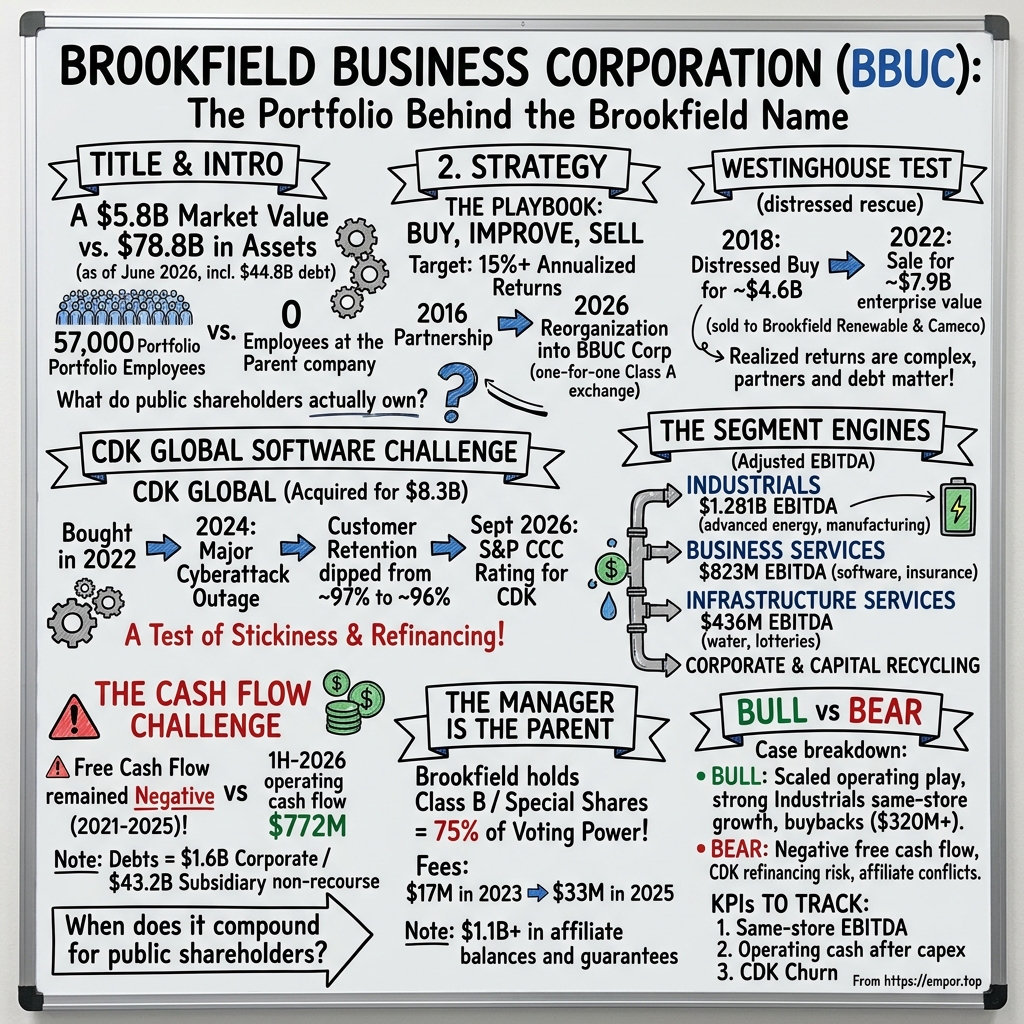
The second puzzle is scale. At the end of June 2026 the corporation reported about $78.8 billion of total assets, up from roughly $75.8 billion at the end of 2025, and about $44.8 billion of borrowings.2 On October 30, 2026, the whole equity was valued by the market at about $5.8 billion, at a share price of $28.02.3 Put those two numbers next to each other and the stock looks like a sliver: the market value is less than a tenth of the assets on the balance sheet. A newcomer might conclude that something enormous is being sold for pocket change. A cynic might conclude that the balance sheet is mostly other people's money. Both would be partly right, which is why this company is so hard to understand from the headline figures.
The explanation lies in accounting. Under international accounting rules, when BBUC controls a business it consolidates all of it: every dollar of revenue, every asset and every dollar of that business's debt goes into BBUC's statements, even when BBUC's own economic stake is a minority and Brookfield's institutional partners own the rest.12 The consolidated totals therefore measure the size of the empire BBUC runs, not the size of the slice that belongs to BBUC's shareholders. For that slice, management uses a different yardstick, Adjusted EBITDA on an economic-ownership basis, which strips out the share belonging to outside partners.2 Most of the borrowing also sits inside the operating companies and has no claim on the parent.2 Neither point makes the risk disappear. They move it to a different place.
So what does a public shareholder actually own here? A portfolio of businesses picked, financed, improved and eventually sold by a controlling parent that is also the manager. The returns depend on three things at once: how well the businesses perform, what Brookfield decides to do with them, and how much cash makes the long trip from a factory or a dealership to the listed company and then to the shareholder. This story follows that trip.
Three questions will run through the episode. The first is whether growth is operational or an artifact of what the company chooses to consolidate. Revenue on Empor's data jumped more than threefold between 2024 and 2025, but that jump came from a change in reporting perimeter, not a sudden boom.4 The second is whether Brookfield's control is an advantage for outside owners or a complication, because the same parent that brings operating know-how also sets the fee, holds the vote and sits across the table in related-party transactions. The third is whether Brookfield's habit of buying, fixing and selling businesses produces durable value per share, after the businesses that disappoint.
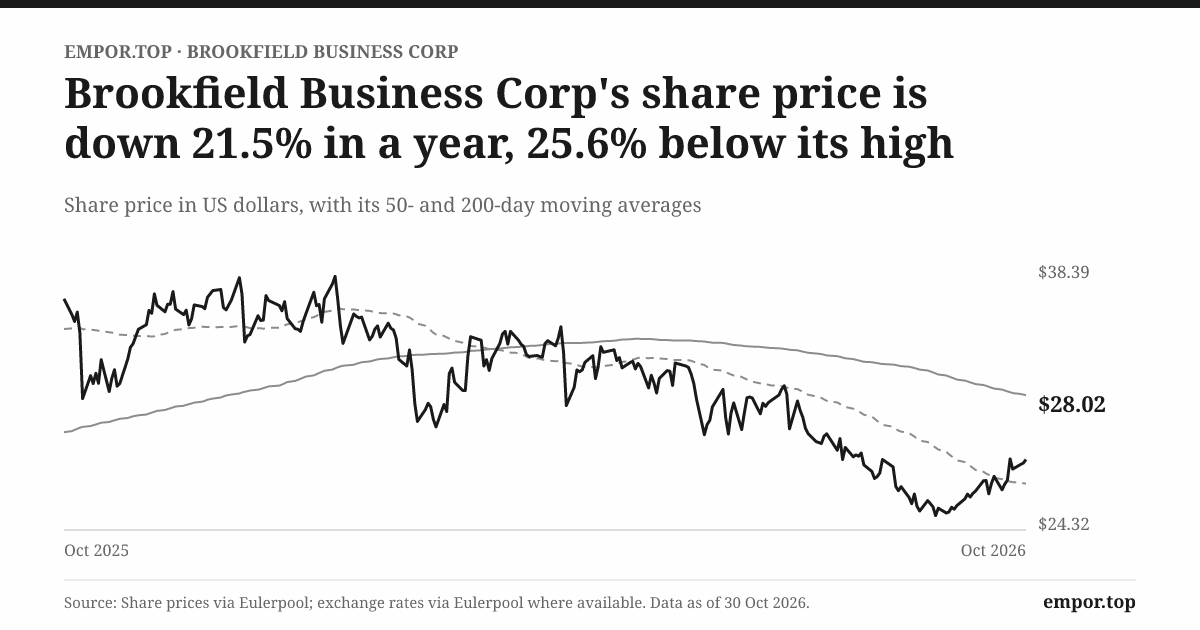
The stock's own recent path frames the stakes without settling them. At $28.02 it sat about 26% below its 52-week high of $37.64.3 A low share price can mean a bargain, or it can mean the market has learned something. The way to tell the difference starts with the bargain Brookfield originally offered public investors, a decade ago, when it first put this portfolio on a stock exchange.
 Subscribe on LinkedIn
II. The Public Vehicle Built to Buy, Improve and Sell
On June 20, 2016, Brookfield Asset Management shareholders woke up holding something new. For every 50 Brookfield shares they owned, they had received one unit of Brookfield Business Partners, a limited partnership that began regular trading that day on the New York and Toronto exchanges under the symbol BBU.7 There was no roadshow, no underwriting syndicate and no IPO pop. Brookfield simply spun out a portfolio of business-services and industrial companies it already owned and handed a public slice to its own investors, while keeping the controlling stake.
The idea was an unusual bargain. Private equity had always been a gated garden: pension funds and sovereign wealth funds committed capital to ten-year funds, paid management and performance fees, and waited for exits. Brookfield's pitch with BBU was that ordinary investors could buy a share on an exchange and sit alongside those institutions, owning the same businesses through a vehicle that invested its own capital in Brookfield's private-equity deals. In return, the public owners would accept that Brookfield ran the show. It would choose the acquisitions, staff the management, set the leverage and decide when to sell.
Brookfield gave that bargain a target. The stated goal has long been annualized total returns to shareholders of 15% or more over the long term, the kind of return private-equity limited partners expect after fees.6 Targets like that are cheap to print and expensive to hit. The fair way to judge one is not through headline portfolio revenue or the size of the assets under management, but through four harder figures: capital invested, operating improvement inside each business, the proceeds when the business is sold, and what all of that does to value per share after fees and losses. That frame will matter in every section that follows.
It helps to understand what kind of private-equity firm Brookfield is, because it is not the classic leveraged-buyout shop. Its roots are in real assets, office towers, hydroelectric dams, toll roads and pipelines, and the culture it brought to buyouts reflects that history. It tends to describe itself as an owner-operator rather than a financial engineer, and it likes businesses that look like infrastructure: essential products and services, high barriers to entry, and cash flows that can support debt. It also likes complexity. Carve-outs from conglomerates, businesses emerging from restructuring and companies in out-of-favour industries are where it believes it can buy at a discount, precisely because fewer competitors are willing to do the work. That temperament explains much of what follows, including the nuclear bankruptcy, the hospital operator, the battery maker carved out of an industrial conglomerate and the software company taken private after years of activist pressure.
The vehicle itself is a strange hybrid. A traditional private-equity fund has a finite life: the manager must return capital to investors within roughly a decade, which forces it to sell. A listed vehicle has no such deadline. That permanence cuts both ways. It lets Brookfield hold a business through a bad cycle instead of dumping it at the wrong moment, but it also removes the discipline of a fixed exit date, and it means the vehicle must keep finding new deals to justify its existence. The public shareholder, unlike a fund investor, can leave at any time by selling the shares, but only at whatever price the market offers that day. If the market doubts the manager, the discount to the underlying businesses can persist for years.
The structure did not stay simple for long. In 2022 Brookfield added a second listed security, a corporation whose exchangeable shares were designed to track the partnership units economically and to be easier for some investors, such as index funds and those who disliked partnership tax forms, to own. For four years investors could own the same economic exposure in two wrappers, with two tickers and two sets of financial statements. That duplication is one reason the historical numbers are so confusing today.
In March 2026 Brookfield collapsed the two wrappers into one. Under a plan of arrangement completed on March 27, holders of BBU partnership units and holders of the old corporation's exchangeable shares each received one Class A share of a new Brookfield Business Corporation for each unit or share they held, and the new corporation began trading on the NYSE and TSX on March 31.4 The old corporation was renamed Brookfield Business Holdings Corporation.4 The new company then filed a Form F-10 registration statement on the day it began trading and, in May, a short-form base shelf prospectus allowing it to issue up to $1.5 billion of securities over time.89 Neither filing was an IPO prospectus, and the shelf only creates the option to raise money; it does not establish that any offering took place.9
The one-for-one exchange matters for anyone reading the long-run numbers. Because the new corporation now reports the predecessor partnership's history as its own, its 2025 revenue looks like about $27.5 billion, while the old corporation, the one that had been listed as BBUC, reported only about $7.2 billion of continuing revenue for the same year.412 The sharp jump in revenue, assets and debt between 2024 and 2025 on Empor's data is therefore a change in which entity's books are being read, not a sudden expansion of the businesses. Read through the predecessor partnership's own history, revenue actually fell, from about $55 billion in 2023 to about $41 billion in 2024 and $27.5 billion in 2025, as Brookfield sold businesses and lost one to receivership.4 Shrinking revenue can be a sign of failure or a sign of successful selling. Here it is mostly the second, with a significant exception that comes later.
So the strategy is legible. Buy businesses, often complex or out of favour; improve them with Brookfield's operating teams; sell them; recycle the cash into new deals or buybacks. Whether the 15% target has been met is a question the company's own disclosures make surprisingly hard to answer, because the record is a series of individual deals rather than a single fund return. The best place to start testing it is the deal that made Brookfield's private-equity business famous: a bankrupt nuclear company that almost everyone else wanted to avoid.
III. Westinghouse: A Turnaround, and a Test of the Return Math
In March 2017, Westinghouse Electric Company, the Pennsylvania firm whose engineers designed much of the world's commercial nuclear fleet, filed for Chapter 11 bankruptcy protection. The cause was not its core business of servicing reactors and supplying fuel, which hummed along. It was a pair of fixed-price contracts to build new reactors in the United States that had spiralled years behind schedule and billions over budget, losses so large that they threatened the solvency of its Japanese owner, 東芝 Toshiba.10 Toshiba needed out. The question was who would want a nuclear company that had just blown itself up on construction projects.
Brookfield's answer came on January 4, 2018. Brookfield Business Partners, together with institutional partners, agreed to buy Westinghouse out of bankruptcy for about $4.6 billion.10 The logic was a classic distressed-asset play. Strip away the reactor-construction obligations that had caused the disaster, and what remained was a business with a huge installed base: utilities around the world needed Westinghouse fuel, spare parts, inspections and outage services to keep their existing plants running. That work was recurring, technical and hard to replace. A buyer who could see past the wreckage of the construction projects, and who had the balance sheet and the patience to work through a cross-border bankruptcy, could own the annuity without the albatross.
Brookfield then did what its playbook promises. It installed management focused on cost and on the services franchise, kept the business out of new fixed-price construction risk, and waited. The world helped. By 2022, energy security and decarbonization had made nuclear power fashionable again; governments that had been closing plants were extending their lives, and new-build programmes were back on the table.
On October 11, 2022, Brookfield Renewable Partners and the Canadian uranium producer Cameco announced that they would buy Westinghouse at a total enterprise value of about $7.875 billion. Brookfield Renewable and its institutional partners would take 51% and Cameco 49%; about $3.4 billion of debt would stay inside Westinghouse, leaving roughly $4.5 billion of equity value.11 The transaction closed in 2023, and that disposition left a footprint that is still visible on BBUC's balance sheet: a $1.1 billion, non-interest-bearing, due-on-demand receivable from BBU arising from what the filings call the 2023 nuclear technology services disposition.12
On the surface the arithmetic is irresistible: buy for $4.6 billion, sell for $7.9 billion, in five years. That is the version most people remember. The record is more complicated in three ways.
First, the two prices are not like for like. The $4.6 billion purchase price and the $7.875 billion sale value measure different things at different moments, with different debt loads, and the sale enterprise value includes debt that stayed in the business.1011 The return to equity depends on how much debt was used, how much additional capital went in during the turnaround, and what cash came out along the way. None of that is visible in the two headline numbers.
Second, BBU was not the only owner. Institutional partners invested alongside it, so BBU's share of any gain was a fraction of the whole. The headline number tells you that the Westinghouse equity rose in value. It does not tell you what BBU's unitholders earned on their slice after fees.
Third, the buyer was a Brookfield company. Brookfield Renewable is another listed vehicle controlled and managed by the same parent. Cameco's participation as an independent 49% partner gives the price real outside validation, because a third party with its own shareholders and deep knowledge of the nuclear fuel chain agreed to pay it.11 Still, a transfer from one Brookfield pocket to another is a related-party transaction. It is evidence of value, not a pure market verdict on BBU's investment.
What does the Westinghouse case prove? It proves that Brookfield can navigate a complex, politically sensitive restructuring, buy the viable business out of bankruptcy and hand it back to the market in better shape and in a stronger cycle. That is a real capability, and few buyers have it. What it does not prove is that every acquisition is attractively priced, or that a tailwind as strong as the nuclear revival will be available for the next one. Some of Westinghouse's gain was skill; some was timing.
The case also teaches a reading habit for the rest of this story. BBUC's capital-allocation record is not one clean fund return with a number at the bottom. It is a series of business-level outcomes, some brilliant, some painful, each with its own debt, partners and ownership share. Even the Westinghouse sale left behind a $1.1 billion IOU from an affiliate rather than cash in the listed company's hands, a detail that will return when we follow the money. To judge whether the method compounds, you have to look at what the portfolio holds now, and the portfolio today looks very different from a single nuclear company.
IV. Fifty-Seven Thousand Operators, Four Very Different Businesses
Leave the reactor control room and walk through the rest of the house. What Brookfield has assembled under BBUC is not a conglomerate built around a common customer or technology. It is a set of businesses that each made sense as a deal: an industrial manufacturer here, a software company there, a services contractor somewhere else. The company organizes them into four segments: Industrials, Business Services, Infrastructure Services and a corporate segment that carries holding-company costs.4
The way to see what matters is to follow the earnings that belong to BBUC's shareholders rather than the consolidated revenue. In 2025, on that economic-ownership basis, Industrials produced about $1.28 billion of Adjusted EBITDA, Business Services about $820 million and Infrastructure Services about $440 million.154 In the first half of 2026 the same three segments produced roughly $640 million, $410 million and $190 million.2 Industrials is the biggest engine by a distance, Business Services is the second, and Infrastructure Services is the smallest and was weaker: its 2025 earnings fell from the prior year.15
Those figures also make the revenue question vivid. On a consolidated basis, the new corporation reported $27.5 billion of 2025 revenue; the old listed corporation, using its narrower perimeter, reported about $7.2 billion.412 Neither figure is wrong. They simply count different empires. For an investor, the economic-ownership earnings are the cleaner signal, because they at least try to measure what belongs to the people holding the shares. Add the three operating segments together and the first half of 2026 ran at roughly the same annual pace as 2025, which is not a growth story on its face. Management argues it is, once sales and acquisitions are stripped out; that argument comes later.
Industrials is dominated by advanced energy storage, the battery business Brookfield knows as Clarios, a maker of the lead-acid and absorbent-glass-mat batteries that start cars and support stop-start engines and vehicle electronics.4 It is a mature product with a surprising moat: the batteries wear out and are replaced every few years, so most demand comes from the aftermarket rather than new car sales, and the business recycles a large share of the lead it uses. On the Q2 2026 call management credited higher-margin advanced batteries for the segment's same-store growth.13 Industrials also includes engineered components and manufacturing businesses and, until its sale, the offshore oil services operation.2
Business Services is a stranger mix. Its anchor is dealer software, CDK Global, the company that runs the back office of thousands of North American car dealerships. Beside it sit a Canadian mortgage insurer, Sagen, and other services businesses, including financial-services operations.4 Infrastructure Services holds lottery services, the work-access and scaffolding contractor BrandSafway, and modular building leasing.4 The construction business, Multiplex, which builds landmark towers and hospitals and was being sold in 2026, has historically sat in Business Services.13
There is no group-wide recurring-revenue percentage, pricing unit or customer count, and the company does not pretend there is.4 What it does publish are revenue clues, each specific to one business. The software and support contracts, mostly CDK's, carried about $3.3 billion of remaining performance obligations at the end of 2025, contracted revenue not yet recognized, most of it due within two years.12 The construction business had about $5.5 billion of backlog, again mostly to be delivered within two years.12 And the Brazilian water and sewage business, BRK Ambiental, carried about $8.9 billion of service obligations under municipal concessions with an average remaining term of about 23 years.12
The mortgage insurer deserves a sentence of explanation, because it behaves unlike anything else in the portfolio. Canadian lenders are required to insure high-ratio mortgages, and Sagen is one of a small number of private insurers that compete with the government-owned insurer for that business. It collects premiums upfront, invests them and pays claims when homeowners default and the house sells for less than the loan. In good years that is a quiet, cash-generative business; in a housing downturn with rising unemployment, it is where losses would surface. Its fortunes depend on the Canadian housing market, not on anything Brookfield does in a factory.
Each clue means something different. Software obligations are the closest thing to a subscription, but they renew only if dealers stay. Construction backlog is a promise of work, not of profit; one bad fixed-price project can swallow a year of margin, as Westinghouse once showed in the reactor business. Water concessions are the longest-duration revenue in the portfolio, but they are tied to regulators, tariff resets and the political temperature of Brazilian municipalities.
This is why one quarter's revenue growth cannot stand in for portfolio health. A battery company's demand depends on the age of the car fleet and the weather; a software company's on retention and price; a construction firm's on project execution; a mortgage insurer's on Canadian house prices and unemployment. Averaging them produces a number that describes none of them. Diversification is real, but it is not a business model, and it should not be confused with one.
If there is a common engine, it has to be something Brookfield brings to all of them: capital, operating discipline, a network of executives and procurement savings. That is precisely the claim the company makes. The next question is whether any of these businesses has the kind of competitive power that would make Brookfield's improvements stick, or whether the portfolio's strength is only as good as its weakest link.
V. Where the Portfolio Has Power—and Where It Has to Prove It
Picture the moment an investor asks the classic question on a call: what is the moat? For a single-product company the answer can be a sentence. For BBUC it can't. Brookfield's own language, buy, build, operate, describes a process, not an advantage in a market. Processes can be copied by any well-funded private-equity firm, and many of them use the same language. A moat has to show up somewhere a customer makes a decision: renewing a contract, accepting a price increase, refusing a rival's offer.
So the honest way to look for power is business by business, starting with the one where the evidence is richest and most contested: CDK.
Dealer-management software is the operating system of a car dealership. It sits beneath the sales desk, the finance office, the service bays, the parts counter and the accounting department, and it connects to manufacturers, lenders and state motor-vehicle agencies. CDK serves more than 15,000 retail locations in North America.4 The industry is concentrated: CDK, Reynolds and Reynolds and Cox Automotive's Dealertrack have long been the incumbents, while newer, cloud-first rivals such as Tekion have been winning attention with modern interfaces. BBUC does not publish a current market-share comparison, and neither do its rivals in a way that would allow one. What can be tested is behaviour.
The case for switching costs is intuitive. Changing a dealer-management system is like changing the plumbing while the restaurant stays open. Staff must be retrained, years of customer and vehicle data must be migrated, integrations with lenders and manufacturers must be rebuilt, and every mistake shows up as a delayed car sale or a botched repair invoice. That is why contracts are long and why churn in this industry is usually low.
The numbers on retention show that the moat exists and that it is leaking. BBUC disclosed that CDK's customer retention was about 96% in the first quarter of 2026, down from roughly 97% in prior quarters.1314 One percentage point sounds trivial. It is not. If a business retains 97% of customers, an average customer stays more than thirty years; at 96% the figure falls to twenty-five. More practically, each lost point at CDK's scale represents roughly 150 dealer locations a year walking away from a system that is supposed to be almost impossible to leave. Something has changed in the customer's calculation.
What changed is visible across the call transcripts. On the Q4 2024 call, analysts were already pressing management about churn in the wake of the 2024 cyberattack, and management framed the elevated losses as a consequence of that disruption that would ease as the business stabilized.16 By the Q4 2025 call, the explanation had widened to include CDK's modernization: the company was investing to move dealers onto newer technology, and management argued that adoption of the new products would help.15 On the Q2 2026 call, management said churn remained elevated but that adoption of new technology was helping stabilize it.13 The story has been consistent in tone, but the timeline for stabilization has stretched. An explanation that first leaned on a one-off event now leans on a multi-year product transition, which is a harder problem.
The lesson is the difference between stickiness and pricing power. Integrated workflows make dealers slow to leave, which buys CDK time. They do not guarantee that CDK can raise prices, or that dealers won't eventually leave for a rival that offers a better product, especially when rivals are pitching cloud software to dealers who just lived through days of downtime. Rising modernization spending and slipping retention suggest CDK is paying to defend its position rather than harvesting it.
The other segments need their own lens. BRK Ambiental's concessions are as close as the portfolio comes to a structural position: municipalities award the water and sewage rights for decades, a rival cannot simply lay a parallel pipe network, and the business's average remaining concession term is about 23 years.12 But the buyer here is a government, and governments renegotiate tariffs, impose investment obligations and change political direction. The concession is a protected territory, not a free one.
Clarios's position rests on scale in a consolidated global battery industry, a closed-loop recycling system and deep distribution relationships with retailers and carmakers, and management describes its advanced-battery mix as a margin driver.13 Industrial manufacturing, construction and work-access businesses depend more on execution, demand and cost control than on any lasting barrier; their customers are large, sophisticated and willing to rebid work. In those businesses, the evidence does not support a claim of bargaining advantage, and the company does not publish data that would.
That leaves the holding-company claim itself, that Brookfield's operating network, procurement and capital make each business better than it would be on its own. The Westinghouse turnaround is a genuine point in its favour. But a capability that improves businesses is different from a moat that protects them. Brookfield's advantage, if it exists, is mainly in buying well, financing cheaply and fixing operations; once a business is fixed, its moat belongs to the business.
The verdict is narrow by design. The portfolio holds several businesses with potentially durable positions, concession-backed water, an aftermarket battery franchise and an entrenched dealer-software platform, but each moat has to be earned in its own market, and the most important software moat is currently being tested by its own customers. That test began with a very large cheque.
VI. Brookfield Paid $8.3 Billion for CDK. Then the Software Story Changed.
On April 7, 2022, CDK Global announced that it had agreed to be acquired by Brookfield Business Partners in an all-cash deal valuing the company at an enterprise value of about $8.3 billion.17 At the time CDK generated roughly $2 billion of annual revenue.17 It was a public, mature software company that had spent years under activist pressure to cut costs and focus on its North American dealer business, and Brookfield was betting that private ownership and a dose of operating discipline could make it more profitable.
The price sounded big for a company growing slowly, so Brookfield explained it. In its letter to unitholders for the fourth quarter of 2022, the partnership said it had acquired CDK for less than ten times pro forma EBITDA once planned operational improvements were included.18 That is a respectable multiple for a sticky software franchise. The important word is pro forma. It meant EBITDA as Brookfield expected it to look after cost savings it planned to deliver, not as CDK had already reported it. Measured against revenue, the price was about 4.2 times sales. There is no clean, independent set of comparable transactions in the public record against which to say whether that was cheap or dear. The entry price does not by itself prove overpayment. It does mean the deal's success always depended on delivering those planned improvements.
To understand why CDK was attractive, think of the dealership's day. A customer arrives to buy a car; the sales desk checks inventory in CDK. Finance prepares a loan application and the paperwork flows through CDK. The trade-in goes to the service bay, where a technician opens a repair order in CDK, orders parts through CDK and bills the customer through CDK. At night, the accounting team closes the books in CDK. That is the switching-cost story from the previous section, in daily motion. It is also a concentration story: a huge amount of activity runs through one technology provider.
The concentration story arrived in June 2024. A cyberattack forced CDK to shut down its systems, and dealerships across North America lost access to the software they used for sales, financing, service and payroll.19 Dealers fell back to paper and spreadsheets; several publicly listed dealer groups warned investors about the disruption to their operations.19 Over more than 15,000 locations, the attack showed how valuable CDK's platform was, because almost nothing worked without it, and how fragile a business becomes when it is that central.419
There is a deeper strategic point hidden in the outage. CDK's competitive pitch had always been integration: one vendor, one system, every department connected. The attack turned that pitch inside out. The more departments a dealer ran through CDK, the more of its business stopped when CDK stopped. A dealer who had used a rival's system for service, or kept a separate finance tool, could limp along; one fully on CDK could not. For competitors with cloud-native architectures, the episode was a sales opportunity handed to them by events, and for every dealer whose contract came up for renewal over the following two years, it was a reason to at least take the meeting. That is how a one-week crisis becomes a multi-year retention problem.
The financial consequences arrived in layers. In 2024 the group booked a $407 million provision for litigation in its dealer-software business.12 In 2025 CDK's settlement led to $450 million paid in the second quarter, with $164 million still provisioned at year-end.12 Those were not generic legal contingencies sitting in a footnote. They were realized costs of owning a software company whose failure had cost its customers money, and they arrived just as management was asking dealers to trust CDK with their modernization.
Then came the repair bill. CDK raised spending on modernization and security; retention slipped toward 96%; revenue came under pressure.1314 On the Q2 2026 call, management said adoption of CDK's newer technology was helping to stabilize churn, and the CFO described CDK's liquidity as strong, with positive operating cash flow over the prior twelve months.13 When analysts asked about reported talks with lenders, the CFO declined to comment.13 That is not proof of trouble. It is the kind of answer that leaves outside investors relying on rating agencies for the more independent view.
The agencies delivered it. In June 2026, S&P revised CDK's outlook to negative, citing weaker customer retention, revenue pressure, refinancing risk and litigation.[^20] Moody's cut CDK's rating in August.[^20]2 In September, S&P downgraded CDK to CCC with a negative outlook, a rating that signals a company dependent on favourable conditions to meet its financial commitments.20 The two views diverge sharply: management sees strong liquidity and positive cash flow, while S&P sees a capital structure that may not be sustainable as it stands.
The distinction between the companies matters. The CCC rating is CDK's, not BBUC's; CDK's debt sits in the operating company and does not have a claim on the listed parent.2 But a CCC-rated portfolio company raises portfolio-level questions. Will Brookfield inject equity to support a refinancing? Will lenders demand concessions? Could the equity value Brookfield ascribes to CDK shrink sharply, or vanish? Non-recourse debt protects the parent from CDK's lenders. It does not protect the parent's investment.
So was CDK a good acquisition? The fairest answer, four years in, is that the thesis has been narrowed. The switching costs were real, and the platform remains central to its customers. But a cyberattack, a costly settlement, rising churn and a rating in deep junk territory mean the deal's success now depends on execution and refinancing rather than on the elegance of the original pro forma math. The confirming evidence would be retention returning toward 97% and a refinancing completed without large new equity from BBUC. The falsifying evidence would be the opposite.
CDK is also a reminder that capital allocation is not judged on the day a deal is signed. It is judged years later, after the surprises. That is the lens to bring to the sales and new investments Brookfield has been announcing.
VII. Selling Is Only Half the Capital-Allocation Story
In the release for the second quarter of 2026, chief executive Anuj Ranjan pointed to more than $1.2 billion of proceeds from asset sales in the first half of the year, money he said gave the company the flexibility to invest in new opportunities and repurchase shares.5 It was a confident message: the machine was working, assets were being sold at good prices, and the cash was being redeployed.
The record behind the message is real. The company reported that its partial sale of La Trobe Financial, an Australian lender, generated about three times its invested capital and an internal rate of return above 35%.15 It sold its stake in Altera, the offshore oil services company that leases floating production and storage vessels, and described it as a strong outcome for an investment that had been more challenging.1513 Multiplex, the construction business, was under agreement to be sold, with closing expected later.13 And the company had repurchased more than $320 million of its shares since the start of 2025, including about $50 million in the second quarter of 2026.13
Those are company-reported returns, chosen by the company to illustrate its successes. A full record has to include the businesses that went wrong, and the most important of them went very wrong.
In May 2025, Healthscope, the Australian private-hospital operator Brookfield had bought in 2019, entered receivership after defaulting on its credit agreement and failing to reach agreement with key stakeholders.21 The group lost control of the business and deconsolidated it. Because the hospital operator's liabilities exceeded the value of its assets on BBU's books, removing it from the balance sheet produced a $236 million pre-tax accounting gain.21 This is one of the stranger artifacts of modern accounting: losing a business can produce a profit, because you no longer carry its debts. The year before, the group had booked a $691 million impairment, primarily on healthcare goodwill.12 An accounting gain on deconsolidation does not make the investment a success. It records the end of a failure.
Healthscope is the counterweight to Westinghouse. It shows that Brookfield's operating playbook does not always work, especially when a business faces structural pressures it cannot fix: rising labour costs, hospital funding disputes and a capital structure that left no room for error. It also shows that the company's selected return disclosures, three times on La Trobe and the Westinghouse story, sit beside losses that are reported as accounting events rather than as investment returns. To judge the 15% target, investors need both in the same table, and the company does not publish one.
The new deals have to be judged in proportion. BBUC committed about $175 million for a 25% interest in World Freight Company, an air-freight services business, and about $140 million for a 30% interest in Gregg Distributors, an industrial distributor.513 Both expand exposure to services and distribution businesses where Brookfield's operating playbook may help. But the purchase prices for the whole companies, their earnings multiples and their standalone earnings were not disclosed in the company's public materials, so there is no way yet to judge whether they were bought cheaply. Management talked on the Q2 call about using AI to automate workflows at the air-freight company, a plausible operating lever but not yet a result.13
There was one more unusual investment. BBUC put money into a preferred-equity position in an OpenAI deployment company, which management described as carrying a contracted return and offering the portfolio access to technology for its operations.13 It is interesting, and it fits a Brookfield-wide push into AI infrastructure, but it is small relative to the portfolio and not yet evidence of a material new earnings stream.
Then there are the buybacks. The test of a buyback is not how much was spent but at what price relative to the value per share. More than $320 million represents about 5% of today's market value, a meaningful amount. If the shares are worth more than the price paid, buybacks shift value to the remaining shareholders; if not, they shift it to the sellers. Management argues that the shares trade well below the value of the underlying businesses. That argument is plausible, but the company does not publish a net asset value per share with enough detail for an outsider to verify it.
One structural point hangs over every capital-allocation decision. Brookfield holds about 69% of the Class A shares and controls the vote.4 Brookfield decides what to sell, what to buy and how much to repurchase, and buybacks increase Brookfield's own percentage ownership when it doesn't sell into them. Public shareholders can approve or disapprove only through the share price.
So recycling is active, and some exits have been excellent. But gross proceeds are not returns, deal announcements are not value, and accounting gains on failed businesses are not wins. Whether recycling compounds depends on what happens to the cash after the sale, which leads to the question of how much cash the portfolio actually produces.
VIII. The Cash That Has to Cross the Portfolio
Imagine following a single dollar earned on a battery sold at an auto-parts store. First it has to pay for the lead, the labour, the factory's electricity and the distributor's margin. Then it has to cover the battery company's capital spending: new production lines, recycling plants, maintenance. Then it has to pay the interest and principal on the battery company's own debt. Only after all of that can the dollar travel up to the holding company, where it might fund a new investment, a buyback or a dividend. Every business in the portfolio is a separate gauntlet, and the dollar that reaches the shareholder is what is left after all of them.
On that measure, the record has been weak. Reported cash from operations was negative $111 million in 2024 and negative $58 million in 2025, and free cash flow, cash from operations after capital spending, was negative $408 million and negative $314 million.412 Free cash flow was negative every year from 2021 through 2025, adding up to a shortfall of about $1.8 billion over five years.412 For a portfolio reporting billions of dollars of EBITDA, that is a striking gap between accounting earnings and cash.
There are reasons for the gap. The 2024 impairment and the 2025 healthcare deconsolidation were non-cash items that distorted profit.12 The litigation settlement at CDK was a real cash outflow.12 Management attributed the 2024 operating cash outflow chiefly to the timing of working capital in the dealer-software business.12 And the 2026 reorganization of the reporting perimeter means that the historical cash series mixes different sets of businesses. Some of the shortfall is therefore noise. But not all of it.
The first half of 2026 shows how much working capital can swing the result. Operating cash flow was $772 million, down from about $1.3 billion a year earlier, but before changes in non-cash working capital it was about $1.78 billion.2 That gap of roughly a billion dollars is cash tied up in receivables, inventory and other balances, money that may come back later, or may not. Meanwhile, capital spending on property, equipment and intangible assets was about $1.2 billion in the half, mainly at the offshore oil services business and advanced energy storage; the offshore spending was contractually reimbursed by the customer.2 Strip out the working-capital swing and the picture improves sharply. Leave it in and the portfolio is consuming much of the cash it generates.
The verdict is that cash conversion is volatile and capital spending is heavy. The adjusted first-half figure shows the portfolio can generate substantial cash before working capital, but it does not erase five years of negative free cash flow.
Now look at the debt that the cash has to service. Total borrowings were about $44.8 billion at June 2026, but that number needs to be split.2 Only about $1.6 billion was corporate borrowing, the kind that the listed company itself must repay; the remaining $43.2 billion was non-recourse borrowing at the subsidiaries, secured by the operating businesses.2 The weighted-average maturity was about 5.9 years and the average interest rate about 7.4%, including hedges, with roughly 70% of non-recourse debt fixed, hedged or naturally hedged.2 Total undrawn credit facilities across the corporate and subsidiary levels were about $8.7 billion.2
A 7.4% average rate on more than $43 billion of operating-company debt implies interest costs in the low billions of dollars every year, paid out of the businesses before they can send anything upward. Non-recourse structuring protects the parent from a single failure, but it does not protect the parent's equity from being wiped out in a failed company, as Healthscope showed. Management reported that its subsidiaries complied with material covenants at June 30, 2026.2 CDK's September downgrade is the specific weak point in that otherwise orderly picture.
A few figures look reassuring until they are examined. Empor's data shows a free-cash-flow yield of about 19% on the current share price, a number that would suggest the stock is very cheap.3 It sits beside five years of negative reported free cash flow, which means it relies on a different definition or a different period and cannot be used as proof of cheapness without reconciliation. Similarly, cash and financial assets of about $4.8 billion at June 2026 sound like a war chest, but most of that cash sits inside operating businesses alongside their own debt, not at the parent.2
Debtor days offer a monitoring clue rather than a verdict. Receivables measured in days of revenue rose from about 81 in 2019 to a peak of 147 in 2022, then fell to 93 in 2025.4 The company defines its receivables to include trade receivables, construction retentions and unbilled amounts, and it does not publish a group-wide ageing schedule that would separate overdue balances from normal billing cycles.12 At June 2026, current receivables were about $6.2 billion.2 The $1.1 billion due-on-demand receivable from BBU, the Westinghouse IOU, should be kept separate from customer receivables, because it depends on an affiliate's willingness to pay, not a customer's.
Currency adds one more layer between the operating businesses and the shareholder's dollar. The portfolio's foreign exposure is mainly to the Australian dollar, the Canadian dollar and the Brazilian real, and the foreign businesses generally borrow in their own currencies, which provides a natural hedge on debt.12 The company also hedges part of its net investment with forward contracts; at June 2026 about 21% of shareholder equity exposed to foreign currencies was hedged.2 That means a weaker real or Australian dollar can shrink reported equity and cash remitted in US dollars without any change in local operating performance. It is not the central risk here, but it is another reason reported totals can move for reasons that have nothing to do with how well a hospital, a water utility or a lender is run.
So the cash path is the crux. Before a dollar can reach a public shareholder, it has to survive operating costs, capital spending, working capital, interest and the decisions of a controlling parent. That last step, the parent, is where the story turns next.
IX. The Manager Is Also the Parent
In March 2026, when the reorganization completed, the listed structure became simpler. Two securities became one; two sets of financial statements became one. What did not change was control. Brookfield holds every Class B share and every Special Share of the new corporation, and the Class B shares carry 75% of the aggregate voting power.4 Brookfield entities own about 69% of the Class A shares; public holders own about 31%.4 Simplification did not transfer power.
The owners above BBUC were also moving pieces. In the second quarter of 2026, Brookfield Wealth Solutions, the group's insurance arm, acquired an economic interest worth about $1 billion from Brookfield Corporation; Brookfield said the combined ownership remained 69%, with 27% held directly by Brookfield Corporation and 42% through Brookfield Wealth Solutions.26 Those are transfers within the family, not market transactions, but they show how much of BBUC's equity is owned by entities that the same people control.
The people running the company are Brookfield people. Chief executive Anuj Ranjan joined Brookfield in 2006, worked in mergers and acquisitions, private equity and real estate, and built the firm's operations in India and the Middle East before rising to lead its private-equity business, succeeding Cyrus Madon, who became executive chair, in early 2024.23 He is a dealmaker who came up through Brookfield's own system, the profile of someone whose career has been about finding complex assets in difficult markets and making them work. Chief financial officer Jaspreet Dehl, like Ranjan, is provided through Brookfield's service arrangements.4 Because the listed corporation had no employees before the arrangement and compensation is paid by Brookfield entities, there is no complete standalone BBUC executive-pay table to compare against performance.4
The economics of the relationship run through several channels. The first is the management fee. Brookfield affiliates charge a base fee of 1.25% a year on a defined measure of total capitalization, essentially market value plus certain debt.12 BBUC's share of that fee rose from $17 million in 2023 to $25 million in 2024 and $33 million in 2025.12 In absolute terms the fee is small relative to a business of this scale. The design is the issue: it is tied to capitalization rather than operating results, so it rises when the share price or the debt rises, regardless of whether value is created. The filings also report incentive expenses linked to realized value, which are meant to align the manager with outcomes, but the base fee is paid regardless.12
The second channel is affiliate balances, and they are large. At the end of 2025 BBUC had about $1.127 billion due from BBU and $313 million due from Brookfield Corporation, while it owed $554 million to BBU through a cash-deposit arrangement.12 Separately, it carried the $1.1 billion non-interest-bearing, due-on-demand receivable from BBU that arose from the Westinghouse sale.12 That last balance is worth pausing on. The Westinghouse gain, the portfolio's best-known success, did not arrive in BBUC as cash. It arrived as a claim on an affiliate that paid no interest. The episode shows how much cash moves inside the Brookfield system at the parent's discretion, and why an outside holder should care as much about where sale proceeds sit as about the size of the gain.
The third channel is guarantees. A subsidiary guaranteed BBU's obligations under $2.35 billion of bilateral credit facilities and a $1 billion revolving acquisition facility with Brookfield.122 Those guarantees connect the listed company's credit to the predecessor's borrowing and to the parent's own facility.
Related-party revenue is modest. Sales to Brookfield Corporation were about $169 million in 2025, under 1% of consolidated revenue, and $98 million in the first half of 2026, with the company describing specific tax-credit transfer agreements as on market terms.122 The real exposure is not in trading but in capital: who holds the cash, who guarantees whom, and who decides.
Governance gives the public shareholder limited recourse. The 2026 annual meeting was held in June with seven director nominees on the ballot, and the company published the results.2425 The predecessor's unitholders approved the arrangement through their own vote.4 But with Class B shares carrying 75% of the voting power, the outcome of any contested vote is not in doubt. The board includes Brookfield executives as well as independent directors, and independent directors are the main check on related-party transactions.4
How should outsiders judge credibility? Through behaviour rather than structure. On the record so far, management has been willing to discuss CDK's churn on calls, has reported failures like Healthscope in its filings and has bought back shares when it believed them cheap. It has also declined to discuss CDK's lender talks, presented selected deal returns rather than a full realized-return record and set a 15% annual return objective without publishing a per-share bridge that would let outsiders test it. Control by an experienced operator is a real advantage. It also means the public shareholder is relying on trust, and trust is easier to give when the numbers are complete.
That is the core of the investment debate, and it is where the market's verdict on the share price comes in.
X. Analysis & Bear vs. Bull Case
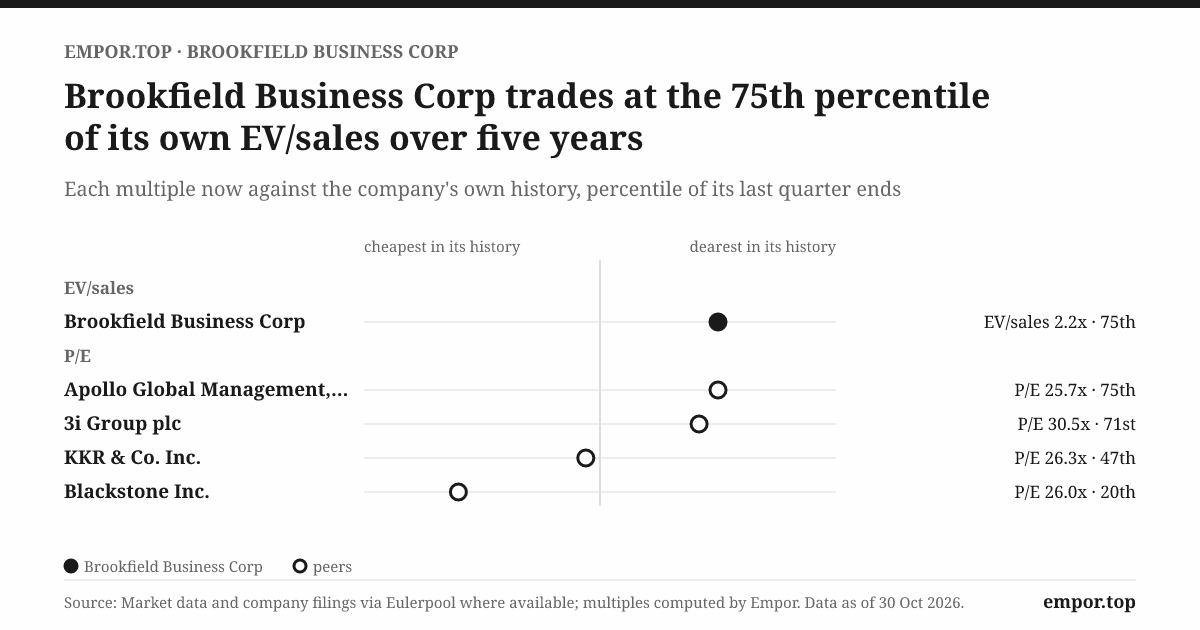
Look at a stock screen on October 30, 2026 and BBUC appears to be one of the cheapest stocks on the New York Stock Exchange. The share price is $28.02, the price-to-earnings ratio about 3.8 times and the five-year median P/E about 4.4 times.3 Book value per share is $26.30, so the stock trades at about 1.1 times book; enterprise value is about 5.3 times EBITDA.3 To a value investor scanning for bargains, that looks like a gift.
But the 3.8 times P/E uses earnings for the twelve months to June 2024. Over the twelve months to June 2026, earnings per share were negative, about minus $6.91.32 The low P/E is stale; it measures a period that no longer describes the company. The 5.3 times EV/EBITDA consolidates businesses where outside partners own large stakes, and the enterprise value includes all the consolidated debt, so it is a ratio of empire to empire rather than a measure of what the public shareholder pays for its slice. The price-to-book ratio, meanwhile, sits beside a 2025 balance sheet on which shareholders' equity was negative on Empor's data, about minus $679 million, a product of non-controlling interests and accumulated losses.4 None of these ratios is wrong. They are context, not a valuation conclusion.
So the honest bull and bear cases have to be built from the evidence, not the screen.
The case for the portfolio, and the case against it
The bull case starts with the operator. Brookfield has decades of experience buying complex businesses and a record that includes real successes: Westinghouse, La Trobe, and others the company has reported.1115 Industrials, the largest engine, is growing on a same-store basis, and management credits the higher-margin advanced batteries at Clarios for the improvement.13 In the second quarter of 2026, Adjusted EBITDA was about $587 million against $591 million a year earlier, but management said it was up about 5% when acquisitions and disposals were excluded.2213 The group is selling assets, $1.2 billion in the first half alone, and buying back shares.5 If the businesses are worth more than the market thinks, each repurchase at a discount compounds for remaining holders. And a 31% public float in a business controlled by a sophisticated parent can, in a good outcome, be a cheap way to ride along.
The bear case starts with cash. Five years of negative free cash flow and volatile working capital mean the public shareholder has not been receiving the cash that EBITDA suggests.412 The portfolio has recorded a distressed failure in healthcare and lower Infrastructure Services earnings in 2025.2115 CDK, the largest software asset, faces churn, a costly litigation history and a CCC rating that puts refinancing at the centre of its future.20 Brookfield's fee is tied to capitalization rather than results, affiliate balances and guarantees complicate the cash path, and outside shareholders have no voting power to change any of it.124 A skeptic would add that the reorganization, though simpler, also resets the historical series, making it harder to track long-term per-share performance.
Now apply the frameworks, business by business, because there is no single industry to analyse. Porter's five forces vary wildly across the portfolio. In dealer software, buyer power is moderate and rising: dealers are fragmented, but the large dealer groups negotiate hard, and the cyberattack gave them a reason to consider alternatives. The threat of substitutes and new entrants, cloud platforms like Tekion, is the most serious force acting on CDK, and slipping retention is the evidence that it is real.13 Rivalry among CDK, Reynolds and Cox is concentrated but not cosy. Supplier power is low. In water concessions, the decisive force is the government as buyer and regulator; the threat of entry is near zero within a concession, but tariff and political risk substitute for competition. In batteries, rivalry is among a few global manufacturers, and supplier power is shaped by lead and other commodity prices. In construction and work-access services, customer power is high and rivalry intense, which is why those businesses depend on execution.
Hamilton Helmer's seven powers sharpen the picture. CDK's main power is switching costs; current retention data shows those costs are real but weakening, not structural. BRK Ambiental's power is a cornered resource, exclusive municipal concessions, bounded by regulatory risk. Clarios has scale economies and process power in recycling and manufacturing. Brookfield itself may have a form of process power in operational turnarounds and counter-positioning in its willingness to buy complex, unloved businesses others avoid. But none of these powers aggregates into a group-wide moat, and the evidence does not support a consolidated market-share or moat claim. The portfolio's strength is the sum of a few defensible businesses and a capable owner, not a single protected franchise.
What does the current price appear to assume? With about $1.6 billion of corporate debt above a $5.8 billion equity value, the market is putting a modest value on BBUC's share of the operating businesses after their own debt and partners' stakes.23 One way to read that is that investors are discounting the possibility that one or more leveraged holdings, CDK most obviously, delivers little or no equity value to BBUC; another is that they are applying a standing discount for control, fees and opacity for which the public holder receives no vote to offset. Both readings can be true at once. The share price has also been volatile, with a one-year volatility near 37% and a fall of more than 60% at its worst point over five years, which suggests the market's confidence in the portfolio's value has never been steady.3
There is also no clean peer against which to set the multiple. Listed private-equity managers such as Brookfield's own asset-management arm earn fees and trade on fee growth; listed infrastructure and renewables vehicles own long-lived regulated assets with more predictable cash flows. BBUC owns operating businesses with real cyclical and execution risk, financed with significant non-recourse debt, and controlled by its manager. Investors pricing it are effectively pricing a listed private-equity portfolio whose underlying values are set by the manager rather than by the market, which is exactly why the missing same-store and per-share bridges carry a price.
A skeptical investor, the kind of activist who sends long letters, would put three demands to management. Publish a consistent same-store bridge on the new reporting perimeter so that growth can be separated from acquisitions and disposals. Show cash returned per share, net of fees and new capital, across a full cycle including the failures. And reconcile affiliate receivables and guarantees with actual cash settlements each year. None of those demands is unusual. Each would let the public shareholder test the 15% objective instead of trusting it.
Three measures matter most for tracking whether the case is improving. The first is same-store Adjusted EBITDA by segment, excluding acquisitions and disposals; the latest reading was up about 5% in the second quarter of 2026, according to management.13 The second is cash from operations after working-capital movements and capital spending; it was positive before working capital in the first half of 2026 but negative on a reported free-cash-flow basis for five straight years.24 The third is CDK's customer retention alongside its refinancing; retention slipped to about 96% and the rating fell to CCC.1320
The conclusion has to be stated carefully. BBUC has a credible operating playbook and a parent with real capabilities. The evidence that the playbook consistently compounds value for BBUC's public shareholders after fees, failures and the long trip of cash up the structure remains incomplete. The cheapness on the screen is mostly an artifact; the real question is whether those three measures move in the right direction. That leaves a few lessons that reach beyond this company.
XI. Business & Investing Lessons
Go back to January 2018, when Brookfield agreed to buy a bankrupt nuclear company for about $4.6 billion, and to October 2022, when a Brookfield affiliate and Cameco agreed to buy it at a $7.9 billion enterprise value.1011 It is one of the most celebrated private-equity trades of the decade, and it is also the cleanest illustration of the first lesson this company teaches: a good exit price is not a return calculation. Between those two numbers sit debt, partners, ownership percentages, interim capital and the fact that the buyer was a sister company. The listed vehicle's own reward even arrived as a non-interest-bearing IOU from an affiliate. For founders and investors, the wider point is that the story people remember about a deal is the two prices, while the return lives in everything between them.
The second lesson is that a moat lives in the customer's renewal decision. CDK's software runs the dealership's day, from the showroom to the service bay, and that integration was supposed to make it almost impossible to leave. Then a cyberattack showed dealers what life looked like when the system went dark, and retention began to slip a point at a time.1913 Switching costs are not a property of software; they are a calculation the customer makes every renewal, and the calculation can change after one bad week. Any investor relying on a moat should know which customer decision proves it, and watch that decision rather than the narrative.
The third lesson is that a portfolio is diversified only if its cash arrives. BBUC owns batteries, software, water, insurance, construction and lottery services, a mix that should smooth any single setback. Yet for five consecutive years the reported free cash flow was negative.4 Diversification protects against one business failing; it does not guarantee that the businesses together will throw off distributable cash after capital spending, working capital and interest. EBITDA and asset-sale proceeds are promises of cash. They are not cash in the shareholder's hands.
The fourth lesson is that control is an operating advantage with a governance price. Brookfield's control means it can install management, refinance quickly and buy or sell without a public fight, and that ability built Westinghouse into a winner. The same control means it sets the fee, holds 75% of the vote, guarantees and is guaranteed by affiliates, and decides when cash moves.412 The benefit and the price come in the same package. Investors who take the first must accept the second, and should insist on the disclosure that makes the price visible.
Put together, the lessons describe a company where the method can create value but where public shareholders need a transparent bridge from deal-level gains to their own after-fee, per-share returns. That bridge is what the next few months will begin to build, or fail to.
XII. Epilogue
Tonight BBUC sits at $28.02, a quarter below its 52-week high, in its first year as a single corporation.3 Its next earnings call is scheduled for November 5.3 The call will be the first chance to test the claims management made at its September investor day against a fresh quarter of numbers.6
Listen first for CDK. Management's prepared remarks will probably describe progress in product adoption; the real information will be in the answers to analysts' questions on retention, customer wins and losses, and the refinancing. If retention moves back toward 97% and CDK refinances without a large equity injection from BBUC, the software thesis survives in a smaller, more credible form. If retention keeps slipping or the refinancing requires sponsor support, the CCC rating will look like a forecast rather than a warning.20
Then watch the deals. World Freight and Gregg have to close, and the company has to show how much capital it actually invested and what it expects those businesses to earn.5 Multiplex's sale has to close and the proceeds have to land somewhere useful.13 Buybacks will continue or slow, and either decision will say something about how management values its own shares. And the cash bridge through year-end will show whether the first half's large working-capital drain reverses.2
Each of those events speaks to one of the central questions. Same-store growth will show whether the businesses are improving or whether the perimeter is doing the work. The cash bridge will show whether portfolio earnings become cash that reaches the parent. And the handling of CDK, affiliate balances and new deals will show whether the parent relationship remains economically fair to the public owners.
The story turns on execution and disclosure. The operating businesses can improve, the sales can go well, and the parent can be fair, but unless the public shareholder can see it per share, the discount may persist. The tension is not whether Brookfield can do deals. It is whether the deals add up to something the person holding the listed share can count.
XIII. Outro
Somewhere tonight, a battery line is still running, a water crew is still on call and a dealership is still logging repair orders into CDK. Fifty-seven thousand people keep the businesses moving.1 Above them sits a listed parent with no workforce of its own and a controlling shareholder that is also its manager. The market values that parent at about $5.8 billion against nearly $79 billion of reported assets.32
That distance is the whole story. BBUC is a public claim on Brookfield's work of buying, operating and selling businesses, and the assets are only the first line of the calculation. The rest is debt, partners, fees and cash, and the answer to whether this vehicle compounds for the people who own its listed shares will be written in that rest.
References
-
Brookfield Business Corporation 2026 Investor Day Presentation — Brookfield, 2026 ↩↩
-
Brookfield Business Corporation Q2 2026 Interim Report and MD&A — SEC, 2026-08-05 ↩↩↩↩↩↩↩↩↩↩↩↩↩↩↩↩↩↩↩↩↩↩↩↩
-
Brookfield Business Corporation — Investor Relations ↩↩↩↩↩↩↩↩↩↩↩
-
Brookfield Business Corporation 2025 Form 20-F — SEC, 2026-03-30 ↩↩↩↩↩↩↩↩↩↩↩↩↩↩↩↩↩↩↩↩↩↩↩↩↩↩↩↩↩↩↩
-
Brookfield Business Corporation Reports Strong Second Quarter 2026 Results — Brookfield, 2026-07-31 ↩↩↩↩
-
Brookfield Affiliates 2026 Investor Day BBUC Transcript — Brookfield, 2026 ↩↩
-
Brookfield Asset Management Completes Spin-Off of Brookfield Business Partners — Brookfield, 2016-06-20 ↩
-
Brookfield Business Corporation Form F-10 — SEC, 2026-03-31 ↩
-
Brookfield Business Corporation Base Shelf Prospectus — SEC, 2026-05-14 ↩↩
-
Brookfield Business Partners to Acquire Westinghouse — Westinghouse, 2018-01-04 ↩↩↩↩
-
Cameco and Brookfield Renewable Form Strategic Partnership to Acquire Westinghouse — Cameco via SEC, 2022-10-11 ↩↩↩↩↩
-
Brookfield Business Corporation 2025 Financial Statements and Notes — SEC, 2026-03-30 ↩↩↩↩↩↩↩↩↩↩↩↩↩↩↩↩↩↩↩↩↩↩↩↩↩↩↩↩
-
Brookfield Business Corporation Q2 2026 Earnings Call Transcript — Brookfield, 2026-07-31 ↩↩↩↩↩↩↩↩↩↩↩↩↩↩↩↩↩↩↩↩↩
-
Brookfield Business Corporation Q1 2026 Earnings Call Transcript — Brookfield, 2026 ↩↩
-
Brookfield Business Partners Q4 2025 Earnings Call Transcript — Brookfield, 2026 ↩↩↩↩↩↩↩
-
Brookfield Business Partners Q4 2024 Earnings Call Transcript — Brookfield, 2025 ↩
-
CDK Global Enters Agreement to Be Acquired by Brookfield Business Partners — CDK Global via SEC, 2022-04-07 ↩↩
-
Brookfield Business Partners Q4 2022 Letter to Unitholders — Brookfield, 2023 ↩
-
Ripple Effect From CDK Hack Widens as More US Auto Dealers Flag Hit — Reuters via Investing.com, 2024-06-24 ↩↩↩↩
-
CDK Global Downgraded to CCC With Negative Outlook — Cbonds, 2026-09-07 ↩↩↩↩
-
Brookfield Business Corporation 2025 Form 20-F (PDF) — Brookfield, 2026 ↩↩↩
-
Brookfield Business Corporation Q2 2026 Results Release — SEC, 2026-07-31 ↩
-
Brookfield Names Anuj Ranjan CEO of Its Private Equity Arm — The Logic, 2024-02-02 ↩
-
Brookfield Business Corporation 2026 Management Information Circular — Brookfield, 2026 ↩
-
Brookfield Business Corporation Announces Results of Annual Meeting of Shareholders — Brookfield, 2026 ↩
-
Brookfield Corporation Q2 2026 Interim Report — SEC, 2026-08-05 ↩
 LinkedIn
 WhatsApp
 Reddit
 Hacker News
 Email
 Kindle
 RSS Feed
 Spotify
 Apple Podcasts
 Amazon Music
 Audible
 YouTube