BridgeBio Pharma: Moneyball, Clinical Heartbreak, and the Three-Way War for ATTR-CM
I. Introduction & Episode Roadmap
There is a particular kind of silence that settles over a biotech company in the hours before a Phase 3 readout. The data is locked. The statisticians have run the analysis. A small handful of people know the answer, and everybody else is still allowed to believe.
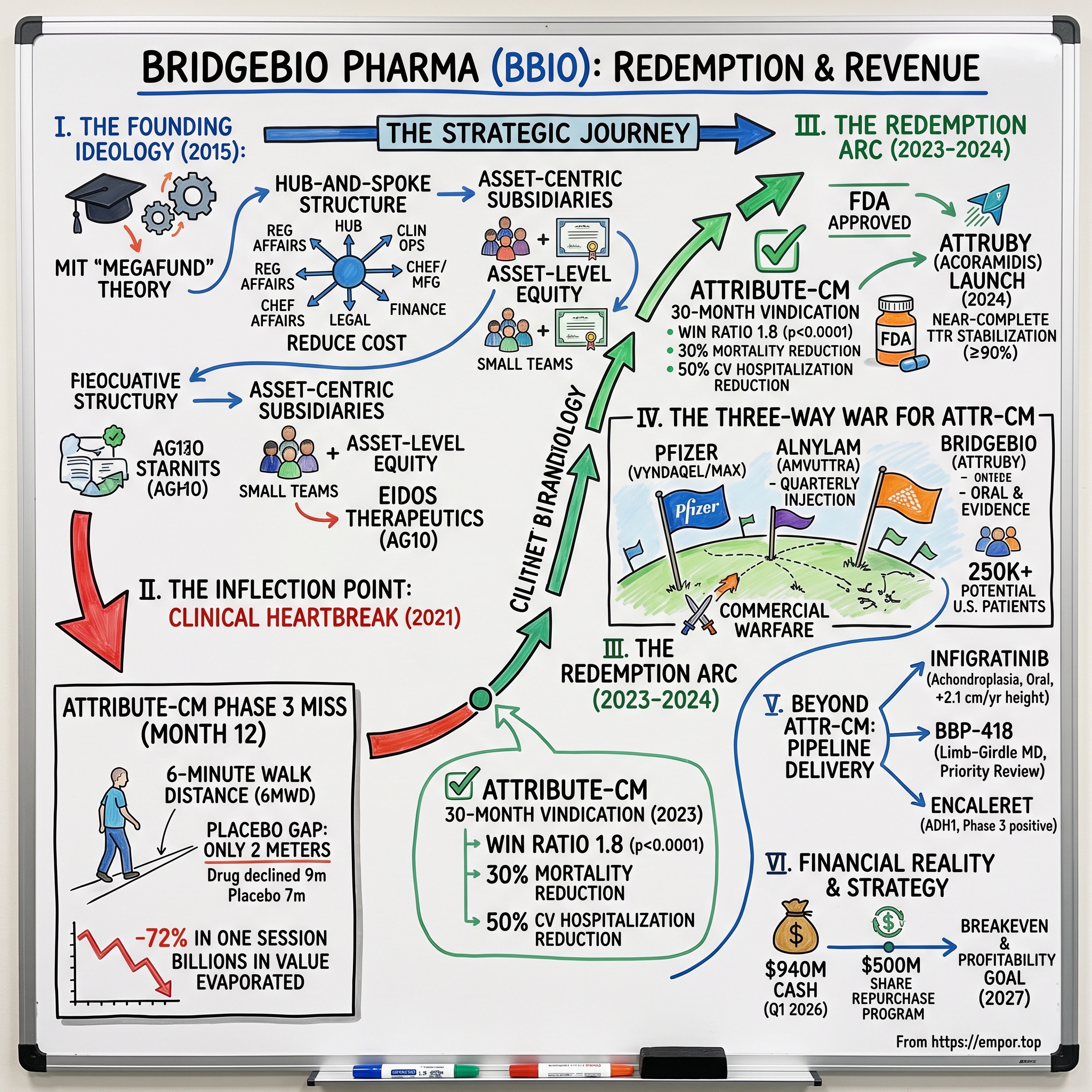
On the morning of December 27, 2021 — a dead-quiet trading day wedged between Christmas and New Year's, when half of Wall Street was on a beach — Neil Kumar, the founder and chief executive of BridgeBio Pharma, had to end that belief in public. The company announced that ATTRibute-CM, its pivotal Phase 3 study of acoramidis in transthyretin amyloid cardiomyopathy, had missed its primary endpoint at Month 12. The measurement was the six-minute walk distance: how far a patient with a stiffening, amyloid-clogged heart can walk down a hospital corridor in six minutes. Patients on the drug declined by a mean of nine meters. Patients on placebo declined by seven.1
Two meters. That was the gap between triumph and catastrophe.
The stock fell nearly 72% in a single session.2 Billions of dollars of market value evaporated on the thinnest holiday volume of the year. And the obituaries that followed were not merely about a failed molecule. They were about a theory. BridgeBio had been sold to investors as something more clever than a normal drug company — a portfolio machine, a diversified holding structure for genetic medicines, engineered specifically so that no single Phase 3 failure could take the whole thing down. On December 27, a single Phase 3 failure took the whole thing down anyway.
Fast forward. In November 2024 the FDA approved Attruby, the brand name for that same molecule, acoramidis, for the same disease that had humiliated the company three years earlier.[^3] By the first quarter of 2026, Attruby was generating $180.6 million of U.S. net product revenue in a single quarter — up 392% year over year — inside a company whose board had just authorized a $500 million share repurchase program, which is not a sentence one typically writes about a loss-making biotech.3 The shares traded around $80 in mid-July 2026, giving BridgeBio a market capitalization near $15.8 billion.4
So the story is a redemption arc. But redemption arcs are the easiest stories in the world to tell badly, and the interesting questions here are not settled by the happy ending.
This is, at its core, a story about a financial idea colliding with biology. The idea was that drug development's central problem is not scientific — it is statistical. Individual drug programs are lottery tickets with terrible odds and enormous variance. But if you could pool enough uncorrelated tickets under one roof, share the overhead, and let the winners pay for the losers, you could transform a gambling business into something closer to an investment portfolio. That thesis has an intellectual lineage running through MIT's finance department, and it has been tried, in various forms, many times. BridgeBio built an entire company around it.
What follows is the test of that thesis in the field: the spin-out of Eidos Therapeutics and its expensive re-acquisition; the twelve-month failure and the thirty-month vindication; the approval; and now the part that actually determines whether the whole edifice pays for itself — a brutal, three-way commercial war for the ATTR-CM market against Pfizer, which got there first and owns the prescribers, and Alnylam, whose quarterly injection arrived with data of its own. Layered on top is a pipeline that is finally, genuinely delivering: oral infigratinib in achondroplasia, published in the New England Journal of Medicine in the summer of 2026, and BBP-418 in limb-girdle muscular dystrophy, sitting under FDA priority review.
The roadmap runs in that order: the theory, the spin-out and the buyback, the crash, the vindication, the war, the pipeline, the playbook, and finally the financial reality — a company with roughly $940 million of cash still losing over $160 million a quarter, betting that the crossover to profitability arrives before the balance sheet gets uncomfortable.3
Start with the theory, because everything that came after was downstream of it.
 Subscribe on LinkedIn
II. The MIT Theory: Moneyball for Biotech & Founding Context
Picture the biotech industry in 2015. Capital was cheap, the genomics revolution had produced an embarrassment of validated disease targets, and the standard operating model looked something like this: a venture firm identifies a promising molecule, wraps a company around it, hires forty people, rents lab space in Cambridge or South San Francisco, spends five years and $300 million, and then submits the entire enterprise to a single binary event. If the Phase 3 works, everyone is rich. If it doesn't, the forty people update their LinkedIn profiles and the lab equipment goes to auction.
Neil Kumar had watched this from both sides. He holds a Ph.D. in chemical engineering from MIT, spent time at McKinsey, and then worked as a Principal at Third Rock Ventures — one of the more successful company-creation shops in the business — where his job was literally forming new biotechs and evaluating whether to fund them.5 That vantage point tends to produce one of two reactions. Either you conclude the system works and you learn to play it, or you conclude the system is structurally wasteful and you try to redesign it.
Kumar took the second route. In 2015 he co-founded BridgeBio with Frank McCormick, the UCSF cancer biologist best known for decades of work on Ras signaling — a scientist whose presence signaled to the field that this was not going to be a purely financial exercise.5 The stated purpose was narrow and, in its way, unglamorous: build medicines for genetic diseases where the biology is already understood, where a single mutation drives a single well-described pathology, and where the scientific risk is therefore lower than in, say, oncology or neurology.
That target selection matters more than it sounds. In a Mendelian genetic disease, nature has effectively already run the experiment. If you know that a broken gene produces a broken protein that produces a specific clinical syndrome, then the question is no longer "does this pathway cause the disease?" but "can we drug it?" That is a chemistry problem, not a biology mystery. The failure modes shrink.
The financial architecture
The second half of the idea was structural, and it is the part that made BridgeBio a topic of argument at investment conferences.
The insight — which rhymes closely with the "megafund" research that came out of MIT's finance faculty in the early 2010s, where the argument was that pooling large numbers of independent drug programs converts an unfinanceable risk profile into a bond-like one — is that drug development's economics are ruined by variance rather than by expected value. The average drug program may have perfectly respectable expected returns. It is the distribution that kills you: mostly zeros, occasionally enormous. No rational investor concentrates in that. So capital demands a punitive risk premium, projects go unfunded, and patients with rare diseases wait.
Pool the programs, though, and the math changes. Twenty independent shots on goal, each with a modest probability of success, produce a portfolio where the probability of at least one winner approaches certainty. The catch is that you need the shots to be genuinely uncorrelated — different genes, different tissues, different mechanisms — and you need to keep the cost per shot low enough that the winners can pay for the losers with room to spare.
BridgeBio's answer to the cost problem was the "hub-and-spoke" structure. The hub is the parent: shared regulatory affairs, shared clinical operations, shared chemistry and manufacturing, shared legal, shared finance, and eventually a shared commercial organization. The spokes are asset-centric subsidiaries — often separate legal entities — each built around one genetic driver, each with a small dedicated team, and crucially each able to grant asset-level equity to the scientists working on it. A researcher working on a limb-girdle muscular dystrophy program owns a piece of that program, not a diluted sliver of a sprawling conglomerate.
It is worth pausing on why that incentive design is genuinely clever rather than merely cosmetic. In a large pharmaceutical company, the scientist who kills a doomed program early gets no reward and possibly loses their job; the rational move is to keep it alive. In an asset-level equity structure, the same scientist's upside is concentrated in a small number of programs, which makes killing the bad ones rational rather than suicidal. Portfolio companies live or die on their ability to terminate failures fast, and most fail at exactly that.
There is a third element that gets less attention but may matter most: sourcing. BridgeBio positioned itself as the natural counterparty for academic labs sitting on a well-characterized genetic mechanism and no idea how to turn it into a drug. A university group that has spent fifteen years working out why a particular enzyme deficiency produces a particular muscle disease does not want to raise a Series A, hire a CMC team, and negotiate with the FDA. Offering that group a spoke — a dedicated entity, a share of the economics, and a professional drug-development machine attached — is a genuinely differentiated pitch, and it is cheaper than in-licensing clinical-stage assets at auction prices. Roughly speaking, BridgeBio's model was to buy scientific risk cheap, because it believed the risk was smaller than the market priced it, and then to industrialize the expensive part.
The stress test
A skeptical investor in 2019, watching BridgeBio complete its Nasdaq IPO, would have asked a harder question: is this a drug company or a financial vehicle?5
The uncomfortable version of the thesis goes like this. Spin out subsidiaries. List them separately. Capture the valuation premium that public markets assign to single-asset stories. Retain a controlling stake so the parent consolidates the upside. Let outside shareholders fund the expensive clinical trials. If the asset works, buy it back or keep the economics; if it fails, the loss is partly borne by someone else. Structurally, that is not so different from a sponsor monetizing risk through affiliated entities — a description that would make any governance-minded investor's eyebrows rise.
The honest answer, viewed from 2026, is that BridgeBio did in fact do the spin-out-and-list thing, did in fact buy the subsidiary back, and did in fact end up owning a commercial drug. Whether that sequence represents good judgment or an expensive round trip depends entirely on the arithmetic of one transaction — the one involving a company called Eidos Therapeutics, and a molecule then known only as AG10.
III. The Eidos Spin-Out: Capital Allocation and Arbitrage
Transthyretin is one of those proteins that does an unglamorous job perfectly well for sixty years and then, in some people, quietly turns on its host.
Its normal function is transport: it ferries thyroid hormone and vitamin A around the bloodstream. To do that it assembles itself into a tetramer — four identical protein subunits locked together into a stable unit, rather like four people standing back-to-back holding hands. The structure is what keeps it functional and, more importantly, keeps it soluble.
The trouble starts when the tetramer comes apart. Free-floating single subunits — monomers — are sticky and misfold. They aggregate into amyloid fibrils, which are essentially protein plaque, and they deposit in tissue. When they deposit in the heart muscle, the walls thicken and stiffen. The heart can still squeeze but can no longer relax and fill properly. The clinical result is progressive heart failure, and before modern treatment it was reliably fatal, typically within a few years of diagnosis. Some patients carry a mutation that makes the tetramer unstable from birth; many others simply accumulate the damage with age, a form called wild-type ATTR that was, for decades, massively underdiagnosed and written off as "stiff old heart."
The therapeutic logic is therefore beautifully simple. Stop the tetramer from falling apart, and you stop making new amyloid.
That was AG10 — a small molecule designed to bind the tetramer and hold it together. BridgeBio created Eidos Therapeutics around it in 2017, and on June 22, 2018, Eidos went public on Nasdaq under the ticker EIDX.6
Why spin it out at all?
The rationale was capital, and it was rational in the moment. ATTR-CM trials are expensive: they enroll elderly, sick cardiac patients, they run for years, and the endpoints require long follow-up. Funding that at the parent level meant issuing BridgeBio equity and diluting every other program's owners to pay for one program. Funding it at the subsidiary level meant selling equity in the asset itself to investors who specifically wanted that risk, at a valuation that reflected the asset's story rather than being buried inside a portfolio conglomerate discount.
There is a second, subtler benefit. A separately traded subsidiary produces a public price for one spoke. In a hub-and-spoke company, the perennial complaint from investors is that they cannot value the pieces. A listed spoke solves that for at least one asset — and if the market's price for the spoke is high, it validates the model.
Then the data started coming in, and the calculus inverted.
The realization of value
As AG10's Phase 2 and mechanistic data matured, it became clear that the molecule was doing something unusual: achieving near-complete stabilization of the TTR tetramer — later characterized around the ≥90% level and marketed by the company as a "near-complete" stabilizer — against a competing incumbent whose stabilization was understood to be substantially less complete.7 In a disease where the entire pathology is monomer generation, the depth of stabilization is not a marketing detail. It is arguably the whole product.
Which created a problem for BridgeBio's own structure. The company had spun out, at a modest valuation, what was increasingly obviously the single most valuable thing it owned. It held roughly 63.7% of Eidos; the other 36.3% belonged to public shareholders who had bought in early and were now sitting on the same realization.8
The great buyback
On October 5, 2020, BridgeBio announced a definitive agreement to acquire the Eidos shares it did not already own.9 The price was not gentle. The transaction valued Eidos at approximately $2.83 billion, with Eidos holders electing either 1.85 BridgeBio shares or $73.26 in cash per share, capped at $175 million of aggregate cash — meaning this was overwhelmingly a stock deal.89 The consideration represented a 41% premium to Eidos's closing price on October 2, 2020 and a 55% premium to the prior thirty-day volume-weighted average.9 It was, notably, a sweetened offer; BridgeBio had approached the minority once already and been forced to improve terms.10 The transaction closed on January 26, 2021.11
So: did they overpay?
The mechanical answer is that BridgeBio spent roughly a billion dollars of its own stock to buy back about a third of an asset it had originally owned outright — an asset it had sold cheap in 2018 and repurchased dear in 2021. Framed that way, the round trip destroyed value, and the "capture the IPO premium" logic looks like it worked in reverse.
The defensible answer is that the spin-out did what it was supposed to do — it funded the trial with someone else's money at a moment when BridgeBio's own currency was worth less — and that the buyback was a rational response to new information. When you learn that one of your twenty lottery tickets is actually a very good ticket, consolidating it is correct even at a premium, because from that point forward the parent captures 100% of an economics stream rather than 64%.
There is also a governance reading, and it is not entirely comfortable. When a controlling parent buys out its own subsidiary's minority, the parent sits on both sides of the table. Eidos's minority holders were negotiating with a counterparty that controlled the board, the pipeline decisions, and the information. That BridgeBio was forced to raise its offer suggests the process worked — the minority had leverage and used it — but the structure itself is exactly the kind of related-party arrangement that makes governance-focused investors uneasy about hub-and-spoke models generally. Every spoke that gets listed separately creates a future negotiation in which the parent's interests and the spoke's shareholders' interests diverge sharply.
The genuinely instructive point is what the transaction revealed about the model's limits. A diversified portfolio structure is elegant right up to the moment one asset becomes 80% of the enterprise value. At that instant, you are no longer running a portfolio. You are running a single-asset biotech that happens to have a lot of side projects — and you are exposed to precisely the binary risk the whole architecture was designed to eliminate.
Eleven months after the deal closed, that exposure detonated.
IV. Clinical Heartbreak: The 6-Minute Walk and the Near-Death Experience
By late 2021, BridgeBio was one of the most confidently valued mid-cap biotechs in the market. Eidos was fully reintegrated. The company had a broad portfolio, a fashionable structure, a charismatic scientist-CEO who spoke fluent net-present-value, and — sitting on top of it all — a Phase 3 cardiac program that a great many people had already decided was going to work.
Everything hinged on the design of ATTRibute-CM. The trial had a two-part structure: a Month 12 assessment on the six-minute walk distance, and then a Month 30 assessment on a hierarchical composite of hard clinical outcomes — death and cardiovascular hospitalization. That structure was itself a tell. Regulators and sponsors had used 6MWD in this disease because it was quick and quantitative; the harder endpoints took years.
Then came December 27, 2021.
The pathology of a miss
The trial did not miss because the drug did nothing. It missed because the placebo arm refused to get sick.1
This deserves unpacking, because it is one of the more instructive failures in modern clinical development. When a trial measures functional decline, the effect size depends entirely on how fast the untreated group deteriorates. Historical ATTR-CM datasets — the ones used to power the study — came from an era when patients arrived at the clinic late, often after years of misdiagnosis, already in advanced heart failure.
By 2019–2021, that world had changed. Cardiologists had learned to recognize ATTR-CM. Non-invasive nuclear imaging had made diagnosis vastly easier. Awareness campaigns had pulled patients into the funnel years earlier in their disease course. And background heart-failure care itself had improved. The patients enrolling in ATTRibute-CM were simply healthier, earlier-stage, and better managed than the historical patients the statistical assumptions were built on.
The result: a placebo group that walked almost as well at Month 12 as it had at baseline. There was no decline for the drug to prevent. A treatment effect that might have been large and obvious in a sicker population compressed into statistical noise.
Kumar himself would later describe the awkwardness of the comparison in blunt terms — noting on a 2026 earnings call that BridgeBio's placebo arm had outperformed the on-drug arm of the competing pivotal trial that had established the standard of care years earlier.12 That is a startling sentence, and it captures the problem precisely: the disease being studied in 2021 was not the disease that had been studied in 2016.
The market's verdict, and what it actually priced
The stock's near-72% single-day collapse was not a considered judgment about transthyretin biology.2 It was a repricing of a company that the market had, correctly, understood to be a one-asset story wearing a portfolio costume. When the asset broke, the costume provided no protection at all.
It also exposed the second structural vulnerability. A hub-and-spoke company running many programs has a high fixed cost base by design — that is the point of the hub. Fixed costs are wonderful when a blockbuster is paying for them and lethal when nothing is. With the lead asset in limbo and the equity currency destroyed, BridgeBio faced the classic biotech death spiral: raise capital at a ruinous price, or cut.
They cut. The company restructured through 2022, prioritized late-stage assets, paused or partnered out earlier-stage programs, and pushed non-core science into separately financed vehicles rather than carrying it on the balance sheet.
That period deserves more credit than it usually gets, because it was where the portfolio model was actually tested — not in the good times, when diversification is a marketing slide, but in the moment when the parent had to decide which of its children to feed. A conventional single-asset biotech in the same position has only two choices: dilute catastrophically or wind down. BridgeBio had a third, which was to convert portfolio breadth into liquidity by finding partners and outside capital for programs it could no longer afford to run alone. The structure did not prevent the crisis. It did give management options during it, and that distinction is the honest version of what diversification bought. The residue of that discipline is still visible in 2026: management now describes BridgeBio Oncology Therapeutics and a sister entity called GondolaBio — the latter holding some seventeen programs from preclinical through Phase 2 — as deliberately "off-balance-sheet R&D," a phrase Kumar used almost casually on the Q1 2026 call.12 The near-death experience permanently changed where the company keeps its optionality.
The credibility test
The more interesting question is what management did with the narrative.
The standard playbook after a Phase 3 miss is to pivot: blame the endpoint, blame the FDA, announce a strategic review, and quietly redirect investor attention to a different program. Kumar did something riskier. He argued that the miss was an artifact of the endpoint and the era, that the drug's mechanism was working exactly as designed, and that the Month 30 hard-outcome analysis — mortality and hospitalization, the endpoints that actually matter to patients and payers — would show it.
He was, in effect, asking investors to believe a hypothesis that would not be testable for another nineteen months. Independent support helped: the trial's data monitoring committee recommended continuing the study to the Month 30 readout, which is not something such a committee does casually.1
For an analyst assessing management credibility, this is the single most useful episode in BridgeBio's history — more useful than any of the successes. It was a falsifiable, publicly stated, high-cost commitment made at the worst possible moment. It could have been stubbornness dressed as conviction. The only way to find out was to wait.
V. Redemption: The 30-Month Triumph and FDA Approval
Nineteen months later, on July 17, 2023, BridgeBio released the Month 30 data.
It was not a narrow win. It was the kind of result that makes a room go quiet for a different reason.
What the data said, in plain English
The primary analysis used a hierarchical composite — every patient on drug is compared against every patient on placebo, ranked first on death, then on cardiovascular hospitalization, then on functional measures. The output is a "win ratio": how many of those head-to-head comparisons the drug arm wins versus loses. Acoramidis produced a win ratio of 1.8 with a p-value below 0.0001, and 58% of comparisons were decided on the two hardest possible criteria — whether the patient died, and how often they were hospitalized for their heart.13
The component numbers carried the story. On-treatment survival was 81% versus 74% on placebo — an absolute reduction in death of roughly six and a half percentage points, a relative reduction of about 25%. Cardiovascular mortality ran 14.9% on drug versus 21.3% on placebo, a 30% relative reduction. And cardiovascular hospitalizations fell by 50%, again with a p-value below 0.0001.13
Translate that into what a cardiologist actually experiences: for every two hospital admissions their ATTR-CM patients would otherwise have had, one didn't happen. Hospitalization is where heart failure care becomes expensive and where patients lose function permanently. A 50% reduction is a health-economics argument as much as a clinical one, and it is the number that gets a drug onto formularies.
The safety profile was clean, which is what you would expect from a molecule whose mechanism is to preserve a native human protein rather than eliminate it. The results were subsequently published in the New England Journal of Medicine in January 2024, which mattered for the only audience that ultimately writes prescriptions: practicing cardiologists.14
Vindication, with an asterisk
The Month 30 data validated Kumar's December 2021 argument almost point for point. The drug had been working the whole time; the Month 12 walk test had simply been the wrong instrument in the wrong decade.
But the asterisk deserves stating plainly, because it cuts against the tidy redemption narrative. Being right in the end does not retroactively make the original trial design good. BridgeBio powered a pivotal study on assumptions about placebo decline that were already going stale when the study was designed, and that error cost the company roughly two years, most of its market capitalization, an entire restructuring, and — quite possibly — first-mover position in the market it was trying to enter. Investors evaluating management should hold both facts simultaneously: the scientific conviction was vindicated, and the operational forecasting that preceded it was wrong in an expensive, arguably foreseeable way.
Approval
Regulatory submissions followed through late 2023 and into 2024. On November 22, 2024, the FDA approved Attruby (acoramidis) for ATTR-CM in adults — one week ahead of the November 29 PDUFA date.1516
The label was the prize. It specifically described near-complete stabilization of transthyretin, giving BridgeBio's sales force something rare: a differentiating claim they were legally permitted to make.16 In a market where the incumbent had a decade of relationships and an enormous sales organization, a label-supported mechanistic differentiator was arguably the only weapon that could work.
There is one more consequence of the delay that is easy to miss. Had ATTRibute-CM read out cleanly at Month 12, Attruby would have reached the market well before Alnylam's cardiomyopathy approval and would have spent that window as the only alternative to the incumbent — building prescriber habit in a market that was doubling its diagnosed population every few years. Instead it arrived into a three-way contest. Market share in chronic therapy is substantially a function of who was available when the physician formed a habit, and BridgeBio forfeited a meaningful chunk of that timing advantage to a walk test.
Because the science was now settled. What remained was a commercial fight — and BridgeBio was walking into it as the smallest company on the field.
VI. The Three-Way Commercial War for ATTR-CM
Here is the thing about rare cardiac diseases: they stop being rare the moment doctors start looking.
For most of the last twenty years, ATTR-CM was a diagnosis of exclusion, found mostly at autopsy. Then imaging improved, awareness campaigns landed, and the estimated patient population in the United States alone climbed to at least 250,000 by management's own framing — against a treated population that remains a small fraction of that.12 The market is not being divided. It is being created, quarter after quarter, by diagnosis rates. On the Q1 2026 call, BridgeBio estimated that the entire category added more than 6,100 new patient starts in the quarter, up from something in the 5,000 range previously.12
That dynamic — a growing pie — is why three well-capitalized competitors can all report excellent numbers at once.
The incumbent: Pfizer
Pfizer's tafamidis franchise, sold as Vyndaqel and Vyndamax, defined the category. It was first, it built the diagnostic infrastructure, it educated the cardiologists, and it generated $5.451 billion in worldwide revenue in 2024 alone.17 In the first quarter of 2026 the franchise still produced roughly $1.6 billion globally, growing 8% year over year, largely on international expansion.18
Pfizer's power here is textbook scale economics and distribution. A cardiovascular sales force of that size, with those payer relationships, reaches community cardiologists that a specialty biotech simply cannot afford to call on. And the incumbent controls the default: when a physician has been prescribing one drug for six years without incident, switching requires a reason.
One overhang did resolve, and not in BridgeBio's favor. In April 2026, Pfizer announced settlements with three generic manufacturers extending Vyndamax's effective U.S. patent expiry to June 1, 2031 — pushing back an anticipated 2029 revenue cliff.19 BridgeBio had internally modeled generic entry around 2035; Kumar conceded on the Q1 call that he had been wrong, while arguing the revision was "a little bit of a discount, but not material."12 The candor is worth noting; so is the fact that a competitor's legal victory quietly removed years of expected tailwind. A skeptical investor should read management's simultaneous claim that Attruby "will continue to grow even past 2032" as the assertion it is, not as an established fact.
The disruptor: Alnylam
The more immediate threat came from a different direction entirely.
Where stabilizers hold the TTR tetramer together, RNA interference does something more radical: it stops the liver from making transthyretin in the first place. Think of it as the difference between reinforcing a leaky pipe and shutting off the water main. Alnylam's Amvuttra (vutrisiran) does exactly that, and on March 20, 2025 the FDA approved it for ATTR-CM on the strength of the HELIOS-B trial.20
The competitive threat is partly clinical and substantially practical. Amvuttra is administered subcutaneously once every three months. Four injections a year, administered in a clinic, versus a pill taken twice daily forever. For adherence — the quiet killer of chronic therapy — quarterly dosing is a genuine advantage, and it also routes the drug through a different reimbursement channel.
The commercial results have been striking. Amvuttra generated $889.9 million in global sales in the first quarter of 2026, up 187% year over year.18 That is a faster ramp than Attruby's, from a company with more commercial infrastructure than BridgeBio and a well-earned reputation in TTR biology.
BridgeBio's position
Against that, BridgeBio has run a focused, evidence-led campaign, and the Q1 2026 numbers suggest it is working better than a third entrant has any right to expect. Attruby delivered $180.6 million of U.S. net product revenue in the quarter, 24% sequential growth, with royalty revenue of $9.5 million from partnered sales abroad.3 Full-year 2025 Attruby sales were roughly $362 million, which frames how steep the 2026 slope has been.18 Management claimed that new-to-brand share had grown beyond the 25% figure cited at the January J.P. Morgan conference, and that BridgeBio had become "convincingly the second brand by volume" in the category — while explicitly conceding it still trails Pfizer in the front line.12
The commercial architecture is deliberately asymmetric. In the United States, BridgeBio kept everything and built its own specialty sales force aimed at high-volume heart-failure and amyloidosis centers rather than trying to blanket the country. In Europe, it did the opposite: on March 4, 2024 it licensed acoramidis to Bayer, which markets it as BEYONTTRA, in exchange for a $135 million upfront payment, up to $175 million of regulatory and sales milestones through 2026 (the "up to $310 million" headline), further sales milestones of up to $450 million, and tiered royalties beginning in the low-thirties percent.21 Japan went to Alexion, AstraZeneca's rare disease arm. Brazil approved the drug in May 2026.3
That is a coherent capital-allocation decision rather than a concession. Building a European cardiovascular commercial organization from scratch would have cost hundreds of millions and years. A low-thirties royalty on Bayer's distribution converts that into high-margin cash with no fixed cost — and the royalty line is already showing up in reported revenue.
Why win, why not
The bull mechanism is evidentiary. BridgeBio's argument is that stabilization depth translates into outcomes, and it has been methodically building the proof: real-world evidence from the Valley Health System of Nevada showing statistically significant outcome improvements versus tafamidis; a study showing a 43% reduction in diuretic intensification versus tafamidis; long-term open-label extension data presented at the American College of Cardiology showing a 45% relative reduction in all-cause mortality at Month 54.312 Management also points to serum TTR literature suggesting each incremental mg/dL of circulating TTR associates with roughly a 5% lower mortality risk at 30 months — a framing that, if it holds, favors stabilizers over silencers on mechanistic grounds.12
Two cautions on that. First, real-world evidence is observational; it is vulnerable to the confound that patients switched to a newer drug may differ systematically from those left on the older one. Second, and more importantly, when an analyst asked directly whether BridgeBio would run a double-blind head-to-head trial against tafamidis, Kumar's answer was that they "still might," "reserve the option," and find event-driven trials difficult to size.12 That is a reasonable operational answer. It is also an acknowledgment that the cleanest possible proof of superiority does not exist and may never be generated.
The bear mechanism is squeeze. Pfizer defends the front line with contracting muscle and incumbency; Alnylam takes newly diagnosed patients on convenience; and Attruby ends up as the well-regarded third option with a respectable but capped share. Management's counter is that the economics of the Part D orphan channel favor them — the chief commercial officer noted that the average Attruby patient co-pay in 2025 was $190 for the entire year, with many patients paying nothing, and that Part D's continuous plan-based model spared Attruby the annual reauthorization friction that afflicts Part B–administered drugs.12 That is a real and underappreciated structural advantage of an oral drug in this market, and it is the sort of unglamorous plumbing detail that determines launches.
The combination question
There is a scenario neither the bull nor the bear case fully captures, and it may be where the market actually lands: patients get both.
The two mechanisms are not logically opposed. A silencer reduces how much transthyretin the liver produces; a stabilizer protects whatever remains from falling apart. Nothing prevents a cardiologist from prescribing both to a patient who is progressing, and BridgeBio said its own data suggested a tripling in combination use of Attruby alongside knockdown agents.12
Kumar's framing of this is worth examining because it is simultaneously the most confident and the least verified part of the company's thesis. His argument is that stabilizers will remain first-line on biochemical grounds — that preserving the native tetramer is inherently preferable, and that if you are going to combine, you want the better stabilizer in the mix.12 He pointed to two large observational datasets associating higher circulating TTR with better outcomes as supporting evidence.12
The counterargument is that combination use, whatever its clinical merit, is commercially ambiguous for BridgeBio. It expands the addressable prescription volume — good — but it also erodes the framing of a head-to-head contest in which one drug wins the patient. And in a combination world, the incumbent's contracting leverage may matter more than the challenger's mechanistic argument, because payers negotiating a two-drug regimen have every incentive to steer the stabilizer component toward whichever product costs them least. A superiority story that cannot be settled by a randomized head-to-head trial is a story that gets litigated in formulary committees rather than in journals.
The commercial fight will take years to resolve. Meanwhile, the rest of the portfolio finally started producing — which is, after all, what the whole model was for.
VII. Spoke Rotation: The Rest of the Pipeline
For a decade, the standing critique of BridgeBio was that the portfolio thesis had produced exactly one drug. In 2026, that critique stopped working.
Infigratinib in achondroplasia
Achondroplasia is the most common form of skeletal dysplasia, caused by a gain-of-function mutation in FGFR3 — a receptor that acts as a brake on bone growth at the growth plate. The mutation jams the brake on. Cartilage does not convert to bone at a normal rate, and long bones stay short.
The existing therapy, BioMarin's Voxzogo, works around the problem: it activates a parallel pathway that counteracts FGFR3 signaling downstream. It also requires a daily subcutaneous injection in a child.
Infigratinib takes the direct route — an oral, selective FGFR3 inhibitor that releases the brake at its source. On June 28, 2026, BridgeBio announced that the pivotal Phase 3 PROPEL 3 results had been published in the New England Journal of Medicine.22 The headline was a +2.1 cm/year observed mean improvement in annualized height velocity versus placebo — described as the largest mean increase reported in any Phase 3 achondroplasia study — alongside a +0.37 standard-deviation improvement in arm span (p<0.0001), the first statistically significant arm-span result from a placebo-controlled trial in the disease.22 It also showed a statistically significant improvement in body proportionality in children aged three to eight, with no discontinuations or drug-related serious adverse events.22 Kyowa Kirin, BridgeBio's Japanese partner, highlighted the publication in its own release on July 2, 2026.23
Proportionality is the point management keeps returning to, and it is worth understanding why. Achondroplasia is not merely a height condition; the disproportion between trunk and limbs, and the associated skull-base and spinal complications, drive much of the actual medical burden. A therapy that improves proportionality is making a claim about health, not just centimeters — and health claims are what advocacy communities, who are influential and appropriately skeptical in this disease, actually care about.
The commercial logic is straightforward and, unusually, has a historical base rate behind it. Management's framing on the Q1 call was that families currently choose between 365 injections a year and 52 injections a year; infigratinib offers zero.12 Roughly 70–80% of the eligible U.S. market has never started treatment at all, and BridgeBio cites historical benchmarks in which an oral entering an injectable-only market expands that market three- to four-fold by year five.12
That is where the skepticism belongs. Management stated a belief in "potentially more than 65% market share," which would be an extraordinary outcome for a third-to-market entrant, and it rests on proprietary market research rather than observed behavior.12 The NDA submission was planned for the third quarter of 2026, with an EMA filing in the second half and U.S. launch anticipated in early-to-mid 2027 — meaning none of it is de-risked yet.22 Japan is partnered with Kyowa Kirin under an exclusive agreement signed in February 2024.24
BBP-418 in limb-girdle muscular dystrophy
The second program is smaller, stranger, and in some ways the purest expression of the founding thesis.
LGMD2I/R9 is caused by mutations in FKRP, an enzyme required to attach a specific sugar chain to a protein called alpha-dystroglycan, which anchors muscle fibers to the surrounding matrix. Without proper glycosylation, the anchor fails and muscle tears itself apart with ordinary use. BBP-418 is ribitol — a sugar alcohol given orally that supplies the substrate the impaired enzyme is starved of, allowing the residual enzyme activity to do more work. It is substrate replacement: not gene therapy, not a novel biologic, just feeding a broken pathway more of what it needs.
The Phase 3 FORTIFY trial met all primary and secondary endpoints at a pre-specified twelve-month interim analysis, with treated patients improving on measures of ambulation and pulmonary function while placebo patients declined.25 BridgeBio went from topline data to NDA submission in 155 days — a genuinely unusual pace that Kumar cited as evidence of the hub's regulatory machinery working as designed.12 The FDA accepted the filing under Priority Review with a PDUFA target action date of November 27, 2026.25
If approved, it would be the first therapy for any form of limb-girdle muscular dystrophy. The patient population is tiny — roughly 500 genetically confirmed patients in the United States by the company's count — which makes patient identification, not prescribing, the binding constraint.12
Encaleret and the patient-finding problem
The third near-term launch is encaleret in autosomal dominant hypocalcemia type 1, a condition in which an overactive calcium-sensing receptor convinces the body it has plenty of calcium when it does not — so the parathyroid glands stay quiet, blood calcium runs low, and the kidneys dump calcium into the urine, where it causes stones and long-term damage. Existing hormone-replacement approaches raise blood calcium but do not fix the urinary problem. Encaleret blocks the receptor directly, and in a small Phase 2 roughly 80% of patients normalized both blood and urine calcium.12 The Phase 3 CALIBRATE study read out positive, with an NDA planned for the first half of 2026 and a much larger Phase 3 in chronic hypoparathyroidism — a population management sizes at roughly 200,000 across the U.S. and EU versus about 25,000 for ADH1 — starting in summer 2026.312
What makes encaleret analytically interesting is that it exposes the binding constraint on all of BridgeBio's rare-disease launches, and it is not clinical or regulatory. It is finding the patients. Management said claims analysis had identified nearly 2,000 U.S. ADH1 patients and that the number keeps growing, aided by an existing ICD-10 code — a genuine advantage, since most rare diseases have no billing code at all and are therefore statistically invisible.12 The other lever is family tracing: because the condition is dominantly inherited, each identified patient implies roughly a 50% chance for each first-degree relative, and company-sponsored genetic testing events reportedly find them in clusters.12
That is the unglamorous operational reality of the whole rare-disease model. The drug is the easy part. The economics are determined by how efficiently a company can convert an undiagnosed population into a diagnosed one — which is a data, logistics and physician-education business, and one where the fixed cost is largely shared across the hub. It is also, notably, the same capability that drove ATTR-CM diagnosis rates and made Attruby possible.
So the spokes are turning. But investors should size this honestly: in the first quarter of 2026, 93% of BridgeBio's revenue came from a single product.3 Everything else is optionality — real, valuable, increasingly de-risked optionality, but optionality that consumes cash today and generates none.
VIII. Playbook: Strategic and Capital Allocation Lessons
Strip away the narrative and BridgeBio offers a set of transferable lessons about how to finance and structure risky science. Some of them are the opposite of what the company originally advertised.
Lesson one: diversification solves the early problem, not the late one
The portfolio model works beautifully at the discovery and early-clinical stage. Twenty small bets, each costing single-digit millions, genuinely do convert lottery odds into something like an expected value. The hub genuinely does reduce cost per program; you do not need twenty CFOs and twenty regulatory departments.
What diversification cannot do is solve Phase 3. Late-stage trials cost hundreds of millions each and cannot be spread thin. When several assets mature simultaneously — as BridgeBio's did in 2025–2026, with three launches queued behind Attruby — the capital requirement is additive, not diversifiable. The company's own reported cost structure shows this: Q1 2026 SG&A rose to $163.9 million from $106.4 million a year earlier, and R&D to $126.6 million from $111.4 million, with management explicitly attributing the increase to launch preparation for three products.3 Diversification pushes the binary risk out of the science and into the balance sheet.
Lesson two: partnerships as capital, not as exits
The most underrated part of BridgeBio's execution is how consistently it has used business development as a financing tool rather than a retreat.
The Bayer arrangement gave up European commercialization but kept a low-thirties royalty — economics that behave like a high-margin annuity while Bayer absorbs the fixed cost. Kyowa Kirin does the same in Japan for infigratinib. The Alexion license does it in Japan for acoramidis. And a one-time $75 million regulatory milestone recognized in Q1 2025 is precisely why 2026's revenue growth optics are more complicated than they appear: license and services revenue fell from $79.7 million to $4.4 million year over year, meaning underlying product growth was substantially stronger than the headline total suggests.3
Pushing early-stage science into separately capitalized vehicles — GondolaBio, BridgeBio Oncology Therapeutics — extends the same logic. The parent keeps a stake and an option; someone else funds the burn. A skeptic will note that this also moves risk, and complexity, off the page where investors can easily see it. Portfolio structures with numerous affiliated entities and minority stakes are genuinely harder to value, and that opacity is a legitimate governance concern rather than a technicality.
Lesson three: the buyback tells you what management believes
In May 2026, BridgeBio's board authorized up to $500 million of share repurchases — an unusual move for a company still reporting quarterly net losses above $160 million.326
Kumar's framing was explicit and, by biotech standards, ideological. He argued that value capture is part of the mission, that persistent dilution is "not a reliable, sustainable long-term model," and that with intrinsic value markedly above the traded price, the highest-return use of marginal capital was the company's own stock.12 He noted BridgeBio has repurchased shares roughly six times in its history.
Two readings. The charitable one: this is a management team that thinks like an owner, has a defined view of intrinsic value, and refuses the reflexive biotech habit of issuing equity at any price. The skeptical one: a company burning cash, financing three simultaneous launches, and holding $940 million against a competitive fight with Pfizer and Alnylam has better uses for half a billion dollars than buying its own shares — and buybacks announced by loss-making companies have a long history of preceding dilutive raises. Kumar preemptively addressed this, saying repurchases are "additive and opportunistic, not substitutive," and that liquidity sufficiency is a precondition.12 The authorization is a ceiling, not a commitment. What matters is how much actually gets executed, and at what prices.
Counter-positioning and the limits of power
Run the company through Hamilton Helmer's framework and the picture is mixed rather than flattering.
Counter-positioning is the strongest claim. BridgeBio's small, specialist sales force calling on high-volume amyloidosis centers is a business model Pfizer cannot easily copy — not because Pfizer lacks the capability, but because a franchise defending $5 billion of incumbent revenue cannot reorganize around a superiority message without implicitly conceding the point. That is the classic incumbent's dilemma.
Cornered resource applies narrowly: composition-of-matter protection on acoramidis, and the specific FGFR3 chemistry behind infigratinib. Real, but time-limited by definition. Patents expire, and the entire ATTR-CM strategic debate now revolves around a competitor's 2031 patent date.
Scale economies run against BridgeBio in every direction. Pfizer has them in distribution; Alnylam has them in TTR-specific commercial infrastructure. BridgeBio's counter is capital efficiency per program, not absolute scale.
Process power is the underrated one, and 155 days from topline to NDA is the evidence for it.12 If the hub can reliably compress regulatory timelines across repeated programs, that compounds — every month saved is a month of exclusivity earned. It is also the only advantage on this list that gets stronger with each additional spoke.
Which brings the argument to the financial statements, where all of this either works or doesn't.
IX. Valuation, Financials & Bear vs. Bull Case
BridgeBio in mid-2026 is a company in transition between two identities, and its income statement shows the seam.
The current financial picture
Total revenue in the first quarter of 2026 was $194.5 million against $116.6 million a year earlier — but as noted, the prior-year figure was inflated by a one-time milestone, so the meaningful comparison is product revenue rising from $36.7 million to $180.6 million.3 Royalties from Bayer and the Japanese partnership contributed $9.5 million.3
Against that, total operating expenses of $290.5 million produced an operating loss of $106 million and a net loss of $164.0 million, or $0.84 per share.3 Cash, equivalents and marketable securities stood at $940.2 million at March 31, 2026, up from $587.5 million at year-end 2025 — an increase driven by financing rather than operations.3
The trend line is the point. Management noted that loss from operations has narrowed by more than 50% over five quarters, and guided that the improvement will flatten over the next two quarters as three launches ramp, then resume narrowing into 2027 toward P&L breakeven followed by sustainable cash-flow positivity.12 That is unusually specific sequencing, and it is the single most checkable promise management has made. Note also what it concedes: the path to breakeven runs through a period of deliberately elevated spending.
For a company carrying a market capitalization near $15.8 billion, the market is clearly not valuing the current P&L.4 It is valuing a portfolio of launches — and management's own stated internal expectation of Attruby as a $4 billion product, a figure first shared on the Q1 2025 call and reaffirmed since.12 Investors should treat that as a management aspiration with a two-year track record of consistency, not as a forecast with external validation.
The risk radar
Execution and burn. The most immediate risk is the simplest. Launching three products simultaneously into three distinct specialist communities is operationally demanding, and each requires its own field force, patient-identification infrastructure, and payer strategy. If any of the three launches disappoints while spending is already committed, the runway compresses fast.
Competitive squeeze. Alnylam's CARDIO-TTRansform-era competitive dynamics and Ionis's eplontersen program both loom. Kumar's own assessment on the Q1 call was that CARDIO-TTRansform "will be positive just given the patient numbers," and that the relevant bar would be roughly a 50% reduction in hospitalization.12 Notably, he argued the readout matters more for Alnylam than for BridgeBio, on the theory that stabilizers stay first-line and silencers get added on top — a view that is coherent but self-serving and, at present, unproven.
Disclosure and valuation opacity. Management anchors its public communication to internally derived net present values and to "intrinsic value per share" — language Kumar acknowledged on the Q1 call that some investors find tiresome.12 The transparency is admirable relative to biotechs that disclose nothing. But an NPV built by the company, using the company's assumptions about peak share, pricing, and duration, is not an independently verifiable number, and the fact that management revised its own tafamidis-genericization assumption by three or four years in a single quarter is a useful reminder of how sensitive such models are to inputs.12 Investors should treat those figures as a window into what management believes, not as a valuation.
Reimbursement. The Part D orphan channel is currently a structural advantage, but drug pricing policy in the U.S. is not static, and orphan-drug channel economics are exactly the sort of thing that gets revisited.
Supply chain, briefly. Management flagged a shortage of technetium pyrophosphate — the tracer used in the nuclear scans that diagnose ATTR-CM — as a genuine constraint on category growth, while noting three suppliers exist and prior shortages resolved.12 It is a small detail with a real mechanism: fewer scans means fewer diagnoses means fewer new patient starts for everyone in the category.
Capital allocation credibility. If the buyback is executed aggressively and is followed within a year by an equity raise, that would be a material mark against management's stated philosophy. This is worth watching precisely because management has staked reputation on it.
The bull case
Attruby establishes stabilization as the mandatory backbone of ATTR-CM therapy, with the mechanistic and real-world evidence accumulating fast enough to convert prescribers before Pfizer's 2031 patent cliff. The company reaches its $4 billion aspiration or somewhere near it. Infigratinib launches into an achondroplasia market it substantially expands by being the only oral option, capturing far more than a typical third entrant. BBP-418 and encaleret each become small, durable, high-margin franchises in populations with no alternatives. Operating leverage arrives — the hub's fixed costs get spread across four commercial products instead of one — and BridgeBio becomes cash-generative, at which point the founding thesis finally closes its loop: internally generated cash funds the next generation of spokes without dilution.
Run through Porter's five forces, the industry structure genuinely supports that outcome in places. Buyer power is moderate — payers negotiate hard, but there are few substitutes for a fatal disease and orphan channel economics are protective. Supplier power is low. Threat of substitutes is the live risk, embodied by RNAi and, further out, gene editing. Barriers to entry are enormous: a decade and a billion dollars per asset. Rivalry among the three incumbents is intense on share but tempered by a rapidly expanding diagnosed population — which is why all three can grow at once.
The bear case
Attruby stalls somewhere in the teens of market share, caught between Pfizer's contracting and Alnylam's convenience, with real-world evidence never proving decisive enough to move entrenched prescribers. Peak revenue lands at a fraction of the $4 billion aspiration. Pfizer's extended exclusivity to 2031 removes the generic-conversion tailwind BridgeBio had modeled. The three new launches each cost more and ramp slower than planned. The $940 million runway erodes against $160-million-plus quarterly losses, the buyback is quietly shelved, and the company returns to the equity market at an unfavorable price — the exact outcome the founding philosophy was built to avoid.
The activist critique writes itself from there: a company with a complex web of affiliated entities and off-balance-sheet R&D vehicles, a history of an expensive round trip on its own subsidiary, a buyback announced while burning cash, and management guidance anchored to internally computed NPVs that no outsider can audit. None of those are accusations of wrongdoing. They are all reasons a skeptical investor would demand a discount.
The KPIs that matter
Three metrics, and only three, will tell an investor whether the story is working.
One: Attruby new-to-brand share and quarterly new patient starts. Not total revenue — new patient share. Total revenue is flattered by the accumulated base and by persistence. New-to-brand share is the live scoreboard of whether cardiologists are choosing Attruby for the patient in front of them today, and it is the leading indicator of everything else. Management disclosed a figure around 25% at the January 2026 J.P. Morgan conference and claimed growth beyond it; that trajectory is the number to follow.12
Two: quarterly operating loss versus product revenue growth. Management has committed to a specific shape — flat for two quarters, then narrowing into 2027, then P&L breakeven, then sustainable cash-flow positivity.12 That is a falsifiable promise from a team whose credibility rests on having made a falsifiable promise once before and been right. Watch whether the operating loss line follows the guided path, and watch cash balance alongside it.
Three: regulatory execution on infigratinib and BBP-418. The BBP-418 PDUFA date of November 27, 2026 and the infigratinib NDA submission in the third quarter of 2026 are the next hard checkpoints.2225 Approval converts optionality into revenue; delay converts it into burn.
X. Epilogue
There is a version of Neil Kumar's career that ended in December 2021.
He was, by background, exactly the kind of person the biotech industry produces in volume: an MIT Ph.D. who did the consulting rotation, then the venture rotation, then decided he had a better idea than the people whose companies he had been evaluating.5 The better idea was structural — that the industry's failures were a portfolio-construction problem as much as a scientific one. It was a thesis that sounded excellent in a pitch meeting and had never really been proven at scale.
Then a two-meter difference in how far some elderly patients could walk down a hallway erased three-quarters of his company's value in a single holiday-week session, and the thesis went from clever to discredited overnight.
What happened next is the part worth remembering. Kumar did not pivot, did not blame, and did not soften. He made a specific, testable, and thoroughly falsifiable claim — that the endpoint was wrong and the drug was right — and then spent nineteen months waiting to find out whether he had just destroyed his credibility permanently. That is not a comfortable place for a public company CEO to stand.
He turned out to be correct. It is important not to over-learn from that. Conviction that happens to be vindicated is indistinguishable, in the moment, from stubbornness that happens to be lucky, and the trial-design error that created the crisis in the first place was BridgeBio's own. The most durable read on management is not "they were right" but "they made a specific claim, held it under maximum pressure, and it checked out" — which is exactly the behavior an investor should want to see repeated, and exactly what makes the current guidance toward breakeven worth taking seriously.
The final surprise is the one nobody predicted in 2021. The critique of BridgeBio was that it was financial engineering wearing a lab coat — a vehicle for spinning out subsidiaries and capturing valuation premiums rather than making medicines. A decade after founding, the company has an approved cardiac drug generating blockbuster-trajectory revenue, an oral achondroplasia therapy published in the New England Journal of Medicine with the largest height-velocity effect reported in the disease, a potential first-ever treatment for limb-girdle muscular dystrophy under priority review, and an endocrine program behind those.32225 Whatever else the hub-and-spoke model turned out to be, it was not merely a financing structure.
Whether it becomes a self-funding engine — the thing it was always supposed to be — depends on arithmetic that has not yet happened: whether four launches generate enough cash to cover a hub built for twenty programs, in a market where two much larger companies are actively trying to prevent it. The theory has survived its near-death experience. It has not yet been proven.
References
-
BridgeBio Pharma Reports Month 12 Topline Results from Phase 3 ATTRibute-CM Study — BridgeBio Pharma, 2021-12-27 ↩↩↩
-
BridgeBio (BBIO) Tumbles on Cardiomyopathy Candidate Failure — Zacks / Nasdaq, 2021-12-28 ↩↩
-
BridgeBio Reports First Quarter 2026 Financial Results and Corporate Updates — BridgeBio Pharma, 2026-05-07 ↩↩↩↩↩↩↩↩↩↩↩↩↩↩↩
-
BridgeBio Pharma, Inc. (BBIO) Market Activity and Quote — Nasdaq ↩↩
-
Neil Kumar, Ph.D. — Founder and CEO Biography — BridgeBio Oncology Therapeutics ↩↩↩↩
-
Eidos Therapeutics, Inc. — Note on Formation, IPO and Consolidation, BridgeBio Pharma Form 10-K FY2022 — U.S. Securities and Exchange Commission ↩
-
Attruby (acoramidis), a Near-Complete TTR Stabilizer (≥90%), Approved by FDA — BridgeBio Pharma, 2024-11-22 ↩
-
Eidos Therapeutics' $2.83 Billion Merger with BridgeBio Pharma — Cravath, Swaine & Moore LLP ↩↩
-
BridgeBio Pharma and Eidos Therapeutics Announce Merger Agreement — BridgeBio Pharma, 2020-10-05 ↩↩↩
-
With a sweetened offer, BridgeBio plans to reel in a subsidiary — BioPharma Dive, 2020-10-05 ↩
-
BridgeBio Pharma Announces Closing of Acquisition of Remaining Shares of Eidos Therapeutics — BridgeBio Pharma, 2021-01-26 ↩
-
BridgeBio Pharma First Quarter 2026 Earnings Call Transcript — BridgeBio Pharma / Quartr, 2026-05-07 ↩↩↩↩↩↩↩↩↩↩↩↩↩↩↩↩↩↩↩↩↩↩↩↩↩↩↩↩↩↩↩↩↩
-
BridgeBio announces consistently positive results from Phase 3 ATTRibute-CM study of acoramidis — BridgeBio Pharma, 2023-07-17 ↩↩
-
BridgeBio Pharma Announces Publication of Positive Results from Phase 3 ATTRibute-CM Study in the New England Journal of Medicine — BridgeBio Pharma, 2024-01-10 ↩
-
BridgeBio Pharma, Inc. Investor Relations — BridgeBio Pharma ↩
-
Attruby (acoramidis) FDA Approval Announcement — BridgeBio Pharma, 2024-11-22 ↩↩
-
Pfizer Reports Strong Full-Year 2024 Results and Reaffirms 2025 Guidance — Pfizer Inc., 2025-02-04 ↩
-
Can Alnylam Rely on Amvuttra to Sustain Its Rapid Sales Momentum? — Zacks / The Globe and Mail, 2026 ↩↩↩
-
Pfizer Reaches Three Settlement Agreements for VYNDAMAX — Pfizer Inc., 2026-04-28 ↩
-
Alnylam Announces FDA Approval of AMVUTTRA (vutrisiran) for ATTR Amyloidosis with Cardiomyopathy — Alnylam Pharmaceuticals, 2025-03-20 ↩
-
BridgeBio Pharma and Bayer Announce European Licensing Agreement for Acoramidis in ATTR-CM — BridgeBio Pharma, 2024-03-04 ↩
-
BridgeBio Announces Publication in the New England Journal of Medicine of Phase 3 PROPEL 3 Trial of Oral Infigratinib in Children Living with Achondroplasia — BridgeBio Pharma, 2026-06-28 ↩↩↩↩↩↩
-
Kyowa Kirin Highlights Publication in the New England Journal of Medicine of Phase 3 PROPEL 3 Trial — Kyowa Kirin, 2026-07-02 ↩
-
BridgeBio Pharma and Kyowa Kirin Announce Exclusive Licensing Agreement for Infigratinib in Japan — BridgeBio Pharma, 2024-02-07 ↩
-
BridgeBio Announces FDA Acceptance and Priority Review of NDA for BBP-418 for LGMD2I/R9 — BridgeBio Pharma, 2026-05-27 ↩↩↩↩
-
BridgeBio Pharma, Inc. Form 8-K, Exhibit 99.1 — U.S. Securities and Exchange Commission, 2026-05-07 ↩
 LinkedIn
 WhatsApp
 Reddit
 Hacker News
 Email
Email Kindle
 RSS Feed
 Spotify
 Apple Podcasts
 Amazon Music
 Audible
 YouTube