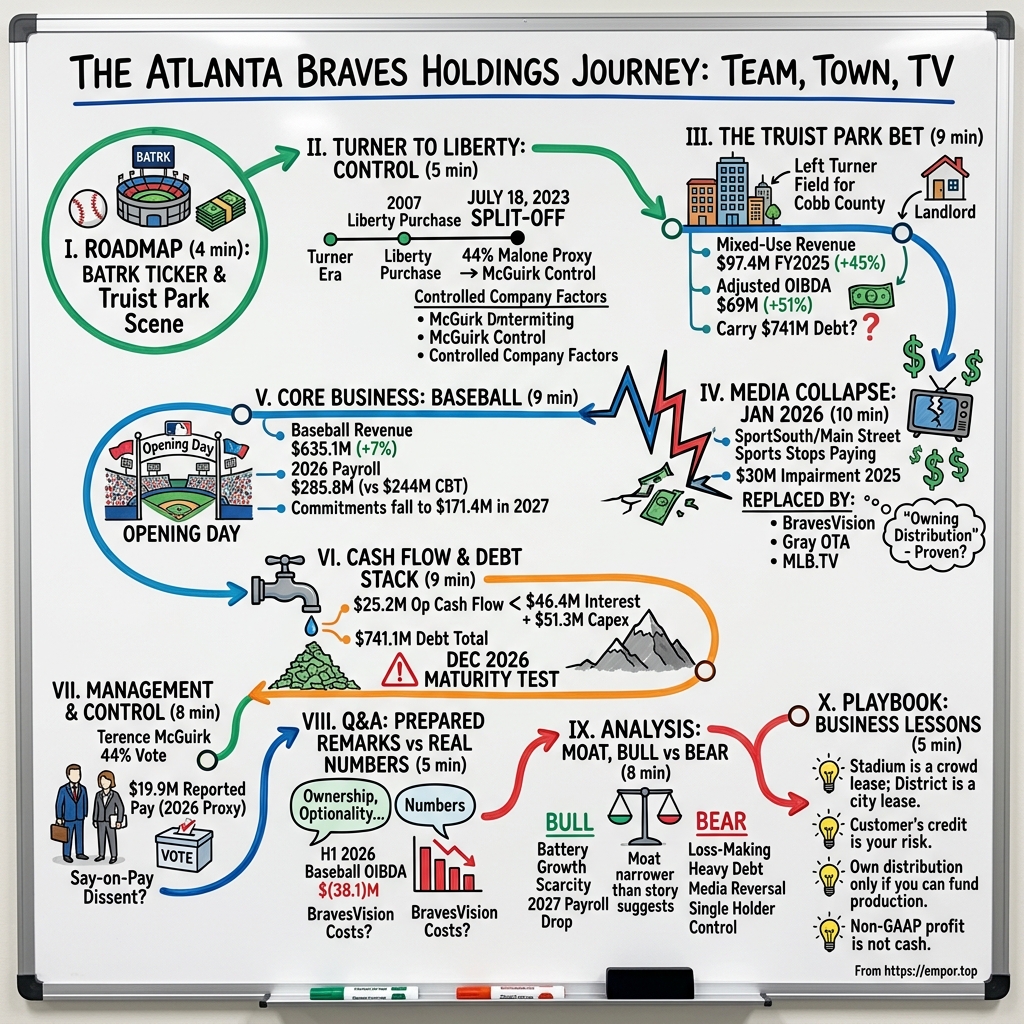
Atlanta Braves Holdings: The Team, the Town It Built, and the TV Deal That Died
I. Introduction & Episode Roadmap (4 min)
It is a warm evening in Cobb County, about two hours before first pitch. The gates at Truist Park are not open yet, but the plaza outside is already full. Families eat dinner on restaurant patios. Office workers walk out of a tower that overlooks the outfield. A line forms at a brewery taproom, and people in jerseys wander past apartment balconies and a hotel lobby. Once the game starts, the crowd moves inside to buy tickets, beer, premium seats and caps. After the last out, many of them walk back out to the same restaurants. The same company is paid at almost every stop.
That company is Atlanta Braves Holdings. It owns the Atlanta Braves, runs Truist Park and owns most of the mixed-use district around it, known as The Battery Atlanta1. It trades on NASDAQ under three tickers: BATRA, BATR.B and BATRK, the non-voting Series C shares that make up most of the float1. Sports media tends to describe the Braves as a storied National League franchise. The financial statements describe something else: a baseball team, a real estate developer and a borrower carrying about $741 million of debt, all in one stock2.
The business is substantial. Revenue reached $732.5 million in fiscal 20252. It has also never reported a net profit as a standalone public company24. Each year has 81 home dates of concessions, sponsorship and Battery foot traffic, but every year has ended in a net loss.
Then comes the moment that ties the story together. In January 2026 the Braves terminated their long-term local television contract with Main Street Sports Group, the company behind the SportSouth regional sports network, after it failed to make its payments16. For decades a cable partner had sent the club a large, dependable check, mostly without much thought from anyone. That arrangement has ended. The Braves are now their own broadcaster, through a team-owned platform called BravesVision, over-the-air partner stations and MLB.TV6.
This episode follows the money in order. It starts with how a team owned by Ted Turner, then Time Warner, then Liberty Media became a standalone public company with no corporate parent. It then covers the 2010s decision to leave downtown Atlanta and build a neighborhood around a ballpark, which turned a baseball club into a landlord. After that come the collapse of the local TV deal, the economics of a big-market club, the debt that funded all of this, and the person who controls the votes. The four questions above run through every section.
 Subscribe on LinkedIn
II. From Turner to Liberty: How Atlanta Got Its Team (5 min)
On July 18, 2023, a sports franchise stopped being a tracking stock and became its own company1. Liberty Media, John Malone's holding company, had carried the Braves inside a "Braves Group" tracking stock for years. That day it split the club off into a new Nevada corporation, Atlanta Braves Holdings, and handed shares directly to Liberty's Braves Group holders1. The club had no parent company after that, at least on paper.
The earlier history only matters for what it explains about control. Ted Turner bought the Braves in 1976 and used them as programming for his cable superstation, which made them "America's Team" on cable systems around the country. Through the Turner Broadcasting merger, the club passed to Time Warner, which sold it to Liberty Media in 2007 as part of a broader asset swap8. Liberty treated the team as a long-term holding, built the stadium district and in 2021 saw the club win the World Series. Then it decided the Braves would be better off on their own.
Why Liberty let go
Liberty's stated reasons were the usual ones for a split-off: simplify the structure, let investors value the team directly, and remove the discount that tracking stocks tend to carry. There was also a tax question underneath. A split-off is only valuable if it is tax-free, and the Internal Revenue Service confirmed that treatment in September 20241. That ruling took away the main contingent risk of the transaction.
The separation was gradual. Under a services agreement, Liberty kept providing executive and administrative support until October 31, 20251. The Braves bore a share of Liberty's chief executive compensation: 7% from the split-off through the end of 2023, and 8% from January through August 20241. On September 1, 2024, the Braves' own operating managers took over the officer roles from the departing Liberty personnel1. That was a planned handoff on the timetable Liberty had laid out, not a sign that something had gone wrong. The 10-K gives the allocation percentages for the services agreement but does not put dollar amounts on the related-party fees in its business overview, so investors know the formula but not the full bill.
Three classes of stock and one controlling voice
The share structure says the most about governance. At the end of 2025 there were about 10.3 million Series A shares with one vote each, about 0.98 million Series B shares with ten votes each, and about 51.8 million Series C shares with no vote2. Most of the economic value sits in the voteless Series C. Most of the voting power sits in the small Series B block.
Major League Baseball also requires every club to have a single named "Control Person" whom the league can hold responsible. For the Braves that person is Terence McGuirk1. On August 21, 2024, Malone gave McGuirk a voting agreement over his 887,079 Series B shares, along with a right of first refusal if those shares are sold. At the time, that represented about 44% of the company's total voting power1.
So the company describes itself as independent, but its votes are effectively controlled by one long-time Braves executive acting under a league rule. That fact runs through the governance section later. First, though, comes the decision that shaped the economics: whether to stay downtown or build somewhere new.
III. The Truist Park Bet: Building a Neighborhood Around the Ballpark (9 min)
In November 2013 the Braves surprised Atlanta by announcing they would leave Turner Field, the converted 1996 Olympic stadium downtown, for a new site in Cobb County, near the junction of I-75 and I-285. Critics objected to the public subsidy, the traffic and the loss of a downtown team. The club's argument was about money. The Braves were tenants at Turner Field, so they collected baseball revenue three hours a night and nothing during the rest of the year. In Cobb they could control the land around the stadium too.
The ballpark opened in 2017 as SunTrust Park and was renamed Truist Park after the banks merged. The more important asset was what went up around it: offices, apartments, a hotel, restaurants, a concert venue and retail. All of it was designed to keep earning money on the roughly 284 nights a year without a home game. The Battery Atlanta turned a baseball club into a mixed-use real estate developer1.
The lease that makes it possible
The stadium sits on a long lease. The Truist Park Stadium Operating Agreement runs to December 2046 and can be extended to 20511. The spring-training home, CoolToday Park in Florida, runs to 2049 with extensions to 20591. These terms matter because lenders will finance real estate next to a stadium only if the anchor tenant is committed for decades. The lease gives the Battery its financing base.
The momentum
The district is now the fastest-growing part of the company. Mixed-use revenue rose about 45% in fiscal 2025 to $97.4 million2, and segment Adjusted OIBDA rose about half, to roughly $69 million26. Tenants reported a record $137 million in sales6. Growth continued in 2026, with first-half mixed-use Adjusted OIBDA of $38.2 million against $30.5 million a year earlier3.
That headline needs an adjustment. Part of the fiscal 2025 jump came from purchasing real estate assets next to the Battery, the Pennant Park acquisition, and not only from existing tenants paying more2. Buying rent is a legitimate strategy, but it is different from growing rent. Underlying organic growth was meaningful but smaller than 45%. The company does not provide a like-for-like split, and its earnings release does not give the price of the acquisition, so it is not possible to test whether the Braves overpaid against comparable Atlanta office deals.
The build-out is winding down
Capital spending shows the shift. Capex was 10.8% of revenue in fiscal 2023, rose to about 13% in 2024 as stadium-area construction peaked, and fell to 7% in 2025, or $51.3 million24. First-half 2026 capex was only $15.9 million3. The construction phase looks mostly finished. The question now is whether the completed assets earn enough.
Who pays the rent
Mixed-use income comes from leases and parking. The company does not disclose tenant concentration, so investors cannot tell how much of the rent depends on a few anchor office users. That matters in a market where suburban office leases are being renegotiated.
Comparisons, used with care
There are few clean comparables. Sphere Entertainment shows what happens when a venue company builds a costly destination and has to grow into it. Manchester United shows a famous club whose stadium is an expense and whose debt sits on the team. The Battery is neither. It is an income-producing property portfolio next to a franchise, and it looks more like a small REIT tied to a ballpark than like a sports team.
The verdict
This is the strongest part of the business, but the district also carries most of the debt. About $487 million of the company's $741 million of borrowings sits at the mixed-use entities2. One of those loans matures in December 20261. The bull case says Battery income can carry its own debt. That stays unproven until mixed-use OIBDA is shown against mixed-use interest and the December maturity is refinanced on acceptable terms. Until then the Battery is a growing asset with a fixed refinancing date.
The district needs foot traffic, and foot traffic depends on the team. In January 2026 the team's main media income stream ended.
IV. The Day SportSouth Stopped Paying (10 min)
For most of baseball's cable era, local TV money was the easiest revenue a club had. A regional sports network paid a fixed, rising fee for every non-national game, the cable bundle charged subscribers whether or not they watched, and the team cashed the checks. The Braves had more history with that model than anyone, going back to Turner's superstation.
Then the bundle started to shrink.
How the pipe broke
Diamond Sports Group, owner of the Bally Sports regional networks and the largest operator in that business, filed for Chapter 11 in 2023 because it could no longer cover its rights fees as subscribers left cable. It emerged in January 2025 under a new name, Main Street Sports Group, and kept a small number of teams, including the Braves through the FanDuel SportSouth network16. The relationship did not last. Main Street failed to make contractual payments to the Braves, and in January 2026 the club terminated the long-term agreement16.
The cost appeared before the termination. The Braves recorded a $30 million non-cash impairment in fiscal 2025 tied to the deteriorating contract26. In effect the company wrote down the value of a promise that it no longer expected to be kept in full. The company does not publish the receivable balance owed by Main Street or its allowance against it, so the written-down amount is clear but the remaining exposure is not.
The replacement
In place of the cable partner, the Braves assembled their own setup: BravesVision, a team-owned production and distribution platform; over-the-air carriage through Gray Media stations; and in-market streaming through MLB.TV6. Management described the change as an opportunity, a chance to "own distribution," reach fans who had dropped cable, and keep the sponsorship and advertising inventory a network partner used to control6.
The 10-K describes the downside more plainly than the earnings calls did. It warns that the new arrangements "may generate less revenue than the prior arrangement"1. That is the company's own risk disclosure, and it limits how far the "ownership" framing can be taken. Owning the distribution means owning the production budget and the advertising sales risk too.
What the first numbers showed
Through the winter, management declined to give operating or capital spending figures for BravesVision and said more detail would come with second-quarter 2026 results6. Those results arrived on August 5, 20263. Baseball media revenue was $72.9 million in the quarter, down about 10% from a year earlier3. Baseball segment Adjusted OIBDA fell from a $12.4 million profit in the first half of 2025 to a $38.1 million loss in the first half of 20263.
Not all of that decline comes from media. Payroll and other costs rose too, as the next section explains. Still, the direction is the reverse of the "owning distribution" pitch. Revenue fell, costs rose, and one half-year of results is the only real evidence available.
The stable counterweight
The national side has held up. MLB negotiates national rights centrally for all 30 clubs, with partners including ESPN, TBS, Fox, NBCUniversal, Apple and Roku, and shares the proceeds1[^9]. Those contracts are diversified and backed by large media companies. They are a floor, not a growth driver the Braves control.
The disruption question
AI is a minor risk here. The real disruption is the one that already happened: cord-cutting broke the regional sports network model, and streaming rights are still being repriced. Management noted that streaming helped broadcasting revenue grow in fiscal 20256. The open question is whether a direct-to-fan model can bring in a regional network's guaranteed fee without the bundle's forced subscribers. No club has yet shown that it can.
The verdict
The credit risk has already played out. It cost a $30 million impairment and a valuable contract. BravesVision remains unproven, and the only half-year of data points the wrong way. A full year of BravesVision revenue and cost, set against the fiscal 2025 media line, will settle the question. Until then, "owning distribution" is management's claim and not established fact.
Media is only one revenue line, though. To see whether the problem is temporary or structural, the whole economics of the baseball club need examining.
V. The Core Business: How a Baseball Club Makes Money (9 min)
Opening Day at Truist Park is the club's best marketing: a sellout, flyovers, new jerseys and a long season ahead. That same night, the payroll is the club's largest financial commitment. A baseball franchise earns most of its revenue during six months of games and pays a roster that is contracted for years.
The revenue machine
Baseball revenue reached $635.1 million in fiscal 2025, up about 7%2. It comes from several sources. Baseball event revenue covers tickets, concessions, parking and premium seating. Media covers local and national rights. Sponsorship includes the stadium name, signage and partner deals. Retail and licensing covers jerseys and caps. "Other" includes special events.
The second quarter of 2026 shows how those lines can move apart3. Event revenue fell about 11% to $161.0 million, which suggests either weaker attendance or schedule timing. Retail and licensing rose about 18% to $21.8 million. "Other" nearly tripled to $20.7 million, helped by special events at the stadium. Total company revenue was $305.1 million, down about 2%3. Merchandise and events can partly offset a weaker gate, but they cannot replace it.
Reading the seasons
Seasonality is the first rule for reading this company. Nearly all 81 home games fall in the second and third quarters, so those quarters carry the year, while the first and fourth quarters show costs with little revenue against them. Comparing a second quarter to a first quarter tells you nothing. The useful comparisons are year over year for the same quarter, and above all the full-year result.
The league structure
The Braves operate inside a regulated system. Thirty clubs share national media revenue. A revenue-sharing system moves money from high-revenue clubs to low-revenue clubs. The Competitive Balance Tax, in effect a luxury tax, charges clubs whose payroll exceeds a threshold, which is $244 million for 20265. A club in Atlanta, one of the largest TV markets in the US with a regional fan base across the Southeast, probably pays into revenue sharing rather than receiving from it. The company does not break out its net revenue-sharing position or rank its revenue against the largest-market clubs, so any comparison to the Dodgers or Yankees would be guesswork.
The payroll problem
The roster costs the most. Player and staff commitments total $285.8 million for 20265, well above the $244 million tax threshold, though committed salary and the tax-calculation payroll are measured differently. That figure falls to $171.4 million in 20275. The commitments are heavily front-loaded: 2026 is a peak spending year, with contracts expiring or stepping down after it.
That is what makes fiscal 2025 look exceptional. Baseball Adjusted OIBDA nearly tripled, from $39.7 million to $107.8 million at the company level2, helped by higher revenue and a lower cost base. Then 2026 went in reverse, with management citing higher player salaries, revenue sharing, special-event costs and BravesVision production3. Fiscal 2025 now looks like a high point, not a new baseline.
October cannot be budgeted
Playoff revenue is real but unpredictable. Postseason revenue after league sharing was $11.3 million in 2023 and only $2.0 million in 20241. Management has talked about the upside of a deep October run6, but nobody can plan around one. A team that expects October income is betting on short-series baseball, which is close to a coin flip.
Progress, briefly
Operating losses did narrow steadily before 2026: from $46.4 million in fiscal 2023 to $39.7 million in 2024 and $13.5 million in 202524. Then the first half of 2026 brought a $59.8 million operating loss, against $2.7 million a year earlier3.
The verdict
Revenue is growing, but 2026 costs are growing faster, partly because of roster decisions the club made and partly because of the media change it did not choose. Whether the cost base outgrows revenue over time depends on whether the 2027 payroll reduction is kept or spent on new contracts. Fans will want those contracts. Shareholders will want the savings. The brand and fan base are real advantages, but direct evidence of pricing power is thin, a point Section IX takes up.
Operating losses become more serious once interest is added, so the next step is to follow the cash.
VI. Where the Cash Goes: Interest, Capex and the Debt Stack (9 min)
The 2025 cash flow statement tells the story in three numbers. Operating cash flow was $25.2 million2. Interest expense was $46.4 million2. Capital spending was $51.3 million2. The business generated about $25 million, owed nearly twice that to lenders, and spent twice that again on construction.
From losses to cash
Start with the reported numbers. Net losses were $125.3 million in fiscal 2023, $31.3 million in 2024 and $23.3 million in 202524. Operating cash flow was positive in each year and rose from $1.6 million to $25.2 million24. The gap comes from non-cash charges. In 2025, depreciation and amortization was $75.6 million and stock compensation $15.6 million2, and the $30 million media impairment was also non-cash.
That means the losses overstate the cash drain somewhat, but not enough to change the conclusion. Subtract capex from operating cash flow and free cash flow was about negative $25 million in 202526. Stock compensation is a non-cash expense, but its cost shows up later in dilution, discussed in the next section.
The debt stack
Total debt rose from $620.1 million at the end of 2024 to $741.1 million at the end of 2025, then to $795.1 million by mid-202623. It is made up of several tranches, best understood by who owes the money and what backs it:
- The Battery mixed-use loans, about $487 million, secured by the district's real estate23. This is the largest piece.
- Term debt, about $152 million at year-end 2025, falling to $148.5 million by June23.
- The TeamCo revolver, the club's credit line, drawn from $35 million to $45 million over the first half of 202623.
- MLB facility fund borrowings, about $66 million across a term loan and revolver, funded through the league2.
- A league-wide credit facility, which first appears at $50 million by mid-20263.
The trend is clear. The Battery loans are flat while club-level borrowing grows through revolvers and league facilities. Interest expense rose from $38.8 million to $46.4 million in 2025 and was $22.8 million in the first half of 202623.
Leverage, with care
A simple ratio: $741 million of debt divided by fiscal 2025 company Adjusted OIBDA of $107.8 million is about 6.9 times2. That uses the company's own non-GAAP earnings measure at its best recent level. On first-half 2026 results, when Adjusted OIBDA was negative $5.8 million3, trailing leverage is far higher. The 6.9 times figure is the most favorable version, not the typical one.
The league's own covenant
There is no public credit rating, but MLB enforces a substitute. Under the Debt Service Rule, a club's debt net of permitted exclusions must stay at or below 8.0 times "available cash flow" (12.0 times for clubs with new stadiums), and $100 million is excludable in 2025 and 20261. For the assessment period ending December 31, 2024, the Braves faced no remedial measures1. The company does not publish its fiscal 2025 compliance result. The rule matters because a club that breaches it can be forced by the league to cut debt or spending, a real constraint on how much more the club can borrow.
Cash on hand
Cash was $99.9 million at the end of 2025, down from $125.1 million two years earlier2. By mid-2026, cash was $116.3 million and restricted cash had risen sharply to $62.7 million3. Cash held at lenders' direction or in reserve accounts cannot be used for payroll.
Testing "a sound balance sheet"
The strongest disconfirming evidence for balance-sheet strength would be a covenant breach, a forced equity raise or a distressed refinancing. Since the 2023 split-off, the company's public reports show none of those. It is still a young public borrower. It has not had to sell new stock, but debt has risen in each period reported, much of it through revolving facilities, and a mixed-use loan matures in December 20261. The verdict is that the balance sheet has been managed carefully but has not yet been tested by a refinancing under stress, and the cash flow does not cover capex and debt service without new borrowing. The December refinancing is the next real test.
Who decides how that test is handled? The answer is concentrated in one office.
VII. Management, Pay and Control (8 min)
On August 21, 2024, John Malone, the dealmaker who built Liberty Media, gave his Series B votes to the man who had run the Braves for decades1. It was a quiet transfer of power.
The man in the chair
Terence McGuirk is Chairman, President and Chief Executive Officer1. He is a Turner Broadcasting veteran who joined the company in the 1970s, rose to run Turner Broadcasting, and has been the Braves' senior executive through the Time Warner and Liberty eras. He is an operator more than a financier. He oversaw the move to Cobb and the Battery, and he is the club's face to MLB. His career has spanned the model that is now breaking, the cable-funded team that Turner built.
Alongside him, the business operation sits with EVP Business Greg Schiller, whose contract runs to December 31, 2027 with automatic extension6. The bench is long-tenured and experienced in Braves operations, which is valuable for running the stadium and harder to judge for running a media company.
Pay
McGuirk's adjusted base salary is $1.2 million, effective June 27, 2025, with a $2.0 million cash bonus opportunity and a $6.8 million long-term award6. Even before any one-off grants, that is a large package for a company that has never reported a net profit, and management has noted Section 162(m) limits on the tax deductibility of pay above $1 million6. The full summary compensation table and the say-on-pay result appear in the April 2, 2026 proxy and the meeting's voting-results filing7. The level of support from outside holders is the clearest signal of whether non-controlling shareholders accept the package.
Promises against outcomes
Management's record looks different depending on the area. On the Battery, it said it would build a district and it did, and the segment's income has grown. On media, the company stayed with a cable partner coming out of bankruptcy, took a $30 million write-down, and then presented the loss as a strategic opportunity6. The fiscal 2025 call stressed control of distribution and deferred cost details6. The second-quarter 2026 release then showed a baseball loss3. The story did not shift openly, but its emphasis moved from optimism to explaining results after the fact.
Capital allocation
The record is simple. Most of the company's capital went into the stadium district, the Pennant Park purchase extended it, and there have been no buybacks or dividends2. No share pledges by insiders appear in the company's disclosures. Dilution is steady: Series C shares rose by about 1.1 million in the first six months of 202623, consistent with roughly $13.4 million of stock compensation in that period3. That is about 2% a year that outside holders absorb.
The offset
There is a defensible reason for concentrated control: MLB requires a single accountable Control Person, and the Malone agreement provides one1. The 10-K filings since 2024 show no related-party fee disputes. The verdict on governance is "intact but unproven." Control is concentrated, and pay is high relative to profits. Whether outside holders have a real voice depends on vote results that the next proxy cycle will show.
Governance is about what management can do. The earnings calls show how management talks about what it has done.
VIII. The Calls That Matter: Prepared Remarks vs. Q&A (5 min)
On the fourth-quarter fiscal 2025 call in late February 2026, analysts kept asking some version of one question: what will BravesVision cost? Management kept giving the same answer: more detail later6.
The split-off-era story
The early narrative after the split-off, in the fiscal 2024 results, was steady improvement: losses narrowing, the Battery leasing up and Adjusted OIBDA edging higher4. The calls and releases focused on operating discipline and the district's growth. Media was described as stable.
February 2026: ownership and optionality
By the fiscal 2025 call, the tone had shifted to opportunity. The prepared remarks presented the end of the SportSouth deal as a chance to own the fan relationship, sell more inventory directly and reach cord-cutters through streaming6. Management pointed to streaming-driven broadcasting growth and a record year at the Battery6. In Q&A, analysts asked how much BravesVision would cost to run and to build. Management declined to give opex or capex figures and pointed to the second quarter6. Answers on the Battery were specific. Answers on the media rebuild were not.
August 2026: the numbers arrive
The second-quarter 2026 results gave the first real view. Baseball Adjusted OIBDA was negative $5.7 million for the quarter, against a $52.0 million profit a year earlier3. For the company as a whole, first-half Adjusted OIBDA was negative $5.8 million, against $37.2 million a year earlier3. Management attributed the decline to higher player costs, revenue sharing, special events and BravesVision production3.
What changed
The narrative did not reverse outright. The emphasis moved from optionality to cost explanations. The pattern across the three periods is consistent: management is concrete on real estate and deferring on media. That does not mean the media plan will fail. It means investors were asked to accept the plan before seeing its costs, and the first costs were higher than the earlier optimism suggested.
With that context, the moat question can be weighed directly.
IX. Analysis: Moat, Bull vs. Bear (8 min)
A fan buys a ticket at Truist Park, then a coffee across the plaza on the way in. The ticket revenue goes to the team. The coffee shop pays rent to the Battery. The same owner collects on both, and that combination is the core of the investment case.
The price
At June 30, 2025, outside holders' shares had an aggregate market value of about $2.5 billion1. On top of that equity sits about $741 million of debt2, against $107.8 million of fiscal 2025 Adjusted OIBDA2. At those values, the market is paying far more than the trailing earnings would justify. Investors are pricing the franchise's scarcity and the real estate, not current profit. Reference points include Madison Square Garden Sports, Manchester United, Liberty's Formula One business and Sphere, each of which also trades on asset value more than earnings.
Porter's Five Forces
- Supplier power: high. Players are the scarcest input, and the union contract and free agency let them capture a large share of revenue. MLB itself controls the schedule, the national rights and the rules. The 2026 commitments show where the money goes.
- Buyer power: high in media, low with fans. The SportSouth failure showed what happens when the biggest local buyer weakens. Individual fans have little bargaining power, but they have plenty of other things to spend on.
- Substitutes: meaningful. Other sports, concerts, streaming and gaming all compete for an evening and a household budget.
- Threat of new entrants: very low. MLB caps the league at 30 clubs and protects territories.
- Rivalry: on the field, not in the market. Clubs compete for wins and players, while sharing revenue as a business.
Hamilton Helmer's 7 Powers
Two of the powers are supported by evidence. Cornered resource / scarcity: the Braves have exclusive MLB rights in a large Southeastern territory, and franchises are rarely sold. Branding: a century-old club with a regional following and a recent championship. Counter-positioning, through owning distribution while rivals depend on failing networks, is the third claimed power, and it is untested. The second-quarter 2026 results argue against it so far. Switching costs, network effects, scale economies and process power do not meaningfully apply.
The record also narrows the moat claim. Two of the biggest economic levers, media prices and player costs, sit partly outside management's control. The company could not stop its media partner from failing. It cannot stop the player market from inflating. The moat protects the franchise's existence and its value, but less of its profit than the brand suggests.
Bull case
The Battery keeps growing and refinances cleanly. Franchise values keep rising, as they have for decades. Payroll falls in 2027, freeing tens of millions of dollars. BravesVision turns out to make money once production costs settle. A deep postseason run adds income on top.
Bear case
The company keeps losing money. Debt keeps rising and the December 2026 maturity is refinanced at higher rates. Local media income never returns to the cable-era level. The 2027 payroll savings get spent on new contracts. And outside holders have little power to change any of it.
The skeptic's stress test
A skeptical long-term investor or activist would ask for two things. First, a valuation of the Battery on its own, with its own debt and interest, so the market can see what the real estate is worth apart from the team. Second, a clear BravesVision breakeven target and timeline. Both would answer the main questions. Neither is published today.
The KPIs that matter
Two numbers matter most. Baseball Adjusted OIBDA is the cleanest read on team economics; it was a $38.1 million loss in the first half of 2026, down from a $12.4 million profit3. Mixed-use Adjusted OIBDA less mixed-use interest shows whether the Battery carries its own debt; Battery OIBDA is rising, at $38.2 million in the first half3, but the company does not disclose segment-level interest.
Risk radar
The material risks, in order: refinancing and cost of capital; media economics; payroll and luxury tax; on-field results; and execution of BravesVision. Cybersecurity and currency exposure are minor for a US-dollar sports and property business.
X. Playbook: Business & Investing Lessons (5 min)
"A stadium is a lease on a crowd; a district is a lease on a city." Turner Field gave the Braves three hours of revenue on 81 nights. The Battery collects rent on the rest of the year. The move to Cobb showed that a team's most valuable asset might be the land beside the field. The catch, for founders and investors, is that a district behaves like a city: it needs constant capital and it borrows like a landlord.
"Your biggest customer's credit is your risk, however long the contract." The SportSouth deal was long-term and contractually guaranteed until its counterparty stopped paying. A guaranteed contract is only as strong as the balance sheet behind it. The Braves had watched Diamond go through bankruptcy and stayed with its successor, and the cost was a $30 million write-down and a scramble to rebuild.
"Own the distribution only if you can fund the production." "Owning the fan relationship" sounds like strategy. In practice it means paying for cameras, crews, ad sales and streaming infrastructure while losing a guaranteed fee. BravesVision may still work, but control of distribution is a cost before it is an advantage.
"Control without ownership is a promise." A voting agreement gives one executive about 44% of the votes, and a league rule requires one person to be accountable. That is workable only as long as the person in control acts for the shareholders who own most of the economics. The say-on-pay vote is the only formal way outside holders can express a view on whether that promise is being kept.
"Non-GAAP profit is not cash." The Braves reported $107.8 million of Adjusted OIBDA in their best recent year and still burned about $25 million in free cash flow. Adjusted OIBDA excludes interest, capex and stock compensation, which are the costs of owning a stadium district and paying people in shares. Investors should read the cash flow statement before the earnings release.
XI. Epilogue (3 min)
As of early October 2026, the regular season is over and the full-year accounting is still ahead. The decisions of the past three years are close to being tested.
The first test comes in late February 2027 with full-year 2026 results. That will be the first complete year of BravesVision. If baseball Adjusted OIBDA recovers in the second half and management finally discloses what the platform earns and costs, the "owning distribution" claim gains its first real support. If the full year resembles the first half, the 10-K's warning that the new setup "may generate less revenue" will have proved accurate, and the first central question will have its answer.
The second test arrives sooner. A Battery mixed-use loan matures in December 20261. A clean refinancing at a manageable rate would show that the district can carry its own debt and would strengthen the case that the Battery is a standalone asset. An expensive or partial refinancing, or one that needs support from the club, would show the reverse: that the most valuable part of the company depends on the weakest.
The third test is the payroll. The 2026 commitments were far above the $244 million tax threshold5, and committed salary falls to $171.4 million in 20275. Over the winter, the club will decide whether to keep that saving or spend it. Keeping it would cut costs sharply. Spending it would mean betting again on winning on the field.
The fourth test comes with the next proxy in spring 2027, when the say-on-pay vote shows how many outside holders back the controlling executive's pay.
The underlying tension remains. A growing real estate asset is carrying a baseball team whose media economics are being rebuilt from scratch, and both depend on a lender's decision in December.
XII. Outro (2 min)
Back on the Battery plaza, two hours before a game, very little has changed in the scene. Families eat on the patios, the office tower lights up, and the taproom line wraps around the corner. The televisions above the bar now show BravesVision instead of a cable network, and few people in the crowd notice the difference.
The company notices it, and so do investors. Atlanta Braves Holdings owns the team, the street outside the team's stadium, and now the broadcast too, and it pays interest on all three.
References
-
Atlanta Braves Holdings, Inc. Form 10-K FY2025 — SEC, 2026-02-26 ↩↩↩↩↩↩↩↩↩↩↩↩↩↩↩↩↩↩↩↩↩↩↩↩↩↩↩↩
-
Q4 and FY2025 results press release (8-K Ex. 99.1) — SEC, 2026-02-25 ↩↩↩↩↩↩↩↩↩↩↩↩↩↩↩↩↩↩↩↩↩↩↩↩↩↩↩↩↩↩↩↩
-
Q2 2026 results press release (8-K Ex. 99.1) — SEC, 2026-08-05 ↩↩↩↩↩↩↩↩↩↩↩↩↩↩↩↩↩↩↩↩↩↩↩↩↩
-
Q4 and FY2024 results press release (8-K Ex. 99) — SEC, 2025-02-26 ↩↩↩↩↩↩
-
Q4 2025 earnings call summary — Equibles ↩↩↩↩↩↩↩↩↩↩↩↩↩↩↩↩↩↩↩↩↩↩
-
All SEC filings, including 10-Ks, 8-Ks, DEF 14A and voting-result 8-Ks (CIK 1958140) — SEC ↩
-
Liberty Media investor relations, 2023 split-off materials — Liberty Media ↩
 LinkedIn
 WhatsApp
 Reddit
 Hacker News
 Email
Email Kindle
 RSS Feed
 Spotify
 Apple Podcasts
 Amazon Music
 Audible
 YouTube