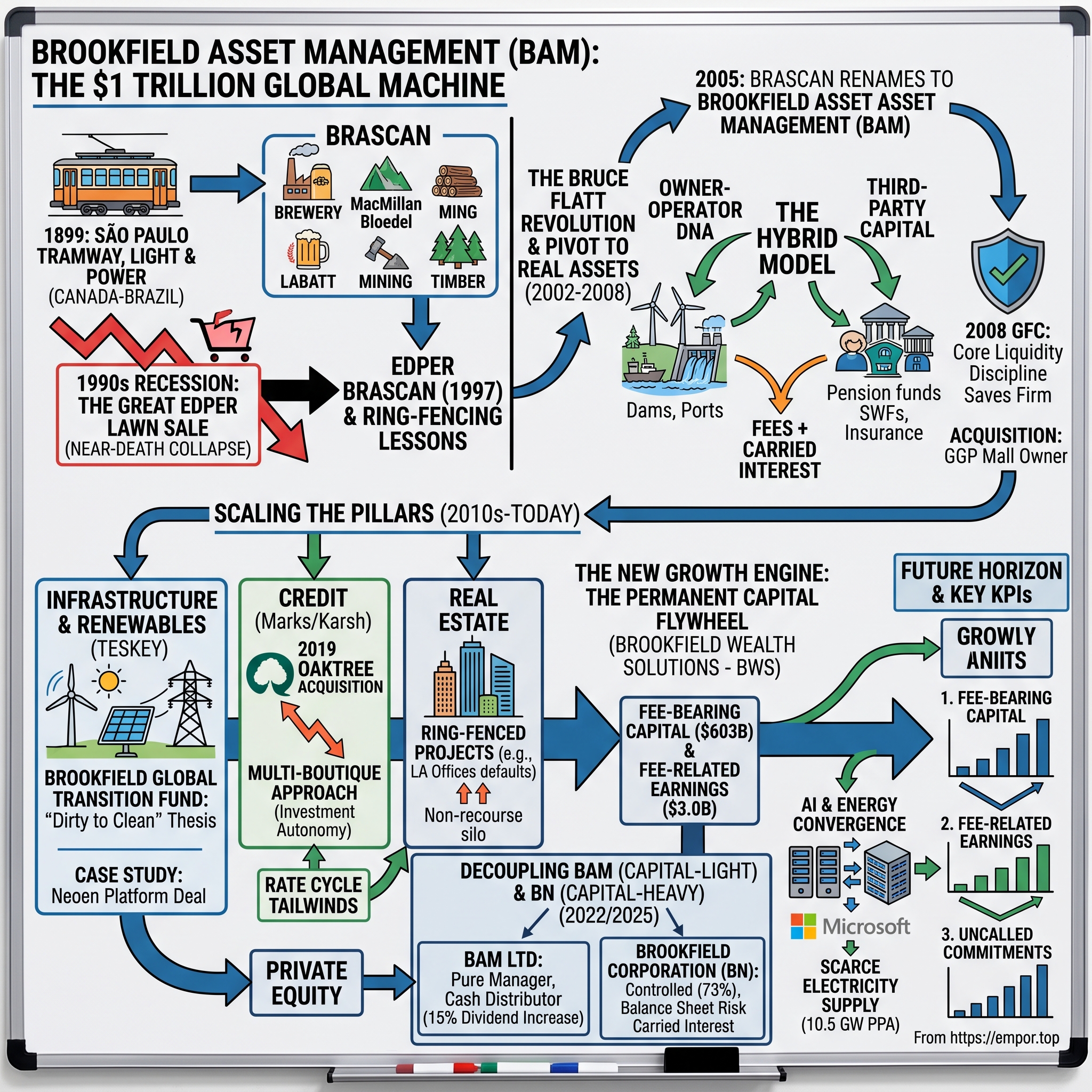
Brookfield Asset Management: The $1 Trillion Global Machine
I. Introduction & Episode Roadmap
On the morning of February 4, 2026, a press release went out from a company headquartered at 225 Liberty Street in Lower Manhattan that contained, buried among the usual quarterly metrics, one of the more consequential sentences in the recent history of global finance. Brookfield Asset Management Ltd. had appointed Connor Teskey as chief executive officer, effective the previous day.1 Teskey was 38 years old.2 The man he was succeeding, Bruce Flatt, had run the Brookfield group since 2002 and had been at the firm since 1990.3
The numbers surrounding that sentence were not modest. For the full year 2025, Brookfield Asset Management reported fee-related earnings of $3.0 billion, up 22%, and distributable earnings of $2.7 billion.1 Fee-bearing capital — the pool of client money on which the firm actually charges fees — reached $603 billion, a 12% increase driven by $112 billion raised over twelve months, including a record $35 billion in the fourth quarter alone.1 Total assets under management crossed $1 trillion.4 The board raised the quarterly dividend 15% to $0.5025 per share.1
Those are the headline facts. What makes Brookfield worth an extended examination is not the size but the architecture — and the questions that architecture raises.
The big transition. Flatt did not leave. He remained chair of BAM's board and chief executive of Brookfield Corporation, the parent company that still controls roughly 73% of BAM.5 On the Q4 2025 earnings call, Flatt framed the handover with characteristic flatness: "Connor has taken on running virtually everything, so this title change merely matches title to substance."6 That is either an honest description of a four-year, carefully engineered succession, or a very tidy way of saying that the founder-figure has not actually let go. Both readings are available on the evidence.
The great corporate unification. Modern BAM exists because of two separate acts of corporate surgery. The first, effective December 9, 2022, spun 25% of Brookfield's asset management business out of the parent, distributing one share of the new manager for every four shares of the old company; the two entities began trading on the NYSE as BN and BAM on December 12, 2022.78 The second, completed February 4, 2025, folded the remaining 73% of the operating business into BAM itself, in exchange for 1,194,021,145 newly issued Class A shares on a one-for-one basis.5 The stated purpose was blunt and commercial: index eligibility. Based on the February 3, 2025 closing price of $58.19, BAM's market capitalization was $95.3 billion — large enough to matter to any index committee paying attention.5
The themes. Four run through everything that follows.
The owner-operator DNA. Brookfield is not, in its own telling, a Wall Street firm that buys assets. It is an operator that happens to manage money. Whether that distinction survives contact with a $603 billion fee base is one of the live questions of this story.
The permanent capital flywheel. In 2025, Brookfield Wealth Solutions — the group's insurance arm — handed BAM $25.2 billion of capital to manage.4 Insurance float is replacing the traditional ten-year pension commitment as the industry's most contested resource, and BAM's access to it is structurally different from a competitor's.
Clinical capital discipline. In February 2023, Brookfield affiliates defaulted on $784 million of loans secured against two prime downtown Los Angeles office towers, and declined to extend.9 The debt was non-recourse. Nothing touched the manager. That is either exemplary risk architecture or a reputational cost being quietly deferred.
The complex web. In January 2025, Veritas Investment Research published a report titled "Brookfield: Sifting Through Complexities," carrying SELL ratings on both BN and BAM, and arguing among other things that BAM's recent growth "stems largely from related-party transactions and goalpost shifts."10 That charge deserves to be taken seriously rather than waved away, and it is examined at length later.
The story begins, improbably, with streetcars in São Paulo.
 Subscribe on LinkedIn
II. From Brazilian Tramways to Canadian Conglomerate: The Wild Century (1899–1990s)
In 1899, two men — the Canadian railway financier William Mackenzie and the American electrical engineer Frederick Stark Pearson — incorporated a company in Toronto to electrify a city neither of them lived in. The São Paulo Tramway, Light and Power Company began operating São Paulo's first electric tram line in 1900. Brazilians did not bother with the full corporate name. They called it, simply, Light.11
It is worth pausing on what this business actually was, because the shape of it echoes for the next 127 years. Light did not buy financial claims on Brazilian infrastructure. Light built Brazilian infrastructure: hydroelectric dams on the Tietê and Paraíba rivers, transmission lines, urban distribution grids, the streetcars themselves. It employed Brazilian engineers, negotiated with Brazilian municipalities, and absorbed Brazilian political risk for decades. In 1912 the holding company Brazilian Traction, Light and Power was incorporated in Toronto to sit above the operating businesses, and at its late-1940s peak the group employed roughly half a million people in Brazil and ranked as Canada's second-largest corporation.11
That is the origin of what Brookfield now markets as its owner-operator DNA. It is a genuinely unusual heritage for a firm that today competes with Blackstone and Apollo. Most large alternative managers trace their lineage to investment banking — deal desks that learned to raise funds. Brookfield's lineage runs through turbines and substations and municipal concession negotiations in a foreign language. Whether an institutional memory formed in 1920s Brazil confers any real advantage in 2026 is debatable, but the cultural claim is at least grounded in something that actually happened.
The Brazilian chapter ended the way foreign utility ownership in emerging markets usually ends. Political pressure mounted through the 1960s and 1970s; the company sold its Brazilian telephone operations and, in 1969, renamed itself Brascan Limited — a portmanteau of Brazil and Canada, a name that announced a heritage even as the company was exiting it.12 The final act came in 1979, when Brascan sold its controlling stake in Light S.A. to the Brazilian state utility Eletrobras for US$380 million, leaving a Toronto-listed company with a pile of cash and no obvious purpose.11
Cash-rich and directionless is a condition that attracts attention. It attracted Edper Investments, the Montreal vehicle of Peter and Edward Bronfman — nephews of Samuel Bronfman of Seagram, and men who had spent a career slightly outside the main line of the family fortune. Edper took control of Brascan in 1979.13
What followed was one of the great conglomerate build-outs in Canadian corporate history, and one of the great near-death experiences. Under Edper, Brascan sprawled. It accumulated real estate, mining, timberland, financial services, and consumer businesses — by the late 1980s it held a 41% stake in the brewer John Labatt Ltd.14 By 1989 the broader Edper group encompassed more than 150 companies and roughly $120 billion of assets, held together by a lattice of cross-shareholdings, layered holding companies, and preferred share structures so intricate that Bay Street analysts openly complained they could not follow the money.13
Then the early-1990s recession arrived, and commodity prices and commercial property values fell at the same time. The structure that had amplified returns on the way up did precisely what leverage does on the way down. The group was forced into a fire sale — in February 1993 it disposed of MacMillan Bloedel and Labatt for combined proceeds of roughly $1.96 billion, a retreat the Canadian press christened "the great Edper lawn sale."13 In 1997 the surviving pieces were amalgamated into EdperBrascan Corporation.12
The near-collapse is the single most important event in Brookfield's pre-modern history, and it is worth being precise about why. The lesson the survivors drew was not "avoid leverage." Brookfield today uses enormous amounts of debt. The lesson was about where the leverage sits. An empire held together by cross-guarantees and parent-level obligations transmits distress upward; one asset's failure becomes every asset's failure. An empire built from ring-fenced, single-purpose, non-recourse silos does not. Every structural decision Brookfield has made since — the non-recourse project debt, the listed affiliates, the separation of manager from balance sheet — is legible as a response to what happened to Edper-Brascan between 1990 and 1993.
The man who would encode that lesson into a business model joined Brascan's investment division in 1990, arriving just in time to watch the empire nearly die.3
III. The Bruce Flatt Revolution & The Pivot to Alternatives (2002–2008)
Bruce Flatt is not a natural protagonist. He was born in Winnipeg, Manitoba on June 10, 1965, took a commerce degree at the University of Manitoba, and trained as a chartered accountant at Clarkson Gordon — a background about as far from the Greenwich hedge-fund archetype as it is possible to get while still ending up running a trillion dollars.3 He joined Brascan in 1990, cut his teeth on the 1993 acquisition of Olympia & York's office assets out of that firm's spectacular bankruptcy, became chief executive of Brookfield Properties in April 2000, and took the top job at the parent in February 2002.15 He was 36 at the appointment, turning 37 that June.15
The press eventually settled on "Canada's Warren Buffett," a nickname that captures the long-duration value orientation and the personal ownership stake — Flatt and a partner group have long held roughly 20% of Brookfield, individually and through the Partners Limited vehicle — while somewhat overstating the folksiness.1617 Flatt gives few interviews, writes shareholder letters that are dry to the point of austerity, and has spent decades constructing an organization designed to outlive his tenure at it. His BAM salary in 2025 was $375,000, with no cash bonus; essentially all of his compensation came in the form of escrowed shares that vest over five years.18 Whatever else is true, he is not paid to care about next quarter.
The core thesis. Flatt's diagnosis of the Edper wreckage was that the conglomerate had owned the wrong kind of cyclicality. Brewing and forest products and mining swing with the economy and have no structural defense. What Flatt wanted instead was real assets: long-life, capital-intensive, physically irreplaceable things with high barriers to entry and cash flows contracted or regulated in a way that tracked inflation. Toll roads. Transmission lines. Hydroelectric dams. Ports. Class-A office towers in supply-constrained downtowns. Assets that were boring in the specific way that pension funds find beautiful.
Through the early 2000s the cyclical businesses were sold and the real-asset businesses were bought. Then, on September 15, 2005, Brascan announced that it would rename itself Brookfield Asset Management Inc., describing the move as "another step in the company's evolution to a specialist asset manager" focused on "property, power and infrastructure investments."19 Shareholders approved on November 10, 2005; trading under the new name began that month.20 Assets under management at the time were roughly $40 billion.20
The hybrid model. The genuinely original insight came next, and it is the commercial engine of everything since. Flatt observed that the world's sovereign wealth funds, pension plans, and insurance companies desperately wanted exposure to real assets — inflation-linked, long-duration, matched against their own long-duration liabilities — and had essentially no capability to run a wind farm or a container terminal. They could buy a bond. They could not dispatch a maintenance crew to a hydro station in Ontario in February.
So Brookfield offered to do it for them. It raised private funds, took management fees and carried interest, and — critically — committed large amounts of its own balance-sheet capital alongside the clients. The alignment argument was straightforward: Brookfield ate its own cooking. The commercial argument was better still. Brookfield could now buy assets far larger than its own balance sheet allowed, earn fees on the client portion, and keep the operating platform it had been building since São Paulo as the thing clients were actually paying for.
The GFC crucible. In 2008, that structure met its first real test, and the test was passed in a way that established the firm's institutional reputation for a generation. The 2008 annual report, filed March 31, 2009, disclosed core liquidity of approximately $3.5 billion — up from $2.8 billion at the start of the year — with over $3 billion in cash, equivalents and undrawn committed lines, no corporate debt maturity before a $200 million bond in late 2010, and $8.0 billion of new or extended financings raised during the worst credit year in living memory.21 Management's framing was almost cheerful: "the illiquidity of the markets is presenting us with investment opportunities."21
The signature deployment came shortly after, when Brookfield led a $2.625 billion equity proposal for General Growth Properties, the bankrupt second-largest mall owner in America — a bid that, combined with commitments from Fairholme and Pershing Square, exceeded $6.5 billion.22
The analytical point is not that Brookfield was clever. Plenty of firms were clever in 2009. The point is that liquidity discipline before the crisis is what created the option to be clever during it, and that discipline is directly traceable to 1993. Brookfield had already lived through the version where you are the forced seller. Firms that have been the forced seller organize themselves, permanently, to never be it again.
That reputation — the buyer who shows up when nobody else can — became the foundation for the fundraising machine that would take the firm from $40 billion to over a trillion.
IV. Scaling the Pillars: Infrastructure, Energy Transition & Private Credit (2010s–Today)
To understand what Brookfield became in the 2010s, it helps to place it against the competitive set, because the four large alternative managers arrived at scale by genuinely different routes.
Blackstone built the broadest franchise, with real estate and private equity at the core and a formidable capability at converting institutional strategies into perpetual-capital retail products. Apollo went credit-first and then insurance-first, using Athene to convert annuity liabilities into a permanent balance sheet for its origination machine. KKR built classic operational buyouts and diversified outward from there. Brookfield's differentiation is that its asset base is disproportionately physical and operated — the firm employs tens of thousands of people who run power plants, ports, pipelines, and towers rather than sitting on boards of companies that do.
That distinction shows up cleanly in the year-end 2025 fee-bearing capital split. Infrastructure held $106 billion, renewable power and transition $67 billion, private equity $48 billion, real estate $102 billion, and credit $279 billion.4 Total assets under management by strategy: infrastructure $247 billion, renewables $143 billion, private equity $155 billion, real estate over $273 billion, and credit $363 billion.4
Notice what that reveals. The business the market thinks of as Brookfield — infrastructure and renewables — accounts for under 30% of fee-bearing capital. The largest single business, by a wide margin, is credit. That transformation happened in roughly six years, and it happened because of one acquisition.
Segment 1: Infrastructure and the Transition Frontier
Connor Teskey's rise runs directly through the renewables business. Born October 8, 1987 in Vancouver, he joined Brookfield in 2012 after starting his career in corporate debt origination at CIBC, moved to London to work on Brookfield Renewable in 2016, and became that entity's chief executive in October 2020 — at 33.223 He was named president of BAM at the December 2022 spin-off and has held the role since.18
Teskey's signature vehicle was the Brookfield Global Transition Fund, a strategy built on a thesis that separated Brookfield from the ESG-labelled crowd: the money in decarbonization would not primarily be made building new clean assets, but in transitioning existing dirty ones — buying the coal-heavy utility and rebuilding it, buying the emissions-intensive industrial and re-engineering it. That is an operator's thesis, not an allocator's.
The market validated it emphatically. On October 7, 2025, Brookfield announced the $20 billion final close of the second vintage of the Global Transition Fund, exceeding its target and beating the $15 billion first fund — the largest private fund ever raised for the energy transition.24 Anchor commitments included $2 billion from ALTÉRRA and $1.5 billion from Norges Bank, with roughly $3.5 billion of associated co-investment.24 Renewables fee-bearing capital rose $9.4 billion in 2025, of which $5.4 billion came from those final closes.4
Case study: Neoen. The clearest window into how Brookfield deploys that capital is the acquisition of Neoen, a French renewable developer with a large Australian battery-storage franchise. On May 30, 2024, Brookfield announced exclusive negotiations to acquire roughly 53% of Neoen from Impala and other shareholders at €39.85 per share, valuing the company at €6.1 billion.25
The price question is worth working through carefully, because the premium looks different depending on which benchmark is chosen. Against the last closing price, €39.85 represented a 26.9% premium. Against the three-month volume-weighted average price, 40.3%. Against the six-month VWAP, 43.5%.25 The wide gap between those figures tells you something: Neoen's shares had been drifting downward before the bid, so the premium to the recent trading range was substantially larger than the premium to the last print. Brookfield paid up meaningfully relative to where public markets had been valuing the business.
The block acquisition of approximately 53.12% completed in late December 2024 for roughly €3.25 billion, followed by a mandatory simplified cash tender offer at the same price.26 On March 19, 2025, Brookfield announced the tender had succeeded, taking it to 97.73% of share capital and voting rights, clearing the threshold for a squeeze-out of the remainder.27
Was it an overpayment? The honest answer is that it is unknowable for several more years, and the analytically useful framing is different. What Brookfield bought was not a portfolio of operating wind and solar assets — those trade in liquid markets at observable yields. It bought a development platform: permitted pipeline, grid connection queue positions, local development teams, and an established battery-storage franchise in Australia. Those capabilities are genuinely scarce, and scarcity value is the standard justification for paying above the trading range. The scarcity argument is also the standard justification offered for every platform deal that later disappoints. What would falsify it: if the pipeline converts at lower returns than underwritten, or if grid-connection and permitting delays stretch the development timeline, the premium becomes a permanent impairment rather than a down payment on optionality.
Segment 2: Credit Conquest via Oaktree
On March 13, 2019, Brookfield announced it would acquire approximately 62% of Oaktree Capital Management, the distressed-debt firm co-founded by Howard Marks and Bruce Karsh.28 Class A unitholders could elect $49.00 in cash or 1.0770 Brookfield shares per unit, a 12.4% premium to the prior close and 15.9% to the 30-day VWAP.28 Marks, Karsh and the other Oaktree principals retained 38% and — the crucial term — operating control. Marks continued as co-chairman and joined Brookfield's board; Karsh remained co-chairman and chief investment officer; Jay Wintrob stayed on as chief executive.28 The transaction closed on September 30, 2019, with Brookfield acquiring 61.2%, funded roughly half in cash and half in shares.29
Two things about this deal deserve emphasis.
The first is the structure. Brookfield did not integrate Oaktree. It bought a majority economic interest and deliberately left the investment organization intact, autonomous, and under the control of the people who had built it. This is a nearly exact inversion of the standard acquisition playbook, and it reflects a specific understanding of what an asset manager actually is: a group of investors with a track record and a client relationship. Integrate them aggressively and both evaporate. The multi-boutique approach — later extended through what Brookfield calls its "partner managers" — is the operating model that follows from that recognition.
The second is the timing, which in retrospect looks close to ideal. Brookfield bought the world's premier distressed-debt franchise in late 2019, immediately before a pandemic credit shock and then, more consequentially, before the fastest interest-rate hiking cycle in four decades. The rate cycle transformed private credit from a niche into the dominant institutional allocation, and it did so while Brookfield happened to own Oaktree.
The results are visible in the fee-bearing capital table. Credit went from $178 billion at the end of 2023 to $245 billion at the end of 2024 to $279 billion at the end of 2025 — and generated $1,726 million of fee revenues in 2025, the largest of any strategy.4 In 2025 alone the credit business raised approximately $68 billion across more than a dozen strategies, including $31.6 billion across the Oaktree franchise, $6.6 billion across other partner managers, $3.3 billion for the fourth infrastructure debt fund, and $25.2 billion from Brookfield Wealth Solutions.4
The caution worth registering is that credit fee rates are structurally lower than private-equity or infrastructure fee rates. Credit produced 46% of fee-bearing capital but only 31% of fee revenues in 2025 — you can compute that directly from the segment disclosures.4 Growing the largest, lowest-fee segment fastest exerts a persistent mix drag on blended fee rates, and management has acknowledged the mechanic: on the Q4 2025 call, CFO Hadley Peer Marshall noted that buying in the remaining Oaktree stake "will bring down consolidated margin, even though highly accretive."6 That is a candid answer, and it is the right way to read the segment: credit is the growth engine and the margin headwind simultaneously.
Segment 3: Real Estate, Private Equity, and the Discipline of Walking Away
The best evidence on capital discipline usually comes from deals that did not happen.
On March 27, 2023, a consortium of Brookfield (with GIC and Temasek) and EIG's MidOcean signed a Scheme Implementation Deed to acquire 100% of Origin Energy, Australia's largest integrated energy retailer. The scheme valued Origin at an enterprise value of A$18.7 billion, at A$8.91 per share — a 53.4% premium to the unaffected price.30 Brookfield would take the Energy Markets business and intended to invest at least A$20 billion in new renewables and storage; MidOcean would take the integrated gas business including the 27.5% APLNG stake.30
It was, on paper, the transition thesis at its most ambitious: acquire a coal-heavy incumbent utility and rebuild it. It failed. AustralianSuper, Australia's largest pension fund, had accumulated a stake exceeding 17% by early November 2023, publicly calling the offer "substantially below" its own estimate of Origin's long-term value — which is to say, it agreed with Brookfield's thesis and therefore refused to sell the upside.31 At the December 4, 2023 vote, shareholders approved at 69%, short of the 75% required. Brookfield's response was two sentences long, saying it would "evaluate its next steps, if any."32
There was no revised bid, no hostile follow-up, no public fight. A consortium that had spent the better part of a year and considerable expense on the largest take-private in Australian corporate history simply walked.
For investors this is one of the more useful data points in the file, because bidding discipline is easy to claim and hard to verify. The Origin outcome is verifiable: presented with an outcome where paying more would have delivered the asset, management declined. The counter-reading — that Brookfield was outmaneuvered by a single large shareholder it should have engaged earlier — is also fair. Both can be true. What the episode establishes is that the walk-away threshold is real, which is precisely the discipline that Neoen's premium requires investors to trust.
Those deals, however, are made with client capital. The more interesting structural question of the last four years concerns whose balance sheet takes the risk.
V. The Two-Headed Beast: Decoupling BAM (Capital-Light) and BN (Capital-Heavy)
Imagine a company that owns two fundamentally different businesses jammed into a single ticker. The first collects predictable management fees on client money, requires almost no capital, and should trade at a high multiple of earnings. The second owns tens of billions of dollars of hydro dams, office towers, and toll roads directly on its balance sheet, carries substantial debt, and should trade at some relationship to the value of those assets. Public markets are notoriously bad at pricing that combination — they tend to apply a discount to the whole rather than a fair multiple to each part.
That was Brookfield Asset Management Inc. before December 2022, and the two-stage separation that followed was an act of financial engineering aimed squarely at the discount.
The architecture as it stands.
BAM (Brookfield Asset Management Ltd.) is the pure-play manager. It collects fees, has minimal capital expenditure, and distributes the overwhelming majority of its earnings — the dividend runs at $0.5025 per quarter against distributable earnings of $1.65 per share for 2025, a payout ratio above 100% of distributable earnings on the face of it, and roughly in line with fee-related earnings of $1.84.1 Its balance sheet at March 31, 2026 carried total assets of $17.9 billion against corporate borrowings of $2.5 billion and equity of $8.6 billion.33 It is not, strictly, a no-debt entity — in Q1 2026 it established a $1.0 billion commercial paper program and subsequently issued $1.0 billion of senior notes, $550 million of five-year paper at 4.832% and $450 million of ten-year at 5.298%.33 But relative to its earnings power the leverage is nominal, and it is used opportunistically rather than structurally.
Brookfield Corporation (BN) is the capital-heavy parent, holding roughly 73% of BAM and, separately, the direct investment portfolio, the insurance operations, and the real estate carry. It takes balance-sheet risk and retains a substantial share of cash flow to compound book value across decades rather than distributing it.
The February 2025 arrangement. The second stage folded BN's remaining 73% interest in the underlying asset-management operating company into BAM itself, in exchange for the 1,194,021,145 new Class A shares mentioned earlier, bringing BAM's total Class A shares outstanding to 1,637,198,026.5 After the transaction, BN retained roughly 73% of BAM — economically unchanged, structurally very different. In June 2025 BN transferred a 4% direct interest to its wealth solutions business, so the 73% is now held as 69% directly and 4% through BWS.34
Why bother? Two reasons, and it is worth separating the honest one from the flattering one.
Index inclusion is the honest one, and it was stated openly in the transaction's own title.5 Before the arrangement, BAM's listed entity reflected only a 25% slice of the asset management business; index providers, which screen on free float, market capitalization, and domicile, could not treat it as the $100 billion-plus business it economically was. Folding the whole operating business into the listed vehicle made BAM eligible for major U.S. indices. Index inclusion is not a business improvement — it changes who owns the shares, not what the shares earn. But mechanical, price-insensitive demand from index funds is genuinely valuable to a controlling shareholder that intends to remain a controlling shareholder.
Corporate simplification is the flattering one, and it should be read with more skepticism. The claim is that removing a layer of holding-company structure eliminates the "double discount" markets apply to stacked ownership chains. There is something to this. But the honest accounting is that the arrangement simplified one layer while leaving intact a group that still comprises a controlling parent, a listed manager, a listed insurance vehicle, multiple listed affiliate partnerships, several partner-manager boutiques, and thousands of underlying special-purpose entities. Investors who bought BAM for simplicity got a cleaner entry point into an organism that remains among the most complicated in global finance.
The practical investor question is what BAM shareholders actually own. The answer is a claim on fee streams from client capital — not on the assets themselves, not on BN's balance sheet, and, importantly, not on carried interest, the bulk of which sits with BN. A BAM shareholder is buying an annuity on the fundraising machine. That annuity is high-quality precisely to the extent that the capital under management is long-dated and cannot leave.
Which is why the most consequential thing Brookfield has built in the last five years is not on BAM's balance sheet at all.
VI. The New Growth Engine: The Permanent Capital Flywheel
Every private-markets firm has the same recurring anxiety. Closed-end funds have finite lives. A ten-year infrastructure fund raised in 2016 must be raised again in 2026, and if that year happens to coincide with a market freeze, an allocation squeeze, or a distribution drought that leaves pension funds over-allocated to private assets, the fundraising cycle stalls. Fee-related earnings — the very thing public markets value most highly — turn out to depend on a process that resets every few years and is exposed to conditions no manager controls.
The industry's answer has been to acquire capital that never has to be raised again. The purest form of that capital is insurance float.
Brookfield Wealth Solutions. The vehicle changed its name from Brookfield Reinsurance Ltd. to Brookfield Wealth Solutions Ltd. on September 6, 2024, with its ticker moving from BNRE to BNT, in a rebrand the company described as better reflecting "the nature of our business and relationship with Brookfield Corporation."35 It sits under BN, not BAM, and it is separately capitalized and separately regulated.
How the flywheel actually turns. Strip away the jargon and the mechanism is simple enough to describe in four steps.
Step one: originate long-dated liabilities. BWS sells annuities and writes reinsurance — promises to pay retirees fixed sums over many years. As of December 31, 2025, total insurance assets within BWS were $143 billion, with retail and institutional annuity sales of $20 billion for the year, of which 85% carried terms of five years or longer.36 The duration matters enormously. An annuity holder cannot demand their money back next Tuesday because a headline frightened them.
Step two: hand the assets to BAM. BWS contracts with BAM to manage that capital under long-term investment management agreements. In 2025, $25.2 billion flowed from BWS to BAM.4 In the fourth quarter alone, BAM's credit business raised $23 billion, of which nearly $9.0 billion came from BWS.4
Step three: invest it in spread-generating alternatives. BAM deploys the money into yield-oriented strategies — Oaktree performing credit, infrastructure debt, real estate credit, asset-backed lending — where the yield exceeds what BWS has promised its annuitants. The difference is the insurance spread.
Step four: collect fees with no redemption risk. BAM earns recurring management fees on capital that structurally cannot leave. This is the crux. Fee revenue on a closed-end fund is high-quality for ten years and then must be re-earned. Fee revenue on insurance float is high-quality indefinitely.
An analogy: a conventional fund manager is a restaurant that must persuade its customers to come back every night. An insurance-backed manager owns the building the customers live in.
Does it work? The first-order evidence says the capital is real and arriving at scale. BWS was the single largest source of credit fundraising in 2025, and the machine kept feeding after the year end — in the first quarter of 2026 BWS contributed $3.8 billion, and post-quarter BAM was awarded a $40 billion mandate from the UK's Just Group, expected to generate roughly $100 million of annual base fee revenue.33 That single mandate is worth almost 2% of BAM's entire 2025 fee revenue base.
But the model carries risks that deserve naming, because they are not the risks of a traditional asset manager.
The first is that the fee stream now depends on the health of an affiliated insurance balance sheet that BAM shareholders do not own and cannot control. If BWS encounters credit losses, ratings pressure, or regulatory capital constraints, the flow of new mandates slows regardless of anything BAM does.
The second is the conflict inherent in an affiliate that both allocates capital to, and pays fees to, a related manager. The fee rate on that capital is set between related parties. So is the valuation of assets that move between group entities. This is the precise seam that critics have pressed on, and it is a legitimate seam.
The third is the industry-wide question. Apollo pioneered this with Athene; Blackstone has built large insurance mandates through separately-managed accounts and minority stakes; KKR acquired Global Atlantic outright. All of the major players are now competing for the same annuity liabilities and deploying the proceeds into the same private credit markets. On the Q1 2026 call, Oaktree co-chief executive Armen Panossian described the environment with some directness: "Today's environment is characterized by tighter spreads, higher leverage in certain segments, and increasing dispersion in credit quality."37 That is a description of a market where the spread being harvested is compressing while the underlying credit is getting more variable — which is exactly what happens when a great deal of capital chases a strategy at once.
Panossian's follow-on comment is the more revealing one for how Brookfield thinks about it: asked about deployment capacity if conditions turned, he said that in a dislocation, "our deployment capabilities measured in a 12- to 24-month period would be in the tens of billions."37 That is the 2008 playbook again, restated in credit. Whether it works twice is the open question — and it is exactly the sort of claim that skeptics say the group's disclosure makes impossible to verify from outside.
VII. The Activist Stress Test & Skeptics' View: Labyrinths, Valuations, and Default Rings
In March 2025, the Financial Times published an investigation asking a question no investor-relations department wants asked in a headline: how much does Brookfield really make? The article quoted Dimitry Khmelnitsky, head of accounting and special situations research at Toronto's Veritas Investment Research, describing the group's intra-company flows in terms that were memorably unflattering: "Brookfield is trying to create a closed loop Brookfield economy by transacting with itself."10
This section takes the skeptical case seriously, because a business that generates enormous reported earnings while moving assets among entities it controls is a business where the skeptical case must be engaged rather than dismissed.
Myth vs reality
Before working through the critique, it is worth testing four consensus narratives about Brookfield against what the filings actually show. Several of the most repeated statements about this company are wrong, and a few of the most repeated criticisms are right for the wrong reasons.
Myth: BAM is a debt-free company. This is the standard description, and it was true at the spin-off. It is no longer precisely true. As noted earlier, BAM established a commercial paper program and issued senior notes in 2026, carrying roughly $2.5 billion of corporate borrowings against $8.6 billion of equity at the end of the first quarter.33 The accurate statement is that BAM is lightly levered by choice and can service that debt many times over from fee income — not that it has no debt. The distinction matters because it signals that management now views the balance sheet as a tool, most visibly for the buybacks Peer Marshall described.
Myth: Brookfield is primarily a renewables and infrastructure firm. This is how the brand is perceived and how much of the sell-side frames it, but the composition of the business no longer supports it. Credit is the largest segment by a wide margin, and it is growing fastest.4 An investor buying BAM for energy-transition exposure is buying a company where under a third of fee-bearing capital sits in renewables and infrastructure combined.
Myth: the 2022 spin-off and 2025 arrangement simplified Brookfield. They simplified the listing. The number of legal entities, cross-holdings, and related-party channels within the group did not fall; if anything, the insurance build-out added a significant new one. What changed is that public investors now have a cleaner instrument through which to express a view, which is a genuine improvement and a narrower one than "simplification" implies.
Reality that gets under-appreciated: BAM shareholders do not own the carry. Carried interest — the performance fee that in most alternative managers represents the upside participation in fund returns — sits predominantly with the parent rather than with BAM. BAM's earnings are overwhelmingly management-fee-driven, which is precisely why fee-related earnings, not distributable earnings, is the metric management leads with. This is a real feature rather than a flaw: fee income is far more predictable than carry, and predictability is what a high-payout dividend structure requires. But an investor who assumes they are participating in Brookfield's investment performance is misreading the instrument. They are participating in Brookfield's ability to gather and retain assets.
That last point reframes the entire skeptical case. If what BAM sells is asset-gathering rather than investment performance, then the integrity of the capital-raising process — including how much of it is related-party — becomes the central analytical question.
The labyrinth
Brookfield's group structure comprises a controlling parent, a listed manager, a listed insurance vehicle, several listed affiliate partnerships, multiple partner-manager boutiques operating semi-autonomously, and thousands of underlying special-purpose entities holding individual assets. Each of those layers has its own accounting, its own leverage, and its own minority interests.
The critics' argument is not that any of this is illegal. It is that the structure makes independent verification effectively impossible. An outside analyst attempting to determine how much cash the consolidated group generates, net of what is owed to minorities and net of what is required to sustain the asset base, must reconcile disclosures across multiple reporting entities using different presentations, several of which report under IFRS, and none of which present a single consolidated cash view. When management chooses which metric to headline — distributable earnings, fee-related earnings, funds from operations — and outsiders cannot reconstruct it from the ground up, a gap opens between reported and verifiable performance.
The Veritas critique
Veritas's January 2025 report, "Brookfield: Sifting Through Complexities," carried SELL ratings on both BN and BAM and made four specific charges worth stating precisely.10
First, that insurance accounts for roughly 83% of the expected growth in BN's distributable earnings, and that the insurance growth targets may fall short given inconsistencies in management's own guidance and disclosures.
Second — and this is the charge aimed directly at BAM — that BAM's recent growth "stems largely from related-party transactions and goalpost shifts" rather than from the sources contemplated in management's original guidance.
Third, that roughly 40% of BN's distributable earnings lack underlying cash-flow backing, being funded instead by return of capital, intercompany equity infusions, and subsidies.
Fourth, that payout-ratio calculations exclude cash costs and understate sustaining capital expenditure.
How should a fundamental investor weigh this? A few observations.
The second charge is partly definitional rather than an allegation of impropriety. BWS capital genuinely is related-party capital, and it genuinely was the single largest contributor to 2025 credit fundraising. Brookfield does not hide this — the $25.2 billion figure appears in the 10-K.4 The disagreement is over whether related-party capital should be valued the same as third-party capital. Reasonable people differ. Related-party capital is stickier, which argues for a higher multiple; it is also non-arm's-length in its fee terms, which argues for a lower one. What is not defensible is treating the distinction as immaterial when it accounts for a substantial share of incremental growth.
The valuation charge is the more serious one and the harder to resolve. When BN or an affiliate sells an asset to BWS, the price is determined internally. A sale at an aggressive valuation would flatter the seller's realized gains, increase the insurance entity's asset base, and increase the fees BAM earns on that base. External investors cannot audit the marks. Brookfield's defenses are structural — BWS is separately regulated with its own board and its own capital requirements, transactions are subject to related-party governance procedures, and the annuity liabilities are supervised by insurance regulators. Those are real constraints. They are not the same as an arm's-length price.
The investor conclusion is not that Brookfield is misrepresenting anything. It is that a meaningful portion of the reported growth rests on transactions whose pricing cannot be independently verified, and that this uncertainty is one credible explanation for why the shares have persistently traded at a discount to what a clean, third-party-only fee stream of comparable growth would command. The complexity discount is not irrational. It is the market charging for unverifiability.
Case study: the non-recourse office defaults
The other pillar of the skeptical case is behavioral rather than accounting, and it played out in downtown Los Angeles.
On February 14, 2023, an entity called Brookfield DTLA Fund Office Trust Investor defaulted on $784 million of loans secured against the Gas Company Tower at 555 West Fifth Street and 777 Tower at 777 South Figueroa Street — two genuinely prime assets in the Los Angeles central business district. The loans had matured on February 9, and Brookfield declined to extend.9 Downtown LA office vacancy at the time stood at 24.5%, and the DTLA portfolio carried $2.28 billion of secured debt in total.9
Two months later, on April 17–18, 2023, Brookfield defaulted on approximately $161 million of floating-rate mortgage debt covering twelve office buildings — nine in the Washington DC suburbs (Rockville, Arlington, Silver Spring, Alexandria), two in Orlando, and one in Alpharetta, Georgia. Occupancy across the pool had fallen from 78.9% at underwriting to roughly 52%.38
The mechanics are worth explaining in plain terms, because "default" carries connotations that do not apply here. Each of these buildings was owned by a separate legal entity whose only asset was that building and whose only debt was the mortgage on it. The lender's sole recourse was to the building. When rising interest rates and collapsing office demand pushed the value of the building below the value of the mortgage, the equity was worth nothing, and continuing to fund operating shortfalls would have meant throwing good money after bad. Brookfield handed the lender the keys.
Crucially, the parent had no obligation to make the lender whole, and no lender to any other Brookfield entity had any claim arising from it. Zero dollars of BAM's fee streams were exposed. This is the Edper lesson, executed with clinical precision three decades later: ring-fence every asset so that no single failure can propagate.
The trade-off deserves a fair hearing on both sides. The bull reading is that this is standard institutional real estate practice, that non-recourse debt is priced for exactly this outcome, that lenders underwrote the asset rather than the sponsor, and that a fiduciary managing client capital has an obligation not to subsidize a lender out of sentiment.
The bear reading is that reputation in credit markets is not fully captured in loan documents. Brookfield is a perpetual borrower across dozens of markets and hundreds of relationships. Lenders keep informal records. A sponsor known to hand back keys at the first sign of negative equity may face wider spreads, tighter covenants, or larger guarantee demands on future financings — costs that are diffuse, unquantifiable, and never appear as a line item. There is no public evidence that Brookfield's borrowing costs suffered materially, which is itself evidence that the market accepted the behavior as normal. But the absence of visible cost is not proof of no cost.
What the calls reveal
Earnings calls are useful less for what management says than for what analysts refuse to let go of, and the pattern across the last two BAM calls is informative.
On the February 4, 2026 call, the questioning clustered around three themes.6 Alexander Blostein of Goldman Sachs pressed on the split between organic and acquired fee-related earnings growth — a question that goes directly to whether the reported 22% growth rate is a repeatable operating result or a function of buying managers. Teskey disclosed that recent acquisitions were expected to add roughly $200 million of incremental annualized FRE, which is a specific and checkable number. Michael Brown of UBS pushed on AI disruption risk; Teskey's response was framed as a positive: "AI is viewed as strong net positive for our business… we have no software exposure," and separately, "The bottleneck to AI growth today is not capital… it is electricity supply." Dean Wilkinson of CIBC pressed on private credit concerns and potential redemptions in wealth products, and Crispin Love of Piper Sandler on the sustainability of fee-related earnings margins.
On the May 8, 2026 call, the tenor shifted.37 Flatt was no longer on the call — the transition was operational, not just titular. Teskey opened by raising the bar: "2026 will not only be a record year… but one where we expect to exceed our long-term growth targets." Kenneth Worthington of JPMorgan pressed on how much of the fundraising was attributable to acquired partner managers rather than the core franchise — the same question Blostein had asked in February, which is what analysts do when they are not satisfied with the first answer. Cherilyn Radbourne of TD Cowen questioned AI-infrastructure fundraising differentiation and over-allocation risk. Peer Marshall was asked about buyback philosophy and answered concretely: "When we see irrationally undervalued stock prices… that is an opportunistic time for us to use that capital," against $375 million of repurchases in the first quarter and $575 million year-to-date at the time of the release.3337
Two observations on management credibility from this evidence. On the positive side, the answers are generally specific and quantified — the $200 million FRE contribution, the tens-of-billions deployment capacity, the buyback figures — rather than evasive. Guidance has historically been met: the 2025 fundraising target was exceeded, the transition fund closed above target, and the mid-to-high-teens growth framing Teskey offered in February was consistent with what the firm had said in prior periods.
On the cautionary side, there is a persistent asymmetry in how the organic-versus-acquired question gets answered. Analysts have asked it in consecutive quarters; the answers describe the contribution of acquisitions in dollar terms but do not cleanly decompose the headline growth rate into organic and inorganic components. That is a disclosure choice, and it is the kind of choice that sustains a complexity discount rather than resolving it.
The pattern across all of this — the ring-fenced defaults, the related-party capital, the specific-but-incomplete disclosure — is not a story of a firm behaving badly. It is a story of a firm optimized relentlessly for one objective, with the costs of that optimization borne in transparency.
VIII. Playbook: Business & Investing Lessons
Strip away the Brazilian streetcars and the Bronfman drama and there are four transferable principles here, each of which was learned expensively.
Lesson 1: Insulate your capital from the fundraising cycle. Traditional private-markets economics contain a hidden fragility: the fee stream is stable within a fund's life and violently unstable across fund vintages. Brookfield attacked this on two fronts over twenty years. First, the listed affiliate partnerships — Brookfield Infrastructure Partners, Brookfield Renewable Partners — which hold assets in permanent vehicles that trade daily rather than in funds that must be wound up. Second, and far more powerfully, the insurance float described earlier. The strategic lesson generalizes well beyond finance: any business whose revenue depends on periodically re-persuading customers should be searching relentlessly for the structural version of the same revenue. The caveat, equally general, is that permanence usually comes bundled with concentration — Brookfield's permanent capital is disproportionately sourced from one affiliated counterparty.
Lesson 2: Engineer downside asymmetry into the legal structure, not the underwriting. Most firms manage downside through analysis — better diligence, more conservative assumptions, stress testing. Brookfield's approach is structural: assume the analysis will sometimes be wrong, and build the corporate architecture so that being wrong about one asset costs exactly that asset. The LA towers demonstrated the mechanism working precisely as designed. The generalizable insight is that in capital-intensive businesses, the legal organization of risk is at least as important as its analytical assessment, and considerably more reliable, because it does not depend on forecasting correctly.
Lesson 3: Operational control is a harder moat than financial engineering. Anyone with a spreadsheet and a Rolodex can bid for a wind farm. Very few organizations can profitably operate one — manage the maintenance cycle, negotiate the interconnection, handle the regulator, optimize dispatch against a volatile power price. Brookfield's claim is that this capability, accumulated over a century of running physical infrastructure, generates proprietary deal flow: sellers of complicated operating businesses approach the buyer who can actually run them, sometimes without a competitive process. The evidence is directionally supportive — the Neoen and Origin transactions were both platform acquisitions requiring operating capability, and the transition fund's thesis is unrunnable without it. The honest qualification is that as credit becomes the largest business, the share of Brookfield's earnings that depends on this moat is falling. Private credit is a scale-and-origination business, not an operating one, and in that arena Brookfield competes on considerably more level terms with Apollo, Ares, Blackstone, and Blue Owl.
Lesson 4: Align incentives over five years, not five quarters. Brookfield's compensation architecture is unusual enough to be worth describing. According to the 2026 management information circular, named executive officers received on average roughly 73% of their 2025 annual compensation as long-term awards; all executive equity vests over a minimum five-year period in arrears; options and escrowed shares carry ten-year lives; and executives have held their equity awards for over eight years on average.18 Executive officers must hold at least five times salary in BAM equity, and must retain net proceeds from option exercises in shares for at least a year.18 Management, executives and directors together hold approximately 101 million Class A shares and share equivalents.18
The most striking feature is what is absent: the plans carry no performance-vesting conditions and no performance multipliers, a choice the circular explicitly defends as avoiding short-termism.18 This runs directly against two decades of governance orthodoxy, which holds that equity should vest against measurable targets. Brookfield's counter-argument is that performance conditions invite gaming of whatever is measured, and that simply forcing executives to hold a large amount of stock for a very long time aligns them with the only metric that cannot be gamed — the share price a decade out.
There is a reasonable objection. Time-vested equity rewards executives handsomely in a rising market regardless of whether they added value, and the mechanics of the escrowed stock plan are themselves complex: escrowed companies are capitalized with common and preferred shares, buy Class A shares in the open market, and vested escrowed shares are exchanged within ten years for newly issued Class A shares equal in value to the appreciation since grant, with the new issuance offset by cancellation so there is no net dilution.18 On February 3, 2026 — the same day Teskey became chief executive — the board approved increasing the escrowed stock pool from 11 million to 15 million Class A shares, taking it from about 0.67% to roughly 0.92% of Class A shares outstanding, and put the amendment to shareholders at the May 7, 2026 meeting.18 Expanding the equity pool on the day of a leadership transition is defensible and also worth watching.
These four lessons describe how the machine is built. The harder question is whether it wins from here.
IX. Strategic Position & Bear vs. Bull Analysis
Hamilton Helmer's 7 Powers, applied honestly
Scale economies. This is BAM's most demonstrable power, and it operates on both sides of the transaction. On the buy side, the ability to write a multi-billion-dollar equity check without a syndicate dramatically narrows the field of competitors for the largest assets — the $6.1 billion Neoen valuation and the A$18.7 billion Origin enterprise value are transactions that perhaps six firms globally could contemplate.2530 On the raise side, a $20 billion transition fund close is only achievable by a manager whose institutional relationships and back office can absorb commitments at that scale.24 Verdict: real, and among the strongest in the industry.
Switching costs. Institutional limited partners commit capital to closed-end vehicles for ten to twelve years, and cannot exit mid-life except through a secondaries market at a discount. That is genuine lock-in for the duration of a fund. But it decays at the vintage boundary, which is why the insurance channel matters so much — annuity liabilities do not have a vintage boundary. Verdict: real but time-limited in the traditional business; substantially stronger in the insurance-backed portion.
Cornered resource. The claim here is the Oaktree franchise and the operating teams. Oaktree's distressed-debt reputation, built over three decades under Marks and Karsh, is genuinely difficult to replicate — it is a relationship business where borrowers and restructuring advisers call a specific set of people. Verdict: real, but with an important qualifier. A cornered resource made of people is only cornered while the people stay. Brookfield's protection here is the multi-boutique structure that left Oaktree autonomous — precisely the deal design that preserves the asset.
Counter-positioning. Weak. Brookfield does not do anything its competitors are structurally unable to copy; Apollo, KKR, and Blackstone have all built or bought insurance capability. The insurance flywheel is a race, not a moat.
Branding, network economies, process power. Branding is meaningful in institutional fundraising — the Brookfield name opens doors — but it is a reputational asset, not a pricing power. Network economies are essentially absent; asset management does not get better for existing clients when new clients join. Process power is where Brookfield's operating claim would sit, and it is the hardest to verify externally.
Porter's Five Forces
Barriers to entry: high. A new entrant needs decades of track record, regulatory licences in dozens of jurisdictions, and institutional relationships that take years to build. Nobody starts a $600 billion alternative manager from scratch.
Buyer power: high, and rising. Sovereign wealth funds and large pension plans are sophisticated, fee-sensitive, and increasingly capable of co-investing directly to reduce blended fees — or of internalizing the strategy altogether. Canadian pension plans in particular have built direct infrastructure teams that compete with Brookfield for the same assets. This is the most underappreciated pressure on the business and the most likely source of long-term fee-rate compression.
Supplier power: moderate. The suppliers are investment professionals, and the best of them can leave to start their own firms. Brookfield's compensation architecture is a direct response.
Threat of substitutes: low for now. Institutions seeking long-duration, inflation-linked yield have limited alternatives; index funds do not build hydro dams. The genuine substitute is direct ownership by the institutions themselves.
Competitive rivalry: intense and intensifying. Blackstone, Apollo, KKR, Ares, EQT, Blue Owl and a lengthening list of insurers-turned-allocators compete for the same commitments, the same assets, and increasingly the same annuity blocks.
The KPIs that actually matter
Three metrics, and only three, tell you whether this business is working. Readers should track them each quarter rather than computing derived ratios.
1. Fee-bearing capital. This is the base on which every management fee is calculated — $603 billion at year-end 2025, $614 billion at March 31, 2026.133 It is the single cleanest measure of the machine's output. Watch not just the level but the composition: growth concentrated in low-fee credit implies weaker revenue translation than growth in infrastructure or private equity, and growth sourced from BWS carries the related-party question described earlier.
2. Fee-related earnings. The profitability of the asset-light manager, stripped of carried interest and investment gains — $3.0 billion for 2025, running at $3.07 billion on a trailing-twelve-month basis at the first quarter of 2026.133 This is what the dividend is paid from and what the market capitalizes. The interpretive discipline is to watch FRE alongside fee-bearing capital: if capital grows faster than earnings over multiple quarters, fee rates or margins are compressing, whatever the headline growth rate says.
3. Uncalled commitments not yet earning fees. The most forward-looking number in the disclosure and the least discussed. At year-end 2025, BAM held $134 billion of uncalled private fund commitments, of which approximately $63 billion was not yet earning fees; management expected those commitments to generate roughly $630 million of additional fee revenues once deployed.4 By the first quarter of 2026 those figures had risen to $137 billion and $67 billion, implying roughly $670 million.33 This is contracted future revenue awaiting deployment — a visible, quantified backlog. If it grows, future FRE growth is largely pre-funded. If it stalls or converts slowly, the growth rate depends on new fundraising in whatever conditions prevail.
The balanced bull case
The bull case rests on three legs, each supported by evidence rather than assertion.
First, the permanent capital transition is genuinely working and is not yet reflected in the run-rate. The BWS contribution, the $40 billion Just Group mandate, and the structural stickiness of annuity liabilities together mean a growing share of fee-bearing capital carries no redemption risk. Fee streams with no redemption risk deserve a higher multiple than fee streams with it.
Second, the electricity thesis has a rare quality: it is a secular demand story where Brookfield's asset base sits precisely where the bottleneck is. Teskey's framing on the Q4 2025 call — that the constraint on AI growth "is not capital… it is electricity supply" — is a claim about scarcity that happens to be observable in interconnection queues and power prices.6 The May 2024 framework agreement with Microsoft to deliver over 10.5 GW of new renewable capacity in the US and Europe between 2026 and 2030 is the concrete proof point; at signing it was described as almost eight times larger than the largest corporate power purchase agreement previously executed between independent parties.39
Third, the credit franchise is positioned for either environment. In benign conditions Oaktree's performing credit compounds; in a dislocation, the distressed franchise deploys into forced sellers — and Panossian's stated capacity to put tens of billions to work in twelve to twenty-four months is the specific form that optionality takes.37
The balanced bear case
The bear case is equally grounded.
First, buyer power and fee compression. The largest allocators are getting better at co-investing and at building internal teams. If blended fee rates drift down even modestly across a $600 billion base, fee-related earnings growth decelerates regardless of how much capital is raised. The credit mix shift is already exerting this pressure from a different direction.
Second, the credit cycle. Private credit has expanded through an extraordinarily benign default environment. Panossian's own description of tighter spreads, higher leverage, and increasing dispersion in credit quality is not a bullish characterization of the market BAM's largest segment operates in.37 A genuine credit downturn would test whether Brookfield's underwriting was better than the industry's — a proposition currently supported by reputation rather than by data from a full cycle.
Third, the complexity discount is persistent and may be permanent. The Veritas critique and the FT investigation did not produce a scandal, but they did articulate something the market appears to have already priced: that a portion of reported growth rests on internally-priced, related-party transactions that outsiders cannot verify.10 Corporate simplification has addressed the structure of the listing without addressing the verifiability of the underlying flows.
Fourth, key-person and execution risk in the transition. Brookfield's culture, deal-sourcing, and lender relationships are inseparable from a group of senior people who have worked together for decades. Teskey is operationally proven within renewables and infrastructure; he has not yet been tested running a credit-dominated business through a downturn, nor as the ultimate decision-maker on capital allocation when Flatt disagrees. Flatt's continued presence as chair of BAM and chief executive of the controlling shareholder mitigates the discontinuity risk and simultaneously raises a governance question about where authority actually resides.
Fifth, real estate is not finished. Office values in secondary markets remain impaired, and the group retains substantial exposure. Further defaults would be structurally contained — that much the 2023 episode established — but each one adds to a narrative that lenders and limited partners are keeping track of, even if no individual instance is material.
X. Epilogue
There is a symmetry in the Brookfield story that is almost too neat. In 1899, two financiers in Toronto raised capital in one country to build electrical infrastructure in another, betting that cities in the developing world would need power. In 2026, a company descended from that venture is raising capital from every developed country on earth to build electrical infrastructure for a different kind of demand — data centers whose appetite for electricity has made power, once again, the scarce input.
The Teskey era. Connor Teskey inherits a firm that is larger, more diversified, and considerably less like its own origin story than the one Flatt inherited in 2002. The core cultural question is whether the developer-first identity survives the arithmetic. When credit represents $279 billion of $603 billion in fee-bearing capital, the organization's center of gravity has moved from people who build things to people who underwrite things.4 Those are different cultures with different failure modes, and the historical record of firms successfully holding both is not encouraging.
Teskey's own record within Brookfield argues for him. He took Brookfield Renewable at 33 and built the largest transition fund in private markets history within five years.224 He is, by background, a credit person who became an operator — which is an unusual and possibly ideal combination for the business as it now stands. What he has not done is manage through a genuine downturn from the top seat.
The governance arrangement deserves one final note. Flatt remains chair of BAM and chief executive of the entity that controls 73% of it.15 For a business built on continuity, that is reassuring. For a business that has just spent two years telling public markets it is now a clean, simple, independently-valued manager, it is a reminder of how much of the old architecture remains.
Clean energy and the AI convergence. The most consequential thing happening at Brookfield right now is arguably not an acquisition at all but a demand-side shift the firm did not create and cannot control. Hyperscale data centers require enormous quantities of firm, ideally carbon-free power, delivered on timelines that grid interconnection queues were not designed to accommodate. Brookfield spent fifteen years accumulating exactly those assets for entirely different reasons. The Microsoft framework agreement is the visible expression of this, and its scale relative to prior corporate procurement deals suggests the market for long-dated clean power contracts has changed character rather than merely grown.39
The falsification test on this thesis is worth stating plainly, because it is the one an investor should watch. If AI-driven electricity demand moderates — through efficiency gains, chip improvements, or simply slower buildout than currently projected — the scarcity premium in contracted clean power compresses, and a meaningful part of the growth case compresses with it. The bottleneck argument is compelling precisely because it is currently true. Bottlenecks are also, historically, the thing that capital and engineering most reliably dissolve.
Final thoughts. What is genuinely remarkable about Brookfield is not the trillion dollars. It is the continuity of a single idea across an implausible span of time: own the physical things that societies cannot function without, finance them so that no individual failure can bring down the whole, and eventually persuade the world's largest pools of capital to pay you to do it on their behalf. That idea survived Brazilian nationalization, a Bronfman conglomerate's near-collapse, a global financial crisis, and the fastest rate-hiking cycle in forty years.
Whether it survives its own scale — and the transparency costs the group has been willing to accept in pursuit of that scale — is the question the next decade will answer.
References
-
Brookfield Asset Management Announces Record 2025 Results and 15% Dividend Increase — Brookfield Asset Management / GlobeNewswire, 2026-02-04 ↩↩↩↩↩↩↩↩
-
38-Year-Old CEO Takes Over At Brookfield Asset Management After Record Fundraising Year — Bisnow, 2026-02 ↩↩↩
-
Brookfield Asset Management Ltd. Form 10-K for fiscal year 2025 — SEC EDGAR, filed 2026-03-02 ↩↩↩↩↩↩↩↩↩↩↩↩↩↩
-
Brookfield Asset Management Closes Transaction to Broaden Shareholder Ownership and Enhance Index Eligibility — Brookfield Asset Management / GlobeNewswire, 2025-02-04 ↩↩↩↩↩↩
-
Brookfield Asset Management (BAM) Q4 2025 Earnings Call Transcript — The Motley Fool, 2026-02-04 ↩↩↩↩
-
Record Date is set for the Distribution of 25% Interest in Brookfield's Asset Management Business — Brookfield Asset Management Inc. Form 6-K Ex-99.1, SEC EDGAR, 2022-11-22 ↩
-
Brookfield Corporation 2022 Annual Information Form (Form 40-F Ex-99.1) — SEC EDGAR ↩
-
Brookfield Defaults on $784M in Loans Tied to Downtown LA Office Towers — Commercial Observer, 2023-02-14 ↩↩↩
-
Brookfield: Sifting Through Complexities — Veritas Investment Research, 2025-01 ↩↩↩↩
-
Brascan Corporation History — FundingUniverse / International Directory of Company Histories ↩↩↩
-
Brascan Corporation Company History — company-histories.com ↩↩
-
Brascan Corporation — company-histories.com (Edper group scale and 1993 asset sales) ↩↩↩
-
Labatt Brewing Company Limited — Encyclopedia.com / International Directory of Company Histories ↩
-
Brookfield Homes Corporation Definitive Proxy Statement (DEF 14A) — SEC EDGAR, 2005-03-15 ↩↩
-
Brookfield Asset Management Ltd. 2026 Management Information Circular — Brookfield Asset Management, 2026 ↩↩↩↩↩↩↩↩
-
Brascan Strengthens Focus On Asset Management — Brascan Corporation Form 6-K Ex-99.1, SEC EDGAR, 2005-09-15 ↩
-
Brookfield Asset Management Confirms Name Change — Form 6-K Ex-99.2, SEC EDGAR, 2005-11-10 ↩↩
-
Brookfield Asset Management 2008 Annual Report (Form 6-K Ex-1) — SEC EDGAR, filed 2009-03-31 ↩↩
-
General Growth Properties Form 8-K Ex-99.1 — SEC EDGAR, 2010-03-08 ↩
-
Brookfield Raises $20 billion for Record Transition Fund — Brookfield Asset Management / GlobeNewswire, 2025-10-07 ↩↩↩↩
-
Brookfield Enters Exclusive Negotiations with Impala and Other Shareholders to Acquire Majority Stake in Neoen — Brookfield Renewable, 2024-05-30 ↩↩↩
-
Completion of the acquisition of a majority stake in Neoen by Brookfield — Neoen press release, 2024-12 ↩
-
Brookfield announces successful completion of the tender offer for Neoen, with mandatory squeeze-out to follow — GlobeNewswire, 2025-03-19 ↩
-
Brookfield to Acquire 62% of Oaktree Capital Management — Oaktree Capital Group Form 8-K Ex-99.1, SEC EDGAR, 2019-03-13 ↩↩↩
-
Brookfield Asset Management Completes Acquisition of 61.2% of Oaktree Capital Management — Oaktree Capital Group Form 8-K Ex-99.1, SEC EDGAR, 2019-09-30 ↩
-
Brookfield and MidOcean Energy Enter Scheme Implementation Deed with Origin Energy — Brookfield Renewable Form 6-K Ex-99.1, SEC EDGAR, 2023-03-27 ↩↩↩
-
Pension fund AustralianSuper raises stake in Origin Energy — Reuters via Investing.com, 2023-11 ↩
-
Brookfield Acknowledges Result of the Origin Energy Shareholder Vote — Brookfield Renewable Form 6-K Ex-99.1, SEC EDGAR, 2023-12-04 ↩
-
Brookfield Asset Management Announces Strong First Quarter Results — Brookfield Asset Management, 2026-05-08 ↩↩↩↩↩↩↩↩
-
Brookfield Corporation Q3 2025 Interim Report (Form 6-K) — SEC EDGAR, 2025 ↩
-
Brookfield Corporation 2025 Annual Report (Form 40-F) — SEC EDGAR, 2026 ↩
-
Brookfield Asset Management Ltd. (BAM) Q1 2026 Earnings Call Transcript — Seeking Alpha, 2026-05-08 ↩↩↩↩↩↩
-
Brookfield Defaults On Office Loan Covering 12 Buildings — Bisnow, 2023-04-18 ↩
-
Brookfield and Microsoft Collaborating to Deliver Over 10.5 GW of New Renewable Power Capacity Globally — GlobeNewswire, 2024-05-01 ↩↩
 LinkedIn
 WhatsApp
 Reddit
 Hacker News
 Email
Email Kindle
 RSS Feed
 Spotify
 Apple Podcasts
 Amazon Music
 Audible
 YouTube