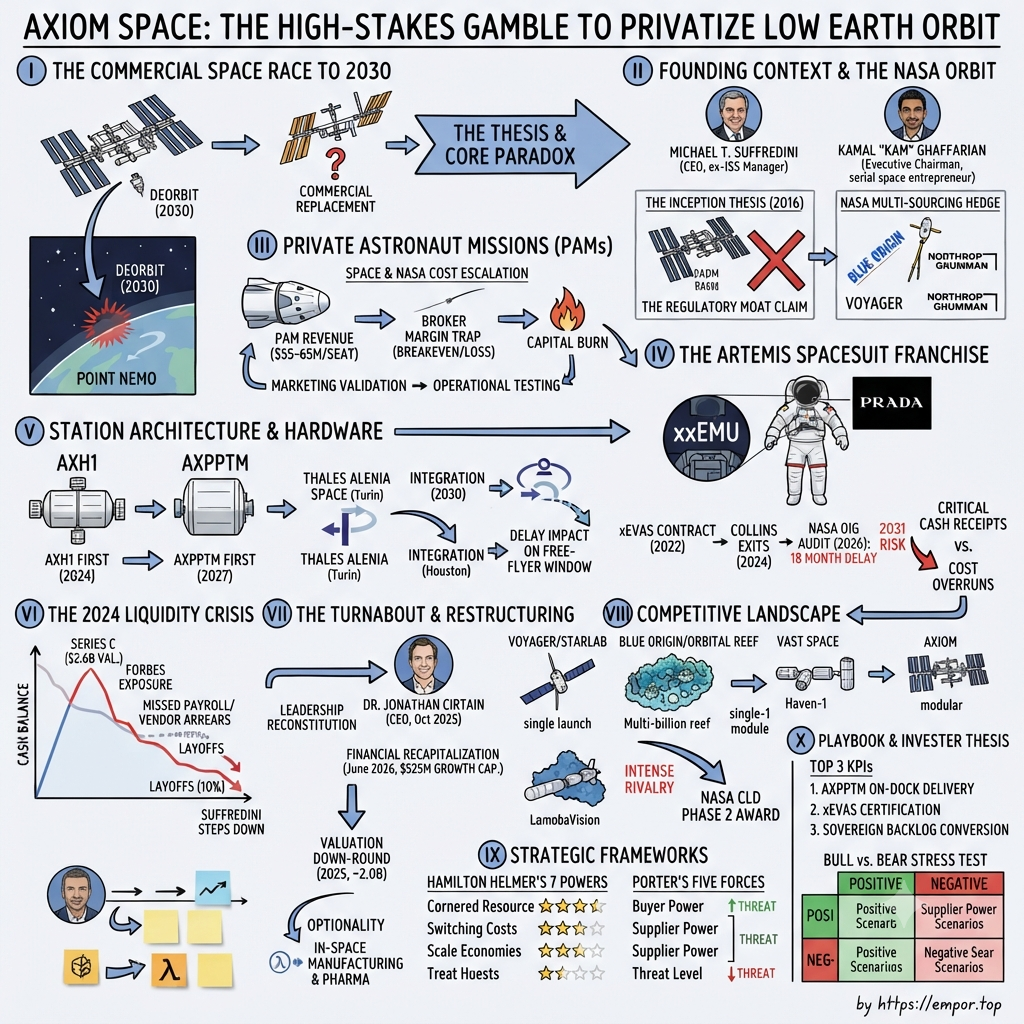
Axiom Space: The High-Stakes Gamble to Privatize Low Earth Orbit
I. Prologue & The Commercial Space Race to 2030 (0:00 – 0:15)
In June 2024, NASA awarded SpaceX a contract worth up to $843 million to build a dedicated vehicle with a singular purpose: grapple the International Space Station, fire its thrusters for hours, and steer roughly 430 metric tons of orbiting laboratory through the atmosphere until whatever survives reentry crashes into remote oceanic waters.1 The vehicle is government-owned rather than procured as a commercial service, a distinction that underscores how decisively NASA is planning for the station's retirement. With the ISS scheduled to cease operations no earlier than 2030, the hardware needed to deorbit it is already under contract.2
That procurement established the countdown against which every commercial space station venture in the United States must now operate. It transformed an abstract policy ambition — the decommissioning of the ISS — into a funded, legally binding, physical event. It also created the commercial opening that Axiom Space was founded to seize. Without an operational American platform in orbit, the United States would surrender uninterrupted human presence in low Earth orbit to China's Tiangong station by default — a geopolitical outcome that shapes congressional appropriations and NASA procurement strategy far more than private market demand forecasts do.
Axiom Space, founded in Houston in 2016 and classified as a startup primarily because it remains privately held, is the only company holding a NASA contract to physically attach a commercial module to the ISS. That agreement — a fixed-price, indefinite-delivery/indefinite-quantity award capped at $140 million, granted in early 2020 for access to the station's Node 2 forward port — has anchored the company's corporate narrative for six years.3 Around that orbital real estate, Axiom assembled three distinct, loosely coupled operations: a charter brokerage arranging four-seat private missions to the ISS at roughly $55 million to $70 million per seat; a government contractor developing next-generation lunar spacesuits under a NASA award with a $1.26 billion ceiling; and a capital-intensive orbital construction effort whose initial module has yet to reach orbit.
The company has raised approximately $1.22 billion in total capital,4 most recently closing an oversubscribed financing round of more than $525 million on June 4, 2026, with MUFG Bank joining as an investor and J.P. Morgan acting as placement agent.5 Yet during that same period, Axiom weathered a severe liquidity crunch, cycled through three chief executives in fourteen months, absorbed a down-round valuation cut, trimmed its workforce by roughly 30 percent from its peak, and contended with a NASA Office of Inspector General report warning that its flagship spacesuit may not be operationally ready until 2031.67
The underlying tension in the business model is stark. Orbital infrastructure requires 10 to 15 years and billions of dollars in upfront capital before producing recurring revenue, whereas venture capital operates on three- to five-year markup cycles. Axiom spent a decade attempting to bridge that gap by selling high-profile, low-margin charter flights and collecting milestone payments under fixed-price government development contracts — a structure the NASA Inspector General concluded is "not well-suited" to developmental aerospace programs.7 Whether that financial bridge can endure until Axiom deploys an operational space station remains the fundamental underwriting question.
This analysis examines that operational record: the original bet on the ISS as an orbital construction scaffold and whether the docking port was ever the unassailable asset it seemed; the underlying unit economics of private astronaut missions once rocket launch expenses and NASA's repriced station services are deducted; the spacesuit franchise as it evolved from a lucrative program win into a critical schedule vulnerability; the persistent manufacturing delays in the module program; the 2024 cash squeeze and the governance fractures it exposed; the 2025–2026 recapitalization and executive turnover, alongside what private valuations reveal to prospective public-market investors; an emerging competitive landscape where a rival recently secured a NASA mission Axiom had won five consecutive times; and the concrete, observable milestones that will ultimately confirm or break the investment thesis.
 Subscribe on LinkedIn
II. Founding Context & The NASA Orbit: Suffredini and Ghaffarian (0:15 – 0:42)
Michael T. Suffredini managed the International Space Station program for NASA from 2005 to 2015. That decade spanned the final assembly flights of the Space Shuttle fleet, the transition to commercial cargo resupply, the complex multilateral diplomacy required to coordinate Roscosmos, ESA, JAXA, and CSA, and the retirement of the Shuttle itself. When Suffredini left the agency in 2015, he brought with him rare institutional knowledge: an operational understanding of how a human-rated orbital facility is certified, integrated, resupplied, and crewed, and, crucially, how NASA decides what to buy and from whom.
Kam Ghaffarian offered a complementary skillset. He built Stinger Ghaffarian Technologies into one of NASA’s primary engineering services contractors before selling it to KBR in 2018, and went on to seed a cluster of capital-intensive deep-tech ventures: Intuitive Machines in lunar landers, X-energy in advanced nuclear reactors, and Axiom in orbital infrastructure.8 Ghaffarian supplied founding capital, institutional familiarity with federal procurement, and — as later liquidity crunches would show — a personal balance sheet that served as the lender of last resort.
Their founding thesis, formulated in 2016, appeared straightforward: avoid launching an independent, free-flying space station from scratch. Instead, dock initial commercial modules to the ISS at the Node 2 forward port, drawing on the host station's established electrical power, thermal management, life support, and attitude control while the commercial segment was assembled and tested in orbit. Once the ISS reached retirement, Axiom would detach its modules to operate as an autonomous platform. The strategy treated a $150 billion taxpayer-funded asset as orbital scaffolding and a risk buffer during the most vulnerable phase of a space station program — the early operational window when hardware failures and integration hurdles routinely escape ground detection.
In early 2020, NASA endorsed that concept. Under Appendix I of the NextSTEP-2 broad agency announcement, the agency awarded Axiom a firm-fixed-price, indefinite-delivery/indefinite-quantity contract — capped at $140 million — to attach at least one habitable commercial module to Node 2 forward.39 Axiom framed the award at the time, and across pitch decks for years to follow, as a decisive victory over traditional aerospace primes for an irreplaceable asset: the station’s sole forward-facing port on Node 2, which the company positioned as the exclusive corridor for incremental commercial expansion.
The cornered-resource claim, tested against the record
That claim formed the bedrock of Axiom's investment narrative, yet it ran counter to three pieces of procurement and operational evidence.
First, consider the bidding field. Bigelow Aerospace, the only other serious contender with flight-proven expandable habitat hardware already attached to the ISS, declined to submit a proposal. Founder Robert Bigelow stated publicly that the company passed because NASA's offered funding was too lean to justify the technical and financial risk; Bigelow Aerospace ceased operations later that year during the pandemic.10 Axiom did not secure the port in a bidding contest against legacy primes such as Boeing or Lockheed Martin; it won because the economics were unattractive enough to deter its only qualified rival. When a peer with directly relevant flight heritage walks away from a tender on commercial grounds, the underlying concession cannot be assumed to be a lucrative asset.
Second, look at NASA's broader procurement behavior. Just twenty-two months after awarding the port to Axiom, NASA committed $415.6 million through funded Space Act Agreements under Phase 1 of its Commercial LEO Destinations initiative to three independent consortia developing free-flying stations that would never touch the ISS: $160 million to Nanoracks for Starlab, $130 million to a Blue Origin-led consortium for Orbital Reef, and $125.6 million to Northrop Grumman.11 Every single one of those awards exceeded the entire $140 million ceiling on Axiom’s port contract. NASA's capital allocation revealed that the agency never treated an ISS-attached architecture as its sole or primary pathway. The agency hedged immediately, committing far more capital to standalone platforms than to Axiom's supposedly cornered junction.
Third, evaluate the operational nature of the concession. A docking port on a space station slated for controlled destruction is a wasting asset. Every month that passed between 2020 and 2030 reduced the operational lifespan of the installation. Furthermore, the operational record of modular construction — both on Mir and across the assembly of the ISS — demonstrates that physical attachment creates reciprocal coupling risk. Technical slippages in testing and qualification on one side propagate into the flight manifests and safety reviews of the host station. Attachment offers shared utilities, but it exacts a cost in shared schedules and shared oversight. In that arrangement, the junior partner with the smaller balance sheet does not control the tempo.
This does not mean the port award was without value. The concession carries demonstrable option value, and Section VIII examines a moment in March 2026 when NASA policy swung so far toward Axiom’s architecture that the company’s roadmap briefly became official agency doctrine. Yet the asset is fundamentally a time-delimited access right on a retiring host, secured in an uncontested tender from a customer actively financing rival architectures. It represents a temporary head start rather than an enduring economic moat. The metric that will confirm or falsify the thesis is clear: whether Axiom can physically berth its primary module at Node 2 forward with enough operational runway before the 2030 retirement target to demonstrate separation and autonomous free-flight. Missing that window risks turning the port from a commercial bridgehead into an unexercised contractual option.
A final piece of founding-era context involves the public-market track record of Ghaffarian’s portfolio ventures, which provides an empirical base rate for how his deep-tech businesses translate initial vision into public-company realities. Intuitive Machines completed a SPAC merger in 2023, building trailing-twelve-month revenue to roughly $490 million through June 2026 while continuing to post a net loss of around $131 million.12 Meanwhile, X-energy agreed to merge with Ares Acquisition Corporation at an implied pre-money equity value of $1.05 billion before mutually terminating the transaction on October 31, 2023, citing market headwinds and peer valuation compression.13 While neither case invalidates Axiom's commercial strategy, both establish a recognizable pattern: Ghaffarian’s ventures demand heavy upfront capitalization before achieving self-sustaining cash flows, and public markets have scrutinized those capital demands closely when asked to fund them.
III. Private Astronaut Missions (PAMs): Glamour, Sovereign Demand, and the Margin Trap (0:42 – 1:12)
On April 8, 2022, a SpaceX Crew Dragon carrying former NASA astronaut Michael López-Alegría and three paying passengers — Larry Connor, Mark Pathy, and Eytan Stibbe — docked at the ISS on Ax-1, marking the first fully private crewed mission to the station.14 Each commercial seat reportedly sold for roughly $55 million.[^15] Operationally, the flight proved Axiom could manage the end-to-end logistics: the company trained the crew, negotiated integration with NASA, contracted the launch vehicle with SpaceX, managed mission operations, and recovered the capsule safely.
Three more missions followed over the next three years. Ax-2, launched in May 2023 under the command of former NASA astronaut Peggy Whitson, carried two Saudi astronauts, Rayyanah Barnawi and Ali AlQarni, on seats funded by the Saudi government. Ax-3, launched in January 2024, marked the first flight where national governments purchased every commercial seat: Italy, Türkiye, and Sweden each paid an estimated $55 million to send Walter Villadei of the Italian Air Force, Alper Gezeravcı as Türkiye’s first astronaut, and European Space Agency project astronaut Marcus Wandt.15 Ax-4 flew from June 25 to July 15, 2025, again commanded by Whitson, carrying India's Shubhanshu Shukla — the first Indian citizen aboard the ISS, arriving 41 years after Rakesh Sharma's flight to Salyut 7 — alongside Poland's Sławosz Uznański-Wiśniewski and Hungary's Tibor Kapu.16
The sovereign pivot is real, and it is the more durable half of the business
The progression across those four flights provided the clearest validation of commercial demand Axiom has demonstrated to date. The customer profile pivoted from private individuals purchasing an orbital experience to national governments procuring sovereign aerospace capability: professional astronaut qualification, national microgravity research programs, and the diplomatic prestige of putting a citizen in orbit. Sovereign clients operate on predictable multi-year budget cycles, publish procurement roadmaps in advance, and represent potential repeat customers — qualities high-net-worth space tourists rarely provide.
That demand shift enabled Axiom to assemble a roster of memoranda of understanding with more than twenty nations and space agencies, including the European Space Agency, the Canadian Space Agency, the Saudi Space Commission, the Turkish Space Agency, the Indian Space Research Organisation, and the UK Space Agency.17 While these agreements outline the commercial pipeline, they are also, almost without exception, non-binding letters of intent rather than committed backlogs.
The margin trap
Behind the top-line revenue, however, the unit economics reveal structural limits. Axiom does not own a launch vehicle, a crew capsule, or an operational orbital platform. On every private astronaut mission, it acts as an intermediary positioned between two dominant, price-setting counterparties.
On the launch side, Axiom charters a Falcon 9 and a Crew Dragon spacecraft from SpaceX. NASA’s own Commercial Crew contracts illustrate the pricing baseline: the space agency has paid roughly $55 million per seat for Crew Dragon flights.18 As a smaller commercial client buying in single-mission increments, Axiom has little pricing leverage to negotiate terms superior to those secured by the anchor government customer that underwrote the vehicle's development.
On the destination side, Axiom must purchase ISS resources from NASA — and in 2021, the agency adjusted its commercial pricing sharply upward. NASA raised the rate for astronaut crew time from $17,500 per hour to $130,000 per hour, cargo upload from $3,000 to $20,000 per kilogram, and cargo return from $6,000 to $40,000 per kilogram. At the same time, the agency withdrew its baseline 2019 tariff — which had charged $11,250 per person per day for life support and $22,500 for crew provisions — acknowledging that subsidized rates intended to prime the commercial market had failed to recover government costs.19 When an essential counterparty can escalate service fees sevenfold with an administrative notice, it functions less like a conventional vendor and more like a sovereign landlord setting terms at will.
Between those launch and accommodation costs sits Axiom's own operating overhead: fifteen weeks of specialized training per customer, flight integration engineering, ground tracking, and compensation for veteran mission commanders like Whitson and López-Alegría, whose presence is a mandatory NASA safety prerequisite rather than an optional service.20 While Axiom does not publish audited segment margins, the financial structure leaves narrow room between pass-through launch expenses, escalating station fees, and top-line charter revenue of roughly $220 million to $280 million across four seats.
Falsification: did PAM ever fund the station?
The claim that mattered to investors was not simply that Axiom could fly crews to orbit, but that private astronaut missions would generate substantial free cash flow to bankroll the station module development — functioning as a self-funding bridge to long-term orbital infrastructure. The operating record has tested that thesis and disproved it.
By September 2024, Forbes reported, drawing on internal records and seven former employees, that Axiom was struggling to meet payroll, had fallen behind on payments to key vendors including SpaceX, had cut approximately 100 jobs, and had instituted voluntary 20 percent pay cuts for remaining staff.6 Those cash pressures emerged after Ax-1, Ax-2, and Ax-3 had already flown and settled their accounts. Generating hundreds of millions of dollars in gross charter receipts across three missions still left the company without sufficient working capital to settle launch invoices with its primary contractor on time. Rather than underwriting hardware manufacturing, the charter flights functioned as operational proving grounds, high-visibility business development, and diplomatic relationship builders — strategically meaningful achievements, but far short of the self-financing cash engine promised to investors.
A second competitive development further challenged the narrative. Axiom had secured the first five commercial astronaut missions sanctioned by NASA, with the agency formalizing the order for Ax-5 on January 30, 2026, for a launch targeted no earlier than January 2027.21 Just thirteen days later, on February 12, 2026, NASA awarded the sixth private astronaut mission to Vast — breaking Axiom’s five-flight monopoly on commercial ISS access.22 The sole commercial segment where Axiom maintained an unblemished competitive sweep now faces direct competition from a well-capitalized rival, well before Axiom has placed its first module into orbit.
The revised investment thesis is more constrained: private astronaut missions represent a proven, repeatable revenue channel backed by durable sovereign demand across at least eight countries, but they remain a structurally low-margin agency business bounded by supplier pricing power and no longer protected by competitive exclusivity. For prospective public-market investors, the key operational metrics will be clear: segment contribution margin disclosed on a per-flight basis, and the rate at which those twenty-plus non-binding memoranda of understanding convert into enforceable, non-refundable commercial contracts.
IV. The Artemis Spacesuit Franchise: Winning xEVAS, The Prada Alliance, and Technical Reality (1:12 – 1:44)
In June 2022, NASA selected Axiom Space and Collins Aerospace as the two vendors under Exploration Extravehicular Activity Services (xEVAS), an indefinite-delivery/indefinite-quantity contract with a maximum potential value of $3.5 billion running through 2034.[^24] Three months later, in September 2022, Axiom captured the initial and most visible task order: a $228.5 million award to design, develop, and produce the lunar surface spacesuit for Artemis III — designated the Axiom Extravehicular Mobility Unit, or AxEMU — under a $1.26 billion ceiling for Axiom's share of the vehicle program.23 In July 2023, NASA awarded a second task order, initially funded at $5 million with a potential value of $142 million over four years, to adapt that architecture into a replacement spacewalking suit for the ISS.24
Strategically, the xEVAS selection was the most consequential programmatic win for Axiom since securing the ISS docking port. It elevated the company from a speculative orbital developer into a tier-one contractor supplying flight-critical, human-rated hardware for NASA's flagship deep-space exploration program. Crucially, it also introduced a revenue mechanism absent from the commercial station effort: milestone-based government cash disbursements tied to verified technical deliverables.
The Prada partnership: brand halo, measured honestly
In October 2024, Axiom and Italian luxury house Prada unveiled the outer layer of the AxEMU, highlighting collaborative materials and tailoring engineered to withstand the thermal extremes and micrometeorite environment of the lunar south pole. In June 2026, the partners revealed the suit's inner layer — the Liquid Cooling and Ventilation Garment worn directly against the skin to regulate body temperature and maintain comfort during moonwalks planned to last up to eight hours.25
It is tempting either to dismiss the partnership as a promotional exercise or to accept its branding at face value. Neither posture holds up under scrutiny. Prada brought legitimate technical expertise in high-performance textiles, pattern design, and ergonomic tailoring, and engineering an outer thermal-protective garment requires rigorous testing. Yet the outer cover and the cooling undergarment are rarely where spacesuit programs stumble. Development bottlenecks center instead on the Portable Life Support System — the backpack assembly that scrubs carbon dioxide, rejects heat, supplies oxygen, and keeps an astronaut alive in a vacuum — alongside the strict mass budgets and cryogenic-thermal limits required for lunar surface operations. While the Prada collaboration generated two global media cycles across twenty months, it produced brand momentum rather than a flight-certified spacesuit, offering little insight into the critical subsystems that remain behind schedule.
Falsification: from monopoly opportunity to sole-source liability
Two shifts altered the competitive dynamics of the xEVAS program, and only one worked to Axiom's advantage.
In 2024, Collins Aerospace and NASA mutually agreed to descope Collins' xEVAS task orders after the veteran aerospace contractor concluded it could not meet the agreed delivery schedule. NASA had already spent $37 million on the Collins effort before the withdrawal.7 On the surface, the exit of Axiom’s primary rival — a legacy prime with decades of spacewalk heritage — eliminated its sole competitor, handing the company a de facto monopoly over NASA's next-generation spacesuit procurement.
That exclusive position inverted from a commercial asset into an acute operational vulnerability on April 20, 2026, when the NASA Office of Inspector General published an audit of the agency's spacesuit procurement. The OIG found AxEMU development running at least eighteen months behind baseline. While Axiom was targeting demonstration readiness for late 2027, the Inspector General projected that if Axiom's testing timeline tracked historical aerospace averages for comparable programs, flight demonstrations would not take place until 2031. The report characterized NASA's original 2025–2026 demonstration targets as "overly optimistic and unrealistic" and delivered a structural critique that struck at the core of Axiom's revenue model, concluding that firm-fixed-price, service-based contracts "are not well-suited for developmental efforts like next-generation spacesuits."7 With Collins off the contract, NASA was left without a redundant provider should Axiom encounter further developmental delays.
The programmatic consequence followed swiftly. Artemis III was restructured: rather than conducting a lunar landing, the mission was recast as an Earth-orbital test flight in 2027 to execute rendezvous operations with the SpaceX and Blue Moon landers and evaluate the AxEMU in orbit, pushing crewed lunar landing attempts to 2028.[^28] As a result, Axiom's spacesuit was decoupled from the critical path of the initial lunar landing attempt.
Viewed through an underwriting lens rather than an aerospace enthusiast's perspective, this sole-source status cuts both ways. It insulates Axiom from near-term competitive displacement: NASA cannot easily re-compete a spacesuit program within current mission schedules, which is precisely why the Inspector General flagged the absence of redundancy as an agency risk rather than an Axiom risk. At the same time, that structure shifts the financial burden of development delays directly onto Axiom’s balance sheet. Under a firm-fixed-price contract, an eighteen-month schedule slip cannot be billed back to the government. Instead, it translates into eighteen additional months of engineering payroll consumed while the milestone disbursements Axiom relies on to fund operations remain locked behind unpassed verification gates.
The revised assessment of the spacesuit franchise is nuanced: Axiom commands a defensible sole-source position under a program with a $1.26 billion ceiling and an anchor customer that cannot easily replace it. Yet it holds that position on contract terms that convert technical friction directly into cash burn, with its customer's own oversight body publicly modeling a four-year gap between the company's target completion date and historical precedent. For prospective public-market investors, the decisive key performance indicators are the ratio of milestone cash collected to program cash expended in each quarter, along with the pace at which Axiom resolves the audit findings. Completing a successful qualification demonstration in late 2027 would validate the commercial value of the franchise; continued slippage beyond 2029 would turn the contract into a capital-draining corporate liability.
V. Station Architecture & The Hardware Reality: AxH1, AxPPTM, and Thales Alenia Space (1:44 – 2:12)
For years, the public face of Axiom Station was a Philippe Starck-designed interior: LED-studded padded walls, a spherical observation module, and the aesthetics of a boutique hotel rendered in microgravity.17 The engineering reality, however, is being fabricated in an industrial hall in Turin.
Thales Alenia Space, the Franco-Italian aerospace prime that manufactured a substantial share of the ISS's pressurized volume — including Columbus, Harmony, Tranquility, and the Cupola — builds Axiom's primary structures: the metallic pressure shells and the micrometeoroid and debris protection systems.26 Partnering with Thales Alenia was an operationally sound decision and represents arguably the company's strongest supplier relationship. Pressure-vessel welding for human-rated spacecraft is a specialized discipline with very few qualified practitioners, and Axiom wisely avoided attempting to master it in-house. Once completed, the bare shells travel to Axiom's Assembly, Integration, and Test facility at the Houston Spaceport at Ellington Airport, where internal structures, avionics, and life-support systems are installed — marking the first human-rated spacecraft to undergo final integration in Houston.27
The assembly resequencing
In December 2024, Axiom and NASA announced a fundamental change to the orbital build sequence. The original architecture called for launching Habitat 1 first, attaching it directly to the ISS, and berthing three additional modules before detaching from the station. The revised plan placed the Payload, Power, and Thermal Module — AxPPTM — first in line, followed by Habitat 1, an airlock, Habitat 2, and eventually the Research and Manufacturing Facility.2829 AxPPTM houses the station's primary electrical generation and thermal rejection systems, alongside eight science racks. Under this altered roadmap, AxPPTM berths at the ISS, separates, rendezvouses with AxH1 in orbit, and forms an independent two-module free-flyer targeted for as early as 2028 — roughly two years earlier than the original architecture permitted — before expanding into a four-module station around 2030.
Management framed this resequencing as an acceleration, and in one operational sense it was: it reduced the number of modules that must be assembled while tethered to the ISS, thereby limiting exposure to the station's 2030 retirement date. Axiom's chief operating officer characterized the shift as revealing "opportunities for flexibility and enhancements," and NASA's Commercial LEO Development program manager endorsed the coordination.29
Yet the change can equally be viewed as a forced adjustment to a manufacturing timetable the company could no longer meet. Reporting from Forbes three months earlier supported that interpretation, describing a design being "radically changed" because of slow progress and the possibility that the ISS might be decommissioned sooner than planned.6 Both perspectives capture part of the truth: while the resequencing represents sensible engineering, the available evidence indicates it was compelled by developmental delays rather than proactive architectural insight.
Falsification: the guidance record on first launch
Management credibility is most directly measurable against this timeline, as Axiom has repeatedly issued revised target dates for its inaugural launch over the course of six years.
Between 2020 and 2021, following the port award, Axiom guided toward launching its initial module in late 2024. By 2023, that target had moved to late 2025 and then into 2026. In September 2024, Forbes reported that the first module remained unfinished and that Axiom was guiding toward a late-2026 launch — noting the direct financial fallout: because the company missed its developmental milestones, milestone revenue Axiom would have received under its NASA contract was not collected.6 Just three months later, the sequence was restructured entirely, designating AxPPTM as the first module, with launch anticipated toward the end of 2027 and free-flight capability in 2028.28 Meanwhile, NASA's public communications throughout that period continued at points to describe Axiom as "on schedule to launch and attach its first module ... in 2026," a characterization that Axiom's own programmatic restructuring had already overtaken.30
In total, that record reflects roughly three years of cumulative slip on a five-to-seven-year program, disclosed in successive increments. Schedule delays are common across developmental space hardware — Vast postponed Haven-1 from 2025 to the first quarter of 2027, and Starlab pushed its target to 2029 — but broader industry base rates do not eliminate the financial penalty. Every month of schedule slip compresses the window between first berthing and ISS deorbit, and that operational window is the entire premise of an ISS-attached architecture. If AxPPTM launches at the end of 2027 and the ISS retires in 2030, Axiom has barely two years to berth, commission, separate, rendezvous with a second module that must itself be completed and launched, and prove independent free-flight — an operational sequence that has never been attempted commercially.
The physical hardware record provides the more tangible side of the ledger. Thales Alenia Space completed the final weld on the AxPPTM primary structure in July 2025, with relocation to Houston for outfitting scheduled for no earlier than autumn 2025.28 On the subsystem side, Redwire holds a contract to supply the roll-out solar array wings for the module.31 These represent concrete, verifiable manufacturing achievements on physical flight hardware.
Yet the core financial hazard lies in the gulf between a welded shell and a flying spacecraft. A bare pressure vessel in Houston lacking flight-qualified environmental control and life support, integrated avionics, and thermal systems is capitalized expenditure generating zero yield while steadily consuming storage costs, insurance premiums, engineering payroll, and cost of capital. Completing the primary structure is typically the most straightforward phase of a space station program; integrating and certifying the environmental control and life support systems is where developmental budgets escalate and schedules compound. Finishing the metal demonstrates that the most manageable engineering hurdles have been cleared — while the most complex qualification gates remain ahead.
VI. The 2024 Liquidity Crisis, Executive Upheaval, and Near-Death Experience (2:12 – 2:40)
In August 2023, Axiom closed a $350 million Series C round anchored by Aljazira Capital and Boryung Co., Ltd., pushing cumulative capital raised beyond $505 million and pairing the announcement with a claim of more than $2.2 billion in contracted customer commitments.32 Third-party trackers estimated the company's valuation at roughly $2.6 billion.33 In the accompanying release, Suffredini spoke of serving "innovators in medicine, materials science, and on-orbit infrastructure who represent billions of dollars in demand."
Within twelve months, the company was struggling to meet its basic operational obligations.
What the record actually shows
An investigation published by Forbes in September 2024 — drawing on internal financial records, interviews with seven former employees bound by nondisclosure agreements, and aerospace industry specialists — detailed an acute cash squeeze, missed payroll dates, payment arrears to critical vendors including SpaceX, approximately 100 job cuts across a workforce of roughly 1,000, and voluntary 20 percent salary reductions for the employees who remained. The reporting also revealed that external fundraising efforts had met a cool reception from institutional venture funds, forcing Ghaffarian to inject personal capital to keep operations afloat.6
Each disclosure carried distinct underwriting implications. For an enterprise employing roughly a thousand engineers and technicians while executing flight-critical NASA contracts, failing to meet payroll on schedule is not a routine working-capital fluctuation; it is a primary indicator of balance-sheet distress. Falling behind on payments to SpaceX was even more precarious. SpaceX was not an interchangeable parts supplier, but the world's sole commercial operator capable of transporting Axiom's crews to the ISS. Accumulating arrears with a single-source, monopolistic supplier while simultaneously relying on that supplier to honor future flight manifests leaves a customer with virtually no negotiating leverage. Furthermore, struggling to raise capital during 2024 — a period when institutional investment was actively backing peers such as Rocket Lab and Vast — signaled that the market's skepticism was targeted specifically at Axiom's operational progress rather than at commercial space infrastructure as an asset class.
The governance fracture
On August 9, 2024, one month before the public disclosure of the cash squeeze, Michael Suffredini stepped down as chief executive after eight years, citing personal reasons and shifting to the board of directors in an advisory capacity.34 Ghaffarian, the company's executive chairman, assumed the role of interim CEO.35
Executive transitions are customarily described as amicable, and the corporate record does not detail internal board deliberations. What the verifiable timeline does show is sequence and context: the co-founder whose signature had accompanied every orbital module milestone since 2016 departed the executive suite just as the company confronted a severe liquidity shortfall, missed milestone collections on government contracts, and a station architecture forced into an extensive redesign. Corporate boards rarely replace a founder-CEO at the peak of operational execution.
The transition also exposed the mismatch between the founders' backgrounds and the venture's maturing requirements. Suffredini possessed deep, institutional expertise in managing an operational space station and maneuvering through the federal bureaucracy that financed it. Yet managing an existing government installation requires an entirely different operational discipline than financing, industrializing, and certifying unproven human-rated flight hardware under fixed-price contract structures. The company was founded on a procurement relationship and then forced to solve an industrial manufacturing challenge.
At the same time, Axiom lacked the structural safety net that has sustained several of its competitors through comparable developmental troughs: a controlling founder-shareholder possessing both the willingness and the liquidity to write nine-figure checks indefinitely. Blue Origin relies on Jeff Bezos. Vast benefits from the backing of Jed McCaleb, whose company had absorbed more than $1 billion in cumulative private capital by March 2026.36 Axiom had Ghaffarian, who provided necessary bridge financing and participated in subsequent funding rounds, but whose personal wealth was distributed across Intuitive Machines, X-energy, and Axiom simultaneously, precluding the open-ended balance-sheet support available to rivals backed by tech mega-billionaires.
The resulting corporate retrenchment extended well beyond an isolated emergency adjustment. Headcount, which peaked at approximately 1,000 personnel in early 2024, fell to roughly 700 by June 2026 — a 30 percent contraction sustained across two years rather than reversed following a temporary downturn.37 That persistent retrenchment did not represent an episodic restructuring charge, but the deliberate shrinking of an organization adapting to tighter capital constraints.
VII. The Turnaround: New Leadership, Capital Restructuring, and the 2025–2026 Reset (2:40 – 3:05)
Three chief executives in fourteen months
On April 25, 2025, Axiom named Tejpaul Bhatia, its chief revenue officer, as chief executive — a promotion that signaled a commercial-first strategy focused on stabilizing enterprise sales and the sovereign mission pipeline.38 Six months later, on October 15, 2025, the board replaced him with Dr. Jonathan Cirtain, who had joined the company as president in June 2025.39 The transition was abrupt enough to surprise industry observers: Bhatia had represented Axiom on a global stage just two weeks earlier at the International Astronautical Congress, signing an extension to a memorandum of understanding with the UK Space Agency.40
Cirtain brought an entirely different operational background: a doctoral physicist from Montana State University with a research fellowship at Harvard, nearly nine years at NASA's Marshall Space Flight Center, and eight years as a senior executive at BWX Technologies, the nuclear components and fuel supplier.41 The BWXT experience was the consequential detail. That is an enterprise whose core business requires delivering safety-critical hardware to federal customers under strict configuration control and regulatory audit — the precise discipline NASA's Office of Inspector General concluded Axiom lacked.
For prospective public-market investors, that leadership rotation warrants careful scrutiny. Appointing an executive with deep government-hardware credentials offered a rational response to technical and regulatory friction. Yet cycling through three chief executives in fourteen months — with the second departing after two quarters — points to governance instability rather than settled succession planning. The brevity of Bhatia's tenure suggests either a board that appointed without conviction or an operational strategy overhauled midstream. The August 2026 appointments of a new chief financial officer, a chief information officer, and a head of international operations for Axiom's Swiss entity indicated that the corporate rebuild remained underway.42
The financing sequence, and what each round can and cannot support
Axiom's capitalization history forms the foundation of any pre-IPO underwriting analysis, and it must be evaluated round by round rather than through a single cumulative headline.
The company achieved unicorn status in February 2021 when it closed a $130 million Series B round led by C5 Capital.43 In 2022, South Korean healthcare group Boryung invested $60 million across two tranches for an equity stake exceeding 2.5 percent, implying an overall valuation cap of roughly $2.4 billion at that time.[^47] That was followed by the August 2023 Series C, which secured $350 million anchored by Aljazira Capital and Boryung at a reported $2.6 billion post-money mark.3233
Then came the valuation reset. In March 2025 — following the liquidity crunch, staff layoffs, and the departure of co-founder Michael Suffredini — Axiom raised $100 million at a $2.0 billion pre-money valuation in a round co-led by 1789 Capital and Type One Ventures.33 Representing a down-round valuation cut of roughly 23 percent from the 2023 peak, it stands as the most informative pricing signal in the company's history: a valuation negotiated at the trough by institutional investors with full data-room visibility when the immediate alternative was insolvency.
On December 12, 2025, Hungarian telecommunications and technology group 4iG entered into a definitive agreement to invest $100 million — structured as $30 million paid by December 21, 2025, and $70 million due by March 31, 2026 — establishing itself as Axiom's largest European shareholder. The transaction was paired with a stated ambition to secure a long-term role in orbital data center initiatives, alongside a separate five-year, $100 million cooperation framework focused on orbital data center systems.4445
On February 12, 2026, Axiom announced that it had secured $350 million through a combination of equity and debt co-led by the Qatar Investment Authority and Type One Ventures, with participation from 4iG, LuminArx Capital Management, and Ghaffarian personally.4647 On June 4, 2026, the company closed an upsized round exceeding $525 million — an expansion of $175 million beyond the February baseline — with MUFG Bank participating as a new investor and J.P. Morgan acting as placement agent. Axiom earmarked the proceeds for Axiom Station engineering, AxEMU spacesuit production, and upcoming commercial astronaut missions.548 With that close, cumulative capital raised reached approximately $1.22 billion.4
Price is not value: what these marks can support, and what they cannot
Axiom did not disclose an official post-money valuation for either the February or June 2026 funding closes.46 While secondary-market trackers and private databases circulated estimates above $2.5 billion, disciplined underwriting requires treating that figure as an unverified extrapolation from an undisclosed transaction structure rather than a confirmed corporate valuation.
Several structural caveats explain why.
First, the 2026 capital injection was structured explicitly as a mix of equity and debt.47 A blended headline figure of $525 million reveals nothing about the equity dilution incurred or the ownership percentage transferred. Debt instruments sit senior to equity in the liquidation waterfall. If that debt carries covenants linked to technical or flight milestones on a timeline the NASA Inspector General has questioned, it introduces default and restructuring risks that pure equity financing avoids. Because the debt-to-equity ratio remains undisclosed, assessing the true balance-sheet burden is impossible from public records alone.
Second, the specific rights attached to the preferred shares remain private. Following a liquidity crisis and a down round, standard venture contracting shifts terms heavily in favor of incoming capital, frequently incorporating senior liquidation preferences, cumulative dividends, or anti-dilution ratchets. If the 2025 or 2026 preferred shares carry participating preferences, the residual economic value attributable to common equity drops well below the figure calculated by simply dividing headline post-money valuation by total shares — and public investors inevitably purchase common stock. The absence of public disclosure cuts both ways: it prevents confirmation of punitive terms, but it also bars analysts from verifying whether common equity retains its headline value.
Third, a substantial portion of Axiom's investor base comprises strategic and sovereign backers rather than purely financial funds, and strategic capital routinely prices in objectives beyond direct investment yield. The investment by 4iG is linked directly to Hungarian satellite constellation and orbital data center initiatives, which its leadership framed as strengthening diplomatic and industrial ties between the United States and Hungary.45 Similarly, Boryung secured exclusive Asia-Pacific commercialization rights through the Brax Space venture, the Qatar Investment Authority advances national aerospace capacity, and MUFG Bank seeks institutional entry into the emerging space economy. Strategic counterparties can rationally justify paying a premium for regional exclusivity, technology access, or geopolitical positioning — value that does not accrue to public common shareholders.
Fourth, the most compelling evidence supporting an enterprise valuation in the $2 billion to $2.5 billion range is not the initial press release, but the subsequent expansion of the round between February and June 2026. Sophisticated institutional investors with full access to internal engineering records chose to commit an additional $175 million after the NASA Office of Inspector General released its critical audit on April 20, 2026. That follow-on commitment was made with the program's primary schedule and procurement vulnerabilities fully known. While that capital commitment validates institutional confidence in Axiom's survival, it remains an endorsement by senior preferred stakeholders rather than a reflection of public-market common equity value.
Building the capitalisation from what is public
A complete capitalization table cannot be constructed from publicly available records — and acknowledging that limitation directly is preferable to fabricating a pro forma share count.
What the verifiable record confirms is fragmented: Boryung's $60 million outlay secured a stake exceeding 2.5 percent in 2022, and 4iG's $100 million injection positioned the Hungarian firm as Axiom's largest European shareholder in 2025–2026.[^47]45 Kam Ghaffarian continues to serve as executive chairman and has backed multiple financing rounds, contributing personal capital to the 2026 raise.47 What remains completely undisclosed — and will remain so until an audited registration statement is filed — includes the total shares of common and preferred stock outstanding by series, the pool reserved for stock options and restricted stock units, the presence and conversion terms of warrants or convertible instruments, dual-class voting rights, board governance arrangements, executive incentive packages, and whether any recent tranches accommodated secondary share sales by insiders. Any market capitalization cited for Axiom today is an implied estimate based on private transactions with opaque mechanics, and calculating a public float is impossible because no public shares exist.
A parallel opacity clouds the enterprise-value bridge. Cash reserves are undisclosed. The debt proportion of the 2026 capital raise is undisclosed. Long-term capital lease obligations tied to the Houston Spaceport assembly complex are undisclosed. Because enterprise value cannot be calculated with standard accounting precision, any valuation multiple applied to Axiom must be recognized as an equity-value multiple measured against an unverified equity baseline — precluding direct comparisons with the enterprise-value multiples of publicly traded aerospace peers examined in subsequent sections.
One structural corporate action is formally documented. On June 23, 2026, Axiom redomiciled its corporate entity from Delaware to Texas, aligning its legal jurisdiction with its Houston headquarters in a joint announcement with Texas Governor Greg Abbott.37 For an enterprise eyeing an eventual public listing, shifting corporate domiciles carries practical governance weight. Texas's newly established business courts lack the century-long judicial precedent and predictable case law that Delaware's Court of Chancery offers regarding fiduciary duties and minority shareholder protections. The operational impact of that move will ultimately depend on the specific shareholder protections and indemnification provisions detailed in future regulatory disclosures.
The optionality bets, sized honestly
Two adjacent commercial initiatives warrant examination, sized according to their actual financial contribution rather than their conceptual novelty.
The first is in-space manufacturing and biomedical research. Commercial arguments centered on microgravity protein crystallization, artificial retinal manufacturing, and ZBLAN optical fiber production represent the space sector's most enduring narrative. Yet at Axiom, as across the broader space economy, they remain fundamentally pre-revenue at scale. In January 2024, Axiom established the Brax Space joint venture with Boryung, granting the South Korean partner a 51 percent controlling interest alongside exclusive commercial rights to Axiom's low-Earth-orbit station technologies across South Korea and the wider Asia-Pacific region to pursue microgravity healthcare, national astronaut training, and joint module engineering.[^47] That corporate structure reveals the compromises imposed by capital constraints: Axiom accepted a minority position in an entity controlling its proprietary station technology across a major economic geography. The near-term corporate value of this vertical lies in sovereign relationship building and science payload fees rather than self-sustaining cash flow.
The orbital data center initiative represents a newer and more rapid technical development. Axiom deployed a prototype processing unit, AxDCU-1, to the ISS in the autumn of 2025. On January 11, 2026, the company launched its first two operational orbital data center nodes into low Earth orbit aboard Kepler Communications' optical data relay network, demonstrating 2.5-gigabit-per-second inter-satellite laser links that bypass terrestrial ground stations entirely.49 An optically interconnected processing node is scheduled for deployment to the ISS in 2027. That milestone established genuine flight heritage for the hardware and helped attract the $100 million strategic commitment from 4iG. Nevertheless, these operations currently represent in-orbit technical demonstrations rather than a recurring commercial software or compute revenue stream — entering a sector characterized by speculative total addressable market projections and mounting competition from hyperscalers and satellite constellations. Given Axiom's documented challenge in converting contractual milestones into steady operational cash flow — from an uncontested 2020 port award that has yet to yield a berthed module, to a $2.2 billion backlog assertion in 2023 that preceded an acute liquidity squeeze in 2024 — underwriting prudence requires treating orbital computing as long-dated speculative optionality rather than a primary enterprise growth driver.
VIII. Competitive Landscape: The Battle for Commercial LEO Destinations (CLD) (3:05 – 3:30)
The industry Axiom competes in features an unforgiving market structure: extreme capital intensity, steep technical and regulatory barriers, and — for the foreseeable future — a single monopsonist customer whose procurement decisions dictate commercial survival.
The policy whipsaw of 2026
On March 24, 2026, NASA unveiled a strategic concept called Ignition. Among its core provisions, the agency proposed that rather than funding fully independent commercial free-flyers from the outset, it would procure a government-owned core module equipped with two docking ports, attach it to the ISS, and mandate that commercial developers dock their private modules to that core.5051 NASA officials justified the proposed pivot by stating they did not believe a self-sustaining commercial business case yet existed in low Earth orbit.
For roughly ten weeks, Axiom's founding thesis became official U.S. policy. The company held the only active NASA agreement to attach a commercial module to the ISS, whereas every commercial rival was designing a standalone platform that would have required comprehensive re-architecting to fit an attached docking framework.30
Industry pushback arrived immediately. Commercial operators, organizing through the Commercial Spaceflight Federation, argued that private orbital demand was real and that tethering operations to a government-owned station would erode the operational autonomy and economic benefits of a private platform. On June 1, 2026, NASA reversed course, agreeing to preserve the Commercial LEO Destinations program substantially as originally conceived and commit to supporting at least one commercial free-flyer, issuing a draft solicitation later that month ahead of procurement over the summer of 2026.52 The procurement vehicle is the Commercial Destinations Development and Demonstration Objectives program — structured as funded Space Act Agreements rather than fixed-price contracts, with $1.0 billion to $1.5 billion anticipated across fiscal years 2026 through 2031, a minimum of two awards, and a demonstration milestone requiring a four-person crewed mission lasting at least 30 days.5354
Three analytical conclusions emerge from that episode. First, the aggregate capital NASA is committing remains modest relative to the industrial scale of the undertaking: less than $600 million in federal funding has flowed to industry since 2020–2021 for a class of orbital asset whose predecessor cost more than $150 billion to construct, while House appropriators proposed $400 million for fiscal year 2027.50 Second, the baseline performance requirements have softened: the agency's earlier ambition of a permanently crewed orbital station gave way to intermittent four-person, one-month operational stays.53 Third, and most consequential for underwriting risk, the anchor customer altered the foundational architecture of its flagship commercial program twice within ten weeks. That level of policy volatility is an acute structural hazard, and its cost falls heaviest on the vendor operating with the narrowest balance-sheet cushion.
The field
Starlab, under Voyager Technologies, provides the clearest benchmark for valuation because it trades on public markets. Voyager listed on the New York Stock Exchange in June 2025, selling more than 12 million shares at $31 to raise $382.8 million against a targeted valuation of $1.6 billion; the stock more than doubled on debut, briefly implying an equity valuation of $3.8 billion.5556 Starlab's architecture centers on a single-launch, eight-meter-diameter stainless-steel free-flyer developed through a joint venture with Airbus Defence and Space, Mitsubishi Corporation, and MDA Space, backed by a Starship launch agreement and targeting deployment in 2029. Voyager holds $217.5 million in Phase 1 awards and models total Starlab development costs at $2.8 billion to $3.3 billion.56 That estimate is the most illuminating benchmark in the sector: an independent, publicly disclosed cost projection for an operational commercial space station, calculated by a publicly traded entity with every incentive to present an achievable budget. Against that $3 billion baseline, Axiom has raised approximately $1.22 billion in total capital across all three of its business lines over a decade.
Orbital Reef, led by Blue Origin in partnership with Sierra Space and its expandable LIFE habitat, secured $130 million in Phase 1 funding.11 While hardware progress has been deliberate and the consortium has weathered well-publicized operational friction, Jeff Bezos's personal balance sheet ensures the venture cannot be starved of development capital. Among the competing consortia, Orbital Reef is the entrant least vulnerable to near-term liquidity failure — and consequently the least pressured by schedule urgency.
Vast represents Axiom's most formidable near-term competitor. In March 2026, Vast raised $500 million in a combined Series A equity and debt round led by Balerion Space Ventures, with participation from In-Q-Tel, the Qatar Investment Authority, Mitsui, MUFG Bank, and Nikon, pushing cumulative private investment beyond $1 billion.36 The institutional overlap is revealing: sovereign and strategic backers such as QIA and MUFG Bank are financing both Vast and Axiom simultaneously, treating orbital infrastructure as a diversified thematic sector allocation rather than an exclusive bet on a single champion. Vast postponed the inaugural launch of its Haven-1 station to the first quarter of 2027 after integrating environmental testing at NASA's Armstrong Test Facility — a qualification slip comparable to the manufacturing delays Axiom has encountered — but it completed Haven-1 structural testing and flew an orbital pathfinder mission in 2025.36 More critically, in February 2026, Vast broke Axiom's commercial monopoly by capturing the contract for NASA's sixth private astronaut mission.22
Axiom's strategic position, stated without spin
Axiom remains the only competitor tethered to an ISS-attached assembly roadmap. The operational merits of that approach are tangible: flight-proven docking interfaces, access to host-station power and environmental support throughout the highest-risk commissioning phases, and an institutional working relationship with NASA embedded in day-to-day orbital operations rather than design-review presentations. Yet the structural liabilities are equally pronounced: mandatory safety integration overhead, complex multi-agency approvals, and an unforgiving operational deadline dictated by the deorbit contract NASA has already executed with SpaceX.
The decisive underwriting question across Commercial LEO Destinations is not which architecture is theoretically superior on a drawing board. It is which enterprise maintains the liquidity to remain solvent and operational when NASA executes its formal C3DO agreements — and, ultimately, when the agency transitions from subsidizing station development to purchasing orbital commercial services. On that balance, Axiom occupies an intermediate, highly leveraged position: substantially better capitalized than during its 2024 liquidity crisis, yet lacking the balance-sheet cushion of Blue Origin, roughly matched in private capital to Vast, and uniquely burdened with carrying a separate, developmental spacesuit franchise subject to federal scrutiny on the very same corporate balance sheet.
IX. Strategic Frameworks: Hamilton Helmer's 7 Powers & Porter's Five Forces (3:30 – 3:55)
Strategic frameworks are useful here only to the extent that they force precision about where economic value actually originates. Evaluated objectively, both Hamilton Helmer’s 7 Powers and Michael Porter’s Five Forces outline an enterprise with far less structural protection than its corporate narrative suggests.
Seven Powers
Cornered resource — partial and decaying. The Node 2 forward port is genuinely unique and contractually Axiom's. Yet it remains an access right on an asset with an already funded destruction date, secured without competitive bidding after the sole qualified rival judged the economics untenable, from a government customer that funded three alternative free-flying platforms twenty-two months later. The more durable cornered resource may be human: a cadre of veteran NASA human-spaceflight managers and commanders — including Michael Suffredini, Peggy Whitson, Michael López-Alegría, and Koichi Wakata — possessing institutional expertise that cannot be quickly replicated. That asset is real, but it is also mobile: the retrenchment that reduced workforce numbers from approximately 1,000 to 700 between 2024 and 2026 tested how effectively that institutional talent can be retained.637
Switching costs — low for commercial buyers, asymmetric for the government. For sovereign space agencies selecting an orbital provider for an inaugural astronaut, switching costs are modest. Vast's award for the sixth private astronaut mission demonstrated that national customers can pivot within a single procurement cycle.22 Where switching costs are genuinely formidable is inside NASA, once hardware completes the agency's arduous qualification and safety-certification pipeline. Yet that barrier cuts both ways: high qualification switching costs protect an incumbent only after certification is complete, requiring Axiom to maintain solvency long enough to cross that threshold.
Scale economies — nascent to absent. Module pressure shells are fabricated individually in Turin by a European aerospace prime, and spacesuits require bespoke, hand-fitted assembly. There is no manufacturing volume at which current unit costs inflect downward, and none is projected before a four-module commercial station materializes around 2030.
Counter-positioning — low. Axiom shoulders prime-contractor overhead without prime-contractor balance-sheet depth, while traditional aerospace primes are aligned with its rivals: Airbus and MDA Space with Starlab, and Boeing historically with Orbital Reef. There is no disruptive business-model asymmetry that an incumbent cannot replicate.
Network effects — absent. Physical orbital infrastructure does not become inherently more valuable to existing participants as new users join — at least not until an orbital facility hosts enough commercial tenants to amortize shared utility and life-support overhead across multiple operators, an operational condition no commercial space station will achieve in the 2020s.
Branding — moderate and real. The Axiom brand carries recognizable equity among sovereign buyers, reinforced by high-profile design collaborations with Prada and by placing veteran NASA commanders at the helm of every private mission. That standing carries tangible value in international diplomatic sales cycles. Yet it has not translated into demonstrable pricing power, nor did it prevent NASA from awarding the sixth commercial mission to a competitor.
Process power — the unresolved variable. Proprietary operational and manufacturing discipline is precisely what Jonathan Cirtain was appointed to instill, and what the NASA Inspector General's audit concluded does not yet exist within the program. Assessing whether Axiom can institutionalize that operational rigor remains premature until qualification milestones are met.
Five Forces
Buyer power — extreme. NASA operates essentially as a monopsonist in low Earth orbit. The agency establishes technical requirements, contract terms, safety verification gates, and audit schedules. In 2021, it proved that it can unilaterally reprice the station services Axiom resells by several multiples.19 Furthermore, NASA demonstrated in March 2026 that it could pivot the entire commercial architecture on ten weeks' notice — and demonstrated in June 2026 that it could reverse course just as quickly.5052
Supplier power — extreme. SpaceX remains the sole commercial provider certified to transport crew to the ISS for Axiom's missions, and Axiom accumulated payment arrears with SpaceX during the 2024 liquidity crisis — an acute vulnerability when negotiating with a single-source supplier.6 On the manufacturing side, Thales Alenia Space is one of the few aerospace primes in the world certified to fabricate human-rated pressure vessels.
Substitutes — high and expanding. Uncrewed autonomous microgravity capsules, suborbital research platforms, and sovereign stations — China's operational Tiangong today, alongside India's planned Bharatiya Antariksh Station later — address substantial segments of the microgravity research and sovereign prestige demand that commercial crewed platforms target, at a fraction of the operating cost.
New entrants — low to moderate. Export control regulations under ITAR, extreme capital intensity, and human-rating certification present steep barriers to entry. Yet those barriers did not prevent Vast, founded in 2021, from securing more than $1 billion in private capital and winning a NASA commercial astronaut mission within five years of inception.3622
Rivalry — intense and structurally value-destructive. Four well-backed consortia are competing for Commercial Destinations Development and Demonstration awards expected to total between $1.0 billion and $1.5 billion across six fiscal years, compared to Voyager Technologies' disclosed estimate of $2.8 billion to $3.3 billion to develop a single operational station.5356 The industry math cannot support every contender. Without substantially expanded federal appropriations, the sector faces an environment where developmental capital requirements outstrip available subsidy pools.
The strategic synthesis is straightforward: Axiom's competitive defensibility today rests on a wasting orbital access right, a sole-source spacesuit contract running behind baseline, a relationship advantage with a customer that has repeatedly shown a willingness to fund alternatives, and a premium brand that facilitates sovereign introductions without conferring pricing power. Axiom is an enterprise competing on operational execution rather than structural moat — meaning that tangible execution milestones represent the entirety of the underwriting case.
X. Playbook & The Long-Term Investor Thesis: Bull vs. Bear (3:55 – 4:18)
Durable lessons
Broker economics in frontier technology are a trap dressed as traction. Reselling scarce third-party infrastructure — whether SpaceX launch capacity or NASA berthing rights — generates impressive top-line gross receipts without delivering underlying pricing power. Both dominant counterparties can, and did, raise prices against Axiom. Consequently, charter flight proceeds proved structurally incapable of bankrolling the capital-intensive manufacturing program they were intended to fund.
Balance-sheet duration must match asset duration. Human-rated orbital infrastructure amortizes over decades, whereas venture capital expects liquidity milestones and valuation markups every three to five years. When those time horizons clash, an enterprise is forced to raise capital at whatever terms are available at the moment of maximum distress — precisely what the $2.0 billion pre-money valuation reset in early 2025 represented, coming just six months after an acute payroll crisis.33
Fixed-price contracting protects margins only when schedule variance is negligible. In developmental aerospace engineering, schedule variance is structural. The NASA Office of Inspector General captured that reality in clear bureaucratic terms when concluding that firm-fixed-price service agreements are fundamentally ill-suited to next-generation spacesuit development.7
Valuing the business: an intrinsic sketch, stated as a range
Because Axiom does not disclose audited financial statements, the analysis below presents a scenario-based underwriting framework rather than a precise point valuation. Its purpose is to define what any enterprise valuation implicitly assumes.
Axiom currently draws revenue from three primary activities whose scale can be bounded from public records. Private astronaut missions generate roughly $220 million to $280 million in gross revenue across four seats, yet yield low single-digit or negative contribution margins once pass-through rocket charter costs, repriced NASA station fees, crew training, and ground operations are settled — an operating reality demonstrated when three completed missions preceded rather than averted a liquidity crisis. These flights have occurred at an average pace of roughly one per year. Spacesuit development yields milestone disbursements against a $1.26 billion program ceiling, with two disclosed task orders covering $228.5 million and up to $142 million, respectively.2324 Commercial station work generates milestone disbursements against a $140 million contract ceiling.3 Meanwhile, experimental lines such as orbital data centers and in-space biomedical manufacturing remain effectively pre-revenue.
Set against those revenue streams, Axiom's cost structure supports approximately 700 employees, two complex hardware development initiatives running in parallel, and specialized assembly facilities in Houston.37 The company has absorbed roughly $1.22 billion in cumulative capital without yet delivering a finished module to orbit. For perspective, Voyager Technologies' publicly disclosed estimate of $2.8 billion to $3.3 billion to complete a single commercial station provides an independent benchmark for the capital required to finish the orbital platform alone.56
A bear scenario assumes AxPPTM launch readiness slips beyond 2028, NASA awards its Commercial Destinations Development and Demonstration agreements to two competing consortia among Vast, Starlab, and Blue Origin, and AxEMU qualification delays track toward the Inspector General's 2031 estimate. In this path, revenue stagnates at roughly one private astronaut flight per year alongside decelerating milestone collections. Cash burn continues at a pace that the 2026 funding round can cover for only two to three years, forcing another dilutive capital raise from a position of acute weakness. Equity value would ultimately be dictated by the liquidation waterfall rather than operating cash flows, leaving common stock worth a fraction of recent private marks.
A base scenario assumes AxPPTM launches in late 2027 or 2028, Axiom secures one of at least two federal development awards, the spacesuit passes qualification testing in the 2028–2029 window, and sovereign demand sustains roughly one private mission per year at moderately improved margins as repeat clients return. Annual revenue reaches several hundred million dollars by 2030, though gross margins remain structurally compressed — with publicly traded peers generating between 6 percent and 27 percent in comparable segments — and free cash flow remains negative through station commissioning. Under these assumptions, an equity valuation in the low single-digit billions is defensible, but it represents an option on future orbital infrastructure rather than a multiple on operating cash flow, requiring at least one additional capital injection to cross the finish line.
A bull scenario assumes Axiom operates the sole commercial platform berthed at the ISS upon station retirement, maintains the exclusive spacesuit services contract for ISS spacewalks and Artemis surface excursions, and converts sovereign letters of intent into recurring national astronaut programs. In that environment, Axiom commands a utility-like asset with an anchor government tenant and an established international client roster. The underwriting question then shifts to what multiple to assign to contracted government and sovereign services — supporting a valuation substantially higher than current private marks. However, realizing this outcome requires roughly four consecutive years of flawless execution from an organization whose verifiable track record has yet to demonstrate sustained schedule adherence.
The comparable set, constructed carefully
The only direct operating peer with publicly traded equity is Voyager Technologies (VOYG, NYSE). It represents the closest operational match: an active commercial space station developer holding a NASA commercial LEO agreement, paired with defense and space-services operations, comparable customer profiles, and similar capital requirements. As of September 5, 2026, Voyager traded at $33.94 per share, representing a market capitalization of $2.06 billion and an enterprise value of $2.17 billion, against trailing-twelve-month revenue through June 30, 2026, of $174.2 million — an enterprise-value-to-revenue multiple of 12.5 times. Its trailing gross profit was $11.4 million, yielding a gross margin of just 6.5 percent, alongside a net loss of $137.0 million.12 That single-digit gross margin is the critical benchmark: the most comparable public pure-play converts less than seven cents of every revenue dollar into gross profit.
Intuitive Machines (LUNR, Nasdaq) offers an adjacent comparison, sharing a co-founder, a milestone-based government contract model, and the Houston aerospace labor market, despite serving lunar surface logistics. It traded at a $2.36 billion market capitalization and an enterprise value of $2.42 billion on trailing-twelve-month revenue of $490.1 million — an enterprise-value-to-revenue multiple of 4.9 times — delivering a gross margin of 27.3 percent alongside a net loss of $131.2 million.12 Redwire (RDW, NYSE), a supplier of orbital infrastructure components and in-space manufacturing hardware, traded at a $2.51 billion market capitalization, a $2.04 billion enterprise value, and trailing-twelve-month revenue of roughly $426 million, reflecting an enterprise-value-to-revenue multiple of 4.8 times.12
Two prominent industry names must be excluded. Rocket Lab (RKLB), commanding a $37.2 billion market capitalization, represents an integrated category leader operating its own orbital launch vehicles and satellite manufacturing lines with an entirely different cost structure; applying its valuation multiple to Axiom would represent a fundamental category error.12 SpaceX must be excluded even more emphatically: it is Axiom's monopolistic supplier rather than a peer, deriving its economics from proprietary launch and capsule infrastructure that Axiom must lease at retail rates.
Comparing Axiom to this peer group presents clear valuation challenges. If Axiom's private top-line revenue is roughly comparable to Voyager's — plausible based on one commercial mission per year plus government milestone payments — the reported private equity valuations of $2.0 billion to $2.5 billion align closely with Voyager's equity mark. Yet Axiom lacks Voyager's recurring defense-services revenue, audited public reporting, and balance-sheet liquidity. If Axiom's actual revenue is lower, its implied revenue multiple exceeds that of every listed competitor. Crucially, the peer multiples reflect enterprise values derived from verified cash and debt balances, whereas Axiom's capital structure remains confidential. Attempting a direct multiple comparison without audited debt figures introduces false precision.
Reconciling price and value
An implied enterprise valuation of $2.0 billion to $2.5 billion embeds demanding assumptions: that Axiom berths its initial module before the ISS is retired; that it wins a substantial share of NASA's $1.0 billion to $1.5 billion commercial destinations budget; that AxEMU achieves flight qualification without generating fixed-price cost overruns that exhaust balance-sheet cash; that sovereign memoranda convert into binding flight contracts; and that the company secures the estimated $1 billion or more in additional capital required to finish the station without wiping out existing common equity.
A public market listing could command a valuation above this operational baseline for several reasons. Scarcity value plays a role, as Axiom would represent the only publicly traded pure-play holding an active ISS berthing concession. Narrative momentum is powerful, as the corporate identity of "the company replacing the ISS" resonates strongly with public market investors. In addition, the public float would likely be tightly constrained by long-term sovereign and strategic shareholders, while space equities frequently trade on thematic momentum — illustrated by Voyager's stock doubling on its first trading day and Rocket Lab fluctuating between $37.57 and $151.00 over the past year.1255 These market dynamics reflect trading liquidity and investor sentiment rather than underlying business performance, but they can sustain elevated valuations for extended periods.
Conversely, public markets could penalize the valuation based on fundamental execution risks: an ongoing schedule delay flagged by the NASA Inspector General on its primary hardware contract, three chief executives in fourteen months, a history of payment arrears with its core launch contractor, well-capitalized rivals, and an anchor customer that altered its commercial station roadmap twice in a single quarter.
The three KPIs that decide it
AxPPTM delivery to the launch site. Not announcements regarding shell welding or revised engineering roadmaps, but the verified delivery of a fully integrated, flight-ready module equipped with certified environmental control and life support systems to Kennedy Space Center. A slip beyond mid-2027 leaves insufficient operational runway to berth, commission, separate, rendezvous with AxH1, and validate free-flight before the ISS deorbits, dismantling the strategic premise of the attached architecture.
AxEMU qualification velocity versus cash consumed. Specifically, the ratio of milestone cash collected from NASA relative to developmental capital expended in each reporting period, alongside verified closure of the Inspector General's audit recommendations. Under a firm-fixed-price structure, this ratio determines whether the spacesuit contract generates cash flow or consumes capital reserves to subsidize government procurement.
Sovereign backlog conversion. The rate at which non-binding memoranda of understanding convert into enforceable, non-refundable flight deposits, accompanied by transparent disclosure of net contribution margins per mission. In 2023, assertions of more than twenty non-binding agreements and a $2.2 billion backlog preceded a severe liquidity crisis within a year; cash collected against binding commitments remains the only dependable measure of underlying commercial demand.
The bull case
Axiom delivers AxPPTM to orbit at the end of 2027, docks it to Node 2 forward, separates, and mates with AxH1 to establish an operational, independent commercial outpost before the ISS is retired. In doing so, it locks in a first-mover advantage in commercial orbital infrastructure that competitors cannot quickly match. The company secures a NASA Commercial Destinations award, shifting from developmental milestone disbursements to recurring service revenue with the federal government as anchor tenant. AxEMU successfully passes qualification reviews, cementing Axiom as the sole spacesuit provider for both orbital spacewalks and Artemis lunar surface missions under a $1.26 billion contract ceiling with no certified backup provider. Simultaneously, international clients from early charter missions formalize continuous national astronaut programs on Axiom Station, converting intermittent chartered flights into multi-year commercial commitments. In this trajectory, using the ISS as an orbital scaffold proves to have been the most capital-efficient path to deploying an independent space station, leaving Axiom with operational infrastructure while rivals are still qualifying hardware on the ground.
The bear case
Hardware integration hurdles push the inaugural module launch into 2028 or 2029, leaving less than two years before the scheduled deorbit of the ISS and forcing a rushed, capital-intensive transition to free-flight operations without the host station's power and life support to absorb commissioning anomalies. The Inspector General's timeline proves accurate as spacesuit qualification stretches toward 2031, prompting NASA to re-compete the xEVAS contract or descope Axiom from lunar surface missions — a vulnerability the agency has already hedged by restructuring Artemis III into an orbital test flight.[^28] Vast's selection for the sixth commercial astronaut mission proves to be an enduring competitive shift rather than an isolated loss, eroding Axiom's charter volume and pricing leverage. The $525 million raised in 2026 is exhausted before any business unit reaches positive cash flow, forcing another emergency recapitalization on terms that heavily dilute or subordinate existing equity, echoing the March 2025 down round. Under the most severe outcome, federal procurement policy pivots once more, leaving Axiom holding an exclusive right to dock with a station that is deorbited before its commercial hardware is certified to fly.
XI. Epilogue: The High Frontier at a Crossroads (4:18 – 4:26)
Axiom Space is attempting something unprecedented: taking an asset class that has existed solely as sovereign infrastructure, financed by national treasuries across decades and measured in hundreds of billions of dollars, and rebuilding it as a commercial enterprise backed by private capital on a ten-year investment horizon. The ambition is not the issue; the capital structure is.
A decade into that effort, the company holds a decaying but genuine access concession to the International Space Station, a sole-source spacesuit contract running behind baseline, a commercial charter operation that is proven yet no longer protected by competitive exclusivity, a welded pressure shell in Houston, roughly $1.22 billion in cumulative consumed capital, a workforce pared from 1,000 to 700, and its third chief executive in fourteen months. It also possesses, for the first time since 2023, more than $525 million in fresh capital and an executive with a background in safety-critical nuclear hardware leading operations.
Three observable milestones over the next twelve to twenty-four months will determine which of the two scenarios reflects operational reality. The first is physical: whether AxPPTM completes internal outfitting and life-support integration in Houston and reaches Kennedy Space Center — because welding a bare shell is the most straightforward phase of orbital manufacturing, while life-support certification is where station programs stumble. The second is commercial: whether Ax-5 launches on schedule in early 2027 and whether sovereign clients who signed non-binding memoranda convert those agreements into non-refundable cash deposits. The third is political: NASA's award of the Commercial Destinations Development and Demonstration agreements, expected from a $1.0 billion to $1.5 billion pool distributed across at least two providers, which will function as the sector's definitive solvency filter.53
Everything else — the Prada tailoring, the Philippe Starck interior renderings, the diplomatic photo opportunities, and the private secondary marks — is secondary commentary on those three gates. Following an eventual public listing, equity prices can swing an extraordinary distance on scarcity, narrative, and thematic momentum; in a category this small and story-driven, they frequently do. Yet underlying enterprise value will ultimately be decided by whether a module fabricated in Turin and finished in Houston is berthed, commissioned, and flying independently before the deorbit vehicle that SpaceX is under contract to build steers the International Space Station into the oceanic waters of the South Pacific.
References
-
NASA awards SpaceX contract for space station deorbit vehicle — SpaceNews, 2024-06-26 ↩
-
NASA Awards SpaceX $843 Million Contract For ISS Deorbit Vehicle — Aviation Week, 2024-06-26 ↩
-
NASA Awards Axiom Potential $140M ISS Module Construction IDIQ — GovCon Wire, 2020-03 ↩↩↩
-
Will Axiom IPO? Investors Want To Get Their Hands on the Space Stock — Market Realist, 2026 ↩↩
-
Axiom Space Closed Oversubscribed Financing at $525M+ — Axiom Space, 2026-06-04 ↩↩
-
Billionaire's Space Unicorn Axiom Is In Crisis Amid Funding Struggles — Forbes, 2024-09-17 ↩↩↩↩↩↩↩
-
Spacesuit Development Delays Could Impact Artemis Timeline and ISS Operations — NASA Office of Inspector General, 2026-04-20 ↩↩↩↩↩
-
Axiom wins NASA approval to attach commercial habitat to space station — Spaceflight Now, 2020-01-28 ↩
-
Bigelow Aerospace sets sights on free-flying station after passing on ISS commercial module — SpaceNews ↩
-
NASA awards Blue Origin, Nanoracks, Northrop Grumman over $400M in contracts to avoid space station gap — TechCrunch, 2021-12-02 ↩↩
-
Batch quotes and trailing-twelve-month financial statements for VOYG, LUNR, RDW and RKLB — Financial Modeling Prep, retrieved 2026-09-07 ↩↩↩↩↩↩
-
X-energy and Ares Acquisition Corporation Mutually Agree to Terminate Business Combination — Ares Acquisition Corp Form 8-K, 2023-10-31 ↩
-
Axiom launches third mission to ISS, carrying European space hopes — Phys.org / AFP, 2024-01-18 ↩
-
Ax-4 Mission: Peggy Whitson & Shubhanshu Shukla | International Space Station — Friends of NASA, 2025-07 ↩
-
Axiom Space — Wikipedia (company overview, partnerships, station design) ↩↩
-
1st Private Crew Will Visit Space Station. The Price Tag: $55 Million Each — NPR, 2021-01-27 ↩
-
ISS: Updated Commercial and Marketing Pricing Policy — eoPortal, 2021-08-03 ↩↩
-
NASA Selects Axiom Space for Fifth Private Astronaut Mission to International Space Station — Axiom Space, 2026-01-30 ↩
-
Vast wins ISS private astronaut mission — SpaceNews, 2026-02-12 ↩↩↩↩
-
Axiom Space Awarded $228M Task Order Under $1.26B NASA Spacesuit Contract — Axiom Space, 2022-09 ↩↩
-
Axiom Space Awarded Contract to Pursue Spacesuit Development for International Space Station — Axiom Space, 2023-07-10 ↩↩
-
Axiom Space, Prada Unveil Inner Layer of Next-Gen Lunar Spacesuit — Prada Group, 2026-06-07 ↩
-
Thales Alenia Space to provide the first two pressurized modules for Axiom Space Station — Thales Group ↩
-
Axiom Space Accelerates Axiom Station Assembly — Axiom Space, 2024-12-18 ↩↩↩
-
NASA, Axiom Space Change Assembly Order of Commercial Space Station — NASA, 2024-12-19 ↩↩
-
Axiom Space ISS Module: Commercial LEO Ignition Strategy — Exterra JSC, 2026 ↩↩
-
Redwire Awarded Contract to Provide Roll-Out Solar Arrays for Axiom Space's First Space Station Module — Redwire ↩
-
Axiom Space Raises $350M at Series-C Close with $2.2B+ in Customer Contracts — Axiom Space, 2023-08-21 ↩↩
-
Axiom Space CEO Transitions to Board of Directors — Axiom Space, 2024-08 ↩
-
Axiom Space CEO Mike Suffredini steps down, search begins for replacement — InnovationMap, 2024-08 ↩
-
Vast Secures $500M in Funding to Accelerate Production of Haven Space Stations — VAST, 2026-03 ↩↩↩↩
-
Axiom Space Redomiciles to Texas, Building the Space Ecosystem to Enable Humanity's Future — Axiom Space, 2026-06-23 ↩↩↩↩
-
Axiom Space Appoints Tejpaul Bhatia as CEO — Axiom Space, 2025-04-25 ↩
-
Axiom Space Appoints Dr. Jonathan Cirtain as CEO and President — Axiom Space, 2025-10-15 ↩
-
Axiom Space ejects CEO after six months, names replacement — The Register, 2025-10-16 ↩
-
Axiom Space raises $130 million for its commercial space station ambitions — TechCrunch, 2021-02-16 ↩
-
Hungary's 4iG commits to $100 million Axiom Space investment — SpaceNews, 2025-12 ↩
-
4iG to become anchor investor in Axiom Space — 4iG, 2025-12-19 ↩↩↩
-
QIA Invests in Axiom Space to Support Development of Next-Generation Space Infrastructure — Qatar Investment Authority, 2026-02-12 ↩↩
-
Axiom Space Raises $350M, in a Mix of Equity and Debt — Via Satellite, 2026-02-13 ↩↩↩
-
Investor demand drives Axiom Space to close $525 million financing round — SpaceQ, 2026-06 ↩
-
Axiom Space to launch orbital data centers on Kepler satellites — SpaceNews ↩
-
NASA Changes Course on Commercial Space Stations — CSIS, 2026 ↩↩↩
-
NASA Agrees with Industry, Keep CLD Program As Is — SpacePolicyOnline, 2026-06-01 ↩↩
-
NASA releases details on revised next phase of commercial space station development — SpaceNews, 2026 ↩↩↩↩
-
Voyager IPOs, Valuation Reaches $3.8B — Payload Space, 2025-06 ↩↩
-
Voyager launches IPO with $1.6 billion valuation target — SpaceNews, 2025-06-02 ↩↩↩↩
 LinkedIn
 WhatsApp
 Reddit
 Hacker News
 Email
Email Kindle
 RSS Feed
 Spotify
 Apple Podcasts
 Amazon Music
 Audible
 YouTube