AxoGen: The Nerve to Grow
I. The $200 Million Bet on NerveTape
On September 10, 2026, AxoGen did two things on the same day, and each one explained the other. In the morning it announced that it would buy BioCircuit Technologies, a privately held device maker based in Atlanta, for $200 million in cash at closing.1 Then it went to the stock market to pay for it, offering new shares to investors.1 By the time the offering was priced, AxoGen had sold 5,646,500 shares at $42.50 each and collected about $225 million after costs.23 The purchase was funded, and the share base was bigger.
What AxoGen bought was a small idea with a large ambition. BioCircuit's product, NerveTape, lets a surgeon align, connect and protect the two ends of a cut nerve without stitching them together under a microscope.1 Anyone who has watched a hand surgeon sew a nerve back together knows why that matters. The sutures are finer than a human hair, the work is done under magnification, and the skill takes years to acquire. AxoGen's chief executive, Michael Dale, framed the product in exactly those terms: NerveTape's sutureless approach, he said, "makes high-quality nerve repair simpler and more accessible for surgeons."1
The bargain AxoGen offered its shareholders was easy to state. It already had the relationships. Its direct sales force calls on hand surgeons, plastic surgeons and oral surgeons, and it reaches roughly 3,000 hospital and surgical-facility accounts, by management's count.4 BioCircuit had a cleared device, a network of about 50 independent distributor reps and roughly 400 accounts.4 Put the device in the bigger bag, the logic ran, and the bag does the selling. The deal closed on October 1, 2026, and AxoGen's own representatives took over every sale.34
The logic is sound. The price is the question. The only revenue figure AxoGen has attached to BioCircuit for 2026 is "at least $7 million," folded into the company's raised full-year guidance.3 That is a single quarter of contribution after closing, not a revenue history, and AxoGen has not published BioCircuit's standalone financial statements. Nobody outside the company can calculate what multiple of trailing sales $200 million represented, and so nobody outside can say whether it was a fair price. What a shareholder can see is the bill: a cash payment almost as large as AxoGen's entire 2025 revenue, financed with stock.
That is where this story begins, because the BioCircuit deal compresses every question that has followed AxoGen for a decade into a single transaction. The first question is whether the company's flagship product, the Avance nerve graft, can turn its new regulatory standing and wider insurance coverage into repeatable profit and cash, rather than just more revenue. The second is whether AxoGen can defend its place in the operating room against old surgical techniques that cost nothing to buy and against far larger device companies that sell nerve products as one line among hundreds. The third is the newest: whether BioCircuit can earn back the shares sold to buy it.
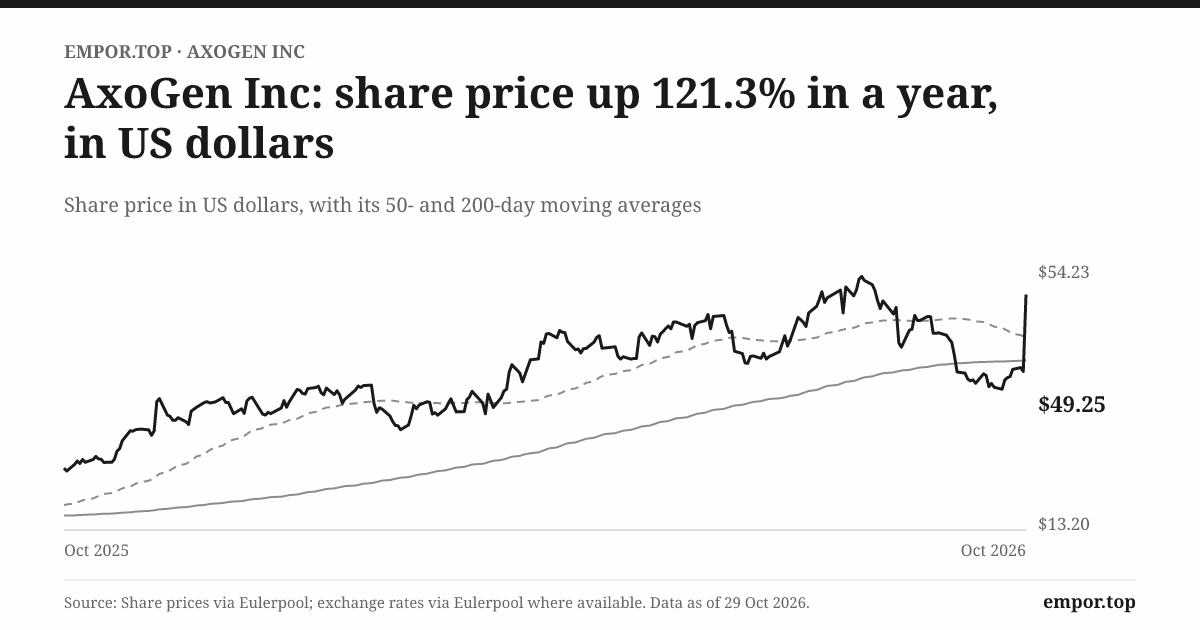
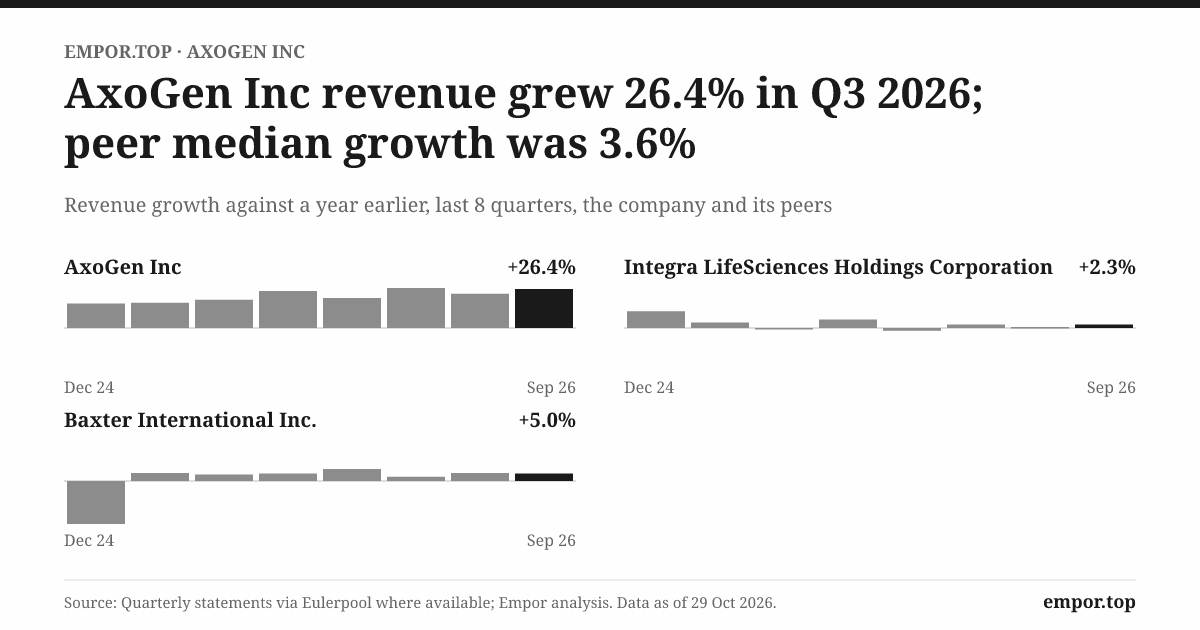
The stakes rose with the share price. AxoGen's revenue reached about $225 million in 2025 and $75.8 million in the third quarter of 2026 alone, up 26.2% from a year earlier.53 On October 29, 2026, the stock closed at $49.25, a little more than 5% below its 52-week high and more than double its 52-week low of about $22.6 Quoted data services put the company's market value at about $2.3 billion and its price at about 8.6 times trailing sales. Those numbers appear to lag the new share count. AxoGen had 59.7 million shares outstanding at the end of September, and 59.7 million times $49.25 is about $2.9 billion, or roughly 11 times the last twelve months of revenue.7
Either way, the market is paying a premium for a company that has not yet produced a year of meaningful profit. That is not a criticism; plenty of great medical-device franchises looked like this before they matured. But it does change what the BioCircuit bet has to prove. A small, cheaply valued company can afford to buy an option. A richly valued one is spending expensive currency, and every new share must eventually carry its weight.
To judge whether it will, the place to start is not the operating room of 2026. It is a much smaller company, a decade earlier, that had to persuade surgeons a box of processed human nerve could replace a piece of their patient's own leg.
 Subscribe on LinkedIn
II. A Small Public Company With a Long Runway—and a Long Loss Record
In the summer of 2013, AxoGen was a company most investors had never heard of. It was headquartered in Alachua, Florida, a town outside Gainesville best known as the home of a university research park. Its amended registration statement, filed in August of that year, told prospective buyers that the company had been approved to list on the Nasdaq Capital Market, the exchange's tier for smaller issuers.8 The company was selling shares because it needed the money. It had a product, a sales force in its infancy and a long list of things to prove.
The product was the strange and clever part. Avance is a processed human nerve allograft: nerve tissue recovered from deceased donors, cleaned of the cells and debris that would trigger rejection, and sterilized so that what remains is the nerve's internal scaffolding.9 Think of it as the empty conduit system of a building after the wiring has been pulled out. Implanted into a gap in a patient's damaged nerve, the scaffold gives the patient's own regenerating nerve fibers a structure to grow along. The underlying technology was licensed exclusively from the University of Florida Research Foundation and the University of Texas at Austin, and AxoGen paid both universities royalties of 1% to 3% on sales.9
Around that core, AxoGen sold a small family of companions. The AxoGuard Nerve Connector and Nerve Protector were made from porcine extracellular matrix, a pig-tissue membrane, and manufactured under contract by Cook Biotech under an agreement dating to 2008.9 The connector helps join nerve ends; the protector wraps a repaired or injured nerve to shield it while it heals. There was even a small sensation-testing tool. It was, in other words, a company that did one thing: surgical products for repairing, protecting and reconnecting peripheral nerves, the nerves outside the brain and spinal cord that let a person feel a fingertip or move a thumb.
The woman running it was Karen Zaderej, who had been promoted from chief operating officer to chief executive in 2010 and would lead AxoGen for roughly fourteen years.10 Her task was less a product launch than a slow campaign of persuasion. At the end of 2014, AxoGen had just 29 direct sales professionals and 23 independent distributors, and it spent about $3 million a year on research and development.9 Revenue that year was about $16.8 million.9
From there, the climb was steep and steady. Revenue grew at more than 23% a year compounded over the decade to 2025, and in the company's early public years it grew by more than half annually.5 By 2025, AxoGen had 138 direct sales professionals in the United States, and the revenue line read $225.2 million, more than thirteen times the 2014 figure.5
The other line on the income statement told a different story. AxoGen lost money in every one of the twelve years from 2014 through 2025. Added together, those annual net losses came to about $227 million.95 Operating cash flow was less bad, because a large share of the losses came from non-cash charges such as stock compensation, but the business still consumed about $118 million of cash from operations over the same years, and after capital spending the cumulative free cash outflow was about $234 million.5
That gap was filled by shareholders and lenders. The company raised equity repeatedly, most dramatically in 2018, when financing inflows exceeded $100 million.5 Cash on hand at the end of 2025, about $35.5 million, was only about $15 million higher than it had been at the end of 2013.5 Twelve years of growth had been paid for, almost dollar for dollar, with outside capital.
None of this makes AxoGen unusual. Building a new category of surgical product means paying for clinical trials, regulatory filings, surgeon training and a sales force long before the revenue covers the bill. What the record does establish is the right question. Revenue growth was never AxoGen's problem. It grew through good years and bad. The question is whether the commercial machine built at such cost can mature into one that earns more than it spends.
For a while, around 2019, it was not obvious that the machine was even working. Growth was slowing sharply, and the company had to decide what kind of sales organization it wanted to be.
III. The 2020 Pivot: Go Deeper With the Surgeons Already There
The slowdown was visible in the arithmetic. AxoGen's revenue growth fell from almost 40% in 2018 to under 28% in 2019, and then to under 6% in 2020, when COVID-19 shut operating rooms across the country.5 Elective and even semi-urgent surgery was postponed. Hospitals barred sales representatives from their buildings. For a company whose entire selling model depended on a rep standing beside a surgeon during a case, the spring of 2020 was close to an existential test.
AxoGen's answer was to not flinch. Management later wrote that it "kept the sales team and broader commercial organization intact" through the pandemic, using the forced downtime for extensive sales training and building remote case-support methods for hospitals that restricted access.11 At the end of 2020, the company had 111 direct sales professionals and 23 independent agencies, and direct sales made up about 87% of product revenue.11 Keeping a costly sales force on payroll while revenue stalled was an expensive bet that the procedures had only been delayed, not lost.
The bet came with a change in emphasis. Rather than chase new hospitals indefinitely, AxoGen leaned harder into accounts where it already had a foothold, especially in extremity trauma, the hand and arm injuries that make up its core market. The company's own definition of an "active account" shows why that was the smarter place to hunt. An account qualifies only after it has passed the hospital's committee approval process, has at least one surgeon who has moved part of their nerve-repair practice to AxoGen products, and has ordered at least six times in the trailing twelve months.11 Getting there is slow. Once there, the next surgeon in the same hospital is much cheaper to win than the first.
In 2020, AxoGen reported 893 active accounts, up 12% from 797 a year earlier.11 That growth, achieved in a year of shuttered operating rooms, suggested the deeper-penetration strategy was taking hold. Over the next five years revenue roughly doubled, from about $112 million in 2020 to $225 million in 2025.5
To understand why account depth matters, it helps to see how a nerve product actually gets used. A hospital is the customer: it signs the contract, approves the product through a value-analysis committee and pays the invoice. The surgeon is the decision-maker: they choose, case by case, whether to reach for Avance, a connector, a wrap, or nothing at all. AxoGen's reps educate surgeons, shepherd the product through committee, and often support the case itself. The company recognizes revenue when control of the product passes to the hospital, at shipment or delivery, and for consigned inventory sitting on a hospital's shelf, only when the product is used or implanted.5 There is no subscription here and no minimum commitment disclosed. Every dollar of revenue is tied to a procedure that a surgeon decided to do with an AxoGen product.
That procedural link explains where the growth came from. In 2024, management attributed revenue growth to about 9 percentage points of unit volume, about 5.5 points of product mix and about 3.3 points of price.12 Volume dominated, which is the healthier answer: it means more surgeons doing more cases rather than the same cases at higher prices. But mix and price together contributed almost as much as volume, a reminder that a meaningful share of growth depended on AxoGen selling more of its pricier products and being able to raise prices at all.
By 2026, the account-depth story had acquired its own metrics. On the third-quarter call, Dale said AxoGen's high-potential accounts generated 61% of year-to-date revenue and 55% of its growth, with productivity in those accounts up 22% year over year; productivity across all accounts rose 22% as well.4 Breast reconstruction was the standout, growing above 60% in the quarter, with about 485 active breast accounts and roughly 590 active surgeons, each up sharply from a year earlier.4 The core extremities, oral and head-and-neck business grew a more modest 10.7% in the quarter, or about 15% after adjusting for a prior-year stocking effect, and Dale guided that business to high single-digit to low double-digit growth going forward.4
That last detail matters more than the headline. The 26.2% third-quarter growth rate was not a uniform surge across the company. It was a fast-growing new market, breast, riding on top of a maturing core. The core is still growing faster than most surgical markets, but it is no longer growing at the rate that defines AxoGen's valuation.
Measured against its own history, the recent pace is impressive. Revenue rose about 20% in 2025 and more than 26% in the third quarter of 2026, both above the company's five-year compound rate of 15% and its three-year rate of about 18%.53 The deeper-penetration strategy has, by the evidence of six years, delivered sustained growth.
What it has not yet delivered is proof of durability. Account counts and productivity growth tell a listener that surgeons are using more product. They do not reveal how many surgeons stop, how often hospitals switch suppliers, or what each account earns after the cost of the rep who serves it. AxoGen does not publish account-level retention or attrition. And the company's selling expenses have grown alongside its revenue, so the payoff from deeper penetration is still mostly visible in sales rather than in profit. The strategy works as a growth engine. Whether it builds a moat is a question that has to be answered in the operating room itself.
IV. What the Surgeon Chooses in the Operating Room
Picture the moment that every AxoGen product is ultimately sold into. A patient arrives with a deep laceration across the palm: a kitchen knife, a power saw, a broken window. The surgeon opens the wound and finds a digital nerve cut clean through, its two ends retracted and frayed. Some tissue has to be trimmed back to healthy nerve, and now there is a gap. The surgeon has a few minutes to decide how to close it.
There are several ways to make that decision, and only some of them involve buying anything. If the ends can be brought together without tension, the surgeon can stitch them directly, which costs nothing beyond suture and time. If the gap is too long, the traditional gold standard is an autograft: harvest a less important sensory nerve from elsewhere in the patient's body, often the sural nerve in the leg, and sew it into the gap. That costs a second incision, extra operating time and a patch of numbness where the donor nerve was taken. Or the surgeon can reach for an off-the-shelf product: a processed allograft like Avance, a hollow-tube conduit, a coaptation aid that helps join the ends, or a protective wrap. Which choice is best depends on the injury, the length of the gap, whether the nerve carries sensation or movement, the surgeon's training and simple habit.5
That is the real competitive field, and it is broader than the list of companies selling nerve products. AxoGen's annual report describes competitors offering hollow-tube conduits, coaptation aids and bioabsorbable wraps, alongside direct suture, autografts, reconstituted bovine collagen and vein or fat wrapping as alternatives.5 Among the companies, Integra LifeSciences is the most familiar name, and AxoGen also faces large, diversified medical-device makers with nerve-repair lines.5 Their size is not the right measure of the threat. Integra's total revenue says nothing about how much of it comes from nerve repair, and none of these companies publishes a reliable nerve-specific market share. The more useful observation is the asymmetry: for AxoGen, nerve repair is the whole company; for its corporate rivals, it is a line item.
That focus is the first pillar of AxoGen's potential edge. The second is evidence. The company has spent years building clinical data, from its RECON study in sensory repair to the more recently published MATCH study comparing Avance with autograft in mixed and motor nerves.54 The third is regulation. The fourth is intellectual property and the exclusive university licenses behind Avance.9 The fifth, harder to measure, is the trained sales force itself: reps who can talk a surgeon through a nerve case are not easily hired away from orthopedics or spine.
The limits are written into the same annual report. AxoGen warns that competitors may bundle nerve products with broader portfolios to win pricing advantages from hospitals, and that alternative treatments may reduce demand for its products.5 Bundling is the classic weapon of the diversified device company. A hospital buying a large basket of surgical supplies from one vendor can be offered a discount that makes the nerve conduit nearly free, and a focused specialist cannot answer with a bigger basket. And the cheapest competitor of all, direct suture, is not going anywhere. On the third-quarter call, management estimated that direct repair accounts for 40% to 50% of transected nerve procedures, which is precisely why it bought NerveTape: to sell into the share of cases where surgeons currently buy nothing at all.4
The economics of the products themselves are attractive. AxoGen kept about 74 cents of every revenue dollar as gross profit in 2025, after the cost of making its products, which is the kind of margin investors usually associate with differentiated medical technology rather than commodity supplies.5 It spent $32.9 million on research and development that year.5 A 74% gross margin is a sign that hospitals pay for something they value. It is not, on its own, proof of pricing power, because gross margin can also reflect a favorable product mix, and AxoGen's mix is shifting.
Then there is the supply chain, which is less glamorous and more consequential than most investors appreciate. AxoGen processes Avance itself, but several of its other products are made by someone else. The Axoguard Connector and Protector line comes from Evergen, the former Cook Biotech, which RTI Surgical acquired in January 2024 and renamed at the end of that year.5 Evergen is also the exclusive contract manufacturer of the Axoguard Nerve Cap and the HA+ Nerve Protector, under agreements that run to 2030.5 The distribution agreement allows for minimum purchases, but the parties have never mutually set or enforced them.5 AxoGen says plainly that losing the ability to sell these products could materially harm its business until replacements were available.5 It does not disclose how much of its revenue or cost of goods depends on Evergen-made products. A company whose moat argument rests partly on owning a focused portfolio does not fully own part of that portfolio.
The inventory tells a related story. At the end of 2025, AxoGen held roughly 267 days of inventory measured against its cost of goods: close to nine months of product sitting in warehouses, consignment shelves and processing lines.5 Some of that is structural. Avance comes from donated tissue in different lengths and diameters, and a surgeon who needs a 50-millimeter graft cannot use a 15-millimeter one, so the company has to stock a wide matrix of sizes across many hospitals. Consignment, where AxoGen keeps ownership of product on a hospital's shelf until it is implanted, adds further days.
But biologic tissue expires, and that turns inventory from a working-capital question into a profit question. Deloitte, AxoGen's auditor, chose the valuation of excess and obsolete inventory as its critical audit matter for 2025, the one area of the financial statements it judged most dependent on difficult estimates: projected distribution, spoilage and expiry.5 The audit opinion itself was unqualified, and the internal-control opinion clean.5 Still, when an auditor points to inventory as the hardest judgment in the books of a company carrying nine months of it, investors should take the hint. On the third-quarter call, the CFO said that lower write-offs had partly offset a 3% increase in product cost, which means write-offs are a lever that moves margins from quarter to quarter.4
The customer side is cleaner. No single customer accounted for 10% or more of AxoGen's revenue or receivables in 2023, 2024 or 2025.5 That fragmentation protects the company from any one hospital system's purchasing decisions, though AxoGen does not disclose what its top five or top ten customers represent, and large group-purchasing organizations can aggregate the bargaining power that individual hospitals lack.
Put together, the competitive picture is clearer than the marketing and murkier than the bulls would like. AxoGen holds a focused, defensible position in a niche it largely created, supported by evidence, regulation and specialized salespeople. That is a real advantage. It is not a cornered market. Surgeons can still choose autograft, direct suture or a rival's conduit; a large competitor can still bundle; a supplier the company does not control still makes part of the portfolio; and the shelf life of its flagship product can quietly consume the profits from growth. The tests that would prove the moat, procedure-level outcomes, repeat use within accounts, realized price and inventory write-offs, are the ones AxoGen discloses least.
The company's biggest effort to change the terms of that competition came not in the operating room but at the Food and Drug Administration.
V. The Approval That Changed the Regulatory Stakes
On December 3, 2025, the FDA approved AxoGen's biologics license application for Avance Nerve Graft.5 For most medical-device companies, a product approval is a starting gun. For AxoGen, it was closer to a finish line it had been running toward for most of a decade, because Avance had been on the market for years before it. The approval did not create the product. It changed what the product legally was, and who else could copy it.
The distinction is technical but important. Human tissue that is minimally processed can be sold under a lighter regulatory framework than drugs or biologics. As AxoGen's processing and claims for Avance advanced, the FDA concluded that the graft needed to be regulated as a biologic, which meant a full biologics license application supported by clinical evidence, much as a drug company would file. The company planned its entire manufacturing footprint around that requirement; the processing center it built in Ohio was designed to be part of the filing.11 The clinical programs, the facility and the regulatory staff were the price of keeping Avance on the market and, AxoGen hoped, of building a wall around it.
The wall is real. AxoGen believes the approval gives Avance 12 years of U.S. exclusivity against biosimilars that use it as the reference product.5 And a rival that wanted to bring its own processed nerve allograft to market without copying Avance would, by the company's estimate, need to complete Phase I, II and III studies, a process AxoGen thinks would take at least eight years.5 In plain terms, anyone who wants to sell a competing processed human nerve graft in America now has to do roughly what AxoGen did, and that took most of a decade.
But the approval came in two tiers, and the second tier is where the bar was raised rather than cleared. The FDA granted traditional approval for sensory nerve gaps up to 25 millimeters, in adults and children from one month old.5 For longer sensory gaps and for mixed and motor nerves, the ones that control movement, it granted accelerated approval, based on extrapolation from the sensory results of the RECON study.5 Accelerated approval is a conditional yes. Continued approval for those indications depends on a confirmatory post-marketing study comparing Avance with nerve autograft, which must be completed by December 5, 2030, with a final report due in June 2031.5
That study design is worth pausing on, because it pits Avance against the procedure surgeons consider the gold standard. Autograft has the advantage of being the patient's own living nerve. Avance's advantage is that it spares the patient a second wound and the numbness that follows. If the trial shows Avance performing comparably, AxoGen's case in motor and long-gap repair becomes much stronger. If it falls short, the company could lose the indications where the clinical need is greatest. Either way, the regulatory story is not finished; it has five more years to run.
The commercial payoff from the approval arrived through insurers. Health plans are often reluctant to pay for products they consider experimental, and for years AxoGen's reps fought coverage denials case by case. The BLA, along with the company's accumulating evidence, gave payers less reason to say no. By the third quarter of 2026, commercial payer coverage for Avance reached about 96% of covered lives in the United States, with Elevance and Aetna among the recent positive decisions.3 Management said about 87.6 million lives had been added since the second quarter of 2025, and described the milestone as near-universal coverage.4 Elevance removed a gap-length restriction in August; Aetna extended coverage in early October to upper-extremity sensory gaps of 30 millimeters or less.4
Covered lives are not procedures, though, and procedures are not profit. Coverage means a surgeon who wants to use Avance is less likely to have the claim denied. It does not mean the surgeon wants to. Nor does it settle the price at which the hospital buys. The useful evidence is what happened to demand after coverage improved, and here the record is encouraging but short. AxoGen reported that account productivity grew more than 20% year over year, and it named improving commercial coverage and payment among the drivers of its growth.3 Avance rose to about 64% of revenue in the third quarter, up from about 60% in 2025.4 Asked by a Leerink analyst on the third-quarter call to quantify the impact of the commercial coverage wins, Dale said it was "very difficult to quantify."4 On Aetna specifically, the company's reimbursement head declined to break out the share of procedures affected.4 Those answers were honest, and they were also a reminder that the link between coverage and demand is still mostly an inference.
The approval and coverage also changed where AxoGen points its sales force. The company estimates the total U.S. opportunity in peripheral nerve injury at no less than $5.6 billion, of which extremity trauma is at least $2.9 billion, oral, maxillofacial and head and neck at least $1.2 billion, breast reconstruction neurotization at least $677 million, and urology about $754 million.5 These are management's estimates of addressable spending, not markets AxoGen has won. Against them, AxoGen's 2025 revenue of $225 million was roughly 4% of its own estimate of the opportunity.
The newest frontier is prostate surgery. Men who undergo radical prostatectomy often lose erectile function and continence when the nerves around the prostate are damaged or removed, and AxoGen believes nerve grafting can restore some of that function. On the third-quarter call, management said more than 220 patients had been treated at 15 sites, that 117 had at least six months of follow-up with no graft-related complications reported, and that surgeons reported about 80% of those patients achieving better-than-expected erectile recovery.4 These are early, surgeon-reported results, not a controlled trial. Market development is planned for 2027, and the company has excluded prostate from both its current and long-range guidance.34
That exclusion is the right discipline, and it should be the reader's discipline too. AxoGen's history is a long, patient conversion of clinical evidence and regulatory work into revenue, one indication at a time. Breast reconstruction shows the conversion can be fast once it starts. Extremities show it eventually matures. Prostate is still a set of encouraging case reports. The BLA opened the door wider than ever. Walking surgeons through it costs money, and AxoGen had already spent heavily to build the house.
VI. The Cost of Building the Platform
For most of its life, AxoGen did not process its own flagship product. Avance was prepared at a tissue-processing facility operated by Community Tissue Services in Dayton, Ohio, under an agreement that was scheduled to end on December 31, 2022.11 If AxoGen wanted to control its supply, and to include its own facility in the biologics filing the FDA required, it needed a factory of its own.
So it built one. AxoGen renovated a 107,000-square-foot building on about 8.6 acres near the Community Tissue Services site in Dayton.11 The company expected state and local economic incentives to help, though not enough to offset the cost.11 In 2023, it transferred Avance processing and packaging into the new Axogen Processing Center.12 Capital expenditure that year reached $13.9 million, about 8.7% of revenue, and the company capitalized $5.3 million of debt interest into the project.125
This was a capacity decision with long consequences. By owning processing, AxoGen took direct responsibility for yield, quality and the cost of turning donated tissue into sellable grafts. It also took on a fixed cost base that only pays off when volume grows into it. The balance sheet shows the scale of the commitment: net property, plant and equipment rose from about $18 million at the end of 2019 to about $104 million at the end of 2023.5
Once the factory was built, capital intensity collapsed. Capital spending fell to $3.1 million in 2024 and $3.7 million in 2025, each about 1.7% of revenue.125 The heavy lifting had been done, and the company now had the processing capacity it believed could support its growth plans.
But reinvestment did not stop. It changed form. Instead of steel and clean rooms, AxoGen began spending on people and evidence. Research and development rose from $27.3 million in 2023 to $32.9 million in 2025, though as a share of revenue it fell from about 17% to under 15%.125 Roughly half of 2025 R&D went to product development and half to clinical trials, including the confirmatory study the FDA now requires.5 Headcount rose from 452 at the end of 2024 to 622 at the end of 2025, an increase of nearly 38%, while revenue rose about 20%.5
That mismatch is the operating-leverage question in a single comparison. When the workforce grows almost twice as fast as revenue, the business is investing ahead of demand, building the reps and clinical staff it thinks it will need for breast, oral surgery and, eventually, prostate. The investment may prove wise. In the meantime, it pushes profit further out.
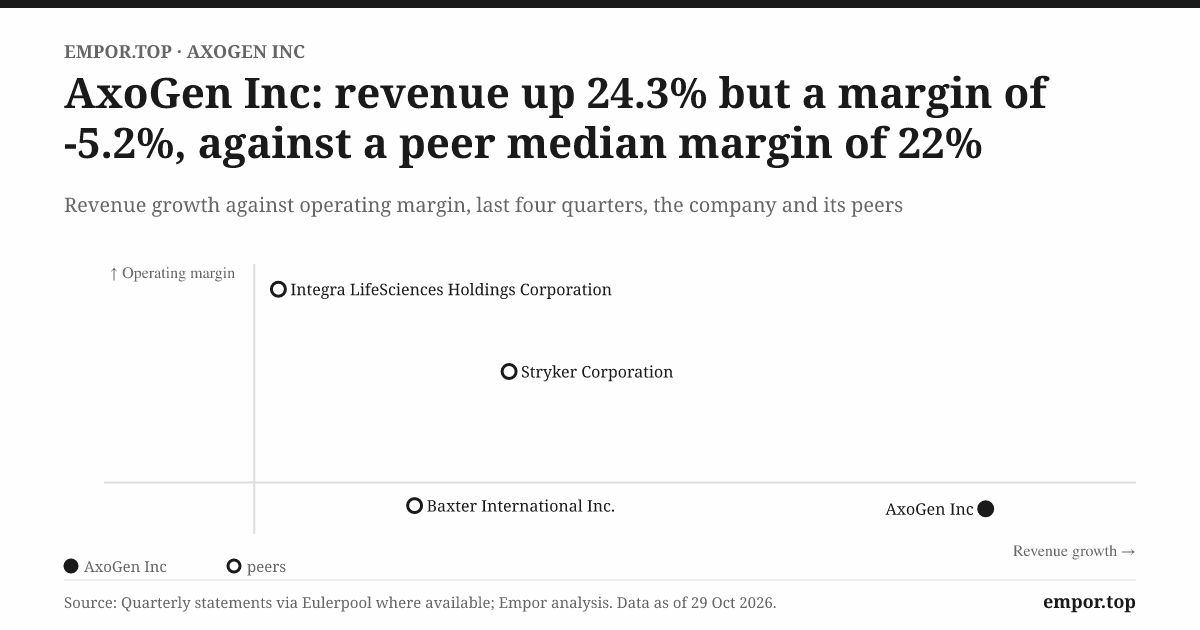
The margin history makes this concrete. AxoGen's operating loss was around $30 million in 2022, an operating margin of about minus 21%.5 Then it narrowed dramatically, to just $3.3 million in 2024, as revenue growth outpaced cost growth after the factory build.5 For a moment, the company looked close to operating breakeven. Then, in 2025, the operating loss widened again, to $7.8 million, a margin of about minus 3.5%.5 The fourth quarter of 2025 alone produced an operating loss of roughly $10 million, swollen by stock compensation tied to the BLA milestone.5 Over the twelve months to September 2026, operating losses totaled about $14 million.75
The 2026 quarters require careful reading. In the third quarter, AxoGen reported GAAP net income of $2.3 million, or 4 cents a share.3 A listener could easily mistake that for a turning point. But the first nine months of 2026 produced a net loss of $18.8 million, largely because of a $16.8 million loss on extinguishing debt in the first quarter.3 The third-quarter profit also benefited from investment income on the cash raised from new shareholders, about $1.4 million, which had nothing to do with selling nerve grafts.7 Operating profit in the quarter was under $1 million.7
Look under that operating line and the drivers of cost come into focus. Operating expenses in the third quarter were $55.8 million, up from $44.1 million a year earlier.4 The CFO, Lindsey Hartley, attributed the increase to compensation, performance stock awards tied to above-target revenue, and about $2 million of BioCircuit deal costs.4 Sales and marketing actually fell as a share of revenue, to 40% from 42.7%, which is genuine evidence of selling leverage.4 General and administrative expense, meanwhile, rose about 52%, to $16.5 million.4 The leverage AxoGen is gaining on its sales force is being spent on overhead and equity compensation.
Gross margin is also moving the wrong way, at least for now. It was 74.8% in the third quarter, down from 76.6% a year earlier, and the company expects fourth-quarter gross margin to fall below the second quarter's 72.7% as it adjusts production toward the long-length Avance grafts that breast reconstruction demands.34 Hartley said 2027 gross margin should be similar to 2026, because pricing and yield improvements will take time to reach cost of goods.4 The fastest-growing market, in other words, is diluting the margin of the core product, at least until the factory learns to produce long grafts more efficiently.
The factory, then, did its job: AxoGen controls its flagship product's processing and no longer needs heavy capital spending to grow. What it did not do is make the company profitable. The reinvestment has moved from buildings to people, clinical trials and stock awards, and those costs grow every year. The payoff is still in the future, and the company's path toward it took a sharp financial turn in 2026.
VII. January's Debt Payoff, September's Acquisition
Michael Dale arrived at AxoGen in August 2024 with more than four decades in medical devices behind him.13 His résumé read like a tour of American cardiovascular and neurological technology: executive roles at Abbott Structural Heart, St. Jude Medical, Cyberonics, Endocardial Solutions, ATS Medical and American Edwards Laboratories, plus chief-executive posts at smaller companies including GI Dynamics and Helical Solutions.1310 He had sat on the boards of Neuronetics, NeoChord, Rhythmia Medical and the industry association AdvaMed, and he still advises Purdue University's biomedical engineering school.13 It was the profile of an operator who had seen both the big-company way of commercializing devices and the venture-backed scramble to make one product work.
His appointment ended a long transition. Karen Zaderej had agreed in January 2024 to step down, and the board had said it expected a new chief executive by January 2025; Dale's start in August 2024 came earlier than planned.1014 Paul Thomas became chairman at the same time.14 A year later, the company promoted Lindsey Hartley, a certified public accountant who had joined in 2021 as corporate controller after finance roles at VERO Biotech and a stint at Ernst & Young, to chief financial officer.13
The capital-allocation record of the Dale era so far comes down to two decisions, eight months apart. The first was getting rid of an expensive loan.
AxoGen had borrowed from Oberland Capital, a specialty lender to health-care companies, under a facility with $50 million of principal outstanding at the end of 2025.5 The headline interest rate understated the cost. Oberland also took a revenue-participation payment, a slice of AxoGen's sales, and the loan carried quarterly revenue covenants and was secured by substantially all the company's assets.5 All in, the effective interest rate was about 11.59%.5 For a company that had just won a biologics license and expected rising revenue, a lender with a cut of every sale was an increasingly expensive partner.
In January 2026, AxoGen sold 4.6 million new shares at $31 each, raising about $133.3 million after costs.7 On January 28, it paid Oberland $69.7 million to retire the facility.75 That was almost $20 million more than the principal, and the company booked a $16.8 million loss on extinguishment, the same charge that turned the first nine months of 2026 into a GAAP loss.3 The early exit was costly. It was also logical. By the third quarter, quarterly interest expense had fallen to about $1,000, the covenants were gone, and the revenue participation no longer skimmed off a share of growth.7
The trade-off was dilution. The loan payoff converted costly debt into equity, and the shareholders who held AxoGen before January now owned a smaller share of a company with no term debt. Whether that was a good trade depends on what the shares were worth. At $31, the January price was well below where the stock traded by October, which means AxoGen sold equity cheaply in hindsight. That is easy to say after the fact; at the time, it bought balance-sheet freedom.
The second decision was BioCircuit. Here the logic is strategic rather than financial. The strategic logic is to sell NerveTape into the direct-repair cases AxoGen has identified as an opportunity.4 The fit with AxoGen's existing sales force, which already calls on the same hand and plastic surgeons, is obvious.
There is one oddity in the announcement worth noting. AxoGen's press release called NerveTape the "first FDA-approved device" of its kind in one passage, while BioCircuit's own description called it "FDA-cleared."1 The difference matters: clearance usually means a device was shown to be substantially equivalent to existing products, a lower bar than approval. Either way, a regulatory green light is not commercial traction, and the evidence of traction is thin. AxoGen has not disclosed how many surgeons use NerveTape, and on the third-quarter call, Dale said adoption was too early to measure.4
How should an investor benchmark the $200 million? The cleanest number available is management's own projection. Answering a Wells Fargo analyst, Hartley said the $34 million of 2027 NerveTape sales the company had discussed was incremental, net of any cannibalization of AxoGen's existing Connector product.4 If that figure is realized, AxoGen paid roughly six times forward sales, which is cheaper than the multiple the market assigns to AxoGen itself. That is the bull's arithmetic: buy revenue at six times, own it inside a company valued at ten. But it rests on a projection, not a history, and the projection depends on AxoGen's sales force rapidly expanding a product BioCircuit sold through a much smaller distribution network.4 The 2026 contribution of at least $7 million for one quarter implies a run rate below the 2027 projection, so growth has to accelerate immediately.
The accretion claims also need careful reading. AxoGen said the acquisition would be accretive to revenue growth, adjusted EBITDA margin and adjusted earnings per share in its first year, and to gross margin in 2027.1 Every one of those measures excludes the costs that a GAAP shareholder ultimately bears. Adjusted EPS leaves out stock compensation and acquisition amortization. The purchase accounting was incomplete at the time of the third-quarter filing, and Hartley warned that higher amortization and a possible inventory step-up could weigh on fourth-quarter results.47 An inventory step-up is an accounting rule that marks acquired inventory up to fair value, so the first products sold after a deal carry an artificially high cost and a thin margin.
The share count makes the test sharper. AxoGen's shares outstanding rose from 44.1 million at the end of 2024 to 59.7 million by September 2026, about 35% more by then.57 The two 2026 offerings account for most of that, and stock compensation for much of the rest. BioCircuit alone required nearly six million new shares. For the acquisition to earn its cost per share, NerveTape revenue has to grow fast enough, and at a high enough margin, to justify roughly a tenth of the company's equity.
A skeptical investor would ask four questions. What revenue would BioCircuit need by 2028 for its gross profit to cover the cost of the shares issued, at AxoGen's own multiple? What will integration cost, in new reps, training and lost focus on Avance? How much NerveTape revenue will simply replace Connector revenue the company was already earning, given that management declined to put a number on cannibalization?4 And what is the GAAP, not adjusted, per-share contribution once amortization and step-up are fully absorbed? AxoGen has given partial answers to the first and none to the last.
Dale's own incentives point in the right general direction, though they do not settle any of these questions. His total reported compensation was $9.05 million in 2025, of which $7.34 million was stock awards, including performance shares that vested on the Avance BLA approval.13 His 2025 cash incentive was about $0.91 million.13 Pay that vests on a regulatory milestone rewards a real achievement, but it rewards the approval, not what the approval earns. Directors and executive officers as a group owned about 2.4% of the company in the 2026 proxy; Dale personally held 63,537 shares as of April 2026, well under 1%.13 That is modest alignment for a chief executive whose company issued more than ten million new shares in a single year.
The verdict on Dale's capital allocation is therefore split. Repaying Oberland removed a genuinely expensive financing constraint, and paying a premium to do so was a defensible price for freedom. BioCircuit fits the core business strategically and may prove cheap if management's projection holds. But both decisions were financed with stock, at a pace that makes per-share results, not company-wide results, the right scoreboard. That scoreboard depends ultimately on whether the business produces cash, and AxoGen's cash story has been more complicated than its revenue story.
VIII. The Cash Test Behind the Growth Story
The cleanest snapshot of AxoGen's cash problem is the last day of 2025. For the full year, the company reported a GAAP net loss of $15.7 million.5 Its operating cash flow, the money actually generated by running the business, was $0.8 million.5 After capital spending, free cash flow was about minus $4.8 million.5 A company with $225 million of revenue and a 74% gross margin produced almost no cash.
The puzzle is why the cash and the accounting loss diverged at all, and then why the cash was still so weak. The first half of the answer is non-cash charges. AxoGen recorded $30.1 million of stock-based compensation in 2025, plus about $6.7 million of depreciation and smaller amortization items.5 Those expenses reduce reported profit without consuming cash, which is why operating cash flow ran ahead of net income.
The second half of the answer is working capital, the cash tied up in running the business day to day. In 2025, it went the wrong way. The company said operating cash fell $3.7 million year over year because of a $13.9 million adverse change in working capital and a larger net loss, partly offset by $16.6 million of higher non-cash charges.5 Inventory grew, receivables grew, prepaid expenses grew, and payables shrank.5 Each of those moves locks up cash. Stock compensation softened the accounting loss; working capital swallowed the cash.
The receivables side of the ledger is genuinely healthy. Customers took about 42 days to pay at the end of 2025, down from around 66 days a decade earlier and a peak of 72 in 2016.59 The allowance for doubtful accounts was under $1 million against more than $26 million of receivables, and the 2025 provision was about $0.4 million.5 AxoGen sells on unsecured credit terms and has reported no material losses on receivables.5 It does not publish aging buckets or overdue-balance history, so the quality of the receivables can be inferred only from their speed and the small allowance. Both point the same way: hospitals pay AxoGen reliably.
The inventory side is where the cash goes. The roughly 267 days of inventory described in the operating-room chapter are not just a margin risk; they are a cash commitment. And in 2025, the company lost the cushion that had once offset it. Payable days, the time AxoGen takes to pay its own suppliers, fell from about 64 days at the end of 2024 to about 18 days at the end of 2025.5 Combine fast-paying customers, slow-turning inventory and suppliers paid almost immediately, and the cash conversion cycle, the number of days between paying for inventory and collecting cash from a sale, stretched to about 292 days, up from about 168 at the end of 2023.5 For every dollar of extra revenue, AxoGen has to fund close to ten months of working capital before it sees the cash.
Then came 2026, and the picture changed sharply. For the first nine months, operating cash flow was $25.3 million, against minus $2.2 million in the same period of 2025; free cash flow was $18.9 million against minus $5.9 million.3 The company reiterated its guidance for positive free cash flow for the full year.3 On the surface, this looks like the moment AxoGen's growth began funding itself.
It may be. But three things complicate the comparison. The first is the debt-extinguishment loss, a $16.8 million charge that depresses net income without touching operating cash, which makes the gap between profit and cash look wider than the underlying business would suggest.3 The second is stock compensation, which rose further in 2026 with performance awards tied to above-target revenue.4 When a company pays its people more in stock, it preserves cash today and dilutes shareholders tomorrow; operating cash flow looks better precisely because some of the bill has been moved to the share count. The third is interest. With the Oberland loan repaid and $350 million of cash, restricted cash and investments on the balance sheet at the end of September, AxoGen now earns investment income instead of paying interest, and that flows straight into operating cash.37 Some of the 2026 cash improvement, in other words, is the dividend from the share offerings rather than from the nerve business.
There is also a concentration wrinkle in that cash pile. At September 30, about $328 million of AxoGen's cash was uninsured or held above federal deposit insurance limits, though the company describes its investments as primarily Treasuries and corporate bonds and its cash equivalents as money-market funds.7 And after October 1, about $200 million of it left for BioCircuit.3
The fair reading is that 2026 marks real progress. Operating cash is clearly positive, the expensive debt is gone, and receivables are collected quickly. But nine months is not a year, and the most important cash variable, inventory, has not yet been tamed. The milestone to verify is full-year 2026 free cash flow alongside year-end inventory days and write-offs. If cash improves while inventory days fall, AxoGen's growth has begun to pay for itself. If cash improves only because of stock pay and interest income while inventory keeps building, the business is still consuming capital, just less visibly.
That distinction matters most because of what the market has already decided to pay.
IX. What the Multiple Already Assumes
On October 29, 2026, AxoGen's stock closed at $49.25.6 In twelve months, the market had re-rated the company from a cheap, struggling specialist to one of the more richly valued small medical-device stocks. The question is what that price assumes.
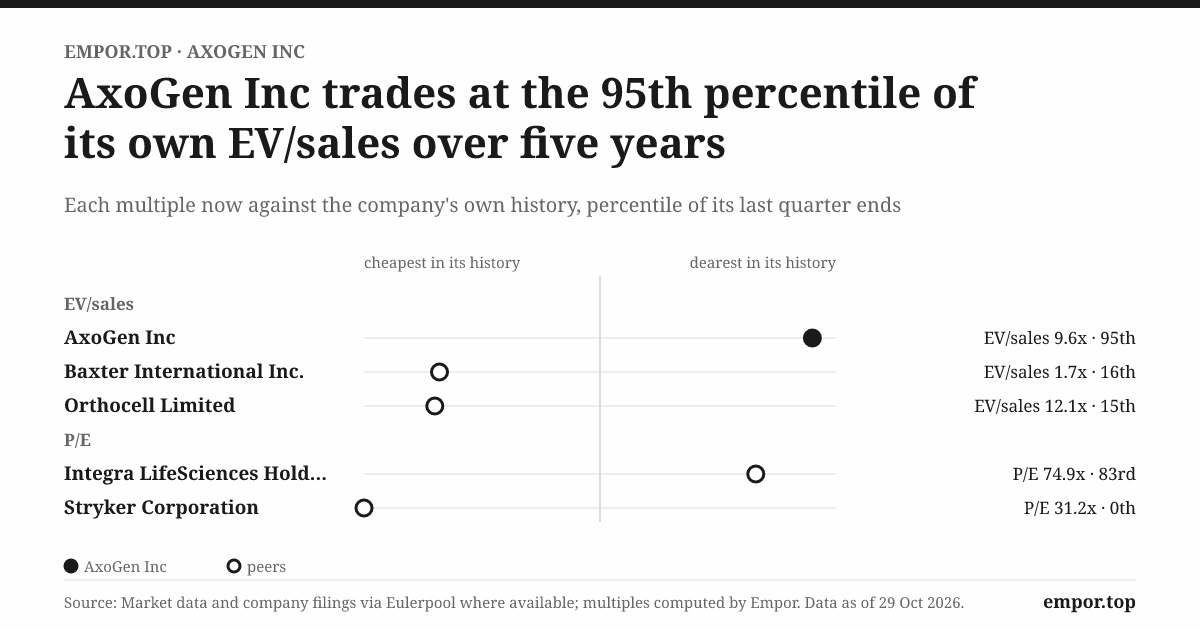
Start with the scale. Quoted data-service figures lagged the September share offering.6 At 59.7 million shares, AxoGen's equity is worth about $2.9 billion, roughly 11 times its trailing twelve months of revenue of about $265 million.7 Subtract the cash left after the BioCircuit payment, roughly $150 million, and the enterprise value is close to $2.8 billion, or about ten and a half times trailing sales.37 Whichever version a listener prefers, AxoGen trades at a sales multiple that historically belongs to companies with either very high growth or established profits.
Against its own history, the shift is dramatic. One data provider's series shows AxoGen's enterprise value at roughly 2 to 4 times sales between 2021 and 2024, rising to about 7 times at the end of 2025 and above 11 times in October 2026.6 Different providers compute these figures differently, so the exact numbers should not be spliced into a single trend line. But the direction is unmistakable: the market is paying three to five times more per dollar of AxoGen revenue than it did before the BLA.
A price-to-earnings ratio, the usual anchor for valuation, is no help here. AxoGen's trailing earnings per share were about minus 64 cents, so there is no positive earnings base to divide into the price, and no five-year median P/E against which to compare it.57 Trailing operating loss was about $14 million.57 Investors are therefore not paying for current earnings at all. They are paying for an expectation of future ones.
Peer comparisons offer limited help, for reasons the competitive picture already made clear. Integra LifeSciences, the most obvious name, traded at about 1.7 times enterprise value to sales in a healthcare M&A survey in early 2026.15 But Integra is a broad device company whose nerve products are a small part of a large portfolio, and the dates and bases of the two figures differ. The comparison shows only that the market values AxoGen as a growth story, not as a medical-supply business. There is no clean public pure-play peer in peripheral nerve repair to anchor the multiple.
What would have to be true to justify the price? A rough worked example helps. If AxoGen's revenue kept compounding at the 20% to 25% it has recently achieved, it would approach $600 million around the end of the decade. A mature specialist medical-device company with a gross margin in the low-to-mid 70s might earn an operating margin of 20% to 25%. That would mean operating profit of perhaps $120 million to $150 million. At today's enterprise value, the market is paying roughly 20 times that hypothetical future operating profit, before accounting for further dilution from stock compensation. That is not an outrageous number for a high-quality device franchise, which is why the valuation is defensible to the bulls. But every link in that chain, sustained growth, expanding margins and per-share discipline, is an assumption rather than a fact. AxoGen has never produced a full year of meaningful GAAP operating profit.
So the multiple has already priced in a great deal of execution. It assumes the core business keeps growing well into double digits, the breast and oral markets keep expanding, BioCircuit hits its projection, gross margins hold up through the long-graft transition, and the company finally converts its operating leverage into profit and cash. None of those has to fail for the stock to disappoint. Some of them only have to arrive late. The bull and bear cases are, at bottom, arguments about how many of those assumptions AxoGen can deliver, and how quickly.
X. Analysis & Bear vs. Bull Case
Lay AxoGen's third quarter of 2026 on the table and it looks like a company hitting its stride. Revenue was up 26.2% to $75.8 million, gross margin was 74.8%, adjusted EBITDA reached $13.4 million, and management raised its full-year outlook to at least $290 million of revenue, including at least $7 million from BioCircuit.3 Commercial coverage for Avance had reached about 96% of covered lives in the United States.3 Beside those numbers sit the unresolved ones: a single quarter of thin GAAP profit, a full year of cash conversion still unproven, a share base 35% larger than two years earlier, and a stock priced for success. Both readings are true at once. The work is deciding which one the evidence favors.
Start with the structure of the industry, because it determines how much of AxoGen's growth it can keep. The buyer is a hospital, but the chooser is a surgeon, and that split is the single most important fact about AxoGen's market. Hospitals have purchasing power, especially when they buy through large group-purchasing organizations, and they can push for discounts or bundled deals. But no single hospital customer accounted for even a tenth of AxoGen's revenue in the last three years, so no buyer can dictate terms company-wide.5 Surgeons, meanwhile, care more about outcomes and convenience than about price, and once a surgeon is trained on a technique and the hospital has approved the product, both have reasons not to switch. Buyer power is real but fragmented.
Supplier power is more concentrated than it looks. AxoGen depends on Evergen for several Axoguard products, and on donated human nerve tissue for Avance.5 A disruption at either point would hit sales directly. The threat of new entrants is low for processed nerve allografts, thanks to the BLA's exclusivity and the years of evidence AxoGen estimates a rival would need to build, but higher for synthetic conduits and wraps, which follow a lighter regulatory path.5 The threat of substitutes is the force that never goes away: direct suture and autograft cost nothing to buy, and AxoGen's estimate that direct repair covers 40% to 50% of transected nerve cases shows how much of the market still chooses them.4 Rivalry among branded competitors is moderate. Integra and the diversified device companies compete, but nerve repair is a sideline for them, and the most aggressive risk they pose is bundling rather than head-to-head innovation.5
Through the lens of Hamilton Helmer's seven powers, the sources of durable advantage, AxoGen's case rests on three. The first is cornered resource, in its regulatory form. The Avance BLA and the expected 12-year biosimilar exclusivity give AxoGen something no competitor can buy quickly: the only approved processed human nerve allograft in the United States.5 That is the strongest, most verifiable power in the story, though accelerated approval for motor and long-gap indications makes part of it conditional on the 2030 confirmatory study. The second is switching costs. A surgeon who has learned Avance's handling and a hospital that has run it through committee face real friction in changing, and the growth in account productivity suggests surgeons deepen their use over time.4 But AxoGen publishes no retention data, so this power is plausible rather than proven. The third is a modest form of scale in a niche. A dedicated sales force, plus clinical evidence and reimbursement expertise, is expensive to replicate for a competitor that sees nerve repair as a small market.5 That is less a classic scale economy than a focus advantage, and it could erode if a large company decides the market is now big enough to fight for.
The other powers are mostly absent. AxoGen has no network effects, no counter-positioning that incumbents cannot copy, and no process power visible in its margins, which are under pressure from the long-graft transition. Branding, in the sense of surgeon loyalty, may exist, but it is measured only through the same productivity figures that also reflect sales effort. The honest verdict is that AxoGen has one strong and defensible power, regulatory exclusivity, and two weaker ones that are developing but not yet demonstrated. That is a respectable foundation. It is not a fortress.
The bull case gives that foundation its full weight. Revenue has compounded at about 18% over three years and 15% over five, and it has accelerated in 2026.5 The BLA approval and near-universal commercial coverage remove two of the barriers that slowed adoption for a decade.3 Account productivity is rising more than 20%, suggesting surgeons who already use the product are using more of it.3 Breast reconstruction is growing above 60% in a quarter, oral and head-and-neck surgery offer further runway, and prostate is a potential new market that management has kept out of its guidance.4 Gross margins in the mid-70s mean that each extra dollar of revenue, once operating costs stop growing as fast, should drop heavily to profit. And BioCircuit, if it hits management's projection, adds a product for the very cases AxoGen currently cannot address. The bull believes AxoGen is at the moment where years of investment begin to pay off.
The bear case does not claim the growth is fictional. It claims the growth has never been converted into profit, and may not be. The company lost money in every year from 2014 through 2025, and cumulative losses reached about $227 million.5 In 2025, with $225 million of revenue, it generated less than $1 million of operating cash.5 Inventory remains a major cash and valuation risk.5 Part of the portfolio depends on an outside supplier.5 Shares outstanding have risen sharply, and stock compensation keeps adding more.7 And the stock trades at roughly ten times sales, a price that leaves little room for delay. The bear believes AxoGen is a well-run growth company whose valuation has run ahead of its economics.
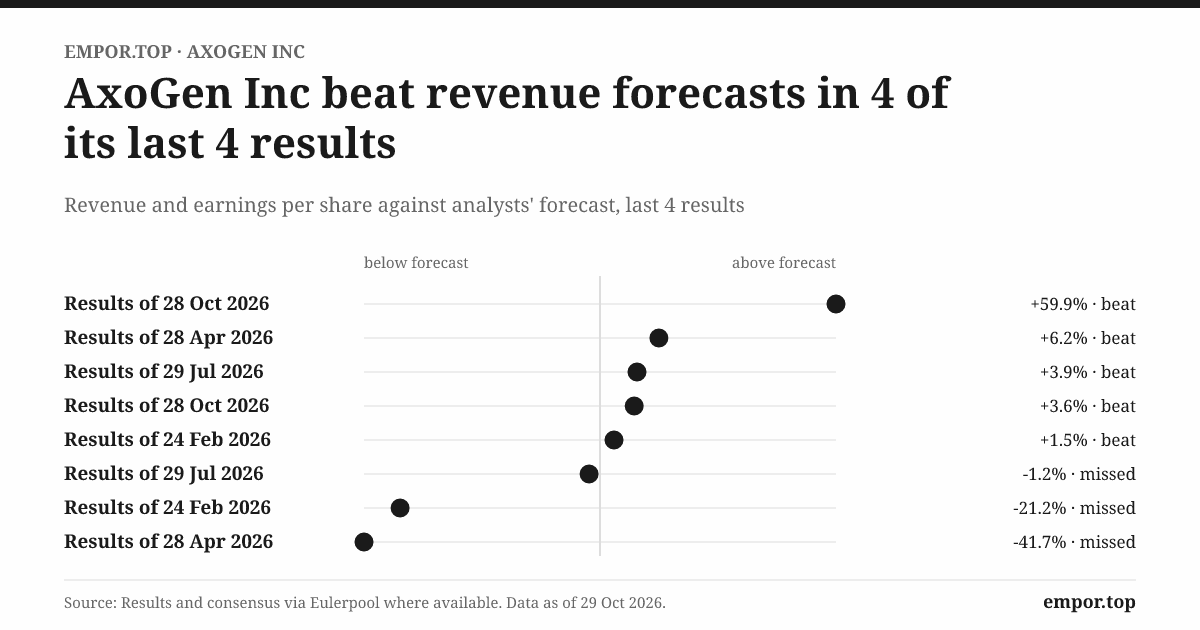
Management's credibility is part of how a listener should weigh those two cases, and the record of 2026 is better than average. In July, after the second quarter, AxoGen guided to full-year revenue of at least $279 million, growth of at least 24%.16 In October, it raised organic guidance to at least $283 million and growth of at least 26%, before adding BioCircuit.3 That is a company beating its own targets, not walking them back. The company also excluded prostate from guidance and said it assumed no material new payer benefits beyond those already known, both signs of conservative target-setting.4
The Q&A tells a more mixed story. When a Jefferies analyst calculated that the guidance implied about 27% organic growth in the fourth quarter, management neither confirmed nor rejected the figure, offering a general answer about seasonality.4 Asked how much NerveTape would cannibalize the existing Connector line, Hartley said the effect was modeled in guidance but that the company was "not going to guide to the exact amount."4 Asked about the size of the NerveTape surgeon base, and about which lever would matter most for the device, Dale offered enthusiasm rather than data.4 On hiring, management said headcount would keep growing in 2027 but gave no pace.4 Those are not evasions of the kind that should alarm a shareholder; they are the normal reticence of a company that has just closed an acquisition. But they leave the most important questions about BioCircuit's economics unanswered at precisely the moment shareholders have paid for it.
A second credibility question concerns how AxoGen presents its profits. The company emphasizes adjusted EBITDA and adjusted net income, which exclude stock compensation and acquisition costs. Adjusted net income was $13.1 million in the third quarter against GAAP net income of $2.3 million.3 The gap is mostly stock compensation, which in 2026 included performance awards tied to revenue exceeding targets.4 Stock pay is a real cost to shareholders, paid in dilution rather than cash. When the adjusted and GAAP figures diverge by a factor of nearly six, the GAAP figure is the one that tells a listener what the business actually earned per existing share.
Governance signals are calm but worth watching. At the June 2026 annual meeting, the say-on-pay resolution passed with about 38.6 million votes for and 1.4 million against, an improvement on the roughly 90% support of the prior year.1713 Kathy Weiler received the most withheld votes among directors, about 3.8 million.17 The board has an independent chair, and all audit-committee members meet Nasdaq and SEC independence standards.13 There are no disclosed related-party dealings of consequence; the one related party is the Global Nerve Foundation, a nerve-injury charity to which AxoGen contributed $100,000 in 2025.5 The shareholder base is institutional: First Light Asset Management held about 11.2% and BlackRock about 6.3% in the April 2026 proxy, and Vanguard reported just under 5% in July.1318 Dissent on pay is modest and declining, but with this much equity compensation flowing through the share count, it is a number to keep watching.
The risks are best understood through their mechanisms. The confirmatory trial could fail to show that Avance matches autograft for motor and long-gap repair, which could narrow the label and weaken payer coverage for the cases where clinical need is greatest. An Evergen disruption could interrupt supply of Axoguard products until a replacement manufacturer was found. Inventory expiry could force write-offs that erase the margin from growth, and inventory growth could consume the cash the business generates. Dilution, from stock pay and further deals, could offset business growth on a per-share basis. And BioCircuit could fail to deliver the margins and incremental revenue that management has projected, particularly if NerveTape mostly replaces sales AxoGen was already making. Small exposures, such as grant clawback provisions of up to about $1 million tied to job-creation targets, do not change the picture.7
Out of all the numbers AxoGen reports, three matter most for tracking whether the bull or bear case is winning. The first is organic revenue growth together with account productivity: both were rising in the third quarter.34 The second is GAAP operating margin, which turned positive in the third quarter after years of losses, but was barely above zero.7 The third is full-year operating and free cash flow alongside inventory days: free cash flow improved sharply in the first nine months of 2026, while inventory days were about 267 at the end of 2025, flat on a year earlier.35 If all three move the right way at the same time, the bull case is being proven. If revenue keeps rising while the other two stall, the bear case is.
The overall verdict is that the bull case has identifiable drivers, while the moat is narrower than the valuation implies. AxoGen's regulatory exclusivity is real; its switching costs and focus advantage are plausible but undisclosed in any measure that would prove them. The history does not reject the growth story. It narrows the profit story to a smaller, unproven claim: that a company which has never sustained operating profit is now about to. That claim will be tested, quarter by quarter, in the next two years.
XI. Playbook: Business & Investing Lessons
Go back to the hospital where AxoGen's account story starts: a surgeon who has finally moved part of their practice to Avance, a value-analysis committee that has finally said yes, and a sixth order in twelve months that finally makes the account "active." That moment took years to reach. Everything AxoGen has built since depends on it repeating, thousands of times, in hospitals across the country.
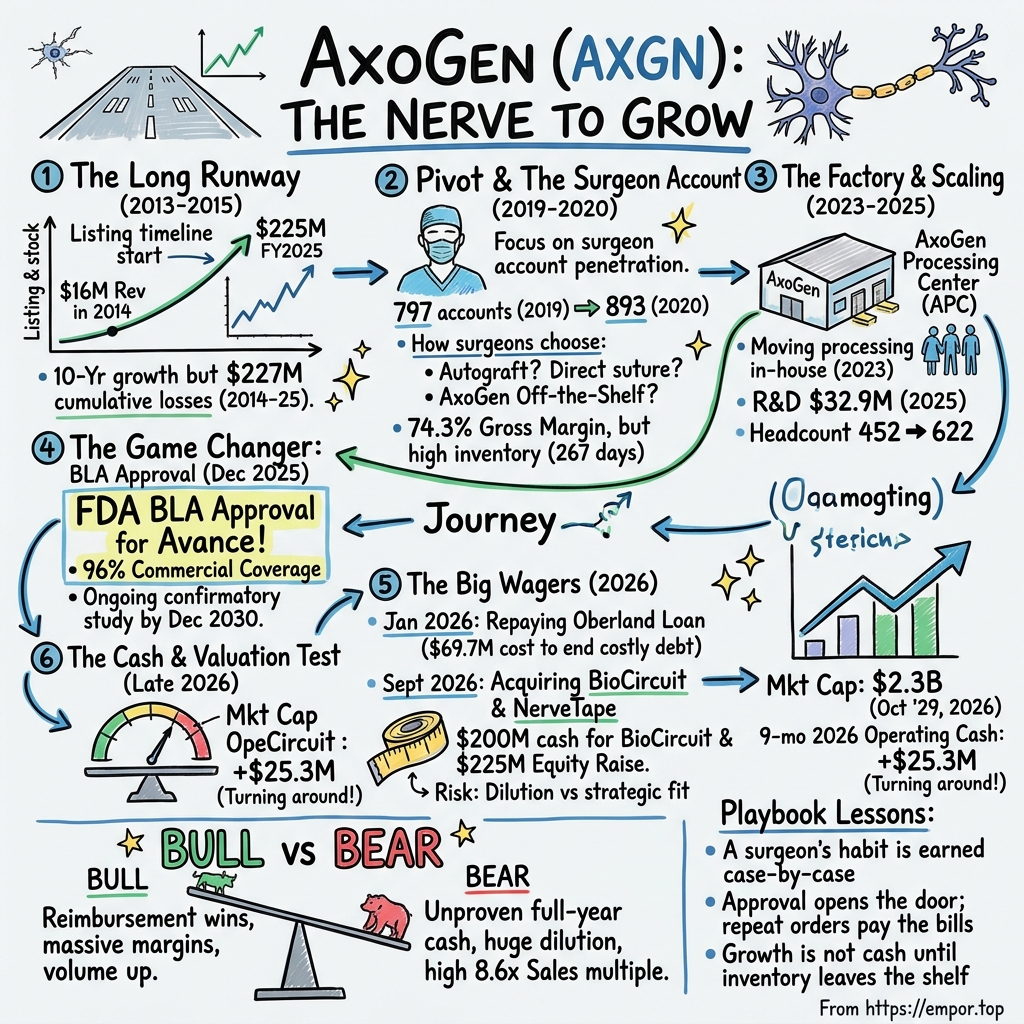
The first lesson is that a surgeon's habit is earned one case at a time. AxoGen's revenue rose from about $17 million to about $225 million over eleven years, and nothing about that climb was a single breakthrough.95 It was 29 sales reps becoming 138, a pandemic in which the company kept its sales force on payroll rather than cut it, and account productivity growing more than 20% a year once surgeons were comfortable.95113 For founders in specialist medical technology, the lesson is that the sales force is not overhead; it is the product's delivery mechanism, and it compounds slowly. For investors, the lesson is the corollary: a business built on surgeon habit will look unprofitable for a long time, and the length of that time is the real risk.
The second lesson is that approval opens the door; repeat orders pay the bills. The December 2025 BLA gave Avance exclusivity and helped push insurance coverage to near-universal levels.53 It did not, by itself, put a single extra graft into a single patient. The approval is also partly conditional: the motor and long-gap indications depend on a confirmatory trial against autograft that will not finish until 2030.5 The broader point is that a regulatory milestone is an asset with a payoff schedule, not a payoff. The best way to judge one is to watch what happens to procedures, not to press releases.
The third lesson is that a good strategic fit still has a price. NerveTape plugs AxoGen into the large share of nerve repairs where surgeons currently stitch and buy nothing, and the fit with its existing sales force is obvious.4 But AxoGen paid $200 million in cash and issued almost six million shares to fund it.12 The lesson for acquirers is that synergies are a reason to buy, not a reason to stop counting. The lesson for shareholders is to judge every deal financed with stock on a per-share basis. A deal can be brilliant for the company and mediocre for each share, and the difference is the price of the stock you sell to pay for it.
The fourth lesson is the one AxoGen's balance sheet teaches most clearly: growth is not cash until the inventory leaves the shelf. AxoGen's hospital customers pay in about six weeks, a mark of a good receivables book.5 But the company carries nearly nine months of inventory, pays its own suppliers within weeks, and runs a cash cycle that ties up the better part of a year of working capital.5 In a business built on donated tissue that expires, revenue growth can consume cash faster than it produces it. Investors who look only at sales growth and gross margin will miss where the money actually goes.
The wider lesson running through all four is about patience and its price. AxoGen's investors have funded more than a decade of losses in exchange for a business with real clinical and regulatory advantages. Whether that bargain pays depends on what happens next.
XII. Epilogue
On the night of October 29, 2026, AxoGen stands in a position it has never quite occupied before. Its core business is growing faster than it has in years. Its flagship product has the regulatory standing that took most of a decade to win. Its balance sheet is free of expensive debt. And NerveTape, a product that did not belong to it two months ago, is now in the hands of AxoGen's own sales force, being introduced to hospitals one value-analysis committee at a time.
The first verdict will come with the full-year 2026 results, when AxoGen reports whether it met its revenue and free-cash-flow guidance.3 Hitting its organic growth target would confirm that the core business can sustain growth in the mid-20s even as the extremities market matures. Hitting its cash target with inventory days falling would be the first full-year evidence that growth has begun to fund itself. Missing either would put the valuation under pressure that no regulatory milestone could relieve.
The next verdict is NerveTape's first full year, in 2027. It will test management's sales and margin projections.41 The numbers to watch are realized revenue, gross margin after the inventory step-up washes out, and the GAAP per-share contribution once amortization is counted. Any shortfall will be read against the six million shares sold to fund the deal. AxoGen has said it will give 2027 guidance in the first quarter of next year and plans an investor day in March 2027, where it expects to give prostate financials.14
Further out lies the confirmatory trial against autograft, due by December 2030, with progress reports to the FDA every six months.5 Its result will determine whether Avance keeps its expanded label.
Every milestone leads back to the same unanswered question: can AxoGen turn its growth and regulatory gains into a consistently profitable, cash-generating company? The next two years will answer it.
XIII. Outro
Return, one last time, to the operating room. A surgeon looks down at a severed nerve and weighs the options, from direct repair to a graft or NerveTape. That choice is made thousands of times a year, quietly, by people who will never think about AxoGen's share count or its cash conversion cycle.
AxoGen's wager is that it can win more of those choices and eventually turn them into cash. Avance has its approval and coverage; NerveTape is now with AxoGen's sales force. The lasting business only exists if surgeons keep reaching for its products, and if the company that sells them finally earns more than it spends.
References
-
Form 8-K Exhibit 99.1, Axogen to Acquire BioCircuit Technologies — Axogen, Inc., 2026-09-10 ↩↩↩↩↩↩↩↩↩
-
Form 424B5 Prospectus Supplement — Axogen, Inc., 2026-09-10 ↩↩
-
Axogen, Inc. Reports Third Quarter 2026 Financial Results — Axogen, Inc., 2026-10-28 ↩↩↩↩↩↩↩↩↩↩↩↩↩↩↩↩↩↩↩↩↩↩↩↩↩↩↩↩↩
-
Axogen Q3 2026 Earnings Call Transcript — StockAnalysis/Quartr, 2026-10-28 ↩↩↩↩↩↩↩↩↩↩↩↩↩↩↩↩↩↩↩↩↩↩↩↩↩↩↩↩↩↩↩↩↩↩↩↩↩↩↩↩↩↩
-
Form 10-K for FY2025 — Axogen, Inc., 2026-02-24 ↩↩↩↩↩↩↩↩↩↩↩↩↩↩↩↩↩↩↩↩↩↩↩↩↩↩↩↩↩↩↩↩↩↩↩↩↩↩↩↩↩↩↩↩↩↩↩↩↩↩↩↩↩↩↩↩↩↩↩↩↩↩↩↩↩↩↩↩↩↩↩↩↩↩↩↩↩↩↩↩↩↩
-
AXGN Financial Ratios and Market Data — StockAnalysis, 2026-10-29 ↩↩↩↩
-
Form 10-Q for the quarter ended September 30, 2026 — Axogen, Inc., 2026-10-28 ↩↩↩↩↩↩↩↩↩↩↩↩↩↩↩↩↩↩
-
Form S-1/A Registration Statement — Axogen, Inc., 2013-08-07 ↩
-
2026 Definitive Proxy Statement — Axogen, Inc., 2026-04-29 ↩↩↩↩↩↩↩↩↩↩
-
Axogen, Inc. Announces New Leadership Appointments, Form 8-K Exhibit 99.1 — Axogen, Inc., 2024-08-08 ↩↩
-
Q1 2026 Strategic Healthcare M&A Report — The Walden Group, 2026 ↩
-
Axogen, Inc. Reports Second Quarter 2026 Financial Results — Axogen, Inc., 2026-07-29 ↩
-
Form 8-K, 2026 Annual Meeting Voting Results — Axogen, Inc., 2026-06-23 ↩↩
 LinkedIn
 WhatsApp
 Reddit
 Hacker News
 Email
 Kindle
 RSS Feed
 Spotify
 Apple Podcasts
 Amazon Music
 Audible
 YouTube