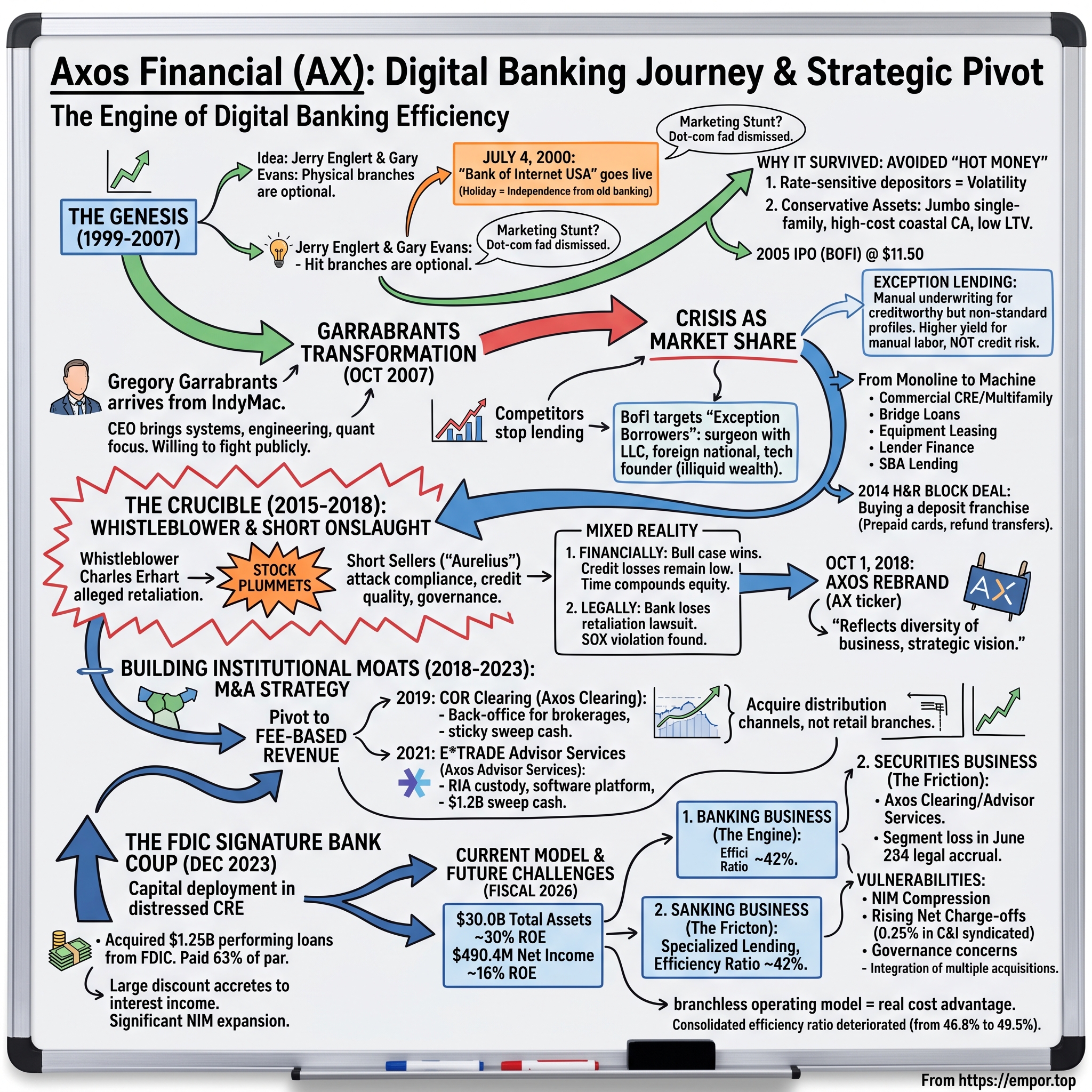
Axos Financial: The Engine of Digital Banking Efficiency
I. Introduction & Episode Roadmap
On the morning of July 4, 2000, while every federally chartered bank in the United States was closed for Independence Day, a small San Diego startup with $14 million of capital opened its doors. Except it had no physical doors. Bank of Internet USA went live on a national holiday precisely because it could — the date was chosen to emphasize independence from traditional banking, and it doubled as a birthday present to one founder's daughter.9 At the time, it was a marketing stunt attached to a business model that most established bankers dismissed as a dot-com fad.
Twenty-six years later, the entity that grew out of that launch closed its fiscal 2026 year on June 30, 2026, with $30.0 billion in total assets, $24.6 billion in deposits, and net income of $490.4 million.1 Its shares traded around $101 at the end of July 2026, giving it a market capitalization near $5.8 billion.12 Now operating as Axos Financial, Inc., the company trades on the New York Stock Exchange under the ticker AX and owns a securities clearing firm, a registered investment adviser custody platform, an equipment leasing company, and a San Francisco fintech built by Y Combinator alumni.
That is the polished surface of the story. The full picture is more complex, because Axos in mid-2026 is not the simple compounding machine described in its bull case. Its efficiency ratio — the share of revenue consumed by operating expenses — deteriorated from 46.84% in fiscal 2025 to 49.49% in fiscal 2026.12 Its net interest margin, the spread between loan earnings and deposit costs, compressed from 4.90% to 4.70% over the same period.12 Return on equity slipped from 17.30% to 16.32%.12 Net charge-offs rose, its securities segment lost money in the June 2026 quarter, and a significant portion of recent deposit growth was not gathered organically from retail customers, but purchased in bulk from institutions exiting consumer markets.
The central thesis, stated carefully. The branchless banking model offers genuine structural advantages, though not primarily through saved lease payments. Operating without a physical branch network keeps non-interest expenses low relative to assets. A bank can deploy that cost advantage in one of two standard ways: offering higher deposit rates to attract funding, or accepting lower loan yields to win borrowers. Axos has largely pursued a third strategy: retaining the cost savings while lending into specialized niches where yields remain high due to underwriting complexity rather than poor credit quality. That strategy produced margins roughly 150 to 200 basis points above the average regional bank.
However, the model faces clear limits, and recent years have tested its durability. Direct-to-consumer digital deposit gathering is essentially a commodity business where rate-sensitive customers switch platforms readily, and traditional banks, fintechs, and money market funds compete for identical funds. Consequently, Axos has spent a decade attempting to diversify beyond pure retail deposits: first expanding into specialized commercial lending, then into securities clearing and RIA custody, and more recently into equipment leasing and small-business software. Whether these acquisitions build a durable competitive moat or merely introduce integration costs, operational complexity, and legal risk to an institution that functioned best in its simplest form remains the core analytical question.
The roadmap. Part one examines the dot-com experiment from 1999 to 2007, detailing why most first-generation internet banks failed and how this survivor navigated that era. Part two covers the appointment of Gregory Garrabrants as chief executive officer in October 2007 and the construction of the specialized lending operations during the global financial crisis. Part three addresses the 2015 to 2018 period, when a whistleblower lawsuit and a coordinated short-seller campaign pressured the stock, examining the actual operational outcomes behind the headlines. Part four details the corporate rebrand and acquisition campaign from 2018 to 2023. Part five analyzes the 2023 regional banking crisis and the FDIC asset purchase that marked management's primary capital deployment. Part six evaluates segment performance, unit economics, management incentives, competitive positioning, and the specific conditions required for either the bull or bear thesis to hold.
The analysis begins where all banking histories start: with the decision that traditional deposit gathering was unnecessarily costly.
 Subscribe on LinkedIn
II. Genesis & The Early Dot-Com Experiment (1999–2007)
In San Diego in 1999, the local community banking scene was small, clubby, and personal. Jerry Englert had already founded Bank of Del Mar, while Gary Lewis Evans served as president of La Jolla Bank. Both had spent careers inside traditional branch banking—with its physical real estate, drive-through lanes, and relationship-driven lending. Both concluded that physical branches were the most expensive customer acquisition channel in financial services, and that the rising internet made them optional.
They incorporated BofI Holding, Inc. in Delaware in July 1999 and capitalized the venture with $14 million.9 The thesis was structural rather than ideological: traditional banks spend heavily on real estate, tellers, vaults, and signage, recovering those expenses by paying depositors lower interest rates. Eliminating branches allowed BofI to pass part of the savings back to depositors via higher yields—a far cheaper acquisition method than constructing physical locations. Operating as Bank of Internet USA, the bank opened for business on July 4, 2000.89
Why the first generation of internet banks mostly died
Between 1996 and 2002, a wave of pure-play internet banks launched across the United States, only for nearly all of them to fail or be absorbed. The structural trap that caught them remains relevant to digital lenders today.
The primary obstacle was customer acquisition cost. An unbranded digital bank had one primary mechanism to attract attention: posting top rates on deposit comparison tables. Capital arrived quickly, but it came from rate-sensitive depositors who lacked deeper institutional ties, such as checking accounts or direct deposits. This volatile "hot money" meant a bank's cost of funds was effectively dictated by its most aggressive competitor.
High funding costs created a secondary problem on the asset side. A bank paying elevated deposit yields could not generate adequate margins from low-risk, conforming loans. To preserve net interest spread, digital institutions reached for yield by expanding into subprime consumer debt, unsecured credit, and high-risk securitized mortgages. The model exerted a persistent pull toward credit risk.
BofI avoided this trajectory through conservative asset selection. Rather than chasing national volume, the bank concentrated on jumbo single-family mortgages in high-cost coastal California markets, underwritten at conservative loan-to-value ratios. For instance, lending $500,000 against a $1 million property gave the bank a 50% equity cushion. Even a steep decline in local real estate values left the loan fully collateralized. Protection derived from physical collateral rather than optimistic borrower income assumptions, insulating BofI from the prevailing underwriting race.
On March 15, 2005, the bank went public, selling 3,052,745 shares at $11.50 apiece on the NASDAQ under the ticker BOFI.9 The small offering provided permanent equity capital and a public currency to fund future expansion.
The ceiling on a mortgage monoline
By 2006, however, the monoline model exposed clear operational constraints. A bank reliant strictly on single-family mortgages remains vulnerable to interest rate cycles. Falling rates trigger refinancing waves that erase high-yielding loans, whereas rising rates depress origination volume. This cyclical volatility makes it difficult to generate the predictable returns required to compound book value across full market cycles.
Furthermore, jumbo mortgage lending is largely a commodity business. Lenders have little ability to differentiate thirty-year fixed-rate loans other than through lower pricing—reintroducing the margin pressure internet banking was intended to circumvent. Low overhead gave BofI an advantage in gathering deposits, but provided little edge in deploying capital profitably.
This imbalance between an efficient deposit gathering model and an undifferentiated lending operation defined BofI prior to 2007. The bank had established a low-cost funding engine, but lacked a high-yield, defensible lending franchise. Transforming the institution required building specialized underwriting capabilities—a task undertaken when new leadership arrived in October 2007.
III. The Garrabrants Transformation & The "Exception Lending" Blueprint (2007–2014)
In October 2007, the market for American residential real estate was in the opening act of a crisis. Countrywide was weeks away from a rescue by Bank of America, and Bear Stearns had already seen two mortgage hedge funds collapse. Against this backdrop, Gregory Garrabrants—a senior vice president running corporate business development at IndyMac Bancorp, an institution regulators would seize nine months later in one of the largest bank failures in U.S. history—left to become chief executive officer of BofI Holding, a San Diego internet bank with roughly $1 billion in assets, mostly mortgages.119
It was either a misreading of the economic cycle or a deliberate bet that a clean balance sheet in a distressed industry represents the most valuable asset in banking. It proved to be the latter.
The operator
Garrabrants brought an atypical background to a community bank chief executive role, explaining much of BofI's subsequent operational strategy. He holds a law degree from Northwestern University, an MBA from the Kellogg School of Management, and undergraduate degrees in industrial and systems engineering from the University of Southern California. A CFA charterholder and member of the California Bar, he clerked for a federal judge, worked in investment banking at Goldman Sachs, and consulted at McKinsey & Company and Deloitte.11
That background produced an executive focused on systems design, legal structures, and quantitative parameters rather than traditional relationship banking. It also yielded a leader willing to fight publicly—a trait that would define the institution's next decade in ways both useful and demanding.
Crisis as market share
BofI entered the financial crisis without subprime collateralized debt obligations, exotic structured products, or loose underwriting standards, having built its residential portfolio at conservative loan-to-value ratios. While reflecting the founders' risk posture, this conservative positioning gave Garrabrants an extraordinary opening.
During a credit panic, traditional banks do not merely tighten lending criteria selectively; they stop lending categorically. Risk committees at troubled institutions issue broad prohibitions against self-employed borrowers, foreign nationals, non-owner-occupied investment properties, and complex trust structures. These decisions are triage rather than precise credit assessments, leaving behind a population of creditworthy borrowers who are simply non-standard to underwrite.
That underserved population became the core of the bank's franchise.
What "exception lending" actually means
Automated mortgage underwriting relies on standardized criteria: two years of W-2 income, a standard credit history, a conforming property type, and an owner-occupied primary residence. If an applicant falls outside these bounds, automated systems decline the loan—not necessarily due to credit weakness, but because automated algorithms cannot price unstandardized risk.
Exception lending targets borrowers who fail standard automated checks despite strong financial positions. Examples include a surgeon who owns her practice and reports income through a pass-through entity, a technology founder holding wealth in illiquid equity, a foreign national purchasing a Los Angeles condominium with a substantial cash down payment, or a real estate investor holding multiple properties through separate limited liability companies. These applicants represent non-standard rather than high-risk credits, requiring manual underwriting to evaluate.
Manual review increases underwriting expenses because it demands experienced credit analysts and lacks algorithmic scale. However, borrowers absorb this cost through higher loan yields because their alternative is a lack of credit access. This structural dynamic generates BofI's yield premium. In banking analysis, a high loan yield can reflect either hidden credit risk or compensation for labor-intensive underwriting that competitors avoid. On an income statement, these two drivers appear identical, but their performance diverges sharply during an economic downturn.
BofI addressed this distinction through structural protection. Loans featured conservative equity cushions, personal guarantees, and cross-collateralization, using physical collateral as a secondary backstop if underwriting assessments failed. Through the 2010s, credit losses remained low, with charge-offs staying near zero.
A critical analytical caveat remains: an underwriting model built primarily on collateral protection is tested by real estate asset prices rather than pure credit evaluation. Because coastal California real estate appreciated across most of this period, low loan-to-value lending against rising asset values yielded minimal losses regardless of underwriting skill. A definitive stress test for this model requires a sustained downturn in the specific property markets backing the portfolio.
From one product to a lending machine
Having established manual underwriting capacity, Garrabrants expanded the model into adjacent specialized lending markets. The bank entered commercial real estate and multifamily bridge lending, providing short-duration loans to property owners repositioning assets, where execution speed and structural flexibility outweigh headline interest rates. It subsequently expanded into equipment leasing, lender finance—lending to non-bank financial institutions secured by their loan portfolios—fund finance, asset-backed facilities, factoring, and Small Business Administration lending.
These specialized lines share common economics: narrow markets, complex deal structures, borrowers prioritizing execution certainty, and yields exceeding standard commercial loans. Furthermore, combining distinct asset classes with independent loss drivers diversified the overall loan portfolio compared to a pure residential mortgage book.
The H&R Block deal: buying a deposit franchise
To support asset expansion, management pursued structural funding acquisitions. In April 2014, the bank announced an agreement to acquire the deposit liabilities and selected assets of H&R Block Bank, completing the transaction on August 31, 2015, with a cash payment of approximately $419 million matching the assumed deposit liabilities.13
The strategic value lay less in the acquired deposits than in the accompanying program management agreement. BofI became the exclusive issuing bank for H&R Block's Emerald Prepaid MasterCard, Refund Transfers, and Emerald Advance lines of credit, embedding the bank directly into the financial workflow of an institution Garrabrants noted served 20 million customers.13
This transaction established a recurring acquisition strategy: acquiring distribution channels rather than retail branches. By embedding products directly within partner platforms, deposits arrive as a byproduct of routine consumer transactions. Because tax refund deposits are seasonal, low-cost, and relatively insensitive to interest rates, this channel helped insulate the bank from the volatile, rate-seeking deposits that destabilized early internet banks.
The arrangement provided a funding template for future expansion. Before management could fully execute that strategy, however, the institution faced three years of public scrutiny and legal challenges.
IV. The Short-Seller Onslaught, Whistleblowers, & The Crucible of Survival (2015–2018)
On October 13, 2015, a whistleblower lawsuit was filed in the U.S. District Court for the Southern District of California by Charles Matthew Erhart, a former internal auditor at BofI. Erhart alleged that after reporting what he believed were regulatory and accounting violations to his supervisors and government agencies, the bank retaliated against him.10
Within days, BofI stock plummeted as a coordinated short-seller campaign took hold.
The short thesis
The short campaign hit from multiple angles. An anonymous author writing under the pseudonym Aurelius published thirteen short-seller reports on Seeking Alpha beginning in October 2015, prompting additional short-focused researchers to join.14 BofI fought back with subpoenas seeking to unmask the anonymous writer, but lost that effort in federal court.14
The bear case rested on three main arguments, each of which produced very different long-term outcomes.
First, critics targeted compliance, alleging weak anti-money-laundering and know-your-customer controls, particularly regarding loans to foreign nationals and opaque legal entities. The regulatory record confirmed official interest: the SEC opened an informal inquiry in May 2015 and a formal investigation in February 2016, issuing subpoenas for records on related-party transactions, potential conflicts of interest, and single-family residential loans extended to non-resident aliens.14
Second, short sellers targeted credit quality, arguing that BofI's above-peer loan yields signaled hidden credit risk or aggressive accounting for expected losses. This was the most directly testable claim, and it proved unfounded. Throughout the campaign and in the years following, realized charge-offs remained remarkably low. By the December 2023 quarter, annualized net charge-offs measured just two basis points of average loans—a level inconsistent with a flawed loan portfolio.5
Third, critics pointed to governance and culture, citing high compensation, an unusually combative management style, and an executive leadership team that favored confrontation over conciliation—concerns that persisted well past the crisis.
What actually happened in court
A common narrative surrounding this episode suggests that Axos achieved complete vindication while routing the short sellers. However, the legal record presents a more nuanced reality.
In financial markets, the bullish thesis proved correct. The stock recovered, book value continued to compound, and the anticipated credit collapse never materialized. Investors who shorted the stock on the belief that the loan book was fraudulent suffered substantial losses.
Legally, however, the outcome favored the whistleblower. The Erhart lawsuit went to a three-week jury trial in 2022, where the jury determined BofI had violated the anti-retaliation provisions of the Sarbanes-Oxley Act, awarding Erhart $1.5 million in damages.10 The bank moved for judgment as a matter of law or a new trial, but the district court denied the motion entirely, later awarding Erhart roughly $2.4 million in attorneys' fees and approximately $170,000 in prejudgment interest.10 In rejecting the bank's assertion that no reasonable jury could consider Erhart's belief in a securities violation reasonable, the court noted that holding employees to the legal standards of attorneys would gut Sarbanes-Oxley's anti-retaliation protections.10 The Ninth Circuit Court of Appeals issued its decision on the appeal on February 6, 2025.15
This distinction is analytically significant. The jury did not rule on whether Axos's loan book was fraudulent, as that was not the legal question before the court; instead, it found that the company retaliated against an employee who raised concerns. While retaliation does not directly represent credit risk, it serves as an established governance signal rather than speculative sentiment.
The lesson about shorting banks
The episode highlights a fundamental dynamic in bank investing. Because a bank's equity represents a small capital base supporting a large volume of borrowed liabilities, the institution is exceptionally sensitive to confidence shocks. That structural leverage makes banks tempting short targets, as negative sentiment alone can trigger deposit flight regardless of factual accuracy—a dynamic illustrated by Silicon Valley Bank's collapse in 2023.
However, short positions in banking face strict temporal limits. If deposits remain stable and credit losses fail to materialize, time favors the institution. A profitable bank continually compounds equity, eroding the short thesis over time. Unlike immediate solvency crises, compliance disputes typically generate legal fees, regulatory fines, and reputational drag—costs that depress valuation without causing structural failure. Ultimately, empirical credit performance settles the debate, and in BofI's case, the loss data disproved the short thesis.
BofI survived without sacrificing solvency, but the campaign imposed real costs on operational momentum. Management spent years focused on litigation rather than strategic expansion, the stock traded at a persistent valuation discount, and the company developed a reputation for combative management that continued to influence analyst perceptions.
The rebrand
On September 12, 2018, BofI Holding announced a corporate rebranding.16 Effective October 1, 2018, the holding company became Axos Financial, Inc., BofI Federal Bank was renamed Axos Bank, its common stock transferred from the NASDAQ Global Select Market to the New York Stock Exchange under the ticker AX, and its subordinated notes began trading under the ticker AXO.16 Garrabrants framed the change as a strategic repositioning: "Our new brand better reflects the diversity of our existing businesses and aligns more closely with our strategic vision."16
Viewed critically, renaming the institution following three years of adverse media coverage helped distance the bank from past controversies. Strategically, however, the original name had become inaccurate. "Bank of Internet" described a single distribution channel rather than a diversified financial company. By 2018, the organization was preparing to enter new lines of business, supported by acquisitions already in development.
V. M&A Strategy & Building Non-Interest Institutional Moats (2018–2023)
Every bank management team eventually confronts a structural limitation of net interest income: spreads are heavily governed by Federal Reserve policy, yield curve shapes, and local deposit competition. While disciplined underwriting and low operating costs improve margins at the perimeter, a bank cannot insulate its spread entirely from macroeconomic cycles. When interest rates drop or yield curves invert, net interest margins compress regardless of operational efficiency.
Fee-based revenue operates on different economics. Custody, clearing, and platform fees are earned for providing operational infrastructure, remaining relatively stable whether benchmark interest rates sit near zero or above five percent. Crucially, these fee-generating businesses sit atop substantial pools of client cash that must be swept into overnight deposit accounts. When a bank sweeps those funds onto its own balance sheet, it captures a sticky deposit base driven by operational necessity rather than yield chasing — offering a structural counterweight to the rate-sensitive deposit volatility that plagued early digital banks.
This strategic rationale underpinned the targeted acquisition campaign that reshaped Axos between 2018 and 2023.
Axos Clearing: buying the plumbing
On October 1, 2018 — the same day the corporate rebrand took effect — Axos announced a definitive agreement to acquire COR Clearing LLC, an Omaha-based full-service correspondent clearing firm.6 The transaction closed on January 29, 2019, and the business was renamed Axos Clearing.6
Securities clearing provides critical back-office infrastructure for retail brokerages. When an investor at an independent brokerage executes a trade, the brokerage rarely maintains the infrastructure required to clear and settle the transaction, hold securities in custody, extend margin loans, produce statements, or meet regulatory capital requirements. Correspondent clearing firms provide this shared operational architecture for dozens of independent broker-dealers simultaneously.
At the time of the acquisition, COR served more than 60 introducing broker-dealers and roughly 90,000 customer accounts, generating approximately $35 million in annual fee income. More importantly for a banking franchise, the firm carried approximately $470 million in low-cost deposits.6 Management projected the transaction would be accretive to earnings per share by roughly 6% in the first year and 7% in the second.6 Garrabrants contended that COR's expansion had been "constrained by its prior ownership structure."6
The primary strategic asset in a clearing acquisition is the stickiness of client cash balances. Cash remains on deposit to satisfy operational trade settlements rather than to maximize interest yields. Furthermore, switching clearing providers imposes significant friction on an introducing broker-dealer, requiring comprehensive client account re-documentation and system integration.
In 2019, Axos complemented this infrastructure by acquiring WiseBanyan, a small automated investment platform that was rebranded as Axos Invest. While financial terms were not disclosed, the acquisition represented a minor product extension rather than a core strategic pillar.
E*TRADE Advisor Services: the sharpest trade
The most strategically impactful acquisition emerged from an integration byproduct of a larger financial sector merger. When Morgan Stanley acquired ETRADE Financial in 2020, the transaction included ETRADE Advisor Services, a custody platform serving independent registered investment advisers. For an institution of Morgan Stanley's scale, a mid-sized RIA custody unit represented a peripheral asset.
Axos closed the acquisition on August 2, 2021, renaming the unit Axos Advisor Services and folding it into Axos Clearing.17 As of July 30, 2021, the platform brought approximately $24.8 billion in assets under custody, $1.2 billion of client cash sweeps, and roughly 200 RIA custodial relationships.17 Axos paid approximately $54.9 million in cash for the business.
The transaction economics were notable: Axos paid $55 million for a platform overseeing nearly $25 billion in custodial assets — roughly two-tenths of one percent of assets under custody. The core strategic value resided in the $1.2 billion in sweep cash and the software infrastructure generating it. Institutional RIA custodial cash represents an attractive funding source because it is managed by investment advisers making operational allocations rather than retail yield-seekers, aggregated across thousands of underlying client accounts, and embedded directly into daily advisory workflows.
Garrabrants emphasized execution speed upon closing, noting that internal teams "successfully completed the conversion of EAS and received the required regulatory approval to transition EAS to a broker-dealer platform in less than four months."17
What the M&A record actually shows
Evaluating the broader acquisition strategy reveals a distinct pattern: Axos consistently avoided traditional whole-bank mergers. Whole-bank acquisitions typically entail physical branch networks, redundant personnel, cultural friction, and substantial goodwill premiums paid for deposit bases that an efficient digital bank can build organically. Instead, Axos targeted financial technology platforms and specialized funding channels at valuations that represented small fractions of their underlying client assets.
However, the strategy introduces trade-offs. The clearing and custody segments have expanded at a slower pace than the core lending operations. Furthermore, integrating multiple disparate software platforms increases operational complexity, compliance overhead, and potential legal exposure — operational challenges that would manifest on the financial statements three years later.
Before those integration challenges materialized, however, the bank encountered a market disruption where capital preservation and balance-sheet liquidity yielded immediate strategic advantages.
VI. The 2023 Regional Banking Panic & The FDIC Signature Bank Coup
March 2023 brought the fastest bank run in American financial history. Silicon Valley Bank surrendered tens of billions of dollars in deposits in a matter of hours, undone by structural vulnerabilities: a depositor base concentrated in venture-backed technology companies connected through shared networks, and an asset portfolio weighed down by long-duration, fixed-rate securities bought during the zero-interest-rate era whose market values tumbled as the Federal Reserve raised rates. Signature Bank collapsed days later, followed by First Republic in May.
The underlying vulnerability across these institutions was identical. After gathering influxes of deposits during 2020 and 2021, they parked unloaned capital in long-dated Treasuries and mortgage-backed securities offering minimal yields. As interest rates escalated, those holdings lost substantial market value. So long as deposits remained static, the mark-to-market losses remained unrealized. But when depositors withdrew funds en masse, the banks were forced to liquidate holdings, converting paper losses into actual capital depletion that erased equity.
Why Axos was not in the blast radius
Axos avoided this turmoil through structural design rather than luck, reflecting choices embedded in its operating model.
A lender generating high yields in specialized credit niches has little incentive to hold 1.5% Treasuries. Axos directed its deposit growth directly into loans, preventing the accumulation of massive, low-yielding securities portfolios that impaired its regional peers. The mark-to-market deficit that broke Silicon Valley Bank remained minimal at Axos — not because management possessed superior interest rate foresight, but because its core lending operations yielded higher returns for its liquidity.
Its deposit architecture was similarly diversified. Where Silicon Valley Bank relied on a single industry, region, and network, Axos funded operations across national retail consumers, commercial treasury clients, H&R Block program accounts, clearing client balances, and RIA custodial sweeps — funding pools with distinct behavior patterns and minimal cross-correlation.
Surviving a systemic panic, however, reflects basic balance sheet management rather than extraordinary skill. Because most regional institutions navigated the 2023 turmoil without failing, maintaining solvency demonstrated adequate risk controls. The company's primary strategic distinction emerged nine months later.
The FDIC trade
By late 2023, the FDIC sat as receiver over the remains of Signature Bank, holding roughly $33 billion of commercial real estate loans it needed to sell.4 The market environment presented severe headwinds for liquidation: office property valuations were declining, refinancing pressures dominated real estate sentiment, and institutional buyers were under board mandates to reduce commercial property exposure.
Axos took the opposite side of that trade. In December 2023, Axos Bank acquired two performing loan portfolios from the FDIC with an aggregate unpaid principal balance of $1.25 billion, paying approximately 63% of par — a $463.7 million discount.4 The package included $578.6 million in commercial real estate loans yielding 6.8% at a 50.2% weighted average loan-to-value ratio, alongside $674.6 million in multifamily and mixed-use loans yielding 7.0% at a 67.0% LTV — delivering a blended 6.9% yield and 59.3% LTV across 58 loans, all current on principal and interest at purchase.4 The deal structure incorporated back-to-back interest rate swaps under which borrowers paid an average fixed rate of about 3.8% while Axos received a primarily variable note rate.4 Garrabrants noted that management had performed "extensive due diligence and valuation analysis on each of the properties."4
What the trade actually was
Beyond the deal terminology, the underlying transaction mechanics were straightforward. Purchasing performing loans at 63 cents on the dollar leaves the borrowers obligated to repay 100 cents. As loans amortize or mature, the 37-cent discount accretes into interest income over time, allowing the bank to earn both contractual interest and the pull-to-par gain.
Management detailed the financial impact during its January 30, 2024 earnings call: the transaction generated a $65 million after-tax gain while requiring a $75 million increase in loan loss allowances, with executives projecting net interest margin expansion of 40 to 50 basis points over the subsequent four to six quarters.5 Management also disclosed $418 million in total office exposure, highlighting that 69% sat in senior A-notes or secondary positions with a conservative average LTV of 32% — a level of disclosure uncommon among regional peers.5
Assessed objectively, the transaction demonstrated effective execution in an unrepeatable market setting: a forced regulatory seller, a hesitant buyer pool, and a bank with excess capital and willingness to commit it. It does not establish a recurring competitive moat, as FDIC liquidations of systemically important lenders remain rare events. Investors who treat this transaction as a permanent boost to earning power risk misinterpreting a one-time gain.
What the trade does demonstrate is a distinct operational posture: management preserved liquidity and deployed capital into a distressed asset class that competitors avoided, relying on its own credit evaluation rather than prevailing market sentiment. That willingness to act counter-cyclically remains a notable analytical factor across credit cycles.
The central question facing the bank is how operations perform as that accretion tailwind recedes and organic growth must drive returns. By fiscal 2026, that question was no longer theoretical.
VII. Current Business Segments, Operating Engine, & Economic Breakdown
Axos reports through two segments, and the split is lopsided in a way that has become more pronounced, not less.
The Banking Business
The banking segment is the company. In fiscal 2026, it generated $1,231.1 million of net interest income and $149.9 million of non-interest income against $582.7 million of non-interest expense, producing $697.3 million of income before taxes at a 4.74% net interest margin and a 42.19% efficiency ratio.1
The asset side breaks into three broad families. Single-family residential lending remains the historical core — jumbo mortgages plus mortgage warehouse lending, where Axos provides short-term funding to independent mortgage originators against loans awaiting sale. Commercial real estate and multifamily covers bridge, construction, and permanent lending, written with the low-LTV discipline described earlier. Commercial specialty finance is the growth engine and the highest-yielding piece: lender finance, fund finance, equipment leasing, asset-backed lending, and factoring.
That last category got substantially larger in September 2025. Axos Bank agreed to acquire Verdant Commercial Capital, LLC, an independent equipment leasing company founded in 2017 that originates small and mid-ticket leases of $50,000 to $5 million across six industry verticals.18 The price was approximately $43.5 million — a 10% premium to book, including a $4 million premium paid at closing — with a performance-based earn-out of up to $50 million over four years contingent on return on equity exceeding 15%.18 Verdant brought roughly $1.1 billion of loans and leases as of August 31, 2025, comprising $750 million of on-balance-sheet securitizations and $350 million of loans and leases, and management guided to EPS accretion of 2-3% in fiscal 2026 and 5-6% in fiscal 2027.18 Garrabrants framed the appeal plainly: "We like Verdant's specialization in vendor-based equipment leasing and believe we can scale this business profitably."18
The earn-out structure is the interesting detail. Tying the majority of potential consideration to a 15% ROE hurdle over four years means the seller only gets paid in full if the business actually performs after integration — a considerably more disciplined structure than paying full price up front on projections.
The Securities Business
The securities segment is where the story gets uncomfortable. In fiscal 2026 it produced $35.7 million of net interest income and $120.8 million of non-interest income against $141.1 million of non-interest expense, for income before taxes of just $15.4 million — down from $32.9 million in fiscal 2025.12 In the June 2026 quarter alone, the segment recorded a pre-tax loss of $11.5 million.1
The proximate cause was a $21.0 million accrual related to a legal matter in Axos Clearing, disclosed with the fiscal 2026 results.1 CFO Derrick Walsh pointed out that excluding it, non-interest expenses for the quarter were down about $1.0 million versus the prior quarter.1 On the July 30, 2026 call, management characterized the accrual as a one-time matter but provided limited detail on the underlying issue during prepared remarks.3
Investors should sit with this rather than move past it. Assets under custody and administration at Axos Clearing grew to $47.8 billion at June 30, 2026 from $39.4 billion a year earlier — genuine growth in the platform.1 But a fee business that produced only $15.4 million of pre-tax income on $141.1 million of operating expense is not, on current evidence, the high-margin diversification engine the strategic rationale promised. Roughly a fifth of full-year segment revenue was consumed by a single legal accrual. The segment has been part of Axos for seven years. That is long enough that "still scaling" is a weaker defense than it was.
The efficiency story, told accurately
Efficiency ratio deserves careful explanation because it is the metric most often quoted about this company and most often quoted wrong.
The ratio is simply operating expense divided by revenue. A bank at 60% spends sixty cents of every revenue dollar running itself. A bank at 40% spends forty. The gap is the whole argument for branchless banking: no leases, no tellers, no vault insurance, no branch security, no signage in a hundred strip malls.
Here is the reality as of fiscal 2026. Consolidated efficiency was 49.49%, up from 46.84% the prior year.12 The June 2026 quarter came in at 54.23% against 46.87% a year earlier — though that quarter carried the legal accrual.1 The banking segment alone ran at 42.19%.1
So the branchless advantage is real and measurable — a 42% banking-segment ratio is genuinely excellent against typical regional bank levels in the mid-50s to mid-60s. But the consolidated company has not operated below 40% in the recent past, and the direction of travel has been the wrong way for two years. The gap between the 42% banking segment and the 49% consolidated figure is precisely the drag from the securities business and holding-company overhead. Every acquisition adds operating expense before it adds revenue.
The margin story is directionally similar. Net interest margin of 4.70% in fiscal 2026 remains far above typical regional bank levels near 3%, but it compressed from 4.90%, and the June 2026 quarter ran at 4.54% against 4.84% a year earlier.12 Return on assets was 1.76% and return on equity 16.32%, both down modestly from the prior year.12 Book value per share grew 17.6% to $55.81, and tangible book value reached $50.96.1
Credit, honestly assessed
Headline asset quality improved during fiscal 2026. Non-performing assets fell to 0.53% of total assets from 0.71%, non-accrual loans to 0.60% of loans from 0.79%, and the allowance for credit losses stood at $347.4 million, or 1.34% of loans and 221% of non-accrual loans.12
But losses actually realized moved the other way. Net annualized charge-offs rose to 0.18% of average loans in fiscal 2026 from 0.13%, with the June quarter at 0.25% and the March quarter at 0.31%.127 Two basis points is what this company charged off in the December 2023 quarter.5 Twenty-five is more than ten times that. It is still low by any peer standard — but the trend is real, and it is exactly the sort of gradual drift that precedes a credit cycle turn.
Management was specific about the source. On the July 2026 call, Garrabrants acknowledged that losses have been "relatively rare" historically but concentrated in syndicated lending to sponsor-backed companies, said the bank is "being more careful about the agents that we choose," and described a shift toward club deals to reduce single-name concentration.3 A $10 million charge-off on a single syndicated commercial and industrial loan drove much of the June quarter figure; excluding it, net charge-offs would have been roughly nine basis points annualized.3
That is a credible, specific explanation with a stated remedy — which is more than many banks offer. It is also an admission that the newest, fastest-growing part of the loan book is where the losses are appearing. Syndicated sponsor-backed lending is the one category in the Axos portfolio where the bank is a participant rather than the underwriter of record, which means the core competitive claim — that Axos wins by reading files nobody else will read — does not apply. Investors should watch whether the discipline sticks.
VIII. Management Credibility, Governance, & Capital Allocation
Assessing a bank chief executive rests far more on long-term execution than quarterly conference calls. On that standard, Gregory Garrabrants presents a mixed record: a strong history of operational performance and crisis avoidance balanced against persistent concerns over corporate governance and executive pay.
The execution record
Start with what is not in dispute. Since taking the helm in October 2007, Garrabrants has overseen Axos's growth from roughly $1 billion in assets to $30.0 billion. The institution remained profitable through the 2008 financial crisis, the 2020 pandemic, and the 2023 regional banking panic, compounding book value per share at rates few peers have matched.111 Nearly two decades of sustained profitability suggests that performance stems from model design rather than luck.
Perhaps the executive team's most consequential decision was one that generated no headlines at the time: declining to buy long-duration, fixed-rate securities during 2020 and 2021. While many American banks deployed surging stimulus deposits into low-yielding Treasuries and mortgage-backed paper—the asset-liability mismatch that subsequently triggered the collapse of Silicon Valley Bank and First Republic—Axos avoided that trap. The bank's core lending operations provided higher-yielding specialty loans, eliminating the pressure to lock in unremunerative bond yields. Chief Financial Officer Derrick Walsh and the finance team maintained balance sheet flexibility, aided by a business model that naturally incentivized higher-yielding credit over fixed-income securities.
The compensation problem
Executive pay, however, has drawn sustained criticism. In fiscal 2025, Garrabrants received total compensation of approximately $11.7 million, comprising a $700,000 base salary, $8.9 million in stock awards, $2.1 million in incentive plan payouts, and roughly $13,800 in other benefits.19 His compensation reached approximately $13.9 million in fiscal 2024 and $10.6 million in fiscal 2023,19 following a 2018 package of $34.5 million that made him the highest-paid bank chief executive in the country.11
The internal pay gap highlights the degree of compensation concentration. In fiscal 2025, the next-highest-paid named executive, Commercial Bank President David Park, received approximately $2.3 million, while Chief Financial Officer Walsh received roughly $1.4 million.19 Garrabrants earned five to eight times the pay of his direct lieutenants—a ratio more typical of mega-cap institutions than a regional bank with a market capitalization under $6 billion.12
Management's defense rests on performance: the base salary remains modest, the overwhelming majority of the package consists of equity awards, and those awards reflect a thirtyfold expansion in market value under Garrabrants's tenure.11 From a pure pay-for-performance standpoint, the structure rewards long-term value creation.
Governance critics view such extreme pay concentration differently. They argue that lavish compensation focused on a single leader reflects an obedient board of directors. That dynamic takes on added weight at an institution that lost a federal jury verdict for retaliating against an internal auditor who raised regulatory concerns.10 While executive compensation and whistleblower retaliation are distinct issues, both point to a corporate culture centered heavily around a single leader, where internal dissent carries significant personal and professional risks.
Capital allocation
Management's capital deployment strategy follows a clear, observable hierarchy. Funding organic loan growth at target margins takes top priority, generating $637.9 million in net loan expansion during the June 2026 quarter alone.1 Opportunistic purchases of distressed assets rank second, followed by targeted acquisitions of technology platforms and deposit channels. Share repurchases remain the lowest priority. Axos repurchased $22.0 million of its common stock in the June 2026 quarter at an average price of $87.95 per share, leaving approximately $126 million under its existing repurchase authorization as of the July earnings call.13 When asked about future buybacks by KBW analyst Kelly Motta during the July call, Garrabrants stated the company would remain "flexible and opportunistic," declining to specify targeted price thresholds.3
That prioritization is financially sound. Repurchasing shares at a premium to book value while the core bank generates high-teens returns on equity is less accretive than deploying capital directly into high-yielding loans.
However, the transaction pace in fiscal 2026 warrants close examination. Within a ten-month span, Axos executed four separate acquisitions. The equipment leasing company Verdant closed in late September 2025. On February 12, 2026, Axos agreed to acquire Jenius Bank's U.S. consumer deposit portfolio from SMBC MANUBANK, completing the transaction on May 2, 2026; the deal added approximately $2.3 billion in deposits alongside cash offset by a negotiated premium.20 On April 22, 2026, the bank contracted to purchase roughly $3.2 billion in individual retirement account deposits from Capital One, encompassing about 101,000 certificate of deposit and savings accounts as of mid-March 2026, pending OCC approval and expected to close later in the year.21 Finally, on July 6, 2026, subsidiary Axos Nevada Holding agreed to acquire Arc Technologies—a San Francisco and New York fintech founded in 2021 with backing from venture firms including Left Lane Capital, NFX, Bain Capital Ventures, Atalaya, Clocktower Technology Ventures, Torch Capital, and Y Combinator—closing the deal later that month on undisclosed terms.22
Executing four acquisitions in ten months during a fiscal year in which the company's efficiency ratio deteriorated by nearly three percentage points raises fundamental strategic questions.
The optimistic interpretation is that management exploited a temporary market dislocation, purchasing low-cost funding and technology from retreating incumbents and capital-constrained fintechs. During the July 2026 earnings call, executives reported that the Jenius deposit integration resulted in minimal account runoff while enabling Axos to cross-sell 3,400 new consumer checking accounts within months of closing.3
The skeptical interpretation is that relying on $5.5 billion in bulk deposit purchases from SMBC and Capital One signals slowing organic deposit growth. Acquired certificate of deposit and savings balances represent the very rate-sensitive retail funds that Axos sought to replace through its clearing and custody expansions. Furthermore, rapid platform integrations introduce conversion friction, operating overhead, and legal tail risk—as demonstrated by the recent legal accrual in the clearing segment.
This aggressive deployment pace absorbed capital cushion. Common Equity Tier 1 capital slipped from 12.52% to 11.76%, while the Tier 1 leverage ratio declined from 10.73% to 9.94%.12 Although both metrics remain comfortably above regulatory requirements, the trend line shows diminishing capital flexibility.
Narrative consistency
Tracking management's guidance against actual outcomes provides a measure of forecast reliability. On the January 2024 earnings call, leadership projected organic loan growth in the high single digits to low teens while signaling plans to reinvest FDIC transaction gains into staff hiring.5 Subsequent loan expansion exceeded that range, supported significantly by acquisitions. On the July 2026 call, Walsh projected stable net interest margins and funding costs, alongside quarterly growth of approximately 2% in non-interest fee income excluding mortgage banking, while Garrabrants committed that personnel and professional services expenses would not outpace revenue growth.3
That cost commitment represents a key benchmark for investors. Coming off a fiscal year where operating expenses expanded faster than revenue, management's ability to deliver positive operating leverage in fiscal 2027 will serve as a direct test of its discipline and guidance credibility.
IX. Competitive Landscape, 7 Powers & 5 Forces Strategic Analysis
Stripping away the growth narrative raises a fundamental competitive question: if a rival wanted to disrupt Axos's business model, how would it do so, and what structural barriers prevent it?
Applying Hamilton Helmer's 7 Powers
Counter-positioning is the primary power, and it is genuinely strong — but narrower than usually claimed. Counter-positioning exists when an incumbent cannot copy a challenger's model without damaging its own business. A regional bank operating three hundred branches cannot match a purely digital cost structure without shuttering locations, which would mean surrendering the low-cost core deposits those physical branches attract. The incumbent is not unobservant; it is structurally constrained. This dynamic explains why branch-heavy institutions watched digital competitors capture market share for two decades without offering an effective structural response.
The limitation is that Axos no longer operates as the sole branchless player. Every major financial institution now maintains a national digital deposit platform, online-only banks compete aggressively for capital, and money market funds offer competitive yields with equivalent liquidity. Counter-positioning insulates Axos from traditional branch networks, but it provides no protection against rival digital platforms.
Process power represents a more compelling claim, though its evidence is mixed. Process power arises from institutional routines and institutional knowledge that competitors cannot quickly replicate, even with full knowledge of them. Exception lending fits this definition in theory: nearly two decades of accumulated judgment regarding which non-standard borrowers present acceptable credit risk, embedded in staff experience and manual workflows rather than automated algorithms. Money-center banks avoid this market because their underwriting relies on standardized scale, while community banks lack the balance sheet capacity and analytical models to execute it.
The historical record supports this advantage in single-family exception lending and structured commercial real estate, where credit losses remained minimal across market cycles. It does not extend, however, to syndicated sponsor-backed commercial loans — the specific asset class driving recent credit charge-offs, where Axos is not the underwriter of record.3 Process power exists within the core underwriting capabilities Axos developed internally, but weakens in syndicated lines acquired or entered through secondary markets.
Scale economies represent the weakest of the structural advantages. Spreading software development, regulatory compliance, and cybersecurity investments over a $30 billion asset base provides modest operating leverage, but $30 billion remains modest within the American banking sector. JPMorgan Chase's annual technology budget alone exceeds Axos's total revenue. Scale provides a helpful tailwind rather than a defensible competitive moat.
Network effects, brand equity, cornered resources, and enterprise-level switching costs remain largely absent at the bank level. A retail savings account remains frictionless and portable. The switching costs that do exist reside within the clearing and custody subsidiaries — which explains management's persistent drive to expand those fee-based platforms.
Porter's Five Forces
Rivalry among existing competitors: moderate to high, and expanding. In specialized commercial lending, Axos competes against regional peers like Western Alliance, Texas Capital, and Live Oak Bank, alongside an expanding private credit sector operating without deposit costs or bank regulatory capital mandates. In securities clearing and custody, the firm faces scale incumbents Charles Schwab, Fidelity, and BNY Pershing. Within custody, Axos operates as a niche alternative for independent investment advisers seeking a partner outside the largest custodial institutions — a viable business line, but not a market-dominating franchise.
Bargaining power of depositors: high, representing the central vulnerability. Direct-to-consumer digital depositors hold no physical attachment, local branch ties, or operational friction; accounts can be closed instantly from a mobile device. Chief Financial Officer Derrick Walsh acknowledged this tension on the July 2026 call, noting that while overall competition remained relatively steady, select institutions were becoming more aggressive, with some adopting models pairing high-cost savings with small-business checking.3 While management's strategic emphasis on clearing sweeps, custodial cash, and treasury balances addresses this volatility, the bulk deposit acquisitions executed in fiscal 2026 shifted the funding mix back toward rate-sensitive retail balances.
Threat of new entrants: low, offering genuine structural protection. Securing a de novo national bank charter remains a slow, capital-intensive, and uncertain regulatory process, while the ongoing compliance framework required to operate a regulated depository imposes substantial fixed costs. Consequently, most fintechs over the past decade opted to partner with existing banks rather than obtain independent charters — and why Arc Technologies sold itself to a bank rather than becoming one.22 Axos's national bank charter represents a durable structural asset.
Threat of substitutes: moderate and rising. For depositors, Treasury bills and money market funds serve as immediate substitutes that gained significant yield appeal in a higher-rate environment. For borrowers, private credit funds emerged as formidable alternatives across the specialty commercial niches targeted by Axos. On the July 2026 earnings call, Chief Executive Officer Gregory Garrabrants argued that a potential pull-back in private credit could benefit Axos by lessening asset competition — a plausible read, though one that concedes private credit had been taking share.3
Myth versus reality
Three widespread assumptions regarding Axos require objective calibration.
Myth: Axos runs a sub-40% efficiency ratio. Reality: the banking segment ran at 42.19% in fiscal 2026 and the consolidated company at 49.49%, up from the prior year.1 The structural cost advantage over physical branch networks remains intact, but the headline efficiency figures frequently cited in optimistic investment cases do not reflect current consolidated results.
Myth: Axos beat the short sellers and was vindicated. Reality: the credit thesis failed and the company survived, but a federal jury found the bank violated Sarbanes-Oxley's anti-retaliation provision, and the district court upheld the verdict and awarded fees.10 Operational resilience and governance shortcomings coexisted within the same institution.
Myth: fee income from clearing and custody has diversified the earnings base. Reality: the securities segment contributed $15.4 million of pre-tax income in fiscal 2026 against $697.3 million from banking, and lost money in the fourth quarter.1 Platform diversification represents a strategic objective supported by expanding custodial assets under management, rather than a proven secondary earnings driver.
X. Investment Story Spine, Risk Radar, & Bull vs. Bear Stress Test
Why it wins from here
The investment case for Axos rests on three linked mechanisms, each tied to observable performance metrics.
The foundation is cost efficiency. The core banking segment operates with an efficiency ratio in the low 40s—compared to the high 50s for typical regional peers—generating more than 100 basis points of expense advantage relative to total assets.1 This cost advantage provides structural flexibility: management can deploy it to offer higher deposit yields during funding pinches, trim loan rates during asset competitive cycles, or preserve net margins when market conditions remain stable. Because the advantage derives from operating without a physical branch network, it is structural rather than cyclical.
The second pillar is asset selection. By deploying capital into specialized niches where elevated yields reflect underwriting complexity rather than underlying credit weakness, Axos converts low-cost funding into top-tier returns on equity. Historically, this approach has produced a credit loss record well below regional bank averages across multiple economic cycles.
The third mechanism—diversification into non-interest fee income—remains the least proven. Platform expansion into clearing and advisory custody was designed to generate fee revenue and insulate funding costs from benchmark interest rate swings. While custodial assets under management expanded to $47.8 billion by the end of fiscal 2026,1 segment profitability has failed to keep pace.
Why it may not
Conversely, three specific vulnerabilities threaten the investment thesis.
First, a severe commercial real estate downturn involving structural asset repricing would directly challenge the bank's collateral-first underwriting strategy. Conservative loan-to-value ratios protect against moderate valuation drops. However, asset price declines exceeding 40% in vulnerable property sectors, paired with elevated refinancing rates, could erode equity cushions and force credit losses.
Second, persistent deposit competition risks compressing net interest margins from the liability side. The net interest margin narrowed by 20 basis points year over year in fiscal 2026, including a 30-basis-point drop during the fourth quarter.12
Third, operational and integration risks associated with recent acquisitions have materialized as concrete expenses. In the fourth quarter of fiscal 2026, a $21.0 million legal accrual at Axos Clearing imposed an immediate cash expense that pushed the securities segment from modest profitability into a pre-tax loss.1
The risk radar
Commercial real estate and multifamily concentration represents the highest-impact risk factor. Management points to conservative underwriting as mitigation, citing weighted-average loan-to-value ratios in the low-to-mid 50% range across commercial real estate, alongside granular disclosures showing that 69% of office exposure sits in senior A-notes or secondary positions with an average LTV of 32%.5 However, residual risks remain: the multifamily portfolio acquired from the FDIC carried a 67.0% weighted-average LTV—substantially higher than the internal CRE book—while New York multifamily properties face specific regulatory pressures under state rent-stabilization laws.4
Deposit cost and funding mix represents a high-probability risk to profitability. The bulk deposit transactions executed in fiscal 2026 expanded total balances but compromised funding quality by introducing rate-sensitive retail accounts. Whether the acquired balances from Jenius Bank and Capital One remain with Axos after promotional interest rates normalize will serve as a clear test of depositor retention.
Credit migration in commercial and industrial lending warrants close monitoring. The credit charge-offs recorded during fiscal 2026 originated within syndicated sponsor-backed corporate loans rather than the collateral-backed real estate portfolio.3 This corporate lending channel represents the newest and least differentiated segment of the asset book.
Legal and regulatory overhang functions as an ongoing operational drag. Axos carries a standing adverse Sarbanes-Oxley retaliation verdict on its record alongside a recent $21.0 million legal accrual within its clearing subsidiary for an undisclosed matter.110 While neither issue threatens solvency, both impose financial and reputational costs rarely incurred by lower-risk peers.
Integration and business complexity magnifies these operational risks. Operating simultaneously as a national digital retail bank, a specialized commercial lender, an equipment lessor, a clearing broker-dealer, an RIA custodian, a digital investment manager, and a small-business technology platform creates significant organizational friction. Heightened complexity increases administrative overhead and expands the potential surface area for operational errors.
The activist stress test
A critical evaluation of corporate governance and capital allocation highlights four primary vulnerabilities that institutional investors frequently scrutinize.
First, executive compensation remains disproportionate. Granting the chief executive a pay package valued at multiple times the combined compensation of the rest of the executive team at a company with a market capitalization under $6 billion raises fundamental questions regarding board independence and oversight.1219
Second, corporate structure adds cost without proportional return. If the securities clearing and custody segment generates returns below its cost of capital while demanding executive oversight and incurring legal liabilities, its strategic rationale comes under pressure. Management contends the segment provides sticky operational deposits and high customer switching costs, but seven years post-acquisition, those advantages have not translated into meaningful segment profitability.
Third, financial disclosure lacks transparency in key areas. Recording a $21.0 million legal accrual and labeling it a non-recurring item without disclosing the underlying cause requires investors to accept management assertions during a quarter in which efficiency metrics deteriorated.13
Fourth, deposit quality reflects external purchases rather than organic gathering. Relying on bulk portfolio acquisitions from departing competitors suggests that organic customer acquisition has slowed, rendering headline deposit growth less indicative of core franchise strength.
Bull versus bear
The bear case: Axos represents a vulnerable credit sensitivity story late in an economic expansion. Annualized net charge-offs expanded from two basis points to twenty-five basis points over roughly two years.35 Profitability metrics are weakening, with net interest margins compressing and efficiency ratios rising. Management has cushioned slowing organic deposit growth through bulk purchases of rate-sensitive retail balances—the volatile funding source its strategy was meant to avoid. Meanwhile, fee-generating subsidiaries produce minimal net income, corporate governance carries the stain of an adverse whistleblower verdict alongside concentrated executive compensation, and an allowance for credit losses of $347.4 million against $25.6 billion in total loans offers modest protection if commercial real estate valuations decline sharply.1
The bull case: Axos remains one of the most efficient operating engines in regional banking, boasting a core banking efficiency ratio in the low 40% range and a net interest margin near 4.7% that traditional branch networks cannot match.1 Conservative underwriting discipline has generated credit losses well below industry averages through three major downturns. The company expanded book value per share by 17.6% in fiscal 2026 while most regional peers struggled, extending a two-decade record of compounding shareholder equity.1 The FDIC loan portfolio acquisition demonstrated management's capacity to deploy capital opportunistically during market dislocations.4 Furthermore, custodial assets under management expanded 21% year over year, and management purchased bulk deposit portfolios at negotiated rates below the cost of organic retail acquisition.13
Both perspectives derive from the same underlying financial data. This divergence in interpretation indicates an institution standing at a strategic inflection point rather than one in clear ascent or structural decline.
The KPIs that matter
Three key performance indicators will determine whether the optimistic or cautious thesis ultimately prevails.
Net interest margin. As the core driver of bank earnings, this metric indicates whether Axos can maintain its high-yield lending premium while defending its funding costs against market competition. The margin compressed across fiscal 2026, with pronounced weakness in the fourth quarter.1 Whether net interest margin stabilizes in subsequent quarters—in line with management guidance during the July 2026 earnings call—serves as the primary indicator of earning power.3
Net charge-offs as a percentage of average loans. This ratio provides empirical evidence on whether elevated loan yields reflect specialized underwriting discipline or hidden credit risk. The increase from two basis points to double-digit levels over two years represents the most significant shift in the bank's risk profile, making both the total volume and loan-category breakdown of future charge-offs critical to evaluate.35
Banking segment versus consolidated efficiency ratio. The spread between these two figures isolates the operational expense drag created by non-bank acquisitions and holding-company overhead. If management fulfills its commitment to prevent operating expense growth from pacing ahead of revenue expansion, the progress will be directly visible in a narrowing efficiency gap.3
XI. Playbook & Key Investing Lessons
Lesson 1: Operating leverage is a real moat in banking, but it is a floor, not a ceiling
The branchless structure removes a fixed overhead cost that physical competitors cannot eliminate without dismantling their own branch networks. That structural advantage explains why Axos's core banking segment operates with an efficiency ratio in the low 40% range while branch-heavy peers sit fifteen percentage points higher.1
However, a cost advantage compounds only if management actively protects it. Every acquisition, new business line, and additional compliance layer eats into that margin. Axos's consolidated efficiency ratio drifted upward for two consecutive fiscal years even as its core banking segment remained efficient.12 The lesson is not that operating leverage is illusionary, but that it requires continuous defense. Consolidated financial metrics reveal whether that efficiency is being preserved, whereas segment metrics show whether the underlying advantage still exists.
Lesson 2: In lending, the only durable edge is doing work others won't
Commoditized digital lending presents a structural trap. If a loan can be underwritten by an automated algorithm, competition quickly drives loan yields down toward the cost of capital plus a narrow margin. Axos avoided that trap by developing manual underwriting capabilities to evaluate complex borrower files rather than relying on automated scoring, while requiring collateral cushions large enough to absorb potential borrower defaults.
The corollary provides an even more instructive lesson. When the bank expanded into markets where it was not the primary underwriter of record—specifically syndicated sponsor-backed lending—credit losses emerged there first.3 Underwriting advantages do not automatically transfer across asset classes; they belong to specific operational capabilities rather than a general institutional reputation.
Lesson 3: Optionality has to be held before it can be exercised
The FDIC loan portfolio purchase in December 2023 succeeded because Axos maintained capital, balance-sheet liquidity, and leadership willing to acquire commercial real estate during a period of intense market pessimism toward the asset class.4 The transaction did not depend on privileged access, as the FDIC conducted a public bidding process. Instead, it required an institution that had preserved capital capacity while competitors had exhausted theirs.
The counter-side of this principle is that maintaining idle capacity carries an opportunity cost during extended market expansions when distressed assets are unavailable. Investors who commend a management team for opportunistic crisis purchases must also evaluate whether they supported carrying excess capital during the years preceding the dislocation.
Lesson 4: Narrative attacks are defeated by data, but narrative victories are not the same as clean records
The short-seller campaign from 2015 to 2018 was resolved by empirical credit data rather than corporate public relations. No amount of management rebuttal would have reassured markets if loan charge-offs had spiked; because credit losses remained minimal, the bearish thesis collapsed.
Simultaneously, however, the bank lost a federal jury trial regarding its treatment of the internal auditor who raised the initial allegations, a verdict subsequently upheld by the district court.10 Evaluating both outcomes requires separating credit risk from corporate governance: financial markets questioned the integrity of the loan portfolio and received a definitive answer through credit performance, while the courtroom addressed organizational governance and internal dissent with a ruling critical of management. Conflating stock price recovery with sound corporate governance mistakes market valuation for institutional health.
Epilogue
One perspective on the Axos trajectory presents a story of operational triumph: an early internet banking experiment that outlasted dot-com peers, survived an aggressive short-seller campaign, and compounded into a $30 billion institution while prominent regional competitors collapsed. Each component of that account is supported by historical fact.
An alternative perspective, equally grounded in disclosed evidence, indicates that a bank operating most effectively in its simplest form has spent seven years acquiring secondary platforms that yield modest returns, overseen two consecutive years of deteriorating efficiency and compression in net interest margin, and purchased $5.5 billion in rate-sensitive retail deposits that its long-term strategy originally sought to avoid.12021
The most constructive analytical framing is that Axos in 2026 is testing its core strategy in real time. The branchless cost advantage is established; the exception-lending capability is verified in its core mortgage and specialty lines but unproven across recent secondary acquisitions; and fee-income diversification remains an ongoing strategic objective rather than a demonstrated earnings engine. Meanwhile, an evolving credit cycle is testing balance sheet resilience in ways unexamined over the preceding decade.
What renders the institution compelling for study is not that it permanently resolved the structural tension between digital deposit gathering and specialized asset origination, but that management identified that imbalance in 2007, executed a targeted model to address it, and is now determining whether that framework scales as total assets expand beyond the point where manual underwriting oversight can be maintained.
References
-
Axos Financial, Inc. Reports Fiscal Year 2026 Results — StockTitan, 2026-07-30 ↩↩↩↩↩↩↩↩↩↩↩↩↩↩↩↩↩↩↩↩↩↩↩↩↩↩↩↩↩↩↩↩↩↩↩↩↩↩
-
Axos Financial, Inc. Reports Fiscal Year 2025 Results — Axos Financial Investor Relations, 2025-07-30 ↩↩↩↩↩↩↩↩↩↩↩↩
-
Earnings call transcript: Axos beats Q4 2026 estimates as shares rise after hours — Investing.com, 2026-07-30 ↩↩↩↩↩↩↩↩↩↩↩↩↩↩↩↩↩↩
-
Axos Closes Purchase of Two Loan Portfolios from the FDIC — Axos Financial Investor Relations, 2023-12-07 ↩↩↩↩↩↩↩↩
-
Earnings call: Axos Financial sees robust growth in Q2 2024 — Investing.com, 2024-01-30 ↩↩↩↩↩↩↩↩
-
Axos Financial, Inc. Signs Agreement to Acquire COR Clearing LLC — Axos Financial Investor Relations, 2018-10-01 ↩↩↩↩↩
-
Axos Financial, Inc. Reports Third Quarter Fiscal Year 2026 Results — Axos Financial Investor Relations, 2026-04-30 ↩
-
CA District Court Upholds $1.5 Million Jury Verdict and Awards $2.4 Million for Attorneys' Fees in Long-Running SOX Whistleblower Lawsuit — Proskauer Rose LLP, 2023-10-18 ↩↩↩↩↩↩↩↩
-
Axos Financial, Inc. (AX) Stock Quote and Market Capitalization — Financial Modeling Prep, 2026-07-31 ↩↩↩
-
BofI Federal Bank Completes Deposit Transaction With H&R Block — Axos Financial Investor Relations, 2015-08-31 ↩↩
-
Aurelius v. BofI Federal Bank, No. 2:16-mc-00071 — CourtListener ↩↩↩
-
Erhart v. BofI Holding, Inc., No. 23-3065, Memorandum Disposition — U.S. Court of Appeals for the Ninth Circuit, 2025-02-06 ↩
-
BofI Holding, Inc. is Now Axos Financial, Inc. — Axos Financial Investor Relations, 2018-09-12 ↩↩↩
-
Axos Financial, Inc. Closes E*TRADE Advisor Services Acquisition — Axos Financial Investor Relations, 2021-08-02 ↩↩↩
-
Axos Bank Announces Acquisition of Verdant Commercial Capital — Axos Financial Investor Relations, 2025-09-22 ↩↩↩↩
-
Axos Financial, Inc. Executive Compensation Disclosure (DEF 14A data) — Financial Modeling Prep / SEC, 2025-09-25 ↩↩↩↩
-
Axos Financial, Inc. Form 8-K — Completion of Jenius Bank Deposit Acquisition — StockTitan / SEC, 2026-05-02 ↩↩
-
Axos Financial, Inc. Form 8-K — Capital One IRA Deposit Purchase and Assumption Agreement — StockTitan / SEC, 2026-04-22 ↩↩
-
Axos Financial, Inc. to Acquire Arc Technologies, Inc. — Axos Financial Investor Relations, 2026-07-07 ↩↩
 LinkedIn
 WhatsApp
 Reddit
 Hacker News
 Email
Email Kindle
 RSS Feed
 Spotify
 Apple Podcasts
 Amazon Music
 Audible
 YouTube