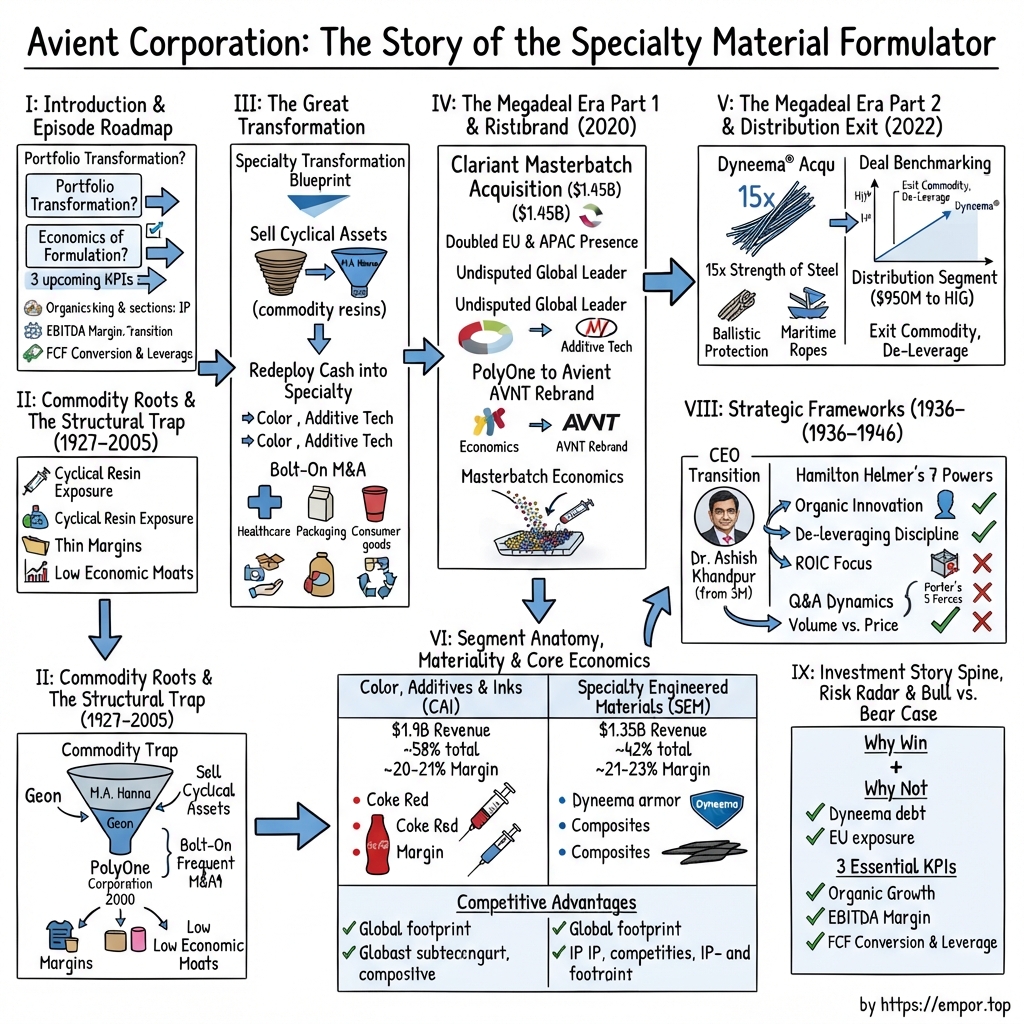
Avient Corporation: The Story of the Specialty Material Formulator
I. Introduction & Episode Roadmap
On the morning of August 6, 2026, a conference operator named Michelle opened an earnings call from Avon Lake, Ohio — a town on the shore of Lake Erie, twenty miles west of Cleveland, where Avient Corporation's headquarters sits on a campus originally built by a vinyl resin manufacturer. The chief executive who took the microphone, Dr. Ashish Khandpur, spent most of his career at 3M in Minnesota. He opened with a figure that would have seemed improbable in that building two decades earlier: for the second quarter of 2026, the company generated a record adjusted EBITDA margin of 18.3%.1
That 18.3% margin stands out for a plastics compounder in a Rust Belt town whose industrial identity was built on polyvinyl chloride (PVC) — a commodity resin used in piping, siding, and window frames that historically traded on fractions of a cent per pound.
The contrast between what this company was and what it now reports forms the core of its corporate evolution. Listed on the New York Stock Exchange under the ticker AVNT, Avient generated $3.26 billion in sales in 2025 and maintains a market capitalization in the low-$4 billion range.2 Avient does not produce primary polymers. Instead, it buys raw resins — such as polyethylene, polypropylene, nylon, and thermoplastic elastomers — from integrated petrochemical suppliers. It then formulates custom materials by mixing pigments, additives, stabilizers, flame retardants, and processing aids into concentrated pellets. Customers dose these pellets into their own production lines at 1% to 5% of the finished product weight. Avient also owns Dyneema, an ultra-high-molecular-weight polyethylene fiber marketed for body armor, offshore platform mooring lines, and performance climbing equipment.
Twenty-five years ago, the business operated as PolyOne, formed through a $3.5 billion merger of equals between two Cleveland-area industrial companies. At the time, the combined entity generated high revenue but suffered from thin operating margins, severe cyclicality, and minimal pricing leverage against suppliers or customers. Its repositioning over the past two decades represents one of the more complete portfolio overhauls in American industrials, driven primarily by acquisitions and divestitures.
The strategic pivot, and the questions it raises
Avient's strategic shift involved divesting asset-heavy, capital-intensive, cyclical operations — specifically commodity PVC compounding and third-party resin distribution — while acquiring formulation businesses. These specialized units feature proprietary formulas, smaller batch volumes, technical customer relationships, and higher customer switching costs. Consequently, gross margin expanded from the mid-teens to approximately 32% of sales in 2025.3 Adjusted EBITDA margin, now management's primary profitability metric, reached a full-year record of 16.7% in 2025 and a quarterly record of 18.3% in the second quarter of 2026.41
However, an acquisition-led portfolio transformation depends heavily on purchase price discipline. Avient executed two of its largest acquisitions near cyclical peaks: buying Clariant's global masterbatch business for a net $1.44 billion in July 2020, and acquiring Royal DSM's protective materials business — the Dyneema franchise — for $1.485 billion in a transaction announced in April 2022 and closed that September.56 To control leverage following these transactions, Avient sold its Distribution segment to H.I.G. Capital for $950 million in cash on November 1, 2022.7 Within twelve months of that sequence, global industrial demand entered an extended destocking environment that has persisted across multiple sub-sectors.
This sequence raises several core analytical questions. Did Avient acquire assets at peak multiples, requiring several years of debt reduction to restore financial flexibility? Does recent margin expansion reflect sustainable operational efficiency, or cost reduction during weak demand that inflates margin percentages while revenue remains stagnant? Can a material formulator exercise genuine pricing power, or does it merely experience raw material cost lags? Furthermore, what are the underlying returns on invested capital given that goodwill and intangibles from acquisitions account for more than half of the balance sheet?
The company's leadership transition also highlights distinct operational approaches. Robert Patterson ran the company from 2014 through 2023 as a portfolio architect, focusing on acquisitions, divestitures, and corporate rebranding. Khandpur, a materials scientist by training who assumed the chief executive role on December 1, 2023, signaled a shift toward organic growth complemented selectively by M&A.8 A key question for 2026 is whether that discipline will hold as leverage declines; during the most recent earnings call, when asked about capital allocation once net leverage falls into the 2.2x to 2.4x EBITDA range, Khandpur noted that "everything is on the table."2
The roadmap
This story examines Avient across six major movements. First, it reviews the commodity origins — Geon and M.A. Hanna — and the structural factors that depressed returns during PolyOne's initial decade. Second, it traces the specialty transformation from 2006 to 2019, executed through bolt-on acquisitions and non-core divestitures. Third, it evaluates the megadeal era, including the Clariant acquisition, the rebrand to Avient, the Dyneema purchase, and the Distribution exit. Fourth, it analyzes the operating models and economic drivers of the two remaining reporting segments. Fifth, it assesses management execution under Khandpur across recent quarterly results. Finally, it applies strategic frameworks and financial metrics to evaluate the company's long-term investment case.
The narrative starts where the underlying economics were worst.
 Subscribe on LinkedIn
II. Commodity Roots & The Structural Trap (1927–2005)
In the summer of 2000, two Cleveland-area industrial firms combined in an effort to gain scale in polymer processing.
The first, M.A. Hanna Company, originated in the Gilded Age iron and coal trade on the Great Lakes. By the late 1980s, Hanna had dismantled its mining operations and redeployed capital into polymer compounding and distribution.
The second, The Geon Company, was spun off from B.F. Goodrich in 1993. Goodrich was a commercial pioneer in polyvinyl chloride (PVC), and Geon inherited its PVC resin capacity and compounding operations, which supplied material for piping, siding, wire insulation, and medical tubing.
On August 31, 2000, shareholders of both companies approved a merger of equals, forming PolyOne Corporation — a roughly $3.5 billion enterprise positioned as a global leader in polymer services.9
Why the merger logic was wrong
The strategic rationale relied on achieving scale in North American resin compounding and distribution. In commodity plastics compounding, however, scale provided little competitive advantage because customers could easily route around processors.
PolyOne's core operations involved purchasing commodity resins — such as polyethylene, polypropylene, and PVC — from upstream producers, mixing them with standard fillers and stabilizers, and selling the compounded pellets by the pound to manufacturers of auto parts, appliances, and building products. Separately, its distribution business warehoused and resold third-party resins.
This structure left PolyOne economically vulnerable at every stage. Upstream, supplier power was concentrated among integrated petrochemical producers — including Dow, ExxonMobil, and LyondellBasell — whose cost positions stemmed from cracker scale and who held substantial pricing leverage over mid-cap buyers. Downstream, buyers in the automotive and construction sectors faced their own margin pressures and would shift volumes to competitors over price differences as small as a fraction of a cent per pound. Operating in the middle, PolyOne processed commodities into slightly modified compounds while carrying capital-intensive extruders, inventory, and expanding working capital needs whenever resin prices surged.
This positioning created asymmetric margin exposure. When feedstock prices rose, PolyOne absorbed immediate cost increases while price adjustments to customers lagged by weeks or months. Conversely, when resin prices fell, customers demanded immediate price cuts before the company could realize lower input costs. Without proprietary product differentiation, PolyOne absorbed working capital expansion during cost spikes without enjoying durable margin gains during downturns.
The trap, stated plainly
During its first five years, PolyOne illustrated a structural weakness common among mid-market processors: it functioned as a price-taker on both inputs and outputs. It possessed little control over feedstock procurement costs or finished product pricing. Consequently, financial performance depended primarily on North American automotive production volumes and housing starts — factors outside management's control — alongside internal cost reduction, which faced operational limits before impacting service quality.
The financial metrics reflected these structural headwinds. Gross margins hovered in the mid-teens, and earnings remained highly volatile across industrial cycles. Returns on invested capital in compounding plants frequently failed to cover the cost of capital over a full cycle. Meanwhile, the distribution segment — though cash-generative and low-risk — operated at thin 5% to 6% operating margins on pass-through revenue, inflating top-line sales while diluting corporate return metrics.
This period demonstrates that commodity operations require a structural cost advantage — such as low-cost cracker access or superior logistics — to generate strong returns. Lacking a cost edge, PolyOne remained a mid-cost processor in a price-sensitive market.
By the mid-2000s, PolyOne's board recognized that portfolio transformation was necessary. The central challenge was whether a company with a leveraged balance sheet and cyclical earnings could execute that transition — a process that ultimately required a decade and a change in executive leadership.
III. The Great Transformation: From Commodity Polymer Mixer to Specialty Formulator (2006–2019)
Stephen Newlin arrived as chief executive officer in 2006 from Ecolab, following a career at Nalco, a specialty water-treatment chemical supplier. That background shaped his strategic orientation: commodity operators focus primarily on lowering unit production costs per pound, whereas specialty operators identify specific customer technical challenges, price for value, and build defensive barriers around proprietary formulations.
Newlin framed PolyOne’s strategy around portfolio transformation: divesting businesses where the company lacked competitive advantages and redeploying capital into specialty operations protected by proprietary formulas, regulatory qualifications, and high customer switching costs.
Executing that strategy took thirteen years.
The mechanics of a formulation business
To evaluate why management pursued this transition, consider the economics of color and additive formulations.
A beverage manufacturer launching a new bottle does not simply buy blue resin. It requires an exact shade reproduced consistently across global bottling facilities — one that withstands ultraviolet light, preserves oxygen barriers, complies with food-contact regulations across jurisdictions, and processes cleanly at high speeds without fouling blow-molding equipment. The formulator supplies a concentrated pellet of pigment and additive suspended in a carrier resin. That pellet represents a small fraction of the finished bottle's total cost, yet a formulation failure can halt production lines and compromise brand identity.
That economic asymmetry — minimal material cost paired with high failure risk — generates customer stickiness. Once a customer qualifies a formulation, the operational risk and cost of switching suppliers outweigh minor price savings. Consequently, formulators maintain pricing leverage even when raw material costs fall. Furthermore, formulation operations require lighter capital investment than primary resin manufacturing: plants utilize extruders and mixing lines rather than steam crackers, resulting in lower capital intensity per dollar of gross profit.
Buying the capability
PolyOne built its specialty capabilities primarily through acquisitions, executing a series of targeted transactions that grew progressively larger.
A key transaction prior to its megadeal era was the acquisition of ColorMatrix Group in December 2011 for $486 million.10 ColorMatrix specialized in liquid colorants — which allow precise dosing and lower usage rates than solid pellets — as well as additive and barrier technologies for polyethylene terephthalate (PET) packaging. The deal embedded PolyOne directly into food and beverage supply chains alongside technical application-engineering teams.
In March 2013, PolyOne acquired Spartech, a manufacturer of engineered sheet, rollstock, and packaging, for approximately $393 million including assumed debt.11 Spartech presented a more complex integration profile; portions of the business leaned closer to basic conversion than specialized formulation and were eventually divested. However, it expanded PolyOne’s presence in engineered materials and structures, including platforms like Gordon Composites and Polystrand that later complemented subsequent acquisitions.
These transactions targeted proprietary formulation libraries, application engineers, regulatory documentation, and specified positions on customer engineering drawings. In specification-driven markets, commercial value rests on having a proprietary product designated in customer engineering drawings or regulatory filings, where replacing a supplier incurs significant validation costs and time.
Selling the anchor
The strategic shift also required divestitures, culminating in the sale of PolyOne's Performance Products and Solutions segment in 2019. That unit — the direct descendant of the Geon vinyl business — generated approximately $700 million in annual sales across twelve plants in North America and Asia with 1,100 employees. PolyOne sold the segment to SK Capital Partners for $775 million in cash, closing the transaction on October 28, 2019.1213 SK Capital rebranded the business GEON Performance Solutions and established its headquarters in Avon Lake, Ohio — sharing a hometown with its former parent.
The divestiture formally severed PolyOne's legacy vinyl business. Financial results reflected the structural transition: reported net income of $588.6 million in 2019 was driven primarily by gains from discontinued operations rather than organic performance, while sales from continuing operations fell to $2.86 billion from $3.53 billion the prior year.3 The divestiture left PolyOne with a smaller top line but higher consolidated margin potential.
What the numbers said, and what they didn't
By the late 2010s, the transformation had reshaped the income statement. Gross margin approximately doubled from its mid-2000s baseline, and earnings volatility decreased as exposure to cyclical automotive builds and housing starts receded. Management highlighted that the portion of adjusted EBITDA generated by specialty applications had expanded from under 10% at the start of the program to a broad majority.5
Despite that progress, two structural friction points remained.
First, PolyOne retained its Distribution segment, which generated over a billion dollars in annual sales by reselling third-party resins at thin operating margins. In 2019, Distribution generated $1.17 billion in sales, compared to $998 million for Color, Additives and Inks.14 Although Distribution provided steady cash flow, low capital risk, and market intelligence, its lower margins diluted corporate return metrics and complicated PolyOne’s positioning as a specialty formulator.
Second, PolyOne lacked global scale in color and additive masterbatches. Multinational consumer goods companies increasingly required formulators capable of delivering identical formulations across North America, Europe, and Asia. Operating at roughly $1 billion in segment sales, PolyOne’s color business maintained strong regional positions but lacked a dominant global footprint.
Addressing both issues required a far larger strategic commitment.
IV. The Megadeal Era Part 1: Clariant Masterbatch & The Avient Rebrand (2020)
PolyOne agreed to acquire Clariant's global masterbatch business in December 2019, when global industrial production was subdued but stable. By the time the transaction closed on July 1, 2020, widespread pandemic shutdowns had disrupted manufacturing across Europe and North America, automotive builds had collapsed, and PolyOne had renegotiated terms. The final net purchase price was $1.439 billion — reflecting $1.488 billion paid to the seller, offset by a $117 million lease adjustment and a $6 million working capital adjustment — reducing the cost relative to the originally announced figure.5
That renegotiation provides clear evidence of management discipline. Buyers facing signed agreements, committed financing, and eager shareholders rarely revisit pricing before closing. PolyOne nevertheless extracted price reductions. While modest relative to a $1.4 billion transaction, the adjustment demonstrated financial rigor during severe market volatility.
What $1.44 billion bought
PolyOne paid 10.8 times Clariant Masterbatch's 2019 adjusted EBITDA before synergies, or roughly 7.5 times after accounting for targeted cost savings.5 The acquisition added 46 manufacturing and technology sites across 29 countries along with approximately 3,500 employees, all integrated into PolyOne's Color, Additives and Inks segment.5
The deal fundamentally altered the company's competitive position. Prior to the acquisition, PolyOne struggled to guarantee identical color matching across global manufacturing footprints in North America, Europe, and Asia-Pacific. The Clariant assets closed that geographic gap, expanding Color, Additives and Inks sales from under $1 billion in 2019 to $1.50 billion during the partial year of 2020, and $2.40 billion in 2021.14
Evaluating whether 10.8 times represented sound value requires context. It was a premium valuation for a high-quality asset in a fragmented sector, defensible primarily through synergy realization. The post-synergy 7.5-times target required rigorous cost execution, while the top-line thesis depended on winning multinational accounts that neither company could secure independently. Evaluating that revenue synergy thesis remains difficult, as subsequent years brought severe macro distortions: pandemic supply shocks, sharp resin cost inflation, and an extended destocking cycle.
More concretely, integration proceeded without major operational disruption, and by 2025 the Color, Additives and Inks segment produced $390.5 million in EBITDA on $2.03 billion in sales — maintaining a segment margin near 19%.4 That performance demonstrates solid execution following a high-multiple purchase, even if it does not prove the acquisition was a bargain.
The rebrand
Concurrently with the transaction's close, PolyOne rebranded as Avient Corporation, trading under the new ticker AVNT starting July 13, 2020.5 Robert Patterson, then chairman, president, and chief executive officer, emphasized that the transaction elevated specialty applications to over 85% of adjusted EBITDA, compared with under 10% at the outset of the portfolio transformation.15
While corporate name changes often amount to marketing window dressing, this rebrand signaled a real operational shift. The name "PolyOne" traced back to legacy vinyl operations inherited from B.F. Goodrich via Geon. Retaining that brand while exiting commodity vinyl and scaling global color formulation created a structural misalignment between the corporate identity and its underlying products. For technical customers and brand owners, retiring a name tied to primary resin production removed commercial ambiguity.
At the same time, the timing offered narrative advantages. Rebranding alongside a major acquisition allowed management to reposition the equity story and encourage a higher valuation multiple. Furthermore, the corporate transformation remained incomplete in July 2020: the commodity-like Distribution business remained on Avient's balance sheet for another 28 months before its eventual divestiture.
How masterbatch economics actually work
Understanding masterbatch economics clarifies Avient's underlying business model.
A masterbatch is a concentrated additive or color formulation. Tinting a swimming pool with a single drop of dye would produce an uneven distribution; dissolving the dye into a bucket of water first ensures uniform blending. A masterbatch acts as that bucket. Formulators pre-disperse pigments, ultraviolet stabilizers, antimicrobials, flame retardants, or oxygen scavengers at high concentration into a carrier resin compatible with the customer's end product. Manufacturers then blend these masterbatch pellets into base resins at dosing ratios typically between 1% and 5%.
Three economic characteristics define this model:
First, masterbatch material represents a small fraction of the finished product's unit cost. Consequently, customers rarely risk switching suppliers to chase marginal price reductions on an item accounting for a low single-digit percentage of total bill of materials.
Second, performance failure risks far outweigh material cost. Imperfect pigment dispersion causes surface streaks, inadequate UV stabilization leads to package discoloration on retail shelves, and incompatible additive packages cause equipment fouling and costly production downtime. The customer's financial risk from product failure vastly exceeds the cost of the formulation itself.
Third, masterbatch formulations serve as the primary vehicle for meeting sustainability and regulatory demands. When consumer brands incorporate post-consumer recycled plastic, the recycled feedstock exhibits color inconsistency and structural variability that colorant and additive packages must correct. Similarly, when regulatory bodies ban specific chemical compounds, formulators must develop compliant alternatives. For example, European regulations taking effect in August 2026 restrict intentionally added per- and polyfluoroalkyl substances (PFAS) in food-contact packaging, prompting multinational customers to adopt Avient's non-PFAS polymer processing aids ahead of formal deadlines.1
This regulatory shift represents a key organic growth driver across Avient's portfolio. Regulatory mandates force customer requalification cycles, creating opportunities for technical formulators to capture market share. On Avient's second-quarter 2026 earnings call, Khandpur noted that qualification requires months of line trials, adding that "once you are in, then you are qualified... the moat is stronger for switching."1 However, he acknowledged during the same call that revenue from these non-PFAS solutions currently totals "a few million dollars."1 Both points remain critical: regulatory shifts create high-margin technical moats, but commercial scaling takes time.
V. The Megadeal Era Part 2: Dyneema® Crown Jewel & The Distribution Exit (2022)
Marketing material for ultra-high-molecular-weight polyethylene fiber often features a hair-thin filament suspended between two clamps, holding a weight that would snap a steel wire of the same diameter. The fiber is fifteen times stronger than steel on a weight-for-weight basis: it floats on water, resists chemical degradation, and does not rot or rust.
On April 20, 2022, Avient announced an agreement to acquire the business behind the material.
What Dyneema is, and why it is hard to copy
Standard polyethylene — the resin used in a common grocery bag — consists of disordered molecular chains lying in random orientations. That structural disorder limits its tensile strength, much like a heap of loose thread compared to a twisted rope. Dyneema is manufactured through gel spinning: long-chain polyethylene molecules are dissolved into a gel, extruded through spinnerets, and drawn at extreme ratios so the molecular chains align almost perfectly along the fiber axis in a crystalline orientation. As a result, the material's strength stems from covalent bonds along the polymer backbone rather than physical entanglements between chains.
The underlying science is decades old, but the primary commercial barrier lies in process control. During Avient's fourth-quarter 2025 earnings call, Chief Executive Officer Ashish Khandpur detailed the operational trade-off: fiber strength — or tenacity — increases with crystallization during drawing, but crystallization takes time. Historically, increasing tenacity required slowing the production line. Khandpur noted that Avient's engineering teams spent over a year learning how to raise tenacity without reducing line speeds. Management chose to protect the resulting equipment and process modifications as trade secrets rather than patenting them, given the difficulty of enforcing process patents externally.4
That choice underscores the structural nature of the business's moat. Defensibility relies less on legal filings and more on accumulated manufacturing expertise, custom equipment configurations, and rigorous customer qualification cycles. Competitors with access to the underlying chemistry must still design specialized production lines, master process controls, and complete multi-year military and law enforcement certification processes.
The price, and the honest arithmetic
Avient agreed to purchase Royal DSM’s protective materials business for $1.485 billion in cash, subject to customary adjustments, backed by committed debt financing from Morgan Stanley and J.P. Morgan.6 At announcement, management projected the unit would generate approximately $415 million in sales and $130 million in EBITDA for 2022, representing an implied valuation multiple of roughly 11.4 times forward EBITDA.6 The transaction closed on September 1, 2022, adding six manufacturing plants, four research facilities, and approximately 1,000 employees to Avient's Specialty Engineered Materials segment under the name Avient Protective Materials.
The transaction's valuation multiple warrants clear distinction. Outside commentary frequently cited a purchase multiple of 13 to 14 times trailing EBITDA, whereas Avient's disclosure reflected 11.4 times forward-year EBITDA. The choice between trailing and forward metrics alters the headline evaluation. In either case, the purchase represented a premium valuation for materials assets, exceeding prevailing multiples for broader chemical producers. Management justified the premium by pointing to the target's 30-plus percent EBITDA margins, proprietary technology, and growing defense market exposure.
The target's profitability claims proved durable. By management's reporting, defense-related sales grew 14% in 2024 and 8% in 2025. In 2025, the Specialty Engineered Materials segment generated $251.8 million in EBITDA on $1.23 billion in revenue — delivering an approximate 20% segment margin that reflected the inclusion of the higher-margin protective materials business.4
However, macroeconomic timing created near-term financial friction. The deal closed in September 2022, immediately ahead of a broad industrial destocking cycle that compressed demand across 2023. Avient's consolidated sales declined from $3.40 billion in 2022 to $3.14 billion in 2023. At the same time, higher interest rates elevated annual interest expense to $115.3 million against operating income of $221.5 million.3 Net leverage rose to a peak of approximately 3.1 times EBITDA at year-end 2023.4 With free cash flow at $82.2 million in 2023, the debt burden created tight financial flexibility for an enterprise carrying over $2.1 billion in gross debt.3
The transaction yields a nuanced assessment. Avient acquired a high-margin, differentiated asset at a full valuation, funding the purchase with debt just as interest rates rose and industrial volumes softened. While post-2022 geopolitical factors bolstered military demand, the company spent three years working down debt to manage the leverage incurred at closing.
The counterweight: exiting Distribution
Management signaled its deleveraging strategy alongside the acquisition announcement. In its April 2022 release, Avient announced plans to explore selling its Distribution segment, targeting a post-transaction net leverage ratio of roughly 2.9 times adjusted EBITDA while elevating consolidated adjusted EBITDA margin from approximately 12% to nearly 18%.6
That explicit guidance established a clear benchmark: management committed to specific leverage and profitability targets prior to execution, rather than formulating a deleveraging strategy after closing a major purchase.
The sale closed on November 1, 2022, with H.I.G. Capital acquiring the business for $950 million in cash. The transaction generated approximately $750 million in net after-tax proceeds, which Avient applied directly to extinguish near-term debt maturities.7 The divested unit was renamed Formerra and continued operating as an independent distributor.16
Strategic clarity or a mistimed sale?
The divestiture presents two distinct analytical perspectives.
The structural thesis emphasizes portfolio quality and balance sheet protection. Distribution generated over $1 billion in annual revenue at high-single-digit gross margins while tying up working capital as resin prices fluctuated. Divesting the segment lifted Avient's consolidated gross margin toward 32% and pushed adjusted EBITDA margins into the mid-teens. The transaction also funded the Dyneema acquisition without equity dilution, leaving the share count essentially unchanged at approximately 91 million shares from 2021 through 2025.3 Executing a major portfolio transformation while preserving share count avoided diluting existing equity holders.
Conversely, the timing thesis highlights the loss of volume stabilization. Distribution provided low-margin but steady cash flow and broad visibility across industrial customer end-markets. Exiting the business in late 2022 removed that revenue baseline just as specialty volumes stagnated. From 2022 to 2025, consolidated sales contracted from $3.40 billion to $3.26 billion, even as margin percentages expanded.3 Consequently, the business achieved higher profitability ratios on a smaller top-line base.
Ultimately, Avient traded sales scale and distribution cash flow for margin expansion and strategic focus. That trade-off reshaped the financial profile while leaving execution dependent on organic performance within its remaining specialty segments.
Following the November 2022 sale, Avient completed its major portfolio restructuring. Future growth and deleveraging would depend entirely on operating performance across the remaining formulation segments — setting the stage for executive leadership when Khandpur assumed the chief executive role thirteen months later.
VI. Segment Anatomy, Materiality & Core Economics
Behind the corporate narrative, Avient operates through two reporting segments, with a revenue split that is less equal than executive summaries often suggest.
Color, Additives and Inks generated $2.034 billion in sales in 2025—roughly 62% of the consolidated total—and $390.5 million in segment EBITDA, yielding a segment margin near 19%.144 Specialty Engineered Materials generated $1.231 billion, accounting for roughly 38% of sales, and $251.8 million in segment EBITDA, representing a margin near 20%.144 Consolidated adjusted EBITDA stood at $545 million, reflecting corporate overhead costs that separate the corporate total from segment-level earnings.4
While the two divisions report comparable profitability margins, their underlying operating characteristics and economic drivers differ substantially.
Color, Additives and Inks: the wide, shallow moat
Color, Additives and Inks operates as Avient's high-volume business, characterized by thousands of customers, hundreds of thousands of proprietary formulations, short order lead times, and a global footprint spanning the Americas, Europe, and Asia-Pacific. Packaging serves as its largest end market, accounting for approximately 23% of total company sales.51 Beyond packaging, the segment supplies consumer goods, healthcare, building and construction, transportation, and general industrial applications.
The market remains fragmented. Primary competitors include Ampacet, a major privately held global masterbatch producer; Cabot Corporation, which focuses on black masterbatch and carbon black; Tosaf; Penn Color; and numerous regional compounders. Integrated chemical producers compete selectively at the higher-volume margins. At the lower end, low-cost Asian processing capacity pressures base formulations. On Avient's third-quarter 2025 earnings call, Khandpur acknowledged "quite a bit of overcapacity, especially on the color side," pointing directly to Chinese competition across multiple regional markets.17
Management counters that cost pressure by emphasizing specialized technical service: rather than competing on commodity resin prices, Avient collaborates with customers from initial product design through regulatory qualification, offering global delivery consistency and short turnaround times. As evidence of pricing leverage, management noted that price/mix remained positive and segment margins expanded across three consecutive quarters of declining organic sales in 2025.17
While positive price/mix during a volume downturn demonstrates pricing resilience, the structural limits are clear. The segment's organic sales fell 2% for full-year 2025.4 Margin expansion during the year stemmed from product mix and internal productivity gains rather than volume growth; Avient's chief financial officer noted explicitly that with flat organic sales, there was "no operating leverage" contributing to the 50 basis points of company-wide margin expansion.4 Holding prices during volume contraction protects margins, but it does not generate top-line expansion.
A key operational dynamic reinforces this customer relationship. On the third-quarter 2025 call, Khandpur noted that color customers had shifted to ordering "smaller lots and more frequently," relying on Avient for rapid fulfillment and leaving management with minimal order visibility beyond two to three weeks.17 While serving as an outsourced inventory manager creates operational stickiness with customers, it also restricts management's forward visibility when forecasting quarterly performance.
Specialty Engineered Materials: the narrow, deep moat
Specialty Engineered Materials operates on a distinct commercial profile: fewer total accounts, longer qualification cycles, higher technical content, and inherently lumpier order patterns.
The division's anchor is Avient Protective Materials—the Dyneema ultra-high-molecular-weight polyethylene business acquired in 2022—which supplies personal ballistic armor for military and law enforcement, marine mooring lines, sustainable infrastructure, and high-performance outdoor equipment. The surrounding portfolio includes composite structures, engineered thermoplastics for medical devices, wire and cable formulations, and an expanding electronics and high-performance computing business.
The segment competes against a distinct peer set, including Celanese, Syensqo, Huntsman, and the specialty compounding divisions of integrated chemical producers, alongside a small group of specialized aramid and fiber manufacturers in ballistic protection.
Three core end markets drive revenue performance. Defense spending expanded 14% in 2024 and 8% in 2025, with management projecting mid- to high-single-digit growth in 2026.41 Healthcare applications contributed roughly $40 million in net new sales over a two-year period across medical device, equipment, and drug-delivery platforms.18 Meanwhile, electronics and high-performance computing represent an emerging growth vector tied to semiconductor manufacturing, data center interconnects, and specialized cabling.
The economics of Specialty Engineered Materials benefit from high switching costs driven by formal qualification requirements. A ballistic composite specified into a military supply program undergoes multi-year field testing, while a polymer used in a Class II medical device is embedded in regulatory filings. Substituting a supplier requires extensive requalification testing rather than a simple purchasing decision, creating durable commercial relationships.
However, high specification barriers also introduce revenue lumpiness. For example, defense sales were flat in the first quarter of 2026 due to order timing and delayed U.S. government spending, before rebounding in the second quarter against a prior-year comparison that had expanded roughly 19%.181 Quarterly fluctuations in this segment often reflect procurement timing rather than shifts in underlying demand.
A disclosure aside worth flagging
Executive disclosures surrounding new growth vectors warrant close tracking. On the first-quarter 2026 call, Khandpur stated that the electronics and high-performance computing vector was "expected to finish greater than $40 million in sales this year," having roughly doubled over three years.18 On the second-quarter call three months later, he revised the outlook, projecting that electronics alone would "finish close to $60 million" and that the combined data-center-and-electronics business would reach "close to $100 million," against an estimated $2 billion addressable market.1
While expanding end-market definitions can explain these shifting figures, the lack of a detailed bridge leaves the exact baseline open to interpretation. Management's self-defined growth vectors remain modest in context, accounting in aggregate for less than 20% of Avient's total revenue portfolio.17
What the two segments together actually are
Taken together, Avient's segments reveal a dual economic structure: switching costs are high at the individual product-specification level, but customer relationships remain contestable over time. While displacing an existing formulation is costly and technically risky for a customer, overall accounts reopen to competition whenever clients launch new product lines, retool facilities, or reformulate to comply with updated regulations.
Consequently, regulatory transitions—such as pending PFAS restrictions, recycled-content mandates, and updated flame-retardant standards—present both Avient's primary organic growth catalyst and an ongoing risk. Requalification cycles allow technical formulators to capture new customer specifications, but they also expose existing accounts to competitive displacement. Winning these specs depends on rapid, application-specific engineering execution—the central operational priority established by Khandpur's leadership.
VII. Current Management & The Khandpur Playbook (2024–Present)
On November 13, 2023, Avient announced that Robert Patterson would retire as president and chief executive, remaining through May 31, 2024, in an advisory role. Dr. Ashish K. Khandpur assumed the chief executive role on December 1, 2023, while Richard H. Fearon — the former Eaton financial executive — became non-executive chairman.8
Khandpur brought an extensive technical and operational background. He joined 3M in 1995 as a senior research engineer and spent nearly three decades at the company, serving as chief technology officer in 2014 — overseeing more than 8,000 scientists and engineers alongside roughly $1.9 billion in annual R&D spending — before running 3M's Transportation and Electronics business group, which generated approximately $8.9 billion in 2022 revenue.8 At the time of the appointment, Fearon publicly described Khandpur as "one of the world's leading experts in polymers and materials."8
The appointment signaled a structural shift in leadership priorities. Having completed a two-decade portfolio transformation through major acquisitions and divestitures, Avient's board sought an operational leader capable of driving organic growth from the assembled specialty business units without relying on further large-scale dealmaking.
On May 14, 2025, Khandpur assumed the additional role of board chairman, succeeding Fearon, who remained a director.19 Combining the chairman and chief executive roles concentrated executive authority eighteen months into his tenure. While Fearon's continued presence as a director and the retention of independent board oversight mitigate concentration risks, combining the roles remains a weaker corporate governance structure that warrants ongoing monitoring.
The strategy, in his words
Khandpur's strategy has remained consistent across his tenure. At an investor day at the New York Stock Exchange on December 4, 2024, management outlined a target to expand organic sales 100 to 200 basis points above GDP alongside concurrent margin expansion, anchored by four strategic pillars: portfolio prioritization, amplified innovation, digital tools for operational excellence, and leadership culture.2021
The company's long-term goal was to raise adjusted EBITDA margin above 20% from a baseline of just over 16%. On the fourth-quarter 2025 earnings call, Chief Financial Officer Jamie Beggs broke down the intended drivers of that target: approximately half the expansion was expected to come from operating leverage, one-quarter from favorable product mix, and one-quarter from operational productivity.4
That breakdown provides a clear benchmark for evaluating execution. Because half the margin target depends on volume-driven operating leverage, organic sales growth is essential to achieving management's long-term plan. In 2025, organic sales stagnated, yet Avient still delivered 50 basis points of margin expansion without any contribution from operating leverage.4 Management achieved its margin target by substituting higher productivity and favorable product mix for missing volume growth.
While that substitution reflects disciplined cost control, internal productivity programs face natural operational limits. Beggs acknowledged that constraint on the call, noting that management needed to be cautious about cutting too deeply into operations.4
The track record, tested
Comparing guidance with reported performance across recent quarters highlights management's operational trajectory.
2024. Full-year sales rose 3% to $3.24 billion, supported by 4% organic growth across all geographic regions. Adjusted diluted earnings per share (EPS) reached $2.66, up 13% from $2.36. Adjusted EBITDA margin expanded 20 basis points to 16.2%, driven by segment margin gains of 90 basis points in Color, Additives and Inks and 110 basis points in Specialty Engineered Materials.21 The initial year of Khandpur's tenure delivered solid top-line performance supported by positive organic volume growth.
2025. Management initially projected full-year adjusted EBITDA of $540 million to $570 million and adjusted EPS of $2.70 to $2.94.21 As broader industrial demand softened during the year, management narrowed its adjusted EBITDA forecast on the third-quarter call to $540 million to $550 million — lowering the midpoint — while maintaining its adjusted EPS outlook at $2.77 to $2.87, noting that reduced interest expense from debt paydown and a third-quarter tax benefit offset lower operating income.17
This disclosure revealed contrasting dynamics. While management provided transparent explanations regarding the factors supporting EPS, sustaining earnings per share through below-the-line interest savings and tax benefits amid declining operating forecasts represented a lower-quality earnings profile than the headline figures indicated.
For the full year 2025, Avient reported adjusted EBITDA of $545 million, adjusted EPS of $2.82 — a 6% increase — and a record full-year adjusted EBITDA margin of 16.7%, reflecting 50 basis points of expansion. The company generated $195 million in free cash flow, repaid $150 million in debt, and reduced net leverage to 2.6 times EBITDA.4 Although final results fell within original guidance ranges, operational earnings accounted for a smaller share of performance than initially planned.
2026 to date. For 2026, management initially guided to adjusted EBITDA of $555 million to $585 million and adjusted EPS of $2.93 to $3.17.4 First-quarter adjusted EPS arrived at $0.83, exceeding the $0.81 outlook, even as total volumes fell approximately 2% and organic sales in Color, Additives and Inks declined 3%.18 Management maintained its full-year guidance despite the beat, citing second-half demand uncertainty and potential customer prebuying driven by Middle East supply chain disruptions.18 Second-quarter results subsequently outperformed expectations, delivering $0.96 in adjusted EPS against an $0.87 consensus, 4.3% organic sales growth, and a record 18.3% adjusted EBITDA margin. Management then raised full-year guidance to $575 million to $603 million in adjusted EBITDA, $3.10 to $3.25 in adjusted EPS, and $210 million to $230 million in free cash flow.1
Holding guidance following a first-quarter beat before raising outlooks after confirming volume trends in the second quarter reflected a conservative approach to guidance management.
What the analysts actually push on
Quarterly earnings calls highlight three recurring analytical questions.
Price versus volume. On the second-quarter 2026 call, a Deutsche Bank analyst requested the composition of the 4.3% organic growth figure. Khandpur clarified that price increases accounted for roughly three-quarters of the gain, with volume contributing one-quarter, while projecting that the balance would shift to approximately 70% volume and 30% price by the fourth quarter of 2026.1 That projection represents a key milestone for management's organic growth narrative; persistent reliance on price expansion into late 2026 would signal ongoing weakness in baseline end-market demand.
Price retention. Analysts also questioned whether falling raw material costs would force Avient to surrender price gains. Khandpur cited post-pandemic precedents to argue that the company expects to retain the vast majority of its pricing.1 Chief Financial Officer Jamie Beggs provided critical context on the first-quarter call, disclosing that fewer than 5% of Avient's customer contracts contain formal raw-material price indexation clauses.18
This disclosure reframes the market's understanding of Avient's pricing model. Rather than operating as a pass-through processor with formulaic price adjustments lagged by one to two quarters, Avient negotiates pricing on an order-by-order basis. That structure enabled the company to maintain positive net pricing across the 2021–2022 cost surge, 2025 tariff shifts, and 2026 geopolitical supply disruptions.18 However, order-by-order pricing relies on commercial execution and customer acceptance rather than legal guarantees, leaving pricing power vulnerable if competitive conditions intensify.
Prebuy risk. Analysts from Truist, Baird, and Oppenheimer questioned whether second-quarter volume gains reflected genuine end-market demand or temporary customer stocking ahead of announced price increases. Khandpur estimated that prebuying contributed no more than $2 million to $3 million in sales, adding that July order rates remained solid.1 Management had taken a cautious approach a quarter earlier, stating that first-quarter guidance included a precautionary reduction for potential demand pull-forward.18
Management disclosures remain less explicit regarding emerging growth initiatives. Sizing estimates for the electronics vector fluctuated between quarterly calls, while non-PFAS formulations generate only a few million dollars in current revenue despite significant customer qualification trials. Furthermore, when Frank Mitsch of Fermium Research asked whether Avient would report a new-product vitality index — a metric common in R&D-driven industrial companies — Khandpur stated that he tracks the metric internally but declined to disclose it publicly, arguing that standard metrics measure product replacement rather than net growth.4 Instead, management cited annual patent applications — which rose to over 50 per year in recent years from roughly 20 previously — as evidence of technical productivity.4 However, patent application totals provide a limited proxy for commercial adoption or revenue impact.
The CFO transition
A leadership change within finance also bears tracking. On the first-quarter 2026 earnings call, Khandpur announced that Jamie Beggs would step down as chief financial officer on June 1, 2026, after six years in the role, to pursue another opportunity. Giuseppe "Joe" Di Salvo — previously vice president, treasurer, and head of investor relations, with 25 years of finance experience including nearly 15 years at Avient — was named her successor.18
An unplanned chief financial officer departure during an active margin expansion program introduces transitional risk. However, appointing an internal successor familiar to institutional investors helped ensure continuity, with Di Salvo leading the second-quarter earnings call without operational disruption. Nonetheless, the transition means the executive who designed Avient's guidance framework and productivity tracking is no longer overseeing its execution.
VIII. Strategic Frameworks: 7 Powers & 5 Forces
Frameworks are useful primarily when applied adversarially — when the central question is not which competitive powers a company claims to have, but which powers survive a rigorous attempt to tear them down. Evaluated through that lens, Avient demonstrates genuine strength on two dimensions, ambiguous positioning on two others, and negligible advantage on the rest.
Hamilton Helmer's 7 Powers
Switching costs: strong, and the core of the investment thesis. Switching costs represent the single power that survives scrutiny without qualification, though locating its source correctly is essential. It does not exist at the overarching corporate level; rather, it resides at the individual product specification. A Dyneema fiber grade specified in a military ballistic program has undergone multi-year field testing; a specialized polymer used inside a medical device is embedded in regulatory submissions; a non-PFAS processing aid has completed months of customer trial runs on a production line before approval. Displacing any of these solutions requires re-testing, re-filing, and re-qualifying — incurring expenses that far exceed the material's purchase price. The evidence for this advantage is behavioral rather than rhetorical: Avient held and expanded price/mix through a year in which its largest segment's volumes fell, and it stayed net price positive through three separate inflation episodes.1718
The boundary of this power is equally distinct. Switching costs defend existing specifications; they do not automatically secure new ones. In a portfolio containing hundreds of thousands of formulations that turn over as clients introduce or reformulate products, a meaningful portion of the commercial book remains contestable each year.
Process power: real in one domain, thin in the other. The Dyneema gel-spinning process — specifically the operational trade-off between fiber tenacity and production line speed that Khandpur detailed, protected as a trade secret rather than patented — represents a clear example of accumulated manufacturing know-how that competitors cannot easily purchase.4 Elsewhere, across color and additives, the assertion that "millions of formulations" create a moat is less persuasive. A formulation library derives its value from established customer qualifications and technical relationships rather than inaccessible chemistry. A competent competitor can reverse-engineer most masterbatch recipes; replicating the embedded customer qualification is what requires time and capital.
Counter-positioning: partial, and largely historical. The underlying thesis holds that integrated petrochemical producers optimize for high-throughput volume and cannot economically serve small-batch, high-touch custom formulations, leaving specialized niches to formulators. While true in general terms, this does not constitute counter-positioning in the strict sense, as integrated producers are not structurally unable to respond — they simply select a different business model. Furthermore, the competitive threat highlighted by Avient's chief executive on earnings calls was not Dow or BASF, but rather Asian overcapacity in color.17 Against low-cost entrants, counter-positioning offers no defensive barrier.
Scale economies: genuine but bounded. The global manufacturing footprint acquired through Clariant enables multinational brand owners to specify a single supplier across multiple continents. This provides a tangible advantage over regional competitors. However, it does not translate into a structural cost advantage: masterbatch plants reach minimum efficient scale at modest production volumes, which explains why the industry remains fragmented and why regional compounders continue to compete effectively.
Branding, network economies, cornered resource: absent. Avient maintains no direct consumer brand equity. Network effects are nonexistent, as individual customers derive no added utility when others adopt Avient's materials. While Dyneema represents a strong industrial brand and a recognized ingredient name, it functions primarily as a commercial expression of underlying process power rather than an independent source of pricing leverage.
The composite analysis reveals that Avient possesses one robust power, one narrowly held specialized power, and two moderate advantages. This configuration describes a resilient industrial business rather than a compounder backed by an automatic growth engine — making a premium equity valuation the central risk in the bullish case.
Porter's Five Forces
Threat of new entrants: low to moderate. Establishing a global masterbatch enterprise from scratch requires a multi-region manufacturing footprint, extensive regulatory documentation for food-contact and medical applications, and years of customer validation. These requirements create a substantial entry barrier. Conversely, establishing a regional masterbatch operation requires far less capital, as evidenced by expanding capacity in Asia, where regional entrants capture price-sensitive volume. In ballistic high-performance fibers, barriers to entry remain close to prohibitive.
Supplier power: moderate, and asymmetric. Avient purchases hydrocarbon resins and specialty minerals from significantly larger chemical producers. For 2026, management quantified this exposure in detail: Khandpur disclosed that hydrocarbon inputs such as thermoplastic elastomers, polyethylene, and polypropylene experienced year-over-year price increases ranging from 20% to 60%, depending on the resin and geography. Meanwhile, specialty additives and titanium dioxide rose in the high single digits and freight increased by nearly 20%, resulting in a mid-single-digit inflation average across the total input basket.18 Avient does not neutralize input cost volatility through contractual indexation; instead, it manages pricing commercially on an order-by-order basis, maintaining net positive pricing through recent inflationary cycles. Energy, representing under 2% of sales, remained substantially hedged for 2026.18
Buyer power: moderate. Large original equipment manufacturers possess overall purchasing leverage, but because an additive represents a minor fraction of the finished product's total bill of materials, buyers have limited incentive to switch suppliers over modest price differences. Buyer power exerts the most pressure during qualification windows and across commoditized color lines — segments where management has explicitly stated a willingness to price aggressively and forfeit low-margin volume as a portfolio decision.18
Threat of substitutes: low to moderate, and frequently mischaracterized. Broad concerns that material shifts away from plastics — toward paper, aluminum, or bio-based polymers — will erode overall demand often misinterpret the formulator's role. In practice, material substitutions generate new technical challenges: recycled resins require more complex color correction, bio-based polymers demand specialized stabilizers, and thinner packaging relies on advanced barrier additives. The substitution risks that genuinely matter are far more specific: a competing fiber technology displacing ultra-high-molecular-weight polyethylene in ballistic protection, or a customer in-sourcing its formulation needs through internal compounding.
Competitive rivalry: moderate to high in color, low in fibers. Competitive dynamics reflect a sharp internal divide. The color and additives market remains fragmented and oversupplied, featuring persistent competition from low-cost producers. Conversely, protective materials operates within a tight oligopoly protected by multi-year qualification requirements. Consolidated financial results combine these distinct operating environments, making the structural mix shift toward Specialty Engineered Materials — which expanded from 28% of segment sales in 2021 to roughly 38% in 2025 — one of the company's most significant internal developments.14
IX. Investment Story Spine, Risk Radar, & Bull vs. Bear Case
Why win
The bull case for Avient does not depend on immediate top-line expansion. Instead, it relies on a specific, testable thesis: management has assembled a specialty portfolio capable of sustaining pricing through inflationary cycles, shifting structural mix toward faster-growing defense, healthcare, and electronics markets, and expanding profit margins through operational productivity even during revenue stagnation — with operating leverage providing further upside once overall volumes recover.
Evidence supporting each element of this model has emerged across recent operating periods. On pricing, Avient maintained net positive pricing across three consecutive inflationary shocks, with fewer than 5% of customer contracts tied to raw material indexes, demonstrating that price retention reflects commercial execution rather than passive contractual formulas.18 On product mix, higher-margin growth vectors — including defense, healthcare, and high-performance computing — expanded at high-single-digit rates in 2025 while the remaining 80-plus percent of the portfolio contracted, aligning with management's target trajectory.17 On operational productivity, internal efficiency initiatives delivered approximately $40 million in net benefits in 2025, with roughly half carrying over into 2026 to offset an expected $30 million input cost inflation basket.4 Regionally, Europe, the Middle East, and Africa (EMEA) adjusted EBITDA margins are projected to expand by more than 400 basis points from 2023 through 2026 to exceed 18%, bringing the historically challenged region in line with portfolio averages through facility consolidation and portfolio simplification.1
Balance sheet deleveraging provides additional structural support. Net leverage declined from 3.1 times EBITDA at year-end 2023 to 2.6 times at year-end 2025 following $150 million in debt repayments, with total debt reduction reaching $200 million over the twelve months ending mid-2026 as management targeted a year-end leverage range of 2.2 to 2.4 times.41 Lower debt levels reduced annual interest expense from $115.3 million in 2023 to $98.6 million in 2025, directly enhancing net earnings per share.3
The second quarter of 2026 provided the first operational period in three years where volume growth coincided with margin expansion across all divisions: organic sales rose 4.3%, both operating segments expanded margins, organic sales in Asia grew 18%, and adjusted earnings per share increased 20%.1 While a single quarter does not establish a long-term trend, the performance demonstrated the potential financial leverage of the reconstructed business model.
Why not
Skeptics point to four core vulnerabilities that challenge the long-term investment case.
The volume recovery remains unproven. Management's internal bridge indicates that price increases accounted for three-quarters of second-quarter 2026 organic growth, with guidance projecting that volume will contribute 70% of organic gains by the fourth quarter.1 However, regional results showed weakness in core North American industrial markets, where organic sales in the United States and Canada fell 2% during the second quarter and underlying volumes dropped nearly 4%.1 Strong volume expansion in Asia offset domestic contraction, but if North American industrial volumes fail to inflect in the second half of 2026, full-year earnings growth will depend once again on pricing and cost cuts against a stagnant revenue base.
Margin expansion relies on temporary mechanisms. Management's long-term plan attributes half of its targeted 20%-plus adjusted EBITDA margin to volume-driven operating leverage.4 For three consecutive years, however, the company substituted internal productivity gains and favorable product mix for absent volume growth. That cost-reduction strategy faces structural limits, as former financial leadership cautioned against over-cutting operating capacity. This raises the analytical question of whether recent margin expansion reflects permanent operational efficiency or deferred investments in research, manufacturing infrastructure, and commercial teams.
The asset base remains dominated by acquired intangibles. At year-end 2025, goodwill of $1.76 billion and intangible assets of $1.49 billion combined to $3.25 billion, representing 54% of Avient's $6.03 billion total asset base against $2.37 billion in total shareholders' equity.3 Consequently, carrying equity value remains heavily dependent on past purchase accounting from the Clariant and Dyneema transactions. Although return on invested capital rose 90 basis points from 2023 levels to reach 9.6% in mid-2026, the metric maintains a narrow spread over the corporate cost of capital.14 Furthermore, when asked whether management would publish an updated capital return target, incoming financial leadership noted that the prior public benchmark dated to 2018 under a legacy portfolio and declined to commit to a new formal target.1 Committing nearly $2.9 billion to major acquisitions without establishing a formal return-on-capital target leaves capital allocation efficiency open to question.
Cyclical and policy risks persist. Core growth vectors remain exposed to government spending cycles and industrial policy changes. Defense sales, a primary growth driver, stagnated in the first quarter of 2026 due to U.S. government budget delays, while extended fiscal impasses threaten to delay product testing and clearance cycles.1817 Industrial energy applications experienced headwinds in 2025 following delays in federal utility infrastructure funding.17 Similarly, transportation demand remained muted into the second half of 2026 amid weaker global vehicle assembly rates and lower marine build schedules, while broader European industrial demand continued an extended multi-year downturn.1
The activist stress test
An adversarial analysis of Avient's corporate history highlights four central arguments.
First, capital deployment efficiency. Avient allocated nearly $2.9 billion across two major acquisitions within twenty-six months, partially funded by divesting a cash-generative distribution division, yet generated lower total revenue three years later. Consolidated net sales contracted from $3.40 billion in 2022 to $3.26 billion in 2025.3 While management notes that exiting third-party distribution intentionally shed low-margin pass-through revenue to elevate portfolio quality, overall enterprise scale decreased despite substantial capital deployment.
Second, capital return metrics. A 9.6% return on invested capital against an asset base dominated by goodwill leaves limited margin above the cost of capital, while the absence of an explicit return target complicates independent evaluation of deal performance.
Third, shifting acquisition guidance. Executive communication regarding M&A has evolved alongside balance sheet deleveraging. In early 2026, management reiterated an organic growth focus, stating publicly that major acquisitions were excluded from near-term plans.4 By mid-2026, as net leverage approached target thresholds, leadership stated that all capital allocation options were available and indicated that expansion within high-performance computing could occur through internal investments or acquisitions.1 While strategic adjustments are routine as balance sheets strengthen, shifting from strict organic discipline to open-ended acquisition commentary within six months warrants investor scrutiny, particularly given that combining the chairman and chief executive roles reduced independent board oversight.
Fourth, commercial disclosure granularity. Management has declined to publish standard innovation metrics — such as a new-product vitality index — providing internal patent filings as an alternative proxy, while growth-vector sizing estimates fluctuated across sequential earnings presentations. For a strategy centered on technical innovation, disclosure around organic development metrics remains limited.
Conversely, management's operating track record provides a straightforward counter-argument: net leverage declined consistently, annual free cash flow expanded, quarterly operating margins broadened, share count remained stable, and full-year 2025 financial results landed within guidance despite severe macroeconomic destocking. Consistent execution against multi-quarter guidance targets provides empirical evidence of management discipline.
Second-layer diligence notes
Several balance sheet and operational factors provide additional context for financial performance.
On cash and liquidity, management defined a minimum operating cash threshold of approximately $350 million against a year-end 2025 cash balance of $510.5 million.173 Consequently, deployable cash reserves total roughly $160 million, indicating that substantial share repurchases or bolt-on acquisitions require ongoing free cash flow generation rather than cash balance deployment.
On capital expenditure, management budgeted 2026 capital spending at approximately $140 million — up $33 million from 2025 — primarily to expand defense production capacity scheduled for a 2028 operational start.4 Mid-year updates adjusted the 2026 outlook to between $120 million and $130 million due to project timing, directly increasing full-year free cash flow guidance to between $210 million and $230 million.1 Investors evaluating free cash flow quality should note that mid-year cash generation improvements reflected project deferrals alongside operating performance.
On dividend commitments, common dividend payments totaled $98.8 million in 2025 against $195 million in free cash flow, absorbing approximately half of annual cash generation before debt reduction or share repurchases.3
On foreign exchange translation, currency movements added approximately 1.5 percentage points to second-quarter 2026 reported sales growth of 5.8% and provided favorable translation impacts for 2025 earnings and 2026 financial guidance.14 With extensive manufacturing operations outside the United States, consolidated revenue and earnings remain subject to currency fluctuations.
The three KPIs that matter
Evaluating Avient's operational trajectory depends primarily on three core metrics:
1. Organic sales growth breakdown. The relative balance between volume expansion and price realization provides the clearest indicator of commercial health. Management projected that organic growth will transition from three-quarters price in the second quarter of 2026 to 70% volume by the fourth quarter.1 Tracking this volume shift across geographic regions — particularly between expanding Asian markets and stagnant North American and European industrial sectors — will confirm whether specialty applications are gaining market share or relying on price adjustments.
2. Adjusted EBITDA margin composition. Management's 20%-plus margin target assumes that operating leverage contributes half of overall expansion, with product mix and operational productivity providing the remainder.4 Margin expansion achieved without volume growth reflects internal cost control, whereas expansion driven by volume growth validates the underlying specialty thesis. Management's quarterly margin bridges clarify these underlying drivers.
3. Net leverage trajectory and capital deployment. Net debt declined from 3.1 times EBITDA in 2023 to 2.6 times in 2025, with management guiding toward 2.2 to 2.4 times by year-end 2026.41 As leverage reaches target levels, subsequent capital allocation decisions — prioritizing share repurchases, organic reinvestment, dividend growth, or bolt-on acquisitions — will demonstrate management's long-term capital discipline.
X. Epilogue & Outro
One detail captures the full arc of the corporate restructuring. The Clariant masterbatch business Avient acquired in 2020 operated 46 plants across 29 countries. By contrast, the legacy vinyl business PolyOne sold to SK Capital in 2019 comprised twelve plants built around a single primary product: vinyl compounding — the business B.F. Goodrich commercialized in the 1920s, inherited by Geon, passed to PolyOne, and ultimately transferred to a private equity firm that restored its original name and established headquarters a few miles from its former parent. The original vinyl business remains operational, but under different ownership.
That outcome illustrates what a portfolio transformation looks like in practice: not a rapid pivot, but a multi-decade series of transactions selling legacy assets and purchasing specialized formulation businesses at market prices.
Three central lessons emerge from this evolution.
The first is that escaping a commodity trap is fundamentally a capital allocation challenge rather than a conceptual one. Executives understood in 2005 that specialty formulations generated higher returns than commodity vinyl compounding. Translating that insight into practice required selling low-margin units, purchasing specialty formulators at full valuation multiples, absorbing integration costs, and sustaining the strategy across three chief executives over two decades. Strategic clarity was straightforward; execution required billions of dollars in capital deployment.
The second is that divestitures serve as strategic financing instruments. Avient's most effective structural move was pre-announcing the Distribution segment sale concurrently with the Dyneema acquisition, identifying both the target asset and its funding mechanism in a single transaction sequence. Consequently, a company with approximately 91 million shares outstanding in 2021 maintained roughly 91 million shares in 2025 despite deploying nearly $3 billion for major acquisitions.3 Shareholders achieved portfolio repositioning without equity dilution.
The third is that portfolio architecture and operational execution represent distinct skill sets. Robert Patterson structured the portfolio through acquisitions and divestitures. By late 2022, however, the restructuring was complete, requiring future value creation to come from operational improvements across existing assets. The board subsequently selected a materials scientist with nearly three decades of corporate research and operational management experience at 3M. Whether leadership can convert technical formulation expertise into sustained above-GDP organic growth remains an open question. As of August 2026, empirical results show eight consecutive quarters of margin expansion, three years of balance sheet deleveraging, one recent quarter of positive volume growth, and a set of innovation initiatives that remain largely unquantified in public disclosures.
Final reflection. Avient will frequently be cited as a case study for industrial companies seeking to transition out of commodity markets. However, the more instructive lesson is the time and capital required for that transition. The portfolio shift succeeded in doubling gross margins, reducing earnings volatility, and establishing defensible positions in specialized markets. Yet the process required twenty years, three chief executives, approximately $2.9 billion in acquisition spending, the sale of three major divisions, and a corporate rebranding — resulting in a company generating comparable total revenue to its 2000 baseline while continuing to work toward a return on invested capital that consistently clears its cost of capital. Transitioning away from commodity operations is achievable, but it is considerably slower and more capital-intensive than strategic models imply.
Consequently, the coming years will test the underlying economic model. With portfolio restructuring complete, performance depends on whether a specialized material formulator supported by switching costs, proprietary process technology in key franchises, and an experienced operational team can generate sustained organic growth above broader economic rates.
References
-
Avient Announces Second Quarter 2026 Results; Increases Full-Year Guidance, and Q2 2026 Earnings Conference Call — Avient Corporation, 2026-08-06 ↩↩↩↩↩↩↩↩↩↩↩↩↩↩↩↩↩↩↩↩↩↩↩↩↩↩
-
Avient Corporation Investor Relations Hub — Avient Corporation ↩↩
-
Avient Corporation Financial Reporting & SEC Filings (Form 10-K Archives, FY2018–FY2025) — Avient Corporation ↩↩↩↩↩↩↩↩↩↩↩↩
-
Avient Announces Fourth-Quarter and Full-Year 2025 Results; Initiates Full-Year 2026 Financial Guidance — Avient Corporation, 2026-02-12 ↩↩↩↩↩↩↩↩↩↩↩↩↩↩↩↩↩↩↩↩↩↩↩↩↩↩↩↩
-
PolyOne Completes Clariant Masterbatch Acquisition, Announces New Name: Avient Corporation — Avient Corporation, 2020-07-01 ↩↩↩↩↩↩↩
-
Avient Announces Agreement to Acquire DSM Protective Materials (Dyneema®) and Plans to Explore Sale of Distribution — Avient Corporation, 2022-04-20 ↩↩↩↩
-
Avient Completes Sale of Distribution Business to H.I.G. Capital — Avient Corporation, 2022-11-01 ↩↩
-
Avient Appoints Ashish K. Khandpur as Chief Executive Officer Effective December 1, 2023 — Avient Corporation, 2023-11-13 ↩↩↩↩
-
The Geon Company and M.A. Hanna Company Consolidation into PolyOne Corporation, Form 8-K — U.S. Securities and Exchange Commission, 2000-08-31 ↩
-
PolyOne Acquires ColorMatrix Group for $486 Million — Jones Day, 2011-10 ↩
-
PolyOne Corporation Form 10-K FY2013 (Spartech Acquisition Disclosure) — U.S. Securities and Exchange Commission, 2014-02 ↩
-
PolyOne Sells Its Performance Products and Solutions Business to SK Capital Partners for $775 Million — Jones Day, 2019-10 ↩
-
SK Capital Closes Acquisition of Performance Products & Solutions from PolyOne, Creating New Leader in Plastic Compounds Named GEON Performance Solutions — SK Capital Partners, 2019-10-28 ↩
-
Avient Corporation Segment Revenue Disclosures, Annual Reports and Form 10-K Filings (FY2011–FY2025) — Avient Corporation ↩↩↩↩↩
-
PolyOne Rebrands and Completes Clariant Masterbatch Acquisition — CompositesWorld, 2020-07-02 ↩
-
H.I.G. Capital Completes Acquisition of Avient's Distribution Business — H.I.G. Capital, 2022-11-01 ↩
-
Avient Corporation Third Quarter 2025 Earnings Conference Call Transcript — Avient Corporation Investor Events, Transcripts & Presentations, 2025-11-05 ↩↩↩↩↩↩↩↩↩↩↩
-
Avient Corporation First Quarter 2026 Earnings Conference Call Transcript — Avient Corporation Investor Events, Transcripts & Presentations, 2026-05-07 ↩↩↩↩↩↩↩↩↩↩↩↩↩↩↩
-
Avient Board of Directors Appoints Ashish K. Khandpur as Chairman of the Board — Avient Corporation, 2025-05-14 ↩
-
Avient Announces Registration Details for December 4th Investor Day — Avient Corporation, 2024-11-04 ↩
-
Avient Announces Fourth Quarter and Full Year 2024 Results — Avient Corporation, 2025-02-18 ↩↩↩
 LinkedIn
 WhatsApp
 Reddit
 Hacker News
 Email
Email Kindle
 RSS Feed
 Spotify
 Apple Podcasts
 Amazon Music
 Audible
 YouTube