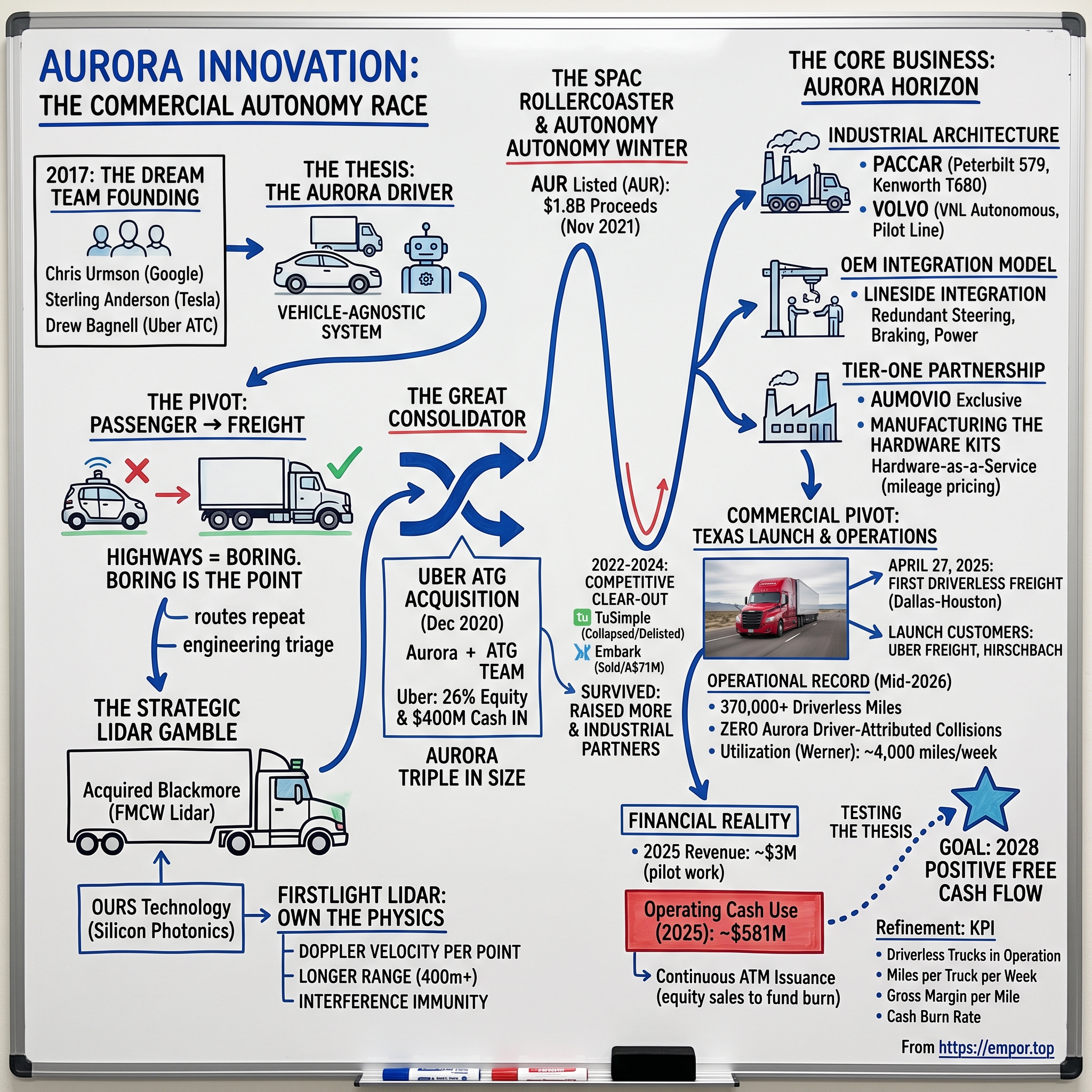
Aurora Innovation: The Commercial Autonomy Race
I. Introduction & Episode Roadmap
On a humid Sunday morning in late April 2025, a Peterbilt 579 tractor pulled out of a freight terminal on the southern edge of Dallas, merged onto Interstate 45, and pointed itself toward Houston. Nothing about the truck looked especially futuristic from a hundred yards away — same red hood, same fifty-three-foot dry van trailer, same diesel rumble that has defined American logistics for seventy years. The only tell was the cluster of sensor pods mounted above the windshield and along the mirror stalks, and the fact that the driver's seat was empty.
It was, as far as anyone can document, the first time a Class 8 semi-truck hauled paying freight down a U.S. public highway with no human being inside it.12 Aurora Innovation had spent eight years and roughly five billion dollars of cumulative losses to arrive at that moment. And within about a week of arriving, one of the three co-founders quit.
That juxtaposition — a genuine engineering first, immediately followed by a reminder of how fragile and expensive the enterprise remains — is the whole Aurora story in miniature.
The company was born in 2017 out of what the technology press immediately labeled a dream team: the man who ran Google's self-driving car project through its formative decade, the man who ran Tesla Autopilot, and the Carnegie Mellon roboticist who built Uber's perception stack. Three people who had each independently concluded that autonomy was solvable, and who had each seen from the inside why their previous employers were unlikely to be the ones to solve it commercially.
They started, as nearly everyone did, aiming at passenger cars and ride-hailing. They ended up aiming at freight. The pivot toward Class 8 highway trucking — hub-to-hub runs along interstate corridors rather than door-to-door robotaxi service in dense cities — was not a retreat but an act of engineering triage. Highways are boring. Boring is the point. A stretch of I-45 does not contain jaywalking pedestrians, unprotected left turns across four lanes of oncoming traffic, delivery cyclists, construction cones rearranged hourly, or a police officer waving you through a red light. It contains other trucks going roughly the same direction at roughly the same speed. The engineering problem is narrower, the routes repeat, and the customer pain is enormous and quantifiable: American trucking runs on drivers who are legally capped at eleven hours behind the wheel per day, which means the most expensive asset in the fleet — the truck itself — sits parked for most of its life.
Here is where things stand as of mid-2026. Aurora trades on NASDAQ under the ticker AUR. It ended 2025 with liquidity of nearly $1.5 billion in cash and investments, having consumed $581 million of operating cash during the year against revenue of $3 million.2 By the end of the first quarter of 2026 that liquidity had fallen to roughly $1.3 billion, and management has guided to average quarterly cash use of $190–$220 million through the year — a deliberate acceleration, not a slippage, funding a fleet build-out.1 Management says it has sufficient liquidity to reach positive free cash flow in 2028.2 That sentence is doing an extraordinary amount of work, and testing it is the central analytical task of this piece.
The story ahead moves through six hinges. The founding and the venture pedigree that made Aurora a magnet for capital before it had a product. The lidar gamble — why the company bought two obscure sensor startups and bet the perception stack on a physics approach almost nobody else pursued at scale. The Uber deal, in which Aurora was paid to absorb its largest rival's autonomy division, one of the strangest and best-structured transactions of the last decade. The SPAC listing and the autonomous winter that followed, which killed most of the competitive set. The industrial architecture — the partnerships with PACCAR, Volvo, and the tier-one supplier now known as AUMOVIO that determine whether any of this can be manufactured at scale. And finally the commercial reality of 2025 and 2026: real driverless miles, real customers, real revenue measured in single-digit millions, and a burn rate that makes the next twenty-four months the most consequential in the company's history.
 Subscribe on LinkedIn
II. The Founding & The Autonomy Dream Team
To understand why three people could raise hundreds of millions of dollars on a slide deck in 2017, you have to remember what that year felt like inside the autonomy world. The consensus timeline, endorsed by executives at nearly every major automaker, held that fully autonomous vehicles would be commercially deployed by roughly 2020. General Motors had bought Cruise. Ford had committed a billion dollars to Argo AI. Waymo was spinning out of Google as a standalone Alphabet subsidiary. Capital was chasing anyone with a robotics PhD and a demo video, and the demo videos were genuinely impressive — right up until the moment something unexpected happened.
Chris Urmson had been living inside that gap between demo and deployment longer than almost anyone alive. A Canadian by birth, he did his PhD at Carnegie Mellon under Red Whittaker, the legendary field-robotics professor whose lab treated "drive a vehicle through a place no vehicle should go" as a research program. In 2007, Urmson served as technical director of CMU's Tartan Racing team, which won the DARPA Urban Challenge — the sixty-mile course through a decommissioned California air force base that is now recognized as the founding event of the modern self-driving industry. Nearly every senior figure in autonomy today can trace a line back to that parking lot.
Urmson then spent roughly seven years running engineering and serving as chief technology officer for Google's self-driving car project, the effort that eventually became Waymo. He was there for the first fully driverless public-road ride, the one where a legally blind man named Steve Mahan rode alone through Austin. He was also there for the internal debates about whether to ship a partial system or hold out for full autonomy, and for the executive churn that ultimately pushed him out in 2016. Colleagues consistently describe him as unusually literal-minded about safety — the kind of engineer who wants to see the argument written down, structured, and audited rather than asserted. That temperament later became institutionalized in Aurora's Safety Case Framework, and it is arguably the company's most distinctive cultural asset.
Sterling Anderson came from the opposite pole of the industry. An MIT-trained mechanical engineer, he led the program that launched the Tesla Model X and then ran Tesla Autopilot during the period when Autopilot went from a research project to a shipping consumer feature installed on hundreds of thousands of cars. Anderson understood something Urmson's world often underweighted: the brutal discipline of actually manufacturing and shipping a product, on a schedule, into customers' hands. When he left Tesla to co-found Aurora, Tesla sued, alleging he had recruited employees and taken proprietary information; the suit was settled within months without any finding of wrongdoing and with Aurora agreeing to an audit. It was an inauspicious start that, in the Silicon Valley of 2017, functioned mostly as free publicity.
Drew Bagnell was the least publicly visible and, to people inside the field, arguably the most technically formidable. A Carnegie Mellon robotics professor whose research sat at the intersection of machine learning and control theory, Bagnell had helped build and then led perception and autonomy at Uber's Advanced Technologies Center in Pittsburgh — a group Uber had essentially assembled by hiring a large fraction of CMU's National Robotics Engineering Center in a single raid. Bagnell's academic work on imitation learning and reinforcement learning anticipated, by roughly a decade, the machine-learning-heavy approach that now dominates autonomy.
The founding thesis they wrote down in early 2017 was deceptively simple and, in hindsight, the most important strategic decision the company ever made: build the Aurora Driver — a single, vehicle-agnostic autonomous driving system, hardware plus software, that could be integrated into any platform. Not a car company. Not a trucking company. A driver, sold as a product, dropped into whatever chassis the market demanded. In 2017 that sounded like hedging. In 2026 it is the reason the same software stack runs on Peterbilt, Kenworth, Volvo, and International trucks.
Capital arrived fast. By February 2019, Aurora had raised more than $530 million in a Series B led by Sequoia Capital, with significant participation from Amazon and T. Rowe Price and existing backing from Greylock — where Reid Hoffman had been an early believer — pushing the company past a $2.5 billion valuation before it had shipped anything.3 Sequoia's Carl Eschenbach joined the board.3 Later that year 현대자동차 Hyundai Motor took a minority stake, joining a partner roster that had already included Volkswagen Group and Byton.4
And then, quietly, the thesis started to change. The passenger partnerships did not compound. Volkswagen ended its arrangement. The urban robotaxi problem revealed itself to be less an engineering sprint than an infinite regress of edge cases, each one rarer than the last and each one requiring bespoke work. Meanwhile the trucking pitch kept getting stronger the more the team examined it: repeatable routes, hub-to-hub operations that avoid residential streets entirely, a customer base that thinks in cost-per-mile and can therefore evaluate the product rationally, and a structural labor shortage in long-haul freight that the industry had been complaining about for thirty years.
For investors, the founding period established two things that still matter. First, Aurora's pedigree let it raise capital on narrative rather than revenue for the better part of a decade — a genuine advantage, and also a habit. Second, the vehicle-agnostic architecture proved to be real optionality rather than marketing: when the passenger-car partners walked away, the company was able to redirect the same core system at freight without starting over. What it could not redirect was the physics of perception. That required buying something.
III. The Strategic Lidar Gamble: Blackmore & OURS Technology
Consider the geometry of the problem. A loaded Class 8 truck weighs up to eighty thousand pounds. At sixty-five miles per hour it covers about ninety-five feet every second. Under emergency braking, that vehicle needs roughly the length of two football fields to stop — and that is on dry pavement with well-maintained brakes. Which means the truck's perception system has to reliably identify a hazard while it is still the better part of a quarter-mile away, in the dark, in glare, in rain, and it has to know not just that something is there but whether it is moving.
This is why Aurora's founders concluded early that the sensor stack was not a component decision. It was the company.
The industry's default was pulsed lidar, or time-of-flight. The concept is intuitive: fire a very short, very bright pulse of laser light, wait for the reflection to come back, multiply the round-trip delay by the speed of light, divide by two, and you have a distance. Do that a few million times per second while spinning the sensor, and you get a three-dimensional point cloud of the world. It works, it is well understood, and by the late 2010s you could buy a competent unit off the shelf from Velodyne.
But time-of-flight has three structural weaknesses that get worse precisely where a truck needs them to get better. Range is limited — practical automotive units typically saw usefully out to roughly two hundred meters, because the returning signal weakens with the square of distance and a dark, non-reflective object at long range returns almost nothing.6 Interference is a real problem: because a pulsed sensor is essentially listening for any bright flash at the right moment, sunlight and other vehicles' lidar can spoof it. And critically, a pulsed system cannot directly measure how fast anything is moving. It infers velocity by comparing consecutive frames — take a picture, take another picture, figure out what moved. That inference costs computation and, more importantly, costs time.
In March 2019, Aurora announced it was acquiring Blackmore Sensors and Analytics, a small company in Bozeman, Montana that had spun out of a defense laser research firm; the deal closed that May.5 Financial terms were not disclosed. Blackmore built a fundamentally different kind of lidar: Frequency Modulated Continuous Wave, or FMCW.
The analogy that works best is the difference between shouting and singing. Pulsed lidar shouts — one loud, brief burst — and listens for the echo. FMCW sings: it emits a continuous beam whose frequency slides steadily up and down, a "chirp." The sensor keeps a copy of the outgoing chirp and compares it against the light coming back. Because the returning light left the sensor at a slightly earlier point in the chirp, the frequency difference between them encodes the distance. This is called coherent detection, and it borrows directly from the photonics developed for fiber-optic telecommunications.
Coherent detection buys three things at once, and they compound.
The first is the one that gets an engineer's attention. Because the system compares the phase and frequency of light rather than just its brightness, it directly measures the Doppler shift of the return — meaning every single point in the point cloud arrives already tagged with its velocity toward or away from the truck, instantaneously, in a single frame.6 There is no frame-to-frame comparison, no tracking algorithm, no latency. The moment the Aurora Driver sees a shape half a kilometer ahead, it knows whether that shape is a stopped vehicle in the lane or a bridge abutment or a truck moving away at sixty.
The second is range. Coherent detection is extraordinarily sensitive — it can pull a signal out of noise that a pulsed system would never register — which is why Aurora's FirstLight lidar was specified to detect objects at more than four hundred meters, roughly double the conventional benchmark.6 At highway speed, that difference is the gap between reacting in about four seconds and reacting in more than eight.
The third is interference immunity. An FMCW receiver only responds to light that matches its own specific chirp signature.6 Sunlight does not match. Another manufacturer's lidar does not match. In a future where thousands of autonomous trucks share the same corridors, this stops being an academic nicety.
There was a catch, and it was the reason nobody else had done this at automotive scale: coherent lidar historically required a laboratory bench full of precision optics, fiber, lasers, and transceivers. Beautiful physics, impossible product. So in February 2021, Aurora bought its second sensor company — OURS Technology, a Berkeley-born silicon photonics startup whose expertise was etching optical components directly onto semiconductor wafers.6 Terms were again not disclosed. The point of OURS was manufacturability: collapse the optical bench onto a chip, and the bill of materials falls, the heat and size fall, reliability rises, and you can ride the semiconductor industry's cost curve instead of fighting it.
The strategic contrast with the rest of the field is stark. Most competitors treated perception hardware as procurement — buy the best available sensor, differentiate on software. Aurora treated it as vertical integration, and accepted years of additional development risk to own the physics. By 2026 the company was claiming its second-generation FirstLight reaches a full kilometer, which it described as double the range of the closest FMCW competitor, translating to more than thirty-four seconds of reaction time at highway speeds.1
Investors should hold two thoughts here simultaneously. The technology advantage appears real, is protected by patents and years of accumulated know-how, and is genuinely difficult to replicate — this is the closest thing Aurora has to a durable proprietary asset. But sensor superiority has never, on its own, won an autonomy market. Waymo has excellent sensors. Kodiak AI is running customer-owned driverless trucks in the Permian Basin using a different architecture entirely.19 The relevant question is not whether FirstLight is better; it is whether "better perception" converts into fewer disengagements, lower validation cost, and ultimately a cheaper cost-per-mile than rivals who chose the easier hardware path. That evidence is still being assembled.
IV. The Great Consolidator: The Uber ATG Acquisition
By the autumn of 2020, Uber's Advanced Technologies Group had become the most expensive apology in Silicon Valley.
ATG's origin story was already contentious — Uber had hired away roughly forty researchers from Carnegie Mellon's robotics center in 2015, effectively decapitating a university lab to bootstrap a division. Then came the Waymo litigation over allegedly misappropriated lidar trade secrets, which produced a spectacle of a trial and a settlement in equity. Then, on a March night in 2018 in Tempe, Arizona, an ATG test vehicle struck and killed a pedestrian named Elaine Herzberg — the first fatality involving an autonomous test vehicle and a moment that permanently changed how the entire industry thought about safety drivers, validation, and public trust.
Uber, meanwhile, had gone public and discovered that public markets have opinions about losing money. ATG was consuming hundreds of millions of dollars a year with no revenue and no credible near-term path to any. The unit had raised outside capital in 2019 from トヨタ自動車 Toyota, Denso, and the SoftBank Vision Fund at a reported valuation in the low billions — a marker that, by late 2020, looked less like a valuation than a historical artifact.
What Aurora did next was the single most elegant piece of corporate finance in the company's history.
On December 7, 2020, the two companies announced that Aurora would acquire ATG. But the cash moved backwards. Uber invested $400 million into Aurora, and in exchange received roughly a 26% equity stake in the combined entity, valuing Aurora at $10 billion. Uber's chief executive, Dara Khosrowshahi, joined Aurora's board.7
Read that structure carefully, because the mechanics matter more than the headline. Aurora did not write a check. It issued paper — shares in a private, pre-revenue company whose value was entirely a matter of narrative — and received in return the engineering organization, the intellectual property portfolio, the test infrastructure, and $400 million of hard currency. Uber, for its part, converted an operating liability that was destroying its earnings into a non-consolidated equity position, cleaned up its income statement ahead of a promised profitability milestone, and retained exposure to autonomy's upside without funding it. Both sides walked away able to describe the deal as a victory, which is the signature of a genuinely well-structured transaction rather than a distress sale.
Aurora also secured a commercial partnership tying its technology to Uber's ride-hailing and freight networks — the seed of what would later be marketed as Aurora Connect, and, more immediately, of the Uber Freight relationship that would become an actual paying customer five years later.7
The talent absorption was the part that mattered operationally. Aurora roughly tripled in size overnight, taking on an organization that had been building autonomy in Pittsburgh and San Francisco for five years. Crucially, ATG had already been oriented toward trucking through its Uber Freight adjacency — meaning Aurora acquired not just headcount but a team that had thought hard about the specific problem Aurora was pivoting toward.
The conventional verdict — repeated frequently since — is that Aurora executed a masterstroke and got paid to eat its rival. That is mostly right, but it deserves a skeptical footnote, because dilution is a real cost even when it does not feel like one. Twenty-six percent of the company was permanent. On the $10 billion mark, that stake was nominally worth $2.6 billion; Aurora received $400 million in cash plus assets it valued at considerably more. Whether that trade was accretive depends entirely on how productive the absorbed engineering organization turned out to be — and on whether Aurora would have needed to raise that equity anyway, which, given the burn rate that followed, it plainly would have.
There is also a governance dimension that surfaced much later. Uber was not a strategic partner locked in forever; it was a shareholder with its own capital priorities. In June 2026, Uber's holding vehicle sold 67.5 million Aurora shares in a single negotiated block at $7.10 per share, leaving it with approximately 15.6% of the Class A shares outstanding.17 That is still a large position. It is also, unmistakably, a partner monetizing rather than accumulating — a data point worth weighing against the framing of Uber as a committed long-term strategic anchor.
The ATG deal solved Aurora's talent and technology problem. It did not solve the capital problem, because nothing consumes money like a thousand-plus person robotics organization with no product. Eleven months later, Aurora went looking for the largest cheque available in the market — and in late 2021, that meant a SPAC.
V. The SPAC Rollercoaster & The "Autonomous Winter"
There is a particular species of financial vehicle that defines the 2020–2021 market, and Aurora used the deluxe model.
Reinvent Technology Partners Y was a blank-check company assembled by Reid Hoffman — LinkedIn co-founder, Greylock partner, and, conveniently, an early Aurora backer — along with Zynga's Mark Pincus and Michael Thompson. Reinvent's pitch was that a SPAC could function as a kind of accelerated, high-touch IPO for companies whose stories the public markets would struggle to price through a traditional roadshow. Aurora, a pre-revenue robotics company asking investors to underwrite a decade-long research program, was precisely that kind of company.
The combination closed on November 3, 2021, and the stock began trading on Nasdaq under AUR the following day.8 Gross proceeds plus balance-sheet cash exceeded $1.8 billion — described at the time as the largest primary raise ever achieved by an autonomous vehicle or robotics company in a go-public transaction.8 The investor list read like a roll call of institutional conviction: Counterpoint Global, PRIMECAP, Baillie Gifford, T. Rowe Price, Fidelity, the Canada Pension Plan Investment Board, alongside strategic holders Uber, PACCAR, and Volvo Group.8 Management told investors the proceeds would fund the company through its commercialization milestone and into 2024.8
That last projection is worth bookmarking. It would be revised, repeatedly.
What followed was not a company-specific failure but a regime change. Through 2022 the Federal Reserve raised interest rates at the fastest pace in four decades, and the entire asset class of long-duration, zero-revenue equity stories repriced violently. Aurora's stock, which had listed around ten dollars, fell to roughly a dollar and change by late 2022. A company that had gone public valued in the low teens of billions was briefly worth a fraction of that. Nothing about the technology had gotten worse. The discount rate had simply changed, and with it the market's willingness to fund a research program with an eight-figure monthly burn.
For most of the sector, that repricing was terminal. The autonomous winter of 2022–2024 was one of the more complete competitive clear-outs in recent technology history.
TuSimple had been the loudest long-haul competitor, and its collapse was almost operatic. The company was consumed by governance scandal, board conflict, executive removals, and federal scrutiny over the transfer of technology to affiliated entities in China. It wound down its U.S. operations, cut staff, and in January 2024 filed to voluntarily delist from Nasdaq, retreating to Asia.9 A company that had listed in 2021 as the world's first publicly traded autonomous trucking firm exited the American market entirely within thirty months.
Waymo — the best-capitalized autonomy operation on earth, backed by Alphabet's balance sheet — reached a different but equally telling conclusion. In July 2023 it announced it was pausing its Waymo Via trucking program to concentrate resources on Waymo One, its robotaxi business.[^9] Waymo's framing was one of commercial prioritization rather than technical defeat: the ride-hailing opportunity was closer, and the company chose focus. For Aurora, this was the single most valuable competitive development of the decade — the one competitor with effectively unlimited capital voluntarily left the field.
Embark Trucks provided the era's most brutal arithmetic. Embark had gone public via SPAC in 2021 at a valuation above five billion dollars. By March 2023 it had laid off the large majority of its staff. In May 2023, Applied Intuition agreed to acquire it in an all-cash deal with an equity value of roughly $71 million — shareholders received $2.88 per share.10 Roughly ninety-eight percent of the company's value evaporated in under two years, not because the engineering was fraudulent but because the capital required to finish the job exceeded the capital available.
Aurora survived for three unglamorous reasons. It had raised more than everyone else at the top of the market, which meant its runway outlasted the winter. It had strategic shareholders in PACCAR and Volvo whose interest was industrial rather than financial, which stabilized the partnership structure when the equity story collapsed. And it kept shipping verifiable technical milestones — driverless-equivalent validation runs, safety-case documentation, hardware iterations — through a period when the market was not paying for them.
But survival is not the same as vindication. The honest read of 2022–2024 is that Aurora outlasted its rivals partly through better execution and substantially through better funding. The strategic prize was real: by the time the market thawed, the field of independent, well-capitalized U.S. long-haul autonomy companies had thinned dramatically. What Aurora had to do next was convert that survivorship into a business — which required something it had never built before: an industrial supply chain.
VI. The Core Business: Aurora Horizon & The OEM Integration Model
Walk the floor at Volvo's New River Valley plant in Dublin, Virginia — the largest Volvo truck manufacturing facility in the world — and you can see the actual answer to the question that determines whether autonomous trucking becomes an industry or stays a demo.
The answer is not on a screen. It is a wiring harness.
Here is the problem in plain terms. A conventional heavy truck is built around the assumption that a human is present as the ultimate backup. If the power steering pump fails, the driver muscles the wheel. If the primary air brake circuit leaks, the driver stops the vehicle. If the electrical system browns out, the driver pulls over. Every one of those human backstops has to be replaced with a machine when the seat is empty — redundant steering, redundant braking, redundant power, redundant communications, and a redundant computer capable of executing a safe stop if the primary autonomy system dies mid-maneuver.
You cannot bolt that on. Redundant braking means plumbing a second air circuit through the frame. Redundant steering means a second actuator wired into the column. Redundant power means an entirely separate electrical architecture. These are decisions made on an assembly line, in a chassis design, years before a truck exists. This is why the retrofit approach — the model several early entrants pursued, buying used tractors and mounting sensor racks on them — was always a bridge to nowhere for genuine driverless operation.
Aurora's commercial architecture reflects that. The company packages its offering as Aurora Horizon, a subscription trucking service resting on three components: the Aurora Driver itself, the integrated hardware-and-software system; Aurora Beacon, the cloud platform that dispatches loads, monitors trucks in flight, and connects to customers' fleet management systems; and Aurora Shield, the safety, roadside support, and insurance wrapper. Beacon is the piece investors tend to underrate, because it is where operational lock-in would eventually accrue — a carrier that has wired its terminals, yard operations, and load-planning software into Beacon does not casually switch vendors.
The manufacturing foundation rests on two OEM relationships, both of which predate commercial launch by years.
PACCAR — parent of Peterbilt and Kenworth, and one of the most profitable manufacturers in the industry — supplied the Peterbilt 579 and Kenworth T680 platforms that carried the Aurora Driver through validation and into the first commercial launch. PACCAR is also an Aurora shareholder.8 The relationship has been deep but deliberate, and PACCAR's engineering conservatism produced one of the more revealing episodes of the commercial launch, discussed in the next section. As of 2026, the two companies are jointly defining a path to integrate Aurora's third-generation hardware onto PACCAR's future autonomy-enabled platform directly on the assembly line.1
Volvo Autonomous Solutions took the purpose-built route. The Volvo VNL Autonomous is a factory-integrated, redundancy-designed tractor built at New River Valley, and by early 2026 the first VNL Autonomous units with the Aurora Driver installed via lineside integration were coming off Volvo's pilot line — the milestone that separates "engineering prototype" from "manufacturable product."2 Volvo plans to build hundreds of these trucks in 2027.1
The third leg — and the one that most directly determines Aurora's long-run margin structure — is the tier-one supplier relationship. In April 2023, Aurora announced an exclusive partnership with Continental AG, whose automotive division has since been spun out and now operates as AUMOVIO.112 The scope was unusually broad. AUMOVIO takes responsibility for manufacturing, supply chain, lifecycle management, and servicing of the Aurora Driver hardware kits, and independently develops the fallback system — the separate computer and sensor set designed to bring a truck safely to a stop if the primary autonomy stack fails.11
The commercial structure is the genuinely novel part: a hardware-as-a-service arrangement priced on miles driven.11 Rather than buying expensive sensor and compute kits up front and carrying them as capital equipment, Aurora pays its supplier per mile once trucks are earning revenue. In effect, a fixed capital cost becomes a variable operating cost that scales with utilization. If Aurora's trucks run, it pays; if they sit, it does not. For a company whose central financial vulnerability is the gap between capital intensity and revenue, converting that gap into a usage-based expense is meaningful — and it explains management's guidance that 2026 represents peak capital spending, with capital expenditures declining significantly in 2027 as the model shifts.1
Start of production for the AUMOVIO-manufactured third-generation kit was on track as of mid-2026 for the second half of 2027, at an expanded facility in New Braunfels, Texas whose construction Aurora expects to complete in the first quarter of 2027.1 That kit is intended to supply tens of thousands of trucks and will run on a compute architecture Aurora, AUMOVIO, and NVIDIA are jointly developing that integrates two NVIDIA DRIVE Thor system-on-chips into a single platform.1
The strategic logic is coherent: let the OEMs handle vehicles, let the tier-one handle hardware industrialization, and keep the driving intelligence, the map, and the customer relationship. It is asset-light by design and, if it works, produces software-like incremental margins.
But the same structure creates the dependency that a skeptic should press hardest on. Aurora controls almost none of its own physical throughput. Volvo controls how many autonomous-ready chassis exist. PACCAR controls its own assembly-line timeline. AUMOVIO controls hardware production and the fallback system. Roush, the upfitter selected to integrate the interim second-generation kit onto International LT-series trucks, controls near-term fleet capacity — initially being equipped for roughly one thousand trucks per year.1 Every one of those partners has its own board, its own capital allocation process, and its own tolerance for a program that has repeatedly moved right. Aurora's deployment curve is, structurally, the slowest of its partners' curves.
That dependency was not an abstraction in 2025. It showed up in the driver's seat.
VII. The Commercial Pivot: April 2025 Texas Launch & Modern Operations
Before a single driverless commercial mile could be run, Aurora had to do something the industry had never formally done: write down, in auditable form, the argument that its system was safe enough — and then declare that argument complete.
The company calls this the Safety Case Framework: a structured hierarchy of claims, each supported by evidence, covering whether the Driver is proficient at the driving task, whether it fails safely, whether it is trustworthy in operation, and whether it continuously improves. It is borrowed from aviation and nuclear engineering, where "we tested it a lot and it seemed fine" has not been an acceptable standard since the 1970s. Aurora closed its safety case in the run-up to launch and published a Driverless Safety Report covering its operational design domain, cybersecurity posture, and remote assistance protocols, briefing federal regulators at FMCSA and NHTSA before going live.1213
On April 27, 2025, Aurora began regular driverless commercial hauls between Dallas and Houston, announcing the milestone publicly on May 1 after the Driver had accumulated more than 1,200 miles with an empty cab.1213 The launch customers were Uber Freight and Hirschbach Motor Lines.12 Chris Urmson's public comment was characteristically flat: the founding purpose had been to deliver the benefits of self-driving safely, quickly, and broadly, and the system, he said, had performed as designed.12
Then came the awkward part. Within weeks, Aurora put an observer back in the driver's seat. The reason, Urmson explained, was that PACCAR — the manufacturer of the base vehicle — had requested a person be present because of prototype components in its own platform.13 The Aurora Driver remained fully responsible for the driving task; the human was, functionally, a passenger. But the optics were poor, and the episode is genuinely instructive. It demonstrated that even after Aurora had satisfied its own safety case and its regulators, a partner's independent risk tolerance could override the operating model. That is the OEM dependency described earlier, made concrete. Removing the partner-requested observer became a stated objective of the second-generation hardware program and the new truck fleet, which is precisely why the 2026 fleet is built on the International LT platform rather than PACCAR's.21
The eighteen months that followed produced the operational record investors now have to judge.
The route network expanded fast. Driverless service extended from the original Dallas–Houston corridor to Fort Worth and El Paso, then across state lines to Phoenix, creating a Fort Worth–Phoenix lane of more than a thousand miles — a distance that far exceeds what a single human driver could legally cover under hours-of-service rules, and therefore the clearest demonstration of the core value proposition.182 Night operations came online. So, importantly, did weather: Aurora disclosed that during 2025, inclement conditions had constrained its Texas driverless operations roughly forty percent of the time, and that its software release around the turn of the year validated driverless operation in rain, fog, and heavy wind.2 That single disclosure is one of the more useful pieces of honest reporting the company has produced — it quantified a limitation most competitors simply do not discuss.
By the end of March 2026, the network encompassed twelve distinct routes, including bidirectional Dallas–Laredo service validated within six weeks of starting supervised runs, and new Dallas–Oklahoma City lanes operated in collaboration with Volvo Autonomous Solutions.1 The customer roster broadened well beyond the launch pair, with commercial loads for Hirschbach, Uber Freight, Werner Enterprises, FedEx, Schneider, Detmar Logistics, McLane, and Volvo Autonomous Solutions.12 The Detmar arrangement is a particularly interesting outlier — hauling frac sand on a sixty-mile loop along I-20 in the Permian Basin for more than twenty hours a day, a use case where the value is pure asset utilization rather than long-haul labor substitution.2
The mileage curve steepened. The Aurora Driver passed 250,000 cumulative driverless miles by January 2026, nearly tripling the total from early October, and surpassed 370,000 by April — with 100% on-time performance and, by the company's account, zero Aurora Driver-attributed collisions.21 More revealing than the cumulative number is the utilization figure: driverless trucks running for Werner averaged over 4,000 miles per week, an annual run rate above 225,000 miles per truck.1 A typical human-driven long-haul tractor covers roughly half that. If that utilization holds at scale, it is the empirical core of the entire investment case — the proof that an autonomous truck is not merely a labor-cost substitute but a fundamentally more productive asset.
The leadership inflection. In May 2025, roughly two weeks after the driverless launch, Sterling Anderson resigned as chief product officer, effective June 1, and left the board effective August 31.14 The next day he was announced as General Motors' new chief product officer and vice president of global product — a newly created role spanning GM's entire vehicle portfolio, hardware, software, services, and user experience, starting June 2.14 The company framed the transition as clean, with the product architecture settled. That framing may well be accurate. It is also true that a co-founder departing within days of the milestone he had spent eight years building toward, to take an operating role at a legacy automaker, is a signal worth registering — and that Anderson retained his high-vote Class B shares afterward, so a person no longer employed by or serving on the board of Aurora remains part of the founder bloc holding roughly 46% of voting control.15 That is a governance structure a skeptical investor is entitled to question.
The financial reality. For fiscal 2025, Aurora recognized $3 million of revenue — $4 million on an adjusted basis including first-quarter pilot work before commercial recognition began.2 Against that, the loss from operations was $901 million and the net loss $816 million, the gap reflecting interest income on the investment portfolio and a favorable swing in derivative liabilities.2 Operating cash use was $581 million, capital expenditures $31 million, and the company closed the year with nearly $1.5 billion in liquidity.2
The most important number in that paragraph is not any of the losses. It is the $916 million of proceeds from stock issuance recorded in 2025 financing activities.2 Aurora funded the year primarily by selling shares. During 2025 it sold approximately 151 million Class A shares through its at-the-market program at an average price of $5.96, raising $898 million gross and $874 million net, and in July 2025 it expanded the ATM authorization to $1,421 million.15 Weighted-average shares outstanding rose from 1.62 billion in 2024 to 1.84 billion in 2025 and reached 1.95 billion by the first quarter of 2026.21 That is roughly a fifth of the company issued in twenty-four months.
This is the honest frame for Aurora's balance sheet: liquidity is not a fortress built from operations. It is a continuously replenished pool, refilled by selling equity into whatever price the market offers. When the stock is strong, the mechanism is cheap. When it is weak, it is expensive — and it is most needed precisely when it is most expensive.
VIII. Playbook: Business & Investing Lessons
Strip away the trucks and the lidar and four transferable lessons remain, each of which has application well beyond autonomy.
Lesson 1: Picking the harder physics can be a strategy — if you can afford the wait. FMCW lidar was, by any engineering measure, the more difficult path. Pulsed time-of-flight sensors were available for purchase; coherent detection required buying two companies, absorbing years of development risk, and inventing a manufacturing approach. What Aurora bought was not a component but a property of the physical world: the Doppler effect gives velocity for free, and no amount of software cleverness gives a pulsed system the same thing without spending time and computation. The generalizable insight is that the most durable technology advantages tend to sit at the layer competitors treat as procurement. The caveat is equally important: this only works if you have the capital to survive the extra development cycles, which is precisely why several rivals who chose the same hard path did not survive to argue about it.
Lesson 2: In safety-critical systems, the integration layer is the moat, not the demo. Any competent robotics team can produce a compelling highway autonomy demo. Almost none can produce a truck with redundant steering, braking, and power designed into the chassis at the factory. Aurora's decision to align with the incumbent OEMs rather than route around them cost years of slower iteration and surrendered control over its own deployment pace. What it purchased was the only realistic path to volume — and a set of relationships that a new entrant cannot simply buy. The trade-off is real and permanent: Aurora is now structurally dependent on partners whose priorities it does not set.
Lesson 3: A distressed competitor is a balance-sheet opportunity, if you pay in the right currency. The ATG transaction worked because Aurora paid in equity — a currency it could print, priced by a narrative it controlled — and received cash, talent, and IP it could not otherwise have assembled at any speed. The reason Uber accepted is that Uber's problem was not valuation but exposure: it needed the losses off its income statement more than it needed the asset. The lesson for operators is that the best acquisitions are structured around what the counterparty actually needs to stop feeling, not around a price. The lesson for shareholders is that permanent dilution is a real cost even when it arrives disguised as a windfall.
Lesson 4: Public capital buys runway and sells patience. The 2021 listing gave Aurora the largest cash pile in its sector, and that pile is the direct reason it exists today while Embark does not. It also converted a decade-long research program into a quarterly-reported public equity, meaning every schedule adjustment became a headline and every capital raise became visible dilution. Management told investors in 2021 that the proceeds would fund the company into 2024.8 Commercial launch arrived in 2025, free cash flow is now projected for 2028, and the intervening gap has been financed by issuing stock. The engineering may be on track; the original financing plan was not. For any pre-revenue company weighing a public listing, that is the real trade: liquidity today, in exchange for having your revised timelines audited in public forever.
The fifth lesson does not have a clean formulation yet, because it is still being written — whether a company can be right about the technology, right about the market structure, and still be defeated by the arithmetic of the calendar. That question is the substance of the bull and bear cases.
IX. Analysis: Bull vs. Bear Case & Stress Test
Start with the frameworks, then stress-test them against what the operating data actually shows.
Hamilton Helmer's 7 Powers, applied honestly
Cornered Resource — strong, but narrower than advertised. The FMCW lidar stack, built from the Blackmore and OURS acquisitions and refined over seven years, is the real thing: proprietary, patent-protected, and expensive to replicate. Aurora's claim that its second-generation FirstLight reaches twice the range of the nearest FMCW competitor is a management assertion rather than an independently verified benchmark, but the underlying physics advantage is not in dispute.1 The limitation is that perception is one layer of a system that also requires planning, prediction, validation, mapping, and operations. A cornered resource in one layer does not corner the market.
Switching Costs — plausible, largely unproven. The theory is that once a carrier integrates yard operations, terminals, and fleet-management systems with Aurora Beacon, moving to a rival becomes operationally painful. With seven driverless customers as of the first quarter of 2026, this is a hypothesis rather than a demonstrated fact.1 The countervailing evidence is that carriers are explicitly running multiple autonomy vendors — Werner appears in both Aurora's and Kodiak's customer disclosures.119 Sophisticated logistics buyers are dual-sourcing precisely to avoid the lock-in Aurora is counting on.
Scale Economies — real but not yet realized. Enormous fixed R&D costs — $745 million in 2025 alone — spread across a few hundred thousand driverless miles produce economics that are, arithmetically, absurd.2 The entire thesis depends on that denominator growing by orders of magnitude. The hardware-as-a-service structure with AUMOVIO is designed to convert scale into unit-cost decline, and the claimed 50%-plus hardware cost reduction from the second-generation kit is the first real test.1
Process Power — the underrated one. The Safety Case Framework, the map automation pipeline that now generates Aurora Atlas content with little human involvement, and the accumulated validation methodology represent institutional knowledge that took a decade to build.2 This is hard to copy and rarely discussed. It may prove more durable than the lidar.
Porter's Five Forces, applied to autonomous freight
Threat of new entrants: lower than it looks in the abstract, higher than Aurora would like. The capital barrier is severe and the OEM integration agreements are genuinely scarce. But the field did not stay cleared. Kodiak AI went public in September 2025 via merger with Ares Acquisition Corporation II at roughly a $2.5 billion valuation, and by early 2026 had customer-owned driverless trucks running for Atlas Energy in the Permian Basin — deliberately choosing private industrial roads over public interstates as its beachhead.19 Waabi raised up to $1 billion in January 2026, including roughly $250 million of milestone-based funding from Uber and participation from Volvo Group Venture Capital and NVIDIA's venture arm, and is developing on the Volvo platform Aurora also uses.20 Bot Auto, a Houston startup with roughly eighty employees and $40 million raised, completed a fully humanless Houston–Dallas commercial run in 2026. The barrier to entry filtered out the underfunded. It did not create a monopoly.
Bargaining power of customers: high, and structurally so. Truckload carriers operate on operating ratios in the mid-90s — a few points of margin on every dollar of revenue. They will not pay a premium for novelty. Aurora's Driver-as-a-Service pricing has been framed around roughly $0.85 per mile, with management targeting approximately $2.00 per mile cost of goods sold for its Transportation-as-a-Service operations at the $80 million run-rate point.16 Those figures have to converge favorably against an all-in human-driven cost that varies by lane and carrier. The customer will do that math, and will do it every year.
Threat of substitutes: moderate and mostly indirect. Intermodal rail competes on long, dense corridors; it does not compete on time-sensitive regional freight. The more interesting substitute is the status quo itself — a carrier that simply keeps hiring drivers, which remains available and requires no integration risk.
Supplier power: the force Aurora should worry about most. In most industries this is a footnote. Here, three suppliers collectively determine how many revenue-generating units can exist. That is an unusual and uncomfortable concentration.
Rivalry: intensifying, not consolidating. The winter cleared the weak. The thaw brought fresh capital to survivors.
The bull case
Aurora is the only company that has demonstrated sustained driverless Class 8 operations on public U.S. interstates at commercial scale, and the operating data supports the productivity claim rather than merely asserting it: over 225,000 annualized miles per truck at Werner, roughly double a human-driven tractor, with 100% on-time performance and no Driver-attributed collisions across more than 370,000 driverless miles.1 The network scaled from one lane to twelve routes across the Sun Belt in about a year, and the six-week validation of the Dallas–Laredo corridor suggests the system is generalizing rather than being hand-tuned lane by lane.1 Commercial demand appears genuine: Hirschbach signed a memorandum of understanding to own and operate 500 trucks under the Driver-as-a-Service model, which management characterized as a potential multi-year revenue stream in the hundreds of millions, with deliveries beginning in 2027.1 The regulatory environment has improved materially, with California moving to enable autonomous trucking — expanding Aurora's estimated serviceable market to a projected 60 billion vehicle miles traveled by 2028 — and the U.S. Department of Transportation publicly working toward a single federal framework.1 And the industrial pathway is concrete rather than conceptual: Volvo units off the pilot line, Roush capacity for a thousand trucks a year, AUMOVIO's plant expansion underway.1
The bear case and the stress test
The capital chasm is the whole argument. Aurora expects to use $190–$220 million of cash per quarter on average in 2026, including roughly $150 million of full-year capital expenditure.1 Against $1.3 billion of liquidity at the end of March 2026, that is a runway measured in quarters, not years, before another meaningful raise.1 Management states it has sufficient liquidity to reach positive free cash flow in 2028 and plans to use the ATM to fund RSU tax liabilities and cash bonuses through 2027, while also expecting to "strategically leverage the ATM and/or other mechanisms" to maintain an appropriate minimum cash balance.2 Translated: further equity issuance is not a risk scenario, it is the stated plan. Shareholders should assume continued dilution and evaluate whether the per-share value created by scaling exceeds the per-share value surrendered to fund it.
The revenue base is still trivially small, and the 2026 guidance is extraordinarily back-loaded. Guidance of $14–$16 million for 2026 requires the fourth quarter alone to contribute more than half the year, contingent on launching a new fleet, on second-generation hardware validating, on Roush hitting production cadence, and on removing the partner-requested observer.1 Four sequential dependencies, each of which must land roughly on schedule. First-quarter 2026 revenue was $1 million — a 10% sequential increase, which is progress in percentage terms and almost nothing in absolute terms.1
Management's track record on timelines is mixed, and worth stating plainly. The 2021 listing materials pointed to funding through commercialization and into 2024; commercial launch came in 2025.8 The original Continental framing anticipated an Aurora Horizon launch in 2024.11 The driverless launch itself was walked back to include an observer within weeks.13 The company reduced its driverless fleet from ten trucks in December 2025 to a smaller number in early 2026 — explained as a deliberate reallocation of capacity toward lane validation and the second-generation launch, which is a plausible and specific explanation, but which also means the truck count went backwards in the year the company promised to scale to 200.2 To management's credit, the disclosures have been specific rather than evasive: the 40% weather constraint, the fleet reduction rationale, and the cash-use-below-target reporting are all volunteered facts a less candid company would bury.2 On the first-quarter call, management held firm on $0.85-per-mile pricing when pressed on whether momentum justified raising it, and stated that order slots were secured for the full 200 trucks — concrete answers rather than deflection.16 The pattern is a team that reports honestly on the present while consistently underestimating how long the future takes.
Supplier and partner concentration. Discussed above, and it is the risk with the least available mitigation. Aurora cannot vertically integrate truck manufacturing; the capital required is prohibitive.
An activist's line of attack. A skeptical investor would press on four points. First, the dual-class structure concentrating roughly 46% of voting power in a founder bloc that includes a person who left the company and the board in 2025 — an accountability gap with no clear justification.15 Second, whether stock-based compensation of $188 million in 2025, against $3 million of revenue, is defensible; it is roughly a third of operating cash use and is a real economic cost to shareholders regardless of its exclusion from adjusted EBITDA.2 Third, whether continuous ATM issuance — selling shares steadily into the market rather than raising discrete capital at negotiated terms — represents optimal capital allocation or simply the path of least resistance. Fourth, whether Uber's block sale of 67.5 million shares in June 2026 tells shareholders something about how the best-informed strategic holder views the risk-reward from here.17
Falsification test. The bull case breaks if any of the following occur: the second-generation hardware fails to deliver its claimed cost reduction, keeping gross margin structurally negative; the 200-truck exit target slips materially, resetting the entire 2027 DaaS ramp; a serious Driver-attributed safety incident occurs, which would reset both regulatory posture and customer willingness; or a competitor demonstrates comparable public-highway driverless reliability at lower cost, collapsing the pricing assumption.
The KPIs that actually matter
Three metrics, and only three, tell you whether this is working.
Driverless trucks in revenue operation, and miles per truck per week. Cumulative driverless miles is the number the company markets; it is the wrong one, because it only ever goes up. The right one is the active driverless fleet count multiplied by weekly utilization — that product is revenue, and it is the only path from single-digit millions to the $80 million run rate management has promised for year-end 2026.
Gross margin per mile. Management has committed to breakeven gross margin on a run-rate basis exiting 2026, contingent on the hardware cost reduction.2 Cost of revenue exceeded revenue by six-to-one in the first quarter of 2026.1 Watch that ratio compress — or fail to.
Quarterly cash use against quarter-end liquidity. Not as an abstraction, but as a countdown. The distance between the burn trend and the cash balance determines when the next capital decision arrives and how much leverage Aurora has when it does.
X. Epilogue & Outro
The photograph Aurora likes to circulate shows a truck on an empty Texas highway at dawn, cab windows dark, hauling a trailer of someone else's freight toward a customer who is paying for the privilege. It is a genuinely remarkable image, and it is easy to forget how recently it was science fiction. The 2007 DARPA course that launched this industry involved vehicles crawling through a mocked-up town at a speed a jogger could match. Nineteen years later, the descendant of that project runs a thousand-mile lane between Fort Worth and Phoenix, at night, in rain, without anyone aboard.
What the story has been about, all along, is the conversion of technical conviction into industrial reality — and the specific, unglamorous, capital-intensive machinery that conversion requires. Aurora's history is a sequence of bets on the harder version of every choice: coherent lidar over off-the-shelf pulsed sensors, factory integration over retrofit, a formal safety case over accumulated test miles, equity paid to a distressed rival over cash spent on a rising one. Most of those bets look defensible in retrospect. Several of them cost years.
The question that remains open is not whether autonomous trucks work. That has been answered, on public roads, with paying customers. The question is whether trucking is the profitable gateway to Level 4 autonomy that the sector has assumed — whether the unit economics of a driverless Class 8 tractor, once hardware costs fall and utilization doubles, produce the software-like margins the equity story requires. That answer arrives not in a demo but in a gross margin line, sometime in the next eighteen months.
Governance-wise, the founders remain in control: shares held by Urmson, Anderson, and Bagnell represented approximately 46% of voting power at the end of 2025, through Class B stock carrying ten votes per share.15 That structure insulates the company from short-term pressure, which is arguably appropriate for a decade-long engineering program, and simultaneously insulates it from accountability, which is less obviously appropriate for a company that has issued roughly a fifth of itself in two years to fund operations. Both things are true.
The stock, meanwhile, has done what stocks do with unresolved questions of this magnitude — traded between roughly $3.60 and $8.57 over the trailing year and sat around $6 in mid-July 2026, a market capitalization near $12 billion attached to trailing revenue of a few million dollars.21 That is not a valuation in any conventional sense. It is a probability-weighted claim on an industry that does not yet exist at scale, priced by investors making a judgment about a company whose most important operating milestones remain in front of it.
The dream that started in a Carnegie Mellon robotics lab is no longer a research presentation. It is a truck on Interstate 45, hauling freight, running the numbers, and asking the market for more time.
References
-
Aurora Innovation First Quarter 2026 Shareholder Letter (Form 8-K, Exhibit 99.1) — SEC, 2026-05-06 ↩↩↩↩↩↩↩↩↩↩↩↩↩↩↩↩↩↩↩↩↩↩↩↩↩↩↩↩
-
Aurora Innovation Fourth Quarter 2025 Shareholder Letter (Form 8-K, Exhibit 99.1) — SEC, 2026-02-11 ↩↩↩↩↩↩↩↩↩↩↩↩↩↩↩↩↩↩↩↩↩↩
-
Amazon, Sequoia invest in self-driving car startup Aurora — TechCrunch, 2019-02-07 ↩↩
-
Hyundai takes minority stake in self-driving car startup Aurora — TechCrunch, 2019-06-12 ↩
-
Aurora to acquire Blackmore, industry-leading Lidar company — Aurora Innovation, 2019-03-23 ↩
-
Aurora is Acquiring Uber's Self-Driving Unit, Advanced Technologies Group — Aurora Innovation, 2020-12-07 ↩↩
-
Aurora Closes Business Combination with Over $1.8 Billion in Gross Proceeds and Cash on Hand — Aurora Innovation, 2021-11-04 ↩↩↩↩↩↩↩
-
TuSimple Holdings Voluntary Nasdaq Delisting (Form 8-K) — SEC, 2024-01-17 ↩
-
Applied Intuition to buy autonomous trucking SPAC Embark for $71M — TechCrunch, 2023-05-25 ↩
-
Continental and Aurora Partner to Realize Commercially Scalable Autonomous Trucking Systems — Continental AG, 2023-04-27 ↩↩↩↩
-
Aurora Begins Commercial Driverless Trucking in Texas, Ushering in a New Era of Freight — Aurora Innovation, 2025-05-01 ↩↩↩↩↩
-
End Of The Beginning: Aurora Launches Commercial Driverless Trucks — Forbes, 2025-05-01 ↩↩↩↩
-
GM taps Aurora co-founder for new chief product officer role — TechCrunch, 2025-05-12 ↩↩
-
Aurora Innovation Annual Report on Form 10-K for the year ended December 31, 2025 — SEC, 2026-02-11 ↩↩↩↩
-
Aurora (AUR) Q1 2026 Earnings Call Transcript — The Motley Fool, 2026-05-07 ↩↩
-
Uber unit sells 67.5M Aurora shares, keeps 15.6% (Schedule 13D/A) — StockTitan, 2026-06 ↩↩
-
Aurora Expands Driverless Trucking Service from Fort Worth to El Paso — Aurora Innovation ↩
-
Kodiak AI, now a public company, looks to deliver an autonomous trucking future — FreightWaves, 2025-09 ↩↩↩
-
Waabi raises $1B and expands into robotaxis with Uber — TechCrunch, 2026-01-28 ↩
 LinkedIn
 WhatsApp
 Reddit
 Hacker News
 Email
Email Kindle
 RSS Feed
 Spotify
 Apple Podcasts
 Amazon Music
 Audible
 YouTube