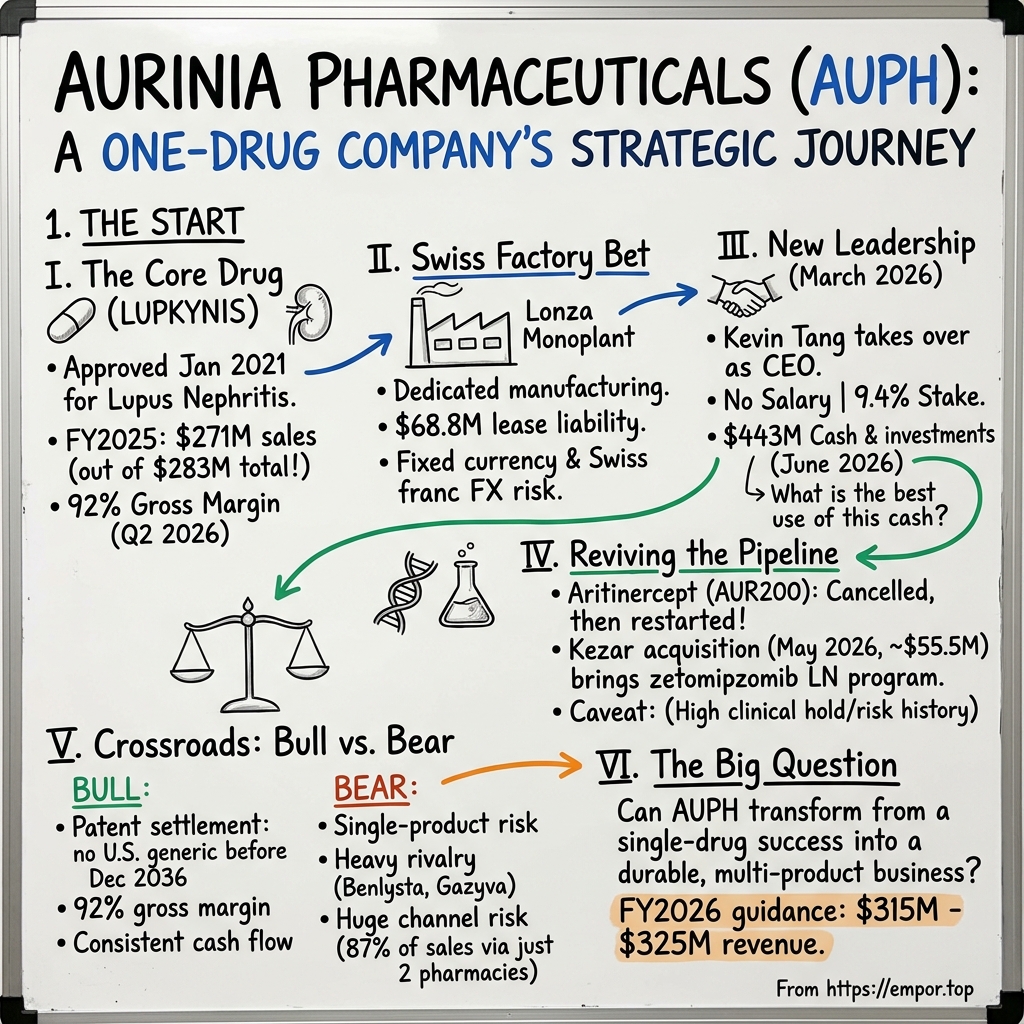
Aurinia Pharmaceuticals: One Drug, a New Owner at the Helm
I. The Company That Changed Hands Without Being Sold
On March 20, 2026, Aurinia Pharmaceuticals changed hands without anyone buying it. That morning the company had a chief executive, a chief financial officer, a chief operating officer and a chief medical officer, the team that had launched its only approved drug and spent five years selling it to American kidney doctors. By the end of the day all four had stopped serving as officers, and the chair of the board, Kevin Tang, had become chief executive as well.1 Nobody paid a takeover premium and no tender offer went out. The man whose investment fund was the largest disclosed holder of the stock simply walked from the boardroom into the corner office.
Tang did not take the job for the money, because he took no money. He elected to receive no salary, no bonus, no equity awards and no other compensation, while holding about 9.4% of the company through Tang Capital Management.1 For a biotech investor who had spent two decades backing, chairing and sometimes taking apart small drug companies, the arrangement made a statement: he would be paid the way the other shareholders were paid, through the share price, or not at all.
The shareholder list he joined was concentrated too. After Tang's fund, the largest disclosed holders were BlackRock, with about 6.9%, and 일진 ILJIN, a Korean investor, with about 5.7%.1 The three together held about a fifth of the company, which meant a handful of investors could shape its direction far more than in a typical Nasdaq biotech.
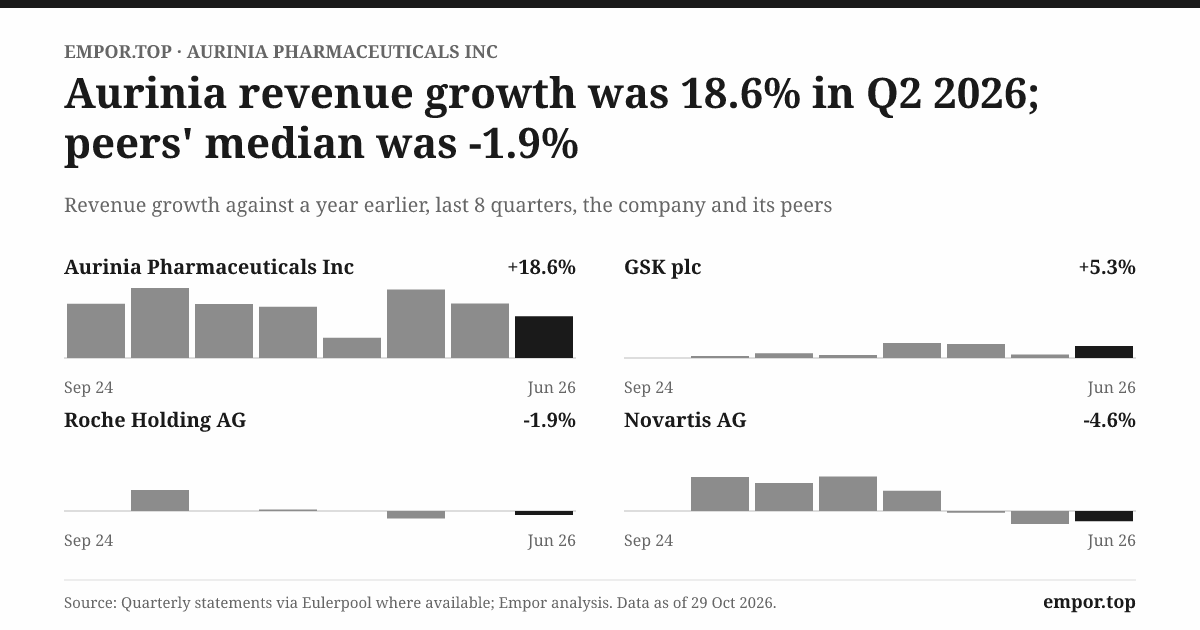
What he inherited was an odd kind of company. Aurinia made money, real money, after years of losses. In 2025 it reported about $283 million of revenue, and nearly all of it, roughly $271 million, came from a single product: LUPKYNIS, an oral pill for lupus nephritis, the kidney inflammation that strikes many people with lupus.2 Product sales grew 25% that year, then another 21% in the first half of 2026.3 The company ended 2025 with about $398 million in cash and investments, and by June 2026 the pile had grown to about $443 million, even after the company had spent heavily on buying back its own shares.3
So here was the tension. On one side sat a cash engine that was still young, still growing, and resting entirely on one molecule. On the other sat a new boss who, within weeks of taking over, kept buying back stock, kept pushing an early-stage antibody program into the clinic and agreed to buy another biotech outright. A company that had once tried to sell itself and failed was now acting like a buyer.
The questions that run through this story follow from that tension. How durable is LUPKYNIS growth, when the product has only been on the market since 2021 and the field around it filled up with new competitors in 2025? How much of the profit Aurinia now reports will repeat, and how much was a one-time accounting event? And what will Tang do with the cash: deepen the core business, buy or build a second product, or keep shrinking the share count?
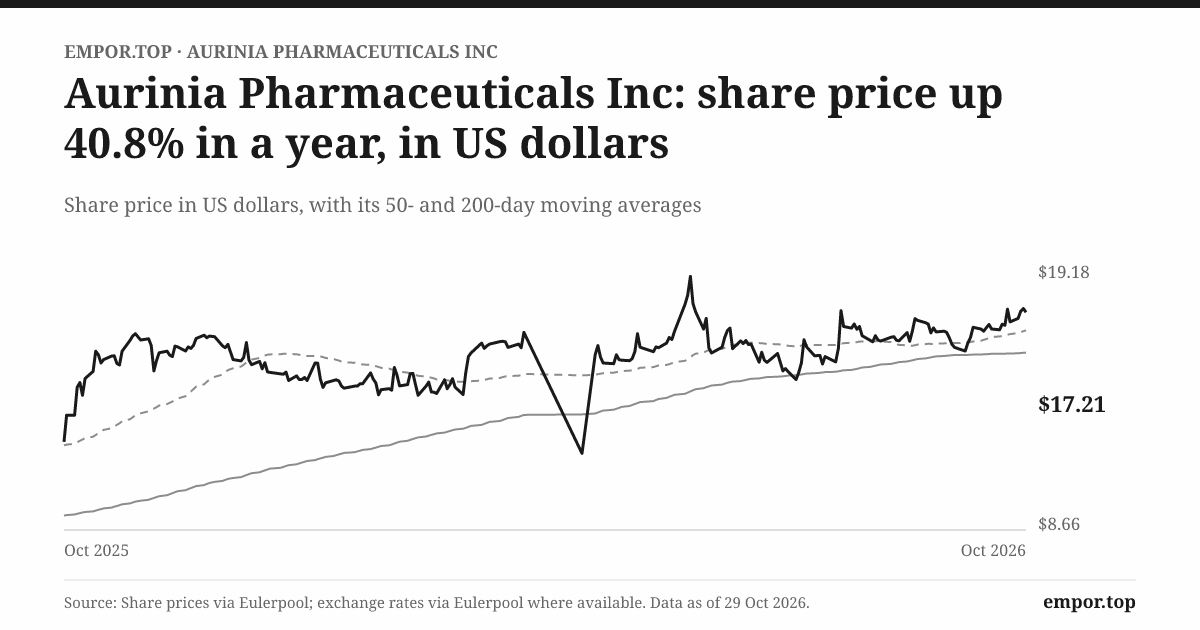
The stock market has given an answer that looks, at first glance, almost generous to the skeptic. On October 29, 2026, Aurinia's shares closed at about $17.21, giving the company a market value of roughly $2.4 billion and a price of just 7.7 times trailing earnings.2 For a growing, profitable drug company, that looks like a bargain hiding in plain sight. But the earnings in that ratio contain a large tax benefit, about $173 million booked in late 2025 when Aurinia concluded it would earn enough future profit to use its old tax losses.2 Take that out and the picture changes, a puzzle this story will come back to once the business underneath has been examined.
Before any of that, there was a more basic test. For most of its life, Aurinia had been a company with a molecule and a hope. The first thing it had to do was get that molecule across the finish line.
 Subscribe on LinkedIn
II. The Molecule That Finally Found Its Disease
Voclosporin had been around for a long time before anyone could buy it. The drug's roots ran back to Isotechnika, a small company in Edmonton, Alberta, that spent years developing it as a better version of cyclosporine, the decades-old transplant drug. In 2013 Isotechnika combined with a private company called Aurinia, and the merged business took the Aurinia name and set out to turn voclosporin into a treatment for lupus nephritis.6 It was a classic small-biotech bet: one molecule, a disease with few good options, and a balance sheet that had to keep coming back to investors for more money. Between the merger and the first sale of the drug, Aurinia raised equity again and again. In one 2016 offering it sold units at $2.25 each, every unit a share plus half a warrant.21 Years of operating losses followed, peaking at an operating loss of about $181 million in 2021, the year of launch.2
To understand why the bet could pay off, it helps to understand the disease. Lupus is an autoimmune condition: the body's defenses attack its own tissue. In a large share of patients the attack reaches the kidneys, inflaming the tiny filters that clean the blood. The visible sign of trouble is protein leaking into the urine, called proteinuria, and the danger is that years of inflammation scar the kidneys until they fail. Doctors had treated the condition with a blunt toolkit of steroids and older immunosuppressants such as mycophenolate. Plenty of patients did not respond well enough.
Voclosporin belongs to a class of drugs called calcineurin inhibitors. The simplest way to picture them is as a brake on the immune system's alarm wiring: calcineurin is a switch inside immune cells that, when flipped, tells them to multiply and attack, and the drug holds that switch off. Calcineurin inhibitors also seem to help steady the cells that line the kidney's filters, which may be part of why they can reduce proteinuria quickly. Aurinia's pivotal AURORA trial tested voclosporin on top of mycophenolate and low-dose steroids, and more patients reached a complete renal response on the combination than on the background regimen alone.6 That was the evidence that mattered.
The two big decisions came close together. In December 2020 Aurinia signed a deal with 大塚製薬 Otsuka Pharmaceutical, handing the Japanese company rights to voclosporin in Europe, Japan and other markets outside the United States. Otsuka paid $50 million upfront, with milestones still to come and royalties of 10% to 20% on its net sales, and it would buy its supply from Aurinia at cost plus a margin.62 Then, on January 22, 2021, the U.S. Food and Drug Administration approved LUPKYNIS for adults with active lupus nephritis, in combination with background immunosuppressive therapy.6
The Otsuka deal said something about Aurinia's strategy. A company of its size could not build sales forces on three continents at once, so it kept the most valuable market, the United States, and rented out the rest. The upfront payment and the supply margin brought in money, but they also capped Aurinia's long-term share of the international opportunity at a royalty. In effect, Aurinia chose to be an American commercial company with a foreign income stream rather than a global one.
There was a quieter lesson from the same few months, and it is easy to miss next to the approval. In November 2020, weeks before the Otsuka deal, Aurinia reported the results of AUDREY, a Phase 2/3 trial of a voclosporin eye-drop for dry eye disease. The study enrolled 508 people across three doses and a placebo, and it missed its primary endpoint: no dose produced a statistically significant improvement in tear production at four weeks.7 Peter Greenleaf, then chief executive, said the company was suspending the dry-eye program.7
The contrast is the point. The same molecule, from the same company, failed in one disease and succeeded in another within about three months. That is a reminder about what a drug really is. It is not a product with general powers; it is a set of effects that turns into value only in a disease where those effects matter and where the evidence is strong enough to persuade a regulator. The technical progress Aurinia made in chemistry and manufacturing did not carry over to dry eye. It carried over only where the biology cooperated.
Approval also settled less than it seemed to. An FDA approval says a drug works and is safe enough to sell. It does not say who will prescribe it, which insurers will pay for it, or how many patients will stay on it. Those questions belonged to the next phase, and the numbers at first were sobering. Revenue in 2021 was about $45 million, actually lower than 2020's $50 million, which had been flattered by Otsuka's upfront payment.2 It took until 2022 for sales to take off, with revenue roughly tripling to about $134 million.2
The approval turned Aurinia from a development company into a commercial one. Whether that commercial business was real, durable and defensible depended on a market Aurinia did not control: the treatment choices made by kidney doctors and rheumatologists across the United States. That market is the whole company.
III. The Lupus Kidney Market Is the Whole Company
Picture a nephrologist in a clinic examination room with a woman in her thirties whose lupus has reached her kidneys. Her urine is full of protein, her biopsy shows active inflammation, and she has a choice to make with her doctor that will shape the next several years of her life.
A decade ago that conversation was short: steroids plus mycophenolate or cyclophosphamide, and hope. By 2026 the doctor had a menu. The American College of Rheumatology's 2024 guideline for lupus nephritis recommended combination approaches for active disease, so that most patients would receive more than one drug from the start. The options included a regimen built on a calcineurin inhibitor such as voclosporin or tacrolimus, and a regimen built on belimumab, GSK's antibody sold as Benlysta.8 Then, in October 2025, the FDA approved Roche's Gazyva, the antibody obinutuzumab, for adults with active lupus nephritis on standard therapy, after a Phase 3 trial called REGENCY showed 46.4% of patients reaching a complete renal response against 33.1% on standard therapy alone.9 Gazyva is given as an infusion, four doses in the first year and then twice a year.9
That is the competitive field LUPKYNIS lives in. It is not one product against nothing. It is one option among several, each backed by trial data and each recommended in some form.
What the pill has going for it
LUPKYNIS has real points of difference. It is an oral pill, taken twice a day, rather than an infusion or an injection. In its pivotal trials it reduced proteinuria quickly, which matters to doctors because falling protein is the earliest sign the kidneys are calming down.6 And unlike tacrolimus, an older calcineurin inhibitor that some doctors use off-label for lupus nephritis, voclosporin was developed and approved specifically for this disease, with dosing that does not require the same blood-level monitoring.6 Like other drugs in its class, it carries serious warnings about infections and cancer risk, and doctors have to watch kidney function closely, which is part of why prescribers do not treat it as a casual add-on.2
These are clinical advantages. They are not proof of durable pricing power or of preference in routine practice. The guideline that recommends a calcineurin-based regimen recommends belimumab-based regimens alongside it, and a doctor who prefers an antibody, or worries about a calcineurin inhibitor's effect on kidney function over years, has good reasons to choose differently.8 GSK's Benlysta is a large drug across its lupus indications, and Gazyva comes from one of the deepest pockets in the industry. Neither GSK nor Roche discloses its share of lupus nephritis specifically, and Aurinia does not publish its own market share. The honest reading is that LUPKYNIS has earned a place in the conversation, not that it owns the conversation.
The two newest rivals also changed what Aurinia has to argue. Gazyva's approval rested on complete renal response after more than a year of treatment, a long-horizon measure of kidney protection, and its twice-yearly maintenance infusions make it easy for a patient to stay on.9 LUPKYNIS's case leans on how quickly it lowers proteinuria, a pill taken every day.6 On the February 2026 call, prior management answered questions about Roche by pointing to the consistency of its own business rather than to any new head-to-head data.5 That leaves Aurinia competing partly on how a benefit is measured. A doctor who values early response will weigh the evidence one way; a doctor who values long-term kidney protection and simple dosing may weigh it another.
The sales record is where the demand shows up. Net product sales of LUPKYNIS reached about $271 million in 2025, up 25%, and the company attributed the growth principally to more cartons sold to specialty pharmacies as the drug penetrated further into the lupus nephritis market.2 In the first half of 2026 product sales were about $153 million, up 21%.3 That growth continued after Gazyva's approval, which is a meaningful data point: the most feared new competitor arrived and LUPKYNIS kept growing at about a fifth a year. But eight months is a short window for a drug whose dosing schedule means patients started on it accumulate slowly, and Roche had only begun to build its lupus nephritis franchise.
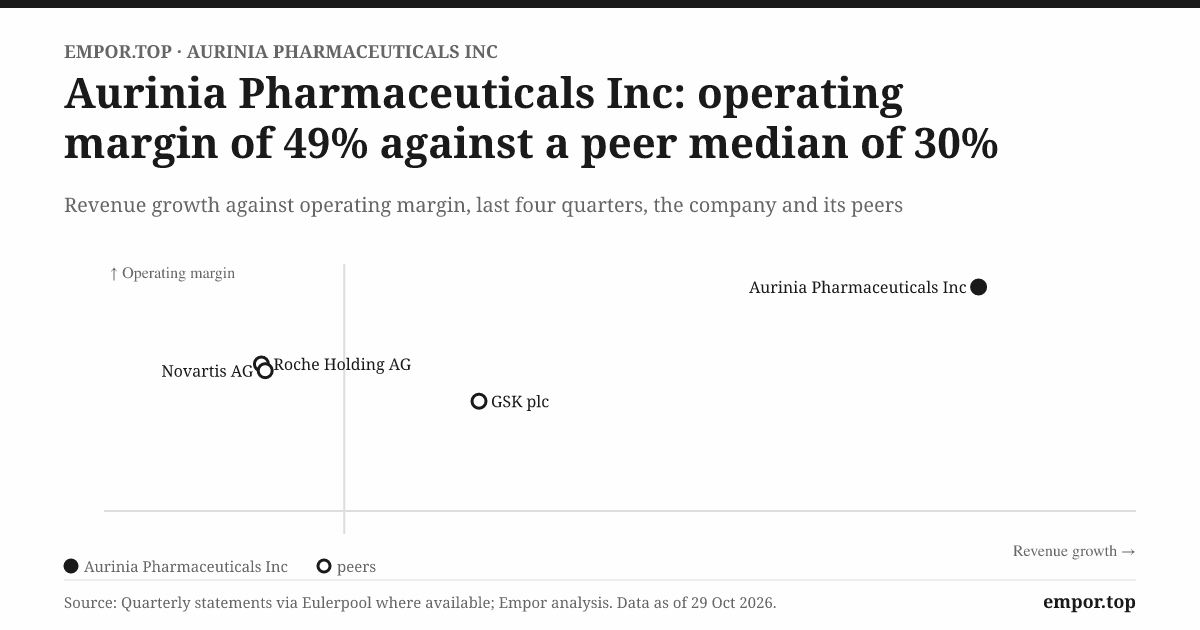
The economics on each sale are excellent. In the second quarter of 2026, Aurinia kept about 92 cents of every revenue dollar after the cost of making and delivering the drug.3 That kind of gross margin is typical of a branded specialty drug and leaves wide room to fund a sales force, medical education and development. It also means the business is very sensitive to price: a few points lost to rebates or discounts fall almost entirely through to profit.
Following the money to two pharmacies
The patient in the examination room never pays Aurinia directly. Her prescription travels to a specialty pharmacy, one of a small number of companies that handle expensive drugs for complex diseases, check insurance coverage, and ship the medicine. Aurinia sells to two U.S. specialty pharmacies and a specialty distributor, and sells inventory to Otsuka for Europe and Japan.2 The two pharmacies alone accounted for 87% of total revenue in 2025, against 88% in 2024.2 Aurinia does not name them or break out the split between them.
That concentration is not the same as depending on one big customer who could walk away. The prescriptions themselves come from thousands of doctors and patients, and the pharmacies are a channel rather than the source of demand. But channels have bargaining power. If either pharmacy renegotiated its fees, changed how it handled the product, or ran into operational trouble, Aurinia's reported revenue would feel it immediately, and there is little evidence in the filings about how those contracts are structured. Aurinia does not disclose a standard contract term or a minimum purchase commitment for these sales.2
What Aurinia reports net of the pharmacy channel also matters. The company recognizes revenue when the pharmacy takes control of the cartons, minus a long list of deductions: discounts, distribution fees, government and commercial payer rebates, co-pay assistance and administration fees.2 That deduction stack is where pricing power, or its absence, appears over time. If insurers demand bigger rebates to keep LUPKYNIS on their formularies, or if competitors buy access with their own rebates, the gap between list price and net price widens, and net sales can lag prescriptions.
On the question of whether the customers pay, the evidence is reassuring. Standard terms run 30 to 45 days, and Aurinia says it has never written off a customer receivable and has not had collection problems.2 Receivables stood at about $41.5 million at the end of 2025, roughly 53 days of revenue, a little above the stated terms but in line with recent years.2 The company does not publish an ageing table, which matters more than usual because almost all the money is owed by the same two pharmacies and Otsuka. There is no sign of trouble; there is also no granular way to watch for it.
How the growth actually happens
Growth in this business does not come from more transactions in the ordinary sense. It comes from a chain: a patient has to be diagnosed with lupus nephritis, which often requires a kidney biopsy; a doctor has to choose LUPKYNIS over the alternatives; an insurer has to agree to pay; and the patient has to stay on the drug. Aurinia's own filings say future sales depend partly on changing treatment practices.2 Each link can break, and each is shaped by forces Aurinia influences but does not control.
On the fourth-quarter 2025 earnings call in February 2026, the last under the old team, analysts pressed management on exactly those links. Greenleaf described the market as hundreds of thousands of lupus patients in the United States and tens of thousands with lupus nephritis, and argued that Roche's new drug had no near-term impact on a business that was performing as it had historically.5 When an analyst asked whether 2026 guidance looked conservative, Greenleaf declined to give any quarterly steer and pointed back to past trends.5 Executives also acknowledged that a post-marketing study called VOCAL had been terminated after it proved very difficult to recruit patients.5 The prepared remarks projected confidence; the answers under questioning were careful and did not offer much new data on competitive share.
The first half of 2026 brought one telling change of posture under the new team. Aurinia began a Phase 4 study called PRESERVE that combines LUPKYNIS with belimumab, obinutuzumab or anifrolumab, AstraZeneca's lupus antibody, in about 150 patients at about 50 U.S. sites, measuring complete renal response at six months.3 Put plainly, Aurinia is trying to recast its rivals as partners: if the future of lupus nephritis treatment is a combination of an antibody and something else, LUPKYNIS wants to be the something else. That is a sensible strategic bet. It is also, for now, a hypothesis that the study has yet to test.
Testing the moat
Run the market through Michael Porter's five forces and the shape of the advantage becomes clearer. Rivalry is intensifying: big companies with large, multi-indication franchises now compete for the same patients. The threat of substitutes is real because the guideline lets doctors choose among several regimens, so the cost to a doctor of switching from one approach to another is mostly habit and comfort, not a technical barrier. Buyer power is concentrated at two levels, in the specialty pharmacies that make up most of revenue and in the insurers who set rebates and access. Supplier power sits with Lonza, the contract manufacturer that makes the drug, a dependency that has its own story. The threat of new generic entrants is held back by patents, which delay copies of voclosporin but do nothing to stop Roche or GSK from competing with entirely different drugs.
Add it up and LUPKYNIS has differentiation backed by clinical evidence and a guideline-supported role, but the evidence does not yet show a moat in the sense of something that would keep competitors from taking share if they chose to. The fullest test of that question, using Hamilton Helmer's framework of strategic powers, belongs to the bull and bear case. For now the narrower conclusion holds: demand is real, the margin is high, and the competitive position is defensible but contested.
That matters because of a decision Aurinia had already made. Long before it could be sure how big this market would be for LUPKYNIS, it committed to a dedicated factory, and the fixed cost of that factory has to be carried by these sales whatever happens to the competition.
The international half of the original bargain has stayed small. Revenue from licensing, collaboration and royalties, most of it tied to Otsuka, was about $3.8 million in the second quarter of 2026 and about $8 million in the first half, against $153 million of product sales.3 Europe and Japan add useful income at almost no cost to Aurinia, but they are not where the company's value is made. The American lupus nephritis market is. That is why the competitive field matters so much: a company with one drug and one dominant market has nowhere else to hide if that market turns.
IV. The Factory Built for a Product That Had Yet to Prove Itself
Lonza, the Swiss contract manufacturer, makes drugs for much of the industry from its plants in Switzerland. Aurinia does not make its own drug; it relies on Lonza, and as LUPKYNIS approached the market the company decided that relying on shared capacity was not enough. It agreed to a dedicated manufacturing arrangement, a facility devoted to voclosporin, which the companies called the Monoplant.2
The logic was supply security. Voclosporin is a complex molecule, and a company with one product cannot afford to run short of it. A dedicated line meant Aurinia would not be competing with Lonza's other customers for capacity when demand rose, and it gave the company more control over quality and timing. If the bet on LUPKYNIS paid off, the facility would look like prudent planning. If it did not, Aurinia would be paying for capacity it did not need.
The commitment was made when the product had little or no commercial record, which is what makes it a bet rather than an expansion. And it came with a particular structure. Aurinia pays a fixed facility fee of 3.6 million Swiss francs a quarter through March 2030, and the accounting rules treat the arrangement as a finance lease: Aurinia records the facility on its balance sheet as an asset and the stream of future payments as a liability.2 At the end of 2025 that liability was about $68.8 million.2 In 2025 the lease cost about $21.7 million in total, of which about $17.4 million was the asset being written down and about $4.3 million was interest.2
Think of it as a long equipment lease with a twist. The payments are fixed in francs, but Aurinia earns its revenue in dollars, so every move in the exchange rate changes what the remaining payments are worth. The company estimates that a 10% swing in the franc would move the value of the liability by about $6.9 million.2 In 2025 a stronger franc produced a non-cash foreign-exchange loss of about $9.7 million on the lease, after a $5.9 million gain the year before and a $5.9 million loss the year before that.2 Aurinia does not describe a hedging program for this exposure in its filings. The result is a line in the income statement that swings with the franc and tells investors nothing about how well LUPKYNIS is selling.
How heavy is the burden? Against about $135 million of operating cash flow in 2025, roughly $14 million a year of franc payments is manageable.2 While sales grow at 20% a year, the fixed cost shrinks as a share of revenue, which is part of why operating margins rose so quickly. The burden would show itself only if sales stalled or fell, because a fixed cost does not shrink with demand. That is the classic trade-off of an owner-operator: the factory makes good years better and bad years worse. Lonza remains a single critical supplier, and Aurinia does not publish a supplier-concentration figure, so the dependence on one partner in one country is a quiet but real risk.
Profit that is not cash, and cash that is not profit
The factory also helps explain why Aurinia's earnings need to be read carefully. In 2025 the company reported net income of about $287 million on revenue of about $283 million, a net margin above 100%, which is the kind of number that should make any investor stop.2 The explanation is that about $173 million of that profit was an income tax benefit, created when Aurinia released a valuation allowance on its deferred tax assets.2
In plain English: for years, Aurinia had piled up tax losses that could, in principle, reduce future tax bills. Accounting rules let a company count those future savings as an asset only when it is confident it will earn enough profit to use them. Until then, the asset is written down to zero with an allowance. In late 2025 Aurinia concluded it was now profitable enough, released the allowance, and booked the whole value of the expected future savings as a one-time gain.2 No cash came in. The same benefit also means Aurinia will now show a normal tax charge on future profits, even though its actual cash tax bill will be held down for a while by the old losses.
Operating cash flow tells the cleaner story. It was about $135.7 million in 2025, up from about $44 million in 2024.2 That is the real measure of the turn: a business that consumed cash every year from 2014 through 2023 now generates it at a rate of more than $100 million a year. Over the twelve years from 2014 to 2025, cumulative net losses added up to about $455 million and cumulative operating cash outflows to about $365 million, which shows how recently the switch flipped.2
The first half of 2026 is the first period with a normal tax line. Net income was about $71.8 million and operating cash flow about $85.1 million, with about $20.9 million of income tax expense, roughly a 23% rate.34 Operating income was about $87.8 million on $160.9 million of revenue, an operating margin above 54%.3 Those are the cleanest numbers Aurinia has ever reported, and they describe a highly profitable small specialty drug company.
One more piece of the profit is not product economics. Aurinia holds most of its cash in U.S. Treasury bills and bonds, which earned about $13.6 million of interest in 2025.2 At roughly $443 million of cash and investments in June 2026, the treasury portfolio adds meaningfully to pre-tax income while interest rates stay high.3 That income is real, but it belongs to the balance sheet rather than the drug, and it would shrink if the cash were spent or rates fell.
The cost discipline of the old regime also shows in the headcount. Aurinia reported about 128 full-time-equivalent employees in February 2026, a small number for a company selling a specialty drug across the United States, and the product of two rounds of layoffs in 2024.2 That leanness is part of why margins rose so fast. It also means the company has little slack: a commercial team that small has to choose which doctors to call on, and every new development program competes for the attention of a thin layer of managers.
The factory's burden is light while sales rise and heavy only if they stop. That makes the question of what management does with the cash, and how it protects the core, the real story. And this was a management team, and a board, that had already cut costs and narrowed the pipeline once before. What, exactly, did it choose to build afterward?
V. The Pipeline Aurinia Cut, Then Brought Back
In February 2024 Aurinia announced the end of an eight-month auction that nobody had won. Under pressure from an activist shareholder, MKT Capital, the board had launched a strategic review in June 2023 and contacted more than 60 parties about a sale, a merger or a licensing deal. Only one showed interest, and it never made a formal offer.11 With no buyer, the board turned inward. It cut at least a quarter of the workforce, sparing the people who sold LUPKYNIS, authorized up to $150 million of share repurchases and targeted up to $55 million of annual savings.11
The research budget took the hardest hit. Aurinia stopped its AUR300 program, an early-stage project in autoimmune disease.1011 AUR200, a second early-stage antibody, was put in limbo: press coverage at the time described it as discontinued, while the company itself said it was exploring alternative approaches for the program.11 Either way, the message to investors in early 2024 was that Aurinia had become a one-product company by choice, focused on selling LUPKYNIS and returning cash.
Then the plan changed. By September 2024 the first participant had been dosed in a Phase 1 study of AUR200, and on November 7, 2024, Aurinia announced a second restructuring, this time cutting about 45% of its workforce and promising more than $40 million of annual cash savings, with a one-time charge of $15 million to $19 million.10 The stated purpose was to sharpen focus on continued LUPKYNIS growth and the rapid development of AUR200.10 Within one year, the same program had gone from a candidate for exit to the centerpiece of the company's future.
What aritinercept is meant to do
AUR200 now goes by the name aritinercept. It is a dual inhibitor of two proteins called BAFF and APRIL.12 Both are signals that keep B cells, the immune cells that produce antibodies, alive and active. In autoimmune diseases such as lupus, those B cells can make antibodies that attack the body's own tissue. Belimumab, the Benlysta in the nephrologist's menu, works by blocking BAFF alone. The idea behind a dual inhibitor is to cut off both supply lines at once, starving the misbehaving cells more thoroughly.
Aurinia argues that aritinercept is built differently from competing dual inhibitors, using a binding domain engineered from a receptor called BCMA rather than the TACI receptor others use.12 In a Phase 1 study in 61 healthy volunteers, single injections under the skin cut antibody levels substantially, reducing IgA by up to 48% and IgM by up to 55% by day 28, with no treatment-related serious adverse events; the company says the data support once-monthly dosing.12 By mid-2026 Aurinia said it had initiated clinical development in four potential indications, but it had not named them in its results.3
The idea fits the company. Aurinia's sales force and medical staff already speak to rheumatologists and nephrologists about autoimmune kidney disease, and a B-cell drug for lupus or related conditions could, in principle, travel through the same doors. But the field is crowded. Other companies are developing dual BAFF/APRIL inhibitors, and the reductions in antibody levels seen in healthy volunteers are a signal that the drug hits its target, not evidence that it helps patients. Aritinercept is at the stage where most drugs fail.
Weighing the record
The timeline can be read two ways, and both readings deserve a hearing. A charitable reading says the board learned from the failed sale that LUPKYNIS alone would not support a durable company, and that reviving the strongest early asset was a disciplined choice to keep one option alive while cutting everything else. A skeptical reading says the company changed its mind about its pipeline twice in a year, which makes its stated priorities a weak guide to its future behavior. The evidence supports neither verdict fully. What it does show is that Aurinia's pipeline strategy has been reactive, shaped by shareholder pressure and a failed auction, rather than by a long-held plan.
The company's own record of turning technical assets into revenue sharpens that point. Across its history, Aurinia has converted exactly one molecule in one indication into a commercial product. The dry-eye program failed, AUR300 was discontinued, and AUR200 was nearly abandoned before it was revived.710 One success in several attempts is not unusual in biotech; it is close to the industry's base rate. But it means no investor should assume that Aurinia's commercial skill in lupus nephritis transfers to drug discovery or early development.
The spending tells the rest of the story. Research and development expense rose from about $20.8 million in 2024 to about $32.5 million in 2025, and the company expected it to keep rising as development advanced.2 That is a real increase, but it is small next to the roughly $100 million Aurinia spent buying back its own shares in 2025.2 For every dollar spent on the future pipeline, the company spent about three dollars shrinking its share count. That ratio is a clear statement of priorities, whatever the press releases say.
The pace of the program changed visibly when the leadership did. On the February 2026 call, the old team said Aurinia had started a clinical study in one autoimmune disease and planned to start one in a second disease in the first half of the year.5 By August, under Tang, the company said it had initiated clinical development in four potential indications.3 Moving from one disease to four in about six months is either a sign of urgency or a sign of spreading a small budget thin, and the company has not yet disclosed enough—the diseases, trial designs or readout dates—for outsiders to tell which. A running start in four directions is cheap in the first year of small studies. It becomes expensive when any of them reaches the larger trials needed for approval, which is when the trade-off between buybacks and research will stop being theoretical.
The milestones that would change the case for aritinercept are concrete. Patients need to tolerate it. It needs to show a clinical effect in a disease, not just a drop in antibody levels in healthy people. It needs to progress into later-stage trials, and it needs a plausible route to market against larger competitors. Until then, it is an option, and an option's worth depends on who is holding it. In March 2026, a new holder arrived.
VI. Kevin Tang's First Test Is What He Does With the Cash
Kevin Tang has spent his career on the investor's side of the biotech table. He founded Tang Capital Management in 2002, and over two decades he chaired La Jolla Pharmaceutical from 2014 until its sale to Innoviva in 2022, founded and ran Odonate Therapeutics from 2013 to 2022, and co-founded Heron Therapeutics in 2009.1 He has served on the boards of companies including Ardea Biosciences, Trimeris and Penwest.1 In the small-cap biotech world, he is known as an investor who takes concentrated positions, gets involved, and is unsentimental about companies whose science has not delivered. He also controls Concentra Biosciences, a vehicle that bids for small biotechs, and it surfaced in Aurinia's story within weeks.16
He did not arrive at Aurinia in 2026. He joined the board on September 12, 2024, and became chair the same year, after two annual meetings in which shareholders had openly rebelled against the old regime.1 In May 2023 the company's say-on-pay proposal failed, with only about 39% of votes cast in favor, and two directors failed to win majority support.13 In June 2024 it happened again: say-on-pay failed with about 40% support, and four directors, including Greenleaf himself, were not re-elected by a majority, forcing them to submit conditional resignations under the company's majority-voting policy.14 The equity incentive plan amendment failed at both meetings.1314
The failed strategic review left Aurinia without a buyer.11 Shareholders had already tried the obvious exit, selling the company to a larger drug maker, and the market had declined. What remained was to run Aurinia as an independent business, and the question became who should run it and for whose benefit. Tang's route to the top ran through that vacuum: an outside investor who joined the board three months after the 2024 vote and ended up owning the decision rather than merely influencing it.
Those votes matter because they measure credibility. For two years in a row, holders of a clear majority of the voted shares told the board they did not think the executives were being paid for performance. In that period Greenleaf's total compensation reached about $10.6 million in 2023, before falling to about $6.4 million in 2024 and $5.9 million in 2025.1 It was the old team that had taken the company to profitability, and that record is real. But the shareholders' verdict on its pay and governance was also real, and Tang's arrival on the board was, in effect, the answer to it.
Then came the March 20, 2026 reset.1 It is best treated as a genuine reset, not a continuation. The figures that make Aurinia look strong, the 2025 sales growth and the first-half 2026 margins, were largely earned under the old management. The new team's record begins essentially now.
Incentives on paper
On paper, the alignment is striking. Tang holds about 9.4% of the company and takes no pay of any kind, so his financial interest rises and falls only with the share price.1 The two other new executives, chief operating officer Ryan Cole and chief financial officer Michael Hearne, each have base salaries of $300,000 and target bonuses of 50%, a modest package for a company of Aurinia's size.1 Compared with the old regime's pay, which shareholders twice rejected, the cost of the top team has fallen sharply.
Shareholders noticed. At the June 2026 annual meeting, say-on-pay passed with about 93% support.15 But not everything went smoothly. Two directors, Craig Johnson and Tina Nova, each had about 13% of their votes withheld, which is a meaningful protest even though both were elected.15 And the structure Tang now leads concentrates power. He is both chief executive and chair, so the person the board is supposed to supervise also runs the board. The company says 80% of its directors are independent, with independent audit, compensation and governance committees.1 Those protections matter more than usual when the chief executive is also the largest disclosed shareholder.
A skeptic would ask what Tang's zero salary actually buys. It removes one cost and one source of misalignment. It does not mean his interests and those of minority shareholders are identical. A 9.4% holder with a long history of investing across biotech has other holdings and other vehicles, and transactions between those vehicles and Aurinia would need careful scrutiny. That concern became concrete within weeks.
Where the cash went
The real test of any new chief executive at a cash-rich company is capital allocation, and Aurinia's choices before and after the change are easy to set side by side. The buyback program began in February 2024 with a $150 million authorization, and the board added another $150 million in July 2025.2 By the end of 2025, Aurinia had bought back about 18.3 million shares for about $138.6 million.2 In 2025 alone it bought back about 12.2 million shares for about $98.2 million, reducing its fully diluted share count from about 150 million to about 140 million.5 Under Tang, the pace picked up: in the first half of 2026 the company bought back another 5.0 million shares for about $74.9 million.3
The price paid tells its own story. In 2025 the average repurchase price worked out to about $8 a share. In the first half of 2026 it was about $15.23 With the stock at about $17 in late October 2026, the earlier purchases look excellent in hindsight, and the more recent ones were made at a much richer price.2 Buying back shares at a higher price is not wrong, but it means each dollar retires fewer shares and the bet on the company's undervaluation becomes larger.
The shares are cancelled under Alberta law, so the reduction is permanent.2 Aurinia has never paid a dividend.2 It has no conventional bank borrowing, but the Monoplant lease is a real obligation, as is about $6.0 million of operating leases on offices.2 The balance sheet, in other words, gives the new team wide room to choose.
What Tang chose, in his first months, was all three paths at once. He kept buying back stock at a faster pace. He let the development budget grow, with aritinercept advancing into four indications and the new PRESERVE study under way.3 And he agreed to buy a company. The record is far too short to call the new team disciplined or undisciplined. What it does provide is one concrete transaction that investors can examine in detail, and that transaction involved a company in which Tang himself had a stake.
VII. Kezar: A Pipeline Option Bought Near Its Cash Value
On March 23, 2026, three days after taking over as chief executive, Kevin Tang sat down with the senior management of Kezar Life Sciences and its financial adviser, TD Cowen. He was not a stranger to them. Before that meeting he had submitted proposals to Kezar and held discussions on behalf of Concentra Biosciences, an entity he controlled.16 He also held, through Tang Capital Partners, about 9% of Kezar's shares.16 Now he came with a different buyer: Aurinia. He told Aurinia's board that day that he would stop negotiating with Kezar through his other entity if Aurinia wanted the deal.16
The terms moved quickly. Aurinia proposed paying $6.955 per share in cash, which valued Kezar's equity at about $51.5 million, described as a $1.5 million premium to the roughly $50 million of net cash Kezar was expected to hold at closing, plus a contingent value right, or CVR, for each share.16 Kezar asked for an upfront value about $10 million above closing net cash. Tang rejected that.16 On March 29 Aurinia's board approved the deal after Tang left the meeting, the merger agreement was signed on March 30, and Tang Capital signed an agreement to tender its shares.16 Kezar's board recommended that its shareholders accept the offer.17 The deal closed on May 11, 2026.4
The structure is, in effect, a purchase of a cash box with a lottery ticket attached. Aurinia paid roughly what Kezar's cash was worth, plus a small premium, and in return took over Kezar's clinical program and other assets. The total consideration Aurinia recorded was about $55.5 million, including about $51.6 million of cash and a CVR liability of about $3.7 million.4 Because the assets acquired were mostly cash and unproven drugs, Aurinia accounted for the deal as an asset acquisition, not a business combination, and expensed the acquired research in progress.4
What the CVR shares, and what it does not
The CVR spreads the upside of Kezar's assets between Aurinia and Kezar's former shareholders. Holders receive any closing net cash above $50 million. If Aurinia starts a clinical study of Kezar's legacy drug within two years, they can collect milestone payments: $500,000 when the tenth patient is dosed in a Phase 2 or 3 trial, $5 million on filing for approval, $12.5 million on approval, and $20 million and $50 million when annual sales reach $500 million and $1 billion, plus a 3% royalty on sales.16 They also receive 90% of the proceeds from any sale of the legacy asset agreed within two years, 90% of proceeds from a collaboration with Everest Medicines and all proceeds from an asset called Enodia.16 Aurinia estimated the probability-weighted value of each CVR at between about $1.11 and $2.32, while noting that it was entirely possible that no cash would ever be paid.16
That last clause matters because of what Kezar's main drug had already been through. Zetomipzomib is a selective immunoproteasome inhibitor, a drug designed to dial down overactive immune cells by blocking a cellular machine that processes proteins. Kezar had been testing it in a Phase 2b trial called PALIZADE in patients with active lupus nephritis, the same disease LUPKYNIS treats. In October 2024 Kezar announced it had suspended enrollment and dosing on the recommendation of its independent data monitoring committee, which had reviewed emerging safety data including four fatal serious adverse events in patients enrolled in the Philippines and Argentina.18 The FDA then placed the lupus nephritis program on clinical hold.18 Kezar did not say the drug caused the deaths, and the review that followed is not a finding of causation. But a trial stopped for patient deaths, in exactly the indication where Aurinia makes its money, is not a free option.
Was it a good price?
Benchmarking a deal like this against conventional biotech takeovers would be misleading. Most acquisitions are priced on expected future sales, and their premiums reflect a buyer's view of an asset's commercial value. Here, the price was set by the cash in the bank. The upfront premium, about $1.5 million, is small next to Aurinia's $443 million of cash and investments, and the CVR means Aurinia shares any future proceeds with the sellers.163 On price alone, the downside to Aurinia's shareholders looks limited.
The harder questions are about process and purpose. Aurinia's chief executive was, through his fund, a meaningful seller in the deal, and had earlier pursued the same target through a vehicle he controlled. The board did take steps that a careful board should take: it approved the deal with Tang out of the room, and Tang rejected Kezar's request for a bigger premium, which is the opposite of what a conflicted seller would want.16 Even so, an activist-minded skeptic would want to know why Aurinia, rather than Concentra, became the buyer, and how much management attention a clinically troubled program will absorb. The offer document answers the first question only partly. It records that Tang offered to stand Concentra down if Aurinia was interested, but not why Aurinia's board judged the assets worth owning.16
The CVR also deserves a second look on the accounting side. Aurinia expected to issue up to about 7.7 million CVRs, and its own probability-weighted estimate of $1.11 to $2.32 per right implies a total value of roughly $9 million to $18 million.16 Yet Aurinia booked a CVR liability of only about $3.7 million at closing.4 Aurinia does not reconcile the two figures, which were made at different moments for different purposes. The gap is a useful reminder that the cost of the deal to Aurinia's shareholders is not fixed. If the legacy assets succeed, Aurinia will pay more to Kezar's former holders; and since Tang Capital owned about 9% of Kezar, a slice of any such payments would flow to the chief executive's own fund.16 That is not improper, and it was disclosed. It is a reason for the independent directors to stay involved in every decision about those assets.
There is also the question of strategic fit. Zetomipzomib has been tested in lupus nephritis and autoimmune hepatitis, so it sits in Aurinia's world. But its lupus nephritis program is on hold, and the CVR's milestones only apply if Aurinia starts a new clinical study within two years.1618 That gives Aurinia an option to proceed and an option to walk away, and the price of walking away is low.
Set against Aurinia's own conversion record, a failed dry-eye trial, a discontinued AUR300 and an aritinercept still at an early stage, the honest verdict is that Kezar adds another option with substantial clinical risk, not diversification. It was bought cheaply, close to the cash. Whether it was bought wisely depends on decisions not yet made. And that leaves shareholders with the question underneath all of this: whether the remaining portfolio and the buybacks justify what the market is now paying for Aurinia.
VIII. Analysis & Bear vs. Bull Case
On October 29, 2026, an investor screening for cheap, profitable drug companies would find Aurinia near the top of the list. At about 7.7 times trailing earnings, with a free-cash-flow yield of about 7.3%, it looks like the kind of stock that the market has forgotten.2 Then the investor opens the income statement and finds the tax benefit sitting in the fourth quarter of 2025.
The number behind the number
Start by stripping out what does not repeat. Over the twelve months to June 2026, Aurinia's reported net profit was about $312 million, but that includes the roughly $173 million deferred-tax release.2 Take it out and the underlying profit is roughly $140 million. On a market value of about $2.4 billion, that is a price of roughly 17 times earnings, not 7.7.2 A second approach reaches a similar place: operating profit over those twelve months was about $151 million, and at the 23% tax rate Aurinia reported in the first half of 2026 that becomes about $116 million after tax, before interest income on the cash.23 Either way, the market is paying something in the high teens for each dollar of underlying earnings.
The enterprise-value ratios make the same point from a different angle. Deducting the cash, Aurinia's enterprise value is about $2.0 billion, or about 7 times sales, roughly 10.6 times EBITDA and about 13.3 times operating profit.2 These are not distressed multiples. They are the price of a profitable, growing specialty drug with an uncertain long-term future. History adds another warning: Aurinia's earnings were close to zero in 2024, which gave a P/E above 200 times that year, and then fell to about 7 times on the tax-boosted 2025 numbers.20 The company's own valuation history is dominated by accounting events and offers no reliable baseline.
Peer comparisons are equally slippery. Aurinia is a single-product company, which makes diversified pharmaceutical companies such as GSK and Roche poor comparables, since they trade on the strength of dozens of products. There is no clean set of listed single-product specialty drug companies with similar growth and similar patent life against which to measure it, and a valuation built on one would be more confident than the evidence deserves. The conclusion is that Aurinia is not self-evidently cheap. It is priced as a good business whose durability the market is unsure about, which is roughly what the evidence says.
What the bull sees
The bull case is straightforward and grounded in numbers. LUPKYNIS grew about 21% in the first half of 2026, even after Gazyva's approval.3 The gross margin was about 92% in the second quarter, and operating margins have risen above 50% as the fixed costs of the sales force and the factory spread over more revenue.3 The company generates more than $100 million of operating cash a year and holds about $443 million of cash and investments.23 Management guided to $315 million to $325 million of revenue for 2026, including $305 million to $315 million of product sales, growth of about 11% to 16%.3 And the patent position strengthened in August 2026, when Aurinia settled with Teva.
That settlement is worth understanding precisely. Teva had filed to sell a generic version of voclosporin, and Aurinia sued under two patents that expire in December 2037. In the settlement, Teva agreed the patents were valid, enforceable and would be infringed by its generic, and agreed not to launch in the United States before December 7, 2036, unless certain contingencies occur earlier, and only with FDA approval.19 Settlements like this often include clauses that allow an earlier launch if another generic company wins its own case or reaches its own settlement first, and Aurinia does not detail the contingencies. That matters, because the litigation continues against other generic makers: DifGen, Dr. Reddy's and its affiliate Galenicum, Hikma, Lotus and its affiliate Sandoz, and Zydus.19 One settlement is good news, not the end of the patent fight.
What the bear sees
The bear case is just as clear. Nearly all revenue comes from one drug, and two specialty pharmacies take 87% of it.2 The competitive field has widened with Gazyva, and the guideline gives doctors several roads to the same destination.89 The Monoplant lease is a fixed cost denominated in a currency Aurinia does not earn in.2 The pipeline consists of an early-stage antibody and a clinically troubled acquisition. And the management team that built the commercial business has left, replaced by an investor-operator whose record at Aurinia is a few months long and whose first deal involved buying a company in which he held a stake.116
There is also the matter of guidance itself. Growth of 11% to 16% for 2026 is meaningfully slower than the 25% of 2025.3 Some deceleration is natural as a product matures. But it means the bull case is already priced on a growth rate that is falling, and the next leg of the story depends on whether LUPKYNIS can keep finding new patients at a time when its competitors are spending heavily to do the same.
Seven powers, tested
Hamilton Helmer's 7 Powers framework asks which durable advantages let a company earn high returns that competitors cannot compete away. Run through it, Aurinia's position looks like this. Its strongest power is a version of what Helmer calls a cornered resource: patents protecting voclosporin and an approved label in lupus nephritis that no one else can sell. But the cornered resource protects the molecule, not the market, and competing drugs with different molecules face no such barrier. Counter-positioning, where an incumbent cannot copy a newcomer's model without harming itself, does not apply; Roche and GSK are not constrained in competing. Switching costs exist to the extent a patient doing well on a drug tends to stay on it, but Aurinia does not publish persistence or discontinuation rates, so the strength of that power cannot be measured. Scale economies are limited: Aurinia is far smaller than its competitors. Network effects and brand, in the consumer sense, are irrelevant. Process power, the advantage of doing something better than others through accumulated know-how, may exist in its commercial team, but the restructurings of 2024 and the departure of the executives who led it in March 2026 make that know-how hard to credit to the current team.
The verdict is that Aurinia has one clear power, the patent-protected molecule, and a set of weaker advantages that are plausible but unproven. The history narrows the moat claim: LUPKYNIS is defensible against copies of itself until the mid-2030s, but not insulated from the drugs it competes with today.
The numbers that will decide it
Three measures carry most of the weight. The first is LUPKYNIS net product sales and their growth, which stood at about $153 million for the first half of 2026, up 21%, and which management has guided to slow to 12% to 16% for the full year.3 The second is operating cash flow against operating profit, which tells whether the clean earnings of 2026 keep turning into cash: in the first half, about $85 million of operating cash against about $88 million of operating income, a healthy ratio.34 The third is aritinercept's clinical progress and the cost of chasing it, the measure of whether the pipeline is becoming a business or remaining a hope.
On the February call, the old team framed competition as background noise.5 The new team's first move was to design a study that makes LUPKYNIS a partner to those competitors.3 Both framings are hypotheses. The next reported quarters are where they meet the evidence.
IX. Business & Investing Lessons
The contrast between the failed eye-drop trial and LUPKYNIS's success is where the story of the company sits.76
The first lesson is that a molecule earns its value one indication at a time. Aurinia's chemistry was the same in both trials. What differed was the disease, the endpoint and whether the biology cooperated. Founders and investors often talk about a platform or a franchise as if the value lives in the molecule. Aurinia shows that the value lives in the match between a molecule and a disease, and that a failure in one does not predict much about the other. The corollary is uncomfortable for any company trying to extend a single drug into new uses: each indication is a fresh bet with its own odds.
The second lesson is that a launch is the start of the proof, not the end. LUPKYNIS's slow commercial start showed that approval was only the beginning.2 Years of selling followed, even as Roche arrived with a new competitor. Approval tells a company that it is allowed to compete. It says nothing about whether it will win. Investors who price a biotech on its approval date are pricing the beginning of the race as if it were the finish line.
The third lesson is that cash can buy time, but choices reveal priorities. Aurinia's factory commitment, buybacks and Kezar acquisition offer three examples.216 None of these choices was obviously wrong. Each says something about what the people in charge believed. A company's capital allocation is its most honest statement of strategy, more honest than any slide in an investor presentation.
The fourth lesson is that a pipeline is a portfolio of probabilities. Aritinercept remains early-stage, and Zetomipzomib's lupus nephritis trial remains on hold after four patient deaths.1218 Neither deserves revenue credit. Both deserve milestones: a dose-ranging result, a Phase 2 readout, a clinical hold lifted or a program abandoned. The investor who treats each early drug as a lottery ticket with a known price and a long-shot payoff will make better decisions than the one who treats it as a second business waiting to happen.
Taken together, Aurinia's story says that the choice of disease can decide a drug's commercial fate, and that one approved product, however profitable, does not on its own make a durable company. The next chapter will show whether Aurinia can learn that second lesson before the market forces it to.
X. Epilogue
Tonight, Aurinia stands where a successful one-drug company always stands: profitable, cash-rich and unsure of its second act. The business that pays the bills is selling about $80 million of LUPKYNIS a quarter at a 92% gross margin.3 The cash pile is about $443 million.3 The patent on the molecule has held, for now, against one generic challenger.19 And the man running the company owns nearly a tenth of it and is paid nothing.1
The next moments that will decide the story are already on the calendar. The first is the next quarterly report, followed by full-year numbers in early 2027, which will show whether Aurinia hits its guidance of $305 million to $315 million of LUPKYNIS sales.3 Hitting the top of that range would suggest the drug is holding its own against Gazyva and the newer combination approaches. Falling to the bottom, or below, would suggest that competition is finally showing up in the numbers, and that the slower growth management guided to is the start of a longer slowdown rather than a pause. Investors should watch where the growth comes from: more patients and more cartons is the healthy version, while a quarter flattered by Otsuka milestones or a one-off rebate adjustment is not.
The second is the line between profit and cash. Through the first half of 2026, operating cash flow closely tracked operating income, and the tax line looked normal for the first time.34 If that pattern holds through the year, the high-teens multiple the market is paying for underlying earnings rests on solid ground. If cash starts to lag profit, because receivables build at the two pharmacies or inventory accumulates at Lonza, the market will want an explanation. The franc will keep moving the Monoplant liability, and that noise should be ignored, but the cash payments behind it should not.
The third is the pipeline. Aurinia says aritinercept is in clinical development in four indications but has not named them.3 The moment the company names them and sets out its timelines, investors will have something to hold management to. The Kezar assets come with their own clock: the CVR's milestone payments apply only if Aurinia starts a new clinical study within two years of the May 2026 closing, and Kezar's former shareholders will receive their share of any excess cash once the final net-cash figure is set.16 A decision to restart zetomipzomib would be a bold bet on a drug with a troubled history; a decision to shelve it would confirm that Aurinia bought mostly cash. Either would tell investors something about how Tang weighs risk.
And then there is the choice that hangs over everything. Tang can use the cash engine to deepen the core, spending on studies like PRESERVE that try to secure LUPKYNIS a permanent place in combination treatment. He can try to build or buy a second product, through aritinercept or another acquisition. Or he can keep shrinking the share count, letting the company slowly become a smaller, more concentrated bet on one drug until its patents expire in the next decade. So far, he has done all three at once. The question for the next year is which one he believes in most when they compete for the same dollars.
XI. Outro
There is something fitting about a company whose only product is a brake. Voclosporin works by holding back an immune system that has lost its sense of proportion, and for five years it has held back something else, the moment when Aurinia would have to prove it was more than one drug.
Aurinia's story has two beginnings: one gave it a product; the other has to give it a future.
References
-
2026 Proxy Statement and Management Information Circular — Aurinia Pharmaceuticals Inc., SEC, 2026-04-21 ↩↩↩↩↩↩↩↩↩↩↩↩↩
-
2025 Form 10-K — Aurinia Pharmaceuticals Inc., SEC, 2026-02-26 ↩↩↩↩↩↩↩↩↩↩↩↩↩↩↩↩↩↩↩↩↩↩↩↩↩↩↩↩↩↩↩↩↩↩↩↩↩↩↩↩↩↩↩↩↩↩↩↩↩
-
Q2 2026 Results — Aurinia Pharmaceuticals Inc., SEC, 2026-08-06 ↩↩↩↩↩↩↩↩↩↩↩↩↩↩↩↩↩↩↩↩↩↩↩↩↩↩↩↩↩
-
Q2 2026 Form 10-Q — Aurinia Pharmaceuticals Inc., SEC, 2026-08-06 ↩↩↩↩↩↩↩
-
Q4 2025 Earnings Call Transcript — Investing.com, 2026-02-26 ↩↩↩↩↩↩↩
-
2020 Form 10-K: FDA Approval and Otsuka Licensing — Aurinia Pharmaceuticals Inc., SEC, 2021-02-25 ↩↩↩↩↩↩↩↩
-
AUDREY Dry-Eye Trial Results — Aurinia Pharmaceuticals Inc., SEC, 2020-11-02 ↩↩↩↩
-
2024 Guideline for Lupus Nephritis — American College of Rheumatology, 2025 ↩↩↩
-
FDA approves Roche's Gazyva/Gazyvaro for the treatment of lupus nephritis — Roche, 2025-10-20 ↩↩↩↩
-
Q3 2024 Results and Strategic Restructuring — Aurinia Pharmaceuticals Inc., SEC, 2024-11-07 ↩↩↩↩
-
Aurinia cuts research, lays off staff after sale process draws no buyers — BioPharma Dive, 2024-02-15 ↩↩↩↩↩
-
2023 Annual Meeting Voting Results, Form 8-K — Aurinia Pharmaceuticals Inc., SEC, 2023-05-17 ↩↩
-
2024 Annual Meeting Voting Results, Form 8-K — Aurinia Pharmaceuticals Inc., SEC, 2024-06-14 ↩↩
-
2026 Annual Meeting Voting Results, Form 8-K — Aurinia Pharmaceuticals Inc., SEC, 2026-06-04 ↩↩
-
Kezar Acquisition Offer and Transaction Analysis — Aurinia Pharmaceuticals Inc., SEC, 2026-04-13 ↩↩↩↩↩↩↩↩↩↩↩↩↩↩↩↩↩↩↩
-
Kezar Merger Recommendation and Offer Details — Kezar Life Sciences Inc., SEC, 2026-05-11 ↩
-
Zetomipzomib Clinical Hold Announcement — Kezar Life Sciences Inc., SEC, 2024-10-04 ↩↩↩↩
-
Teva Patent Settlement Announcement — Aurinia Pharmaceuticals Inc., SEC, 2026-08-19 ↩↩↩
-
Prospectus supplement No. 4 — Aurinia Pharmaceuticals Inc., SEC, 2016-12-22 ↩
 LinkedIn
 WhatsApp
 Reddit
 Hacker News
 Email
 Kindle
 RSS Feed
 Spotify
 Apple Podcasts
 Amazon Music
 Audible
 YouTube