Astronics Corporation: The Aircraft Is Full. Can the Business Make Money?
I. The $44.7 Million Order
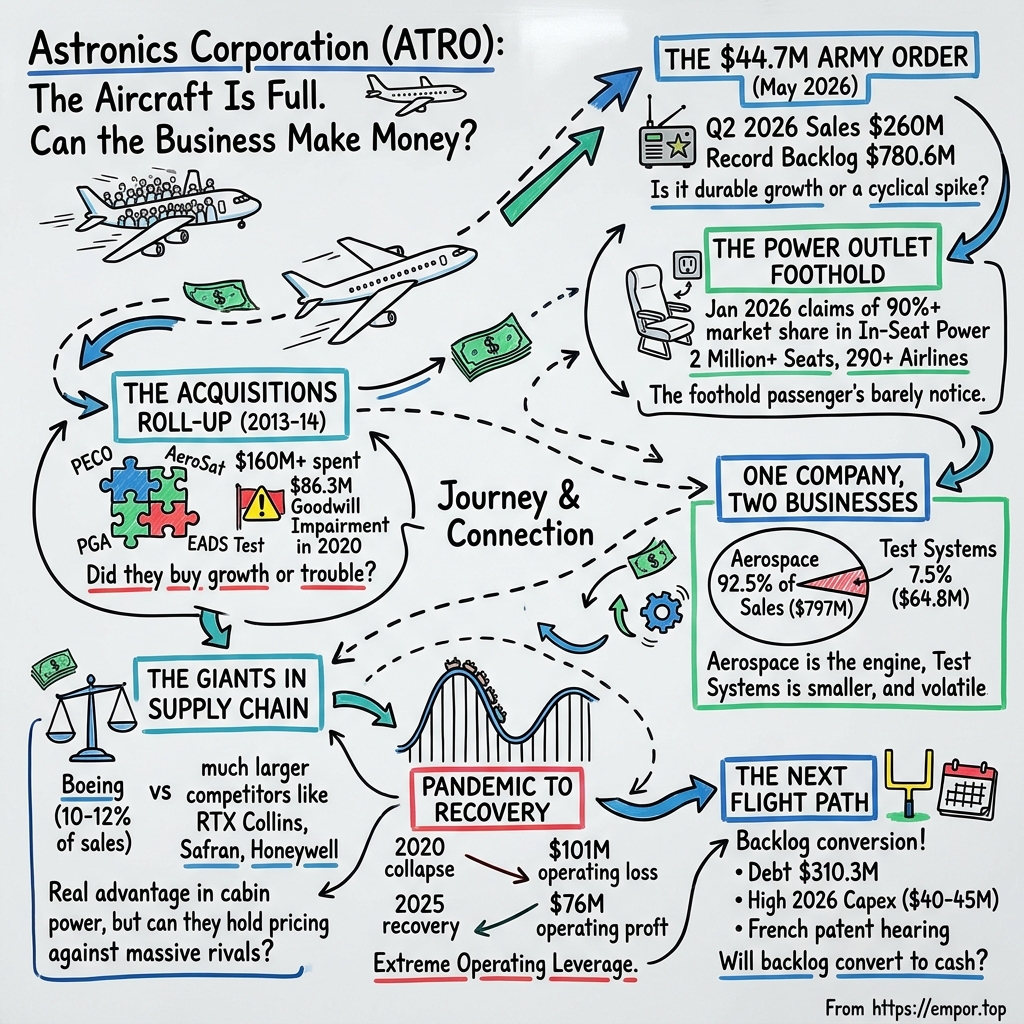
In May 2026, the U.S. Army ordered radio test sets. It was not a fighter jet or a missile. A radio test set is a rugged box that tells a soldier whether the radio in their hand will work before they depend on it. The order was worth $44.7 million, and it started full-rate production of a program Astronics had been working toward for years.1 Most investors would not notice a contract that size. At Astronics, a company with about $2.3 billion of market value, it mattered because of what came next.2
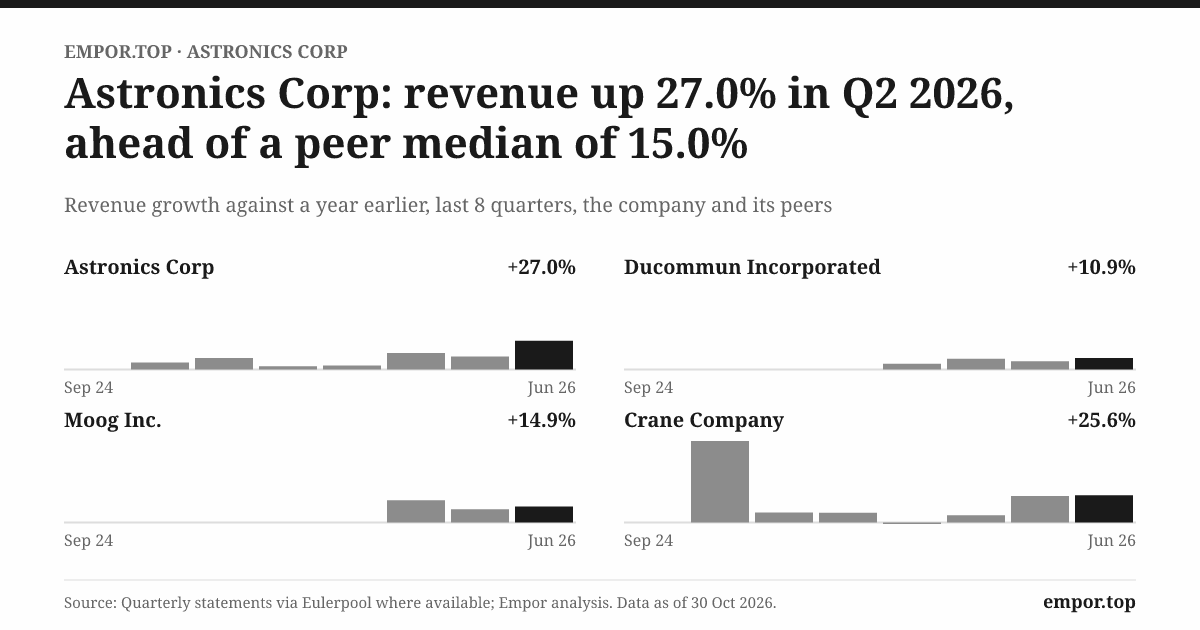
The next quarter brought record sales, record operating income and record backlog all at once. Sales in the three months to early July 2026 reached about $260 million, up 27% on the year before. Operating margin came in at 15.6%. Backlog, the orders customers had signed and Astronics had not yet delivered, reached $780.6 million.1 On the August call, CEO Peter Gundermann raised full-year revenue guidance to between $1.02 billion and $1.04 billion.3 Five years earlier, the company was not sure it could stay out of the red. Now it is guiding to its first billion-dollar year.
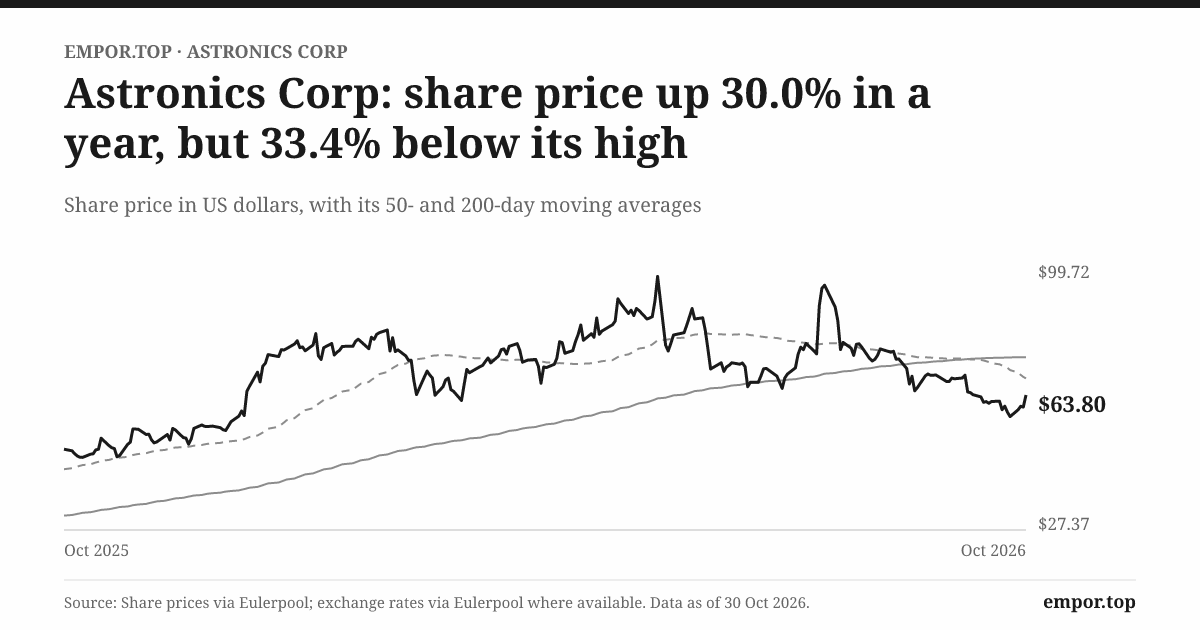
The market's reaction has been mixed. On October 30, 2026, the shares traded at $63.80. That was well above the 52-week low of about $47, but roughly a third below the high of about $96 reached earlier in the year.2 Over the past year, the stock's volatility has been close to 58%, and at one point in the past five years it lost almost half its value.2 Investors who own the stock have lived through big swings and want to know whether this one ends differently.
For a listener who has never heard of it, Astronics is a mid-size American manufacturer based in East Aurora, near Buffalo, New York, with about 2,700 employees at the end of 2025.4 It does not build aircraft. It builds the parts inside them that airlines, aircraft makers and militaries specify and then forget about: power converters, lights, antennas, seat actuators and the test machines that check other people's electronics. That position, deep inside other companies' products, explains both why the business can be hard to dislodge and why its fortunes swing with decisions it does not make.
The worry has history behind it. Over the decade to 2025, revenue grew only about 2% a year, from roughly $692 million to $862 million.4 Over the last three of those years, it grew about 17% a year. Recent growth is therefore far faster than the company's long-run trend, and most of it came from rebuilding what the pandemic destroyed. From 2020 to 2023, Astronics lost money at the operating line every year. It reported net losses every year from 2020 through 2024.4 Its first meaningful net profit since the downturn, about $29 million, came in 2025.4 If you had looked at the company in 2022, you would have seen a sprawling aerospace supplier burning cash. By mid-2026, it looked like a well-run one.
So which is it? This story turns on three questions. The first is whether aerospace demand can hold margins at levels Astronics has not sustained since the mid-2010s. The second is whether a supplier this size has a defensible position against Collins Aerospace, Safran, Honeywell and others many times larger. The third is whether management can turn a record order book into cash without stretching a balance sheet that now carries more than $300 million of debt.5
One number needs fixing before the valuation can be discussed. The popular price-to-earnings multiple for Astronics, about 80 times, divides today's price by full-year 2025 diluted earnings of $0.76 a share. That year included a roughly break-even June quarter and a loss in the September quarter.4 Sum the last four reported quarters instead and diluted earnings come to about $1.78 a share, which puts the multiple at roughly 36 times.54 Both numbers are accurate. They answer different questions. The 80x figure describes a company that was still emerging from losses. The 36x figure describes one that has already emerged, and it assumes the recent quarters will keep coming. Most of what follows tests which description is right.
The rebound is real. It has not yet proved durable. Durability depends on something that is easy to say and hard to do: new orders have to become profitable shipments, and those shipments have to become cash. To see why that is harder for Astronics than for most suppliers, start with the product passengers use and rarely think about.
 Subscribe on LinkedIn
II. The Power Outlet That Put Astronics on the Aircraft
Picture a seat in economy on a long-haul flight. Under the armrest or in the seatback there is a small socket. A passenger plugs in a laptop, the battery icon turns green, and nobody thinks about it again. Getting that socket onto the aircraft took a power converter certified not to overheat, interfere with avionics or start a fire 35,000 feet up. It took wiring that has to survive years of vibration and spilled coffee. And it took an engineer who can explain to a regulator why every one of those things is true.
Astronics bought its way into that problem in February 2005. It paid $13 million in cash, plus up to $4 million more depending on 2005 revenue, for the Airborne Electronic Systems unit of a General Dynamics subsidiary. The unit was based in Redmond, Washington, and sold cabin power under the EmPower name. Astronics renamed it Astronics Advanced Electronic Systems, or AES.6 That deal is the hinge of the modern company. Astronics had long been a small electronics maker in western New York, with aircraft lighting among its products. AES gave it a product that went into seats by the thousand, at airlines all over the world.
Two decades later the installed base is large. In January 2026 the company told investors its in-seat power systems served more than 2 million seats across more than 290 airlines, and it claimed more than 90% share of that product category.7 Around the outlet it built a wider set of businesses: aircraft electrical power and motion, exterior and cabin lighting, safety systems, antennas and connectivity hardware, structures, and certification services that help airlines modify aircraft.4 The common thread is unglamorous, mission-critical hardware that must be approved before it flies.
That approval is the core of the business case. Aircraft equipment is not like a phone charger you can swap at the airport kiosk. Every product installed on a commercial aircraft has to be certified for that specific aircraft type and installation. When an airline retrofits a fleet with seat power, the approval covers that design in that cabin. Replacing it with a competitor's unit means new engineering, new paperwork and new downtime, and the aircraft earns nothing while it sits in the hangar. The incumbent supplier also knows things the challenger does not: how its units behave in a particular airline's cabin, which failures show up after five years, and what a maintenance base needs on its shelves. Supplying aircraft is a bit like being a building's original electrician. Once the wiring is in the walls, the next renovation tends to call the same firm.
A 90% share and two million seats sound like a monopoly. The evidence for that is weaker than it looks. The share figure comes from the company's own investor presentation, and Astronics does not publish how it calculated it or how it has changed over time.7 It does not disclose a retention rate for airline customers, a realized pricing trend for power systems, or its share by aircraft program. And in its annual report it describes the competitive landscape with some candor: many of its competitors are substantially larger, have greater resources, and compete on price as well as performance.4 A real moat usually shows up as rising prices or rising margins over time. Astronics' consolidated margins have not done that. They peaked in 2015 and fell for years before recovering.4
The fair conclusion is that Astronics has a meaningful installed base in a category where qualification and reliability make replacement hard. That is a genuine product advantage. Whether the company can price it, and turn it into durable returns, remains unproven. The outlet put Astronics on the aircraft. What it did with that foothold next decided whether the company was building around a strong position or using it as a platform for acquisitions.
III. The Roll-Up That Changed the Mix
In the summer of 2013 Astronics went shopping. On July 18 it bought PECO, a maker of commercial aircraft interior components, based in the Pacific Northwest. On October 1 it took over the assets of AeroSat, which built fuselage- and tail-mounted antennas for aircraft that wanted satellite internet.8 In early 2014 it added PGA, a French maker of seat motion and cabin electronics, and on February 28, 2014 it bought the Test and Services division of EADS North America in Irvine, California, folding it into Astronics Test Systems.9 Across about seven months the company spent roughly $160 million on PECO, AeroSat and PGA, and about $69 million on the EADS test business.9
For a company that had reported roughly $340 million of revenue in 2013, this was a big change of direction.9 The strategy was easy to state. An airline buying a cabin upgrade buys power, lighting, seat actuation, connectivity and interior hardware together. A supplier that can offer more of that package, and certify it, becomes more useful to the airline and harder to replace. In 2014 the deals made the company look very smart. Revenue nearly doubled to about $661 million, and operating margin was about 13%. The next year revenue rose to about $692 million and margin to more than 14%, the best of the decade.4 For a moment Astronics looked like a small-cap aerospace compounder that had found its formula.
Then the deals started to show their seams, and they did not all fail the same way.
The test acquisition became a platform. It brought Astronics into military automated test systems, the business that would eventually win the Army radio order. It also brought a semiconductor test line that sold equipment to a single large customer. That line had a dramatic run. In 2018 Astronics agreed to sell the semiconductor test business to Advantest for $185 million. Then business conditions changed, and the deal was renegotiated. When it closed in February 2019, Astronics received $100 million in cash.10 Bought as part of a roughly $69 million package, sold for $100 million: on paper that is a reasonable result. But about $85 million of expected proceeds disappeared between signing and closing, because a business dependent on one customer's spending is worth what that customer's plans are worth on closing day. The lesson is about deal and exit assumptions. It does not show that every acquisition failed.
AeroSat is the harder case. It was a bet on satellite connectivity for aircraft. The technology worked, but the business model came under pressure as the satellite industry moved from large geostationary satellites to low-earth-orbit constellations. In 2020, as the pandemic emptied airport terminals, Astronics recorded $86.3 million of goodwill impairment, concentrated in Aerospace.11 Goodwill is the premium a buyer pays above the value of a target's identifiable assets. Writing it down is the accounting admission that the premium is not coming back. The pandemic triggered the timing, but the write-down was the market's verdict on acquired businesses that were not earning what was assumed when they were bought. The connectivity issue is still live. On the August 2026 call Gundermann described the geostationary antenna business as roughly a $60 million annual business and "under the weather," while he said he was optimistic that the transition to low-earth-orbit would more than offset the short-term pain.3
Not everything from the spree ended in a write-down. PECO's interior components and PGA's seat motion technology became part of the cabin portfolio Astronics sells today, and seat actuation is the very line BMA was later bought to extend.47 That matters for judging the strategy. The parts of the roll-up that sat closest to the original cabin power franchise, sold to the same airlines and seat makers through the same relationships, held up better than the bet on a fast-moving technology like satellite antennas.
Were the 2013 and 2014 deals cheap or expensive? The filings do not publish enough of the sellers' earnings to compute purchase multiples, so there is no clean answer. What the record does show is that a rapid roll-up produced a few years of excellent results, then a long stretch in which some of the acquired capabilities had to be restructured, written down or sold. That rejects any simple label of "disciplined acquirer." It does not say the strategy was wrong. It says some deals worked and others did not.
The recent deals are different in scale. In 2025 Astronics paid about $18 million for Bühler Motor Aviation, or BMA, a German seat-actuation business it expected to contribute $20 million to $25 million of revenue in 2026. It also paid about $8.3 million for Envoy, a certification-services firm with sales of around $8 million.47 That works out to about 0.7 to 0.9 times projected sales for BMA and roughly one times sales for Envoy. Those prices sound modest, but sales multiples say little without margins. On the August call Gundermann said BMA was going "pretty well" but conceded it was "not as profitable as the rest of our aerospace business."3 He also described further M&A as "incidental" rather than central.3
That is the test for the new deal strategy. The question is not whether the price looked low. It is whether an acquired product sells through Astronics' existing airline and manufacturer relationships, and whether it earns a return after integration. The 2013 roll-up passed the first test and failed the second for some assets. To judge the tuck-ins, start with where Astronics makes its money today.
IV. One Company, Two Very Different Businesses
On paper Astronics reports two segments of similar standing: Aerospace and Test Systems. In practice one carries the other. In 2025 Aerospace produced about $797 million of revenue, roughly 92.5% of the total, and about $113 million of segment operating profit, a margin of about 14%. Test Systems had $64.8 million of revenue and lost about $7.8 million.4 After corporate costs of roughly $29 million, consolidated operating profit was about $76 million.4 Without Aerospace there would be no profitable company.
Aerospace customers buy a collection of engineered products around the cabin-power franchise, from seat actuators and lighting to connectivity hardware and certification services.4 The common customer is the airline or aircraft manufacturer, each of which needs a supplier that can engineer to a specific aircraft and stand behind the part for years.
Commercial transport aircraft, the jets airlines fly, generated about $599 million of 2025 sales. Military aircraft added about $116 million, general aviation, mainly business jets, about $70 million, and other markets about $12 million.4 That mix tells you what really drives Astronics' earnings: the health of airlines, aircraft build rates at Boeing and Airbus, and passengers' appetite for power and connectivity on board. In the second quarter of 2026 the in-flight entertainment and connectivity line alone grew 19% to about $126 million, which management attributed to connectivity and passenger power products.3 When airlines spend on cabins, Astronics does well. When they stop, as in 2020, it does badly.
Test Systems is much smaller and much choppier. It builds automated test equipment and provides services for aerospace and defense customers, communications and mass transit. These are large machines that check whether radios, avionics or train systems work as specified.4 Its 2025 loss reflected weak volume and problems on long-duration transit contracts. Orders recovered in 2026, led by the Army program. But it is still a small segment trying to show it can earn money consistently, not a second engine of the same size as Aerospace.
Two newer contributors sit inside Aerospace. BMA was expected to add $20 million to $25 million of 2026 sales, and in the second quarter it contributed about $5.9 million of seat-motion revenue.37 The other is the MV-75, the Army's future long-range assault aircraft, built by Bell. Astronics supplies development work on it, followed a $57 million order in 2025 with a $27 million booking in the second quarter of 2026, and expects about $35 million of revenue from the program in 2026.3 Gundermann said it "will be a big deal in our future" and declined to elaborate.3 Both are useful additions. Neither is a hidden business waiting to be revalued. At a combined $55 million to $60 million of expected 2026 revenue, they are small beside an $800 million segment, and the MV-75 is development work whose production value depends on a government program schedule Astronics does not control.
One more detail in the segment numbers deserves attention. Corporate costs of nearly $30 million sit above both segments, which means the Aerospace margin overstates what shareholders actually keep: a 14% segment margin became a consolidated operating margin of about 9% in 2025.4 Every additional dollar of profit from Test Systems therefore matters twice. It helps cover that overhead and it removes the drag a loss-making segment puts on the whole. That arithmetic is why a small segment's order could move the consolidated numbers more than its revenue share suggests.
So the picture is clear. Astronics serves attractive markets: the global aircraft fleet is growing, airlines keep upgrading cabins, and defense budgets fund new rotorcraft. Attractive markets attract competitors, though, and a supplier earns good margins only if it has leverage over its customers. That is the real question about Astronics. It sells into one of the most consolidated, demanding supply chains in industry. The issue is how much of the value its products create it gets to keep.
V. The Supplier Inside a Much Bigger Supply Chain
Imagine the procurement team at a large airline planning a cabin refresh for a fleet of widebody jets. On the table are bids for seat power, cabin lighting, connectivity hardware and seat actuators. Several bidders are divisions of companies with revenue in the tens of billions: Collins Aerospace, part of RTX, Safran and Honeywell. Eaton competes in power distribution, Garmin in cockpit and cabin systems, and Korry Electronics in cockpit controls and lighting. Astronics is a fraction of their size. Safran alone reported revenue of more than €27 billion in 2024.12 Why would the airline pick the smaller company?
Whole-company size is not the right comparison. Aerospace supply looks concentrated from the outside, a handful of giant groups and two aircraft makers. Inside, it is a mosaic of small product markets: seat outlets, exit-path lighting, actuators for lie-flat seats, antenna radomes. Each has its own handful of qualified suppliers. Collins as a whole is vastly larger than Astronics, but the share that matters is the share of in-seat power or cabin lighting on a given aircraft, and it is in those narrow categories that a specialist can lead. Astronics competes as a focused engineering shop that moves faster on a specific problem than a large group's division does.
Where the moat is real
In-seat power is the best case for a moat: its installed base and aircraft-specific certification make replacement hard.7
That case is plausible, but it is not proved. As the earlier discussion showed, Astronics does not publish the product-level retention, pricing or share data needed to confirm the moat.47 The broader record also argues for caution. Aerospace operating margin collapsed into losses during the pandemic, and in the later recovery a third of deliveries ran on long-term contracts that management had to reprice after inflation, because the old prices no longer covered costs.3 A supplier with strong pricing power would not need to renegotiate contracts to restore its margin.
Who holds the bargaining power
The buyer side of the market weighs heavily. Boeing was Astronics' largest customer at about 10.4% of 2025 sales, up from around 10.2% in 2024, and about 12% of second-quarter 2026 sales.45 Boeing was the only customer at or above 10% of 2025 sales, so it matters without dominating. But Astronics does not disclose its top-five or top-ten customer concentration, so the claim that its customer base is broadly diversified cannot be checked either way.4 The general shape of the market is familiar. Aircraft manufacturers and large airlines are sophisticated, consolidated buyers that push suppliers hard on price, especially on long-term production contracts. Smaller customers bring a different risk. Two Aerospace customers went bankrupt in 2023 and 2024, and Astronics booked reserves for unpaid receivables, inventory and equipment, about $11 million for the larger 2023 case alone.4
The supplier side gets less attention but matters too. Astronics buys electronic components, metals and specialist parts from a supply base it does not describe in concentration terms.4 Tariffs have become a real cost: management put the ongoing tariff run rate at about $3 million to $4 million a quarter before mitigation, and recognized a $2 million refund in the second quarter of 2026.3 A company that can pass costs straight through to customers would not need to call out tariffs at all.
Defense works differently. Military programs reward qualification even more strongly than commercial ones. Once a test set or aircraft component is designed into a weapons system, the program may run for decades, and switching suppliers mid-program is costly and risky for the government. That makes defense relationships sticky. They are also contestable. Awards are competed, budgets change and programs are stretched, delayed or cancelled. Asked on the August call about funding for a related program, Gundermann said he knew nothing about its funding status that was not "generally known."3 A supplier to the government sells into a market where the customer sets the schedule.
Connectivity shows the limit: Gundermann said little could yet be said about Astronics' position in low-earth-orbit systems.3 This is what substitution looks like in aerospace. A supplier does not lose a qualified installation to a cheaper rival. It loses the next installation because the technology underneath changed. Qualification protects the incumbent product. It does not protect the incumbent when the product itself is replaced.
Weighing all of this, Astronics wins where responsive engineering and qualified products matter: specific aircraft installations where an airline wants a supplier that answers the phone, solves a problem quickly and stands behind the part. In-seat power is the clearest example. But the evidence does not show a broad scale or cost advantage over much larger competitors, and no published retention or pricing figure shows that the product advantage produces consistently superior returns. The moat is real at the level of a socket in a seat. It has not yet been shown at the level of the company. The pandemic was the clearest test of how much protection the company had when demand vanished.
VI. The Pandemic Exposed the Operating Leverage
In the spring of 2020 aircraft parked wingtip to wingtip in desert storage yards across the American southwest. Airlines stopped flying, stopped refurbishing cabins and stopped taking delivery of new aircraft. For a supplier whose biggest market was commercial transport, there was suddenly almost nothing to sell. Astronics' 2020 revenue fell about 35%, from roughly $772 million to about $502 million. Operating profit went from slightly positive to a loss of about $101 million, an operating margin of roughly negative 20%.411
Some of that loss was the goodwill impairment tied to acquired businesses. The rest was operating leverage. Astronics runs a fixed manufacturing base: factories, engineering teams, certification specialists and test equipment, all of which cost roughly the same whether the plants run full or half empty. When revenue falls, those costs do not fall with it, so a modest drop in sales produces a large drop in profit. The same mechanism works in reverse on the way up, which explains the speed of the 2025 and 2026 recovery. Operating leverage is not good or bad in itself. It means a company's profits move much more than its sales, in both directions.
The trouble had started before the pandemic. In 2019 Astronics had already sold the semiconductor test business at a reduced price. In March of that year Boeing's 737 MAX was grounded, and production was suspended in early 2020, which hit a program Astronics supplied.11 Operating margin in 2019 was close to zero even before the pandemic.4 Then 2020 compounded everything. A company that had earned 14% margins in 2015 had been sliding for four years before Covid arrived.
The long climb back
The recovery took far longer than the headline numbers suggest. Revenue bottomed in 2021 at about $444 million and then recovered strongly: about $534 million in 2022, $689 million in 2023 and $795 million in 2024.4 But Astronics kept losing money at the operating line through 2023 and reported a net loss through 2024.4 For three years its sales grew while it lost money. Why? Inflation hit labor and materials, and roughly a third of deliveries ran on long-term contracts priced before that inflation, so Astronics was locked into prices that no longer covered costs.3 Labor was the other problem. During the pandemic, employee turnover approached 20% a year, and headcount fell from about 3,000 to 2,200.3 Rehiring and retraining in an industry where much of the work requires certification is slow and expensive. New employees build fewer parts per hour than experienced ones and make more errors.
By 2025 the levers were working. Management lists five: higher volume, improving productivity, lower turnover, simplification and repricing.3 On the August 2026 call Gundermann said volume was "a major driver for higher margins." He said turnover was down to about half its pandemic peak, and that the company was "75% or 80% of the way through" repricing its long-term contracts, with about a quarter still to go over the next 12 to 18 months.3 Seven production sites had been closed or consolidated in recent years, and he added: "There's more to do."3 The results matched the story. Operating profit rose to about $76 million in 2025, an operating margin of about 9%, and segment operating margin in Aerospace was about 14%.4 In the second quarter of 2026 consolidated operating margin reached 15.6%.1
How much of this is permanent? The answer depends on which lever is doing the work. Repricing is the most durable, because a contract renegotiated to cover today's costs stays that way for its term. Simplification is durable too, since a closed factory does not reopen by itself. Productivity and lower turnover can be kept but can also be lost again; a hiring surge to meet backlog would bring back inexperienced workers. Volume is not structural at all. It is the cycle. The second-quarter margin also included help that will not repeat: a $2 million tariff refund contributed about 0.7 percentage points of margin, and comparisons benefited from the absence of prior-year simplification charges.3
The company's own recent history shows how quickly reported earnings can move with execution and mix rather than demand. In 2023 and 2024 there were the customer bankruptcies, and reserves for receivables, inventory and fixed assets.4 Lufthansa Technik's patent litigation brought a large charge and, in 2025, payments of about $21.6 million related to the UK case.4 In the second quarter of 2025, Test Systems booked $6.9 million of unfavorable revisions to the estimated cost of completing certain mass transit contracts, which also cut revenue by about $6.4 million.3 Quarterly operating margin moved from about 2% in mid-2025 to about 16% a year later.5 A business whose margin swings that much in four quarters has not yet shown a stable profit level.
Cash behaved in a way that surprises people who only look at the income statement. In 2020, the worst year, Astronics generated about $37 million of operating cash despite its large loss, because shrinking production released cash tied up in receivables and inventory, and because the goodwill impairment cost nothing in cash.4 Then, as recovery began, the cash ran the other way: operating cash flow was negative in 2021, 2022 and 2023, as the company rebuilt inventory and waited for customers to pay on rising sales.4 Only in 2024 did it turn positive again, reaching about $74 million in 2025.4 The pattern is the mirror image of operating leverage. In a downturn a manufacturer turns inventory into cash. In an upturn it turns cash back into inventory. A rising order book is therefore no guarantee of rising cash, a point that comes back when the order book reaches its record.
That is the key distinction. If Astronics' margins rise only because volume is rising, the next demand slowdown will push them back down, as in 2020. If repricing, simplification and productivity have permanently lowered the cost base, margins should hold up better in a downturn than they did last time. The evidence so far supports some of each. Nothing yet proves the improvement will survive a downturn, because there has not been one. In the meantime, the most visible test of execution has moved to the smaller segment, where the Army order now sits.
VII. The $44.7 Million Order Meets the Test Systems Record
A radio test set does something simple to describe and hard to build. A military radio is a complex device. It hops frequencies, encrypts traffic and has to keep working under jamming, heat, dust and shock. Before a unit goes into the field or comes back from repair, someone has to confirm that every one of those functions works to specification. Doing that by hand, function by function, would take an expert technician hours. An automated test set does it quickly and the same way every time, at a depot or near the front line. The TS-4549/T is the Army's version of that box, and the May 2026 order moved the program from development and low-rate work into full-rate production.13
For Astronics Test Systems this was the order it had been waiting for. The order covers deliveries over about 18 months. The work runs under an indefinite-delivery contract awarded in 2024, and Gundermann told investors he expects "similar orders annually for the next four to five years."3 Production was ramping through the second half of 2026, and he said that "as we exit the fourth quarter, we will be at full run rate production."3 The second quarter's orders show how much the program means to this small segment: bookings of about $63 million against sales of about $23 million, a book-to-bill of 2.78, and segment backlog of about $123 million.35 A book-to-bill above one means a segment is taking in orders faster than it ships them. The segment's backlog was nearly twice its 2025 revenue.
The contract structure is worth understanding, because it shapes how much of the promise is real. An indefinite-delivery, indefinite-quantity contract, known in Washington as an IDIQ, sets prices and terms for a product but does not oblige the government to buy any particular volume. The Army places task orders against it as budgets allow. So the 2024 contract was a hunting licence, and the May 2026 order was the first large animal. Astronics also has a parallel radio test program for the Marine Corps, which shares the same production ramp.3 Expectations of "similar orders annually" are management's reading of the Army's needs, not a contractual commitment.
Keep scale in view. Test Systems was 7.5% of Astronics' 2025 sales.4 Even if the radio program ramps perfectly and produces similar orders every year for five years, it will not displace Aerospace as the company's main source of value. What it can do is stop Test Systems from subtracting value. The segment lost money in 2025, money the aerospace business had to earn back before shareholders saw a dollar.4 Turning that into a modest profit would be worth something real, and it would also free management's attention.
Why the market waits to be convinced
The segment's record is the reason caution is warranted. The Army radio program took longer to reach full-rate production than the original contract structure implied. The indefinite-delivery contract was signed in 2024, but the first full-rate order arrived only in 2026.3 On mass transit, long-duration contracts to build test and service equipment for rail systems hurt the segment's results. In the second quarter of 2025, Astronics revised its estimates of the cost to complete certain transit contracts, which cost about $6.9 million and reduced revenue by about $6.4 million.3 Revenue on these contracts is recognized over time as work progresses, based on estimates of total cost. When those estimates turn out wrong, revenue and profit already booked have to be reversed. The revision was an admission that earlier estimates of how much work remained had been too optimistic.
The second quarter of 2026 also needs a careful read. Test Systems reported sales of about $22.7 million and operating profit of only about $0.6 million.3 Part of the reason was $4.1 million of revenue that carried no margin at all. It came mainly from raw materials Astronics bought for the Army and Marine Corps radio test programs. Under over-time revenue recognition, buying those materials counts as progress on the contract and therefore as revenue, but the margin is recognized later as the units are assembled and delivered.3 It is like a builder billing a client for bricks at cost and earning the profit when the wall goes up. The low margin is real, but it is mostly timing, and it does not yet show what the segment will earn.
Management's expectation is ambitious. Gundermann said that in full-rate production the test business's margin "should start to approach what we routinely get out of our aerospace business. Maybe not up at the 20% EBITDA level, but pretty close." He added that the company would have "a really good idea" of margins by the end of the fourth quarter or early in 2027.3 For a segment that lost money a year earlier, that is a large promise, and it comes from a team whose previous estimates on this segment's contracts, including the transit cost revisions, turned out too optimistic. Without a track record of hitting those estimates, the promise remains a hypothesis.
The award is a credible near-term catalyst for a small segment. It is not proof of a durable second growth engine. Three things will tell whether it becomes an economic win: units shipped at the planned production rate, segment margin as those units ship, and cash collected from the Army. Bookings alone show none of these. Whether the people who set those expectations deserve the benefit of the doubt is the next question, because the same leadership team has been running the company through every chapter so far.
VIII. The CEO's Long Bet—and the Balance Sheet It Leaves Behind
Peter Gundermann has run Astronics since 2003.13 That is more than two decades in the job. He was in charge when Astronics bought AES in 2005, during the 2013 and 2014 acquisition spree, through the margin peak of 2015, the semiconductor sale, the AeroSat write-down, the pandemic losses and now the recovery. He is also chairman.3 Most turnarounds come with a new CEO who can blame the predecessor. This one does not, which is in one sense more honest. Every chapter of the record, good and bad, belongs to the same leadership.
On calls Gundermann is plain-spoken and slightly understated. Asked in August what had surprised the company in the quarter, he said: "I do not know if there were any real surprises."3 He tends to give concrete answers on operating matters, such as the repricing percentage or the number of sites closed, and to stay vague on things he cannot control, such as government program funding.3 That pattern is useful to investors. The specifics can be checked, and the uncertainties are acknowledged rather than glossed over.
Where the money is going now
The capital plan has changed sharply. Capital expenditure was about $7.6 million in 2023 and $8.4 million in 2024, roughly 1% of sales, less than the depreciation of an asset-heavy manufacturer.414 In 2025 it jumped to about $31.7 million, and management guided to $40 million to $45 million for 2026.34 The money is going into facility expansion, capacity improvements in Seattle, home of the power business, and an ERP system, the enterprise software that runs order entry, inventory and accounting.43 Much of it is catch-up: growth and maintenance projects that were deferred during the pandemic, when cash was too scarce to spend on anything optional.4 A company that underinvested for four years is now paying for it.
Research and development moved the other way. R&D fell from about $53.7 million in 2023, nearly 8% of sales, to about $43.5 million in 2025, roughly 5%.4 Part of the change is arithmetic: sales grew faster than the engineering budget. But the dollar amount also fell. An aerospace supplier's long-term position depends on being designed into the next generation of aircraft and cabins, and that requires engineering spend years before the revenue arrives. Lower R&D raises current margins. Whether it also weakens future products is a question the company's disclosures do not answer, because Astronics does not show how much of its R&D is customer-funded or how much goes to new products versus sustaining existing ones. The combination of rising capex and falling R&D shows a company prioritizing capacity for the products it already sells over development of new ones. That fits a business with a record backlog. It is also a bet that today's products will sell for years to come.
The tuck-in acquisitions are small next to this. BMA and Envoy cost about $26 million combined.4 The prices look reasonable as multiples of sales, but no seller earnings figures or comparable transactions have been published that would show them to be bargains. The counterevidence is the company's own history. AeroSat showed that technical capability does not automatically become a profitable commercial business. Facilities were later closed and consolidated as the company simplified.3 The difference this time is size: a mistake on a $26 million purchase is survivable in a way the 2013 spree's problems were not.
Who controls the company
Governance matters at Astronics because of its two-class share structure. Common stock carries one vote per share. Class B stock carries ten votes per share and converts one-for-one into common stock.13 Gundermann owned about 2% of the common stock and about 19.8% of Class B as of April 2026, and directors and officers together held about 40.6% of Class B.13 Because each Class B share carries ten times the votes, Class B held the majority of votes on the 2026 proxy record date, even though it was a small fraction of the shares outstanding.13 Class B shares have been converting into common shares over time, shrinking the class from about 5.95 million shares in 2022 to about 3.97 million in 2025, and in June 2026 the company declared a 20% Class B stock distribution to replenish it.1315 Replenishing a high-vote class when it is naturally shrinking is a choice that preserves insider control. Shareholders should notice it.
The ownership creates real alignment, since the CEO has significant wealth tied up in the stock. It also gives insiders more control than their economic stake implies. Large institutions own much of the common stock. BlackRock held about 8.7%, Bares Capital Management about 6%, Capital International about 5.9%, State Street about 5.8% and American Century about 5.6%.13 They hold the economic risk but have limited power to change the board. The 2026 annual meeting showed both support and dissent. Say-on-pay passed easily, about 44.8 million votes for and 1.4 million against, but some directors received large numbers of withheld votes, including about 11.1 million for director Mark Moran.16 Gundermann's reported 2025 compensation rose to about $4.56 million from $2.92 million, but much of the increase was a pension-value remeasurement. Excluding pension changes, his pay was about $3.09 million, compared with $2.92 million a year earlier, a modest increase during the company's first profitable year in five.13 The proxy also discloses that a director had pledged 120,000 Class B shares as collateral for an undrawn bank line, and that the company has no formal written policy for reviewing related-person transactions, although none were reported for 2025.13
The most important thing on the balance sheet is debt. At the end of the second quarter of 2026 long-term debt stood at about $310.3 million, after a reduction of about $24 million in the first half.5 The debt is a mix of convertible notes and a revolving credit line. In December 2024 Astronics issued $165 million of 5.5% convertible notes due 2030. In September 2025 it issued $225 million of zero-coupon convertible notes due 2031 and used part of the proceeds to repurchase about $132 million of the 2030 notes.4 The 2031 notes convert into common stock at an initial price of about $54.87 per share, and the company bought capped calls to reduce dilution above that price up to a cap.4 With the shares above $60, conversion is a real possibility. That is why diluted share counts and earnings per share differ so much from basic figures at Astronics. Convertible debt is cheap money when the stock rises, but it is paid for in shares.
The refinancing also explains two oddities in the headline figures. In the September 2025 quarter, Astronics earned about $23 million of operating profit yet reported a pretax loss of about $12 million, because the costs of that quarter landed below the operating line, in the same period the company retired most of its 2030 notes.4 And shareholders' equity fell from about $256 million at the end of 2024 to about $140 million at the end of 2025, even though the company earned a profit that year.4 A smaller equity base makes ratios built on it look extreme: a price-to-book multiple near 15 times and a return on equity around 21% say more about the convertible accounting than about the business. Return on invested capital, about 14% in 2025, is the more honest measure, and it was the best since 2015.4
Credit is not under pressure, yet. A $300 million senior secured revolver due October 2030 had about $60 million drawn and about $238 million available at the end of the second quarter, giving total liquidity of about $253 million.53 Its covenants cap total net leverage at 4.5 times earnings and require interest coverage of at least 3.5 times; the company was in compliance at the end of 2025.4 Equity investors should also know that the company did not pay a dividend, issued about $21 million of new stock through an at-the-market program in 2023 when cash was tight, and last bought back stock in 2020.4 Management itself warns that a significant earnings decline could affect covenant compliance and access to financing.4 Today's headroom depends on today's earnings.
The final competing claim on capital is legal. Lufthansa Technik has been suing Astronics' AES subsidiary over an in-seat power patent since 2010, in Germany, the UK and France.4 Astronics paid about $21.6 million related to the UK case in 2025 and recorded about $11.6 million plus interest as its probable exposure at year-end.4 In July 2026 the UK Court of Appeal partly reversed the original ruling in Astronics' favor, and the company said about $2.2 million including interest should be repaid, subject to court order.175 A further appeal to the UK Supreme Court is uncertain, and Gundermann said the U.S. matter "is closed and final."3 The French appeal of the patent's invalidation was set for a hearing on October 28, 2026, with no ruling expected before early 2027.5 It is a patent case over the very product that put Astronics on the aircraft, which is a reminder that the installed base has carried a legal cost alongside its commercial value.
Taken together, the team has narrowed the portfolio, faced up to weak businesses and repriced contracts that were losing money. That is real progress. But the record also includes revised production dates, revised contract cost estimates and impairment losses, and the same people made all those calls. The right stance toward their claims is earned confidence. Judge each new promise against shipped revenue and returns, not against how confidently it was made. The market already prices in a lot of trust, as the valuation shows.
IX. Analysis & Bear vs. Bull Case
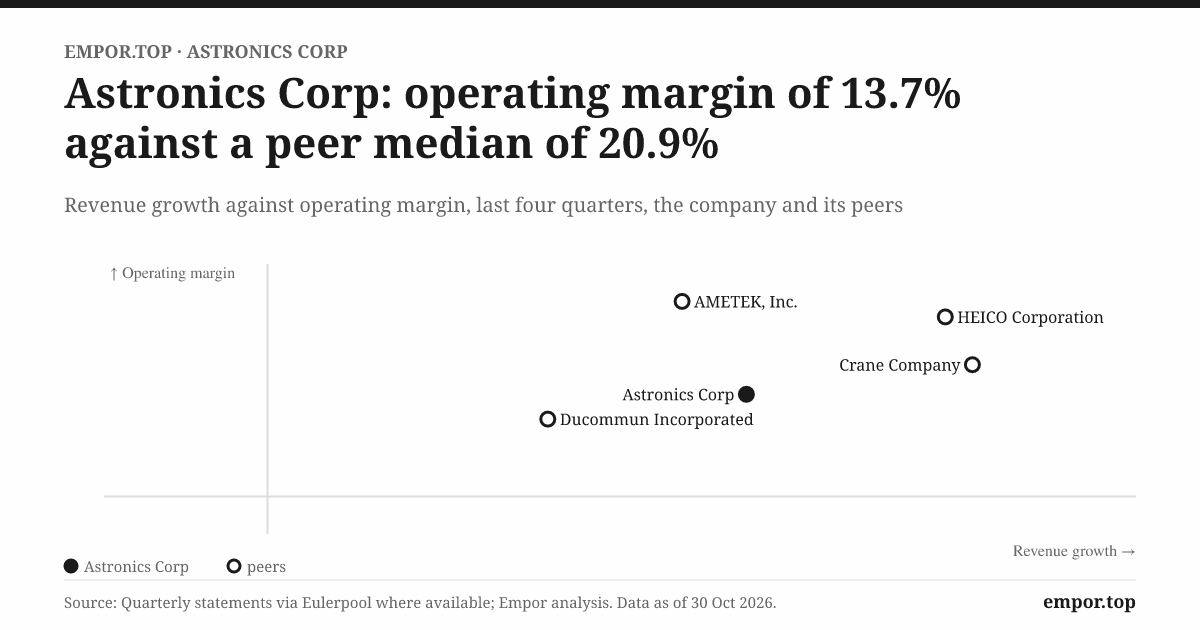
Here is what a buyer at $63.80 is paying for. The market values Astronics' equity at about $2.3 billion. Add net debt and the enterprise value is about $2.7 billion.25 Against 2025 revenue of about $862 million, that is about 2.7 times sales.4 Against 2025 operating profit of about $76 million, the enterprise value is about 35 times, and against 2025 EBITDA about 40 times.4 Those multiples are what a market pays for a high-growth software company, not a cyclical aircraft-parts supplier. But they look back at a year that was itself only a partial recovery.
Look forward a little and the numbers change dramatically. Over the four reported quarters to mid-2026, operating profit was about $129 million and revenue about $940 million.54 On that basis the enterprise value is about 21 times trailing operating profit, while the trailing diluted earnings multiple is about 36 times. If management delivers 2026 revenue of $1.02 billion to $1.04 billion at mid-teens margins, operating profit would be well above trailing levels.3 The current price is, in other words, a bet that the margins of the past few quarters are the new normal, not a peak. It assumes the recovery has already happened, and then a bit more.
How does that compare with peers? There is no clean, same-date comparison. An April 2026 peer snapshot had Astronics at about 16.7 times EV/EBITDA, close to Ducommun, another mid-size aerospace components supplier, at 16.0 times.18 That snapshot used a different date, price and earnings base from the October figures, and it is useful only as a rough reference point. Astronics also lacks a long, stable earnings record to compare with its own history, because five of the last six years were loss years. So the valuation cannot be anchored to a "normal" historical multiple. The market is pricing a company it has not seen before.
The bull case
The optimists' argument is straightforward. Backlog is at a record and grew faster than sales, with a book-to-bill of about 1.18 in the second quarter.1 Commercial transport demand is strong: the global fleet needs new aircraft, Boeing and Airbus are raising production rates, and airlines keep spending on cabin power and connectivity, as the 19% growth in that line showed.3 The cost base is leaner after seven site closures, contract repricing is about three-quarters done, and turnover has halved.3 Military programs add new layers: the Army radio test program and MV-75 development work could grow into long-running production revenue.3 Management also points to a potential $40 million to $50 million valuation allowance release, essentially the recognition of tax assets from past losses as future profits make them usable.3 In the bull's view, Astronics is now an engineering-led specialist with a qualified installed base, a cleaner portfolio and operating leverage working in its favor.
The bear case
The skeptics do not need the recovery to fail. They only need normalized earnings to fall short of what the price assumes. Their starting point is the decade: revenue growth of about 2% a year over ten years and a profit history that has repeatedly collapsed, in 2017, 2019 and again from 2020 to 2024.4 The current margin is the best in a decade, and it is being valued as permanent. Customer and program timing, contract estimates and working capital have each surprised investors in the past few years. Debt is above $300 million, convertible notes could dilute shareholders, and the Lufthansa case is still open in France.54
The sharpest point a skeptical investor would make concerns cash. In the first half of 2026, receivables and inventory together absorbed about $52.5 million.5 Growth consumed cash because Astronics has to buy materials, build products and wait for customers to pay, and in a growing business that gap widens. The cash conversion cycle, the number of days between paying for materials and collecting from customers, was about 181 days in 2025, up from about 113 in 2014.4 Astronics' business ties up cash for about six months between paying suppliers and getting paid, which is longer than it used to be. Free cash flow was about $43 million in 2025, a free cash yield of about 1.9% at today's price.42 The bear question is whether the market is valuing adjusted margins and backlog as permanent when the company has not yet shown sustained through-cycle returns or reliable conversion of backlog into free cash.
A skeptical activist would sharpen the bear case into three challenges. The first is governance: why replenish a ten-vote share class through a stock distribution while funding growth with convertibles that could dilute public investors?15 The second is reinvestment: is the company investing enough in the next generation of cabins and connectivity hardware, which is being designed now? The third is portfolio: why keep the test segment before it proves its value in production? Management has answers to each, the Army program chief among them. But these are the questions on which future credibility will be judged.
The risks that matter are specific to how this business makes money. Aircraft production rates set the pace of line-fit demand, and Boeing in particular has spent years under production limits and quality scrutiny. A renewed slowdown would hit Astronics directly through its largest customer.4 Input costs and tariffs can outrun contract prices again, as they did after the pandemic.3 Technology shifts in connectivity can strand products. And because so much of the revenue comes from government programs and long contracts, schedule slips and estimate revisions can move profits even when demand is healthy.
Porter's five forces and Hamilton Helmer's seven powers help organize the evidence. On rivalry, Astronics competes against much larger groups in narrow product categories where specialists can lead, so competition is real but contained to product niches. Buyer power is the strongest force against it. Aircraft manufacturers and airlines are concentrated, sophisticated customers, and Boeing alone is 10% to 12% of sales.45 Supplier power is moderate. Tariffs and inflation have shown that input costs can move faster than prices, which is why long-term contracts needed repricing.3 The threat of new entrants is low because certification is expensive and slow. The threat of substitutes is moderate. In connectivity, technology shifts like the move to low-earth-orbit satellites can change which hardware airlines need, as the weakness in the geostationary antenna business shows.3
Of Helmer's seven powers, two may apply. Switching costs are the most plausible: certified installations, airline maintenance practices and spare-parts inventories make replacing an incumbent costly. Cornered resource, in the form of certifications and a deep library of approved installations, is a weaker version of the same idea. Scale economies do not apply, since Astronics is a fraction of the size of Collins, Safran or Honeywell. There is no evidence of network effects or brand power, and no counter-positioning against rivals. Process power, the ability to make things in a way competitors cannot copy, is not evident either: the company's productivity has improved, but from a weak base.
The moat remains narrow.
Three indicators will tell investors more than anything else. The first is Aerospace segment margin, about 14% for 2025 and higher in 2026, which shows whether repricing and productivity are holding as volume grows.4 The second is book-to-bill and backlog conversion. Book-to-bill was about 1.18 in the second quarter, with backlog at a record $780.6 million.1 The question is whether that backlog turns into revenue on schedule. The third is operating cash flow relative to net income, receivables and inventory. Cash flow lagged profit in the first half of 2026.5
On balance, Astronics is a stronger operating company than the one that emerged from the pandemic trough: leaner, better priced and with a much fuller order book. It is not yet a demonstrated through-cycle compounder, and at this valuation it has little room for another execution or utilization setback. The history offers lessons that apply well beyond this company.
X. Playbook: Business & Investing Lessons
Put two moments side by side. The 2019 semiconductor test sale closed below its signed price, while the 2026 Army order carried management's expectation of annual repeats.1013 The two look unrelated. One was an exit and the other a win. Both show the same thing: in this business, what a company expects and what it actually receives can be far apart, and the gap is where investors make or lose money.
The first lesson is about the outlet in the seat. "A qualification opens the door; repeat profitable orders prove the room is yours." Astronics' seat-power franchise shows it has passed the hardest engineering and regulatory tests in its category.7 But a certificate does not set a price. The return it earns from that position remains unproven. Founders building in regulated hardware should know that qualification is the entry ticket, not the prize. Investors should look past the certificate to the repeat order and the margin on it.
The second lesson is about the order book. "Backlog is a promise with a working-capital bill attached." Astronics' record backlog sounds like money in the bank. But to fill it, the company must first buy materials, pay workers and build inventory, and growth absorbed cash in the first half of 2026.5 Revenue arrives before profit, and profit before cash. A growing backlog in a business with a long cash cycle is a claim on future cash as much as a source of it.
The third lesson is about deals. "An acquisition price is only the first number in the deal." The 2013 and 2014 acquisitions looked brilliant for two years. Then AeroSat's goodwill was written down, and the semiconductor test sale closed below its signed price.1110 The recent tuck-ins look cheap on sales multiples. Their real cost will show up in integration, margins and the attention they absorb, and BMA was less profitable than the rest of Aerospace, the company said.3 For acquirers, the price paid is the most visible number and often the least important one.
The fourth lesson is the one that matters most for the investment case. "A recovery is not a moat until it survives the next slowdown." Astronics' pandemic collapse and 2026 margin recovery measure the same company with the same factories and the same CEO.41 The difference was demand. Margins that rose with volume can fall with it. Only a downturn will show how much of the improvement belongs to management rather than the cycle. For founders, the wider point is that a fixed-cost business tells two stories about the same decisions, one on the way up and one on the way down, and good managers plan for the second while they are telling the first. For investors, the honest margin to underwrite is the one a company earns across a whole cycle, not at the top of one.
XI. Epilogue
On the evening of October 30, 2026, Astronics stands at its busiest point in years. The backlog is a record $780.6 million.1 The factories are running hard, the Seattle expansion is underway and capex is guided to $40 million to $45 million for the year.3 Long-term debt was about $310 million at mid-year.5 In France, a hearing on the latest chapter of a patent case that began in 2010 was set for October 28, with no ruling expected before early 2027.5 The next public moment comes on November 10, when Astronics reports its third-quarter results and management faces analysts again.19
Several outcomes over the next two to four quarters will decide the story. The first is Aerospace margin once one-offs drop out. The $2 million tariff refund will not repeat, and comparisons will no longer benefit from last year's simplification charges.3 If Aerospace margins stay in the mid-teens without those aids, the repricing and productivity story is confirmed. If they fall back toward 2025 levels, the bull case shrinks to a volume story. Management guided third-quarter sales to between $265 million and $275 million, with modest improvement in the fourth quarter.3 Hitting that range without margin slippage would be the first clean test.
The second is the Army ramp. Management said Test Systems would exit 2026 at full production rate, with a clear view of margins by early 2027.3 If the segment ships at that pace and shows margins approaching Aerospace's, it becomes a genuine contributor and a credibility win for management. If shipments slip or margins stay thin, it reinforces a long record of optimistic estimates in that segment.
The third is cash. Management said it expected to be free cash flow positive for the rest of 2026.3 Investors should compare operating cash flow with net income each quarter and follow receivables, unbilled costs and inventory. Sales that rise while cash lags would weaken the recovery story more than any single margin miss.
The fourth is the balance sheet: capex, debt and covenant headroom considered together. Heavy capex while debt falls would show that the business is generating real cash. Debt that rises to fund capex and working capital would be a warning sign.
The fifth is the courtroom. The French decision will come next year, and Germany is "in the background," in Gundermann's words.53 A favorable outcome would mostly close a long-running distraction. An unfavorable one could bring another charge tied to the very product that defines the company.
There is also a quieter accounting moment to watch. Years of losses left Astronics with tax assets it has not been allowed to count, because accountants require evidence that future profits will use them. Management has said that a release of $40 million to $50 million of that valuation allowance depends on future taxable income.3 If it happens, reported earnings will jump for one quarter. It would be a signal that the auditors are comfortable the profits will last, not a change in the cash the business produces, and investors should treat it that way.
The unresolved question is the one this story started with. Has Astronics rebuilt a business that earns through the cycle, or has it simply reached the most favorable point in one? Nobody can know yet. The answer will come from the quarters ahead, not from the backlog.
XII. Outro
Go back to the seat. Somewhere over the Atlantic tonight, a passenger plugs a laptop into the outlet under the armrest. The battery icon turns green. They will never think about the converter behind the panel, the certification files that approved it, the Redmond engineers who designed it, or the court cases fought over it. The only thing that matters to them is that it works, flight after flight.
Astronics is built on that kind of invisible reliability, a specialist hidden inside a much larger industry, hard to replace in the specific places it has earned its way in. The same quiet dependability that makes the outlet forgettable to a passenger makes Astronics easy for markets to misjudge, ignored when aircraft sit idle and celebrated when they fly full. The question investors have to answer is whether that position produces durable, cash-backed returns or just a good year in a good cycle. On an aircraft, reliability is invisible—until the economics have to show up.
References
-
Astronics Corporation Reports Record Operating Income on Record Sales — Astronics Corporation, 2026-08-11 ↩↩↩↩↩↩↩↩↩
-
Q2 2026 Earnings Call Transcript — StockAnalysis, 2026-08-11 ↩↩↩↩↩↩↩↩↩↩↩↩↩↩↩↩↩↩↩↩↩↩↩↩↩↩↩↩↩↩↩↩↩↩↩↩↩↩↩↩↩↩↩↩↩↩↩↩↩↩↩↩↩↩
-
2025 Form 10-K — Astronics Corporation, 2026-02-26 ↩↩↩↩↩↩↩↩↩↩↩↩↩↩↩↩↩↩↩↩↩↩↩↩↩↩↩↩↩↩↩↩↩↩↩↩↩↩↩↩↩↩↩↩↩↩↩↩↩↩↩↩↩↩↩↩↩↩↩↩↩↩
-
Q2 2026 Form 10-Q — Astronics Corporation, 2026-08-12 ↩↩↩↩↩↩↩↩↩↩↩↩↩↩↩↩↩↩↩
-
Astronics Completes Acquisition of Airborne Electronic Systems — Astronics Corporation / SEC, 2005-02 ↩
-
2026 Investor Presentation — Astronics Corporation, 2026-01-14 ↩↩↩↩↩↩↩↩
-
Astronics Completes Sale of Semiconductor Test Technology — Astronics Corporation / SEC, 2019-02-14 ↩↩↩
-
2026 Definitive Proxy Statement — Astronics Corporation, 2026-04-17 ↩↩↩↩↩↩↩↩
-
Astronics Announces 20% Class B Stock Distribution — Astronics Corporation / SEC, 2026-06-01 ↩↩
-
2026 Annual Meeting Voting Results — Astronics Corporation, 2026-05-28 ↩
-
Lufthansa Technik AG v Astronics Advanced Electronic Systems — UK Court of Appeal, 2026-07-27 ↩
-
Aerospace and Defense Peer Snapshot — Intro-act / FactSet, 2026-05-19 ↩
 LinkedIn
 WhatsApp
 Reddit
 Hacker News
 Email
 Kindle
 RSS Feed
 Spotify
 Apple Podcasts
 Amazon Music
 Audible
 YouTube