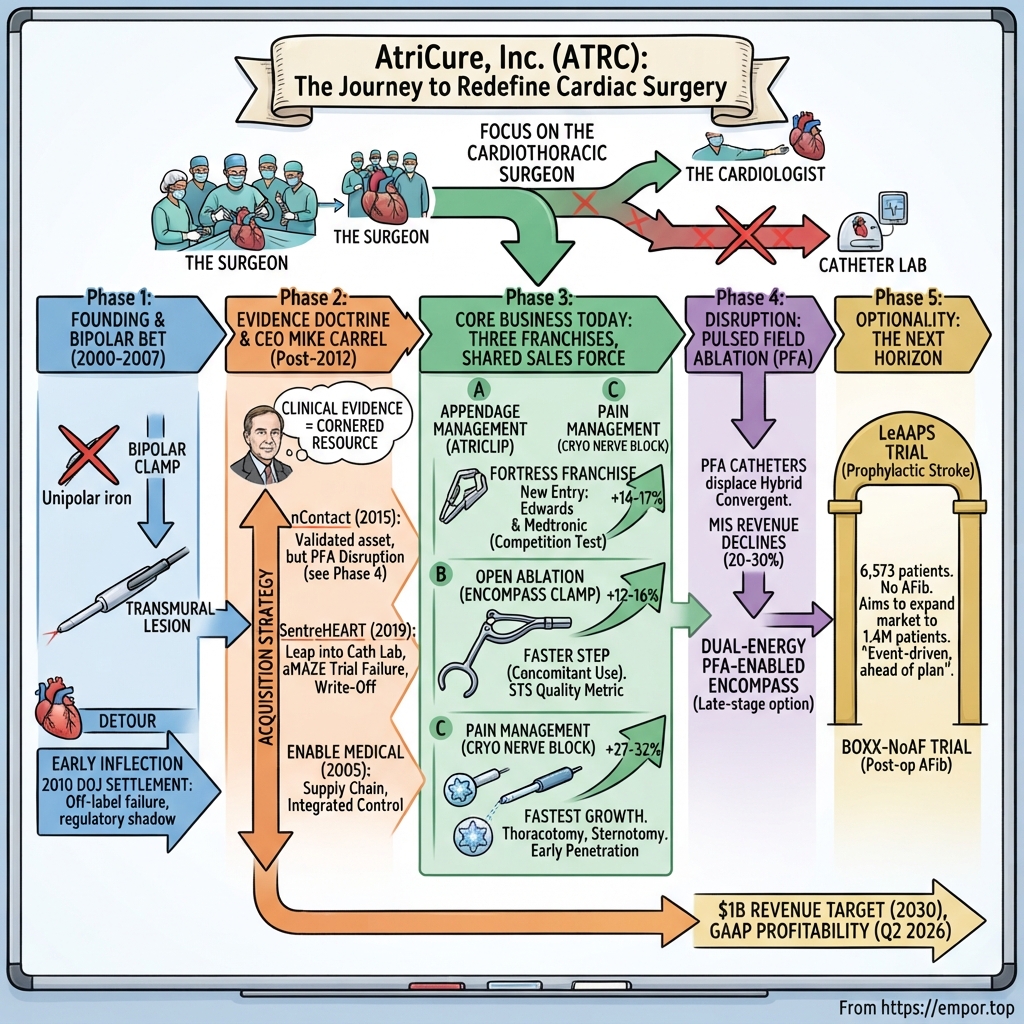
AtriCure, Inc.: The Company That Bet on the Surgeon When Everyone Else Bet on the Cardiologist
I. Cold Open & Hook (~5 min)
The patient on the table
It is seven in the morning in a cardiac operating room somewhere in the American Midwest. A 71-year-old man is on the table for a mitral valve repair. His chest is open, his heart is stopped, and a heart-lung machine is doing the work his body cannot. His chart carries a second diagnosis unrelated to why he is here: atrial fibrillation, the irregular heartbeat that raises his stroke risk several times over.
For most of cardiac surgery's history, the surgeon would repair the valve, close the chest, and leave the AFib alone. It was someone else's problem — a cardiologist's, a pill's, or a future stroke's. The surgeon had direct access to the exact tissue that drives the arrhythmia and to the small pouch where most AFib-related clots form. What the surgeon lacked was a quick, reliable, defensible way to treat either without adding meaningful time and risk to an already long operation.
AtriCure built its business around that gap. First it handed surgeons a clamp that burns a precise line of scar tissue to block stray electrical signals. Then it added a clip that seals off the left atrial appendage from the outside of the heart. More recently it introduced a cryogenic probe that deadens the chest-wall nerves so patients wake up needing far fewer opioids. All three interventions happen in the same room, on the same patient, during the same operation.
A niche inside a war zone
Here is the tension that makes AtriCure worth extended examination. Atrial fibrillation is one of the most contested markets in medical devices. Medtronic, Boston Scientific, Johnson & Johnson, and Abbott have spent billions competing over the catheter lab, where electrophysiologists thread wires through a leg vein to treat AFib from inside the heart. Yet a company based in Mason, Ohio, outside Cincinnati, generated $534.5 million in revenue in 2025 — up 14.9% year over year — from a corner of that market the giants largely overlooked1. In the second quarter of 2026 it posted quarterly revenue of $153.6 million, a gross margin of 77.2%, and GAAP net income of $9.0 million2. That last figure is notable by AtriCure's own standards: the company's balance sheet still carries an accumulated deficit of $413.2 million1.
The straightforward reading is that a smaller company chose the right battlefield. The fuller picture is more complicated. AtriCure's record includes a federal fraud settlement, a $300 million acquisition whose clinical thesis failed, a short-seller attack that proved partially well-founded, and a technology shift — pulsed field ablation — that stripped nearly a third of the revenue from one product line in a single year1. Management argues that its surgical franchises are protected by product innovation, clinical evidence, and a specialized field force. That argument is now under its first serious competitive test: Edwards Lifesciences and Medtronic have both entered the appendage-clip market, moves that management has publicly characterized as validation that the segment is large enough to defend3.
The roadmap
This story follows five arcs. It begins with the disease itself and why the operating room remained an underserved setting for so long. It then covers the company's founding and an early compliance failure, the arrival of CEO Mike Carrel and his emphasis on clinical evidence, and the acquisitions that worked alongside the one that did not. The center of the piece examines the three-franchise business as it stands today and how the company absorbed the pulsed-field disruption. It closes with the clinical trials — LeAAPS above all — that could expand a surgical niche into something substantially larger, or confirm that the niche was always the ceiling.
Throughout, the claims that form the investment case — the competitive moat, management's capital allocation, and the optionality embedded in ongoing trials — are weighed against the company's own disclosed record. The starting point is the disease, because AtriCure's opportunity and its limits are both written into the anatomy of the heart.
 Subscribe on LinkedIn
II. The Disease: Why AFib Is Both a Massive Opportunity and a Graveyard for Medtech (~8 min)
A heart that quivers instead of beats
Think of the heart's upper chambers — the atria — as a well-drilled rowing crew. A single coxswain, a cluster of cells called the sinus node, calls the stroke, and every muscle fiber pulls in unison. In atrial fibrillation, the crew mutinies. Hundreds of rogue electrical signals, many firing from the sleeves of tissue where the pulmonary veins join the left atrium, shout conflicting orders. The atria stop contracting and start to quiver.
Two consequences follow. The first is symptomatic: palpitations, breathlessness, fatigue, and, over years, a heart that weakens and eventually fails. The second is quieter and deadlier. Blood that is not squeezed forward pools and clots. The likeliest site for pooling is a small, windsock-shaped pouch hanging off the left atrium called the left atrial appendage, or LAA. When a clot breaks free from there, it tends to travel directly to the brain. AtriCure's own filings estimate that AFib accounts for roughly 15% to 20% of all strokes1.
Two worlds, two tribes
AFib treatment has divided into two professional tribes, and that split explains nearly everything about AtriCure's positioning.
The first tribe is electrophysiologists — cardiologists who work in the catheter lab. They treat AFib from inside the heart, threading a catheter up through the groin and burning or freezing rings of tissue around the pulmonary veins. That procedure, pulmonary vein isolation, is the standard interventional therapy for patients whose primary diagnosis is AFib and who have no other reason for surgery. It is also where Medtronic, Boston Scientific, Johnson & Johnson, and Abbott have concentrated their capital, their sales forces, and their clinical programs.
The second tribe is cardiothoracic surgeons, who encounter AFib incidentally — already inside a chest opened for a valve repair or bypass. For them, treating AFib is a concomitant step, an add-on to an operation that was happening regardless. AtriCure built itself almost entirely around this second tribe.
The two groups see the same patient differently. An electrophysiologist is managing a primary arrhythmia in someone who is otherwise ambulatory. A surgeon is treating a secondary diagnosis in a patient already under general anesthesia, where the incremental cost of addressing the AFib is measured in minutes rather than a separate procedure. That difference in economics is the niche AtriCure has occupied.
The Class I paradox
The 2023 clinical practice guidelines from the Society of Thoracic Surgeons give concomitant surgical ablation a Class I recommendation — the highest tier — for AFib patients undergoing first-time, non-emergency heart surgery. Surgical management of the left atrial appendage in the same patient population received a Class I-A rating, the strongest possible endorsement4. Yet as Cleveland Clinic surgeon Marc Gillinov observed, "only a small percentage of patients with atrial fibrillation undergo treatment during a concomitant procedure"4.
AtriCure puts numbers on that gap in its annual report: more than 500,000 patients undergoing open-heart surgery worldwide each year carry pre-operative AFib and could be candidates for surgical ablation, and fewer than 15% are currently treated1. The figure is a company estimate and reflects management's view of its own market. Even heavily discounted, it describes a substantial compliance gap between guideline recommendation and routine practice.
That gap is the central feature of AtriCure's commercial opportunity — and investors should understand both what it offers and what it does not. The patients are already on the table and the surgeries are already on the schedule, which makes underlying demand unusually predictable. It also makes demand difficult to accelerate, because the obstacle is surgeon habit, operating-room time allocation, and hospital economics rather than a shortage of eligible patients. Guidelines have endorsed the procedure for years, and most surgeons still omit it. A growth strategy built on changing professional behavior reliably moves more slowly than one built on expanding the addressable patient pool.
Why AFib is a graveyard
The AFib device market has repeatedly punished optimism. Large clinical programs have failed to meet primary endpoints, reimbursement decisions have stalled product launches, and successive generations of catheter technology have made prior approaches obsolete before they could scale. The market tends to reward products supported by clean randomized evidence and to strand those built on clinical enthusiasm or physician adoption curves alone. AtriCure's own record falls on both sides of that line, as later sections describe.
The two adjacencies
Two additional clinical problems round out the picture. The first concerns the left atrial appendage in patients who do not yet have AFib. AtriCure's annual report notes that up to 50% of cardiac surgery patients without a pre-operative AFib diagnosis develop the arrhythmia post-operatively, an event associated with worse short- and long-term outcomes and for which no FDA-approved preventive therapy currently exists1. A meaningful portion of AtriCure's longer-term optionality sits in this unresolved clinical problem.
The second is pain. Splitting the sternum or spreading the ribs ranks among the most painful procedures in surgery, and the default response for decades was opioids. AtriCure's cryogenic nerve block therapy freezes the intercostal nerves running beneath each rib, interrupting pain signaling for weeks to months while the nerves regenerate. The therapy originated in thoracic surgery and has since expanded into sternotomies and limb amputations1.
All three problems — AFib rhythm management, appendage thrombosis risk, and post-operative pain — are addressed in the same room, often in the same patient, by the same type of surgeon. That shared setting is what holds AtriCure's portfolio together, and it took the company roughly two decades to construct it.
III. Founding & the Bipolar Bet (2000–2007) (~7 min)
A clamp that closes like a stapler
AtriCure's founding idea came from surgical instrument engineering, not cardiology. Michael Hooven, an inventor from the Cincinnati device community, was central to developing the company's core ablation system from its inception5. His insight was mechanical. Early surgical ablation tools were unipolar: a single electrode pressed against the heart's surface and pushed energy into the tissue, much like a soldering iron applied to a thick steak. The surface burned, but there was no reliable way to confirm the burn had gone all the way through. A lesion that stops short of the inner wall is like a firebreak with a gap in it — the electrical wildfire simply goes around it.
AtriCure's answer was bipolar radiofrequency energy delivered between the two jaws of a clamp. The surgeon clamps a fold of atrial tissue; current flows only between the jaws, through the captured tissue. The device continuously measures the tissue's electrical conductance as it heats, and when conductance levels off, the lesion has penetrated the full wall thickness — what clinicians call a transmural lesion. For a surgeon, that feedback meant a line of scar that could be trusted. That technical core is what the company still builds on.
IPO, and the Enable question
AtriCure went public on Nasdaq on August 10, 2005, under the ticker ATRC, selling 4,150,000 shares and raising $49.8 million in gross proceeds, with David Drachman as president and CEO6. On the same day it closed its $7 million acquisition of Enable Medical Corporation, the manufacturer of its Isolator handpieces — an essential component of the bipolar system6. In effect, part of the IPO proceeds went toward securing control of AtriCure's own supply chain. It was the first of three acquisitions that shaped the company, and the least risky of them.
Revenue in 2005 was approximately $31.0 million, generated by a sales force of roughly 44 people, 25 of them full-time regional representatives5. The 2005 annual report also carried a disclosure that explains the trouble that followed. AtriCure's bipolar ablation system held FDA 510(k) clearance for the ablation and coagulation of soft tissue during general surgical procedures — not specifically for treating atrial fibrillation5. A separate device, the Isolator bipolar pen, was cleared for ablating cardiac tissue during cardiac surgery, but not for AFib as an indication5.
The off-label shadow
That regulatory gap is how device compliance failures typically begin. Surgeons were using AtriCure clamps to treat AFib — which physicians are legally permitted to do — but the company could not lawfully promote the device for that use. The Department of Justice later alleged that AtriCure did more than tolerate off-label use. According to the settlement announced in February 2010, the government alleged that AtriCure promoted its devices for AFib without FDA approval for that indication, steered hospitals toward more expensive inpatient surgical ablation when less costly catheter procedures were appropriate, advised hospitals on coding that inflated Medicare reimbursement, and provided kickbacks in the form of free equipment, discounts, and marketing services7. AtriCure paid approximately $3.8 million plus interest to resolve the civil claims; the whistleblower received $625,0007.
How much weight does this carry today? By dollar amount, very little — the settlement was small even relative to AtriCure's revenue at the time. By personnel, also little, since the conduct occurred under a management team replaced before the current CEO arrived. The more durable signal is the pattern, not the fine. In its early years, AtriCure's commercial push ran ahead of what its regulatory clearances permitted, and a sales pitch built on the gap between reimbursement and procedure cost is precisely what federal prosecutors look for.
That history warrants scrutiny of the company's conduct whenever it enters a new indication — particularly one where the clinical evidence is still being assembled, as is currently the case in pain management and prophylactic appendage exclusion. It does not by itself indicate anything about current conduct. Within the filings reviewed for this story, no comparable enforcement action appears under the current management.
The loss machine
The years after the IPO were a slow grind. AtriCure was building a dedicated surgical sales force from scratch, funding clinical studies, and navigating the FDA's longer approval pathways — all while losing money year after year. By early 2006 the company had approximately 12.1 million shares outstanding5. In 2025, the weighted-average share count was approximately 47.75 million1. That roughly fourfold increase is the cumulative cost of two decades of equity raises to fund losses, stock-funded acquisitions, and employee compensation. None of it was unusual for a device company building a new therapy category, but long-term shareholders bore the dilution. Whether it purchased something durable depends largely on the executive who took over in 2012.
IV. The CEO Transition and the Evidence Doctrine (2012–2016) (~6 min)
The imaging executive who met the surgeons
In the autumn of 2012, AtriCure announced a new leader. Michael H. Carrel became president and chief executive officer effective November 1, 20128. His background differed from that of a typical cardiac device executive. He had run Vital Images, a publicly traded medical imaging software company, as CEO from 2008 until Toshiba acquired it in 2011, then stayed on to manage the integration through 2012. Before that, he had joined Vital Images in 2005 as chief operating and financial officer8.
The announcement stressed two things: that Carrel had "worked extensively with surgeons, cardiologists, radiologists, oncologists and neurologists in developing and taking new products to market," and that Vital Images had raised $100 million in equity under his watch8. Chairman Dick Johnston described him as someone with a strong record of "driving corporate development activities and successfully building commercial platforms"8.
In practical terms, AtriCure hired a finance-trained operator who had sold a company, understood capital markets, and had watched physicians adopt new technology from close range. That profile explains much of what followed: a growth strategy built on acquisitions funded largely in stock, and a recurring insistence that clinical data sells devices more durably than sales pressure does.
The evidence doctrine
Carrel's central strategic choice was to treat randomized clinical evidence as a competitive asset rather than a regulatory obligation. In medical devices, two broad routes to market exist. The 510(k) pathway clears a device by demonstrating substantial equivalence to something already sold — fast and relatively inexpensive. The premarket approval pathway, typically supported by an investigational device exemption trial, requires proof of safety and efficacy for a specific indication — slow, expensive, and rarely chosen when the faster option is available.
Most of AtriCure's products had reached the market via 510(k). Carrel's argument was that the company's long-term position would come from the harder pathway: trials that would let AtriCure make clinical claims competitors could not replicate, shift guideline recommendations, and give hospital value-analysis committees a defensible reason to pay a premium. It was, in a deliberate sense, the inverse of the pre-2010 playbook. Rather than promoting ahead of the label, the company would invest to move the label forward.
The Hybrid Convergent idea
The first major test of that doctrine was a procedure called Hybrid Convergent, designed for the most difficult AFib patients: those with long-standing persistent AFib, in whom the heart has been out of rhythm for more than a year and catheter ablation alone frequently fails.
A rough analogy helps clarify the approach. Picture a wall covered in graffiti that has soaked through from both sides. A worker cleaning only from the inside can scrub diligently and still leave marks that originated from the outside. In a hybrid procedure, a surgeon approaches the outside surface of the heart through a small incision below the breastbone, ablating the posterior wall of the left atrium, while an electrophysiologist works from the inside with a catheter to complete the pulmonary vein isolation and seal any gaps. Together they can create a more continuous electrical barrier than either could achieve independently.
The technology for the surgical side belonged to a company called nContact, and the trial designed to prove it was called CONVERGE. Carrel's decision to acquire nContact and commit to CONVERGE was the first major capital allocation bet of his tenure.
Setting the bar
When AtriCure agreed to acquire nContact in October 2015, Carrel stated: "We are confident that we can sustain organic revenue growth of approximately 18% through the end of the decade"9. That is among the clearest and most testable commitments in the company's disclosed record.
AtriCure's 2019 revenue was $230.8 million, representing growth of 14.5%10. For 2020, management guided to growth of roughly 10% to 13% before the pandemic disrupted elective surgery10. In the final year of the declared timeframe, the company grew at about 14.5% — not 18% — and was already signaling a lower trajectory heading into 2020, before COVID-19 became a factor. The gap was not catastrophic; mid-teens growth is a creditable result for a device company building a new therapy category. But the record shows a CEO who, at that stage in the company's development, publicly set targets above what the business subsequently delivered. The long-standing persistent AFib opportunity that justified the nContact acquisition proved slower and smaller than the 2015 framing implied — a point the fate of that acquisition, examined in the next section, makes concrete.
V. The Acquisitions: What Worked, What Didn't, and What the Pattern Reveals (~10 min)
nContact (October 2015): the right technology, a costly lesson in timing
The terms deserve precision. AtriCure paid roughly 3.7 million of its shares, valued at $24.60 each, plus approximately $8 million in cash upfront — a combined outlay of roughly $99 million, not the $8 million figure that sometimes appears in summaries. On top of that, nContact holders were eligible for up to $50 million if the CONVERGE trial completed enrollment and the FDA granted premarket approval, with additional earn-out payments if nContact revenue grew faster than 25% annually through 20199. Most of the upfront value was paid in stock, and the merger agreement capped total issuance — including earn-out shares — at 19.9% of AtriCure's pre-deal shares outstanding9.
What followed was a slow clinical process. The CONVERGE trial ultimately proved its point: in April 2021, the FDA granted PMA approval of the EPi-Sense System for symptomatic, drug-refractory, long-standing persistent AFib, used together with endocardial catheter ablation1. AtriCure's filings state that the EPi-Sense System remains the only FDA-approved device for treating long-standing persistent AFib1 — a real and defensible regulatory position, earned through a randomized trial.
The timeline, however, reveals an inconvenient detail. AtriCure's filings state that as of December 31, 2020, the contingent consideration terms under the nContact merger agreement expired11. The regulatory milestone payment never became due because FDA approval arrived roughly four months after the contractual deadline. From the sellers' perspective, that was bad luck. From AtriCure shareholders' perspective, it meant a meaningful payment obligation was extinguished. It also showed that the trial took substantially longer than either side had anticipated at signing.
The assessment. The nContact deal produced the clinical and regulatory outcome it was designed for. Commercially, the product line it created became AtriCure's minimally invasive ablation franchise — and in 2025, U.S. MIS revenue fell 31.2% to $31.5 million1. The reason for that decline is examined later in this story, but the short version is that a technology shift the deal could not have anticipated eroded the market the trial was designed to address. nContact is better described as a validated asset with shrinking commercial value than as a straightforward success or failure.
SentreHEART (August 2019): the leap into the catheter lab
If nContact was a bet on the surgeon's side of the hybrid procedure, SentreHEART was a bet on leaving the operating room altogether.
AtriCure announced the deal on August 12, 2019. SentreHEART, a Redwood City, California startup, made the LARIAT — a device that loops a suture around the left atrial appendage and cinches it closed, delivered by catheter without opening the chest12. The headline value was up to $300 million: $40 million upfront in cash and stock, $140 million tied to clinical and FDA milestones, and $120 million tied to reimbursement12. At signing, SentreHEART's U.S. pivotal trial, aMAZE, was roughly 90% enrolled across 65 sites12.
The strategic logic was coherent. If adding LARIAT to standard catheter ablation improved outcomes for persistent AFib patients, AtriCure would have a product for electrophysiologists — the larger and faster-growing of the two clinical tribes described in Section II. It would provide a path into the catheter lab without competing directly against the large companies' ablation catheters.
The trial result, presented at the American Heart Association meeting in November 2021, did not support that logic. Freedom from atrial arrhythmias at one year was 64.3% with LARIAT added, versus 59.9% for ablation alone — a difference that pointed in the right direction but fell short of statistical superiority13. Principal investigator David Wilber observed that the control arm had performed better than expected and that "some patients might do fine with pulmonary vein isolation alone"13. AtriCure had been informed that the trial missed its primary effectiveness endpoint in July 202111.
The accounting echo
The financial statements show the magnitude of the shift in a single line item. AtriCure carried the SentreHEART contingent consideration on its balance sheet at $184.8 million at the end of 2020, implying that management judged the milestone payments highly likely to be made11. In the third quarter of 2021, that liability was written to zero, generating a $189.9 million credit to operating expenses, while the company simultaneously took an $82.3 million impairment on the aMAZE in-process R&D asset11. The net accounting effect exceeded $100 million in a single quarter — far larger than AtriCure's typical annual net loss of $20 million to $50 million in those years (2019's net loss was $35.2 million)10.
Investors screening historical financial data should take note. AtriCure's one profitable GAAP year before 2026, 2021, did not reflect operational improvement. It reflected a failed trial that extinguished the company's obligation to pay the sellers. A screen showing "profitable in 2021, losses before and after" is describing an accounting event, not a business inflection.
What the earn-out did and did not protect
The milestone structure worked as designed: AtriCure did not ultimately pay $260 million for a clinical hypothesis that proved wrong. But characterizing that outcome as disciplined capital allocation overstates the case. The company paid roughly $40 million upfront, funded and managed a large multi-site trial, and committed management attention over several years to a product that today plays only a peripheral role in the portfolio — described in the 2025 10-K as a soft-tissue closure device alongside other enabling technologies1.
The more pointed lesson concerns clinical forecasting. The aMAZE hypothesis was scientifically plausible, and it was wrong. The trial was nearly fully enrolled at the time of the deal, yet AtriCure still carried the milestone liability close to its full value more than a year after closing — right up until the data arrived. That record of overconfidence about a near-term trial outcome is directly relevant to the weight an observer should assign to management's current optimism about ongoing trials, a topic this story returns to in its final sections.
The pattern
Setting the three deals in sequence makes the pattern legible. The Enable Medical acquisition in 2005 was a supply-chain transaction within AtriCure's existing product line — low risk and immediately useful. nContact extended AtriCure's work in surgical ablation, delivered a genuine regulatory result through a randomized trial, and then saw its commercial value eroded by a technology shift no one had planned for. SentreHEART was the one attempt to move into the electrophysiologists' domain, and it failed on clinical grounds.
The acquisitions closest to the operating room have held up better than the one aimed at the catheter lab. Even among the surgical deals, the one that required cooperation with electrophysiologists — the hybrid procedure — has proven more commercially fragile than the businesses that depend solely on what surgeons do inside an open chest. That distinction is not incidental. It describes precisely where AtriCure's remaining competitive position is concentrated, and it is where the rest of this story takes place.
VI. The Core Business Today: Three Franchises, One Sales Force (~14 min)
One rep, one surgeon, three products
A useful way to picture AtriCure today is to follow one of its roughly 350 cardiac surgery sales representatives through a working day14. She stands in the operating room in scrubs, not touching anything but available to answer questions. The surgeon is halfway through a bypass. She has brought a clamp for the ablation, a clip for the appendage and, in some hospitals, a colleague from the company's separate team of about 100 cryo nerve block specialists who handles the freezing probe14. AtriCure's business is one relationship — surgeon by surgeon — with several products sold into the same case.
The 2025 financials show the revenue mix. Across U.S. and international sales combined, appendage management produced roughly $220 million, open ablation roughly $185 million, pain management roughly $90 million, and minimally invasive ablation roughly $40 million1. Appendage management accounts for about two-fifths of the company, open ablation a bit more than a third, pain management about a sixth, and MIS well under a tenth. That last figure becomes important when the pulsed-field disruption is assessed in subsection D.
A. Appendage Management: the fortress
The product. The AtriClip is a spring-loaded, fabric-covered clip that the surgeon places around the base of the left atrial appendage from outside the heart. It closes the pouch permanently, without energy, sutures, or any material left inside the bloodstream — roughly analogous to a clothespin cinching the neck of a balloon. AtriCure reports that more than 750,000 patients worldwide have been treated with AtriClip devices1.
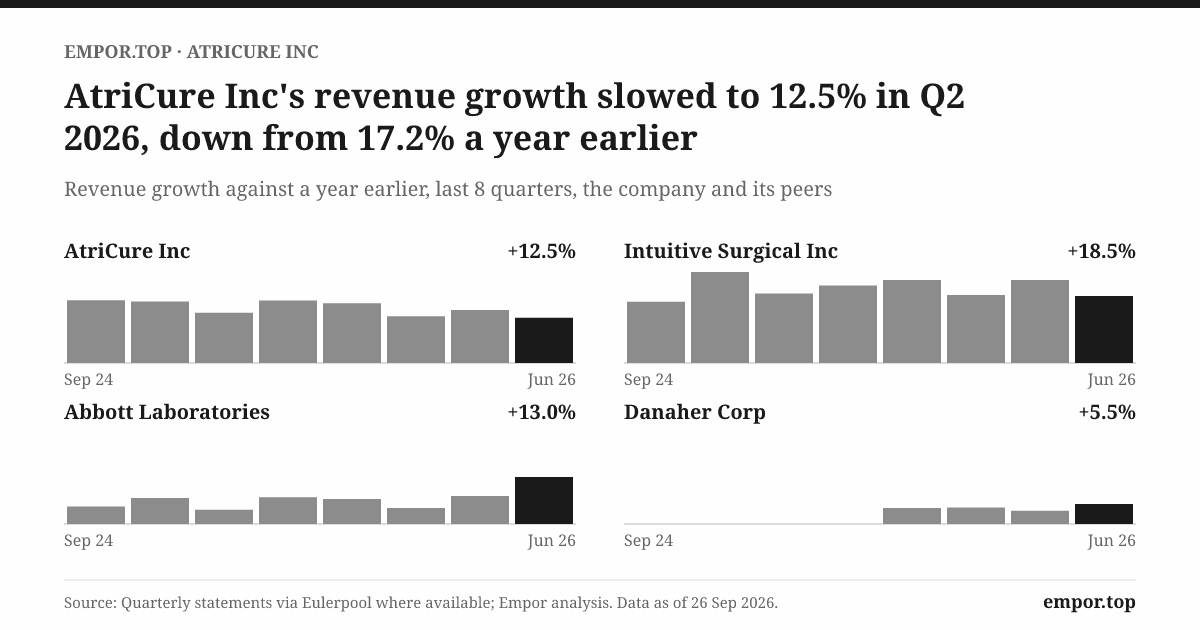
The numbers. In 2025, U.S. appendage management revenue rose 17.5% to $178.1 million, and international appendage revenue reached $42.1 million1. On the fourth-quarter 2025 call, management pointed specifically to the AtriClip FLEX-Mini, a lower-profile version designed for small or awkwardly shaped appendages, noting that it represented 18% of appendage revenue and was in use across more than 300 active accounts; a newer PRO-Mini version followed in the second half of 20253. In the second quarter of 2026, U.S. appendage revenue grew 14.5% to $51.6 million2.
What the evidence says. The mini-clip line sustained mid-to-high-teens growth while the broader product category matured, which points to genuine product-driven demand in existing accounts rather than growth dependent on winning new hospitals. That noted, growth did decelerate — from 17.5% for full-year 2025 to 14.5% in the second quarter of 2026 — before Edwards Lifesciences had any meaningful commercial presence21. Part of that deceleration reflects the arithmetic of a larger revenue base; part may reflect fading lift from the FLEX-Mini cycle. Either way, the franchise is not a passive compounder. It depends on sustained product innovation to hold its growth rate, and the recent trajectory suggests that dependence is real.
The competitors arrive. For most of AtriClip's commercial life, Medtronic was the primary surgical competitor named in AtriCure's 10-K1. Medtronic strengthened its position by acquiring the Penditure clip technology from Syntheon in August 2023 and launching it in the United States that November15. Then, on June 29, 2026, Edwards Lifesciences received FDA 510(k) clearance for Ecliptis, its own surgical LAA clip, and said it would pursue a "measured, targeted rollout" built on its existing relationships with surgical valve customers15.
The Edwards entry is the more consequential of the two. Edwards is the dominant company in heart valves, which means its sales teams already call on the cardiac surgeons who place AtriClips — often in the same valve procedures where appendage clips are used. Medtronic brings broad reach; Edwards brings the same customers.
Testing the moat. On the second-quarter 2026 call, Carrel described AtriCure's "clinical compendium that simply has no rival" and said its "products are superior"16, framing innovation, clinical science, and education as "three pillars" that "will prove to be extremely difficult to replicate"14. In February he had characterized the new entrants more as confirmation than threat: "entry into the market tells you cardiac surgery is a growth market that people are coming after"3.
What the available evidence actually supports is more limited. Medtronic's Penditure has been on the U.S. market since late 2023, and AtriCure's U.S. appendage growth accelerated through 20251. BTIG analyst Marie Thibault reached a similar conclusion, noting that the LAA clip market continued expanding during Medtronic's launch15. That is genuine evidence — a large company with a newer, repositionable clip did not dislodge AtriClip across roughly two years.
The limit of that evidence is that it tests AtriCure against a competitor with broad reach but no particular affinity for AtriCure's core customers. Edwards is a different kind of test. Surgeons' switching costs for a clip are real but modest: a clip requires no dedicated capital equipment, and the technique transfers. The honest verdict is that the moat has held against one serious entrant, and the data on whether it will hold against a competitor with pre-existing relationships with the same surgeons does not yet exist. The most useful metric to watch will be U.S. appendage growth over the next four to six quarters.
B. Open Ablation: the clamp that made the step fast
The problem it solved. The main reason surgeons skipped concomitant ablation was time. The classic Cox-Maze lesion set is effective but demanding: multiple separate clamp applications, sometimes requiring the atrium to be opened, all while the patient is on bypass. Every extra minute on the heart-lung machine adds risk and occupies operating room time on crowded surgical schedules.
The EnCompass clamp, launched in the United States in 2022 following 510(k) clearance in 2021, was designed to reduce that burden1. It lets a surgeon isolate the pulmonary veins and the posterior left atrial wall — the "box lesion" — in substantially fewer steps. On the fourth-quarter 2025 call, Carrel said procedure times had fallen below ten minutes3.
The numbers. U.S. open ablation revenue rose 16.3% to $143.8 million in 20251. By year-end, EnCompass was in use across more than 830 accounts worldwide and accounted for roughly 60% of U.S. open ablation revenue3. Growth moderated to 12.1% in the second quarter of 2026, when U.S. open ablation revenue was $40.9 million2.
What the evidence says. EnCompass is the clearest example of AtriCure's product engineering directly addressing the adoption gap described earlier. A tool that makes the guideline-recommended step fast enough to fit into a normal operative day can raise treatment rates in a way that sales effort alone cannot. Given the company's own estimate that fewer than 15% of eligible patients currently receive the procedure1, the remaining runway is substantial — though, as Section II established, guidelines have endorsed the step for years without moving that figure decisively. Speed helps; it does not by itself resolve the institutional and behavioral obstacles.
A new tailwind, and a disclosure. Management highlighted on the fourth-quarter 2025 call that concomitant AFib treatment had become a hospital quality metric in cardiac surgery — only the second therapeutic treatment to reach that status in 25 years, by Carrel's characterization3. Analysts pointed to the new Society of Thoracic Surgeons quality measures as a catalyst for faster open ablation adoption17. Quality metrics change what hospital administrators pay attention to, and that can shift surgeon behavior faster than guideline updates have historically done.
One caveat deserves mention: AtriCure funds many of the studies that support surgical ablation, trains the surgeons who perform it, and profits when adoption rises. That is standard practice in the device industry and does not make the underlying evidence wrong. It does mean that guideline endorsement backed primarily by industry-sponsored research is not the same kind of independent confirmation as findings produced at arm's length from commercial interests.
Switching costs. AtriCure's clamps run on its Isolator Synergy energy platform. Once a hospital's surgeons are trained on the system and its consoles are installed, switching to a competitor means retraining staff and restarting procurement. That friction is moderate — weaker than replacing capital-intensive imaging equipment but meaningful in a procedure where the surgeon's technique is built around a specific tool. No competitor with a comparable evidence base and a similarly engineered clamp has emerged in this segment.
C. Pain Management: the fastest horse
The product. Cryo nerve block uses a probe chilled far below freezing and pressed briefly against an intercostal nerve during surgery. The nerve's outer sheath survives while the signal-carrying fibers inside die back and later regrow — effectively silencing the nerve for weeks rather than hours, without a drug. A reasonable analogy is a very long-duration local anesthetic. The cryoSPHERE MAX probe, AtriCure's current version, features a larger ball tip that freezes faster, reducing the time required to treat each nerve.
The numbers. Pain management is AtriCure's fastest-growing franchise by growth rate. U.S. pain management revenue rose 32.5% to $81.9 million in 20251. Growth continued into 2026 — up 29.5% in the first quarter and 27.9% in the second, when U.S. pain revenue reached $27.1 million182. By the second quarter, cryoSPHERE MAX accounted for roughly 75% of U.S. pain revenue, and more than 700 accounts were active16, up from roughly 500 at the end of 20253. At an August 2026 conference, management described the franchise as a roughly $100 million annual business19 and noted more than 2,000 systems installed across thoracic centers20.
Where the growth comes from. Management's position is that the franchise is still early in penetration. It estimates that fewer than 25% of eligible thoracotomy procedures currently use cryo nerve block, and that sternotomy and amputation — supported by the cryoXT probe cleared in 2025 — account for less than 10% of pain revenue16141. Account growth ran at roughly 12% while volume grew roughly 25%, which means most revenue growth is coming from deeper use in existing hospitals rather than from adding new institutions19. Greater utilization within established accounts tends to be more durable than growth driven by logo additions alone, so the composition of that growth is a reasonable sign.
The caveat. The pain franchise carries a thinner evidence base than the ablation businesses. CONVERGE was a randomized pivotal trial. Cryo nerve block has reached the market primarily through 510(k) clearances, registries, and observational studies. Lighter regulatory requirements allowed faster adoption; they also leave the franchise more exposed if reimbursement decisions shift or a competing approach emerges.
That vulnerability has already materialized once. On the fourth-quarter 2025 call, management said U.K. revenue had fallen from roughly $4 million a quarter to just over $1 million, partly because of National Health Service reimbursement uncertainty around pain management products3. In the second quarter of 2026, management described the U.K. business as still "sequentially flat"16. A single national payer reconsidering coverage reduced a regional business by roughly three-quarters within a few quarters. The U.S. reimbursement environment is structured very differently, but the U.K. episode illustrates how quickly coverage reconsideration can affect this franchise specifically. It is worth keeping in mind when assessing how durable the growth rate is.
Competition. AtriCure's 10-K states that the company is not aware of other U.S. companies actively pursuing cryo nerve block therapies1. That first-mover position is genuine. It is not synonymous with a durable competitive moat. The physics of cryoablation are well understood, the devices are single-use disposables rather than capital equipment that creates switching inertia, and a larger device company could enter if the franchise scales to the point of warranting their attention. AtriCure's current advantage rests on early market development, a dedicated and specialized sales team, and a product that clinicians appear to regard well — advantages that can erode faster than regulatory exclusivity or switching costs can.
D. MIS Ablation: the disrupted franchise
The fourth franchise is the one that declined. EPi-Sense — the device approved on the strength of the CONVERGE trial — anchors AtriCure's minimally invasive, hybrid-procedure business. In 2025, U.S. MIS revenue fell from $45.7 million to $31.5 million, a decline AtriCure attributes to "continued reduction in Hybrid procedures as physicians adopt PFA catheters to treat patients"1. The decline continued into 2026: U.S. MIS revenue fell 24.8% in the first quarter and 23.1% in the second, to $6.0 million182.
Pulsed field ablation, or PFA, is a catheter-based technology that uses electrical pulses rather than heat or cold to destroy cardiac tissue. It proved faster and safer than prior catheter approaches in a population — long-standing persistent AFib patients — that EPi-Sense was designed to serve through a collaborative surgical-and-catheter procedure. When electrophysiologists found they could achieve comparable results with PFA catheters alone, the clinical rationale for adding a surgeon to the case weakened, and hybrid procedure volumes fell accordingly. What CONVERGE built over several years of clinical work, a competing technology category dismantled commercially within roughly two years.
AtriCure's response is an early-stage dual-energy platform that combines pulsed field ablation with radiofrequency ablation for surgical use. The first human treatments took place in the fourth quarter of 20251. The technology came from an exclusive licensing agreement signed on October 15, 2024, under which AtriCure paid $12 million upfront and may pay up to $28 million more in milestones1. Management said in July 2026 that it expects to file an investigational device exemption for a PFA-enabled EnCompass clamp in late 2026 or early 202716. The platform has not been approved in any market1, and at this stage it represents an early-stage option rather than a functioning revenue source.
Two things are worth noting about this response. First, AtriCure is trying to bring the technology that disrupted its minimally invasive business into its open-surgery business — essentially chasing into PFA rather than away from it, which suggests management believes the underlying energy modality has durable clinical advantages worth incorporating. Second, the trajectory of U.S. MIS revenue — still falling at a rate of more than 20% annually through mid-2026 — means the franchise is unlikely to stabilize before a PFA-enabled surgical product reaches the market. The gap between disruption and response has cost the company roughly $14 million in annualized MIS revenue compared with 2024, with no bottom yet clearly in sight. Why PFA had the impact it did, and what it may yet mean for AtriCure's larger surgical business, is the subject of the next section.
VII. The PFA Earthquake and the Survival Test (~8 min)
April 2023: the invisible arrival
Measured by hospital purchasing records, pulsed field ablation did not exist in American hospitals before April 2023. It had no line items, no inventory and no share of spend21. Then it arrived and moved very quickly.
Traditional catheter ablation kills tissue with heat (radiofrequency) or cold (cryoablation). Both work, and both carry a risk of damaging nearby structures such as the esophagus, because heat and cold spread indiscriminately. Pulsed field ablation uses very short, high-voltage electrical pulses that punch microscopic holes in cell membranes. Heart muscle cells happen to be especially sensitive to this, while the esophagus and nerves are much less so. The practical effect is a faster, simpler and more selective procedure.
The numbers show how fast adoption was. According to Guidepoint's analysis of U.S. purchasing data, PFA accounted for 35% of AFib ablation catheter spending in 2024, its first full year. It reached 69% of spending and 48% of units in 2025, and 78% of spending and 57% of units by early 202621. Radiofrequency's share of spending fell from 63% in 2023 to 22% by 202521. Boston Scientific's FARAPULSE had 100% of PFA spending in 2023. By early 2026 its share had dropped to 41%, while Medtronic had reached 48%21. It was the fastest technology shift in electrophysiology in a generation, and overall procedure volumes kept growing at around 20% a year even as the technology mix flipped21.
Why a catheter revolution hit a surgical company
At first glance this looks like someone else's war. AtriCure does not sell catheters. How did a catheter revolution take nearly a third out of one of its franchises in a year?
The answer lies in how the hybrid procedure depends on two groups of doctors. Hybrid Convergent is a joint effort: a surgeon does the outside work, and an electrophysiologist does the inside work, either in the same session or a few weeks later. The procedure only happens if the electrophysiologist refers the patient and makes lab time available. Once PFA made standalone catheter ablation faster and more effective, including for persistent AFib, electrophysiologists had less reason to send patients to a surgeon and a full schedule of quicker PFA cases to fill. The hybrid referral stream dried up.
The 10-K contains a sentence that reads awkwardly in hindsight. In its competition section, AtriCure says it believes endocardial catheters "are complementary to our business because our products improve treatment outcomes" for patients with long-standing persistent AFib1. In the same report, the company attributes a 31% decline in MIS revenue to physicians adopting PFA catheters1. Both statements can be partly true, but the revenue shows which effect is winning in 2025 and 2026. When a partner controls referrals, it can reduce them, and that dependence is a structural weakness of any business built on another specialty's scheduling decisions.
The short seller who was half right
In September 2020, Kerrisdale Capital published a short report on AtriCure, arguing among other things that the Convergent procedure faced poor commercial prospects as catheter technology kept improving22. At the time, CONVERGE had not yet produced its approval, and the stock was near record valuations.
How did that thesis turn out? On the specific product line, Kerrisdale looks right, though for a reason it could not have described in 2020. PFA was not yet on the U.S. market, and the collapse in hybrid procedures fits the report's core argument that surgical approaches to standalone AFib would lose ground to better catheters. On the company as a whole, the thesis did not hold. MIS was a small enough part of revenue by 2025, and appendage, open ablation and pain management were growing fast enough, that total revenue still grew about 15% in 20251. Kerrisdale correctly identified which part of AtriCure was exposed. It underestimated how much of the rest of the business did not depend on the catheter lab.
How AtriCure absorbed the blow
The survival arithmetic is simple. In 2025, U.S. MIS revenue fell by $14.3 million. U.S. appendage management, pain management and open ablation grew by a combined $66.8 million1. The loss was real but much smaller than the gains elsewhere.
That outcome reflects more than luck, but it was not foresight either. AtriCure did not build the pain franchise as a hedge against PFA. Cryo nerve block grew because it was a good product in the same operating room. The protection came from the company's focus on the surgical setting, not from a deliberate plan against catheter disruption.
Signs of stabilization, or not
Management has been careful here, and that care deserves credit. On the fourth-quarter 2025 call, Carrel said a sequential improvement in hybrid revenue from the third to the fourth quarter was "not enough to feel confident" that sustained growth would follow3. By July 2026, management said hybrid referral patterns had "stabilized over the last several quarters in a small subset of accounts"16. That is measured language, and it matches the revenue: declines are narrowing, not reversing.
The strategic non-event
What AtriCure chose not to do is also worth noting. It did not buy a catheter company or raise large sums of equity to join the PFA fight in the electrophysiology lab. It licensed a PFA technology for a $12 million upfront payment and aimed it at the surgeon's clamp rather than the electrophysiologist's catheter1. Given the SentreHEART experience, staying out of the catheter lab reflects a lesson learned.
There is still a cost that is easy to miss. MIS revenue that disappears also stops covering its share of fixed overhead, including manufacturing lines, regulatory staff and clinical support. If MIS keeps shrinking, some of the gross margin gains from pain and mini-clip sales go toward absorbing that loss rather than reaching profit. The next question is whether AtriCure's next major bet will look more like CONVERGE, which proved its case, or aMAZE, which did not.
VIII. The Optionality Bet: LeAAPS and the Prophylactic Appendage Story (~7 min)
6,573 patients and one question
In January 2023, surgeons began enrolling patients in a trial with an unusually ambitious premise23. The patients had no atrial fibrillation. They were having heart surgery for other reasons, such as bypass or valve repair. Half would have their left atrial appendage clipped shut with an AtriClip, and the other half would not. Researchers would then follow them for years to see which group had more strokes.
The trial is LeAAPS, short for Left Atrial Appendage Exclusion for Prophylactic Stroke Reduction. Enrollment finished in July 2025 with 6,573 patients at 139 centers worldwide1. Its primary effectiveness endpoint is the time to first ischemic stroke or systemic arterial embolism, measured at a common termination point with median follow-up of about five years23. The ClinicalTrials.gov record lists an estimated primary completion date of December 2031 and study completion in April 203223.
Why this could be larger than everything else combined
The logic is straightforward. Today AtriClip is mainly used in surgical patients who already have AFib. The LeAAPS population is cardiac surgery patients without an AFib diagnosis, which management described on the fourth-quarter call as an annual opportunity of about 1.4 million patients3. Many of these patients are older and at elevated stroke risk, and a meaningful share will develop AFib in the future, often without anyone noticing. If closing the appendage during surgery lowers their stroke risk, the device could move from a treatment for some surgical patients to a routine part of cardiac surgery for most of them.
Management has attached a long-range target to this pipeline. At the Canaccord Genuity conference in August 2026, AtriCure described an ambition to reach $1 billion in revenue with a 20% adjusted EBITDA margin by 203020. That is a management target, not a forecast grounded in approved indications.
Timing: two stories
Timing is more uncertain than it first appears. LeAAPS is event-driven: its length depends on how quickly strokes occur, not on a fixed calendar. At the same August conference, management said the trial had already accrued more than half of its required events and that "we're definitely ahead of plan on the numbers," with no device-related adverse events recorded19. Other coverage of the same appearance described data as expected "by end of decade"20. The public registry still shows 203123. Carrel also said in February that interim looks at 50% and 75% of events produce only a go/no-go recommendation from the Data Safety Monitoring Board, not publishable efficacy results3.
The fair reading is that the trial appears to be accruing events faster than planned, and management has been careful not to promise a date. Investors should treat reports of an early readout as possible but unconfirmed.
The aMAZE test
Section V covered aMAZE, the most relevant precedent here. That was a large, well-run trial of an appendage-closure device, sponsored by AtriCure, in which the company went in confident and the result came back neutral. The differences from LeAAPS are real. LeAAPS uses a different device (a clip versus a suture loop), approaches the heart from outside during surgery rather than by catheter, and targets a different endpoint (stroke rather than arrhythmia recurrence). Surgical appendage closure also carries a Class I-A guideline rating in patients who already have AFib4, so the biological rationale is stronger. Those differences make a positive result plausible. They do not make it likely enough to count on.
The base rate is not reassuring. Prophylactic trials in low-event populations are notoriously difficult. If the control group has fewer strokes than predicted, much as aMAZE's control arm outperformed expectations, a trial can fail to show a benefit that really exists. The patients in LeAAPS are, by design, at lower risk than those with AFib.
Even a win is not revenue
Suppose LeAAPS is positive. A new indication would still need FDA review, guideline updates and, most importantly, a reimbursement pathway. Payers are generally reluctant to pay for preventive procedures in patients without a diagnosed condition. AtriCure's history shows why this matters: the SentreHEART deal included $120 million in contingent payments tied specifically to reimbursement, a recognition that clinical success and payment are separate milestones12. A positive trial could open a larger market, but converting it to revenue would take years.
The nearer bet: BoxX-NoAF
A second trial is moving faster. BoxX-NoAF tests whether a box lesion using the EnCompass clamp, combined with appendage exclusion, reduces post-operative AFib in cardiac surgery patients who do not have AFib1. The first patient was enrolled in October 20251. On June 4, 2026, AtriCure said enrollment was running far ahead of plan and should be complete by year end, about 12 months early24. In July, management said enrollment had passed 500 of the planned 960 patients, that the trial is powered to detect a 10-percentage-point absolute difference, and that data are expected in the first half of 202716. Several analysts cited BoxX-NoAF as a reason for raising their estimates in September17.
BoxX-NoAF is smaller, faster and closer to AtriCure's existing strengths than LeAAPS. It is also subject to the same general rule: a positive result does not by itself produce a paying market. Whether investors should trust management's handling of these trials depends on its broader record, which is the subject of the next section.
IX. Current Management: Carrel's Record and the Incentive Structure (~7 min)
Fourteen years in
Mike Carrel has run AtriCure for nearly fourteen years — long enough for a genuine verdict. He is not independent under Nasdaq rules. The board is chaired by Robert S. White, and Deloitte & Touche has audited AtriCure since 200225. Separating the chair and CEO roles is a modest governance positive. A 24-year auditor relationship is long, though not unusual for a company of this size.
CFO Angela Wirick handles most financial questions on earnings calls, and her answers have tended to be specific. When BTIG's Marie Thibault pressed on gross-margin durability in July 2026, Wirick attributed the gains to new product launches and flagged a "small headwind" from a new manufacturing facility coming online16. In February she disclosed that a $4 million PFA program milestone had slipped from the fourth quarter of 2025 into 20263 — the kind of detail less candid teams tend to leave out.
The scorecard
Promises versus outcomes. Carrel's 2015 target of roughly 18% organic growth through the end of the decade was not met; the company grew at 14.5% in the final year of that window910. The gap was not catastrophic, and mid-teens growth is a creditable result for a company building a new therapy category. But it was a specific, public target, and the record shows it was set above what the business delivered.
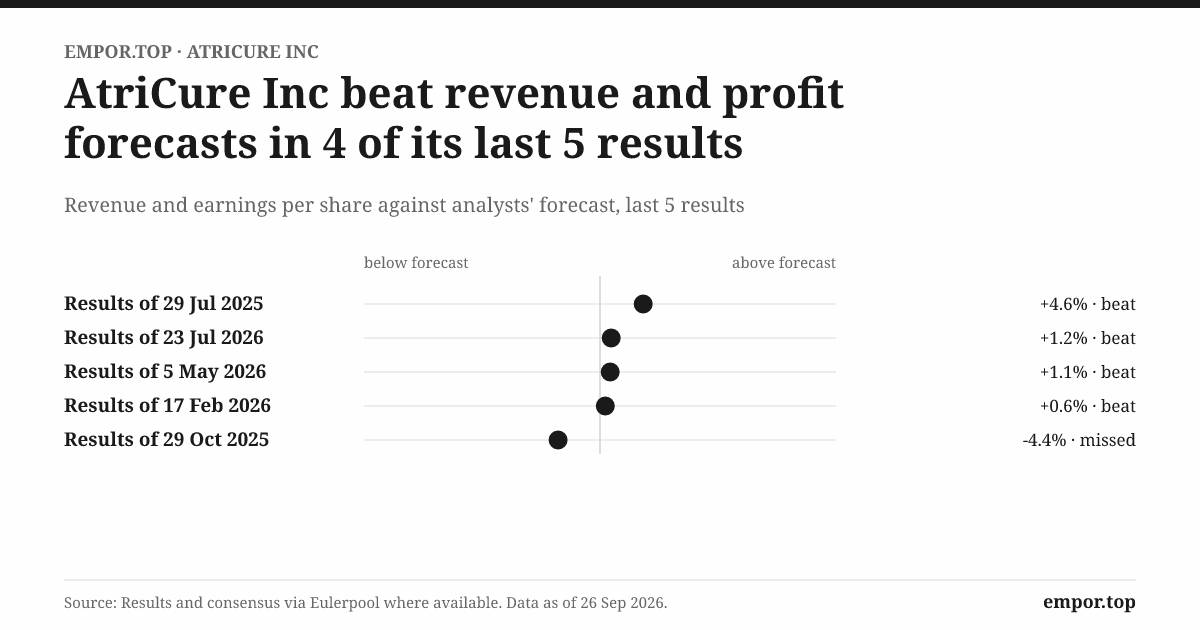
Guidance discipline in the recent era. For 2025, AtriCure initially guided to 11% to 13% revenue growth and delivered 14.9%3. For 2026, it set a range of $600 million to $610 million, subsequently narrowed to $602 million to $610 million with adjusted EBITDA raised to $85 million to $89 million23. The pattern over the past two years has been to set achievable targets and beat them — good for credibility, though analysts could reasonably ask whether guidance is deliberately conservative.
The market's reaction in July 2026 is instructive. Despite the earnings beat, the stock fell 6.4% after hours to $30.89, because management guided to a sequential revenue decline of 1% to 2% for the third quarter16. Management disclosed seasonal softness in advance rather than obscuring it, and paid for that transparency in the share price for a few weeks.
Honesty about bad news. The MIS decline has been described clearly, attributed to the right cause, and not presented as temporary. The "not enough to feel confident" remark from February 2026 about hybrid procedure stabilization3 is the kind of restraint that builds credibility over time, and it is one of the stronger parts of the recent record.
Capital allocation, in full. The record is mixed and is best read as a sequence. The Enable Medical purchase at IPO was a supply-chain transaction — sensible and cheap. The nContact deal, with roughly $99 million paid mostly in stock, produced a validated regulatory asset that PFA subsequently eroded9. SentreHEART cost roughly $40 million upfront, generated more than a year of optimistic balance-sheet accounting, ended in a large write-off, and left a product that now plays only a peripheral role in the portfolio1112. In May 2023, AtriCure paid $33.4 million to buy out a license that had required 5% royalties on certain product sales — a sensible move that removed a permanent cost1. The October 2024 PFA license, at $12 million upfront, is too early to judge1.
This is not the record of a reckless acquirer. Two of the three significant acquisitions did not produce commercial results proportionate to their prices, and characterizing the overall pattern as disciplined capital allocation requires qualification.
Equity raises. In May 2020, as the pandemic halted elective surgery, AtriCure sold 3,977,273 shares at $44.00 for roughly $175 million in gross proceeds26. Raising equity at a relatively high share price during a period of uncertainty was a sound decision. It was also dilution, extending a long series of earlier raises that together took the share count from roughly 12 million in 2006 to nearly 48 million today51.
The activist's question: what "adjusted" hides
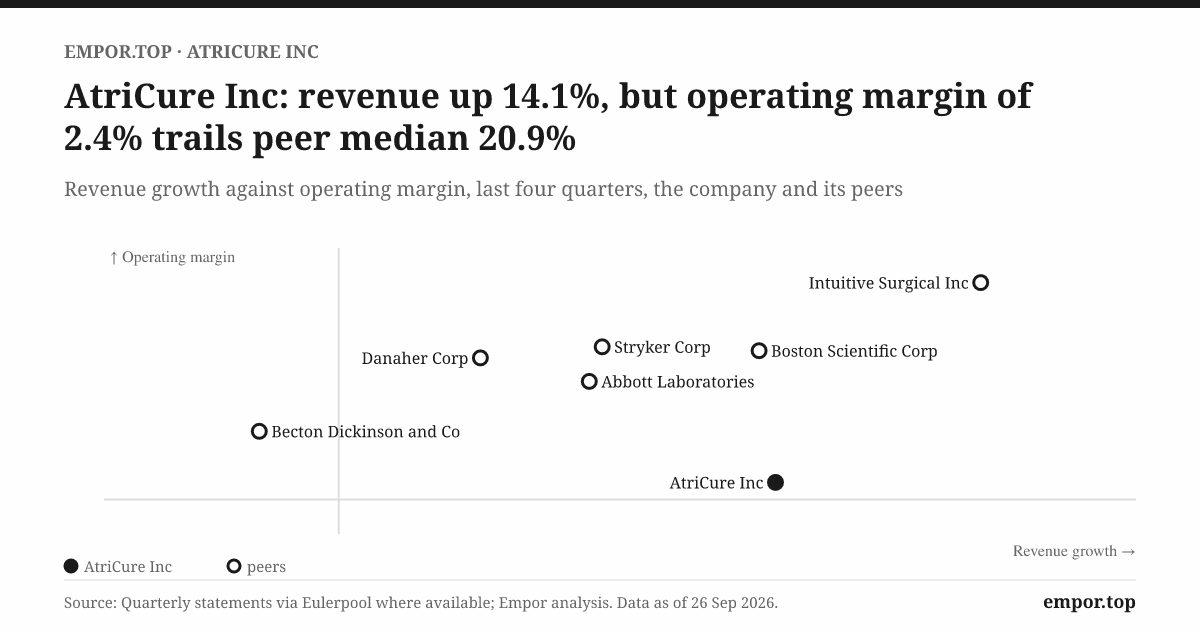
The distance between AtriCure's two profit measures warrants a close look. For 2025, the company reported adjusted EBITDA of $61.8 million against a GAAP net loss of $11.4 million31. Most of the gap is share-based compensation, which was $44.7 million that year, up from $40.4 million in 20241. Stock compensation is a real cost paid in shares rather than cash. Excluding it from adjusted profit makes the business look more profitable than it is for shareholders.
The trajectory is improving. Operating cash flow rose from $12.2 million in 2024 to $57.3 million in 20251, and the second quarter of 2026 produced $9.0 million in GAAP net income2 — the company's first quarterly GAAP profit outside of 2021, which, as Section V established, reflected an accounting gain from a failed trial rather than operational improvement. Cash generation is now real. The $1 billion revenue and 20% adjusted EBITDA targets for 203020 should still be read with the compensation gap in mind: a 20% adjusted margin could correspond to a considerably thinner GAAP margin if stock-based compensation continues its recent trajectory.
Incentives and ownership
Carrel's exact ownership stake and the structure of his long-term incentive awards — including any performance share units tied to stock-price hurdles — are set out in the company's proxy statements25. Those tables show what the board is actually paying management to achieve, and whether pay has tracked shareholder outcomes over a period that included the stock's extended slide from its pre-2022 highs to the mid-$30s in mid-202616. Investors should read them directly rather than rely on summaries.
What the disclosed record does show is a consistent strategic focus. Under Carrel's leadership AtriCure remained inside the cardiac surgery setting, with one costly exception in SentreHEART. That concentration is both the source of the company's resilience against the PFA disruption — the open and appendage businesses were unaffected — and the frame within which competition is now arriving. That competition is the subject of the next section.
X. Competitive Structure and the Five Forces (~8 min)
The war room
Imagine a strategy session at Edwards Lifesciences's headquarters in Irvine, California. A slide shows every U.S. cardiac surgery program where Edwards sells surgical valves, which is most of them. A second slide shows the average number of AtriClips each of those hospitals buys. The question is simple: how much of that clip business can Edwards win by adding a product to relationships it already has? That is the competitive problem AtriCure faces in 2026, and Porter's five forces are a useful way to break it down.
Threat of new entrants: rising in appendage, low in ablation, latent in pain
In appendage management, the barrier to entry has turned out to be lower than AtriCure's dominance suggested. A 510(k) clearance, a relatively fast process, was enough for both Medtronic's Penditure and Edwards's Ecliptis to reach the market15. AtriClip's advantages are its long clinical record, the evidence behind it, and the size of its installed base1. Those are real advantages, but they rest on trust and experience rather than regulatory barriers. A clinically adequate clip from a trusted company can get into the operating room.
In open ablation, entry is harder. A competitor would need an energy platform, a clamp design, and clinical data that satisfies the new quality metrics and guidelines. No credible challenger to EnCompass with a comparable evidence base has appeared.
In pain management, there are currently no U.S. entrants1, but that is because the market has been small, not because entry is blocked. At about $100 million in annual revenue and growing near 30%, the franchise is starting to become large enough to attract attention19.
Buyer power: high, but diffuse
Hospitals buy through group purchasing organizations and value analysis committees, and AtriCure's 10-K acknowledges that industry consolidation and payer pressure have produced "greater pricing pressures"1. AtriCure does not disclose average selling prices by product, so investors cannot directly check whether prices are holding.
There is indirect evidence. Gross margin rose to 77.2% in the second quarter of 20262, and management attributed the increase to product mix and new launches rather than cost cuts16. Rising margins alongside a new competitor suggest AtriCure has not had to discount heavily. The new competitors have only just arrived, though, and hospitals will now have credible alternatives to use in negotiations. This is the force most likely to change over the next two years.
Supplier power: low, with one caveat
AtriCure assembles, inspects, tests and packages most of its products at its Ohio facilities1. The Enable Medical acquisition at IPO was the origin of that in-house control6. No material supplier concentration is disclosed. The caveat is that a new manufacturing facility is expected to reduce gross margin by about a point temporarily; management has indicated roughly 76% versus 77% while it ramps19.
Threat of substitutes: extreme in MIS, low elsewhere, for now
Section VII covered PFA as a substitute for the hybrid procedure. For the operating room franchises, the substitution risk is different. For appendage exclusion, the alternative is a catheter-delivered occluder such as Boston Scientific's WATCHMAN or Abbott's Amulet. Those devices serve patients who are not having surgery, so they do not compete in the operating room.
The larger long-term risk is whether catheter procedures become good enough that fewer patients need open-heart surgery at all. Transcatheter valve replacement, a market Edwards leads, has already moved many valve patients out of the surgical operating room. AtriCure's addressable market is tied to the volume of open-heart procedures, and in some categories that volume has been shifting to catheters for years. Management said in July that it had seen no impact from changes in insurance enrollment on its largely non-elective surgical volumes and expects demographic support for procedure counts14, but the slow migration from open surgery to catheters is the substitute worth monitoring over a decade.
Rivalry: calm in the OR, until now
For most of AtriCure's history, rivalry in the surgical setting was mild, because the large companies saw cardiac surgery AFib as too small to prioritize. That has changed. Medtronic and Edwards investing in surgical appendage devices means the company's quietest advantage, being overlooked, is gone. Management describes this as validation of the market3. It is that, and it also marks the end of the period in which AtriCure effectively had the surgical AFib market to itself.
XI. The Investment Case: Bull vs. Bear (~8 min)
Setting the table
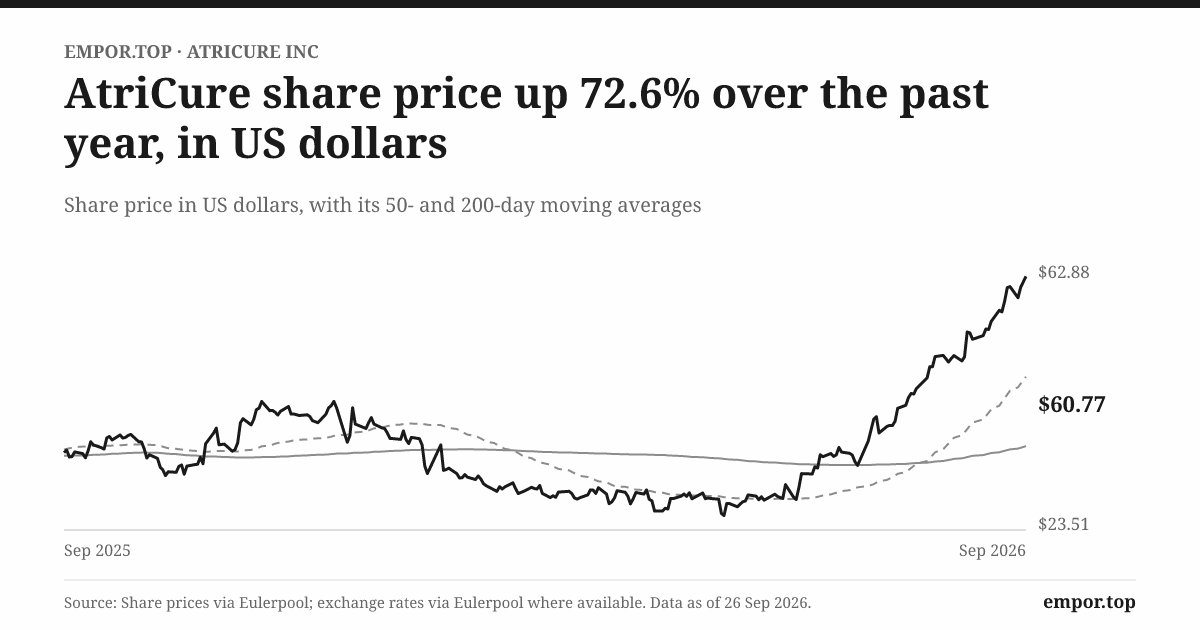
In mid-September 2026 AtriCure shares reached a 52-week high of $55.83, a market value of about $2.8 billion, up nearly 60% over the year and more than 80% over six months17. The rally followed the strong second quarter, the BoxX-NoAF acceleration and the new STS quality measures17. Only two months earlier, the shares had closed at $33.02 before the second-quarter release16. At the September valuation the market pays roughly four and a half to five times 2026 revenue guidance, a meaningful premium for a company that has only just become profitable on a GAAP basis. The price of admission is a bet on durable growth. Whether that growth is durable is the question.
Hamilton Helmer's 7 Powers: which powers does AtriCure actually have?
Switching costs. Present, and strongest in open ablation, where console installation and surgeon technique make change costly. They are weaker in appendage management, where a clip is relatively easy to substitute, and weaker still in pain management and MIS.
Counter-positioning. This is AtriCure's most interesting power historically. Large companies have been reluctant to push surgical AFib treatment because their profits come from catheters, and promoting a surgeon's solution would cut against their core business. That hesitation gave AtriCure room to grow. Edwards, which does not sell AFib catheters, does not face the same conflict. Its entry undermines this power in the appendage franchise more than Medtronic's did.
Cornered resource. The clinical evidence base is the closest thing AtriCure has to a cornered resource. That includes CONVERGE, the long-standing persistent AFib approval, and soon LeAAPS and BoxX-NoAF, which together involve roughly 10,000 randomized patients14. Competitors can copy a clip. They cannot quickly replicate years of randomized trial data. If LeAAPS succeeds, the resulting indication would be AtriCure's alone for a meaningful period.
Scale economies. Modest. AtriCure's 77% gross margin2 reflects pricing and mix rather than scale. Its sales force of about 350 cardiac surgery reps is an important asset14, but large competitors have far larger ones.
Process power. Possibly, in the company's rapid product iteration from FLEX-Mini to PRO-Mini to cryoSPHERE MAX. It is hard to prove from outside.
Network effects and brand. Weak. Surgeon preference is a form of reputation, but it is individual and not self-reinforcing.
The conclusion is that AtriCure's advantages rest mainly on clinical evidence and switching costs, with counter-positioning weakening. That is a narrower position than "dominant niche leader." It is still strong enough to support a premium business as long as the evidence advantage keeps growing.
The bull case, tested
1. Deep penetration runway inside existing accounts. The company's own estimate that fewer than 15% of eligible patients receive surgical ablation, together with the new quality metric, gives open ablation substantial room to grow13. Test: the figure is a company estimate, and guideline compliance has remained low for years. The bull case depends on the quality metric changing behavior in a way that guidelines did not. That is plausible and not yet proven. The evidence to watch is whether U.S. open ablation growth holds in the low-to-mid teens or accelerates after 2026.
2. Trial catalysts. BoxX-NoAF data are expected in the first half of 2027, and LeAAPS events are accruing ahead of plan1619. Test: aMAZE shows that AtriCure's confidence about trials has been wrong before, and a positive trial does not guarantee payment. The optionality is real, but it should be discounted, not treated as a certainty built into the current business.
3. Operating leverage. Management expects SG&A to grow in the mid-to-upper single digits while revenue grows in the low-to-mid teens14. The second quarter of 2026 delivered GAAP profit2. Test: AtriCure has been profitable on a GAAP basis for only a couple of quarters. Stock compensation is large, and the new facility and trial costs add expense. The leverage is showing up, but it is early.
4. Proven resilience. The company absorbed the PFA shock with total growth near 15%1. Test: that resilience came partly from the fact that MIS was already a small part of revenue. The same arithmetic would not protect AtriCure if appendage management, its largest franchise, came under serious pressure.
The bear case, tested
1. Edwards changes the appendage franchise. Appendage management is about two-fifths of revenue, and management attributes much of its margin gain to mini-clip mix116. A competitor that already works closely with the same surgeons could take share or force price concessions. Test: AtriCure has held up against Medtronic for about two years1. Edwards has only just launched its product. The risk is real and untested.
2. MIS never stabilizes. Declines have narrowed from 31% to the low-to-mid 20s, but the franchise has not stopped shrinking12. Test: MIS is now under a tenth of revenue, so even continued decline is a moderate drag rather than a threat to the business. The bigger issue is that a franchise AtriCure paid about $99 million to build is shrinking9.
3. Trial failure. If LeAAPS fails, the long-term expansion story weakens considerably. Test: the current business does not depend on LeAAPS, and most of today's revenue would not be affected. The valuation, however, probably includes some expectation of trial success, and a failure would remove it.
4. Valuation leaves little margin. After a rise of more than 80% in six months17, the stock already reflects a good deal of good news. Test: a company that has only just become profitable, with one franchise shrinking and a new competitor in its largest one, is priced for continued strong execution.
Myth versus reality
Myth: AtriCure is a profitable compounder. Reality: It has become profitable on a quarterly GAAP basis only in 2026; its one earlier profitable year, 2021, was an accounting reversal from a failed trial112.
Myth: The earn-outs proved disciplined M&A. Reality: They capped the downside on SentreHEART, but two of three significant acquisitions have not delivered the commercial results their prices implied912.
Myth: PFA was a near-death experience. Reality: It badly damaged one small franchise and barely dented total growth1.
The synthesis
AtriCure's history both supports and limits the bull case. It supports it because the company has absorbed several shocks (the DOJ settlement, the aMAZE failure, PFA) and kept growing in the mid-teens. It limits it because each of those shocks showed a specific weakness: the company can be overconfident about trials, it depends on partners it does not control, and it attracts competition once its markets become large enough to notice. The business is better than a niche device company, but the moat is narrower than management describes. Watching a few specific measures is more useful than holding a firm view in either direction.
XII. Three KPIs That Matter Most (~3 min)
1. U.S. appendage management revenue growth. This is the most direct test of whether AtriCure's largest franchise can hold up against Edwards and Medtronic. The company reports it every quarter in its revenue tables2. Growth that stays near recent levels while Ecliptis ramps up would support the view that surgeons' familiarity with AtriClip and the depth of its evidence protect the business. A sustained slowdown, especially if accompanied by commentary about pricing, would show that the moat is weaker than management claims.
2. U.S. pain management revenue growth and active accounts. AtriCure disclosed about 500 cryoSPHERE MAX accounts at the end of 2025 and more than 700 active pain accounts by mid-2026316. The important question is whether revenue keeps growing faster than account count, which would indicate deeper use within hospitals, and whether sternotomy and amputation become a meaningful share of revenue. If growth slows while accounts plateau, the franchise's growth phase may be shorter than management expects.
3. U.S. minimally invasive ablation revenue trajectory. Declines of 31% in 2025 and in the low-to-mid 20s in the first half of 2026 show a franchise still shrinking12. Stabilization would indicate that the PFA shock has run its course. A third year of steep declines would confirm that the hybrid procedure's market has permanently shrunk, and management's willingness to say so plainly would itself be a test of its credibility.
XIII. Durable Lessons from the AtriCure Story (~5 min)
Evidence compounds, and so do its costs
The CONVERGE approval made AtriCure the only company with FDA-approved devices for long-standing persistent AFib1. The STS guidelines and new quality metrics rest in part on evidence AtriCure helped create. That is the case for building advantages through clinical trials. The other side is aMAZE, which shows that the same approach can consume capital and management attention without producing anything. Clinical evidence builds lasting advantages only when the trials succeed. Otherwise it is expensive.
Choose your setting, not just your disease
The most valuable decision in AtriCure's history was defining itself by the operating room rather than by AFib. Every product that depended only on the surgeon (clamps, clips, cryoprobes) has grown. Both products that depended on the electrophysiologist, LARIAT directly and the hybrid procedure through referrals, have struggled. For any company operating in a niche, the lesson is to look closely at which part of the business depends on someone else's schedule.
Earn-outs cap the price, not the cost
SentreHEART's structure protected AtriCure from paying $260 million for a failed trial12. It did not recover the upfront payment, the trial costs or the management attention. It also produced a large accounting reversal that distorted reported results for a year11. Contingent consideration is a useful tool, but it does not justify acquiring businesses whose success depends on a trial that may well fail.
Diversification by adjacency, not by design
The pain franchise protected AtriCure when MIS declined, but it was not built for that purpose. It grew because it was useful in the same room, for the same patients and surgeons. The practical takeaway is that adjacency within a clinical setting has proven more reliable for AtriCure than adjacency within a disease area.
XIV. Epilogue: The Road to LeAAPS and What Comes After (~4 min)
Autumn 2026
In late September 2026, AtriCure is at the most consequential point in its history. It became profitable on a GAAP basis at the quarterly level in 2026, with second-quarter net income of $9.0 million and cash of $167.8 million against $61.0 million of long-term debt2. It faces its first serious competition in its largest franchise. It has two trials with data expected in the next few years: BoxX-NoAF in the first half of 2027, and LeAAPS at an uncertain date sometime before the registry's 2031 estimate1623.
The dual-energy surgical platform, which entered human testing in late 2025, could eventually help AtriCure recover some of the hybrid and minimally invasive business it lost to PFA1. Given the company's record of converting technical milestones into revenue, it should be treated as a long-dated possibility rather than a near-term contributor.
The key question for the next several years is whether AtriCure can defend AtriClip against Edwards and Medtronic, keep pain management growing, and get the trial results it needs, all while turning quarterly profits into sustained annual ones. Management's 2026 guidance of $602 million to $610 million2 and its 2030 target of $1 billion in revenue20 show that it believes it can. The stock's rise shows the market largely agrees. The history reviewed here suggests treating that confidence with some caution.
XV. Outro & Further Reading (~2 min)
AtriCure's story is, at its core, about the advantages of staying in one room. The company chose the surgeon over the cardiologist, the operating theater over the catheter lab, and clinical evidence over commercial shortcuts. That choice has mostly served it well — though not without cost, and not without exceptions. Its strongest results came when it built tools that made a guideline-recommended step fast enough to fit into a normal operative day. Its most expensive setbacks came when it moved onto someone else's territory or expected a trial outcome that the data did not deliver.
The business that exists in late September 2026 is meaningfully different from the one that existed even five years ago: three growing franchises, a first serious competitor in its largest product line, two trials with results still ahead, and a quarterly profit margin that is real rather than an accounting artifact. None of that resolves the central question of whether the current valuation is justified. It does mean the question is worth asking carefully.
Readers who want to go further will find the most useful primary material in four places. The FY2025 10-K contains the franchise revenue tables and competition section that underpin much of the financial analysis here1. The third-quarter 2021 10-Q records the SentreHEART accounting reversal in precise detail11. The ClinicalTrials.gov entry for LeAAPS sets out the trial design, enrollment figures, and estimated completion dates in terms that can be compared against management's public statements23. And the transcripts of the February and July 2026 earnings calls are where management's language on competition, the MIS decline, and trial timing can be tracked quarter to quarter — and tested against what eventually happens316.
References
-
AtriCure, Inc. Form 10-K for Fiscal Year 2025 — SEC EDGAR, 2026-02-19 ↩↩↩↩↩↩↩↩↩↩↩↩↩↩↩↩↩↩↩↩↩↩↩↩↩↩↩↩↩↩↩↩↩↩↩↩↩↩↩↩↩↩↩↩↩↩↩↩↩↩↩↩↩↩↩↩
-
AtriCure Reports Second Quarter 2026 Financial Results (Form 8-K Exhibit 99.1) — SEC EDGAR, 2026-07-23 ↩↩↩↩↩↩↩↩↩↩↩↩↩↩↩↩↩
-
AtriCure (ATRC) Q4 2025 Earnings Call Transcript — The Motley Fool, 2026-02-17 ↩↩↩↩↩↩↩↩↩↩↩↩↩↩↩↩↩↩↩↩
-
Takeaways From Updated STS Guidelines for Surgical Treatment of Atrial Fibrillation — Cleveland Clinic Consult QD ↩↩↩
-
AtriCure, Inc. Form 10-K for Fiscal Year 2005 — SEC EDGAR, 2006 ↩↩↩↩↩↩
-
AtriCure Announces Closing of Initial Public Offering and Acquisition of Enable Medical Corporation (Form 8-K Exhibit) — SEC EDGAR, 2005-08-10 ↩↩↩
-
Ablation Company Pays $3.8 Million for Off-Label Use — Diagnostic and Interventional Cardiology, 2010-02-05 ↩↩
-
AtriCure Names Michael H. Carrel President and Chief Executive Officer (Form 8-K Exhibit 99.2) — SEC EDGAR, 2012 ↩↩↩↩
-
AtriCure Enters Into Definitive Agreement to Acquire nContact (Form 8-K Exhibit 99.1) — SEC EDGAR, 2015-10-05 ↩↩↩↩↩↩↩
-
AtriCure Reports Fourth Quarter and Full Year 2019 Financial Results (Form 8-K Exhibit 99.1) — SEC EDGAR, 2020-02-18 ↩↩↩↩
-
AtriCure, Inc. Form 10-Q for the Quarter Ended September 30, 2021 — SEC EDGAR, 2021 ↩↩↩↩↩↩↩↩
-
AFib device maker AtriCure to spend up to $300M in SentreHeart buyout — MedTech Dive, 2019-08-12 ↩↩↩↩↩↩↩
-
Lariat LAA Ligation Doesn't Boost Effect of AF Ablation: aMAZE Trial — TCTMD, 2021-11-18 ↩↩
-
AtriCure, Inc. (ATRC) Q2 2026 Earnings Call Transcript — Equibles, 2026-07-23 ↩↩↩↩↩↩↩↩
-
Edwards wins FDA clearance for LAA clip, setting up competition with AtriCure and Medtronic — MedTech Dive, 2026-06-30 ↩↩↩↩
-
Earnings call transcript: AtriCure tops Q2 2026 estimates, shares fall after hours — Investing.com, 2026-07-23 ↩↩↩↩↩↩↩↩↩↩↩↩↩↩↩↩↩
-
AtriCure stock hits 52-week high at 55.83 USD — Investing.com, 2026-09-14 ↩↩↩↩↩
-
AtriCure Reports First Quarter 2026 Financial Results (Form 8-K Exhibit 99.1) — SEC EDGAR, 2026-05-05 ↩↩
-
AtriCure at Canaccord Genuity conference: growth, trials and margin gains — Investing.com, 2026-08-11 ↩↩↩↩↩↩
-
AtriCure Targets $1 Billion as Pain Management and AFib Trials Fuel Growth — Yahoo Finance, 2026-08 ↩↩↩↩↩
-
Inside the Pulsed Field Ablation Market 2026 — Guidepoint Qsight, 2026 ↩↩↩↩↩
-
Kerrisdale Capital Short Report on AtriCure, Inc. (ATRC) — Kerrisdale Capital, 2020-09-30 ↩
-
Left Atrial Appendage Exclusion for Prophylactic Stroke Reduction Trial (LeAAPS), NCT05478304 — ClinicalTrials.gov, updated 2026-03-24 ↩↩↩↩↩↩
-
AtriCure (ATRC) Advances Key Heart Disease Trial 12 Months Ahead of Schedule — Yahoo Finance, 2026-06 ↩
-
AtriCure, Inc. Definitive Proxy Statement (DEF 14A) 2025 — SEC EDGAR, 2025-04-07 ↩↩
-
AtriCure Announces Pricing of Public Offering of Common Stock (Form 8-K Exhibit 99.2) — SEC EDGAR, 2020-05-11 ↩
 LinkedIn
 WhatsApp
 Reddit
 Hacker News
 Email
Email Kindle
 RSS Feed
 Spotify
 Apple Podcasts
 Amazon Music
 Audible
 YouTube