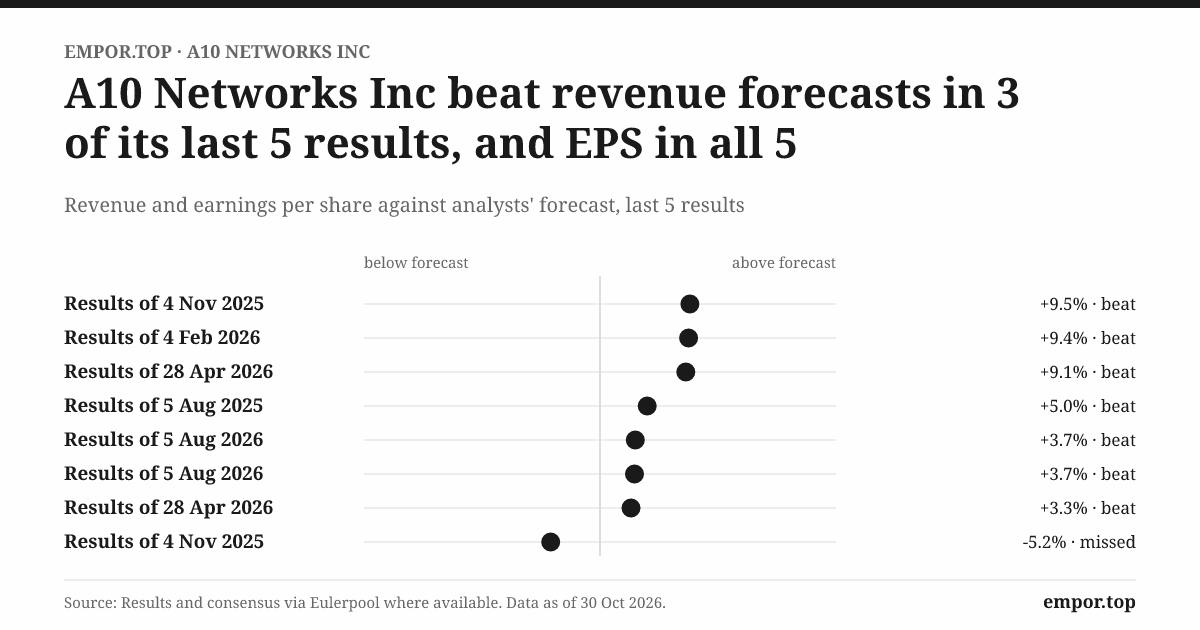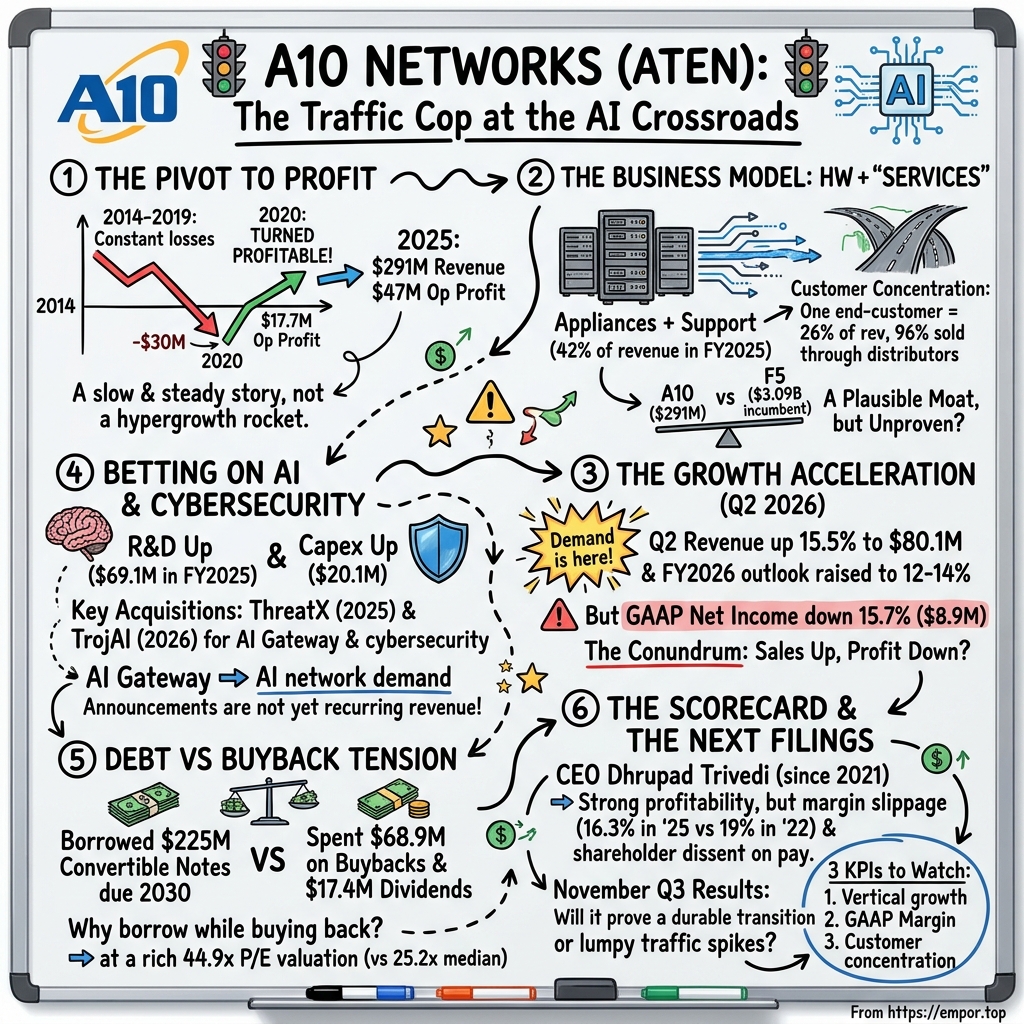
A10 Networks: The Traffic Cop at the AI Crossroads
The quarter when growth stopped being a forecast
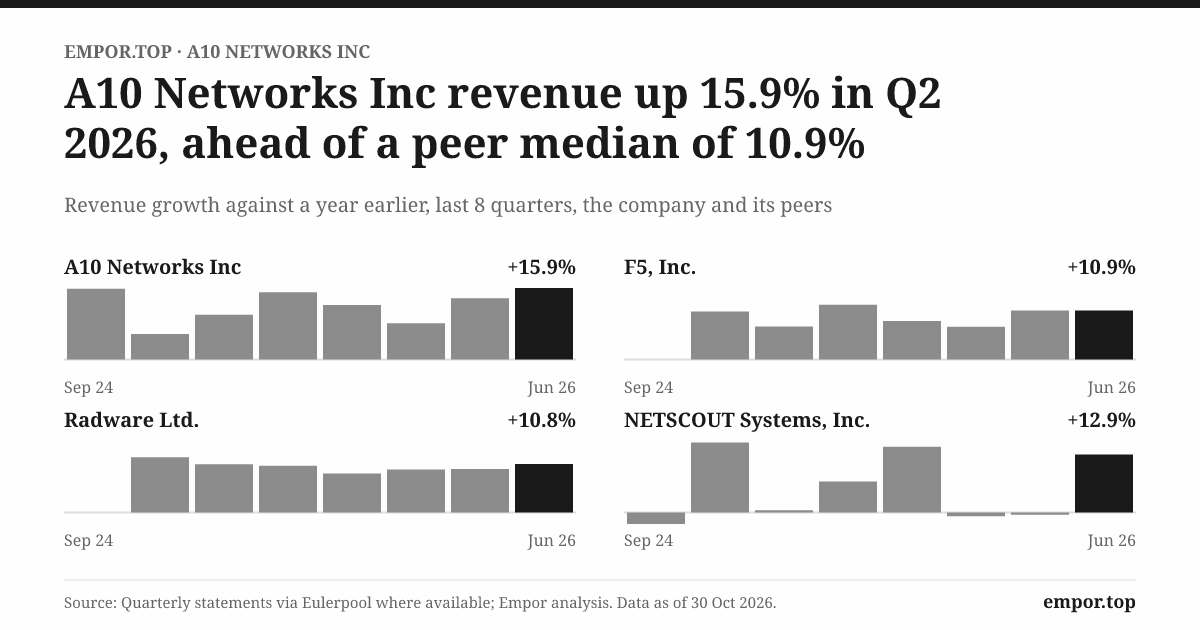
At 4:30 in the afternoon, New York time, on August 5, 2026, the people who run A10 Networks dialed into their second-quarter earnings call with the best top-line news the company had delivered in years. Revenue for the three months to June had reached $80.1 million, up 15.5% from a year earlier.1
Product sales, the boxes and licences that customers buy when they are building something new, had jumped by roughly a quarter.1 Chief executive Dhrupad Trivedi told listeners it was the fourth quarter of double-digit growth in the last five, and the company raised its full-year revenue outlook from growth of 10–12% to growth of 12–14%.12
Then there was the other number. Under standard accounting, A10 earned $8.9 million in the quarter, down from about $10.5 million a year earlier, a decline of roughly 16%.1 Diluted earnings per share slipped from 14 cents to 12 cents.1 More sales, less profit.
The company's preferred "non-GAAP" measure told a happier story, with adjusted earnings per share rising from 21 cents to 25 cents, because it strips out stock compensation, acquisition costs and the amortization of purchased intangibles.1 Both numbers are true. They simply answer different questions, and the gap between them is where this story lives.
The source of that gap is visible in the cost lines. Gross margin actually held up, edging up to about 79%, so the company was not cutting prices to win the extra volume.1
The damage came below that line: operating expenses rose about 22% in a year, led by research and development, which climbed from roughly $16 million to $21 million a quarter, and general and administrative costs, which went from about $7 million to $11 million in the same quarter A10 closed an acquisition.1
Gross profit rose by about $8.7 million; operating expenses rose by about $10 million. Every extra dollar of gross profit, and then some, was spent before it could reach shareholders, and GAAP operating margin fell from about 15% to about 11%.1
Was that spending the down payment on a bigger company or the cost of standing still in a harder market? The analysts on the call circled exactly that question. Gray Powell of BTIG asked what was driving 25% product growth and how long the spending cycle would last; Trivedi called product revenue the "lead indicator" for new business and said the quarter supported "a significant project," not demand borrowed from other periods.2
Michael Romanelli of Mizuho asked how the pipeline looked compared with ninety days earlier; the answer was that it was "definitely better," with enterprise sales cycles of six to nine months and results expected "later this year, early next year," but no dollar figure, customer count or deal size came with it.2
Simon Leopold of Raymond James asked about concentration, and Trivedi said the share of revenue from the largest end customer in the June quarter would be similar to the 37% disclosed for the March quarter.2 That was the most concrete answer on the call, and it was not a reassuring one: more than a third of the company's sales were coming from one buyer.
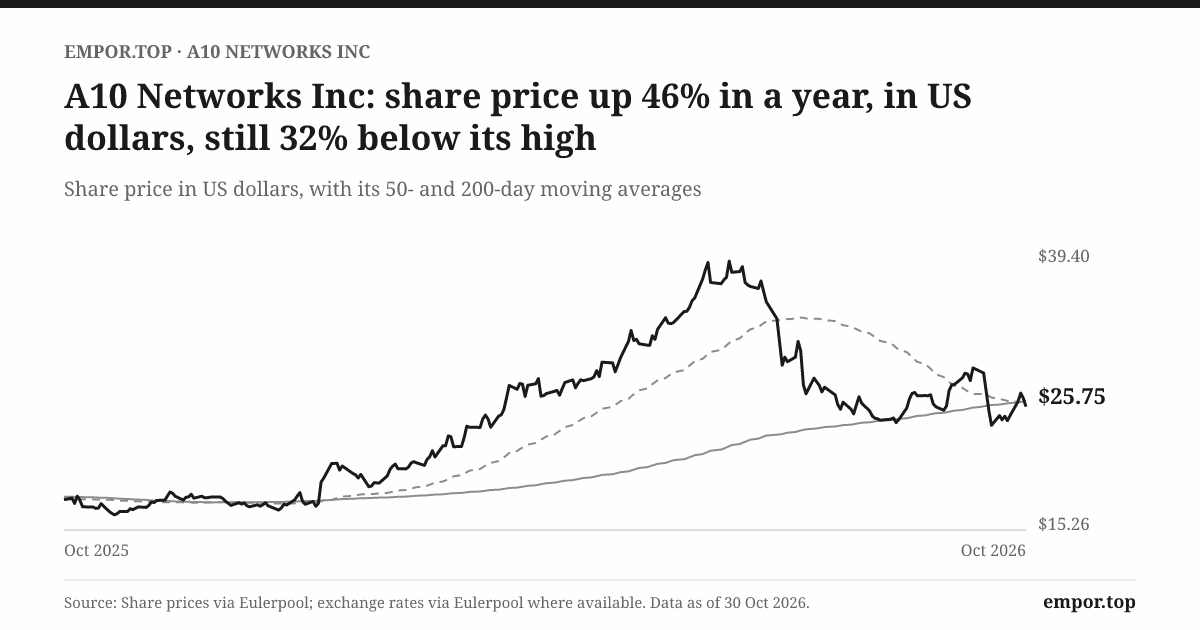
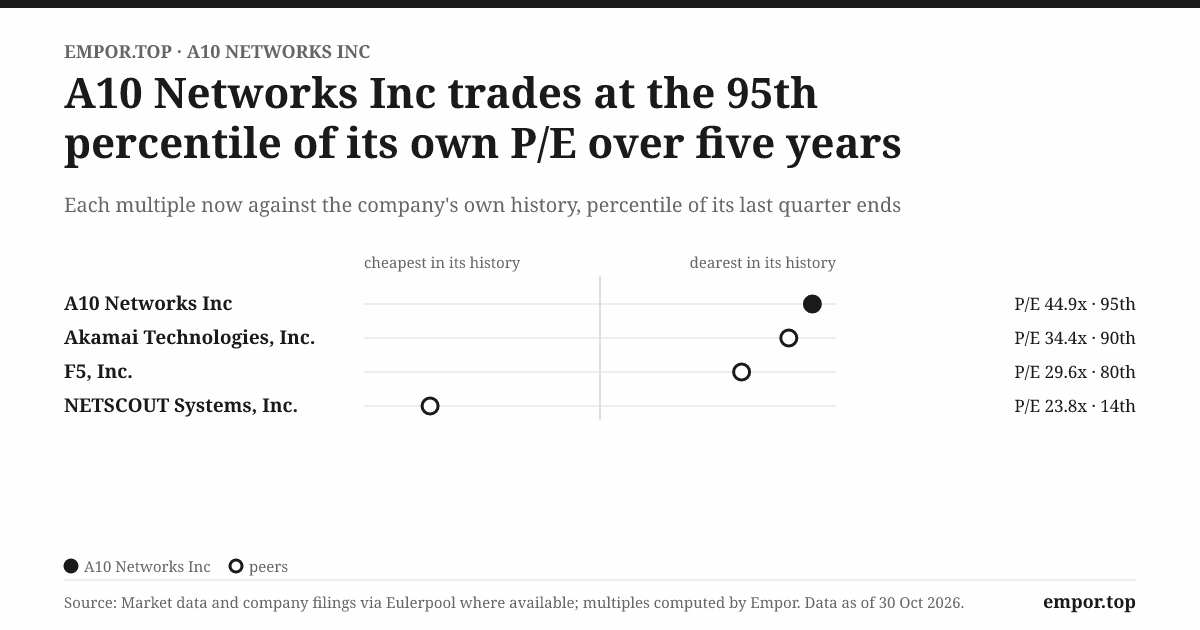
So the stakes are plain. A10 is a company with roughly $291 million of annual revenue in its last full fiscal year.3 On October 30, 2026, at a share price of $25.75, the market valued it at about $1.8 billion, or about six times sales and almost 45 times trailing earnings.
Five years of history put the median earnings multiple at about 25. The stock had traded as high as $38.11 and as low as $16.55 over the previous twelve months, a range that tells you investors are arguing about what kind of company this is.
Four questions will run through this episode. Can a business that still leans on appliance orders turn a burst of demand into durable growth? Can the money A10 is pouring into security and artificial intelligence lift its margins, or will it keep eating them?
Are the buybacks and acquisitions earning their cost, especially when they sit alongside new debt? And how much of the earnings story is operating profit from selling products, rather than interest on a large pile of cash and the accounting choice to treat stock compensation as something other than a cost?
Hold one distinction through all of it. A customer's need can be real, urgent and expensive before it becomes repeatable revenue for any single vendor. The traffic is coming. The question is whether it keeps coming through A10.
 Subscribe on LinkedIn
From a decade of losses to a business that could pay
A10's founder, Lee Chen, had already helped build one networking company before he started this one. He co-founded Foundry Networks, where he ran engineering, and A10's own materials describe him as a founding member of Centillion Networks as well.4 In 2004 he incorporated A10 in California with a bet that the boxes sitting in front of websites and telecom networks, deciding which server should answer which request, could be built faster and cheaper than the incumbents' versions.3
That box has a dull name, the application delivery controller, and a vital job. Think of it as the traffic cop at a busy junction in a data center. Millions of requests arrive; the controller sends each one to a server that has room, keeps sessions intact, encrypts and decrypts traffic, and turns away floods of junk traffic meant to knock the site offline.
If it slows down, everything behind it slows down. If it fails, the application is gone. Customers who buy these boxes care about speed and reliability first and price second, which is the kind of market a fast-moving challenger dreams of entering.
By the time A10 filed to go public in February 2014, the dream had become a business with real revenue and real losses.5 The company priced its initial public offering on March 20, 2014, at $15 a share, selling 12.5 million shares, and began trading on the New York Stock Exchange the next day under the ticker ATEN.6
That year it booked about $179 million in revenue and an operating loss of about $30 million.7 For a hardware challenger burning cash to win share from much bigger rivals, that was not unusual. What was unusual was how long it lasted.
A10 lost money every year from 2014 through 2019. Revenue grew in the first years after the listing, peaked at about $235 million in 2017, and then went backwards, sliding to about $213 million by 2019.7
On July 30, 2019, the board announced that it had formed a strategy committee to oversee activities "directed to increasing shareholder value," and the company began describing its "exploration of strategic alternatives" in its filings, the polite public-company phrase for a business that might be for sale.7
Into that moment walked Dhrupad Trivedi. He joined A10 as president and chief executive in December 2019 after nearly a decade at Belden, the industrial networking and cable company, where as an executive vice president he had overseen businesses including the security software unit Tripwire, corporate development, and Belden's network solutions platform.8 Before Belden he held general management and corporate development roles at JDS Uniphase.8
He is an engineer by training, with a doctorate in electrical engineering from the University of Massachusetts Amherst, and a finance MBA from Duke.8 That combination, a technologist who had spent years buying and integrating businesses, shaped what came next. In September 2020 the board also made him its chair, with director Eric Singer named lead independent director.9
The turnaround that followed is the most important fact in A10's modern history, and it is worth getting its cause right. In 2020, Trivedi's first full year, revenue rose about 6% to $225.5 million and A10 swung from an operating loss of $17.1 million to an operating profit of $17.7 million.7 The popular version of this story is that growth finally arrived. The filing tells a different one.
Total operating expenses fell from about $208 million in 2018 to about $158 million in 2020, a cut of roughly $50 million in two years.7 Sales and marketing spending alone fell $15 million in 2020, which the company attributed largely to a 12% reduction in headcount, after a 14% reduction the year before.7 Revenue in 2020 was still lower than in 2017.7 A10 became profitable by shrinking its cost base to fit the business it had, not by outgrowing its losses.
That is not a criticism. Plenty of companies never make that adjustment, and once A10 did, the economics of the product shone through. Gross margins near 78% meant that each extra dollar of sales carried a lot of profit with it.7
Revenue rose to about $280 million in 2022, and operating margin reached about 19%, the best year in the company's history on that measure.10 Over five years from 2020 to 2025, net profit grew about 20% a year. A loss-making challenger had become a cash-generating niche vendor.
The counterweight is just as real. In 2023 revenue fell about 10%, to roughly $252 million, because product sales dropped about 19% on lower demand from service-provider customers in the Americas, Asia-Pacific and Europe; support revenue rose, but nowhere near enough to fill the hole.11 The best year in the company's history was followed directly by one of its sharpest declines, and the cause was the same customer group that had powered the recovery.
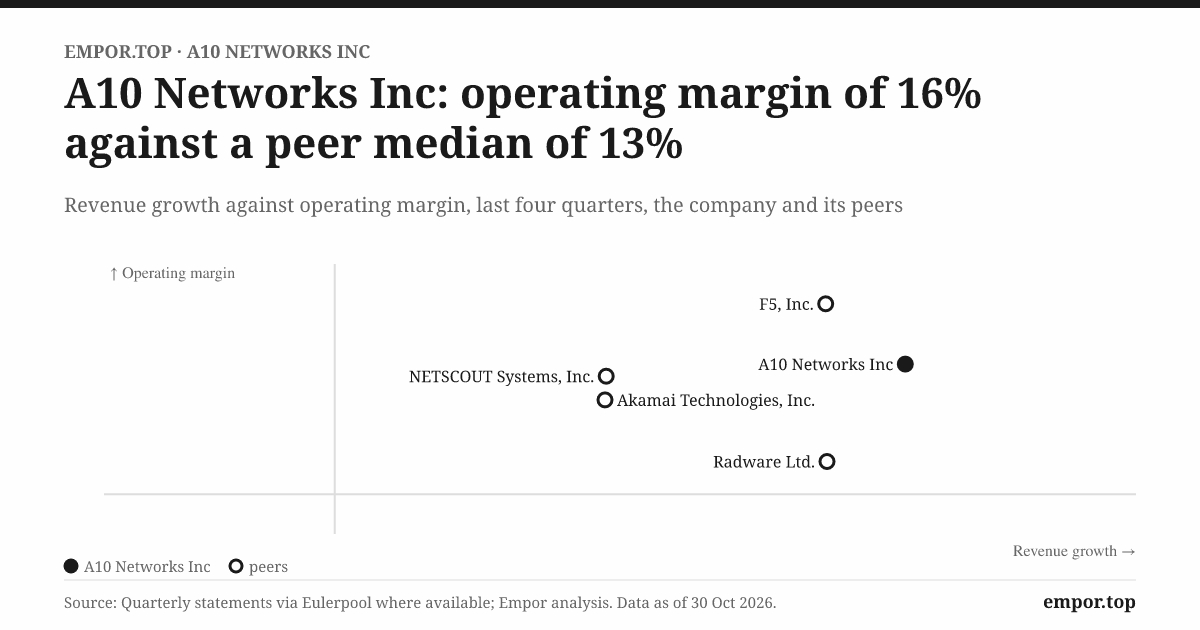
Measured from the 2022 peak to 2025, revenue grew only about 1% a year, and the full ten-year record works out to about 4% a year. Revenue reached a record $290.6 million in 2025, but operating margin was about 16%, below the 2022 high.3 Over the longest span that matters, this has been a modest-growth business that learned to be profitable, not a growth company that took a while to get going.
Trivedi's strategy, laid out over several investor presentations, has been to change what A10 is: to shrink the weight of its legacy load-balancing business and push the company toward security and what management calls next-generation networking for cloud, hybrid and AI-heavy environments.
Whether that strategy has changed the company's growth rate is the question 2026 is supposed to answer. To judge it, you first have to understand what A10 actually sells, and why its most recurring-sounding revenue line is not all recurring.
What does "services" really mean at A10?
Picture a network operator at a mobile carrier or a large cloud provider. Traffic through the core network is rising every quarter, some of it from video, some from millions of connected devices, and increasingly some from AI applications that send sudden, heavy bursts of requests.
The operator needs to handle more volume without adding latency to critical applications, and needs to fend off distributed denial-of-service attacks that try to drown the network in junk. A10 offers to solve that with a bundle: a physical appliance or software instance, the licence to run it, and a support contract that keeps it patched, updated and backed by engineers if something breaks.
The products under the Thunder brand do more than balance load, and two of them explain why carriers have been such important customers. Thunder CGN, for carrier-grade network address translation, stretches the life of the internet's old numbering system, IPv4, whose supply of addresses ran out years ago.11
Think of an apartment building with one street address and thousands of residents: the box keeps track of which resident each letter belongs to, so a mobile operator can serve millions of phones from a limited block of public addresses, and it translates between the old system and its successor, IPv6.11
Thunder SSL Insight tackles a different blind spot. Most traffic is now encrypted, which protects users but also hides malware from security tools, so the box does the computationally heavy work of decrypting traffic and handing it to a firewall for inspection.11 Both are unglamorous, both sit in the critical path, and both are bought in large quantities when a carrier expands its network.
That bundle is the heart of the revenue model. A10 sells hardware appliances that come with a perpetual software licence, term-based software licences that run for a set period, and a smaller amount of subscription product revenue.3
Everything else goes into "services," which covers post-contract support, professional services, training and software-as-a-service.3 In 2025, services made up about 42% of revenue.3 It is tempting to read that line as the recurring part of the business, the steady annuity underneath the lumpy boxes. That reading is too generous.
Support is the recurring piece. A typical support contract runs for a year, some run as long as seven, and most customers buy support when they first deploy and renew it when it expires.3 That is genuine repeat revenue, and it is valuable.
But the same line also includes professional services and training, which are one-time by nature, and A10 does not disclose what share of total revenue is truly recurring, what its renewal rate is, or what minimum commitments it holds by product.3 An investor who multiplies the services line by a software-company multiple is paying for a recurring stream whose size the company has never published.
There is also an accounting judgment buried in the split itself. When a customer buys a box, a licence and support in one deal, A10 must estimate what each piece would sell for on its own and divide the price accordingly.
Its auditor singled out exactly that estimate, the standalone selling price of bundled products and support, as the critical audit matter in the 2025 audit, while giving clean opinions on the accounts and on internal controls.3 Nothing suggests the estimate is wrong. It does mean the line between "product" and "services" is partly a matter of judgment, which is one more reason not to treat services as a pure measure of recurring revenue.
The other side of the model is more volatile. Hardware revenue is generally recognized when the box ships.3 Large customers buy in large, irregular orders after long evaluations, so a single delayed purchase can move a quarter. And almost none of it is sold directly: about 96% of 2025 revenue was fulfilled through distributors and other channel partners.3 A10's own salespeople often do the persuading, but the invoice usually runs through a middleman.
Collections have held up well through that structure. Receivables fell from about $77 million at the end of 2024 to about $62 million a year later, the allowance for bad debts shrank to a token $66,000, and invoice terms generally run 30 to 90 days.3
The weak spot is not who pays late but who pays at all: one distribution partner accounted for about 23% of gross receivables at the end of 2025, and A10 does not publish an ageing schedule.3
The first half of 2026 showed how the mix can swing. In the June quarter, products were about 61% of revenue and grew about 25%, while services grew only about 3%.1 In the March quarter, products had grown about 22% and services less than 3%, according to the company's remarks on that call.12 All of the acceleration, in other words, came from new boxes and licences.
That is exactly what a buying cycle looks like at its start, and it is also exactly what a single customer's large deployment looks like. The support stream follows hardware with a lag, so strong product quarters should lift services later. If services growth stays near 3% after a year of 20%-plus product growth, the market will have learned something about how much of the new hardware comes with long-lived support.
The customer mix also turned over. In 2025, service providers, the telecom carriers, cable companies and cloud operators that A10 grew up selling to, accounted for about 60% of revenue, and enterprises about 40%.3
In the June quarter of 2026, those proportions flipped, with enterprise at 60% of quarterly revenue, and about half on a trailing twelve-month basis.2 That sounds like a broad move into corporate data centers, and management presents it as part of a convergence in which AI is blurring the line between the two kinds of buyer.
But the call contained a detail that changes how to read the shift. Asked whether any revenue had been reclassified, Trivedi said historical revenue from Microsoft stayed in the service-provider bucket, while new Microsoft business on "a completely different product set" is reported as enterprise.2 At least part of the enterprise surge, then, appears to be a very large existing customer buying different things. A10 does not quantify how much.
Geography tells a similar story of concentration in a new place. In the June quarter, the Americas generated about 68% of revenue, and Caron said service-provider spending there "has begun to normalize," while carriers in Europe were held back by geopolitics and Japan by macroeconomic pressure.2
That is a striking change for a company whose second home market used to be Japan, which supplied about 30% of revenue in 2020.7 Japan is also where A10's currency exposure sits, because invoices there are mostly in yen, while most other contracts are in dollars.3 When Japanese carriers slow down, A10 loses both volume and, if the yen is weak, some of the dollar value of what it does sell.
There is some contracted visibility behind all this. At the end of 2025 A10 had about $143 million of remaining performance obligations, revenue it has been contracted for but not yet recognized, with about $81 million of it expected within a year.3 That is a cushion of a few months of revenue. It is not a renewal rate, and it does not tell you whether a customer will choose A10 again when its network needs its next capacity upgrade.
That is the question this business model forces on every investor. When the boxes reach the end of their useful life, or the traffic outgrows them, the customer runs a new evaluation. What, exactly, stops that customer from choosing someone else?
The moat has to survive the next bid
Imagine the procurement meeting. A large service provider's network team has two finalists for a capacity upgrade: A10, and the incumbent everyone in the industry knows. Traffic volumes are rising; the security team wants protection built into the same platform; finance wants a five-year cost.
A10 can argue that its boxes handle more traffic per dollar, that its management software runs across physical appliances, virtual machines and public clouds, and that it can deliver quickly. The incumbent can argue that it is ten times bigger, already embedded across the customer's estate, and sells a dozen other products the customer also needs. That meeting, repeated across hundreds of customers, decides whether A10 has a moat.
The battlefield is crowded. In application delivery, A10 lists F5, Citrix's NetScaler business and VMware, now part of Broadcom, as competitors; in broader networking and security, Cisco, Juniper (now part of HPE) and Fortinet; in DDoS protection, Radware and NETSCOUT's Arbor; and in cloud-delivered application protection, AWS, Cloudflare, Akamai and Imperva.3 Some of these are specialists of similar ambition. Others are giants for whom A10's whole market is a product line.
Scale is the first fact of this war game. F5, the company most investors think of when they hear "application delivery," reported fiscal 2025 revenue of about $3.09 billion.13 A10's was about $291 million.3
F5 is more than ten times larger, and A10 itself acknowledges in its filings that larger competitors can bring broader product portfolios, longer customer relationships and more money for sales, research and distribution.3 In a market where buyers want a single throat to choke, a broad portfolio is a weapon. A10's answer has to be that it is better at the specific job, not that it does everything.
Michael Porter's five forces make the pressure concrete, and the most important force here is the buyer. In 2025 a single end customer accounted for 26% of A10's revenue, up from 15% in 2024 and 14% in 2023, and the ten largest end customers accounted for 40%.3 That concentration persisted into June.2
A10's filings do not name the customer. The conversation on the June-quarter call made the likely answer hard to miss: analysts asked about Microsoft pre-buys and about managing the business "given Microsoft's revenue share," and Trivedi answered in terms of Microsoft's demand and rollout forecasts, saying "there is no prebuys or anything like that."2
Then came a filing that turns buyer power from a theory into a contract. Two days before the earnings release, A10 issued Microsoft a warrant to buy up to 800,000 A10 shares at one cent each, vesting in two equal tranches tied to Microsoft's purchases through June 2027 and June 2028.14 At the October 30 share price, the full warrant would be worth roughly $20 million.
Trivedi described the expanded agreement as "a shared commitment to a long term partnership with mutual performance commitments on both sides."2 That is a reasonable way to lock in a huge customer. It is also, economically, a price concession paid in equity: the buyer is large enough to ask for a share of the seller's upside in exchange for volume. Vendors with overwhelming pricing power do not usually need to offer that.
Channel power is the second pressure. One distribution partner handled 29% of A10's 2025 revenue, up from about 20% the year before.3 When a single intermediary carries nearly a third of your sales, it has leverage over terms, and its own financial health becomes your credit risk.
Substitution is the third, and the most strategic. The traffic-cop job that once required a dedicated box can increasingly be done by software running on ordinary servers, by features built into cloud platforms, or by security suites from vendors who bundle load balancing into something larger. Asked on the June call who the main competitors were, Trivedi named traditional infrastructure vendors adding features and "a lot of small and start up companies."2
Supplier power is real but secondary: manufacturing is outsourced, and component prices can change quickly with industry demand.3 On the March-quarter call, management said memory shortages could last four quarters or more and were "certainly a cost issue."12 New entrants face high technical barriers in carrier-grade networking, which is one of the few forces running in A10's favor.
What is A10's proposed answer? Management's pitch is integration: one architecture for delivery and security, across on-premises data centers, hybrid clouds and the network edge, run from one management console, and serving both carriers and enterprises with "1 architecture, 1 operating model, 1 security framework."2
At its February 2026 investor day, the company argued that more than 70% of revenue now comes from next-generation networking and security, and that its security-led revenue had reached 72%, above the 65% target it set in 2022.15 "Security-led" is management's classification, not an audited segment, but the direction is consistent with a company deliberately leaving its oldest market behind.
Hamilton Helmer's seven powers offer a stricter test. Switching costs are the most plausible power: these boxes sit in the critical path of a network, operators train their staff on one vendor's configuration language, and ripping out a working traffic manager is risky.
Process integration, the way A10's software ties into a customer's automation and monitoring, could reinforce that. Both are plausible, and neither is measured, because A10 publishes no retention rate, no renewal rate and no price realization data. Scale economies clearly favor the larger rivals.
Brand, in enterprise networking, belongs to Cisco and F5 more than to A10. There is no network effect in a load balancer. A cornered resource would require something no rival can copy, and the public record shows no disclosed technology or customer position of that kind.
Counter-positioning, a model the incumbents cannot copy without hurting themselves, is the most interesting candidate: an independent vendor can sell into Microsoft's data centers in a way a cloud rival cannot. But that argument depends on one customer.
Now test the claim against A10's own history. If the product position were a strong moat, it should show up as growth that compounds. The 2023 service-provider pause exposed the limits of that position.11
That record does not prove A10 lost share; the service-provider market itself was weak, and the company's chief financial officer said on the March-quarter call, "We're not losing market share or experiencing competitive displacement."12
But it does put a ceiling on what the product advantage has delivered so far. Management's own investor-day revenue bridge assumes the company can add six to seven points a year of share gains on top of four to five points of market growth.15 A10 does not publish market-share data that would let anyone check whether that has happened before.
The verdict, then, is that A10 has a credible product position and a plausible switching-cost advantage with existing customers, but the moat is unproven rather than established. The evidence that would strengthen it is specific: a falling share for the largest customer even as total revenue grows, a broader base of customers contributing to growth, and some disclosed measure of retention or renewal.
The evidence that would weaken it is equally specific: a reversal when one customer's rollout ends. Trivedi himself said the concentration figure "will change probably in the future."2 Whether it changes because others grow or because the big one slows is the whole game.
For now, A10's plan is to make the moat wider by selling into the newest, loudest source of network traffic. That plan costs money, and the question is whether the demand can pay for it.
Can AI demand pay for the new strategy?
In February 2026, A10 held an investor day and put up a slide with a sentence designed to be remembered: "AI is a Traffic Problem Before It's a Compute Problem."15 The argument was elegant. Everyone was talking about chips, but every AI model sitting in a data center has to receive requests, return answers and talk to other systems, and all of that is traffic that has to be routed, balanced and secured.
The company cited a third-party estimate that AI workloads had reached nearly 30% of data-center traffic by the end of 2025, and described the moment as "The Intelligent Era," in which its job was "enabling performance and security at AI scale."15
The deck broke the business into three pieces, and it is the most useful map of the strategy A10 has published. Legacy networking, the old load-balancing business, had shrunk from about 47% of revenue in 2022 to 28% in 2025, and management expected it to shrink by up to 5% a year from then on.15 Network security had grown from 18% of revenue to 35%, with a three-year growth outlook of 14–16% a year.15
Next-generation networking, the cloud and AI traffic products, had moved from 35% to 37%, with an outlook of 16–18% a year.15 The company set goals of at least 12% annual revenue growth across 2027 and 2028 and an adjusted EBITDA margin of 28–30% or better.15 For 2026, it guided to 10–12% revenue growth.15
The first half of 2026 delivered more than that. March-quarter revenue grew about 13%, and Trivedi said that "traffic management is returning to the forefront of build-out plans."12 He also disclosed that one large AI infrastructure customer accounted for a high percentage of the quarter's revenue and that A10 had chosen to prioritize that deployment.12 The company held its 2026 outlook steady at that point because it wanted to "see the progression through the year."12
After the June quarter's 15.5% growth, it raised its outlook again.1 On that call Trivedi described AI traffic as "burst traffic, high volume traffic" that creates two needs, low-latency traffic management and protection against AI-enabled threats, and said the demand should be sustainable for "several years" because it depends on whether people use AI, not on how many data centers get built.2
Set that confident narrative beside the analysts' questions and a pattern emerges. On the March call, Powell asked where AI spending stood in its cycle; Trivedi said the build-out phase was active and enterprise use was at a "very early stage."12 On the June call, Christian Schwab of Craig-Hallum asked about growth drivers, and Trivedi said on-premises enterprise AI was "not a big demand driver immediately" but should matter over two to three years.2
When Romanelli asked how A10 measures AI success, the answer was by "how many customers are we engaged with," with no count given, while many customers were running proofs of concept.2 Hamed Khorsand of BWS Financial pressed on whether the business was growing without the big customer, and got the most revealing answer of the year: excluding the Microsoft agreement and "1 or 2 countries" with macroeconomic problems, the business was growing "close to double digits."2 That is a solid number. It also means that the AI story, in revenue terms, is still mostly one customer's story.
The company is investing as if the broader opportunity is real. Research and development rose from $57.7 million in 2024 to $69.1 million in 2025, from about 22% of revenue to about 24%, mainly because of personnel costs, and A10 said it expected further investment in cybersecurity and AI in 2026.316 Capital spending rose from $12.3 million to $20.1 million, from under 5% of revenue to about 7%.316
Headcount went from 481 to 494.3 Meanwhile the gross margin on services fell from about 83% in 2024 to about 78% in 2025, partly because of higher support personnel costs, a change in delivery mix and a small impairment.3 These are real commitments. They are not yet proof that the new products sell at scale, and they help explain the June-quarter margin decline.
A10 has also bought its way into new capabilities, twice in eighteen months. In February 2025 it acquired the assets and key staff of ThreatX Protect, a cloud-delivered service that protects web applications and the programming interfaces that apps use to talk to each other, including bot management and a next-generation web application firewall.17
Terms were not announced, and management said the deal would be modestly accretive to 2025 earnings per share without changing the long-term model.17 A10's 2025 cash-flow statement shows about $19 million spent on the acquisition, and goodwill rose by roughly $14 million that year.3 ThreatX's standalone revenue has not been disclosed, so the deal's return cannot be measured from the outside.
The second deal reached further into the AI story. On June 15, 2026, A10 acquired TrojAI, a company that helps organizations secure, test and govern AI applications and agent-based workflows, through "red teaming," attacking a model before release to find its weaknesses, and real-time protection when the model is live.18
Founded around 2020 and based in Saint John, New Brunswick, TrojAI had a team of about 22 people and had last raised about US$5.75 million in 2024.19 Trivedi framed the logic in a sentence: "Pairing our hardware-based AI firewall with TrojAI's software-based red teaming and runtime protection helps customers adopt AI quickly and confidently."18
A10 said the deal would not materially affect its 2026 results.18 On the June call, asked by Mizuho's Romanelli why the deal made sense, Trivedi said TrojAI had "a very strong technical solution" that complemented A10's own, that it could be sold on its own or bundled, and that the longer-term roadmap pointed toward "native AI solutions" within one or two years.2 That is a product plan, sensibly argued. It is not yet a revenue plan, because none of the answer described customers, pricing or expected sales.
The price is in the June-quarter filing even though the press release left it out. A10 paid about $34.7 million in cash and about $5.0 million in stock, roughly 154,000 shares, and recorded about $32.8 million of goodwill and $8.8 million of intangible assets.2021
In plain terms, A10 paid around $40 million for a small team and a technology, and most of that price sits on the balance sheet as goodwill: the premium for capabilities and future revenue that do not yet show up anywhere in the accounts.
TrojAI's revenue has not been disclosed, so no revenue multiple can be calculated, and comparing it with other AI security deals would be guesswork. The test is simpler: within a couple of years, does A10 report customers paying for AI security in a way that justifies a $40 million cheque?
History offers a cautionary echo. In 2016, A10 bought Appcito, a cloud application-delivery startup, for about $6.5 million in total consideration, a strategic move toward exactly the cloud-native future the company was then promising.22
A10 never reported standalone revenue or returns from that deal, and the company kept losing money for three more years. That is not a verdict on TrojAI; the price, the management team and the market are all different. But it is a reminder that A10 has been early to the right idea before without that idea showing up in its income statement.
The same caution applies to the AI Gateway and AI firewall products. Announcements and technical features are not revenue. A10 does not report revenue by product line, so it is impossible today to say how much of the 2026 acceleration came from AI-specific products versus a large customer buying traditional traffic management for AI-adjacent infrastructure.
The strategy is coherent, and the demand signal strengthened through the first half of 2026. The strategy will be proven when A10 can point to paying customers, product revenue and margin contribution, and the rising cost base means it needs to get there soon.
There was one more choice in the same period that complicates the picture. While A10 was spending to grow, it also borrowed $225 million and handed a large slice of cash back to shareholders.
The buyback happened alongside a new debt
In March 2025, A10 did something it had never done as a public company: it borrowed in size. It sold $225 million of convertible senior notes due in 2030, carrying an interest rate of 2.75%, and collected about $217.7 million after costs.3 Until then the company's balance sheet had carried almost no financial debt.
Over the rest of the year A10 bought back $68.9 million of its own stock and paid $17.4 million in dividends.3 By December it had about $378 million of cash and marketable securities, the largest pile in its history, and about $219 million of notes on the other side of the ledger.3
A convertible note is a loan with an option attached, and it helps to spell out how this one works. Investors lent A10 money at a low interest rate. In exchange, they received the right to swap each $1,000 of notes for about 42.6 shares, which works out to an initial conversion price of about $23.46 a share.320 If the stock stays below that price, the noteholders simply get their interest and their money back in 2030, and A10 has borrowed cheaply.
If the stock rises well above it, the holders can claim shares worth more than their loan, and existing shareholders give up some of that upside. The notes carry no financial maintenance covenants, so A10 cannot be forced into default by a weak quarter.3 The company can choose to settle conversions in cash or in a mix of cash and shares.20
In the second quarter of 2026, the share price did something the note's fine print anticipated. It traded above 130% of the conversion price, about $30.50, on at least 20 of 30 trading days, which triggered the holders' right to convert between July 1 and September 30, 2026.20
Because holders could demand settlement within a year, A10 reclassified the notes as a current liability, about $219.5 million on the June balance sheet, and estimated their fair value at about $383 million.20 That is what the market thought the loan-plus-option was worth when the stock was riding high. Against it, A10 held about $357 million of cash and marketable securities at the end of June, and management said that would cover a cash settlement.20
Here is the arithmetic that matters. If every note converted, the conversion right would cover about 9.6 million shares, roughly an eighth of the shares outstanding. If A10 paid the $225 million principal in cash and delivered shares only for the value above it, the share count would rise far less: at the October 30 price of $25.75, the in-the-money portion is worth only about $22 million, or fewer than a million shares.
But paying the principal in cash would take more than 60% of the June cash pile, leaving roughly $130 million for a company that has also promised to keep investing, buying back stock and paying dividends. By the end of October, A10 had made no separate announcement about how many notes were converted in the window or how they were settled. That answer will arrive with the third-quarter results.
Now step back and look at what the board did in 2025. A10 generated about $64.8 million of free cash flow that year.3 It returned about $86 million to shareholders through buybacks and dividends, more than the business produced. The gap, and then some, was funded by the notes. The company did not need the money to survive; it had nearly $200 million of cash and securities at the end of 2024.3
So the board was making a choice: borrow cheaply against the option value of its own stock, keep the cash cushion growing, and shrink the share count. That can be a smart trade. It can also be a way of making per-share numbers look better while the operating business is still finding its growth.
Did the buyback earn its cost? The repurchases in 2025 averaged about $18.77 a share.3 On October 30, 2026, the stock was at $25.75, so on paper the shares bought back are worth more than A10 paid.
That is not proof of good judgment, because the subsequent price reflects things the board could not have known, and the right test is whether the price paid was sensible against the value and alternatives available at the time. The awkward detail is the relationship between the two halves of the trade. A10 bought back shares in the high teens while selling investors the right to receive shares at about $23.46.
If the stock stays above that level, some of the share-count reduction the buyback achieved will be given back through conversion, and the company will have paid the noteholders' option premium for the privilege. If the stock falls below it, the buyback looks expensive and the notes look cheap. The board effectively placed a bet on its own stock in both directions. The bet continued into 2026 at higher prices.
In the June quarter, A10 repurchased about 86,000 shares at an average of about $27.63, above the conversion price it had sold to noteholders, and it still had about $53 million left on its $75 million authorization.12 The amounts were small, but the direction is telling: the company was buying its own stock at a level where, if the stock kept rising, the notes would hand shares back out.
The capital story also flatters the earnings story in a way investors should separate. In 2025 A10 earned about $11.6 million of interest income on its cash and securities, about 22% of its $52.4 million pretax income.3
The note itself costs about $6.2 million a year in cash interest, so the borrowed money partly paid for itself while invested in Treasury and corporate securities. That is a treasury result, not a product result. In 2024, A10's non-operating income was flattered differently, by about $5.3 million of gains on equity investments.3
Neither source tells you anything about whether customers want A10's boxes. The dividend, meanwhile, has become part of the furniture. A10 has paid six cents a share each quarter, and in 2025 the payout absorbed about 40% of net income, a steady commitment that the company reaffirmed with another six-cent dividend in August 2026.13 At the October 30 share price that is a yield of under 1%, small enough that the dividend is a signal of confidence rather than a reason to own the stock.
The same discipline applies to cash flow. Over the twelve years from 2014 to 2025, A10 generated about $392 million of operating cash against only about $140 million of cumulative net income. Part of that gap is a genuinely good business trait: customers often pay for multi-year support upfront, so cash arrives before revenue is recognized.
Part of it is the way cash-flow statements work. Stock-based compensation, about $20 million in 2025, is added back to cash flow because no cash leaves the building.3 But shares issued to employees dilute every other shareholder, which is why the honest version of A10's free cash flow in 2025 is closer to $45 million than $65 million once stock compensation is treated as the cost it is.
A10's own published framework for capital allocation puts organic growth first, then buybacks and dividends, then opportunistic acquisitions with a three-to-four-year payback target.15 By that standard, 2025 and 2026 delivered all three at once: rising R&D, a large buyback, a steady dividend, and two acquisitions, all while a convertible note was approaching its first conversion window.
The balance sheet can absorb it. Whether the combination created value per share depends on two numbers the market does not yet have: how the note was settled, and what TrojAI and ThreatX end up earning. Both bring the story back to the person who signed off on all of it.
The CEO's scorecard: growth, pay and shareholder trust
The 2026 annual meeting, held in April, should have been a quiet affair. Every proposal passed. But the vote tallies, filed with regulators a day later, told a less comfortable story. Eric Singer, the director who had been named lead independent director when Trivedi became chair, received about 29.2 million votes in favor, while about 32.1 million shares were withheld from him.23
More shareholders declined to support him than supported him. He remained on the board all the same. The advisory vote on executive pay passed with about 44.6 million votes in favor and 15.8 million against.23 A year earlier, according to the company's proxy, the same say-on-pay proposal had won roughly 97% support.24
Something had changed in twelve months, and shareholders did not file a public explanation with their ballots. Judge management, then, on behavior over time, not personality.
Start with the record. Trivedi arrived at a company exploring a sale and made it profitable within a year. Under his leadership, A10 has paid a dividend since 2021,10 built a cash pile of nearly $400 million, made two security acquisitions and delivered record revenue in 2025.3
Those are real achievements. Against them stand the post-2022 slowdown, the lower 2025 operating margin and the June-quarter profit decline.13
Management has a way of scoring itself that deserves attention. At the February 2026 investor day, the company set its 2022 targets beside its 2025 results: a "Rule of 40" score, the sum of growth and margin, of about 40.6; revenue growth of 11% against a 10–12% target; adjusted EBITDA margin of about 29.6% against a 26–28% target; and security-led revenue of 72% against a 65% target.15 Every box ticked.
But the revenue target was met by the growth rate in the final year, which came after a 10% decline in 2023. Measured across the full period from 2022 to 2025, revenue barely grew. The margin targets were met on an adjusted basis that excludes stock compensation and acquisition costs, while GAAP operating margin went backwards. Neither presentation is false. Both choose the yardstick that flatters.
The same pattern appears in the guidance. A10 told investors in 2026 that earnings per share would grow faster than revenue, and on the June call Trivedi said the company was "on track to do just that."2
On the adjusted measure, that was true: non-GAAP EPS rose.1 On the GAAP measure, EPS fell.1 A promise that holds only after excluding the costs of acquisitions and employee shares is a narrower promise than it sounds.
Pay is the next test. Trivedi's reported total compensation rose from about $4.6 million in 2023 to about $6.3 million in 2024 and about $7.0 million in 2025, while net income moved from about $40 million to a peak of about $50 million and then back to about $42 million.24 His 2024 package included a cash bonus of about $338,000; the summary table shows no CEO bonus in 2023 or 2025.24
Most of the increase came through stock awards, whose value depends on performance conditions and the share price, so totals alone cannot settle whether pay is aligned with results. They do show that the CEO's reported pay rose by about half in two years while net profit rose only slightly, and that 15.8 million votes against the pay plan were a signal worth heeding.
Ownership gives Trivedi real exposure. According to the 2026 proxy, he held about 887,847 shares, roughly 1.2% of the company, worth about $23 million at the October 30 price.24 That is meaningful skin in the game for a company of this size. Board structure cuts the other way.
Four of the five directors were independent as of the 2026 proxy, but the chief executive also chairs the board, which concentrates both running the company and overseeing it in one person.24
In September 2026, the board expanded to six seats and appointed Mary C. Henry as a director effective October 5.25 The company did not frame the appointment as a response to the vote, and it is too early to say whether it marks a change in how the board operates.
Who, then, withheld those votes? The register does not say much. A10 has no controlling shareholder, and the 2026 proxy listed BlackRock at about 18% and Vanguard at about 10%, but those stakes came from filings dated December 2023 and February 2025 and are not current snapshots.24 Vanguard later reported zero beneficial ownership after an internal reorganization moved its holdings to separately reporting investment managers.26
The proxy counted just 37 holders of record, with the real owners hidden behind brokers and institutions.24 What is clear is that this is an institutionally owned company, and institutions that withhold votes from a lead independent director are usually sending a message about board oversight rather than about a single quarter.
The chief financial officer's chair also changed hands. Brian Becker resigned effective September 2025, and Michelle Caron became CFO that month.24 A new CFO inherited the old guidance and the old definitions, and her first year was the best window into whether the narrative was tightening or loosening. On the March-quarter call, Caron called a build in receivables "a calendar event and not a credit event," with no change in payment behavior or terms.12
On the June call she said service-provider spending in the Americas "has begun to normalize," while Europe was "impacted by the geopolitical environment" and Japan faced "macroeconomic pressures."2 Those are specific, falsifiable statements. They also leave the hardest question to the CEO: how much of the growth is broad, and how much is one customer.
The fairest verdict is that Trivedi has earned credit for rescuing the business and for consistency of strategy, but not yet for proving the strategy pays. The next credibility test is simple and public.
When the raised guidance meets the third-quarter results, does management explain any reversal in customer mix or margin with numbers, or with adjectives? That test sits inside a larger one, which is whether the market is paying too much for the possibility that all of this works.
The investment case lives between the appliance and the renewal
Put two facts side by side and the whole debate comes into focus. In the first half of 2026, A10 grew revenue about 14.5%, faster than in any full year since 2016.1
On October 30, 2026, the stock traded at a premium to its five-year median earnings multiple. One fact says the business has changed. The other says the market has already decided it has. The space between them is where the risk lives.
Start with why A10 might win. The company sits at the junction of three needs that are all growing: more traffic, more encryption and more attacks. AI workloads add bursty, heavy demand to networks that were not designed for it, and management's argument that AI is "a traffic problem before it's a compute problem" is a reasonable description of a real engineering challenge.15
A10's products combine traffic management and security in one platform that can run on its own hardware, on customers' servers or in public clouds, which appeals to carriers and enterprises that want fewer vendors in the critical path. Gross margins near 80% mean that if volume grows, a lot of it falls to profit once operating costs stop climbing as fast.1
The second reason is momentum with a cushion. Revenue accelerated through the first half of 2026, guidance went up, and A10's contracted-revenue cushion includes support contracts that tend to renew.3
A10's balance sheet, even if it pays out the convertible principal in cash, would leave it with a meaningful cash position and no maintenance covenants. That gives the company room to keep investing through a soft quarter rather than cutting R&D to protect earnings, which is exactly the choice that kept it small in the late 2010s.
The third reason is the Microsoft relationship itself. A multi-year agreement with "mutual performance commitments," backed by a warrant that vests only if Microsoft keeps buying through mid-2028, gives A10 more visibility into its largest customer than it had before.214 If the relationship extends into new product sets, as the enterprise reclassification suggests, it could become a reference account that helps sell to others.
Now the case against. The first problem is concentration, and it is getting worse, not better. The largest customer's share rose sharply, while one distributor handles a large share and nearly all sales go through channel partners.23
In a business where revenue is recognized when boxes ship, a single paused rollout can turn a 15% growth quarter into a decline, and the 2023 service-provider slump shows that this is not a hypothetical. The Microsoft warrant reduces the risk of losing the customer, but it also confirms who holds the bargaining power.
The second problem is the long record. Ten years of about 4% annual revenue growth and three years of about 1% are hard to reconcile with a premium multiple. The latest quarter's GAAP profit fell. A10 does not disclose total recurring revenue, renewal rates, win rates or market share, so investors cannot verify the claims that would justify paying for durability. The moat, as the procurement-meeting war game showed, is plausible rather than proven.
The third problem is competition. Larger rivals have greater scale, while cloud providers, content-delivery networks and software-only vendors can offer substitutes for A10's core products.3
Every one of those alternatives gets better each year whether or not A10 does. Add the cost side: management called memory shortages "certainly a cost issue" that could persist for four quarters or more, and supply-chain cost and delivery challenges were still being cited in August.122
A skeptical activist would sharpen these into four questions for the board. Why did the company borrow to fund shareholder returns while ramping investment? Why should investors accept adjusted margins as the scorecard when GAAP margins are falling?
Why does the chief executive also chair the board after shareholders signaled concern about oversight? And when will A10 disclose the numbers, such as recurring revenue, renewal rates, product-line revenue and AI revenue, that would let the market judge whether the strategy works?
None of these questions implies wrongdoing. All of them are fair at a premium valuation. One more item belongs on a careful investor's list, if only as a footnote. In 2023, A10 disclosed a cybersecurity incident in its own corporate IT systems, not in the products it sells to customers; the company said it incurred investigation costs but no material impact.3 For a vendor that sells security, even a contained incident is a reminder that the company's reputation is part of the product.
The third-quarter report will show how the notes were settled and whether some of the per-share benefit of the 2025 buyback was given back. Then stress-test the growth story by watching three things over several quarters: the mix between products and services and between enterprise and service providers, GAAP operating margin, and the largest customer's share.
If an investor were to carry only three numbers forward, these would be them. The first is revenue growth by product and customer group: products grew about 25% and services about 3% in the June quarter.1 The second is GAAP operating margin, which fell in the June quarter.1
The third is customer and channel concentration, which remains high.23 If A10 ever begins to disclose recurring revenue or renewal rates, those should join the list, because they would answer the durability question directly.
Finally, valuation, as data rather than verdict. At about 6.6 times enterprise value to sales and about 24 times EV to EBITDA, A10 trades well above where it stood at the end of 2025. A snapshot dated December 31, 2025, put A10 at about 4 times trailing EV to revenue and about 18 times EV to EBITDA, against about 4.5 and 16 times for F5 and about 1.7 and 9 times for NetScout.27
Those peer figures come from a different date and a different period, so they are not a clean comparison. What they suggest is that the market has re-rated A10 from a price below the category leader's to one well above it.
That price appears to assume that the 2026 acceleration is the start of a sustained new growth rate, not a large customer's deployment cycle. The evidence so far supports the possibility, not the certainty. Another way to see the same assumption is through yields.
At almost 45 times earnings, each dollar invested in A10 stock buys about 2.2 cents of current annual GAAP profit, less than the 2.75% A10 itself pays its noteholders. A buyer at that price is not paid for today's earnings; they are paying for the earnings growth that the 2026 acceleration promises, and for the hope that the gap between adjusted and reported profit narrows rather than widens.
What does a company like this teach, beyond the numbers?
Lessons from a business built for traffic spikes
Somewhere tonight a network engineer is watching a dashboard. The line on it climbs every evening as people stream, search and ask chatbots questions. If the traffic cop at the front of the data center hesitates, customers notice in milliseconds. That engineer cannot afford a slow or unavailable application.
And yet the vendor who makes that box can still face lumpy orders, a procurement team that pushes hard on price, and a customer large enough to ask for warrants. A10's story is full of that paradox, and it leaves five lessons that belong to this company.
The first lesson comes from the shipping dock. A10's lumpy appliance sales and smaller support stream behave differently, as the 2023 product-sales collapse and 2026 surge showed.
Critical infrastructure is not the same thing as recurring revenue. Founders who build mission-critical hardware should never let investors confuse the two, and investors should never pay for the second when they are buying the first.
The second lesson comes from the procurement meeting. A10's integrated performance-and-security pitch gets it into the room and often wins the trial; it is a good story, technically credible and sharply targeted.
But the moat question is only answered when the customer comes back for the next upgrade without seriously considering the incumbent, and A10 has never published the data that would show how often that happens. A good product story earns a trial; a good renewal record earns a moat.
The third lesson comes from the cash-flow statement. A10's operating cash has far outpaced net income, partly because of stock compensation and support paid in advance. Cash can outgrow earnings for reasons that still cost shareholders. The engineer's salary paid in shares is still a salary.
The fourth lesson comes from March 2025, when A10's borrowing funded shareholder returns beyond what its business generated. The board had reasons, and the share price later made the buyback look clever on paper.
But the note carried an option that the stock has since put into the money. A buyback funded beside new debt is a choice, not a free lunch. The bill came due in the conversion window, and it is paid either in cash that could have funded growth or in shares that undo the buyback.
The fifth lesson comes from the TrojAI deal. ThreatX before it, and Appcito a decade earlier, were bought for the same kind of strategic reason: they made the product story more modern.
An acquisition is strategic only after customers pay for what it added. Until A10 reports revenue from these deals, they are options bought with shareholders' money, and options can expire.
Each of those lessons points to the same evidence, and the next filings will supply much of it.
The next filings will decide what kind of growth this is
On October 8, 2026, A10 announced that it would report third-quarter results after the market closes on Thursday, November 5, with a call at 4:30 p.m. Eastern.28 On the date this story is written, that report is six days away, and the September quarter is already over. The answers exist; they simply have not been published.
The first thing to look for is the note. The holders' conversion window closed on September 30.20 The third-quarter filing will settle the question of how the notes were handled and show the diluted share count afterwards. A cash settlement would reduce the cash pile and the interest income that has propped up pretax profit; a share-heavy settlement would hand back part of the buyback.
Microsoft's warrant provides another test as its vesting milestones come due.14 Each milestone will tell investors, more clearly than any press release, whether A10's largest relationship is still growing.
The second is the shape of growth. Guidance of 12–14% for the year implies a second half that keeps growing at a double-digit pace.1 If the third quarter delivers that with services growth picking up and the largest customer's share starting to fall, the "few big orders" worry shrinks.
If growth holds only because one customer kept buying, the concentration question gets sharper. If product revenue slows as the big rollout completes, the market will learn how much of 2026 was a deployment cycle.
The third is margin. If revenue grows while GAAP operating profit keeps falling, the gap between the adjusted story and the reported one becomes the story. If R&D and acquisition costs begin to level off while revenue keeps climbing, the investment phase will start to show returns in the accounts, not just in the presentation.
The fourth is product proof. A10 has said its AI firewall, AI Gateway, ThreatX and TrojAI capabilities position it for the next era of network security. Any disclosed customer counts, paid usage or revenue from those products would be the first hard evidence that the optionality is becoming a business. Without it, the right way to think about them is as investments that have not yet paid.
Beyond the quarter, the investor-day promises set the longer clock.15 Those promises are measurable. If A10 begins reporting revenue along the same three lines it used on investor day, investors will be able to check the share-gain arithmetic directly. If it does not, they will have to infer it from a single revenue line that one customer can move by a third.
And in the spring of 2027, at the next annual meeting, shareholders will see whether the board responds to the withheld votes and the pay dissent of 2026, or simply hopes they do not recur. Tonight, A10 is a profitable, well-capitalized company with accelerating sales, falling GAAP margins, one dominant customer and a premium price. Within a week, the market will learn whether those facts still fit together.
Outro
Go back to the network engineer and the climbing line on the dashboard. The traffic is not going away. On August 5, 2026, A10 reported its fastest growth in years.
But essential in the moment is not the same as essential at renewal. The engineer will face a choice again: renew, upgrade or switch. Multiply that choice across a few very large customers and the whole company's future is inside it. A10's story is not whether the world needs more secure traffic management; it is whether enough customers will keep choosing A10 to make that need compound.
References
-
Q2 2026 Earnings Release — A10 Networks, 2026-08-05 ↩↩↩↩↩↩↩↩↩↩↩↩↩↩↩↩↩↩↩↩↩
-
A10 Networks (ATEN) Q2 2026 Earnings Call Transcript — The Motley Fool, 2026-08-12 ↩↩↩↩↩↩↩↩↩↩↩↩↩↩↩↩↩↩↩↩↩↩↩↩↩
-
2025 Form 10-K — A10 Networks, 2026-02-25 ↩↩↩↩↩↩↩↩↩↩↩↩↩↩↩↩↩↩↩↩↩↩↩↩↩↩↩↩↩↩↩↩↩↩↩↩↩↩↩↩↩↩↩↩↩↩
-
Form S-1 Registration Statement — A10 Networks, 2014-02-18 ↩
-
A10 Networks, Inc. Announces Pricing of Initial Public Offering — Summit Partners, 2014-03-20 ↩
-
Dhrupad Trivedi Appointed as the Company's Chairperson of the Board of Directors — A10 Networks, 2020 ↩
-
A10 Networks Q1 2026 Earnings Call Transcript — Equibles, 2026-04-28 ↩↩↩↩↩↩↩↩↩
-
F5 Reports Fiscal Year 2025 Fourth Quarter and Full Year Results — F5, 2025 ↩
-
Form 8-K: Warrant Issued to Microsoft — A10 Networks, 2026-08-05 ↩↩↩
-
2026 Investor Day Presentation — A10 Networks, 2026-02-19 ↩↩↩↩↩↩↩↩↩↩↩↩↩
-
A10 Networks Expands its Cybersecurity Portfolio with Acquisition of ThreatX Protect — A10 Networks, 2025-02-13 ↩↩
-
A10 Networks Acquires TrojAI Inc., Expanding AI Roadmap — A10 Networks, 2026-06-15 ↩↩↩
-
TrojAI Acquired by A10 of Silicon Valley — Entrevestor, 2026 ↩
-
Prospectus Supplement (Form 424B7) for Shares Issued to Former TrojAI Holders — A10 Networks, 2026-08-07 ↩
-
Form 8-K: 2026 Annual Meeting Vote Results — A10 Networks, 2026-04-23 ↩↩
-
Form 8-K: Board Expansion and Appointment of Mary C. Henry — A10 Networks, 2026-09-14 ↩
-
Q4 2025 Technology Review — Cassel Salpeter & Co., 2026-02 ↩
-
A10 Networks to Announce Third Quarter 2026 Financial Results on November 5, 2026 — Finviz/Business Wire, 2026-10-08 ↩
 LinkedIn
 WhatsApp
 Reddit
 Hacker News
 Email
 Kindle
 RSS Feed
 Spotify
 Apple Podcasts
 Amazon Music
 Audible
 YouTube