Strive, Inc.: The Bitcoin Treasury That Has to Keep Raising Capital
I. Forty-three Thousand Bitcoin, Three Classes of Stock
On Monday, October 26, 2026, a small company from Ohio filed a one-page update with the Securities and Exchange Commission that read like a dispatch from a factory running three shifts. In the five trading days from October 17 to October 23, Strive, Inc. had bought 6,182 bitcoin at an average of about $82,700 apiece. Its holdings had reached 43,000 coins. Its cash pile had grown by roughly $187 million in a week, to about $504 million.
And the same table showed what had paid for all of it: 3.3 million more common shares than the week before, 14 million shares of one preferred stock, and a brand-new line for 7 million shares of a second preferred stock that had not existed a fortnight earlier.1
That second preferred stock is called SATS. Strive had sold 7 million shares of it to the public at $90 each, closing the deal on October 20, which works out to about $630 million before fees.2 Every share carries a stated amount of $100 and accumulates dividends at 15% a year on that amount, paid out each business day once the board declares them.3
On the same day as the treasury update, Strive registered an at-the-market program to sell up to $1 billion more of it, a little at a time, through a roster of seven brokers who would collect up to 2% of whatever they sold.3
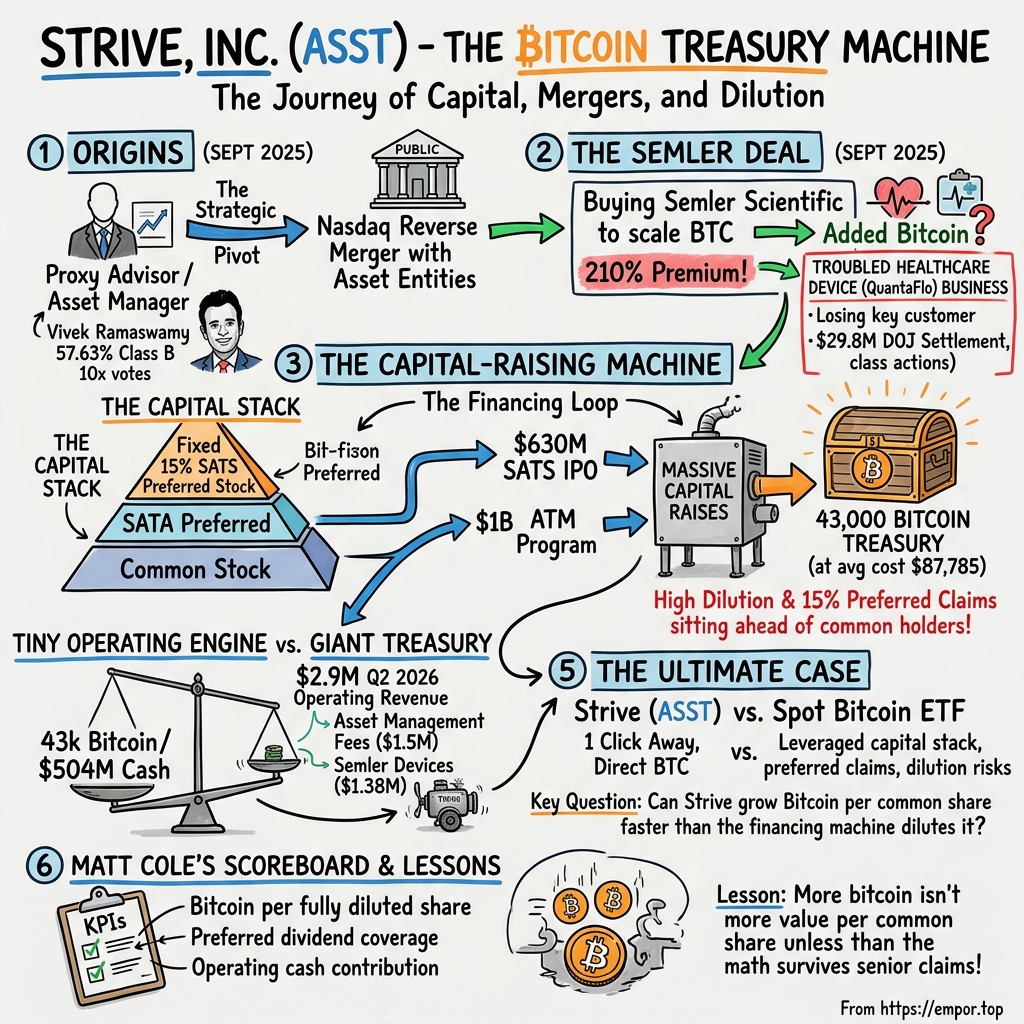
Set those numbers against the business that sits underneath them and the contrast is almost comic. In its most recent reported quarter, the three months to June 2026, Strive earned about $2.9 million of revenue: roughly $1.5 million of fees for managing other people's money and roughly $1.4 million from renting out a medical device that tests for peripheral artery disease.4
At late-October prices, its bitcoin was worth more than a thousand times that quarterly revenue. A company that takes in about $12 million a year from customers had just promised preferred shareholders roughly $105 million a year on SATS alone, on top of the dividends already flowing to the older preferred stock.31
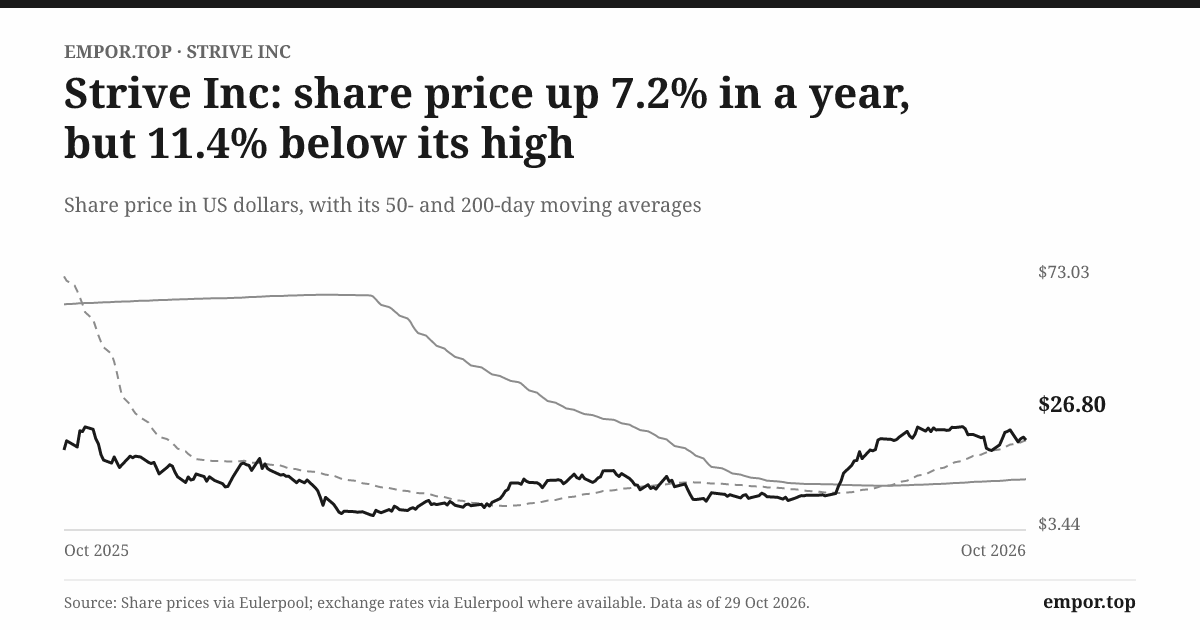
The stock market has noticed. Strive's Class A shares closed at $26.80 on October 29, near the top of a 52-week range that runs from $7.17 to $30.26, and the shares have swung with a one-year volatility above 100%.5 For anyone who bought at the wrong moment, the record is brutal: at their worst, the shares had lost 98% from a prior peak.5
So this is a story about a machine, and about whether the machine works. Strive does not make anything a bitcoin holder needs. It does not mine, custody or trade bitcoin for customers. What it sells is its own securities: common stock to investors who want a leveraged, actively managed bitcoin position, and preferred stock to investors who want a high, regular cash yield with bitcoin as the collateral underneath. The money comes in; bitcoin goes out the other side onto the balance sheet. The pitch is that each turn of the crank leaves every common share owning more bitcoin than it did before.
That pitch raises three questions this episode will try to answer. The first is what Strive actually is, because the company on the Nasdaq ticker today is barely a year old in its current form and stitched together from three different businesses. The second is whether the financing model creates value for the common shareholder after counting everyone who stands ahead of them in line. The third is whether the people running it can keep it going when markets stop cooperating, since a model that has to keep raising capital is only as strong as its next raise.
A word of caution before the story starts, because the numbers here need careful fences. Today's listed Strive was created by a reverse merger in September 2025, when a privately held asset manager slipped into the shell of a tiny Nasdaq-listed social-media marketing company called Asset Entities.6 Its annual report for 2025 therefore splits the year into "Predecessor" and "Successor" periods, and the long-run revenue growth rates a stock screener shows for ASST stitch together businesses that have nothing to do with each other.6
Then, in January 2026, Strive absorbed Semler Scientific, a diagnostics company with a bitcoin hoard of its own, and Semler's healthcare results joined the consolidated statements from that point.7 Any figure from before those dates describes a different company.
What remains is a genuinely interesting experiment in corporate finance. Strive has grown its bitcoin holdings more than fivefold since the end of 2025.61 Whether that growth belongs to the common shareholders, or mostly to the people who lent and sold preferred stock to make it possible, is the question that will run through every section that follows. To answer it, the story has to start with a very different company: an asset manager founded to pick a fight with BlackRock.
 Subscribe on LinkedIn
II. The Proxy Adviser Became a Treasury Company
In the summer of 2022, a biotech entrepreneur named Vivek Ramaswamy was pressing an argument about corporate America. He had left Roivant Sciences, the drug-development company he built, in 2021, and he had come to believe that the three giants of index investing, BlackRock, State Street and Vanguard, were using the votes attached to everyone's retirement savings to push companies toward environmental and social goals that had little to do with returns.8 His answer was to start a rival. Strive Asset Management was founded in early 2022, with backing from investors including Peter Thiel and Bill Ackman.96
Strive's first product said everything about its personality. In August 2022 it launched an exchange-traded fund under the ticker DRLL, a fund of US energy stocks whose stated purpose was to use its shareholder votes to push oil companies to drill more, not less. It traded about $27 million on its first day and charged 0.41% a year.10
Strive wrote to the boards of Chevron, Apple and Disney, telling Chevron that the big index managers were pushing "value-destroying limitations on its business."8 It was a proxy-voting business with a political edge: a fee-based asset manager whose differentiation was what it did with the votes, not what it did with the money.
Ramaswamy did not stay long. He resigned in February 2023 to run for the Republican presidential nomination, and the firm's chief investment officer was elevated to chief executive.11 That man was Matthew Cole, then in his late thirties, and he had arrived at Strive by an unexpected route. Cole had spent fifteen years at CalPERS, the giant California public pension fund, joining in 2006 as a real-estate intern and rising to run about $70 billion of actively managed fixed income, including roughly $40 billion of Treasuries and $30 billion of structured securities.96
He is a CFA charterholder with an MBA from California State University, Sacramento.6 In other words, the person who would later turn Strive into a factory for preferred stock spent his formative career on the buying side of bond and structured-credit deals, studying exactly how yield-hungry institutions price risk.
By the spring of 2023, Strive ran eight ETFs with a bit over $700 million between them.11 It was a real business, but a small one in an industry where scale is everything and fees keep falling. Asset managers earn a thin slice of the money they oversee, so a firm with under a billion dollars cannot pay for much.
Growth came, slowly; by the end of 2025 Strive reported more than $2.4 billion of assets under management, and by mid-2026 it had about $2.8 billion.64 Those are respectable numbers for a young firm. They are not the numbers of a company that would one day carry a multibillion-dollar market value.
The shell, the PIPE and the pivot
The turn came in 2025, the year bitcoin treasury companies became Wall Street's hottest trade. Strategy, the former MicroStrategy, had shown that a listed company could raise money from stock and bond investors, buy bitcoin with it, and see its shares trade at a premium to the coins it held, and dozens of companies around the world rushed to copy it.12 Strive's leadership decided to join them, but it needed a public listing to do so, and it chose the fastest route available.
Asset Entities was a small Nasdaq-listed company that sold social-media marketing services and had registered its initial public offering in early 2023.13 Under a merger agreement amended in June 2025, Strive Enterprises would become a subsidiary of Asset Entities, and Strive's owners would hold about 94.2% of the combined company before any new money was raised, leaving Asset Entities' shareholders with about 5.8%.14
Alongside the merger, Strive lined up a private placement, a PIPE, expected to bring in more than $750 million, with warrants attached that could bring in another $750 million if exercised.14 It also designed what it called a "first-of-its-kind" exchange under Section 351 of the tax code, letting holders swap bitcoin for shares without triggering a taxable sale.14
The deal closed on September 12, 2025.6 The PIPE raised $749.6 million gross, and the Section 351 exchange brought in all of 69 bitcoin.6 Cole became chairman as well as CEO.14 Overnight, a firm that had been earning fees on other people's assets became a company whose principal asset was its own bitcoin.
It is worth being precise about what this listing was and was not. It was a financing event and a strategic pivot. It was not the arrival of a seasoned operating company on the public markets. The company's economics would be driven by bitcoin and by the cost of raising money, not by advisory fees.
That is why the 2025 annual report has two columns where most companies have one, and why any multi-year growth rate for ASST should be treated as noise.6
The accounting soon delivered a verdict on the price of that shell, too. In the successor period of 2025, Strive recorded $140.8 million of goodwill and intangible-asset impairment.6 Goodwill is the accounting residue of paying more for a business than its identifiable assets are worth; writing it down is the bookkeeper's admission that the premium did not hold. The $140.8 million impairment, along with $12.4 million of successor-period transaction costs and another $15.7 million in the predecessor period, showed that the move from private asset manager to listed treasury company was not cheap.6
Ramaswamy, meanwhile, remained in the picture in a specific and important way. He was no longer an executive, and he was not running the business. But through his investment vehicle, Virtuous Industries, and a family trust, he kept a large block of Class B shares that carry ten votes each against one vote for each Class A share.15 That structure, which matters a great deal for how much say ordinary shareholders have, will return later in this story.
So by the autumn of 2025, Strive had what every would-be treasury company wants: a listing, a pile of fresh cash and a management team with a background in pricing fixed income. What it did next was not to buy bitcoin slowly with that cash. It used its newly listed shares as currency to go after something much bigger.
III. The Deal That Added Bitcoin—and a Troubled Device Business
On the morning of Monday, September 22, 2025, ten days after its own listing closed, Strive announced that it would buy Semler Scientific in an all-stock deal. Each Semler share would become 21.05 shares of Strive Class A stock. On the prices of the previous Friday, that valued Semler at about $90.52 a share, roughly 210% above its closing price of $29.18.1617 The same morning, Strive disclosed that it had bought 5,816 bitcoin for about $675 million, at an average of roughly $116,000 a coin, bringing its own holdings to 5,886.1816 Together, the companies would hold more than 10,900 bitcoin before raising another dollar.16
Bloomberg Law's headline captured the mood with precision: Strive was buying a "bitcoin hoarder" just as the treasury wave was showing cracks.17 The industry's premium valuations were already fading by the autumn of 2025. Strive's answer to a crowded field was to get bigger by merging.
What Strive was buying
Semler Scientific was an odd partner and, for a while, an impressive business. It sold a test called QuantaFlo, a quick, non-invasive device that measures blood flow in the fingers and toes to detect peripheral artery disease, the narrowing of arteries in the limbs. Its most important customers were Medicare Advantage insurers and the companies that run in-home health assessments for them, because a documented diagnosis can raise the risk-adjusted payment an insurer receives from Medicare.
For years that made QuantaFlo a profitable little franchise. Then Semler's board did something unusual for a medical-device company: it started buying bitcoin, becoming one of the earlier copycats of Strategy's playbook. By the end of July 2025, Semler held 5,021 bitcoin.19
But its device business was in decline. Revenue fell 17% in 2024, from $68.2 million to $56.3 million.20 The trouble traced back to the federal government's 2024 Medicare Advantage rate announcement, which changed the risk-adjustment model so that diagnoses like the ones QuantaFlo supported counted for less money.21 When a test's main commercial value is the reimbursement it unlocks for the payer, and the payer's reimbursement shrinks, demand follows.
Twelve days before the Strive announcement, the picture got much worse. On September 10, 2025, Semler disclosed that a "significant customer," which together with its affiliates had accounted for 44.9% of its second-quarter revenue, expected to significantly reduce its use of QuantaFlo from October 1.21 Semler guided third-quarter revenue to $6.9 million to $7.5 million and warned that fourth-quarter revenue would be at least 50% lower than that.21 A new regulatory clearance that would let QuantaFlo be marketed for broader uses was "not expected until mid- to late 2026 at the earliest."21
The same filing settled a long-running government case. Semler agreed to pay $29.75 million plus 4.25% interest from April 2025, along with $390,000 of attorneys' fees, to resolve allegations under the False Claims Act concerning Medicare tests performed with its FloChec and QuantaFlo devices.21 Semler did not admit wrongdoing, but it signed a five-year Corporate Integrity Agreement with the Department of Health and Human Services' inspector general, the kind of compliance regime that brings outside monitoring, training requirements and reporting obligations.216 And on August 29, 2025, shareholders had filed a putative securities class action against the company.216
Put those facts in a row and the 210% premium starts to look different. Semler's market price was not depressed for no reason. Its largest customer was walking away, its revenue was about to halve and then halve again, and it had just written a check to the Justice Department. The premium Strive offered was measured against a share price that already reflected all of that bad news, so the headline percentage says more about how far Semler's stock had fallen than about how richly its operations were valued.
The honest answer is that the filings do not settle it. There is no clean peer transaction for "a bitcoin treasury attached to a shrinking diagnostics business," and the merger documents give no aggregate deal value or bitcoin-adjusted valuation that would let an investor compute the premium over net assets.22 What can be said is how the logic was meant to work. Strive was paying in its own stock, which at the time traded at a large premium to the bitcoin behind it, for a company whose shares traded closer to the value of its coins.
If you can pay with expensive paper for cheap bitcoin, you increase bitcoin per share even while paying a headline premium, and Semler's still-operating device business came along as a bonus.
That logic depended entirely on Strive's own stock price holding up, and it did not. Because the exchange ratio was fixed at 21.05 shares with no collar, the value Semler holders would receive moved with Strive's share price.22 By December 2, 2025, the deal was worth only about $21.68 per Semler share, less than a quarter of the September headline.22 The industry as a whole was in retreat: by late 2025, Strive's shares had risen from about 60 cents to more than $13 before falling back below a dollar, in pre-split terms.23
The accounting tells the rest. In the first half of 2026, Strive's income statement included a $66.7 million bargain purchase gain.4 A bargain purchase gain is what an acquirer books when the fair value of what it buys exceeds what it pays, and Semler was the business Strive acquired in that period. The 210% premium that made headlines in September had, by the January closing, turned into a purchase price below the fair value of Semler's net assets, largely because the currency used to pay for it had collapsed.
That is not proof of shrewd negotiating. It is proof that, in all-stock deals between treasury companies, the acquirer's share price is the real deal term.
Semler's shareholders approved the merger on January 13, 2026, with about 8.7 million shares for and 0.6 million against. They were far less enthusiastic about the payments executives would receive in connection with the deal: that advisory vote passed by roughly 5.7 million to 3.5 million.24 The merger closed on January 16, 2026, bringing Semler's 5,048 bitcoin into Strive and taking the combined holdings to about 12,798 coins, which made Strive the eleventh-largest corporate holder of bitcoin at the time.25
Eric Semler joined Strive's board.25 Strive also carried out a one-for-twenty reverse stock split on February 6, 2026, so every per-share figure before that date needs to be multiplied by twenty to compare with today's.6
What came with the coins
The deal also brought debt. Strive assumed a $20 million loan from Coinbase and $100 million of Semler's 4.25% convertible notes due 2030. It repaid the loan on January 27, 2026, and swapped $90 million of the notes for its own preferred stock, leaving $10 million outstanding.626 Turning convertible debt into preferred equity removed a maturity and margin-call risk, a point management would later highlight, but it also added to the stack of claims that sit ahead of common shareholders.
And it brought the healthcare business, which is where the merger's original "scale" rationale meets the numbers. In the second quarter of 2026, Strive's medical-device revenue was about $1.4 million.4 Semler had booked about $56 million in 2024, an average of roughly $14 million a quarter.20 Within two years, the device business had shrunk by roughly nine-tenths. The DOJ settlement, the integrity agreement and the class action came along with it.6 Strive's second-quarter results release did not discuss QuantaFlo at all.4
None of this makes the device business worthless. It still produces revenue, it has a cleared product, and Semler had been pursuing expanded labeling that could open new uses. But regulatory clearance is not commercial demand, and QuantaFlo's history is a cautionary one: the product's success was tied to a reimbursement regime that a single government rate announcement could change, and its customer base was concentrated enough that one company's decision could cut revenue in half.
For an investor, the right posture is to treat the healthcare unit as an option with a poor recent record, not as a source of current value. The tests that would change that verdict are concrete: device utilization, customer retention, and how much cash the unit contributes after compliance costs.
So the Semler deal did what it was meant to do on the bitcoin line. It doubled Strive's holdings and brought in a company whose stock was cheap relative to its coins. The real legacy, though, was a lesson the whole company would build on: the value of a Strive share is set by what investors will pay for it, and the company's ability to buy anything, coins or companies, depends on that price. Over the following nine months, Strive set out to turn that lesson into an industrial process.
IV. The Machine: Can Financing Create More Bitcoin per Common Share?
Picture the week of October 12, 2026 from inside Strive's capital-markets desk. On Monday and Tuesday, holders of warrants that had been attached to the PIPE a year earlier exercised them en masse, handing Strive about $369 million in exchange for 13.7 million new Class A shares, and the company spent part of it on 2,822 bitcoin the same two days.27 The same Tuesday, Strive told the market that its variable-rate preferred stock, SATA, could no longer be sold below $100 a share, and it set SATA's dividend for November at an annualized 13%.28
By Friday, a new fixed-rate preferred stock had been upsized and priced: 7 million SATS shares at $90.29 The following Tuesday the deal closed and SATS began trading on Nasdaq.2 One week, three different securities, roughly a billion dollars, all of it pointed at the same destination.
This is the core of the Strive story, and it deserves to be understood as a machine with moving parts. It is not complicated once you see it, but it is easy to be dazzled by the headline bitcoin count and miss what each part costs.
Three ways to sell the same bitcoin
Start with the capital stack, the order in which different investors get paid. At the bottom sit the common shareholders, Class A with one vote per share and Class B with ten. They own whatever is left after everyone else is paid, which means they capture all of the upside if bitcoin rises and absorb the first losses if it falls. Above them sit two preferred stocks. SATA pays a variable dividend that the company resets monthly, currently at 13% a year on a $100 stated amount, paid every business day.284
SATS pays a fixed 15% a year on $100, also daily, and the dividends accumulate if they are skipped, so missed payments pile up as a claim that must be cleared before common shareholders can receive any dividend.3 Preferred shareholders do not get the upside of bitcoin. They get a promise of cash, ranked ahead of the common.
Why would anyone buy a 15% preferred stock from a company with $12 million of annual revenue? Because the collateral is bitcoin, and a lot of it. The preferred buyer is making a credit judgment: that the bitcoin behind each preferred share is worth comfortably more than the $100 stated amount, even after a sharp fall. The common buyer is making the opposite bet: that bitcoin will rise faster than the cost of the preferred dividends, so that the borrowed-against coins earn more than they cost.
It is the same trade a homeowner makes with a mortgage, except that the house is bitcoin, the bank is a crowd of yield investors, and the interest rate is in the teens.
Strive has run some version of this playbook since its first day as a public company. In the post-merger months of 2025 alone, Strive raised about $545 million from selling Class A stock, $283 million from pre-funded warrants, $161 million from SATA and $32 million from warrant exercises, less $42 million of issuance costs.6 By December 31, 2025, Strive held about 7,627 bitcoin, bought at a total cost of roughly $863 million.6 Then came the Semler coins and a steady drumbeat of at-the-market sales.
In the second quarter of 2026, Strive sold 12.8 million Class A shares for $211 million, an average of about $16.50 a share, and 3.5 million SATA shares for $346 million.7 By June it had enlarged the at-the-market programs to $2.55 billion for common stock and $2.6 billion for SATA.730 Its holdings reached 19,864 bitcoin at June 30, at an average cost of about $94,800 a coin.31
That average cost is the first warning light. Bitcoin was trading near $60,000 at the start of July, when Strive was buying coins at about $59,850.31 The company's treasury was underwater on paper by more than a third, and the first half of 2026 produced an unrealized bitcoin loss of $523.8 million.7 Strive had bought most of its coins in 2025 at prices well above where bitcoin traded for most of 2026.
The machine kept running anyway, and the summer and autumn showed its full capacity. Between early August and late October, Strive filed weekly updates and bought bitcoin almost every week, from a low of 79 coins in mid-August to 6,182 in the final week of October.321 Its holdings went from about 20,167 coins on August 7 to 28,000 at the end of September, by which time the average cost had fallen to about $90,200 as cheaper coins diluted the expensive early purchases.3233
SATA shares outstanding went from about 7.8 million to 14 million, a stated amount that rose from about $783 million to $1.4 billion, and SATA sales stopped after the second week of October, once the $100 floor took effect.32128
The October warrant exercises were the biggest single source of new common equity. The warrants carried an exercise price of $27 a share after the reverse split.34 As the stock climbed toward that level and above it, warrant holders exercised roughly 25 million shares between mid-September and October 13, which at $27 a share implies around $675 million of fresh capital.332734
The remaining warrants inherited from Asset Entities expired unexercised on October 13.27 And then came SATS, with its $630 million of gross proceeds, much of which Strive spent within days: the October 23 cash balance of about $504 million, in fact, still held a large part of it.21
Add it all up and Strive went from about 10,900 bitcoin at the Semler announcement to 43,000 thirteen months later.161 By the arithmetic of its weekly filings, the average cost of the whole pile now sits a little under $88,000 a coin.331 That is the headline the company leads with. The question is what it means for the person holding one Class A share.
The per-share math, with everyone senior counted
The simplest test is bitcoin per common share. On August 7, Strive had about 20,167 bitcoin and roughly 85.4 million Class A and Class B shares, or about 236 bitcoin for every million shares.32 On October 23, it had 43,000 bitcoin and 127.3 million shares, or about 338 bitcoin for every million shares.1 That is an increase of about 43% in eleven weeks, which is a striking number. The common share count rose by half, but the bitcoin count more than doubled.
That simple ratio leaves something out, though, and it is the thing that matters most. Over the same eleven weeks, the preferred claims ahead of each common share also grew. On August 7, Strive had about $783 million of SATA stated amount and no SATS. On October 23, it had about $1.4 billion of SATA and $700 million of SATS stated amount, a total of about $2.1 billion.3213 In August, there was about $39,000 of preferred claim for every bitcoin Strive owned. By late October there was about $49,000.
So run the calculation that a careful common shareholder would want, holding the bitcoin price constant at the roughly $82,700 Strive paid in late October so that only the financing is being measured. In August, 20,167 coins plus about $200 million of cash and other preferred-equity holdings, less $783 million of SATA, leaves a residual worth about 13,150 bitcoin, or about 154 bitcoin per million common shares.324
In October, 43,000 coins plus about $554 million of cash and STRC shares, less $2.1 billion of preferred, leaves a residual worth about 24,280 bitcoin, or about 191 bitcoin per million common shares.13 That is an increase of roughly 24%, which is less than half the 43% the headline ratio suggests but still a large gain.
Here is the reveal, and it cuts both ways. The financing machine did, over these eleven weeks, add to each common share's slice of the treasury even after subtracting the preferred stock. Warrant holders paid $27 a share, investors in the at-the-market program paid prices well above the net bitcoin backing of each share, and preferred buyers accepted terms that, at least while bitcoin was rising, cost less than the coins they financed. That is the bull case in miniature, and it happened.
The warrants show the mechanism most cleanly. A holder who exercised in October paid $27 in cash for a new share. On the late-October arithmetic, each existing share was backed by about $15.80 of net assets after the preferred. So every exercise brought in roughly $11 more than the backing it diluted, and that surplus was spread across all the other common shares. The same logic applies to any common stock sold above net backing, which is why the market premium is not a vanity number for Strive. It is the raw material of the whole strategy.
The flip side follows directly. The premium exists only because investors believe the machine will keep running, and the machine keeps running only because the premium exists. That circularity is not unique to Strive; it is the defining feature of every bitcoin treasury company. But it means the most important input to Strive's per-share growth is not anything management controls directly. It is market sentiment toward the wrapper.
But the same arithmetic shows the price of the gain. The residual is now thinner relative to the total. At $82,700 a coin, the bitcoin is worth about $3.56 billion, and the preferred claims are about 59% of that. Push bitcoin down by 30%, to about $57,900, and the coins are worth about $2.49 billion. Add the cash and STRC stake, subtract the $2.1 billion of preferred, and the residual falls from about $2 billion to under $950 million, or from roughly $15.80 per common share to about $7.40.
A 30% fall in bitcoin would cut the common's net backing by more than half. Leverage that magnifies gains magnifies losses with exactly the same arithmetic.
Management does not hide from this; it has embraced it. Strive tracks what it calls an "Amplification Ratio," and the figures it published line up with preferred stated amount divided by the market value of its bitcoin: 67.2% at the end of June.31 In early October, the company set a target of keeping that ratio above 60% while bitcoin trades below $100,000, alongside a facility to buy back up to $500 million of SATA.33
Cole said at the SATS closing that "maintaining a high Amplification Ratio is the most important driver" of the strategy.2 Read plainly, management is telling common shareholders that it intends to stay highly levered while bitcoin is cheap. That is a coherent strategy, but it is a leveraged one.
The other half of the machine is the cash it consumes. On the late-October share counts, SATA's 13% dividend on $1.4 billion of stated amount costs about $182 million a year, and SATS's 15% on $700 million costs about $105 million, for a total of roughly $287 million a year, or about $24 million a month.2813 For context, Strive paid $26.2 million of preferred dividends in the whole of the second quarter, when SATA was a fraction of its present size.4 The operating businesses bring in about $12 million of revenue a year before expenses. Bitcoin pays nothing.
So the dividends have three possible sources: the cash already on the balance sheet, new money raised from selling more securities, or bitcoin sold to cover the payments. Strive's $504 million of cash would cover about 21 months of preferred dividends with nothing else coming in, and the SATS terms add a further protection: at the IPO closing, Strive increased its dividend reserve by an amount equal to the first 18 months of SATS payments, $22.50 a share.13
That is genuine near-term cushion. Over the longer term, though, a company whose main asset produces no income can only pay a 13% to 15% coupon indefinitely by raising fresh money or selling the asset. The machine has to keep running to keep running.
The price investors charge for that risk is visible in the terms. SATS was sold at $90 for a $100 stated amount, so a buyer at the IPO earns about 16.7% a year on what they paid. When it last traded before the ATM launch, at $94.88, the yield on price was still close to 16%.3 A company that can borrow cheaply does not pay 16%.
Strive's preferred buyers are pricing in the possibility that the dividends stop. The company's prospectus is blunt that its board may decline to pay dividends even when funds are available, and that it does not expect to pay cash dividends on its common stock in the foreseeable future.3
Management's favourite metric is "Bitcoin Yield," the percentage growth in bitcoin per share over a period. Strive reported 11.1% for the first quarter of 2026 and 23.9% for the second, or 37.7% for the first half.354 These are large numbers, and they describe a real increase in coins per share. But the company's own disclosures caution that Bitcoin Yield is not an investment yield, not a measure of income and not a measure of stockholder return.31 Because it compares bitcoin with shares, it does not subtract the preferred stock that financed part of the bitcoin, nor the dividends that stock is owed.
That caveat matters more than it looks. A company could, in principle, drive Bitcoin Yield up indefinitely by selling preferred stock and buying bitcoin, without issuing a single common share. Each sale would raise coins per common share. Each sale would also add a senior claim. The metric would rise while the common shareholder's net position grew more fragile. The eleven-week test above suggests Strive's financing really did add net value per common share in the autumn, but the reported metric alone could not have shown that.
The scoreboard that matters to a common shareholder therefore has three lines. First, bitcoin per fully diluted common share after subtracting the stated amount of all preferred stock and any debt; on the October numbers, about 191 coins per million shares at constant prices, up from about 154 in August. Second, the cost and coverage of the preferred dividends, now about $287 million a year against roughly $504 million of cash.
Third, the price the market puts on the common relative to that net backing, which determines whether the next round of issuance adds value or destroys it. When the stock trades well above net backing, selling more of it is accretive. When it trades below, every new share dilutes.
Those three lines will decide whether the machine compounds or eats itself. But they all assume the operating business underneath does not matter. It is worth asking whether that is true.
V. The Operating Business Still Has to Earn Its Keep
In the second quarter of 2026, Strive's income statement put two unrelated businesses side by side: advisory fees and QuantaFlo leasing revenue. The two streams, plus $41,000 of other revenue, brought the total to about $2.9 million.4 A year earlier, the predecessor company had reported about $1.5 million of revenue, almost entirely from advisory fees.4
That is a business that nearly doubled in a year, and the growth is real. But the doubling came from consolidating Semler, not from the asset manager finding new customers. Advisory fees rose by about 2%, from roughly $1.49 million to $1.51 million.4 The asset-management business, which reported about $2.8 billion of assets under management, is holding steady rather than accelerating.4
Two businesses, two engines
Each revenue stream runs on a different engine. Advisory fees are a function of assets and pricing: if clients add money or markets rise, fees rise, and if fee rates fall or money leaves, fees fall. Strive's roughly $6 million annual run rate of advisory fees on $2.8 billion of assets implies an average fee of about 0.2% a year, in line with a competitive ETF market where large passive funds charge a fraction of that and specialist strategies charge somewhat more.4 It is a respectable small asset manager. It is also a business whose economics are measured in single-digit millions of dollars.
The device business runs on usage. Health-care companies pay to use QuantaFlo, and their willingness to do so depends on whether the test helps them get paid. With reimbursement pressure and the loss of the customer that drove close to half of Semler's revenue, usage collapsed, and so did revenue. Strive does not disclose how long QuantaFlo contracts last, whether customers have minimum commitments, or what share of the revenue is recurring.7 So investors cannot yet tell whether the roughly $1.4 million a quarter is a floor or a waystation on the way down.
Strive's consolidated filings say that no single customer accounted for 10% or more of revenue in the reported periods.6 That sounds reassuring, but it should not be read as evidence of diversified demand in the healthcare unit. The threshold applies to consolidated revenue, which before Semler was nearly all advisory fees, and Semler's own disclosure a year earlier showed one customer group at 44.9% of its revenue.21 A consolidated statistic cannot answer a question about a subsidiary that was, until recently, unusually concentrated.
Losses that are mostly marks, and a burn that is mostly real
The reported losses are enormous, but most of them are not cash. For the full 2025 year, Strive's net loss was about $421 million against revenue of about $5.7 million.6 In the successor period alone, the $393.6 million loss came mainly from $209.2 million of net investment losses, which were largely bitcoin marked down to market, and $140.8 million of goodwill and intangible-asset impairment, neither of which consumed cash in the period.6
Operating expenses were about $33.4 million.6 In the first quarter of 2026, a $265.9 million net loss included a $295.8 million fall in the fair value of bitcoin; in the second quarter, $234 million of the $257.6 million loss, about 94%, came from fair-value declines in bitcoin and Strive's holding of STRC preferred stock.354
That last item deserves a brief explanation. STRC is a preferred stock issued by Strategy, the largest bitcoin treasury company.7 Strive owns about 505,000 shares, worth about $50 million in late October.1 It is a small position, but a telling one: Strive holds the preferred stock of a larger competitor as part of its treasury, so its results depend on the credit of the very model it is copying.
Strip out the marks and impairments and a clearer picture emerges. Over the four years from 2022 through 2025, Strive and its predecessor reported a cumulative net loss of about $433 million but used only about $31 million of cash in operations.6 That is a large gap, and it reflects how much of the reported loss was accounting rather than spending. But the cash burn is real too.
Operating cash outflow was about $21.6 million in 2025 alone, against revenue of $5.7 million.6 Operating losses, before the bitcoin marks, ran at about $18 million to $22 million a quarter in the first half of 2026.7 Strive's operating expenses are several times its operating revenue, so the operating businesses do not pay for themselves, let alone for the preferred dividends.
Spending on the operating business is modest. Strive had 28 full-time employees at the end of 2025, and its purchases of property, equipment and intangible assets in the post-merger period came to about $100,000.6 Almost every dollar of strategic investment went into bitcoin. That is consistent with the strategy, but it means the operating businesses are not being built up as a counterweight to the treasury. They are being run, not grown.
Any claim that the asset manager can become a steady profit contributor is, for now, a target to check against future results rather than something the reported numbers show. And even if it is achieved, a few million dollars a year cannot offset the swings in a treasury where a 10% move in bitcoin changes the value of the holdings by about $350 million.
So the honest verdict on Strive's operating business is that it is real but small. It gives the company a reason to exist beyond bitcoin, a few million dollars of fee income and a medical-device option that might recover. It does not support the market value, and it does not carry the dividends. Which leaves the question that every bitcoin treasury company eventually has to answer: if the operating business is not the point, what reason does an investor have to own Strive rather than bitcoin itself?
VI. What Is the Edge When a Bitcoin ETF Is One Click Away?
Imagine an investor with $10,000 who wants bitcoin exposure in the autumn of 2026. They can open a brokerage app and buy a spot bitcoin ETF in seconds, paying a fee of a fraction of a percent a year and owning a share of coins held in custody, with no leverage, no preferred stockholders ahead of them and no management team deciding when to issue new shares.
Or they can buy ASST, a company whose common stock sits beneath substantial preferred claims and whose value depends on management's ability to keep raising money on good terms. Strive's whole business rests on persuading enough investors to choose the second option, or at least some version of it.
The industry around Strive has made that choice harder every month. In 2025, companies that announced bitcoin purchases saw their shares soar, and dozens followed Strategy's lead.12 By the summer of 2026 the tide had turned. The Financial Times reported in late August that more than $80 billion of value had been wiped off bitcoin treasury companies since the middle of 2025, that the 50 largest holders had fallen in value from about $150 billion to about $67 billion, and that 43 of those 50 traded below the share price they had before announcing their pivot.36
Even Strategy, the pioneer, sold nearly 7,000 bitcoin for about $430 million between late June and mid-August, and the top 50 holders were net sellers of bitcoin in July.36 A model built on buying was, for the first time, showing what selling looks like.
Strive also faced the risk of being shut out of the passive money that props up many listed stocks. In December 2025, as MSCI weighed whether to drop companies whose assets were mostly digital currency from its indexes, Strive wrote to MSCI's chief executive urging the index provider to "let the market decide," calling a proposed 50%-of-assets threshold "unjustified, overbroad and unworkable."23
Analysts at JPMorgan had estimated that Strategy alone could see $2.8 billion of outflows if MSCI excluded such companies.23 Index inclusion is a quiet but important source of demand for any stock, and for a company that needs a strong share price to issue new shares, losing it would be a material blow.
A crowded field with no walls
Run Michael Porter's five forces over the business and the picture is stark. Buyers, meaning investors, have enormous power: they can switch to spot ETFs, to bitcoin itself, to Strategy or to any of dozens of smaller treasury companies at the cost of a trade commission. Substitutes are abundant and cheap. Rivalry is intense, because every treasury company is competing for the same pool of investors willing to pay a premium for leveraged bitcoin exposure.
Barriers to entry were low in 2025, when any listed company could announce a bitcoin strategy, though they are higher now that capital is scarcer and the weaker players are being forced out. Supplier power, in the form of the brokers and underwriters who sell Strive's securities and take fees for it, is moderate. Nothing in this analysis suggests a structurally advantaged position.
Hamilton Helmer's seven powers give the same answer more precisely. There is no network effect: one more Strive shareholder does not make Strive more valuable to the next. There are no switching costs: selling ASST and buying an ETF takes seconds. There is no cornered resource, because bitcoin can be bought by anyone at the same price. Scale economies exist in a weak form, because larger treasury companies can spread fixed costs and may find it easier to issue securities, but Strategy is far larger than Strive, so scale cuts against Strive rather than for it.
There is no meaningful brand power with the general investing public, whatever loyalty Strive has among a particular political and bitcoin-enthusiast audience. Counter-positioning is hard to argue when Strive is copying an incumbent's model.
The strongest case is for process power, the hard-to-copy ability to structure and sell securities efficiently. Strive's team has built a genuinely distinctive set of instruments. SATA was billed by Cole as the first listed US security to pay cash dividends every business day, which he called "a true zero-to-one innovation."35 SATS adds a fixed-rate cumulative instrument for buyers who want certainty. The company has put more than $2 billion of preferred stated amount into the market in about a year, which proves there is a market for it.13
But process power must be shown to persist, and the evidence so far points both ways. The company stopped selling SATA below $100 in mid-October, which suggests that demand at the old terms was softening, and then launched a new instrument that pays 15% fixed, two points more than SATA's current rate.283 That is not what a company with a durable cost-of-capital edge does.
It is what a company does when the cheapest buyers have already bought and the next ones demand more. Daily dividends are a clever feature, but a clever feature is not a moat if a competitor can copy it, and if the price of attracting buyers keeps rising.
Those dividends are also the mechanism that could break the edge. Every preferred dollar raised adds a fixed claim that common shareholders must cover, whatever bitcoin does. If bitcoin per share stops growing, if the cost of new preferred keeps rising, or if investors stop buying new securities at prices that add value, the machine reverses. The common stock would then trade at a discount to its net backing, issuing new shares would destroy value, and management would face the choice between selling bitcoin to cover the dividends or cutting them. Either would likely make the next raise harder still.
So the honest verdict on Strive's edge is that it lies in capital-markets access and security design, not in any operating moat. That edge is real but unproven at scale, and it is testable: repeat issuance at stable or falling cost, with the common trading above its net backing, would confirm it; rising coupons, wider discounts and stalled issuance would falsify it. And because an edge like that lives or dies by the judgment of the people running it, the next question is about them.
VII. Matt Cole's Scoreboard—and Who Holds the Votes
On May 14, 2026, Matt Cole stood behind Strive's first-quarter numbers and chose to talk about a dividend. The company had just reported a large first-quarter loss, much of it from bitcoin's fall.35 Cole's message was that SATA would become "the first listed security in the history of U.S. capital markets to pay cash dividends every single Business Day," starting June 16, and that Strive "stands debt-free, with zero margin requirements, and zero encumbered Bitcoin." He unveiled what he called the next chapter: "Strive: The Daily Dividend Company."35
It was a characteristic Cole moment. With his fixed-income background, he talks about Strive the way a bond manager talks about a portfolio: in terms of collateral, coverage, duration and the appetite of the buyer.96 He joined Strive in May 2022, became chief executive in 2023 when Ramaswamy left for the campaign trail, and added the chairman's title at the reverse merger.6
The decisions that define Strive's public life are his: the listing through Asset Entities, the Semler acquisition, the warrant-funded PIPE, the move into preferred stock, and the choice to measure success in bitcoin per share.
Around him is a small, tight team with long roots in Ramaswamy's orbit. Chief financial officer Ben Pham was Strive's first employee when it was founded in early 2022, after working as Ramaswamy's chief of staff and at Roivant.6 Logan Beirne serves as chief legal officer. The Semler deal added Avik Roy as chief strategy officer and Eric Semler to the board.25 Jeff Walton, the chief risk officer, framed the SATS launch around the idea that "credit risk is easiest to manage when it is transparent."2
Promises against outcomes
How does Cole's record look when his statements are set beside what happened? On the balance sheet, his promises have mostly held. He told investors in May that Strive was debt-free, and by August the company had retired all remaining short- and long-term debt, including the leftover Semler convertible notes.4 He said SATA would pay every business day, and it has, without interruption since June 16.4
He promised a high Amplification Ratio, and the company has delivered one. When SATA buyers grew scarcer, management set a $100 sale floor rather than sell the stock at a discount, which protected existing preferred holders and kept the company from issuing cheap paper that would dilute common shareholders.28
On disclosure, the record is thinner. Strive's results releases lead with Bitcoin Yield and bitcoin counts, but they do not reconcile those metrics to net backing per common share, the measure that matters to common shareholders. The second-quarter release did not discuss QuantaFlo at all, even though the device business had become nearly half of revenue.4
Cole called SATS "a critical milestone in our strategy to maximize long-term total returns for our common equity investors."37 That may prove true, and the autumn's per-share arithmetic offers some support. But the company has not published the reconciliation that would let shareholders verify it quarter by quarter.
On capital allocation, the record is short and mixed. The largest bitcoin purchases of 2025 were made at prices that left the treasury underwater for much of 2026, and the goodwill from the reverse merger was written down by $140.8 million within months.67 The Semler deal brought valuable coins but also a collapsing device business and a legal tail; its accounting outcome reflected the fall in Strive's share price between signing and closing.
On the other hand, the summer and autumn of 2026 show a team that knows how to raise money and buy bitcoin cheaply when the window is open. A management team that has operated as a public bitcoin treasury for a little over a year has not yet been tested through a full cycle, so its skill at allocating capital through one remains, for now, unproven.
Pay, votes and accountability
Compensation in 2025 was substantial for a company of Strive's operating size. Cole received total compensation of about $2.58 million, almost all of it a $2 million cash bonus. Pham received about $5.62 million, including $4.72 million of stock awards and a $500,000 bonus. Beirne received about $20.24 million, of which $19.32 million was stock awards.6 Stock awards are not cash out of the company's pocket, and much of this pay reflected one-off events around the merger. But they are real dilution, and they were granted in a year when the company reported a loss of more than $400 million.
Who can hold management to account? Less of a question at Strive than at most companies, because the answer was, for most of the past year, Vivek Ramaswamy. As of March 6, 2026, Ramaswamy beneficially owned about 5.7 million Class B shares through Virtuous Industries, or about 58% of that class; a Ramaswamy family trust held another 14%, and co-founder Anson Frericks held 10%.15 Each Class B share carries ten votes. The 2025 annual report said Strive relies on the controlled-company exemption from Nasdaq's rules, which means a majority of its board need not be independent.6
The 2026 annual meeting showed what that structure means in practice. Strive's directors were not elected at the meeting at all; shareholders elected them and approved a new equity incentive plan by written consent effective February 5, 2026.15 The only proposal on the April 27 agenda was ratifying KPMG as auditor, which passed with about 107.1 million votes for and 0.7 million against.1538 KPMG's report on the 2025 financial statements flagged no critical audit matters.6 That is clean as far as it goes, but common shareholders had no vote on the board or on pay.
There is a twist that the share count has written into the governance story. Class B voting power is fixed while Class A keeps growing. By October 23, the 9.2 million Class B shares carried about 92 million votes against about 118 million for Class A, so Class B's share of the total had fallen below half.1
On the March holdings, Ramaswamy's own Class B stake now represents roughly a quarter of all votes. The more Strive issues, the more its founder's control dilutes. Whether that will open the door to genuine shareholder accountability depends on agreements and future votes that have not yet been tested.
The trust test for Cole and his team is therefore concrete. Will they reconcile headline bitcoin metrics to net backing per common share? Will they explain misses plainly when bitcoin falls and the preferred burden rises? And will they stop issuing when issuance no longer adds value, even though the whole company is built around issuing? The answers will shape how investors value the stock, which is where the analysis must turn next.
VIII. Analysis & Bear vs. Bull Case
Picture the two sides of Strive's balance sheet as of October 23. On the left, 43,000 bitcoin, about $504 million of cash and a $50 million stake in a rival's preferred stock.1 On the right, $1.4 billion of SATA, $700 million of SATS, and 127.3 million common shares that own whatever is left.13 At $26.80 a share, the common is worth about $3.4 billion on that share count.15
At the roughly $82,700 Strive paid for bitcoin that week, the residual net assets come to about $2 billion, or about $15.80 a share. The market is valuing each common share at about 1.7 times its net bitcoin backing. Screens that show ASST at about 1.4 times accounting book value point the same way: investors are paying a substantial premium for the wrapper.
Conventional valuation tools are close to useless here. The 173.7 times price-to-earnings ratio that data providers report refers to the twelve months to December 2021, a period that belongs to a different company. Price-to-sales of about 310 times reflects a revenue denominator so small it is a rounding error against the balance sheet.6 The only meaningful question is what the market is paying for net bitcoin backing per common share, and what it would take to justify that premium.
The bull case runs like this. Strive has shown it can raise large amounts of capital quickly and on terms that, at least recently, have added net bitcoin to each common share. Between August and October, net backing per common share at constant bitcoin prices rose by about a quarter, and bitcoin per common share rose by about 43%. If management can keep doing that, the premium is earned: an investor who buys ASST today gets not only the bitcoin behind each share but a claim on the future bitcoin the machine will add.
The preferred instruments are genuinely innovative and appear to have found buyers who would not otherwise own bitcoin-linked securities. The balance sheet has no debt and no margin loans, so there is no lender who can force a sale during a crash.4 The cash reserve covers more than a year and a half of preferred dividends. And if bitcoin rises, the leverage built into the structure means common shareholders gain more than direct holders.
The bear case is just as clear. Spot ETFs offer bitcoin exposure without dilution, preferred claims or management risk, and the collapse in treasury-company valuations across 2026 shows how quickly a wrapper premium can disappear.36 Strive's operating businesses are too small to cover expenses, let alone preferred dividends. About $287 million a year of dividend obligations now sit ahead of the common, and a 30% fall in bitcoin would halve the common's net backing.
If the premium to net backing narrows, Strive would face a choice between issuing common stock that destroys value, selling bitcoin, or cutting preferred dividends, each of which would make the next raise harder. The concentrated voting structure, though weakening, has insulated management from the shareholders who bear that risk.
The reported losses deserve an honest reading here. Most of the second-quarter loss came from fair-value marks on bitcoin and STRC, which do not consume cash.4 It would be wrong to treat them as operating failure. But it would be equally wrong to dismiss them. Fair-value accounting makes bitcoin's volatility visible quarter by quarter, and the preferred dividends remain an economic claim whether the marks go up or down. The marks are not cash, but they are a fair picture of what the common is worth on the day.
The Semler verdict stays bounded. The 210% premium was measured against a depressed share price, not an industry-comparable operating valuation, and by closing it had turned into a bargain-purchase gain. The device business deteriorated around the same time, but the filings do not isolate an overpayment. What the deal does show is how much Strive's acquisitions depend on its own share price.
Three numbers to watch
Weighing the evidence, the bull case is credible only if Strive can keep raising capital on terms that increase bitcoin per diluted common share after all preferred claims. The bear case is that the wrapper premium compresses and the financing burden falls on the common. Three numbers will tell investors which is winning.
The first is net bitcoin per fully diluted common share after preferred stated amounts. At the late-October bitcoin price it stood at about 191 coins per million shares, up from about 154 in August. Its direction after each raise is the clearest test of whether issuance is creating or destroying value.
The second is preferred dividend coverage and cost. Annual preferred dividends are now about $287 million against about $504 million of cash, with the newest instrument priced at 15% and selling at a discount to its $100 stated amount.31 Rising coupons or a shrinking cash cushion would be the earliest warning.
The third is the operating contribution of the advisory and healthcare businesses, including QuantaFlo usage and customer retention. Quarterly operating revenue was about $2.9 million in the latest period.4 It is the only part of Strive that produces income without selling securities, and it is currently too small to matter. Whether it grows will determine whether Strive is more than a financing vehicle.
The events that could change the case are close at hand: the third-quarter 10-Q, the first SATS dividend on November 9, the monthly SATA rate reset, any update on QuantaFlo's expanded clearance, and the next large issuance or bitcoin purchase.3921 Each will add data to the three numbers. Together they will decide whether this is a platform that compounds or a vehicle that transfers risk to the common.
IX. Playbook: Business & Investing Lessons
Strive's year as a public treasury company is a short history, but it is unusually rich in lessons, because almost every decision it made was a decision about securities rather than products.
The first lesson comes from the reverse merger and the PIPE. In September 2025, the listing transformed a small asset manager into a different company overnight, and within months the goodwill from the deal was written down.
For founders, that is a reminder that a listing is a tool, not a validation. For investors, it is a warning to discard historical growth rates when the company behind the ticker has changed. A listing can change the business before it proves the business.
The second comes from the Semler deal. The logic was elegant: pay with expensive paper for cheap bitcoin. But the paper got cheaper, and the device business shrank as Semler's largest customer prepared to leave. A premium is a claim about what you will do with what you buy. A large premium needs a larger explanation than scale.
The third comes from the SATS offering. Bitcoin per share leapt; the claims ahead of the common leapt too. Measured after those claims, the gain was real but about half the size of the headline. More bitcoin is not more value per common share unless the math survives every senior claim.
The fourth comes from the operating businesses. Neither currently covers its own costs. QuantaFlo's history shows how quickly a reimbursement change and one customer's decision can undo a business. A future option is not an earnings engine until customers keep using it and cash arrives.
There is a wider lesson underneath all four. A company that sells its own securities as its main product is, in effect, running a bank whose depositors can leave at any time and whose assets pay no interest. That can work brilliantly while confidence holds, and it can unwind quickly when it does not. The discipline that keeps it working is not ambition or innovation. It is the willingness to stop selling when the price is wrong.
X. Epilogue
Tonight, Strive stands at a high point of its own making. It owns 43,000 bitcoin, more than three times the holdings it had when the Semler deal closed in January.125 It has about 127.3 million common shares, 14 million SATA shares and 7 million SATS shares outstanding, and about $504 million of cash.1 The warrant overhang from the PIPE is gone, exercised or expired.27 The stock is near its 52-week high. In the space of a month, the company completed the largest capital-raising sequence of its short life.
The next few weeks will show whether that sequence worked. The third-quarter 10-Q will give the first full set of figures for a quarter in which Strive increased its holdings, and the next weekly updates will show whether the burst of October issuance continues or pauses. The first SATS dividend, $0.87 a share for the first partial month, falls due on November 9, followed by daily payments of about 6 cents a share.39
If the monthly pattern holds, the SATA rate for December will be set in mid-November; a cut would ease the burden on the common, while a rise would signal that buyers are demanding more. And the $1 billion SATS at-the-market program will reveal whether investors keep buying the new preferred at prices that make sense.3
Each outcome maps onto the central question. If Strive keeps issuing above net backing, the per-share math will keep improving and the bull case will gain evidence. If issuance slows while dividends continue, the cash reserve will start to fall, and the company will have to decide whether to sell bitcoin, cut dividends or issue below net backing. If bitcoin falls sharply, the 59% preferred-to-bitcoin ratio will rise quickly, and the common will discover how much of the treasury it really owns.
On the healthcare side, the next filings should show whether QuantaFlo's revenue has stabilized after the loss of its largest customer, what compliance under the integrity agreement is costing, and whether the expanded clearance Semler expected no earlier than mid-to-late 2026 has arrived.21 A clearance alone would not be commercial proof. Usage and customer retention would be.
And the company's next claims about Bitcoin Yield should be set beside the quarter's actual dilution, financing terms and preferred additions. The question that remains is not how many bitcoin Strive owns. It is how much of the treasury belongs to each common share after everyone senior has been paid.
XI. Outro
Go back to that October filing, the one-page table from the week of October 23. Bitcoin had grown every week for months, while the table showed a growing stack of securities and potential shares against the same pile.1
That is the image that captures Strive: a company turning access to public capital into bitcoin and betting it can keep financing that bet without giving away the common shareholders’ upside.
References
-
Form 8-K: Bitcoin holdings and capital structure update — Strive, Inc. / SEC, 2026-10-26 ↩↩↩↩↩↩↩↩↩↩↩↩↩↩↩↩↩↩↩↩↩↩↩
-
Strive Announces Nasdaq Listing of SATS and Closing of Upsized Initial Public Offering — Strive, 2026-10-20 ↩↩↩↩↩
-
Prospectus supplement: up to $1,000,000,000 of 15.00% Series A Perpetual SATS Preferred Stock — Strive, Inc. / SEC, 2026-10-26 ↩↩↩↩↩↩↩↩↩↩↩↩↩↩↩
-
Strive, Inc. Announces Second Quarter 2026 Financial Results — Strive, 2026-08-10 ↩↩↩↩↩↩↩↩↩↩↩↩↩↩↩↩↩↩↩↩↩
-
Strive, Inc. 2025 Form 10-K — SEC, 2026-03-19 ↩↩↩↩↩↩↩↩↩↩↩↩↩↩↩↩↩↩↩↩↩↩↩↩↩↩↩↩↩↩↩↩↩↩
-
How rising anti-ESG crusader Ramaswamy is shaking up corporate America — Straight Arrow News, 2022-10-06 ↩↩
-
CalPERS Portfolio Manager Joins Strive Asset Management, the Anti-Woke Firm Backed by Peter Thiel and Bill Ackman — Institutional Investor, 2022-05-23 ↩↩↩
-
Thiel-Backed Firm Debuts Anti-ESG ETF to Urge More Drilling — WealthManagement.com, 2022-08-11 ↩
-
Strive Asset Management fills leadership vacuum created by CEO's run for president — InvestmentNews, 2023-05-04 ↩↩
-
Crypto's Hottest New Trend: Publicly Traded Companies Buying Bunches of Bitcoin — Associated Press, 2025-06-09 ↩↩
-
Asset Entities and Strive press release on merger, PIPE and Section 351 exchange — SEC, 2025-08-25 ↩↩↩↩
-
Strive, Inc. and Semler Scientific, Inc. Announce Bitcoin Treasury Merger — Seeking Alpha (press release), 2025-09-22 ↩↩↩↩
-
Strive Buys Bitcoin Hoarder Semler as Treasury Wave Shows Cracks — Bloomberg Law, 2025-09-22 ↩↩
-
Strive and Semler Scientific to merge in all-stock deal — Yahoo Finance, 2025-09-22 ↩
-
Semler Scientific second-quarter 2025 results release — SEC, 2025-08-04 ↩
-
Semler Scientific fourth-quarter and full-year 2024 results release — SEC, 2025-02-18 ↩↩
-
Semler Scientific Form 8-K: business update and DOJ settlement — SEC, 2025-09-16 ↩↩↩↩↩↩↩↩↩↩
-
Strive Urges MSCI to 'Let the Market Decide' on Bitcoin Treasury Companies — The Block, 2025-12-05 ↩↩↩
-
Semler Scientific Form 8-K: special meeting voting results — SEC, 2026-01-13 ↩
-
Strive Announces the Completion of Semler Scientific Acquisition — Strive, 2026-01-16 ↩↩↩↩
-
Strive, Inc. Announces Financial Results (Q4 and FY2025) — Strive, 2026-03-19 ↩
-
Form 8-K: warrant exercises and bitcoin purchases — Strive, Inc. / SEC, 2026-10-14 ↩↩↩↩
-
Form 8-K: SATA dividend rate and amended terms — Strive, Inc. / SEC, 2026-10-13 ↩↩↩↩↩↩
-
Form 8-K: pricing of upsized SATS initial public offering — Strive, Inc. / SEC, 2026-10-16 ↩
-
SATA ATM prospectus supplement amendment — Strive, Inc. / SEC, 2026-06-05 ↩
-
Form 8-K: bitcoin holdings and capital structure update — Strive, Inc. / SEC, 2026-07-06 ↩↩↩↩
-
Form 8-K: weekly bitcoin holdings update — Strive, Inc. / SEC, 2026-08-10 ↩↩↩↩↩↩
-
Form 8-K: third-quarter 2026 bitcoin and capital update — Strive, Inc. / SEC, 2026-10-05 ↩↩↩↩
-
Prospectus supplement for shares issuable on warrant exercise — Strive, Inc. / SEC, 2026-10-13 ↩↩
-
Strive, Inc. first-quarter 2026 results release — SEC, 2026-05-14 ↩↩↩↩↩
-
Bitcoin Treasury Companies Shed $80bn in Value as Business Model Unwinds — Financial Times via Yahoo Finance, 2026-08-27 ↩↩↩
-
SATS IPO closing press release (Exhibit 99.1) — Strive, Inc. / SEC, 2026-10-20 ↩
-
Form 8-K: 2026 annual meeting voting results — Strive, Inc. / SEC, 2026-04-27 ↩
-
Form 8-K: SATS dividend declaration — Strive, Inc. / SEC, 2026-10-21 ↩↩
 LinkedIn
 WhatsApp
 Reddit
 Hacker News
 Email
 Kindle
 RSS Feed
 Spotify
 Apple Podcasts
 Amazon Music
 Audible
 YouTube