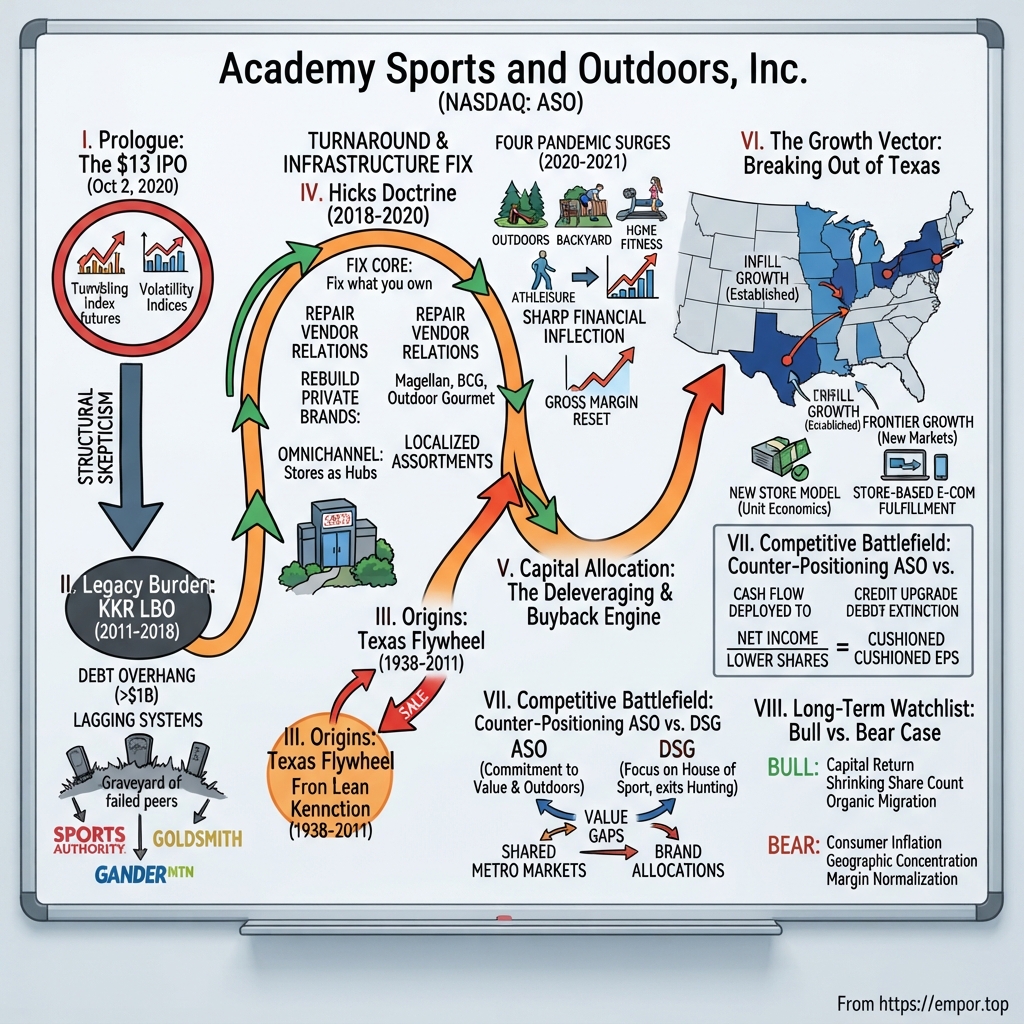
Academy Sports and Outdoors, Inc. (NASDAQ: ASO): The Fortress of Everyday Value
I. Prologue & The $13 Bargain-Basement IPO
On the morning of October 2, 2020, the American stock market opened to news that the sitting president of the United States had tested positive for COVID-19. Index futures tumbled, volatility indices surged, and portfolio managers who had spent six months learning to price a pandemic were suddenly forced to handicap an election-season constitutional contingency.
By almost any measure, it was the single worst morning of that autumn to take a company public.
Academy Sports + Outdoors went forward anyway. The sporting goods retailer based in Katy, Texas — operating 259 stores at the time, concentrated heavily across Texas and the Gulf Coast — priced its initial public offering at $13.00 per share, the absolute floor of an indicative range already lowered from an initial $15–$17 target.1 The deal raised roughly $180 million in gross proceeds for the company, a modest sum against the leveraged balance sheet it was intended to repair.1 Institutional investors who took allocations were not buying a high-flying growth narrative; they were buying a discount.
That discount reflected real structural skepticism. In the prevailing market consensus, Academy fit an unflattering profile: a burdened leveraged buyout. Kohlberg Kravis Roberts had acquired the retailer in 2011, funding the purchase with well over $1 billion in debt. As a result, Academy spent the following decade — an era defined by Amazon Prime, mall vacancies, and the retail apocalypse — directing cash toward interest payments rather than modernizing digital systems. Meanwhile, its legacy peers steadily failed. Sports Authority liquidated in 2016. Golfsmith filed for bankruptcy that same year. Gander Mountain followed in 2017. Across traditional sporting goods retail, the casualties shared a familiar diagnosis: excessive leverage, lagging e-commerce capabilities, and oversized store footprints.
What that consensus missed was that Academy had already begun overhauling operations.
By the time of the offering, the company was generating substantial free cash flow. Over the preceding two years, a new chief executive had dismantled legacy inventory systems, eliminated thousands of unproductive stock-keeping units, repaired vendor relationships strained under private equity ownership, and converted stores into regional fulfillment hubs. The business occupied a distinctive niche in American retail: neither an experiential outdoor destination like Bass Pro Shops nor an aspirational athletic showroom like Dick's Sporting Goods, but something closer to everyday regional infrastructure. For families across Beaumont, Shreveport, or Mobile, it served as a practical hub — supplying youth baseball cleats in February, fishing licenses in May, deer rifles in October, and turkey fryers in November. In those markets, Academy functioned less like a discretionary shopping destination and more like an everyday utility.
This is the story of how an army surplus shop founded in San Antonio in 1938 grew into a roughly $6 billion big-box operator; how private equity ownership brought it to the brink before an executive turnaround stabilized the business; how leaning into firearms and everyday value — categories its primary rival retreated from — proved to be a deliberate strategy rather than an accident; and how, since returning to public markets, the company has retired more than a quarter of its own equity base while generating modest top-line revenue growth.
It is also an investment story with a genuinely contested thesis. Both the bull and bear arguments draw on tangible operational evidence, and an objective assessment does not resolve that tension through cheerleading. It resolves it by identifying precisely what operating metrics will prove each side right.
 Subscribe on LinkedIn
II. Origins: The Gochman Dynasty & The Texas Flywheel (1938–2011)
Max Gochman opened Academy Tire Shop in San Antonio in 1938, selling tires in a regional economy still climbing out of the Great Depression. The pivotal transformation came a few years later, when the end of the Second World War flooded the American market with military surplus: canvas tents, ammunition cans, field jackets, mess kits, and boots. Gochman capitalized on the glut, renamed the business Academy Super Surplus, and built a modest retail chain on the premise that working Texans prioritized utility and low prices over retail polish.
The company's core identity was established there: Academy focused on selling goods people use rather than goods they display.
The transition to modern retail began with Arthur Gochman, who took over his father's six-store operation in 1973. His background was unconventional for a merchant. A practicing civil rights attorney in San Antonio, he had argued landmark cases challenging inequities in Texas public school financing — litigation that ultimately reached the U.S. Supreme Court. The legal work gave him a granular understanding of household economics across the state, and he built a retail chain aimed squarely at budget-conscious consumers.
Arthur's insight was to preserve the surplus store's discount pricing while modernizing the merchandise mix. Out went the military surplus remnants; in came sporting goods, camping gear, hunting supplies, and fishing tackle. The chain adopted an enduring value proposition — "Right Stuff. Low Price. Everyday." — and backed it up by systematically stripping out store overhead.
The aesthetics of not caring. Academy stores bypassed traditional retail amenities. They had no carpet, no elaborate visual merchandising, no mood lighting, and no designer fixtures. Instead, they relied on polished concrete floors, industrial steel racking, dense center-aisle pallet displays, and bare fluorescent lighting. Every dollar saved on store theater was preserved to keep prices low at the register or redirected into inventory depth. This was not thrift for its own sake; it was a coherent operating model. In a category where consumers can easily compare prices across retailers, the most sustainable way to win is to maintain the lowest cost structure — and the easiest cost to avoid is the one never built into the footprint.
Merchandising to a specific life. What elevated Academy beyond a generic discounter was Gochman's decision to tailor inventory to an observable regional lifestyle rather than a standardized national planogram. The product assortment mirrored the local calendar: youth baseball in the spring; high school football gear in late summer; saltwater tackle along the Gulf Coast and freshwater rigs for inland lakes; deer hunting supplies — blinds, feeders, rifles, and bulk corn — as autumn arrived; and heavy-duty smokers and grills for the region's serious barbecue culture. The assortment reflected how the target customer actually lived and spent discretionary time.
Density as a weapon. The third pillar was geographic clustering, an easily underestimated structural advantage. Rather than scattering locations across the country, Academy systematically saturated Texas: San Antonio, Houston, Austin, and the Dallas–Fort Worth metroplex, followed by secondary and border markets. Clustering generated compounding operating efficiencies. It made regional advertising cost-effective, because a single broadcast buy covered dozens of stores. It optimized freight logistics, allowing distribution centers to service dense clusters with short, efficient hauls. And it established deep unprompted brand ubiquity across its home territory. The hub-and-spoke distribution network anchored in Katy, west of Houston, served as the physical backbone of that regional saturation.
By 2011, the business had expanded to 133 stores across 11 states, generating more than $2.7 billion in annual sales. While substantial, it remained a regional, family-controlled enterprise. Following Arthur Gochman's death in 2010, the family confronted familiar generational questions regarding succession, estate concentration, and the capital intensity required for a broader geographic expansion. They decided to sell.
The buyer would take a structurally sound regional operator and immediately subject it to severe financial strain.
III. The KKR Leveraged Buyout & The Near-Death Spiral (2011–2018)
That buyer was Kohlberg Kravis Roberts. KKR announced its acquisition of a majority stake in Academy Sports + Outdoors in the summer of 2011, in a transaction widely reported at roughly $2.1 billion — a valuation representing a mid- to high-single-digit multiple of EBITDA financed largely with borrowed money.2 Term loans and high-yield notes were placed on the balance sheet, allowing the Gochman family to cash out and exit.
On paper, the private equity thesis appeared straightforward: back an established regional retailer with loyal customers and a proven store model, accelerate unit growth across untapped markets to the east, professionalize management, and exit within five to seven years at an expanded multiple.
What followed instead became a case study in how excessive financial leverage warps retail decision-making.
The growth pedal, the maintenance brake. Under private equity ownership, Academy prioritized opening 15 to 20 new stores a year — the visible growth metric that typically underwrites an exit valuation. What the company neglected to fund was its underlying infrastructure: merchandising software, inventory planning systems, supply chain automation, and digital commerce. In leveraged buyouts, debt service absorbs cash flow and forces strict capital rationing. In retail, the projects that get deferred are inevitably those whose returns are complex and hard to quantify in a board meeting. Opening a new store is easy to model; funding a multi-year overhaul of core inventory software is far harder to defend.
Flying blind on inventory. As a result, a multi-billion-dollar enterprise operated with virtually no real-time visibility into its inventory. Merchandise was pushed to stores via rigid, centralized allocations with little regard for regional variation. The operational mismatches were immediate: heavy winter coats sat on racks in South Texas during December, while stores in prime hunting country ran out of seasonal gear that could have sold many times over. Every misallocated item became idle inventory that ultimately required steep promotional markdowns, steadily draining gross margins.
The digital no-show. Through 2017, Academy's e-commerce presence remained little more than a digital catalog. Online sales accounted for only a low-single-digit share of total revenue, fulfillment costs were prohibitive, and shipping was slow — precisely as Amazon was setting two-day delivery as the standard expectation for American retail.
And then the industry caught fire. Between 2015 and 2017, widespread distress hit the sporting goods sector. As previously noted, legacy competitors including Sports Authority, Gander Mountain, and Golfsmith collapsed into bankruptcy and liquidation, alongside regional chains like City Sports and MC Sports. Retailers with leveraged balance sheets were squeezed simultaneously by Amazon's expansion into commodity sporting goods, price competition from Walmart, and an overbuilt retail footprint. Liquidation sales from failing chains flooded the market with discounted inventory, depressing merchandise margins across the industry.
Compounding the pressure was a severe category-specific downturn. Firearm and ammunition sales had surged during the 2015–2016 election cycle, driven by consumer expectations of impending federal gun restrictions. When those legislative changes failed to materialize after the election, consumer demand dropped sharply. The resulting slump left gun manufacturers with bloated inventories and retailers with overstocked shelves, sparking two years of aggressive channel-wide discounting. For Academy, where the outdoor division represented the largest share of sales, the decline was material.
The credit market lost its nerve. Debt climbed past six times EBITDA, and comparable store sales turned negative. In 2017, credit rating agencies downgraded Academy deep into speculative territory, citing deteriorating liquidity and the mounting risk of a distressed debt restructuring.3 By any realistic valuation, the equity value had eroded almost completely.
The central lesson here concerns capital allocation rather than retail viability. KKR is among the industry's most seasoned private equity firms, yet its investment in Academy came close to a total loss before an operational turnaround intervened. By contrast, Dick's Sporting Goods operated through the same decade with minimal debt, allowing it to invest in digital capabilities and store experience rather than manage liquidity. Academy's underlying business was not fundamentally flawed; rather, pairing high operating leverage with heavy debt left the company brittle the moment market conditions shifted.
By early 2018, KKR faced an ultimatum: pursue a debt restructuring, or recruit leadership capable of overhauling operations. It chose to rebuild.
IV. The Ken Hicks Doctrine: Rebuilding the Core from the Supply Chain Up (2018–2020)
In May 2018, Academy named Ken C. Hicks chairman and chief executive officer.[^4] The significance of the appointment lay in what Hicks had already accomplished.
A West Point graduate with a Harvard MBA, Hicks brought an executive reputation built on systems thinking, process discipline, and an unsentimental clarity about retail operations. He had held senior leadership roles at May Department Stores and served as president of J.C. Penney, but his defining track record came at Foot Locker. When Hicks took over Foot Locker in 2009, it was a mall-based chain burdened with aged inventory, declining comparable store sales, and a damaged relationship with its primary vendor, Nike. Over the ensuing five years, he overhauled the merchandise assortment, rationalized the store fleet, rebuilt the Nike partnership into a strategic alliance, and executed an operational turnaround that made Foot Locker one of the premier specialty retail performers of that cycle.
The parallel at Academy was unmistakable: an overextended, technologically lagging retailer with strained vendor relationships and an underdeveloped digital footprint. Hicks had engineered this exact recovery before.
He moved quickly to reshape executive leadership. Michael Mullican was appointed chief financial officer, and in early 2019, Hicks recruited Steven P. Lawrence as chief merchandising officer. Lawrence was a career merchant with leadership experience at Kohl's, J.C. Penney, and Francesca's — an executive focused on assortment curation, inventory flow, and gross margin architecture rather than rapid square-footage expansion.
The operational strategy that followed was pragmatic and infrastructure-focused.
One: fix what you own before you buy more. Hicks slowed store openings to near zero and redirected capital internally. Merchandisers eliminated thousands of slow-moving stock-keeping units and marked down aged inventory. While liquidating stagnant merchandise created a short-term drag on gross margins, it freed up floor space and working capital that had been trapped in unproductive goods. Academy also upgraded and expanded its supply chain infrastructure, adding distribution centers in Cookeville, Tennessee, and Twiggs County, Georgia, to supplement the central hub in Katy, Texas. The expanded network positioned inventory closer to eastern stores and shortened replenishment cycles.
Crucially, management introduced localized assortment planning. Rather than distributing uniform, Texas-derived merchandise allocations to every door, Academy began aligning store inventory with regional climates, local hunting and fishing seasons, and area demographics. The underlying demand data had always existed, but the retailer had previously lacked the planning systems required to execute store-level allocation.
Two: repair the vendor relationships. In retail turnarounds, vendor dynamics are often decisive. Premier athletic and outdoor brands like Nike, Under Armour, Adidas, Carhartt, and Shimano do not distribute top-tier product lines indiscriminately. They allocate inventory to retailers that protect brand equity, limit immediate clearance discounting, and maintain reliable merchandising standards. Hicks leveraged his credibility from Foot Locker to convince top suppliers that Academy could merchandise premium assortments rather than rely on off-price promotions. Reclaiming premium door allocations for high-demand footwear and apparel was gradual, relationship-driven work that did not appear as an immediate quarterly line item, but it steadily compounded over several seasons.
Three: rebuild the private brands. Academy had accumulated an unwieldy collection of disparate in-house labels. The new team consolidated these into a streamlined portfolio of distinct private brands: Magellan Outdoors for hunting, fishing, and outdoor recreation; BCG for athletic training and activewear; and Outdoor Gourmet for grills and outdoor cooking equipment. The primary objective was margin control. While selling national brands largely distributes third-party pricing power, established private brands allow a retailer to capture higher gross margins and manage sourcing costs directly.
Four: make the stores do the shipping. Rather than committing heavy capital to dedicated e-commerce distribution warehouses, Academy rebuilt its digital platform on modern cloud infrastructure and enabled its store fleet to fulfill online orders directly through in-store pickup, curbside service, and ship-from-store fulfillment. The model offered clear cost advantages: inventory and store labor were already in place, order picking absorbed store associates' downtime, and delivering merchandise from a local store located within tens of miles cost significantly less than shipping packages across several states from a centralized warehouse.
Now the falsification. A common narrative suggests Ken Hicks transformed Academy into an optimized retail operation entirely through operational discipline, and that the company's post-2020 financial surge was simply the planned result. The pre-pandemic financial disclosures tell a more nuanced story.
In fiscal 2019 — the year ended February 1, 2020, representing the final clean baseline prior to the pandemic — Academy generated net sales of roughly $4.83 billion, virtually flat compared to the $4.84 billion reported in fiscal 2017 before the turnaround began. Operating income reached approximately $179 million, yielding an operating margin of 3.7%.4 Net income stood at roughly $120 million against more than $100 million in annual interest expenses, reflecting a capital structure that continued to route a heavy share of operating profit directly to debt service.4
The objective takeaway is that operational discipline stabilized a distressed business rather than instantly transforming it into an elite performer. Two years of operational restructuring lifted operating margin by less than a percentage point on stagnant top-line revenue. That progress was critical — it separated a viable enterprise from an impending default — but it did not represent full-scale business transformation. Hicks established the necessary operational foundation: disciplined inventory, modern planning tools, restored vendor access, and functional omnichannel fulfillment. Whether that foundation alone would have driven breakout financial returns in an ordinary retail environment remains an open question, because ordinary operating conditions disappeared within weeks of fiscal 2019 drawing to a close.
V. The 2020 Windfall, The IPO, & The Great Debt Extinguishment (2020–2021)
In March 2020, as the United States initiated widespread pandemic lockdowns, American consumer demand reorganized in a matter of weeks around a single question: what can a household do outside, close to home, either individually or as a family?
Academy sold merchandise addressing almost every variation of that question.
Four distinct demand waves converged on the retailer simultaneously, each with markedly different long-term durability.
The outdoors surge. Firearm background checks ran at unprecedented levels throughout 2020, driven by a combination of pandemic anxiety, civil unrest, and election-year political uncertainty. The surge overwhelmed the ammunition supply chain, rendering common calibers effectively unobtainable across American retail for nearly two years. Concurrently, hunting, fishing, and camping participation rose as consumers sought socially distanced recreation.
Backyard recreation. With municipal gyms, public pools, playgrounds, and youth sports leagues closed, residential backyards became primary recreation venues. Trampolines, basketball hoops, above-ground pools, patio furniture, grills, and coolers sold out across the retail network.
Home fitness. Dumbbells and kettlebells briefly became among the scarcest consumer goods in the country, while nationwide bicycle inventories were exhausted for months.
Athleisure. The sudden shift toward remote work accelerated an ongoing casualization in American dress, redirecting apparel demand toward comfortable activewear and casual footwear — matching Academy's core apparel and footwear assortments.
Critically, Academy's physical stores remained open. Classified as essential retailers in most operating markets — a designation supported in part by firearm sales and in part by general merchandise offerings — the company continued selling while large segments of specialty retail remained shuttered. Meanwhile, the omnichannel capabilities Hicks and his team implemented in 2018 and 2019, which might otherwise have scaled gradually, immediately became the primary transaction channel for millions of customers. Curbside pickup, introduced as a modest convenience feature in February 2020, served as a primary sales conduit by April.
The financial inflection was sharp. Fiscal 2020 net sales expanded roughly 18% to approximately $5.69 billion, while operating income more than doubled to about $420 million.[^6] Performance accelerated further in fiscal 2021: net sales climbed an additional 19% to approximately $6.77 billion, generating operating income of about $908 million — an operating margin exceeding 13% for a business that had recorded an operating margin of 3.7% just two years earlier.5
This financial backdrop contextualized the October 2020 public offering. Academy priced its IPO at the absolute floor of its range because public market investors remained skeptical that peak operating performance would persist.1 The prevailing Wall Street consensus held that Academy was a temporary pandemic beneficiary whose demand had been borrowed from future periods, setting up difficult year-over-year comparisons and an eventual margin regression back toward historical 3% to 4% levels. That consensus proved partially prescient regarding sales normalization, but it fundamentally underestimated the structural durability of the company's margin baseline.
KKR's rapid exit. The private equity sponsor's subsequent transactions revealed how it assessed its holding. Rather than distributing its equity stake incrementally over multiple years, KKR executed a rapid series of secondary share offerings throughout 2021 — in January, May, and September — fully divesting its remaining equity position within eleven months of the IPO.[^8] In the final September 2021 offering, Academy repurchased approximately 4.5 million shares directly from KKR at roughly $44 per share, retiring the stock immediately.[^8]
Market observers offered two competing interpretations of this exit velocity. The constructive interpretation viewed the divestiture as disciplined fund management: KKR had held the investment for a decade, steered it through near-insolvency, and executed an orderly exit at attractive valuations once public liquidity became available. The skeptical interpretation highlighted the asymmetry: the sponsor with the deepest operational familiarity with the business monetized its entire holding near peak earnings, less than a year after pricing the IPO at $13 per share. Both perspectives are grounded in the transaction record. For public equity investors, the key insight was behavioral: the primary insider fully liquidated its stake at the top of the retail cycle, signaling clear skepticism regarding the sustainability of peak 2021 operating margins.
The deleveraging. The most significant long-term deployment of pandemic cash flow occurred on the liabilities side of the balance sheet rather than through equity repurchases. Management systematically directed excess liquidity toward extinguishing the expensive debt tranches that had constrained operations since 2011. Total debt declined substantially; annual interest expenses fell from over $100 million in fiscal 2019 to roughly $49 million in fiscal 2021, and ultimately dropped below $37 million by fiscal 2025.456 Net leverage reached conservative levels, neutralizing balance-sheet risk and lifting credit ratings out of speculative, distressed territory.
Beyond the cyclical windfall, the operational reality was clear: temporary, non-recurring demand was mobilized to eliminate permanent structural balance-sheet fragility. That capital allocation choice proved to be the most consequential corporate decision in Academy's modern operating history. When retail demand normalized and comparable-store sales contracted after 2022, the slowdown manifested as a manageable margin moderation rather than a solvency crisis. The leveraged capital structure of 2011 would have buckled under a mid-single-digit sales contraction; the restructured balance sheet of 2023 absorbed the downcycle without balance-sheet distress.
The central analytical question moving forward became straightforward: once the pandemic surge fully receded, what level of baseline earning power remained?
VI. Dissecting the Unit Economics: 4 Merchandise Segments & The Private Brand Engine
A walk through an Academy store on a Saturday morning in September reveals the operating strategy directly through the floor plan. Near the entrance stands a wall of licensed collegiate and NFL apparel, timed to the opening weeks of the football season. Along one perimeter runs an expansive fishing department, with rods racked vertically like books in a library, tackle arranged in bulk bins, and a dedicated service counter. At the rear, behind a secure counter governed by strict regulatory compliance procedures, sits the firearms and ammunition department. Along the opposite wall is footwear, spanning work boots, running shoes, and youth athletic cleats. And through the center concourse, stacked on industrial pallets, are grills, coolers, folding chairs, and bulk bags of deer corn.
Academy reports its business across four merchandise divisions, and each one plays a structurally distinct role in the retail model.8
Outdoors — roughly 30% of net sales — the traffic engine. Hunting, shooting sports, ammunition, fishing, camping, and marine gear make up the retailer's largest division. On a standalone basis, it is not the most profitable segment. Firearms carry thin gross margins and extensive regulatory requirements, including federal licensing, mandatory background check protocols, detailed record-keeping subject to Bureau of Alcohol, Tobacco, Firearms and Explosives audits, and substantial legal exposure if compliance slips. Ammunition is bulky, heavy, and working-capital intensive.
The category functions as an operational anchor through what economists term complementary baskets. A customer who visits in October to purchase shotgun shells often leaves with a hunting jacket, a pair of boots, an insulated cooler, polarized sunglasses, a headlamp, and a bag of deer corn — items that carry significantly higher gross margins than the ammunition itself. Outdoors is merchandised not for standalone profit margins, but because it generates habitual, seasonal store traffic in categories where national competitors like Dick's Sporting Goods have largely retreated.
Apparel — roughly 27% — the margin blend. In apparel, Academy balances brand credibility against profitability. The floor plan pairs national athletic and outdoor labels that validate the store — Nike, Under Armour, Adidas, Columbia, and Carhartt — with high-margin private brands. Soft goods typically generate gross margins eight to twelve percentage points higher than hard goods, meaning every percentage point shift in assortment mix toward apparel directly lifts corporate gross margins. This dynamic explains management's consistent operational push to expand apparel and footwear penetration: each revenue dollar generated in soft goods delivers structurally higher gross profit.
Sports & Recreation — roughly 23% — the suburban lifestyle hub. This division comprises two distinct businesses with divergent economic profiles. The first is youth team sports: baseball gloves, bats, cleats, football pads, soccer gear, and swim equipment. This represents the most reliably recurring demand in the building, insulated by school calendars, youth league schedules, and the biological reality that children regularly outgrow athletic gear. A twelve-year-old requires new cleats in the spring regardless of broader consumer sentiment. The second component is backyard recreation: outdoor cooking equipment from Traeger and Weber alongside Academy's proprietary Outdoor Gourmet brand, patio furniture, Yeti coolers, trampolines, and residential basketball systems. This half is discretionary, big-ticket, and highly cyclical — the specific product categories that contracted most sharply after pandemic-era demand peaked in 2021.
Footwear — roughly 20% — the credibility frontier. Spanning performance running brands such as Brooks, Hoka, and On; court and lifestyle staples from Nike and Jordan; and rugged work and hunting boots from Wolverine, Justin, and Magellan. Footwear is where the vendor relationship rebuilding initiated under Hicks yields its most visible returns, because premier athletic brands tightly restrict distribution of high-tier merchandise. Academy's pitch to brand partners has centered on an intentional barbell strategy: while the store's average selling price remains lower than that of Dick's, a meaningful cohort of its customer base readily pays $160 for a premium running shoe while purchasing value-priced trainers in adjacent aisles for other family members. Maintaining that shelf allocation remains an ongoing operational dependency, as brand partners retain unilateral control over product distribution.
The owned-brand engine. Underlying all four merchandise divisions is a private brand portfolio that management has expanded to the low-to-mid twenties as a percentage of net sales, alongside a stated goal to drive penetration higher.8 Magellan Outdoors serves as the flagship label — a substantial regional business in its own right across the American South for fishing apparel, waders, and camouflage, priced well below national alternatives such as Columbia or Sitka. BCG provides activewear at sharp discounts to Nike and Under Armour. Freely targets women's activewear and athleisure, while Redfield and H2OX cover hunting optics and fishing gear.
The financial incentive is straightforward: private brands deliver gross margins roughly eight to ten percentage points above comparable national brands because Academy captures the wholesale margin alongside the retail markup. The strategic value is equally significant as an operational hedge against supplier leverage. If a major athletic vendor restricts wholesale distribution or routes inventory toward direct-to-consumer channels, a retailer generating nearly a quarter of its revenue from proprietary brands retains defensive pricing and volume flexibility. This portfolio serves as the primary mechanism insulating Academy's gross margins from third-party distribution decisions.
And the fulfillment model. Digital commerce accounts for roughly a tenth of total net sales and grew 12.8% year over year in the second quarter of fiscal 2026, outpacing the broader business.7 More significantly for return on invested capital, the vast majority of digital orders are fulfilled directly from stores rather than centralized e-commerce warehouses. Store-based fulfillment prevents digital sales growth from demanding the heavy capital expenditure required by pure-play e-commerce logistics, converting the physical store footprint into distributed fulfillment centers located within short delivery radiuses of target consumers.
This structure yields a retail model with a disciplined cost profile and a differentiated regional assortment. Yet it also leaves Academy tied to an outdoor category driven by weather and hunting seasons, footwear allocations governed by external brand partners, and discretionary recreation lines that fluctuate with middle-income household budgets. That balance directly shapes how Academy defends its territory against both regional specialists and national giants.
VII. The Competitive Battlefield: Counter-Positioning Dick's Sporting Goods & Defending Value
On February 28, 2018, two weeks after the shooting at Marjory Stoneman Douglas High School in Parkland, Florida, Dick's Sporting Goods chairman and chief executive Ed Stack went on national television to announce that his company would immediately cease selling assault-style rifles, ban firearm sales to anyone under twenty-one, and stop carrying high-capacity magazines. Dick's subsequently destroyed its unsold tactical rifle inventory rather than returning it to manufacturers, and over the following two years removed hunting merchandise entirely from hundreds of stores, reallocating the square footage to other categories.
Regardless of the social debate surrounding the decision — Stack framed it as a matter of corporate conscience and acknowledged publicly that it would forfeit revenue — from a competitive standpoint, it represented a unilateral surrender of a substantial customer segment. Crucially, it occurred in the exact year Ken Hicks assumed leadership at Academy.
In strategic terms, this move created classic counter-positioning: adopting a business stance that an incumbent cannot easily copy without compromising something it values more. Dick's had spent a decade pivoting toward affluent suburban households, building upscale concept stores, and courting premium brand partners focused on pristine retail environments. Reversing course on firearms after taking a high-profile public stance would have imposed severe reputational costs.
Academy took the opposite approach. It remained committed to hunting and shooting sports, invested in rigorous compliance infrastructure rather than exiting the category, and continued serving rural and exurban consumers who felt alienated by its rival's departure. The traffic benefits compounded across departments: shoppers who visited for ammunition routinely picked up work boots, hunting apparel, coolers, and youth sports equipment.
Mapping the battlefield. Four distinct competitor groups define the landscape, each requiring a tailored operational response.
Dick's Sporting Goods remains the national market leader by a wide margin, operating at roughly double Academy's revenue scale and expanding aggressively into its experiential House of Sport format. The divergence between the two chains centers on target demographics and price architecture. Dick's serves higher-income suburban households with elevated store formats and premium assortments; Academy targets median-income working families with materially lower average selling prices across overlapping categories. The two chains compete directly across Southeastern metropolitan markets, where Dick's typically captures premium footwear and golf while Academy wins on basket value and outdoor breadth. That balance is not fixed: any concerted return by the market leader to hunting and outdoor categories would directly challenge Academy's counter-positioning advantage, making the competitive dynamic one to monitor closely.
Bass Pro Shops and Cabela's represent the destination anchor in outdoor retail, competing head-to-head with Academy's largest division. Yet the two formats serve entirely different consumer trips. A Bass Pro location is an experiential tourist destination — complete with massive aquariums, indoor waterfalls, and taxidermy displays — that a family might drive two hours to visit a few times a year. An Academy store functions as routine local infrastructure: a convenient stop visited a dozen times a year along an everyday commute. Destination retail and convenience retail address distinct shopping habits, allowing both models to coexist within the same metropolitan markets.
Walmart and Target establish the price floor on commodity sporting goods, consistently undercutting specialty retailers on basic soccer balls or entry-level camping tents. However, mass merchants lack technical assortment depth, specialized floor staff, and tier-one brand access. Premier athletic and outdoor brands strictly limit distribution through mass discounters to safeguard brand equity. Academy occupies the narrow, defensible ground between discount retail and luxury specialty: offering tier-one brand access at everyday-value pricing. That space remains defensible because neither competitor can easily bridge the divide — mass discounters cannot secure premium allocations, and upscale specialty retailers cannot match Academy's low-overhead cost structure.
Hibbett and Dunham's Sports serve as small-market and strip-center specialists. The acquisition of Hibbett by JD Sports in 2024 for roughly $1.1 billion consolidated a significant share of small-town athletic footwear retail under a well-capitalized global parent. That transaction raised competitive intensity in the secondary and tertiary markets where Academy is expanding its footprint.
Why Amazon has not eaten this category. Two structural barriers — both physical rather than strategic — insulate the business from pure-play digital disruption. First, federal regulations require firearms to be transferred and background-checked through a federally licensed dealer, establishing an unavoidable brick-and-mortar requirement. Second, freight economics penalize parcel shipping for bulky, heavy merchandise with low value density. Barbell plates, gun safes, kayaks, fifty-pound bags of deer corn, patio furniture, and above-ground pools incur parcel freight costs that scale with weight and volume, frequently exceeding the merchandise's gross profit margin. In these hard-goods categories, physical store distribution is not an outdated legacy expense; it represents the most cost-effective fulfillment model available. While this creates a durable defensive moat, that protection is category-specific. Apparel and footwear — representing nearly half of total sales — enjoy no such freight barrier and remain fully exposed to digital competition.
The competitive verdict: Academy occupies a distinct and hard-to-replicate market position, but it remains an operational position rather than an impregnable fortress. It depends on maintaining a disciplined price gap, preserving third-party brand allocations, and benefiting from a major competitor's self-imposed product restrictions. Maintaining that edge requires continuous execution — which leads directly to how management deployed its capital and generated cash returns.
VIII. Capital Allocation: Organic Compounding vs. The Buyback Engine
One comparison captures Academy's post-IPO trajectory more effectively than any corporate presentation. In fiscal 2021, the company earned about $671 million of net income on roughly 94 million diluted shares. By fiscal 2025, it generated about $377 million on roughly 68 million diluted shares.56 Net income fell 44%, yet the diluted share count dropped 28%. Consequently, earnings per share contracted from $7.12 to $5.54 — a meaningful decline, but significantly cushioned relative to the underlying drop in total profit.
That dynamic encapsulates management's capital allocation thesis: using free cash flow to shrink the share count denominator while the operating numerator absorbs post-pandemic normalization.
What it has deliberately avoided. Academy has pursued no large-scale acquisitions since returning to public markets. In an industry reshaped by Bass Pro acquiring Cabela's and JD Sports buying Hibbett, that restraint reflects an intentional choice. Management's rationale is straightforward: acquired chains inherit non-standard store formats, legacy lease liabilities, real estate selected for alternative strategies, and obsolete technology stacks requiring costly integration. Academy's store model relies on standardized layouts and predictable build costs; paying a control premium to absorb a competitor's legacy footprint rarely rivals the return profile of building new locations.
The analytical caveat is that this discipline has yet to be tested by a deeply discounted, distressed asset during an economic downturn. Maintaining an organic expansion strategy is comparatively straightforward when a company's own shares trade at depressed multiples and its store pipeline remains well populated. The restraint is consistent with empirical discipline, but it remains an untested posture against cyclical temptation.
The store model. New Academy stores operate as standardized leased boxes spanning roughly 60,000 to 80,000 square feet, requiring between $4 million and $4.5 million of net capital investment after tenant allowances from landlords. Management targets mature annual sales in the mid-teens of millions per store within two to three years, with store-level margins designed to deliver cash payback within approximately three years. Annual capital expenditure has generally run in the range of a couple hundred million dollars, funded entirely out of operating cash flow that comfortably exceeds reinvestment needs.
Those target unit economics are compelling on paper — a three-year cash payback implies an incremental return on invested capital well above the company's cost of capital. Whether those economics replicate seamlessly outside the retailer's core Southern footprint remains the central operational question of its expansion strategy, and evaluating that geography forms the crux of the growth thesis.
The share count reduction. Weighted average diluted shares fell from roughly 94 million in fiscal 2021 to about 68 million in fiscal 2025 — retiring more than a quarter of the company's equity base in four years.56 In December 2024, the board authorized a new $700 million, three-year repurchase program, extending execution under earlier authorizations.[^11] That pace accelerated into the following fiscal year: share repurchases in the first half of fiscal 2026 reached roughly $182 million, up more than 80% over the prior-year period.7
The arithmetic underpinning this program is powerful when examined closely. When a company's stock trades at eight times earnings, each dollar of profit dedicated to repurchases eliminates eight dollars of market capitalization — generating an effective 12.5% earnings yield for ongoing shareholders before accounting for operational growth. At that multiple, retiring 5% to 8% of the share base annually produces 5% to 8% annual growth in earnings per share even if net income remains entirely flat. Academy has executed against that formula consistently, buying back shares at valuations that have lingered in the high single digits of price-to-earnings for much of the post-IPO period.
Two critical counterarguments temper that dynamic. First, low-multiple share repurchases are value-accretive only if the valuation multiple is mispricing durable earnings power; if the market is correctly anticipating long-term structural decline, capital deployment simply accelerates cash conversion into a melting asset. Second, buybacks reflect opportunity cost. A retailer convinced it can generate 30% incremental returns on greenfield locations should theoretically allocate every available dollar to store openings. Management has balanced both priorities, fully funding its store development pipeline while returning residual free cash flow through repurchases. Disclosed capital deployment confirms that cash has targeted new store openings and share retirements rather than speculative diversification or corporate acquisitions.
The dividend remains secondary by design — a quarterly distribution of $0.15 per share scheduled for October 2026, following a 15% increase announced alongside fiscal 2025 results, representing roughly $35 million in annual cash commitments.67 That represents a small fraction of capital deployed toward repurchases, and the asymmetry is deliberate: dividends establish an ongoing corporate obligation, whereas share repurchase programs can be dialed up or paused as market valuations and operating conditions warrant. Keeping the baseline payout modest preserves financial flexibility.
The resulting posture is a business supported by a conservative balance sheet, high stated returns on incremental retail investments, and a shrinking share base that bolsters per-share earnings. What remains absent is top-line organic growth — and unlocking that growth requires expanding beyond its historic Texas heartland.
IX. The Growth Vector: Breaking Out of the Texas Fortress
There is a scenario for Academy's future that requires almost nothing to go right: keep existing store productivity roughly flat, generate around $400 million in annual free cash flow, steadily retire shares, and allow per-share value to compound quietly over time.
Management chose a far more aggressive path. In April 2023, Academy hosted an investor day in New York and laid out an ambitious multi-year target: reaching $10 billion in net sales by fiscal 2027, supported by an aggressive unit rollout that would expand the base from 268 stores toward 800 potential locations nationwide over the long term.[^12] Internal real estate models identified that expansion potential by screening for the demographic profile of an Academy shopper — young families, suburban and exurban density, and high outdoor recreation participation — and found extensive opportunities beyond the South.
More than three years later, evaluating that expansion reveals a mixed and instructive picture.
The store program is real. Academy has expanded its store base at a steady clip, opening 24 new locations in fiscal 2025 alone to bring the fleet to 322 doors at year-end and 327 by the second quarter of fiscal 2026, with an additional 20 to 25 planned for the full year.67 The footprint has pushed beyond the Gulf Coast into the Midwest and Mid-Atlantic. The geographic concentration that historically defined the retailer — Texas once represented roughly half of all locations and sales — has been gradually diluted.
The expansion runs along two distinct operational vectors. Infill growth deepens penetration in markets Academy already serves — Atlanta, Orlando, Nashville, Charlotte, and Houston — where supply chain networks are established, regional advertising is already funded, and brand recognition is high. These stores carry lower operational risk, though they risk cannibalizing some existing volume. Frontier growth, by contrast, pushes into contiguous new states where none of those regional advantages exist.
The revenue target did not survive contact with the consumer. The disconfirming evidence on top-line growth is substantial. The goal of reaching $10 billion by fiscal 2027 was established in the spring of 2023 with an underlying assumption of positive comparable store sales. What followed instead was three consecutive years of contraction. Fiscal 2024 comparable store sales fell 5.1%, and while fiscal 2025 showed relative improvement, comps remained down 1.5%.6 Net sales, which stood at roughly $6.4 billion in fiscal 2022, slipped to about $6.05 billion in fiscal 2025 — meaning top-line revenue contracted over a three-year stretch even as the company opened dozens of new stores.6 Fiscal 2026 guidance projects net sales between $6.23 billion and $6.36 billion.7 That trajectory leaves the business well short of its $10 billion milestone.
Management acknowledged the shortfall rather than quietly revising the benchmark, attributing the gap primarily to sustained pressure on lower- and middle-income households from cumulative inflation in essential goods, elevated borrowing costs, and the drawdown of pandemic-era savings. That explanation aligns with reports across value-oriented retail over the same period, lending credibility to the macro diagnosis. It is less convincing as an explanation for why leadership established such an aggressive target in 2023, well after inflation and tightening credit had already reshaped consumer behavior.
Now the harder test: do frontier stores work as well as Texas stores? The central operational premise underpinning the expansion is that Academy can open more than twenty stores a year in unfamiliar geographies while achieving unit economics comparable to its historical Texas returns. In practice, three sources of friction have emerged in the operational record.
Brand awareness. In Texas, Academy is institutional furniture — consumer awareness is nearly universal. In Indiana, Ohio, or West Virginia, a new store enters a market with little baseline recognition. Building that familiarity requires local advertising dollars that an infill store in Houston does not require, slowing the initial sales ramp and compressing store-level margins during the opening years.
Construction cost. Elevated real estate development and build-out expenses between 2022 and 2025 pushed gross capital investment per store above historical averages, mechanically extending the cash payback period even if unit sales productivity holds.
Entrenched defenders. The Midwest features a crowded retail landscape. Regional competitors including Dunham's Sports, Rural King, Scheels, independent gun dealers, and Dick's Sporting Goods hold established local incumbency. Incumbents typically defend market share with targeted discounting and price-matching promotions, depressing a newcomer's gross margins during its critical volume-building phase.
The verdict on this claim: unproven, with early operational traction. The most useful recent data point is management's disclosure that newer stores generated positive comparable sales in the mid-single-digit range in the second quarter of fiscal 2026, even as total company comparable sales contracted slightly.7 That divergence mirrors the trajectory an expanding store program is designed to deliver: younger vintages ramping toward maturity while the older base stabilizes. It provides tangible evidence of progress, though it represents only a single quarter of operating data.
What will confirm or falsify the thesis decisively is the second- and third-year productivity of non-Southern store vintages — specifically, whether a store opened in Ohio in 2024 achieves the mature sales volume by 2027 that a comparable unit in Louisiana delivers. Academy does not disclose cohort economics at regional granularity, leaving investors dependent on aggregate management commentary. The structural test, however, is straightforward: if an expansion program is generating returns above its cost of capital, net sales should compound faster than square footage over time. Through mid-2026, that compounding has yet to materialize.
X. Management Under the Microscope: Steve Lawrence, Governance, & Credibility
Executive succession is where retail turnarounds frequently unravel. A departing leader exits after capturing the immediate operational gains, leaving a successor to steer the business through maturing comps and tougher year-over-year comparisons.
Academy managed that leadership handoff with deliberate continuity. In April 2023, the company announced that Ken Hicks would transition from chief executive to executive chairman, with Steve Lawrence — the merchant Hicks had recruited in 2019 and elevated through the chief merchandising role — becoming chief executive officer effective that June.[^13] Hicks subsequently stepped back to non-executive chairman of the board in 2024. The rest of the leadership bench moved up internally as well: Carl Ford, who had served in senior finance roles at the company since 2019, was elevated to chief financial officer, while retail veteran Sam Johnson assumed the role of president.
Promoting a merchant rather than an operator or a finance specialist signaled what the board believed the next phase required. With core operational systems and distribution logistics stabilized, the strategic focus shifted toward assortment curation, pricing architecture, and brand equity.
The credibility test. Assessing an executive team ultimately requires comparing corporate commitments against operational delivery. For Academy, the ambitious targets set at its April 2023 investor day alongside three subsequent years of financial results provide a clean baseline for evaluation.
While top-line sales fell well short of the $10 billion target, management's margin performance proved more instructive. The 2023 framework projected sustained double-digit operating margins in the 12% to 13% range. In practice, operating margin ran roughly 11% in fiscal 2023, about 9.1% in fiscal 2024, and settled at roughly 8.5% in fiscal 2025.6 The trajectory moved downward, settling below long-range corporate projections.
Yet the composition of that margin compression reveals key managerial discipline. Despite three years of contracting comparable store sales, Academy avoided chasing short-term volume through aggressive discounting. Gross margin, rather than collapsing under competitive pressure, actually improved — rising from 33.9% in fiscal 2024 to 34.8% in fiscal 2025.6 The margin compression stemmed not from merchandise markdowns, but from selling, general, and administrative deleverage — the arithmetic reality that fixed occupancy, store wages, and corporate overhead get spread over fewer sales dollars when comps decline.
During quarterly earnings calls throughout this cycle, Lawrence maintained that Academy would protect its everyday value proposition without engaging in margin-diluting promotional battles simply to manufacture positive comps. Wall Street analysts pressed repeatedly on whether operating margins would inevitably drift back toward pre-pandemic 3% to 4% levels. Management held its ground, and disclosed operating results through fiscal 2025 validated that stance: gross margins remained above 34%, indicating that the pricing architecture and private-brand penetration established during the turnaround proved resilient even in a soft discretionary spending environment.
What a skeptic would still press on. Three areas warrant ongoing scrutiny.
First, disclosure granularity. Management characterized new-store performance in qualitative terms — citing positive mid-single-digit comps for younger vintages — without publishing vintage-level cohort data. While standard across specialty retail, this lack of disclosure means the primary operational validation of the geographic expansion thesis cannot be independently verified from public filings.
Second, long-range forecasting discipline. Formulating a $10 billion sales target in 2023 and subsequently extending the timeline is not a governance failure, but it underscores the risk of weighting multi-year corporate targets too heavily. Near-term annual guidance has offered a more reliable operational gauge, including upward revisions during fiscal 2026.
Third, executive compensation design. Incentive packages weighted toward adjusted EBITDA, comparable store sales, and return on invested capital provide reasonable operational alignment. The ROIC linkage is particularly meaningful, establishing a direct penalty if new-store development fails to earn its cost of capital. However, relying on adjusted metrics introduces analytical friction: fiscal 2026 adjusted diluted earnings per share guidance of $6.50 to $6.90 sits roughly forty-five cents above the GAAP range of $6.05 to $6.45, a gap worth understanding rather than ignoring.7
On balance, the leadership team has demonstrated operational discipline across controllable variables — defending gross margin, rationalizing inventory, and funding store growth from internal cash flow — while overestimating broader consumer resilience. For investors, that distinction matters: evaluating Academy requires setting aside long-range corporate ambition and anchoring the thesis on verifiable operational evidence.
XI. Strategic Analysis: 7 Powers, Porter's 5 Forces, & The Falsification Dossier
Strip the narrative away and ask the structural question: what, precisely, prevents a competitor from taking Academy's profits?
Running Hamilton Helmer's seven powers honestly.
Counter-positioning is the company's strongest advantage. Academy's commitment to firearms and hunting, paired with everyday value pricing, represents a posture its primary competitor cannot readily match without compromising an upscale identity built over fifteen years at substantial capital expense. This is an authentic strategic power, tempered by the standard caveat that counter-positioning erodes if peer strategies shift.
Scale economies remain moderate and regional rather than national. Academy's distribution network and freight density across Southern transit lanes provide genuine cost advantages inside its core geographic cluster. Against a national rival operating at twice its revenue scale, however, the retailer enjoys no absolute scale advantage — only local density, which is a narrower and more vulnerable moat.
Process power is moderate. Localized micro-merchandising and store-fulfilled omnichannel capabilities require complex operational coordination that took years to construct. Yet they remain replicable over time by well-capitalized competitors willing to fund similar logistics overhauls. Process power decays unless an operator continually widens its execution lead.
Cornered resource is weak. Academy holds no proprietary patents, exclusive supply agreements, or irreplaceable natural assets. Its most critical inputs — top-tier product allocations from Nike, Brooks, and other national brands, alongside well-sited commercial leases — remain revocable privileges granted by external third parties.
Brand is powerful but geographically bounded. Across Texas and the Gulf Coast, Academy commands entrenched goodwill established across more than eight decades of operating history. In Ohio or Indiana, by contrast, it arrives as an unfamiliar storefront. The geographic expansion essentially attempts to manufacture, at meaningful marketing expense, brand equity that the business inherited organically in its home territory.
Switching costs are practically non-existent. Nothing prevents a retail shopper from buying at Dick's or a local specialty shop tomorrow.
Network effects do not exist in this business model.
That framework yields an unvarnished diagnosis: Academy maintains one strong structural power, two moderate capabilities, and a regionally concentrated brand moat. It is a viable competitive position, but it is not an insurmountable franchise in the manner of a payment rail or an exchange. Preserving it requires unrelenting day-to-day execution.
Porter's five forces reinforces that conclusion. Supplier power is moderate-to-high, because premier athletic brands control product allocation and increasingly market directly to consumers through proprietary e-commerce and retail stores — an ongoing structural pressure across specialty retail. Buyer power is high; modern consumers carry instant price-comparison engines on their smartphones. Substitutes are everywhere: direct-to-consumer brand channels, mass discounters, and pure-play e-commerce platforms. New entrants face steep structural barriers, given that building an 80,000-square-foot store network with ATF-compliant firearms protocols and tier-one vendor relationships demands capital and patience that few rational investors would deploy into a mature retail category. Rivalry has consolidated favorably: the industry liquidations between 2015 and 2017 eliminated excess store capacity, establishing healthier baseline pricing discipline among the survivors.
In aggregate, sporting goods remains a structurally average retail sector in which Academy occupies an above-average operational position. Superior returns stem from meticulous merchandise execution and disciplined capital allocation rather than favorable industry economics.
The falsification dossier. Three core claims define the investment thesis, tested directly against the disclosed operating record.
Claim 1: The operating margin expansion from 3.7% in fiscal 2019 to current levels is structural and permanent.
Counter-evidence: Operating income peaked at roughly $908 million on a 13.4% operating margin in fiscal 2021 before contracting across every subsequent fiscal year — dropping to roughly $678 million, then $539 million, and settling at approximately $512 million in fiscal 2025, an operating margin of about 8.5%.56 Nearly five percentage points of operating margin eroded over four years. The underlying mechanism was selling, general, and administrative deleverage against negative comparable store sales, demonstrating that a substantial portion of peak profitability was an artifact of cyclical volume rather than a permanent structural reset.
Verdict: narrowed, not rejected. The operational floor sits permanently higher than its pre-turnaround baseline. Gross margin reached 34.8% in fiscal 2025 compared to 29.6% in fiscal 2019, reflecting durable improvements in private brand penetration, modern supply chain systems, tighter inventory controls, and lower merchandise shrink.46 Crucially, that gross margin expansion held firm across three consecutive years of negative comparable sales — the most rigorous stress test a retail model can endure. What the evidence disproves is the claim of permanent 12% to 13% operating margins. Instead, historical results support through-cycle operating margin power in the 8% to 10% range, with the upper half contingent on positive top-line comparable store sales. Confirming KPI: whether operating margins expand when comparable store sales inflect positive, a dynamic that upward revisions to fiscal 2026 guidance begin to test.
Claim 2: Firearms and outdoors is a secular growth engine.
Counter-evidence: The category's long-term sales patterns refute this claim. The election-driven surge of 2015 and 2016 reversed into an acute channel downturn across 2017 and 2018. Similarly, the pandemic buying wave of 2020 and 2021 subsided into an extended inventory hangover throughout 2022 and 2023. Demand spikes in shooting sports are frequently catalyzed by political anxiety and episodic buying rushes, neither of which compounds on a predictable multi-year curve.
Verdict: rejected as a growth engine; reclassified as a cyclical traffic moat. The genuine strategic value of the outdoor division lies in its capacity to draw an engaged, loyal demographic into the building across seasonal cycles, unlocking high-margin complementary basket purchases. Its function is not compounding top-line growth. Investors should treat earnings generated during political cycles or supply crunches as non-recurring windfalls to be capitalized at low valuation multiples, rather than as an elevated structural earnings baseline. This distinction mirrors the market's initial miscalculation in 2021, when public market pricing discounted the durability of the cash flows entirely.
Claim 3: The store rollout can go national without diluting returns.
Counter-evidence: The historical base rate for regional sporting goods operators attempting national expansion is fraught with missteps. The downfalls of Sports Authority and Gander Mountain demonstrated that national scale in hard-goods retail introduces distribution friction while diluting the local brand density that protected initial regional profitability. In frontier markets, Academy has incurred higher promotional costs to build baseline consumer awareness while absorbing elevated construction expenses.
Verdict: intact but unproven. Tangible supporting evidence exists: newer store vintages generated positive comparable sales in the mid-single-digit range during the second quarter of fiscal 2026, even as the mature store base contracted slightly.7 Yet that data reflects early, aggregate management commentary across a single quarter rather than detailed cohort reporting by geography. Falsifying event: a full fiscal year in which net sales fail to grow alongside mid-single-digit square-footage expansion across the fleet would indicate that new units are cannibalizing existing doors or failing to ramp toward target maturity. The financial results of fiscal 2024 and fiscal 2025 exhibited elements of that divergence, which is why the geographic rollout remains an unproven operational thesis rather than an established competitive victory.
XII. Bull vs. Bear Case & The Long-Term Investor Watchlist
The central tension in the investment debate surrounding Academy is that both sides construct their arguments from the exact same operating facts.
The bull case rests on a mechanical capital-allocation formula rather than an open-ended growth narrative. It starts with a retailer generating several hundred million dollars in annual free cash flow while trading at a persistent high-single-digit price-to-earnings multiple. Management has consistently deployed that cash to retire 5% to 8% of the outstanding share count annually at that low valuation. Complementing the buyback is a new-store development program that management contends achieves cash payback within approximately three years. Meanwhile, secular population migration into the Sunbelt steadily expands the customer base residing inside existing store trade areas. On top of that geographic tailwind sits the enduring counter-positioning dividend from a primary national competitor that abandoned hunting and shooting sports, alongside an expanding private-brand portfolio that widens gross margins with each incremental point of sales penetration.
Under those operating dynamics, top-line revenue barely needs to grow for per-share intrinsic value to compound at an attractive rate. This is fundamentally a capital-return framework augmented by modest unit expansion rather than a speculative growth thesis. Disclosed results for fiscal 2026 provided early validation for that compounding mechanism: second-quarter net sales rose 3.0%, operating income climbed nearly 43% to $246.4 million, diluted earnings per share grew 17.3% to $2.17, e-commerce sales expanded 12.8%, and leadership raised full-year earnings guidance.7 After three consecutive years of top-line and profit contraction, the business demonstrated that its earnings base could expand.
The bear case begins by scrutinizing the composition of that performance. Comparable store sales remained slightly negative at -0.4%, demonstrating that quarterly revenue expansion was driven entirely by newly opened square footage rather than heightened transaction volume across the existing store base.7 Furthermore, gross margin expansion — reaching 40.4% compared to 36.0% in the prior-year period — was aided by non-recurring tariff-related benefits; full-year gross margin guidance of 35.5% to 36.0% sits well below the quarterly print, confirming that the second quarter benefited from transient items that will not repeat.7 From a skeptical perspective, the performance reflected solid operational execution and favorable timing rather than a verified macro recovery.
Beyond quarterly volatility, the bear case rests on four structural vulnerabilities. First, the core customer base of lower- and middle-income households has endured years of cumulative inflation across essential living expenses like rent, food, and auto insurance, directly constraining discretionary budgets for big-ticket recreation gear and premium athletic footwear. Second, geographic concentration remains pronounced, leaving operating results exposed to Gulf Coast hurricane disruptions, regional economic downturns, or localized weakness in the Texas energy sector. Third, merchandise margins could face renewed pressure if competitor promotions intensify in a sluggish retail climate. Finally, the geographic expansion risks delivering substandard returns in unfamiliar markets, turning the company's primary reinvestment runway into a drag on capital efficiency.
The activist lens. If a concentrated, skeptical investor were to challenge corporate strategy, the pressure point would not be share repurchases, which are already extensive, nor the balance sheet, which remains largely de-risked. The critical question centers on the store rollout: if greenfield units outside the South are not demonstrably earning their cost of capital, the most value-accretive deployment of cash would be to halt store development entirely and channel all available capital into repurchasing undervalued equity. This represents the central capital allocation debate facing the business: leadership continues funding physical growth in a retail category with limited secular expansion, while its own stock trades at a valuation that makes share retirements mathematically compelling. Resolving that debate requires regional cohort-level productivity data that management does not disclose.
The risks that matter. Beyond generic retail disclosures, four specific operational variables dictate the downside: supply chain and tariff exposure, given that a meaningful portion of inventory is imported and trade policy remains unpredictable; vendor distribution changes, where athletic footwear and apparel partners redirecting allocations toward direct-to-consumer channels would immediately pressure high-tier shelf assortments; regulatory shifts surrounding firearms and ammunition, which represent an ongoing tail risk for the largest merchandise division; and severe weather, which across the Gulf Coast operates as an ongoing operating variable rather than an exceptional event.
The three KPIs that matter. The entire investment thesis ultimately reduces to three observable operating metrics.
Comparable store sales. This metric provides the cleanest gauge of baseline demand, isolating the organic productivity of existing stores from newly added real estate. Academy needs comparable store sales to sustain positive low-single-digit growth to prove that its core fleet remains healthy and that operating margins can expand through operating leverage rather than cost discipline alone. Following three consecutive years of negative comps, a slightly negative second quarter in fiscal 2026 alongside a positive first half points to a business approaching an inflection point rather than one fully through it.
Merchandise gross margin and private brand penetration. Gross margin reflects the durability of the operational overhaul, while private brand penetration serves as the primary defense against vendor leverage and input cost inflation. The key test is whether gross margin holds above the mid-thirties once temporary tariff benefits wash out, and whether owned-brand share continues climbing toward management's 25%-plus long-term target.
New store productivity. This metric will confirm or falsify the geographic expansion thesis. Investors must watch whether younger store cohorts maintain positive comparable sales growth and whether company-wide net sales expand faster than total square footage — the aggregate benchmark that reveals whether new locations are generating genuine enterprise growth or simply diluting historical returns.
Tracking these three indicators over the coming fiscal years will determine whether Academy operates as a durable cash compounder or as a regional discounter approaching the limits of its geographic moat.
XIII. Epilogue & Playbook Lessons
Lesson one: counter-positioning is most valuable when it costs a competitor something to copy. Academy's advantage in hunting and value pricing is not that those merchandise categories are inherently difficult to manage; any discounter can price ammunition aggressively. The structural advantage is that Dick's Sporting Goods made a public, principled commitment that makes reversing course costly in reputation rather than capital alone. Competitive strategy is often less about discovering what a company can do than identifying what its rival cannot easily undo.
Lesson two: financial leverage and operating leverage do not mix in retail. KKR's buyout paired a sound underlying retail business with a debt burden that turned a standard industry downturn into an acute liquidity crisis. The eventual recovery was not financial engineering. It was Ken Hicks rationalizing inventory, modernizing distribution, localizing merchandise assortments, and repairing vendor partnerships. The unglamorous reality of retail turnarounds is that they are won in the supply chain and planning systems — and a merchant cannot fund an inventory overhaul while directing roughly one hundred million dollars a year toward interest payments.
Lesson three: in a low-growth category, the denominator is a strategy. Between fiscal 2021 and fiscal 2025, Academy's net income declined 44%, yet diluted earnings per share fell far less because the share count contracted 28%. That resilience is not financial sleight of hand; it is the mathematical consequence of generating steady free cash flow while the equity trades at a modest multiple, allowing management to prioritize per-share arithmetic over nominal revenue growth. Yet the strategy carries an essential condition: the valuation multiple must genuinely understate long-term earning power. Repurchasing shares at eight times earnings compounds value if the operating core is stable, but merely accelerates cash burn into a declining asset if structural deterioration takes hold. That arithmetic is precisely why comparable store sales remain the decisive metric for the investment thesis.
A closing thought. There is an easy temptation to frame this trajectory as a retail hero's journey — the scrappy Texas operator that survived private equity debt and an industry shakeout to emerge as a disciplined cash compounder. Elements of that narrative hold true: Academy survived conditions that liquidated legacy peers, carved out a distinct competitive position, and allocated capital with far greater discipline than most of its sector.
Yet the operational record reveals a story shaped heavily by contingency. The turnaround attributed to managerial discipline was still generating a 3.7% operating margin on flat sales when the pandemic arrived. The margin expansion that appeared structural in 2021 shed roughly half its gains by fiscal 2025. The $10 billion sales target formulated in 2023 will not be reached on schedule. And the geographic expansion justifying ongoing capital expenditure remains, on the public record, unproven outside the Southern footprint where the brand has enjoyed decades of organic brand awareness.
What Academy has earned is the right to be evaluated on its operating delivery rather than on its survival history — an everyday retail network of concrete floors, fishing tackle, and value pricing, no longer defending against insolvency, but now required to prove that its model can compound beyond its home fortress.
References
-
Form S-1 Registration Statement: Academy Sports and Outdoors, Inc. — U.S. Securities and Exchange Commission, 2020-09-09 ↩↩↩
-
SEC EDGAR Company Filings: Academy Sports and Outdoors, Inc. (CIK 0001817358) — U.S. Securities and Exchange Commission ↩
-
Academy Sports and Outdoors, Inc. Company Profile and Financials — Reuters ↩
-
Annual Report on Form 10-K for Fiscal Year Ended February 1, 2020 (fiscal 2019 results) — Academy Sports and Outdoors, Inc., via SEC EDGAR ↩↩↩↩
-
Annual Report on Form 10-K for Fiscal Year Ended January 29, 2022 (fiscal 2021 results) — Academy Sports and Outdoors, Inc., via SEC EDGAR ↩↩↩↩↩
-
Academy Sports + Outdoors Reports Fourth Quarter and Full Year Fiscal 2025 Results (Form 8-K Exhibit 99.1) — U.S. Securities and Exchange Commission, 2026-03-17 ↩↩↩↩↩↩↩↩↩↩↩
-
Academy Sports + Outdoors Reports Second Quarter Fiscal 2026 Results — GlobeNewswire, 2026-09-09 ↩↩↩↩↩↩↩↩↩↩↩
-
Annual Report on Form 10-K for Fiscal Year Ended February 1, 2025 — Academy Sports and Outdoors, Inc., 2025-03-20 ↩↩
 LinkedIn
 WhatsApp
 Reddit
 Hacker News
 Email
Email Kindle
 RSS Feed
 Spotify
 Apple Podcasts
 Amazon Music
 Audible
 YouTube